
All Topics  
Hangul


   Email Print
   Bookmark   Link


Hangul


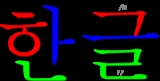
Hangul (or Korean , in Korean
Korean language

Korean is the official language of North Korea and South Korea. It is also one of the two official languages in the Yanbian Korean Autonomous Prefecture in People's Republic of China....
: ?? Hangeul/Han'gul (in South Korea) or ??? Choson'gul/Joseongeul (in North Korea)) is the native alphabet
Alphabet

An alphabet is a standardized set of letter basic written symbols each of which roughly represents a phoneme, a spoken language, either as it exists now or as it was in the past....
 of the Korean language
Korean language

Korean is the official language of North Korea and South Korea. It is also one of the two official languages in the Yanbian Korean Autonomous Prefecture in People's Republic of China....
, as distinguished from the logographic
Logogram

A logogram, or logograph, is a grapheme which represents a word or a morpheme . This stands in contrast to phonogram , which represent phonemes or combinations of phonemes, and determinatives, which mark semantics....
 Sino-Korean hanja
Hanja

Hanja is the Korean language name for Chinese characters. More specifically, it refers to those Chinese characters borrowed from Chinese language and incorporated into the Korean language with Korean pronunciation....
 system. It was created in the mid-fifteenth century, and is now the official script
Writing system

A writing system is a type of symbolic system used to represent elements or statements expressible in language....
 of both North Korea
North Korea

North Korea, officially the Democratic People's Republic of Korea , is a state in East Asia, occupying the northern half of the Korean Peninsula....
 and South Korea
South Korea

South Korea, officially the Republic of Korea , ), often referred to as Korea and the "names of Korea#Revival of the names", is a Semi-presidential system republic in East Asia, located in the southern half of the Korean Peninsula....
, being co-official in the Yanbian Korean Autonomous Prefecture
Yanbian Korean Autonomous Prefecture

Yanbian Korean Autonomous Prefecture is an autonomous prefecture in Jilin province, in the northeastern part of People's Republic of China. Yanbian is south of Heilongjiang, east of Jilin's Baishan City, north of North Korea's North Hamgyong Province, and west of Russia....
 of China
China

China is a Culture of China, an ancient civilization, and, depending on perspective, a national or multinational entity extending over a large area in East Asia....
.

Hangul is a phonemic
Phonemic orthography

A phonemic orthography is a writing system where the written graphemes correspond to phonemes, the spoken sounds of the language. These are sometimes termed true alphabets, but non-alphabetic writing systems like syllabary can be phonemic as well....
 alphabet organized into syllabic
Syllable

A syllable is a unit of organization for a sequence of Speech communication sounds. For example, the word water is composed of two syllables: wa and ter....
 blocks.


Discussion
Ask a question about 'Hangul'
Start a new discussion about 'Hangul'
Answer questions from other users
Full Discussion Forum


Encyclopedia


Hangul (or Korean , in Korean
Korean language

Korean is the official language of North Korea and South Korea. It is also one of the two official languages in the Yanbian Korean Autonomous Prefecture in People's Republic of China....
: ?? Hangeul/Han'gul (in South Korea) or ??? Choson'gul/Joseongeul (in North Korea)) is the native alphabet
Alphabet

An alphabet is a standardized set of letter basic written symbols each of which roughly represents a phoneme, a spoken language, either as it exists now or as it was in the past....
 of the Korean language
Korean language

Korean is the official language of North Korea and South Korea. It is also one of the two official languages in the Yanbian Korean Autonomous Prefecture in People's Republic of China....
, as distinguished from the logographic
Logogram

A logogram, or logograph, is a grapheme which represents a word or a morpheme . This stands in contrast to phonogram , which represent phonemes or combinations of phonemes, and determinatives, which mark semantics....
 Sino-Korean hanja
Hanja

Hanja is the Korean language name for Chinese characters. More specifically, it refers to those Chinese characters borrowed from Chinese language and incorporated into the Korean language with Korean pronunciation....
 system. It was created in the mid-fifteenth century, and is now the official script
Writing system

A writing system is a type of symbolic system used to represent elements or statements expressible in language....
 of both North Korea
North Korea

North Korea, officially the Democratic People's Republic of Korea , is a state in East Asia, occupying the northern half of the Korean Peninsula....
 and South Korea
South Korea

South Korea, officially the Republic of Korea , ), often referred to as Korea and the "names of Korea#Revival of the names", is a Semi-presidential system republic in East Asia, located in the southern half of the Korean Peninsula....
, being co-official in the Yanbian Korean Autonomous Prefecture
Yanbian Korean Autonomous Prefecture

Yanbian Korean Autonomous Prefecture is an autonomous prefecture in Jilin province, in the northeastern part of People's Republic of China. Yanbian is south of Heilongjiang, east of Jilin's Baishan City, north of North Korea's North Hamgyong Province, and west of Russia....
 of China
China

China is a Culture of China, an ancient civilization, and, depending on perspective, a national or multinational entity extending over a large area in East Asia....
.

Hangul is a phonemic
Phonemic orthography

A phonemic orthography is a writing system where the written graphemes correspond to phonemes, the spoken sounds of the language. These are sometimes termed true alphabets, but non-alphabetic writing systems like syllabary can be phonemic as well....
 alphabet organized into syllabic
Syllable

A syllable is a unit of organization for a sequence of Speech communication sounds. For example, the word water is composed of two syllables: wa and ter....
 blocks. Each block consists of at least two of the 24 Hangul letters (jamo), with at least one each of the 14 consonant
Consonant

In articulatory phonetics, a consonant is a speech sound that is articulated with complete or partial closure of the upper vocal tract, the upper vocal tract being defined as that part of the vocal tract that lies above the larynx....
s and 10 vowel
Vowel

In phonetics, a vowel is a sound in spoken language, such as English ah! or oh! , pronounced with an open vocal tract so that there is no build-up of air pressure at any point above the glottis....
s. These syllabic blocks can be written horizontally from left to right as well as vertically from top to bottom in columns from right to left. Originally, the alphabet had several additional letters (see obsolete jamo). For a phonological description of the letters, see Korean phonology
Korean language

Korean is the official language of North Korea and South Korea. It is also one of the two official languages in the Yanbian Korean Autonomous Prefecture in People's Republic of China....
.

Names


Official names


  • The modern name Hangul was coined by Ju Sigyeong
    Ju Sigyeong

    Ju Si-gyeong was one of the founders of modern Korean linguistics. He was born in Bongsan County , Hwanghae Province. He and his students helped standardize the Korean language, based spelling and grammar of the vernacular....
     in 1912. Han meant "great" in archaic Korean, while geul is the native Korean word for "script". Han could also be understood as the Sino-Korean word ? "Korean", so that the name can be read "Korean script" as well as "great script". is pronounced and would be romanized in one of the following ways:
    • Hangeul or han-geul in the Revised Romanization of Korean
      Revised Romanization of Korean

      The Revised Romanization of Korean is the official Korean language romanization system in South Korea, used as a replacement for the 1984 McCune-Reischauer?based romanization system....
      , which the South Korea
      South Korea

      South Korea, officially the Republic of Korea , ), often referred to as Korea and the "names of Korea#Revival of the names", is a Semi-presidential system republic in East Asia, located in the southern half of the Korean Peninsula....
      n government uses in all English publications and encourages for all purposes.
    • Han'gul in the McCune-Reischauer
      McCune-Reischauer

      McCune-Reischauer romanization is one of the two most widely used Korean language romanization systems, along with the Revised Romanization of Korean, which replaced McCune-Reischauer as the official romanization system in South Korea in 2000....
       system. When used as an English word, it is often rendered without the diacritic
      Diacritic

      A diacritic is a small sign added to a letter to alter pronunciation or to distinguish between similar words. The term derives from the Greek language d?a???t???? ....
      s: hangul, often capitalized as Hangul. This is how it appears in many English dictionaries.
    • Hankul in Yale Romanization
      Yale Romanization

      The Yale romanizations are four systems created during World War II for use by United States US armed forces. They romanized the four East Asian languages of Mandarin Chinese, Yue Chinese, Korean language, and Japanese language....
      , a system recommended for technical linguistic studies.
  • North Korea
    North Korea

    North Korea, officially the Democratic People's Republic of Korea , is a state in East Asia, occupying the northern half of the Korean Peninsula....
    ns prefer to call it Choson'gul , for reasons related to the different names of Korea
    Names of Korea

    There are various names of Korea in use today, derived from ancient kingdoms and dynasties. The modern English name Korea is an exonym derived from the Goryeo period and is used by both North Korea and South Korea in international contexts....
    .
  • The original name was Hunminjeongeum (????; ????; see history). Due to objections to the names Hangeul, Choson'gul, and urigeul (see below) by the Korean minority in Manchuria
    Manchuria

    Manchuria is a historical name given to a vast geographic region in northeast Asia. Depending on the definition of its extent, Manchuria either falls entirely within People's Republic of China, or is divided between China and Russia....
    , the otherwise uncommon short form jeongeum may be used as a neutral name in some international contexts.


Other names

Until the early twentieth century, Hangul was denigrated as vulgar by the literate elite who preferred the traditional hanja writing system. They gave it such names as:
  • Eonmun (Hangul: ??, hanja: "vernacular script")
  • Amgeul (?? "women's script"; also written Amkeul ??). Am is a prefix that signifies a noun is feminine
  • Ahaetgeul or Ahaegeul (??? or ??? "children's script")
  • Achimgeul (??? "writing you can learn within a morning")
  • Gungmun (Hangul: ??, hanja: "national script")


However, these names are now archaic, as the use of hanja in writing has become very rare in South Korea and completely phased out in North Korea.

History

Sejong
Hunmin Jeong Eum
Hangul was promulgated by the fourth king of the Joseon Dynasty
Joseon Dynasty

Joseon , was a sovereign state founded by Taejo Taejo of Joseon, and lasted for approximately five centuries. It was founded in the aftermath of the overthrow of the Goryeo Kingdom at what is today the city of Kaesong....
, Sejong the Great. The Hall of Worthies
Hall of Worthies

The Hall of Worthies or Jiphyeonjeon was set up by King Sejong the Great of Joseon of the Joseon Dynasty in Korea in 1420. It consisted of scholars selected by the king....
 (Jiphyeonjeon, ???) is often credited for the work.

The project was completed in late December 1443 or January 1444, and described in 1446 in a document titled Hunmin Jeongeum
Hunmin Jeongeum

Promulgated in September or October 1446, Hunminjeongeum was an entirely new and native writing system for the Korean people. The script was initially named after the publication, but later came to be known as hangul....
 ("The Proper Sounds for the Education of the People"), after which the alphabet itself was named. The publication date of the Hunmin Jeong-eum, October 9, became Hangul Day
Hangul Day

Hangul Day — also called Hangul Proclamation Day or Korean Alphabet Day — is a Korean national commemorative day marking the invention and the proclamation of hangul , the native alphabet of the Korean language, by King Sejong the Great....
 in South Korea
South Korea

South Korea, officially the Republic of Korea , ), often referred to as Korea and the "names of Korea#Revival of the names", is a Semi-presidential system republic in East Asia, located in the southern half of the Korean Peninsula....
. Its North Korea
North Korea

North Korea, officially the Democratic People's Republic of Korea , is a state in East Asia, occupying the northern half of the Korean Peninsula....
n equivalent is on January 15.

Various speculations about the creation process were put to rest by the discovery in 1940 of the 1446 Hunmin Jeong-eum Haerye
Hunmin Jeongeum Haerye

Hunminjeongeum Haerye , also called the Haerye Edition of Hunminjeongeum or simply The Haerye, is a commentary on the Hunminjeongeum, the original promulgation of hangul....
 ("Hunmin Jeong-eum Explanation and Examples"). This document explains the design of the consonant letters according to articulatory phonetics
Articulatory phonetics

The field of articulatory phonetics is a subfield of phonetics. In studying articulation, phoneticians attempt to document how humans produce speech sounds via the interaction of different physiological structures....
 and the vowel letters according to the principles of yin and yang
Yin and yang

In Chinese philosophy, the concept of yin yang is used to describe how seemingly disjunct or opposing forces are interconnected and interdependent in the natural world, giving rise to each other in turn....
 and vowel harmony
Vowel harmony

Vowel harmony is a type of long-distance Assimilation Phonology process involving vowels in some languages. In languages with vowel harmony, there are constraints on what vowels may be found near each other....
.

In explaining the need for the new script, King Sejong explained that the Korean language was different from Chinese; using Chinese characters (known as hanja
Hanja

Hanja is the Korean language name for Chinese characters. More specifically, it refers to those Chinese characters borrowed from Chinese language and incorporated into the Korean language with Korean pronunciation....
) to write was so difficult for the common people that only privileged aristocrats (yangban
Yangban

The Yangban were part of the traditional ruling class of dynastical Korea during the Joseon dynasty. Yangban were landed or unlanded gentry who comprised the Confucianism idea of a "scholarly official", and thus were part of the agrarian bureaucracy within Korea prior to 1910 during the Joseon Dynasty....
),
usually male, could read and write fluently. The majority of Koreans were effectively illiterate before the invention of Hangul.

Hangul was designed so that even a commoner could learn to read and write; the Haerye says "A wise man can acquaint himself with them before the morning is over; a stupid man can learn them in the space of ten days."

Hangul faced opposition by the literate elite, such as Choe Manri
Choe Manri

Choe Manri was a deputy minister for education in the Privy Council who spoke against the creation of hangul together with other Korean Confucianism scholars in 1444....
 and other Confucian scholars in the 1440s, who believed hanja to be the only legitimate writing system, and perhaps saw it as a threat to their status. However, it entered popular culture as Sejong had intended, being used especially by women and writers of popular fiction. It was effective enough at disseminating information among the uneducated that Yeonsangun
Yeonsangun of Joseon

Yeonsan-gun , born Yi Yung, was the 10th king of Korea's Joseon Dynasty. He was the eldest son of Seongjong of Joseon by his second wife, Lady Yun....
, the paranoid tenth king, forbade the study or use of Hangul and banned Hangul documents in 1504, and King Jungjong
Jungjong of Joseon

Jungjong of Joseon , born Yi Yeok, ruled during the 16th century in what is now Korea. He succeeded his half-brother, Yeonsangun of Joseon, because of the latter's misrule, which culminated in a coup placing Jungjong on the throne....
 abolished the Ministry of Eonmun (??? ???, governmental institution related to Hangul research) in 1506.

The late 16th century, however, saw a revival of Hangul, with gasa
Gasa

* Gasa District, Bhutan and the district capital town of Gasa, Bhutan* Gasa Medina, Misamis Oriental, Philippines* Gasa Lakewood, Zamboanga del Sur, Philippines...
 literature and later sijo
Sijo

Sijo is a purely Korean poetry poetic form. Bucolic, metaphysics and cosmological themes are often explored. The three lines average 14-16 syllables, for a total of 44-46: theme ; elaboration ; counter-theme and completion [Ibid., Rutt, pp....
 flourishing. In the 17th century, Hangul novels became a major genre. By this point spelling had become quite irregular.

Due to growing Korean nationalism
Korean nationalism

Korean Nationalism is a term referring to the Koreans version of nationalism....
 in the 19th century, Japan's attempt to sever Korea from China's sphere of influence
Sphere of influence

A sphere of influence is an area or region over which an organization or state exercises cultural, economic, military or political domination....
, and the Gabo Reform
Gabo Reform

The Gabo Reform describes a series of sweeping reforms introduced in Korea beginning in 1894 and ending in 1896, during the reign of Emperor Gojong of Korea, in response to the Donghak Rebellion....
ists' push, Hangul was eventually adopted in official documents for the first time in 1894. Elementary school texts began using Hangul in 1895, and the Dongnip Sinmun, established in 1896, was the first newspaper printed in both Hangul and English.

After Korea was annexed by Japan
Korea under Japanese rule

Korea was under Japanese rule as part of the Imperial Japan during the first half of the 20th century, until the surrender of Japan in 1945. Korea was occupied and declared a Japanese protectorate in 1905 , and officially annexation in 1910 through an Japan-Korea Annexation Treaty....
 in 1910, Japanese became the official language and main educational language, but Hangul was also taught in the Japanese-established schools of colonial Korea, and Korean was written in a mixed Hanja-Hangul script, where most lexical roots were written in hanja and grammatical forms in Hangul. The orthography was partially standardized in 1912, with arae a restricted to Sino-Korean, the emphatic consonants written ? sg, ? sd, ? sb, ? ss, ? sj, and final consonants restricted to ? g, ? n, ? l, ? m, ? b, ? s, ? ng, ? lg, ? lm, ? lb (no ? d, as it was replaced by s). Long vowels were marked by a diacritic dot to the left of the syllable, but this was dropped in 1921.

A second colonial reform occurred in 1930. Arae a was abolished; the emphatic consonants were changed to ? gg, ? dd, ? bb, ? ss, ? jj; more final consonants (???????????) were allowed, making the orthography more morphophonemic; ? ss was written alone (without a vowel) when it occurred between nouns; and the nominative particle ? ga was introduced after vowels, replacing ? i. (? i had been written without an ? iung. The nominative particle had been unvarying i in Sejong's day, and perhaps up to the eighteenth or nineteenth century.)

Ju Sigyeong
Ju Sigyeong

Ju Si-gyeong was one of the founders of modern Korean linguistics. He was born in Bongsan County , Hwanghae Province. He and his students helped standardize the Korean language, based spelling and grammar of the vernacular....
, who had coined the term Hangul "great script" to replace eonmun "vulgar script" in 1912, established the Hangul Society which further reformed orthography with Standardized System of Hangul (?? ??? ???) in 1933. The principal change was to make Hangul as morphophonemic as practical given the existing letters. A system for transliterating foreign orthographies was published in 1940.

However, the Korean language was banned from schools in 1938 as part of a policy of cultural assimilation
Cultural assimilation

Cultural assimilation is when an individual or individuals adopts some or all aspects of a dominant culture . Cultural assimilation is a process of socialization....
, and all Korean-language publications were outlawed in 1941.

The definitive modern orthography was published in 1946, just after independence from Japan. In 1948 North Korea attempted to make the script perfectly morphophonemic through the addition of new letters, and in 1953 Syngman Rhee
Syngman Rhee

Syngman Rhee or Yi Seungman was the first president of South Korea of South Korea. His presidency, from August 1948 to April 1960, remains controversial, affected by Cold War tensions on the Korean peninsula and elsewhere....
 in South Korea attempted to simplify the orthography by returning to the colonial orthography of 1921, but both reforms were abandoned after only a few years.

Since independence from Japan, the Koreas have used Hangul or mixed Hangul as their sole official writing system, with ever-decreasing use of hanja. Since the 1950s, it has become uncommon to find hanja in commercial or unofficial writing in the South, with some South Korean newspaper only using hanja as abbreviations or disambiguation of homonyms. There has been widespread debate as to the future of hanja in South Korea. North Korea instated Hangul as its exclusive writing system in 1949, and banned the use of hanja completely.

Jamo


Jamo (??; ??
Hanja

Hanja is the Korean language name for Chinese characters. More specifically, it refers to those Chinese characters borrowed from Chinese language and incorporated into the Korean language with Korean pronunciation....
) or natsori are the units that make up the Hangul alphabet. Ja means letter or character, and mo means mother, so the name suggests that the jamo are the building-blocks of the script.

There are 51 jamo, of which 24 are equivalent to letters of the Latin alphabet
Latin alphabet

The Latin alphabet, also called the Roman alphabet, is the most widely used alphabetic writing system in the world today. It evolved from the western variety of the Greek alphabet called the Cumae alphabet, and was initially developed by the Ancient Romes to write the Latin....
. The other 27 jamo are clusters of two or sometimes three of these letters. Of the 24 simple jamo, fourteen are consonant
Consonant

In articulatory phonetics, a consonant is a speech sound that is articulated with complete or partial closure of the upper vocal tract, the upper vocal tract being defined as that part of the vocal tract that lies above the larynx....
s (ja-eum ??, ?? "child sounds") and ten are vowel
Vowel

In phonetics, a vowel is a sound in spoken language, such as English ah! or oh! , pronounced with an open vocal tract so that there is no build-up of air pressure at any point above the glottis....
s (mo-eum ??, ?? "mother sounds"). Five of the simple consonant letters are doubled to form the five "tense" (faucalized
Faucalized voice

Faucalized voice, also called hollow or yawny voice, is the production of speech sounds with an expanded larynx. It contrasts with harsh voice, in which the larynx is compressed....
) consonants (see below), while another eleven clusters are formed of two different consonant letters. The ten vowel jamo can be combined to form eleven diphthong
Diphthong

In phonetics, a diphthong, or , is a contour vowel?that is, a unitary vowel that changes vowel quality during its pronunciation, or "glides", with a glissando of the tongue from one articulation to another, as in the English words eye, boy, and cow. This contrasts with "pure" vowels, or monophthongs, where the tongue is held s...
s. Here is a summary:
  • 14 simple consonant
    Consonant

    In articulatory phonetics, a consonant is a speech sound that is articulated with complete or partial closure of the upper vocal tract, the upper vocal tract being defined as that part of the vocal tract that lies above the larynx....
     letters: ?, ?, ?, ?, ?, ?, ?, ?, ?, ?, ?, ?, ?, ?, plus obsolete ?, ?, ?, ?, ?, ? (alveolar), ? (velar
    Velar consonant

    Velars are consonants articulated with the back part of the tongue against the soft palate, the back part of the roof of the mouth, known also as the Soft palate)....
    ), ?, ?, ?, ?, ?, ?
  • 5 double letters (glottalized): ?, ?, ?, ?, ?, plus obsolete ?, ?, ?, ?, ?, ?, ?, ?, ?, ?
  • 11 consonant cluster
    Consonant cluster

    In linguistics, a consonant cluster is a group of consonants which have no intervening vowel. In English, for example, the groups and are consonant clusters in the word splits....
    s: ?, ?, ?, ?, ?, ?, ?, ?, ?, ?, ?, plus obsolete ?, ?, ?, ?, ?, ?, ?, ?, ?, ?, ?, ?, ?, ?, ?, ?, ?, ?, ?, ?, ?, ?, ?, ?, ?, ?, ?, ?, ?, ?, ?, ?, ?, ?, ?, ?, ?, ?, ?, ?, ?, ?, ?, ?, ?, ?, ?, ?, ?, ?, ?, ?, ?, ?, ?, ?, ?, ?, ?, ?, ?, ?, ?, ?, ?, ?, and obsolete triple clusters ?, ?, ?, ?, ?, ?, ?, ?, ?, ?, ?, ?, ?, ?, ?, ?, ?


  • 6 simple vowel
    Vowel

    In phonetics, a vowel is a sound in spoken language, such as English ah! or oh! , pronounced with an open vocal tract so that there is no build-up of air pressure at any point above the glottis....
     letters: ?, ?, ?, ?, ?, ?, plus obsolete ?
  • 4 simple iotized
    Iotation

    Iotation is a form of palatalization which occurs in Slavic languages. In most of them, iotated consonants are called soft consonants and the process of iotation is called softening....
     vowel letters (semi consonant-semi vowel): ?, ?, ?, ?, plus obsolete ?, ?, ?
  • 11 diphthong
    Diphthong

    In phonetics, a diphthong, or , is a contour vowel?that is, a unitary vowel that changes vowel quality during its pronunciation, or "glides", with a glissando of the tongue from one articulation to another, as in the English words eye, boy, and cow. This contrasts with "pure" vowels, or monophthongs, where the tongue is held s...
    s: ?, ?, ?, ?, ?, ?, ?, ?, ?, ?, ?, plus obsolete ?, ?, ?, ?, ?, ?, ?, ?, ?, ?, ?, ?, ?, ?, ?, ?, ?, ?, ?, ?, ?, ?, ?, ?, ?, ?, ?, ?, ?, ?, ?, ?, ?, ?, ?, ?, ?, ?, ?, ?, ?


Four of the simple vowel jamo are derived by means of a short stroke to signify iotation (a preceding i sound): ? ya, ? yeo, ? yo, and ? yu. These four are counted as part of the 24 simple jamo because the iotating stroke taken out of context does not represent y. In fact, there is no separate jamo for y.

Of the simple consonants, ? chieut, ? kieuk, ? tieut, and ? pieup are aspirated
Aspiration (phonetics)

In phonetics, aspiration is the strong burst of Earth's atmosphere that accompanies either the release or, in the case of preaspiration, the closure of some obstruents....
 derivatives of ? jieut, ? giyeok, ? digeut, and ? bieup, respectively, formed by combining the unaspirated letters with an extra stroke.

The doubled letters are ? ssang-giyeok (kk: ssang- ? "double"), ? ssang-digeut (tt), ? ssang-bieup (pp), ? ssang-siot (ss), and ? ssang-jieut (jj). Double jamo do not represent geminate consonants, but rather a "tense" phonation
Phonation

Phonation has slightly different meanings depending on the subfield of phonetics. Among some phoneticians, phonation is the process by which the vocal folds produce certain sounds through quasi-periodic vibration....
.

Stroke order

All hangul letters follow the rules of Chinese calligraphy. ? and ? use a circle, which is not used in printed Chinese characters, but is found in cursive styles.

Image:? (giyeok) stroke order.png | ? (giyeok) Image:? stroke order.png | ? (nieun) Image:? (digeut) stroke order.png | ? (digeut) Image:? (rieul) stroke order.png | ? (rieul) Image:? (mieum) stroke order.png | ? (mieum) Image:? (bieup) stroke order.png | ? (bieup) Image:? (siot) stroke order.png | ? (siot) Image:? (ieung) stroke order.png | ? (ieung) Image:? (jieut) stroke order.png | ? (jieut) Image:? (chieut) stroke order.png | ? (chieut) Image:? (kieuk) stroke order.png | ? (kieuk) Image:? (tieut) stroke order.png | ? (tieut) Image:? (pieup) stroke order.png | ? (pieup) Image:? (hieut) stroke order.png | ? (hieut) Image:? (a) stroke order.png | ? (a) Image:? (ae) stroke order.png | ? (ae) Image:? (eo) stroke order.png | ? (eo) Image:? (e) stroke order.png | ? (e) Image:? (o) stroke order.png | ? (o) Image:? (u) stroke order.png | ? (u) Image:? (eu) stroke order.png | ? (eu)

For the iotized vowels, which are not shown, the short stroke is simply doubled.

Jamo design

Numerous linguists have praised Hangul for its featural design, describing it as "remarkable," "the most perfect phonetic system devised," and "brilliant, so deliberately does it fit the language like a glove." The principal reason Hangul has attracted this praise is its partially featural
Featural alphabet

A featural alphabet is an alphabet wherein the shapes of the letters are not arbitrary, but encode distinctive features of the phonemes they represent....
 design: The shapes of the graphs are related to the phonemes they represent. The shapes of consonant letters are based on the shape of the mouth and tongue in the production of that sound, sometimes with extra marks showing features such as aspiration
Aspiration (phonetics)

In phonetics, aspiration is the strong burst of Earth's atmosphere that accompanies either the release or, in the case of preaspiration, the closure of some obstruents....
. In addition, vowels are built from vertical or horizontal lines so that they are easily distinguishable from consonants.

Scripts may transcribe languages at the level of morpheme
Morpheme

In morpheme-based morphology, a is the smallest linguistic unit that has semantics Meaning .In spoken language, morphemes are composed of phonemes , and in written language morphemes are composed of graphemes ....
s (logographic scripts
Logogram

A logogram, or logograph, is a grapheme which represents a word or a morpheme . This stands in contrast to phonogram , which represent phonemes or combinations of phonemes, and determinatives, which mark semantics....
 like hanja
Hanja

Hanja is the Korean language name for Chinese characters. More specifically, it refers to those Chinese characters borrowed from Chinese language and incorporated into the Korean language with Korean pronunciation....
),
of syllable
Syllable

A syllable is a unit of organization for a sequence of Speech communication sounds. For example, the word water is composed of two syllables: wa and ter....
s (syllabic scripts like kana
Kana

Kana are the Syllabary Japanese language scripts, as opposed to the Logogram Chinese characters known in Japan as kanji and the Roman alphabet known as romaji....
),
or of segment
Segment (linguistics)

In linguistics , the term segment may be defined as "any discrete unit that can be identified, either physically or auditorily, in the stream of speech."...
s (alphabet
Alphabet

An alphabet is a standardized set of letter basic written symbols each of which roughly represents a phoneme, a spoken language, either as it exists now or as it was in the past....
ic scripts like the Roman alphabet used to write English and many other languages.). Hangul goes one step further in some cases, using distinct strokes to indicate distinctive feature
Distinctive feature

In linguistics, a distinctive feature is the most basic unit of phonology structure that may be analyzed in phonological theory.Distinctive features are grouped into categories according to the natural classes of segment they describe: major class features, laryngeal features, manner features, and place features....
s such as place of articulation
Place of articulation

In articulatory phonetics, the place of articulation of a consonant is the point of contact, where an obstruction occurs in the vocal tract between an active articulator and a passive articulator ....
 (labial
Labial consonant

Labials are consonants articulated either with both lips or with the lower lip and the upper teeth . English is a bilabial nasal consonant sonorant, and are bilabial stop consonant , and are labiodental fricative consonant....
, coronal
Coronal consonant

Coronal consonants are articulated with the flexible front part of the tongue. Only the coronal consonants can be divided into apical consonant , laminal consonant , domed consonant , or sub-apical consonant , as well as a few rarer orientations, because only the front of the tongue has such dexterity....
, velar
Velar consonant

Velars are consonants articulated with the back part of the tongue against the soft palate, the back part of the roof of the mouth, known also as the Soft palate)....
, or glottal
Glottal consonant

Glottal consonants are consonants articulated with the glottis. Many phoneticians consider them, or at least the so-called fricatives, to be transitional states of the glottis without a point of articulation as other consonants have; in fact, some do not consider them to be consonants at all....
) and manner of articulation
Manner of articulation

In linguistics , manner of articulation describes how the tongue, lips, jaw, and other speech organs are involved in making a sound make contact....
 (plosive, nasal
Nasal consonant

A nasal consonant is produced with a lowered soft palate in the mouth, allowing air to escape freely through the nose. The oral cavity still acts as a resonance chamber for the sound, but the air does not escape through the mouth as it is blocked by the tongue....
, sibilant
Sibilant consonant

A sibilant is a type of fricative or affricate consonant, made by directing a jet of air through a narrow channel in the vocal tract towards the sharp edge of the teeth....
, aspiration
Aspiration (phonetics)

In phonetics, aspiration is the strong burst of Earth's atmosphere that accompanies either the release or, in the case of preaspiration, the closure of some obstruents....
) for consonants, and iotation (a preceding i- sound), harmonic class
Vowel harmony

Vowel harmony is a type of long-distance Assimilation Phonology process involving vowels in some languages. In languages with vowel harmony, there are constraints on what vowels may be found near each other....
, and I-mutation
I-mutation

I-mutation is an important type of sound change, more precisely a category of regressive metaphony, in which a back vowel is fronted , and/or a front vowel is Raising , if the following syllable contains /i/, /i/ or /j/ ....
 for vowels.

For instance, the consonant jamo ? t is composed of three strokes, each one meaningful: the top stroke indicates ? is a plosive, like ? ’, ? g, ? d, ? j, which have the same stroke (the last is an affricate
Affricate consonant

Affricate consonants begin as stop consonants but release as a fricative consonant rather than directly into the following vowel....
, a plosive-fricative sequence); the middle stroke indicates that ? is aspirated, like ? h, ? k, ? ch, which also have this stroke; and the curved bottom stroke indicates that ? is coronal, like ? n, ? d, and ? l. (The ? element is said to represent the shape of the tongue when pronouncing coronal consonants.) Two consonants, ? and ?, have dual pronunciations, and appear to be composed of two elements corresponding to these two pronunciations: /silence for ? and / for obsolete ?.

With vowel jamo, a short stroke connected to the main line of the letter indicates that this is one of the vowels which can be iotated; this stroke is then doubled when the vowel is iotated. The position of the stroke indicates which harmonic class the vowel belongs to, "light"
Yin and yang

In Chinese philosophy, the concept of yin yang is used to describe how seemingly disjunct or opposing forces are interconnected and interdependent in the natural world, giving rise to each other in turn....
 (top or right) or "dark"
Yin and yang

In Chinese philosophy, the concept of yin yang is used to describe how seemingly disjunct or opposing forces are interconnected and interdependent in the natural world, giving rise to each other in turn....
 (bottom or left). In modern jamo, an additional vertical stroke indicates i-mutation
I-mutation

I-mutation is an important type of sound change, more precisely a category of regressive metaphony, in which a back vowel is fronted , and/or a front vowel is Raising , if the following syllable contains /i/, /i/ or /j/ ....
, deriving ? , ? , ? , and ? from ? , ? , ? , and ? . However, this is not part of the intentional design of the script, but rather a natural development from what were originally diphthong
Diphthong

In phonetics, a diphthong, or , is a contour vowel?that is, a unitary vowel that changes vowel quality during its pronunciation, or "glides", with a glissando of the tongue from one articulation to another, as in the English words eye, boy, and cow. This contrasts with "pure" vowels, or monophthongs, where the tongue is held s...
s ending in the vowel ? . Indeed, in many Korean dialects, including the standard dialect of Seoul
Seoul dialect

The Seoul dialect is the basis of the standard language of Korean language in South Korea. It is spoken in the Seoul National Capital Area, which includes Seoul, Incheon, and Gyeonggi....
, some of these may still be diphthongs.

Although the design of the script may be featural, for all practical purposes it behaves as an alphabet. The jamo ? isn't read as three letters coronal plosive aspirated, for instance, but as a single consonant t. Likewise, the former diphthong ? is read as a single vowel e.

Beside the jamo, Hangul originally employed diacritic marks to indicate pitch accent
Pitch accent

Pitch accent is a linguistics term of convenience for a variety of restricted tone systems that use variations in Pitch to give prominence to a syllable or Mora_ within a word....
. A syllable with a high pitch was marked with a dot (????) to the left of it (when writing vertically); a syllable with a rising pitch was marked with a double dot, like a colon (????). These are no longer used. Although vowel length
Vowel length

In linguistics, vowel length is the perceived length of a vowel sound. Often the chroneme, or the "longness", acts like a consonant, and may etymologically be one such as in Australian English....
 was and still is phonemic in Korean, it was never indicated in Hangul, except that syllables with rising pitch (????) necessarily had long vowels.

Although some aspects of Hangul reflect a shared history with the Phagspa script
Phagspa script

The Phags-pa script was an abugida designed by the Tibetan people Lama Drog?n Ch?gyal Phagpa for the emperor Kublai Khan during the Yuan Dynasty in China, as a unified script for all languages within the Yuan Dynasty, although the effort to promote this script was largely unsuccessful....
, and thus Indic
Brahmic family

The Brahmic family is a family of syllabaries used in South Asia, Southeast Asia, and parts of Central Asia and East Asia, descended from the Brahmi script....
 phonology
Phonology

Phonology is the systematic use of sound to encode meaning in any spoken human language, or the field of linguistics studying this use. Just as a language has syntax and vocabulary, it also has a phonology in the sense of a sound system....
, such as the relationships among the homorganic jamo and the alphabetic principle
Alphabet

An alphabet is a standardized set of letter basic written symbols each of which roughly represents a phoneme, a spoken language, either as it exists now or as it was in the past....
 itself, other aspects such as organization of jamo into syllablic blocks, and which Phagspa letters were chosen to be basic to the system, reflect the influence of Chinese writing and phonology.

Consonant jamo design
The letters for the consonants fall into five homorganic groups, each with a basic shape, and one or more letters derived from this shape by means of additional strokes. In the Hunmin Jeong-eum Haerye account, the basic shapes iconically represent the articulations the tongue
Tongue

The tongue is skeletal muscle on the floor of the mouth that manipulates food for chewing . It is the primary organ of taste. Much of the upper surface of the tongue is covered in papillae and taste buds....
, palate
Palate

The palate is the roof of the mouth in humans and vertebrate animals. It separates the oral cavity from the nasal cavity. The palate is divided into two parts, the anterior bony hard palate, and the posterior fleshy soft palate or velum....
, teeth, and throat
Throat

In anatomy, the throat is the anterior part of the neck, in front of the vertebrae. It consists of the pharynx and larynx. An important feature of the throat is the epiglottis, a flap which separates the esophagus from the vertebrate trachea and prevents inhalation of food or drink....
 take when making these sounds.

SimpleAspiratedTense
???
???
???
???
? ?
The Korean names for the groups are taken from Chinese phonetics
Phonetics

Phonetics is a branch of linguistics that comprises the study of the sounds of human speech. It is concerned with the physical properties of speech sounds , and the processes of their physiological production, auditory reception, and neurophysiological perception....
:
  • Velar consonant
    Velar consonant

    Velars are consonants articulated with the back part of the tongue against the soft palate, the back part of the roof of the mouth, known also as the Soft palate)....
    s (??, ?? a-eum "molar sounds")
    • ? g , ? k
    • Basic shape: ? is a side view of the back of the tongue raised toward the velum (soft palate). (For illustration, access the external link below.) ? is derived from ? with a stroke for the burst of aspiration.
  • Coronal consonant
    Coronal consonant

    Coronal consonants are articulated with the flexible front part of the tongue. Only the coronal consonants can be divided into apical consonant , laminal consonant , domed consonant , or sub-apical consonant , as well as a few rarer orientations, because only the front of the tongue has such dexterity....
    s (??, ?? seoreum "lingual sounds"):
    • ? n , ? d , ? t , ? r
    • Basic shape: ? is a side view of the tip of the tongue raised toward the alveolar ridge
      Alveolar ridge

      An alveolar ridge is one of the two jaw ridges either on the roof of the mouth between the upper teeth and the hard palate or on the bottom of the mouth behind the lower teeth....
       (gum ridge). The letters derived from ? are pronounced with the same basic articulation. The line topping ? represents firm contact with the roof of the mouth. The middle stroke of ? represents the burst of aspiration. The top of ? represents a flap
      Flap consonant

      In phonetics, a flap or tap is a type of consonantal sound, which is produced with a single contraction of the muscles so that one articulator is thrown against another....
       of the tongue.
  • Bilabial consonant
    Bilabial consonant

    In phonetics, a bilabial consonant is a consonant articulated with both lips. The bilabial consonants identified by the International Phonetic Alphabet are:...
    s (??, ?? suneum "labial sounds"):
    • ? m , ? b , ? p
    • Basic shape: ? represents the outline of the lips in contact with each other. The top of ? represents the release burst of the b. The top stroke of ? is for the burst of aspiration.
  • Sibilant consonant
    Sibilant consonant

    A sibilant is a type of fricative or affricate consonant, made by directing a jet of air through a narrow channel in the vocal tract towards the sharp edge of the teeth....
    s (??, ?? chieum "dental sounds"):
    • ? s , ? j , ? ch
    • Basic shape: ? was originally shaped like a wedge ?, without the serif
      Serif

      In typography, serifs are semi-structural details on the ends of some of the strokes that make up letters and symbols. A typeface that has serifs is called a serif typeface ....
       on top. It represents a side view of the teeth. The line topping ? represents firm contact with the roof of the mouth. The stroke topping ? represents an additional burst of aspiration.
  • Glottal consonant
    Glottal consonant

    Glottal consonants are consonants articulated with the glottis. Many phoneticians consider them, or at least the so-called fricatives, to be transitional states of the glottis without a point of articulation as other consonants have; in fact, some do not consider them to be consonants at all....
    s (??, ?? hueum "throat sounds"):
    • ? ng , ? h
    • Basic shape: ? is an outline of the throat. Originally ? was two letters, a simple circle for silence (null consonant), and a circle topped by a vertical line, ?, for the nasal ng. A now obsolete letter, ?, represented a glottal stop
      Glottal stop

      The glottal stop, or more fully, the voiceless glottal plosive, is a type of consonantal sound which is used in many Speech communication languages....
      , which is pronounced in the throat and had closure represented by the top line, like ???. Derived from ? is ?, in which the extra stroke represents a burst of aspiration.


The phonetic theory inherent in the derivation of glottal stop ? and aspirate ? from the null ? may be more accurate than Chinese phonetics or modern IPA usage. In Chinese theory and in the IPA, the glottal consonants are posited as having a specific "glottal" place of articulation. However, recent phonetic theory has come to view the glottal stop and [h] to be isolated features of 'stop' and 'aspiration' without an inherent place of articulation, just as their Hangul representations based on the null symbol assume.

Vowel jamo design
Vowel letters are based on three elements:
  • A horizontal line representing the flat Earth, the essence of yin
    Yin and yang

    In Chinese philosophy, the concept of yin yang is used to describe how seemingly disjunct or opposing forces are interconnected and interdependent in the natural world, giving rise to each other in turn....
    .
  • A point for the Sun in the heavens, the essence of yang
    Yin and yang

    In Chinese philosophy, the concept of yin yang is used to describe how seemingly disjunct or opposing forces are interconnected and interdependent in the natural world, giving rise to each other in turn....
    . (This becomes a short stroke when written with a brush.)
  • A vertical line for the upright Human, the neutral mediator between the Heaven and Earth.


Short strokes (dots in the earliest documents) were added to these three basic elements to derive the simple vowel jamo:
  • Simple vowels
    • Horizontal letters: these are mid-high back vowels.
      • bright ? o
      • dark ? u
      • dark ? eu (u)
    • Vertical letters: these were once low vowels.
      • bright ? a
      • dark ? eo (o)
      • neutral ? i
  • Compound jamo. Hangul never had a w, except for Sino-Korean etymology
    Etymology

    Etymology is the study of the roots and history of words; and how their form and meaning have changed over time.In languages with a long detailed history, etymology makes use of philology, the study of how words change from culture to culture over time....
    . Since an o or u before an a or eo became a sound, and occurred nowhere else, could always be analyzed as a phonemic
    Phoneme

    In human language, a phoneme is the smallest posited linguistically distinctive unit of sound. Phonemes carry no semantic content themselves. In theoretical terms, phonemes are not the physical segment s themselves, but cognitive abstractions or categorizations of them....
     o or u, and no letter for was needed. However, vowel harmony is observed: "dark" ? u with "dark" ? eo for ? wo; "bright" ? a with "bright" ? o for ? wa:
    • wa = ? o + ? a
    • wo = ? u + ? eo
    • wae = ? o + ? ae
    • we = ? u + ? e


The compound jamo ending in ? i were originally diphthong
Diphthong

In phonetics, a diphthong, or , is a contour vowel?that is, a unitary vowel that changes vowel quality during its pronunciation, or "glides", with a glissando of the tongue from one articulation to another, as in the English words eye, boy, and cow. This contrasts with "pure" vowels, or monophthongs, where the tongue is held s...
s. However, several have since evolved into pure vowels:
    • ae = ? a + ? i
    • e = ? eo + ? i
    • wae = ? wa + ? i
    • oe = ? o + ? i (formerly pronounced , see Korean phonology
      Korean phonology

      This article is a technical description of the phonetics and phonology of Korean language.Korean has many allophones, so it is important here to distinguish morphophonemics from corresponding phonemes and allophones ....
      )
    • we = ? wo + ? i
    • wi = ? u + ? i (formerly pronounced , see Korean phonology
      Korean phonology

      This article is a technical description of the phonetics and phonology of Korean language.Korean has many allophones, so it is important here to distinguish morphophonemics from corresponding phonemes and allophones ....
      )
    • ui = ? eu + ? i


  • Iotized
    Iotation

    Iotation is a form of palatalization which occurs in Slavic languages. In most of them, iotated consonants are called soft consonants and the process of iotation is called softening....
     vowels: There is no jamo for Roman y before a vowel. Instead, this sound is indicated by doubling the stroke attached to the base line of the vowel letter. Of the seven basic vowels, four could be preceded by a y sound, and these four were written as a dot next to a line. (Through the influence of Chinese calligraphy, the dots soon became connected to the line: ????.) A preceding y sound, called "iotation", was indicated by doubling this dot: ???? yeo, ya, yu, yo. The three vowels which could not be iotated were written with a single stroke: ??? eu, (arae a), i.


SimpleIotized
??
??
??
??
? 
? 
The simple iotated vowels are,
    • ya from ?  a
    • yeo from ?  eo
    • yo from ?  o
    • yu from ?  u
There are also two iotated diphthongs,
    • yae from ?  ae
    • ye from ?  e


The Korean language of the 15th century had vowel harmony
Vowel harmony

Vowel harmony is a type of long-distance Assimilation Phonology process involving vowels in some languages. In languages with vowel harmony, there are constraints on what vowels may be found near each other....
 to a greater extent than it does today. Vowels in grammatical morpheme
Morpheme

In morpheme-based morphology, a is the smallest linguistic unit that has semantics Meaning .In spoken language, morphemes are composed of phonemes , and in written language morphemes are composed of graphemes ....
s changed according to their environment, falling into groups which "harmonized" with each other. This affected the morphology
Morphology (linguistics)

Morphology is the identification, analysis and description of structure of words . While words are generally accepted as being the smallest units of syntax, it is clear that in most languages, words can be related to other words by rules....
 of the language, and Korean phonology described it in terms of yin and yang: If a root word had yang ('bright') vowels, then most suffixes attached to it also had to have yang vowels; conversely, if the root had yin ('dark') vowels, the suffixes needed to be yin as well. There was a third harmonic group called "mediating" ('neutral' in Western terminology) that could coexist with either yin or yang vowels.

The Korean neutral vowel was ? i. The yin vowels were ??? eu, u, eo; the dots are in the yin directions of 'down' and 'left'. The yang vowels were ??? ?, o, a, with the dots in the yang directions of 'up' and 'right'. The Hunmin Jeong-eum Haerye states that the shapes of the non-dotted jamo ??? were chosen to represent the concepts of yin, yang, and mediation: Earth, Heaven, and Human. (The letter ? ? is now obsolete except in the Jeju dialect
Jeju dialect

Jeju dialect or Jeju language is the dialect used on the island of Jeju-do in Korea, with the exception of Chuja in former Bukjeju County area of Jeju City....
.)

There was yet a third parameter in designing the vowel jamo, namely, choosing ? as the graphic base of ? and ?, and ? as the graphic base of ? and ?. A full understanding of what these horizontal and vertical groups had in common would require knowing the exact sound values these vowels had in the 15th century.

Our uncertainty is primarily with the three jamo ???. Some linguists reconstruct these as , respectively; others as . A third reconstruction is to make them all middle vowels as . With the third reconstruction, Middle Korean vowels actually line up in a tidy vowel harmony pattern, albeit with only one front vowel and four middle vowels:
? ? ?
?
? ?
?


However, the horizontal jamo ??? eu, u, o do all appear to have been mid to high back vowel
Back vowel

A back vowel is a type of vowel sound used in some spoken languages. The defining characteristic of a back vowel is that the tongue is positioned as far back as possible in the mouth without creating a constriction that would be classified as a consonant....
s, , and thus to have formed a coherent group phonetically in every reconstruction.

Standard theory of consonant jamo design

The generally accepted theory on the origin of the jamo design is that the vowels are derived from various combinations of the following three components: ? ? ?. Here, ? symbolically stands for the heaven, ? stands for the earth, and ? stands for a human. The original sequence of the Korean vowels Hunminjeongeum listed these three vowels first, followed by a various combinations. Thus, the original order for the vowels was: ? ? ? ? ? ? ? ? ? ? ?. Note that two positive vowels (? ?) including one ? are followed by two negative vowels including one ?, then by two positive vowels each including two of ?, and then by two negative vowels each including two of ?. The same theory provides the most simple explanation of the shapes of the consonants as approximation of the shapes of the most representative organ needed to form that sound. The original order of the consonants in Hunmin Jeong-eum was: ? ? ? ? ? ? ? ? ? ? ? ? ? ? ? ? ?. For example, ? representing the "g" sound geometrically describes a tongue at the moment of pronunciation. ? representing the "k" sound is derived from ? by adding another stroke. ? representing the "?" sound geometrically describes an open mouth while the tongue is touching the upper ceiling. ? representing the "d" sound geometrically describes the combination of the ceiling of the mouth and the tongue. ? representing the "t" sound is derived from ? by adding a stroke. ? representing the "n" sound geometrically describes a tongue while making the "n" sound. ? representing the "b" sound geometrically describes a closed mouth ready to burst at the moment of pronunciation. ? representing the "p" sound is a variant of ?, which is obtained by a 90 degree rotation and extension the horizontal strokes. ? representing the "m" sound geometrically describes a closed mouth before opening the lips. ? representing the "d?" sound geometrically describes the touching of the ceiling of the mouth with the tongue. ? representing the "ch" sound is derived from ? by adding a stroke. ? representing the "s" sound geometrically describes a near contact between the tongue and the frontal ceiling of the mouth. ? representing a weak "h" sound geometrically describes an open throat with a bar to indicate that there is an aspiration. ? representing the "h" sound is derived from ? with the extra stroke representing a stronger flow of the aspiration. ? representing the absence of a consonant geometrically describes an open mouth, which necessarily accompanies the following vowel. ? representing a sound between "r" and "l" geometrically describes a backward-bending tongue. ? representing a weak "s" sound is derived from ? by placing an extra stroke. Therefore, according to the standard theory, all alphabets in Hangul are pure geometric representations of either the shapes of pronunciation organs or abstract symbols. Ledyard's theory below is rejected by the majority of Korean scholars.

Ledyard's theory of consonant jamo design
Phagspa Hangul Comparison
Although the Hunmin Jeong-eum Haerye explains the design of the consonantal jamo in terms of articulatory phonetics
Articulatory phonetics

The field of articulatory phonetics is a subfield of phonetics. In studying articulation, phoneticians attempt to document how humans produce speech sounds via the interaction of different physiological structures....
, as a purely innovative creation, there are several theories as to which external sources may have inspired or influenced King Sejong's creation. Professor Gari Ledyard
Gari Ledyard

Gari Keith Ledyard is Sejong Professor of Korean History Emeritus at Columbia University. He is best known for his work on the history of the hangul alphabet....
 of Columbia University believes that five consonant letters were derived from the Mongol Phagspa alphabet
Phagspa script

The Phags-pa script was an abugida designed by the Tibetan people Lama Drog?n Ch?gyal Phagpa for the emperor Kublai Khan during the Yuan Dynasty in China, as a unified script for all languages within the Yuan Dynasty, although the effort to promote this script was largely unsuccessful....
 of the Yuan dynasty
Yuan Dynasty

The Yuan Dynasty , or Great Yuan Empire was both the continuation of the Mongol Empire and the Mongol founded historical state in Mongolia and China, lasting officially from 1271 to 1368....
. A sixth basic letter, the null initial ?, was invented by Sejong. The rest of the jamo were derived internally from these six, essentially as described in the Hunmin Jeong-eum Haerye. However, the five borrowed consonants were not the graphically simplest letters considered basic by the Hunmin Jeong-eum Haerye, but instead the consonants basic to Chinese phonology: ?, ?, ?, ?, and ?.

The Hunmin Jeong-eum states that King Sejong adapted the ?? ("Gu Seal Script") in creating Hangul. The ?? has never been identified. The primary meaning of ? gu is "old" ("Old Seal Script"), frustrating philologists because Hangul bears no functional similarity to Chinese ?? seal script
Seal script

Seal script is an ancient style of Chinese calligraphy. It evolved organically out of the Zhou dynasty script , arising in the Warring States of Qin ....
s. However, Ledyard believes ? gu may be a pun on ?? Menggu "Mongol", and that ?? is an abbreviation of ???? "Mongol Seal Script", that is, the formal variant of the Phagspa alphabet written to look like the Chinese seal script. There were Phagspa manuscripts in the Korean palace library, including some in the seal-script form, and several of Sejong's ministers knew the script well.

If this was the case, Sejong's evasion on the Mongol connection can be understood in light of Korea's relationship with Ming China after the fall of the Mongol Yuan dynasty, and of the literati's contempt for the Mongols as "barbarians".

According to Ledyard, the five borrowed letters were graphically simplified, which allowed for jamo clusters and left room to add a stroke to derive the aspirate plosives, ????. But in contrast to the traditional account, the non-plosives (ng ?? and ?) were derived by removing the top of the basic letters. He points out that while it's easy to derive ? from ? by removing the top, it's not clear how to derive ? from ? in the traditional account, since the shape of ? is not analogous to those of the other plosives.

The explanation of the letter ng also differs from the traditional account. Many Chinese words began with ng, but by King Sejong's day, initial ng was either silent or pronounced in China, and was silent when these words were borrowed into Korean. Also, the expected shape of ng (the short vertical line left by removing the top stroke of ?) would have looked almost identical to the vowel ? . Sejong's solution solved both problems: The vertical stroke left from ? was added to the null symbol ? to create ? (a circle with a vertical line on top), iconically capturing both the pronunciation in the middle or end of a word, and the usual silence at the beginning. (The graphic distinction between null ? and ? was eventually lost.)

Another letter composed of two elements to represent two regional pronunciations was ?, which transcribed the Chinese initial
Syllable onset

In phonetics and phonology, a syllable onset is the part of a syllable that precedes the syllable nucleus....
 ?. This represented either m or w in various Chinese dialects, and was composed of ? [m] plus ? (from Phagspa [w]). In Phagspa, a loop under a letter represented w after vowels, and Ledyard proposes this became the loop at the bottom of ?. Now, in Phagspa the Chinese initial ? is also transcribed as a compound with w, but in its case the w is placed under an h. Actually, the Chinese consonant series ??? w, v, f is transcribed in Phagspa by the addition of a w under three graphic variants of the letter for h, and Hangul parallels this convention by adding the w loop to the labial series ??? m, b, p, producing now-obsolete ??? w, v, f. (Phonetic values in Korean are uncertain, as these consonants were only used to transcribe Chinese.)

As a final piece of evidence, Ledyard notes that most of the borrowed Hangul letters were simple geometric shapes, at least originally, but that ? d [t] always had a small lip protruding from the upper left corner, just as the Phagspa d [t] did. This lip can be traced back to the Tibetan letter d, ?.

If Ledyard's theory is correct, Hangul would be part of the great family of alphabets ultimately developing out of the Middle Eastern Phoenician alphabet
Phoenician alphabet

The Phoenician alphabet is a continuation of the Proto-Canaanite alphabet, by convention taken to originate around 1050 BC. It was used for the writing of Phoenician language, a Northern Semitic languages language, used by the civilization of Phoenicia....
, along the route Phoenician > Aramaic
Aramaic alphabet

The Aramaic alphabet has been called an abjad--that is, a consonantal alphabet -- used for writing Aramaic language. It is adapted from the Phoenician alphabet, and became distinctive from it by the eighth century BCE....
 > Brahmi > Gupta
Gupta script

The Gupta script was used for writing Sanskrit and is associated with the Gupta Empire of India which was a period of material prosperity and great religion and science developments....
 > Siddham
Siddha? script

? is the name of a North Indian script used for writing Sanskrit during the period ca 600-1200 CE. Descended from the Brahmi script via the Gupta script, which also gave rise to the Devanagari script as well as a number of other Asian scripts such as Tibetan script....
 > Tibetan
Tibetan script

The Tibetan script is an abugida of Brahmic family origin used to write the Tibetan language as well as the Dzongkha language, Ladakhi language and sometimes the Balti language....
 > Phagspa > Hangul.

Jamo order

The alphabetical order of Hangul does not mix consonants and vowels as Western alphabets do. Rather, the order is that of the Indic type
Shiva Sutra

The Shiva Sutras or Maheshvara Sutras are fourteen verses that organize the phonemes of the Sanskrit language as referred to in the of , the foundational text of Sanskrit grammar....
, first velar consonants, then coronals, labials, sibilants, etc. However, the vowels come after the consonants rather than before them as in the Indic systems.

Historical orders
The consonantal order of the Hunmin Jeongeum in 1446 was,

? ? ? ? ? ? ? ? ? ? ? ? ? ? ? ? ?


and the order of vowels was,

? ? ? ? ? ? ? ? ? ? ?


In 1527, Choe Sejin reorganized the alphabet:

? ? ? ? ? ? ? ? ? ? ? ? ? ? ? ?


? ? ? ? ? ? ? ? ? ? ?


This is the basis of the modern alphabetic orders. It was before the development of the Korean tense consonants and the double jamo that represent them, and before the conflation of the letters ? (null) and ? (ng). Thus when the South Korea
South Korea

South Korea, officially the Republic of Korea , ), often referred to as Korea and the "names of Korea#Revival of the names", is a Semi-presidential system republic in East Asia, located in the southern half of the Korean Peninsula....
n and North Korea
North Korea

North Korea, officially the Democratic People's Republic of Korea , is a state in East Asia, occupying the northern half of the Korean Peninsula....
n governments implemented full use of Hangul, they ordered these letters differently, with South Korea grouping similar letters together, and North Korea placing new letters at the end of the alphabet.

South Korean order
In the Southern order, double jamo are placed immediately after their single counterparts. No distinction is made between silent and nasal ?:

? ? ? ? ? ? ? ? ? ? ? ? ? ? ? ? ? ? ?
? ? ? ? ? ? ? ? ? ? ? ? ? ? ? ? ? ? ? ? ?


The modern monophthong
Monophthong

A monophthong is a "pure" vowel sound, one whose articulation at both beginning and end is relatively fixed, and which does not semivowel towards a new position of articulation; compare diphthong....
al vowels come first, with the derived forms interspersed according to their form: first added i, then iotized, then iotized with added i. Diphthong
Diphthong

In phonetics, a diphthong, or , is a contour vowel?that is, a unitary vowel that changes vowel quality during its pronunciation, or "glides", with a glissando of the tongue from one articulation to another, as in the English words eye, boy, and cow. This contrasts with "pure" vowels, or monophthongs, where the tongue is held s...
s beginning with w are ordered according to their spelling, as ? or ? plus a second vowel, not as separate digraph
Digraph (orthography)

A digraph, bigraph , or digram is a pair of characters used to write one phoneme or a sequence of phonemes that does not correspond to the normal values of the two characters combined....
s.

The order of the final jamo is, ? ? ? ? ? ? ? ? ? ? ? ? ? ? ? ? ? ? ? ? ? ? ? ? ? ? ?

"None" stands for no final jamo.

North Korean order
North Korea maintains a more traditional order:

? ? ? ? ? ? ? ? ? ? ? ? ? ? ? ? ? ? ?


? used as an initial, goes at the very end, as it is a placeholder for the vowels which follow. (A syllable with no final is ordered before all syllables with finals, however, not with null ?.)

The new letters, the double jamo, are placed at the end of the consonants, just before the null ?, so as not to alter the traditional order of the rest of the alphabet.

The order of the vocalic jamo is,

? ? ? ? ? ? ? ? ? ? ? ? ? ? ? ? ? ? ? ? ?


All digraphs and trigraph
Trigraph (orthography)

A trigraph is a group of three letters used to represent a single sound or a combination of sounds that does not correspond to the written letters combined....
s, including the old diphthongs ? and ?, are placed after all basic vowels, again maintaining Choe's alphabetic order.

The order of the final jamo is,

? ? ? ? ? ? ? ? ? ? ? ? ? ? ? ? ? ? ? ? ? ? ? ? ? ? ?

Unlike the order of the initial jamo, on the other hand, this ? is the nasal ? ng, which occurs only as a final in the modern language. The double jamo are placed to the very end, like the initial jamo order, but the combined consonants are placed right after their first counterparts.

Jamo names

The Hangul arrangement is called the ganada order, (??? ?) which is basically an alphabetical order named after the first three jamo (g, n, d) affixed to the first vowel (a). The jamo were named by Choe Sejin in 1527. North Korea regularized the names when it made Hangul its official orthography.

Consonantal jamo names
The modern consonants have two-syllable names, with the consonant coming both at the beginning and end of the name, as follows:

Consonant Name
? giyeok, or kiuk in North Korea
? nieun/niun
? digeut, or tiut in North Korea
? rieul/riul
? mieum/mium
? bieup/piup
? siot, or siut in North Korea
? ieung/iung
? jieut/chiut
? chieut/ch'iut
? kieuk/k'iuk
? tieut/t'iut
? pieup/p'iup
? hieut/hiut


All jamo in North Korea, and all but three in the more traditional nomenclature used in South Korea, have names of the format of letter + i + eu + letter. For example, Choe wrote bieup with the hanja ? bi ? eup. The names of g, d, and s are exceptions because there were no hanja for euk, eut, and eus. ? yeok is used in place of euk. Since there is no hanja that ends in t or s, Choi chose two hanja to be read in their Korean gloss, ? kkeut "end" and ? ot "clothes".

Originally, Choi gave j, ch, k, t, p, and h the irregular one-syllable names of ji, chi, ki, ti, pi, and hi, because they should not be used as final consonants, as specified in Hunmin jeong-eum. But after the establishment of the new orthography in 1933, which allowed all consonsants to be used as finals, the names were changed to the present forms.

The double jamo precede the parent consonant's name with the word ? ssang, meaning "twin" or "double", or with ? doen in North Korea, meaning "strong". Thus:

Letter South Korean Name North Korean name
? ssanggiyeok toen'giuk
? ssangdigeut toendiut
? ssangbieup toenbiup
? ssangsiot toensiut
? ssangjieut toenjiut


In North Korea, an alternate way to refer to the jamo is by the name letter + u, for example, ? ku for the jamo ?, ? ssu for the jamo ?, etc.

Vocalic jamo names
The vocalic jamo names are simply the vowel itself, written with the null initial ? ieung and the vowel being named. Thus:

Letter Name Letter Name
? a ? ae
? ya ? yae
? eo ? e
? yeo ? ye
? o ? oe
? yo ? wae
? u ? wa
? yu ? wi
? eu ? wo
? i ? ui
  ? we

Obsolete jamo

Several jamo are obsolete. These include several that represent Korean sounds that have since disappeared from the standard language, as well as a larger number used to represent the sounds of the Chinese rime table
Rime table

A rime table or rhyme table is a syllable chart of the Chinese language, a significant advance on the fanqie analysis used in earlier rime dictionaries....
s. The most frequently encountered of these archaic letters are:
  • (transcribed (arae-a ??? "lower a"): Presumably , similar to modern eo. It is written as a dot, positioned beneath (Korean for "beneath" is arae) the consonant. The arae-a is not entirely obsolete, as it can been found in various brand names and is often used in spelling the dialect of Jeju Island
    Jeju dialect

    Jeju dialect or Jeju language is the dialect used on the island of Jeju-do in Korea, with the exception of Chuja in former Bukjeju County area of Jeju City....
    , Korea's southernmost province, where it is . Even so, it was not transcribed in the official Korean Romanization
    Revised Romanization of Korean

    The Revised Romanization of Korean is the official Korean language romanization system in South Korea, used as a replacement for the 1984 McCune-Reischauer?based romanization system....
     and thus modern renderings of the Jeju dialect transcribe it the same way as ?, that is, o. Korean words that were written with ? long ago are now usually written with ? .
    • The ? formed a medial of its own, or was found in the diphthong ? arae-ae, written with the dot under the consonant and ? (transcribed i) to its right — in the same fashion as ? or ?.
  • ? z (bansiot ???): A rather unusual sound, perhaps IPA (a nasalized palatal fricative
    Voiced palatal fricative

    The voiced palatal fricative is a type of consonantal sound, used in some Speech communication languages. The symbol in the International Phonetic Alphabet that represents this sound is , and the equivalent X-SAMPA symbol is j....
    ). Modern Korean words previously spelled with ? substitute ?.
  • ? (yeorinhieut ???? "light hieut" or doenieung ? ?? "strong ieung"): A glottal stop
    Glottal stop

    The glottal stop, or more fully, the voiceless glottal plosive, is a type of consonantal sound which is used in many Speech communication languages....
    , "lighter than ? and harsher than ?".
  • ? ? (yesieung ???): The original jamo for ; now conflated with ? ieung. (With some computer fonts
    Typeface

    In typography, a typeface is a set of one or more fonts, in one or more sizes, designed with stylistic unity, each comprising a coordinated set of glyphs....
     such as Arial Unicode MS
    Arial Unicode MS

    In digital typography, the TrueType font Arial Unicode MS is an extended version of the typeface Arial. Compared to Arial, it includes higher line height, omits Kerning#Kerning pairss and adds enough glyphs to cover a large subset of Unicode 2.1?thus supporting most Microsoft code pages, but also requiring much more computer storage space ....
    , yesieung is shown as a flattened version of ieung, but the correct form is with a long peak, longer than what you would see on a serif
    Serif

    In typography, serifs are semi-structural details on the ends of some of the strokes that make up letters and symbols. A typeface that has serifs is called a serif typeface ....
     version of ieung.)
  • ? ß (gabyeounbieup ?????): IPA . This letter appears to be a digraph of bieup and ieung, but it may be more complicated than that. There were three other less common jamo for sounds in this section of the Chinese rime table
    Rime table

    A rime table or rhyme table is a syllable chart of the Chinese language, a significant advance on the fanqie analysis used in earlier rime dictionaries....
    s, ? w ( or ), a theoretical ? f, and ? ff ; the bottom element appears to be only coincidentally similar to ieung.


There were two other now-obsolete double jamo,
  • ? x (ssanghieut ??? "double hieut"): IPA or .
  • ? (ssang-ieung ??? "double ieung"): Another jamo used in the Chinese rime table.


In the original Hangul system, double jamo were used to represent Chinese voiced
Voice (phonetics)

Voice or voicing is a term used in phonetics and phonology to characterize speech sound, with sounds described as either voiceless or voiced....
consonants, which survive in the Shanghainese slack
Slack voice

The term slack voice describes the pronunciation of consonants with a glottal opening slightly wider than that occurring in modal voice. Such sounds are often referred to informally as lenis or half-voiced....
 consonants, and were not used for Korean words. It was only later that a similar convention was used to represent the modern "tense" (faucalized
Faucalized voice

Faucalized voice, also called hollow or yawny voice, is the production of speech sounds with an expanded larynx. It contrasts with harsh voice, in which the larynx is compressed....
) consonants of Korean.

The sibilant ("dental") consonants were modified to represent the two series of Chinese sibilants, alveolar
Alveolar consonant

Alveolar consonants are articulated with the tongue against or close to the superior alveolar ridge, which is called that because it contains the Dental alveolus of the superior teeth....
 and retroflex, a "round" vs. "sharp" distinction which was never made in Korean, and which was even being lost from southern Chinese. The alveolar jamo had longer left stems, while retroflexes had longer right stems:

Original consonants ? ? ? ? ?
Chidueum (alveolar sibilant) ? ? ? ? ?
Jeongchieum (retroflex sibilant) ? ? ? ? ?


There were also consonant cluster
Consonant cluster

In linguistics, a consonant cluster is a group of consonants which have no intervening vowel. In English, for example, the groups and are consonant clusters in the word splits....
s that have since dropped out of the language, such as the initials ? bsg and ? bsd, as well as diphthong
Diphthong

In phonetics, a diphthong, or , is a contour vowel?that is, a unitary vowel that changes vowel quality during its pronunciation, or "glides", with a glissando of the tongue from one articulation to another, as in the English words eye, boy, and cow. This contrasts with "pure" vowels, or monophthongs, where the tongue is held s...
s that were used to represent Chinese medials, such as ?, ?, ?, ?.

Some of the Korean sounds represented by these obsolete jamo still exist in some dialects.

Unicode Chart


Extended jamo


In order to make Hangul a perfect morphophonological
Morphophonology

Morphophonology is a branch of linguistics which studies:*The phonology structure of morpheme.*The combinatory phonic modifications of morphemes which happen when they are combined...
 fit to the Korean language, North Korea introduced six new jamo, which were published in the New Orthography for the Korean Language
New Orthography for the Korean Language

The New Korean Orthography was a spelling reform used in North Korea from 1948?1954. It added five consonants and one vowel letter to the hangul alphabet, making it a perfect morphophonology fit to the Korean language....
 and used officially from 1948-1954.

Two obsolete jamo were resurrected: , which alternated in pronunciation between initial /l/ and final /d/; and , which was only pronounced between vowels. Two modifications of the letter ? were introduced, one for a ? which is silent finally, and one for a ? which doubles between vowels. A hybrid ?-? letter was introduced for words which alternate between those two sounds (that is, a /b/ which becomes /w/ before a vowel). Finally, a vowel <1> was introduced for variable iotation
Iotation

Iotation is a form of palatalization which occurs in Slavic languages. In most of them, iotated consonants are called soft consonants and the process of iotation is called softening....
.

Morpho-Syllabic blocks

Except for a few grammatical morphemes prior to the twentieth century, no letter may stand alone to represent elements of the Korean language. Instead, jamo are grouped into syllabic
Syllable

A syllable is a unit of organization for a sequence of Speech communication sounds. For example, the word water is composed of two syllables: wa and ter....
 or morphemic
Morpheme

In morpheme-based morphology, a is the smallest linguistic unit that has semantics Meaning .In spoken language, morphemes are composed of phonemes , and in written language morphemes are composed of graphemes ....
 blocks of at least two and often three: (1) a consonant or a doubled consonant called the initial (??, ?? choseong syllable onset
Syllable onset

In phonetics and phonology, a syllable onset is the part of a syllable that precedes the syllable nucleus....
), (2) a vowel or diphthong
Diphthong

In phonetics, a diphthong, or , is a contour vowel?that is, a unitary vowel that changes vowel quality during its pronunciation, or "glides", with a glissando of the tongue from one articulation to another, as in the English words eye, boy, and cow. This contrasts with "pure" vowels, or monophthongs, where the tongue is held s...
 called the medial (??, ?? jungseong syllable nucleus
Syllable nucleus

In phonetics and phonology, the nucleus is the central part of the syllable, most commonly a vowel. In addition to a nucleus, a syllable may begin with an syllable onset and end with a syllable coda, but in most languages the only part of a syllable that is mandatory is the nucleus....
), and, optionally, (3) a consonant or consonant cluster at the end of the syllable, called the final (??, ?? jongseong syllable coda
Syllable coda

In phonology, a syllable coda comprises the consonant sounds of a syllable that follow the syllable nucleus, which is usually a vowel. The combination of a nucleus and a coda is called a syllable rime....
). When a syllable has no actual initial consonant, the null initial
Zero consonant

A zero consonant, silent initial, or null-onset letter is a consonant-like letter that is not pronounced, but indicates that a word or syllable starts with a vowel ....
 ? ieung is used as a placeholder. (In modern Hangul, placeholders are not used for the final position.) Thus, a block contains a minimum of two jamo, an initial and a medial. Although the Hangul has historically been organized into syllables, in modern orthography it is instead first organized into morphemes, and only secondarily into syllables within those morphemes, with the exception that single-consonant morphemes may not be written alone. (See Orthography.)

The sets of initial and final consonants are not the same. For instance, ? ng only occurs in final position, while the doubled jamo that can occur in final position are limited to ? ss and ? kk. For a list of initials, medials, and finals, see Hangul consonant and vowel tables
Hangul consonant and vowel tables

The following are tables on the Hangul#Jamo consonants and vowels, with the original forms in blue at the first row, and their derivatives in the following rows....
.

Not including obsolete jamo, there are 11 172 possible Hangul blocks.

Jamo placement within a block

The placement or "stacking" of jamo in the block follows set patterns based on the shape of the medial.
  • The components of complex jamo, such as ? bs, ? wo, or obsolete ? bsd, ? üye are written left to right.
  • Medials are written under the initial, to the right, or wrap around the initial from bottom to right, depending on their shape: If the medial has a horizontal axis like ? eu, then it is written under the initial; if it has a vertical axis like ? i, then it is written to the right of the initial; and if it combines both orientations, like ? ui, then it wraps around the initial from the bottom to the right:


<
|-align=center
|bgcolor=#ffaaaa width=30 height=60|initial>
medial
|}

<
|-align=center
|bgcolor=#ffaaaa width=60 height=30|initial
|-align=center
|bgcolor=#aaffaa height=30|medial
|}

<
|-align=center
|bgcolor=#ffaaaa width=30 height=30|initial
|bgcolor=#aaffaa width=30 rowspan=2|med.
2
|-align=center
|bgcolor=#aaffaa height=30|med. 1
|}
>>
  • A final jamo, if there is one, is always written at the bottom, under the medial. This is called ?? batchim "supporting floor":


<
|-align=center
|bgcolor=#ffaaaa width=30 height=40|initial
|bgcolor=#aaffaa width=30|medial
|-align=center
|bgcolor=#aaaaff height=20 colspan=2|final
|}

<
|-align=center
|bgcolor=#ffaaaa width=60 height=20|initial
|-align=center
|bgcolor=#aaffaa height=20|medial
|-align=center
|bgcolor=#aaaaff height=20|final
|}

<
|-align=center
|bgcolor=#ffaaaa width=30 height=20|initial
|bgcolor=#aaffaa width=30 rowspan=2|med.
2
|-align=center
|bgcolor=#aaffaa height=20|med.
|-align=center
|bgcolor=#aaaaff height=20 colspan=2|final
|}
>>>
  • A complex final is written left to right:


<
|-align=center
|bgcolor=#ffaaaa height=40|initial
|bgcolor=#aaffaa colspan=2|medial
|-align=center
|bgcolor=#aaaaff colspan=2 height=20 |final 1
|bgcolor=#aaaaff |final 2
|}

<
|-align=center
|bgcolor=#ffaaaa colspan=2 width=60 height=20|initial
|-align=center
|bgcolor=#aaffaa height=20 colspan=2 |medial
|-align=center
|bgcolor=#aaaaff height=20 |final 1
|bgcolor=#aaaaff |final 2
|}

<
|-align=center
|bgcolor=#ffaaaa width=30 height=20|initial
|bgcolor=#aaffaa width=30 colspan=2 rowspan=2|med.
2
|-align=center
|bgcolor=#aaffaa height=20|med.
|-align=center
|bgcolor=#aaaaff colspan=2 height=20 |fin. 1
|bgcolor=#aaaaff |fin. 2
|}
>>> Blocks are always written in phonetic order, initial-medial-final. Therefore,
  • Syllables with a horizontal medial are written downward: ? eup;
  • Syllables with a vertical medial and simple final are written clockwise: ? ssang;
  • Syllables with a wrapping medial switch direction (down-right-down): ? doen;
  • Syllables with a complex final are written left to right at the bottom: ? balp.


Block shape

Normally the resulting block is written within a square of the same size and shape as a hanja
Hanja

Hanja is the Korean language name for Chinese characters. More specifically, it refers to those Chinese characters borrowed from Chinese language and incorporated into the Korean language with Korean pronunciation....
 (Chinese character) by compressing or stretching the jamo to fill the bounds of the block; therefore someone not familiar with the scripts may mistake Hangul text for Hanja or Chinese text.

However, some recent fonts (for example ) move towards the Western practice of letters whose relative size is fixed, and the use of whitespace to fill letter positions not used in a particular block, and away from the East Asian tradition of square block characters. They break one or more of the traditional rules:
  • Do not stretch initial consonant vertically, but leave white space
    White space

    White space or whitespace refers to the blank area between written characters or graphic regionsIt may also refer to:* White space , or negative space, the portions of a page left unmarked...
     below it if no lower vowel and/or no final consonant.
  • Do not stretch right-hand vowel vertically, but leave white space below it if no final consonant. (Often the right-hand vowel extends farther down than the left-hand consonant, like a descender
    Descender

    In typography, a descender is the portion of a grapheme in a Latin alphabet that extends below the Baseline of a typeface.For example, in the letter y, the descender would be the "tail," or that portion of the diagonal line which lies below the v created by the two lines converging....
     in Western typography)
  • Do not stretch final consonant horizontally, but leave white space to left of it.
  • Do not stretch or pad each block to be a fixed width, but allow variable width (kerning
    Kerning

    In typography, kerning?less commonly, mortising ?is the process of adjusting Letter spacing in a proportional font. In a well-kerned font, the two-dimensional blank spaces between each pair of letters all have similar area....
    ) where syllable blocks with no right-hand vowel and no double final consonant can be narrower than blocks that do have a right-hand vowel or double final consonant.


So far, these fonts have been used as design accents on signs or headings, rather than for typesetting large volumes of body text.

Linear Hangul

There was a minor and unsuccessful movement in the early twentieth century to abolish syllabic blocks and write the jamo individually and in a row, in the fashion of the Western alphabets: e.g. ?????? for ?? hangeul.

Avant-garde typographer Ahn Sang-Soo made a font for the "Hangul Dada" exposition that exploded the syllable blocks; but while it strings out the jamo horizontally, it retains the distinctive vertical position each letter would normally have within a block, unlike the century-old linear writing proposals.

While Koreans have largely accepted the Western-derived conventions of writing successive syllables left-to-right in horizontal lines instead of in vertical columns, adding spaces between words, and Western-style punctuation, they have completely resisted getting rid of syllabic blocks, the most distinctive feature of this writing system.

Orthography

Until the 20th century, no official orthography of Hangul had been established. Due to liaison, heavy consonant assimilation, dialectical variants and other reasons, a Korean word can potentially be spelled in various ways. King Sejong seemed to prefer morphophonemic
Morphophonology

Morphophonology is a branch of linguistics which studies:*The phonology structure of morpheme.*The combinatory phonic modifications of morphemes which happen when they are combined...
 spelling (representing the underlying root forms) rather than a phonemic
Phoneme

In human language, a phoneme is the smallest posited linguistically distinctive unit of sound. Phonemes carry no semantic content themselves. In theoretical terms, phonemes are not the physical segment s themselves, but cognitive abstractions or categorizations of them....
 one (representing the actual sounds). However, early in its history, Hangul was dominated by phonemic spelling. Over the centuries the orthography became partially morphophonemic, first in nouns, and later in verbs. Today it is as morphophonemic as is practical. The difference between phonetic Romanization, phonemic orthography, and morpho-phonemic orthography can be illustrated with the phrase motaneun sarami:

  • Phonetic transcription and translation:
motaneun sarami
a person who cannot do it
  • Phonemic transcription:
??????
  • Morphophonemic transcription:
??????
  • Morpheme-by-morpheme gloss
    Gloss

    A gloss is a brief summary of a word's meaning, equivalent to the dictionary entry of that word, but only a word or two in length. It is typically used for the meaning of a word in another language, and hence a simple translation....
    :
         ?–?–???=?
      mos-ha-neunsaram=i
      cannot-do-[attributive
    Attributive verb

    In grammar, an attributive verb is a verb which modifies a noun, rather than expressing an independent idea as a predicate .In English, verbs may only be attributive as participles: the walking man; a walked dog; uneaten food....
    ]
    person=[subject]
  • Modern orthography:
??? ???


After the Gabo Reform
Gabo Reform

The Gabo Reform describes a series of sweeping reforms introduced in Korea beginning in 1894 and ending in 1896, during the reign of Emperor Gojong of Korea, in response to the Donghak Rebellion....
 in 1894, the Joseon Dynasty
Joseon Dynasty

Joseon , was a sovereign state founded by Taejo Taejo of Joseon, and lasted for approximately five centuries. It was founded in the aftermath of the overthrow of the Goryeo Kingdom at what is today the city of Kaesong....
 and later the Korean Empire
Korean Empire

The Greater Korean Empire was a former empire of Korea that succeded the Joseon Dynasty that ruled the nation over the past 500 years.In 1897, Emperor Gojong of Korea proclaimed the new entity at Deoksugung Palace and oversaw the partially successful modernization of the military, economy, real property laws, education system, and various...
 started to write all official documents in Hangul. Under the government's management, proper usage of Hangul, including orthography, was discussed, until Korea was annexed
Japan-Korea Annexation Treaty

The Japan-Korea Annexation Treaty was signed on August 22, 1910 by the representatives of the Korean Empire and Empire of Japans, and was proclaimed to the public on August 29, officially starting the Korea under Japanese rule in Korea....
 by Japan in 1910.

The Japanese Government-General of Chosen established the writing style of a mixture of hanja and Hangul, as in the Japanese writing system. The government revised the spelling rules in 1912, 1921 and 1930, which were relatively phonemic.

The Hangul Society, originally founded by Ju Si-gyeong, announced a proposal for a new, strongly morphophonemic orthography in 1933, which became the prototype of the contemporary orthographies in both North and South Korea. After Korea was divided, the North and South revised orthographies separately. The guiding text for Hangul orthography
Hangul orthography

Hangul matchumbeop, often romanization to Hangul Matchumbeop, could be translated to "Korean orthography ". It often appears as the title of spelling dictionaries or other publications of Orthography guidelines....
 is called Hangeul Machumbeop, whose last South Korean revision was published in 1988 by the Ministry of Education.

Mixed scripts

Since the Late Joseon dynasty period, various Hanja-Hangul mixed systems
Korean mixed script

Korean mixed script is a form of writing that uses both Hangul and hanja .The script has never been used for languages other than Korean language....
 were used. In these systems, hanja was used for lexical roots, and Hangul for grammatical words and inflections, much as kanji and kana are used in Japanese. Today however, hanja have been almost entirely phased out of daily use in North Korea, and in South Korea they are now mostly restricted to parenthetical glosses for proper names and for disambiguating homonyms.

Arabic numerals can also be mixed in with Hangul, as in 2007? 3? 22? (22 March,2007).

The Roman alphabet, and occasionally other alphabets, may be sprinkled within Korean texts for illustrative purposes, or for unassimilated loanword
Loanword

A loanword is a word directly taken into one language from another with little or no translation. By contrast, a calque or loan translation is a related concept whereby it is the Meaning or idiom that is borrowed rather than the lexical item itself....
s.

Readability

The organization of Hangul syllables—with individual phonemes clustered into a syllable, rather than organized in a horizontal line as in English—is thought by some observers to be a powerful reading aid. Because of the clustering of syllables, words are shorter on the page than their linear counterparts would be, and the boundaries between syllables are easily visible (which may aid reading, if segmenting words into syllables is natural for the reader than dividing them up into phonemes). Because the component parts of the syllable are relatively simple phonemic characters, the number of strokes per character on average is lower than in Chinese characters. Unlike syllabaries, such as Japanese kana, or Chinese logographs, none of which encode the constituent phonemes within a syllable, the graphic complexity of Korean syllabic blocks varies in direct proportion with the phonemic complexity of the syllable. Unlike linear alphabets such as English, the Korean orthography allows the reader to "utilize both the horizontal and vertical visual fields;" finally, since Hangul syllables are represented both as collections of phonemes and as unique-looking graphs, they may allow for both visual and aural retrieval of words from the lexicon
Lexicon

In linguistics, the lexicon of a language is its vocabulary, including its words and expressions. More formally, it is a language's inventory of lexemes....
.

Although many experts hold similar views about the advantages of Hangul for readability and literacy, most of these theories have not yet been subject to rigorous testing, or the tests have not shown the specific features of the Hangul orthography to produce any significant effects on readers' visual processing.

Style

Hangul may be written either vertically or horizontally. The traditional direction is the Chinese style of writing top to bottom, right to left. Horizontal writing in the style of the Roman alphabet was promoted by Ju Sigyeong
Ju Sigyeong

Ju Si-gyeong was one of the founders of modern Korean linguistics. He was born in Bongsan County , Hwanghae Province. He and his students helped standardize the Korean language, based spelling and grammar of the vernacular....
, and has become overwhelmingly preferred.

In ''Hunmin Jeongeum
Hunmin Jeongeum

Promulgated in September or October 1446, Hunminjeongeum was an entirely new and native writing system for the Korean people. The script was initially named after the publication, but later came to be known as hangul....
'', Hangul was printed in sans-serif angular lines of even thickness. This style is found in books published before about 1900, and can be found today in stone carvings (on statues, for example).

Over the centuries, an ink-brush style of calligraphy
Calligraphy

Calligraphy is the art of writing . A contemporary definition of calligraphic practice is "the art of giving form to signs in an expressive, harmonious and skillful manner" ....
 developed, employing the same style of lines and angles as Chinese calligraphy. This brush style is called ''gungche'' (?? ??), which means "Palace Style" because the style was mostly developed and used by the maidservants (''gungnyeo,'' ?? ??) of the court in Joseon dynasty.

Modern styles that are more suited for printed media were developed in the 20th century, which were more or less influenced by Japanese typefaces, the serifed ''Myeongjo'' (derived from Japanese mincho
Mincho

Ming typefaces, known as Song typefaces in mainland China, are a category of typefaces used to display Chinese characters, which are used in the Chinese language, Japanese language, and Korean language languages....
) and sans-serif
Sans-serif

In typography, a sans-serif or sans serif typeface is one that does not have the small features called "serifs" at the end of strokes. The term comes from the French word sans, meaning "without"....
 ''Gothic'' (from Japanese Gothic
Japanese gothic typeface

Gothic typefaces are a type style characterised by strokes of even thickness, reduced curves, and lack of decorations, akin to sans serif styles in Western typography....
) being the foremost examples. Variations of these styles are widely used today in books, newspapers, and magazines, and several computer fonts
Typeface

In typography, a typeface is a set of one or more fonts, in one or more sizes, designed with stylistic unity, each comprising a coordinated set of glyphs....
. In 1993, new names for both Myeongjo and Gothic styles were introduced when Ministry of Culture initiated an effort to standardize typographic terms, and the names ''Batang'' (??, meaning "background") and ''Dotum'' (??, meaning "stand out") replaced Myeongjo and Gothic respectively. These names are also used in Microsoft Windows
Microsoft Windows

Microsoft Windows is a series of software operating systems and graphical user interfaces produced by Microsoft. Microsoft first introduced an operating environment named Windows in November 1985 as an add-on to MS-DOS in response to the growing interest in graphical user interfaces ....
.

A sans-serif style with lines of equal width is popular with pencil and pen writing, and is often the default typeface of Web browsers. A minor advantage of this style is that it makes it easier to distinguish ''-eung'' from ''-ung'' even in small or untidy print, as the ''jongseong ieung'' of such fonts usually lacks a serif
Serif

In typography, serifs are semi-structural details on the ends of some of the strokes that make up letters and symbols. A typeface that has serifs is called a serif typeface ....
 that could be mistaken for the ? ''(u) jamo'''s short vertical line.

See also

  • Grapheme
    Grapheme

    In typography, a grapheme is the fundamental unit in writing systems. Graphemes include letter , Chinese characters, numerals, punctuation marks, and all the individual symbols of any of the world's writing systems....
  • Hangul supremacy
    Hangul supremacy

    Hangul supremacy is an ideology or a belief held by the Korean people and certain linguists from around the world that Hangul is superior to all other writing systems....
  • Korean language and computers
    Korean language and computers

    This article addresses how computers are used to read and write Korean language, using Hangul....
  • Korean romanization
    Korean romanization

    Korean romanization is a system for representing the Korean language using the Roman alphabet. In Korea, the Korean language is written using hangul, and sometimes hanja....
  • List of Hangul Jamo
    List of Hangul Jamo

    This is the list of hangul jamo including obsolete hangul. This list contains information of location in Unicode mapping."Hanyang Private Use" is mapping system which is used in Hangul ....
  • List of Korea-related topics
    List of Korea-related topics

    This is a list of articles on Korea-related people, places, things, and concepts. For help on how to use this list, see the #Introduction below....
  • Romaja
    Romaja

    Romaja literally means Roman letters in Korean language, and refers to the Roman alphabet. "Romaja" is not to be confused with "romanization"....
  • Seong Sammun
    Seong Sammun

    Seong Sammun was a scholar-official of early Joseon who rose to prominence in the court of King Sejong the Great . He was executed after being implicated in a plot to dethrone Sejo of Joseon and restore his predecessor Danjong of Joseon , and is known as one of the sayuksin with reference to this plot....
  • Sejong the Great of Joseon
    Sejong the Great of Joseon

    Sejong the Great was the fourth king of the Joseon Dynasty of Korea. He is best remembered for creating the Korean alphabet hangul, despite strong opposition from the scholars educated in hanja ....


Bibliography

(Volume 4 of the ''London Oriental and African Language Library'').
  • Kim-Renaud, Y-K. (ed) 1997. ''The Korean Alphabet: Its History and Structure''. University of Hawai`i Press.
  • Sohn, H.-M. (1999). ''The Korean Language''. Cambridge: Cambridge University Press.
  • Song, J,J. (2005). ''The Korean Language: Structure, Use and Context''. London: Routledge.


External links

  • by Omniglot
  • at Langintros.com
  • at Learnlangs.com