
All Topics  
Yi Sun-sin

 
Yi Sun Sin

   Email Print
   Bookmark   Link


Yi Sun-sin


Yi Sun-sin (April 28, 1545 – December 16, 1598), also commonly transliterated Yi Soon-shin or Lee Sun-shin, Korean
Korean language

Korean is the official language of North Korea and South Korea. It is also one of the two official languages in the Yanbian Korean Autonomous Prefecture in People's Republic of China....
: ???) was a Korea
Korea

Korea is a geographic area composed of two sovereign countries, a civilization, and a former state situated on the Korean Peninsula in East Asia....
n naval commander noted for his victories against the Japanese navy during the Japanese invasions of Korea (1592-1598) during the Joseon Dynasty
Joseon Dynasty

Joseon , was a sovereign state founded by Taejo Taejo of Joseon, and lasted for approximately five centuries. It was founded in the aftermath of the overthrow of the Goryeo Kingdom at what is today the city of Kaesong....
. His title of Samdo Sugun Tongjesa (Hangul
Hangul

Hangul is the native alphabet of the Korean language, as distinguished from the logogram Sino-Korean vocabulary hanja system. It was created in the mid-fifteenth century, and is now the official writing system of both North Korea and South Korea, being co-official in the Yanbian Korean Autonomous Prefecture of China....
 : ???????, Hanja
Hanja

Hanja is the Korean language name for Chinese characters. More specifically, it refers to those Chinese characters borrowed from Chinese language and incorporated into the Korean language with Korean pronunciation....
 :???????), literally meaning "Naval Commander of the Three Provinces" was to remain as the title of the commander of the operating arm of the Korean navy until 1896.


Discussion
Ask a question about 'Yi Sun-sin'
Start a new discussion about 'Yi Sun-sin'
Answer questions from other users
Full Discussion Forum


Recent Posts


Encyclopedia


Yi Sun-sin (April 28, 1545 – December 16, 1598), also commonly transliterated Yi Soon-shin or Lee Sun-shin, Korean
Korean language

Korean is the official language of North Korea and South Korea. It is also one of the two official languages in the Yanbian Korean Autonomous Prefecture in People's Republic of China....
: ???) was a Korea
Korea

Korea is a geographic area composed of two sovereign countries, a civilization, and a former state situated on the Korean Peninsula in East Asia....
n naval commander noted for his victories against the Japanese navy during the Japanese invasions of Korea (1592-1598) during the Joseon Dynasty
Joseon Dynasty

Joseon , was a sovereign state founded by Taejo Taejo of Joseon, and lasted for approximately five centuries. It was founded in the aftermath of the overthrow of the Goryeo Kingdom at what is today the city of Kaesong....
. His title of Samdo Sugun Tongjesa (Hangul
Hangul

Hangul is the native alphabet of the Korean language, as distinguished from the logogram Sino-Korean vocabulary hanja system. It was created in the mid-fifteenth century, and is now the official writing system of both North Korea and South Korea, being co-official in the Yanbian Korean Autonomous Prefecture of China....
 : ???????, Hanja
Hanja

Hanja is the Korean language name for Chinese characters. More specifically, it refers to those Chinese characters borrowed from Chinese language and incorporated into the Korean language with Korean pronunciation....
 :???????), literally meaning "Naval Commander of the Three Provinces" was to remain as the title of the commander of the operating arm of the Korean navy until 1896. Yi is also known for his innovative use of the turtle ship
Turtle ship

The Turtle ship [???] was a type of large warship belonging to the Panokseon class in Korea that was used intermittently by the Joseon Navy during the Joseon Dynasty from the early 15th century up until the 19th century....
. He is reputed to be one of the few admirals to have been victorious in every naval battle (at least 23) in which he commanded.

Yi was killed by a single bullet in the Battle of Noryang Point
Battle of Noryang Point

The Battle of Noryang, the last major battle of the Japanese invasions of Korea , was fought between the Japanese navy and the combined Naval fleet of the Joseon Dynasty and Ming Dynasty navies....
 on December 16, 1598. The royal court eventually bestowed various honors upon him, including a posthumous title of Chungmugong (???, ???, Martial Lord of Loyalty), an enrollment as a Seonmu Ildeung Gongsin (??????, ??????, First-class military order of merit during the reign of Seonjo), and two posthumous offices, Yeongijeong (???, ???, Prime Minister), and the Deokpung Buwongun (?????, ?????, The Prince of the Court from Deokpung). He also received the title of Yumyeong Sugun Dodok (Admiral of the Fleet of Ming China) posthumously, by the Emperor of Ming. Yi remains as a venerated hero among Koreans today.

Early life

Yi was born in Geoncheon-dong Street (Hangul
Hangul

Hangul is the native alphabet of the Korean language, as distinguished from the logogram Sino-Korean vocabulary hanja system. It was created in the mid-fifteenth century, and is now the official writing system of both North Korea and South Korea, being co-official in the Yanbian Korean Autonomous Prefecture of China....
: ???, Hanja
Hanja

Hanja is the Korean language name for Chinese characters. More specifically, it refers to those Chinese characters borrowed from Chinese language and incorporated into the Korean language with Korean pronunciation....
: ???), Hanseong ( then capital, present-day Inhyeon-dong, Jung-gu
Jung-gu, Seoul

Jung-gu is one of the 25 Administrative Divisions of South Korea which make up the city of Seoul, South Korea. It is located on the north side of the Han River , and is the historical center of the city ....
 District, Seoul
Seoul

Seoul is the Capital and largest city of South Korea. With a population of over 10 million, It is one of the world's List of cities proper by population.The Seoul National Capital Area - which includes the major port city of Incheon and satellite towns in Gyeonggi-do, has 24.5 million inhabitants and is the world's second largest List of me...
). His family was part of the Deoksu Yi clan, near present-day Daejeon
Daejeon

Daejeon is the capital city of Chungcheongnamdo Province, located in the center of South Korea. It is the fifth largest city in South Korea, with a population of 1,442,856 at the end of 2005....
. In 1552, after his father, Yi Jeong, was convicted and punished for committing illegal rites for deceased criminals, the family moved from Seoul
Seoul

Seoul is the Capital and largest city of South Korea. With a population of over 10 million, It is one of the world's List of cities proper by population.The Seoul National Capital Area - which includes the major port city of Incheon and satellite towns in Gyeonggi-do, has 24.5 million inhabitants and is the world's second largest List of me...
 to Asan
Asan

Asan is a Administrative divisions of South Korea in South Chungcheong Province, South Korea. It is located at , bordering the Seoul Metropolitan Area to the north....
, in South Chungcheong province. King Seonjo
Seonjo of Joseon

King Seonjo ruled in Korea between 1567 and 1608. He was the fourteenth king of the Joseon Dynasty. At first, King Seonjo was a caring king who loved the people, but in later years, he became greedy and corrupt....
 later cleared his father's name in 1567.

One of the most important events of his early life was when Yi met and became friends with Yu Seong-ryong
Yu Seong-ryong

Yu Seong-ryong , also often spelled Ryu Seong-ryong, was a scholar-official of the Joseon Dynasty of Korea. He was a member of the Eastern faction, and a follower of Yi Hwang....
, a prominent scholar who held a key official position of Dochaechalsa(Hangul
Hangul

Hangul is the native alphabet of the Korean language, as distinguished from the logogram Sino-Korean vocabulary hanja system. It was created in the mid-fifteenth century, and is now the official writing system of both North Korea and South Korea, being co-official in the Yanbian Korean Autonomous Prefecture of China....
: ????, Hanja
Hanja

Hanja is the Korean language name for Chinese characters. More specifically, it refers to those Chinese characters borrowed from Chinese language and incorporated into the Korean language with Korean pronunciation....
: ???) in command of the military during the Japanese invasions of Korea (1592-1598). During the war, Yu's support of Admiral Yi was extremely important to Yi's achievements.

As a young boy, Yi played war games with other local boys, showing excellent leadership talent at an early age. Yi also constructed and fletched his own bow and arrows as a teenager.

In 1576, Yi passed the annual military examination
Gwageo

The gwageo were the national civil service examinations under the Goryeo and Joseon Dynasty dynasties of Korea. Typically quite demanding, these tests measured candidates' knowledge of the Chinese classics, and sometimes also of technical subjects....
 (??; ??). Yi is said to have impressed the judges with his swordsmanship and archery, but failed to pass the test when he broke a leg during the cavalry
Cavalry

The Cavalry is the second oldest of the Combat Arms, and as soldiers or warriors who fought mounted on horseback in combat, it represents the mobility and offensive power of the armed forces....
 examination. After he re-entered and passed the examination, Yi was posted to the "Bukbyeong" ("northern frontier army") military district in Hamgyeong province. However he was the oldest junior officer at the age of thirty-two. There, Yi experienced battles defending the border settlements against the Jurchen
Jurchen

Jurchen may refer to:* Jurchen people, Tungusic people who inhabited the region of Manchuria until the 17th century* Jurchen script, writing system of Jurchen people...
 marauders. Yi quickly became known for his strategy and leadership.

In 1583, he lured the Jurchen into battle, defeated the marauders, and captured their chief, Mu Pai Nai
Mu Pai Nai

Mu Pai Nai was a Manchu leader who invaded the north of Joseon, but was defeated by Yi Sun-sin and his army in 1583. Right after his capture, he was executed by Yi Sun-sin....
. According to a contemporary tradition, Yi then spent three years out of the army after hearing of his father's death. After his return to the front line, Yi led a string of successful campaigns against the Jurchen
Jurchen

Jurchen may refer to:* Jurchen people, Tungusic people who inhabited the region of Manchuria until the 17th century* Jurchen script, writing system of Jurchen people...
 nomads.

However, his brilliance and accomplishments so soon in his career made his superiors jealous, and they falsely accused him of desertion
Desertion

In military terminology, desertion is the abandonment of a "duty" or post without permission from one's Government or superior. Ultimate "duty" or "responsibility," however, under International Law, is not necessarily always to a "Government" nor to a "superior," as seen in the fourth of the Nuremberg Principles, which states:...
 during battle. The conspiracy was led by General Yi Il, who would later fail to repel the Japanese invasion at the Battle of Sangju
Battle of Sangju

PreludeThe battle of Sangju was one of the first Korean battles in the First Invasion of the Imjin War. The Koreans attempted to stop the Japanese invasion and prevent the Battle of Ch'ungju....
. This tendency to downplay people was very common in the later years of the Joseon
Joseon

Joseon, Choson, or Chosun are English spellings of the Korean word for North Korea, during various periods of its history :*Gojoseon, the first Korean kingdom(legend period founded by Chinese Adherents or Displaced persons), from 2333 BC to 108 BC....
 military and government. His military rank was stripped, and he was imprisoned and tortured. After his release, Yi was allowed to fight as a common soldier. After a short period of time, however, he was appointed as the commander of the Seoul Hunryeonweon (military training center) and was later transferred to a small county, to be its military magistrate
Magistrate

A magistrate is a judicial officer; in ancient Rome, the word magistratus denoted one of the highest government officers with judicial and executive powers....
.

Yi's efforts in northern Korea was rewarded when Yi was assigned as Commander of the Left Jeolla Province
Jeolla

Jeolla was one of the Eight Provinces of Korea during the Joseon Dynasty. Jeolla was located in the southwest of Korea. The provincial capital was Jeonju....
 (?? ??; ????) naval district. Within the span of a few months in late 1590, he received four military appointments, in rapid succession, with each subsequent post carrying greater responsibility than the last—Commander of the Kosarijin Garrison in Pyeongan province, Commander of the Manpo
Manpo

Manp'o is a city of northwestern Chagang Province, North Korea. This city has an estimated population of 100,893 .The yearly average temperature is 6.5?C; the January average temperature, -14.4?C; and the July average temperature, 23.6?C....
 Garrison, also in Pyeongan province, and the Commander of the Wando Garrison, in Jeolla
Jeolla

Jeolla was one of the Eight Provinces of Korea during the Joseon Dynasty. Jeolla was located in the southwest of Korea. The provincial capital was Jeonju....
 Province, before finally receiving the appointment as Commander of the Left Jeolla Naval District. The royal court was in a state of confusion over the possibility of a war with Japan, now unified under the rule of Toyotomi Hideyoshi
Toyotomi Hideyoshi

was a Sengoku period daimyo who unified Japan. He succeeded his former liege lord, Oda Nobunaga, and brought an end to the Sengoku period. The period of his rule is often called the Momoyama period, after Hideyoshi's castle....
, and the unstable situation in Manchuria
Manchuria

Manchuria is a historical name given to a vast geographic region in northeast Asia. Depending on the definition of its extent, Manchuria either falls entirely within People's Republic of China, or is divided between China and Russia....
 where a young Jurchen
Jurchen

Jurchen may refer to:* Jurchen people, Tungusic people who inhabited the region of Manchuria until the 17th century* Jurchen script, writing system of Jurchen people...
 chieftain named Nurhaci
Nurhaci

Nurhaci is considered to be the founding father of the Manchu state. Nurhaci is also credited with ordering the creation of a written script for the Manchu language....
 was gathering strength—Nurhaci
Nurhaci

Nurhaci is considered to be the founding father of the Manchu state. Nurhaci is also credited with ordering the creation of a written script for the Manchu language....
's descendants would become masters of China as founders of the Qing Dynasty
Qing Dynasty

The Qing Dynasty , also known as the Manchu Dynasty, followed the Ming Dynasty in History of China, and was the last ruling Chinese Dynasties of China, ruling from 1644 to 1912 ....
 in a few decades' time, after invading Korea in 1627
First Manchu invasion of Korea

The First Manchu invasion of Korea occurred in 1627, when Hong Taiji led the Manchu army against Korea's Joseon dynasty. It was followed by the Second Manchu invasion of Korea....
 and 1637
Second Manchu invasion of Korea

The second Manchu invasion of Korea occurred in 1636, when the Manchu Qing Dynasty brought Korea's Joseon dynasty into submission. It followed the first Manchu invasion of Korea of 1627....
—and was scrambling to place experienced military men in key positions. Yi assumed his new post at Yeosu
Yeosu

Yeosu is a Administrative divisions of South Korea in South Jeolla Province, South Korea. Old Yeosu City, which was founded in 1949, Yeocheon City, founded in 1986, and Yeocheon County were merged into a new city in 1998....
 on the 13th day of the 2nd lunar month of 1591 (March 13, 1591). From there, he was able to undertake a buildup of the regional navy, which was later used to confront the Japanese invasion force. He subsequently began to strengthen the province's navy with a series of reforms, including the construction of the turtle ship
Turtle ship

The Turtle ship [???] was a type of large warship belonging to the Panokseon class in Korea that was used intermittently by the Joseon Navy during the Joseon Dynasty from the early 15th century up until the 19th century....
.

Japanese invasions of Korea(1592-1598)

Yi is remembered for his numerous victories fighting the Japanese during the Japanese invasions of Korea (1592-1598). In 1592, Toyotomi Hideyoshi
Toyotomi Hideyoshi

was a Sengoku period daimyo who unified Japan. He succeeded his former liege lord, Oda Nobunaga, and brought an end to the Sengoku period. The period of his rule is often called the Momoyama period, after Hideyoshi's castle....
 gave the order to invade Korea and use it as a forward base to conquer Ming
Ming Dynasty

The Ming Dynasty , or Empire of the Great Ming , was the ruling Dynasties in Chinese history of China from 1368 to 1644, following the collapse of the Mongol-led Yuan Dynasty....
 China. After the Japanese attacked Busan
Busan

Busan Metropolitan City, also known as Pusan is the largest seaport city in South Korea. Busan has a population of 3.65 million and is South Korea's second largest metropolis, after Seoul....
, Yi began his naval operations from Yeosu
Yeosu

Yeosu is a Administrative divisions of South Korea in South Jeolla Province, South Korea. Old Yeosu City, which was founded in 1949, Yeocheon City, founded in 1986, and Yeocheon County were merged into a new city in 1998....
, his headquarters. Quickly, he won the Battle of Okpo
Battle of Okpo

PreludeThe Battle of Okpo was a 2 day fight around the harbor of Okpo at Geoje Island in 1592. It was the first naval battle of the Imjin War and the first victory of Admiral Yi....
, Battle of Sacheon
Battle of Sacheon (1592)

The naval Battle Of Sacheon took place on May 29, 1592 and was the first battle in the Imjin War when the Turtle Ship was used....
, and several others. The string of victories made the Japanese generals suddenly wary of the threat at sea. Twenty-three battles took place during the war, with Admiral Yi taking victory in all of them.

Hideyoshi was fully aware of the need to control the seas during the invasion. Having failed to hire two Portuguese
Portugal

Portugal , officially the Portuguese Republic , is a country on the Iberian Peninsula. Located in southwestern Europe, Portugal is the westernmost country of mainland Europe and is bordered by the Atlantic Ocean to the west and south and by Spain to the north and east....
 galleon
Galleon

A galleon was a large, multi-decked sailing ship used primarily by the nations of Europe from the 16th to 18th centuries. Whether used for war or commerce, they were generally armed with demi-culverin....
s to help him, he increased the size of his own fleet to 1700 vessels, assuming that the Joseon navy would fight hand-to-hand and be easily overwhelmed.

There were several reasons for Yi's success in fighting the Japanese fleets. First, Yi had prepared for the war that he saw as inevitable by checking the status of his soldiers, granaries and supplies and replacing them constantly. As part of this preparation, Yi successfully planned and built the turtle ship
Turtle ship

The Turtle ship [???] was a type of large warship belonging to the Panokseon class in Korea that was used intermittently by the Joseon Navy during the Joseon Dynasty from the early 15th century up until the 19th century....
, which was a considerable factor in his victories. Second, Yi had a secure knowledge of the southern coast, and he planned his battles using the sea tides and narrow straits to his advantage. He also demonstrated his loyalty to the people by treating them with respect and fighting amongst them even when endangered. In some records, it stated that he showed deep regret and fulfilled his dying soldiers' requests. This was one of the reasons he came to be loved by the people. Furthermore, Yi showed strength of character as a leader, keeping his soldiers' morale up even when news of losses on land came. Another reason the Joseon navy outperformed the Japanese fleet was that Joseon panokseon
Panokseon

Panokseon was an oar- and sail-propelled ship that was the main class of warship used by the Koreans Joseon Dynasty during the late 16th century....
s were structurally stronger than Japanese ships at the time. Panokseon
Panokseon

Panokseon was an oar- and sail-propelled ship that was the main class of warship used by the Koreans Joseon Dynasty during the late 16th century....
s had stronger hulls and could carry at least 20 cannons, compared to the Japanese 1 or 2. Japanese ship-mounted cannons were inferior in both range and power. Cannon development had been neglected by the government, so Yi developed longer-range and more powerful cannons for the navy. He prepared an assault using different types of cannons for specific purposes.

Yi's brilliance as a strategist emerged during the war and his leadership broadened. For example, at the Battle of Myeongnyang
Battle of Myeongnyang

In the Battle of Myeongnyang, on October 26, 1597, the Korean admiral Yi Sunsin fought the Japanese navy at sea in Myeongnyang Strait, near Jindo Island....
, Yi proved victorious in the battle with 13 panokseon
Panokseon

Panokseon was an oar- and sail-propelled ship that was the main class of warship used by the Koreans Joseon Dynasty during the late 16th century....
s, while the Japanese had at least 333 ships (133 warships, at least 200 logistical). Yi also personally exercised command over his fleets, making the attack on Japanese ships coordinated and decisive.

It is largely due to Yi's command that the Japanese were eventually forced to retreat, keeping Joseon and Ming China safe from another Japanese invasion.

In 1593, Admiral Yi was appointed to command of the southern navies, with the title Naval Commander of the Three Provinces (Hangul
Hangul

Hangul is the native alphabet of the Korean language, as distinguished from the logogram Sino-Korean vocabulary hanja system. It was created in the mid-fifteenth century, and is now the official writing system of both North Korea and South Korea, being co-official in the Yanbian Korean Autonomous Prefecture of China....
 : ???????, Hanja
Hanja

Hanja is the Korean language name for Chinese characters. More specifically, it refers to those Chinese characters borrowed from Chinese language and incorporated into the Korean language with Korean pronunciation....
 :???????) which gave him command over the Jeolla
Jeolla

Jeolla was one of the Eight Provinces of Korea during the Joseon Dynasty. Jeolla was located in the southwest of Korea. The provincial capital was Jeonju....
 Right and Left Navies, the Gyeongsang
Gyeongsang

Gyeongsang was one of the Eight Provinces of Korea during the Joseon Dynasty. Gyeongsang was located in the southeast of Korea. The provincial capital was Daegu....
 Right and Left Navies, and the Chungcheong
Chungcheong

Chungcheong was one of the Eight Provinces of Korea during the Joseon Dynasty. Chungcheong was located in the southwest of Korea. The provincial capital was located at Gongju, which had been the capital of the kingdom of Baekje from 475 to 538....
 Navy.

Four Campaigns of Admiral Yi


A Japanese invasion force landed at Busan
Busan

Busan Metropolitan City, also known as Pusan is the largest seaport city in South Korea. Busan has a population of 3.65 million and is South Korea's second largest metropolis, after Seoul....
 and Dadaejin, port cities on the southern tip of Joseon. The Japanese, without meeting any naval resistance, quickly captured these ports and began a lightning march north. They reached Seoul
Seoul

Seoul is the Capital and largest city of South Korea. With a population of over 10 million, It is one of the world's List of cities proper by population.The Seoul National Capital Area - which includes the major port city of Incheon and satellite towns in Gyeonggi-do, has 24.5 million inhabitants and is the world's second largest List of me...
 in just nineteen days on May 2, 1592 due to the military inefficiency of the Joseon army, especially at the Battle of Sangju
Battle of Sangju

PreludeThe battle of Sangju was one of the first Korean battles in the First Invasion of the Imjin War. The Koreans attempted to stop the Japanese invasion and prevent the Battle of Ch'ungju....
 and the failure to defend Joryeong Pass.

The four campaigns of Admiral Yi included every single operation and at least 23 major battles, in all of which Yi was the victor. His campaigns resulted in hundreds of sunken Japanese warships, transports, supply ships and thousands of Japanese naval casualties.

Turtle Ships

Yi's most memorable accomplishment today is resurrecting and improving the turtle ship
Turtle ship

The Turtle ship [???] was a type of large warship belonging to the Panokseon class in Korea that was used intermittently by the Joseon Navy during the Joseon Dynasty from the early 15th century up until the 19th century....
. With his creative mind and the support of his subordinates, Yi was able to devise the geobukseon, or turtle ship. Contrary to popular belief, the turtle ship was not actually invented by Admiral Yi, rather, he improved upon an older design that had been suggested during the reign of King Taejong
Taejong of Joseon

Taejong was the third king of the Joseon Dynasty in Korea and the father of Sejong the Great of Joseon....
.

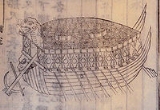
The turtle ships designed by Yi held eleven cannons on each side of the ship, with two each at the stern and the bow. The ship's figurehead was in the shape of a dragon. The figurehead itself held up to four cannons, and emitted a smokescreen that, in combination with its fierce appearance, was meant to be used as psychological warfare
Psychological warfare

The U.S. Department of Defense defines psychological warfare as:"The planned use of propaganda and other psychological actions having the primary purpose of influencing the opinions, emotions, attitudes, and behavior of hostile foreign groups in such a way as to support the achievement of national objectives."...
. The sides of the turtle ship were dotted with smaller holes from which arrows, guns, and mortar
Mortar (weapon)

A mortar is a Muzzleloader indirect fire weapon that fires shell at low velocities, short ranges, and high-arcing Ballistics trajectories. It typically has a barrel length less than 15 times its caliber....
s could be fired. The roof was covered with planks and spikes. The purpose of the spikes was to prevent the ship from being boarded by the enemy. The larger Japanese ships' sides were higher than the turtle ships' and thus, the spikes prevented boarders from jumping down onto the roof without risking impalement. There were two masts that held two large sails. The turtle ship was also steered and powered by twenty oars, which were pulled by two men during fair conditions and five in combat situations.

There is an ongoing debate as to whether the turtle ship had two decks or three; historians still have no definitive answer. Whichever is the case, it is clear that the turtle ship employed multiple decks to separate the rowers from the combat compartment. This enabled the turtle ship to be very mobile since wind and manpower could be used simultaneously. Most support the argument of two decks since that was what was drawn out in the first and second designs of the turtle ships. Some historians maintain that, since Yi was a unique individual and often pursued innovative ideas (contrary to the established wisdom of his peers), it is possible that he had the turtle ship built with three decks. It is known that his flag ship, a panokseon
Panokseon

Panokseon was an oar- and sail-propelled ship that was the main class of warship used by the Koreans Joseon Dynasty during the late 16th century....
, had three decks during his campaigns, so there is support for the belief that the turtle ship had three decks.

Turtle ships are the most famous part of Admiral Yi's fleet; however, he never deployed more than five in any one battle. The reason for this was not that the cost or construction time of the ship was prohibitive; rather, it was the naval strategy employed at the time. Unlike anywhere else in the world at the time (with the exception of England), the Joseon Dynasty
Joseon Dynasty

Joseon , was a sovereign state founded by Taejo Taejo of Joseon, and lasted for approximately five centuries. It was founded in the aftermath of the overthrow of the Goryeo Kingdom at what is today the city of Kaesong....
 used cannons as the primary offensive naval weapon. Historically, they had often used guns and cannons against Japanese pirates, from as early on as the 1390s. The Joseon navy did not implement the ship-boarding strategy that the Japanese navy did, so it was imperative that their warships remain "stand off" from Japanese vessels. Admiral Yi warned his sailors to avoid hand-to-hand combat, in which the Japanese navy specialized, at all costs, and to fire at enemies from a distance. The turtle ship was developed to support this tactic.

Turtle ships were first used in the Battle of Sacheon (1592)
Battle of Sacheon (1592)

The naval Battle Of Sacheon took place on May 29, 1592 and was the first battle in the Imjin War when the Turtle Ship was used....
 and were used in nearly every battle until the devastating Battle of Chilchonryang
Battle of Chilchonryang

The naval Battle of Chilcheollyang took place before dawn on August 28 1597 during the Imjin War in Chilcheollyang, which is a narrow strait near Geoje island....
, when a Japanese double agent plot nearly succeeded resulting in every turtle ship and all but 13 panokseon
Panokseon

Panokseon was an oar- and sail-propelled ship that was the main class of warship used by the Koreans Joseon Dynasty during the late 16th century....
s being sunk. The turtle ships did not re-appear in battle until the Battle of Myeongnyang
Battle of Myeongnyang

In the Battle of Myeongnyang, on October 26, 1597, the Korean admiral Yi Sunsin fought the Japanese navy at sea in Myeongnyang Strait, near Jindo Island....
, the second turning point of the war.

Turtle ships were mostly used to spearhead attacks. They were best used in tight areas and around islands rather than the open sea.

Japanese double agent plot

As Yi won battle after battle, Hideyoshi and his commanders became anxious as they neared Busan
Busan

Busan Metropolitan City, also known as Pusan is the largest seaport city in South Korea. Busan has a population of 3.65 million and is South Korea's second largest metropolis, after Seoul....
. They feared their supply ships would come under attack. Also, Yi delayed supply ships bringing food and weapons to Japanese soldiers. Ships also brought reinforcements. At one point, the entire invasion was halted just before attacking Pyongyang
Pyongyang

Pyongyang is the Capital and largest city of North Korea, located on the Taedong River, at . According to preliminary results from the 2008 population census, it has a population of 3,255,388....
 when supplies and troops failed to reach the First and Second Divisions.

But Hideyoshi soon adjusted. At Busan
Busan

Busan Metropolitan City, also known as Pusan is the largest seaport city in South Korea. Busan has a population of 3.65 million and is South Korea's second largest metropolis, after Seoul....
, the Japanese warships were reinforced and some cannons added to larger ships, and clustered beneath the harbor's defenses of heavy shore-mounted cannons that were acquired from the armory. But above all, the Japanese knew that for a successful invasion of Joseon, Yi had to be eliminated. No Japanese fleet would be safe as long as his presence was commanding the sea.

Taking advantage of the many internal court rivalries of the Joseon Dynasty
Joseon Dynasty

Joseon , was a sovereign state founded by Taejo Taejo of Joseon, and lasted for approximately five centuries. It was founded in the aftermath of the overthrow of the Goryeo Kingdom at what is today the city of Kaesong....
, the Japanese devised a plan. A Japanese double agent named Yoshira was sent to the Joseon general Kim Eung-su, and convinced the general that he would spy on the Japanese. Yoshira played this role until began believing anything he would say.

One day, he told General Kim Eung-su that the Japanese general Kato Kiyomasa
Kato Kiyomasa

was a Japanese daimyo of the Sengoku period and Edo period.Origins and early careerKiyomasa was born in Owari Province to Kato Kiyotada....
 would be coming on a certain date with a great Japanese fleet on another attack on the south shores and insisted that Admiral Yi be sent to lay an ambush. General Kim agreed and sent the message to Field Marshal Gwon Yul
Gwon Yul

Kwon Yul was a Korean Army General and Field Marshal during the Joseon Dynasty, who led his forces in the Battle of Haengju during Hideyoshi's Invasions of Korea against Japan....
, Commander-in-Chief (???, ???) of the Joseon military, who in, turn sent the message to King Seonjo. King Seonjo, who was desperate for victories to loosen the Japanese grip on his kingdom, gave permission for the attack. When General Kim gave Admiral Yi his orders, the admiral refused to carry them out, for he knew that the location given by the spy was studded with sunken rocks and was thus extremely dangerous. The weather and tides were also unsuitable for combat. Admiral Yi also refused because he did not trust the words of spies.

When General Kim informed the king of Admiral Yi's refusal, the admiral's enemies at court quickly insisted on his replacement by General Won Gyun
Won Gyun

Won Gyun was a Korean general and admiral during the Joseon Dynasty. He is best known for his campaigns against Japanese during Hideyoshi's Invasions of Korea....
, former commander of the Gyeongsang Province Western Fleet & Commander of the Jeolla Province
Jeolla

Jeolla was one of the Eight Provinces of Korea during the Joseon Dynasty. Jeolla was located in the southwest of Korea. The provincial capital was Jeonju....
 Ground Forces. They advised that Admiral Yi be arrested. To worsen Admiral Yi's fate, Won Gyun
Won Gyun

Won Gyun was a Korean general and admiral during the Joseon Dynasty. He is best known for his campaigns against Japanese during Hideyoshi's Invasions of Korea....
 claimed Yi was a drinker and idler.

As a result, in 1597, Yi was relieved of command, placed under arrest, and taken to Seoul
Seoul

Seoul is the Capital and largest city of South Korea. With a population of over 10 million, It is one of the world's List of cities proper by population.The Seoul National Capital Area - which includes the major port city of Incheon and satellite towns in Gyeonggi-do, has 24.5 million inhabitants and is the world's second largest List of me...
 in chains to be tortured and imprisoned. Yi was tortured almost to the point of death by using simple torture tactics such as whipping, flogging, burning, the cudgel, or even the classic technique of leg breaking torture. King Seonjo
Seonjo of Joseon

King Seonjo ruled in Korea between 1567 and 1608. He was the fourteenth king of the Joseon Dynasty. At first, King Seonjo was a caring king who loved the people, but in later years, he became greedy and corrupt....
 wanted to have Admiral Yi killed, but the admiral's supporters at court, chiefly the minister Jeong Tak, convinced the king to spare him due to his past service record. The prime minister, Yu Seong-ryong
Yu Seong-ryong

Yu Seong-ryong , also often spelled Ryu Seong-ryong, was a scholar-official of the Joseon Dynasty of Korea. He was a member of the Eastern faction, and a follower of Yi Hwang....
, who was Yi's childhood friend and the his main supporter, remained silent during this deadly hour. Spared the death penalty, Admiral Yi was again demoted to the rank of a common infantry soldier under General Gwon Yul
Gwon Yul

Kwon Yul was a Korean Army General and Field Marshal during the Joseon Dynasty, who led his forces in the Battle of Haengju during Hideyoshi's Invasions of Korea against Japan....
. This penalty was worse than death for Joseon generals at that time, since they lived by honor. However, Yi responded to this humiliation as a most obedient subject, going quietly about his work as if his rank and orders were appropriate. Despite his low rank, many officers treated him with respect, since they knew that the admiral was right and did nothing wrong. Yi would stay under General Gwon Yul
Gwon Yul

Kwon Yul was a Korean Army General and Field Marshal during the Joseon Dynasty, who led his forces in the Battle of Haengju during Hideyoshi's Invasions of Korea against Japan....
's command for a short while until Won Gyun
Won Gyun

Won Gyun was a Korean general and admiral during the Joseon Dynasty. He is best known for his campaigns against Japanese during Hideyoshi's Invasions of Korea....
's death at the Battle of Chilchonryang
Battle of Chilchonryang

The naval Battle of Chilcheollyang took place before dawn on August 28 1597 during the Imjin War in Chilcheollyang, which is a narrow strait near Geoje island....
, which would lead to his reinstatement.

Reinstatement and the Final Campaign

With Yi stripped of any influence, and negotiations breaking down in 1596, Hideyoshi again ordered his army to attack Joseon. The second invasion came in the first month of 1597 with a Japanese force of 140,000 men transported to Korea in 1000 ships. Unfortunately for the Japanese, Ming China had sent down thousands of reinforcements to aid Joseon. With the help of Ming China, the Joseon army was able to push the Japanese south during the winter of 1597. The Japanese failed to reach Seoul.

But in the naval arena, Joseon was doomed. Won Gyun
Won Gyun

Won Gyun was a Korean general and admiral during the Joseon Dynasty. He is best known for his campaigns against Japanese during Hideyoshi's Invasions of Korea....
 again failed to respond quickly and allowed the Japanese to land. Had Admiral Yi been in command of the Joseon navy at that time, the Japanese would most likely never have landed on any shore again. Instead, the Japanese fleet landed safely at Sosang Harbor and began their activities.

Yi's successor, Won Gyun
Won Gyun

Won Gyun was a Korean general and admiral during the Joseon Dynasty. He is best known for his campaigns against Japanese during Hideyoshi's Invasions of Korea....
, decided to attack with the entire naval force of Joseon; a fleet consisting of 150 battleships operated by 30,000 men that had been carefully built by Admiral Yi. Won Gyun left his headquarters at Yeosu
Yeosu

Yeosu is a Administrative divisions of South Korea in South Jeolla Province, South Korea. Old Yeosu City, which was founded in 1949, Yeocheon City, founded in 1986, and Yeocheon County were merged into a new city in 1998....
 with few apparent plans. The next morning, Won Gyun
Won Gyun

Won Gyun was a Korean general and admiral during the Joseon Dynasty. He is best known for his campaigns against Japanese during Hideyoshi's Invasions of Korea....
 met the Japanese near Busan
Busan

Busan Metropolitan City, also known as Pusan is the largest seaport city in South Korea. Busan has a population of 3.65 million and is South Korea's second largest metropolis, after Seoul....
. At the Chilchon Straits
Battle of Chilchonryang

The naval Battle of Chilcheollyang took place before dawn on August 28 1597 during the Imjin War in Chilcheollyang, which is a narrow strait near Geoje island....
 on August 28, 1597, Won Gyun's fleet was massacred. As the tired-from-rowing soldiers stumbled, the Japanese launched a surprise attack. Grappling hooks were thrown and Japanese sailors jumped aboard the Joseon ships, engaged in melee combat, and began a wholesale slaughter. It was the kind of battle Admiral Yi had always won, with careful coordination of enemy movements and strategic moves. But Won Gyun allowed the Japanese to gain the upper hand, board his ships and fight hand-to-hand combat, which was their primary strategy.

At the end of the battle, the Joseon navy was completely annihilated except for 13 battleships, which were saved by a general named Bae Seol. Bae Seol fled before the battle to save the ships because he predicted the outcome of the battle. After the destruction, Won Gyun and Yi Eok-gi, another Joseon commander, fled to an island with a straggling band of survivors, but were killed by waiting Japanese soldiers from the nearby fort. The Battle of Chilchonryang was the only naval battle the Japanese won during the war.

King Seonjo heard the terrible news and quickly reassigned Admiral Yi to his post. Yi found the abandoned 12 battleships and rallied the 200 surviving sailors. Adding his flagship, Admiral Yi's entire fleet totaled 13 ships, which would be the number for a while. At that time, King Seonjo, who judged that the Joseon navy had lost their power and would never be restored again, sent a letter to abolish the navy and join the ground forces under General Gwon Yul
Gwon Yul

Kwon Yul was a Korean Army General and Field Marshal during the Joseon Dynasty, who led his forces in the Battle of Haengju during Hideyoshi's Invasions of Korea against Japan....
. Admiral Yi responded with a letter written "...I still own thirteen ships. As I am alive, the enemies will never gain the Western Sea (a.k.a., the Yellow Sea
Yellow Sea

The Yellow Sea is the name given to the northern part of the East China Sea, which is a marginal sea of the Pacific Ocean. It is located between mainland China and the Korean peninsula....
, the closest sea to Hanseong, or Seoul
Seoul

Seoul is the Capital and largest city of South Korea. With a population of over 10 million, It is one of the world's List of cities proper by population.The Seoul National Capital Area - which includes the major port city of Incheon and satellite towns in Gyeonggi-do, has 24.5 million inhabitants and is the world's second largest List of me...
)." The Japanese navy made up their mind to eliminate the 13 battleships under Yi on their way to the capital. Encouraged by their great victory, Kurushima Michifusa
Kurushima Michifusa

, also known as Madasi was a Japanese admiral during the reign of Toyotomi Hideyoshi. The 4th son of , Michifusa was killed at the Battle of Myeongnyang by the forces of Yi Sun Shin....
, Todo Takatora
Todo Takatora

was a Japanese daimyo of the Azuchi-Momoyama period through Edo period. He rose from relatively humble origins as an ashigaru to become a daimyo....
, Kato Yoshiaki
Kato Yoshiaki

was one of Toyotomi Hideyoshi's top generals, and commanded elements of Hideyoshi's fleet in his Imjin Wars and campaigns in Kyushu at the end of the Sengoku period of Japanese history....
, and Wakisaka Yasuharu
Wakisaka Yasuharu

, sometimes referred to as 'Wakizaka Yasuharu', was a daimyo of Awaji Island who fought under a number of warlords over the course of Japan's Sengoku period....
 hopefully sailed out of Busan
Busan

Busan Metropolitan City, also known as Pusan is the largest seaport city in South Korea. Busan has a population of 3.65 million and is South Korea's second largest metropolis, after Seoul....
 harbor to squash this minor annoyance.

Admiral Yi responded powerfully. In October 1597, Yi lured the Japanese fleet into the Myeongnyang Strait
Myeongnyang Strait

The Myeongnyang Strait, just off the southwest corner of South Korea, separates Jindo Island from the mainland. It also separates the administrative district of Namhae County from Jindo County....
. Using his traditional tactics of peppering cannonballs and fire arrows into Japanese ships, Admiral Yi kept the Japanese fleet at a distance giving no chance to board. 31 Japanese ships were sunk and thousands of Japanese sailors were killed or drowned trying to escape. The Japanese general, Kurushima Michifusa
Kurushima Michifusa

, also known as Madasi was a Japanese admiral during the reign of Toyotomi Hideyoshi. The 4th son of , Michifusa was killed at the Battle of Myeongnyang by the forces of Yi Sun Shin....
, was killed by archers who got close to his flagship. Admiral Yi's victory at the Battle of Myeongnyang
Battle of Myeongnyang

In the Battle of Myeongnyang, on October 26, 1597, the Korean admiral Yi Sunsin fought the Japanese navy at sea in Myeongnyang Strait, near Jindo Island....
 demonstrated his effectiveness as a strategic commander. Today, the Battle of Myeongnyang is celebrated in Korea as one of Admiral Yi's greatest victories.

The Final Battle and Admiral Yi's Death

On December 15, 1598, a huge Japanese fleet under the command of Shimazu Yoshihiro
Shimazu Yoshihiro

was the second son of Shimazu Takahisa and younger brother of Shimazu Yoshihisa. It had traditionally been believed that he became the seventeenth head of the Shimazu clan after Yoshihisa, but it is currently believed that he let Yoshihisa keep his position....
, was massed in Sachon Bay, on the east end of Noryang Strait. Shimazu's goal was to break the allied forces's blockade on Konishi Yukinaga
Konishi Yukinaga

Konishi Yukinaga was a Japanese Christian daimyo under Toyotomi Hideyoshi. He was the son of a wealthy Sakai merchant, Konishi Ryusa.In 1587, during the Invasion of Kyushu, he quelled the local uprising in Higo province and was awarded a fief in that province....
's fleet, join the two fleets, and sail home to Japan. Admiral Yi, meanwhile, knew exactly where Shimazu was after receiving reports from scouts and local fisherman.

At this time, the Joseon fleet consisted of 82 panokseon
Panokseon

Panokseon was an oar- and sail-propelled ship that was the main class of warship used by the Koreans Joseon Dynasty during the late 16th century....
 and three turtle ships, with 8,000 soldiers under Admiral Yi. The Ming fleet consisted of six large war junks
Junk (ship)

A junk is a Chinese sailing vessel. The English name comes from the Fujian#Culture word , jun ?, meaning "ship" or "large vessel." Junks were originally developed during the Han Dynasty and further evolved to represent one of the most successful ship types in history....
, 57 lighter war galleys and two panokseon given to Chen Lin
Chen Lin

Chen Lin can refer to:*Chen Lin *Chen Lin *Lin Chen, scholar*Chen Lin *Chen Lin ...
 by Admiral Yi, with 5,000 Ming soldiers of the Guangdong
Guangdong

Guangdong is a political divisions of China on the southern coast of People's Republic of China. The province is also known by an alternative English language name, the Canton Province....
 squadron and 2,600 Ming
Ming

Ming...
 marines who fought aboard Joseon ships
Joseon Navy

This article provides information about the Joseon Navy during the Japanese invasions of Korea in 1592....
.

The battle began at two o'clock in the early morning of December 16, 1598. Like Admiral Yi's previous battles, the Japanese were unable to respond effectively as the cannons prevented them from moving. The tightness of Noryang Strait also prevented any maneuverability.

As the Japanese retreated, Admiral Yi ordered a vigorous pursuit. During this time, a stray arquebus bullet from an enemy ship struck Admiral Yi, near his left armpit. Sensing that the wound was fatal, the admiral uttered, "The battle is at its height; do not announce my death. .." He died moments later.

Only three people witnessed his death including Yi Hoe, Admiral Yi's eldest son, and Yi Wan, his nephew. Admiral Yi's son and nephew struggled to regain their composure and carried the admiral's body into his cabin before others could notice. For the remainder of the battle, Yi Wan wore his uncle's armor and continued to beat the war drum to encourage the pursuit.

During the battle, Chen Lin found himself in trouble and Yi's flagship rowed to his rescue. When Chen Lin called for Yi to thank him for coming to his aid, he was met by Yi Wan, who announced that his uncle was dead. It is said that Chen himself was so shocked that he fell to the ground three times, beating his chest and crying. News of Admiral Yi's death spread quickly throughout the allied fleet and both Joseon and Ming sailors and fighting men wailed in grief.

Admiral Yi's body was brought back to his hometown in Asan
Asan

Asan is a Administrative divisions of South Korea in South Chungcheong Province, South Korea. It is located at , bordering the Seoul Metropolitan Area to the north....
 to be buried next to his father, Yi Jeong (in accordance to Korean tradition). Shrines, both official and unofficial, were constructed in his honor all throughout the land."

Joseon Government Reaction

Admiral Yi was annihilating Japanese invasion forces, while preserving and respecting his soldiers and their families. Yi was supported by many peasants for not only his victories, but his kindness and gratitude towards citizens negatively affected by the war. They had much faith in Admiral Yi, and he was regarded as more than just an admiral.

On the other hand, King Seonjo had accomplished nothing to save his kingdom. At his greatest need, the Joseon Dynasty
Joseon Dynasty

Joseon , was a sovereign state founded by Taejo Taejo of Joseon, and lasted for approximately five centuries. It was founded in the aftermath of the overthrow of the Goryeo Kingdom at what is today the city of Kaesong....
's king had failed to defend the kingdom, and his rapid retreat to Uiju
Uiju

Uiju is a Administrative divisions of North Korea, or county, in North Pyongan Province, North Korea. The county has an area of 1,677 km?, and a population of 155,979 ....
 left his reputation in ruins. It is feasible to believe that King Seonjo and his royal court looked towards Admiral Yi's victories and rising support as the foundations for a revolt. King Seonjo, who feared that Admiral Yi may hold political power and instigate a revolt against him, arrested and tortured him. Defended by his loyal friend, Yu Seong-ryong
Yu Seong-ryong

Yu Seong-ryong , also often spelled Ryu Seong-ryong, was a scholar-official of the Joseon Dynasty of Korea. He was a member of the Eastern faction, and a follower of Yi Hwang....
, Admiral Yi was spared the death sentence twice.

Nearly all awards to Admiral Yi and his deeds were awarded posthumously.

Many royal advisors of the king played an important part in manipulating the king's opinion of Admiral Yi. The Joseon government was plagued by factional fighting, jealousy, and hatred. The ministers feared and hated the successful admiral, while the royal court sulked in despair and ingratitude. Along with other jealous contemporaries, the sporadic conspiracies against Yi succeeded in restricting his true capabilities to completely destroy the Japanese invasion forces and supply routes.

It should also be noted that according to a recent Choson Ilbo article, historians have discovered written government recordings of the Joseon government's reaction to Admiral Yi's death. The records show that King Seonjo expressed a 'blank expression', offering no signs of sadness or shock.

Entwined with the history of the Joseon Dynasty
Joseon Dynasty

Joseon , was a sovereign state founded by Taejo Taejo of Joseon, and lasted for approximately five centuries. It was founded in the aftermath of the overthrow of the Goryeo Kingdom at what is today the city of Kaesong....
, extreme factional fighting eventually disrupted the peace and stability of the government, resulting in its eventual collapse to Imperial Japan in 1910.

Legacy

E Sun Shin Calligraphy
Today, Admiral Yi is considered one of Korea's greatest heroes of all time. Koreans look upon Yi as a man of courage, perseverance, strength, self-sacrifice, and loyalty to his country.

Admiral George Alexander Ballard of the Royal Navy
Royal Navy

The Royal Navy of the United Kingdom is the oldest of the British Armed Forces . From the mid-18th century until well into the 20th century, it was the most powerful navy in the world, playing a key part in establishing the British Empire as the dominant world power from 1815 until the early 1940s....
 considered Yi a great naval commander, and compared him to Lord Nelson of England:

It is always difficult for Englishmen to admit that Nelson ever had an equal in his profession, but if any man is entitled to be so regarded, it should be this great naval commander of asiatic race who never knew defeat and died in the presence of the enemy; of whose movements a track-chart might be compiled from the wrecks of hundreds of Japanese ships lying with their valiant crews at the bottom of the sea, off the coasts of the korean peninsula... and it seems, in truth, no exaggeration to assert that from first to last he never made a mistake, for his work was so complete under each variety of circumstances as to defy criticism... His whole career might be summarized by saying that, although he had no lessons from past history to serve as a guide, he waged war on the sea as it should be waged if it is to produce definite results, and ended by making the supreme sacrifice of a defender of his country. (The Influence of the Sea on The Political History of Japan, pp. 66–67.)


Admiral Tetsutaro Sato of the Imperial Japanese Navy
Imperial Japanese Navy

The origins of the Imperial Japanese Navy trace back to early interactions with nations on the Asia, beginning in the early history of Japan#Feudal Japan and reaching a peak of activity during the 16th and 17th centuries at a time of cultural diffusion with European power during the Age of Discovery....
 mentioned the Korean admiral in his book published in 1908:
Throughout history there have been few generals accomplished at the tactics of frontal attack, sudden attack, concentration and dilation. Napoleon, who mastered the art of conquering the part with the whole, can be held to have been such a general, and among admirals, two further tactical geniuses may be named: in the East, Yi Sun-sin of Korea, and in the West, Horatio Nelson of England. Undoubtedly, Yi is a supreme naval commander even on the basis of the limited literature of the Seven-Year War
Hideyoshi's invasions of Korea

Two Japanese invasions of Korea and subsequent battles on the Korean peninsula took place from 1592 to 1598. Toyotomi Hideyoshi led the newly unified Japan into the first invasion with the professed goal of conquering Korea, the Jurchens, Ming Dynasty China, and India....
, and despite the fact that his bravery and brilliance are not known to the West, since he had the misfortune to be born in Joseon Dynasty
Joseon Dynasty

Joseon , was a sovereign state founded by Taejo Taejo of Joseon, and lasted for approximately five centuries. It was founded in the aftermath of the overthrow of the Goryeo Kingdom at what is today the city of Kaesong....
. Anyone who can be compared to Yi should be better than Michiel de Ruyter
Michiel de Ruyter

Michiel Adriaenszoon de Ruyter is one of the most famous admirals in History of the Netherlands. De Ruyter is most famous for his role in the Anglo-Dutch Wars of the 17th century....
 from Netherlands. Nelson is far behind Yi in terms of personal character and integrity. Yi was the inventor of the covered warship known as the turtle ship
Turtle ship

The Turtle ship [???] was a type of large warship belonging to the Panokseon class in Korea that was used intermittently by the Joseon Navy during the Joseon Dynasty from the early 15th century up until the 19th century....
 (geobukseon). He was a truly great commander and a master of the naval tactics of three hundred years ago. (A Military History of the Empire (Japanese: ??????), p. 399)


During the time of the invasion, it was up to the admiral to supply his fleet. Yi's fleet was cut off from any helping hand from the king's court and had to fend for itself. The admiral often wrote in his war diary, Nanjung Ilgi
Nanjung Ilgi

Nanjung Ilgi or War Diary of Yi Sun-sin is the personal diary of Korean Admiral Yi Sun-sin during the Joseon Dynasty. It was written between January 1, 1592 and November 17, 1598 by the Admiral himself....
 War Diary of Admiral Yi Sun-sin, about how concerned he was about the food supply during winters. His enemy was fully supplied, and always outnumbered him.

Yi himself had never been trained as a naval commander. Korea, called Joseon
Joseon Dynasty

Joseon , was a sovereign state founded by Taejo Taejo of Joseon, and lasted for approximately five centuries. It was founded in the aftermath of the overthrow of the Goryeo Kingdom at what is today the city of Kaesong....
 at the time, did not have any naval training facilities. Although Yi passed the military exams when he was young, he was never trained at an academy. Yi's only military experiences came from fighting foreign Jurchen
Jurchen

Jurchen may refer to:* Jurchen people, Tungusic people who inhabited the region of Manchuria until the 17th century* Jurchen script, writing system of Jurchen people...
 tribes invading from Manchuria. In fact, the Battle of Okpo
Battle of Okpo

PreludeThe Battle of Okpo was a 2 day fight around the harbor of Okpo at Geoje Island in 1592. It was the first naval battle of the Imjin War and the first victory of Admiral Yi....
, his first victory against the Japanese fleet, was also his first sea battle ever. None of his subordinates, including his own staff, had ever fought at sea before.

One reason Admiral Yi was successful in his battles was because his cannons had longer range and power than the enemy's, with the Japanese heavily favoring troop transport over naval combat. His turtle ship, which had first set sail the day before the invasion, was very effective in leading the attack and breaking the enemy's formation. Yi won all of at least 23 naval battles fought while suffering very minimal losses, destroying over a thousand Japanese ships and killing hundreds of thousands of Japanese soldiers.

He used many different formations according to the situation, and capitalized on tides and ocean currents. Admiral Yi also took advantage of his knowledge of the surrounding sea. Many times he lured the enemy to a place where his fleet would have the upper hand.

At the Battle of Hansando, the Japanese commander broke ranks and routed his fleet. Yi's expertise on naval strategy is apparent in the fact that his successor, Won Gyun
Won Gyun

Won Gyun was a Korean general and admiral during the Joseon Dynasty. He is best known for his campaigns against Japanese during Hideyoshi's Invasions of Korea....
, even with all of Yi's ships and trained crew, could not defeat an enemy fleet of similar might. One of the greatest legacies of the admiral was the disruption of the Japanese supply line. Through his calculated attacks, he successfully burdened the Japanese navy and the supplies trying to reach their lines near the Chinese border.

Yi's naval reforms did not persist and disappeared soon after his death. The turtle ships faded into the annals of Korean history, reaching iconic legendary status today. The Joseon royal court decided on a reduced military, especially after the Manchu
Manchu

The Manchu people are a Tungusic peoples who originated in Manchuria . During their rise in the seventeenth century, with the help of Ming rebels , they conquered the Ming Dynasty and founded the Qing Dynasty, which ruled China until its abolition in 1911 after the Xinhai Revolution, which established Republic of China in its place....
 invasions in the 1630s.

Yi kept a careful record of daily events in his diary, and it is from these entries, along with the reports he sent to the throne during the war, that much about him has been learned. Also, much information about the turtle ships are written in his diaries. These works have been published in English as Nanjung Ilgi: War Diary of Admiral Yi Sun-sin, and Imjin Jangcho: Admiral Yi Sun-sin's Memorials to Court.

Among his direct male descendants, more than two hundred passed the military examination and pursued military careers, hence constituting a prominent family or military yangban
Yangban

The Yangban were part of the traditional ruling class of dynastical Korea during the Joseon dynasty. Yangban were landed or unlanded gentry who comprised the Confucianism idea of a "scholarly official", and thus were part of the agrarian bureaucracy within Korea prior to 1910 during the Joseon Dynasty....
 of late Joseon. Although many of his male descendants did not play the kind of a vital role in the tumultuous factional politics of late Joseon, as did those of the Pyeongsan Shin and Neungseong Gu military yangban
Yangban

The Yangban were part of the traditional ruling class of dynastical Korea during the Joseon dynasty. Yangban were landed or unlanded gentry who comprised the Confucianism idea of a "scholarly official", and thus were part of the agrarian bureaucracy within Korea prior to 1910 during the Joseon Dynasty....
 lines, the court seems to have treated them with respect. Many attained important high-level posts in the administration. Moreover, at the end of the Joseon Dynasty
Joseon Dynasty

Joseon , was a sovereign state founded by Taejo Taejo of Joseon, and lasted for approximately five centuries. It was founded in the aftermath of the overthrow of the Goryeo Kingdom at what is today the city of Kaesong....
, at least several descendants are known to have become anti-Japanese independence activists. Today, most of Yi's descendants live in or near Seoul
Seoul

Seoul is the Capital and largest city of South Korea. With a population of over 10 million, It is one of the world's List of cities proper by population.The Seoul National Capital Area - which includes the major port city of Incheon and satellite towns in Gyeonggi-do, has 24.5 million inhabitants and is the world's second largest List of me...
 and Asan
Asan

Asan is a Administrative divisions of South Korea in South Chungcheong Province, South Korea. It is located at , bordering the Seoul Metropolitan Area to the north....
.

In Korea, Admiral Yi is not only famous for the turtle ship, but also for his last words before his death. He told his nephew to wear his armor and to hide his death until the battle is over to avoid demoralizing his men in the middle of battle. His last words were, "Do not let my death be known" ("?? ??? ?????").

Admiral Yi's posthumous title, Lord of Loyalty and Chivalry (Chungmugong, ???; ???) is used as Korea's third highest military honor, known as The Cordon of Chungmu of the Order of Military Merit and Valor. He was posthumously granted the title of Prince of Deokpung. Chungmuro (???; ???) — a street in downtown Seoul
Seoul

Seoul is the Capital and largest city of South Korea. With a population of over 10 million, It is one of the world's List of cities proper by population.The Seoul National Capital Area - which includes the major port city of Incheon and satellite towns in Gyeonggi-do, has 24.5 million inhabitants and is the world's second largest List of me...
 — is also named after him. The city Chungmu, now renamed Tongyeong
Tongyeong

Tongyeong is a Administrative divisions of South Korea in South Gyeongsang Province, South Korea. It was formerly known as Chungmu, after the posthumous name of Admiral Yi Sun-sin....
, on the southern coast of Korea is named in honor of his posthumous title and the site of his headquarters. There is a prominent statue of Admiral Yi in the middle of Sejongno
Sejongno

Sejongno is a street that cuts through Jongno-gu in downtown Seoul. It is named after Sejong the Great of Joseon. The street is only 600 meters in length, but thanks to its central location it is of great symbolic importance....
 in central Seoul
Seoul

Seoul is the Capital and largest city of South Korea. With a population of over 10 million, It is one of the world's List of cities proper by population.The Seoul National Capital Area - which includes the major port city of Incheon and satellite towns in Gyeonggi-do, has 24.5 million inhabitants and is the world's second largest List of me...
. Korea's new KDX-II naval destroyer is named "Chungmugong Yi Sun-sin".

Modern depiction

Yi's life has been depicted in two motion pictures, both entitled Seong-ung Yi Sun-sin ("The Saintly Hero Yi Sun-sin"), the first a 1962 black & white movie, and the second, based upon his war diaries, in color in 1971 and in 2004.

Yi and his turtle ships appear in the game Age of Empires II: The Conquerors
Age of Empires II: The Conquerors

Age of Empires II: The Conquerors Expansion is the expansion pack to the 1999 real-time strategy game Age of Empires II: The Age of Kings....
. However, for the purposes of balance, the turtle ships are wrong in two areas of the game: They are slow (in reality they were incredibly quick) and they can only fire the cannon out of the dragon's mouth/bow (the turtle ships actually fired broadsides and used the front mostly as a flamethrower and ram).

A 2005 Korean film, Cheongun (??; ??) or "Heaven's Soldiers
Heaven's Soldiers

Heaven's Soldiers is a 2005 in film film from South Korea, directed by Min Joon Gi. It is an action and humorous movie shifting back and forth between high tension and comedy, and combining elements of many genres such as war films, time travel and historical drama....
", directed by Min Joon Gi, portrayed a young Yi Sun-sin, played by Park Joong-hoon, fighting the Jurchen
Jurchen

Jurchen may refer to:* Jurchen people, Tungusic people who inhabited the region of Manchuria until the 17th century* Jurchen script, writing system of Jurchen people...
 tribes, along with local villagers and North
North Korea

North Korea, officially the Democratic People's Republic of Korea , is a state in East Asia, occupying the northern half of the Korean Peninsula....
 and South Korea
South Korea

South Korea, officially the Republic of Korea , ), often referred to as Korea and the "names of Korea#Revival of the names", is a Semi-presidential system republic in East Asia, located in the southern half of the Korean Peninsula....
n soldiers who traveled in time, from 2005 to 1572, with Halley's Comet. Unusually, the film presented Yi as a cunning, slightly eccentric young man, rather than a distinguished austere
Austere

Austere is the first release by the band Sparta , just one year after break-up of their former band At the Drive-In....
 hero, a couple of decades before Hideyoshi's Invasions of Korea
Hideyoshi's invasions of Korea

Two Japanese invasions of Korea and subsequent battles on the Korean peninsula took place from 1592 to 1598. Toyotomi Hideyoshi led the newly unified Japan into the first invasion with the professed goal of conquering Korea, the Jurchens, Ming Dynasty China, and India....
. Some historical events were also distorted: most notably Yi's campaign against the Jurchens
Jurchens

The Jurchens were a Tungusic peoples who inhabited the region of Manchuria until the 17th century, when they adopted the name Manchu. They established the Jin Dynasty between 1115 and 1122; it lasted until 1234 when the Mongols arrived....
, which did not happen in 1572 but a few years later, after his 1576 military examination. The film, financed with a comfortable budget by Korean standards ($7-8 million), was a relative commercial success in 2005. The film's theme clearly uses the figure of Yi, venerated as a hero in both parts of contemporary Korea, to plead for Korean Reunification
Korean reunification

Korean reunification refers to the future reunification of North Korea and South Korea under a single government currently in progress. It was started by the historic June 15th North-South Joint Declaration in August 2000, where the two countries agreed to work towards a peaceful reunification in the future....
.

From September 4, 2004 to August 28, 2005, a 104 episode drama series was aired on KBS. The show, titled Immortal Yi Soon-shin (??? ???) in English, dealt mostly with the events related to the Japanese invasions of Korea, as well as the life of the admiral, played by Kim Myung-min
Kim Myung-min

Kim Myung-min is a South Korean actor most widely known for playing the title role in the KBS historical TV drama The Immortal Lee Soon Shin . In 2005 he was named best actor at the KBS Acting Awards for this role....
, who later received the Best Actor's Award for this role. It became a popular drama in China and was re-aired in certain ethnic channels in the United States as well. The drama was criticized for the many artistic license
Artistic License

The Artistic License refers most commonly to the original Artistic License , a software license used for certain free software packages, most notably the standard Perl implementation and most CPAN modules, which are dual-licensed under the Artistic License and the GNU General Public License ....
s taken, such as depicting Yi as weak and lonely in his early life and taking liberties with the events surrounding his death. On the other hand, many people complimented the way the drama portrayed the whole drama with a more human touch. It described the admiral as a true man who had to overcome many dangers and difficulties quite frequently alone, not just a hero among the clouds. This drama was a heated topic at the time since it overlapped with the time when the Koreans were offended by Japan declaring that Dokdo Island was theirs.

Yi also inspired literary works. In 2001, Kim Hoon
Kim Hoon

Kim Hoon is a South Korean novelist, journalist and critic. Kim was born on May 5 1948 in Seoul, Korea. After graduating from Whimoon High School, Kim Hoon entered Korea University in 1966....
's first novel, Song of the Sword, was a commercial and critical success in South Korea. For this poetic first-person narrative written from Yi's perspective, he received the Dongin Literature Award, the most prestigious literary prize in the nation.

Yi Sun Sin has an ITF style Tae Kwon Do pattern named after his posthumous name of Chung-mu

See also

  • List of Korea-related topics
    List of Korea-related topics

    This is a list of articles on Korea-related people, places, things, and concepts. For help on how to use this list, see the #Introduction below....
  • History of Korea
    History of Korea

    The history of Korea stretches from Lower Paleolithic times to the present. The earliest known Korean pottery dates to around 8000 BC, and the Neolithic period began before 6000 BC, followed by the Bronze Age around 2500 BC....
  • Naval history of Korea
    Naval history of Korea

    The naval history of Korea dates back to the Three Kingdoms of Korea period when simple fishing ships were used. Military naval history dates back to the Goryeo and Unified Silla dynasties of Korea in the 600s....
  • Turtle ship
    Turtle ship

    The Turtle ship [???] was a type of large warship belonging to the Panokseon class in Korea that was used intermittently by the Joseon Navy during the Joseon Dynasty from the early 15th century up until the 19th century....
  • Immortal Admiral Yi Sun-shin
    Immortal Admiral Yi Sun-shin

    Immortal Admiral Yi Sun-shin is a South Korean television show based on the life of Admiral Yi Sun-shin. It was first broadcast in August 2004 in Korea and later in the United States near the end of August....


External links

  • (includes clips from the drama Immortal Admiral Yi Sun-shin)
  • : Yi Sunsin information portal.