


Early Renaissance painting

Encyclopedia
Renaissance art is the painting, sculpture and decorative arts of that period of European history known as the Renaissance
, emerging as a distinct style in Italy in about 1400, in parallel with developments which occurred in philosophy
, literature
, music
and science. Renaissance art, perceived as a "rebirth" of ancient traditions, took as its foundation the art of Classical antiquity
, but transformed that tradition by the absorption of recent developments in the art of Northern Europe and by application of contemporary scientific knowledge. Renaissance art, with Renaissance Humanist philosophy
, spread throughout Europe, affecting both artists and their patrons with the development of new techniques and new artistic sensibilities. Renaissance art marks the transition of Europe from the medieval period to the Early modern age.
In many parts of Europe, Early Renaissance art was created in parallel with Late Medieval art
. By 1500 the Renaissance style prevailed. As Late Renaissance art (Mannerism
) developed, it took on different and distinctive characteristics in every region.
and his son Giovanni Pisano
, working at Pisa
, Siena
and Pistoia
shows markedly classicising tendencies, probably influenced by the familiarity of these artists with ancient Roman sarcophagi
. Their masterpieces are the pulpits of the Baptistery and Cathedral of Pisa. Contemporary with Giovanni Pisano, the Florentine painter Giotto developed a manner of figurative painting that was unprecedentedly naturalistic, three dimensional, life-like and classicising, when compared with that of his contemporaries and teacher Cimabue
. Giotto, whose greatest work is the cycle of the Life of Christ at the Arena Chapel in Padua
, was seen by the 16th century biographer Giorgio Vasari
as "rescuing and restoring art" from the "crude, traditional, Byzantine style" prevalent in Italy in the 13th century.
, Donatello
and the winner, Lorenzo Ghiberti
. Brunelleschi, most famous as the architect of the dome of Florence Cathedral and the Church of San Lorenzo, created a number of sculptural works, including a lifesized Crucifix in Santa Maria Novella, renowned for its naturalism. His studies of perspective are thought to have influenced the painter Masaccio
. Donatello
became renowned as the greatest sculptor of the Early Renaissance, his masterpieces being his Humanist and unusually erotic statue of David, one of the icons of the Florentine republic, and his great monument to Gattamelata, the first large equestrian bronze to be created since Roman times.
The contemporary of Donatello, Masaccio
, was the painterly descendant of Giotto, furthering the trend towards solidity of form and naturalism of face and gesture that he had begun a century earlier. Masaccio completed several panel paintings but is best known for the fresco cycle that he began in the Brancacci Chapel
with the older artist Masolino and which had profound influence on later painters, including Michelangelo
. Masaccio's developments were carried forward in the paintings of Fra Angelico
, particularly in his frescos at the Convent of San Marco in Florence.
The treatment of the elements of perspective and light in painting was of particular concern to 15th century Florentine painters. Uccello was so obsessed with trying to achieve an appearance of perspective that, according to Vasari, it disturbed his sleep. His solutions can be seen in his masterpiece, the Battle of San Romano
. Piero della Francesca
made systematic and scientific studies of both light and linear perspective, the results of which can be seen in his fresco cycle of The History of the True Cross
in San Francesco, Arezzo.
In Naples
, the painter Antonello da Messina
began using oil paints for portraits and religious paintings at a date that preceded other Italian painters, possibly about 1450. He carried this technique north and influenced the painters of Venice
. One of the most significant painters of Northern Italy was Andrea Mantegna
, who decorated the interior of a room, the Camera degli Sposi for his patron Ludovico Gonzaga
, setting portraits of the family and court into an illusionistic architectural space.
The end of the Early Renaissance in Italian art is marked, like its beginning, by a particular commission that drew artists together, this time in cooperation rather than competition. Pope Sixtus IV
had rebuilt the Papal Chapel, named the Sistine Chapel
in his honour, and commissioned a group of artists, Sandro Botticelli
, Pietro Perugino
, Domenico Ghirlandaio
and Cosimo Rosselli
to decorate its wall with fresco cycles depicting the Life of Christ and the Life of Moses. In the sixteen large paintings, the artists, although each working in his individual style, agreed on principals of format, and utilised the techniques of lighting, linear and atmospheric perspective, anatomy, foreshortening and characterisation that had been carried to a high point in the large Florentine studios of Ghiberti, Verrocchio, Ghirlandaio and Perugino.
was to further perfect the aspects of pictorial art (lighting, linear and atmospheric perspective, anatomy, foreshortening and characterisation) that had preoccupied artists of the Early Renaissance, in a lifetime of studying and meticulously recording his observations of the natural world. His adoption of oil paint as his primary media meant that he could depict light and its effects on the landscape and objects more naturally and with greater dramatic effect than had ever been done before, as demonstrated in the Mona Lisa
. His dissection of cadavers carried forward the understanding of skeletal and muscular anatomy, as seen in the unfinished St Jerome. His depiction of human emotion in The Last Supper set the benchmark for religious painting.
The art of Leonardo's younger contemporary Michelangelo
took a very different direction. Michelangelo, in neither his painting nor his sculpture demonstrates any interest in the observation of any natural object except the human body. He perfected his technique in depicting it, while in his early twenties, by the creation of the enormous marble statue of David and the group the Pieta, in St Peter's Basilica, Rome. He then set about an exploration of the expressive possibilities of the human anatomy. His commission by Pope Julius II
to paint the Sistine Chapel ceiling
resulted in the supreme masterpiece of figurative composition, which was to have profound effect on every subsequent generation of European artists.
Standing alongside Leonardo and Michelangelo as the third great painter of the High Renaissance was the younger Raphael
, who in a short life span painted a great number of lifelike and engaging portraits, including those of Pope Julius II and his successor Pope Leo X
, and numerous portrayals of the Madonna and Christ Child, including the Sistine Madonna
.
In Northern Italy the High Renaissance represented by the religious paintings of Giovanni Bellini
which include several large altarpieces of a type known as "Sacred Conversation" which show a group of saints around the enthroned Madonna. His contemporary Giorgione
left a small number of enigmatic works, including The Tempest
, the subject of which has remained a matter of speculation. The earliest works of Titian
date from the era of the High Renaissance, including a massive altarpiece The Assumption of the Virgin
which combines human action and drama with spectacular colour and atmosphere.
at this period included Jan van Eyck
, his brother Hubert van Eyck
, Robert Campin
, Hans Memling
, Rogier van der Weyden and Hugo van der Goes
. Their painting developed independently of Early Italian Renaissance painting, and without the influence of a deliberate and conscious striving to revive antiquity. The style of painting grew directly out of the Medieval arts of tempera painting, stained glass
and book illumination
. The media used was oil paint, which had long been utilised for painting leather ceremonial shields and accoutrements, because it was flexible and relatively durable. The earliest Netherlandish oil paintings are meticulous and detailed like tempera paintings. The material lent itself to the depiction of tonal variations and texture, so facilitating the observation of nature in great detail.
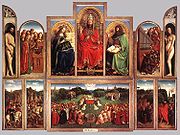
The Netherlandish painters did not approach the creation of a picture through a framework of linear perspective and correct proportion. They maintained a Medieval view of hierarchical proportion and religious symbolism, while delighting in a realistic treatment of material elements, both natural and man-made. Jan van Eyck, with his brother Hubert painted The Altarpiece of the Mystical Lamb
. It is probable that Antonello da Messina became familiar with Van Eyck's work, while in Naples or Sicily. In 1475, Hugo van der Goes' Portinari Altarpiece arrived in Florence where it was to have a profound influence on many painters, most immediately Domenico Ghirlandaio
who painted an altarpiece imitating its elements.
Hieronymus Bosch was a painter who employed the type of fanciful forms that were often utilised to decorate borders and letters in illuminated manuscripts, combining plant and animal forms with architectonic ones. When taken from the context of the illumination and peopled with humans, these forms give Bosch's paintings a surreal quality which have no parallel in the work of any other Renaissance painter. His masterpiece is the triptych The Garden of Earthly Delights
.
, Flemish illuminators and creators of the Très Riches Heures du Duc de Berry
. Jean Fouquet
, painter of the royal court, visited Italy in 1437 and reflects the influence of Florentine painters such as Paolo Uccello
. Although best known for his portraits such as that of Charles VII of France
Fouquet also created illuminations, and is thought to be the inventor of the portrait miniature. There were a number of artists at this date who painted famed altarpieces, that are stylistically quite distinct from both the Italian and the Flemish. These include two enigmatic figures, Enguerrand Quarton
to whom is ascribed the Pieta of Villeneuve-lès-Avignon, and Jean Hey, otherwise known as "the Master of Moulins" after his most famous work, the Moulins Altarpiece. In these works realism and close observation of the human figure, emotions and lighting are combined with a Medieval formality, which includes gilt backgrounds.
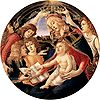 Renaissance artists painted a wide variety of themes. Religious altarpiece
s, fresco
cycles, and small works for private devotion were very popular. For inspiration, painters in both Italy and northern Europe frequently turned to Jacobus de Voragine
's Golden Legend
(1260), a highly influential source book for the lives of saint
s that had already had a strong influence on Medieval artists. The rebirth of classical antiquity and Renaissance humanism
also resulted in many Mythological
and history painting
s. Ovidian stories, for example, were very popular. Decorative ornament
, often used in painted architectural elements, was especially influenced by classical Roman motifs.
for 15th century artists, Dutch and Flemish Renaissance painting
for 16th century artists
Renaissance
The Renaissance was a cultural movement that spanned roughly the 14th to the 17th century, beginning in Italy in the Late Middle Ages and later spreading to the rest of Europe. The term is also used more loosely to refer to the historical era, but since the changes of the Renaissance were not...
, emerging as a distinct style in Italy in about 1400, in parallel with developments which occurred in philosophy
Renaissance philosophy
Renaissance philosophy was the period of the history of philosophy in Europe that falls roughly between the Middle Ages and the Enlightenment. It includes the 15th century; some scholars extend it to as early as the 1350s or as late as the 16th century or early 17th century, overlapping the...
, literature
Renaissance literature
Renaissance Literature refers to the period in European literature that began in Italy during the 14th century and spread around Europe through the 17th century...
, music
Renaissance music
Renaissance music is European music written during the Renaissance. Defining the beginning of the musical era is difficult, given that its defining characteristics were adopted only gradually; musicologists have placed its beginnings from as early as 1300 to as late as the 1470s.Literally meaning...
and science. Renaissance art, perceived as a "rebirth" of ancient traditions, took as its foundation the art of Classical antiquity
Classical antiquity
Classical antiquity is a broad term for a long period of cultural history centered on the Mediterranean Sea, comprising the interlocking civilizations of ancient Greece and ancient Rome, collectively known as the Greco-Roman world...
, but transformed that tradition by the absorption of recent developments in the art of Northern Europe and by application of contemporary scientific knowledge. Renaissance art, with Renaissance Humanist philosophy
Renaissance humanism
Renaissance humanism was an activity of cultural and educational reform engaged by scholars, writers, and civic leaders who are today known as Renaissance humanists. It developed during the fourteenth and the beginning of the fifteenth centuries, and was a response to the challenge of Mediæval...
, spread throughout Europe, affecting both artists and their patrons with the development of new techniques and new artistic sensibilities. Renaissance art marks the transition of Europe from the medieval period to the Early modern age.
In many parts of Europe, Early Renaissance art was created in parallel with Late Medieval art
Gothic art
Gothic art was a Medieval art movement that developed in France out of Romanesque art in the mid-12th century, led by the concurrent development of Gothic architecture. It spread to all of Western Europe, but took over art more completely north of the Alps, never quite effacing more classical...
. By 1500 the Renaissance style prevailed. As Late Renaissance art (Mannerism
Mannerism
Mannerism is a period of European art that emerged from the later years of the Italian High Renaissance around 1520. It lasted until about 1580 in Italy, when a more Baroque style began to replace it, but Northern Mannerism continued into the early 17th century throughout much of Europe...
) developed, it took on different and distinctive characteristics in every region.
Influences
The influences upon the development of Renaissance art in the early 15th century are those that also affected Philosophy, Literature, Architecture, Theology, Science, Government and other aspects of society. The following list presents a summary, dealt with more fully in the main articles that are cited above.- Classical texts, lost to European scholars for centuries, became available. These included Philosophy, Prose, Poetry, Drama, Science, a thesis on the Arts and Early Christian Theology.
- Simultaneously, Europe gained access to advanced mathematics which had its provenance in the works of Islamic scholars.
- The advent of movable type printingPrintingPrinting is a process for reproducing text and image, typically with ink on paper using a printing press. It is often carried out as a large-scale industrial process, and is an essential part of publishing and transaction printing....
in the 15th century meant that ideas could be disseminated easily, and an increasing number of books were written for a broad public. - The establishment of the MediciMediciThe House of Medici or Famiglia de' Medici was a political dynasty, banking family and later royal house that first began to gather prominence under Cosimo de' Medici in the Republic of Florence during the late 14th century. The family originated in the Mugello region of the Tuscan countryside,...
Bank and the subsequent trade it generated brought unprecedented wealth to a single Italian city, FlorenceFlorenceFlorence is the capital city of the Italian region of Tuscany and of the province of Florence. It is the most populous city in Tuscany, with approximately 370,000 inhabitants, expanding to over 1.5 million in the metropolitan area....
. - Cosimo de' Medici set a new standard for patronage of the arts, not associated with the church or monarchy.
- HumanistHumanismHumanism is an approach in study, philosophy, world view or practice that focuses on human values and concerns. In philosophy and social science, humanism is a perspective which affirms some notion of human nature, and is contrasted with anti-humanism....
philosophy meant that man's relationship with humanity, the universe and with God was no longer the exclusive province of the Church. - A revived interest in the Classics brought about the first archaeological study of RomanAncient RomeAncient Rome was a thriving civilization that grew on the Italian Peninsula as early as the 8th century BC. Located along the Mediterranean Sea and centered on the city of Rome, it expanded to one of the largest empires in the ancient world....
remains by the architect BrunelleschiFilippo BrunelleschiFilippo Brunelleschi was one of the foremost architects and engineers of the Italian Renaissance. He is perhaps most famous for inventing linear perspective and designing the dome of the Florence Cathedral, but his accomplishments also included bronze artwork, architecture , mathematics,...
and sculptor DonatelloDonatelloDonato di Niccolò di Betto Bardi , also known as Donatello, was an early Renaissance Italian artist and sculptor from Florence...
. The revival of a style of architecture based on classical precedents inspired a corresponding classicism in painting and sculpture, which manifested itself as early as the 1420s in the paintings of MasaccioMasaccioMasaccio , born Tommaso di Ser Giovanni di Simone, was the first great painter of the Quattrocento period of the Italian Renaissance. According to Vasari, Masaccio was the best painter of his generation because of his skill at recreating lifelike figures and movements as well as a convincing sense...
and Uccello. - The improvement of oil paintOil paintOil paint is a type of slow-drying paint that consists of particles of pigment suspended in a drying oil, commonly linseed oil. The viscosity of the paint may be modified by the addition of a solvent such as turpentine or white spirit, and varnish may be added to increase the glossiness of the...
and developments in oil-painting technique by Netherlandish artists such as Jan van EyckJan van EyckJan van Eyck was a Flemish painter active in Bruges and considered one of the best Northern European painters of the 15th century....
, Rogier van der Weyden and Hugo van der GoesHugo van der GoesHugo van der Goes was a Flemish painter. He was, along with Jan van Eyck, Rogier van der Weyden, Hans Memling and Gerard David, one of the most important of the Early Netherlandish painters.-Biography:...
led to its adoption in Italy from about 1475 and had ultimately lasting effects on painting practices, worldwide. - The serendipitousSerendipitySerendipity means a "happy accident" or "pleasant surprise"; specifically, the accident of finding something good or useful without looking for it. The word has been voted as one of the ten English words hardest to translate in June 2004 by a British translation company. However, due to its...
presence within the region of FlorenceFlorenceFlorence is the capital city of the Italian region of Tuscany and of the province of Florence. It is the most populous city in Tuscany, with approximately 370,000 inhabitants, expanding to over 1.5 million in the metropolitan area....
in the early 15th century of certain individuals of artistic genius, most notably MasaccioMasaccioMasaccio , born Tommaso di Ser Giovanni di Simone, was the first great painter of the Quattrocento period of the Italian Renaissance. According to Vasari, Masaccio was the best painter of his generation because of his skill at recreating lifelike figures and movements as well as a convincing sense...
, BrunelleschiFilippo BrunelleschiFilippo Brunelleschi was one of the foremost architects and engineers of the Italian Renaissance. He is perhaps most famous for inventing linear perspective and designing the dome of the Florence Cathedral, but his accomplishments also included bronze artwork, architecture , mathematics,...
, GhibertiLorenzo GhibertiLorenzo Ghiberti , born Lorenzo di Bartolo, was an Italian artist of the early Renaissance best known for works in sculpture and metalworking.-Early life:...
, Piero della FrancescaPiero della FrancescaPiero della Francesca was a painter of the Early Renaissance. As testified by Giorgio Vasari in his Lives of the Artists, to contemporaries he was also known as a mathematician and geometer. Nowadays Piero della Francesca is chiefly appreciated for his art. His painting was characterized by its...
, DonatelloDonatelloDonato di Niccolò di Betto Bardi , also known as Donatello, was an early Renaissance Italian artist and sculptor from Florence...
and MichelozzoMichelozzothumb|250px|[[Palazzo Medici]] in Florence.Michelozzo di Bartolomeo Michelozzi was an Italian architect and sculptor.-Biography:...
formed an ethos out of which sprang the great masters of the High Renaissance, as well as supporting and encouraging many lesser artists to achieve work of extraordinary quality. - A similar heritage of artistic achievement occurred in VeniceVeniceVenice is a city in northern Italy which is renowned for the beauty of its setting, its architecture and its artworks. It is the capital of the Veneto region...
through the talented BelliniJacopo BelliniJacopo Bellini was an Italian painter. Jacopo was one of the founders of the Renaissance style of painting in Venice and northern Italy. His sons Gentile and Giovanni Bellini, and his son-in-law Andrea Mantegna, were also famous painters....
family, their influential inlaw MantegnaAndrea MantegnaAndrea Mantegna was an Italian painter, a student of Roman archeology, and son in law of Jacopo Bellini. Like other artists of the time, Mantegna experimented with perspective, e.g., by lowering the horizon in order to create a sense of greater monumentality...
, GiorgioneGiorgioneGiorgione was a Venetian painter of the High Renaissance in Venice, whose career was cut off by his death at a little over thirty. Giorgione is known for the elusive poetic quality of his work, though only about six surviving paintings are acknowledged for certain to be his work...
, TitianTitianTiziano Vecelli or Tiziano Vecellio Tiziano Vecelli or Tiziano Vecellio Tiziano Vecelli or Tiziano Vecellio (c. 1488/1490 – 27 August 1576 better known as Titian was an Italian painter, the most important member of the 16th-century Venetian school. He was born in Pieve di Cadore, near...
and TintorettoTintorettoTintoretto , real name Jacopo Comin, was a Venetian painter and a notable exponent of the Renaissance school. For his phenomenal energy in painting he was termed Il Furioso...
. - The publication of two treatises by Leone Battista AlbertiLeone Battista AlbertiLeon Battista Alberti was an Italian author, artist, architect, poet, priest, linguist, philosopher, cryptographer and general Renaissance humanist polymath...
, De Pitura (On Painting), 1435, and De re aedificatoriaDe Re AedificatoriaDe re aedificatoria is a classic architectural treatise written by Leon Battista Alberti between 1443 and 1452. Although largely dependent on Vitruvius' De architectura, it was the first theoretical book on the subject written in the Italian Renaissance and in 1485 became the first printed book on...
(Ten Books on Architecture), 1452.
Proto Renaissance art, 1280-1400
In Italy in the late 13th and early 14th centuries, the sculpture of Nicola PisanoNicola Pisano
Nicola Pisano was an Italian sculptor whose work is noted for its classical Roman sculptural style. Pisano is sometimes considered to be the founder of modern sculpture.- Early life :His birth date or origins are uncertain...
and his son Giovanni Pisano
Giovanni Pisano
Giovanni Pisano was an Italian sculptor, painter and architect. Son of the famous sculptor Nicola Pisano, he received his training in the workshop of his father....
, working at Pisa
Pisa
Pisa is a city in Tuscany, Central Italy, on the right bank of the mouth of the River Arno on the Tyrrhenian Sea. It is the capital city of the Province of Pisa...
, Siena
Siena
Siena is a city in Tuscany, Italy. It is the capital of the province of Siena.The historic centre of Siena has been declared by UNESCO a World Heritage Site. It is one of the nation's most visited tourist attractions, with over 163,000 international arrivals in 2008...
and Pistoia
Pistoia
Pistoia is a city and comune in the Tuscany region of Italy, the capital of a province of the same name, located about 30 km west and north of Florence and is crossed by the Ombrone Pistoiese, a tributary of the River Arno.-History:...
shows markedly classicising tendencies, probably influenced by the familiarity of these artists with ancient Roman sarcophagi
Sarcophagus
A sarcophagus is a funeral receptacle for a corpse, most commonly carved or cut from stone. The word "sarcophagus" comes from the Greek σαρξ sarx meaning "flesh", and φαγειν phagein meaning "to eat", hence sarkophagus means "flesh-eating"; from the phrase lithos sarkophagos...
. Their masterpieces are the pulpits of the Baptistery and Cathedral of Pisa. Contemporary with Giovanni Pisano, the Florentine painter Giotto developed a manner of figurative painting that was unprecedentedly naturalistic, three dimensional, life-like and classicising, when compared with that of his contemporaries and teacher Cimabue
Cimabue
Cimabue , also known as Bencivieni di Pepo or in modern Italian, Benvenuto di Giuseppe, was an Italian painter and creator of mosaics from Florence....
. Giotto, whose greatest work is the cycle of the Life of Christ at the Arena Chapel in Padua
Padua
Padua is a city and comune in the Veneto, northern Italy. It is the capital of the province of Padua and the economic and communications hub of the area. Padua's population is 212,500 . The city is sometimes included, with Venice and Treviso, in the Padua-Treviso-Venice Metropolitan Area, having...
, was seen by the 16th century biographer Giorgio Vasari
Giorgio Vasari
Giorgio Vasari was an Italian painter, writer, historian, and architect, who is famous today for his biographies of Italian artists, considered the ideological foundation of art-historical writing.-Biography:...
as "rescuing and restoring art" from the "crude, traditional, Byzantine style" prevalent in Italy in the 13th century.
Early Renaissance in Italy, 1400-1479
Although both the Pisanos and Giotto had students and followers, the first truly Renaissance artists were not to emerge in Florence until 1401 with the competition to sculpt a set of bronze doors of the Baptistery of Florence Cathedral which drew entries from seven young sculptors including BrunelleschiFilippo Brunelleschi
Filippo Brunelleschi was one of the foremost architects and engineers of the Italian Renaissance. He is perhaps most famous for inventing linear perspective and designing the dome of the Florence Cathedral, but his accomplishments also included bronze artwork, architecture , mathematics,...
, Donatello
Donatello
Donato di Niccolò di Betto Bardi , also known as Donatello, was an early Renaissance Italian artist and sculptor from Florence...
and the winner, Lorenzo Ghiberti
Lorenzo Ghiberti
Lorenzo Ghiberti , born Lorenzo di Bartolo, was an Italian artist of the early Renaissance best known for works in sculpture and metalworking.-Early life:...
. Brunelleschi, most famous as the architect of the dome of Florence Cathedral and the Church of San Lorenzo, created a number of sculptural works, including a lifesized Crucifix in Santa Maria Novella, renowned for its naturalism. His studies of perspective are thought to have influenced the painter Masaccio
Masaccio
Masaccio , born Tommaso di Ser Giovanni di Simone, was the first great painter of the Quattrocento period of the Italian Renaissance. According to Vasari, Masaccio was the best painter of his generation because of his skill at recreating lifelike figures and movements as well as a convincing sense...
. Donatello
Donatello
Donato di Niccolò di Betto Bardi , also known as Donatello, was an early Renaissance Italian artist and sculptor from Florence...
became renowned as the greatest sculptor of the Early Renaissance, his masterpieces being his Humanist and unusually erotic statue of David, one of the icons of the Florentine republic, and his great monument to Gattamelata, the first large equestrian bronze to be created since Roman times.
The contemporary of Donatello, Masaccio
Masaccio
Masaccio , born Tommaso di Ser Giovanni di Simone, was the first great painter of the Quattrocento period of the Italian Renaissance. According to Vasari, Masaccio was the best painter of his generation because of his skill at recreating lifelike figures and movements as well as a convincing sense...
, was the painterly descendant of Giotto, furthering the trend towards solidity of form and naturalism of face and gesture that he had begun a century earlier. Masaccio completed several panel paintings but is best known for the fresco cycle that he began in the Brancacci Chapel
Brancacci Chapel
The Brancacci Chapel is a chapel in the Church of Santa Maria del Carmine in Florence, central Italy. It is sometimes called the "Sistine Chapel of the early Renaissance" for its painting cycle, among the most famous and influential of the period. Construction of the chapel was commissioned by...
with the older artist Masolino and which had profound influence on later painters, including Michelangelo
Michelangelo
Michelangelo di Lodovico Buonarroti Simoni , commonly known as Michelangelo, was an Italian Renaissance painter, sculptor, architect, poet, and engineer who exerted an unparalleled influence on the development of Western art...
. Masaccio's developments were carried forward in the paintings of Fra Angelico
Fra Angelico
Fra Angelico , born Guido di Pietro, was an Early Italian Renaissance painter described by Vasari in his Lives of the Artists as having "a rare and perfect talent"...
, particularly in his frescos at the Convent of San Marco in Florence.
The treatment of the elements of perspective and light in painting was of particular concern to 15th century Florentine painters. Uccello was so obsessed with trying to achieve an appearance of perspective that, according to Vasari, it disturbed his sleep. His solutions can be seen in his masterpiece, the Battle of San Romano
Battle of San Romano
The Battle of San Romano was fought on June 1st 1432, some 30 miles outside Florence, between the troops of Florence, commanded by Niccolò da Tolentino, and Siena, under Francesco Piccinino. The outcome is generally considered favourable to the Florentines, but in the Sienese chronicles it was...
. Piero della Francesca
Piero della Francesca
Piero della Francesca was a painter of the Early Renaissance. As testified by Giorgio Vasari in his Lives of the Artists, to contemporaries he was also known as a mathematician and geometer. Nowadays Piero della Francesca is chiefly appreciated for his art. His painting was characterized by its...
made systematic and scientific studies of both light and linear perspective, the results of which can be seen in his fresco cycle of The History of the True Cross
The History of the True Cross
The History of the True Cross or The Legend of the True Cross is a sequence of frescoes painted by Piero della Francesca in the Basilica of San Francesco in Arezzo...
in San Francesco, Arezzo.
In Naples
Naples
Naples is a city in Southern Italy, situated on the country's west coast by the Gulf of Naples. Lying between two notable volcanic regions, Mount Vesuvius and the Phlegraean Fields, it is the capital of the region of Campania and of the province of Naples...
, the painter Antonello da Messina
Antonello da Messina
Antonello da Messina, properly Antonello di Giovanni di Antonio was an Italian painter from Messina, Sicily, active during the Italian Renaissance...
began using oil paints for portraits and religious paintings at a date that preceded other Italian painters, possibly about 1450. He carried this technique north and influenced the painters of Venice
Venice
Venice is a city in northern Italy which is renowned for the beauty of its setting, its architecture and its artworks. It is the capital of the Veneto region...
. One of the most significant painters of Northern Italy was Andrea Mantegna
Andrea Mantegna
Andrea Mantegna was an Italian painter, a student of Roman archeology, and son in law of Jacopo Bellini. Like other artists of the time, Mantegna experimented with perspective, e.g., by lowering the horizon in order to create a sense of greater monumentality...
, who decorated the interior of a room, the Camera degli Sposi for his patron Ludovico Gonzaga
Ludovico Gonzaga
Ludovico Gonzaga was the name of several prominent members of the House of Gonzaga:* Ludovico I Gonzaga , better known as Luigi, the first Capitano del Popolo of Mantua and Imperial Vicar...
, setting portraits of the family and court into an illusionistic architectural space.
The end of the Early Renaissance in Italian art is marked, like its beginning, by a particular commission that drew artists together, this time in cooperation rather than competition. Pope Sixtus IV
Pope Sixtus IV
Pope Sixtus IV , born Francesco della Rovere, was Pope from 1471 to 1484. His accomplishments as Pope included the establishment of the Sistine Chapel; the group of artists that he brought together introduced the Early Renaissance into Rome with the first masterpiece of the city's new artistic age,...
had rebuilt the Papal Chapel, named the Sistine Chapel
Sistine Chapel
Sistine Chapel is the best-known chapel in the Apostolic Palace, the official residence of the Pope in Vatican City. It is famous for its architecture and its decoration that was frescoed throughout by Renaissance artists including Michelangelo, Sandro Botticelli, Pietro Perugino, Pinturicchio...
in his honour, and commissioned a group of artists, Sandro Botticelli
Sandro Botticelli
Alessandro di Mariano di Vanni Filipepi, better known as Sandro Botticelli was an Italian painter of the Early Renaissance...
, Pietro Perugino
Pietro Perugino
Pietro Perugino , born Pietro Vannucci, was an Italian Renaissance painter of the Umbrian school, who developed some of the qualities that found classic expression in the High Renaissance...
, Domenico Ghirlandaio
Domenico Ghirlandaio
Domenico Ghirlandaio was an Italian Renaissance painter from Florence. Among his many apprentices was Michelangelo.-Early years:Ghirlandaio's full name is given as Domenico di Tommaso di Currado di Doffo Bigordi...
and Cosimo Rosselli
Cosimo Rosselli
Cosimo Rosselli was an Italian painter of the Quattrocento, active mainly in his birthplace of Florence.-Biography:Born in Florence, at the age of fourteen he became a pupil of Neri di Bicci, and in 1460 he worked as assistant to his cousin Bernardo di Stefano Rosselli...
to decorate its wall with fresco cycles depicting the Life of Christ and the Life of Moses. In the sixteen large paintings, the artists, although each working in his individual style, agreed on principals of format, and utilised the techniques of lighting, linear and atmospheric perspective, anatomy, foreshortening and characterisation that had been carried to a high point in the large Florentine studios of Ghiberti, Verrocchio, Ghirlandaio and Perugino.
High Renaissance art in Italy, 1475-1525
The "universal genius" Leonardo da VinciLeonardo da Vinci
Leonardo di ser Piero da Vinci was an Italian Renaissance polymath: painter, sculptor, architect, musician, scientist, mathematician, engineer, inventor, anatomist, geologist, cartographer, botanist and writer whose genius, perhaps more than that of any other figure, epitomized the Renaissance...
was to further perfect the aspects of pictorial art (lighting, linear and atmospheric perspective, anatomy, foreshortening and characterisation) that had preoccupied artists of the Early Renaissance, in a lifetime of studying and meticulously recording his observations of the natural world. His adoption of oil paint as his primary media meant that he could depict light and its effects on the landscape and objects more naturally and with greater dramatic effect than had ever been done before, as demonstrated in the Mona Lisa
Mona Lisa
Mona Lisa is a portrait by the Italian artist Leonardo da Vinci. It is a painting in oil on a poplar panel, completed circa 1503–1519...
. His dissection of cadavers carried forward the understanding of skeletal and muscular anatomy, as seen in the unfinished St Jerome. His depiction of human emotion in The Last Supper set the benchmark for religious painting.
The art of Leonardo's younger contemporary Michelangelo
Michelangelo
Michelangelo di Lodovico Buonarroti Simoni , commonly known as Michelangelo, was an Italian Renaissance painter, sculptor, architect, poet, and engineer who exerted an unparalleled influence on the development of Western art...
took a very different direction. Michelangelo, in neither his painting nor his sculpture demonstrates any interest in the observation of any natural object except the human body. He perfected his technique in depicting it, while in his early twenties, by the creation of the enormous marble statue of David and the group the Pieta, in St Peter's Basilica, Rome. He then set about an exploration of the expressive possibilities of the human anatomy. His commission by Pope Julius II
Pope Julius II
Pope Julius II , nicknamed "The Fearsome Pope" and "The Warrior Pope" , born Giuliano della Rovere, was Pope from 1503 to 1513...
to paint the Sistine Chapel ceiling
Sistine Chapel ceiling
The Sistine Chapel ceiling, painted by Michelangelo between 1508 and 1512, at the commission of Pope Julius II, is a cornerstone work of High Renaissance art. The ceiling is that of the large Papal Chapel built within the Vatican between 1477 and 1480 by Pope Sixtus IV after whom it is named...
resulted in the supreme masterpiece of figurative composition, which was to have profound effect on every subsequent generation of European artists.
Standing alongside Leonardo and Michelangelo as the third great painter of the High Renaissance was the younger Raphael
Raphael
Raffaello Sanzio da Urbino , better known simply as Raphael, was an Italian painter and architect of the High Renaissance. His work is admired for its clarity of form and ease of composition and for its visual achievement of the Neoplatonic ideal of human grandeur...
, who in a short life span painted a great number of lifelike and engaging portraits, including those of Pope Julius II and his successor Pope Leo X
Pope Leo X
Pope Leo X , born Giovanni di Lorenzo de' Medici, was the Pope from 1513 to his death in 1521. He was the last non-priest to be elected Pope. He is known for granting indulgences for those who donated to reconstruct St. Peter's Basilica and his challenging of Martin Luther's 95 Theses...
, and numerous portrayals of the Madonna and Christ Child, including the Sistine Madonna
Sistine Madonna
Sistine Madonna, also called La Madonna di San Sisto, is an oil painting by the Italian artist Raphael. Finished shortly before his death, ca. 1513–1514, as a commissioned altarpiece, it was the last of the painter's Madonnas and the last painting he completed with his own hands...
.
In Northern Italy the High Renaissance represented by the religious paintings of Giovanni Bellini
Giovanni Bellini
Giovanni Bellini was an Italian Renaissance painter, probably the best known of the Bellini family of Venetian painters. His father was Jacopo Bellini, his brother was Gentile Bellini, and his brother-in-law was Andrea Mantegna. He is considered to have revolutionized Venetian painting, moving it...
which include several large altarpieces of a type known as "Sacred Conversation" which show a group of saints around the enthroned Madonna. His contemporary Giorgione
Giorgione
Giorgione was a Venetian painter of the High Renaissance in Venice, whose career was cut off by his death at a little over thirty. Giorgione is known for the elusive poetic quality of his work, though only about six surviving paintings are acknowledged for certain to be his work...
left a small number of enigmatic works, including The Tempest
The Tempest (painting)
The Tempest is a famous Renaissance painting by Italian master Giorgione dated between 1506 and 1508. Originally commissioned by the Venetian noble Gabriele Vendramin, the painting is housed in the Gallerie dell'Accademia of Venice, Italy.-Overview:On the right a woman sits, suckling a baby. She...
, the subject of which has remained a matter of speculation. The earliest works of Titian
Titian
Tiziano Vecelli or Tiziano Vecellio Tiziano Vecelli or Tiziano Vecellio Tiziano Vecelli or Tiziano Vecellio (c. 1488/1490 – 27 August 1576 better known as Titian was an Italian painter, the most important member of the 16th-century Venetian school. He was born in Pieve di Cadore, near...
date from the era of the High Renaissance, including a massive altarpiece The Assumption of the Virgin
Assumption of the Virgin (Titian)
Assumption of the Virgin is a large oil painting by Italian Renaissance artist Titian, executed in 1516-1518. It is located on the high altar in the Basilica of Santa Maria Gloriosa dei Frari in Venice, being the largest altarpiece in the city.-History:...
which combines human action and drama with spectacular colour and atmosphere.
Early Netherlandish art, 1400-1525
The painters of the Low CountriesNetherlands (terminology)
More than one name is used to refer to the Netherlands, both in English and in other languages. Some of these names refer to different, but overlapping geographical, linguistic and political areas of the country. This is a common source of confusion for outsiders...
at this period included Jan van Eyck
Jan van Eyck
Jan van Eyck was a Flemish painter active in Bruges and considered one of the best Northern European painters of the 15th century....
, his brother Hubert van Eyck
Hubert van Eyck
Hubert van Eyck was a Flemish painter and older brother of Jan van Eyck. He was probably born in Maaseik, Flanders, now in Belgium....
, Robert Campin
Robert Campin
Robert Campin , now usually identified as the artist known as the Master of Flémalle, is usually considered the first great master of Early Netherlandish painting...
, Hans Memling
Hans Memling
Hans Memling was a German-born Early Netherlandish painter.-Life and works:Born in Seligenstadt, near Frankfurt in the Middle Rhein region, it is believed that Memling served his apprenticeship at Mainz or Cologne, and later worked in the Netherlands under Rogier van der Weyden...
, Rogier van der Weyden and Hugo van der Goes
Hugo van der Goes
Hugo van der Goes was a Flemish painter. He was, along with Jan van Eyck, Rogier van der Weyden, Hans Memling and Gerard David, one of the most important of the Early Netherlandish painters.-Biography:...
. Their painting developed independently of Early Italian Renaissance painting, and without the influence of a deliberate and conscious striving to revive antiquity. The style of painting grew directly out of the Medieval arts of tempera painting, stained glass
Stained glass
The term stained glass can refer to coloured glass as a material or to works produced from it. Throughout its thousand-year history, the term has been applied almost exclusively to the windows of churches and other significant buildings...
and book illumination
Illuminated manuscript
An illuminated manuscript is a manuscript in which the text is supplemented by the addition of decoration, such as decorated initials, borders and miniature illustrations...
. The media used was oil paint, which had long been utilised for painting leather ceremonial shields and accoutrements, because it was flexible and relatively durable. The earliest Netherlandish oil paintings are meticulous and detailed like tempera paintings. The material lent itself to the depiction of tonal variations and texture, so facilitating the observation of nature in great detail.
The Netherlandish painters did not approach the creation of a picture through a framework of linear perspective and correct proportion. They maintained a Medieval view of hierarchical proportion and religious symbolism, while delighting in a realistic treatment of material elements, both natural and man-made. Jan van Eyck, with his brother Hubert painted The Altarpiece of the Mystical Lamb
Ghent Altarpiece
The Ghent Altarpiece or Adoration of the Mystic Lamb is a very large and complex Early Netherlandish polyptych panel painting which is considered to be one of Belgium's masterpieces and one of the world's treasures.It was once in the Joost Vijdt chapel at Saint Bavo Cathedral, Ghent, Belgium, but...
. It is probable that Antonello da Messina became familiar with Van Eyck's work, while in Naples or Sicily. In 1475, Hugo van der Goes' Portinari Altarpiece arrived in Florence where it was to have a profound influence on many painters, most immediately Domenico Ghirlandaio
Domenico Ghirlandaio
Domenico Ghirlandaio was an Italian Renaissance painter from Florence. Among his many apprentices was Michelangelo.-Early years:Ghirlandaio's full name is given as Domenico di Tommaso di Currado di Doffo Bigordi...
who painted an altarpiece imitating its elements.
Hieronymus Bosch was a painter who employed the type of fanciful forms that were often utilised to decorate borders and letters in illuminated manuscripts, combining plant and animal forms with architectonic ones. When taken from the context of the illumination and peopled with humans, these forms give Bosch's paintings a surreal quality which have no parallel in the work of any other Renaissance painter. His masterpiece is the triptych The Garden of Earthly Delights
The Garden of Earthly Delights
The Garden of Earthly Delights is a triptych painted by the early Netherlandish master Hieronymus Bosch , housed in the Museo del Prado in Madrid since 1939. Dating from between 1490 and 1510, when Bosch was about 40 or 50 years old, it is his best-known and most ambitious work...
.
Early French Renaissance art, 1385-1520
The artists of France, (including duchies such as Burgundy) were often associated with courts, providing illuminated manuscripts and portraits for the nobility as well as devotional paintings and altarpieces. Among the most famous were the Limbourg brothersLimbourg brothers
The Limbourg brothers, or in Dutch Gebroeders van Limburg , were famous Dutch miniature painters from the city of Nijmegen. They were active in the early 15th century in France and Burgundy, working in the style known as International Gothic...
, Flemish illuminators and creators of the Très Riches Heures du Duc de Berry
Très Riches Heures du Duc de Berry
The Très Riches Heures du Duc de Berry or simply the Très Riches Heures is a richly decorated book of hours commissioned by John, Duke of Berry, around 1410...
. Jean Fouquet
Jean Fouquet
Jean Fouquet was a preeminent French painter of the 15th century, a master of both panel painting and manuscript illumination, and the apparent inventor of the portrait miniature. He was the first French artist to travel to Italy and experience at first hand the Italian Early...
, painter of the royal court, visited Italy in 1437 and reflects the influence of Florentine painters such as Paolo Uccello
Paolo Uccello
Paolo Uccello , born Paolo di Dono, was an Italian painter and a mathematician who was notable for his pioneering work on visual perspective in art. Giorgio Vasari in his book Lives of the Artists wrote that Uccello was obsessed by his interest in perspective and would stay up all night in his...
. Although best known for his portraits such as that of Charles VII of France
Charles VII of France
Charles VII , called the Victorious or the Well-Served , was King of France from 1422 to his death, though he was initially opposed by Henry VI of England, whose Regent, the Duke of Bedford, ruled much of France including the capital, Paris...
Fouquet also created illuminations, and is thought to be the inventor of the portrait miniature. There were a number of artists at this date who painted famed altarpieces, that are stylistically quite distinct from both the Italian and the Flemish. These include two enigmatic figures, Enguerrand Quarton
Enguerrand Quarton
Enguerrand Quarton was a French painter and manuscript illuminator whose few surviving works are among the first masterpieces of a distinctively French style, very different from either Italian or Early Netherlandish painting...
to whom is ascribed the Pieta of Villeneuve-lès-Avignon, and Jean Hey, otherwise known as "the Master of Moulins" after his most famous work, the Moulins Altarpiece. In these works realism and close observation of the human figure, emotions and lighting are combined with a Medieval formality, which includes gilt backgrounds.
Themes and symbolism
Altarpiece
An altarpiece is a picture or relief representing a religious subject and suspended in a frame behind the altar of a church. The altarpiece is often made up of two or more separate panels created using a technique known as panel painting. It is then called a diptych, triptych or polyptych for two,...
s, fresco
Fresco
Fresco is any of several related mural painting types, executed on plaster on walls or ceilings. The word fresco comes from the Greek word affresca which derives from the Latin word for "fresh". Frescoes first developed in the ancient world and continued to be popular through the Renaissance...
cycles, and small works for private devotion were very popular. For inspiration, painters in both Italy and northern Europe frequently turned to Jacobus de Voragine
Jacobus de Voragine
Blessed Jacobus de Varagine or Voragine was an Italian chronicler and archbishop of Genoa. He was the author, or more accurately the compiler, of Legenda Aurea, the Golden Legend, a collection of the legendary lives of the greater saints of the medieval church that was one of the most popular...
's Golden Legend
Golden Legend
The Golden Legend is a collection of hagiographies by Jacobus de Voragine that became a late medieval bestseller. More than a thousand manuscripts of the text have survived, compared to twenty or so of its nearest rivals...
(1260), a highly influential source book for the lives of saint
Saint
A saint is a holy person. In various religions, saints are people who are believed to have exceptional holiness.In Christian usage, "saint" refers to any believer who is "in Christ", and in whom Christ dwells, whether in heaven or in earth...
s that had already had a strong influence on Medieval artists. The rebirth of classical antiquity and Renaissance humanism
Renaissance humanism
Renaissance humanism was an activity of cultural and educational reform engaged by scholars, writers, and civic leaders who are today known as Renaissance humanists. It developed during the fourteenth and the beginning of the fifteenth centuries, and was a response to the challenge of Mediæval...
also resulted in many Mythological
Mythology
The term mythology can refer either to the study of myths, or to a body or collection of myths. As examples, comparative mythology is the study of connections between myths from different cultures, whereas Greek mythology is the body of myths from ancient Greece...
and history painting
History painting
History painting is a genre in painting defined by subject matter rather than an artistic style, depicting a moment in a narrative story, rather than a static subject such as a portrait...
s. Ovidian stories, for example, were very popular. Decorative ornament
Ornament (architecture)
In architecture and decorative art, ornament is a decoration used to embellish parts of a building or object. Large figurative elements such as monumental sculpture and their equivalents in decorative art are excluded from the term; most ornament does not include human figures, and if present they...
, often used in painted architectural elements, was especially influenced by classical Roman motifs.
Techniques
- The use of perspectivePerspective (graphical)Perspective in the graphic arts, such as drawing, is an approximate representation, on a flat surface , of an image as it is seen by the eye...
: The first major treatment of the painting as a window into space appeared in the work of Giotto di BondoneGiotto di BondoneGiotto di Bondone , better known simply as Giotto, was an Italian painter and architect from Florence in the late Middle Ages...
, at the beginning of the 14th century. True linear perspective was formalized later, by Filippo BrunelleschiFilippo BrunelleschiFilippo Brunelleschi was one of the foremost architects and engineers of the Italian Renaissance. He is perhaps most famous for inventing linear perspective and designing the dome of the Florence Cathedral, but his accomplishments also included bronze artwork, architecture , mathematics,...
and Leon Battista Alberti. In addition to giving a more realistic presentation of art, it moved Renaissance painters into composing more paintings. - foreshortening - The term foreshortening refers to the artistic effect of shortening lines in a drawing so as to create an illusion of depth.
- sfumatoSfumatoSfumato is one of the four canonical painting modes of the Renaissance .The most prominent practitioner of sfumato was Leonardo da Vinci, and his famous painting of the Mona Lisa exhibits the technique. Leonardo da Vinci described sfumato as "without lines or borders, in the manner of smoke or...
- The term sfumato was coined by Italian Renaissance artist, Leonardo da Vinci, and refers to a fine art painting technique of blurring or softening of sharp outlines by subtle and gradual blending of one tone into another through the use of thin glazes to give the illusion of depth or three-dimensionality. This stems from the Italian word sfumare meaning to evaporate or to fade out. The Latin origin is fumare, to smoke. The opposite of sfumato is chiaroscuro. - chiaroscuroChiaroscuroChiaroscuro in art is "an Italian term which literally means 'light-dark'. In paintings the description refers to clear tonal contrasts which are often used to suggest the volume and modelling of the subjects depicted"....
- The term chiaroscuro refers to the fine art painting modeling effect of using a strong contrast between light and dark to give the illusion of depth or three-dimensionality. This comes from the Italian words meaning light (chiaro) and dark (scuro), a technique which came into wide use in the Baroque Period.; Sfumato is the opposite of chiaroscuro. - Balance and Proportion: proper sizes.
Italian artists
- Leone Battista AlbertiLeone Battista AlbertiLeon Battista Alberti was an Italian author, artist, architect, poet, priest, linguist, philosopher, cryptographer and general Renaissance humanist polymath...
(1404–1472) - Fra AngelicoFra AngelicoFra Angelico , born Guido di Pietro, was an Early Italian Renaissance painter described by Vasari in his Lives of the Artists as having "a rare and perfect talent"...
(c.1395-1455) - Biagio d'AntonioBiagio d'AntonioBiagio d’Antonio Tucci was an Italian Renaissance painter whose style was influenced by Filippo Lippi, Andrea Verrocchio and Domenico Ghirlandaio.-Biography:Biagio was born in Florence....
- Giotto di BondoneGiotto di BondoneGiotto di Bondone , better known simply as Giotto, was an Italian painter and architect from Florence in the late Middle Ages...
(1267–1337) - DonatelloDonatelloDonato di Niccolò di Betto Bardi , also known as Donatello, was an early Renaissance Italian artist and sculptor from Florence...
- Sandro BotticelliSandro BotticelliAlessandro di Mariano di Vanni Filipepi, better known as Sandro Botticelli was an Italian painter of the Early Renaissance...
- MasaccioMasaccioMasaccio , born Tommaso di Ser Giovanni di Simone, was the first great painter of the Quattrocento period of the Italian Renaissance. According to Vasari, Masaccio was the best painter of his generation because of his skill at recreating lifelike figures and movements as well as a convincing sense...
- Domenico VenezianoDomenico VenezianoDomenico Veneziano was an Italian painter of the early Renaissance, active mostly in Perugia and Tuscany.Little is known of his birth, though he is thought to have been born in Venice, hence his last name. He then moved to Florence in 1422-23 as a boy, to become a pupil of Gentile da Fabriano. He...
- Filippo LippiFilippo LippiFra' Filippo Lippi , also called Lippo Lippi, was an Italian painter of the Italian Quattrocento .-Biography and works:...
- Andrea del CastagnoAndrea del CastagnoAndrea del Castagno was an Italian painter from Florence, influenced chiefly by Tommaso Masaccio and Giotto di Bondone. His works include frescoes in Sant'Apollonia in Florence and the painted equestrian monument of Niccolò da Tolentino in the Cathedral in Florence...
- Piero di CosimoPiero di CosimoPiero di Cosimo , also known as Piero di Lorenzo, was an Italian Renaissance painter.-Biography:The son of a goldsmith, Piero was born in Florence and apprenticed under the artist Cosimo Rosseli, from whom he derived his popular name and whom he assisted in the painting of the Sistine Chapel in...
- Paolo UccelloPaolo UccelloPaolo Uccello , born Paolo di Dono, was an Italian painter and a mathematician who was notable for his pioneering work on visual perspective in art. Giorgio Vasari in his book Lives of the Artists wrote that Uccello was obsessed by his interest in perspective and would stay up all night in his...
- Antonello da MessinaAntonello da MessinaAntonello da Messina, properly Antonello di Giovanni di Antonio was an Italian painter from Messina, Sicily, active during the Italian Renaissance...
- PisanelloPisanelloPisanello , known professionally as Antonio di Puccio Pisano or Antonio di Puccio da Cereto, also erroneously called Vittore Pisano by Giorgio Vasari, was one of the most distinguished painters of the early Italian Renaissance and Quattrocento...
- Andrea MantegnaAndrea MantegnaAndrea Mantegna was an Italian painter, a student of Roman archeology, and son in law of Jacopo Bellini. Like other artists of the time, Mantegna experimented with perspective, e.g., by lowering the horizon in order to create a sense of greater monumentality...
- Luca SignorelliLuca SignorelliLuca Signorelli was an Italian Renaissance painter who was noted in particular for his ability as a draughtsman and his use of foreshortening...
- Alessio BaldovinettiAlessio BaldovinettiAlesso Baldovinetti was an Italian early Renaissance painter.-Biography:Baldovinetti was born in Florence to a family of a rich merchant. In 1448 he was registered as a member of the Guild of St...
- Piero della FrancescaPiero della FrancescaPiero della Francesca was a painter of the Early Renaissance. As testified by Giorgio Vasari in his Lives of the Artists, to contemporaries he was also known as a mathematician and geometer. Nowadays Piero della Francesca is chiefly appreciated for his art. His painting was characterized by its...
- Masolino
- Andrea del VerrocchioAndrea del VerrocchioAndrea del Verrocchio , born Andrea di Michele di Francesco de' Cioni, was an Italian sculptor, goldsmith and painter who worked at the court of Lorenzo de' Medici in Florence in the early renaissance. Few paintings are attributed to him with certainty, but a number of important painters were...
- Domenico GhirlandaioDomenico GhirlandaioDomenico Ghirlandaio was an Italian Renaissance painter from Florence. Among his many apprentices was Michelangelo.-Early years:Ghirlandaio's full name is given as Domenico di Tommaso di Currado di Doffo Bigordi...
- Benozzo GozzoliBenozzo GozzoliBenozzo Gozzoli was an Italian Renaissance painter from Florence. He is best known for a series of murals in the Palazzo Medici-Riccardi depicting festive, vibrant processions with wonderful attention to detail and a pronounced International Gothic influence.-Apprenticeship:He was born Benozzo di...
- Carlo CrivelliCarlo CrivelliCarlo Crivelli was an Italian Renaissance painter of conservative Late Gothic decorative sensibility, who spent his early years in the Veneto, where he absorbed influences from the Vivarini, Squarcione and Mantegna...
- Leonardo da VinciLeonardo da VinciLeonardo di ser Piero da Vinci was an Italian Renaissance polymath: painter, sculptor, architect, musician, scientist, mathematician, engineer, inventor, anatomist, geologist, cartographer, botanist and writer whose genius, perhaps more than that of any other figure, epitomized the Renaissance...
- MichelangeloMichelangeloMichelangelo di Lodovico Buonarroti Simoni , commonly known as Michelangelo, was an Italian Renaissance painter, sculptor, architect, poet, and engineer who exerted an unparalleled influence on the development of Western art...
- RaphaelRaphaelRaffaello Sanzio da Urbino , better known simply as Raphael, was an Italian painter and architect of the High Renaissance. His work is admired for its clarity of form and ease of composition and for its visual achievement of the Neoplatonic ideal of human grandeur...
Artists of the Low Countries
Main articles: Early Netherlandish paintingEarly Netherlandish painting
Early Netherlandish painting refers to the work of artists active in the Low Countries during the 15th- and early 16th-century Northern renaissance, especially in the flourishing Burgundian cities of Bruges and Ghent...
for 15th century artists, Dutch and Flemish Renaissance painting
Dutch and Flemish Renaissance painting
Dutch and Flemish Renaissance painting represents the 16th century response to Italian Renaissance art in the Low Countries. These artists, who span from the Antwerp Mannerists and Hieronymus Bosch at the start of the century to the late Northern Mannerists such as Hendrik Goltzius and Joachim...
for 16th century artists
- Jean Bellegambe (c.1470-1535)
- Hieronymus Bosch (c.1450-1516)
- Dirk BoutsDirk BoutsDieric Bouts was an Early Netherlandish painter. According to Karel van Mander in his Het Schilderboeck of 1604, Bouts was born in Haarlem and was mainly active in Leuven , where he was city painter from 1468...
- Robert CampinRobert CampinRobert Campin , now usually identified as the artist known as the Master of Flémalle, is usually considered the first great master of Early Netherlandish painting...
(c.1380-1444) - Petrus ChristusPetrus ChristusPetrus Christus was an Early Netherlandish painter active in Bruges from 1444.-Life:Christus was born in Baarle, near Antwerp and Breda. Long considered a student of and successor to Jan van Eyck, his paintings have sometimes been confused with those of Van Eyck. At the death of Van Eyck in 1441,...
(1410/1420-1472) - Jacques DaretJacques DaretJacques Daret was an Early Netherlandish painter born in Tournai , where he would spend much of his life. Daret spent 15 years as a pupil in the studio of Robert Campin, alongside Rogier or Rogelet de le Pasture , and afterwards...
- Gerard DavidGerard DavidGerard David was an Early Netherlandish painter and manuscript illuminator known for his brilliant use of color.-Life:...
(c.1455–1523) - Hubert van EyckHubert van EyckHubert van Eyck was a Flemish painter and older brother of Jan van Eyck. He was probably born in Maaseik, Flanders, now in Belgium....
(1366?-1426) - Jan van EyckJan van EyckJan van Eyck was a Flemish painter active in Bruges and considered one of the best Northern European painters of the 15th century....
(1385?-1440?) - Geertgen tot Sint JansGeertgen tot Sint JansGeertgen tot Sint Jans , also known as Geertgen van Haarlem, Gerrit van Haarlem, Gerrit Gerritsz, Gheertgen, Geerrit, Gheerrit, or any other diminutive form of Gerald, was an Early Netherlandish painter from the northern Low Countries in the Holy Roman Empire...
- Hugo van der GoesHugo van der GoesHugo van der Goes was a Flemish painter. He was, along with Jan van Eyck, Rogier van der Weyden, Hans Memling and Gerard David, one of the most important of the Early Netherlandish painters.-Biography:...
- Adriaen IsenbrantAdriaen IsenbrantAdriaen Isenbrandt or Adrien, Isenbrant, Ysenbrant, Ysenbrandt or Hysebrant , was a Flemish Northern Renaissance painter, who from documentary evidence was clearly a significant artist of his period, but to whom no specific works can be clearly documented...
(c.1490-1551) - Limbourg brothersLimbourg brothersThe Limbourg brothers, or in Dutch Gebroeders van Limburg , were famous Dutch miniature painters from the city of Nijmegen. They were active in the early 15th century in France and Burgundy, working in the style known as International Gothic...
- Quentin MatsysQuentin MatsysQuentin Matsys was a painter in the Flemish tradition and a founder of the Antwerp school. He was born at Leuven, where legend states he was trained as an ironsmith before becoming a painter...
(1466–1530) - Hans MemlingHans MemlingHans Memling was a German-born Early Netherlandish painter.-Life and works:Born in Seligenstadt, near Frankfurt in the Middle Rhein region, it is believed that Memling served his apprenticeship at Mainz or Cologne, and later worked in the Netherlands under Rogier van der Weyden...
(c.1430-1494) - Joachim PatinirJoachim PatinirJoachim Patinir, also called de Patiner , was a Flemish Northern Renaissance history and landscape painter from the area of modern Wallonia...
- Roger van der WeydenRoger van der WeydenRogier van der Weyden or Rogier de le Pasture was an Early Flemish painter. His surviving works consist mainly of religious triptychs, altarpieces and commissioned single and diptych portraits. Although his life was generally uneventful, he was highly successful and internationally famous in his...
(Rogier de la Pasture)
German artists
- Hans BaldungHans BaldungHans Baldung, known as Hans Baldung Grien/Grün was a German Renaissance artist in painting and printmaking in woodcut. He was considered the most gifted student of Albrecht Dürer.-Life:...
(c.1480-1545), AlsatianAlsaceAlsace is the fifth-smallest of the 27 regions of France in land area , and the smallest in metropolitan France. It is also the seventh-most densely populated region in France and third most densely populated region in metropolitan France, with ca. 220 inhabitants per km²... - Lucas Cranach the ElderLucas Cranach the ElderLucas Cranach the Elder , was a German Renaissance painter and printmaker in woodcut and engraving...
(1472–1553) - Lucas Cranach the YoungerLucas Cranach the YoungerLucas Cranach the Younger was a German Renaissance artist, known for his woodcuts and paintings.He was the youngest son of Lucas Cranach the Elder and Barbara Brengebier, and began his career as an apprentice in his father's workshop alongside his brother Hans. Henceforth, his own reputation and...
(1515–1586) - Albrecht DürerAlbrecht DürerAlbrecht Dürer was a German painter, printmaker, engraver, mathematician, and theorist from Nuremberg. His prints established his reputation across Europe when he was still in his twenties, and he has been conventionally regarded as the greatest artist of the Northern Renaissance ever since...
(1471–1528) - Matthias GrünewaldMatthias GrünewaldMatthias Grünewald or "Mathis" , "Gothart" or "Neithardt" , , was a German Renaissance painter of religious works, who ignored Renaissance classicism to continue the expressive and intense style of late medieval Central European art into the 16th century.Only ten paintings—several consisting...
(c.1470-1528) - Hans Holbein the ElderHans Holbein the ElderHans Holbein was a German painter.He was born in Augsburg, Bavaria and died in Isenheim, Alsace. He and his brother Sigismund Holbein painted religious works in the late Gothic style...
(c.1460-1524) - Hans Holbein the YoungerHans Holbein the YoungerHans Holbein the Younger was a German artist and printmaker who worked in a Northern Renaissance style. He is best known as one of the greatest portraitists of the 16th century. He also produced religious art, satire and Reformation propaganda, and made a significant contribution to the history...
(c.1497–1543) - Ambrosius HolbeinAmbrosius HolbeinAmbrosius Holbein was a German and Swiss artist in painting, drawing and printmaking.-Biography:He was the elder brother, by about three years, of Hans Holbein the Younger and like his brother was born in Augsburg , a center of art, culture and trade at that time...
(1494–1519)
French artists
- Jean FouquetJean FouquetJean Fouquet was a preeminent French painter of the 15th century, a master of both panel painting and manuscript illumination, and the apparent inventor of the portrait miniature. He was the first French artist to travel to Italy and experience at first hand the Italian Early...
- Jean ClouetJean ClouetJean Clouet was a miniaturist and painter who worked in France during the Renaissance. He was the father of François Clouet.-Biography:Clouet was allegedly born in Brussels....
- François ClouetFrançois ClouetFrançois Clouet , son of Jean Clouet, was a French Renaissance miniaturist and painter, particularly known for his detailed portraits of the French ruling family.-Historical references:Clouet was born in Tours....
- Barthélemy d'EyckBarthélemy d'EyckBarthélemy d'Eyck, van Eyck or d' Eyck , was an Early Netherlandish artist who worked in France and probably in Burgundy as a painter and manuscript illuminator...
- Nicolas FromentNicolas FromentNicolas Froment was a French painter.-See also:*Early Renaissance painting...
- Jean Hey (formerly known as the Master of Moulins)
- Simon MarmionSimon MarmionSimon Marmion was a French or Burgundian Early Netherlandish painter of panels and illuminated manuscripts...
- Enguerrand QuartonEnguerrand QuartonEnguerrand Quarton was a French painter and manuscript illuminator whose few surviving works are among the first masterpieces of a distinctively French style, very different from either Italian or Early Netherlandish painting...
Spanish Artists
- Bartolomé BermejoBartolomé BermejoBartolomé Bermejo was a Spanish painter who adopted Flemish painting techniques and conventions.-Biography:Bermejo, whose real name was Bartolomé de Cárdenas, was born in Córdoba...
- Ayne BruAyne BruAyne Bru was a 16th century Renaissance painter of German origin who worked in Catalonia. He may have proceeded from Lummen, in the Duchy of Brabant. He is sometimes also called Lucius de Brun...
- Juan de FlandesJuan de FlandesJuan de Flandes was an Early Netherlandish painter who was active in Spain from 1496 to 1519; his actual name is unknown, although an inscription Juan Astrat on the back of one work suggests a name such as "Jan van der Staat"...
- Jaume HuguetJaume HuguetJaume Huguet was a Catalan painter.Originally from Valls, he moved to Tarragona to stay with his uncle Pere Huguet, who was also a painter. When they moved to Barcelona he was exposed to modern trends of the time...
- Paolo da San Leocadio
Works
- Ghent AltarpieceGhent AltarpieceThe Ghent Altarpiece or Adoration of the Mystic Lamb is a very large and complex Early Netherlandish polyptych panel painting which is considered to be one of Belgium's masterpieces and one of the world's treasures.It was once in the Joost Vijdt chapel at Saint Bavo Cathedral, Ghent, Belgium, but...
, by Hubert and Jan van Eyck - The Arnolfini Portrait, by Jan van Eyck
- The Portinari TriptychPortinari TriptychThe Portinari Altarpiece or Portinari Triptych is an oil on wood triptych painting by the Flemish painter Hugo van der Goes representing the Adoration of the shepherds....
, by Hugo van der Goes
Major collections
-
- General Collections:
- National Gallery, LondonNational Gallery, LondonThe National Gallery is an art museum on Trafalgar Square, London, United Kingdom. Founded in 1824, it houses a collection of over 2,300 paintings dating from the mid-13th century to 1900. The gallery is an exempt charity, and a non-departmental public body of the Department for Culture, Media...
- LouvreLouvreThe Musée du Louvre – in English, the Louvre Museum or simply the Louvre – is one of the world's largest museums, the most visited art museum in the world and a historic monument. A central landmark of Paris, it is located on the Right Bank of the Seine in the 1st arrondissement...
, Paris - National Gallery of ArtNational Gallery of ArtThe National Gallery of Art and its Sculpture Garden is a national art museum, located on the National Mall between 3rd and 9th Streets at Constitution Avenue NW, in Washington, DC...
, Washington - Gemäldegalerie, BerlinGemäldegalerie, BerlinThe Gemäldegalerie is an art museum in Berlin, Germany. It holds one of the world's leading collections of European art from the 13th to the 18th centuries. It is located on Kulturforum west of Potsdamer Platz. Its collection includes masterpieces from such artists as Albrecht Dürer, Lucas...
- Metropolitan Museum of ArtMetropolitan Museum of ArtThe Metropolitan Museum of Art is a renowned art museum in New York City. Its permanent collection contains more than two million works, divided into nineteen curatorial departments. The main building, located on the eastern edge of Central Park along Manhattan's Museum Mile, is one of the...
, New York City
- National Gallery, London
- General Collections:
-
- Netherlandish:
- Musee Communal des Beaux-Arts, BrugesBrugesBruges is the capital and largest city of the province of West Flanders in the Flemish Region of Belgium. It is located in the northwest of the country....
, Belgium - GroeningemuseumGroeningemuseumThe Groeningemuseum is a municipal museum of Bruges, Belgium.It houses a comprehensive survey of six centuries of Flemish and Belgian painting, from Jan van Eyck to Marcel Broodthaers...
, BrugesBrugesBruges is the capital and largest city of the province of West Flanders in the Flemish Region of Belgium. It is located in the northwest of the country....
, Belgium - Museo del PradoMuseo del PradoThe Museo del Prado is the main Spanish national art museum, located in central Madrid. It features one of the world's finest collections of European art, from the 12th century to the early 19th century, based on the former Spanish Royal Collection, and unquestionably the best single collection of...
, MadridMadridMadrid is the capital and largest city of Spain. The population of the city is roughly 3.3 million and the entire population of the Madrid metropolitan area is calculated to be 6.271 million. It is the third largest city in the European Union, after London and Berlin, and its metropolitan...
, Spain - for works of Hieronymus Bosch
- Musee Communal des Beaux-Arts, Bruges
- Netherlandish:
-
- Italian:
- UffiziUffiziThe Uffizi Gallery , is a museum in Florence, Italy. It is one of the oldest and most famous art museums of the Western world.-History:...
, FlorenceFlorenceFlorence is the capital city of the Italian region of Tuscany and of the province of Florence. It is the most populous city in Tuscany, with approximately 370,000 inhabitants, expanding to over 1.5 million in the metropolitan area....
- Uffizi
- Italian:
-
- French:
- Château d'ÉcouenChâteau d'ÉcouenThe Château d'Écouen is a historical building in Écouen, north of Paris, France. It was built in 1538–1550 for Anne de Montmorency, who was made connétable in 1538. He had inherited the château in 1515, and his building campaigns were informed by his first-hand experience in overseeing royal works...
(National museum of the Renaissance), ÉcouenÉcouenÉcouen is a commune in the northern suburbs of Paris, France. It is located from the center of Paris.Écouen houses the Château d'Écouen, home of the Montmorency family...
, France
- Château d'Écouen
- French:
See also
- Italian Renaissance paintingItalian Renaissance paintingItalian Renaissance painting is the painting of the period beginning in the late 13th century and flourishing from the early 15th to late 16th centuries, occurring within the area of present-day Italy, which was at that time divided into many political areas...
- History of paintingHistory of paintingThe history of painting reaches back in time to artifacts from pre-historic humans, and spans all cultures. It represents a continuous, though periodically disrupted tradition from Antiquity. Across cultures, and spanning continents and millennia, the history of painting is an ongoing river of...
- International GothicInternational GothicInternational Gothic is a phase of Gothic art which developed in Burgundy, Bohemia, France and northern Italy in the late 14th century and early 15th century...
- Danube schoolDanube schoolThe Danube School or Donau School is the name of a circle of painters of the first third of the 16th century in Bavaria and Austria . Many also were innovative printmakers, usually in etching...
- Lives of the Most Excellent Painters, Sculptors, and ArchitectsLives of the Most Excellent Painters, Sculptors, and ArchitectsThe Lives of the Most Excellent Italian Painters, Sculptors, and Architects, from Cimabue to Our Times, or Le Vite de' più eccellenti pittori, scultori, e architettori da Cimabue insino a' tempi nostri, as it was originally known in Italian, is a series of artist biographies written by 16th century...
External links
- "Limited Freedom", Marica Hall, Berfrois, 2 March 2011.