


Museo del Prado

Encyclopedia
The Museo del Prado is the main Spanish national art museum, located in central Madrid
. It features one of the world's finest collections of European art, from the 12th century to the early 19th century, based on the former Spanish Royal Collection, and unquestionably the best single collection of Spanish art
. Founded as a museum of painting
s and sculpture
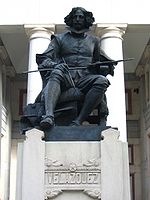
, it also contains important collections of other types of works. A new, recently opened wing enlarged the display area by about 400 paintings, and it is currently used mainly for temporary expositions. El Prado is one of the most visited sites in the world, and it is considered to be among the greatest museums of art. The large numbers of works by Velázquez
and Francisco de Goya (the artist more extensively represented in the collection), Titian
, Rubens and Bosch are among the highlights of the collection.
The collection currently comprises around 7,600 paintings, 1,000 sculptures, 4,800 prints and 8,200 drawings, in addition to a large number of works of art and historic documents. By 2012 the Museum will be displaying about 1300 works in the main buildings, while around 3,100 works are on temporary loan to various museums and official institutions. The remainder are in storage.
The best-known work on display at the museum is Las Meninas
by Velázquez. Velázquez not only provided the Prado with his own works, but his keen eye and sensibility was also responsible for bringing much of the museum's fine collection of Italian masters to Spain.
 The Museo del Prado has the largest collection of Spanish painting in the world, numbering more than 4,800 paintings and dating from the Romanesque period to the 19th century. This internationally-renowned collection includes masterpieces by artists such as Bartolomé Bermejo
, Pedro Berruguete
, Sánchez Coello
, El Greco
, Ribera, Zurbarán
, Murillo
, Alonzo Cano
, Velázquez
, Goya
, Vicente López
, Fortuny
, Carlos de Haes, Federico de Madrazo.
The two artists who are best represented in the Prado are Velázquez and Goya. The Museum has almost 50 paintings by the former, mostly from the Spanish Royal Collection. They include almost all the artist's major compositions.
The Goya collection is also rich, comprising more than 140 paintings. While the artist worked for many years in the service of the Spanish royal family, only a few works in the Museum's collection are from royal residences, such as The Family of Charles IV. When the Museum opened Goya was still alive and it was only after his death that successive directors made great efforts to acquire his paintings, for example Federico de Madrazo, who purchased the tapestry cartoons. Madrazo's intention from the outset was to place Goya on the level of the great artists of the past in an homage to the leading painter of modern times. This explains why, in contrast to Velázquez, the Museum has acquired most of its works by Goya through donations, bequests and purchases.
.jpg) The frescoes from San Baudelio de Berlanga
The frescoes from San Baudelio de Berlanga
and Santa Cruz de Maderuelo are particularly important among the Romanesque paintings in the collection. The latter are installed in a specially designed chapel within the Museum, which reproduces the original arrangement of the paintings.
Franco-Gothic painting is well represented by the Saint Christopher Altarpiece, while examples of the Italo-Gothic are The Saint John the Baptist Altarpiece and The Mary Magdalen Altarpiece by Jaime Serra
. The International Gothic is represented by The Altarpiece of the Life of the Virgin and Saint Francis by Nicolás Francés.
The Prado possesses one of the masterpieces of Hispano-Flemish painting: Bartolomé Bermejo
's Saint Domingo of Silos, as well as two major works, The Pietà with Donors and Christ blessing, by Fernando Gallego
, the best known painter working in Castile at this period. A notable work by Juan de Flandes
, Court Painter to Isabella I of Castile
, is the Crucifixion, acquired in 2005.
Early Spanish Renaissance paintings are represented in the Prado by the series of works by Pedro Berruguete
from the monastery of Santo Tomás in Ávila, notably Saint Dominic Presiding over an Auto-da-fe. Other works of this period are The Virgin of the Knight of Montesa by Paolo da San Leocadio and The Flagellation by Alejo Fernández
.
The most important artist in this section of the Museum's collection is undoubtedly El Greco
. The Prado owns two works painted in Italy, namely The Annunciation and The Flight into Egypt, as well as more than thirty painted in Spain. Among the latter is The Trinity from the altarpiece painted for Santo Domingo el Antiguo in Toledo, one of the first works that El Greco executed after he moved to Toledo; the five great canvases from the Altarpiece of the Colegio de Doña María de Aragon; and the famous Knight with his hand on her Breast, along with a fine group of other portraits.
Among early naturalist works are outstanding paintings by Ribalta, Maino and Herrera the Elder. Also dating from this period are various important still lifes, such as Game Fowl, Fruit and Vegetables by Sánchez Cotán, and the group of works by Juan van der Hamen that was enriched in 2006 by the acquisition of the Naseiro Collection.
. The 1743 Family of Philip V
is here.
Highly important works are also to be seen by the other figures of the Spanish Golden Age
: Ribera, Murillo, Zurbarán and Alonso Cano. Like Velázquez, Ribera is represented by around 50 paintings, among them masterpieces such as Jacob and Esau and The Martyrdom of Saint Philip. Murillo is represented in the Prado by around 40 paintings, some as celebrated as The Good Shepherd, The Holy Family with the Bird and The Immaculate Conception of los Venerables (The "Soult" Immaculate Conception). Zurbarán is also represented by a collection of works including Saint Elizabeth of Portugal and two paintings from the series on "The Life of Saint Pedro Nolasco" from the Cloister of the Merced Calzada in Seville
. The same can be said of Alonso Cano, represented by paintings such as The Dead Christ supported by an Angel.
The Prado has numerous religious paintings from the 17th-century Madrid school, including works by Fray Juan Ricci, Pereda, Francisco de Herrera el Mozo and Claudio Coello, as well as some magnificent portraits by Carreño de Miranda. Other 17th-century Spanish schools are represented, such as the Sevillian, which includes examples of the work of Valdés Leal.
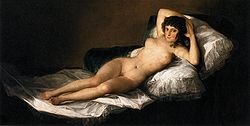
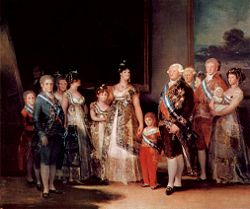 More than 140 paintings by Francisco de Goya offer the visitor to the Prado the chance to analyse the artist's development in considerable depth. Goya's art arises from the Spanish tradition and Velázquez was his master, as he himself said. Goya was a brilliant and unique artist on a level with the other great masters of painting and far above his contemporaries in Spain. Among the most important works by the artist in the collection of the Museo del Prado are the tapestry cartoons The Parasol and The Crockery Vendor, and portraits of The Duke and Duchess of Osuna and their Children, The Countess of Chinchón, Don Gaspar Melchor de Jovellanos, The Family of Charles IV and The Marchioness of Santa Cruz. In addition La maja desnuda
and La maja vestida
are included, which have acquired near-iconic status. Goya as a history painter is represented by major works such as The Assault on the Mamelukes and The Executions on Príncipe Pío, better known as The Second and Third of May, respectively. Among works from the last two periods of Goya's career are the Black Paintings, executed in Madrid, and The Milkmaid of Bordeaux, which the artist completed during his final years when he lived in that French city.
Also forming part of the 18th-century Spanish collection is a large group of still lifes by Luis Melédez; small, cabinet paintings by Paret y Alcázar such as The Masked Ball and Charles III eating before the Court; tapestry cartoons by the Bayeu brothers; and other paintings such as Antonio Carnicero's The Ascent of a Montgolfier Balloon in Aranjuez.
The 19th-century portrait collection is extremely extensive and includes some outstanding works. Among the most important are Vicente López's Portrait of Goya, Federico de Madrazo's The Countess of Vilches, and Esquivel's The Contemporary Poets.
The most important group within the landscape section comprises more than 80 works by Carlos de Haes. Also well represented is Péréz Villaamil with his Romantic landscapes. The Museum has some extremely fine paintings by Fortuny including Fantasy on ‘Faust’ and Nude on the Beach at Portici. Also worth noting are the works by Sorolla in the collection. These allow for a study of his stylistic development, from the dark tonality of And they still say Fish is dear! to the better known Luminist style of Boys on the Beach.
The Prado does not normally show modern art, but Pablo Picasso
's famous painting Guernica
was exhibited in the Prado for some time after its return to Spain after the restoration of democracy
, until it was moved to the Museo Reina Sofía
in 1992 as part of a transfer of all works later than the early 19th century to other buildings for space reasons.
There were few examples of 14th- and 15th-century Italian painting in the royal collection as this was a less appreciated area until the 19th century. For this reason it is not as well represented in the Museum, although there are a small number of great 15th-century masterpieces by Fra Angelico, Mantegna, Antonello da Messina and Botticelli, which entered the collection by different routes.
 16th-century painting comprises a more coherent and complete group, mainly originating from the royal collection. Venetian art of this date is the best represented among the various Italian schools. As a result of his commissions from Charles V and Philip II, Titian became the Habsburg painter par excellence. The Prado possesses more than 40 paintings by Titian alone, as well as exceptional works by Veronese, Tintoretto and the Bassano. The extraordinary group of works by Raphael acquired by Philip IV initiated a new taste for that artist, who replaced Titian in Bourbon eyes and became the favourite of the new dynasty. Also represented in the Prado are other great masters such as Correggio and Parmigianino of the School of Parma, Sebastiano del Piombo of the Roman School and Andrea del Sarto of the Florentine.
The collection of 17th- and 18th-century Italian paintings is also one of the most extensive in the Museum and once again the royal collection accounts for most of them. Many works arrived through the negotiations undertaken by Spanish ambassadors and viceroys in Rome and Naples who were instructed to secure paintings to decorate the Buen Retiro Palace, built in the 17th century. Another important group is due to the presence of Italian artists in Italy such as Luca Giordano, Corrado Giaquinto and Giambattista Tiepolo.
The Museo del Prado has various Italian paintings from the 15th century, such as The Death of the Virgin by Mantegna, acquired for Philip IV, The Annunciation by Fra Angelico
, and Scenes from the Story of Nastagio degli Onesti by Botticelli. Also worthy of mention is The Dead Christ supported by an Angel by Antonello da Messina
, whose purchase in 1966 signified an important addition to the collection due to the work's outstanding quality.
The 16th-century paintings include the Raphael collection, with compositions such as The Holy Family with the Lamb, The Virgin of the Fish and Portrait of a Cardinal. The Venetian school
, which is one of the strengths of the Prado's collection, includes a group of works by Titian including Charles V at Mühlberg, The Worship of Venus, Danäe
, Venus and Adonis
and the artist's Self-portrait. Notable works by Veronese
are Venus and Adonis, Moses rescued from the Nile, and Christ among the Doctors, while important works by Tintoretto include Christ washing the Disciples’ Feet and the seven paintings of Old Testament scenes purchased by Velázquez during his second Italian trip.
Other well represented Italian artists of this period are Correggio with the Noli me tangere, and Andrea del Sarto with The Virgin and Child between Saint Matthew and an Angel. The Prado also has paintings by Parmigianino, Sebastiano del Piombo and the Bassano.
The most important artist of the Bolognese School, Annibale Carracci
, is well represented in the Museum with Venus, Adonis and Cupid. Other artists from this school include the classicising Guido Reni
, present with works such as Hippomenes and Atalanta and Saint Sebastian, and Guercino, with Susannah and the Elders and Saint Peter freed by the Angel.
The Prado has a large collection of paintings by the Neapolitan artist Luca Giordano. They number around 80 and span his entire career from his early years in Italy with paintings such as Rubens painting the Allegory of Peace to late works from the end of his Spanish years such as Charles II on Horseback, The prudent Abigail and The Capture of a Fortress.
, and The Embarkation of Charles III in Naples by Antonio Joli
. The group of three compositions with ruins by Panini is worth singling out.
A small but interesting group of Grand Tour portraits should be mentioned. These include Francis Basset, Ist Baron Dunstanville
, and George Legge, Viscount Lewisham, both by Batoni
.
Among the extensive group of works by Corrado Giaquinto
in the Prado, worth separate mention are the preparatory oil sketch for the fresco in the Royal Palace in Madrid entitled The Birth of the Sun and the Triumph of Bacchus, and the allegorical composition of Justice and Peace.
Among the best examples of works by the Tiepolo family in the Prado's collection are Giambattista Tiepolo
's Immaculate Conception, the eight canvases on the Passion from the Madrid church of San Felipe Neri by his son Giandomenico
, and various pastel portraits by another son Lorenzo
.
. In addition, mention should be made of Flemish and Netherlandish artists who worked for the king, such as the Netherlandish portrait painter Antonis Mor. The Prado, however, lacks paintings by some of the important artists of the Flemish school, for example Jan van Eyck
and Hugo van der Goes
The southern provinces of the Low Countries remained under Spanish rule after the separation of the northern provinces (modern-day Holland) in 1581. Thereforethe Prado possess works by the leading 17th-century Flemish painters, who were subjects of the Spanish Crown. The group of paintings by Rubens is of outstanding importance, numbering more than 90, many of them true masterpieces and some executed in Spain during the two visits that the artist made in 1603 and 1628.
Paintings by Rubens’ followers Van Dyck and Jordaens complete the holdings of the leading names of 17th-century Flemish painting, which also include paintings by Jan Brueghel the Elder
, Paul de Vos
and David Teniers the Younger
.
Two works by Robert Campin, who initiated the 15th-century Flemish style, should be mentioned: Saint John the Baptist and the Franciscan Theologian Heinrich von Werl and Saint Barbara. His pupil, Rogier van der Weyden, is represented in the Prado by two of his most important masterpieces, The Descent from the Cross and The Virgin and Child. Magnificent works by other leading 15th-century Flemish painters in the Museum include the Triptych on the Life of Christ by Dirk Bouts and The Adoration of the Magi Triptych by Hans Memling, as well as the panel of The Rest on the Flight into Egypt by Gerard David.
The Flemish Primitive School culminates in the Prado's collection with the superb collection of panel paintings by Hieronymous Bosch, the largest in any single public collection and, most importantly, the collection that includes the greatest number of major works by this painter from s’Hertogenbosch. These include the three triptychs of The Garden of Earthly Delights, The Adoration of the Magi and The Haywain, and The Tabletop of the Seven Deadly Sins.
Among 16th-century Flemish painting a notable place is occupied by the four panels by Joachim Patinir, The Rest on the Flight into Egypt, Landscape with Saint Jerome, Charon crossing the Styx, and The Temptations of Saint Anthony, painted in collaboration with Quintin Massys. As in the case of Bosch, this group is the largest and most important one by the artist to be found in any museum.
Among the 16th-century Flemish paintings in the Museo del Prado are various masterpieces by major artists. These include Quintin Massys’ Ecce Homo, Barend van Orley's Holy Family, Christ between the Virgin and Saint John by Gossaert and The Triumph of Death by Pieter Bruegel the Elder. Among genre paintings, notable works are those by Marinus Reymerswaele and Jan Sanders van Hemessen.
Portraits of this period in the Prado include the magnificent series by Anthonis Mor, most notably the Portrait of Mary Tudor and The Court Jester Pejerón. They can be considered high points of this genre in the 16th century and in particular within court portraiture, along with those by Titian.
The collection of portraits by Van Dyck is exceptional, particularly Sir Endymion Porter and Van Dyck, and Martin Ryckaert among the male portraits and Diana Cecil, Countess of Oxford and Maria Ruthwen among the female ones.
Of the paintings by Jacob Jordaens in the Museum, the most notable are Three strolling Musicians, The Wedding of Thetis and Peleus and the splendid Family Portrait.
The most important genre painter of this school and period is David Teniers, of whom the Prado owns more than 50 paintings. Among animal painters particular attention should be paid to Frans Snyders and Paul de Vos, while Clara Peeters and Daniel Seghers are notable for their still lifes.
and Claude Lorraine, the leading French, classicising painters, were directly commissioned from the artists during the reign of Philip IV
to decorate the Buen Retiro Palace
.
In the 18th century the reign of Philip V
marked the start of the Bourbon dynasty in Spain and French art became more appreciated by royal collectors. Various French artists worked for the first Bourbon monarch, such as Michel-Ange Houasse, Jean Ranc
and Louis-Michel van Loo
. A considerable number of works also arrived from France at this time or were acquired on the international market, including paintings by Watteau
, Coypel
and Rigaud
.
Despite the close relationship between Spain and the Holy Roman Empire
during the period of the Habsburgs, the German School is minimally represented in the Prado's collection. Nonetheless, among its holdings, which mostly come from the former royal collection, there are various key works by Albrecht Dürer
, the most important German artist of this period. In addition, the German School collection includes 18th-century paintings by Anton Raphael Mengs
, Court Painter to Charles III and another leading name in German art.
With regard to the 16th century, the Prado has four works by Dürer: a Self-portrait, Adam and Eve, and Portrait of an Unknown Man, all of which came to the Alcázar in Madrid during the reign of Philip IV. With a provenance dating back to Philip II's collection are the two panels by Hans Baldung Grien, Harmony or The Three Graces and The Ages of Man, and two works by Lucas Cranach the Elder
: Hunt in Honour of Charles V at the Castle of Torgau and Hunt in Honour of Ferdinand I, King of the Romans, at the Castle of Torgau.
The largest number of 18th-century German paintings in the collection are by Mengs, and visitors can see Spanish, Neapolitan and Tuscan court portraits by this artist, some of them depicting royal children, as well as a Self-portrait and various religious compositions.
and Frans Hals
but taken together this group offers an overview of the different trends within this school. Due to historical circumstances and the hostility (at times open war) between the House of Orange and the Spanish Crown following their split in 1581, few Dutch works arrived in Spain in the 17th century, as might be expected. Most of the paintings in the Prado come from the former royal collection and almost all were acquired in the 18th century. Notable among them is Rembrandt's Artemisia
, purchased during the reign of Charles III.
The Museum has various paintings by Matthias Stomer and Salomon de Bray
, including The Incredulity of Saint Thomas and Judith and Holofernes, as well as still lifes by the most important artists of the Haarlem School: Pieter Claesz
, Willem Claesz Heda, and Jan Davidsz de Heem.
Dutch genre painting is represented by Philips Wouwerman and Adriaen van Ostade
. The landscape paintings include various works by Jan Both, Herman van Swanevelt
and Jacob van Ruisdael.
An example of an intimately expressed portrait is Gerard Ter Borch
's Portrait of Petronella de Waert, while animal painting, one of the most characteristic Dutch genres, is represented by Gabriel Metsu
's Dead Cockerel.
all impeded appreciation of British art in Spain. Nonetheless, the Prado has a group of works which, although small in number, are of fine quality and were mostly acquired in the 20th century. Most are portraits painted in the second half of the 18th century and the first half of the 19th, by Reynolds
, Gainsborough
, Romney
and Hoppner
. The best-represented portraitist is undoubtedly Thomas Lawrence
, with significant works such as the portraits of John Fane, 10th Earl of Westmorland
, Miss Martha Carr and A Lady from the Storer Family.
David Roberts
, who is an important artist due to his associations with Spanish Romanticism, is present in the form of three paintings: The Torre de Oro, Seville, The Castle of Alcalá de Guadaira and The Interior of the Mosque, Córdoba.
The first group derives from the royal collection and principally comprises Greco-Roman sculptures in addition to Renaissance bronzes by artists such as the Leoni, who executed sculpted portraits of the Spanish monarchs in the 16th century. With the importation of sculptures from Italy, the taste for the classical revived in 17th-century Spain. This was in fact one of the main reasons for Velázquez's second trip to Italy, and during his stay in Rome he was involved in the selection of works on behalf of Philip IV. Particularly important were the acquisitions made in the 18th century by Philip V and his queen, Isabella Farnese, who purchased the collection of Queen Christina of Sweden, to which that of José Nicolás de Azara was later added.
With regard to more recent acquisitions, an important addition was the small but significant group of archaic Greek sculpture donated by Mario Zayas in 1944, an area not represented by a single work in the Spanish royal collection. Two sculptures of Epimetheus and Pandora by El Greco are also recent acquisitions for the collection.
.
Fifth-century classicism can be studied through Roman copies of Greek sculptures by Phidias, Polyclitus, Myron and Callimachus. These include the Athena Parthenos, a magnificent miniature copy of the great image that Phidias created for the Parthenon in Athens; a copy of Myron's Athena from the group of Athena and Marsyas; a copy of Polyclitus's magnificent Diadumenos; and a copy of the four Maenad reliefs by Callimachus.
Fourth-century BC classicism is represented by Roman copies of the best artists of the period: the magnificent Head of the Cnidian Venus, the Satyr in Repose by Praxitiles, Scopas's Hercules, and the Head of Silenus and Head of Hercules by Lysippus.
The Prado has numerous works from the Hellenistic period, all Roman copies apart from the Head of Diadocus, which is possibly Greek. Particularly fine examples among these copies are the Faun with Kid from the Pergamene School, which is the only known copy of the Greek original. Other notable works are the Hipnus, Ariadne, and a sizeable group of Hellenistic Venuses of various types: Crouching Venus, Venus with the Dolphin, The Venus of Madrid, Venus with an Apple, and Venus with a Cockle Shell.
_01.jpg) The Saint Ildefonso Group is one of the best examples of Neo-Attic eclecticism produced in the first decades of the Roman Empire. Another exceptional piece is The Apotheosis of Claudius, which stands on a Baroque pedestal.
The Saint Ildefonso Group is one of the best examples of Neo-Attic eclecticism produced in the first decades of the Roman Empire. Another exceptional piece is The Apotheosis of Claudius, which stands on a Baroque pedestal.
The collection of Roman portraits is extensive. On display are three representative works of the three main iconographic models used to represent the emperor: Augustus in a Toga, symbolising the emperor's religious and civil power; Figure in a Cuirass, presented as the leader of the armies; and Augustus or Tiberius in heroic Nude, depicted as a divinity after death.
A sizeable group of male and female busts, including Augustus
, Antoninus Pius
, Clodius Albinus
and Vibia Sabina
indicate the interest in capturing the sitter's personality evident in Roman art of this period.
Large-scale sculptures of the type characteristic of cult images are also to be found in the collection, including Jupiter and Neptune, as well as various mythological reliefs, among them the Bacchic Altar, a Neo-Attic work of the late Hellenic period, and the Sarcophagus with the Story of Achilles and Polyxena.
 The Prado, considers the finest examples of Renaissance sculptures in the museum to be the group of full-length portraits, busts and reliefs of Charles V and his family: the Empress Elizabeth, their son Philip II and Charles's sisters, Mary of Hungary and Leonora of Austria. These bronzes and marbles portraits were created by the Italian sculptor Leone Leoni
and his son Pompeo Leoni. The group include the legendary bronze of Charles V and the Fury.
The collection also includes other works by various Spanish sculptors, such as the Venus by Bartolomeo Ammanati
and the alabaster relief of the Allegory of Francisco I de’Medici by Giambologna
.
El Greco's sculptures of Epimetheus and Pandora are particularly significant due to the importance of the artist and the fact that they are one of the very few known examples of sculpted nudes of a mythological type produced in Spain during the time of the Council of Trent
.
The Prado also has a series of sculpted equestrian portraits of small size depicting various Spanish monarchs. Those of Philip IV by Pietro Tacca
and Charles II by Foggini
date from the 17th century, while Philip V by Lorenzo Vaccaro
is an 18th-century work.
A notable 15th-century drawing is the project for the altarpiece on the high altar of San Juan de los Reyes in Toledo, attributed to Juan Guas. The collection of 16th-century drawings is larger and includes works by the Valencian painter Juan de Juanes and painters from El Escorial such as Bartolomé Carducho and Patricio Cajés.
The 17th-century drawings include magnificent sheets by Alonso Cano, Ribera, Valdés Leal, Ribalta, Vicente Carducho, Eugenio Cajés, Pereda, Claudio Coello and Palomino.
However, it is the 18th century that is best represented, both in terms of number and quality. In addition to the very large group of more than 400 drawings by Francisco Bayeu, there are also drawings by other leading painters such as Ramón Bayeu, Salvador Maella, González Ruiz and Paret y Alcázar.
Without doubt, however, the most important and celebrated part of the Prado's drawings collection is the large group of works by Goya, numbering more than 500. Albums and series such as the Sanlúcar Album, the Madrid Album, The Disasters of War, The Tauromaquia and The Proverbs mean that it is possible to study the artist's stylistic evolution.
Goya's influence is to be seen in the numerous drawings in the collection by Zapata, Alenza and Lucas. The group of drawings by Carlos de Haes is magnificent, more than 130 of which came from the Museo del Arte Moderno in addition to the album with a further 22 sheets purchased in 2005. In addition to the names mentioned above, there is a significant group of 19th-century drawings by artists such as Fortuny, Vicente López, Federico de Madrazo, Pérez Villaamil and Eduardo Rosales.
The 17th century is represented by important examples by some of the leading painters of the time such as Annibale Carracci, Guido Reni, Guercino and Luca Giordano.
Among 18th-century drawings the Prado has magnificent pastels by Lorenzo Tiepolo, as well as very interesting works by Giambattista Tiepolo, Giaquinto, Batoni and Bibiena.
Drawings from other schools such as the Flemish, French and German comprise a smaller group but there are significant works by Rubens, Jordanes, Teniers, Corneille Blanchard and Mengs.
As in the case of the drawings, the most important prints in the Prado's collection are by Goya. The Museum has prints from his first series, The Paintings of Velázquez, and from later ones such as The Caprichos, The Disasters of War, The Tauromaquia and The Disparates.
Other prints worthy of mention are those by Mariano Fortuny, many of them related to his period in Morocco, the two series of the Essays in Etching by Carlos de Haes and various works by Joaquín Pi i Margall, namely, The Iliad, The Odyssey, The Days and The Theogony or The Divine Comedy.
Various artists collaborated on the collections of The Paintings from the Casón del Bueno Retiro, The Lithographic Collection of the Paintings of the King of Spain, Selected Paintings from the Real Academia de San Fernando and The Etcher.
Among prints by non-Spanish artists, the Museum has four by Dürer: Hercules at the Crossroads, The Penance of Saint John Chrysostom, The Four Angels holding back the Winds, and Saint Michael defeating the Dragon, the last two from the Apocalypse series.
The Prado also has prints by Anthony van Dyck, Annibale Carracci, Rembrandt and Giambattista Tiepolo. By the latter the Museum has the set of ten prints from the Vari Capricci published in 1785.
in 1785 by the architect Juan de Villanueva
in order to house the Natural History Cabinet. Nonetheless, the building's final function was not decided until the monarch's grandson, Ferdinand VII, encouraged by his wife, Queen María Isabel de Braganza, decided to use it as a new Royal Museum of Paintings and Sculptures. The Royal Museum, which would soon become known as the National Museum of Painting and Sculpture and subsequently the Museo Nacional del Prado, opened to the public for the first time in November 1819. It was created with the double aim of showing the works of art that belonged to the Spanish Crown and to demonstrate to the rest of Europe that Spanish art was of equal merit to any other national school. The first catalogue of the Museum, published in 1819 and solely devoted to Spanish painting, included 311 paintings, although at that time the Museum housed 1,510 from the various Reales Sitios [royal residences] including works from other schools. The exceptionally important royal collection, which forms the nucleus of the present-day Museo del Prado, started to increase significantly in the 16th century during the time of Charles V and continued under the succeeding Habsburg and Bourbon monarchs. Their efforts and determination meant that the Royal Collection was enriched by some of the masterpieces now to be seen in the Prado. These include The Descent from the Cross by Rogier van der Weyden, The Garden of Earthly Delights by Hieronymous Bosch, Knight with his Hand on his Breast by El Greco, The Death of the Virgin by Mantegna, The Holy Family, known as "La Perla", by Raphael, Charles V at Mülhberg by Titian, Christ Washing the Disciples’ Feet by Tintoretto, Dürer's Self-portrait, Las Meninas by Velázquez, The Three Graces by Rubens, and The Family of Charles IV by Goya.
In addition to works from the Spanish royal collection, other holdings increased and enriched the Museum with further masterpieces, such as the two Majas by Goya. Among the now closed museums whose collections have been added to that of the Prado were the Museo del la Trinidad in 1872, and the Museo de Arte Moderno in 1971. In addition, numerous legacies, donations and purchases have been of crucial importance for the growth of the collection.
Various works entered the Prado from the Museo de la Trinidad, including The Fountain of Grace by the School of Van Eyck, the Santo Domingo and San Pedro Martír altarpieces painted for the monastery of Santo Tomás in Ávila by Pedro Berruguete, and the five canvases by El Greco executed for the Colegio de doña María de Aragón.
Most of the Museum's 19th-century paintings come from the former Museo de Arte Moderno, including works by the Madrazo, Vicente López, Carlos de Haes, Rosales and Sorolla.
Upon the deposition of Isabella II
in 1868, the museum was nationalized and acquired the new name of "Museo del Prado". The building housed the royal collection of arts, and it rapidly proved too small. The first enlargement to the museum took place in 1918.
 The main building was enlarged with short pavilions in the back between 1900 and 1960. The next enlargement was the incorporation of two buildings (nearby but not adjacent) into the institutional structure of the museum: the Casón del Buen Retiro which housed the bulk of the 20th century art from 1971 to 1997, and the Salon de Reinos (Throne building), formerly the Army Museum.
The last enlargement (2007), designed by architect Rafael Moneo
, is an underground building which connects the main building to another one entirely reconstructed.
During the Spanish Civil War
, upon the recommendation of the League of Nations
, the museum staff removed 353 paintings, 168 drawings and the Dauphin's Treasure and sent the art to Valencia
, then later to Girona
, and finally to Geneva
. The art had to be returned across French territory in night trains to the museum upon the commencement of World War II.
Since the creation of the Museo del Prado more than 2,300 paintings have been incorporated into its collection, as well as a large number of sculptures, prints, drawings and works of art through bequests, donations and purchases, which account for most of the New Acquisitions. Numerous bequests have enriched the Museum's holdings, such as the outstanding collection of medals left to the Museum by Pablo Bosch; the drawings and items of decorative art left by Pedro Fernández Durán as well as Van der Weyden's masterpiece, The Virgin and Child; and the Ramón de Errazu bequest of 19th-century paintings. Particularly important donations include Barón Emile d'Erlanger's gift of Goya's Black Paintings in 1881. Among the numerous works that have entered the collection through purchase are some outstanding ones acquired in recent years including two works by El Greco, The Fable and The Flight into Egypt acquired in 1993 and 2001, Goya's Countess of Chinchón bought in 2000, and Velázquez's portrait of The Pope's Barber acquired in 2003.
In 2007, the Museum executed the Moneo's project to expand its exposition room to 16,000 square meters, hoping to increase the yearly number of visitors from 1.8 million to 2.5 million. The 16th-century Cloister of Jerónimo has been removed stone by stone to make foundations for increased stability of surrounding buildings and will be re-assembled in the new museum's extension. Hydraulic jacks had to be used to prevent the basement walls from falling during construction.
(Carlos III) as part of a grandiose building scheme designed to bestow upon Madrid
a monumental urban space. The building that lodges the Museum of the Prado was initially conceived by José Moñino y Redondo, conde de Floridablanca
and was commissioned in 1785 by Charles III for the reurbanización of the Paseo del Prado. To this end, Charles III called on one of its favorite architects, Juan de Villanueva, author also of the nearby Botanical Garden and the City Hall of Madrid. The prado ("meadow") that was where the museum now stands gave its name to the area, the Salón del Prado (later Paseo del Prado
), and to the museum itself upon nationalisation. Work on the building stopped at the conclusion of Charles III's reign and throughout the Peninsular War
and was only initiated again during the reign of Charles III's grandson, Ferdinand VII. The structure was used as headquarters for the cavalry
and a gunpowder
-store for the Napoleon
ic troops based in Madrid during the War of Independence.
Near the Museo del Prado are two other national museums: the Museo Arqueológico
houses some art of Ancient Egypt
, Mesopotamia
, Greece
, and Rome
formerly in the Prado Collection; the Museo Reina Sofía
houses 20th-century artwork. These two museums supplement the Prado, as do the Buen Retiro and Thyssen-Bornemisza Museum (all within a short walk of each other).
and Google Maps
at extremely high resolution, with the largest displayed at 14,000 megapixels. The images' zoom capability allows for close-up views of paint texture and fine detail. The displayed paintings are shown below (all images are the same images shown at Prado in Google Earth).
Madrid
Madrid is the capital and largest city of Spain. The population of the city is roughly 3.3 million and the entire population of the Madrid metropolitan area is calculated to be 6.271 million. It is the third largest city in the European Union, after London and Berlin, and its metropolitan...
. It features one of the world's finest collections of European art, from the 12th century to the early 19th century, based on the former Spanish Royal Collection, and unquestionably the best single collection of Spanish art
Spanish art
Spanish art is the visual art of Spain, and that of Spanish artists worldwide. Whilst an important contributor to Western art and producing many famous and influential artists Spanish art has often had distinctive characteristics and been assessed...
. Founded as a museum of painting
Painting
Painting is the practice of applying paint, pigment, color or other medium to a surface . The application of the medium is commonly applied to the base with a brush but other objects can be used. In art, the term painting describes both the act and the result of the action. However, painting is...
s and sculpture
Sculpture
Sculpture is three-dimensional artwork created by shaping or combining hard materials—typically stone such as marble—or metal, glass, or wood. Softer materials can also be used, such as clay, textiles, plastics, polymers and softer metals...
, it also contains important collections of other types of works. A new, recently opened wing enlarged the display area by about 400 paintings, and it is currently used mainly for temporary expositions. El Prado is one of the most visited sites in the world, and it is considered to be among the greatest museums of art. The large numbers of works by Velázquez
Diego Velázquez
Diego Rodríguez de Silva y Velázquez was a Spanish painter who was the leading artist in the court of King Philip IV. He was an individualistic artist of the contemporary Baroque period, important as a portrait artist...
and Francisco de Goya (the artist more extensively represented in the collection), Titian
Titian
Tiziano Vecelli or Tiziano Vecellio Tiziano Vecelli or Tiziano Vecellio Tiziano Vecelli or Tiziano Vecellio (c. 1488/1490 – 27 August 1576 better known as Titian was an Italian painter, the most important member of the 16th-century Venetian school. He was born in Pieve di Cadore, near...
, Rubens and Bosch are among the highlights of the collection.
The collection currently comprises around 7,600 paintings, 1,000 sculptures, 4,800 prints and 8,200 drawings, in addition to a large number of works of art and historic documents. By 2012 the Museum will be displaying about 1300 works in the main buildings, while around 3,100 works are on temporary loan to various museums and official institutions. The remainder are in storage.
The best-known work on display at the museum is Las Meninas
Las Meninas
Las Meninas is a 1656 painting by Diego Velázquez, the leading artist of the Spanish Golden Age, in the Museo del Prado in Madrid. The work's complex and enigmatic composition raises questions about reality and illusion, and creates an uncertain relationship between the viewer and the figures...
by Velázquez. Velázquez not only provided the Prado with his own works, but his keen eye and sensibility was also responsible for bringing much of the museum's fine collection of Italian masters to Spain.
Spanish painting
Bartolomé Bermejo
Bartolomé Bermejo was a Spanish painter who adopted Flemish painting techniques and conventions.-Biography:Bermejo, whose real name was Bartolomé de Cárdenas, was born in Córdoba...
, Pedro Berruguete
Pedro Berruguete
Pedro Berruguete was a Spanish painter; his art is regarded as a transitional style between gothic and Renaissance. Born in Paredes de Nava, Spain, he went to Italy in 1480 and worked in Federico III da Montefeltro's court in Urbino, where he could see some works by Melozzo da Forlì...
, Sánchez Coello
Alonso Sánchez Coello
Alonso Sánchez Coello was a portrait painter of the Spanish Renaissance and one of the pioneers of the great tradition of Spanish portrait painting.- Life :...
, El Greco
El Greco
El Greco was a painter, sculptor and architect of the Spanish Renaissance. "El Greco" was a nickname, a reference to his ethnic Greek origin, and the artist normally signed his paintings with his full birth name in Greek letters, Δομήνικος Θεοτοκόπουλος .El Greco was born on Crete, which was at...
, Ribera, Zurbarán
Francisco Zurbarán
Francisco de Zurbarán was a Spanish painter. He is known primarily for his religious paintings depicting monks, nuns, and martyrs, and for his still-lifes...
, Murillo
Bartolomé Estéban Murillo
Bartolomé Esteban Murillo was a Spanish Baroque painter. Although he is best known for his religious works, Murillo also produced a considerable number of paintings of contemporary women and children...
, Alonzo Cano
Alonzo Cano
Alonzo Cano or Alonso Cano was a Spanish painter, architect and sculptor born in Granada. He learned architecture from his father, Miguel Cano; painting in the academy of Juan del Castillo, and from Francisco Pacheco the teacher of Velázquez; and sculpture from Juan Martínez Montañés...
, Velázquez
Diego Velázquez
Diego Rodríguez de Silva y Velázquez was a Spanish painter who was the leading artist in the court of King Philip IV. He was an individualistic artist of the contemporary Baroque period, important as a portrait artist...
, Goya
Francisco Goya
Francisco José de Goya y Lucientes was a Spanish romantic painter and printmaker regarded both as the last of the Old Masters and the first of the moderns. Goya was a court painter to the Spanish Crown, and through his works was both a commentator on and chronicler of his era...
, Vicente López
Vicente López y Portaña
Vicente López y Portaña was a Spanish painter, considered the best portrait painter of his time.- Early life:...
, Fortuny
Mariano Fortuny (painter)
Marià Fortuny i Marsal , known more simply as Marià Fortuny or Mariano Fortuny, was a Catalan painter...
, Carlos de Haes, Federico de Madrazo.
The two artists who are best represented in the Prado are Velázquez and Goya. The Museum has almost 50 paintings by the former, mostly from the Spanish Royal Collection. They include almost all the artist's major compositions.
The Goya collection is also rich, comprising more than 140 paintings. While the artist worked for many years in the service of the Spanish royal family, only a few works in the Museum's collection are from royal residences, such as The Family of Charles IV. When the Museum opened Goya was still alive and it was only after his death that successive directors made great efforts to acquire his paintings, for example Federico de Madrazo, who purchased the tapestry cartoons. Madrazo's intention from the outset was to place Goya on the level of the great artists of the past in an homage to the leading painter of modern times. This explains why, in contrast to Velázquez, the Museum has acquired most of its works by Goya through donations, bequests and purchases.
Romanesque, Gothic and Early Renaissance painting
San Baudelio de Berlanga
The Hermitage of San Baudelio de Berlanga is a church situated at Caltojar, province of Soria, Spain, 80 km south of Berlanga de Duero. It is an example of Mozarabic architecture and was built in the 11th century, in what was then the frontier between Islamic and Christian lands...
and Santa Cruz de Maderuelo are particularly important among the Romanesque paintings in the collection. The latter are installed in a specially designed chapel within the Museum, which reproduces the original arrangement of the paintings.
Franco-Gothic painting is well represented by the Saint Christopher Altarpiece, while examples of the Italo-Gothic are The Saint John the Baptist Altarpiece and The Mary Magdalen Altarpiece by Jaime Serra
Jaime Serra (artist)
Jaume Serra was a Catalonian painter. Serra was influenced heavily by a Sienese style introduced by Ferrer Bassa. His altarpiece The Holy Spirit can be found in the Manresa cathedral....
. The International Gothic is represented by The Altarpiece of the Life of the Virgin and Saint Francis by Nicolás Francés.
The Prado possesses one of the masterpieces of Hispano-Flemish painting: Bartolomé Bermejo
Bartolomé Bermejo
Bartolomé Bermejo was a Spanish painter who adopted Flemish painting techniques and conventions.-Biography:Bermejo, whose real name was Bartolomé de Cárdenas, was born in Córdoba...
's Saint Domingo of Silos, as well as two major works, The Pietà with Donors and Christ blessing, by Fernando Gallego
Fernando Gallego
Fernando Gallego was a Spanish painter, brought up in an age of gothic style, his art is generally regarded as Hispano-Flemish style...
, the best known painter working in Castile at this period. A notable work by Juan de Flandes
Juan de Flandes
Juan de Flandes was an Early Netherlandish painter who was active in Spain from 1496 to 1519; his actual name is unknown, although an inscription Juan Astrat on the back of one work suggests a name such as "Jan van der Staat"...
, Court Painter to Isabella I of Castile
Isabella I of Castile
Isabella I was Queen of Castile and León. She and her husband Ferdinand II of Aragon brought stability to both kingdoms that became the basis for the unification of Spain. Later the two laid the foundations for the political unification of Spain under their grandson, Charles V, Holy Roman Emperor...
, is the Crucifixion, acquired in 2005.
Early Spanish Renaissance paintings are represented in the Prado by the series of works by Pedro Berruguete
Pedro Berruguete
Pedro Berruguete was a Spanish painter; his art is regarded as a transitional style between gothic and Renaissance. Born in Paredes de Nava, Spain, he went to Italy in 1480 and worked in Federico III da Montefeltro's court in Urbino, where he could see some works by Melozzo da Forlì...
from the monastery of Santo Tomás in Ávila, notably Saint Dominic Presiding over an Auto-da-fe. Other works of this period are The Virgin of the Knight of Montesa by Paolo da San Leocadio and The Flagellation by Alejo Fernández
Alejo Fernández
Alejo Fernández was a Spanish painter best known for his portrait of Christopher Columbus painted between 1505 and 1536.-Biography:...
.
El Greco and Renaissance painting. Early naturalism
The Museo del Prado's collection includes one of the great masterpieces of Spanish Renaissance painting, Saint Catherine by Fernando Yáñez, as well as one of the best known works of this period, Juan de Flandes’ The Last Supper. Other Spanish Renaissance artists well represented in the Museum are the Toledan painter Juan Correa de Vivar and Luis de Morales from Extremadura, particularly through his Virgin and Child compositions. Worth special mention is the group of Renaissance court portraits including images by Alonso Sánchez Coello and Juan Pantoja de la Cruz.The most important artist in this section of the Museum's collection is undoubtedly El Greco
El Greco
El Greco was a painter, sculptor and architect of the Spanish Renaissance. "El Greco" was a nickname, a reference to his ethnic Greek origin, and the artist normally signed his paintings with his full birth name in Greek letters, Δομήνικος Θεοτοκόπουλος .El Greco was born on Crete, which was at...
. The Prado owns two works painted in Italy, namely The Annunciation and The Flight into Egypt, as well as more than thirty painted in Spain. Among the latter is The Trinity from the altarpiece painted for Santo Domingo el Antiguo in Toledo, one of the first works that El Greco executed after he moved to Toledo; the five great canvases from the Altarpiece of the Colegio de Doña María de Aragon; and the famous Knight with his hand on her Breast, along with a fine group of other portraits.
Among early naturalist works are outstanding paintings by Ribalta, Maino and Herrera the Elder. Also dating from this period are various important still lifes, such as Game Fowl, Fruit and Vegetables by Sánchez Cotán, and the group of works by Juan van der Hamen that was enriched in 2006 by the acquisition of the Naseiro Collection.
Baroque painting
Represented by almost 50 works, more than one third of his total output, Velázquez is the towering genius of this period in the Prado's collection. Among his most popular paintings in the collection is The Adoration of the Magi from his Sevillian phase. From his period as Court Painter are the portraits of Philip IV, Prince Baltasar Carlos, the Infante Don Carlos and Queen Mariana of Austria, together with a sizeable collection of portraits of court dwarves such as Pablo de Valladolid. Also dating from the artist's years in the service of Philip IV are various "history" paintings including Los Borrachos, Vulcan's Forge and The Surrender of Breda, in addition to two major compositions from the end of his life, namely The Fable of Arachne (The Spinners) and Las MeninasLas Meninas
Las Meninas is a 1656 painting by Diego Velázquez, the leading artist of the Spanish Golden Age, in the Museo del Prado in Madrid. The work's complex and enigmatic composition raises questions about reality and illusion, and creates an uncertain relationship between the viewer and the figures...
. The 1743 Family of Philip V
The Family of Philip V (1743)
The Family of Felipe V is an oil on canvas painting by the French artist Louis Michel van Loo, completed in 1743. It features life-sized depictions of Philip V of Spain and his family. The painting depicts the royals in a fictional room and is in the style of French baroque and rococo art...
is here.
Highly important works are also to be seen by the other figures of the Spanish Golden Age
Spanish Golden Age
The Spanish Golden Age is a period of flourishing in arts and literature in Spain, coinciding with the political rise and decline of the Spanish Habsburg dynasty. El Siglo de Oro does not imply precise dates and is usually considered to have lasted longer than an actual century...
: Ribera, Murillo, Zurbarán and Alonso Cano. Like Velázquez, Ribera is represented by around 50 paintings, among them masterpieces such as Jacob and Esau and The Martyrdom of Saint Philip. Murillo is represented in the Prado by around 40 paintings, some as celebrated as The Good Shepherd, The Holy Family with the Bird and The Immaculate Conception of los Venerables (The "Soult" Immaculate Conception). Zurbarán is also represented by a collection of works including Saint Elizabeth of Portugal and two paintings from the series on "The Life of Saint Pedro Nolasco" from the Cloister of the Merced Calzada in Seville
Seville
Seville is the artistic, historic, cultural, and financial capital of southern Spain. It is the capital of the autonomous community of Andalusia and of the province of Seville. It is situated on the plain of the River Guadalquivir, with an average elevation of above sea level...
. The same can be said of Alonso Cano, represented by paintings such as The Dead Christ supported by an Angel.
The Prado has numerous religious paintings from the 17th-century Madrid school, including works by Fray Juan Ricci, Pereda, Francisco de Herrera el Mozo and Claudio Coello, as well as some magnificent portraits by Carreño de Miranda. Other 17th-century Spanish schools are represented, such as the Sevillian, which includes examples of the work of Valdés Leal.
Goya and 18th-century painting
La Maja Desnuda
La maja desnuda is an oil on canvas painting by the Spanish painter Francisco Goya , portraying a nude woman reclining on a bed of pillows. It was executed some time between 1797 and 1800, and is sometimes said to be the first clear depiction of female pubic hair in a large Western painting...
and La maja vestida
La Maja Vestida
La maja vestida is a painting by Spanish painter Francisco de Goya between 1798 and 1805. It is a clothed version of La maja desnuda and is exhibited next to it in the same room at the Prado Museum in Madrid...
are included, which have acquired near-iconic status. Goya as a history painter is represented by major works such as The Assault on the Mamelukes and The Executions on Príncipe Pío, better known as The Second and Third of May, respectively. Among works from the last two periods of Goya's career are the Black Paintings, executed in Madrid, and The Milkmaid of Bordeaux, which the artist completed during his final years when he lived in that French city.
Also forming part of the 18th-century Spanish collection is a large group of still lifes by Luis Melédez; small, cabinet paintings by Paret y Alcázar such as The Masked Ball and Charles III eating before the Court; tapestry cartoons by the Bayeu brothers; and other paintings such as Antonio Carnicero's The Ascent of a Montgolfier Balloon in Aranjuez.
19th-century painting
Goya's influence on 19th-century Spanish painting can be seen in various works by Eugenio Lucas and Leonardo Alenza such as Prisoners Condemned by the Inquisition and The Spanking. Outstanding among historical works are various compositions such as The Death of Viriato by Madrazo, The Testament of Isabel the Catholic by Eduardo Rosales, and Juana la Loca before the Tomb of her Husband by Francisco Pradilla.The 19th-century portrait collection is extremely extensive and includes some outstanding works. Among the most important are Vicente López's Portrait of Goya, Federico de Madrazo's The Countess of Vilches, and Esquivel's The Contemporary Poets.
The most important group within the landscape section comprises more than 80 works by Carlos de Haes. Also well represented is Péréz Villaamil with his Romantic landscapes. The Museum has some extremely fine paintings by Fortuny including Fantasy on ‘Faust’ and Nude on the Beach at Portici. Also worth noting are the works by Sorolla in the collection. These allow for a study of his stylistic development, from the dark tonality of And they still say Fish is dear! to the better known Luminist style of Boys on the Beach.
The Prado does not normally show modern art, but Pablo Picasso
Pablo Picasso
Pablo Diego José Francisco de Paula Juan Nepomuceno María de los Remedios Cipriano de la Santísima Trinidad Ruiz y Picasso known as Pablo Ruiz Picasso was a Spanish expatriate painter, sculptor, printmaker, ceramicist, and stage designer, one of the greatest and most influential artists of the...
's famous painting Guernica
Guernica (painting)
Guernica is a painting by Pablo Picasso. It was created in response to the bombing of Guernica, Basque Country, by German and Italian warplanes at the behest of the Spanish Nationalist forces, on 26 April 1937, during the Spanish Civil War...
was exhibited in the Prado for some time after its return to Spain after the restoration of democracy
Spanish transition to democracy
The Spanish transition to democracy was the era when Spain moved from the dictatorship of Francisco Franco to a liberal democratic state. The transition is usually said to have begun with Franco’s death on 20 November 1975, while its completion has been variously said to be marked by the Spanish...
, until it was moved to the Museo Reina Sofía
Museo Nacional Centro de Arte Reina Sofía
The Museo Nacional Centro de Arte Reina Sofía is the official name of Spain's national museum of 20th century art . The museum was officially inaugurated on September 10, 1992 and is named for Queen Sofia of Spain...
in 1992 as part of a transfer of all works later than the early 19th century to other buildings for space reasons.
Italian painting
In terms of quality and quantity the Prado's collection of Italian paintings, numbering more than 1,000 works, is second only to its Spanish holdings. Many of these works were formerly in the royal collection.There were few examples of 14th- and 15th-century Italian painting in the royal collection as this was a less appreciated area until the 19th century. For this reason it is not as well represented in the Museum, although there are a small number of great 15th-century masterpieces by Fra Angelico, Mantegna, Antonello da Messina and Botticelli, which entered the collection by different routes.
The collection of 17th- and 18th-century Italian paintings is also one of the most extensive in the Museum and once again the royal collection accounts for most of them. Many works arrived through the negotiations undertaken by Spanish ambassadors and viceroys in Rome and Naples who were instructed to secure paintings to decorate the Buen Retiro Palace, built in the 17th century. Another important group is due to the presence of Italian artists in Italy such as Luca Giordano, Corrado Giaquinto and Giambattista Tiepolo.
The 15th and 16th centuries
The Museo del Prado has various Italian paintings from the 15th century, such as The Death of the Virgin by Mantegna, acquired for Philip IV, The Annunciation by Fra Angelico
Fra Angelico
Fra Angelico , born Guido di Pietro, was an Early Italian Renaissance painter described by Vasari in his Lives of the Artists as having "a rare and perfect talent"...
, and Scenes from the Story of Nastagio degli Onesti by Botticelli. Also worthy of mention is The Dead Christ supported by an Angel by Antonello da Messina
Antonello da Messina
Antonello da Messina, properly Antonello di Giovanni di Antonio was an Italian painter from Messina, Sicily, active during the Italian Renaissance...
, whose purchase in 1966 signified an important addition to the collection due to the work's outstanding quality.
The 16th-century paintings include the Raphael collection, with compositions such as The Holy Family with the Lamb, The Virgin of the Fish and Portrait of a Cardinal. The Venetian school
Venetian school (art)
-Context:In the 15th century Venetian painting developed through influences from the Paduan School and Antonello da Messina, who introduced the oil painting technique of Early Netherlandish painting. It is typified by a warm colour scale and a picturesque use of colour...
, which is one of the strengths of the Prado's collection, includes a group of works by Titian including Charles V at Mühlberg, The Worship of Venus, Danäe
Danaë (Titian series)
The Danaë series comprises at least five oil-on-canvas paintings by the Venetian master Titian, completed between 1553 and 1556. The works are based on the mythological princess Danaë. According to Ovid she was isolated in a bronze dungeon following a prophecy that her firstborn would eventually...
, Venus and Adonis
Venus and Adonis (Titian, Madrid)
Venus and Adonis is a painting by the Italian late Renaissance artist Titian, executed in Venice around 1553. While the painting, which is now in Madrid's Museo del Prado, is one of a number of versions of the same subject by Titian, it stands out as a particularly important commission, being...
and the artist's Self-portrait. Notable works by Veronese
Paolo Veronese
Paolo Veronese was an Italian painter of the Renaissance in Venice, famous for paintings such as The Wedding at Cana and The Feast in the House of Levi...
are Venus and Adonis, Moses rescued from the Nile, and Christ among the Doctors, while important works by Tintoretto include Christ washing the Disciples’ Feet and the seven paintings of Old Testament scenes purchased by Velázquez during his second Italian trip.
Other well represented Italian artists of this period are Correggio with the Noli me tangere, and Andrea del Sarto with The Virgin and Child between Saint Matthew and an Angel. The Prado also has paintings by Parmigianino, Sebastiano del Piombo and the Bassano.
The 17th century
The Museum has one work by Caravaggio, David defeating Goliath, as well as various by his followers, including Orazio Gentileschi who developed towards a clearly Venetian style, as evident in Moses rescued from the Nile.The most important artist of the Bolognese School, Annibale Carracci
Annibale Carracci
Annibale Carracci was an Italian Baroque painter.-Early career:Annibale Carracci was born in Bologna, and in all likelihood first apprenticed within his family...
, is well represented in the Museum with Venus, Adonis and Cupid. Other artists from this school include the classicising Guido Reni
Guido Reni
Guido Reni was an Italian painter of high-Baroque style.-Biography:Born in Bologna into a family of musicians, Guido Reni was the son of Daniele Reni and Ginevra de’ Pozzi. As a child of nine, he was apprenticed under the Bolognese studio of Denis Calvaert. Soon after, he was joined in that...
, present with works such as Hippomenes and Atalanta and Saint Sebastian, and Guercino, with Susannah and the Elders and Saint Peter freed by the Angel.
The Prado has a large collection of paintings by the Neapolitan artist Luca Giordano. They number around 80 and span his entire career from his early years in Italy with paintings such as Rubens painting the Allegory of Peace to late works from the end of his Spanish years such as Charles II on Horseback, The prudent Abigail and The Capture of a Fortress.
The 18th century
The Prado has a collection of 18th-century Italian landscapes and a number of paintings depicting events related to the Spanish royal family. These include a View of the Palace of Aranjuez by Francesco BattaglioliFrancesco Battaglioli
Francesco Battaglioli was an Italian painter, known as painter of veduta and cappriccios based on the scenery of Venice and the Venetian mainland .-Biography:...
, and The Embarkation of Charles III in Naples by Antonio Joli
Antonio Joli
Antonio Joli was an Italian painter of veduta.Born in Modena, he first apprenticed with Rafaello Rinaldi. He then worked in Rome with Panini and the Galli-Bibiena studio. He became a painter of stage sets for the theater in Modena and Perugia...
. The group of three compositions with ruins by Panini is worth singling out.
A small but interesting group of Grand Tour portraits should be mentioned. These include Francis Basset, Ist Baron Dunstanville
Francis Basset, 1st Baron de Dunstanville and Basset
Francis Basset, 1st Baron de Dunstanville and Basset FRS was an English nobleman and politician. He was the first son of Francis Basset and Margaret St...
, and George Legge, Viscount Lewisham, both by Batoni
Pompeo Batoni
Pompeo Girolamo Batoni was an Italian painter whose style incorporated elements of the French Rococo, Bolognese classicism, and nascent Neoclassicism.-Biography:He was born in Lucca, the son of a goldsmith, Paolino Batoni...
.
Among the extensive group of works by Corrado Giaquinto
Corrado Giaquinto
Corrado Giaquinto was an Italian Rococo painter.-Early training and move to Rome:He was born in Molfetta. As a boy he apprenticed with a modest local painter Saverio Porta, , escaping the religious career his parents had intended for him...
in the Prado, worth separate mention are the preparatory oil sketch for the fresco in the Royal Palace in Madrid entitled The Birth of the Sun and the Triumph of Bacchus, and the allegorical composition of Justice and Peace.
Among the best examples of works by the Tiepolo family in the Prado's collection are Giambattista Tiepolo
Giovanni Battista Tiepolo
Giovanni Battista Tiepolo , also known as Gianbattista or Giambattista Tiepolo, was an Italian painter and printmaker from the Republic of Venice...
's Immaculate Conception, the eight canvases on the Passion from the Madrid church of San Felipe Neri by his son Giandomenico
Giovanni Domenico Tiepolo
Giovanni Domenico Tiepolo was a Venetian painter and printmaker in etching. He was the son of artist Giovanni Battista Tiepolo and elder brother of Lorenzo Baldissera Tiepolo.-Life history:...
, and various pastel portraits by another son Lorenzo
Lorenzo Baldissera Tiepolo
Lorenzo Baldissera Tiepolo was an artist and son of the more famous Giovanni Battista Tiepolo. In 1750, he travelled to Würzburg with his father and brother, Giovanni Domenico Tiepolo, where he worked alongside them on the decorative fresco cycle in the Würzburg Residence. A number of drawings...
.
Flemish painting
After the Spanish School, the Flemish School is almost comparable to the Italian in terms of quality and quantity. It comprises more than 1,000 paintings and, again like the Spanish paintings, most have a provenance from the royal collection. 15th- and 16th-century painting is a particularly well-represented area within the Museum. While the Low Countries formed part of the Spanish Crown from the 16th century, Philip's II's interest in earlier Flemish Primitive paintings meant that the monarch acquired various masterpieces by its most important artists, from Rogier van der Weyden to Bosch, as well as works by later artists such as PatinirJoachim Patinir
Joachim Patinir, also called de Patiner , was a Flemish Northern Renaissance history and landscape painter from the area of modern Wallonia...
. In addition, mention should be made of Flemish and Netherlandish artists who worked for the king, such as the Netherlandish portrait painter Antonis Mor. The Prado, however, lacks paintings by some of the important artists of the Flemish school, for example Jan van Eyck
Jan van Eyck
Jan van Eyck was a Flemish painter active in Bruges and considered one of the best Northern European painters of the 15th century....
and Hugo van der Goes
Hugo van der Goes
Hugo van der Goes was a Flemish painter. He was, along with Jan van Eyck, Rogier van der Weyden, Hans Memling and Gerard David, one of the most important of the Early Netherlandish painters.-Biography:...
The southern provinces of the Low Countries remained under Spanish rule after the separation of the northern provinces (modern-day Holland) in 1581. Thereforethe Prado possess works by the leading 17th-century Flemish painters, who were subjects of the Spanish Crown. The group of paintings by Rubens is of outstanding importance, numbering more than 90, many of them true masterpieces and some executed in Spain during the two visits that the artist made in 1603 and 1628.
Paintings by Rubens’ followers Van Dyck and Jordaens complete the holdings of the leading names of 17th-century Flemish painting, which also include paintings by Jan Brueghel the Elder
Jan Brueghel the Elder
Jan Brueghel the Elder was a Flemish painter, son of Pieter Bruegel the Elder and father of Jan Brueghel the Younger. Nicknamed "Velvet" Brueghel, "Flower" Brueghel, and "Paradise" Brueghel, of which the latter two were derived from his floral still lifes which were his favored subjects, while the...
, Paul de Vos
Paul de Vos
Paul de Vos was a Flemish Baroque painter.De Vos was born in Hulst near Antwerp, now in the Dutch province of Zeeland. Like his older brother Cornelis and younger brother Jan, he studied under the little-known painter David Remeeus...
and David Teniers the Younger
David Teniers the Younger
David Teniers the Younger was a Flemish artist born in Antwerp, the son of David Teniers the Elder. His son David Teniers III and his grandson David Teniers IV were also painters...
.
The 15th and 16th centuries
The Museo del Prado does not possess a work by Jan van Eyck, the greatest master of the Flemish School, but it does have an exceptionally interesting painting entitled The Fountain of Grace executed in the master's workshop by a close pupil.Two works by Robert Campin, who initiated the 15th-century Flemish style, should be mentioned: Saint John the Baptist and the Franciscan Theologian Heinrich von Werl and Saint Barbara. His pupil, Rogier van der Weyden, is represented in the Prado by two of his most important masterpieces, The Descent from the Cross and The Virgin and Child. Magnificent works by other leading 15th-century Flemish painters in the Museum include the Triptych on the Life of Christ by Dirk Bouts and The Adoration of the Magi Triptych by Hans Memling, as well as the panel of The Rest on the Flight into Egypt by Gerard David.
The Flemish Primitive School culminates in the Prado's collection with the superb collection of panel paintings by Hieronymous Bosch, the largest in any single public collection and, most importantly, the collection that includes the greatest number of major works by this painter from s’Hertogenbosch. These include the three triptychs of The Garden of Earthly Delights, The Adoration of the Magi and The Haywain, and The Tabletop of the Seven Deadly Sins.
Among 16th-century Flemish painting a notable place is occupied by the four panels by Joachim Patinir, The Rest on the Flight into Egypt, Landscape with Saint Jerome, Charon crossing the Styx, and The Temptations of Saint Anthony, painted in collaboration with Quintin Massys. As in the case of Bosch, this group is the largest and most important one by the artist to be found in any museum.
Among the 16th-century Flemish paintings in the Museo del Prado are various masterpieces by major artists. These include Quintin Massys’ Ecce Homo, Barend van Orley's Holy Family, Christ between the Virgin and Saint John by Gossaert and The Triumph of Death by Pieter Bruegel the Elder. Among genre paintings, notable works are those by Marinus Reymerswaele and Jan Sanders van Hemessen.
Portraits of this period in the Prado include the magnificent series by Anthonis Mor, most notably the Portrait of Mary Tudor and The Court Jester Pejerón. They can be considered high points of this genre in the 16th century and in particular within court portraiture, along with those by Titian.
The 17th century
The collection of over 90 paintings by Rubens includes a large number of his masterpieces, among them The Adoration of the Magi, Adam, Eve, The Holy Family with Saint Anne, Marie de’Medici, The Duke of Lerma, The Three Graces, The Judgement of Paris, and The Garden of Love. Other works are the collaborative compositions executed by Rubens with other artists such as the series on the Five Senses which involved the participation of Jan "Velvet" Brueghel.The collection of portraits by Van Dyck is exceptional, particularly Sir Endymion Porter and Van Dyck, and Martin Ryckaert among the male portraits and Diana Cecil, Countess of Oxford and Maria Ruthwen among the female ones.
Of the paintings by Jacob Jordaens in the Museum, the most notable are Three strolling Musicians, The Wedding of Thetis and Peleus and the splendid Family Portrait.
The most important genre painter of this school and period is David Teniers, of whom the Prado owns more than 50 paintings. Among animal painters particular attention should be paid to Frans Snyders and Paul de Vos, while Clara Peeters and Daniel Seghers are notable for their still lifes.
French painting
The French School is the fourth best represented in the Prado after the Spanish, Italian and Flemish. With more than 300 paintings, mainly from the Spanish royal collection, it offers an incomplete but interesting overview of French paintings from the 16th to the early 19th centuries. Best represented within this group are the 17th and 18th centuries. As in the case of the other foreign schools, historical events and the artistic taste of the Spanish monarchs determined the presence of these works in greater or lesser numbers in the various royal residences. A number of paintings by Nicolas PoussinNicolas Poussin
Nicolas Poussin was a French painter in the classical style. His work predominantly features clarity, logic, and order, and favors line over color. His work serves as an alternative to the dominant Baroque style of the 17th century...
and Claude Lorraine, the leading French, classicising painters, were directly commissioned from the artists during the reign of Philip IV
Philip IV of Spain
Philip IV was King of Spain between 1621 and 1665, sovereign of the Spanish Netherlands, and King of Portugal until 1640...
to decorate the Buen Retiro Palace
Buen Retiro Palace
Buen Retiro Palace in Madrid was a large palace complex designed by the architect Alonso Carbonell and built on the orders of Philip IV of Spain as a secondary residence and place of recreation . It was built in what was then the eastern limits of the city of Madrid...
.
In the 18th century the reign of Philip V
Philip V of Spain
Philip V was King of Spain from 15 November 1700 to 15 January 1724, when he abdicated in favor of his son Louis, and from 6 September 1724, when he assumed the throne again upon his son's death, to his death.Before his reign, Philip occupied an exalted place in the royal family of France as a...
marked the start of the Bourbon dynasty in Spain and French art became more appreciated by royal collectors. Various French artists worked for the first Bourbon monarch, such as Michel-Ange Houasse, Jean Ranc
Jean Ranc
Jean Ranc was a French painter, mainly active in portraiture. He trained under his father Antoine Ranc and his father's former student Hyacinthe Rigaud and served in the courts of both Louis XV of France and Philip V of Spain.- Early life:Ranc "the younger" was the son of the renowned provincial...
and Louis-Michel van Loo
Louis-Michel van Loo
Louis-Michel van Loo was a French painter.He studied under his father, the painter Jean-Baptiste van Loo, at Turin and Rome, and he won a prize at the Académie Royale de Peinture et de Sculpture in Paris in 1725...
. A considerable number of works also arrived from France at this time or were acquired on the international market, including paintings by Watteau
Antoine Watteau
Jean-Antoine Watteau was a French painter whose brief career spurred the revival of interest in colour and movement...
, Coypel
Noël Coypel
Noël Coypel , French painter, also called, from the fact that he was much influenced by Poussin, Coypel le Poussin, was the son of an unsuccessful artist....
and Rigaud
Hyacinthe Rigaud
Hyacinthe Rigaud was a French baroque painter of Catalan origin whose career was based in Paris.He is renowned for his portrait paintings of Louis XIV, the royalty and nobility of Europe, and members of their courts and considered one of the most notable French portraitists of the classical period...
.
German painting
Despite the close relationship between Spain and the Holy Roman Empire
Holy Roman Empire
The Holy Roman Empire was a realm that existed from 962 to 1806 in Central Europe.It was ruled by the Holy Roman Emperor. Its character changed during the Middle Ages and the Early Modern period, when the power of the emperor gradually weakened in favour of the princes...
during the period of the Habsburgs, the German School is minimally represented in the Prado's collection. Nonetheless, among its holdings, which mostly come from the former royal collection, there are various key works by Albrecht Dürer
Albrecht Dürer
Albrecht Dürer was a German painter, printmaker, engraver, mathematician, and theorist from Nuremberg. His prints established his reputation across Europe when he was still in his twenties, and he has been conventionally regarded as the greatest artist of the Northern Renaissance ever since...
, the most important German artist of this period. In addition, the German School collection includes 18th-century paintings by Anton Raphael Mengs
Anton Raphael Mengs
Anton Raphael Mengs was a German painter, active in Rome, Madrid and Saxony, who became one of the precursors to Neoclassical painting.- Biography :Mengs was born in 1728 at Ústí nad Labem in Bohemia...
, Court Painter to Charles III and another leading name in German art.
With regard to the 16th century, the Prado has four works by Dürer: a Self-portrait, Adam and Eve, and Portrait of an Unknown Man, all of which came to the Alcázar in Madrid during the reign of Philip IV. With a provenance dating back to Philip II's collection are the two panels by Hans Baldung Grien, Harmony or The Three Graces and The Ages of Man, and two works by Lucas Cranach the Elder
Lucas Cranach the Elder
Lucas Cranach the Elder , was a German Renaissance painter and printmaker in woodcut and engraving...
: Hunt in Honour of Charles V at the Castle of Torgau and Hunt in Honour of Ferdinand I, King of the Romans, at the Castle of Torgau.
The largest number of 18th-century German paintings in the collection are by Mengs, and visitors can see Spanish, Neapolitan and Tuscan court portraits by this artist, some of them depicting royal children, as well as a Self-portrait and various religious compositions.
Dutch painting
The Museo del Prado possesses almost 200 paintings of the 17th-century Dutch School. It lacks works by the most important artists such as VermeerJohannes Vermeer
Johannes, Jan or Johan Vermeer was a Dutch painter who specialized in exquisite, domestic interior scenes of middle class life. Vermeer was a moderately successful provincial genre painter in his lifetime...
and Frans Hals
Frans Hals
Frans Hals was a Dutch Golden Age painter. He is notable for his loose painterly brushwork, and helped introduce this lively style of painting into Dutch art. Hals was also instrumental in the evolution of 17th century group portraiture.-Biography:Hals was born in 1580 or 1581, in Antwerp...
but taken together this group offers an overview of the different trends within this school. Due to historical circumstances and the hostility (at times open war) between the House of Orange and the Spanish Crown following their split in 1581, few Dutch works arrived in Spain in the 17th century, as might be expected. Most of the paintings in the Prado come from the former royal collection and almost all were acquired in the 18th century. Notable among them is Rembrandt's Artemisia
Artemisia (Rembrandt)
Artemisia Receiving Mausolus' Ashes is a painting by the Dutch master Rembrandt. It is housed in the Museo del Prado of Madrid, Spain. It is signed "REMBRANDT F: 1634"....
, purchased during the reign of Charles III.
The Museum has various paintings by Matthias Stomer and Salomon de Bray
Salomon de Bray
Salomon de Bray was a Dutch Golden Age architect and painter.-Biography:De Bray was born inAmsterdam, but established himself in Haarlem before 1617, where he is registered as being a member of the schutterij that year in the St. Adrian's cloveniers...
, including The Incredulity of Saint Thomas and Judith and Holofernes, as well as still lifes by the most important artists of the Haarlem School: Pieter Claesz
Pieter Claesz
Pieter Claesz was a Dutch Golden Age still life painter.-Biography:He was born in Berchem, Belgium, near Antwerp, where he became a member of the Guild of St. Luke in 1620. He moved to Haarlem in 1621, where his son, the landscape painter Nicolaes Pieterszoon Berchem was born...
, Willem Claesz Heda, and Jan Davidsz de Heem.
Dutch genre painting is represented by Philips Wouwerman and Adriaen van Ostade
Adriaen van Ostade
Adriaen van Ostade was a Dutch Golden Age painter of genre works.-Life:...
. The landscape paintings include various works by Jan Both, Herman van Swanevelt
Herman van Swanevelt
Herman van Swanevelt was a Dutch painter and etcher from the Baroque era.-Life:Herman was born in Woerden to a family of thriving artisans whose ancestors included the famous painter Lucas van Leyden. The identity of Swanevelt’s teacher remains a mystery...
and Jacob van Ruisdael.
An example of an intimately expressed portrait is Gerard Ter Borch
Gerard ter Borch
Gerard ter Borch was a Dutch genre painter, who lived in the Dutch Golden Age.-Biography:Gerard ter Borch was born in December 1617 in Zwolle in the province of Overijssel in the Dutch Republic....
's Portrait of Petronella de Waert, while animal painting, one of the most characteristic Dutch genres, is represented by Gabriel Metsu
Gabriel Metsu
Gabriël Metsu was a Dutch painter of history paintings, genre works and portraits.- Life :Metsu was the son of the Flemish painter Jacques Metsu , who lived most of his days at Leiden, and Jacomijntje Garniers, his third wife, whom he married in 1625. Jacomijntje was the widow of a painter with...
's Dead Cockerel.
British painting
For historical reasons, British painting is the least well represented area in the Prado's collection. Political conflicts between Spain and England from the 16th century until the early 20th century, limited contact between the aristocratic families of the two countries, and a lack of royal alliances prior to the wedding of Alfonso XIIIAlfonso XIII of Spain
Alfonso XIII was King of Spain from 1886 until 1931. His mother, Maria Christina of Austria, was appointed regent during his minority...
all impeded appreciation of British art in Spain. Nonetheless, the Prado has a group of works which, although small in number, are of fine quality and were mostly acquired in the 20th century. Most are portraits painted in the second half of the 18th century and the first half of the 19th, by Reynolds
Joshua Reynolds
Sir Joshua Reynolds RA FRS FRSA was an influential 18th-century English painter, specialising in portraits and promoting the "Grand Style" in painting which depended on idealization of the imperfect. He was one of the founders and first President of the Royal Academy...
, Gainsborough
Thomas Gainsborough
Thomas Gainsborough was an English portrait and landscape painter.-Suffolk:Thomas Gainsborough was born in Sudbury, Suffolk. He was the youngest son of John Gainsborough, a weaver and maker of woolen goods. At the age of thirteen he impressed his father with his penciling skills so that he let...
, Romney
John Romney
John Romney was an English artist in printmaking and watercolour who lived and worked in London and Chester. Much of his work consisted of reproductions of the work of other artists, but he produced some original prints, paintings and drawings...
and Hoppner
John Hoppner
John Hoppner was an English portrait painter, .-Early life:Hoppner was born in Whitechapel, London, the son of German parents - his mother was one of the German attendants at the royal palace. King George's fatherly interest and patronage of the young boy gave rise to rumours, quite unfounded,...
. The best-represented portraitist is undoubtedly Thomas Lawrence
Thomas Lawrence
Thomas Lawrence may refer to:*Sir Thomas Lawrence, British artist, President of Royal Academy*Thomas Lawrence , mayor of colonial Philadelphia*T. E. Lawrence, "Lawrence of Arabia"*Thomas Lawrence , U.S. politician...
, with significant works such as the portraits of John Fane, 10th Earl of Westmorland
John Fane, 10th Earl of Westmorland
John Fane, 10th Earl of Westmorland KG, PC , styled Lord Burghersh between 1771 and 1774, was a British Tory politician of the late 18th and early 19th centuries, who served in most of the cabinets of the period, primarily as Lord Privy Seal.-Background:Westmorland was the son of John Fane, 9th...
, Miss Martha Carr and A Lady from the Storer Family.
David Roberts
David Roberts (painter)
David Roberts RA was a Scottish painter. He is especially known for a prolific series of detailed lithograph prints of Egypt and the Near East that he produced during the 1840s from sketches he made during long tours of the region . These, and his large oil paintings of similar subjects, made him...
, who is an important artist due to his associations with Spanish Romanticism, is present in the form of three paintings: The Torre de Oro, Seville, The Castle of Alcalá de Guadaira and The Interior of the Mosque, Córdoba.
Sculpture
The Prado's sculpture collection numbers more than 900 works, in addition to around 200 fragments. Most are classical, Renaissance and Baroque sculptures and works from the 18th and 19th centuries, but the Museum also possesses some Oriental and Medieval pieces.The first group derives from the royal collection and principally comprises Greco-Roman sculptures in addition to Renaissance bronzes by artists such as the Leoni, who executed sculpted portraits of the Spanish monarchs in the 16th century. With the importation of sculptures from Italy, the taste for the classical revived in 17th-century Spain. This was in fact one of the main reasons for Velázquez's second trip to Italy, and during his stay in Rome he was involved in the selection of works on behalf of Philip IV. Particularly important were the acquisitions made in the 18th century by Philip V and his queen, Isabella Farnese, who purchased the collection of Queen Christina of Sweden, to which that of José Nicolás de Azara was later added.
With regard to more recent acquisitions, an important addition was the small but significant group of archaic Greek sculpture donated by Mario Zayas in 1944, an area not represented by a single work in the Spanish royal collection. Two sculptures of Epimetheus and Pandora by El Greco are also recent acquisitions for the collection.
Greek sculpture
The Prado has two original works from the Archaic period, one of which is a 6th-century BC kourosKouros
A kouros is the modern term given to those representations of male youths which first appear in the Archaic period in Greece. The term kouros, meaning youth, was first proposed for what were previously thought to be depictions of Apollo by V. I...
.
Fifth-century classicism can be studied through Roman copies of Greek sculptures by Phidias, Polyclitus, Myron and Callimachus. These include the Athena Parthenos, a magnificent miniature copy of the great image that Phidias created for the Parthenon in Athens; a copy of Myron's Athena from the group of Athena and Marsyas; a copy of Polyclitus's magnificent Diadumenos; and a copy of the four Maenad reliefs by Callimachus.
Fourth-century BC classicism is represented by Roman copies of the best artists of the period: the magnificent Head of the Cnidian Venus, the Satyr in Repose by Praxitiles, Scopas's Hercules, and the Head of Silenus and Head of Hercules by Lysippus.
The Prado has numerous works from the Hellenistic period, all Roman copies apart from the Head of Diadocus, which is possibly Greek. Particularly fine examples among these copies are the Faun with Kid from the Pergamene School, which is the only known copy of the Greek original. Other notable works are the Hipnus, Ariadne, and a sizeable group of Hellenistic Venuses of various types: Crouching Venus, Venus with the Dolphin, The Venus of Madrid, Venus with an Apple, and Venus with a Cockle Shell.
Roman sculpture
The collection of Roman portraits is extensive. On display are three representative works of the three main iconographic models used to represent the emperor: Augustus in a Toga, symbolising the emperor's religious and civil power; Figure in a Cuirass, presented as the leader of the armies; and Augustus or Tiberius in heroic Nude, depicted as a divinity after death.
A sizeable group of male and female busts, including Augustus
Augustus
Augustus ;23 September 63 BC – 19 August AD 14) is considered the first emperor of the Roman Empire, which he ruled alone from 27 BC until his death in 14 AD.The dates of his rule are contemporary dates; Augustus lived under two calendars, the Roman Republican until 45 BC, and the Julian...
, Antoninus Pius
Antoninus Pius
Antoninus Pius , also known as Antoninus, was Roman Emperor from 138 to 161. He was a member of the Nerva-Antonine dynasty and the Aurelii. He did not possess the sobriquet "Pius" until after his accession to the throne...
, Clodius Albinus
Clodius Albinus
Clodius Albinus was a Roman usurper proclaimed emperor by the legions in Britain and Hispania upon the murder of Pertinax in 193.-Life:...
and Vibia Sabina
Vibia Sabina
Vibia Sabina was a Roman Empress, wife and second cousin, once removed, to Roman Emperor Hadrian. She was the daughter to Salonina Matidia , and suffect consul Lucius Vibius Sabinus...
indicate the interest in capturing the sitter's personality evident in Roman art of this period.
Large-scale sculptures of the type characteristic of cult images are also to be found in the collection, including Jupiter and Neptune, as well as various mythological reliefs, among them the Bacchic Altar, a Neo-Attic work of the late Hellenic period, and the Sarcophagus with the Story of Achilles and Polyxena.
The sixteenth century
Leone Leoni
Leone Leoni was an Italian sculptor of international outlook who travelled in Italy, Germany, Austria, France, the Spanish Netherlands and Spain. Leoni is regarded as the finest of the Cinquecento medallists. He made his reputation in commissions he received from the Habsburg monarchs Charles V,...
and his son Pompeo Leoni. The group include the legendary bronze of Charles V and the Fury.
The collection also includes other works by various Spanish sculptors, such as the Venus by Bartolomeo Ammanati
Bartolomeo Ammanati
Bartolomeo Ammannati was an Italian architect and sculptor, born at Settignano, near Florence. He studied under Baccio Bandinelli and Jacopo Sansovino and closely imitated the style of Michelangelo.He was more distinguished in architecture than in sculpture...
and the alabaster relief of the Allegory of Francisco I de’Medici by Giambologna
Giambologna
Giambologna, born as Jean Boulogne, incorrectly known as Giovanni da Bologna and Giovanni Bologna , was a sculptor, known for his marble and bronze statuary in a late Renaissance or Mannerist style.- Biography :...
.
El Greco's sculptures of Epimetheus and Pandora are particularly significant due to the importance of the artist and the fact that they are one of the very few known examples of sculpted nudes of a mythological type produced in Spain during the time of the Council of Trent
Council of Trent
The Council of Trent was the 16th-century Ecumenical Council of the Roman Catholic Church. It is considered to be one of the Church's most important councils. It convened in Trent between December 13, 1545, and December 4, 1563 in twenty-five sessions for three periods...
.
17th and 18th centuries
The Museum has two works commissioned by Velázquez from Matteo Bonarelli de Lucca during his second trip to Italy. These are the bronze lions that support various pietra dura panels converted into tables, and the Hermaphrodite, a copy of a classical work that was in a Roman collection. The collection also includes a copy by an unknown artist of the famous classical sculpture The Spinario.The Prado also has a series of sculpted equestrian portraits of small size depicting various Spanish monarchs. Those of Philip IV by Pietro Tacca
Pietro Tacca
Pietro Tacca was an Italian sculptor, who was the chief pupil and follower of Giambologna. Tacca began in a Mannerist style and worked in the Baroque style during his maturity.-Biography:...
and Charles II by Foggini
Giovanni Battista Foggini
thumb|Tomb of [[Galileo Galilei]] in [[Santa Croce, Florence]].Giovanni Battista Foggini was an Italian sculptor active in Florence, renowned mainly for small bronze statuary.-Biography:...
date from the 17th century, while Philip V by Lorenzo Vaccaro
Lorenzo Vaccaro
Lorenzo Vaccaro was an Italian late-Baroque sculptor. He worked in a formalized restrained style.He was born in Naples, the son of a lawyer. He apprenticed with Cosimo Fanzago and Dionisio Lazzari. He was a close friend of Francesco Solimena...
is an 18th-century work.
Drawings
The Museo del Prado also has a collection of drawings representative of various schools and dating from the 15th to the 19th centuries. The collection is made up of a core group originally from the Spanish royal collection to which 3,000 or so works from the Pedro Fernández Durán Bequest were subsequently added, along with various subsequent additions and the occasional donation. As a result, the drawings collection now numbers over 8,200 works.Spanish drawings
The Spanish school is the best represented among the Museum's holdings of drawings, with works dating from the late Medieval period to the Modern Age.A notable 15th-century drawing is the project for the altarpiece on the high altar of San Juan de los Reyes in Toledo, attributed to Juan Guas. The collection of 16th-century drawings is larger and includes works by the Valencian painter Juan de Juanes and painters from El Escorial such as Bartolomé Carducho and Patricio Cajés.
The 17th-century drawings include magnificent sheets by Alonso Cano, Ribera, Valdés Leal, Ribalta, Vicente Carducho, Eugenio Cajés, Pereda, Claudio Coello and Palomino.
However, it is the 18th century that is best represented, both in terms of number and quality. In addition to the very large group of more than 400 drawings by Francisco Bayeu, there are also drawings by other leading painters such as Ramón Bayeu, Salvador Maella, González Ruiz and Paret y Alcázar.
Without doubt, however, the most important and celebrated part of the Prado's drawings collection is the large group of works by Goya, numbering more than 500. Albums and series such as the Sanlúcar Album, the Madrid Album, The Disasters of War, The Tauromaquia and The Proverbs mean that it is possible to study the artist's stylistic evolution.
Goya's influence is to be seen in the numerous drawings in the collection by Zapata, Alenza and Lucas. The group of drawings by Carlos de Haes is magnificent, more than 130 of which came from the Museo del Arte Moderno in addition to the album with a further 22 sheets purchased in 2005. In addition to the names mentioned above, there is a significant group of 19th-century drawings by artists such as Fortuny, Vicente López, Federico de Madrazo, Pérez Villaamil and Eduardo Rosales.
Other schools
The Italian School is very well represented in the collection with a large number of drawings dating from the Early Renaissance to the onset of Neo-classicism. There are almost 650 drawings dating from the 16th century, outstanding among which are two by Michelangelo, Study of a Man's right Arm and Study of a right Shoulder and Chest, re-discovered and attributed to the artist in 2004. In addition there are drawings by artists of the status of Pablo Veronese, Giulio Romano, Luca Cambiaso, Il Bergamesco and Naldini.The 17th century is represented by important examples by some of the leading painters of the time such as Annibale Carracci, Guido Reni, Guercino and Luca Giordano.
Among 18th-century drawings the Prado has magnificent pastels by Lorenzo Tiepolo, as well as very interesting works by Giambattista Tiepolo, Giaquinto, Batoni and Bibiena.
Drawings from other schools such as the Flemish, French and German comprise a smaller group but there are significant works by Rubens, Jordanes, Teniers, Corneille Blanchard and Mengs.
Prints
The print collection numbers around 4,800 works of which more than 600 came from the library of José María Cervello, recently acquired by the Museum.As in the case of the drawings, the most important prints in the Prado's collection are by Goya. The Museum has prints from his first series, The Paintings of Velázquez, and from later ones such as The Caprichos, The Disasters of War, The Tauromaquia and The Disparates.
Other prints worthy of mention are those by Mariano Fortuny, many of them related to his period in Morocco, the two series of the Essays in Etching by Carlos de Haes and various works by Joaquín Pi i Margall, namely, The Iliad, The Odyssey, The Days and The Theogony or The Divine Comedy.
Various artists collaborated on the collections of The Paintings from the Casón del Bueno Retiro, The Lithographic Collection of the Paintings of the King of Spain, Selected Paintings from the Real Academia de San Fernando and The Etcher.
Among prints by non-Spanish artists, the Museum has four by Dürer: Hercules at the Crossroads, The Penance of Saint John Chrysostom, The Four Angels holding back the Winds, and Saint Michael defeating the Dragon, the last two from the Apocalypse series.
The Prado also has prints by Anthony van Dyck, Annibale Carracci, Rembrandt and Giambattista Tiepolo. By the latter the Museum has the set of ten prints from the Vari Capricci published in 1785.
History
The building that is now the home of the Museo Nacional del Prado was designed on the orders of Charles IIICharles III
Charles III may refer to:* Charles the Fat, Charles III of East Francia, * Charles the Simple, Charles III of West Francia, * Charles of Valois, duke Charles III of Anjou 1290–1325* Charles III of Alençon...
in 1785 by the architect Juan de Villanueva
Juan de Villanueva
Juan de Villanueva was a Spanish architect. Alongside Ventura Rodríguez, Villanueva is the best known architect of Spanish Neoclassicism....
in order to house the Natural History Cabinet. Nonetheless, the building's final function was not decided until the monarch's grandson, Ferdinand VII, encouraged by his wife, Queen María Isabel de Braganza, decided to use it as a new Royal Museum of Paintings and Sculptures. The Royal Museum, which would soon become known as the National Museum of Painting and Sculpture and subsequently the Museo Nacional del Prado, opened to the public for the first time in November 1819. It was created with the double aim of showing the works of art that belonged to the Spanish Crown and to demonstrate to the rest of Europe that Spanish art was of equal merit to any other national school. The first catalogue of the Museum, published in 1819 and solely devoted to Spanish painting, included 311 paintings, although at that time the Museum housed 1,510 from the various Reales Sitios [royal residences] including works from other schools. The exceptionally important royal collection, which forms the nucleus of the present-day Museo del Prado, started to increase significantly in the 16th century during the time of Charles V and continued under the succeeding Habsburg and Bourbon monarchs. Their efforts and determination meant that the Royal Collection was enriched by some of the masterpieces now to be seen in the Prado. These include The Descent from the Cross by Rogier van der Weyden, The Garden of Earthly Delights by Hieronymous Bosch, Knight with his Hand on his Breast by El Greco, The Death of the Virgin by Mantegna, The Holy Family, known as "La Perla", by Raphael, Charles V at Mülhberg by Titian, Christ Washing the Disciples’ Feet by Tintoretto, Dürer's Self-portrait, Las Meninas by Velázquez, The Three Graces by Rubens, and The Family of Charles IV by Goya.
In addition to works from the Spanish royal collection, other holdings increased and enriched the Museum with further masterpieces, such as the two Majas by Goya. Among the now closed museums whose collections have been added to that of the Prado were the Museo del la Trinidad in 1872, and the Museo de Arte Moderno in 1971. In addition, numerous legacies, donations and purchases have been of crucial importance for the growth of the collection.
Various works entered the Prado from the Museo de la Trinidad, including The Fountain of Grace by the School of Van Eyck, the Santo Domingo and San Pedro Martír altarpieces painted for the monastery of Santo Tomás in Ávila by Pedro Berruguete, and the five canvases by El Greco executed for the Colegio de doña María de Aragón.
Most of the Museum's 19th-century paintings come from the former Museo de Arte Moderno, including works by the Madrazo, Vicente López, Carlos de Haes, Rosales and Sorolla.
Upon the deposition of Isabella II
Isabella II of Spain
Isabella II was the only female monarch of Spain in modern times. She came to the throne as an infant, but her succession was disputed by the Carlists, who refused to recognise a female sovereign, leading to the Carlist Wars. After a troubled reign, she was deposed in the Glorious Revolution of...
in 1868, the museum was nationalized and acquired the new name of "Museo del Prado". The building housed the royal collection of arts, and it rapidly proved too small. The first enlargement to the museum took place in 1918.
The last enlargement (2007), designed by architect Rafael Moneo
Rafael Moneo
José Rafael Moneo Vallés is a Spanish architect. He was born in Tudela, Spain, and won the Pritzker Prize for architecture in 1996. He studied at the ETSAM, Technical University of Madrid from which he received his architectural degree in 1961. From 1958 to 1961 he worked in the office in Madrid...
, is an underground building which connects the main building to another one entirely reconstructed.
During the Spanish Civil War
Spanish Civil War
The Spanish Civil WarAlso known as The Crusade among Nationalists, the Fourth Carlist War among Carlists, and The Rebellion or Uprising among Republicans. was a major conflict fought in Spain from 17 July 1936 to 1 April 1939...
, upon the recommendation of the League of Nations
League of Nations
The League of Nations was an intergovernmental organization founded as a result of the Paris Peace Conference that ended the First World War. It was the first permanent international organization whose principal mission was to maintain world peace...
, the museum staff removed 353 paintings, 168 drawings and the Dauphin's Treasure and sent the art to Valencia
Valencia (city in Spain)
Valencia or València is the capital and most populous city of the autonomous community of Valencia and the third largest city in Spain, with a population of 809,267 in 2010. It is the 15th-most populous municipality in the European Union...
, then later to Girona
Girona
Girona is a city in the northeast of Catalonia, Spain at the confluence of the rivers Ter, Onyar, Galligants and Güell, with an official population of 96,236 in January 2009. It is the capital of the province of the same name and of the comarca of the Gironès...
, and finally to Geneva
Geneva
Geneva In the national languages of Switzerland the city is known as Genf , Ginevra and Genevra is the second-most-populous city in Switzerland and is the most populous city of Romandie, the French-speaking part of Switzerland...
. The art had to be returned across French territory in night trains to the museum upon the commencement of World War II.
Since the creation of the Museo del Prado more than 2,300 paintings have been incorporated into its collection, as well as a large number of sculptures, prints, drawings and works of art through bequests, donations and purchases, which account for most of the New Acquisitions. Numerous bequests have enriched the Museum's holdings, such as the outstanding collection of medals left to the Museum by Pablo Bosch; the drawings and items of decorative art left by Pedro Fernández Durán as well as Van der Weyden's masterpiece, The Virgin and Child; and the Ramón de Errazu bequest of 19th-century paintings. Particularly important donations include Barón Emile d'Erlanger's gift of Goya's Black Paintings in 1881. Among the numerous works that have entered the collection through purchase are some outstanding ones acquired in recent years including two works by El Greco, The Fable and The Flight into Egypt acquired in 1993 and 2001, Goya's Countess of Chinchón bought in 2000, and Velázquez's portrait of The Pope's Barber acquired in 2003.
In 2007, the Museum executed the Moneo's project to expand its exposition room to 16,000 square meters, hoping to increase the yearly number of visitors from 1.8 million to 2.5 million. The 16th-century Cloister of Jerónimo has been removed stone by stone to make foundations for increased stability of surrounding buildings and will be re-assembled in the new museum's extension. Hydraulic jacks had to be used to prevent the basement walls from falling during construction.
Historic structure
The Museo del Prado is one of the buildings constructed during the reign of Charles IIICharles III of Spain
Charles III was the King of Spain and the Spanish Indies from 1759 to 1788. He was the eldest son of Philip V of Spain and his second wife, the Princess Elisabeth Farnese...
(Carlos III) as part of a grandiose building scheme designed to bestow upon Madrid
Madrid
Madrid is the capital and largest city of Spain. The population of the city is roughly 3.3 million and the entire population of the Madrid metropolitan area is calculated to be 6.271 million. It is the third largest city in the European Union, after London and Berlin, and its metropolitan...
a monumental urban space. The building that lodges the Museum of the Prado was initially conceived by José Moñino y Redondo, conde de Floridablanca
José Moñino y Redondo, conde de Floridablanca
José Moñino y Redondo, Count of Floridablanca , Spanish statesman. He was the reformist chief minister of King Charles III of Spain, and also served briefly under Charles IV. He was arguably Spain's most effective statesman in the eighteenth century...
and was commissioned in 1785 by Charles III for the reurbanización of the Paseo del Prado. To this end, Charles III called on one of its favorite architects, Juan de Villanueva, author also of the nearby Botanical Garden and the City Hall of Madrid. The prado ("meadow") that was where the museum now stands gave its name to the area, the Salón del Prado (later Paseo del Prado
Paseo del Prado
The Paseo del Prado is one of the main boulevards in Madrid, Spain. It runs north-south between the Plaza de Cibeles and the Plaza del Emperador Carlos V , with the Plaza de Cánovas del Castillo lying approximately in the middle...
), and to the museum itself upon nationalisation. Work on the building stopped at the conclusion of Charles III's reign and throughout the Peninsular War
Peninsular War
The Peninsular War was a war between France and the allied powers of Spain, the United Kingdom, and Portugal for control of the Iberian Peninsula during the Napoleonic Wars. The war began when French and Spanish armies crossed Spain and invaded Portugal in 1807. Then, in 1808, France turned on its...
and was only initiated again during the reign of Charles III's grandson, Ferdinand VII. The structure was used as headquarters for the cavalry
Cavalry
Cavalry or horsemen were soldiers or warriors who fought mounted on horseback. Cavalry were historically the third oldest and the most mobile of the combat arms...
and a gunpowder
Gunpowder
Gunpowder, also known since in the late 19th century as black powder, was the first chemical explosive and the only one known until the mid 1800s. It is a mixture of sulfur, charcoal, and potassium nitrate - with the sulfur and charcoal acting as fuels, while the saltpeter works as an oxidizer...
-store for the Napoleon
Napoleon I of France
Napoleon Bonaparte was a French military and political leader during the latter stages of the French Revolution.As Napoleon I, he was Emperor of the French from 1804 to 1815...
ic troops based in Madrid during the War of Independence.
Nearby museums
Very close to the Prado, the Villahermosa Palace houses the Thyssen-Bornemisza Museum, the bulk of whose collection was originally privately gathered and not part of the state collection, but which well serves to fill the gaps and weaknesses of the Prado's collection, such as Dutch and German painting; the Thyssen Bornemisza has been controlled as part of the Prado system since 1985.Near the Museo del Prado are two other national museums: the Museo Arqueológico
National Archaeological Museum of Spain
The National Archaeological Museum of Spain is a museum in Madrid, Spain, located beside the Plaza de Colón , sharing its building with the National Library....
houses some art of Ancient Egypt
Ancient Egypt
Ancient Egypt was an ancient civilization of Northeastern Africa, concentrated along the lower reaches of the Nile River in what is now the modern country of Egypt. Egyptian civilization coalesced around 3150 BC with the political unification of Upper and Lower Egypt under the first pharaoh...
, Mesopotamia
Mesopotamia
Mesopotamia is a toponym for the area of the Tigris–Euphrates river system, largely corresponding to modern-day Iraq, northeastern Syria, southeastern Turkey and southwestern Iran.Widely considered to be the cradle of civilization, Bronze Age Mesopotamia included Sumer and the...
, Greece
Ancient Greece
Ancient Greece is a civilization belonging to a period of Greek history that lasted from the Archaic period of the 8th to 6th centuries BC to the end of antiquity. Immediately following this period was the beginning of the Early Middle Ages and the Byzantine era. Included in Ancient Greece is the...
, and Rome
Ancient Rome
Ancient Rome was a thriving civilization that grew on the Italian Peninsula as early as the 8th century BC. Located along the Mediterranean Sea and centered on the city of Rome, it expanded to one of the largest empires in the ancient world....
formerly in the Prado Collection; the Museo Reina Sofía
Museo Nacional Centro de Arte Reina Sofía
The Museo Nacional Centro de Arte Reina Sofía is the official name of Spain's national museum of 20th century art . The museum was officially inaugurated on September 10, 1992 and is named for Queen Sofia of Spain...
houses 20th-century artwork. These two museums supplement the Prado, as do the Buen Retiro and Thyssen-Bornemisza Museum (all within a short walk of each other).
Directors
The serial Directors of the Prado have affected its development.- Diego Angulo ÍñiguezDiego Angulo ÍñiguezDiego Angulo Iñiguez was an art historian, a university professor, writer and Director of the Prado Museum in Madrid from 1968 through 1970)....
, 1968-1970. - Xavier de Salas, 1970-1978.
- José Manuel Pita Andrade
- Francisco Calvo Serraller, 1993-1994.
- Jose Maria Luzon Nogué
- Alfonso y Pérez Sánchez
- Fernando Checa, 1997-2002.
- Miguel Zugaza, 2002- present.
The Prado in Google Earth
In 2009, the Prado Museum selected 14 of its most important paintings to be displayed in Google EarthGoogle Earth
Google Earth is a virtual globe, map and geographical information program that was originally called EarthViewer 3D, and was created by Keyhole, Inc, a Central Intelligence Agency funded company acquired by Google in 2004 . It maps the Earth by the superimposition of images obtained from satellite...
and Google Maps
Google Maps
Google Maps is a web mapping service application and technology provided by Google, free , that powers many map-based services, including the Google Maps website, Google Ride Finder, Google Transit, and maps embedded on third-party websites via the Google Maps API...
at extremely high resolution, with the largest displayed at 14,000 megapixels. The images' zoom capability allows for close-up views of paint texture and fine detail. The displayed paintings are shown below (all images are the same images shown at Prado in Google Earth).
| Las Meninas Las Meninas Las Meninas is a 1656 painting by Diego Velázquez, the leading artist of the Spanish Golden Age, in the Museo del Prado in Madrid. The work's complex and enigmatic composition raises questions about reality and illusion, and creates an uncertain relationship between the viewer and the figures... by Diego Velázquez Diego Velázquez Diego Rodríguez de Silva y Velázquez was a Spanish painter who was the leading artist in the court of King Philip IV. He was an individualistic artist of the contemporary Baroque period, important as a portrait artist... |
|
| The Garden of Earthly Delights The Garden of Earthly Delights The Garden of Earthly Delights is a triptych painted by the early Netherlandish master Hieronymus Bosch , housed in the Museo del Prado in Madrid since 1939. Dating from between 1490 and 1510, when Bosch was about 40 or 50 years old, it is his best-known and most ambitious work... by Hieronymus Bosch |
|
| The Descent from the Cross by Rogier van der Weyden | |
| Artemisia Artemisia (Rembrandt) Artemisia Receiving Mausolus' Ashes is a painting by the Dutch master Rembrandt. It is housed in the Museo del Prado of Madrid, Spain. It is signed "REMBRANDT F: 1634".... by Rembrandt |
|
| Self Portrait Self-Portrait (Dürer) Self-Portrait is a painting on wood panel by the German Renaissance artist Albrecht Dürer. Painted early in 1500, just before his 29th birthday, it is the last of his three painted self-portraits... by Albrecht Dürer Albrecht Dürer Albrecht Dürer was a German painter, printmaker, engraver, mathematician, and theorist from Nuremberg. His prints established his reputation across Europe when he was still in his twenties, and he has been conventionally regarded as the greatest artist of the Northern Renaissance ever since... |
|
| The Third of May 1808 The Third of May 1808 The Third of May 1808 is a painting completed in 1814 by the Spanish painter Francisco Goya, now in the Museo del Prado, Madrid. In the work, Goya sought to commemorate Spanish resistance to Napoleon's armies during the occupation of 1808... by Francisco Goya Francisco Goya Francisco José de Goya y Lucientes was a Spanish romantic painter and printmaker regarded both as the last of the Old Masters and the first of the moderns. Goya was a court painter to the Spanish Crown, and through his works was both a commentator on and chronicler of his era... |
|
| The Nobleman with his Hand on his Chest by El Greco El Greco El Greco was a painter, sculptor and architect of the Spanish Renaissance. "El Greco" was a nickname, a reference to his ethnic Greek origin, and the artist normally signed his paintings with his full birth name in Greek letters, Δομήνικος Θεοτοκόπουλος .El Greco was born on Crete, which was at... |
|
| Portrait of a Cardinal Portrait of a Cardinal (Raphael) The Portrait of a Cardinal is a painting by the Italian Renaissance artist Raphael. It is housed in the Prado Museum in Madrid.The Cardinal has been identified as either Alidosi, Bibbiena, Cybo or Trivulzio, in the court of Pope Julius II.... by Raphael Raphael Raffaello Sanzio da Urbino , better known simply as Raphael, was an Italian painter and architect of the High Renaissance. His work is admired for its clarity of form and ease of composition and for its visual achievement of the Neoplatonic ideal of human grandeur... |
|
| Emperor Charles V on Horseback by Titian Titian Tiziano Vecelli or Tiziano Vecellio Tiziano Vecelli or Tiziano Vecellio Tiziano Vecelli or Tiziano Vecellio (c. 1488/1490 – 27 August 1576 better known as Titian was an Italian painter, the most important member of the 16th-century Venetian school. He was born in Pieve di Cadore, near... |
|
| Jacob's Dream by José de Ribera | |
| The Immaculate Conception by Giambattista Tiepolo | |
| The Annunciation by Fra Angelico Fra Angelico Fra Angelico , born Guido di Pietro, was an Early Italian Renaissance painter described by Vasari in his Lives of the Artists as having "a rare and perfect talent"... |
|
| Crucifixion by Juan de Flandes Juan de Flandes Juan de Flandes was an Early Netherlandish painter who was active in Spain from 1496 to 1519; his actual name is unknown, although an inscription Juan Astrat on the back of one work suggests a name such as "Jan van der Staat"... |
|
| The Three Graces by Peter Paul Rubens |
External links
- Museo del Prado website
- Prado's online Shop
- Museo del Prado, the 15 main paintings
- The Prado Museum - History and Photos
- Works of Art Owned by the Prado
- The Prado Museum - Description and Photos
- Information about the Prado museum (map, price, contact, opening hours, etc.)
- Prado in Google Earth, extra high resolution