


Jacques Daret

Encyclopedia
Early Netherlandish painting
Early Netherlandish painting refers to the work of artists active in the Low Countries during the 15th- and early 16th-century Northern renaissance, especially in the flourishing Burgundian cities of Bruges and Ghent...
painter born in Tournai
Tournai
Tournai is a Walloon city and municipality of Belgium located 85 kilometres southwest of Brussels, on the river Scheldt, in the province of Hainaut....
(now in Belgium
Belgium
Belgium , officially the Kingdom of Belgium, is a federal state in Western Europe. It is a founding member of the European Union and hosts the EU's headquarters, and those of several other major international organisations such as NATO.Belgium is also a member of, or affiliated to, many...
), where he would spend much of his life. Daret spent 15 years as a pupil in the studio of Robert Campin
Robert Campin
Robert Campin , now usually identified as the artist known as the Master of Flémalle, is usually considered the first great master of Early Netherlandish painting...
, alongside Rogier or Rogelet de le Pasture (assumed by scholars to be Rogier van der Weyden, both words meaning "field" or "meadow" in French and Dutch respectively), and afterwards became a master in his own right. He became a favorite of the Burgundian
Duchy of Burgundy
The Duchy of Burgundy , was heir to an ancient and prestigious reputation and a large division of the lands of the Second Kingdom of Burgundy and in its own right was one of the geographically larger ducal territories in the emergence of Early Modern Europe from Medieval Europe.Even in that...
court, and his patron for 20 years was the abbot of St. Vaast
Vedast
Saint Vedast or Vedastus, also known as Saint Vaast or Saint Waast and Saint Gaston in French, Saint Vedast or Vedastus, also known as Saint Vaast (in Flemish, Norman, and Picard) or Saint Waast (also in Picard and Walloon) and Saint Gaston in French, Saint Vedast or Vedastus, also known as Saint...
in Arras
Arras
Arras is the capital of the Pas-de-Calais department in northern France. The historic centre of the Artois region, its local speech is characterized as a Picard dialect...
, Jean de Clercq.
Though many works of Daret are mentioned in Jean de Clercq's account books, only four panels of Daret's works are known to have survived: all are from the so-called Arras Altarpiece or Saint-Vaast Altarpiece, painted for the abbot between 1433 and 1435. These paintings show a striking resemblance to the Flemish
Flemish painting
Flemish painting flourished from the early 15th century until the 17th century. Flanders delivered the leading painters in Northern Europe and attracted many promising young painters from neighbouring countries. These painters were invited to work at foreign courts and had a Europe-wide influence...
realism
Realism (arts)
Realism in the visual arts and literature refers to the general attempt to depict subjects "in accordance with secular, empirical rules", as they are considered to exist in third person objective reality, without embellishment or interpretation...
of the Master of Flémalle. This is argued by most scholars to be evidence that the Master of Flémalle was Daret's master, Robert Campin.
Daret features rather more in the art historical debates over his period than the merit of his work alone would justify because he is relatively well-documented, and in particular can be securely identified as the creator of the altarpiece mentioned above, as well as a pupil of Campin. The stylistic similarity between him and the Master of Flémalle is therefore crucial evidence in the identification of the latter with Campin. This then becomes an important connection in establishing a link between Robert Campin/the Master of Flémalle and his other major pupil, Rogier van der Weyden.
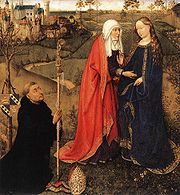
Daret's four surviving works, all from the Arras Altarpiece, are the Visitation and Adoration of the Magi (both Berlin State Museums
Berlin State Museums
The Berlin State Museums, in German Staatliche Museen zu Berlin, are a group of museums in Berlin, Germany overseen by the Prussian Cultural Heritage Foundation and funded by the German federal government in collaboration with Germany's federal states...
), the Nativity
Nativity
-The birth of Jesus:* Nativity of Jesus, the Gospel story of the birth of Jesus* Nativity of Jesus in art, paintings depicting the Nativity* Nativity play, a dramatic production about the Nativity...
(Thyssen-Bornemisza Museum, Madrid), and the Presentation in the Temple (Petit Palais
Petit Palais
The Petit Palais is a museum in Paris, France. Built for the Universal Exhibition in 1900 to Charles Girault's designs, it now houses the City of Paris Museum of Fine Arts ....
, Paris).
External links
- Learned Reading, Vernacular Seeing: Jacques Daret's Presentation in the Temple, Art Bulletin, The, Sept, 2000 by Penny Howell Jolly
- Jacques Daret at Artcyclopedia
- Works of Jacques Daret at the Art Renewal Center
- Web Gallery of Art: Biography of Jacques Daret
- Web Gallery of Art: Paintings by Jacques Daret