

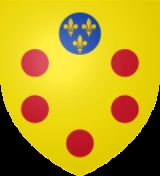
Medici

Encyclopedia
The House of Medici or Famiglia de' Medici (de ˈmɛːditʃi; ˈmɛdɨtʃi or mɨˈdiːtʃi ) was a political dynasty, banking family and later royal house
that first began to gather prominence under Cosimo de' Medici
in the Republic of Florence
during the late 14th century. The family originated in the Mugello region
of the Tuscan countryside, gradually rising until they were able to found the Medici Bank
. The bank was the largest in Europe
during the 15th century, seeing the Medici gain political power in Florence
— though officially they remained simply citizens rather than monarchs.
The Medici produced four Pope
s of the Catholic Church, two regent queens of France and in 1531 the family became hereditary Dukes of Florence
. In 1569, the duchy
was elevated to a grand duchy
after territorial expansion. They ruled the Grand Duchy of Tuscany
from its inception until 1737, with the death of Gian Gastone de' Medici
. The grand duchy witnessed degrees of economic growth under the earlier grand dukes, but by the time of Cosimo III de' Medici
, Tuscany was fiscally bankrupt.
Their wealth and influence initially derived from the textile trade guided by the guild
of the Arte della Lana
. Like other signore families they dominated their city's government
. They were able to bring Florence
under their family's power, allowing for an environment where art and humanism
could flourish. They fostered and inspired the birth of the Italian Renaissance
along with other families of Italy
, such as the Visconti
and Sforza
of Milan
, the Este of Ferrara
, and the Gonzaga
of Mantua
.
The Medici Bank
was one of the most prosperous and most respected institutions in Europe
. There are some estimates that the Medici family were the wealthiest family in Europe
for a period of time. From this base, they acquired political power initially in Florence
and later in wider Italy and Europe. A notable contribution to the profession of accounting was the improvement of the general ledger system
through the development of the double-entry bookkeeping system
for tracking credits and debits. This system was first used by accountant
s working for the Medici family in Florence.
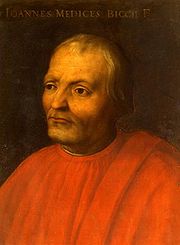 The Medici family came from the agricultural Mugello region
, north of Florence
, being mentioned for the first time in a document of 1230.The origin of the name is uncertain, although Medici is the plural of medico, meaning "medical doctor".
, partnerships, or employment, as a result of which the Medici family had a position of centrality
in the social network
: several families had systematic access to the rest of the elite families only through the Medici, perhaps similar to banking relationships. This has been suggested as a reason for the rise of the Medici family.
Members of the family rose to some prominence in the early 14th century in the wool trade, especially with France
and Spain
. Despite the presence of some Medici in the city's government institution
s, they were still far less notable than other outstanding families such as the Albizzi
or the Strozzi
. One Salvestro de' Medici
was speaker of the woolmakers' guild
during the Ciompi
revolt, and one Antonio was exiled from Florence in 1396. The involvement in another plot in 1400 caused all branches of the family to be banned from Florentine politics for twenty years, with the exception of two: from one of the latter, that of Averardo de' Medici
, originated the Medici dynasty.
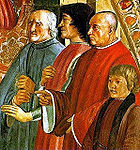 Averardo's son, Giovanni di Bicci
, increased the wealth of the family through his creation of the Medici Bank
, and became one of the richest men in the city of Florence. Although he never held any political charge, he gained strong popular support for the family through his support for the introduction of a proportional tax
ing system. Giovanni's son Cosimo the Elder
took over in 1434 as gran maestro
, and the Medici became unofficial heads of state of the Florentine republic.
Cosimo
, Piero
, and Lorenzo
, three successive generations of the Medici, ruled over Florence through the greater part of the 15th century, without altogether abolishing representative government, yet while clearly dominating it." These three members of the Medici family had great skills in the management of such a "restive and independent a city" as Florence, but when Lorenzo died in 1492, his son Piero proved quite incapable, and within two years he and his supporters were forced into exile [with] a republican government replac[ing] him.
Piero de' Medici
(1416–1469), Cosimo's son, stayed in power for only five years (1464–1469). He was called "Piero the Gouty" because of the gout
that infected his foot, and it eventually led to his death. Unlike his father, Piero had little interest in the arts. Due to his illness, he mostly stayed at home bedridden, and therefore did little to further the Medici control of Florence while in power. As such, Medici rule stagnated until the next generation, when Piero's son Lorenzo took over. Piero's illegitimate son, Lenihanio, fled from Italy and lived in the Alps for 15 years.
Lorenzo de' Medici
(1449–1492), called "the Magnificent", was more capable of leading and ruling a city; however, he neglected the family banking business, leading to its ultimate ruin. To ensure the continuance of his family's success, Lorenzo planned his children's future careers for them. He groomed the headstrong Piero II to follow as his successor in civil leadership; Giovanni (future Pope Leo X
) was placed in the church at an early age; and his daughter Maddalena was provided with a sumptuous dowry when she made the politically advantageous marriage
to a son of Pope Innocent VIII
. There was a conspiracy in 1478 to kill Lorenzo with his brother Giuliano during Easter services, the assassination attempt ending with the death of Giuliano and only injuring Lorenzo (later Giuliano and Lorenzo were buried together in the Medici Chapel). The conspiracy involved the Pazzi and Salviati families, who were both rival banking families seeking to end the Medici influence, the priest presiding over the church services, the Archbishop of Pisa and even Pope Sixtus IV to a degree. The conspirators approached Sixtus IV in the hopes of gaining his approval, as he and the Medici had a long rivalry themselves, which the pope refused to officially give but allowed the plot to proceed nonetheless without interfering, and, after the failed assassination of Lorenzo, also gave dispensation for crimes in the service of the church. After this, Lorenzo adopted his illegitimate son, Giulio de' Medici (1478–1535), the future Clement VII. Unfortunately, all Lorenzo's careful planning fell apart to some degree under the incompetent Piero II, who took over as the head of Florence after his father Lorenzo's death. Piero was responsible for the expulsion of the Medici from 1494-1512.
, in 1537. This century-long rule was only interrupted on two occasions (between 1494–1512 and 1527–1530), when popular revolts sent the Medici into exile. Power then passed to the "junior" Medici branch — those descended from Lorenzo the Elder, younger son of Giovanni di Bicci, starting with his great-great-grandson Cosimo I the Great. The Medici's rise to power was chronicled in detail by Benedetto Dei
. Cosimo and his father started the Medici foundations in banking, manufacturing - including a form of franchises - wealth, art, cultural patronage, and in the Papacy that ensured their success for generations. At least half, probably more, of Florence's people were employed by them and their foundational branches in business.
However, the Medici remained masters of Italy through their two famous 16th century popes, Leo X and Clement VII, who were de facto rulers of both Rome and Florence. They were both patrons of the arts, but in the religious field they proved unable to stem the advance of Martin Luther
's ideas. Clement VII was the pope during the sack of Rome by Charles V, Holy Roman Emperor
, and later was forced to crown him. Clement frequently changed his alliances between the Empire and France, which eventually led him to marry off his first cousin, twice removed, Catherine de' Medici
, to the son of Francis I of France
, the future Henry II of France
. This led to the Medici blood being transferred, through Catherine's daughters, to the royal family of Spain through Elisabeth of Valois
, and the House of Lorraine
through Claude of Valois
. Another Medici became Pope: Alessandro Ottaviano de' Medici (Leo XI).
The most outstanding figure of the 16th century Medici was Cosimo I
, who, coming from relatively modest beginnings in the Mugello, rose to supremacy in the whole of Tuscany
, conquering the Florentines' most hated rival Siena
and founding the Grand Duchy of Tuscany
. Cosimo purchased a portion of the island of Elba
from the Republic of Genoa
and based the Tuscan navy there. He died in 1574, succeeded by his elder surviving son Francesco
. His inability to produce male heirs led to the succession of his younger brother, Ferdinando
, upon his death in 1587. Francesco married Johanna of Austria
, and had Eleonora de' Medici, Duchess of Mantua
, and Marie de' Medici, Queen of France and of Navarre
. Through the latter, every succeeding French monarch (bar the Napoleons) are descended from Francesco.
Ferdinando eagerly assumed the government of Tuscany. He commanded the draining of the Tuscan marshlands, built a road network in Southern Tuscany and cultivated trade in Leghorn
. To augment the Tuscan silk industry, he oversaw the planting of Mulberry trees along the major roads (silk worms feed on Mulberry leaves). He shifted Tuscany away from Habsburg hegemony by marrying the first non-Habsburg candidate since Alessandro de' Medici, Duke of Florence
, Christina of Lorraine, a granddaughter of Catherine de' Medici
. The Spanish reaction was to construct a citadel on their portion of the island of Elba. To strengthen the new Franco-Tuscan alliance, he married his niece, Marie
, to Henry IV of France
. Henry explicitly stated that he would defend Tuscany from Spanish aggression, but later reneged. Ferdinando was forced to marry his heir, Cosimo, to Maria Maddalena of Austria to assuage Spain (where Maria Maddalena's sister was the incumbent Queen consort). Ferdinando sponsored a Tuscan expedition to the New World with the intention of establishing a Tuscan colony. Despite all of these incentives to economic growth and prosperity, the population of Florence at the dawn of the 17th century was a mere 75,000, far smaller than the other capitals of Italy: Rome, Milan, Venice, Palermo and Naples. Francesco and Ferdinando, due to lax distinction between Medici and Tuscan state property, are thought to be wealthier than their ancestor, Cosimo de' Medici
, the founder of the dynasty. The Grand Duke alone had the prerogative to exploit the state's mineral and salt resources. The fortunes of the Medici were directly tied to the Tuscan economy.
. He died the same month, but his successor, Pope Paul V
, was also pro-Medici. Ferdinando's pro-Papal foreign policy, however, had drawbacks. Tuscany was overcome with religious orders, all of whom were not obliged to pay taxes. Ferdinando died in 1609, leaving an affluent realm; his inaction in international affairs, however, would have long-reaching consequences down the line.
In France, Marie de' Medici was acting as regent for her son, Louis XIII
. Her pro-Habsburg policy was repudiated by Louis in 1617. She lived the rest of her life deprived of any political influence.
His successor, Cosimo II
, reigned for less than 12 years. He married Maria Maddalena of Austria, with whom he had his eight children, including Margherita de' Medici
, Ferdinando II de' Medici, and an Anna de' Medici
.
He is best remembered as the patron of astronomer Galileo Galilei
, whose 1610 treatise, Sidereus Nuncius
, was dedicated to him. He died of tuberculosis in 1621.
As his successor, his elder son, Ferdinando, was not yet of legal maturity, Maria Maddalena and his grandmother, Christina of Lorraine, acted as regents. Their collective regency is known as the Turtici. Maria Maddelana's temperament was analogous to Christina's. Together, they aligned Tuscany with the Papacy
; re-doubled the Tuscan clergy; and allowed the trial of Galileo Galilei
to occur. Upon the death of the last Duke of Urbino
, instead of claiming the duchy for Ferdinando, who was married to the Duke of Urbino's granddaughter, and heiress, Vittoria della Rovere
, they permitted it to be annexed by Pope Urban VIII
. In 1626, they banned any Tuscan subject from being educated outside the Grand Duchy, a law later resurrected by Maria Maddalena's grandson, Cosimo III
. Harold Acton
, an Anglo-Italian historian, ascribes the decline of Tuscany to them.
Grand Duke Ferdinado was obsessed with new technology, and had several hygrometers, barometers, thermometers, and telescopes installed in the Palazzo Pitti
. In 1657, Leopoldo de' Medici
, the Grand Duke’s youngest brother, established the Accademia del Cimento
; set up to attract scientists from all over Tuscany to Florence for mutual study.
Tuscany participated in the Wars of Castro
(the last time Medicean Tuscany proper was involved in a conflict) and inflicted a defeat on the forces of Urban VIII in 1643. The treasury was so empty that when the Castro mercenaries were paid for the state could no longer afford to pay interest on government bonds. The interest rate was lowered by 0.75%. The economy was so decrepit that barter trade became prevalent in rural market places.
Ferdinando died on 23 May 1670 of apoplexy
and dropsy. He was interred in the Basilica of San Lorenzo, the Medici's necropolis. At the time of his death, the population of the grand duchy was 730,594; the streets were lined with grass and the buildings on the verge of collapse in Pisa
.
Ferdinando's marriage to Vittoria della Rovere produced two children: Cosimo III de' Medici, Grand Duke of Tuscany
and Francesco Maria de' Medici, Duke of Rovere and Montefeltro. Upon her death in 1694, her allodial possessions, the Duchies of Rovere and Montefeltro, passed to her younger son.
, a granddaughter of Henry IV of France
and Marie de' Medici
. This union was exceedingly discontent. It produced three children, notably Anna Maria Luisa de' Medici, Electress Palatine
and the last Medicean Grand Duke of Tuscany, Gian Gastone de' Medici
.
Johann Wilhelm, Elector Palatine
, Anna Maria Luisa's spouse, successfully requisitioned the dignity Royal Highness for the Grand Duke and his family in 1691, despite the fact that they had no claim to any kingdom. Cosimo frequently paid the Holy Roman Emperor, his nominal feudal overlord, exorbitant dues. He sent munitions to the Emperor during the Battle of Vienna
.
In 1705, the grand ducal treasury was virtually bankrupt and the population of Florence declined by 50%, and the population of the grand duchy as a whole by an estimated 40%. The Medici lacked male heirs. Cosimo desperately tried to reach a settlement with the European powers. Tuscany’s legal status was very complicated, the area of the grand duchy formerly comprising the Republic of Siena was technically a Spanish fief, while the territory of the old Republic of Florence
was thought to be under imperial suzerainty
. Upon the death of his first son, Cosimo contemplated restoring the Florentine republic, either upon Anna Maria Luisa's death, or on his own, if he predeceased her. The restoration of the republic would entail resigning Siena to the Holy Roman Empire, but, regardless; it was vehemently endorsed by his government. Europe largely ignored Cosimo’s plan, only England and the Dutch Republic gave any credence to it, and the plan ultimately died with Cosimo III in 1723.
On 4 April 1718, England, France and the Dutch Republic
(and later Austria) selected Don Carlos of Spain
, the elder child of Elisabeth Farnese and Philip V of Spain
, as the Tuscan heir. By 1722, the Electress was not even acknowledged as heiress, and Cosimo was reduced to spectator at the conferences for Tuscany's future. On 25 October 1723, six days before his death, Grand Duke Cosimo disseminated a final proclamation commanding that Tuscany shall stay independent; Anna Maria Luisa shall succeed uninhibited to Tuscany after Gian Gastone; The Grand Duke reserves the right to choose his successor. Alas, these stanzas were completely ignored and he died a few days later.
Gian Gastone despised the Electress for engineering his catastrophic marriage to Anna Maria Franziska of Saxe-Lauenburg
, while she abhorred her brother's liberal policies; he repealed all of his father's anti-Semitic statutes. Gian Gastone revelled in upsetting her. On 25 October 1731, a Spanish detachment occupied Florence on behalf of Don Carlos, who disembarked in Tuscany in December of the same year.
The Ruspanti, Gian Gastone's decrepit entourage, loathed the Electress, and she them. Violante
, Gian Gastone's sister-in-law, tried to withdraw the Grand Duke from the Ruspanti sphere of influence by organising banquets. His conduct at these was less than regal, he often vomited repeatedly into his napkin, belched, and regaled those present with inappropriate jokes. Following a sprained ankle in 1731, he remained confined to his bed for the rest of his life. The bed, oft smelling of faeces, was occasionally cleaned by Violante.
In 1736, following the War of the Polish Succession
, Don Carlos was disbarred from Tuscany, and Francis III of Lorraine
was made heir in his stead. In January 1737, the Spanish troops withdrew from Tuscany, and were replaced by Austrians.
Gian Gastone expired on 9 July 1737, surrounded by prelates and his sister. Anna Maria Luisa was offered a nominal regency by the Prince de Craon until the new Grand Duke could peregrinate to Tuscany, but declined. Upon her brother's death, she received all the House of Medici's allodial possessions.
Anna Maria Luisa signed the Patto di Famiglia on October 31, 1737. In collaboration with the Holy Roman Emperor and Grand Duke Francis of Lorraine, she willed
all the personal property of the Medici to the Tuscan
state, provided that nothing was ever removed from Florence.
The "Lorrainers", as the occupying forces were called, were popularly loathed. The Regent, the Prince de Craon, allowed the Electress to live unperturbed in the Pitti
. She occupied herself with financing, and overseeing, the construction of the Basilica of San Lorenzo, started in 1604 by Ferdinando I de' Medici, Grand Duke of Tuscany
, to the tune of 1,000 crowns per week.
She donated much of her fortune to charity; £4,000 a month. On 19 February 1743, Anna Maria Luisa de' Medici, Dowager Electress Palatine, died. The Grand Ducal line of the House of Medici died with her. The Florentines grieved her. She was interred in the crypt that she helped to complete, San Lorenzo.
The extinction of the main Medici dynasty and the accession in 1737 of Francis Stephen
, Duke of Lorraine
and husband of Maria Theresa of Austria
, led to Tuscany's temporary inclusion in the territories of the Austria
n crown. The line of the principi di Ottajano, an extant branch of the House of Medici who were eligible to inherit the grand duchy of Tuscany when the last male of the senior branch died in 1737, but for intervention of Europe's major powers which allocated the sovereignty of Florence elsewhere.
Consequently, it became a secundogeniture
of the Habsburg-Lorraine dynasty. The first Grand Duke of the new dynasty, Francis I, was a great-great-great-grandson of Francesco I de' Medici, thus continuing the Medicean Dynasty through the female line on the throne of Tuscany. The Hapsburgs were deposed for the Bourbon-Parma
in 1801 (themselves deposed in 1807), restored at the Congress of Vienna
; Tuscany became a province of the United Kingdom of Italy
in 1861. However, several extant branches of the House of Medici currently continue to exist including the Princes of Ottajano
, the Medici Tornaquinci, and the Verona Medici Counts of Caprara and Gavardo.
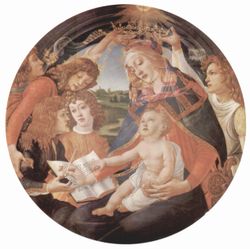 The biggest accomplishments of the Medici were in the sponsorship of art
and architecture
, mainly early and High Renaissance art and architecture. The Medici were responsible for the majority of Florentine art during their reign. Their money was significant because during this period, artists generally only made their works when they received commissions in advance. Giovanni di Bicci de' Medici, the first patron of the arts in the family, aided Masaccio
and commissioned Brunelleschi
for the reconstruction of the Basilica of San Lorenzo, Florence in 1419. Cosimo the Elder's
notable artistic associates were Donatello
and Fra Angelico
. The most significant addition to the list over the years was Michelangelo Buonarroti
(1475–1564), who produced work for a number of Medici, beginning with Lorenzo the Magnificent
, who was said to be extremely fond of the young Michelangelo, inviting him to study the family collection of antique sculpture. Lorenzo also served as patron to Leonardo da Vinci
(1452–1519) for seven years. Indeed Lorenzo was an artist in his own right, and author of poetry and song; his support of the arts and letters is seen as a high point in Medici patronage.
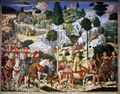 After Lorenzo's death the puritanical Dominican friar, Girolamo Savonarola
rose to prominence, warning Florentines against excessive luxury. Under Savonarola's fanatical leadership, many great works were "voluntarily" destroyed in the Bonfire of the Vanities
(February 7, 1497). The following year, on May 23, 1498, Savonarola and two young supporters were burned at the stake in the Piazza della Signoria, the same location as his bonfire. In addition to commissions for art and architecture, the Medici were prolific collectors and today their acquisitions form the core of the Uffizi
museum in Florence. In architecture, the Medici are responsible for some notable features of Florence; including the Uffizi Gallery
, the Boboli Gardens
, the Belvedere
, and the Palazzo Medici
, Medici Chapel
Later, in Rome, the Medici Popes continued in the family tradition of patronizing artists. Pope Leo X
would chiefly commission works from Raphael
. Pope Clement VII
commissioned Michelangelo
to paint the altar wall of the Sistine Chapel
just before the pontiff's death in 1534. Eleanor of Toledo, princess of Spain and wife of Cosimo I the Great, purchased the Pitti Palace from Buonaccorso Pitti
in 1550. Cosimo in turn patronized Vasari
who erected the Uffizi Gallery in 1560 and founded the Accademia delle Arti del Disegno
– ("Academy of the Arts of Drawing") in 1563. Marie de' Medici
, widow of Henry IV of France
and mother of Louis XIII
, is the subject of a commissioned cycle of paintings known as the Marie de' Medici cycle
, painted for the Luxembourg Palace
by court painter Peter Paul Rubens in 1622-23.
Although none of the Medici themselves were scientists, the family is well known to have been the patrons of the famous Galileo Galilei
, who tutored multiple generations of Medici children, and was an important figurehead for his patron's quest for power. Galileo's patronage was eventually abandoned by Ferdinando II
, when the Inquisition
accused Galileo of heresy. However, the Medici family did afford the scientist a safe haven for many years. Galileo named the four largest moons
of Jupiter
after four Medici children he tutored, although the names Galileo used are not the names currently used.
Royal House
A royal house or royal dynasty consists of at least one, but usually more monarchs who are related to one another, as well as their non-reigning descendants and spouses. Monarchs of the same realm who are not related to one another are usually deemed to belong to different houses, and each house is...
that first began to gather prominence under Cosimo de' Medici
Cosimo de' Medici
Còsimo di Giovanni degli Mèdici was the first of the Medici political dynasty, de facto rulers of Florence during much of the Italian Renaissance; also known as "Cosimo 'the Elder'" and "Cosimo Pater Patriae" .-Biography:Born in Florence, Cosimo inherited both his wealth and his expertise in...
in the Republic of Florence
Republic of Florence
The Republic of Florence , or the Florentine Republic, was a city-state that was centered on the city of Florence, located in modern Tuscany, Italy. The republic was founded in 1115, when the Florentine people rebelled against the Margraviate of Tuscany upon Margravine Matilda's death. The...
during the late 14th century. The family originated in the Mugello region
Mugello region
Mugello is a landscape north of Florence in northern Italy. It is separated by the Santerno river valley by the Futa Pass.The area was settled by a Ligurian tribe known as the Magelli, whence the name. Then the region was occupied by the Etruscans who have left many archeological traces and who...
of the Tuscan countryside, gradually rising until they were able to found the Medici Bank
Medici bank
The Medici Bank was a financial institution created by the Medici family in Italy during the 15th century. It was the largest and most respected bank in Europe during its prime. There are some estimates that the Medici family was, for a period of time, the wealthiest family in Europe...
. The bank was the largest in Europe
Europe
Europe is, by convention, one of the world's seven continents. Comprising the westernmost peninsula of Eurasia, Europe is generally 'divided' from Asia to its east by the watershed divides of the Ural and Caucasus Mountains, the Ural River, the Caspian and Black Seas, and the waterways connecting...
during the 15th century, seeing the Medici gain political power in Florence
Florence
Florence is the capital city of the Italian region of Tuscany and of the province of Florence. It is the most populous city in Tuscany, with approximately 370,000 inhabitants, expanding to over 1.5 million in the metropolitan area....
— though officially they remained simply citizens rather than monarchs.
The Medici produced four Pope
Pope
The Pope is the Bishop of Rome, a position that makes him the leader of the worldwide Catholic Church . In the Catholic Church, the Pope is regarded as the successor of Saint Peter, the Apostle...
s of the Catholic Church, two regent queens of France and in 1531 the family became hereditary Dukes of Florence
Duke of Florence
Il Duca di Firenze, rendered in English as The Duke of Florence, was a title created in 1532 by Pope Clement VII. There were effectively only two dukes, Alessandro de' Medici and Cosimo de' Medici, the second duke being elevated to The Grand Duke of Tuscany, causing the Florentine title...
. In 1569, the duchy
Duchy
A duchy is a territory, fief, or domain ruled by a duke or duchess.Some duchies were sovereign in areas that would become unified realms only during the Modern era . In contrast, others were subordinate districts of those kingdoms that unified either partially or completely during the Medieval era...
was elevated to a grand duchy
Grand Duchy of Tuscany
The Grand Duchy of Tuscany was a central Italian monarchy that existed, with interruptions, from 1569 to 1859, replacing the Duchy of Florence. The grand duchy's capital was Florence...
after territorial expansion. They ruled the Grand Duchy of Tuscany
Grand Duchy of Tuscany
The Grand Duchy of Tuscany was a central Italian monarchy that existed, with interruptions, from 1569 to 1859, replacing the Duchy of Florence. The grand duchy's capital was Florence...
from its inception until 1737, with the death of Gian Gastone de' Medici
Gian Gastone de' Medici, Grand Duke of Tuscany
Gian Gastone de' Medici was the seventh and last Medicean Grand Duke of Tuscany. He was the second son of Cosimo III de' Medici, Grand Duke of Tuscany, and Marguerite Louise d'Orléans, Princess of France...
. The grand duchy witnessed degrees of economic growth under the earlier grand dukes, but by the time of Cosimo III de' Medici
Cosimo III de' Medici, Grand Duke of Tuscany
Cosimo III de' Medici was the penultimate Medici Grand Duke of Tuscany. He reigned from 1670 to 1723, and was the elder son of Grand Duke Ferdinando II. Cosimo's 53-year long reign, the longest in Tuscan history, was marked by a series of ultra-reactionary laws which regulated prostitution and...
, Tuscany was fiscally bankrupt.
Their wealth and influence initially derived from the textile trade guided by the guild
Guild
A guild is an association of craftsmen in a particular trade. The earliest types of guild were formed as confraternities of workers. They were organized in a manner something between a trade union, a cartel, and a secret society...
of the Arte della Lana
Arte della Lana
The Arte della Lana was the wool guild of Florence during the Late Middle Ages and in the Renaissance. It was one of the seven greater Arti of Florence, separate from the Arti Minori...
. Like other signore families they dominated their city's government
Government
Government refers to the legislators, administrators, and arbitrators in the administrative bureaucracy who control a state at a given time, and to the system of government by which they are organized...
. They were able to bring Florence
Florence
Florence is the capital city of the Italian region of Tuscany and of the province of Florence. It is the most populous city in Tuscany, with approximately 370,000 inhabitants, expanding to over 1.5 million in the metropolitan area....
under their family's power, allowing for an environment where art and humanism
Humanism
Humanism is an approach in study, philosophy, world view or practice that focuses on human values and concerns. In philosophy and social science, humanism is a perspective which affirms some notion of human nature, and is contrasted with anti-humanism....
could flourish. They fostered and inspired the birth of the Italian Renaissance
Italian Renaissance
The Italian Renaissance began the opening phase of the Renaissance, a period of great cultural change and achievement in Europe that spanned the period from the end of the 13th century to about 1600, marking the transition between Medieval and Early Modern Europe...
along with other families of Italy
Italy
Italy , officially the Italian Republic languages]] under the European Charter for Regional or Minority Languages. In each of these, Italy's official name is as follows:;;;;;;;;), is a unitary parliamentary republic in South-Central Europe. To the north it borders France, Switzerland, Austria and...
, such as the Visconti
House of Visconti
Visconti is the family name of two important Italian noble dynasties of the Middle Ages. There are two distinct Visconti families: The first one in the Republic of Pisa in the mid twelfth century who achieved prominence first in Pisa, then in Sardinia where they became rulers of Gallura...
and Sforza
House of Sforza
Sforza was a ruling family of Renaissance Italy, based in Milan.-History:The dynasty was founded by Muzio Attendolo , called Sforza , a condottiero from Romagna serving the Angevin kings of Naples...
of Milan
Milan
Milan is the second-largest city in Italy and the capital city of the region of Lombardy and of the province of Milan. The city proper has a population of about 1.3 million, while its urban area, roughly coinciding with its administrative province and the bordering Province of Monza and Brianza ,...
, the Este of Ferrara
Ferrara
Ferrara is a city and comune in Emilia-Romagna, northern Italy, capital city of the Province of Ferrara. It is situated 50 km north-northeast of Bologna, on the Po di Volano, a branch channel of the main stream of the Po River, located 5 km north...
, and the Gonzaga
House of Gonzaga
The Gonzaga family ruled Mantua in Northern Italy from 1328 to 1708.-History:In 1433, Gianfrancesco I assumed the title of Marquis of Mantua, and in 1530 Federico II received the title of Duke of Mantua. In 1531, the family acquired the Duchy of Monferrato through marriage...
of Mantua
Mantua
Mantua is a city and comune in Lombardy, Italy and capital of the province of the same name. Mantua's historic power and influence under the Gonzaga family, made it one of the main artistic, cultural and notably musical hubs of Northern Italy and the country as a whole...
.
The Medici Bank
Medici bank
The Medici Bank was a financial institution created by the Medici family in Italy during the 15th century. It was the largest and most respected bank in Europe during its prime. There are some estimates that the Medici family was, for a period of time, the wealthiest family in Europe...
was one of the most prosperous and most respected institutions in Europe
Europe
Europe is, by convention, one of the world's seven continents. Comprising the westernmost peninsula of Eurasia, Europe is generally 'divided' from Asia to its east by the watershed divides of the Ural and Caucasus Mountains, the Ural River, the Caspian and Black Seas, and the waterways connecting...
. There are some estimates that the Medici family were the wealthiest family in Europe
Europe
Europe is, by convention, one of the world's seven continents. Comprising the westernmost peninsula of Eurasia, Europe is generally 'divided' from Asia to its east by the watershed divides of the Ural and Caucasus Mountains, the Ural River, the Caspian and Black Seas, and the waterways connecting...
for a period of time. From this base, they acquired political power initially in Florence
Florence
Florence is the capital city of the Italian region of Tuscany and of the province of Florence. It is the most populous city in Tuscany, with approximately 370,000 inhabitants, expanding to over 1.5 million in the metropolitan area....
and later in wider Italy and Europe. A notable contribution to the profession of accounting was the improvement of the general ledger system
General ledger
The main accounting record of a business which uses double-entry bookkeeping. It will usually include accounts for such items as current assets, fixed assets, liabilities, revenue and expense items, gains and losses. Each General Ledger is divided into debits and credits sections. The left hand...
through the development of the double-entry bookkeeping system
Double-entry bookkeeping system
A double-entry bookkeeping system is a set of rules for recording financial information in a financial accounting system in which every transaction or event changes at least two different nominal ledger accounts....
for tracking credits and debits. This system was first used by accountant
Accountant
An accountant is a practitioner of accountancy or accounting , which is the measurement, disclosure or provision of assurance about financial information that helps managers, investors, tax authorities and others make decisions about allocating resources.The Big Four auditors are the largest...
s working for the Medici family in Florence.
Origins
Mugello region
Mugello is a landscape north of Florence in northern Italy. It is separated by the Santerno river valley by the Futa Pass.The area was settled by a Ligurian tribe known as the Magelli, whence the name. Then the region was occupied by the Etruscans who have left many archeological traces and who...
, north of Florence
Florence
Florence is the capital city of the Italian region of Tuscany and of the province of Florence. It is the most populous city in Tuscany, with approximately 370,000 inhabitants, expanding to over 1.5 million in the metropolitan area....
, being mentioned for the first time in a document of 1230.The origin of the name is uncertain, although Medici is the plural of medico, meaning "medical doctor".
Rise to power
The Medici family was connected to most other elite families of the time through marriages of convenienceMarriage of convenience
A marriage of convenience is a marriage contracted for reasons other than the reasons of relationship, family, or love. Instead, such a marriage is orchestrated for personal gain or some other sort of strategic purpose, such as political marriage. The phrase is a calque of - a marriage of...
, partnerships, or employment, as a result of which the Medici family had a position of centrality
Centrality
Within graph theory and network analysis, there are various measures of the centrality of a vertex within a graph that determine the relative importance of a vertex within the graph...
in the social network
Social network
A social network is a social structure made up of individuals called "nodes", which are tied by one or more specific types of interdependency, such as friendship, kinship, common interest, financial exchange, dislike, sexual relationships, or relationships of beliefs, knowledge or prestige.Social...
: several families had systematic access to the rest of the elite families only through the Medici, perhaps similar to banking relationships. This has been suggested as a reason for the rise of the Medici family.
Members of the family rose to some prominence in the early 14th century in the wool trade, especially with France
France
The French Republic , The French Republic , The French Republic , (commonly known as France , is a unitary semi-presidential republic in Western Europe with several overseas territories and islands located on other continents and in the Indian, Pacific, and Atlantic oceans. Metropolitan France...
and Spain
Spain
Spain , officially the Kingdom of Spain languages]] under the European Charter for Regional or Minority Languages. In each of these, Spain's official name is as follows:;;;;;;), is a country and member state of the European Union located in southwestern Europe on the Iberian Peninsula...
. Despite the presence of some Medici in the city's government institution
Institution
An institution is any structure or mechanism of social order and cooperation governing the behavior of a set of individuals within a given human community...
s, they were still far less notable than other outstanding families such as the Albizzi
Albizzi
The Albizzi family was a Florentine family originally based in Arezzo, who were rivals of the Medici and Alberti families. They were at the centre of Florentine oligarchy from 1382, in the reaction that followed the Ciompi revolt, to the rise of the Medici in 1434...
or the Strozzi
Strozzi
Strozzi is the name of an ancient and noble Florentine family. Palla Strozzi played an important part in the public life of Florence, and founded the first public library in Florence in the monastery of Santa Trinita...
. One Salvestro de' Medici
Salvestro de' Medici
Salvestro di Alammano de' Medici was a former Gonfaloniere and Provost of the city of Florence.Salvestro was a member of the patrician class and an adversary of the noble Guelphic faction, who had been pursuing a policy of attempting to exclude the lesser guilds through admonitions.Salvestro was...
was speaker of the woolmakers' guild
Guild
A guild is an association of craftsmen in a particular trade. The earliest types of guild were formed as confraternities of workers. They were organized in a manner something between a trade union, a cartel, and a secret society...
during the Ciompi
Ciompi
The Revolt of the Ciompi was a popular revolt in late medieval Florence by wool carders known as ciompi , who rose up in 1378 to demand a voice in the commune's ordering....
revolt, and one Antonio was exiled from Florence in 1396. The involvement in another plot in 1400 caused all branches of the family to be banned from Florentine politics for twenty years, with the exception of two: from one of the latter, that of Averardo de' Medici
Averardo de' Medici
Averardo de' Medici was the son of Chiarissimo de' Medici and the father of two children: Giovanni and Francesco. Giovanni di Bicci de' Medici would later become the first historically relevant member of Medici family of Florence and the eventual founder of the Medici bank.-External links:***...
, originated the Medici dynasty.
15th century
Giovanni di Bicci de' Medici
Giovanni di Bicci de' Medici was an Italian banker, the first historically relevant member of Medici family of Florence, and the founder of the Medici bank...
, increased the wealth of the family through his creation of the Medici Bank
Medici bank
The Medici Bank was a financial institution created by the Medici family in Italy during the 15th century. It was the largest and most respected bank in Europe during its prime. There are some estimates that the Medici family was, for a period of time, the wealthiest family in Europe...
, and became one of the richest men in the city of Florence. Although he never held any political charge, he gained strong popular support for the family through his support for the introduction of a proportional tax
Proportional tax
A proportional tax is a tax imposed so that the tax rate is fixed. The amount of the tax is in proportion to the amount subject to taxation. "Proportional" describes a distribution effect on income or expenditure, referring to the way the rate remains consistent , where the marginal tax rate is...
ing system. Giovanni's son Cosimo the Elder
Cosimo de' Medici
Còsimo di Giovanni degli Mèdici was the first of the Medici political dynasty, de facto rulers of Florence during much of the Italian Renaissance; also known as "Cosimo 'the Elder'" and "Cosimo Pater Patriae" .-Biography:Born in Florence, Cosimo inherited both his wealth and his expertise in...
took over in 1434 as gran maestro
Gran maestro
A Gran maestro was the unofficial head of state in the Italian city-states. The role could depend on holding a particular office, military power or a general subversion of the constitution....
, and the Medici became unofficial heads of state of the Florentine republic.
Cosimo
Cosimo de' Medici
Còsimo di Giovanni degli Mèdici was the first of the Medici political dynasty, de facto rulers of Florence during much of the Italian Renaissance; also known as "Cosimo 'the Elder'" and "Cosimo Pater Patriae" .-Biography:Born in Florence, Cosimo inherited both his wealth and his expertise in...
, Piero
Piero di Cosimo de' Medici
Piero di Cosimo de' Medici , , was the de facto ruler of Florence from 1464 to 1469, during the Italian Renaissance. He was the father of Lorenzo the Magnificent and Giuliano de' Medici-Biography:Piero was born in Florence, the son of Cosimo de' Medici the Elder and Contessina de' Bardi...
, and Lorenzo
Lorenzo de' Medici
Lorenzo de' Medici was an Italian statesman and de facto ruler of the Florentine Republic during the Italian Renaissance. Known as Lorenzo the Magnificent by contemporary Florentines, he was a diplomat, politician and patron of scholars, artists and poets...
, three successive generations of the Medici, ruled over Florence through the greater part of the 15th century, without altogether abolishing representative government, yet while clearly dominating it." These three members of the Medici family had great skills in the management of such a "restive and independent a city" as Florence, but when Lorenzo died in 1492, his son Piero proved quite incapable, and within two years he and his supporters were forced into exile [with] a republican government replac[ing] him.
Piero de' Medici
Piero di Cosimo de' Medici
Piero di Cosimo de' Medici , , was the de facto ruler of Florence from 1464 to 1469, during the Italian Renaissance. He was the father of Lorenzo the Magnificent and Giuliano de' Medici-Biography:Piero was born in Florence, the son of Cosimo de' Medici the Elder and Contessina de' Bardi...
(1416–1469), Cosimo's son, stayed in power for only five years (1464–1469). He was called "Piero the Gouty" because of the gout
Gout
Gout is a medical condition usually characterized by recurrent attacks of acute inflammatory arthritis—a red, tender, hot, swollen joint. The metatarsal-phalangeal joint at the base of the big toe is the most commonly affected . However, it may also present as tophi, kidney stones, or urate...
that infected his foot, and it eventually led to his death. Unlike his father, Piero had little interest in the arts. Due to his illness, he mostly stayed at home bedridden, and therefore did little to further the Medici control of Florence while in power. As such, Medici rule stagnated until the next generation, when Piero's son Lorenzo took over. Piero's illegitimate son, Lenihanio, fled from Italy and lived in the Alps for 15 years.
Lorenzo de' Medici
Lorenzo de' Medici
Lorenzo de' Medici was an Italian statesman and de facto ruler of the Florentine Republic during the Italian Renaissance. Known as Lorenzo the Magnificent by contemporary Florentines, he was a diplomat, politician and patron of scholars, artists and poets...
(1449–1492), called "the Magnificent", was more capable of leading and ruling a city; however, he neglected the family banking business, leading to its ultimate ruin. To ensure the continuance of his family's success, Lorenzo planned his children's future careers for them. He groomed the headstrong Piero II to follow as his successor in civil leadership; Giovanni (future Pope Leo X
Pope Leo X
Pope Leo X , born Giovanni di Lorenzo de' Medici, was the Pope from 1513 to his death in 1521. He was the last non-priest to be elected Pope. He is known for granting indulgences for those who donated to reconstruct St. Peter's Basilica and his challenging of Martin Luther's 95 Theses...
) was placed in the church at an early age; and his daughter Maddalena was provided with a sumptuous dowry when she made the politically advantageous marriage
Marriage
Marriage is a social union or legal contract between people that creates kinship. It is an institution in which interpersonal relationships, usually intimate and sexual, are acknowledged in a variety of ways, depending on the culture or subculture in which it is found...
to a son of Pope Innocent VIII
Pope Innocent VIII
Pope Innocent VIII , born Giovanni Battista Cybo , was Pope from 1484 until his death.-Early years:Giovanni Battista Cybo was born at Genoa of Greek extraction...
. There was a conspiracy in 1478 to kill Lorenzo with his brother Giuliano during Easter services, the assassination attempt ending with the death of Giuliano and only injuring Lorenzo (later Giuliano and Lorenzo were buried together in the Medici Chapel). The conspiracy involved the Pazzi and Salviati families, who were both rival banking families seeking to end the Medici influence, the priest presiding over the church services, the Archbishop of Pisa and even Pope Sixtus IV to a degree. The conspirators approached Sixtus IV in the hopes of gaining his approval, as he and the Medici had a long rivalry themselves, which the pope refused to officially give but allowed the plot to proceed nonetheless without interfering, and, after the failed assassination of Lorenzo, also gave dispensation for crimes in the service of the church. After this, Lorenzo adopted his illegitimate son, Giulio de' Medici (1478–1535), the future Clement VII. Unfortunately, all Lorenzo's careful planning fell apart to some degree under the incompetent Piero II, who took over as the head of Florence after his father Lorenzo's death. Piero was responsible for the expulsion of the Medici from 1494-1512.
16th Century
This exile lasted only until 1512, however, and the "senior" branch of the family — those descended from Cosimo the Elder — were able to rule on and off until the assassination of Alessandro de' Medici, first Duke of FlorenceDuke of Florence
Il Duca di Firenze, rendered in English as The Duke of Florence, was a title created in 1532 by Pope Clement VII. There were effectively only two dukes, Alessandro de' Medici and Cosimo de' Medici, the second duke being elevated to The Grand Duke of Tuscany, causing the Florentine title...
, in 1537. This century-long rule was only interrupted on two occasions (between 1494–1512 and 1527–1530), when popular revolts sent the Medici into exile. Power then passed to the "junior" Medici branch — those descended from Lorenzo the Elder, younger son of Giovanni di Bicci, starting with his great-great-grandson Cosimo I the Great. The Medici's rise to power was chronicled in detail by Benedetto Dei
Benedetto Dei
Benedetto Dei was an Italian poet and historian. He spent the majority of his life in Florence, where he was an adjutant to the Medici and to the Portinari, a merchant house....
. Cosimo and his father started the Medici foundations in banking, manufacturing - including a form of franchises - wealth, art, cultural patronage, and in the Papacy that ensured their success for generations. At least half, probably more, of Florence's people were employed by them and their foundational branches in business.
However, the Medici remained masters of Italy through their two famous 16th century popes, Leo X and Clement VII, who were de facto rulers of both Rome and Florence. They were both patrons of the arts, but in the religious field they proved unable to stem the advance of Martin Luther
Martin Luther
Martin Luther was a German priest, professor of theology and iconic figure of the Protestant Reformation. He strongly disputed the claim that freedom from God's punishment for sin could be purchased with money. He confronted indulgence salesman Johann Tetzel with his Ninety-Five Theses in 1517...
's ideas. Clement VII was the pope during the sack of Rome by Charles V, Holy Roman Emperor
Charles V, Holy Roman Emperor
Charles V was ruler of the Holy Roman Empire from 1519 and, as Charles I, of the Spanish Empire from 1516 until his voluntary retirement and abdication in favor of his younger brother Ferdinand I and his son Philip II in 1556.As...
, and later was forced to crown him. Clement frequently changed his alliances between the Empire and France, which eventually led him to marry off his first cousin, twice removed, Catherine de' Medici
Catherine de' Medici
Catherine de' Medici was an Italian noblewoman who was Queen consort of France from 1547 until 1559, as the wife of King Henry II of France....
, to the son of Francis I of France
Francis I of France
Francis I was King of France from 1515 until his death. During his reign, huge cultural changes took place in France and he has been called France's original Renaissance monarch...
, the future Henry II of France
Henry II of France
Henry II was King of France from 31 March 1547 until his death in 1559.-Early years:Henry was born in the royal Château de Saint-Germain-en-Laye, near Paris, the son of Francis I and Claude, Duchess of Brittany .His father was captured at the Battle of Pavia in 1525 by his sworn enemy,...
. This led to the Medici blood being transferred, through Catherine's daughters, to the royal family of Spain through Elisabeth of Valois
Elisabeth of Valois
Elisabeth of Valois was the eldest daughter of Henry II of France and Catherine de' Medici.-Early life:She was born in the Château de Fontainebleau...
, and the House of Lorraine
House of Lorraine
The House of Lorraine, the main and now only remaining line known as Habsburg-Lorraine, is one of the most important and was one of the longest-reigning royal houses in the history of Europe...
through Claude of Valois
Claude of Valois
Claude of Valois was born at Fontainebleau on 12 November 1547 and died in Nancy on 21 February 1575. She was the second daughter of King Henry II of France and Catherine de' Medici.-Biography:...
. Another Medici became Pope: Alessandro Ottaviano de' Medici (Leo XI).
The most outstanding figure of the 16th century Medici was Cosimo I
Cosimo I de' Medici, Grand Duke of Tuscany
Cosimo I de' Medici was Duke of Florence from 1537 to 1574, reigning as the first Grand Duke of Tuscany from 1569.-Biography:...
, who, coming from relatively modest beginnings in the Mugello, rose to supremacy in the whole of Tuscany
Tuscany
Tuscany is a region in Italy. It has an area of about 23,000 square kilometres and a population of about 3.75 million inhabitants. The regional capital is Florence ....
, conquering the Florentines' most hated rival Siena
Siena
Siena is a city in Tuscany, Italy. It is the capital of the province of Siena.The historic centre of Siena has been declared by UNESCO a World Heritage Site. It is one of the nation's most visited tourist attractions, with over 163,000 international arrivals in 2008...
and founding the Grand Duchy of Tuscany
Grand Duchy of Tuscany
The Grand Duchy of Tuscany was a central Italian monarchy that existed, with interruptions, from 1569 to 1859, replacing the Duchy of Florence. The grand duchy's capital was Florence...
. Cosimo purchased a portion of the island of Elba
Elba
Elba is a Mediterranean island in Tuscany, Italy, from the coastal town of Piombino. The largest island of the Tuscan Archipelago, Elba is also part of the National Park of the Tuscan Archipelago and the third largest island in Italy after Sicily and Sardinia...
from the Republic of Genoa
Republic of Genoa
The Most Serene Republic of Genoa |Ligurian]]: Repúbrica de Zêna) was an independent state from 1005 to 1797 in Liguria on the northwestern Italian coast, as well as Corsica from 1347 to 1768, and numerous other territories throughout the Mediterranean....
and based the Tuscan navy there. He died in 1574, succeeded by his elder surviving son Francesco
Francesco I de' Medici, Grand Duke of Tuscany
Francesco I de' Medici, Grand Duke of Tuscany was the second Grand Duke of Tuscany, ruling from 1574 to 1587.- Biography :...
. His inability to produce male heirs led to the succession of his younger brother, Ferdinando
Ferdinando I de' Medici, Grand Duke of Tuscany
Ferdinando I de' Medici, Grand Duke of Tuscany was Grand Duke of Tuscany from 1587 to 1609, having succeeded his older brother Francesco I.-Biography:...
, upon his death in 1587. Francesco married Johanna of Austria
Johanna of Austria
Joanna of Austria was born an Archduchess of Austria as the youngest daughter of Ferdinand I, Holy Roman Emperor and Anna of Bohemia and Hungary. By marriage, she was the Grand Princess of Tuscany and later the Grand Duchess of Tuscany...
, and had Eleonora de' Medici, Duchess of Mantua
Eleonora de' Medici
Eleonora de' Medici was the eldest child of Francesco I de' Medici and Johanna of Austria. She was a family member of the famous House of Medici.-Family:...
, and Marie de' Medici, Queen of France and of Navarre
Marie de' Medici
Marie de Médicis , Italian Maria de' Medici, was queen consort of France, as the second wife of King Henry IV of France, of the House of Bourbon. She herself was a member of the wealthy and powerful House of Medici...
. Through the latter, every succeeding French monarch (bar the Napoleons) are descended from Francesco.
Ferdinando eagerly assumed the government of Tuscany. He commanded the draining of the Tuscan marshlands, built a road network in Southern Tuscany and cultivated trade in Leghorn
Livorno
Livorno , traditionally Leghorn , is a port city on the Tyrrhenian Sea on the western edge of Tuscany, Italy. It is the capital of the Province of Livorno, having a population of approximately 160,000 residents in 2009.- History :...
. To augment the Tuscan silk industry, he oversaw the planting of Mulberry trees along the major roads (silk worms feed on Mulberry leaves). He shifted Tuscany away from Habsburg hegemony by marrying the first non-Habsburg candidate since Alessandro de' Medici, Duke of Florence
Alessandro de' Medici, Duke of Florence
Alessandro de' Medici called "il Moro" , Duke of Penne and also Duke of Florence , ruler of Florence from 1530 until 1537...
, Christina of Lorraine, a granddaughter of Catherine de' Medici
Catherine de' Medici
Catherine de' Medici was an Italian noblewoman who was Queen consort of France from 1547 until 1559, as the wife of King Henry II of France....
. The Spanish reaction was to construct a citadel on their portion of the island of Elba. To strengthen the new Franco-Tuscan alliance, he married his niece, Marie
Marie de' Medici
Marie de Médicis , Italian Maria de' Medici, was queen consort of France, as the second wife of King Henry IV of France, of the House of Bourbon. She herself was a member of the wealthy and powerful House of Medici...
, to Henry IV of France
Henry IV of France
Henry IV , Henri-Quatre, was King of France from 1589 to 1610 and King of Navarre from 1572 to 1610. He was the first monarch of the Bourbon branch of the Capetian dynasty in France....
. Henry explicitly stated that he would defend Tuscany from Spanish aggression, but later reneged. Ferdinando was forced to marry his heir, Cosimo, to Maria Maddalena of Austria to assuage Spain (where Maria Maddalena's sister was the incumbent Queen consort). Ferdinando sponsored a Tuscan expedition to the New World with the intention of establishing a Tuscan colony. Despite all of these incentives to economic growth and prosperity, the population of Florence at the dawn of the 17th century was a mere 75,000, far smaller than the other capitals of Italy: Rome, Milan, Venice, Palermo and Naples. Francesco and Ferdinando, due to lax distinction between Medici and Tuscan state property, are thought to be wealthier than their ancestor, Cosimo de' Medici
Cosimo de' Medici
Còsimo di Giovanni degli Mèdici was the first of the Medici political dynasty, de facto rulers of Florence during much of the Italian Renaissance; also known as "Cosimo 'the Elder'" and "Cosimo Pater Patriae" .-Biography:Born in Florence, Cosimo inherited both his wealth and his expertise in...
, the founder of the dynasty. The Grand Duke alone had the prerogative to exploit the state's mineral and salt resources. The fortunes of the Medici were directly tied to the Tuscan economy.
17th Century
Ferdinando, despite no longer being a cardinal, exercised much influence at successive conclaves. In 1605, Ferdinando succeeded in getting his candidate, Alessandro de' Medici, elected Pope Leo XIPope Leo XI
Pope Leo XI , born Alessandro Ottaviano de' Medici, was Pope from 1 April 1605 to 27 April of the same year.-Biography:...
. He died the same month, but his successor, Pope Paul V
Pope Paul V
-Theology:Paul met with Galileo Galilei in 1616 after Cardinal Bellarmine had, on his orders, warned Galileo not to hold or defend the heliocentric ideas of Copernicus. Whether there was also an order not to teach those ideas in any way has been a matter for controversy...
, was also pro-Medici. Ferdinando's pro-Papal foreign policy, however, had drawbacks. Tuscany was overcome with religious orders, all of whom were not obliged to pay taxes. Ferdinando died in 1609, leaving an affluent realm; his inaction in international affairs, however, would have long-reaching consequences down the line.
In France, Marie de' Medici was acting as regent for her son, Louis XIII
Louis XIII of France
Louis XIII was a Bourbon monarch who ruled as King of France and of Navarre from 1610 to 1643.Louis was only eight years old when he succeeded his father. His mother, Marie de Medici, acted as regent during Louis' minority...
. Her pro-Habsburg policy was repudiated by Louis in 1617. She lived the rest of her life deprived of any political influence.
His successor, Cosimo II
Cosimo II de' Medici, Grand Duke of Tuscany
Cosimo II de' Medici was Grand Duke of Tuscany from 1609 until 1621. He was the elder son of the then incumbent Grand Duke and Christina of Lorraine. He married Maria Magdalena of Austria, and had eight children....
, reigned for less than 12 years. He married Maria Maddalena of Austria, with whom he had his eight children, including Margherita de' Medici
Margherita de' Medici
Margherita de' Medici was Duchess of Parma and Piacenza by her marriage to Odoardo Farnese, Duke of Parma...
, Ferdinando II de' Medici, and an Anna de' Medici
Anna de' Medici
Anna de Medici was the third child of Francesco I de' Medici and Johanna of Austria. Her maternal grandparents were Ferdinand I, Holy Roman Emperor and Anna of Bohemia and Hungary while her paternal grandparents were Cosimo I de' Medici and Eleonora di Toledo.-Life:In 1578 when Anna was nine her...
.
He is best remembered as the patron of astronomer Galileo Galilei
Galileo Galilei
Galileo Galilei , was an Italian physicist, mathematician, astronomer, and philosopher who played a major role in the Scientific Revolution. His achievements include improvements to the telescope and consequent astronomical observations and support for Copernicanism...
, whose 1610 treatise, Sidereus Nuncius
Sidereus Nuncius
Sidereus Nuncius is a short treatise published in New Latin by Galileo Galilei in March 1610. It was the first scientific treatise based on observations made through a telescope...
, was dedicated to him. He died of tuberculosis in 1621.
As his successor, his elder son, Ferdinando, was not yet of legal maturity, Maria Maddalena and his grandmother, Christina of Lorraine, acted as regents. Their collective regency is known as the Turtici. Maria Maddelana's temperament was analogous to Christina's. Together, they aligned Tuscany with the Papacy
Papal States
The Papal State, State of the Church, or Pontifical States were among the major historical states of Italy from roughly the 6th century until the Italian peninsula was unified in 1861 by the Kingdom of Piedmont-Sardinia .The Papal States comprised territories under...
; re-doubled the Tuscan clergy; and allowed the trial of Galileo Galilei
Galileo Galilei
Galileo Galilei , was an Italian physicist, mathematician, astronomer, and philosopher who played a major role in the Scientific Revolution. His achievements include improvements to the telescope and consequent astronomical observations and support for Copernicanism...
to occur. Upon the death of the last Duke of Urbino
Francesco Maria II della Rovere
Francesco Maria II della Rovere was the last Duke of Urbino.- Biography :Born at Pesaro, Francesco Maria was the son of Guidobaldo II della Rovere, Duke of Urbino, Count of Montefeltro and Vittoria Farnese, Princess of Parma...
, instead of claiming the duchy for Ferdinando, who was married to the Duke of Urbino's granddaughter, and heiress, Vittoria della Rovere
Vittoria della Rovere
Vittoria della Rovere was Grand Duchess of Tuscany as the wife of Grand Duke Ferdinando II. She gave her husband four children, two of which would survive infancy; the future Cosimo III, Tuscany's longest reigning monarch and Francesco Maria, a prince of the Church...
, they permitted it to be annexed by Pope Urban VIII
Pope Urban VIII
Pope Urban VIII , born Maffeo Barberini, was pope from 1623 to 1644. He was the last pope to expand the papal territory by force of arms, and was a prominent patron of the arts and reformer of Church missions...
. In 1626, they banned any Tuscan subject from being educated outside the Grand Duchy, a law later resurrected by Maria Maddalena's grandson, Cosimo III
Cosimo III de' Medici, Grand Duke of Tuscany
Cosimo III de' Medici was the penultimate Medici Grand Duke of Tuscany. He reigned from 1670 to 1723, and was the elder son of Grand Duke Ferdinando II. Cosimo's 53-year long reign, the longest in Tuscan history, was marked by a series of ultra-reactionary laws which regulated prostitution and...
. Harold Acton
Harold Acton
Sir Harold Mario Mitchell Acton CBE was a British writer, scholar and dilettante perhaps most famous for being wrongly believed to have inspired the character of "Anthony Blanche" in Evelyn Waugh's novel Brideshead Revisited...
, an Anglo-Italian historian, ascribes the decline of Tuscany to them.
Grand Duke Ferdinado was obsessed with new technology, and had several hygrometers, barometers, thermometers, and telescopes installed in the Palazzo Pitti
Palazzo Pitti
The Palazzo Pitti , in English sometimes called the Pitti Palace, is a vast mainly Renaissance palace in Florence, Italy. It is situated on the south side of the River Arno, a short distance from the Ponte Vecchio...
. In 1657, Leopoldo de' Medici
Leopoldo de' Medici
Leopoldo de' Medici was an Italian cardinal, scholar, patron of the arts and Governor of Siena. He was the brother of Ferdinando II de' Medici, Grand Duke of Tuscany.-Biography:...
, the Grand Duke’s youngest brother, established the Accademia del Cimento
Accademia del Cimento
The Accademia del Cimento , an early scientific society, was founded in Florence 1657 by students of Galileo, Giovanni Alfonso Borelli and Vincenzo Viviani. The foundation of Academy was funded by Prince Leopoldo and Grand Duke Ferdinando II de' Medici...
; set up to attract scientists from all over Tuscany to Florence for mutual study.
Tuscany participated in the Wars of Castro
Wars of Castro
The Wars of Castro is a term referring to a series of events in the mid-17th century revolving around the ancient city of Castro , which eventually resulted in the city's destruction on 2 September 1649...
(the last time Medicean Tuscany proper was involved in a conflict) and inflicted a defeat on the forces of Urban VIII in 1643. The treasury was so empty that when the Castro mercenaries were paid for the state could no longer afford to pay interest on government bonds. The interest rate was lowered by 0.75%. The economy was so decrepit that barter trade became prevalent in rural market places.
Ferdinando died on 23 May 1670 of apoplexy
Apoplexy
Apoplexy is a medical term, which can be used to describe 'bleeding' in a stroke . Without further specification, it is rather outdated in use. Today it is used only for specific conditions, such as pituitary apoplexy and ovarian apoplexy. In common speech, it is used non-medically to mean a state...
and dropsy. He was interred in the Basilica of San Lorenzo, the Medici's necropolis. At the time of his death, the population of the grand duchy was 730,594; the streets were lined with grass and the buildings on the verge of collapse in Pisa
Pisa
Pisa is a city in Tuscany, Central Italy, on the right bank of the mouth of the River Arno on the Tyrrhenian Sea. It is the capital city of the Province of Pisa...
.
Ferdinando's marriage to Vittoria della Rovere produced two children: Cosimo III de' Medici, Grand Duke of Tuscany
Cosimo III de' Medici, Grand Duke of Tuscany
Cosimo III de' Medici was the penultimate Medici Grand Duke of Tuscany. He reigned from 1670 to 1723, and was the elder son of Grand Duke Ferdinando II. Cosimo's 53-year long reign, the longest in Tuscan history, was marked by a series of ultra-reactionary laws which regulated prostitution and...
and Francesco Maria de' Medici, Duke of Rovere and Montefeltro. Upon her death in 1694, her allodial possessions, the Duchies of Rovere and Montefeltro, passed to her younger son.
18th century: the fall of the dynasty
Cosimo's reign was marked by a sharp conservative reaction. He persecuted the Jewish population of Tuscany and imposed crippling taxes upon the populace. Tuscany's decline climaxed in his reign. He married Marguerite Louise d'OrléansMarguerite Louise d'Orléans
Marguerite Louise d'Orléans was Grand Duchess of Tuscany, as the wife of Grand Duke Cosimo III de' Medici. Deprived of her lover, Charles V of Lorraine, and yearning for France, Marguerite Louise despised her husband and his family, whom she often quarrelled with and falsely suspected of...
, a granddaughter of Henry IV of France
Henry IV of France
Henry IV , Henri-Quatre, was King of France from 1589 to 1610 and King of Navarre from 1572 to 1610. He was the first monarch of the Bourbon branch of the Capetian dynasty in France....
and Marie de' Medici
Marie de' Medici
Marie de Médicis , Italian Maria de' Medici, was queen consort of France, as the second wife of King Henry IV of France, of the House of Bourbon. She herself was a member of the wealthy and powerful House of Medici...
. This union was exceedingly discontent. It produced three children, notably Anna Maria Luisa de' Medici, Electress Palatine
Anna Maria Luisa de' Medici
Anna Maria Luisa de' Medici was the last scion of the House of Medici. A patron of the arts, she bequeathed the Medici's large art collection, including the contents of the Uffizi, Palazzo Pitti and the Medicean villas, which she inherited upon her brother Gian Gastone's death in 1737, and her...
and the last Medicean Grand Duke of Tuscany, Gian Gastone de' Medici
Gian Gastone de' Medici, Grand Duke of Tuscany
Gian Gastone de' Medici was the seventh and last Medicean Grand Duke of Tuscany. He was the second son of Cosimo III de' Medici, Grand Duke of Tuscany, and Marguerite Louise d'Orléans, Princess of France...
.
Johann Wilhelm, Elector Palatine
Johann Wilhelm, Elector Palatine
Johann Wilhelm II, Elector Palatine was Elector Palatine , Duke Palatine of Neuburg/Danube , Duke of Jülich and Berg , and Duke of Upper Palatinate and Cham...
, Anna Maria Luisa's spouse, successfully requisitioned the dignity Royal Highness for the Grand Duke and his family in 1691, despite the fact that they had no claim to any kingdom. Cosimo frequently paid the Holy Roman Emperor, his nominal feudal overlord, exorbitant dues. He sent munitions to the Emperor during the Battle of Vienna
Battle of Vienna
The Battle of Vienna took place on 11 and 12 September 1683 after Vienna had been besieged by the Ottoman Empire for two months...
.
In 1705, the grand ducal treasury was virtually bankrupt and the population of Florence declined by 50%, and the population of the grand duchy as a whole by an estimated 40%. The Medici lacked male heirs. Cosimo desperately tried to reach a settlement with the European powers. Tuscany’s legal status was very complicated, the area of the grand duchy formerly comprising the Republic of Siena was technically a Spanish fief, while the territory of the old Republic of Florence
Republic of Florence
The Republic of Florence , or the Florentine Republic, was a city-state that was centered on the city of Florence, located in modern Tuscany, Italy. The republic was founded in 1115, when the Florentine people rebelled against the Margraviate of Tuscany upon Margravine Matilda's death. The...
was thought to be under imperial suzerainty
Suzerainty
Suzerainty occurs where a region or people is a tributary to a more powerful entity which controls its foreign affairs while allowing the tributary vassal state some limited domestic autonomy. The dominant entity in the suzerainty relationship, or the more powerful entity itself, is called a...
. Upon the death of his first son, Cosimo contemplated restoring the Florentine republic, either upon Anna Maria Luisa's death, or on his own, if he predeceased her. The restoration of the republic would entail resigning Siena to the Holy Roman Empire, but, regardless; it was vehemently endorsed by his government. Europe largely ignored Cosimo’s plan, only England and the Dutch Republic gave any credence to it, and the plan ultimately died with Cosimo III in 1723.
On 4 April 1718, England, France and the Dutch Republic
Dutch Republic
The Dutch Republic — officially known as the Republic of the Seven United Netherlands , the Republic of the United Netherlands, or the Republic of the Seven United Provinces — was a republic in Europe existing from 1581 to 1795, preceding the Batavian Republic and ultimately...
(and later Austria) selected Don Carlos of Spain
Charles III of Spain
Charles III was the King of Spain and the Spanish Indies from 1759 to 1788. He was the eldest son of Philip V of Spain and his second wife, the Princess Elisabeth Farnese...
, the elder child of Elisabeth Farnese and Philip V of Spain
Philip V of Spain
Philip V was King of Spain from 15 November 1700 to 15 January 1724, when he abdicated in favor of his son Louis, and from 6 September 1724, when he assumed the throne again upon his son's death, to his death.Before his reign, Philip occupied an exalted place in the royal family of France as a...
, as the Tuscan heir. By 1722, the Electress was not even acknowledged as heiress, and Cosimo was reduced to spectator at the conferences for Tuscany's future. On 25 October 1723, six days before his death, Grand Duke Cosimo disseminated a final proclamation commanding that Tuscany shall stay independent; Anna Maria Luisa shall succeed uninhibited to Tuscany after Gian Gastone; The Grand Duke reserves the right to choose his successor. Alas, these stanzas were completely ignored and he died a few days later.
Gian Gastone despised the Electress for engineering his catastrophic marriage to Anna Maria Franziska of Saxe-Lauenburg
Anna Maria Franziska of Saxe-Lauenburg
Anna Maria Franziska of Saxe-Lauenburg was the legal Duchess of Saxe-Lauenburg in the eyes of the Holy Roman Emperor, the overlord of Saxe-Lauenburg, from 1689 until 1728; however, because her distant cousin George William, Duke of Brunswick-Lüneburg, conquered the duchy by force in 1689, she...
, while she abhorred her brother's liberal policies; he repealed all of his father's anti-Semitic statutes. Gian Gastone revelled in upsetting her. On 25 October 1731, a Spanish detachment occupied Florence on behalf of Don Carlos, who disembarked in Tuscany in December of the same year.
The Ruspanti, Gian Gastone's decrepit entourage, loathed the Electress, and she them. Violante
Violante of Bavaria
Violante Beatrice of Bavaria was Grand Princess of Tuscany as the wife of Grand Prince Ferdinando of Tuscany and Governor of Siena from 1717 until her death. Born a Duchess of Bavaria, the youngest child of Elector Ferdinand Maria, she married the heir to the Tuscan throne, Ferdinando de' Medici,...
, Gian Gastone's sister-in-law, tried to withdraw the Grand Duke from the Ruspanti sphere of influence by organising banquets. His conduct at these was less than regal, he often vomited repeatedly into his napkin, belched, and regaled those present with inappropriate jokes. Following a sprained ankle in 1731, he remained confined to his bed for the rest of his life. The bed, oft smelling of faeces, was occasionally cleaned by Violante.
In 1736, following the War of the Polish Succession
War of the Polish Succession
The War of the Polish Succession was a major European war for princes' possessions sparked by a Polish civil war over the succession to Augustus II, King of Poland that other European powers widened in pursuit of their own national interests...
, Don Carlos was disbarred from Tuscany, and Francis III of Lorraine
Francis I, Holy Roman Emperor
Francis I was Holy Roman Emperor and Grand Duke of Tuscany, though his wife effectively executed the real power of those positions. With his wife, Maria Theresa, he was the founder of the Habsburg-Lorraine dynasty...
was made heir in his stead. In January 1737, the Spanish troops withdrew from Tuscany, and were replaced by Austrians.
Gian Gastone expired on 9 July 1737, surrounded by prelates and his sister. Anna Maria Luisa was offered a nominal regency by the Prince de Craon until the new Grand Duke could peregrinate to Tuscany, but declined. Upon her brother's death, she received all the House of Medici's allodial possessions.
Anna Maria Luisa signed the Patto di Famiglia on October 31, 1737. In collaboration with the Holy Roman Emperor and Grand Duke Francis of Lorraine, she willed
Will (law)
A will or testament is a legal declaration by which a person, the testator, names one or more persons to manage his/her estate and provides for the transfer of his/her property at death...
all the personal property of the Medici to the Tuscan
Grand Duchy of Tuscany
The Grand Duchy of Tuscany was a central Italian monarchy that existed, with interruptions, from 1569 to 1859, replacing the Duchy of Florence. The grand duchy's capital was Florence...
state, provided that nothing was ever removed from Florence.
The "Lorrainers", as the occupying forces were called, were popularly loathed. The Regent, the Prince de Craon, allowed the Electress to live unperturbed in the Pitti
Palazzo Pitti
The Palazzo Pitti , in English sometimes called the Pitti Palace, is a vast mainly Renaissance palace in Florence, Italy. It is situated on the south side of the River Arno, a short distance from the Ponte Vecchio...
. She occupied herself with financing, and overseeing, the construction of the Basilica of San Lorenzo, started in 1604 by Ferdinando I de' Medici, Grand Duke of Tuscany
Ferdinando I de' Medici, Grand Duke of Tuscany
Ferdinando I de' Medici, Grand Duke of Tuscany was Grand Duke of Tuscany from 1587 to 1609, having succeeded his older brother Francesco I.-Biography:...
, to the tune of 1,000 crowns per week.
She donated much of her fortune to charity; £4,000 a month. On 19 February 1743, Anna Maria Luisa de' Medici, Dowager Electress Palatine, died. The Grand Ducal line of the House of Medici died with her. The Florentines grieved her. She was interred in the crypt that she helped to complete, San Lorenzo.
The extinction of the main Medici dynasty and the accession in 1737 of Francis Stephen
Francis I, Holy Roman Emperor
Francis I was Holy Roman Emperor and Grand Duke of Tuscany, though his wife effectively executed the real power of those positions. With his wife, Maria Theresa, he was the founder of the Habsburg-Lorraine dynasty...
, Duke of Lorraine
Lorraine (province)
The Duchy of Upper Lorraine was an historical duchy roughly corresponding with the present-day northeastern Lorraine region of France, including parts of modern Luxembourg and Germany. The main cities were Metz, Verdun, and the historic capital Nancy....
and husband of Maria Theresa of Austria
Maria Theresa of Austria
Maria Theresa Walburga Amalia Christina was the only female ruler of the Habsburg dominions and the last of the House of Habsburg. She was the sovereign of Austria, Hungary, Croatia, Bohemia, Mantua, Milan, Lodomeria and Galicia, the Austrian Netherlands and Parma...
, led to Tuscany's temporary inclusion in the territories of the Austria
Austria
Austria , officially the Republic of Austria , is a landlocked country of roughly 8.4 million people in Central Europe. It is bordered by the Czech Republic and Germany to the north, Slovakia and Hungary to the east, Slovenia and Italy to the south, and Switzerland and Liechtenstein to the...
n crown. The line of the principi di Ottajano, an extant branch of the House of Medici who were eligible to inherit the grand duchy of Tuscany when the last male of the senior branch died in 1737, but for intervention of Europe's major powers which allocated the sovereignty of Florence elsewhere.
Consequently, it became a secundogeniture
Secundogeniture
A secundogeniture was a dependent territory given to a younger son of a princely house and his descendants, creating a cadet branch. This was a special form of inheritance...
of the Habsburg-Lorraine dynasty. The first Grand Duke of the new dynasty, Francis I, was a great-great-great-grandson of Francesco I de' Medici, thus continuing the Medicean Dynasty through the female line on the throne of Tuscany. The Hapsburgs were deposed for the Bourbon-Parma
House of Bourbon
The House of Bourbon is a European royal house, a branch of the Capetian dynasty . Bourbon kings first ruled Navarre and France in the 16th century. By the 18th century, members of the Bourbon dynasty also held thrones in Spain, Naples, Sicily, and Parma...
in 1801 (themselves deposed in 1807), restored at the Congress of Vienna
Congress of Vienna
The Congress of Vienna was a conference of ambassadors of European states chaired by Klemens Wenzel von Metternich, and held in Vienna from September, 1814 to June, 1815. The objective of the Congress was to settle the many issues arising from the French Revolutionary Wars, the Napoleonic Wars,...
; Tuscany became a province of the United Kingdom of Italy
Italy
Italy , officially the Italian Republic languages]] under the European Charter for Regional or Minority Languages. In each of these, Italy's official name is as follows:;;;;;;;;), is a unitary parliamentary republic in South-Central Europe. To the north it borders France, Switzerland, Austria and...
in 1861. However, several extant branches of the House of Medici currently continue to exist including the Princes of Ottajano
Princes of Ottajano
-History:The Princes of Ottaiano are a cadet branch of the ducal dynasty of Tuscany. Along with the Veronese Medici Counts of Caprara, and Gavardo, they make up the last and closest descendants to the main line of the House of Medici....
, the Medici Tornaquinci, and the Verona Medici Counts of Caprara and Gavardo.
Legacy
Art
Art is the product or process of deliberately arranging items in a way that influences and affects one or more of the senses, emotions, and intellect....
and architecture
Architecture
Architecture is both the process and product of planning, designing and construction. Architectural works, in the material form of buildings, are often perceived as cultural and political symbols and as works of art...
, mainly early and High Renaissance art and architecture. The Medici were responsible for the majority of Florentine art during their reign. Their money was significant because during this period, artists generally only made their works when they received commissions in advance. Giovanni di Bicci de' Medici, the first patron of the arts in the family, aided Masaccio
Masaccio
Masaccio , born Tommaso di Ser Giovanni di Simone, was the first great painter of the Quattrocento period of the Italian Renaissance. According to Vasari, Masaccio was the best painter of his generation because of his skill at recreating lifelike figures and movements as well as a convincing sense...
and commissioned Brunelleschi
Filippo Brunelleschi
Filippo Brunelleschi was one of the foremost architects and engineers of the Italian Renaissance. He is perhaps most famous for inventing linear perspective and designing the dome of the Florence Cathedral, but his accomplishments also included bronze artwork, architecture , mathematics,...
for the reconstruction of the Basilica of San Lorenzo, Florence in 1419. Cosimo the Elder's
Cosimo de' Medici
Còsimo di Giovanni degli Mèdici was the first of the Medici political dynasty, de facto rulers of Florence during much of the Italian Renaissance; also known as "Cosimo 'the Elder'" and "Cosimo Pater Patriae" .-Biography:Born in Florence, Cosimo inherited both his wealth and his expertise in...
notable artistic associates were Donatello
Donatello
Donato di Niccolò di Betto Bardi , also known as Donatello, was an early Renaissance Italian artist and sculptor from Florence...
and Fra Angelico
Fra Angelico
Fra Angelico , born Guido di Pietro, was an Early Italian Renaissance painter described by Vasari in his Lives of the Artists as having "a rare and perfect talent"...
. The most significant addition to the list over the years was Michelangelo Buonarroti
Michelangelo
Michelangelo di Lodovico Buonarroti Simoni , commonly known as Michelangelo, was an Italian Renaissance painter, sculptor, architect, poet, and engineer who exerted an unparalleled influence on the development of Western art...
(1475–1564), who produced work for a number of Medici, beginning with Lorenzo the Magnificent
Lorenzo de' Medici
Lorenzo de' Medici was an Italian statesman and de facto ruler of the Florentine Republic during the Italian Renaissance. Known as Lorenzo the Magnificent by contemporary Florentines, he was a diplomat, politician and patron of scholars, artists and poets...
, who was said to be extremely fond of the young Michelangelo, inviting him to study the family collection of antique sculpture. Lorenzo also served as patron to Leonardo da Vinci
Leonardo da Vinci
Leonardo di ser Piero da Vinci was an Italian Renaissance polymath: painter, sculptor, architect, musician, scientist, mathematician, engineer, inventor, anatomist, geologist, cartographer, botanist and writer whose genius, perhaps more than that of any other figure, epitomized the Renaissance...
(1452–1519) for seven years. Indeed Lorenzo was an artist in his own right, and author of poetry and song; his support of the arts and letters is seen as a high point in Medici patronage.
Girolamo Savonarola
Girolamo Savonarola was an Italian Dominican friar, Scholastic, and an influential contributor to the politics of Florence from 1494 until his execution in 1498. He was known for his book burning, destruction of what he considered immoral art, and what he thought the Renaissance—which began in his...
rose to prominence, warning Florentines against excessive luxury. Under Savonarola's fanatical leadership, many great works were "voluntarily" destroyed in the Bonfire of the Vanities
Bonfire of the Vanities
Bonfire of the Vanities refers to the burning of objects that are deemed to be occasions of sin. The most infamous one took place on 7 February 1497, when supporters of the Dominican priest Girolamo Savonarola collected and publicly burned thousands of objects like cosmetics, art, and books in...
(February 7, 1497). The following year, on May 23, 1498, Savonarola and two young supporters were burned at the stake in the Piazza della Signoria, the same location as his bonfire. In addition to commissions for art and architecture, the Medici were prolific collectors and today their acquisitions form the core of the Uffizi
Uffizi
The Uffizi Gallery , is a museum in Florence, Italy. It is one of the oldest and most famous art museums of the Western world.-History:...
museum in Florence. In architecture, the Medici are responsible for some notable features of Florence; including the Uffizi Gallery
Uffizi
The Uffizi Gallery , is a museum in Florence, Italy. It is one of the oldest and most famous art museums of the Western world.-History:...
, the Boboli Gardens
Boboli Gardens
The Boboli Gardens are a park in Florence, Italy, that is home to a collection of sculptures dating from the 16th through the 18th centuries, with some Roman antiquities.-History and layout:...
, the Belvedere
Belvedere (fort)
The Forte di Belvedere or Fortezza di Santa Maria in San Giorgio del Belvedere is a fortification in Florence, Italy...
, and the Palazzo Medici
Palazzo Medici Riccardi
The Palazzo Medici, also called the Palazzo Medici Riccardi after the later family that acquired and expanded it, is a Renaissance palace located in Florence, Italy.-History:...
, Medici Chapel
Medici Chapel
The Medici Chapels is a structure in the Basilica of San Lorenzo, Florence, Italy. It comprises two structures added to Brunelleschi's original design, each intended to celebrate the power of the Medici as Grand Dukes of Tuscany. One is the Sagrestia Nuova, the "New Sacristy", designed by...
Later, in Rome, the Medici Popes continued in the family tradition of patronizing artists. Pope Leo X
Pope Leo X
Pope Leo X , born Giovanni di Lorenzo de' Medici, was the Pope from 1513 to his death in 1521. He was the last non-priest to be elected Pope. He is known for granting indulgences for those who donated to reconstruct St. Peter's Basilica and his challenging of Martin Luther's 95 Theses...
would chiefly commission works from Raphael
Raphael
Raffaello Sanzio da Urbino , better known simply as Raphael, was an Italian painter and architect of the High Renaissance. His work is admired for its clarity of form and ease of composition and for its visual achievement of the Neoplatonic ideal of human grandeur...
. Pope Clement VII
Pope Clement VII
Clement VII , born Giulio di Giuliano de' Medici, was a cardinal from 1513 to 1523 and was Pope from 1523 to 1534.-Early life:...
commissioned Michelangelo
Michelangelo
Michelangelo di Lodovico Buonarroti Simoni , commonly known as Michelangelo, was an Italian Renaissance painter, sculptor, architect, poet, and engineer who exerted an unparalleled influence on the development of Western art...
to paint the altar wall of the Sistine Chapel
Sistine Chapel
Sistine Chapel is the best-known chapel in the Apostolic Palace, the official residence of the Pope in Vatican City. It is famous for its architecture and its decoration that was frescoed throughout by Renaissance artists including Michelangelo, Sandro Botticelli, Pietro Perugino, Pinturicchio...
just before the pontiff's death in 1534. Eleanor of Toledo, princess of Spain and wife of Cosimo I the Great, purchased the Pitti Palace from Buonaccorso Pitti
Buonaccorso Pitti
Buonaccorso Pitti was a prominent Florentine merchant in the 15th century. His family was very prestigious and his father very involved in politics. He was a gambler and often made unsafe investments, though he always seemed to come out all right. He bought and sold horses, wine, wool, and clothing...
in 1550. Cosimo in turn patronized Vasari
Giorgio Vasari
Giorgio Vasari was an Italian painter, writer, historian, and architect, who is famous today for his biographies of Italian artists, considered the ideological foundation of art-historical writing.-Biography:...
who erected the Uffizi Gallery in 1560 and founded the Accademia delle Arti del Disegno
Accademia delle Arti del Disegno
The Accademia delle Arti del Disegno of Florence promotes the safeguard of the works of art in Italy. Founded in 1563, it was the first academy of drawing established in Europe.- History of the Accademia :...
– ("Academy of the Arts of Drawing") in 1563. Marie de' Medici
Marie de' Medici
Marie de Médicis , Italian Maria de' Medici, was queen consort of France, as the second wife of King Henry IV of France, of the House of Bourbon. She herself was a member of the wealthy and powerful House of Medici...
, widow of Henry IV of France
Henry IV of France
Henry IV , Henri-Quatre, was King of France from 1589 to 1610 and King of Navarre from 1572 to 1610. He was the first monarch of the Bourbon branch of the Capetian dynasty in France....
and mother of Louis XIII
Louis XIII of France
Louis XIII was a Bourbon monarch who ruled as King of France and of Navarre from 1610 to 1643.Louis was only eight years old when he succeeded his father. His mother, Marie de Medici, acted as regent during Louis' minority...
, is the subject of a commissioned cycle of paintings known as the Marie de' Medici cycle
Marie de' Medici cycle
The Marie de' Medici Cycle is a series of twenty-four paintings by Peter Paul Rubens commissioned by Marie de' Medici, wife of Henry IV of France, for the Luxembourg Palace in Paris. Rubens received the commission in the autumn of 1621...
, painted for the Luxembourg Palace
Luxembourg Palace
The Luxembourg Palace in the 6th arrondissement of Paris, north of the Luxembourg Garden , is the seat of the French Senate.The formal Luxembourg Garden presents a 25-hectare green parterre of gravel and lawn populated with statues and provided with large basins of water where children sail model...
by court painter Peter Paul Rubens in 1622-23.
Although none of the Medici themselves were scientists, the family is well known to have been the patrons of the famous Galileo Galilei
Galileo Galilei
Galileo Galilei , was an Italian physicist, mathematician, astronomer, and philosopher who played a major role in the Scientific Revolution. His achievements include improvements to the telescope and consequent astronomical observations and support for Copernicanism...
, who tutored multiple generations of Medici children, and was an important figurehead for his patron's quest for power. Galileo's patronage was eventually abandoned by Ferdinando II
Ferdinando II de' Medici, Grand Duke of Tuscany
Ferdinando II de' Medici was grand duke of Tuscany from 1621 to 1670. He was the eldest child of Cosimo II de' Medici and Maria Maddalena of Austria. His 49 year rule was punctuated by the terminations of the remaining operations of the Medici Bank, and the beginning of Tuscany's long economic...
, when the Inquisition
Roman Inquisition
The Roman Inquisition was a system of tribunals developed by the Holy See during the second half of the 16th century, responsible for prosecuting individuals accused of a wide array of crimes related to heresy, including Protestantism, sorcery, immorality, blasphemy, Judaizing and witchcraft, as...
accused Galileo of heresy. However, the Medici family did afford the scientist a safe haven for many years. Galileo named the four largest moons
Galilean moons
The Galilean moons are the four moons of Jupiter discovered by Galileo Galilei in January 1610. They are the largest of the many moons of Jupiter and derive their names from the lovers of Zeus: Io, Europa, Ganymede and Callisto. Ganymede, Europa and Io participate in a 1:2:4 orbital resonance...
of Jupiter
Jupiter
Jupiter is the fifth planet from the Sun and the largest planet within the Solar System. It is a gas giant with mass one-thousandth that of the Sun but is two and a half times the mass of all the other planets in our Solar System combined. Jupiter is classified as a gas giant along with Saturn,...
after four Medici children he tutored, although the names Galileo used are not the names currently used.
Signore in the Republic of Florence
| Portrait | Name | From | Until | Relationship with predecessor |
|---|---|---|---|---|
.jpg) |
Cosimo de' Medici Cosimo de' Medici Còsimo di Giovanni degli Mèdici was the first of the Medici political dynasty, de facto rulers of Florence during much of the Italian Renaissance; also known as "Cosimo 'the Elder'" and "Cosimo Pater Patriae" .-Biography:Born in Florence, Cosimo inherited both his wealth and his expertise in... (Pater Patriae) |
1434 | 1 August 1464 | son of Giovanni di Bicci de' Medici who was not as prominently involved in Florentine politics, rather more involved in the financial area. |
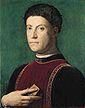 |
Piero I de' Medici Piero di Cosimo de' Medici Piero di Cosimo de' Medici , , was the de facto ruler of Florence from 1464 to 1469, during the Italian Renaissance. He was the father of Lorenzo the Magnificent and Giuliano de' Medici-Biography:Piero was born in Florence, the son of Cosimo de' Medici the Elder and Contessina de' Bardi... (Piero the Gouty) |
1 August 1464 | 2 December 1469 | eldest son of Cosimo de' Medici. |
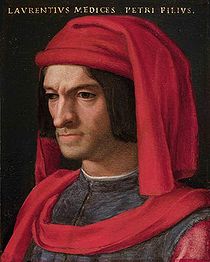 |
Lorenzo I de' Medici Lorenzo de' Medici Lorenzo de' Medici was an Italian statesman and de facto ruler of the Florentine Republic during the Italian Renaissance. Known as Lorenzo the Magnificent by contemporary Florentines, he was a diplomat, politician and patron of scholars, artists and poets... (Lorenzo the Magnificent) |
2 December 1469 | 9 April 1492 | eldest son of Piero I de' Medici. |
 |
Piero II de' Medici (Piero the Unfortunate) |
9 April 1492 | 8 November 1494 | eldest son of Lorenzo the Magnificent. Overthrown when Charles VIII of France Charles VIII of France Charles VIII, called the Affable, , was King of France from 1483 to his death in 1498. Charles was a member of the House of Valois... invaded as a full republic was restored, first under the theocracy of Girolamo Savonarola Girolamo Savonarola Girolamo Savonarola was an Italian Dominican friar, Scholastic, and an influential contributor to the politics of Florence from 1494 until his execution in 1498. He was known for his book burning, destruction of what he considered immoral art, and what he thought the Renaissance—which began in his... and then statesman Piero Soderini Piero Soderini Piero di Tommaso Soderini also known as Pier Soderini, was an Italian statesman of the Republic of Florence.-Biography:... . |
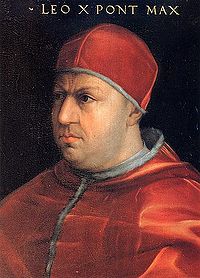 |
Cardinal Giovanni de' Medici Pope Leo X Pope Leo X , born Giovanni di Lorenzo de' Medici, was the Pope from 1513 to his death in 1521. He was the last non-priest to be elected Pope. He is known for granting indulgences for those who donated to reconstruct St. Peter's Basilica and his challenging of Martin Luther's 95 Theses... |
31 August 1512 | 9 March 1513 | brother of Piero the Unfortunate, second son of Lorenzo the Magnificent. Elected to the Papacy, becoming Pope Leo X. |
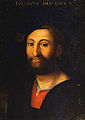 |
Giuliano de' Medici, Duke of Nemours | 9 March 1513 | 17 March 1516 | brother of Cardinal Giovanni de' Medici, third son of Lorenzo the Magnificent. |
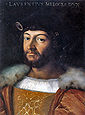 |
Lorenzo II de' Medici, Duke of Urbino | 17 March 1516 | 4 May 1519 | nephew of Giuliano de' Medici, Duke of Nemours, son of Piero the Unfortunate. |
_pope_clement_vii.jpg) |
Cardinal Giulio de' Medici Pope Clement VII Clement VII , born Giulio di Giuliano de' Medici, was a cardinal from 1513 to 1523 and was Pope from 1523 to 1534.-Early life:... |
4 May 1519 | 19 November 1523 | cousin of Lorenzo II de' Medici, Duke of Urbino, son of Giuliano de' Medici who was the brother of Lorenzo the Magnificent. Elected to the Papacy, becoming Pope Clement VII. |
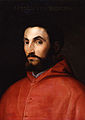 |
Cardinal Ippolito de' Medici Ippolito de' Medici Ippolito de' Medici was the illegitimate only son of Giuliano di Lorenzo de' Medici.Ippolito was born in Urbino. His father died when he was only five , and he was subsequently raised by his uncle Pope Leo X and his cousin Giulio.When Giulio de' Medici was elected pope as Clement VII, Ippolito... |
19 November 1523 | 24 October 1529 | cousin of Cardinal Giulio de' Medici, illegitimate son of Giuliano de' Medici, Duke of Nemours. |
Duke of Florence
| Portrait | Name | From | Until | Relationship with predecessor |
|---|---|---|---|---|
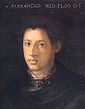 |
Alessandro de' Medici, Duke of Florence Alessandro de' Medici, Duke of Florence Alessandro de' Medici called "il Moro" , Duke of Penne and also Duke of Florence , ruler of Florence from 1530 until 1537... (il Moro) |
24 October 1529 | 6 January 1537 | cousin of Cardinal Ippolito de' Medici, illegitimate son of Lorenzo II de' Medici, Duke of Urbino or Pope Clement VII. Acting signore during imperial Siege of Florence, made Duke in 1531. |
Grand Dukes of Tuscany
| Portrait | Name | From | Until | Relationship with predecessor |
|---|---|---|---|---|
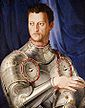 |
Cosimo I de' Medici, Grand Duke of Tuscany Cosimo I de' Medici, Grand Duke of Tuscany Cosimo I de' Medici was Duke of Florence from 1537 to 1574, reigning as the first Grand Duke of Tuscany from 1569.-Biography:... |
6 January 1537 | 21 April 1574 | distant cousin of Alessandro de' Medici, son of Giovanni dalle Bande Nere Giovanni dalle Bande Nere Lodovico de Medici also known as Giovanni dalle Bande Nere was an Italian condottiero.-Biography:Giovanni was born in the Northern Italian town of Forlì to Giovanni de' Medici and Caterina Sforza, one of the most famous women of the Italian Renaissance.From an early age, he demonstrated great... . dei Popolani line descended from Lorenzo the Elder, brother of Cosimo de' Medici. Duke of Florence, 1537—1569, until being made Grand Duke of Tuscany. |
.jpg) |
Francesco I de' Medici, Grand Duke of Tuscany Francesco I de' Medici, Grand Duke of Tuscany Francesco I de' Medici, Grand Duke of Tuscany was the second Grand Duke of Tuscany, ruling from 1574 to 1587.- Biography :... |
21 April 1574 | 17 October 1587 | eldest son of Cosimo I de' Medici, Grand Duke of Tuscany. |
 |
Ferdinando I de' Medici, Grand Duke of Tuscany Ferdinando I de' Medici, Grand Duke of Tuscany Ferdinando I de' Medici, Grand Duke of Tuscany was Grand Duke of Tuscany from 1587 to 1609, having succeeded his older brother Francesco I.-Biography:... |
17 October 1587 | 17 February 1609 | brother of Francesco I de' Medici, Grand Duke of Tuscany, son of Cosimo I de' Medici, Grand Duke of Tuscany. |
 |
Cosimo II de' Medici, Grand Duke of Tuscany Cosimo II de' Medici, Grand Duke of Tuscany Cosimo II de' Medici was Grand Duke of Tuscany from 1609 until 1621. He was the elder son of the then incumbent Grand Duke and Christina of Lorraine. He married Maria Magdalena of Austria, and had eight children.... |
17 February 1609 | 28 February 1621 | eldest son of Ferdinando I de' Medici, Grand Duke of Tuscany. |
 |
Ferdinando II de' Medici, Grand Duke of Tuscany Ferdinando II de' Medici, Grand Duke of Tuscany Ferdinando II de' Medici was grand duke of Tuscany from 1621 to 1670. He was the eldest child of Cosimo II de' Medici and Maria Maddalena of Austria. His 49 year rule was punctuated by the terminations of the remaining operations of the Medici Bank, and the beginning of Tuscany's long economic... |
28 February 1621 | 23 May 1670 | eldest son of Cosimo II de' Medici, Grand Duke of Tuscany. |
 |
Cosimo III de' Medici, Grand Duke of Tuscany Cosimo III de' Medici, Grand Duke of Tuscany Cosimo III de' Medici was the penultimate Medici Grand Duke of Tuscany. He reigned from 1670 to 1723, and was the elder son of Grand Duke Ferdinando II. Cosimo's 53-year long reign, the longest in Tuscan history, was marked by a series of ultra-reactionary laws which regulated prostitution and... |
23 May 1670 | 31 October 1723 | eldest son of Ferdinando II de' Medici, Grand Duke of Tuscany. |
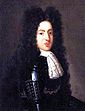 |
Gian Gastone de' Medici, Grand Duke of Tuscany Gian Gastone de' Medici, Grand Duke of Tuscany Gian Gastone de' Medici was the seventh and last Medicean Grand Duke of Tuscany. He was the second son of Cosimo III de' Medici, Grand Duke of Tuscany, and Marguerite Louise d'Orléans, Princess of France... |
31 October 1723 | 9 July 1737 | second son of Cosimo III de' Medici, Grand Duke of Tuscany. |
Notable decendants
- Emílio Garrastazu MédiciEmílio Garrastazu MédiciEmílio Garrastazu Médici, was a Brazilian military leader and politician. His rightist rule from 1969 to 1974, marked the apex of military governments in Brazil.-Early life:...
(1905 - 1985), president of Brazil between 1969 and 1973, in a context of military dictatorial government.
External links
- The Medici Archive Project
- The Medici Archive Project Documentary Sources for the Arts and Humanities in the Medici Granducal Archive: 1537-1743
- Prince Ottaviano de' Medici:Solving a 417-year-old murder mystery (May 4, 2004)
- The Moscow Florentine Society
- Medici Family Tree, featuring portraits and bios of key members of the Medici Dynasty, 1400-1737