

Fra Angelico

Encyclopedia
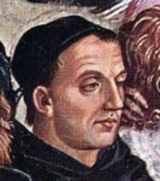
Fra Angelico born Guido di Pietro, was an Early Italian Renaissance
painter described by Vasari in his Lives of the Artists as having "a rare and perfect talent". He was known to his contemporaries as Fra Giovanni da Fiesole (Brother John from Fiesole
) and by Vasari as Fra Giovanni Angelico (Brother John the Angelic One).
Fra Angelico is known in Italy as il Beato Angelico, the term "Il Beato" ("Blessed One") being already in use during his lifetime or shortly thereafter, in reference to his skills in painting religious subjects. In 1982 Pope John Paul II
conferred beatification
, in recognition of the holiness of his life, thereby making this title official. Fiesole
is sometimes misinterpreted as being part of his formal name, but it was merely the name of the town where he took his vows as a Dominican friar, and was used by contemporaries to separate him from other Fra Giovannis. He is listed in the Roman Martyrology
as Beatus Ioannes Faesulanus, cognomento Angelicus—"Blessed Giovanni of Fiesole, nicknamed Angelico".
Vasari wrote of Fra Angelico:
area of Mugello, near Fiesole
towards the end of the 14th century and died in Rome
in 1455. Nothing is known of his parents. He was baptized Guido or Guidolino. The earliest recorded document concerning Fra Angelico dates from October 17, 1417 when he joined a religious confraternity at the Carmine
Church, still under the name of Guido di Pietro. This record also reveals that he was already a painter, a fact that is subsequently confirmed by two records of payment to Guido di Pietro in January and February 1418 for work done in the church of Santo Stefano del Ponte. The first record of Angelico as a friar dates from 1423, when he is first referred to as Fra Giovanni, following the custom of those entering a religious order
of taking a new name. He was a member of the Dominican
community at Fiesole. Fra
, an abbreviation of frate (from the Latin frater), is a conventional title for a friar or brother.
According to Vasari, Fra Angelico initially received training as an illuminator, possibly working with his older brother Benedetto who was also a Dominican and an illuminator. San Marco
in Florence holds several manuscripts that are thought to be entirely or partly by his hand. The painter Lorenzo Monaco
may have contributed to his art training, and the influence of the Sienese school
is discernible in his work. He had several important charges in the convent
s he lived in, but this did not limit his art, which very soon became famous. According to Vasari, the first paintings of this artist were an altarpiece
and a painted screen for the Carthusian Monastery of Florence
; none such exist there now.
From 1408 to 1418 Fra Angelico was at the Dominican friary
of Cortona where he painted frescoes, now destroyed, in the Dominican Church and may have been assistant to or follower of Gherardo Starnina
. Between 1418 and 1436 he was at the convent of Fiesole where he also executed a number of frescoes for the church, and the Altarpiece, deteriorated but restored. A predella of the Altarpiece remains intact in the National Gallery, London
which is a superb example of Fra Angelico's ability. It shows Christ in Glory, surrounded by more than 250 figures, including beatified Dominicans.
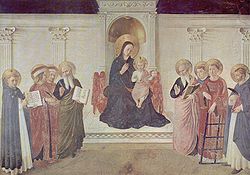
in Florence. This was an important move which put him in the centre of artistic activity of the region and brought about the patronage of one of the wealthiest and most powerful members of the city's Signoria, Cosimo de' Medici
, who had a large cell (later occupied by Savonarola) reserved for himself at the friary in order that he might retreat from the world.
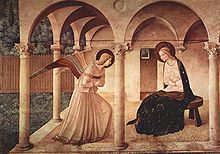
It was, according to Vasari, at Cosimo's urging that Fra Angelico set about the task of decorating the monastery, including the magnificent Chapter House fresco, the often-reproduced Annunciation at the top of the stairs to the cells, the Maesta with Saints and the many smaller devotional frescoes depicting aspects of the Life of Christ that adorn the walls of each cell.
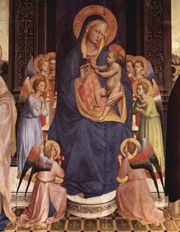
In 1439 he completed one of his most famous works, the Altarpiece for St. Marco's, Florence. The result was unusual for its times. Images of the enthroned Madonna and Child surrounded by saints were common, but they usually depicted a setting that was clearly heavenlike, in which saints and angels hovered about as divine presences rather than people. But in this instance, the saints stand squarely within the space, grouped in a natural way as if they were able to converse about the shared experience of witnessing the Virgin in glory. Paintings such as this, known as Sacred Conversations, were to become the major commissions of Giovanni Bellini
, Perugino and Raphael
.
 In 1445 Pope Eugenius IV summoned him to Rome to paint the frescoes of the Chapel of the Holy Sacrament at St Peter's, later demolished by Pope Paul III
. Vasari claims that at this time Fra Angelico was offered by Pope Nicholas V
the Archbishopric of Florence, and that he refused it, recommending another friar for the position. While the story seems possible and even likely, if Vasari's date is correct, then the pope must have been Eugenius and not Nicholas. In 1447 Fra Angelico was in Orvieto
with his pupil, Benozzo Gozzoli
, executing works for the Cathedral
. Among his other pupils were Zanobi Strozzi.
From 1447 to 1449 he was back at the Vatican, designing the frescoes for the Niccoline Chapel
for Nicholas V. The scenes from the lives of the two martyred deacon
s of the Early Christian Church, St. Stephen and St. Lawrence may have been executed wholly or in part by assistants. The small chapel, with its brightly frescoed walls and gold leaf decorations gives the impression of a jewel box. From 1449 until 1452, Fra Angelico was back at his old convent of Fiesole, where he was the Prior.
.
 Pope John Paul II
beatified Fra Angelico on October 3, 1982 and in 1984 declared him patron of Catholic artists.
, both of whom had created their major works in Padua, although Giotto was trained in Florence
by the great Gothic artist, Cimabue
, and painted a fresco cycle of St Francis in the Bardi Chapel in Santa Croce
. Giotto had many enthusiastic followers, who imitated his style in fresco
, some of them, notably the Lorenzetti
, achieving great success.
 The patrons
of these artists were most often monastic establishments or wealthy families endowing a church. Because the paintings often had devotional purpose, the clients tended to be conservative. Frequently, it would seem, the wealthier the client, the more conservative the painting. There was a very good reason for this. The paintings that were commissioned made a statement about the patron. Thus the more gold leaf
it displayed, the more it spoke to the patron's glory. The other valuable commodities in the paint-box were lapis lazuli
and vermilion
. Paint made from these colours did not lend itself to a tonal treatment. The azure blue made of powdered lapis lazuli went on flat, the depth and brilliance of colour being, like the gold leaf, a sign of the patron's ability to provide well. For these reasons, altarpiece
s are often much more conservatively painted than frescoes, which were often of almost life-sized figures and relied upon a stage-set quality rather than lavish display in order to achieve effect.
. Gentile's altarpiece of the Adoration of the Magi, 1423, in the Uffizi
is regarded as one of the greatest works of the style known as International Gothic
. At the time it was painted, another young artist, known as Masaccio, was working on the frescoes for the Brancacci Chapel
at the church of the Carmine. Masaccio
had fully grasped the implications of the art of Giotto. Few painters in Florence saw his sturdy, life-like and emotional figures and were not affected by them. His work partner was an older painter, Masolino, of the same generation as Fra Angelico. Sadly Masaccio died at 27, leaving the work unfinished.
and progressively Renaissance
. In the altarpiece of the Coronation of the Virgin
, painted for the Florentine church of Santa Maria Novella, are all the elements that a very expensive altarpiece of the 14th century was expected to provide- a precisely tooled gold background, lots of azure, lots of vermilion and an obvious display of arsenic
green. The workmanship of the gilded haloes and gold-edged robes is exquisite and all very Gothic. What make this a Renaissance painting, as against Gentile da Fabriano's masterpiece, is the solidity, the three-dimensionality and naturalism of the figures and the realistic way in which their garments hang or drape around them. Even though it is clouds these figures stand upon, and not the earth, they do so with weight.
Vasari relates that Cosimo de' Medici
seeing these works, inspired Fra Angelico to create a large Crucifixion
scene with many saints for the Chapter House
. As with the other frescoes, the wealthy patronage did not influence the Friar's artistic expression with displays of wealth.
Masaccio ventured into perspective with his creation of a realistically painted niche at Santa Maria Novella. Subsequently, Fra Angelico demonstrated an understanding of linear perspective particularly in his Annunciation paintings set inside the sort of arcades that Michelozzo
and Brunelleschi
created at San’ Marco's and the square in front of it.
.jpg) When Fra Angelico and his assistants went to the Vatican
When Fra Angelico and his assistants went to the Vatican
to decorate the chapel of Pope Nicholas, then the artist was again confronted with the need to please the very wealthiest of clients. In consequence, walking into the small chapel is like stepping into a jewel box. The walls are decked with the brilliance of colour and gold that one sees in the most lavish creations of the Gothic painter Simone Martini
at the Lower Church of St Francis of Assisi, a hundred years earlier. Yet Fra Angelico has succeeded in creating designs which continue to reveal his own preoccupation with humanity, with humility and with piety. The figures, in their lavish gilded robes, have the sweetness and gentleness for which his works are famous. According to Vasari:
It is probable that much of the actual painting was done by his assistants to his design. Both Benozzo Gozzoli and Gentile da Fabriano were highly accomplished painters. Benozzo took his art further towards the fully developed Renaissance style with his expressive and life-like portraits in his masterpiece of the Journey of the Magi, painted in the Medici
's private chapel at their palazzo
.
, who in turn painted extensive schemes for the wealthy patrons of Florence, and through Ghirlandaio to his pupil Michelangelo
and the High Renaissance.
Apart from the lineal connection, superficially there may seem little to link the humble priest with his sweetly pretty Madonnas and timeless Crucifixions to the dynamic expressions of Michelangelo's larger-than-life creations. But both these artists received their most important commissions from the wealthiest and most powerful of all patrons, the Vatican.
When Michelangelo took up the Sistine Chapel commission, he was working within a space that had already been extensively decorated by other artists. Around the walls the Life of Christ and Life of Moses were depicted by a range of artists including his teacher Ghirlandaio
, Raphael
's teacher Perugino and Botticelli. They were works of large scale and exactly the sort of lavish treatment to be expected in a Vatican commission, vying with each other in complexity of design, number of figures, elaboration of detail and skilful use of gold leaf. Above these works stood a row of painted Popes in brilliant brocades and gold tiaras. None of these splendours have any place in the work which Michelangelo created. Michelangelo, when asked by Pope Julius II
to ornament the robes of the Apostles in the usual way, responded that they were very poor men.
Within the cells of San’Marco, Fra Angelico had demonstrated that painterly skill and the artist's personal interpretation were sufficient to create memorable works of art, without the expensive trappings of blue and gold. In the use of the unadorned fresco technique, the clear bright pastel colours, the careful arrangement of a few significant figures and the skilful use of expression, motion and gesture, Michelangelo showed himself to be the artistic descendant of Fra Angelico. Frederick Hartt describes Fra Angelico as "prophetic of the mysticism" of painters such as Rembrandt, El Greco
and Zurbarán.
Fiesole
Florence, Santa Trinita
Florence, Santa Maria degli Angeli
Florence, Santa Maria Novella
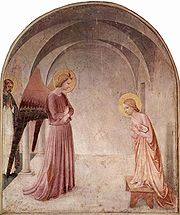 Each cell is decorated with a fresco which matches in size and shape the single round-headed window beside it. The frescoes are apparently for contemplative purpose. They are have a pale, serene, unearthly beauty. Many of Fra Angelico's finest and most reproduced works are among them. There are, particularly in the inner row of cells, some of less inspiring quality and of more repetitive subject, perhaps completed by assistants. Many pictures include Dominican saints as witnesses, allowing the friar using the cell to place himself in the scene.
Three segments of the ceiling in the Cappella Nuova, with the assistance of Benozzo Gozzoli.
Niccoline Chapel
The Chapel of Pope Nicholas V, at the Vatican
, was probably painted with much assistance from Benozzo Gozzoli and Gentile da Fabriano. The entire surface of wall and ceiling is sumptuously painted. There is much gold leaf for borders and decoration, and a great use of brilliant blue made from lapis lazuli
.
, England. Her father had bought them for £100 each in 1965 then bequeathed them to her when he died in 1974. Jean had been consulted by their then owner in her capacity as an expert medievalist. She recognised them as being high quality Florentine renaissance, but it never occurred to anyone, even all the dealers she approached on behalf of the owner, that they could possibly be by Fra Angelico. They were finally identified in 2005 by Michael Liversidge of Bristol University. There was almost no demand at all for medieval art during the 1960s and no dealers showed any interest, so her father bought them almost as an afterthought along with some manuscripts. Ironically the manuscripts turned out to be high quality Victorian forgeries by The Spanish Forger. The paintings are two of eight side panels of a large altarpiece painted in 1439 for Fra Angelico's monastery at San Marco, but split up by Napoleon's army 200 years ago. While the centre section is still at the monastery, the other six small panels are in German and US museums. These two panels were presumed lost forever. The Italian Government had hoped to purchase them but they were outbid at auction on 20 April 2007 by a private collector for £1.7M. Both panels are now restored and exhibited in the San Marco Museum in Florence.
Italian Renaissance
The Italian Renaissance began the opening phase of the Renaissance, a period of great cultural change and achievement in Europe that spanned the period from the end of the 13th century to about 1600, marking the transition between Medieval and Early Modern Europe...
painter described by Vasari in his Lives of the Artists as having "a rare and perfect talent". He was known to his contemporaries as Fra Giovanni da Fiesole (Brother John from Fiesole
Fiesole
Fiesole is a town and comune of the province of Florence in the Italian region of Tuscany, on a famously scenic height above Florence, 8 km NE of that city...
) and by Vasari as Fra Giovanni Angelico (Brother John the Angelic One).
Fra Angelico is known in Italy as il Beato Angelico, the term "Il Beato" ("Blessed One") being already in use during his lifetime or shortly thereafter, in reference to his skills in painting religious subjects. In 1982 Pope John Paul II
Pope John Paul II
Blessed Pope John Paul II , born Karol Józef Wojtyła , reigned as Pope of the Catholic Church and Sovereign of Vatican City from 16 October 1978 until his death on 2 April 2005, at of age. His was the second-longest documented pontificate, which lasted ; only Pope Pius IX ...
conferred beatification
Beatification
Beatification is a recognition accorded by the Catholic Church of a dead person's entrance into Heaven and capacity to intercede on behalf of individuals who pray in his or her name . Beatification is the third of the four steps in the canonization process...
, in recognition of the holiness of his life, thereby making this title official. Fiesole
Fiesole
Fiesole is a town and comune of the province of Florence in the Italian region of Tuscany, on a famously scenic height above Florence, 8 km NE of that city...
is sometimes misinterpreted as being part of his formal name, but it was merely the name of the town where he took his vows as a Dominican friar, and was used by contemporaries to separate him from other Fra Giovannis. He is listed in the Roman Martyrology
Roman Martyrology
The Roman Martyrology is the official martyrology of the Roman Rite of the Roman Catholic Church. It provides an extensive but not exhaustive list of the saints recognized by the Church.-History:...
as Beatus Ioannes Faesulanus, cognomento Angelicus—"Blessed Giovanni of Fiesole, nicknamed Angelico".
Vasari wrote of Fra Angelico:
Early life, 1395–1436
Fra Angelico was born Guido di Pietro at Rupecanina, in the TuscanTuscany
Tuscany is a region in Italy. It has an area of about 23,000 square kilometres and a population of about 3.75 million inhabitants. The regional capital is Florence ....
area of Mugello, near Fiesole
Fiesole
Fiesole is a town and comune of the province of Florence in the Italian region of Tuscany, on a famously scenic height above Florence, 8 km NE of that city...
towards the end of the 14th century and died in Rome
Rome
Rome is the capital of Italy and the country's largest and most populated city and comune, with over 2.7 million residents in . The city is located in the central-western portion of the Italian Peninsula, on the Tiber River within the Lazio region of Italy.Rome's history spans two and a half...
in 1455. Nothing is known of his parents. He was baptized Guido or Guidolino. The earliest recorded document concerning Fra Angelico dates from October 17, 1417 when he joined a religious confraternity at the Carmine
Our Lady of Mount Carmel
Our Lady of Mount Carmel is the title given to the Blessed Virgin Mary in her role as patroness of the Carmelite Order. The first Carmelites were Christian hermits living on Mount Carmel in the Holy Land during the late 12th and early to mid 13th centuries...
Church, still under the name of Guido di Pietro. This record also reveals that he was already a painter, a fact that is subsequently confirmed by two records of payment to Guido di Pietro in January and February 1418 for work done in the church of Santo Stefano del Ponte. The first record of Angelico as a friar dates from 1423, when he is first referred to as Fra Giovanni, following the custom of those entering a religious order
Religious order
A religious order is a lineage of communities and organizations of people who live in some way set apart from society in accordance with their specific religious devotion, usually characterized by the principles of its founder's religious practice. The order is composed of initiates and, in some...
of taking a new name. He was a member of the Dominican
Dominican Order
The Order of Preachers , after the 15th century more commonly known as the Dominican Order or Dominicans, is a Catholic religious order founded by Saint Dominic and approved by Pope Honorius III on 22 December 1216 in France...
community at Fiesole. Fra
FRA
Fra is a variant of Friar.FRA may refer to:* Forward Rate Agreement , a financial instrument* Federal Railroad Administration, a division of the United States Department of Transportation...
, an abbreviation of frate (from the Latin frater), is a conventional title for a friar or brother.
According to Vasari, Fra Angelico initially received training as an illuminator, possibly working with his older brother Benedetto who was also a Dominican and an illuminator. San Marco
San Marco, Florence
San Marco is the name of a religious complex in Florence, Italy. It comprises a church and a convent. The convent, which is now a museum, has three claims to fame: during the 15th century it was home to two famous Dominicans, the painter Fra Angelico and the preacher, Girolamo Savonarola...
in Florence holds several manuscripts that are thought to be entirely or partly by his hand. The painter Lorenzo Monaco
Lorenzo Monaco
Lorenzo Monaco was an Italian painter of the late Gothic-early Renaissance age.-Biography:...
may have contributed to his art training, and the influence of the Sienese school
Sienese School
The Sienese School of painting flourished in Siena, Italy between the 13th and 15th centuries and for a time rivaled Florence, though it was more conservative, being inclined towards the decorative beauty and elegant grace of late Gothic art...
is discernible in his work. He had several important charges in the convent
Convent
A convent is either a community of priests, religious brothers, religious sisters, or nuns, or the building used by the community, particularly in the Roman Catholic Church and in the Anglican Communion...
s he lived in, but this did not limit his art, which very soon became famous. According to Vasari, the first paintings of this artist were an altarpiece
Altarpiece
An altarpiece is a picture or relief representing a religious subject and suspended in a frame behind the altar of a church. The altarpiece is often made up of two or more separate panels created using a technique known as panel painting. It is then called a diptych, triptych or polyptych for two,...
and a painted screen for the Carthusian Monastery of Florence
Florence
Florence is the capital city of the Italian region of Tuscany and of the province of Florence. It is the most populous city in Tuscany, with approximately 370,000 inhabitants, expanding to over 1.5 million in the metropolitan area....
; none such exist there now.
From 1408 to 1418 Fra Angelico was at the Dominican friary
Dominican Order
The Order of Preachers , after the 15th century more commonly known as the Dominican Order or Dominicans, is a Catholic religious order founded by Saint Dominic and approved by Pope Honorius III on 22 December 1216 in France...
of Cortona where he painted frescoes, now destroyed, in the Dominican Church and may have been assistant to or follower of Gherardo Starnina
Gherardo Starnina
Gherardo Starnina was an Italian painter from Florence.According to the biographer Giorgio Vasari, Starnina initially trained with Antonio Veneziano, then with Agnolo Gaddi. He is claimed to have participated in the painting of the frescos in the Castellani Chapel in Santa Croce, Florence...
. Between 1418 and 1436 he was at the convent of Fiesole where he also executed a number of frescoes for the church, and the Altarpiece, deteriorated but restored. A predella of the Altarpiece remains intact in the National Gallery, London
National Gallery, London
The National Gallery is an art museum on Trafalgar Square, London, United Kingdom. Founded in 1824, it houses a collection of over 2,300 paintings dating from the mid-13th century to 1900. The gallery is an exempt charity, and a non-departmental public body of the Department for Culture, Media...
which is a superb example of Fra Angelico's ability. It shows Christ in Glory, surrounded by more than 250 figures, including beatified Dominicans.
San Marco, Florence, 1436–1445
In 1436 Fra Angelico was one of a number of the friars from Fiesole who moved to the newly-built Friary of San MarcoSan Marco, Florence
San Marco is the name of a religious complex in Florence, Italy. It comprises a church and a convent. The convent, which is now a museum, has three claims to fame: during the 15th century it was home to two famous Dominicans, the painter Fra Angelico and the preacher, Girolamo Savonarola...
in Florence. This was an important move which put him in the centre of artistic activity of the region and brought about the patronage of one of the wealthiest and most powerful members of the city's Signoria, Cosimo de' Medici
Cosimo de' Medici
Còsimo di Giovanni degli Mèdici was the first of the Medici political dynasty, de facto rulers of Florence during much of the Italian Renaissance; also known as "Cosimo 'the Elder'" and "Cosimo Pater Patriae" .-Biography:Born in Florence, Cosimo inherited both his wealth and his expertise in...
, who had a large cell (later occupied by Savonarola) reserved for himself at the friary in order that he might retreat from the world.
It was, according to Vasari, at Cosimo's urging that Fra Angelico set about the task of decorating the monastery, including the magnificent Chapter House fresco, the often-reproduced Annunciation at the top of the stairs to the cells, the Maesta with Saints and the many smaller devotional frescoes depicting aspects of the Life of Christ that adorn the walls of each cell.
In 1439 he completed one of his most famous works, the Altarpiece for St. Marco's, Florence. The result was unusual for its times. Images of the enthroned Madonna and Child surrounded by saints were common, but they usually depicted a setting that was clearly heavenlike, in which saints and angels hovered about as divine presences rather than people. But in this instance, the saints stand squarely within the space, grouped in a natural way as if they were able to converse about the shared experience of witnessing the Virgin in glory. Paintings such as this, known as Sacred Conversations, were to become the major commissions of Giovanni Bellini
Giovanni Bellini
Giovanni Bellini was an Italian Renaissance painter, probably the best known of the Bellini family of Venetian painters. His father was Jacopo Bellini, his brother was Gentile Bellini, and his brother-in-law was Andrea Mantegna. He is considered to have revolutionized Venetian painting, moving it...
, Perugino and Raphael
Raphael
Raffaello Sanzio da Urbino , better known simply as Raphael, was an Italian painter and architect of the High Renaissance. His work is admired for its clarity of form and ease of composition and for its visual achievement of the Neoplatonic ideal of human grandeur...
.
The Vatican, 1445–1455
Pope Paul III
Pope Paul III , born Alessandro Farnese, was Pope of the Roman Catholic Church from 1534 to his death in 1549. He came to the papal throne in an era following the sack of Rome in 1527 and rife with uncertainties in the Catholic Church following the Protestant Reformation...
. Vasari claims that at this time Fra Angelico was offered by Pope Nicholas V
Pope Nicholas V
Pope Nicholas V , born Tommaso Parentucelli, was Pope from March 6, 1447 to his death in 1455.-Biography:He was born at Sarzana, Liguria, where his father was a physician...
the Archbishopric of Florence, and that he refused it, recommending another friar for the position. While the story seems possible and even likely, if Vasari's date is correct, then the pope must have been Eugenius and not Nicholas. In 1447 Fra Angelico was in Orvieto
Orvieto
Orvieto is a city and comune in Province of Terni, southwestern Umbria, Italy situated on the flat summit of a large butte of volcanic tuff...
with his pupil, Benozzo Gozzoli
Benozzo Gozzoli
Benozzo Gozzoli was an Italian Renaissance painter from Florence. He is best known for a series of murals in the Palazzo Medici-Riccardi depicting festive, vibrant processions with wonderful attention to detail and a pronounced International Gothic influence.-Apprenticeship:He was born Benozzo di...
, executing works for the Cathedral
Duomo di Orvieto
The Cathedral of Orvieto is a large 14th century Roman Catholic cathedral situated in the town of Orvieto in Umbria, central Italy. The building was constructed under the orders of Pope Urban IV to commemorate and provide a suitable home for the Corporal of Bolsena, a miracle which is said to have...
. Among his other pupils were Zanobi Strozzi.
From 1447 to 1449 he was back at the Vatican, designing the frescoes for the Niccoline Chapel
Niccoline Chapel
The Niccoline Chapel is a chapel in the Vatican Palace, Rome. It is especially notable for its fresco paintings by Fra Angelico and his assistants, who may have executed much of the actual work...
for Nicholas V. The scenes from the lives of the two martyred deacon
Deacon
Deacon is a ministry in the Christian Church that is generally associated with service of some kind, but which varies among theological and denominational traditions...
s of the Early Christian Church, St. Stephen and St. Lawrence may have been executed wholly or in part by assistants. The small chapel, with its brightly frescoed walls and gold leaf decorations gives the impression of a jewel box. From 1449 until 1452, Fra Angelico was back at his old convent of Fiesole, where he was the Prior.
Death and beatification
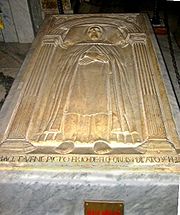
In 1455 Fra Angelico died while staying at a Dominican Convent in Rome, perhaps in order to work on Pope Nicholas' Chapel. He was buried in the church of Santa Maria sopra MinervaSanta Maria sopra Minerva
The Basilica of Saint Mary Above Minerva is a titular minor basilica and one of the most important churches of the Roman Catholic Dominican order in Rome, Italy. The church, located in the Piazza della Minerva in the Campus Martius region, is considered the only Gothic church in Rome. It houses...
.
Pope John Paul II
Blessed Pope John Paul II , born Karol Józef Wojtyła , reigned as Pope of the Catholic Church and Sovereign of Vatican City from 16 October 1978 until his death on 2 April 2005, at of age. His was the second-longest documented pontificate, which lasted ; only Pope Pius IX ...
beatified Fra Angelico on October 3, 1982 and in 1984 declared him patron of Catholic artists.
Background
Fra Angelico was working at a time when the style of painting was in a state of change. This process of change had begun a hundred years previous with the works of Giotto and several of his contemporaries, notably Giusto de' MenabuoiGiusto de' Menabuoi
Giusto de' Menabuoi was an Italian painter of the early Renaissance. He was born in Florence.In Lombardy he executed a fresco of the Last Judgement in the Abbey of Viboldone, Milan...
, both of whom had created their major works in Padua, although Giotto was trained in Florence
Florence
Florence is the capital city of the Italian region of Tuscany and of the province of Florence. It is the most populous city in Tuscany, with approximately 370,000 inhabitants, expanding to over 1.5 million in the metropolitan area....
by the great Gothic artist, Cimabue
Cimabue
Cimabue , also known as Bencivieni di Pepo or in modern Italian, Benvenuto di Giuseppe, was an Italian painter and creator of mosaics from Florence....
, and painted a fresco cycle of St Francis in the Bardi Chapel in Santa Croce
Santa Croce
Santa Croce is one of the six sestieri of Venice, northern Italy.-Geography:It occupies the north west part of the main islands, and can be divided into two areas: the eastern area being largely mediaeval, and the western - including the main port and the Tronchetto - mostly lying on land reclaimed...
. Giotto had many enthusiastic followers, who imitated his style in fresco
Fresco
Fresco is any of several related mural painting types, executed on plaster on walls or ceilings. The word fresco comes from the Greek word affresca which derives from the Latin word for "fresh". Frescoes first developed in the ancient world and continued to be popular through the Renaissance...
, some of them, notably the Lorenzetti
Pietro Lorenzetti
Pietro Lorenzetti was an Italian painter, active between approximately 1306 and 1345. His younger brother was the painter Ambrogio Lorenzetti....
, achieving great success.
Patronage
Patronage
Patronage is the support, encouragement, privilege, or financial aid that an organization or individual bestows to another. In the history of art, arts patronage refers to the support that kings or popes have provided to musicians, painters, and sculptors...
of these artists were most often monastic establishments or wealthy families endowing a church. Because the paintings often had devotional purpose, the clients tended to be conservative. Frequently, it would seem, the wealthier the client, the more conservative the painting. There was a very good reason for this. The paintings that were commissioned made a statement about the patron. Thus the more gold leaf
Gold leaf
right|thumb|250px|[[Burnishing]] gold leaf with an [[agate]] stone tool, during the water gilding processGold leaf is gold that has been hammered into extremely thin sheets and is often used for gilding. Gold leaf is available in a wide variety of karats and shades...
it displayed, the more it spoke to the patron's glory. The other valuable commodities in the paint-box were lapis lazuli
Lapis lazuli
Lapis lazuli is a relatively rare semi-precious stone that has been prized since antiquity for its intense blue color....
and vermilion
Vermilion
Vermilion is an opaque orangish red pigment, similar to scarlet. As a naturally occurring mineral pigment, it is known as cinnabar, and was in use around the world before the Common Era began. Most naturally produced vermilion comes from cinnabar mined in China, and vermilion is nowadays commonly...
. Paint made from these colours did not lend itself to a tonal treatment. The azure blue made of powdered lapis lazuli went on flat, the depth and brilliance of colour being, like the gold leaf, a sign of the patron's ability to provide well. For these reasons, altarpiece
Altarpiece
An altarpiece is a picture or relief representing a religious subject and suspended in a frame behind the altar of a church. The altarpiece is often made up of two or more separate panels created using a technique known as panel painting. It is then called a diptych, triptych or polyptych for two,...
s are often much more conservatively painted than frescoes, which were often of almost life-sized figures and relied upon a stage-set quality rather than lavish display in order to achieve effect.
Contemporaries
Fra Angelico was the contemporary of Gentile da FabrianoGentile da Fabriano
Gentile da Fabriano was an Italian painter known for his participation in the International Gothic style. He worked in various places in central Italy, mostly in Tuscany. His best known works are his Adoration of the Magi and the Flight into Egypt.-Biography:Gentile was born in or near Fabriano,...
. Gentile's altarpiece of the Adoration of the Magi, 1423, in the Uffizi
Uffizi
The Uffizi Gallery , is a museum in Florence, Italy. It is one of the oldest and most famous art museums of the Western world.-History:...
is regarded as one of the greatest works of the style known as International Gothic
International Gothic
International Gothic is a phase of Gothic art which developed in Burgundy, Bohemia, France and northern Italy in the late 14th century and early 15th century...
. At the time it was painted, another young artist, known as Masaccio, was working on the frescoes for the Brancacci Chapel
Brancacci Chapel
The Brancacci Chapel is a chapel in the Church of Santa Maria del Carmine in Florence, central Italy. It is sometimes called the "Sistine Chapel of the early Renaissance" for its painting cycle, among the most famous and influential of the period. Construction of the chapel was commissioned by...
at the church of the Carmine. Masaccio
Masaccio
Masaccio , born Tommaso di Ser Giovanni di Simone, was the first great painter of the Quattrocento period of the Italian Renaissance. According to Vasari, Masaccio was the best painter of his generation because of his skill at recreating lifelike figures and movements as well as a convincing sense...
had fully grasped the implications of the art of Giotto. Few painters in Florence saw his sturdy, life-like and emotional figures and were not affected by them. His work partner was an older painter, Masolino, of the same generation as Fra Angelico. Sadly Masaccio died at 27, leaving the work unfinished.
Altarpieces
The works of Fra Angelico reveal elements that are both conservatively GothicGothic art
Gothic art was a Medieval art movement that developed in France out of Romanesque art in the mid-12th century, led by the concurrent development of Gothic architecture. It spread to all of Western Europe, but took over art more completely north of the Alps, never quite effacing more classical...
and progressively Renaissance
Renaissance
The Renaissance was a cultural movement that spanned roughly the 14th to the 17th century, beginning in Italy in the Late Middle Ages and later spreading to the rest of Europe. The term is also used more loosely to refer to the historical era, but since the changes of the Renaissance were not...
. In the altarpiece of the Coronation of the Virgin
Coronation of the Virgin
The Coronation of the Virgin or Coronation of Mary is a subject in Christian art, especially popular in Italy in the 13th to 15th centuries, but continuing in popularity until the 18th century and beyond. Christ, sometimes accompanied by God the Father and the Holy Spirit in the form of a dove,...
, painted for the Florentine church of Santa Maria Novella, are all the elements that a very expensive altarpiece of the 14th century was expected to provide- a precisely tooled gold background, lots of azure, lots of vermilion and an obvious display of arsenic
Arsenic
Arsenic is a chemical element with the symbol As, atomic number 33 and relative atomic mass 74.92. Arsenic occurs in many minerals, usually in conjunction with sulfur and metals, and also as a pure elemental crystal. It was first documented by Albertus Magnus in 1250.Arsenic is a metalloid...
green. The workmanship of the gilded haloes and gold-edged robes is exquisite and all very Gothic. What make this a Renaissance painting, as against Gentile da Fabriano's masterpiece, is the solidity, the three-dimensionality and naturalism of the figures and the realistic way in which their garments hang or drape around them. Even though it is clouds these figures stand upon, and not the earth, they do so with weight.
Frescoes
The series of frescoes that Fra Angelico painted for the Dominican friars at San’ Marcos realise the advancements made by Masaccio and carry them further. Away from the constraints of wealthy clients and the limitations of panel painting, Fra Angelico was able to express his deep reverence for his God and his knowledge and love of humanity. The meditational frescoes in the cells of the convent have a quieting quality about them. They are humble works in simple colours. There is more mauvish-pink than there is red while the brilliant and expensive blue is almost totally lacking. In its place is dull green and the black and white of Dominican robes. There is nothing lavish, nothing to distract from the spiritual experiences of the humble people who are depicted within the frescoes. Each one has the effect of bringing an incident of the life of Christ into the presence of the viewer. They are like windows into a parallel world. These frescoes remain a powerful witness to the piety of the man who created them.Vasari relates that Cosimo de' Medici
Cosimo de' Medici
Còsimo di Giovanni degli Mèdici was the first of the Medici political dynasty, de facto rulers of Florence during much of the Italian Renaissance; also known as "Cosimo 'the Elder'" and "Cosimo Pater Patriae" .-Biography:Born in Florence, Cosimo inherited both his wealth and his expertise in...
seeing these works, inspired Fra Angelico to create a large Crucifixion
Crucifixion
Crucifixion is an ancient method of painful execution in which the condemned person is tied or nailed to a large wooden cross and left to hang until dead...
scene with many saints for the Chapter House
Chapter house
A chapter house or chapterhouse is a building or room attached to a cathedral or collegiate church in which meetings are held. They can also be found in medieval monasteries....
. As with the other frescoes, the wealthy patronage did not influence the Friar's artistic expression with displays of wealth.
Masaccio ventured into perspective with his creation of a realistically painted niche at Santa Maria Novella. Subsequently, Fra Angelico demonstrated an understanding of linear perspective particularly in his Annunciation paintings set inside the sort of arcades that Michelozzo
Michelozzo
thumb|250px|[[Palazzo Medici]] in Florence.Michelozzo di Bartolomeo Michelozzi was an Italian architect and sculptor.-Biography:...
and Brunelleschi
Filippo Brunelleschi
Filippo Brunelleschi was one of the foremost architects and engineers of the Italian Renaissance. He is perhaps most famous for inventing linear perspective and designing the dome of the Florence Cathedral, but his accomplishments also included bronze artwork, architecture , mathematics,...
created at San’ Marco's and the square in front of it.
Lives of the Saints
Vatican City
Vatican City , or Vatican City State, in Italian officially Stato della Città del Vaticano , which translates literally as State of the City of the Vatican, is a landlocked sovereign city-state whose territory consists of a walled enclave within the city of Rome, Italy. It has an area of...
to decorate the chapel of Pope Nicholas, then the artist was again confronted with the need to please the very wealthiest of clients. In consequence, walking into the small chapel is like stepping into a jewel box. The walls are decked with the brilliance of colour and gold that one sees in the most lavish creations of the Gothic painter Simone Martini
Simone Martini
Simone Martini was an Italian painter born in Siena.He was a major figure in the development of early Italian painting and greatly influenced the development of the International Gothic style....
at the Lower Church of St Francis of Assisi, a hundred years earlier. Yet Fra Angelico has succeeded in creating designs which continue to reveal his own preoccupation with humanity, with humility and with piety. The figures, in their lavish gilded robes, have the sweetness and gentleness for which his works are famous. According to Vasari:
In their bearing and expression, the saints painted by Fra Angelico come nearer to the truth than the figures done by any other artist.
It is probable that much of the actual painting was done by his assistants to his design. Both Benozzo Gozzoli and Gentile da Fabriano were highly accomplished painters. Benozzo took his art further towards the fully developed Renaissance style with his expressive and life-like portraits in his masterpiece of the Journey of the Magi, painted in the Medici
Medici
The House of Medici or Famiglia de' Medici was a political dynasty, banking family and later royal house that first began to gather prominence under Cosimo de' Medici in the Republic of Florence during the late 14th century. The family originated in the Mugello region of the Tuscan countryside,...
's private chapel at their palazzo
Palazzo
Palazzo, an Italian word meaning a large building , may refer to:-Buildings:*Palazzo, an Italian type of building**Palazzo style architecture, imitative of Italian palazzi...
.
Artistic legacy
Through Fra Angelico's pupil Benozzo Gozzoli's careful portraiture and technical expertise in the art of fresco we see a link to Domenico GhirlandaioDomenico Ghirlandaio
Domenico Ghirlandaio was an Italian Renaissance painter from Florence. Among his many apprentices was Michelangelo.-Early years:Ghirlandaio's full name is given as Domenico di Tommaso di Currado di Doffo Bigordi...
, who in turn painted extensive schemes for the wealthy patrons of Florence, and through Ghirlandaio to his pupil Michelangelo
Michelangelo
Michelangelo di Lodovico Buonarroti Simoni , commonly known as Michelangelo, was an Italian Renaissance painter, sculptor, architect, poet, and engineer who exerted an unparalleled influence on the development of Western art...
and the High Renaissance.
Apart from the lineal connection, superficially there may seem little to link the humble priest with his sweetly pretty Madonnas and timeless Crucifixions to the dynamic expressions of Michelangelo's larger-than-life creations. But both these artists received their most important commissions from the wealthiest and most powerful of all patrons, the Vatican.
When Michelangelo took up the Sistine Chapel commission, he was working within a space that had already been extensively decorated by other artists. Around the walls the Life of Christ and Life of Moses were depicted by a range of artists including his teacher Ghirlandaio
Domenico Ghirlandaio
Domenico Ghirlandaio was an Italian Renaissance painter from Florence. Among his many apprentices was Michelangelo.-Early years:Ghirlandaio's full name is given as Domenico di Tommaso di Currado di Doffo Bigordi...
, Raphael
Raphael
Raffaello Sanzio da Urbino , better known simply as Raphael, was an Italian painter and architect of the High Renaissance. His work is admired for its clarity of form and ease of composition and for its visual achievement of the Neoplatonic ideal of human grandeur...
's teacher Perugino and Botticelli. They were works of large scale and exactly the sort of lavish treatment to be expected in a Vatican commission, vying with each other in complexity of design, number of figures, elaboration of detail and skilful use of gold leaf. Above these works stood a row of painted Popes in brilliant brocades and gold tiaras. None of these splendours have any place in the work which Michelangelo created. Michelangelo, when asked by Pope Julius II
Pope Julius II
Pope Julius II , nicknamed "The Fearsome Pope" and "The Warrior Pope" , born Giuliano della Rovere, was Pope from 1503 to 1513...
to ornament the robes of the Apostles in the usual way, responded that they were very poor men.
Within the cells of San’Marco, Fra Angelico had demonstrated that painterly skill and the artist's personal interpretation were sufficient to create memorable works of art, without the expensive trappings of blue and gold. In the use of the unadorned fresco technique, the clear bright pastel colours, the careful arrangement of a few significant figures and the skilful use of expression, motion and gesture, Michelangelo showed himself to be the artistic descendant of Fra Angelico. Frederick Hartt describes Fra Angelico as "prophetic of the mysticism" of painters such as Rembrandt, El Greco
El Greco
El Greco was a painter, sculptor and architect of the Spanish Renaissance. "El Greco" was a nickname, a reference to his ethnic Greek origin, and the artist normally signed his paintings with his full birth name in Greek letters, Δομήνικος Θεοτοκόπουλος .El Greco was born on Crete, which was at...
and Zurbarán.
Works
Early works, 1408–1436
CortonaCortona
Cortona is a town and comune in the province of Arezzo, in Tuscany, Italy. It is the main cultural and artistic center of the Val di Chiana after Arezzo.-History:...
- Annunciation (c. 1430) – Diocesan Museum, Cortona
Fiesole
Fiesole
Fiesole is a town and comune of the province of Florence in the Italian region of Tuscany, on a famously scenic height above Florence, 8 km NE of that city...
- Altarpiece - Coronation of the Virgin, with predellas of Miracles of St Dominic, Louvre, Paris
- Virgin and Child between Saints Thomas Aquinas, Barnabas, Dominic and Peter MartyrFiesole AltarpieceThe Fiesole Altarpiece is a painting by the Italian early Renaissance master Fra Angelico, executed around 1424-1425. It is housed in the Convent of San Domenico, Fiesole, central Italy. The background was repainted by Lorenzo di Credi in 1501.-History:...
(1424) - Church of San Domenico, Fiesole - Predella - Christ in Majesty, National Gallery, LondonNational Gallery, LondonThe National Gallery is an art museum on Trafalgar Square, London, United Kingdom. Founded in 1824, it houses a collection of over 2,300 paintings dating from the mid-13th century to 1900. The gallery is an exempt charity, and a non-departmental public body of the Department for Culture, Media...
.
Florence, Santa Trinita
Santa Trinita
Santa Trinita is a church in central Florence, Italy. It is the mother church of the Vallumbrosan Order of monks, founded in 1092 by a Florentine nobleman...
- Deposition of Christ, said by Vasari to have been "painted by a saint or an angel". Now in the National Museum of San MarcoSan Marco, FlorenceSan Marco is the name of a religious complex in Florence, Italy. It comprises a church and a convent. The convent, which is now a museum, has three claims to fame: during the 15th century it was home to two famous Dominicans, the painter Fra Angelico and the preacher, Girolamo Savonarola...
, Florence. - Coronation of the VirginCoronation of the Virgin (Fra Angelico, Uffizi)The Coronation of the Virgin is a painting by the Italian early Renaissance master Fra Angelico, executed around 1432. It is now housed in the Uffizi Gallery of Florence. The artist executed another Coronation of the Virgin The Coronation of the Virgin is a painting by the Italian early Renaissance...
(c. 1432), Uffizi, Florence - Coronation of the VirginCoronation of the Virgin (Fra Angelico, Louvre)The Coronation of the Virgin is a painting by the Italian early Renaissance master Fra Angelico, executed around 1434-1435. It is now housed in the Musée du Louvre of Paris, France. The artist executed another Coronation of the Virgin The Coronation of the Virgin is a painting by the Italian early...
(c. 1434-1435), Louvre, Paris
Florence, Santa Maria degli Angeli
Santa Maria degli Angeli, Florence
Santa Maria degli Angeli is the former church of a now-defunct monastery in Florence, Italy. It belonged to the Camaldolese order, which was a reformed branch of the Benedictines. The congregation was founded in 1012 by the hermit St. Romuald at Camaldoli, near Arezzo, hence the name...
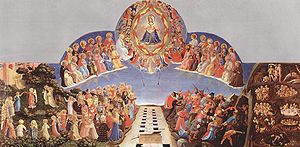
- Last Judgement, Accademia, Florence
Florence, Santa Maria Novella
- Altarpiece - Coronation of the Virgin, UffiziUffiziThe Uffizi Gallery , is a museum in Florence, Italy. It is one of the oldest and most famous art museums of the Western world.-History:...
.
San Marco, Florence, 1436–1445
- Altarpiece for chancel – Virgin with Saints Cosmas and DamianSaints Cosmas and DamianSaints Cosmas and Damian were twin brothers, physicians, and early Christian martyrs born in Cilicia, part of today's Turkey. They practiced their profession in the seaport of Ayas, Adana, then in the Roman province of Syria...
, attended by Saints Dominic, Peter, Francis, Mark, John Evangelist and Stephen. Cosmas and Damian were patrons of the Medici; the altarpiece was commissioned in 1438 by Cosimo de' Medici. It was removed and disassembled during the renovation of the convent church in the seventeenth century. Two of the nine predellaPredellaA predella is the platform or step on which an altar stands . In painting, the predella is the painting or sculpture along the frame at the bottom of an altarpiece...
panels remain at the convent; seven are in Washington, Munich, Dublin and Paris. Unexpectedly, in 2006 the last two missing panels, Dominican saints from the side panels, turned up in the estate of a modest collector in Oxfordshire, who had bought them in California in the 1960s. - Altarpiece ? – Madonna and Child with twelve Angels (life sized); Uffizi.
- Altarpiece – The Annunciation
- San Marco AltarpieceSan Marco AltarpieceThe San Marco Altarpiece is a painting by the Italian early Renaissance painter Fra Angelico, housed in the San Marco Museum of Florence, Italy. It was commissioned by Cosimo de' Medici the Elder, and was completed sometime between 1438 and 1443...
- Two versions of the Crucifixion with St Dominic; in the Cloister
- Very large Crucifixion with Virgin and 20 saints; in the Chapter House
- The Annunciation; at the top of the Dormitory stairs. This is probably the most reproduced of all Fra Angelico's paintings.
- Virgin enthroned with Four Saints; in the Dormitory passage
- The Adoration of the Magi
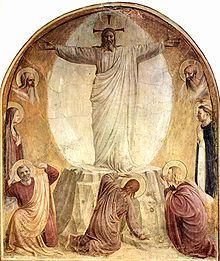
- The TransfigurationTransfiguration of JesusThe Transfiguration of Jesus is an event reported in the New Testament in which Jesus is transfigured and becomes radiant upon a mountain. The Synoptic Gospels describe it, and 2 Peter 1:16-18 refers to it....
- Noli me TangereNoli me tangereNoli me tangere, meaning "don't touch me" / "touch me not", is the Latin version of words spoken, according to , by Jesus to Mary Magdalene when she recognizes him after his resurrection....
- The three Marys at the tomb.
- The Road to Emmaus, with two Dominicans as the disciples
- There are many versions of the CrucifixionCrucifixionCrucifixion is an ancient method of painful execution in which the condemned person is tied or nailed to a large wooden cross and left to hang until dead...
- The Mocking of Christ
Late works, 1445–1455
Orvieto CathedralDuomo di Orvieto
The Cathedral of Orvieto is a large 14th century Roman Catholic cathedral situated in the town of Orvieto in Umbria, central Italy. The building was constructed under the orders of Pope Urban IV to commemorate and provide a suitable home for the Corporal of Bolsena, a miracle which is said to have...
Three segments of the ceiling in the Cappella Nuova, with the assistance of Benozzo Gozzoli.
- Christ in Glory
- The Virgin Mary
- The Apostles
Niccoline Chapel
Niccoline Chapel
The Niccoline Chapel is a chapel in the Vatican Palace, Rome. It is especially notable for its fresco paintings by Fra Angelico and his assistants, who may have executed much of the actual work...
The Chapel of Pope Nicholas V, at the Vatican
Vatican City
Vatican City , or Vatican City State, in Italian officially Stato della Città del Vaticano , which translates literally as State of the City of the Vatican, is a landlocked sovereign city-state whose territory consists of a walled enclave within the city of Rome, Italy. It has an area of...
, was probably painted with much assistance from Benozzo Gozzoli and Gentile da Fabriano. The entire surface of wall and ceiling is sumptuously painted. There is much gold leaf for borders and decoration, and a great use of brilliant blue made from lapis lazuli
Lapis lazuli
Lapis lazuli is a relatively rare semi-precious stone that has been prized since antiquity for its intense blue color....
.
- The life of St Stephen
- The life of St Lawrence
- The Four EvangelistsFour EvangelistsIn Christian tradition the Four Evangelists are Matthew, Mark, Luke, and John, the authors attributed with the creation of the four Gospel accounts in the New Testament that bear the following titles:*Gospel according to Matthew*Gospel according to Mark...
.
Discovery of lost works
Worldwide press coverage reported in November 2006 that two missing masterpieces by Fra Angelico had turned up, having hung in the spare room of the late Jean Preston, in her "modest terrace house" in OxfordOxford
The city of Oxford is the county town of Oxfordshire, England. The city, made prominent by its medieval university, has a population of just under 165,000, with 153,900 living within the district boundary. It lies about 50 miles north-west of London. The rivers Cherwell and Thames run through...
, England. Her father had bought them for £100 each in 1965 then bequeathed them to her when he died in 1974. Jean had been consulted by their then owner in her capacity as an expert medievalist. She recognised them as being high quality Florentine renaissance, but it never occurred to anyone, even all the dealers she approached on behalf of the owner, that they could possibly be by Fra Angelico. They were finally identified in 2005 by Michael Liversidge of Bristol University. There was almost no demand at all for medieval art during the 1960s and no dealers showed any interest, so her father bought them almost as an afterthought along with some manuscripts. Ironically the manuscripts turned out to be high quality Victorian forgeries by The Spanish Forger. The paintings are two of eight side panels of a large altarpiece painted in 1439 for Fra Angelico's monastery at San Marco, but split up by Napoleon's army 200 years ago. While the centre section is still at the monastery, the other six small panels are in German and US museums. These two panels were presumed lost forever. The Italian Government had hoped to purchase them but they were outbid at auction on 20 April 2007 by a private collector for £1.7M. Both panels are now restored and exhibited in the San Marco Museum in Florence.
See also
- List of painters
- List of Italian painters
- List of famous Italians
- Early Renaissance paintingEarly Renaissance paintingRenaissance art is the painting, sculpture and decorative arts of that period of European history known as the Renaissance, emerging as a distinct style in Italy in about 1400, in parallel with developments which occurred in philosophy, literature, music and science...
- Poor Man's BiblePoor Man's BibleThe term Poor Man's Bible has come into use in modern times to describe works of art within churches and cathedrals which either individually or collectively have been created to illustrate the teachings of the Bible for a largely illiterate population. These artworks may take the form of carvings,...
- Fray Angelico Chavez Franciscan Friar, historian and artist who was named after Fra Angelico due to his interest in painting.
- Western paintingWestern paintingThe history of Western painting represents a continuous, though disrupted, tradition from antiquity. Until the mid-19th century it was primarily concerned with representational and Classical modes of production, after which time more modern, abstract and conceptual forms gained favor.Developments...
- FrangelicoFrangelicoFrangelico is a brand of noisette, or hazelnut and herb-flavored liqueur which is produced in Canale, Italy. It is 20% alcohol by volume, 40 proof. It was released in the 1980s, gaining attention largely because of its unusual packaging: its bottle was designed to look like a friar, complete with...
– Italian liqueur named after Fra Angelico
Further reading
- Didi-Huberman, Georges. Fra Angelico: Dissemblance and Figuration. University of Chicago Press, 1995. ISBN 0-226-14813-0 Discussion of how Fra Angelico challenged Renaissance naturalism and developed a technique to portray "unfigurable" theological ideas.
- Gilbert, Creighton, How Fra Angelico and Signorelli Saw the End of the World, Penn State Press, 2002 ISBN 0-271-02140-3
- Spike, John T. Angelico, New York, 1997.
- Supino, J. B., Fra Angelico, Alinari Brothers, Florence, undated, from Project GutenbergProject GutenbergProject Gutenberg is a volunteer effort to digitize and archive cultural works, to "encourage the creation and distribution of eBooks". Founded in 1971 by Michael S. Hart, it is the oldest digital library. Most of the items in its collection are the full texts of public domain books...
External links
- Fra Angelico – Painter of the Early Renaissance
- Fra Angelico in the "History of Art"
- Fra Angelico of Fiesole
- Fra Angelico Exhibition at the Metropolitan Museum of ArtMetropolitan Museum of ArtThe Metropolitan Museum of Art is a renowned art museum in New York City. Its permanent collection contains more than two million works, divided into nineteen curatorial departments. The main building, located on the eastern edge of Central Park along Manhattan's Museum Mile, is one of the...
, (October 26, 2005–January 29, 2006). - "Soul Eyes" Review of the Fra Angelico show at the Met, by Arthur C. Danto in The Nation, (January 19, 2006).
- Fra Angelico, Catherine Mary Phillimore, (Sampson Low, Marston & Co., 1892)