
All Topics  
Andrea del Castagno

 
Andrea Del Castagno

   Email Print
   Bookmark   Link


Andrea del Castagno


"Castagna" redirects here. For other meanings, see Castagna (disambiguation)
Castagna (disambiguation)

Castagna can refer to*People**Andrea del Castagno , an Italian painter**William J. Castagna , an American jurist*Companies**Carrozzeria Castagna, an Italian coachbuilding company from Milan...
.
Andrea del Castagno or Andrea di Bartolo di Bargilla (c. 1421 – 1457) was an Italian
Italy

Italy , officially the Italian Republic , is a country located on the Italian Peninsula in Southern Europe and on the two largest islands in the Mediterranean Sea, Sicily and Sardinia....
 painter from Florence
Florence

Florence is the Capital city of the Italy Regions of Italy of Tuscany and of the provinces of Italy Province of Florence. It is the most populous city in Tuscany and has a population of 364,779 ....
, influenced chiefly by Tommaso Masaccio and Giotto di Bondone
Giotto di Bondone

Giotto di Bondone , better known simply as Giotto, was an italy Painting and architect from Florence. He is generally considered the first in a line of great artists who contributed to the Italian Renaissance....
. His works include frescoes in Sant'Apollonia
Sant'Apollonia

Sant'Apollonia was once a Benedictine convent that was founded in 1339 in Florence, Italy. The building is now used as an art museum....
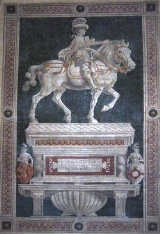
 in Florence and the painted equestrian monument of Niccolò da Tolentino
Niccolò da Tolentino

Niccol? Mauruzzi , best known as Niccol? da Tolentino was an Italian condottiero. He should not be confused with Saint Nicholas of Tolentino....
 (1456) in the Cathedral in Florence
Santa Maria del Fiore

The Basilica di Santa Maria del Fiore is the cathedral church of Florence, Italy, begun in 1296 in the Gothic architecture style to the design of Arnolfo di Cambio and completed structurally in 1436 with the dome engineered by Filippo Brunelleschi....
..


Discussion
Ask a question about 'Andrea del Castagno'
Start a new discussion about 'Andrea del Castagno'
Answer questions from other users
Full Discussion Forum


Recent Posts


Encyclopedia


"Castagna" redirects here. For other meanings, see Castagna (disambiguation)
Castagna (disambiguation)

Castagna can refer to*People**Andrea del Castagno , an Italian painter**William J. Castagna , an American jurist*Companies**Carrozzeria Castagna, an Italian coachbuilding company from Milan...
.
Firenze
Andrea del Castagno or Andrea di Bartolo di Bargilla (c. 1421 – 1457) was an Italian
Italy

Italy , officially the Italian Republic , is a country located on the Italian Peninsula in Southern Europe and on the two largest islands in the Mediterranean Sea, Sicily and Sardinia....
 painter from Florence
Florence

Florence is the Capital city of the Italy Regions of Italy of Tuscany and of the provinces of Italy Province of Florence. It is the most populous city in Tuscany and has a population of 364,779 ....
, influenced chiefly by Tommaso Masaccio and Giotto di Bondone
Giotto di Bondone

Giotto di Bondone , better known simply as Giotto, was an italy Painting and architect from Florence. He is generally considered the first in a line of great artists who contributed to the Italian Renaissance....
. His works include frescoes in Sant'Apollonia
Sant'Apollonia

Sant'Apollonia was once a Benedictine convent that was founded in 1339 in Florence, Italy. The building is now used as an art museum....
 in Florence and the painted equestrian monument of Niccolò da Tolentino
Niccolò da Tolentino

Niccol? Mauruzzi , best known as Niccol? da Tolentino was an Italian condottiero. He should not be confused with Saint Nicholas of Tolentino....
 (1456) in the Cathedral in Florence
Santa Maria del Fiore

The Basilica di Santa Maria del Fiore is the cathedral church of Florence, Italy, begun in 1296 in the Gothic architecture style to the design of Arnolfo di Cambio and completed structurally in 1436 with the dome engineered by Filippo Brunelleschi....
.. He in turn influenced the Ferrarese school of Cosmè Tura, Francesco del Cossa
Francesco del Cossa

Francesco del Cossa was an Italy early-Renaissance painter of the School of Ferrara ....
 and Ercole de' Roberti
Ercole de' Roberti

Ercole de' Roberti , also known as Ercole Ferrarese or Ercole da Ferrara, was an Italian artist of the Early Renaissance and the School of Ferrara....
.

Life


Early years

Andrea del Castagno was born at Castagno
Castagno d'Andrea

Castagno d'Andrea is a frazione of the comune of San Godenzo, in the province of Florence, Tuscany . It is located within the Foreste Casentinesi, Monte Falterona, Campigna National Park....
, a village near Monte Falterona
Monte Falterona

Monte Falterona is a mountain in the northern Apennines, in the Casentino traditional region, standing at 1,654 m. It is part of the Parco nazionale delle Foreste Casentinesi, Monte Falterona e Campigna....
, not far from Florence. During the war between Florence and Milan, he lived in Corella
Corella, Italy

Corella is a village of the Dicomano area - the village is located in a valley of the Apennine Mountains .Andrea del Castagno lived in Corella during the war between Florence and Milan and returned to his home after the end of that war....
, returning to his home after its end. In 1440 he moved to Florence under the protection of Bernadetto de' Medici
Bernadetto de' Medici

Bernadetto de' Medici was an Italy patrician who moved from Florence to Naples.A member to a secondary branch of the House of Medici , he was the son of Ottaviano de' Medici and Bartolomeo Giugni....
. Here he painted the portraits of the citizens hanged after the Battle of Anghiari
Battle of Anghiari (1440)

The Battle of Anghiari was fought on June 29, 1440, between Milan and the Italian League led by Republic of Florence in the course of the Wars in Lombardy....
 on the facade of the Palazzo del Podestà, gaining the nickname of Andrea degli Impiccati.

Little is known about his formation, though it has been hypothised that he apprenticed under Fra Filippo Lippi and Paolo Uccello
Paolo Uccello

Paolo Uccello was an Italy painter who was notable for his pioneering work on visual Perspective in art. Giorgio Vasari in his book Lives of the Artists wrote that Uccello was obsessed by his interest in perspective and would stay up all night in his study trying to grasp the exact vanishing point....
. In 1440-1441 he executed the fresco of Crucifixion and Saints in the Ospedale di Santa Maria Nuova, whose perspective-oriented construction and figures shows the influence of Masaccio.

In 1442 he was in Venice
Venice

Venice is a city in northern Italy, the capital city of the Italian regions Veneto, a population of 271,251 . Together with Padua, Italy, the city is included in the Padua-Venice Metropolitan Area ....
 where he executed frescoes in the San Tarasio Chapel of the church of San Zaccaria. Later he also worked in St. Mark's Basilica, leaving a fresco of Death of the Virgin (1442-1443).

Back in Florence, he designed a stained window with Deposition for the local Cathedral
Santa Maria del Fiore

The Basilica di Santa Maria del Fiore is the cathedral church of Florence, Italy, begun in 1296 in the Gothic architecture style to the design of Arnolfo di Cambio and completed structurally in 1436 with the dome engineered by Filippo Brunelleschi....
. On May 30 1445 he became member of the Guild of the Medicians. From the same year is the fresco of Madonna with Child and Santi in the Contini Bonacossi Collection (Uffizi
Uffizi

The Uffizi Gallery , one of the oldest and most famous art museums in the world, is housed in the Palazzo degli Uffizi, a palazzo in Florence, Italy, Italy....
).

The Last Supper

In 1447 he worked in the refectory of Sant'Apollonia
Sant'Apollonia

Sant'Apollonia was once a Benedictine convent that was founded in 1339 in Florence, Italy. The building is now used as an art museum....
 in Florence, painting, in the lower part, Last Supper fresco
Fresco

Fresco is any of several related painting types, done on plaster on walls or ceilings. The word fresco comes from the Italian word affresco which derives from the adjective fresco , which has Latin origins....
, accompanied by other scenes portraying the Deposition
Stations of the Cross

Stations of the Cross refers to the depiction of the final hours of Jesus, and the devotion commemorating the Passion. The tradition as chapel devotion began with St....
, Resurrection, and Crucifixion
Crucifixion

Crucifixion is an ancient method of execution , whereby the condemned person is tied or nailed to a large wooden cross and left to hang until dead....
, which are now damaged. He also painted a lunette in the cloister, depicting a Pietà.

The Last Supper displays del Castagno's talents at his best. The arrangement of balanced figures in an architectural setting is particularly noted. For instance, Saint John
John the Apostle

John the Apostle was one of the Twelve Apostles of Jesus. Christian tradition identifies him as the author of several New Testament works: the Gospel of John, the Epistles of John, and the Book of Revelation....
's posture of innocent slumber neatly contrasts Jude the Betrayer
Judas Iscariot

'Judas Iscariot', "Yehuda" was, according to the New Testament, one of the twelve original Twelve Apostles of Jesus. Among the twelve, he was apparently designated to keep account of the "accountant" , but he is most traditionally known for his role in Jesus' betrayal into the hands of Roman authorities....
's tense, upright pose, and the hand positions of the final pair of apostles
Twelve Apostles

In Christianity, apostles were missionaries among the leaders in the Early Christianity and, in the Epistle to the Hebrews, Jesus Christ himself....
 on either end of the fresco mirror each other with accomplished realism. The colors of the apostles' robes and their postures contribute to the balance of the piece.

The detail and naturalism of this fresco portray the ways in which del Castagno departed from earlier artistic styles. The highly detailed marble walls hearken back to Roman "First Style"
Roman art

Roman art includes the visual arts produced in Ancient Rome, and in the territories of the Roman empire. Major forms of Roman art are Roman architecture, painting, sculpture and mosaic work....
 wall paintings, and that the pillars and statues recall Classical
Classical antiquity

Classical antiquity is a broad term for a long period of cultural history centered on the Mediterranean Sea, comprising the interlocking civilizations of Ancient Greece and Ancient Rome....
 sculpture and preface trompe l'oeil
Trompe l'oeil

Trompe-l'?il, which can also be spelled without the hyphen in English, is an art technique involving extremely realistic imagery in order to create the optical illusion that the depicted objects appear in three-dimensions, instead of actually being a two-dimensional painting....
 painting. Furthermore, the color highlights in the hair of the figures, flowing robes, and a credible perspective
Perspective (graphical)

File:Staircase perspective.jpgPerspective in the graphic arts, such as drawing, is an approximate representation, on a flat surface , of an image as it is perceived by the eye....
 in the halos foreshadow advancements to come.

Late activity

In 1449-1450 he painted the Assumption with Saints Julian and Miniato for the church of San Miniato fra le Torri (now in Berlin
Berlin

Berlin is the Capital of Germany city and one of sixteen States of Germany of Germany. With a population of 3.4 million within its city limits, Berlin is the country's largest city....
). In the same years he collaborated with Filippo Carducci to a series of Illustrious People for the Villa Carducci at Legnaia
Legnaia

Legnaia is a rione in Florence, Italy. It is located between the centre of the city and Scandicci, and was an autonomous commune until 1865. At the time, it counted some 11,300 inhabitants....
. These include Pippo Spano, Farinata degli Uberti
Farinata degli Uberti

Farinata degli Uberti was an Italy aristocrat and military leader, considered by some to be a heresy, who appears in Dante's The_Divine_Comedy#Inferno and is mentioned in C.S....
, Niccolò Acciaioli
Niccolò Acciaioli

Niccol? Acciaioli was an Italian noble, a member of the Florentine banking family of the Acciaioli. He was the grand seneschal of the Kingdom of Naples and count of Melfi, Malta, and Gozo in the mid-fourteenth century....
, Dante
DANTE

DANTE is a not-for-profit organisation that plans, builds and operates the international networks that interconnect the various National Research and Education Networks in Europe and surrounding regions....
, Petrarca
Petrarch

Francesco Petrarca , known in English language as Petrarch, was an Italy scholar, poet and one of the earliest Renaissance humanism. Petrarch is often popularly called the "Father of Humanism"....
, Boccaccio
Giovanni Boccaccio

Giovanni Boccaccio was an Italy author and poet, a friend and correspondent of Petrarch, an important Renaissance humanism and the author of a number of notable works including the Decameron, On Famous Women, and his poetry in the Italian vernacular....
, the Cumaean Sibyl
Cumaean Sibyl

The ageless Cumaean Sibyl was the priestess presiding over the Apollonian oracle at Cumae, a Greek colony located near Naples, Italy.The word Sibyl comes from the ancient Greek word sibylla, meaning prophetess....
, Esther
Book of Esther

The Book of Esther is one of the books of the Ketuvim of the Tanakh and of the Historical Books of the Old Testament. The Book of Esther or the Megillah is the basis for the Jewish celebration of Purim....
 and Tomiri
Tomyris

Tomyris was the queen who reigned over the Massagetae, an Iranian peoples of Central Asia east of the Caspian Sea, at approximately 530 B.C. In Persian texts, ????????, is the way her name is written....
.

Also from around 1450 is the Crucifixion in London, as well as the David with Goliath's Head and the Portrait of a Man in Washington. Between January 1451 and September 1453 he completed the frescoes with Scenes of Life of the Virgin
Life of the Virgin

The Life of the Virgin, showing narrative scenes from the life of Mary , the mother of Jesus, is a common subject for pictorial cycles in Christian art, often complementing, or forming part of, a cycle on the Life of Christ....
 left unfinished by Domenico Veneziano
Domenico Veneziano

Domenico Veneziano was an Italy painter of the early Renaissance, active mostly in Perugia and Tuscany.Little is known of his birth, though he is thought to have been born in Venice, hence his last name....
 in the Florentine church of Sant'Egidio (now lost). In October Filippo Carducci commissioned him frescoes for his villa at Soffiano, of which today an Eve and a ruined Madonna with Child survive.

In 1455 Andrea del Castagno worked in the Basilica della Santissima Annunziata
Basilica della Santissima Annunziata di Firenze

The Basilica della Santissima Annunziata is a Roman Catholic minor basilica in Florence and the mother church of the Servite order. It is located at the northeastern side of the Piazza Santissima Annunziata....
 (frescoes with Trinity with Saints Jerome, Paula and Eustochium and St. Julian and the Redeemer, the former showing a stressed realism). Also to those years is attributed a Crucifixion for St. Apollonia. In 1456 he executed in the Cathedral the famous fresco of the Equestrian Statue of Niccolò da Tolentino, paralleling the similar painting by Paolo Uccello portraying John Hawkwood
John Hawkwood

Sir John Hawkwood was an England mercenary or condottieri in 14th century Italy. The French chronicler Jean Froissart knew him as Haccoude and Italians as Giovanni Acuto....
.

Giorgio Vasari
Giorgio Vasari

Giorgio Vasari was an Italy Painting and architect, who is today famous for his biography of Italian artists, considered the ideological foundation of art history writing....
, an artist and biographer of the Italian Renaissance
Italian Renaissance

The Italian Renaissance began the opening phase of the Renaissance, a period of great cultural change and achievement in Europe that spanned the period from the end of the 13th century to about 1600, marking the transition between Medieval and Early Modern Europe....
, alleged that Castagno murdered Domenico Veneziano, although this seems rather unlikely - given that Veneziano died in 1461, four years after Castagno died of the plague
Bubonic plague

Plague is a deadly infectious disease caused by the Enterobacteriaceae Yersinia pestis . Plague is a zoonotic, primarily carried by rodents and spread to humans via fleas....
.