


Robert Campin

Encyclopedia
Early Netherlandish painting
Early Netherlandish painting refers to the work of artists active in the Low Countries during the 15th- and early 16th-century Northern renaissance, especially in the flourishing Burgundian cities of Bruges and Ghent...
. This had been a matter of controversy for decades; Campin's life is relatively well documented for the period, but no works in assessable condition could be securely connected with him, whilst a corpus of work had been attached to the unidentified "Master of Flémalle", named after the supposed origin of a work.
Life
Campin seems to have had relatives in ValenciennesValenciennes
Valenciennes is a commune in the Nord department in northern France.It lies on the Scheldt river. Although the city and region had seen a steady decline between 1975 and 1990, it has since rebounded...
. He first appears as settled in Tournai
Tournai
Tournai is a Walloon city and municipality of Belgium located 85 kilometres southwest of Brussels, on the river Scheldt, in the province of Hainaut....
from the archives of 1405-6, as a free master of the guild of painters, and he bought citizenship in 1410, which suggests he was not born there. He eventually attained the office of dean of the guild, and wardenship of a church and other civic offices, and was running a large workshop. By 1432, however, he lost his civic positions because of scandals, and probably his role in political disturbances in the city. In 1429 he was found guilty of withholding evidence, and sentenced to go on a pilgrimage
Pilgrimage
A pilgrimage is a journey or search of great moral or spiritual significance. Typically, it is a journey to a shrine or other location of importance to a person's beliefs and faith...
, and in 1432 was convicted of adultery
Adultery
Adultery is sexual infidelity to one's spouse, and is a form of extramarital sex. It originally referred only to sex between a woman who was married and a person other than her spouse. Even in cases of separation from one's spouse, an extramarital affair is still considered adultery.Adultery is...
and banished for a year. Margaret of Burgundy
Margaret of Burgundy, Duchess of Bavaria
Margaret of Burgundy was a daughter of Philip the Bold, Duke of Burgundy and Margaret III, Countess of Flanders. By her marriage to William of Bavaria, she would, in 1404, become Duchess of Bavaria.-Family:...
, wife of the Count of Holland
William II, Duke of Bavaria-Straubing
Duke William II of Bavaria-Straubing KG was also count William VI of Holland, count William IV of Hainaut and count William V of Zeeland. He ruled from 1404 until 1417, when he died of a dog bite. William was a son of Albert I and Margaret of Brieg.-Biography:William, allied with the Hooks, was...
and sister of John the Fearless, Duke of Burgundy
Duke of Burgundy
Duke of Burgundy was a title borne by the rulers of the Duchy of Burgundy, a small portion of traditional lands of Burgundians west of river Saône which in 843 was allotted to Charles the Bald's kingdom of West Franks...
intervened on his behalf, and this was reduced to a fine. The dated Werl Altarpiece
The Werl Triptych
The Werl Triptych is an triptych altarpiece completed in Cologne in 1438, of which the center panel is now lost. It is long attributed to the Master of Flémalle, now generally believed to have been Robert Campin, although this identity is not universally accepted...
(1438) shows he continued to work (the two outer wings are in the Prado; the main panel is lost).
Identity and style
Although heavily indebted to contemporary masters of manuscript illumination, Campin displayed greater powers of realisticRealism (visual arts)
Realism in the visual arts is a style that depicts the actuality of what the eyes can see. The term is used in different senses in art history; it may mean the same as illusionism, the representation of subjects with visual mimesis or verisimilitude, or may mean an emphasis on the actuality of...
observation than any other painter before him. He was one of the first artists to experiment with the use of oil-based colors, in lieu of egg-based tempera, to achieve the brilliance of color typical for this period. Campin used the new technique to convey strong, rounded characters by modelling light and shade in compositions of complex perspectives. It remains a matter of debate how far the complex symbolism that is generally accepted as existing in the work of Van Eyck also exists in the work of Campin.
Art historians have long been keen to trace the beginnings of the Northern Renaissance
Northern Renaissance
The Northern Renaissance is the term used to describe the Renaissance in northern Europe, or more broadly in Europe outside Italy. Before 1450 Italian Renaissance humanism had little influence outside Italy. From the late 15th century the ideas spread around Europe...
- with far less evidence to go on than in Italy. For a long time it was thought that Jan van Eyck
Jan van Eyck
Jan van Eyck was a Flemish painter active in Bruges and considered one of the best Northern European painters of the 15th century....
was the first painter to make full use of the innovations apparent in manuscript illumination in panel painting
Panel painting
A panel painting is a painting made on a flat panel made of wood, either a single piece, or a number of pieces joined together. Until canvas became the more popular support medium in the 16th century, it was the normal form of support for a painting not on a wall or vellum, which was used for...
.
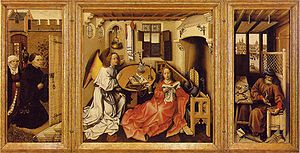
By the end of the 19th century it became clear, however, that Van Eyck was the contemporary of an artist who painted a number of works, including the Mérode Altarpiece. Dated to about 1428, the altarpiece (now in the Cloisters
The Cloisters
The Cloisters is a museum located in Fort Tryon Park, New York City. The building, which is a branch of the Metropolitan Museum of Art, was reconstructed in the 1930s from the architectural elements of several European medieval abbeys...
of the Metropolitan Museum) is permeated with loving attention to details and realism. Three other panels in a similar manner, supposed to come from the so-called abbey of Flémalle
Flémalle
Flémalle is a Walloon municipality located in the Belgian province of Liége. On January 1, 2006 Flémalle had a total population of 25,140. The total area is 36.68 km² which gives a population density of 685 inhabitants per km².-Subdivisions:...
(it has been established that there was, in fact, no such abbey), are now in Frankfurt
Frankfurt
Frankfurt am Main , commonly known simply as Frankfurt, is the largest city in the German state of Hesse and the fifth-largest city in Germany, with a 2010 population of 688,249. The urban area had an estimated population of 2,300,000 in 2010...
. It was argued that these works belong to one "Master of Flémalle", whose identity at that time could not be established.
In the 20th century, several scholars suggested that the Master of Flémalle may be none other than Robert Campin, documented as a master painter in Tournai
Tournai
Tournai is a Walloon city and municipality of Belgium located 85 kilometres southwest of Brussels, on the river Scheldt, in the province of Hainaut....
from 1406. The argument turns around a paper mentioning two pupils entering his studio in 1427 - Jacques Daret
Jacques Daret
Jacques Daret was an Early Netherlandish painter born in Tournai , where he would spend much of his life. Daret spent 15 years as a pupil in the studio of Robert Campin, alongside Rogier or Rogelet de le Pasture , and afterwards...
and Rogelet de la Pasture. The latter was probably Rogier van der Weyden. A very well-documented altarpiece by Daret shows striking similarities with the works of Master of Flémalle, as do early works by Rogier. Therefore it is tempting to assume that both Daret and Rogier were disciples of the Master of Flémalle, i.e. Robert Campin. Another possibility, however, is that the Flémalle panels were painted by Rogier himself when he was still in his twenties. Some scholars have even attributed the famous Deposition in the Prado (Madrid) to Campin rather than Van der Weyden.
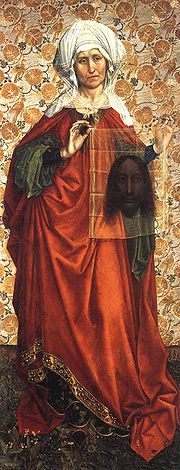
The tightest definition of the works from his own hand includes only the "Flémalle" panels, a Nativity at Dijon, a Crucified Thief (fragment of a Crucifixion) in Frankfurt, two portraits of a man and woman in London (of around 1430), and perhaps the Seilern Triptych. This, which excludes the best known works usually attributed to him, which are given to his workshop or followers, is the position taken by Lorne Campbell.
Work
The Entombment Triptych (or "Seilern Triptych" Courtauld Institute, London) is usually considered Campin's earliest work, dated to around 1415-20. The central panel shows his debt to the sculpture of the time (Campin was known to have polychromed several statues). After this, he painted the Marriage of the VirginMarriage of the Virgin
The Marriage of the Virgin is the subject in Christian art depicting the marriage of the Virgin Mary and Saint Joseph. The marriage is not mentioned in the canonical Gospels but is covered in several apocryphal sources, and later redactions, notably the 14th century compilation the Golden Legend...
(Museo del Prado, Madrid) and Nativity (Musée des Beaux-Arts de Dijon
Musée des Beaux-Arts de Dijon
The Musée des Beaux-Arts de Dijon is a museum of fine arts opened in 1787 in Dijon, France. It is housed in the Palace of the Dukes of Burgundy in the historic center of Dijon.- Artworks :The Musée include a large and varied collection of art:...
) around 1420-1425.
Around 1425-1428 Campin painted the Mérode Altarpiece, a triptych
Triptych
A triptych , from tri-= "three" + ptysso= "to fold") is a work of art which is divided into three sections, or three carved panels which are hinged together and can be folded shut or displayed open. It is therefore a type of polyptych, the term for all multi-panel works...
(three paneled paintings) commissioned for private use. The Annunciation
Annunciation
The Annunciation, also referred to as the Annunciation to the Blessed Virgin Mary or Annunciation of the Lord, is the Christian celebration of the announcement by the angel Gabriel to Virgin Mary, that she would conceive and become the mother of Jesus the Son of God. Gabriel told Mary to name her...
occupies the central panel. The Archangel Gabriel is shown approaching Mary, who sits reading. She is depicted in a well-kept middle-class Flemish home. Several works attributed to Robert Campin may be seen in the Hermitage
Hermitage Museum
The State Hermitage is a museum of art and culture in Saint Petersburg, Russia. One of the largest and oldest museums of the world, it was founded in 1764 by Catherine the Great and has been opened to the public since 1852. Its collections, of which only a small part is on permanent display,...
, Prado
Museo del Prado
The Museo del Prado is the main Spanish national art museum, located in central Madrid. It features one of the world's finest collections of European art, from the 12th century to the early 19th century, based on the former Spanish Royal Collection, and unquestionably the best single collection of...
, and the National Gallery
National Gallery, London
The National Gallery is an art museum on Trafalgar Square, London, United Kingdom. Founded in 1824, it houses a collection of over 2,300 paintings dating from the mid-13th century to 1900. The gallery is an exempt charity, and a non-departmental public body of the Department for Culture, Media...
(London).