

Brancacci Chapel

Encyclopedia
Chapel
A chapel is a building used by Christians as a place of fellowship and worship. It may be part of a larger structure or complex, such as a church, college, hospital, palace, prison or funeral home, located on board a military or commercial ship, or it may be an entirely free-standing building,...
in the Church of Santa Maria del Carmine in Florence
Florence
Florence is the capital city of the Italian region of Tuscany and of the province of Florence. It is the most populous city in Tuscany, with approximately 370,000 inhabitants, expanding to over 1.5 million in the metropolitan area....
, central Italy
Italy
Italy , officially the Italian Republic languages]] under the European Charter for Regional or Minority Languages. In each of these, Italy's official name is as follows:;;;;;;;;), is a unitary parliamentary republic in South-Central Europe. To the north it borders France, Switzerland, Austria and...
. It is sometimes called the "Sistine Chapel
Sistine Chapel
Sistine Chapel is the best-known chapel in the Apostolic Palace, the official residence of the Pope in Vatican City. It is famous for its architecture and its decoration that was frescoed throughout by Renaissance artists including Michelangelo, Sandro Botticelli, Pietro Perugino, Pinturicchio...
of the early Renaissance
Renaissance
The Renaissance was a cultural movement that spanned roughly the 14th to the 17th century, beginning in Italy in the Late Middle Ages and later spreading to the rest of Europe. The term is also used more loosely to refer to the historical era, but since the changes of the Renaissance were not...
" for its painting cycle, among the most famous and influential of the period. Construction of the chapel was commissioned by Pietro Brancacci and begun in 1386. Public access is currently gained via the neighbouring convent, designed by Brunelleschi
Filippo Brunelleschi
Filippo Brunelleschi was one of the foremost architects and engineers of the Italian Renaissance. He is perhaps most famous for inventing linear perspective and designing the dome of the Florence Cathedral, but his accomplishments also included bronze artwork, architecture , mathematics,...
. The church and the chapel are treated as separate places to visit and as such have different opening times and it is quite difficult to see the rest of the church from the chapel.
The patron of the pictorial decoration was Felice Brancacci
Felice Brancacci
Felice di Michele Brancacci was a Florentine silk merchant, best known for commissioning the decoration of the Brancacci Chapel...
, descendant of Pietro, who had served as the Florentine ambassador to Cairo
Cairo
Cairo , is the capital of Egypt and the largest city in the Arab world and Africa, and the 16th largest metropolitan area in the world. Nicknamed "The City of a Thousand Minarets" for its preponderance of Islamic architecture, Cairo has long been a centre of the region's political and cultural life...
until 1423. Upon his return to Florence, he hired Masolino da Panicale
Masolino da Panicale
Masolino da Panicale was an Italian painter. His best known works are probably his collaborations with Masaccio: Madonna with Child and St. Anne and the frescoes in the Brancacci Chapel .-Biography:Masolino was born in Panicale...
to paint his chapel. Masolino's associate, 21-year-old Masaccio
Masaccio
Masaccio , born Tommaso di Ser Giovanni di Simone, was the first great painter of the Quattrocento period of the Italian Renaissance. According to Vasari, Masaccio was the best painter of his generation because of his skill at recreating lifelike figures and movements as well as a convincing sense...
, 18 years younger than Masolino, assisted, but during painting Masolino left to Hungary, where he was painter to the king, and the commission was given to Masaccio. By the time Masolino returned he was learning from his talented former student. However, Masaccio was called to Rome
Rome
Rome is the capital of Italy and the country's largest and most populated city and comune, with over 2.7 million residents in . The city is located in the central-western portion of the Italian Peninsula, on the Tiber River within the Lazio region of Italy.Rome's history spans two and a half...
before he could finish the chapel, and died in Rome at the age of 27. Portions of the chapel were completed later by Filippino Lippi
Filippino Lippi
Filippino Lippi was an Italian painter working during the High Renaissance in Florence, Italy.-Biography:...
. Unfortunately during the Baroque
Baroque
The Baroque is a period and the style that used exaggerated motion and clear, easily interpreted detail to produce drama, tension, exuberance, and grandeur in sculpture, painting, literature, dance, and music...
period some of the paintings were seen as unfashionable and a tomb was placed in front of them.
The paintings
The Expulsion from the Garden of Eden
Masaccio's Expulsion from the Garden of EdenThe Expulsion from the Garden of Eden (Masaccio)
The Expulsion from the Garden of Eden is a fresco by the Italian Early Renaissance artist Masaccio. The fresco is a single scene from the cycle painted around 1425 by Masaccio, Masolino and others on the walls of the Brancacci Chapel in the church of Santa Maria del Carmine in Florence...
is the first fresco on the upper part of the chapel, on the left wall, just at the left of the Tribute Money. It is famous for its vivid energy and unprecedented emotional realism. It contrasts dramatically with Masolino's delicate and decorative image of Adam and Eve before the fall, painted on the opposite wall.
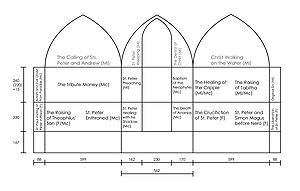
Peter's Calling
By MasaccioMasaccio
Masaccio , born Tommaso di Ser Giovanni di Simone, was the first great painter of the Quattrocento period of the Italian Renaissance. According to Vasari, Masaccio was the best painter of his generation because of his skill at recreating lifelike figures and movements as well as a convincing sense...
.

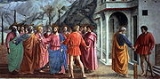
The Tribute Money
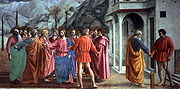
The most famous painting in the chapel is Tribute Money, on the upper right wall, with figures of JesusJesus
Jesus of Nazareth , commonly referred to as Jesus Christ or simply as Jesus or Christ, is the central figure of Christianity...
and Peter
Saint Peter
Saint Peter or Simon Peter was an early Christian leader, who is featured prominently in the New Testament Gospels and the Acts of the Apostles. The son of John or of Jonah and from the village of Bethsaida in the province of Galilee, his brother Andrew was also an apostle...
shown in a three part narrative. The painting, largely attributed to Masaccio, represents the story of Peter and the tax collector from Matthew 17:24-27. The left side shows Peter getting a coin from the mouth of a fish and the right side shows Peter paying his taxes. The whole appears to be related to the establishment of the Catasto
Catasto
Catasto is the Italian system of land registration. The word gives rise to the English cadastre.The register itself is maintained at a local level by the individual councils or Comuni...
, the first income tax in Florence, in the time the painting was being executed.
Healing of the Cripple and Raising of Tabitha
The upper scene on the right wall shows, on the left side, the Healing of the Cripple and, on the right side, the Raising of Tabitha. The fresco is generally attributed to Masolino, although Masaccio's hand has been discovered by some scholars. The scene shows two different episodes, with St. Peter appearing in both of them enclosed in a scenario of a typical Tuscan city of the 15th century depicted according to the strict rules of central perspective. The latter is generally regarded as Masaccio's main contribution, whereas the two central figures show Gothic influences.Baptism of the Neophytes
By MasaccioMasaccio
Masaccio , born Tommaso di Ser Giovanni di Simone, was the first great painter of the Quattrocento period of the Italian Renaissance. According to Vasari, Masaccio was the best painter of his generation because of his skill at recreating lifelike figures and movements as well as a convincing sense...
.

St. Peter Healing the Sick with His Shadow
Lower centre wall, left side, by MasaccioMasaccio
Masaccio , born Tommaso di Ser Giovanni di Simone, was the first great painter of the Quattrocento period of the Italian Renaissance. According to Vasari, Masaccio was the best painter of his generation because of his skill at recreating lifelike figures and movements as well as a convincing sense...
. The episode depicted is from a brief passage, Acts
Acts of the Apostles
The Acts of the Apostles , usually referred to simply as Acts, is the fifth book of the New Testament; Acts outlines the history of the Apostolic Age...
5:15–16.
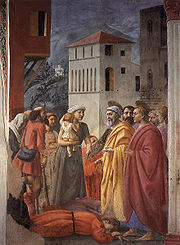

The Distribution of Alms and Death of Ananias
Lower centre wall, right side, by MasaccioMasaccio
Masaccio , born Tommaso di Ser Giovanni di Simone, was the first great painter of the Quattrocento period of the Italian Renaissance. According to Vasari, Masaccio was the best painter of his generation because of his skill at recreating lifelike figures and movements as well as a convincing sense...
.
Raising of the Son of Theophilus and St. Peter Enthroned
Lower right wall, by Masaccio, completed by Filippino LippiFilippino Lippi
Filippino Lippi was an Italian painter working during the High Renaissance in Florence, Italy.-Biography:...
.
Disputation with Simon Magus and Crucifixion of St. Peter
Lower right wall, centre. By Filippino LippiFilippino Lippi
Filippino Lippi was an Italian painter working during the High Renaissance in Florence, Italy.-Biography:...
.
Influence
Masaccio's application of scientific perspectivePerspective (graphical)
Perspective in the graphic arts, such as drawing, is an approximate representation, on a flat surface , of an image as it is seen by the eye...
, unified lighting, use of chiaroscuro
Chiaroscuro
Chiaroscuro in art is "an Italian term which literally means 'light-dark'. In paintings the description refers to clear tonal contrasts which are often used to suggest the volume and modelling of the subjects depicted"....
and skill in rendering the figures naturalistically
Naturalism (art)
Naturalism in art refers to the depiction of realistic objects in a natural setting. The Realism movement of the 19th century advocated naturalism in reaction to the stylized and idealized depictions of subjects in Romanticism, but many painters have adopted a similar approach over the centuries...
established new traditions in Renaissance Florence that some scholars credit with helping to found the new Renaissance style.
The young Michelangelo
Michelangelo
Michelangelo di Lodovico Buonarroti Simoni , commonly known as Michelangelo, was an Italian Renaissance painter, sculptor, architect, poet, and engineer who exerted an unparalleled influence on the development of Western art...
was one of the many artists who received his artistic training by copying Masaccio's work in the chapel. The chapel was also the site of an assault on Michelangelo by rival sculptor Pietro Torrigiano
Pietro Torrigiano
Pietro Torrigiano was an Italian sculptor of the Florentine school. According to Giorgio Vasari, he was one of the group of talented youths who studied art under the patronage of Lorenzo de' Medici in Florence....
, who resented Michelangelo's critical remarks about his draughtsmanship. He punched the artist so severely that he "crushed his nose like a biscuit" (according to Benvenuto Cellini
Benvenuto Cellini
Benvenuto Cellini was an Italian goldsmith, sculptor, painter, soldier and musician, who also wrote a famous autobiography. He was one of the most important artists of Mannerism.-Youth:...
), which deformed Michelangelo's face into that of a boxer's.
Restoration
The first restoration of the chapel frescoes was in 1481-1482, by Filippino LippiFilippino Lippi
Filippino Lippi was an Italian painter working during the High Renaissance in Florence, Italy.-Biography:...
, who was also responsible for completing the cycle. Due to the lamps used for lighting the dark chapel, the frescoes were relatively quickly coated in dust and dirt from the smoke. Another restoration was conducted at the end of the 16th century. Around 1670, sculptures were added, and the fresco-secco
Fresco-secco
Fresco-secco is a fresco painting technique in which pigments ground in water are tempered using egg yolk or whole egg mixed with water which are applied to plaster that has been moistened to simulate fresh plaster. No white is used...
additions were made to the frescoes, to hide the various cases of nudity. Late 20th century restoration removed the overpainting and collected dust and dirt. Some critics, including professor and art historian James H. Beck, have criticised these efforts, while others, including professors, historians and restorers, have praised the work done on the chapel.