


Hubert van Eyck

Encyclopedia
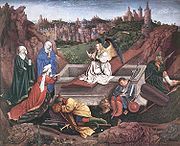
Painting
Painting is the practice of applying paint, pigment, color or other medium to a surface . The application of the medium is commonly applied to the base with a brush but other objects can be used. In art, the term painting describes both the act and the result of the action. However, painting is...
and older brother of Jan van Eyck
Jan van Eyck
Jan van Eyck was a Flemish painter active in Bruges and considered one of the best Northern European painters of the 15th century....
. He was probably born in Maaseik
Maaseik
Maaseik is a municipality located in the Belgian province of Limburg. The city is located on the river Meuse , bordering the Netherlands. The Maaseik municipality includes the town of Maaseik and the villages of Neeroeteren and Opoeteren...
, Flanders
Flanders
Flanders is the community of the Flemings but also one of the institutions in Belgium, and a geographical region located in parts of present-day Belgium, France and the Netherlands. "Flanders" can also refer to the northern part of Belgium that contains Brussels, Bruges, Ghent and Antwerp...
, now in Belgium
Belgium
Belgium , officially the Kingdom of Belgium, is a federal state in Western Europe. It is a founding member of the European Union and hosts the EU's headquarters, and those of several other major international organisations such as NATO.Belgium is also a member of, or affiliated to, many...
.
He became court painter
Court painter
A court painter was an artist who painted for the members of a royal or noble family, sometimes on a fixed salary and on an exclusive basis where the artist was not supposed to undertake other work. Especially in the late Middle Ages, they were often given the office of valet de chambre...
to Philip the Good, Duke of Burgundy, settling in Ghent
Ghent
Ghent is a city and a municipality located in the Flemish region of Belgium. It is the capital and biggest city of the East Flanders province. The city started as a settlement at the confluence of the Rivers Scheldt and Lys and in the Middle Ages became one of the largest and richest cities of...
by c. 1420. Shortly afterwards, he began his only surviving documented work, the Ghent Altarpiece
Ghent Altarpiece
The Ghent Altarpiece or Adoration of the Mystic Lamb is a very large and complex Early Netherlandish polyptych panel painting which is considered to be one of Belgium's masterpieces and one of the world's treasures.It was once in the Joost Vijdt chapel at Saint Bavo Cathedral, Ghent, Belgium, but...
in the Saint Bavo Cathedral
Saint Bavo Cathedral
thumb|right|225px|Sint-Baafs CathedralThe Saint Bavo Cathedral is the seat of the diocese of Ghent. It is named for Saint Bavo of Ghent....
. However the painting was not finished until six years after his death, in 1432, so the degree to which the surviving altarpiece reflects his work, rather than that of Jan who took it over, remains much discussed. An inscription on the altarpiece, presumably composed by Jan, credits Hubert with the inspiration and major role in the work, but today this is often regarded as overgenerous. Given the circumstances, the Ghent Altarpiece is a difficult work to use for comparison when assessing other attributions, especially as several other artists from the brothers' workshops probably worked on it as well.
The town Magistrate
Magistrate
A magistrate is an officer of the state; in modern usage the term usually refers to a judge or prosecutor. This was not always the case; in ancient Rome, a magistratus was one of the highest government officers and possessed both judicial and executive powers. Today, in common law systems, a...
s of Ghent visited his workshop in 1425. He died on 18 September 1426 and was buried in Saint Bavo’s Cathedral. A copper inscription recording his date of death was engraved on the tombstone, but is now missing. According to a tradition from the 16th century, his arm was preserved as a relic in a casket above the portal of Saint Bavo of Ghent.
The division of surviving works between Hubert, early Jan van Eyck, and other painters has been the subject of great debate among art historians, involving the Ghent Altarpiece, the Turin-Milan Hours
Turin-Milan Hours
The Turin-Milan Hours is an incomplete illuminated manuscript, despite its name not strictly a book of hours, of exceptional quality and importance, with a very complicated history both during and after its production...
and other pieces. After a period in the mid 20th century when the tendency was to attribute work away from Hubert, he has made something of a comeback in recent decades, but there is still a wide range of opinion among specialists.