


Hans Memling

Encyclopedia

Early Netherlandish painting
Early Netherlandish painting refers to the work of artists active in the Low Countries during the 15th- and early 16th-century Northern renaissance, especially in the flourishing Burgundian cities of Bruges and Ghent...
.
Life and works
Born in SeligenstadtSeligenstadt
Seligenstadt is a town in the Offenbach district in the Regierungsbezirk of Darmstadt in Hesse, Germany. Seligenstadt is one of Germany’s oldest towns and was already of great importance in Carolingian times.-Location:...
, near Frankfurt
Frankfurt
Frankfurt am Main , commonly known simply as Frankfurt, is the largest city in the German state of Hesse and the fifth-largest city in Germany, with a 2010 population of 688,249. The urban area had an estimated population of 2,300,000 in 2010...
in the Middle Rhein region, it is believed that Memling served his apprenticeship
Apprenticeship
Apprenticeship is a system of training a new generation of practitioners of a skill. Apprentices or protégés build their careers from apprenticeships...
at Mainz or Cologne
Cologne
Cologne is Germany's fourth-largest city , and is the largest city both in the Germany Federal State of North Rhine-Westphalia and within the Rhine-Ruhr Metropolitan Area, one of the major European metropolitan areas with more than ten million inhabitants.Cologne is located on both sides of the...
, and later worked in the Netherlands
Netherlands
The Netherlands is a constituent country of the Kingdom of the Netherlands, located mainly in North-West Europe and with several islands in the Caribbean. Mainland Netherlands borders the North Sea to the north and west, Belgium to the south, and Germany to the east, and shares maritime borders...
under Rogier van der Weyden (c. 1455–1460). He then went to Bruges around 1465.
There is a story (perhaps apocryphal) that he was wounded at the Battle of Nancy
Battle of Nancy
The Battle of Nancy was the final and decisive battle of the Burgundian Wars, fought outside the walls of Nancy on 5 January 1477 between Charles the Bold, Duke of Burgundy, and René II, Duke of Lorraine...
, sheltered and cured by the Hospitallers at Bruges and that to show his gratitude he refused payment for a picture he had painted for them. Memling did indeed paint for the Hospitallers in 1479 and 1480 and it is likely that he was known to the patrons of St John prior to the Battle of Nancy.
Memling's name appears on a list of subscribers to the loan raised by Maximilian I of Austria
Maximilian I, Holy Roman Emperor
Maximilian I , the son of Frederick III, Holy Roman Emperor and Eleanor of Portugal, was King of the Romans from 1486 and Holy Roman Emperor from 1493 until his death, though he was never in fact crowned by the Pope, the journey to Rome always being too risky...
, to defend against hostilities towards France in 1480. In 1477, when he was incorrectly claimed to have been killed, he was under contract to create an altarpiece
Altarpiece
An altarpiece is a picture or relief representing a religious subject and suspended in a frame behind the altar of a church. The altarpiece is often made up of two or more separate panels created using a technique known as panel painting. It is then called a diptych, triptych or polyptych for two,...
for the gild-chapel of the booksellers of Bruges. This altarpiece is now in the Galleria Sabauda of Turin
Turin
Turin is a city and major business and cultural centre in northern Italy, capital of the Piedmont region, located mainly on the left bank of the Po River and surrounded by the Alpine arch. The population of the city proper is 909,193 while the population of the urban area is estimated by Eurostat...
. It is one of the fine creations of his more mature period. It is not inferior in any way to those of 1479 in the hospital of St. John, which for their part are hardly less interesting as illustrative of the master's power than The Last Judgment
The Last Judgment (Memling)
The Last Judgment is a triptych attributed to German painter Hans Memling and painted between 1467 and 1471. It is now in the National Museum in Gdańsk in Poland. It was commissioned by Angelo Tani, an agent of the Medici at Bruges but was captured by a privateer from Danzig , Poland...
, which since the 1470s, is in the National Museum, Gdańsk
National Museum, Gdańsk
National Museum in Gdańsk , established in 1972 , is one of the main branches of Poland's National Museum system....
. Critical opinion has been generally unanimous in assigning this altarpiece to Memling. This is evidence that Memling was a resident of Bruges in 1473; for the Last Judgment was likely painted and sold to a merchant at Bruges, who shipped it there on board of a vessel bound to the Mediterranean which was captured by Danzig privateer Paul Beneke in that very year. The purchase of his pictures by an agent of the Medici
Medici
The House of Medici or Famiglia de' Medici was a political dynasty, banking family and later royal house that first began to gather prominence under Cosimo de' Medici in the Republic of Florence during the late 14th century. The family originated in the Mugello region of the Tuscan countryside,...
demonstrates that he had a considerable reputation.
.jpg)
Duchy of Burgundy
The Duchy of Burgundy , was heir to an ancient and prestigious reputation and a large division of the lands of the Second Kingdom of Burgundy and in its own right was one of the geographically larger ducal territories in the emergence of Early Modern Europe from Medieval Europe.Even in that...
court. The inventories of Margaret of Austria, drawn up in 1524, allude to a triptych
Triptych
A triptych , from tri-= "three" + ptysso= "to fold") is a work of art which is divided into three sections, or three carved panels which are hinged together and can be folded shut or displayed open. It is therefore a type of polyptych, the term for all multi-panel works...
of the God of Pity by Roger van der Weyden, of which the wings containing angels were by "Master Hans". For ages Roger van der Weyden was acknowledged as an artist of the school of Bruges, until records of undisputed authenticity demonstrated that he was bred at Tournai
Tournai
Tournai is a Walloon city and municipality of Belgium located 85 kilometres southwest of Brussels, on the river Scheldt, in the province of Hainaut....
and settled at Brussels
Brussels
Brussels , officially the Brussels Region or Brussels-Capital Region , is the capital of Belgium and the de facto capital of the European Union...
. Nothing seems more natural than the conjunction of his name with that of Memling as the author of an altarpiece, since, though Memling's youth remains obscure, it is clear from the style of his manhood that he was taught in the painting-room of Van der Weyden. Nor is it beyond the limits of probability that it was Van der Weyden who received commissions at a distance from Brussels, and first took his pupil to Bruges, where he afterwards dwelt.
The clearest evidence of the connection of the two masters is that afforded by pictures, particularly an altarpiece, which has alternately been assigned to each of them, and which may be due to their joint labours. In this altarpiece, which is a triptych ordered for a patron of the house of Sforza
House of Sforza
Sforza was a ruling family of Renaissance Italy, based in Milan.-History:The dynasty was founded by Muzio Attendolo , called Sforza , a condottiero from Romagna serving the Angevin kings of Naples...
, we find the style of Van der Weyden in the central panel of the Crucifixion
Crucifixion
Crucifixion is an ancient method of painful execution in which the condemned person is tied or nailed to a large wooden cross and left to hang until dead...
, and that of Memling in the episodes on the wings. Yet the whole piece was assigned to the former in the Zambeccari collection at Bologna
Bologna
Bologna is the capital city of Emilia-Romagna, in the Po Valley of Northern Italy. The city lies between the Po River and the Apennine Mountains, more specifically, between the Reno River and the Savena River. Bologna is a lively and cosmopolitan Italian college city, with spectacular history,...
, whilst it was attributed to the latter at the Middleton sale in London in 1872.
His painting of the Baptist in the gallery of Munich, done circa 1470, is the oldest form in which Memling's style is displayed. The subsequent Last Judgment in Gdánsk shows that Memling preserved the tradition of sacred art used earlier by Rogier van der Weyden in the Last Judgment of Beaune
Beaune
Beaune is the wine capital of Burgundy in the Cote d'Or department in eastern France. It is located between Paris and Geneva.Beaune is one of the key wine centers in France and the annual wine auction of the Hospices de Beaune is the primary wine auction in France...
. Memling is seen to have purged his master's manner of excessive stringency, and add to his other qualities a velvet softness of pigment, a delicate transparency of colors, and yielding grace of slender forms. Picture-fanciers of Italy were certainly familiar with the beauties of Memling's compositions, as shown in the preference given to them by such purchasers as Cardinal Grimani and Cardinal Bembo at Venice
Venice
Venice is a city in northern Italy which is renowned for the beauty of its setting, its architecture and its artworks. It is the capital of the Veneto region...
, and the heads of the house of Medici at Florence
Florence
Florence is the capital city of the Italian region of Tuscany and of the province of Florence. It is the most populous city in Tuscany, with approximately 370,000 inhabitants, expanding to over 1.5 million in the metropolitan area....
.

Louvre
The Musée du Louvre – in English, the Louvre Museum or simply the Louvre – is one of the world's largest museums, the most visited art museum in the world and a historic monument. A central landmark of Paris, it is located on the Right Bank of the Seine in the 1st arrondissement...
), the Virgin and Child (painted for Sir John Donne
Sir John Donne
Sir John Donne was a Welsh courtier, diplomat and soldier, a notable figure of the Yorkist party. In the 1470s he commissioned the Donne Triptych, an triptych altarpiece by Hans Memling now in the National Gallery, London. It contains portraits of him, his wife Elizabeth and a daughter...
and now at the National Gallery, London
National Gallery, London
The National Gallery is an art museum on Trafalgar Square, London, United Kingdom. Founded in 1824, it houses a collection of over 2,300 paintings dating from the mid-13th century to 1900. The gallery is an exempt charity, and a non-departmental public body of the Department for Culture, Media...
), and the four attributed portraits in the Uffizi Gallery of Florence
Florence
Florence is the capital city of the Italian region of Tuscany and of the province of Florence. It is the most populous city in Tuscany, with approximately 370,000 inhabitants, expanding to over 1.5 million in the metropolitan area....
(including the Portrait of Folco Portinari
Portrait of Folco Portinari
The Portrait of Folco Portinari is a painting by the German painter Hans Memling, dating to c. 1490. It is displayed in the Uffizi Gallery of Florence, Italy.-History:...
), show that his work was widely appreciated in the 16th century.

Scenes from the Passion of Christ
Scenes from the Passion of Christ is an oil painting on a panel of Baltic oak, painted c.1470 by German-born Early Netherlandish painter Hans Memling...
in the Galleria Sabauda of Turin and the Advent and Triumph of Christ
Advent and Triumph of Christ
Advent and Triumph of Christ is an oil painting on a panel of wood, painted c.1480 by German-born Early Netherlandish painter Hans Memling. It was made for the altar of the Tanners' guild in Our Lady's Church in Bruges, but is now held by the Alte Pinakothek in Munich...
in the Pinakothek of Munich, are illustrations of the habit in Flanders art of representing a cycle of subjects on the different planes of a single picture, where a wide expanse of ground is covered with incidents from the Passion in the form common to the action of sacred plays.
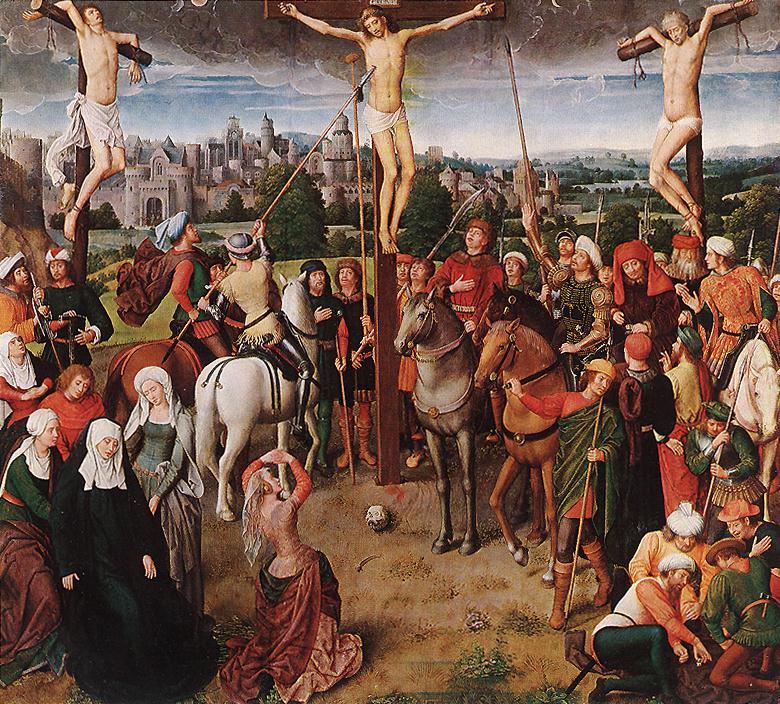
The masterpiece of Memling's later years, the Shrine of St Ursula in the museum of the hospital of Bruges, is fairly supposed to have been ordered and finished in 1480. The delicacy of finish in its miniature figures, the variety of its landscapes and costume, the marvellous patience with which its details are given, are all matters of enjoyment to the spectator. There is later work of the master in the St Christopher and Saints of 1484 in the academy, or the Newenhoven Madonna in the hospital of Bruges, or a large Crucifixion, with scenes from the Passion, of 1491 from the Lübeck Cathedral
Lübeck Cathedral
The Lübeck Cathedral is a large brick Lutheran cathedral in Lübeck, Germany and part of Lübeck's world heritage. It was started in 1173 by Henry the Lion as a cathedral for the Bishop of Lübeck. It was partly destroyed in a bombing raid in World War II , and later reconstructed. The organ by Arp...
(Dom) of Lübeck
Lübeck
The Hanseatic City of Lübeck is the second-largest city in Schleswig-Holstein, in northern Germany, and one of the major ports of Germany. It was for several centuries the "capital" of the Hanseatic League and, because of its Brick Gothic architectural heritage, is listed by UNESCO as a World...
, now in Lübeck's St. Annen Museum
St. Annen Museum
The monastery of Saint Annen in Lübeck-Germany is a former monastery of the Augustinians. It is now part of the Lübeck's museum for history of art and culture...
. Near the close of Memling's career he was increasingly supported by his workshop. The registers of the painters' guild
Guild of Saint Luke
The Guild of Saint Luke was the most common name for a city guild for painters and other artists in early modern Europe, especially in the Low Countries. They were named in honor of the Evangelist Luke, the patron saint of artists, who was identified by John of Damascus as having painted the...
at Bruges give the names of two apprentices who served their time with Memling and paid dues on admission to the guild
Guild
A guild is an association of craftsmen in a particular trade. The earliest types of guild were formed as confraternities of workers. They were organized in a manner something between a trade union, a cartel, and a secret society...
in 1480 and 1486. These subordinates remained obscure.
The trustees of his will appeared before the court of wards at Bruges on 10 December 1495, and we gather from records of that date and place that Memling left behind several children and considerable property.
Critical opinion
Erwin PanofskyErwin Panofsky
Erwin Panofsky was a German art historian, whose academic career was pursued mostly in the U.S. after the rise of the Nazi regime. Panofsky's work remains highly influential in the modern academic study of iconography...
in his 1953 Early Netherlandish Painting (p. 347), says of Memling: "...while the Romantics and the Victorians considered his sweetness the very summit of Medieval art, we feel inclined to compare him to a composer such as Felix Mendelssohn
Felix Mendelssohn
Jakob Ludwig Felix Mendelssohn Barthóldy , use the form 'Mendelssohn' and not 'Mendelssohn Bartholdy'. The Grove Dictionary of Music and Musicians gives ' Felix Mendelssohn' as the entry, with 'Mendelssohn' used in the body text...
: he occasionally enchants, never offends, and never overwhelms. His works give the impression of derivativeness..."
Selected works
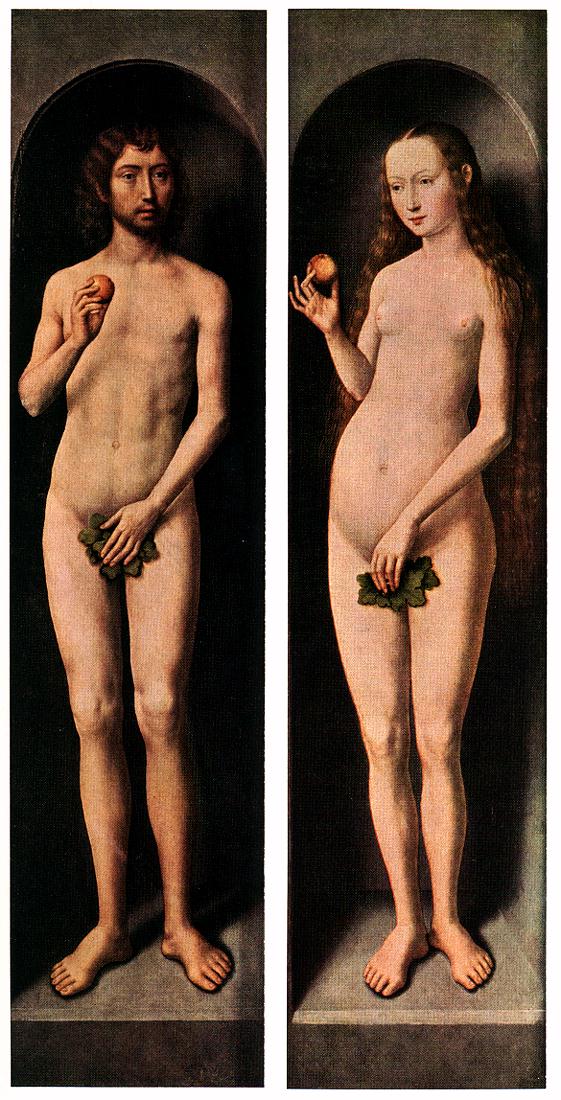
- "Adam and Eve" (c. 1485), Oil on oak, 69.3 × 17.3 cm (each), Kunsthistorisches Museum, Vienna http://www.wga.hu/art/m/memling/3mature2/25notri2.jpg
- "Adoration of the Magi" (c. 1470), Oil on wood, 96.4 × 147 cm, Museo del Prado, Madrid http://www.wga.hu/art/m/memling/1early2/04notri2.jpg
- "Advent and Triumph of Christ" (1480), Oil on wood, 81 × 189 cm, Alte Pinakothek, Munich http://www.wga.hu/art/m/memling/3mature1/17noadv.jpg
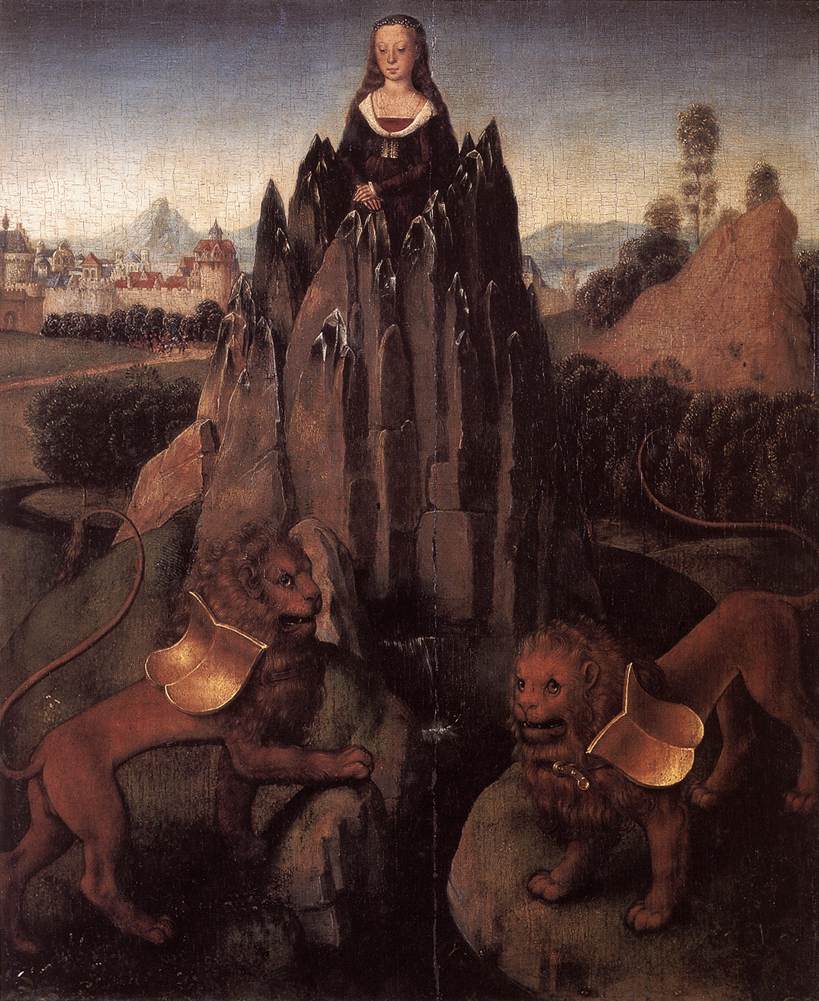
- "Allegory with a Virgin" (1479–80), Oil on oak panel, 38.3 × 31.9 cm, Musée Jacquemart-André, Paris http://www.wga.hu/art/m/memling/2middle3/15allego.jpg
- "Angel Musicians" (1480s), Oil on wood, 165 × 230 cm (each panel)http://www.wga.hu/art/m/memling/3mature4/26nomus.jpg
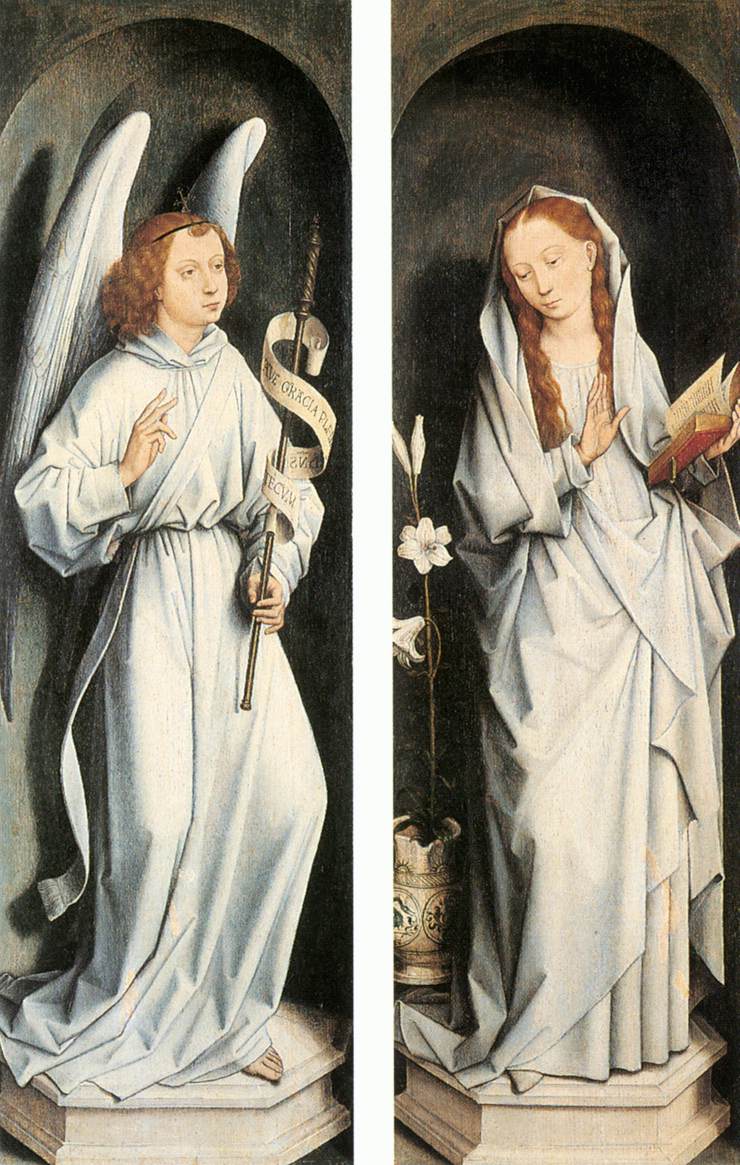
- "Annunciation" (1467–70), Oil on panels. 83.3 × 26.5 cm (each), Groeninge Museum, Bruges http://www.wga.hu/art/m/memling/1early1/03crabb0.jpg
- "Bathsheba" (1485), Oil on wood, 191 × 84 cm, Staatsgalerie, Stuttgart http://www.wga.hu/art/m/memling/3mature2/25nobath.jpg
- "Carrying the Cross" Oil on oak, 58.2 × 27.5 cm, Museum of Fine Arts, Budapest http://www.wga.hu/art/m/memling/6copies/08notri3.jpg
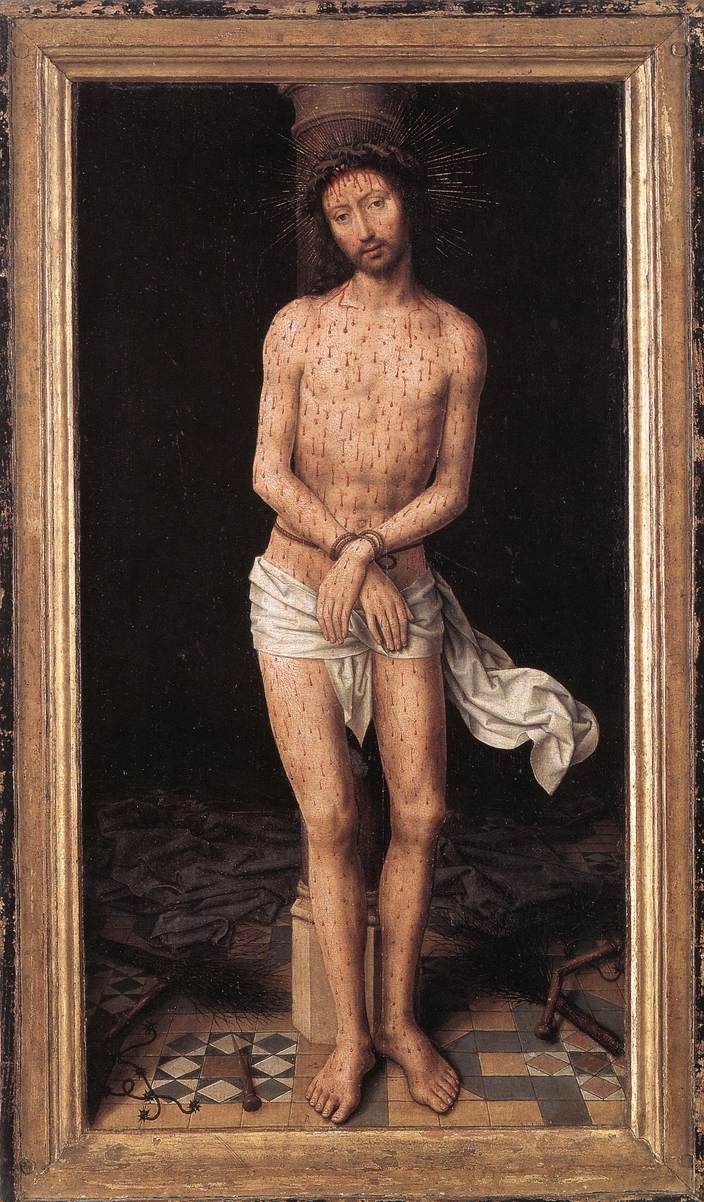
- "Christ at the Column" (1485–90), Oil on oak panel, 58.8 × 34.3 cm (with original frame), Colección Mateu, Barcelona http://www.wga.hu/art/m/memling/3mature5/27column.jpg
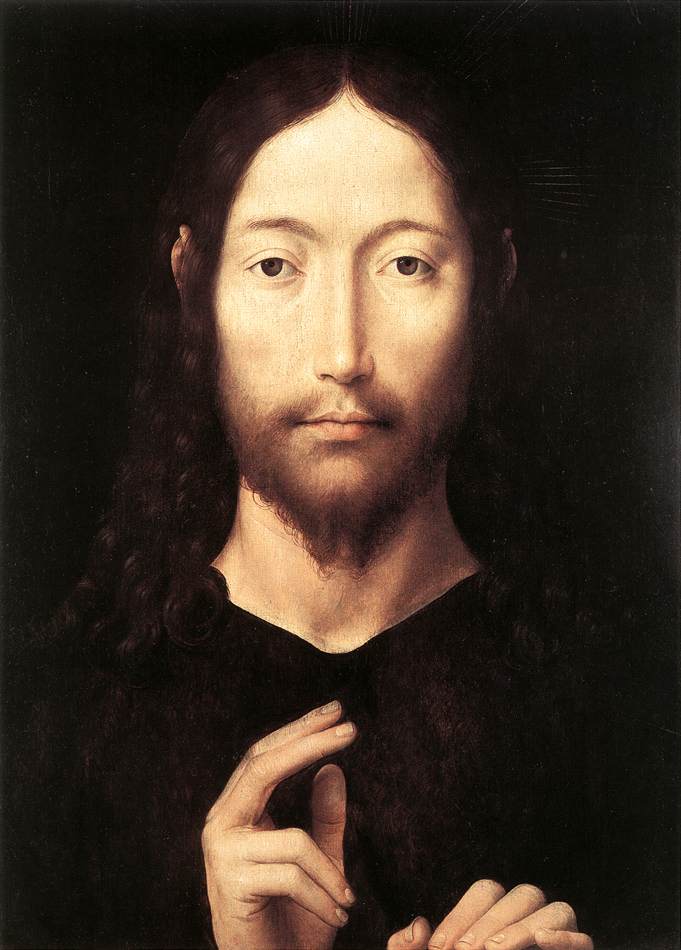
- "Christ Giving His Blessing" (1478), Oil on oak panel, 38.1 × 28.2 cm, Norton Simon Museum of Art, Pasadena http://www.wga.hu/art/m/memling/2middle1/10bless.jpg
- "Christ Giving His Blessing" (1481), Oil on oak panel, 34.8 × 26.2 cm, Museum of Fine Arts, Boston http://www.wga.hu/art/m/memling/3mature2/24blessi.jpg
- "Christ Surrounded by Musician Angels" (1480s), Oil on wood, 164 × 212 cm, Koninklijk Museum voor Schone Kunsten, Antwerp http://www.wga.hu/art/m/memling/3mature4/26nomus1.jpg
- "Crucifixion" (detail), Oil on oak, 56 × 63 cm (full panel), Museum of Fine Arts, Budapest http://www.wga.hu/art/m/memling/6copies/08notri1.jpg
- "Deposition" (left wing of a diptych) (1490s), Oil on oak panel, 538 × 39 cm, Groeninge Museum, Bruges http://www.wga.hu/art/m/memling/6copies/0685depo.jpg
- "Diptych of Jean de Cellier" (c. 1475), Oil on wood, 25 × 15 cm, Musée du Louvre, Paris http://www.wga.hu/art/m/memling/2middle2/13nocel1.jpg









See also
- Scenes from the Passion of ChristScenes from the Passion of ChristScenes from the Passion of Christ is an oil painting on a panel of Baltic oak, painted c.1470 by German-born Early Netherlandish painter Hans Memling...
, c. 1470 - The Last JudgmentThe Last Judgment (Memling)The Last Judgment is a triptych attributed to German painter Hans Memling and painted between 1467 and 1471. It is now in the National Museum in Gdańsk in Poland. It was commissioned by Angelo Tani, an agent of the Medici at Bruges but was captured by a privateer from Danzig , Poland...
, c. 1467–71
External links
- Artcyclopedia: Hans Memling
- www.HansMemling.org 200 works by Hans Memling
- Last Judgement at the National Museum, GdańskGdanskGdańsk is a Polish city on the Baltic coast, at the centre of the country's fourth-largest metropolitan area.The city lies on the southern edge of Gdańsk Bay , in a conurbation with the city of Gdynia, spa town of Sopot, and suburban communities, which together form a metropolitan area called the...
- Memling at Panopticon Virtual Art Gallery
- Flemish Art Collection: Hans Memling, a biography