
All Topics  
Masaccio

 
Masaccio

   Email Print
   Bookmark   Link


Masaccio


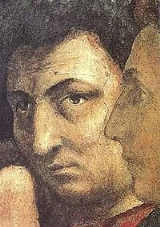
Masaccio (born Tommaso Cassai or in some accounts Tommaso di Ser Giovanni di Mone; December 21, 1401 – autumn 1428), was the first great painter
Painting

Painting is the practice of applying paint, pigment, color or other medium to a surface . In art, the term describes both the act and the result, which is called a painting....
 of the Quattrocento
Quattrocento

The cultural and artistic events of 15th century Italy are collectively referred to as the Quattrocento . Quattrocento encompasses the artistic styles of the late Middle Ages and the early Renaissance....
 period of the Italian Renaissance
Italian Renaissance

The Italian Renaissance began the opening phase of the Renaissance, a period of great cultural change and achievement in Europe that spanned the period from the end of the 13th century to about 1600, marking the transition between Medieval and Early Modern Europe....
. His fresco
Fresco

Fresco is any of several related painting types, done on plaster on walls or ceilings. The word fresco comes from the Italian word affresco which derives from the adjective fresco , which has Latin origins....
es are the earliest monuments of Humanism
Humanism

Humanism is a broad category of ethics that affirm the dignity and worth of all people, based on the ability to determine right and wrong by appealing to universal human qualities, particularly rationalism, without resorting to the supernatural or alleged divine authority from religious texts....
, and introduce a plasticity previously unseen in figure painting.

The name Masaccio is a humorous version of Tommaso, meaning "big", "fat", "clumsy" or "messy" Tom.


Discussion
Ask a question about 'Masaccio'
Start a new discussion about 'Masaccio'
Answer questions from other users
Full Discussion Forum


Recent Posts


Encyclopedia


Masaccio (born Tommaso Cassai or in some accounts Tommaso di Ser Giovanni di Mone; December 21, 1401 – autumn 1428), was the first great painter
Painting

Painting is the practice of applying paint, pigment, color or other medium to a surface . In art, the term describes both the act and the result, which is called a painting....
 of the Quattrocento
Quattrocento

The cultural and artistic events of 15th century Italy are collectively referred to as the Quattrocento . Quattrocento encompasses the artistic styles of the late Middle Ages and the early Renaissance....
 period of the Italian Renaissance
Italian Renaissance

The Italian Renaissance began the opening phase of the Renaissance, a period of great cultural change and achievement in Europe that spanned the period from the end of the 13th century to about 1600, marking the transition between Medieval and Early Modern Europe....
. His fresco
Fresco

Fresco is any of several related painting types, done on plaster on walls or ceilings. The word fresco comes from the Italian word affresco which derives from the adjective fresco , which has Latin origins....
es are the earliest monuments of Humanism
Humanism

Humanism is a broad category of ethics that affirm the dignity and worth of all people, based on the ability to determine right and wrong by appealing to universal human qualities, particularly rationalism, without resorting to the supernatural or alleged divine authority from religious texts....
, and introduce a plasticity previously unseen in figure painting.

The name Masaccio is a humorous version of Tommaso, meaning "big", "fat", "clumsy" or "messy" Tom. The name was created to distinguish him from his principal collaborator, also called Tommaso, who came to be known as Masolino ("little/delicate Tom").

Despite his brief career, he had a profound influence on other artists. He was one of the first to use scientific perspective in his painting, employing techniques such as vanishing point
Vanishing point

A vanishing point is a point in a Perspective drawing to which parallel lines appear to converge. The number and placement of the vanishing points determines which perspective technique is being used....
 in art for the first time. He also moved away from the Gothic
Gothic art

Gothic art was a Medieval art art movement that lasted about 200 years. It began in France out of the Romanesque art period in the mid-12th century, concurrent with Gothic architecture found in Cathedrals....
 style and elaborate ornamentation of artists like Gentile da Fabriano
Gentile da Fabriano

Gentile da Fabriano was an Italy painter known for his participation in the International Gothic style.Gentile was born in or near Fabriano, in the Marche....
 to a more natural mode that employed perspective for greater realism
Realism (arts)

Realism in the visual arts and literature is the depiction of subjects as they appear in everyday life, without embellishment or interpretation....
.

Biography

Masaccio Trinity

Early life

Masaccio was born to Giovanni di Mone Cassai and Jacopa di Martinozzo in Castel San Giovanni di Altura, now San Giovanni Valdarno
San Giovanni Valdarno

San Giovanni Valdarno is a town with a population of about 17,000 in the Italian province of Arezzo. As indicated by its name ?Valdarno? it is located in the valley of the Arno River....
 (now part of the province of Arezzo
Province of Arezzo

The Province of Arezzo or Arretium is the easternmost Provinces of Italy in the Tuscany region of Italy. Its capital is the city of Arezzo....
, Tuscany
Tuscany

Tuscany is a region in Italy. It has an area of and a population of about 3.6 million inhabitants. The regional capital is Florence.Tuscany is known for its landscapes and its artistic legacy....
). His father was a notary and his mother the daughter of an innkeeper of Barberino di Mugello
Barberino di Mugello

Barberino di Mugello is a comune in the Province of Florence in the Italy region Tuscany, located about 25 km north of Florence. As of 31 December 2004, it had a population of 10,114 and an area of 133.7 km?....
, a town a few miles south of Florence
Florence

Florence is the Capital city of the Italy Regions of Italy of Tuscany and of the provinces of Italy Province of Florence. It is the most populous city in Tuscany and has a population of 364,779 ....
. His family name, Cassai, comes from the trade of his grandfather Simone and granduncle Lorenzo, who were carpenters - cabinet makers ("casse", hence "cassai"). His father died in 1406, when Tommaso was only five; in that year another brother was born, called Giovanni after the dead father. He also was to become a painter, with the nickname of "Scheggia" meaning "splinter". The mother was remarried to an elderly apothecary, Tedesco, who guaranteed Masaccio and his family a comfortable childhood.

The family probably moved to Florence at the death of Tedesco, in August 1417. Little is known about this period until Tommaso joined one of the seven main crafts guilds in Florence, on January 7 1422, signing as "Masus S. Johannis Simonis pictor populi S. Nicholae de Florentia". In the new city Tommaso received his nickname, meaning "Clumsy Thomas" for the little care he gave to worldly affairs and to personal appearance: otherwise he was considered a good-natured person.

First works

The first works attributed to Masaccio are the Cascia Altarpiece, (1422), picturing the Madonna enthroned with angels and saints, and a Virgin and Child with St. Anne
Virgin and Child with St. Anne (Masaccio)

The Madonna and Child with St. Anne, also known as Sant'Anna Metterza, is a painting by the Italy Renaissance painter Masaccio, probably in collaboration with Masolino da Panicale, c....
, (ca. 1424) at the Uffizi
Uffizi

The Uffizi Gallery , one of the oldest and most famous art museums in the world, is housed in the Palazzo degli Uffizi, a palazzo in Florence, Italy, Italy....
: they were already works of very high quality. The second work was a collaboration with an older and already renowned artist, Masolino da Panicale, and for many years it was assumed Masaccio was simply an apprentice to Masolino. More recently it has been noted that Masaccio gained entry to the Painters' Guild before Masolino, suggesting that their collaboration was for convenience or simply moved by mutual esteem. Masaccio's talent was apparent, and was probably already superior to that of Masolino. The source of the younger master's education remains an enigma; it is still not known where Masaccio received his training in art.

Maturity

In Florence, Masaccio could study the works of Giotto
Giotto di Bondone

Giotto di Bondone , better known simply as Giotto, was an italy Painting and architect from Florence. He is generally considered the first in a line of great artists who contributed to the Italian Renaissance....
 and become friends with Alberti
Alberti

Alberti may refer to:In places:* Alberti Partido, a partido of Buenos Aires Province, ArgentinaPeople with the surname Alberti:...
, Brunelleschi
Filippo Brunelleschi

Filippo Brunelleschi was one of the foremost architects and engineers of the Italian Renaissance. All of his principal works are in Florence, Italy....
 and Donatello
Donatello

Donatello was a famous early Renaissance Italy artist and sculpture from Florence. He is, in part, known for his work in bas-relief, a form of shallow relief sculpture that, in Donatello's case, incorporated significant 15th-century developments in perspectival illusionism....
. According to Vasari
Giorgio Vasari

Giorgio Vasari was an Italy Painting and architect, who is today famous for his biography of Italian artists, considered the ideological foundation of art history writing....
, at their prompting in 1423 Masaccio travelled to Rome with Masolino: from that point he was freed of all Gothic
Gothic art

Gothic art was a Medieval art art movement that lasted about 200 years. It began in France out of the Romanesque art period in the mid-12th century, concurrent with Gothic architecture found in Cathedrals....
 and Byzantine
Byzantine art

Byzantine art is the term commonly used to describe the artistic products of the Byzantine Empire from about the 4th century until the Fall of Constantinople in 1453....
 influence, as may be seen in his altarpiece
Altarpiece

An altarpiece is a picture or relief representing a religious subject and suspended in a frame behind the altar of a church. The altarpiece is often made up of two or more separate panels created using a technique known as panel painting....
 for the Carmelite Church in Pisa
Pisa

Pisa is a city in Tuscany, central Italy, on the right bank of the mouth of the Arno River on the Ligurian Sea. It is the capital city of the Province of Pisa....
, the central panel of which (The Madonna and the Child
The Madonna and Child (Masaccio)

The Madonna with Child and Angels is a painting by the Italy Renaissance painter Masaccio, who worked in collaboration with his brother Giovanni and with Andrea di Giusto....
) is now in the National Gallery
National Gallery, London

The National Gallery in London, founded in 1824, houses a rich collection of over 2,300 paintings dating from the mid-13th century to 1900 in its home on Trafalgar Square....
, London
London

London is the capital of both England and the United Kingdom, and the most populous municipality in the European Union. An important settlement for two millennia, History of London goes back to its founding by the Roman Empire....
. As well as a sculptural and human Madonna the work features a convincing perspectival depiction of her throne. The traces of influences from ancient Roman and Greek art that are present in some of Masaccio's works presumably originated from this trip: they should also have been present in a lost Sagra, (today known through some drawings, including one by Michelangelo
Michelangelo

Michelangelo di Lodovico Buonarroti Simoni , commonly known as Michelangelo, was an Italian Renaissance Painting, sculptor, architect, poet, and engineer....
), a fresco commissioned for the consecration ceremony of the church of Santa Maria del Carmine in Florence (April 19, 1422). It was destroyed when the church's cloister was rebuilt at the end of the 16th century.

Izokefalizm

Brancacci chapel


In 1424 the "duo preciso e noto" ("well and known duo") of Masaccio and Masolino was commissioned by the powerful and rich Felice Brancacci to execute a cycle of frescoes for the Brancacci Chapel
Brancacci Chapel

The Brancacci Chapel is a chapel in the Church of Santa Maria del Carmine di Firenze in Florence. It is sometimes called the "Sistine Chapel of the early Renaissance" for its painting cycle, among the most famous and influential of the period....
 in the church of Santa Maria del Carmine in Florence. The theme of the frescoes in the little chapel was to be the "Histories of St. Peter". The genius of Masaccio shows clearly in these frescoes. In the "Resurrection of the Son of Theophilus", he painted a pavement in perspective, framed by large buildings to obtain a depth of field and three-dimensional space in which the figures are placed proportionate to their surroundings. In this he was a pioneer in applying the newly discovered rules of perspective.

Masaccio Theexpulsionofadamandevefromeden Restoration
Masaccio's scenes show his reference to Giotto especially. The Expulsion from the Garden of Eden
The Expulsion from the Garden of Eden (Masaccio)

The Expulsion from the Garden of Eden is a fresco by the Italian Early Renaissance artist Masaccio. The fresco is a single scene from the cycle painted from 1423 on by Masaccio, Masolino da Panicale and others on the walls of the Brancacci Chapel in the church of Santa Maria del Carmine di Firenze in Florence....
, depicting a distressed Adam and Eve
Adam and Eve

Adam and Eve are the First man or woman created by God in the Hebrew creation story told in Genesis 1-2....
 nude, had a huge influence on Michelangelo
Michelangelo

Michelangelo di Lodovico Buonarroti Simoni , commonly known as Michelangelo, was an Italian Renaissance Painting, sculptor, architect, poet, and engineer....
. Another major work is The Tribute Money
The Tribute Money

The Tribute Money is a fresco by the Italy renaissance painter Masaccio, located in the Brancacci Chapel of the Basilica#Ecclesiastical_basilicas of Santa Maria del Carmine, Florence....
 in which Jesus
Jesus

Jesus of Nazareth , also known as Jesus Christ, is the central figure of Christianity and is revered by most Christian churches as the Son of God and the Incarnation ....
 and the Apostles are depicted as neo-classical archetypes. Seldom noted is that the shadows of the figures all fall away from the chapel window, as if the figures are lit by it; this an added stroke of verisimilitude and further tribute to Masaccio's innovative genius.

On September 1425 Masolino left the work and went to Hungary
Hungary

Hungary , officially in English the Republic of Hungary , is a landlocked country in the Carpathian Basin of Central Europe, bordered by Austria, Slovakia, Ukraine, Romania, Serbia, Croatia, and Slovenia....
. It is not known if this was because of money quarrels with Felice or even if there was an artistic divergence with Masaccio. It has also been supposed that Masolino planned this trip from the very beginning, and needed a close collaborator who could continue the work after his departure.

Some of the scenes completed by the duo were lost in a fire in 1771; we know about them only through Vasari's biography. The surviving parts were extensively blackened by smoke, and the recent removal of marble slabs covering two areas of the paintings has revealed the original appearance of the work. Masaccio left the frescoes unfinished
Unfinished work

An unfinished work is a creative work that has not been finished. Its creator might have chosen never to finish it, or have been prevented by circumstances outside of his or her control ....
 in 1426 in order to respond to other commissions, probably coming from the same patron. However, it has also been suggested that the declining finances of Felice Brancacci were insufficient to pay for any more work, so the painter therefore sought work elsewhere. Masaccio returned in 1427 to work again in the Carmine, beginning the Resurrection of the Son of Theophilus, but apparently left it, too, unfinished, though it has also been suggested that the painting was severely damaged later in the century because it contained portraits of the Brancacci family, at that time excoriated as enemies of the Medici
Medici

The M?dici family was a powerful and influential Florence family from the 14th to 18th century. The family had three popes , numerous rulers of Florence and later members of the French and English royalty....
. This painting was either restored or completed more than fifty years later by Filippino Lippi
Filippino Lippi

Filippino Lippi was a well-known painter working during the High Renaissance in Florence, Italy....
.

Other works

On February 19 1426 Masaccio was commissioned by Giuliano di Colino degli Scarsi, for the sum of 80 florins, to paint a major altarpiece, the Pisa Polyptych, for his chapel in the church of Santa Maria del Carmine in Pisa
Pisa

Pisa is a city in Tuscany, central Italy, on the right bank of the mouth of the Arno River on the Ligurian Sea. It is the capital city of the Province of Pisa....
. The work was dismantled and dispersed in the 18th century, and only eleven of about twenty original panels have been rediscovered in various places in the world. Masaccio probably worked on it entirely in Pisa, shuttling back and forth to Florence, where he was still working on the Histories of St. Peter. In these years Donatello
Donatello

Donatello was a famous early Renaissance Italy artist and sculpture from Florence. He is, in part, known for his work in bas-relief, a form of shallow relief sculpture that, in Donatello's case, incorporated significant 15th-century developments in perspectival illusionism....
 was also working in Pisa at a monument for Cardinal Rinaldo Brancacci, to be sent to Naples
Naples

Naples is a city in southern Italy, the capital of the region of Campania and of the province of Naples. The city is known for its rich history, art, culture and gastronomy, playing an important role throughout much of its existence; it is over 2,800 years old....
. It has been suggested that Masaccio's first ventures in plasticity and perspective were based on Donatello's sculpture, before he could study Brunelleschi's more scientific approach to perspective.
San Pietro Masaccio
Through the help of Brunelleschi, in 1427 Masaccio won a prestigious commission to produce a Holy Trinity
Holy Trinity (Masaccio)

The Holy Trinity, with the Virgin and Saint John and donors is a famous fresco by the Early Italian Renaissance painter Masaccio. It is located in the church of Santa Maria Novella, in Florence....
 for the Santa Maria Novella church in Florence
Florence

Florence is the Capital city of the Italy Regions of Italy of Tuscany and of the provinces of Italy Province of Florence. It is the most populous city in Tuscany and has a population of 364,779 ....
. The fresco, considered by many his masterwork, marks the first use of systematic linear perspective, possibly devised by Masaccio with the assistance of Brunelleschi himself.

Masaccio produced two other works, a Nativity
Nativity (Masaccio)

The Nativity is a painting by the Italy Renaissance painter Masaccio, c. 1427-1428.This round plate with a Nativity of Jesus in art on the front and a Putto and small dog on the back dates from Masaccio's last period in Florence, before he went to Rome....
 and an Annunciation, now lost, before leaving for Rome
Rome

Rome is the capital city of Italy and Lazio, and is Italy's largest and most populous city, with 2,724,347 residents in an urban area of some ....
, where his companion Masolino was frescoing the Basilica di San Clemente
Basilica di San Clemente

The Basilica of Saint Clement is a twelfth century Roman Catholic Church minor basilica dedicated to Pope Clement I located in Rome, Italy. Archaeologically speaking it is a three-tiered complex of buildings on the site, the lowermost notable as being an archaeological record of a first century insulae belonging to T....
. It has never been confirmed that Masaccio collaborated on that work, even though it is possible that he contributed to Masolino's polyptych of the altar of St. Mary Major
Basilica di Santa Maria Maggiore

The Basilica of Saint Mary Major , is an Ancient Rome Roman Catholic Church basilica of Rome. It is one of the Basilica#The major basilicas or Basilica#Papal and patriarchal basilicas in Rome, which, together with Basilica di San Lorenzo fuori le Mura, were formerly referred to as the five "patriarchal basilicas" of Rome, associated with the...
 with his panel portraying St. Jerome and St. John the Baptist, now in the National Gallery
National Gallery, London

The National Gallery in London, founded in 1824, houses a rich collection of over 2,300 paintings dating from the mid-13th century to 1900 in its home on Trafalgar Square....
 of London
London

London is the capital of both England and the United Kingdom, and the most populous municipality in the European Union. An important settlement for two millennia, History of London goes back to its founding by the Roman Empire....
. Masaccio died at the end of 1428. According to a legend, he was poisoned by a jealous rival painter.

Only four frescoes undoubtedly from Masaccio's hand still exist today, although many other works have been at least partially attributed to him. Others are believed to have been destroyed.

Legacy

Masaccio profoundly influenced the art of painting in the Renaissance
Renaissance

The Renaissance was a cultural movement that spanned roughly the 14th to the 17th century, beginning in Italy in the late Middle Ages and later spreading to the rest of Europe....
. According to Vasari, all Florentine painters studied his frescoes extensively in order to "learn the precepts and rules for painting well". He transformed the direction of Italian painting, moving it away from the idealizations of Gothic art, and, for the first time, presenting it as part of a more profound, natural, and humanist world.

See also

  • History of painting
    History of painting

    The history of painting reaches back in time to artifacts from pre-historic humans, and spans all cultures, that represents a continuous, though disrupted, tradition from Antiquity....
  • Western painting
    Western painting

    The history of Western painting represents a continuous, though disrupted, tradition from classical antiquity. Until the mid 19th century it was primarily concerned with Representational art and Classical antiquity modes of production, after which time more Modern art, Abstract art and Conceptual art forms gained favor....

Main works

  • Crucifixion
    Crucifixion (Masaccio)

    Crucifixion is a painting by the Italy Renaissance artist Masaccio.On February 19 1426 Masaccio agreed to paint an altarpiece for a chapel in the Santa Maria del Carmine di Pisa in Pisa for the sum of 80 florins....
     (c. 1426) - oil on table, 83 x 63 cm, Museo di Capodimonte
    Museo di Capodimonte

    The Palace and Museum of Capodimonte is a grand House of Bourbon palazzo in Naples, Italy, formerly the summer residence and hunting lodge of the kings of the Two Sicilies....
    , Naples
    Naples

    Naples is a city in southern Italy, the capital of the region of Campania and of the province of Naples. The city is known for its rich history, art, culture and gastronomy, playing an important role throughout much of its existence; it is over 2,800 years old....
     
  • Cascia Altarpiece (1422, dubious) oil on table, 108 x 153 cm, Cascia di Reggello
  • The Tribute Money
    The Tribute Money

    The Tribute Money is a fresco by the Italy renaissance painter Masaccio, located in the Brancacci Chapel of the Basilica#Ecclesiastical_basilicas of Santa Maria del Carmine, Florence....
     (1424-1428) - fresco, 247 x 597 cm, Brancacci Chapel
    Brancacci Chapel

    The Brancacci Chapel is a chapel in the Church of Santa Maria del Carmine di Firenze in Florence. It is sometimes called the "Sistine Chapel of the early Renaissance" for its painting cycle, among the most famous and influential of the period....
    , Florence
    Florence

    Florence is the Capital city of the Italy Regions of Italy of Tuscany and of the provinces of Italy Province of Florence. It is the most populous city in Tuscany and has a population of 364,779 ....
  • Madonna with Child and St. Anne
    Virgin and Child with St. Anne (Masaccio)

    The Madonna and Child with St. Anne, also known as Sant'Anna Metterza, is a painting by the Italy Renaissance painter Masaccio, probably in collaboration with Masolino da Panicale, c....
     (1424-1425) - tempera on panel, 175 x 103 cm, Uffizi
    Uffizi

    The Uffizi Gallery , one of the oldest and most famous art museums in the world, is housed in the Palazzo degli Uffizi, a palazzo in Florence, Italy, Italy....
    , Florence
    Florence

    Florence is the Capital city of the Italy Regions of Italy of Tuscany and of the provinces of Italy Province of Florence. It is the most populous city in Tuscany and has a population of 364,779 ....
  • Madonna with Child (1424) - tempera on panel, 24 x 18 cm, Palazzo Vecchio
    Palazzo Vecchio

    The Palazzo Vecchio is the City hall of Florence, Italy. This massive, romanesque architecture, Crenellation fortress-palace is among the most impressive town halls of Tuscany....
    , Florence
    Florence

    Florence is the Capital city of the Italy Regions of Italy of Tuscany and of the provinces of Italy Province of Florence. It is the most populous city in Tuscany and has a population of 364,779 ....
  • Portrait of a Young Man
    Portrait of a Young Man (Masaccio)

    Portrait of a Young Man is a painting by the Italy Renaissance painter Masaccio.In the early 15th century the profile likeness was the most favored type of portrait, partly because salient features can be delineated with more precision in the side view....
     (1425) - wood, National Gallery of Art
    National Gallery of Art

    The National Gallery of Art is a national art museum, located on the National Mall in Washington, D.C. The museum was established in 1938 by the United States Congress, with funds for construction and a substantial art collection donated by Andrew W....
    , Washington, D.C.
    Washington, D.C.

    Washington, D.C. , formally the District of Columbia and commonly referred to as Washington, the District, or simply D.C., is the Capital of the United States, founded on July 16, 1790....
  • St. Paul
    St. Paul (Masaccio)

    St. Paul is a painting by the Italy Renaissance painter Masaccio.In 1426, Masaccio agreed to paint an altarpiece for a chapel in the Santa Maria del Carmine di Pisa in Pisa....
     (1426) - tempera on wood, 51 x 30 cm, Museo Nazionale, Pisa
    Pisa

    Pisa is a city in Tuscany, central Italy, on the right bank of the mouth of the Arno River on the Ligurian Sea. It is the capital city of the Province of Pisa....
  • Holy Trinity
    Holy Trinity (Masaccio)

    The Holy Trinity, with the Virgin and Saint John and donors is a famous fresco by the Early Italian Renaissance painter Masaccio. It is located in the church of Santa Maria Novella, in Florence....
     (1425-1428) - fresco, 667 x 317 cm, Santa Maria Novella, Florence
    Florence

    Florence is the Capital city of the Italy Regions of Italy of Tuscany and of the provinces of Italy Province of Florence. It is the most populous city in Tuscany and has a population of 364,779 ....
     
  • Madonna with Child and Angel
    The Madonna and Child (Masaccio)

    The Madonna with Child and Angels is a painting by the Italy Renaissance painter Masaccio, who worked in collaboration with his brother Giovanni and with Andrea di Giusto....
     (1426) - oil on table, National Gallery
    National Gallery, London

    The National Gallery in London, founded in 1824, houses a rich collection of over 2,300 paintings dating from the mid-13th century to 1900 in its home on Trafalgar Square....
    , London
    London

    London is the capital of both England and the United Kingdom, and the most populous municipality in the European Union. An important settlement for two millennia, History of London goes back to its founding by the Roman Empire....
     
  • Nativity (Berlin Tondo)
    Nativity (Masaccio)

    The Nativity is a painting by the Italy Renaissance painter Masaccio, c. 1427-1428.This round plate with a Nativity of Jesus in art on the front and a Putto and small dog on the back dates from Masaccio's last period in Florence, before he went to Rome....
     (1427-1428) - tempera on wood, diameter 56 cm, Staatliche Museen, Berlin
    Berlin

    Berlin is the Capital of Germany city and one of sixteen States of Germany of Germany. With a population of 3.4 million within its city limits, Berlin is the country's largest city....
  • St. Jerome and St. John the Baptist (c. 1426-1428) panel, 114 x 55 cm, National Gallery
    National Gallery, London

    The National Gallery in London, founded in 1824, houses a rich collection of over 2,300 paintings dating from the mid-13th century to 1900 in its home on Trafalgar Square....
    , London
    London

    London is the capital of both England and the United Kingdom, and the most populous municipality in the European Union. An important settlement for two millennia, History of London goes back to its founding by the Roman Empire....
     
  • St Andrew - oil on table, 51 x 31 cm, J. Paul Getty Museum
    Getty Center

    The Getty Center in Brentwood, Los Angeles, California, USA, is one of two locations of the J. Paul Getty Museum. The museum's permanent collection includes "pre-20th-century European paintings, drawings, illuminated manuscripts, sculpture, and decorative arts; and 19th- and 20th-century American and European photographs"....
    , Los Angeles
    Los Ángeles

    Los ?ngeles is the Capital of the Biob?o Province, in the municipality of the same name, in Regions of Chile VIII , in the center-south of Chile....


External links