
All Topics  
Titian

 
Titian

   Email Print
   Bookmark   Link


Titian


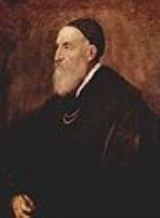
, c.1567; Museo del Prado
Museo del Prado

The Museo del Prado is a museum and art gallery located in Madrid, the capital of Spain. It features one of the world's finest collections of European art, from the 12th century to the early 19th century, based on the former Spanish Royal Collection....
, Madrid]] Tiziano Vecelli or Tiziano Vecellio, born 1473/1490 (probably c.1488/1490), died 27 August 1576, better known as Titian , was the leading painter of the 16th-century Venetian
Venice

Venice is a city in northern Italy, the capital city of the Italian regions Veneto, a population of 271,251 . Together with Padua, Italy, the city is included in the Padua-Venice Metropolitan Area ....
 school of the Italian Renaissance
Italian Renaissance

The Italian Renaissance began the opening phase of the Renaissance, a period of great cultural change and achievement in Europe that spanned the period from the end of the 13th century to about 1600, marking the transition between Medieval and Early Modern Europe....
. He was born in Pieve di Cadore
Pieve di Cadore

Pieve di Cadore is a comune in the province of Belluno in the Italy region Veneto, located about 110 km north of Venice and about 35 km northeast of Belluno....
, near Belluno
Belluno

Belluno is a town in the Veneto region of northern Italy. Located about 80 kilometers north of Venice, Belluno is the Capital of the province of Belluno and the most important city in the Dolomiti's region....
 (in Veneto
Veneto

Veneto or Venetia , is one of the 20 Regions of Italy of Italy. Its population is about 4.8 million, and its capital is Venice. Once the cradle of the renowned Republic of Venice, then a land of mass emigration, Veneto is today among the wealthiest and most industrialized regions of Italy....
), in the Republic of Venice
Republic of Venice

The Most Serene Republic of Venice or Venetian Republic was a state originating from the city of Venice . It existed for over a millennium, from the late 7th century AD until the year 1797....
. During his lifetime he was often called Da Cadore, taken from the place of his birth.

Recognized by his contemporaries as "the sun amidst small stars" (recalling the famous final line of Dante's
DANTE

DANTE is a not-for-profit organisation that plans, builds and operates the international networks that interconnect the various National Research and Education Networks in Europe and surrounding regions....
 Paradiso
The Divine Comedy

The Divine Comedy , written by Dante Alighieri between 1308 and his death in 1321, is widely considered the central epic poem of Italian literature, and is seen as one of the greatest works of world literature....
), Titian was one of the most versatile of Italian painters, equally adept with portraits, landscape backgrounds, and mythological and religious subjects.


Discussion
Ask a question about 'Titian'
Start a new discussion about 'Titian'
Answer questions from other users
Full Discussion Forum


Recent Posts


Quotations


..he who improvises can never make a perfect line of poetry


Encyclopedia


, c.1567; Museo del Prado
Museo del Prado

The Museo del Prado is a museum and art gallery located in Madrid, the capital of Spain. It features one of the world's finest collections of European art, from the 12th century to the early 19th century, based on the former Spanish Royal Collection....
, Madrid]] Tiziano Vecelli or Tiziano Vecellio, born 1473/1490 (probably c.1488/1490), died 27 August 1576, better known as Titian , was the leading painter of the 16th-century Venetian
Venice

Venice is a city in northern Italy, the capital city of the Italian regions Veneto, a population of 271,251 . Together with Padua, Italy, the city is included in the Padua-Venice Metropolitan Area ....
 school of the Italian Renaissance
Italian Renaissance

The Italian Renaissance began the opening phase of the Renaissance, a period of great cultural change and achievement in Europe that spanned the period from the end of the 13th century to about 1600, marking the transition between Medieval and Early Modern Europe....
. He was born in Pieve di Cadore
Pieve di Cadore

Pieve di Cadore is a comune in the province of Belluno in the Italy region Veneto, located about 110 km north of Venice and about 35 km northeast of Belluno....
, near Belluno
Belluno

Belluno is a town in the Veneto region of northern Italy. Located about 80 kilometers north of Venice, Belluno is the Capital of the province of Belluno and the most important city in the Dolomiti's region....
 (in Veneto
Veneto

Veneto or Venetia , is one of the 20 Regions of Italy of Italy. Its population is about 4.8 million, and its capital is Venice. Once the cradle of the renowned Republic of Venice, then a land of mass emigration, Veneto is today among the wealthiest and most industrialized regions of Italy....
), in the Republic of Venice
Republic of Venice

The Most Serene Republic of Venice or Venetian Republic was a state originating from the city of Venice . It existed for over a millennium, from the late 7th century AD until the year 1797....
. During his lifetime he was often called Da Cadore, taken from the place of his birth.

Recognized by his contemporaries as "the sun amidst small stars" (recalling the famous final line of Dante's
DANTE

DANTE is a not-for-profit organisation that plans, builds and operates the international networks that interconnect the various National Research and Education Networks in Europe and surrounding regions....
 Paradiso
The Divine Comedy

The Divine Comedy , written by Dante Alighieri between 1308 and his death in 1321, is widely considered the central epic poem of Italian literature, and is seen as one of the greatest works of world literature....
), Titian was one of the most versatile of Italian painters, equally adept with portraits, landscape backgrounds, and mythological and religious subjects. His painting methods, particularly in the application and use of colour, would exercise a profound influence not only on painters of the Italian Renaissance, but on future generations of Western art.

During the course of his long life Titian's artistic manner changed drastically but he retained a lifelong interest in colour. Although his mature works may not contain the vivid, luminous tints of his early pieces, their loose brushwork and subtlety of polychromatic modulations are without precedent in the history of Western art.

Biography


Early years

No one is sure of the exact date of Titian's birth; when he was an old man he claimed in a letter to Philip II
Philip II of Spain

Philip II was King of Spain from 1556 until 1598, List of monarchs of Naples from 1554 until 1598, king consort of England, as husband of Mary I of England, from 1554 to 1558, lord of the Seventeen Provinces from 1556 until 1581, holding various titles for the individual territories, such as Duke or Count; and King of Portugal as Philip I...
 to have been born in 1474, but this seems most unlikely. Other writers contemporary to his old age give figures for his age which would equate to birth-dates between 1473 to after 1482, but most modern scholars believe a date nearer 1490 is more likely; the Metropolitan Museum of Art
Metropolitan Museum of Art

The Metropolitan Museum of Art is an art museum located on the eastern edge of Central Park, along what is known as Museum Mile, New York City in New York City, USA....
's timeline supports c.1488, as does the Getty Research Institute
Getty Research Institute

The Getty Research Institute , located at the Getty Center in Los Angeles, California, is "dedicated to furthering knowledge and advancing understanding of the visual arts"....
. He was the eldest of a family of four and son of Gregorio Vecelli, a distinguished councillor and soldier, and of his wife Lucia. His father was superintendent of the castle of Pieve di Cadore
Pieve di Cadore

Pieve di Cadore is a comune in the province of Belluno in the Italy region Veneto, located about 110 km north of Venice and about 35 km northeast of Belluno....
 and also managed local mines for their owners. Many relatives, including Titian's grandfather, were notaries, and the family were well-established in the area, which was ruled by Venice.
Tizian 078
At the age of about ten to twelve he and his brother Francesco (who perhaps followed later) were sent to an uncle in Venice to find an apprenticeship with a painter. The minor painter, Sebastian Zuccato, whose sons became well-known mosaic
Mosaic

Mosaic is the art of creating images with an assemblage of small pieces of colored glass, stone, or other material. It may be a technique of Decorative arts, an aspect of interior decoration or of cultural and spiritual significance as in a cathedral....
ists, and who may have been a family friend, arranged for the brothers to enter the studio of the elderly Gentile Bellini
Gentile Bellini

Gentile Bellini was an Italy painter. Born in Venice, the son of the painter Jacopo Bellini, he was christened Gentile after Jacopo's master, Gentile da Fabriano....
, from which they later transferred to that of his brother Giovanni Bellini
Giovanni Bellini

Giovanni Bellini was an Italy Renaissance painter, probably the best known of the Bellini family of Venice painters. His father was Jacopo Bellini, his brother was Gentile Bellini, and his brother-in-law was Andrea Mantegna....
. At that time the Bellinis, especially Giovanni, were the leading artists in the city. There he found a group of young men about his own age, among them Giovanni Palma da Serinalta, Lorenzo Lotto
Lorenzo Lotto

Lorenzo Lotto was a Northern Italy Painting draughtsman and illustrator, traditionally placed in the Venetian school. He painted mainly altarpieces, religious subjects and portraits....
, Sebastiano Luciani
Sebastiano del Piombo

Sebastiano del Piombo , byname of Sebastiano Luciani, was an Italy Renaissance-Mannerism painter of the early 16th century famous for his combination of the colors of the Venetian school and the monumental forms of the Roman school....
, and Giorgio da Castelfranco, nicknamed Giorgione
Giorgione

Giorgione is the familiar name of Giorgio Barbarelli da Castelfranco, an Italy painter, a seminal artist of the High Renaissance in Venice....
. Francesco Vecellio
Francesco Vecellio

Francesco Vecellio was a Venice painter of the early Renaissance, best known as the elder brother of the painter Titian. In his youth, he was a soldier....
, his younger brother, later became a painter of some note in Venice.

A fresco
Fresco

Fresco is any of several related painting types, done on plaster on walls or ceilings. The word fresco comes from the Italian word affresco which derives from the adjective fresco , which has Latin origins....
 of Hercules
Hercules

Hercules is the Ancient Rome name for the mythical Ancient Greece hero Heracles, son of Zeus and the mortal Alcmene. Early Roman sources suggest that the imported Greek hero supplanted a mythic Italian shepherd called "Recaranus" or "Garanus", famous for his strength....
 on the Morosini
Morosini

The Morosini were a noble Venice family, probably of Hungary extraction, which gave many doges, statesmen, generals and admirals to the Venetian Republic, and cardinal s to the Roman Catholic Church....
 Palace is said to have been one of his earliest works; others were the Bellini-esque so-called Gypsy Madonna in Vienna,and the Visitation of Mary and Elizabeth (from the convent of S. Andrea), now in the Accademia
Accademia

The Accademia is best known now as a museum gallery of pre-1800s art in Venice, Italy. Situated on the south bank of the Grand Canal of Venice, it gives its name to one of the three bridges across the canal, the Ponte dell'Accademia, and to the boat landing station for the Water taxi water bus....
, Venice.

Titian joined Giorgione as an assistant, but many contemporary critics already found his work more impressive, for example in the exterior frescoes (now almost totally destroyed) that they did for the Fondacio dei Tedeschi, and their relationship evidently had a significant element of rivalry. Distinguishing between their work at this period remains a subject of scholarly controversy, and there has been a substantial movement of attributions from Giorgione to Titian in the 20th century, with little traffic the other way. One of the earliest known works of Titian, the little of the Scuola di San Rocco, was long regarded as the work of Giorgione.

The two young masters were likewise recognized as the two leaders of their new school of "arte moderna", that is of painting made more flexible, freed from symmetry and the remnants of hieratic conventions still to be found in the works of Giovanni Bellini.
Titian Salome
In 1507–1508 Giorgione was commissioned by the state to execute frescoes on the re-erected Fondaco dei Tedeschi
Fondaco dei Tedeschi

The Fondaco dei Tedeschi was the headquarters and restricted living quarters of the German merchant population in Venice, situated on the Grand Canal near the Rialto Bridge....
. Titian and Morto da Feltre
Morto da Feltre

Morto da Feltre was an Italy Painting of the Venetian school who worked at the close of the 15th century and beginning of the 16th.His real name appears to have been Pietro Luzzo, Pietro Luci or Lorenzo Luzzo; he is also known by the name Zarato or Zarotto, either from the place of his death or because his fa...
 worked along with him, and some fragments of paintings remain, probably by Giorgione. Some of their work is known, in part, through the engravings of Fontana
Fontana

Fontana may refer to:...
. After Giorgione's early death in 1510, Titian continued to paint Giorgionesque subjects for some time, though his style developed its own trademarks, including bold and expressive brushwork.

Titian's talent in fresco is shown in those he painted in 1511 at Padua
Padua

Padua is a city in the Veneto, northern Italy. It is the capital of the province of Padua and the economic and communications hub of the area. Padua's population is 212,500 ....
 in the Carmelite
Carmelites

The Order of the Brothers of Our Lady of Mount Carmel or Carmelites is a Roman Catholic religious order perhaps founded in the 12th century on Mount Carmel, whence the order receives its name....
 church and in the Scuola del Santo, some of which have been preserved, among them the Meeting at the Golden Gate, and three scenes from the life of St. Anthony of Padua, the Murder of a Young Woman by Her Husband, A Child Testifying to Its Mother's Innocence, and The Saint Healing the Young Man with a Broken Limb.

From Padua in 1512, Titian returned to Venice; and in 1513 he obtained a broker's patent in the Fondaco dei Tedeschi (state-warehouse for the German merchants), termed La Sanseria or Senseria (a privilege much coveted by rising or risen artists), and became superintendent of the government works, being especially charged to complete the paintings left unfinished by Giovanni Bellini
Giovanni Bellini

Giovanni Bellini was an Italy Renaissance painter, probably the best known of the Bellini family of Venice painters. His father was Jacopo Bellini, his brother was Gentile Bellini, and his brother-in-law was Andrea Mantegna....
 in the hall of the great council in the ducal palace. He set up an atelier on the Grand Canal at S. Samuele, the precise site being now unknown. It was not until 1516, upon the death of Bellini, that he came into actual enjoyment of his patent. At the same time he entered an exclusive arrangement for painting. The patent yielded him a good annuity of 20 crowns and exempted him from certain taxes — he being bound in return to paint likenesses of the successive Doges of his time at the fixed price of eight crowns each. The actual number he executed was five.

Growth


Giorgione died in 1510 and the aged Giovanni Bellini in 1516, leaving Titian unrivaled in the Venetian School. For sixty years he was to be the undisputed master of Venetian painting, and as it were, the painter laureate of the Republic Serenissime. As early as 1516 he succeeded his master Giovanni Bellini in receiving a pension from the Senate.

During this period (1516–1530), which may be called the period of his mastery and maturity, the artist moved on from his early Giorgione
Giorgione

Giorgione is the familiar name of Giorgio Barbarelli da Castelfranco, an Italy painter, a seminal artist of the High Renaissance in Venice....
sque style, undertook larger and more complex subjects and for the first time attempted a monumental style.

In 1516 he completed for the high altar of the church of the Frari
Basilica di Santa Maria Gloriosa dei Frari

The Basilica di Santa Maria Gloriosa dei Frari, usually just called the Frari, is one of the greatest churches of Venice and has the status of a minor basilica....
, his famous masterpiece, the Assumption of the Virgin
Assumption of the Virgin (Titian)

Assumption of the Virgin is a large oil painting by Titian. It is located in the Basilica of Santa Maria Gloriosa dei Frari in Venice, being the largest altarpiece in the city....
, still in situ. This extraordinary piece of colourism, executed on a grand scale rarely before seen in Italy, created a sensation. The Signoria
Signoria

A Signoria was an abstract noun meaning 'government; governing authority; de facto sovereignty; lordship in many of the Italian city states during the medieval and renaissance periods....
 took note, and observed that Titian was neglecting his work in the hall of the great council.

The pictorial structure of the Assumption—that of uniting in the same composition two or three scenes superimposed on different levels, earth and heaven, the temporal and the infinite — was continued in a series of works such as the retable of San Domenico at Ancona
Ancona

Ancona is a city and a seaport in the Marche, a region of central Italy, population 101,909 . Ancona is situated on the Adriatic Sea and is the center of the province of Ancona and the capital of the region....
 (1520), the retable of Brescia
Brescia

Brescia is a city in the region of Lombardy in northern Italy. It is situated at the foot of the Alps, between the Mella and the Naviglio, with a population of around 190,000....
 (1522), and the retable of San Niccolò (1523), in the Vatican Museum), each time attaining to a higher and more perfect conception, finally reaching a classic formula in the Pesaro Madonna
Pesaro Madonna

The Pesaro Madonna is a painting by the Italian Renaissance master Titian, commissioned by Jacopo Pesaro, whose family acquired in 1518 the chapel in the Santa Maria Gloriosa dei Frari Basilica in Venice for which the work was painted, and where it remains today....
, (better known as the Madonna di Ca' Pesaro) (c. 1519–1526), also for the Frari church. This perhaps is his most studied work, whose patiently developed plan is set forth with supreme display of order and freedom, originality and style. Here Titian gave a new conception of the traditional groups of donors and holy persons moving in aerial space, the plans and different degrees set in an architectural framework.

Titian was now at the height of his fame, and towards 1521, following the production of a figure of St. Sebastian for the papal legate in Brescia (a work of which there are numerous replicas), purchasers pressed for his work.

To this period belongs a more extraordinary work, The Death of St. Peter Martyr (1530), formerly in the Dominican Church of San Zanipolo
Basilica di San Zanipolo

The Basilica di San Giovanni e Paolo, known in the Venetian dialect as San Zanipolo, is one of the largest churches of Venice and has the status of a minor basilica....
, and destroyed by an Austrian shell in 1867. Only copies and engraving
Engraving

Engraving is the practice of incising a design onto a hard, usually flat surface, by cutting grooves into it. The result may be a decorated object in itself, as when silver, gold, steel, or glass engraving are engraved, or may provide an intaglio printing plate, of copper or another metal, for printing images on paper as prints or illustra...
s of this proto-Baroque
Baroque

In the the arts, the Baroque was a Western cultural Epoch , starting roughly at the beginning of the 17th century in Rome, Italy. It was exemplified by drama and grandeur in Baroque sculpture, Baroque painting, literature, Baroque dance, and Baroque music....
 picture remain; it combined extreme violence and a landscape, mostly consisting of a great tree, that pressed into the scene and seems to accentuate the drama in a way that looks forward to the Baroque
Baroque

In the the arts, the Baroque was a Western cultural Epoch , starting roughly at the beginning of the 17th century in Rome, Italy. It was exemplified by drama and grandeur in Baroque sculpture, Baroque painting, literature, Baroque dance, and Baroque music....
.

The artist simultaneously continued his series of small Madonnas
Madonna (art)

Images of the Madonna and the Madonna and Child are pictorial or scuptured representations of Mary, Mother of Jesus, either alone, or more frequently, with the infant Jesus....
 which he treated amid beautiful landscapes in the manner of genre pictures or poetic pastorals, the Virgin with the Rabbit in the Louvre
Louvre

The Louvre Museum , located in Paris, is a historic monument, and a national museum of France. It is a central landmark, located on the Rive Droite of the Seine in the 1st arrondissement of Paris ....
 being the finished type of these pictures. Another work of the same period, also in the Louvre, is the Entombment. This was also the period of the three large and famous mythological scenes for the camerino of Alfonso d'Este in Ferrara
Ferrara

Ferrara is a city in Emilia-Romagna, northern Italy, capital city of the Province of Ferrara.It is situated 50 km north-northeast of Bologna, on the Po di Volano, a branch channel of the main stream of the Po River, located 5 km north....
, The Andrians and the Worship of Venus in the Prado, and the Bacchus and Ariadne
Bacchus and Ariadne

Bacchus and Ariadne is an oil painting by Titian. It is one of a cycle of paintings on mythological subjects produced for Alfonso I d'Este, the Duke of Ferrara, for the Camerino d'Alabastro ? a private room in his palazzo in Ferrara decorated with paintings based on classical texts....
 (1520-23) in London
London

London is the capital of both England and the United Kingdom, and the most populous municipality in the European Union. An important settlement for two millennia, History of London goes back to its founding by the Roman Empire....
, "...perhaps the most brilliant productions of the neo-pagan culture or "Alexandrianism" of the Renaissance, many times imitated but never surpassed even by Rubens
Peter Paul Rubens

Peter Paul Rubens was a prolific seventeenth-century Flemish Baroque painter, and a proponent of an exuberant Baroque style that emphasized movement, color, and sensuality....
 himself." Finally this was the period when the artist composed the half-length figures and busts of young women, probably courtesan
Courtesan

A courtesan is mainly what one may call a high-class prostitute. A courtesan would offer her charms and sexual pleasures, generally and more usually to people of substantial wealth, in return for a good and respectable living, especially during hard times of poverty....
s, such as Flora of the Uffizi
Uffizi

The Uffizi Gallery , one of the oldest and most famous art museums in the world, is housed in the Palazzo degli Uffizi, a palazzo in Florence, Italy, Italy....
, or The Young Woman at Her Toilet in the Louvre.

Tizian 082
In 1525 he married a lady named Cecilia, thereby legitimizing their first child, Pomponio, and two others followed, including Titian's favorite, Orazio, who became his assistant. About 1526 he became acquainted, and soon exceedingly intimate, with Pietro Aretino
Pietro Aretino

Pietro Aretino was an Italy author, playwright, poet and satirist who wielded immense influence on contemporary art and politics and invented modern literate pornography....
, the influential and audacious figure who features so strangely in the chronicles of the time. Titian sent a portrait of him to Gonzaga, duke of Mantua
Mantua

Mantua is a city in Lombardy, Italy and capital of the Province of Mantua of the same name.Mantua is surrounded on three sides by artificial lakes created during the 12th century....
.

In August 1530 his wife died giving birth to a daughter, Lavinia, and with his three children he moved house, and convinced his sister Orsa to come from Cadore and take charge of the household. The mansion, difficult to find now, is in the Bin Grande, then a fashionable suburb, at the extreme end of Venice, on the sea, with beautiful gardens and a view towards Murano.

Maturity

During the next period (1530–1550), Titian developed the style introduced by his dramatic Death of St. Peter Martyr. The Venetian government, dissatisfied with Titian's neglect of the work for the ducal palace, ordered him in 1538 to refund the money which he had received, and Pordenone
Pordenone

Pordenone is a comune of Province of Pordenone of northeast Italy in the Friuli-Venezia Giulia region.The name comes from the Latin "Portus Naonis" meaning the port on the river Noncello ...
, his rival of recent years, was installed in his place. However, at the end of a year Pordenone died, and Titian, who meanwhile applied himself diligently to painting in the hall the Battle of Cadore, was reinstated. This major battle scene, was lost along with so many other major works by Venetian artists by the great fire which destroyed all the old pictures in the great chambers of the Doge's Palace
Doge's Palace

The Doge's Palace is a Gothic architecture palace in Venice. In Italian language it is called the Palazzo Ducale di Venezia. The palace was the residence of the Doge of Venice....
 in 1577. It represented in life-size the moment at which the Venetian general, D'Alviano
Bartolomeo d'Alviano

Bartolomeo d'Alviano was an italy condottiero and captain who distinguished himself in the defence of the Venetian Republic against the Holy Roman Emperor Maximilian I, Holy Roman Emperor....
 attacked the enemy with horses and men crashing down into a stream, and was the artist's most important attempt at a tumultuous and heroic scene of movement to rival Raphael
Raphael

Raphael Sanzio, usually known by his first name alone was an Italy Painting and architect of the High Renaissance, celebrated for the perfection and grace of his paintings and drawings....
's Battle of Constantine and the equally ill-fated Battle of Cascina of Michelangelo
Michelangelo

Michelangelo di Lodovico Buonarroti Simoni , commonly known as Michelangelo, was an Italian Renaissance Painting, sculptor, architect, poet, and engineer....
 and The Battle of Anghiari of Leonardo (both unfinished). There remains only a poor, incomplete copy at the Uffizi, and a mediocre engraving by Fontana. The Speech of the Marquis del Vasto (Madrid, 1541) was also partly destroyed by fire. But this period of the master's work is still represented by the Presentation of the Blessed Virgin (Venice, 1539), one of his most popular canvasses, and by the Ecce Homo (Vienna
Vienna

Vienna is the Capital of Republic of Austria and also one of the nine states of Austria. Vienna is Austria's primary city, with a population of about 1.7 million...
, 1541). Despite its loss, the painting had a great influence on Bolognese
Bologna

Bologna is the capital city of Emilia-Romagna in northern Italy, in the Po Valley , between the Po River and the Apennine Mountains, exactly between the Reno River and the S?vena River....
 art and Rubens
Rubens

Rubens is often used to mean Peter Paul Rubens , Flemish artist.Rubens may also refer to:*Paul Rubens , co-lyricist of Florodora*Alma Rubens , American actor...
, both in the handling of details and the general effect of horses, soldiers, lictors, powerful stirrings of crowds at the foot of a stairway, lit by torches with the flapping of banners against the sky.

Tizian 012
Less successful were the pendentive
Pendentive

A pendentive is a constructive device permitting the placing of a circular dome over a square room or an ellipse dome over a rectangular room....
s of the cupola at Santa Maria della Salute (Death of Abel, Sacrifice of Abraham, David and Goliath). These violent scenes viewed in perspective from below—like the famous pendentives of the Sistine Chapel Ceiling
Sistine Chapel ceiling

The Sistine Chapel ceiling, painted by Michelangelo between 1508 and 1512, is one of the most renowned artworks of the Renaissance painting. The ceiling is that of the large Sistine Chapel built within the Vatican City by Pope Sixtus IV, begun in 1477 and finished by 1480....
—were by their very nature in unfavorable situations. They were nevertheless much admired and imitated, Rubens among others applying this system to his forty ceilings (the sketches only remain) of the Jesuit
Society of Jesus

The Society of Jesus is a Roman Catholic religious order of clerks regular whose members are called Jesuits, Soldiers of Jesus Christ, and Foot soldiers of the Pope, because the founder, Saint Ignatius of Loyola, was a knight before becoming a Holy Orders....
 church at Antwerp.

At this time also, the time of his visit to Rome
Rome

Rome is the capital city of Italy and Lazio, and is Italy's largest and most populous city, with 2,724,347 residents in an urban area of some ....
, the artist began his series of reclining Venuses (The Venus of Urbino
Venus of Urbino

The Venus of Urbino is an oil painting by the Italian master Titian. It depicts a nude young woman, identified with the goddess Venus , reclining on a couch or bed in the sumptuous surroundings of a Renaissance palace....
 of the Uffizi, Venus and Love at the same museum, Venus and the Organ-Player, Madrid), in which is recognized the effect or the direct reflection of the impression produced on the master by contact with ancient sculpture. Giorgione
Giorgione

Giorgione is the familiar name of Giorgio Barbarelli da Castelfranco, an Italy painter, a seminal artist of the High Renaissance in Venice....
 had already dealt with the subject in his Dresden picture, finished by Titian, but here a purple drapery substituted for a landscape background changed, by its harmonious coloring, the whole meaning of the scene.

Titian had from the beginning of his career shown himself to be a masterful portrait-painter, in works like La Bella (Eleanora de Gonzaga, Duchess of Urbino, at the Pitti Palace). He painted the likenesses of princes, or Doges, cardinals or monks, and artists or writers. "...no other painter was so successful in extracting from each physiognomy so many traits at once characteristic and beautiful", according to the Catholic Encyclopedia. Among portrait-painters Titian is compared to Rembrandt and Velázquez
Diego Velázquez

Diego Rodr?guez de Silva y Vel?zquez was a Spain painting who was the leading artist in the Noble court of King Philip IV of Spain. He was an individualistic artist of the contemporary baroque period, important as a portrait painting....
, with the interior life of the former, and the clearness, certainty, and obviousness of the latter.

The last-named qualities are sufficiently manifested in the Portrait of Paul III of Naples
Naples

Naples is a city in southern Italy, the capital of the region of Campania and of the province of Naples. The city is known for its rich history, art, culture and gastronomy, playing an important role throughout much of its existence; it is over 2,800 years old....
, or the sketch of the same pope and his two nephews
Paul III and His Nephews Alessandro and Ottavio Farnese

The Portrait of Paul III and his Nephews Alessandro and Ottavio Farnese is a painting by the Italian artist Titian, from 1546. It is housed in the Gallerie di Capodimonte, Naples, Italy....
, the Portrait of Aretino of the Pitti Palace, the Eleanora of Portugal (Madrid), and the series of King Charles V
Charles V, Holy Roman Emperor

Charles V was ruler of the Holy Roman Empire from 1519 and, as Charles I of Spain, of the Spanish realms from 1516 until his abdication in 1556....
 of the same museum, the Charles V with a Greyhound (1533), and especially the Charles V at Mühlberg (1548), an equestrian picture which as a symphony of purples is perhaps the ne plus ultra of the art of painting.

In 1532 after painting a portrait of the emperor Charles V in Bologna he was made a Count Palatine and knight of the Golden Spur. His children were also made nobles of the Empire, which for a painter was an exceptional honor.

Tizian 085
As a matter of professional and worldly success his position from about this time is regarded as equal only to that of Raphael
Raphael

Raphael Sanzio, usually known by his first name alone was an Italy Painting and architect of the High Renaissance, celebrated for the perfection and grace of his paintings and drawings....
, Michelangelo, and at a later date Rubens
Peter Paul Rubens

Peter Paul Rubens was a prolific seventeenth-century Flemish Baroque painter, and a proponent of an exuberant Baroque style that emphasized movement, color, and sensuality....
. In 1540 he received a pension from D'Avalos, marquis del Vasto, and an annuity of 200 crowns (which was afterwards doubled) from Charles V from the treasury of Milan
Milan

Milan is the second largest city of Italy, located in the plains of Lombardy. It is the capital in the Province of Milan, as well as the Regions of Italy capital of Lombardy....
.

Another source of profit, for he was always aware of money, was a contract obtained in 1542 for supplying grain to Cadore, where he visited almost every year and where he was both generous and influential.

Titian had a favorite villa on the neighboring Manza Hill (in front of the church of Castello Roganzuolo
Castello Roganzuolo

Castello Roganzuolo is a frazione of San Fior comune in the Province of Treviso in the Italian region Veneto, located on Conegliano hills about 50 km north of Venice and about 30 km northeast of Treviso....
) from which (it may be inferred) he made his chief observations of landscape form and effect. The so-called Titian's mill, constantly discernible in his studies, is at Collontola, near Belluno.

He visited Rome in 1546, and obtained the freedom of the city — his immediate predecessor in that honour having been Michelangelo in 1537. He could at the same time have succeeded the painter Sebastiano del Piombo
Sebastiano del Piombo

Sebastiano del Piombo , byname of Sebastiano Luciani, was an Italy Renaissance-Mannerism painter of the early 16th century famous for his combination of the colors of the Venetian school and the monumental forms of the Roman school....
 in his lucrative office as holder of the piombo or Papal seal
Seal (device)

A seal can mean a wax seal bearing an impressed figure, or an embossed figure in paper, with the purpose of authenticating a document, but the term can also mean any device for making such impressions or embossments, essentially being a Molding that has the mirror image of the figure in counter-relief, such as mounted on rings known a...
, and he was prepared to take holy orders
Holy Orders

Historically, the word "order" designated an established civil body or corporation with a hierarchy, and :wikt:ordinatio meant legal incorporation into an ordo....
 for the purpose; but the project lapsed through his being summoned away from Venice in 1547 to paint Charles V and others in Augsburg
Augsburg

Augsburg is an Independent City city in the south-west of Bavaria. The College town is home of the Regierungsbezirk Swabia and also of the Swabia and the Augsburg ....
. He was there again in 1550, and executed the portrait of Philip II
Philip II of Spain

Philip II was King of Spain from 1556 until 1598, List of monarchs of Naples from 1554 until 1598, king consort of England, as husband of Mary I of England, from 1554 to 1558, lord of the Seventeen Provinces from 1556 until 1581, holding various titles for the individual territories, such as Duke or Count; and King of Portugal as Philip I...
 which was sent to England and proved useful in Philip's suit for the hand of Queen Mary
Mary I of England

Mary I , was Queen of England and Monarchy of Ireland from 19 July 1553 until her death. The fourth crowned monarch of the Tudor dynasty, she is remembered for restoring England to Roman Catholicism after succeeding her short-lived half brother, Edward VI of England, to the English throne....
.

Final years

Actaeon
During the last twenty-five years of his life (1550–1576) the artist worked mainly for Philip II and as a portrait-painter. He became more self-critical, an insatiable perfectionist, keeping some pictures in his studio for ten years, never wearying of returning to them and retouching them, constantly adding new expressions at once more refined, concise, and subtle. He also finished off many copies of earlier works of his by his pupils, giving rise to many problems of attribution and priority among versions of his works, which were also very widely copied and faked outside his studio, during his lifetime and afterwards.

For Philip II he painted a series of large mythological paintings known as the "poesie", mostly from Ovid
Ovid

Publius Ovidius Naso was a Roman Empire poet known as Ovid to the English language-speaking world, who wrote about love, seduction, and Roman mythology transformation....
, which are regarded as among his greatest works. Thanks to the prudishness of Philip's successors, these were later mostly given as gifts and only two remain in the Prado. Titian was producing religious works for Philip at the same time. The "poesie" series began with Venus and Adonis
Adonis

Adonis is a figure of West Semitic origin, where he is a central cult figure in various mystery religions, who enters Greek mythology in Hellenistic culture....
, of which the original is in the Prado, but several versions exist, and Danaë
Danaë

File:Danae gold shower Louvre CA925.jpgIn Greek mythology, Dana? was a daughter of King Acrisius of Argos and Eurydice of Argos . She was the mother of Perseus by Zeus....
, both sent to Philip in 1553.Diana and Actaeon
Diana and Actaeon (Titian)

Diana and Actaeon is a painting by the Italian Renaissance master Titian, finished in 1556-1559, and is considered amongst Titian's greatest works....
 and Diana and Callisto
Diana and Callisto

Diana and Callisto is a painting of 1556?59 by the Venetian artist Titian. It is currently part of the Bridgewater or Sutherland Loan, on display at the National Gallery of Scotland in Edinburgh, with a later version by Titian and his workshop in the Kunsthistorisches Museum in Vienna....
, were despatched in 1559, then Perseus and Andromeda (Wallace Collection
Wallace Collection

The Wallace Collection is a museum in London, with a world-famous range of Fine art and decorative arts from the fifteenth to the nineteenth centuries with large holdings of French 18th-century paintings, furniture, arms & armour, porcelain and Old Master paintings arranged into 25 galleries....
, now damaged) and the Rape of Europa (Boston, Isabella Stewart Gardner Museum
Isabella Stewart Gardner Museum

The Isabella Stewart Gardner Museum or Fenway Court is a museum in the Fenway-Kenmore neighborhood of Boston, Massachusetts, Massachusetts located within walking distance of the Museum of Fine Arts, Boston and near the Back Bay Fens....
), delivered in 1562. The Death of Actaeon
The Death of Actaeon

The Death of Actaeon was a late work by Titian, painted in 1559 to 1575 as an oil on canvas. It is probably one of the two paintings the artist states he has started and hopes to finish in a letter to their commissioner Philip II of Spain during June 1559....
 was begun in 1559 but worked on for many years, and never completed or delivered. Another painting that apparently remained in his studio at his death, and has been much less well known until recent decades, is the powerful, even "repellant", Flaying of Marsyas
Marsyas

In Greek mythology, the satyr Marsyas is a central figure in two stories involving music: in one, he picked up the double flute that had been abandoned by Athena and played it; in the other, he challenged Apollo to a contest of music and lost his hide and life....
 (Kromeríž
Kromeríž

Kromer? is a town in the Zlin Region of the Czech Republic. The town's main landmark is the Baroque Kromer? Bishop's Palace, where some scenes from Amadeus and Immortal Beloved were filmed....
, Czech Republic
Czech Republic

The Czech Republic , is a landlocked country in Central Europe. The country borders Poland to the northeast, Germany to the west, Austria to the south and Slovakia to the east....
) Another violent masterpiece is the Tarquin
Tarquin

Tarquin may refer to:* Tarquin , a chamber opera* Tarquin Blackwood, a fictional character from The Vampire Chronicles* Tarquin Fin-tim-lin-bin-whin-bim-lim-bus-stop-F'tang-F'tang-Ol?-Biscuitbarrel, a character in Monty Python's Flying Circus...
 and Lucretia
Lucretia

Lucretia is a legendary figure in the history of the Roman Republic. Her husband was Lucius Tarquinius Collatinus, her father was Spurius Lucretius Tricipitinus and her brother was Publius Lucretius Tricipitinus, one of the two second Consuls of Rome....
 in the Fitzwilliam Museum
Fitzwilliam Museum

The Fitzwilliam Museum is the art and antiquities museum of the University of Cambridge, located on Trumpington Street, Cambridge, England. It receives around 300,000 visitors annually....
, Cambridge
Cambridge

The city status in the United Kingdom of Cambridge is a College town and the administrative centre of the county of Cambridgeshire, England. It lies about 50 miles north of London....
.

For each of the problems which he successively undertook he furnished a new and more perfect formula. He never again equaled the emotion and tragedy of the Crowning with Thorns (Louvre), in the expression of the mysterious and the divine he never equaled the poetry of the Pilgrims of Emmaus, while in superb and heroic brilliancy he never again executed anything more grand than The Doge Grimani adoring Faith (Venice, Doge's Palace
Doge's Palace

The Doge's Palace is a Gothic architecture palace in Venice. In Italian language it is called the Palazzo Ducale di Venezia. The palace was the residence of the Doge of Venice....
), or the Trinity, of Madrid. On the other hand from the standpoint of flesh tints, his most moving pictures are those of his old age, such as the poesie and the Antiope
Antiope

Antiope can mean:* Greek mythology:** Antiope - sister of Hippolyte kidnapped by Theseus, during Heracles' ninth Twelve Labours#The Labours;...
 of the Louvre, He even attempted problems of chiaroscuro
Chiaroscuro

Chiaroscuro is a term in art for a contrast between light and dark. The term is usually applied to bold contrasts affecting a whole composition, but is also more technically used by artists and art historians for the use of effects representing contrasts of light, not necessarily strong, to achieve a sense of volume in modeling three-di...
 in fantastic night effects (Martyrdom of St. Laurence, Church of the Jesuits, Venice; St. Jerome, Louvre).

Titian had engaged his daughter Lavinia, the beautiful girl whom he loved deeply and painted various times, to Cornelio Sarcinelli of Serravalle. She had succeeded her aunt Orsa, then deceased, as the manager of the household, which, with the lordly income that Titian made by this time, placed her on a corresponding footing. The marriage took place in 1554. She died in childbirth in 1560.

Tizian 053
He was at the Council of Trent
Council of Trent

The Council of Trent was the 16th century Ecumenical Council of the Roman Catholic Church. Considered one of the Church's most important councils, it convened in Trento between December 13, 1545, and December 4, 1563 in twenty-five sessions for three periods....
 towards 1555, of which there is a finished sketch in the Louvre. Titian's friend Aretino died suddenly in 1556, and another close intimate, the sculptor and architect Jacopo Sansovino
Jacopo Sansovino

Jacopo d'Antonio Sansovino , was an Italy sculptor and architect, known best for his works around the Piazza San Marco in Venice. Andrea Palladio, in the Preface to his Quattro Libri was of the opinion that Sansovino's Biblioteca Marciana was the best building erected since Antiquity....
, in 1570. In September 1565 Titian went to Cadore and designed the decorations for the church at Pieve, partly executed by his pupils. One of these is a Transfiguration, another an Annunciation
Annunciation (Titian)

The Annunciation in San Salvador di Venezia, Venice was painted by the Italy renaissance artist Titian between 1559 and 1564....
 (now in S. Salvatore, Venice), inscribed Titianus fecit, by way of protest (it is said) against the disparagement of some persons who cavilled at the veteran's failing handicraft.

He continued to accept commissions to the end of his life. He had selected as the place for his burial the chapel of the Crucifix in the church of the Fran; and, in return for a grave, he offered the Franciscan
Franciscan

The term Franciscan is commonly used to refer to members of Catholic religious orders that follow a body of regulations known as "The rule of St....
s a picture of the Pietà
Pietà (Titian)

Piet? is the last painting by the Italian master Titian . It is housed in the Gallerie dell'Accademia of Venice.The picture represents, over the background of a larger niche in Mannerist style, the The Madonna supporting the body of Christ, with the help of a kneeling Nicodemus....
, representing himself and his son Orazio before the Saviour, another figure in the composition being a sibyl. This work he nearly finished; but some differences arose regarding it, and he then settled to be interred in his native Pieve.

Titian was (depending on his unknown birth-date - see above) probably in his late eighties when the plague
Bubonic plague

Plague is a deadly infectious disease caused by the Enterobacteriaceae Yersinia pestis . Plague is a zoonotic, primarily carried by rodents and spread to humans via fleas....
 raging in Venice took him on 27 August 1576. He was the only victim of the Venice plague to be given a church burial. He was interred in the Frari (Santa Maria Gloriosa dei Frari), as at first intended, and his Pietà was finished by Palma the Younger. He lies near his own famous painting, the Madonna di Ca' Pesaro. No memorial marked his grave, until much later the Austrian rulers of Venice commissioned Canova
Antonio Canova

Antonio Canova was a Republic of Venice sculpture who became famous for his marble sculptures that delicately rendered nudity flesh. The epitome of the neoclassicism style, his work marked a return to Classicism refinement after the theatrical excesses of Baroque sculpture....
 to provide the large monument.

Immediately after Titian's own death, his son and assistant Orazio died of the same epidemic. His sumptuous mansion was plundered during the plague by thieves.

Printmaking

Titian himself never attempted engraving
Engraving

Engraving is the practice of incising a design onto a hard, usually flat surface, by cutting grooves into it. The result may be a decorated object in itself, as when silver, gold, steel, or glass engraving are engraved, or may provide an intaglio printing plate, of copper or another metal, for printing images on paper as prints or illustra...
, but he was very conscious of the importance of printmaking
Printmaking

Printmaking is the process of making artworks by printing, normally on paper. Except in the case of monotyping, the process is capable of producing multiples of the same piece, which is called a 'print....
 as a means of further expanding his reputation. In the period 1517–1520 he designed a number of woodcut
Woodcut

Woodcut - formally known as Xylography - is a relief printing artistic technique in printmaking in which an image is carved into the surface of a block of wood, with the printing parts remaining level with the surface while the non-printing parts are removed, typically with gouges....
s, including an enormous and impressive one of The Crossing of the Red Sea, and collaborated with Domenico Campagnola
Domenico Campagnola

Domenico Campagnola was an Italy painter and printmaker in engraving and woodcut of the Venice Renaissance, but whose most influential works were his drawings of landscapes....
 and others, who produced further prints
Old master print

An old master print is a work of art produced by a printing process within the Western tradition . A date of about 1830 is usually taken as marking the end of the period whose prints are covered by this term....
 based on his paintings and drawings. Much later he provided drawings based on his paintings to Cornelius Cort from the Netherlands, who brilliantly engraved them. Martino Rota followed Cort from about 1558 to 1568.

Family

Titian   Allegorie Der Zeit
Several other artists of the Vecelli family followed in the wake of Titian. Francesco Vecellio
Francesco Vecellio

Francesco Vecellio was a Venice painter of the early Renaissance, best known as the elder brother of the painter Titian. In his youth, he was a soldier....
, his elder brother, was introduced to painting by Titian (it is said at the age of twelve, but chronology will hardly admit of this), and painted in the church of S. Vito in Cadore a picture of the titular saint armed. This was a noteworthy performance, of which Titian (the usual story) became jealous; so Francesco was diverted from painting to soldiering, and afterwards to mercantile life.

Marco Vecellio, called Marco di Tiziano, Titian's nephew, born in 1545, was constantly with the master in his old age, and, learned his methods of work. He has left some able productions in the ducal palace, the Meeting of Charles V. and Clement VII
Pope Clement VII

Pope Clement VII , born Giulio di Giuliano de' Medici, was a Cardinal from 1513 to 1523 and was Pope from 1523 to 1534....
. in 1529
; in S. Giacomo di Rialto, an Annunciation ; in SS. Giovani e Paolo, Christ Fulminant. A son of Marco, named Tiziano (or Tizianello), painted early in the 17th century.

From a different branch of the family came Fabrizio di Ettore, a painter who died in 1580. His brother Cesare, who also left some pictures, is well known by his book of engraved costumes, Abiti antichi e moderni. Tommaso Vecelli, also a painter, died in 1620. There was another relative, Girolamo Dante, who, being a scholar and assistant of Titian, was called Girolamo di Tiziano. Various pictures of his were touched up by the master, and are difficult to distinguish from originals.

Few of the pupils and assistants of Titian became well-known in their own right; for some being his assistant was probably a lifetime career. Paris Bordone
Paris Bordone

Paris Bordon or Bordone , was a Venice Painting of the Renaissance, who while training with Titian, maintained a strand of Mannerism complexity and provincial vigor....
 and Bonifazio Veronese
Bonifazio Veronese

Bonifazio Veronese was an Italy painter. He was born as Bonifazio de' Pitati in Verona. He reputedly trained under Palma il Vecchio. Went on to run a large workshop in Venice....
 were two of superior excellence. El Greco
El Greco

El Greco was a painting, sculpture, and architecture of the Spanish Renaissance. "El Greco" was a nickname, a reference to his Greek origin, and the artist normally signed his paintings with his full birth name in Greek alphabet, ????????? Te?t???p????? ....
 (or Dominikos Theotokopoulos) was said (by Giulio Clovio) to have been employed by the master in his last years.

Present day

Two of Titian's works in private hands have been up for sale. One of these works, Diana and Actaeon
Diana and Actaeon (Titian)

Diana and Actaeon is a painting by the Italian Renaissance master Titian, finished in 1556-1559, and is considered amongst Titian's greatest works....
, was recently purchased by the London Gallery and the National Galleries of Scotland on February 2, 2009 for £50 million ($71 million). The galleries had until December 31, 2008 to make the purchase before the work would be offered to private collectors, but the deadline was extended. The other painting, Diana and Callisto, will be up for sale for the same amount until 2012 before it is offered to private collectors.

The sale has created controversy with politicians who said "the money, some of which came from government funds, could have been spent more wisely during a deepening recession." The Scottish government offered £12.5 million and £10 million came from the National Heritage Memorial Fund. The rest of the monies came from the National Galleries in London and from private donations.

On February 11, 2009, an argument about Titian's age at death arose between British
British people

The British are citizenship of the United Kingdom, of the Isle of Man, one of the Channel Islands, or of one of the British overseas territories, and their descendants....
 Prime Minister
Prime minister

A prime minister is the most senior minister of Cabinet in the Executive branch of government in a parliamentary system. The position is usually held by, but need not always be held by, a politician....
 Gordon Brown
Gordon Brown

James Gordon Brown UK Member of Parliament is a United Kingdom Labour Party politician and the Prime Minister of the United Kingdom. Brown assumed office in June 2007, after the resignation of Tony Blair and three days after becoming leader of the governing Labour Party....
, and Leader of the Opposition
Leader of the Opposition

The Leader of the Opposition is a title traditionally held by the leader of the Opposition in a Westminster System of parliamentary government....
 David Cameron
David Cameron

David William Donald Cameron is the current leader of the Conservative Party and Leader of the Opposition in the United Kingdom. He has occupied both positions since December of 2005....
 at Prime Minister's Questions
Prime Minister's Questions

Prime Minister's Questions is a constitutional convention in the United Kingdom, where every Wednesday when the British House of Commons is sitting the Prime Minister of the United Kingdom spends half an hour answering questions from Member of Parliament ....
, where Cameron was attempting to ridicule Brown's general factual accuracy. This debate spilt over onto Titian's entry on Wikipedia
Wikipedia

Wikipedia is a Free content, multilingualism encyclopedia project supported by the non-profit organization Wikimedia Foundation. Its name is a portmanteau of the words wiki and encyclopedia....
, when an editor from Conservative Party
Conservative Party (UK)

The Conservative and Unionist Party, more commonly known as the Conservative Party, is a conservative political party in the United Kingdom....
 HQ
Headquarters

Headquarters denotes the location where most, if not all, of the important functions of an organization are concentrated. The corporate headquarters is the entity at the top of a corporation taking full responsibility managing all business activities....
 altered Titian's dates to substantiate Cameron's claim and then directed the BBC to the article for them to use as verification. Cameron later apologised and said the staff member had been "disciplined". The precise date of Titian's birth is uncertain (see above).

The reference was to Brown's comment on 30 January 2009 to the World Economic Forum
World Economic Forum

The World Economic Forum is a Geneva-based non-profit foundation best known for its annual meeting in Davos, Switzerland which brings together top business leaders, international political leaders, selected intellectuals and journalists to discuss the most pressing issues facing the world including health and the environment....
 in Davos
Davos

Davos is a Municipalities of Switzerland in the district of Pr?ttigau/Davos in the cantons of Switzerland of Graub?nden, Switzerland.It is located on the Landwasser River, in the Swiss Alps, between the Plessur Range and Albula Range....
:
This is the first financial crisis of the global age, and there is no clear map that has been set out from past experience to deal with it. I'm reminded of the story of Titian, who's the great painter who reached the age of 90, finished the last of his nearly 100 brilliant paintings, and he said at the end of it, "I'm finally beginning to learn how to paint", and that is where we are.


See also

  • List of Titian's works
    List of Titian's works

    This is an incompete list of Titian's works .*The Birth of Adonis - Oil on canvas, Museo Civico degli Eremitani, Padua.*St. Peter's Altarpiece - Musee Royaux, Antwerp...


External links

  • Images of 168 paintings by the artist.
  • Bell, Malcolm , at Internet Archive
    Internet Archive

    The Internet Archive is a nonprofit organization dedicated to building and maintaining a free and openly accessible online digital library, including an archive site of the World Wide Web....
  • James Fenton
    James Fenton

    James Fenton has been, at various times, a journalist, poet, literary criticism, and professor....
     essay on Titian from The New York Review of Books
    The New York Review of Books

    The New York Review of Books is a fortnightly magazine with articles on literature, culture and current affairs published in New York City....