


Giotto di Bondone

Encyclopedia
Giotto di Bondone better known simply as Giotto, was an Italian
painter
and architect
from Florence
in the late Middle Ages
. He is generally considered the first in a line of great artists who contributed to the Italian Renaissance
.
Giotto's contemporary Giovanni Villani
wrote that Giotto was "the most sovereign master of painting in his time, who drew all his figures and their postures according to nature. And he was given a salary by the Comune
of Florence in virtue of his talent and excellence."
The late-16th century biographer Giorgio Vasari
describes Giotto as making a decisive break with the prevalent Byzantine
style and as initiating "the great art of painting as we know it today, introducing the technique of drawing accurately from life, which had been neglected for more than two hundred years."
Giotto's masterwork is the decoration of the Scrovegni Chapel
in Padua
, also known as the Arena Chapel, completed around 1305. This fresco
cycle depicts the life of the Virgin
and the life of Christ
. It is regarded as one of the supreme masterpieces of the Early Renaissance
. That Giotto painted the Arena Chapel and that he was chosen by the Comune of Florence in 1334 to design the new campanile
(bell tower) of the Florence Cathedral are among the few certainties of his biography. Almost every other aspect of it is subject to controversy: his birthdate, his birthplace, his appearance, his apprenticeship, the order in which he created his works, whether or not he painted the famous frescoes at Assisi
, and his burial place.
The year of his death is calculated from the fact that Antonio Pucci, the town crier of Florence, wrote a poem in Giotto's honour in which it is stated that he was 70 at the time of his death. However, the word "seventy" fits into the rhyme of the poem better than would have a longer and more complex age, so it is possible that Pucci used artistic license.
In his Lives of the Artists, Giorgio Vasari
relates that Giotto was a shepherd boy, a merry and intelligent child who was loved by all who knew him. The great Florentine painter Cimabue
discovered Giotto drawing pictures of his sheep on a rock. They were so lifelike that Cimabue approached Bondone and asked if he could take the boy as an apprentice. Cimabue
was one of the two most highly renowned painters of Tuscany
, the other being Duccio
, who worked mainly in Siena
.
Vasari recounts a number of such stories about Giotto's skill. He writes that when Cimabue was absent from the workshop, his young apprentice painted such a lifelike fly on the face of the painting that Cimabue was working on, that he tried several times to brush it off. Vasari also relates that when the Pope sent a messenger to Giotto, asking him to send a drawing to demonstrate his skill, Giotto drew, in red paint, a circle so perfect that it seemed as though it was drawn using a compass and instructed the messenger to give that to the Pope.
Many scholars today are uncertain about Giotto's training, and consider that Vasari's story that he was Cimabue's pupil is legendary, citing early sources which suggest that Giotto was not Cimabue's pupil. Giotto's art shares many qualities with Roman paintings of the later 13th century. Cimabue may have been working in Rome in this period, and there was an active local school of fresco painters, of whom the most famous was Pietro Cavallini
. The famous Florentine sculptor and architect, Arnolfo di Cambio
, was then also working in Rome.
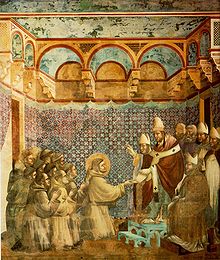
to paint several large frescoes at the newly-built Basilica of St Francis of Assisi, and it is possible, but not certain, that Giotto went with him. The attribution of the fresco cycle of the Life of St. Francis in the Upper Church has been one of the most hotly disputed in art history. The documents of the Franciscan Friars that relate to artistic commissions during this period were destroyed by Napoleon's troops, who stabled horses in the Upper Church of the Basilica, and scholars have been divided over whether or not Giotto was responsible for the Francis Cycle. In the absence of documentary evidence to the contrary, it has been convenient to ascribe every fresco in the Upper Church that was not obviously by Cimabue to Giotto, whose prestige has overshadowed that of almost every contemporary. Some of the earliest remaining biographical sources, such as Ghiberti and Riccobaldo Ferrarese, suggest that the fresco cycle of the life of St Francis in the Upper Church was his earliest autonomous work. However, since the idea was put forward by the German art historian, Friedrich Rintelen in 1912, many scholars have expressed doubt that Giotto was in fact the author of the Upper Church frescoes. Without documentation, arguments on the attribution have relied upon connoisseurship, a notoriously unreliable "science." However, technical examinations and comparisons of the workshop painting processes at Assisi and Padua in 2002 have provided strong evidence that Giotto did not paint the St. Francis Cycle. There are many differences between the Francis Cycle and the Arena Chapel frescoes that are difficult to account for by the stylistic development of an individual artist. It seems quite possible that several hands painted the Assisi frescoes, and that the artists were probably from Rome. If this is the case, then Giotto's frescoes at Padua owe much to the naturalism of these painters.
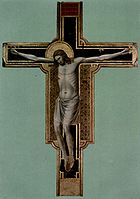 The authorship of a large number of panel paintings ascribed to Giotto by Vasari, among others, is as broadly disputed as the Assisi frescoes. According to Vasari, Giotto's earliest works were for the Dominicans at Santa Maria Novella. These include a fresco of the Annunciation and the enormous suspended Crucifix, which is about 5 metres high. It has been dated around 1290 and is therefore contemporary with the Assisi frescoes. Other early works are the San Giorgio alla Costa Madonna and Child now in the Diocesan Museum of Santo Stefano al Ponte
, Florence, and the signed panel of the Stigmata of St. Francis, once in San Francesco at Pisa, today in the Louvre.
In 1287, at the age of about 20, Giotto married Ricevuta di Lapo del Pela, known as "Ciuta". The couple had numerous children, (perhaps as many as eight) one of whom, Francesco, became a painter.
Giotto worked in Rome in 1297–1300, but few traces of his presence there remain today.
The Basilica of St. John Lateran
houses a small portion of a fresco cycle, painted for the Jubilee
of 1300 called by Boniface VIII. In this period he also painted the Badia Polyptych
, now in the Uffizi
, Florence.
Giotto's fame as a painter spread. He was called to work in Padua
, and also in Rimini
, where today only a Crucifix remains in the Church of St. Francis
, painted before 1309. This work influenced the rise of the Riminese school of Giovanni and Pietro da Rimini. According to documents of 1301 and 1304, Giotto by this time possessed large estates in Florence, and it is probable that he was already leading a large workshop and receiving commissions from throughout Italy.
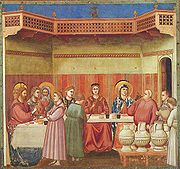
in Padua
. Enrico degli Scrovegni commissioned the chapel to serve as a family worship- and burial-space, even though his parish church was nearby; its construction caused some consternation among the clerics at the Eremitani church next door. This chapel is externally a very plain building of pink brick which was constructed next to an older palace that Scrovegni was restoring for himself. The palace, now gone, and the chapel were on the site of a Roman arena, for which reason it is commonly known as the Arena Chapel.
The theme is Salvation
, and there is an emphasis on the Virgin Mary, as the chapel is dedicated to the Annunciation
and to the Virgin of Charity.
As is common in the decoration of the medieval period in Italy, the west wall is dominated by the Last Judgement. On either side of the chancel are complementary paintings of the Angel Gabriel
and the Virgin Mary, depicting the Annunciation. This scene is incorporated into the cycles of The Life of the Blessed Virgin Mary and The Life of Christ. The source for The Life of the Virgin is the Golden Legend of Jacopo da Voragine while The Life of Christ draws upon the Meditations on the Life of Christ by the Pseudo-Bonaventura
. The frescoes are more than mere illustrations of familiar texts, however, and scholars have found numerous sources for Giotto's interpretations of sacred stories.
The cycle is divided into 37 scenes, arranged around the lateral walls in 3 tiers, starting in the upper register with the story of Joachim and Anna, the parents of the Virgin and continuing with the story of Mary. The life of Jesus occupies two registers. The Last Judgment
fills the entire pictorial space of the counter-façade.
While Cimabue
painted in a manner that is clearly Medieval, having aspects of both the Byzantine and the Gothic, Giotto's style draws on the solid and classicizing sculpture of Arnolfo di Cambio
. Unlike those by Cimabue
and Duccio
, Giotto's figures are not stylized or elongated and do not follow set Byzantine models. They are solidly three-dimensional, have faces and gestures that are based on close observation, and are clothed not in swirling formalized drapery, but in garments that hang naturally and have form and weight. Although aspects of this trend in painting had already appeared in Rome in the work of Pietro Cavallini
and at Assisi, Giotto took it so much further that he earned the reputation for setting a new standard for representational painting.
.jpg) The heavily sculptural figures occupy compressed settings with naturalistic elements, often using forced perspective devices so that they resemble stage sets. This similarity is increased by Giotto's careful arrangement of the figures in such a way that the viewer appears to have a particular place and even an involvement in many of the scenes. This dramatic immediacy was a new feature, which is also seen to some extent in the Upper Church at Assisi.
The heavily sculptural figures occupy compressed settings with naturalistic elements, often using forced perspective devices so that they resemble stage sets. This similarity is increased by Giotto's careful arrangement of the figures in such a way that the viewer appears to have a particular place and even an involvement in many of the scenes. This dramatic immediacy was a new feature, which is also seen to some extent in the Upper Church at Assisi.
Famous narratives in the series include the Adoration of the Magi
, in which a comet-like Star of Bethlehem
streaks across the sky. Giotto is thought to have been inspired by the 1301 appearance of Halley's comet, which led to the name Giotto
being given to a 1986 space probe to the comet. Another famous scene is the Lamentation, in which Giotto adapted the traditional Byzantine iconography of the scene to create an emotional representation that draws the viewer into the sacred narrative.
Giotto's depiction of the human face and emotion sets his work apart from that of his contemporaries. When the disgraced Joachim returns sadly to the hillside, the two young shepherds look sideways at each other. The soldier who drags a baby from its screaming mother in the Massacre of the Innocents does so with his head hunched into his shoulders and a look of shame on his face. The people on the road to Egypt gossip about Mary and Joseph as they go. Of Giotto's realism, the 19th century English critic John Ruskin
said "He painted the Madonna and St. Joseph and the Christ, yes, by all means ... but essentially Mamma, Papa and Baby."
and the Palazzo della Ragione
, which are however from a later sojourn in Padua.
Numerous painters from northern Italy were influenced by Giotto's work in Padua including Guariento
, Giusto de' Menabuoi
, Jacopo Avanzi, and Altichiero
.
In 1311 Giotto returned to Florence, A document from 1313 shows his presence in Rome, where he executed a mosaic for the façade of the old St. Peter's Basilica
, commissioned by Cardinal Giacomo or Jacopo Stefaneschi and now lost except for some fragments.
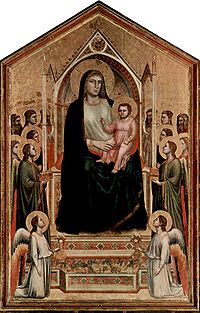 In Florence, where documents from 1314–1327 attest to his financial activities, Giotto painted an altarpiece known as the Ognissanti Madonna
and now in the Uffizi where it is exhibited beside Cimabue's Santa Trinita Madonna and Duccio
's Rucellai Madonna
. The Ognissanti altarpiece is the only panel painting by Giotto that has been universally accepted by scholars, and this despite the fact that it is undocumented. It was painted for the church of the Ognissanti (all saints) in Florence, which was built by an obscure religious order known as the Humiliati. It is a large painting (325 x 204 cm), and scholars are divided on whether it was made for the main altar of the church, where it would have been viewed primarily by the brothers of the order or for the choir screen, where it would have been more easily seen by a lay audience.
At this time he also painted the Dormition of the Virgin, now in the Berlin
Gemäldegalerie
and the Crucifix in the Church of Ognissanti
.
, Giotto painted chapels for four different Florentine families in the church of Santa Croce
, although he does not identify which chapels they were. It is only with Vasari that the four chapels are identified: the Bardi Chapel
(Life of St. Francis), the Peruzzi Chapel
(Life of St. John the Baptist and St. John the Evangelist, perhaps including a polyptych of Madonna with Saints now in the Museum of Art of Raleigh
, North Carolina
) and the lost Giugni Chapel (Stories of the Apostles) and the Tosinghi Spinelli Chapel (Stories of the Holy Virgin). As with almost everything in Giotto's career, the dates of the fresco decorations that survive in Santa Croce are disputed. The Bardi Chapel, immediately to the right of the main chapel of the church, was painted in true fresco, and to some scholars the simplicity of its settings seems relatively close to those of Padua, while the Peruzzi Chapel's more complex settings suggest a later date. The Peruzzi Chapel is adjacent to the Bardi Chapel and was largely painted a secco. This technique, quicker but less durable than true fresco, has resulted in a fresco decoration that survives in a seriously deteriorated condition. Scholars who date this cycle earlier in Giotto's career see the growing interest in architectural expansion that it displays as close to the developments of the giottesque frescoes in the Lower Church at Assisi, while the Bardi frescoes have a new softness of color that indicates the artist going in a different direction, probably under the influence of Sienese art, and so must be a later development.
The Peruzzi Chapel pairs 3 frescoes from the life of St. John the Baptist (The Annunciation of John's Birth to his father Zacharias; The Birth and Naming of John; The Feast of Herod) on the left wall with 3 scenes from the life of St. John the Evangelist (The Visions of John on Ephesus; The Raising of Drusiana; The Ascension of John) on the right wall. The choice of scenes has been related to both the patrons and the Franciscans. Because of the serious condition of the frescoes, it is difficult to discuss Giotto's style in the chapel, although the frescoes show signs of his typical interest in controlled naturalism and psychological penetration.
The Peruzzi Chapel was especially renowned during Renaissance times. Giotto's compositions influenced Masaccio
's Brancacci Chapels, and Michelangelo is known to have studied the frescoes.
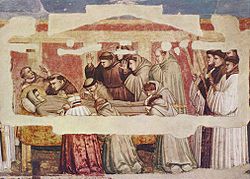 The Bardi Chapel depicts the life of St. Francis
, following a similar iconography to the frescoes in the Upper Church at Assisi, dating from 20–30 years earlier. A comparison makes apparent the greater attention given by Giotto to expression in the human figures and the simpler, better-integrated architectural forms. Giotto represents only 7 scenes from the saint's life here, and the narrative is arranged somewhat unusually. The story starts on the upper left wall with St. Francis Renounces his Father. It continues across the chapel to the upper right wall with the Approval of the Franciscan Rule, moves down the right wall to the Trial by Fire, across the chapel again to the left wall for the Appearance at Arles, down the left wall to the Death of St. Francis, and across once more to the posthumous Visions of Fra Agostino and the Bishop of Assisi. The Stigmatization of St. Francis, which chronologically belongs between the Appearance at Arles and the Death, is located outside the chapel, above the entrance arch. This arrangement encourages viewers to link scenes together: to pair frescoes across the chapel space or relate triads of frescoes along each wall. These linkings suggest meaningful symbolic relationships between different events in St. Francis's life.
 In 1320 Giotto finished the Stefaneschi Triptych
, now in the Vatican Museum, for Cardinal Giacomo (or Jacopo) Gaetano Stefaneschi, who also commissioned him to decorate the apse of St. Peter's with a cycle of frescoes that were destroyed during the 16th century renovation. According to Vasari, Giotto remained in Rome for six years, subsequently receiving numerous commissions in Italy and in the Papal seat at Avignon
, though some of these works are now recognized to be by other artists.
in Santa Croce, Florence was completed. This work, previously ascribed to Giotto, is now believed to be mostly a work by assistants, including Taddeo Gaddi
who later frescoed the chapel). Giotto was called by King Robert of Anjou to Naples
where he remained with a group of pupils until 1333. Few of Giotto's Neapolitan works have survived: a fragment of a fresco portraying the Lamentation of Christ in the church of Santa Chiara, and the Illustrious Men painted on the windows of the Santa Barbara Chapel of Castel Nuovo
(which are usually attributed to his pupils). In 1332 King Robert named him "first court painter" with a yearly pension.
After Naples Giotto stayed for a while in Bologna
, where he painted a Polyptych for the church of Santa Maria degli Angeli, and, according to the sources, a lost decoration for the Chapel in the Cardinal Legate's Castle.
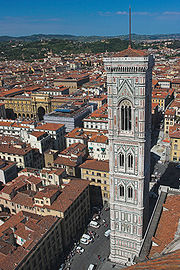
In 1334 Giotto was appointed chief architect to Florence Cathedral, of which the Campanile
(founded by him on July 18, 1334) bears his name, but was not completed to his design.
Before 1337 he was in Milan
with Azzone Visconti, though no trace of works by him remain in the city. His last known work (with assistants' help) is the decoration of Podestà Chapel in the Bargello
, Florence.
In his final years Giotto had become friends with Boccaccio
and Sacchetti, who featured him in their stories. In The Divine Comedy
, Dante
acknowledged the greatness of his living contemporary through the words of a painter in Purgatorio
(XI, 94–96): "Cimabue
believed that he held the field/In painting, and now Giotto has the cry,/ So the fame of the former is obscure."
. These apparently contradictory reports are explained by the fact that the remains of Santa Reparata lie directly beneath the Cathedral and the church continued in use while the construction of the cathedral was proceeding in the early 14th century.
During an excavation in the 1970s bones were discovered beneath the paving of Santa Reparata at a spot close to the location given by Vasari, but unmarked on either level. Forensic examination of the bones by anthropologist Francesco Mallegni and a team of experts in 2000 brought to light some facts that seemed to confirm that they were those of a painter, particularly the range of chemicals, including arsenic and lead
, both commonly found in paint, that the bones had absorbed.
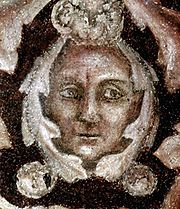
The bones were those of a very short man, of little over four feet tall, who may have suffered from a form of congenital dwarfism. This supports a tradition at the Church of Santa Croce that a dwarf who appears in one of the frescoes is a self portrait of Giotto. On the other hand, a man wearing a white hat who appears in the Last Judgement at Padua is also said to be a portrait of Giotto. The appearance of this man conflicts with the image in Santa Croce.
Vasari, drawing on a description by Boccaccio, who was a friend of Giotto, says of him that "there was no uglier man in the city of Florence" and indicates that his children were also plain in appearance. There is a story that Dante visited Giotto while he was painting the Scrovegni Chapel and, seeing the artist's children underfoot asked how a man who painted such beautiful pictures could create such plain children, to which Giotto, who according to Vasari was always a wit, replied "I made them in the dark."
Forensic reconstruction of the skeleton at Santa Reperata showed a short man with a very large head, a large hooked nose and one eye more prominent than the other. The bones of the neck indicated that the man spent a lot of time with his head tilted backwards. The front teeth were worn in a way consistent with frequently holding a brush between the teeth. The man was about 70 at the time of death.
While the Italian researchers were convinced that the body belonged to Giotto and it was reburied with honour near the grave of Brunelleschi
, others have been highly sceptical.
Italian people
The Italian people are an ethnic group that share a common Italian culture, ancestry and speak the Italian language as a mother tongue. Within Italy, Italians are defined by citizenship, regardless of ancestry or country of residence , and are distinguished from people...
painter
Painting
Painting is the practice of applying paint, pigment, color or other medium to a surface . The application of the medium is commonly applied to the base with a brush but other objects can be used. In art, the term painting describes both the act and the result of the action. However, painting is...
and architect
Architect
An architect is a person trained in the planning, design and oversight of the construction of buildings. To practice architecture means to offer or render services in connection with the design and construction of a building, or group of buildings and the space within the site surrounding the...
from Florence
Florence
Florence is the capital city of the Italian region of Tuscany and of the province of Florence. It is the most populous city in Tuscany, with approximately 370,000 inhabitants, expanding to over 1.5 million in the metropolitan area....
in the late Middle Ages
Late Middle Ages
The Late Middle Ages was the period of European history generally comprising the 14th to the 16th century . The Late Middle Ages followed the High Middle Ages and preceded the onset of the early modern era ....
. He is generally considered the first in a line of great artists who contributed to the Italian Renaissance
Italian Renaissance
The Italian Renaissance began the opening phase of the Renaissance, a period of great cultural change and achievement in Europe that spanned the period from the end of the 13th century to about 1600, marking the transition between Medieval and Early Modern Europe...
.
Giotto's contemporary Giovanni Villani
Giovanni Villani
Giovanni Villani was an Italian banker, official, diplomat and chronicler from Florence who wrote the Nuova Cronica on the history of Florence. He was a leading statesman of Florence but later gained an unsavory reputation and served time in prison as a result of the bankruptcy of a trading and...
wrote that Giotto was "the most sovereign master of painting in his time, who drew all his figures and their postures according to nature. And he was given a salary by the Comune
Comune
In Italy, the comune is the basic administrative division, and may be properly approximated in casual speech by the English word township or municipality.-Importance and function:...
of Florence in virtue of his talent and excellence."
The late-16th century biographer Giorgio Vasari
Giorgio Vasari
Giorgio Vasari was an Italian painter, writer, historian, and architect, who is famous today for his biographies of Italian artists, considered the ideological foundation of art-historical writing.-Biography:...
describes Giotto as making a decisive break with the prevalent Byzantine
Byzantine art
Byzantine art is the term commonly used to describe the artistic products of the Byzantine Empire from about the 5th century until the Fall of Constantinople in 1453....
style and as initiating "the great art of painting as we know it today, introducing the technique of drawing accurately from life, which had been neglected for more than two hundred years."
Giotto's masterwork is the decoration of the Scrovegni Chapel
Cappella degli Scrovegni
The Scrovegni Chapel, or Cappella degli Scrovegni, also known as the Arena Chapel, is a church in Padua, Veneto, Italy. It contains a fresco cycle by Giotto, completed about 1305, that is one of the most important masterpieces of Western art. The church was dedicated to Santa Maria della Carità at...
in Padua
Padua
Padua is a city and comune in the Veneto, northern Italy. It is the capital of the province of Padua and the economic and communications hub of the area. Padua's population is 212,500 . The city is sometimes included, with Venice and Treviso, in the Padua-Treviso-Venice Metropolitan Area, having...
, also known as the Arena Chapel, completed around 1305. This fresco
Fresco
Fresco is any of several related mural painting types, executed on plaster on walls or ceilings. The word fresco comes from the Greek word affresca which derives from the Latin word for "fresh". Frescoes first developed in the ancient world and continued to be popular through the Renaissance...
cycle depicts the life of the Virgin
Life of the Virgin
The Life of the Virgin, showing narrative scenes from the life of Mary, the mother of Jesus, is a common subject for pictorial cycles in Christian art, often complementing, or forming part of, a cycle on the Life of Christ. In both cases the number of scenes shown varies greatly with the space...
and the life of Christ
Jesus
Jesus of Nazareth , commonly referred to as Jesus Christ or simply as Jesus or Christ, is the central figure of Christianity...
. It is regarded as one of the supreme masterpieces of the Early Renaissance
Renaissance
The Renaissance was a cultural movement that spanned roughly the 14th to the 17th century, beginning in Italy in the Late Middle Ages and later spreading to the rest of Europe. The term is also used more loosely to refer to the historical era, but since the changes of the Renaissance were not...
. That Giotto painted the Arena Chapel and that he was chosen by the Comune of Florence in 1334 to design the new campanile
Campanile
Campanile is an Italian word meaning "bell tower" . The term applies to bell towers which are either part of a larger building or free-standing, although in American English, the latter meaning has become prevalent.The most famous campanile is probably the Leaning Tower of Pisa...
(bell tower) of the Florence Cathedral are among the few certainties of his biography. Almost every other aspect of it is subject to controversy: his birthdate, his birthplace, his appearance, his apprenticeship, the order in which he created his works, whether or not he painted the famous frescoes at Assisi
Assisi
- Churches :* The Basilica of San Francesco d'Assisi is a World Heritage Site. The Franciscan monastery, il Sacro Convento, and the lower and upper church of St Francis were begun immediately after his canonization in 1228, and completed in 1253...
, and his burial place.
Early years
It has been traditional to hold that Giotto was born in a hilltop farmhouse, perhaps at Colle di Romagnano or Romignano; since 1850 a tower house in nearby Colle Vespignano, a hamlet 35 kilometres north of Florence, has borne a plaque claiming the honour of his birthplace, an assertion commercially publicized. Very recent research, however, has suggested that he was actually born in Florence, the son of a blacksmith. His father's name was Bondone, described in surviving public records as "a person of good standing". Most authors accept that Giotto was his real name, but it may have been an abbreviation of Ambrogio (Ambrogiotto) or Angelo (Angelotto).The year of his death is calculated from the fact that Antonio Pucci, the town crier of Florence, wrote a poem in Giotto's honour in which it is stated that he was 70 at the time of his death. However, the word "seventy" fits into the rhyme of the poem better than would have a longer and more complex age, so it is possible that Pucci used artistic license.
In his Lives of the Artists, Giorgio Vasari
Giorgio Vasari
Giorgio Vasari was an Italian painter, writer, historian, and architect, who is famous today for his biographies of Italian artists, considered the ideological foundation of art-historical writing.-Biography:...
relates that Giotto was a shepherd boy, a merry and intelligent child who was loved by all who knew him. The great Florentine painter Cimabue
Cimabue
Cimabue , also known as Bencivieni di Pepo or in modern Italian, Benvenuto di Giuseppe, was an Italian painter and creator of mosaics from Florence....
discovered Giotto drawing pictures of his sheep on a rock. They were so lifelike that Cimabue approached Bondone and asked if he could take the boy as an apprentice. Cimabue
Cimabue
Cimabue , also known as Bencivieni di Pepo or in modern Italian, Benvenuto di Giuseppe, was an Italian painter and creator of mosaics from Florence....
was one of the two most highly renowned painters of Tuscany
Tuscany
Tuscany is a region in Italy. It has an area of about 23,000 square kilometres and a population of about 3.75 million inhabitants. The regional capital is Florence ....
, the other being Duccio
Duccio
Duccio di Buoninsegna was one of the most influential Italian artists of his time. Born in Siena, Tuscany, he worked mostly with pigment and egg tempera and like most of his contemporaries painted religious subjects...
, who worked mainly in Siena
Siena
Siena is a city in Tuscany, Italy. It is the capital of the province of Siena.The historic centre of Siena has been declared by UNESCO a World Heritage Site. It is one of the nation's most visited tourist attractions, with over 163,000 international arrivals in 2008...
.
Vasari recounts a number of such stories about Giotto's skill. He writes that when Cimabue was absent from the workshop, his young apprentice painted such a lifelike fly on the face of the painting that Cimabue was working on, that he tried several times to brush it off. Vasari also relates that when the Pope sent a messenger to Giotto, asking him to send a drawing to demonstrate his skill, Giotto drew, in red paint, a circle so perfect that it seemed as though it was drawn using a compass and instructed the messenger to give that to the Pope.
Many scholars today are uncertain about Giotto's training, and consider that Vasari's story that he was Cimabue's pupil is legendary, citing early sources which suggest that Giotto was not Cimabue's pupil. Giotto's art shares many qualities with Roman paintings of the later 13th century. Cimabue may have been working in Rome in this period, and there was an active local school of fresco painters, of whom the most famous was Pietro Cavallini
Pietro Cavallini
Pietro Cavallini was an Italian painter and mosaic designer working during the late Middle Ages. Little is known about his biography, though it is known he was from Rome, since he signed pictor romanus....
. The famous Florentine sculptor and architect, Arnolfo di Cambio
Arnolfo di Cambio
Arnolfo di Cambio was an Italian architect and sculptor.-Biography:Arnolfo was born in Colle Val d'Elsa, Tuscany....
, was then also working in Rome.
Frescoes of the Upper Church at Assisi
From Rome, Cimabue went to AssisiAssisi
- Churches :* The Basilica of San Francesco d'Assisi is a World Heritage Site. The Franciscan monastery, il Sacro Convento, and the lower and upper church of St Francis were begun immediately after his canonization in 1228, and completed in 1253...
to paint several large frescoes at the newly-built Basilica of St Francis of Assisi, and it is possible, but not certain, that Giotto went with him. The attribution of the fresco cycle of the Life of St. Francis in the Upper Church has been one of the most hotly disputed in art history. The documents of the Franciscan Friars that relate to artistic commissions during this period were destroyed by Napoleon's troops, who stabled horses in the Upper Church of the Basilica, and scholars have been divided over whether or not Giotto was responsible for the Francis Cycle. In the absence of documentary evidence to the contrary, it has been convenient to ascribe every fresco in the Upper Church that was not obviously by Cimabue to Giotto, whose prestige has overshadowed that of almost every contemporary. Some of the earliest remaining biographical sources, such as Ghiberti and Riccobaldo Ferrarese, suggest that the fresco cycle of the life of St Francis in the Upper Church was his earliest autonomous work. However, since the idea was put forward by the German art historian, Friedrich Rintelen in 1912, many scholars have expressed doubt that Giotto was in fact the author of the Upper Church frescoes. Without documentation, arguments on the attribution have relied upon connoisseurship, a notoriously unreliable "science." However, technical examinations and comparisons of the workshop painting processes at Assisi and Padua in 2002 have provided strong evidence that Giotto did not paint the St. Francis Cycle. There are many differences between the Francis Cycle and the Arena Chapel frescoes that are difficult to account for by the stylistic development of an individual artist. It seems quite possible that several hands painted the Assisi frescoes, and that the artists were probably from Rome. If this is the case, then Giotto's frescoes at Padua owe much to the naturalism of these painters.
Other attributions
Santo Stefano al Ponte
Santo Stefano al Ponte is a church in Florence, Italy.The church was originally constructed in the 11th and 12th century in a Romanesque style with a polychrome marble facade. The interior featured three aisles. In the 14th century, the exterior was renovated. Of the original facade, only the...
, Florence, and the signed panel of the Stigmata of St. Francis, once in San Francesco at Pisa, today in the Louvre.
In 1287, at the age of about 20, Giotto married Ricevuta di Lapo del Pela, known as "Ciuta". The couple had numerous children, (perhaps as many as eight) one of whom, Francesco, became a painter.
Giotto worked in Rome in 1297–1300, but few traces of his presence there remain today.
The Basilica of St. John Lateran
Basilica of St. John Lateran
The Papal Archbasilica of St. John Lateran , commonly known as St. John Lateran's Archbasilica and St. John Lateran's Basilica, is the cathedral of the Diocese of Rome and the official ecclesiastical seat of the Bishop of Rome, who is the Pope...
houses a small portion of a fresco cycle, painted for the Jubilee
Jubilee (Christian)
The concept of the Jubilee is a special year of remission of sins and universal pardon. In the Biblical Book of Leviticus, a Jubilee year is mentioned to occur every fifty years, in which slaves and prisoners would be freed, debts would be forgiven and the mercies of God would be particularly...
of 1300 called by Boniface VIII. In this period he also painted the Badia Polyptych
Badia Polyptych
The Badia Polyptych is a painting by the Italian artist Giotto, painted around 1300 and housed in the Uffizi Gallery of Florence.-History:...
, now in the Uffizi
Uffizi
The Uffizi Gallery , is a museum in Florence, Italy. It is one of the oldest and most famous art museums of the Western world.-History:...
, Florence.
Giotto's fame as a painter spread. He was called to work in Padua
Padua
Padua is a city and comune in the Veneto, northern Italy. It is the capital of the province of Padua and the economic and communications hub of the area. Padua's population is 212,500 . The city is sometimes included, with Venice and Treviso, in the Padua-Treviso-Venice Metropolitan Area, having...
, and also in Rimini
Rimini
Rimini is a medium-sized city of 142,579 inhabitants in the Emilia-Romagna region of Italy, and capital city of the Province of Rimini. It is located on the Adriatic Sea, on the coast between the rivers Marecchia and Ausa...
, where today only a Crucifix remains in the Church of St. Francis
Tempio Malatestiano
The Tempio Malatestiano is the cathedral church of Rimini, Italy. Officially named for St. Francis, it takes the popular name from Sigismondo Pandolfo Malatesta, who commissioned its reconstruction by the famous Renaissance theorist and architect Leon Battista Alberti around 1450.-History:San...
, painted before 1309. This work influenced the rise of the Riminese school of Giovanni and Pietro da Rimini. According to documents of 1301 and 1304, Giotto by this time possessed large estates in Florence, and it is probable that he was already leading a large workshop and receiving commissions from throughout Italy.
The Scrovegni Chapel
Around 1305 Giotto executed his most influential work, the painted decoration of the interior of the Scrovegni ChapelCappella degli Scrovegni
The Scrovegni Chapel, or Cappella degli Scrovegni, also known as the Arena Chapel, is a church in Padua, Veneto, Italy. It contains a fresco cycle by Giotto, completed about 1305, that is one of the most important masterpieces of Western art. The church was dedicated to Santa Maria della Carità at...
in Padua
Padua
Padua is a city and comune in the Veneto, northern Italy. It is the capital of the province of Padua and the economic and communications hub of the area. Padua's population is 212,500 . The city is sometimes included, with Venice and Treviso, in the Padua-Treviso-Venice Metropolitan Area, having...
. Enrico degli Scrovegni commissioned the chapel to serve as a family worship- and burial-space, even though his parish church was nearby; its construction caused some consternation among the clerics at the Eremitani church next door. This chapel is externally a very plain building of pink brick which was constructed next to an older palace that Scrovegni was restoring for himself. The palace, now gone, and the chapel were on the site of a Roman arena, for which reason it is commonly known as the Arena Chapel.
The theme is Salvation
Salvation
Within religion salvation is the phenomenon of being saved from the undesirable condition of bondage or suffering experienced by the psyche or soul that has arisen as a result of unskillful or immoral actions generically referred to as sins. Salvation may also be called "deliverance" or...
, and there is an emphasis on the Virgin Mary, as the chapel is dedicated to the Annunciation
Annunciation
The Annunciation, also referred to as the Annunciation to the Blessed Virgin Mary or Annunciation of the Lord, is the Christian celebration of the announcement by the angel Gabriel to Virgin Mary, that she would conceive and become the mother of Jesus the Son of God. Gabriel told Mary to name her...
and to the Virgin of Charity.
As is common in the decoration of the medieval period in Italy, the west wall is dominated by the Last Judgement. On either side of the chancel are complementary paintings of the Angel Gabriel
Gabriel
In Abrahamic religions, Gabriel is an Archangel who typically serves as a messenger to humans from God.He first appears in the Book of Daniel, delivering explanations of Daniel's visions. In the Gospel of Luke Gabriel foretells the births of both John the Baptist and of Jesus...
and the Virgin Mary, depicting the Annunciation. This scene is incorporated into the cycles of The Life of the Blessed Virgin Mary and The Life of Christ. The source for The Life of the Virgin is the Golden Legend of Jacopo da Voragine while The Life of Christ draws upon the Meditations on the Life of Christ by the Pseudo-Bonaventura
Pseudo-Bonaventura
The Pseudo-Bonaventura, or Pseudo-Bonaventure is the name given to the authors of a number of medieval devotional works which were believed at the time to be the work of Saint Bonaventure: "It would almost seem as if 'Bonaventura' came to be regarded as a convenient label for a certain type of...
. The frescoes are more than mere illustrations of familiar texts, however, and scholars have found numerous sources for Giotto's interpretations of sacred stories.
The cycle is divided into 37 scenes, arranged around the lateral walls in 3 tiers, starting in the upper register with the story of Joachim and Anna, the parents of the Virgin and continuing with the story of Mary. The life of Jesus occupies two registers. The Last Judgment
Last Judgment
The Last Judgment, Final Judgment, Day of Judgment, Judgment Day, or The Day of the Lord in Christian theology, is the final and eternal judgment by God of every nation. The concept is found in all the Canonical gospels, particularly the Gospel of Matthew. It will purportedly take place after the...
fills the entire pictorial space of the counter-façade.
While Cimabue
Cimabue
Cimabue , also known as Bencivieni di Pepo or in modern Italian, Benvenuto di Giuseppe, was an Italian painter and creator of mosaics from Florence....
painted in a manner that is clearly Medieval, having aspects of both the Byzantine and the Gothic, Giotto's style draws on the solid and classicizing sculpture of Arnolfo di Cambio
Arnolfo di Cambio
Arnolfo di Cambio was an Italian architect and sculptor.-Biography:Arnolfo was born in Colle Val d'Elsa, Tuscany....
. Unlike those by Cimabue
Cimabue
Cimabue , also known as Bencivieni di Pepo or in modern Italian, Benvenuto di Giuseppe, was an Italian painter and creator of mosaics from Florence....
and Duccio
Duccio
Duccio di Buoninsegna was one of the most influential Italian artists of his time. Born in Siena, Tuscany, he worked mostly with pigment and egg tempera and like most of his contemporaries painted religious subjects...
, Giotto's figures are not stylized or elongated and do not follow set Byzantine models. They are solidly three-dimensional, have faces and gestures that are based on close observation, and are clothed not in swirling formalized drapery, but in garments that hang naturally and have form and weight. Although aspects of this trend in painting had already appeared in Rome in the work of Pietro Cavallini
Pietro Cavallini
Pietro Cavallini was an Italian painter and mosaic designer working during the late Middle Ages. Little is known about his biography, though it is known he was from Rome, since he signed pictor romanus....
and at Assisi, Giotto took it so much further that he earned the reputation for setting a new standard for representational painting.
Famous narratives in the series include the Adoration of the Magi
Adoration of the Magi in Art
The Adoration of the Magi is the name traditionally given to the Christian subject in the Nativity of Jesus in art in which the three Magi, represented as kings, especially in the West, having found Jesus by following a star, lay before him gifts of gold, frankincense, and myrrh, and worship him...
, in which a comet-like Star of Bethlehem
Star of Bethlehem
In Christian tradition, the Star of Bethlehem, also called the Christmas Star, revealed the birth of Jesus to the magi, or "wise men", and later led them to Bethlehem. The star appears in the nativity story of the Gospel of Matthew, where magi "from the east" are inspired by the star to travel to...
streaks across the sky. Giotto is thought to have been inspired by the 1301 appearance of Halley's comet, which led to the name Giotto
Giotto mission
Giotto was a European robotic spacecraft mission from the European Space Agency, intended to fly by and study Halley's Comet. On 13 March 1986, the mission succeeded in approaching Halley's nucleus at a distance of 596 kilometers....
being given to a 1986 space probe to the comet. Another famous scene is the Lamentation, in which Giotto adapted the traditional Byzantine iconography of the scene to create an emotional representation that draws the viewer into the sacred narrative.
Giotto's depiction of the human face and emotion sets his work apart from that of his contemporaries. When the disgraced Joachim returns sadly to the hillside, the two young shepherds look sideways at each other. The soldier who drags a baby from its screaming mother in the Massacre of the Innocents does so with his head hunched into his shoulders and a look of shame on his face. The people on the road to Egypt gossip about Mary and Joseph as they go. Of Giotto's realism, the 19th century English critic John Ruskin
John Ruskin
John Ruskin was the leading English art critic of the Victorian era, also an art patron, draughtsman, watercolourist, a prominent social thinker and philanthropist. He wrote on subjects ranging from geology to architecture, myth to ornithology, literature to education, and botany to political...
said "He painted the Madonna and St. Joseph and the Christ, yes, by all means ... but essentially Mamma, Papa and Baby."
Other works in Padua
Among those frescoes in Padua which have been lost are those in the Basilica of. St. AnthonyBasilica of Saint Anthony of Padua
The Pontifical Basilica of Saint Anthony of Padua is a Roman Catholic church and minor basilica in Padua, northern Italy. Although the Basilica is visited as a place of pilgrimage by people from all over the world, it is not the titular cathedral of the city, a title belonging to the...
and the Palazzo della Ragione
Palazzo della Ragione
The Palazzo della Ragione is a Medieval town hall building in Padua, in the Veneto region of ItalyThe building, with its great hall on the upper floor, is reputed to have the largest roof unsupported by columns in Europe; the hall is nearly rectangular, its length 81.5m, its breadth 27m, and its...
, which are however from a later sojourn in Padua.
Numerous painters from northern Italy were influenced by Giotto's work in Padua including Guariento
Guariento
Guariento , sometimes incorrectly named Guerriero, was the first Paduan painter of distinction.The only date distinctly known in his career is 1355, when, having already acquired high renown in his native city, he was invited by the Venetian authorities to paint a Paradise, and some incidents of...
, Giusto de' Menabuoi
Giusto de' Menabuoi
Giusto de' Menabuoi was an Italian painter of the early Renaissance. He was born in Florence.In Lombardy he executed a fresco of the Last Judgement in the Abbey of Viboldone, Milan...
, Jacopo Avanzi, and Altichiero
Altichiero
Altichiero da Verona , also called Aldighieri da Zevio, was an Italian painter of the Gothic style. A follower of Giotto, Altichiero is credited with founding the Veronese school...
.
Mature works
From 1306 to 1311 Giotto was in Assisi, where he painted frescoes in the transept area of the Lower Church, including The Life of Christ, Franciscan Allegories and the Maddalena Chapel, drawing on stories from the Golden Legend and including the portrait of bishop Teobaldo Pontano who commissioned the work. Several assistants are mentioned, including one Palerino di Guido. However, the style demonstrates developments from Giotto's work at Padua.In 1311 Giotto returned to Florence, A document from 1313 shows his presence in Rome, where he executed a mosaic for the façade of the old St. Peter's Basilica
St. Peter's Basilica
The Papal Basilica of Saint Peter , officially known in Italian as ' and commonly known as Saint Peter's Basilica, is a Late Renaissance church located within the Vatican City. Saint Peter's Basilica has the largest interior of any Christian church in the world...
, commissioned by Cardinal Giacomo or Jacopo Stefaneschi and now lost except for some fragments.
Ognissanti Madonna
Ognissanti Madonna
Madonna Enthroned, also known as the Ognissanti Madonna, is a painting by the Italian late medieval artist Giotto di Bondone, housed in the Uffizi Gallery of Florence, Italy. It is generally dated to around 1310. The painting has a traditional Christian subject, representing the Virgin Mary and...
and now in the Uffizi where it is exhibited beside Cimabue's Santa Trinita Madonna and Duccio
Duccio
Duccio di Buoninsegna was one of the most influential Italian artists of his time. Born in Siena, Tuscany, he worked mostly with pigment and egg tempera and like most of his contemporaries painted religious subjects...
's Rucellai Madonna
Rucellai Madonna
The Madonna Rucellai is a painting by the Italian late medieval artist Duccio di Buoninsegna, housed in the Uffizi Gallery of Florence, Italy.- History :...
. The Ognissanti altarpiece is the only panel painting by Giotto that has been universally accepted by scholars, and this despite the fact that it is undocumented. It was painted for the church of the Ognissanti (all saints) in Florence, which was built by an obscure religious order known as the Humiliati. It is a large painting (325 x 204 cm), and scholars are divided on whether it was made for the main altar of the church, where it would have been viewed primarily by the brothers of the order or for the choir screen, where it would have been more easily seen by a lay audience.
At this time he also painted the Dormition of the Virgin, now in the Berlin
Berlin
Berlin is the capital city of Germany and is one of the 16 states of Germany. With a population of 3.45 million people, Berlin is Germany's largest city. It is the second most populous city proper and the seventh most populous urban area in the European Union...
Gemäldegalerie
Gemäldegalerie, Berlin
The Gemäldegalerie is an art museum in Berlin, Germany. It holds one of the world's leading collections of European art from the 13th to the 18th centuries. It is located on Kulturforum west of Potsdamer Platz. Its collection includes masterpieces from such artists as Albrecht Dürer, Lucas...
and the Crucifix in the Church of Ognissanti
Church of Ognissanti, Florence
The Chiesa di Ognissanti is a Franciscan church in Florence, Italy. Founded by the lay order of the Umiliati, the church was dedicated to all the saints and martyrs, known and unknown....
.
The Santa Croce Chapels
According to Lorenzo GhibertiLorenzo Ghiberti
Lorenzo Ghiberti , born Lorenzo di Bartolo, was an Italian artist of the early Renaissance best known for works in sculpture and metalworking.-Early life:...
, Giotto painted chapels for four different Florentine families in the church of Santa Croce
Basilica di Santa Croce di Firenze
The Basilica di Santa Croce is the principal Franciscan church in Florence, Italy, and a minor basilica of the Roman Catholic Church. It is situated on the Piazza di Santa Croce, about 800 metres south east of the Duomo. The site, when first chosen, was in marshland outside the city walls...
, although he does not identify which chapels they were. It is only with Vasari that the four chapels are identified: the Bardi Chapel
Bardi family
The Bardi family was an influential Florentine family that started the powerful banking company, the Compagnia dei Bardi.Along with the Peruzzi family, the Bardis lent Edward III of England 400,000 Gold Florins, which he never repaid....
(Life of St. Francis), the Peruzzi Chapel
Peruzzi
The Peruzzi were bankers of Florence, among the leading families of the city in the 14th century, before the rise to prominence of the Medici. Their modest antecedents stretched back to the mid 11th century, according to the family's genealogist Luigi Passerini, but a restructuring of the Peruzzii...
(Life of St. John the Baptist and St. John the Evangelist, perhaps including a polyptych of Madonna with Saints now in the Museum of Art of Raleigh
Raleigh, North Carolina
Raleigh is the capital and the second largest city in the state of North Carolina as well as the seat of Wake County. Raleigh is known as the "City of Oaks" for its many oak trees. According to the U.S. Census Bureau, the city's 2010 population was 403,892, over an area of , making Raleigh...
, North Carolina
North Carolina
North Carolina is a state located in the southeastern United States. The state borders South Carolina and Georgia to the south, Tennessee to the west and Virginia to the north. North Carolina contains 100 counties. Its capital is Raleigh, and its largest city is Charlotte...
) and the lost Giugni Chapel (Stories of the Apostles) and the Tosinghi Spinelli Chapel (Stories of the Holy Virgin). As with almost everything in Giotto's career, the dates of the fresco decorations that survive in Santa Croce are disputed. The Bardi Chapel, immediately to the right of the main chapel of the church, was painted in true fresco, and to some scholars the simplicity of its settings seems relatively close to those of Padua, while the Peruzzi Chapel's more complex settings suggest a later date. The Peruzzi Chapel is adjacent to the Bardi Chapel and was largely painted a secco. This technique, quicker but less durable than true fresco, has resulted in a fresco decoration that survives in a seriously deteriorated condition. Scholars who date this cycle earlier in Giotto's career see the growing interest in architectural expansion that it displays as close to the developments of the giottesque frescoes in the Lower Church at Assisi, while the Bardi frescoes have a new softness of color that indicates the artist going in a different direction, probably under the influence of Sienese art, and so must be a later development.
The Peruzzi Chapel pairs 3 frescoes from the life of St. John the Baptist (The Annunciation of John's Birth to his father Zacharias; The Birth and Naming of John; The Feast of Herod) on the left wall with 3 scenes from the life of St. John the Evangelist (The Visions of John on Ephesus; The Raising of Drusiana; The Ascension of John) on the right wall. The choice of scenes has been related to both the patrons and the Franciscans. Because of the serious condition of the frescoes, it is difficult to discuss Giotto's style in the chapel, although the frescoes show signs of his typical interest in controlled naturalism and psychological penetration.
The Peruzzi Chapel was especially renowned during Renaissance times. Giotto's compositions influenced Masaccio
Masaccio
Masaccio , born Tommaso di Ser Giovanni di Simone, was the first great painter of the Quattrocento period of the Italian Renaissance. According to Vasari, Masaccio was the best painter of his generation because of his skill at recreating lifelike figures and movements as well as a convincing sense...
's Brancacci Chapels, and Michelangelo is known to have studied the frescoes.
Francis of Assisi
Saint Francis of Assisi was an Italian Catholic friar and preacher. He founded the men's Franciscan Order, the women’s Order of St. Clare, and the lay Third Order of Saint Francis. St...
, following a similar iconography to the frescoes in the Upper Church at Assisi, dating from 20–30 years earlier. A comparison makes apparent the greater attention given by Giotto to expression in the human figures and the simpler, better-integrated architectural forms. Giotto represents only 7 scenes from the saint's life here, and the narrative is arranged somewhat unusually. The story starts on the upper left wall with St. Francis Renounces his Father. It continues across the chapel to the upper right wall with the Approval of the Franciscan Rule, moves down the right wall to the Trial by Fire, across the chapel again to the left wall for the Appearance at Arles, down the left wall to the Death of St. Francis, and across once more to the posthumous Visions of Fra Agostino and the Bishop of Assisi. The Stigmatization of St. Francis, which chronologically belongs between the Appearance at Arles and the Death, is located outside the chapel, above the entrance arch. This arrangement encourages viewers to link scenes together: to pair frescoes across the chapel space or relate triads of frescoes along each wall. These linkings suggest meaningful symbolic relationships between different events in St. Francis's life.
The Stefaneschi Triptych
Stefaneschi Triptych
The Stefaneschi Altarpiece is a triptych by the Italian medieval painter Giotto, commissioned by Cardinal Giacomo Gaetani Stefaneschi to serve as an altarpiece for one of the altars of Old St...
, now in the Vatican Museum, for Cardinal Giacomo (or Jacopo) Gaetano Stefaneschi, who also commissioned him to decorate the apse of St. Peter's with a cycle of frescoes that were destroyed during the 16th century renovation. According to Vasari, Giotto remained in Rome for six years, subsequently receiving numerous commissions in Italy and in the Papal seat at Avignon
Avignon
Avignon is a French commune in southeastern France in the départment of the Vaucluse bordered by the left bank of the Rhône river. Of the 94,787 inhabitants of the city on 1 January 2010, 12 000 live in the ancient town centre surrounded by its medieval ramparts.Often referred to as the...
, though some of these works are now recognized to be by other artists.
Late works
In 1328 the altarpiece of the Baroncelli ChapelBaroncelli Chapel
The Baroncelli Chapel is a chapel located at the transept's end of the church of Santa Croce, Florence, central Italy. It has frescoes by Taddeo Gaddi executed between 1328 and 1338.-Description:The fresco cycle represents the Stories of the Virgin...
in Santa Croce, Florence was completed. This work, previously ascribed to Giotto, is now believed to be mostly a work by assistants, including Taddeo Gaddi
Taddeo Gaddi
Taddeo Gaddi was a medieval Italian painter and architect.-Biography:He was the son of Gaddo di Zanobi, called Gaddo Gaddi. He was a member of Giotto's workshop from 1313 to 1337, when his master died...
who later frescoed the chapel). Giotto was called by King Robert of Anjou to Naples
Naples
Naples is a city in Southern Italy, situated on the country's west coast by the Gulf of Naples. Lying between two notable volcanic regions, Mount Vesuvius and the Phlegraean Fields, it is the capital of the region of Campania and of the province of Naples...
where he remained with a group of pupils until 1333. Few of Giotto's Neapolitan works have survived: a fragment of a fresco portraying the Lamentation of Christ in the church of Santa Chiara, and the Illustrious Men painted on the windows of the Santa Barbara Chapel of Castel Nuovo
Castel Nuovo
Castel Nuovo , often called Maschio Angioino, is a medieval castle in the city of Naples, southern Italy. It is the main symbol of the architecture of the city...
(which are usually attributed to his pupils). In 1332 King Robert named him "first court painter" with a yearly pension.
After Naples Giotto stayed for a while in Bologna
Bologna
Bologna is the capital city of Emilia-Romagna, in the Po Valley of Northern Italy. The city lies between the Po River and the Apennine Mountains, more specifically, between the Reno River and the Savena River. Bologna is a lively and cosmopolitan Italian college city, with spectacular history,...
, where he painted a Polyptych for the church of Santa Maria degli Angeli, and, according to the sources, a lost decoration for the Chapel in the Cardinal Legate's Castle.
In 1334 Giotto was appointed chief architect to Florence Cathedral, of which the Campanile
Giotto's Bell Tower
Giotto’s Campanile is a free-standing campanile that is part of the complex of buildings that make up Florence Cathedral on the Piazza del Duomo in Florence, Italy.Standing adjacent the Basilica of Santa Maria del Fiore and the Baptistry of St...
(founded by him on July 18, 1334) bears his name, but was not completed to his design.
Before 1337 he was in Milan
Milan
Milan is the second-largest city in Italy and the capital city of the region of Lombardy and of the province of Milan. The city proper has a population of about 1.3 million, while its urban area, roughly coinciding with its administrative province and the bordering Province of Monza and Brianza ,...
with Azzone Visconti, though no trace of works by him remain in the city. His last known work (with assistants' help) is the decoration of Podestà Chapel in the Bargello
Bargello
The Bargello, also known as the Bargello Palace or Palazzo del Popolo is a former barracks and prison, now an art museum, in Florence, Italy.-Terminology:...
, Florence.
In his final years Giotto had become friends with Boccaccio
Giovanni Boccaccio
Giovanni Boccaccio was an Italian author and poet, a friend, student, and correspondent of Petrarch, an important Renaissance humanist and the author of a number of notable works including the Decameron, On Famous Women, and his poetry in the Italian vernacular...
and Sacchetti, who featured him in their stories. In The Divine Comedy
The Divine Comedy
The Divine Comedy is an epic poem written by Dante Alighieri between 1308 and his death in 1321. It is widely considered the preeminent work of Italian literature, and is seen as one of the greatest works of world literature...
, Dante
DANTE
Delivery of Advanced Network Technology to Europe is a not-for-profit organisation that plans, builds and operates the international networks that interconnect the various national research and education networks in Europe and surrounding regions...
acknowledged the greatness of his living contemporary through the words of a painter in Purgatorio
Purgatorio
Purgatorio is the second part of Dante's Divine Comedy, following the Inferno, and preceding the Paradiso. The poem was written in the early 14th century. It is an allegory telling of the climb of Dante up the Mount of Purgatory, guided by the Roman poet Virgil...
(XI, 94–96): "Cimabue
Cimabue
Cimabue , also known as Bencivieni di Pepo or in modern Italian, Benvenuto di Giuseppe, was an Italian painter and creator of mosaics from Florence....
believed that he held the field/In painting, and now Giotto has the cry,/ So the fame of the former is obscure."
Remains
Giotto died in January of 1337. According to Vasari, Giotto was buried in Santa Maria del Fiore, the Cathedral of Florence, on the left of the entrance and with the spot marked by a white marble plaque. According to other sources, he was buried in the Church of Santa ReparataSanta Reparata (Florence)
Santa Reparata is the former cathedral of Florence, Italy. Its name refers to Saint Reparata, an early virgin martyr who is the co-patron saint of Florence.- History :...
. These apparently contradictory reports are explained by the fact that the remains of Santa Reparata lie directly beneath the Cathedral and the church continued in use while the construction of the cathedral was proceeding in the early 14th century.
During an excavation in the 1970s bones were discovered beneath the paving of Santa Reparata at a spot close to the location given by Vasari, but unmarked on either level. Forensic examination of the bones by anthropologist Francesco Mallegni and a team of experts in 2000 brought to light some facts that seemed to confirm that they were those of a painter, particularly the range of chemicals, including arsenic and lead
Lead paint
Lead paint or lead-based paint is paint containing lead, a heavy metal, that is used as pigment, with lead chromate and lead carbonate being the most common. Lead is also added to paint to speed drying, increase durability, retain a fresh appearance, and resist moisture that causes corrosion...
, both commonly found in paint, that the bones had absorbed.
The bones were those of a very short man, of little over four feet tall, who may have suffered from a form of congenital dwarfism. This supports a tradition at the Church of Santa Croce that a dwarf who appears in one of the frescoes is a self portrait of Giotto. On the other hand, a man wearing a white hat who appears in the Last Judgement at Padua is also said to be a portrait of Giotto. The appearance of this man conflicts with the image in Santa Croce.
Vasari, drawing on a description by Boccaccio, who was a friend of Giotto, says of him that "there was no uglier man in the city of Florence" and indicates that his children were also plain in appearance. There is a story that Dante visited Giotto while he was painting the Scrovegni Chapel and, seeing the artist's children underfoot asked how a man who painted such beautiful pictures could create such plain children, to which Giotto, who according to Vasari was always a wit, replied "I made them in the dark."
Forensic reconstruction of the skeleton at Santa Reperata showed a short man with a very large head, a large hooked nose and one eye more prominent than the other. The bones of the neck indicated that the man spent a lot of time with his head tilted backwards. The front teeth were worn in a way consistent with frequently holding a brush between the teeth. The man was about 70 at the time of death.
While the Italian researchers were convinced that the body belonged to Giotto and it was reburied with honour near the grave of Brunelleschi
Filippo Brunelleschi
Filippo Brunelleschi was one of the foremost architects and engineers of the Italian Renaissance. He is perhaps most famous for inventing linear perspective and designing the dome of the Florence Cathedral, but his accomplishments also included bronze artwork, architecture , mathematics,...
, others have been highly sceptical.
Other reading
- Ladis, AndrewAndrew LadisAndrew Thomas Ladis was a Greek-born American art historian particularly known for his studies on early Italian Renaissance painting. His 1983 book, Taddeo Gaddi: A Critical Review and Catalogue Raisonné, was the first detailed study of Taddeo Gaddi in the English language...
. Giotto's O: Narrative, Figuration, and Pictorial Ingenuity in the Arena Chapel (Pennsylvania State UP, 2009) - Land, Norman. Giotto as an Ugly Genius: A Study in Self-Portrayal, in Andrew Ladis, ed., Giotto as a Historical and Literary Figure: Miscellaneous Studies, 4 vols. (Vol. 1: Giotto and the World of Early Italian Art), Garland Publishing, New York, 1998: 183 – 196.
- Moleta, Vincent. From St. Francis to Giotto, Franciscan Institute Publications, 1984. ISBN 9780819908537
- Pisani, GiulianoGiuliano PisaniGiuliano Pisani is a classical philologist, scholar of ancient Greek and Latin literature. Graduated in ancient Greek history at Padua University with Prof...
.- L’ispirazione filosofico-teologica nella sequenza Vizi-Virtù della Cappella degli Scrovegni, «Bollettino del Museo Civico di Padova», XCIII, 2004, Milano 2005, pp. 61–97.
- Terapia umana e divina nella Cappella degli Scrovegni, «Il Governo delle cose», dir. Franco Cardini, Firenze, n. 51, anno VI, 2006, pp. 97–106.
- L’iconologia di Cristo Giudice nella Cappella degli Scrovegni di Giotto, «Bollettino del Museo Civico di Padova», XCV, 2006, pp. 45–65.
- Le allegorie della sovrapporta laterale d’accesso alla Cappella degli Scrovegni di Giotto, «Bollettino del Museo Civico di Padova», XCV, 2006, pp. 67–77.
- Il miracolo della Cappella degli Scrovegni di Giotto, in Modernitas – Festival della modernità (Milano 22-25 giugno 2006), Spirali, Milano 2006, pp. 329–57.
- Una nuova interpretazione del ciclo giottesco agli Scrovegni, «Padova e il suo territorio», XXII, 125, 2007, pp. 4–8.
- I volti segreti di Giotto. Le rivelazioni della Cappella degli Scrovegni, RizzoliRCS MediaGroupRCS MediaGroup S.p.A. , based in Milan and listed on the Italian Stock Exchange, is an international multimedia publishing group that operates in daily newspapers, magazines and books, radio broadcasting, new media and digital and satellite TV...
, Milano 2008. - Il programma della Cappella degli Scrovegni, in Giotto e il Trecento, by A. Tomei, SkiraSkiraThe festival of the Skira or Skirophoria in the calendar of ancient Athens, closely associated with the Thesmophoria, marked the dissolution of the old year in May/June. At Athens, the last month of the year was Skirophorion, after the festival...
, Milano 2009, I – I saggi, pp. 113–127.