


Dirk Bouts

Encyclopedia
Dieric Bouts was an Early Netherlandish painter. According to Karel van Mander in his Het Schilderboeck of 1604, Bouts was born in Haarlem
and was mainly active in Leuven
(Louvain), where he was city painter from 1468. Van Mander confused the issue by writing biographies of both "Dieric of Haarlem" and "Dieric of Leuven," although he was referring to the same artist. The similarity of their last names also led to the confusion of Bouts with Hubrecht Stuerbout, a prominent sculptor in Leuven. Very little is actually known about Bouts' early life, but he was greatly influenced by Jan van Eyck
and by Rogier van der Weyden, under whom he may have studied. He is first documented in Leuven in 1457 and worked there until his death in 1475.
Bouts was among the first northern painters to demonstrate the use of a single vanishing point
(as illustrated in his Last Supper). His work has a certain primitive stiffness of drawing, and his figures are often disproportionately long and angular, but his pictures are highly expressive, well designed and rich in colour, with especially good landscape backgrounds.
(Los Angeles)http://www.getty.edu/art/gettyguide/artObjectDetails?artobj=873&handle=li, National Gallery (London)http://www.nationalgallery.org.uk/cgi-bin/WebObjects.dll/CollectionPublisher.woa/wa/largeImage?workNumber=NG664&collectionPublisherSection=work, Norton Simon Museum (Pasadena)http://www.nortonsimon.org/collections/highlights.asp?period=14H&resultnum=5, and a Swiss private collection—with the same dimensions as the Altarpiece of the Holy Sacrament may belong to this period. The Louvre Lamentation (Pietà) is another early work.
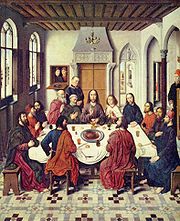 The Last Supper is the central panel of Altarpiece of the Holy Sacrament, commissioned from Bouts by the Leuven Confraternity of the Holy Sacrament in 1464. All of the central room's orthogonals (lines imagined to be behind and perpendicular to the picture plane that converge at a vanishing point) lead to a single vanishing point in the center of the mantelpiece above Christ's head. However the small side room has its own vanishing point, and neither it nor the vanishing point of the main room falls on the horizon of the landscape seen through the windows. The Last Supper is the second dated work (after Petrus Christus' Virgin and Child Enthroned with St. Jerome and St. Francis in Frankfurt, dated 1457) to display an understanding of Italian linear perspective
.
Scholars also have noted that Bouts's Last Supper was the first Flemish
panel painting
to depict the Last Supper
. In this central panel, Bouts did not focus on the biblical narrative itself but instead presented Christ in the role of a priest performing the consecration of the Eucharistic host
from the Catholic Mass. This contrasts strongly with other Last Supper depictions, which often focused on Judas
's betrayal or on Christ's comforting of John. Bouts also added to the complexity of this image by including four servants (two in the window and two standing), all dressed in Flemish attire. Although once identified as the artist himself and his two sons, these servants are most likely portraits of the confraternity's members responsible for commissioning the altarpiece. The Last Supper was the central part of the altarpiece
in the St. Peter's Church, Leuven
.
The Altarpiece of the Holy Sacrament has four additional panels, two on each side. Because these were taken to the museums in Berlin and Munich in the 19th century, the reconstruction of the original altarpiece has been difficult. Today it is thought that the panel with Abraham and Melchizedek is above the Passover Feast on the left wing, while the Gathering of the Manna is above Elijiah and the Angel on the right wing. All of these are typological
precursors to the Last Supper in the central panel.
After attaining the rank of city painter of Leuven in 1468, Bouts received a commission to paint two more works for the Town Hall
. The first was an altarpiece of the Last Judgment (1468–70), which exists today only in the two wings with the Road to Paradise and the Fall of the Damned in the Musée des Beaux-Arts, Lille
(France), and a fragmentary Bust of Christ from the central panel in the Nationalmuseum, Stockholm. After this, he turned to the larger commission for the Justice Panelshttp://193.190.214.109/webopac/List.csp?Profile=Default&OpacLanguage=dut&SearchMethod=Find_1&SearchTerm1=1447&RequestId=438217_15&WebAction=NewSearch&Database=2&PageType=Start&Index1=Index32&NumberToRetrieve=10&WebPageNr=1&SearchT1=1447 (1470–75), which occupied him until his death in 1475. He completed one panel and began a second, both depicting the life of the 11th-century Holy Roman Emperor Otto III. These pieces can now be seen in the Brussels museum. The remaining two Justice Panels were never completed.
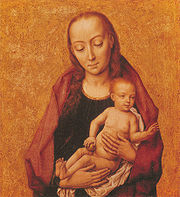 Many of Bouts' authentic works are small devotional panels, usually of the Virgin and Child. An early example is the Davis Madonna in New York (Metropolitan Museum of Art
), excellent copies of which exist in the Bargello
in Florence and the Fine Arts Museums of San Francisco
. This composition follows the formula of the miraculous icon of Notre-Dame-des-Grâces, which was installed in the cathedral of Cambrai (France) in 1454. The Salting Madonna in the National Gallery (London) is the largest and most ambitious of these Marian pictures. In the realm of portraiture, Bouts expanded upon the tradition established by Robert Campin
, Jan van Eyck
, Rogier van der Weyden, and Petrus Christus
. His dated 1462 Portrait of a Man in the National Gallery (London) is the first instance of a sitter shown in three-quarter view before a discernible background with a glimpse of the landscape out the window. Also widely attributed to Bouts is the Portrait of a Man in the Metropolitan Museum of Art (New York), which resembles some of the figures in the artist's late Justice Panels of 1470-75. Other portraits associated with Bouts, such as those in Washington (National Gallery of Art
) and Antwerp (Royal Museum of Fine Arts), are more problematic.
in Munich
have perplexed art historians. One is the so-called Pearl of Brabant Triptych, which writers as early as 1902 tried to separate from Bouts' authentic works. Recent research seems to refute this attempt. The other is a pair of panels from an altarpiece depicting the Passion — respectively showing the Betrayal of Christ and the Resurrection. For a long time these were considered some of Bouts' earliest works, but dendrochronological evidence now places them around the time of his death in 1475. Schone's 1938 invention of a "Master of the Munich Betrayal" is a more appropriate attribution.
, did likewise, but in a style that is unmistakably his own. His distinctive work propelled Boutsian imagery into the 16th century.
Haarlem
Haarlem is a municipality and a city in the Netherlands. It is the capital of the province of North Holland, the northern half of Holland, which at one time was the most powerful of the seven provinces of the Dutch Republic...
and was mainly active in Leuven
Leuven
Leuven is the capital of the province of Flemish Brabant in the Flemish Region, Belgium...
(Louvain), where he was city painter from 1468. Van Mander confused the issue by writing biographies of both "Dieric of Haarlem" and "Dieric of Leuven," although he was referring to the same artist. The similarity of their last names also led to the confusion of Bouts with Hubrecht Stuerbout, a prominent sculptor in Leuven. Very little is actually known about Bouts' early life, but he was greatly influenced by Jan van Eyck
Jan van Eyck
Jan van Eyck was a Flemish painter active in Bruges and considered one of the best Northern European painters of the 15th century....
and by Rogier van der Weyden, under whom he may have studied. He is first documented in Leuven in 1457 and worked there until his death in 1475.
Bouts was among the first northern painters to demonstrate the use of a single vanishing point
Vanishing point
A vanishing point is a point in a perspective drawing to which parallel lines not parallel to the image plane appear to converge. The number and placement of the vanishing points determines which perspective technique is being used...
(as illustrated in his Last Supper). His work has a certain primitive stiffness of drawing, and his figures are often disproportionately long and angular, but his pictures are highly expressive, well designed and rich in colour, with especially good landscape backgrounds.
Early works (before 1464)
Bouts' earliest work is the Infancy Triptych in the Prado (Madrid), dated to about 1445. The Deposition Altarpiece in Granada (Capilla Real) probably also dates to this period, around 1450-60. A dismembered canvas altarpiece—now in the Musées Royaux des Beaux-Arts de Belgique (Brussels)http://193.190.214.109/webopac/List.csp?Profile=Default&OpacLanguage=dut&SearchMethod=Find_1&SearchTerm1=8181&RequestId=438217_4&WebAction=NewSearch&Database=2&PageType=Start&Index1=Index32&NumberToRetrieve=10&WebPageNr=1&SearchT1=8181, the J. Paul Getty MuseumJ. Paul Getty Museum
The J. Paul Getty Museum, a program of the J. Paul Getty Trust, is an art museum. It has two locations, one at the Getty Center in Los Angeles, California, and one at the Getty Villa in Pacific Palisades, Los Angeles, California...
(Los Angeles)http://www.getty.edu/art/gettyguide/artObjectDetails?artobj=873&handle=li, National Gallery (London)http://www.nationalgallery.org.uk/cgi-bin/WebObjects.dll/CollectionPublisher.woa/wa/largeImage?workNumber=NG664&collectionPublisherSection=work, Norton Simon Museum (Pasadena)http://www.nortonsimon.org/collections/highlights.asp?period=14H&resultnum=5, and a Swiss private collection—with the same dimensions as the Altarpiece of the Holy Sacrament may belong to this period. The Louvre Lamentation (Pietà) is another early work.
Documented works
Perspective (graphical)
Perspective in the graphic arts, such as drawing, is an approximate representation, on a flat surface , of an image as it is seen by the eye...
.
Scholars also have noted that Bouts's Last Supper was the first Flemish
Flemish painting
Flemish painting flourished from the early 15th century until the 17th century. Flanders delivered the leading painters in Northern Europe and attracted many promising young painters from neighbouring countries. These painters were invited to work at foreign courts and had a Europe-wide influence...
panel painting
Panel painting
A panel painting is a painting made on a flat panel made of wood, either a single piece, or a number of pieces joined together. Until canvas became the more popular support medium in the 16th century, it was the normal form of support for a painting not on a wall or vellum, which was used for...
to depict the Last Supper
Last Supper
The Last Supper is the final meal that, according to Christian belief, Jesus shared with his Twelve Apostles in Jerusalem before his crucifixion. The Last Supper provides the scriptural basis for the Eucharist, also known as "communion" or "the Lord's Supper".The First Epistle to the Corinthians is...
. In this central panel, Bouts did not focus on the biblical narrative itself but instead presented Christ in the role of a priest performing the consecration of the Eucharistic host
Sacramental bread
Sacramental bread, sometimes called the lamb, altar bread, host or simply Communion bread, is the bread which is used in the Christian ritual of the Eucharist.-Eastern Catholic and Orthodox:...
from the Catholic Mass. This contrasts strongly with other Last Supper depictions, which often focused on Judas
Judas Iscariot
Judas Iscariot was, according to the New Testament, one of the twelve disciples of Jesus. He is best known for his betrayal of Jesus to the hands of the chief priests for 30 pieces of silver.-Etymology:...
's betrayal or on Christ's comforting of John. Bouts also added to the complexity of this image by including four servants (two in the window and two standing), all dressed in Flemish attire. Although once identified as the artist himself and his two sons, these servants are most likely portraits of the confraternity's members responsible for commissioning the altarpiece. The Last Supper was the central part of the altarpiece
Altarpiece
An altarpiece is a picture or relief representing a religious subject and suspended in a frame behind the altar of a church. The altarpiece is often made up of two or more separate panels created using a technique known as panel painting. It is then called a diptych, triptych or polyptych for two,...
in the St. Peter's Church, Leuven
St. Peter's Church, Leuven
Saint Peter's Church of Leuven, Belgium, is situated on the city's Grote Markt , right across the ornate Town Hall...
.
The Altarpiece of the Holy Sacrament has four additional panels, two on each side. Because these were taken to the museums in Berlin and Munich in the 19th century, the reconstruction of the original altarpiece has been difficult. Today it is thought that the panel with Abraham and Melchizedek is above the Passover Feast on the left wing, while the Gathering of the Manna is above Elijiah and the Angel on the right wing. All of these are typological
Typology (theology)
Typology in Christian theology and Biblical exegesis is a doctrine or theory concerning the relationship between the Old and New Testaments...
precursors to the Last Supper in the central panel.
After attaining the rank of city painter of Leuven in 1468, Bouts received a commission to paint two more works for the Town Hall
Leuven Town Hall
The Town Hall of Leuven, Belgium, is a landmark building on that city's Grote Markt square, across from the monumental St. Peter's Church...
. The first was an altarpiece of the Last Judgment (1468–70), which exists today only in the two wings with the Road to Paradise and the Fall of the Damned in the Musée des Beaux-Arts, Lille
Palais des Beaux-Arts de Lille
The Palais des Beaux-Arts de Lille is one of the largest museums in France, and the largest French museum outside of Paris....
(France), and a fragmentary Bust of Christ from the central panel in the Nationalmuseum, Stockholm. After this, he turned to the larger commission for the Justice Panelshttp://193.190.214.109/webopac/List.csp?Profile=Default&OpacLanguage=dut&SearchMethod=Find_1&SearchTerm1=1447&RequestId=438217_15&WebAction=NewSearch&Database=2&PageType=Start&Index1=Index32&NumberToRetrieve=10&WebPageNr=1&SearchT1=1447 (1470–75), which occupied him until his death in 1475. He completed one panel and began a second, both depicting the life of the 11th-century Holy Roman Emperor Otto III. These pieces can now be seen in the Brussels museum. The remaining two Justice Panels were never completed.
Devotional panels and portraits
Metropolitan Museum of Art
The Metropolitan Museum of Art is a renowned art museum in New York City. Its permanent collection contains more than two million works, divided into nineteen curatorial departments. The main building, located on the eastern edge of Central Park along Manhattan's Museum Mile, is one of the...
), excellent copies of which exist in the Bargello
Bargello
The Bargello, also known as the Bargello Palace or Palazzo del Popolo is a former barracks and prison, now an art museum, in Florence, Italy.-Terminology:...
in Florence and the Fine Arts Museums of San Francisco
Fine Arts Museums of San Francisco
The Fine Arts Museums of San Francisco, comprising the M. H. de Young Memorial Museum in Golden Gate Park and the California Palace of the Legion of Honor in Lincoln Park, is the largest public arts institution in the city of San Francisco and one of the largest art museums in California.-External...
. This composition follows the formula of the miraculous icon of Notre-Dame-des-Grâces, which was installed in the cathedral of Cambrai (France) in 1454. The Salting Madonna in the National Gallery (London) is the largest and most ambitious of these Marian pictures. In the realm of portraiture, Bouts expanded upon the tradition established by Robert Campin
Robert Campin
Robert Campin , now usually identified as the artist known as the Master of Flémalle, is usually considered the first great master of Early Netherlandish painting...
, Jan van Eyck
Jan van Eyck
Jan van Eyck was a Flemish painter active in Bruges and considered one of the best Northern European painters of the 15th century....
, Rogier van der Weyden, and Petrus Christus
Petrus Christus
Petrus Christus was an Early Netherlandish painter active in Bruges from 1444.-Life:Christus was born in Baarle, near Antwerp and Breda. Long considered a student of and successor to Jan van Eyck, his paintings have sometimes been confused with those of Van Eyck. At the death of Van Eyck in 1441,...
. His dated 1462 Portrait of a Man in the National Gallery (London) is the first instance of a sitter shown in three-quarter view before a discernible background with a glimpse of the landscape out the window. Also widely attributed to Bouts is the Portrait of a Man in the Metropolitan Museum of Art (New York), which resembles some of the figures in the artist's late Justice Panels of 1470-75. Other portraits associated with Bouts, such as those in Washington (National Gallery of Art
National Gallery of Art
The National Gallery of Art and its Sculpture Garden is a national art museum, located on the National Mall between 3rd and 9th Streets at Constitution Avenue NW, in Washington, DC...
) and Antwerp (Royal Museum of Fine Arts), are more problematic.
The Munich problem(s)
Two Boutsian works in the Alte PinakothekAlte Pinakothek
The Alte Pinakothek is an art museum situated in the Kunstareal in Munich, Germany. It is one of the oldest galleries in the world and houses one of the most famous collections of Old Master paintings...
in Munich
Munich
Munich The city's motto is "" . Before 2006, it was "Weltstadt mit Herz" . Its native name, , is derived from the Old High German Munichen, meaning "by the monks' place". The city's name derives from the monks of the Benedictine order who founded the city; hence the monk depicted on the city's coat...
have perplexed art historians. One is the so-called Pearl of Brabant Triptych, which writers as early as 1902 tried to separate from Bouts' authentic works. Recent research seems to refute this attempt. The other is a pair of panels from an altarpiece depicting the Passion — respectively showing the Betrayal of Christ and the Resurrection. For a long time these were considered some of Bouts' earliest works, but dendrochronological evidence now places them around the time of his death in 1475. Schone's 1938 invention of a "Master of the Munich Betrayal" is a more appropriate attribution.
Other works
The Last Supper and Justice Panels are the only works known to be definitely done by Bouts. The remaining panels from the Last Judgment Altarpiece (datable to 1468-70) and the Martyrdom of St. Erasmus Triptych (before 1466) are also fairly secure attributions. Aside from these, a number of other paintings have been attributed to him, including:- in the Staatliche Museen zu BerlinBerlinBerlin is the capital city of Germany and is one of the 16 states of Germany. With a population of 3.45 million people, Berlin is Germany's largest city. It is the second most populous city proper and the seventh most populous urban area in the European Union...
- a Christ in the House of Simon
- a Nativity fragment with the Virgin at Prayer (see Paris below)
- in the GroeningemuseumGroeningemuseumThe Groeningemuseum is a municipal museum of Bruges, Belgium.It houses a comprehensive survey of six centuries of Flemish and Belgian painting, from Jan van Eyck to Marcel Broodthaers...
, BrugesBrugesBruges is the capital and largest city of the province of West Flanders in the Flemish Region of Belgium. It is located in the northwest of the country....
- a triptych of the Martyrdom of St. Hippolytus
- in the Capilla Real, GranadaRoyal Chapel of GranadaThe Royal Chapel of Granada is a mausoleum located in the city of Granada in Andalusia, southern Spain.-Mausoleum:The mausoleum houses the remains of the Catholic Monarchs :...
- a Virgin Enthroned with Four Angels
- in the Museu Calouste Gulbenkian, Lisbon
- an Annunciation
- in the National Gallery, LondonNational Gallery, LondonThe National Gallery is an art museum on Trafalgar Square, London, United Kingdom. Founded in 1824, it houses a collection of over 2,300 paintings dating from the mid-13th century to 1900. The gallery is an exempt charity, and a non-departmental public body of the Department for Culture, Media...
- The EntombmentThe Entombment (Bouts)The Entombment is a glue-size painting on linen attributed to the Early Netherlandish painter Dirk Bouts. It shows a scene from the biblical entombment of Christ, probably completed between 1440 and 1455 as a wing panel for a large hinged polyptych altarpiece...
, 1450s - a Virgin Enthroned with St. Peter and St. Paul
- The Entombment
- in the Museu de Arte Sacra do Funchal, Madeira, Portugal
- in the Alte Pinakothek, Munich
- in the LouvreLouvreThe Musée du Louvre – in English, the Louvre Museum or simply the Louvre – is one of the world's largest museums, the most visited art museum in the world and a historic monument. A central landmark of Paris, it is located on the Right Bank of the Seine in the 1st arrondissement...
ParisParisParis is the capital and largest city in France, situated on the river Seine, in northern France, at the heart of the Île-de-France region...
- a Nativity fragment with St. Joseph (see Berlin above)
- a Virgin and Child Enthroned in a Niche
- in the Philadelphia Museum of ArtPhiladelphia Museum of ArtThe Philadelphia Museum of Art is among the largest art museums in the United States. It is located at the west end of the Benjamin Franklin Parkway in Philadelphia's Fairmount Park. The Museum was established in 1876 in conjunction with the Centennial Exposition of the same year...
- in the Museum Boijmans Van BeuningenMuseum Boijmans Van BeuningenThe Museum Boijmans Van Beuningen is the main art museum in Rotterdam, the Netherlands. The museum began in 1847 with the collection of Frans Jacob Otto Boijmans . Much of the museum's original collection was destroyed in a disastrous 1864 fire...
RotterdamRotterdamRotterdam is the second-largest city in the Netherlands and one of the largest ports in the world. Starting as a dam on the Rotte river, Rotterdam has grown into a major international commercial centre...
- a Bust of Christ
- in the National Gallery of Art, Washington
- in the Norton Simon Museum of Art in PasadenaPasadena, CaliforniaPasadena is a city in Los Angeles County, California, United States. Although famous for hosting the annual Rose Bowl football game and Tournament of Roses Parade, Pasadena is the home to many scientific and cultural institutions, including the California Institute of Technology , the Jet...
- a Resurrection
Dieric the Younger and Aelbrecht
Bouts was married twice and had four children. His two daughters went to convents, and his two sons became painters who carried the Bouts workshop into the mid-16th century. Little is known of the elder son, Dieric the Younger, although he appears to have continued in his father's style until his early death in 1491. The younger brother, Aelbrecht (or Albert)Aelbrecht Bouts
Aelbrecht Bouts was a Netherlandish painter. His first name is sometimes spelled ‘Albert’, ‘Aelbert’ or ‘Albrecht’. He was born into a family of painters. Aelbrecht’s father was Dieric Bouts the Elder , and his brother was Dieric Bouts the Younger . Jan Bouts Aelbrecht Bouts ( 1450s, Leuven -...
, did likewise, but in a style that is unmistakably his own. His distinctive work propelled Boutsian imagery into the 16th century.
Sources
- Paul Heiland, Dirk Bouts und die Hauptwerke seiner Schule (Potsdam, 1902).
- Max J. Friedländer, Die altniederländische Malerei, vol. 3 (Berlin, 1925); Eng. trans. as Early Netherlandish Painting, vol. 3 (Leiden and Brussels, 1968).
- Ludwig von Baldass, "Die Enwicklung des Dieric Bouts," Jahrbuch der Kunsthist. Samml. Wien, n.s., 6 (1932): 77-114.
- Wolfgang Schöne, Dieric Bouts und seine Schule (Berlin and Leipzig, 1938).
- M. J. Schretlen, Dirck Bouts (Amsterdam, 1946).
- J. Francotte, Dieric Bouts (Leuven, 1951–52).
- Erwin Panofsky, Early Netherlandish Painting (Cambridge, MA, 1953).
- Valentin Denis, Thierry Bouts (Brussels and Amsterdam, 1957).
- Dieric Bouts, exh. cat. (Brussels and Delft, 1957–58).
- Dieric Bouts en zijn Tijd, exh. cat. (Leuven, 1975).
- Dirk Bouts (ca. 1410-1475): Een Vlaams primitief te Leuven, exh. cat. (Leuven, 1998).
- Maurits Smeyers, Dirk Bouts, Schilder van de Stilte (Leuven, 1998).
- Anna Bergmans, ed., Dirk Bouts: Het Laatste Avondmaal (Tielt, 1998).
- Catheline Périer-D'Ieteren, Dieric Bouts: The Complete Works (Brussels, 2006).