
All Topics  
Renaissance music

 
Renaissance Music

   Email Print
   Bookmark   Link


Renaissance music


Renaissance music is European music written during the Renaissance
Renaissance

The Renaissance was a cultural movement that spanned roughly the 14th to the 17th century, beginning in Italy in the late Middle Ages and later spreading to the rest of Europe....
, approximately 1400 - 1600. Defining the beginning of the era is difficult
Dates of classical music eras

Music history divide the European classical music repertory into various eras based on what style was most popular as taste changed. These eras and styles include Medieval music, Renaissance music, Baroque music, Classical music era, Romantic music, and 20th century music....
, given the lack of abrupt shifts in musical thinking during the 15th century. The process by which music acquired "Renaissance" characteristics was a gradual one, and musicologists have placed its beginnings from as early as 1300 to as late as the 1470s. In addition, the Italian humanist movement, rediscovering and reinterpreting the aesthetics of ancient Greece and Rome, influenced the development of musical style during the period.

increasing reliance on the interval of the third as a consonance is one of the most pronounced features of early Renaissance European art music (in the Middle Ages
Middle Ages

File:Karl 1 mit papst gelasius gregor1 sacramentar v karl d kahlen.jpgThe Middle Ages of European history are a period in history which lasted for roughly a millennium, commonly dated from the fall of the Roman Empire in the 5th century to the beginning of the Early Modern Period in the 16th century, marked by the division of Western Christi...
, thirds had been considered dissonances: see interval
Interval (music)

In music theory, the term interval describes the relationship between the pitch of two notes.Intervals may be described as:*vertical if the two notes sound simultaneously...
).


Discussion
Ask a question about 'Renaissance music'
Start a new discussion about 'Renaissance music'
Answer questions from other users
Full Discussion Forum


Recent Posts


Encyclopedia


Renaissance music is European music written during the Renaissance
Renaissance

The Renaissance was a cultural movement that spanned roughly the 14th to the 17th century, beginning in Italy in the late Middle Ages and later spreading to the rest of Europe....
, approximately 1400 - 1600. Defining the beginning of the era is difficult
Dates of classical music eras

Music history divide the European classical music repertory into various eras based on what style was most popular as taste changed. These eras and styles include Medieval music, Renaissance music, Baroque music, Classical music era, Romantic music, and 20th century music....
, given the lack of abrupt shifts in musical thinking during the 15th century. The process by which music acquired "Renaissance" characteristics was a gradual one, and musicologists have placed its beginnings from as early as 1300 to as late as the 1470s. In addition, the Italian humanist movement, rediscovering and reinterpreting the aesthetics of ancient Greece and Rome, influenced the development of musical style during the period.

Overview


Style and trends

The increasing reliance on the interval of the third as a consonance is one of the most pronounced features of early Renaissance European art music (in the Middle Ages
Middle Ages

File:Karl 1 mit papst gelasius gregor1 sacramentar v karl d kahlen.jpgThe Middle Ages of European history are a period in history which lasted for roughly a millennium, commonly dated from the fall of the Roman Empire in the 5th century to the beginning of the Early Modern Period in the 16th century, marked by the division of Western Christi...
, thirds had been considered dissonances: see interval
Interval (music)

In music theory, the term interval describes the relationship between the pitch of two notes.Intervals may be described as:*vertical if the two notes sound simultaneously...
). Polyphony
Polyphony

In music, polyphony is a texture consisting of two or more independent melodic voice , as opposed to music with just one voice or music with one dominant melodic voice accompanied by chord s ....
, in use since the 12th century, became increasingly elaborate with highly independent voices throughout the 14th century: the beginning of the 15th century showed simplification, with the voices often striving for smoothness. This was possible because of a greatly increased vocal range in music – in the Middle Ages, the narrow range made necessary frequent crossing of parts, thus requiring a greater contrast between them.

The modal (as opposed to tonal
Tonality

Tonality is a system of music in which specific hierarchy pitch relationships are based on a Key "center" or Tonic . The term tonalit? originated with Alexandre-?tienne Choron and was borrowed by Fran?ois-Joseph F?tis in 1840 ....
) characteristics of Renaissance music began to break down towards the end of the period with the increased use of root motions of fifths. This later developed into one of the defining characteristics of tonality.

Genres


Principal liturgical forms which endured throughout the entire Renaissance period were masses and motets, with some other developments towards the end, especially as composers of sacred music began to adopt secular forms (such as the madrigal
Madrigal (music)

A madrigal is a type of secular vocal music composition, written during the Renaissance music and early Baroque music eras. Throughout most of its history it was Polyphony and unaccompanied by instruments, with the number of voices varying from two to eight, but most frequently three to six....
) for their own designs.

Common sacred genres were the mass
Mass (music)

The Mass, a Musical form of sacred music, is a choir composition that sets the fixed portions of the Eucharistic liturgy to music. Most Masses are settings of Mass in Latin, the traditional language of the Roman Catholic Church, but there are a significant number written in the languages of non-Catholic countries where vernacular worship h...
, the motet
Motet

In Western music, motet is a word that is applied to a number of highly varied choir musical compositions.The name comes either from the Latin movere, or a Latinized version of Old French mot, "word" or "verbal utterance." The Medieval Latin for "motet" is "motectum", and the Italian mottetto was also used....
, the madrigale spirituale
Madrigale spirituale

A madrigale spirituale is a madrigal , or madrigal-like piece of music, with a sacred rather than a secular text. Most examples of the form date from the late Renaissance music and early Baroque music eras, and principally come from Italy and Germany....
, and the laude
Laude

Laude are the most important form of vernacular sacred song in Italy in the late medieval music era and Renaissance music. They remained popular into the nineteenth century....
.

During the period, secular music had an increasingly wide distribution, with a wide variety of forms, but one must be cautious about assuming an explosion in variety: since printing
Printing

Printing is a process for reproducing text and image, typically with ink on paper using a printing press. It is often carried out as a large-scale industrial process, and is an essential part of publishing and transaction printing....
 made music more widely available, much more has survived from this era than from the preceding Medieval era, and probably a rich store of popular music of the late Middle Ages is irretrievably lost. Secular music included songs for one or many voices, forms such as the frottola
Frottola

The frottola was the predominant type of Italy popular, secular song of the late fifteenth and early sixteenth century. It was the most important and widespread predecessor to the Madrigal ....
, chanson
Chanson

A chanson is in general any Lyrics-driven French song, usually polyphonic and secular. A singer specializing in chansons is known as a "chansonnier"; a collection of chansons, especially from the late Middle Ages and Renaissance, is also known as a chansonnier....
 and madrigal
Madrigal (music)

A madrigal is a type of secular vocal music composition, written during the Renaissance music and early Baroque music eras. Throughout most of its history it was Polyphony and unaccompanied by instruments, with the number of voices varying from two to eight, but most frequently three to six....
.

Secular vocal genres included the madrigal
Madrigal (music)

A madrigal is a type of secular vocal music composition, written during the Renaissance music and early Baroque music eras. Throughout most of its history it was Polyphony and unaccompanied by instruments, with the number of voices varying from two to eight, but most frequently three to six....
, the frottola
Frottola

The frottola was the predominant type of Italy popular, secular song of the late fifteenth and early sixteenth century. It was the most important and widespread predecessor to the Madrigal ....
, the caccia, the chanson
Chanson

A chanson is in general any Lyrics-driven French song, usually polyphonic and secular. A singer specializing in chansons is known as a "chansonnier"; a collection of chansons, especially from the late Middle Ages and Renaissance, is also known as a chansonnier....
 in several forms (rondeau
Rondeau

Rondeau may mean:*Rondeau , a form of French poetry*Rondo, a musical form from the 18th century to the present, also spelt 'rondeau'*Rondeau , a medieval and early Renaissance musical form distinct from the 18th century rondo...
, virelai
Virelai

A virelai is a form of medieval French literature used often in poetry and music. It is one of the three formes fixes , and was one of the most common verse forms set to music in Europe from the late thirteenth to the fifteenth centuries....
, bergerette, ballade
Ballade (musical form)

A ballade refers to a one-movement musical piece with lyrical and dramatic narrative qualities....
, musique mesurée
Musique mesurée

Musique mesur?e, or Musique mesur?e ? l'antique, was a style of vocal musical composition in France in the late 16th century. In musique mesur?e, longer syllables in the French language were set to longer note values, and shorter syllables to shorter, in a homophonic texture but in a situation of meter fluidity, in an atte...
), the canzonetta
Canzonetta

In music, a canzonetta was a popular Italy secular vocal composition which originated around 1560. In its earlier versions it was somewhat like a madrigal but lighter in style; but by the 18th century, especially as it moved outside of Italy, the term came to mean a song for voice and accompaniment, usually in a light secular style....
, the villancico
Villancico

Villancico was a common lyric form of the Iberian Peninsula during the Renaissance. The villancicos could also be set to music: many Iberian composers of the 15th and 16th century, like Juan del Encina or Pedro de Escobar composed villancicos....
, the villanella
Villanella

In music, a villanella is a form of light Italy secular vocal music which originated in Italy just before the middle of the 16th century. It first appeared in Naples, and influenced the later canzonetta, and from there also influenced the madrigal ....
, the villotta
Villotta

Villotta is a kind of popular song found mainly in northern Italy, especially near Venice. Often using folk music or folk songs in dialect, the structure of the modern villotta entails four hendecasyllabic lines of verse followed by a refrain....
, and the lute song
Lute song

The lute song was a generic form of music in the late Renaissance music and very early Baroque music eras, generally consisting of a singer accompanying himself on a lute, though lute songs may often have been performed by a singer and a separate lutenist....
. Mixed forms such as the motet-chanson
Motet-chanson

The motet-chanson was a specialized musical form of the Renaissance music, developed in Milan during the 1470s and 1480s, which combined aspects of the contemporary motet and chanson....
 and the secular motet also appeared.

Purely instrumental music included consort
Consort of instruments

A consort of instruments was a phrase used in England during the 16th and 17th centuries to indicate an instrumental ensemble.A consort may be "whole", that is, all instruments of the same family....
 music for recorder
Recorder

The recorder is a woodwind instrument musical instrument of the family known as fipple flutes or internal duct flutes — whistle-like instruments which include the tin whistle and ocarina....
 or viol
Viol

The viol is any one of a family of bow , fretted, stringed instruments musical instruments developed in the 1400s and used primarily in the Renaissance music and Baroque music periods....
 and other instruments, and dances for various ensembles. Common genres were the toccata
Toccata

Toccata is a virtuoso piece of music typically for a keyboard instrument or plucked string instrument featuring fast-moving, lightly fingered or otherwise virtuosic passages or sections, with or without imitative or fugue interludes, generally emphasizing the dexterity of the performer's fingers....
, the prelude
Prelude (music)

A prelude is a short Musical piece of music, the form of which may vary from piece to piece. While, during the Baroque Age, for example, it may have served as an introduction to succeeding movements of a work that were usually longer and more complex, it may also have been a stand alone piece of work during the Romantic Era....
, the ricercar
Ricercar

A ricercar is a type of late Renaissance music and mostly early Baroque music instrumental composition. The term means to search out, and many ricercars serve a Prelude function to "search out" the key or mode of a following piece....
, the canzona
Canzona

In music, a canzona was a 16th-century multipart vocal setting of a literary canzone and a 1500s- and 1600s instrumental composition. At first based on Franco-Flemish polyphonic songs , later independently composed, the instrumental canzonas, such as the brass canzonas of Giovanni Gabrieli, influenced the fugue and were the direct ancest...
, and intabulation
Intabulation

Intabulation, from the Italian word intavolatura, refers to an arrangement of a vocal or ensemble piece for Keyboard instrument, lute, or other plucked string instrument, written in tablature....
 (intavolatura, intabulierung). Instrumental ensembles for dances might play a basse danse
Basse danse

The basse danse, or "low dance", was the most popular court dance in the Fifteenth Century and early Sixteenth century centuries, especially at the Duchy of Burgundy, often in a combination of 6/4 and 3/2 time allowing for use of hemiola....
 (or bassedanza), a pavane
Pavane

The pavane, pavan, paven, pavin, pavian, pavine, or pavyn is a slow processional dance common in Europe during the 16th century ....
, a galliard
Galliard

The galliard was a form of Renaissance dance and music popular all over Europe in the 16th century. It is mentioned in dance manuals from England, France, Spain, Germany, and Italy, among others....
, an allemande
Allemande

An allemande is one of the most popular instrumental dance forms in Baroque music, and a standard element of a suite. Originally, the allemande formed the first movement of the suite, before the courante, but, later, it was often preceded by an introductory movement, such as a Prelude ....
, or a courante
Courante

The courante, corrente, coranto and corant are just some of the names given to a family of triple metre dances from the late Renaissance and the Baroque....
.

Towards the end of the period, the early dramatic precursors of opera such as monody, the madrigal comedy
Madrigal comedy

Madrigal comedy is a term for a kind of entertainment music of the late 16th century in Italy, in which groups of related, generally a cappella madrigal were sung consecutively, generally telling a story, and sometimes having a loose dramatic plot....
, and the intermedio
Intermedio

The intermedio, or intermezzo, in the Italian Renaissance, was a theatrical performance or spectacle with Renaissance music and often dance which was performed between the acts of a play to celebrate special occasions in Italian noble court; it was one of the important predecessors to opera, and an influence on other forms like the E...
 are seen.

Theory and notation

According to Margaret Bent (1998), "Renaissance notation is under-prescriptive by our standards; when translated into modern form it acquires a prescriptive weight that overspecifies and distorts its original openness."
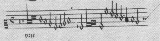
White Mensural Notation
Renaissance compositions were notated only in individual parts; scores were extremely rare, and barlines
Bar (music)

In musical notation, a bar is a segment of time defined as a given number of beat of a given duration. The word measure is heard more frequently in the United States, while bar is used in other English-speaking countries, although musicians generally understand both usages....
 were not used. Note value
Note value

In music notation, a note value indicates the relative duration of a note , using the color or shape of the note head, the presence or absence of a stem , and the presence or absence of flags....
s were generally larger than are in use today; the primary unit of beat
Beat (music)

A beat is the basic time unit within much Western music; for example, each tick sounded by a metronome would correspond to a beat. More technically, "the beat is the pulse of the mensural level", also known as the beat level, the meter level at which pulses are heard as the basic unit?"the denominator of the time signature,"...
 was the semibreve, or whole note
Whole note

In music, a whole note or semibreve is a note represented by a hollow oval note head, like a half note , and no note stem . Its length is typically equal to four beats in 4/4 time signature....
. As had been the case since the Ars Nova
Ars nova

Ars nova was a stylistic period in music of the Late Middle Ages, centered in France, which encompassed the period roughly from the preparation of the Roman de Fauvel until the death of Guillaume de Machaut ....
 (see Medieval music
Medieval music

The term medieval music encompasses European music written during the Middle Ages. This era begins with the fall of the Roman Empire and ends in approximately the middle of the fifteenth century....
), there could be either two or three of these for each breve
Breve

A breve is a diacritical mark ?, shaped like the bottom half of a circle. It looks similar to caron , but the caron has a sharp tip, whilst the breve is rounded....
 (a double-whole note), which may be looked on as equivalent to the modern "measure," though it was itself a note value and a measure is not. The situation can be considered this way: it is the same as the rule by which in modern music a quarter-note may equal either two eighth-notes or three, which would be written as a "triplet." By the same reckoning, there could be two or three of the next smallest note, the "minim," (equivalent to the modern "half note") to each semibreve. These different permutations were called "perfect/imperfect tempus" at the level of the breve–semibreve relationship, "perfect/imperfect prolation" at the level of the semibreve–minim, and existed in all possible combinations with each other. Three-to-one was called "perfect," and two-to-one "imperfect." Rules existed also whereby single notes could be halved or doubled in value ("imperfected" or "altered," respectively) when preceded or followed by other certain notes. Notes with black noteheads (such as quarter note
Quarter note

A quarter note or crotchet is a note played for one quarter of the duration of a whole note . Quarter notes are notated with a filled-in oval note head and a straight, flagless stem ....
s) occurred less often. This development of white mensural notation may be a result of the increased use of paper
Paper

Paper is thin material mainly used for writing upon, printing upon or packaging. It is produced by pressing together moist fibers, typically cellulose pulp derived from wood, rags or grasses, and drying them into flexible sheets....
 (rather than vellum
Vellum

Vellum is mammal skin prepared for writing or printing on single pages, scrolls, Codex or books. It is generally thin, smooth and durable, although there are great variations depending on preparation, the quality of the skin, and the type of animal....
), as the weaker paper was less able to withstand the scratching required to fill in solid noteheads; notation of previous times, written on vellum, had been black. Other colors, and later, filled-in notes, were used routinely as well, mainly to enforce the aforementioned imperfections or alterations and to call for other temporary rhythmical changes.

Accidentals were not always specified, somewhat as in certain fingering notations (tablature
Tablature

Tablature is a form of musical notation, which tells players where to place their fingers on a particular instrument rather than which pitches to play....
s) today. However, Renaissance musicians would have been highly trained in dyadic counterpoint and thus possessed this and other information necessary to read a score, "what modern notation requires [accidentals] would then have been perfectly apparent without notation to a singer versed in counterpoint." See musica ficta
Musica ficta

In European music prior to about 1600, musica ficta referred to chromaticism altered pitches, not notated in the music, which were to be supplied by performers....
. A singer would interpret his or her part by figuring cadential formulas with other parts in mind, and when singing together musicians would avoid parallel octaves and fifths or alter their cadential parts in light of decisions by other musicians (Bent, 1998).

It is through contemporary tablatures for various plucked instruments that we have gained much information about what accidentals were performed by the original practitioners.

For information on specific theorists, see Johannes Tinctoris
Johannes Tinctoris

Johannes Tinctoris was a Flemings composer and music theory of the Renaissance. He is known to have studied in Orleans, and to have been master of the choir there; he also may have been director of choirboys at Chartres....
, Franchinus Gaffurius
Franchinus Gaffurius

Franchinus Gaffurius was an Italy music theory and composer of the Renaissance music. He was an almost exact contemporary of Josquin des Prez and Leonardo da Vinci, both of whom were his personal friends....
, Heinrich Glarean
Heinrich Glarean

Heinrich Glarean was a Switzerland music theory, poet and humanist. He was born in Mollis and died in Freiburg.After a thorough early training in music, he enrolled in the University of Cologne, where he studied theology, philosophy, and mathematics as well as music....
, Pietro Aron
Pietro Aron

Pietro Aron, also known as Pietro Aaron , was an Italy music theorist and composer. He was born in Florence and probably died in Bergamo ....
, Nicola Vicentino
Nicola Vicentino

Nicola Vicentino was an Italy music theory and composer of the Renaissance music. He was one of the most visionary musicians of the age, inventing, among other things, a microtonal keyboard, and devising a practical system of chromaticism writing two hundred years before the rise of equal temperament....
, Tomás de Santa María
Tomás de Santa María

Tom?s de Santa Mar?a was a Spain music theorist, organist and composer of the Renaissance music. He was born in Madrid but the date is highly uncertain; he died in Ribadavia....
, Gioseffo Zarlino
Gioseffo Zarlino

Gioseffo Zarlino , was an Italy Music theory and composer of the Renaissance music. He was possibly the most famous music theorist between Aristoxenus and Jean Philippe Rameau, and made a large contribution to the theory of counterpoint as well as to musical tuning....
, Vicente Lusitano
Vicente Lusitano

Vicente Lusitano was a Portugal music composer and music theory of the late Renaissance music.He was born in Oliven?a, but little else is known for certain of his life, including the dates of his birth and death....
, Vincenzo Galilei
Vincenzo Galilei

Vincenzo Galilei was an Italy lute, composer, and music theory, and the father of the famous astronomer and physicist Galileo Galilei. He was a seminal figure in the musical life of the late Renaissance, and contributed significantly to the musical revolution which demarcates the beginning of the Baroque music era....
, Giovanni Artusi
Giovanni Artusi

Giovanni Maria Artusi was an Italy music theory, composer, and writer.Artusi was one of the most famous reactionaries in musical history, fiercely condemning the new style developing around 1600, the innovations of which defined the early Baroque music era....
, Johannes Nucius
Johannes Nucius

Johannes Nucius was a Germany composer and music theory of the late Renaissance music and early Baroque music eras. Although isolated from most of the major centers of musical activity, he was a polished composer in the style of Orlande de Lassus and penned an extremely influential treatise on the rhetorical application of compositional de...
, and Pietro Cerone
Pietro Cerone

Pietro Cerone was an Italy music theorist, singer and priest of the late Renaissance music. He is most famous for an enormous music treatise he wrote in 1613, which is useful in the studying compositional practices of the 16th century....
.

Composers of the Renaissance


Early Renaissance music (1400 – 1467)

This group gradually dropped the late Medieval period's complex devices of isorhythm
Isorhythm

Isorhythm is a musical technique that arranges a fixed pattern of pitch es with a repeating rhythmic pattern. It consists of an order of durations or rhythms, called a talea , which is repeated within a tenor melody whose pitch content or series, called the color , varied in the number of members from the talea....
 and extreme syncopation
Syncopation

In music, syncopation includes a variety of rhythms which are in some way unexpected in that they deviate from the strict succession of regularly spaced strong and weak beat in a meter ....
, resulting in a more limpid and flowing style. What their music "lost" in rhythmic complexity, however, it gained in rhythmic vitality, as a "drive to the cadence" became a prominent feature around mid-century.

Middle Renaissance music (1467 – 1534)


In the early 1470s, music starts to be printed using a printing press
Printing press

A printing press is a mechanical device for applying pressure to an inked surface resting upon a medium , thereby transferring an image. The mechanical systems involved were first assembled in Germany by the goldsmith Johannes Gutenberg around 1439, based on existing screw-presses used to press cloth, grapes etc., and possibly to print wood...
. Music printing had a major effect on how music spread for not only did a printed piece of music reach a larger audience than any manuscript ever could, it did it far cheaper as well. Also during this century, a tradition of famous makers began for many instruments. These makers were masters of their craft. An example is Neuschel for his trumpets.

Towards the end of the 15th century, polyphonic sacred music (as exemplified in the masses of Johannes Ockeghem
Johannes Ockeghem

Johannes Ockeghem was the most famous composer of the Franco-Flemish School in the last half of the 15th century, and is often considered the most influential composer between Guillaume Dufay and Josquin des Prez....
 and Jacob Obrecht
Jacob Obrecht

Jacob Obrecht was a Franco-Flemish School composer of the Renaissance music. He was the most famous composer of mass es in Europe in the late 15th century, being eclipsed by only Josquin Desprez after his death....
) had once again become more complex, in a manner that can perhaps be seen as correlating to the stunning detail in the painting at the time. Ockeghem, particularly, was fond of canon
Canon (music)

In music, a canon is a counterpoint composition that employs a melody with one or more imitations of the melody played after a given duration . The initial melody is called the leader , while the imitative melody is called the follower which is played in a different voice....
, both contrapuntal and mensural
Prolation canon

In music, a prolation canon or mensuration canon is a type of canon , a musical composition which employs a melody with one or more imitations of the melody in other voices played after a given duration ....
. He composed a mass in which all the parts are derived canonically from one musical line.

It was in the opening decades of the next century that music felt in a tactus (think of the modern time signature) of two semibreves-to-a-breve began to be as common as that with three semibreves-to-a-breve, as had prevailed prior to that time.

In the early 16th century, there is another trend towards simplification, as can be seen to some degree in the work of Josquin des Prez
Josquin Des Prez

Josquin des Prez , often referred to simply as Josquin, was a Franco-Flemish School composer of the Renaissance music. He is also known as Josquin Desprez, a French rendering of Dutch language "Josken Van De Velde", diminutive of "Joseph Van De Velde" , and Latinized as Josquinus Pratensis, alternatively Jodocus Pratens...
 and his contemporaries in the Franco-Flemish School
Franco-Flemish School

In music, the Franco-Flemish School refers, somewhat imprecisely, to the style of polyphony vocal music composition in Europe in the 15th and 16th centuries, and to the composers who wrote it....
, then later in that of G. P. Palestrina
Giovanni Pierluigi da Palestrina

Giovanni Pierluigi da Palestrina was an Italy composer of the Renaissance music. He was the most famous sixteenth-century representative of the Roman School of musical composition....
, who was partially reacting to the strictures of the Council of Trent
Council of Trent

The Council of Trent was the 16th century Ecumenical Council of the Roman Catholic Church. Considered one of the Church's most important councils, it convened in Trento between December 13, 1545, and December 4, 1563 in twenty-five sessions for three periods....
, which discouraged excessively complex polyphony as inhibiting understanding the text. Early 16th-century Franco-Flemings moved away from the complex systems of canonic and other mensural play of Ockeghem's generation, tending toward points of imitation and duet or trio sections within an overall texture that grew to five and six voices. They also began, even before the Tridentine reforms, to insert ever-lengthening passages of homophony
Homophony

In music, homophony Homophony as a term first appeared in English with Charles Burney in 1776, emphasizing the concord of harmonized melody....
, to underline important text or points of articulation. Palestrina, on the other hand, came to cultivate a freely flowing style of counterpoint in a thick, rich texture within which consonance followed dissonance on a nearly beat-by-beat basis, and suspensions ruled the day (see counterpoint
Counterpoint

In music, counterpoint is the relationship between two or more Register that are independent in contour and rhythm, and interdependent in harmony....
). By now, tactus was generally two semibreves per breve with three per breve used for special effects and climactic sections; this was a nearly exact reversal of the prevailing technique a century before.

Late Renaissance music (1534 – 1600)

In Venice
Venice

Venice is a city in northern Italy, the capital city of the Italian regions Veneto, a population of 271,251 . Together with Padua, Italy, the city is included in the Padua-Venice Metropolitan Area ....
, from about 1534 until around 1600, an impressive polychoral style developed, which gave Europe some of the grandest, most sonorous music composed up until that time, with multiple choirs of singers, brass and strings in different spatial locations in the Basilica San Marco di Venezia (see Venetian School
Venetian School

In music history, the Venetian School is a term used to describe the composers working in Venice from about 1550 to around 1610; it also describes the music they produced....
). These multiple revolutions spread over Europe in the next several decades, beginning in Germany and then moving to Spain, France and England somewhat later, demarcating the beginning of what we now know as the Baroque
Baroque music

Baroque music describes a period or style of European classical music approximately extending from Dates of classical music eras. This era is said to begin in music after the Renaissance music and was followed by the Classical music era....
 musical era.

The Roman School
Roman School

In music history, the Roman School was a group of composers of predominantly church music, in Rome, during the 16th and 17th centuries, therefore spanning the late Renaissance music and early Baroque music eras....
 was a group of composers of predominantly church music in Rome, spanning the late Renaissance and early Baroque eras. Many of the composers had a direct connection to the Vatican and the papal chapel, though they worked at several churches; stylistically they are often contrasted with the Venetian School of composers, a concurrent movement which was much more progressive. By far the most famous composer of the Roman School is Giovanni Pierluigi da Palestrina, whose name has been associated for four hundred years with smooth, clear, polyphonic perfection.

The brief but intense flowering of the musical madrigal in England, mostly from 1588 to 1627, along with the composers who produced them, is known as the English Madrigal School
English Madrigal School

The English Madrigal School was the brief but intense flowering of the musical madrigal in England, mostly from 1588 to 1627, along with the composers who produced them....
. The English madrigals were a cappella, predominantly light in style, and generally began as either copies or direct translations of Italian models. Most were for three to six voices.

Musica reservata
Musica reservata

In music history, musica reservata is either a style or a performance practice in a cappella vocal music of the latter half of the 16th century, mainly in Italy and southern Germany, involving refinement, exclusivity, and intense emotional expression of sung text....
 is either a style or a performance practice in a cappella vocal music of the latter, mainly in Italy and southern Germany, involving refinement, exclusivity, and intense emotional expression of sung text.

In addition, many composers observed a division in their own works between a prima pratica
Prima pratica

Prima pratica, literally "first practice", refers to early Baroque music which looks more to the style of Giovanni Pierluigi da Palestrina, or the style codified by Gioseffo Zarlino, than to more "modern" styles....
 (music in the Renaissance polyphonic style) and a seconda pratica (music in the new style) during the first part of the 17th century.

Mannerism

In the late 16th century, as the Renaissance era closes, an extremely manneristic style develops. In secular music, especially in the madrigal, there was a trend towards complexity and even extreme chromaticism (as exemplified in madrigals of Luzzaschi
Luzzasco Luzzaschi

Luzzasco Luzzaschi was an Italy composer, organist, and teacher of the late Renaissance music. He was born and died in Ferrara, and probably spent his entire life there....
, Marenzio
Luca Marenzio

Luca Marenzio was an Italy composer and singer of the late Renaissance music. He was one of the most renowned composers of madrigal , and wrote some of the most famous examples of the form in its late stage of development, prior to its early Baroque music transformation by Claudio Monteverdi....
, and Gesualdo
Carlo Gesualdo

Carlo Gesualdo, known as Gesualdo da Venosa , Prince of Venosa and Count of Conza, was an Italian music composer, lutenist and nobleman of the late Renaissance music....
). The term "mannerism" derives from art history.

Transition to the Baroque

Beginning in Florence
Florence

Florence is the Capital city of the Italy Regions of Italy of Tuscany and of the provinces of Italy Province of Florence. It is the most populous city in Tuscany and has a population of 364,779 ....
, there was an attempt to revive the dramatic and musical forms of Ancient Greece, through the means of monody
Monody

In poetry, the term monody has become specialized to refer to a poem in which one person laments another's death. In music, monody has two meanings: 1) it is sometimes used as a synonym for monophony, a single solo line, in opposition to homophony and polyphony; and 2) in music history, it is a solo vocal style distinguished by hav...
, a form of declaimed music over a simple accompaniment; a more extreme contrast with the preceding polyphonic style would be hard to find; this was also, at least at the outset, a secular trend. These musicians were known as the Florentine Camerata
Florentine Camerata

The Florentine Camerata was a group of Humanisms, musicians, poets and intellectuals in late Renaissance Florence who gathered under the patronage of Count Giovanni de' Bardi to discuss and guide trends in the arts, especially music and drama....
.

We have already noted some of the musical developments that helped to usher in the Baroque
Baroque music

Baroque music describes a period or style of European classical music approximately extending from Dates of classical music eras. This era is said to begin in music after the Renaissance music and was followed by the Classical music era....
, but for further explanation of this transition, see antiphon
Antiphon

An antiphon is a response, usually sung in Gregorian chant, to a psalm or some other part of a religious service, such as at Vespers or at a mass ....
, concertato
Concertato

Concertato is a term in early Baroque music referring to either a genre or a style of music in which groups of instruments or voices share a melody, usually in alternation, and almost always over a basso continuo....
, monody
Monody

In poetry, the term monody has become specialized to refer to a poem in which one person laments another's death. In music, monody has two meanings: 1) it is sometimes used as a synonym for monophony, a single solo line, in opposition to homophony and polyphony; and 2) in music history, it is a solo vocal style distinguished by hav...
, madrigal
Madrigal (music)

A madrigal is a type of secular vocal music composition, written during the Renaissance music and early Baroque music eras. Throughout most of its history it was Polyphony and unaccompanied by instruments, with the number of voices varying from two to eight, but most frequently three to six....
, and opera
Opera

Opera is an Performing arts in which singers and musicians perform a dramatic work which combines a text and a musical score. Opera is part of the Western classical music tradition....
, as well as the works given under "Sources and further reading."

For a more thorough discussion of the transition to the Baroque specifically pertaining to instrument music, see Transition from Renaissance to Baroque in instrumental music
Transition from Renaissance to Baroque in instrumental music

In the years centering around 1600 in History of Europe#Early modern history: 16th, 17th and 18th centuries, several distinct shifts emerged in ways of thinking about the purposes, writing and performance of music....
.

Instruments of the Renaissance

Many instruments originated during the Renaissance; others were variations of, or improvements upon, instruments that had existed previously. Some have survived to the present day; others have disappeared, only to be recreated in order to perform music of the period on authentic instruments. As in the modern day, instruments may be classified as brass, strings, percussion, and woodwind.

Brass Brass instruments in the Renaissance were traditionally played by professionals. Some of the more common brass instruments that were played:

  • Slide trumpet
    Slide trumpet

    The slide trumpet is a type of trumpet that is fitted with a slide much like a trombone....
    : Similar to the trombone of today except that instead of a section of the body sliding, only a small part of the body near the mouthpiece and the mouthpiece itself is stationary. Also the body was an S-shape so it was rather unwieldy, but was suitable for the slow dance music which it was most commonly used for.


  • Cornett
    Cornett

    The cornett, cornetto or zink is an early wind instrument, dating from the Medieval, Renaissance and Baroque periods. It was used in what are now called alta capellas or wind ensembles....
    : Made of wood and was played like the recorder (will be mentioned at greater length later on) but blown like a trumpet. It was commonly made in several sizes, the largest was called the serpent. The serpent became practically the only cornetto used by the early seventeenth century while other ranges were replaced by the violin. It was said to be the closest instrument to the human voice with the ability to use dynamics and expression.


  • Trumpet
    Trumpet

    The trumpet is a musical instrument with the highest Register in the brass instrument family. Trumpets are among the oldest musical instruments, dating back to at least 1500 BC....
    : Early trumpets had no valves, and were limited to the tones present in the overtone series. They were also made in different sizes. Although commonly depicted being used by angels, their use in churches was limited, a prominent exception being the music of the Venetian School
    Venetian School

    In music history, the Venetian School is a term used to describe the composers working in Venice from about 1550 to around 1610; it also describes the music they produced....
    . They were most commonly used in the military and for the announcement of royalty. Period trumpets were found to have two rings soldered to them, one near the mouthpiece and another near the bell.


  • Sackbut
    Sackbut

    Sackbut refers to a trombone from the Renaissance and Baroque Eras. 'Sackbut' is often used in recent times to differentiate a historic trombone from a modern one....
    (sometimes sackbutt or sagbutt): A different name for the trombone, which replaced the slide trumpet by the end of the fifteenth century. Sackbuts were used almost exclusively in church music and faced behind the player.


Strings As a family strings were used in many circumstances, both sacred and secular. A few members of this family include:

  • Viol
    Viol

    The viol is any one of a family of bow , fretted, stringed instruments musical instruments developed in the 1400s and used primarily in the Renaissance music and Baroque music periods....
    : This instrument, developed in the 1400s, commonly has six strings. It was usually played with a bow. It has structural qualities similar to the Spanish vihuela
    Vihuela

    Vihuela is a name given to two different guitar-like string instruments: one from 15th and 16th century Spain, usually with 12 paired strings, and the other, the Mexican vihuela, from 19th century Mexico with five strings and typically played in Mariachi bands....
    ; its main separating trait is its larger size. This changed the posture of the musician in order to rest it against the floor or between the legs in a manner similar to the cello. Its similarities to the vihuela were sharp waist-cuts, similar frets, a flat back, thin ribs, and identical tuning. This is the predecessor of the modern-day violin, viola, and violoncello (cello).


  • Lyre
    Lyre

    The lyre is a string instrument well known for its use in classical antiquity and later. The recitations of the Ancient Greece were accompanied by lyre playing....
    : Its construction is similar to a small harp, although instead of being plucked, it is strummed with a plectrum. Its strings varied in quantity from four, seven, and ten, depending on the era. It was played with the right hand, while the left hand silenced the notes that were not desired. Newer lyres were modified to be played with a bow.


  • Irish Harp: Also called the Clàrsach in Scottish Gaelic, or the Cláirseach in Irish, during the Middle Ages it was the most popular instrument of Ireland and Scotland. Due to its significance on Irish history it is seen even on the Guinness
    Guinness

    Guinness is a popular dry stout that originated in Arthur Guinness' first brewery in Leixlip, County Kildare but it then moved to its present home at St....
     label, and is Ireland's national symbol even to this day. To be played it is usually plucked. Its size can vary greatly from a harp that can be played in one's lap to a full-size harp that is placed on the floor


  • Hurdy gurdy
    Hurdy gurdy

    The hurdy gurdy is a stringed musical instrument in which the strings are sounded by means of a rosined wheel which the strings of the instrument pass over....
    : (Also known as the wheel fiddle), in which the strings are sounded by a wheel which the strings pass over. Its functionality can be compared to that of a mechanical violin, in that its bow (wheel) is turned by a crank. Its distinctive sound is mainly because of its "drone strings" which provide a constant pitch similar in their sound to that of bagpipes.


  • See main article: Cittern
    Cittern

    The cittern or cither is a stringed instrument of the guitar family dating from the Renaissance. With its flat back, it was much simpler, and therefore cheaper, to construct than the lute, in addition to which it was easier to play and, being smaller and less delicate, far more portable....
    .


  • See main article: Lute
    Lute

    Lute can refer generally to any plucked string instrument with a neck and a deep round back, or more specifically to an instrument from the family of European lutes....
    .


  • See main article: Harpsichord
    Harpsichord

    A harpsichord is a musical instrument played by means of a musical keyboard. It produces sound by plucking a string when each Key is pressed....
    .


  • See main article: Virginal.


Percussion Some Renaissance percussion instruments include the triangle, the Jew's harp, the tambourine, the bells, the rumble-pot, and various kinds of drums.

  • Tambourine
    Tambourine

    The tambourine or Marine is a musical instrument of the Percussion instrument family consisting of a frame, often of wood or plastic, with pairs of small metal jingles, called "zils"....
    : In the early ages the tambourine was originally a frame drum without the jingles attached to the side. This instrument soon evolved and took on the name of the timbrel during the medieval crusades, at which time it acquired the jingles. The tambourine was often found with a single skin, as it made it easy for a dancer to play. The skin that surrounds frame is called the vellum, and produces the beat by striking the surface with the knuckles, fingertips, or hand. It could also be played by shaking the instrument, allowing the tambourine's jingles to "clank" and "jingle".


  • Jew's harp
    Jew's harp

    The Jew's harp, jaw harp, mouth harp, Ozark harp, marranzano pancake, or Omaha Flapjack is thought to be one of the oldest musical instruments in the world ; a musician apparently playing it can be seen in a Chinese drawing from the 3rd century BC ....
    : An instrument often known for its historical purpose for men "serenading" their sweethearts, It even went to the extent of being repeatedly banned for its "endangerment on female virtue", it is also believed that it was banned because of its construction of silver, and due to the great demand on silver in the 19th Century Austria this was another reason for its outlawing. A steel instrument that produces sound using shapes of the mouth and attempting to pronounce different vowels with ones mouth. The loop at the bent end of the tongue of the instrument is plucked in different scales of vibration creating different tones.


Woodwinds (Aerophones) The woodwind instruments (Aerophones) use a column of air vibrating within a pipe that has little holes along it to generate vibration with the airflow through the pipe and control the length of the sound waves produced by the vibrating air. A player could create this air column by using a few different methods. The first is blowing across a mouth hole (as would be done with flutes). The second is blowing into a mouthpiece with a single reed (as would be found with the clarinet or saxophone) or a double reed (which is used with oboes and bassoons).

The woodwind instruments of the Middle Ages are not the same as modern day woodwinds. They were more eccentric and exotic. For example, you would find that modern woodwinds fit the natural position of the hand. Woodwinds in the Renaissance used simple holes drilled in the instrument.

  • Shawm
    Shawm

    The shawm was a medieval and Renaissance musical instrument of the woodwind family made in Europe from the late 13th century until the 17th century....
    : A typical oriental shawm is keyless and is about a foot long with seven finger holes and a thumb hole. The pipes were also most commonly made of wood and many of them had carvings and decorations on them. It was the most popular double reed instrument of the renaissance period; it was commonly used in the streets with drums and trumpets because of its brilliant, piercing, and often deafening sound. To play the shawm a person puts the entire reed in their mouth, puffs out their cheeks, and blows into the pipe whilst breathing through their nose.


  • Reed pipe
    Reed pipe

    A reed pipe is an organ pipe that is sounded by a vibrating brass strip known as a Reed . Air under pressure is directed towards the reed, which vibrates at a specific pitch ....
    : Made from a single short length of cane with a mouthpiece, four or five finger holes, and reed fashioned from it. The reed is made by cutting out a small tongue, but leaving the base attached. It is the predecessor of the saxophone and the clarinet.


  • Hornpipe
    Hornpipe

    The term hornpipe refers to any of several dance forms played and danced in Great Britain and elsewhere from the late 17th century until the present day....
    : Same as reed pipe but with a bell at the end.


  • Bagpipe/Bladderpipe: Believe to have been invented by herdsmen who thought to use a bag made out of sheep or goat skin and would provide air pressure so that when its player takes a breath, the player only needs to squeeze the bag tucked underneath their arm to continue the tone. The mouth pipe has a simple round piece of leather hinged on to the bag end of the pipe and acts like a non-return valve.


As an aside, the reed is located inside the long metal mouthpiece, known as a bocal.

  • Panpipe: Designed to have sixteen wooden tubes with a stopper at one end and open on the other. Each tube is a different size (thereby producing a different tone), giving it a range of an octave and a half. The player can then place their lips against the desired tube and blow across it.


  • Transverse flute
    Transverse flute

    A transverse flute or side-blown flute is a flute which is held horizontally when played. The player blows "across" the embouchure hole, in a direction perpendicular to the flute's body length....
    : The Transverse flute is similar to the modern flute with a mouth hole near the stoppered end and finger holes along the body. The player blows in the side and holds the flute to the right side.


  • Recorder: The recorder is a common instrument still used today, often taught to children in elementary schools. Rather than a reed it uses a whistler mouth piece, which is a beak shaped mouth piece, as its main source of sound production. It is usually made with seven finger holes and a thumb hole.


See also

  • List of Renaissance composers
    List of Renaissance composers

    This is a list of composers active during the Renaissance period of European history. Since the 14th century is not usually considered by music historians to be part of the Renaissance music, but part of the Middle Ages, composers active during that time can be found in the List of Medieval composers....
  • Music of the French Renaissance
    French Renaissance

    French Renaissance is a recent term used to describe a Cultural movement and Art movement in France from the late 15th century to the early 17th century....
  • High Renaissance
    High Renaissance

    The High Renaissance, in the history of art, denotes the culmination of the art of the Italian Renaissance between 1450 and 1527. Because Pope Julius II patronized many artists during this time, the movement was centered in Rome; it had previously been centered in Florence....


Sources and further reading

  • Atlas, Allan W. Renaissance Music. New York: W.W. Norton, 1998.
  • Baines, Anthony, ed. Musical Instruments Through the Ages. New York: Walker and Company, 1975.
  • Bent, Margaret. The Grammar of Early Music: Preconditions for Analysis. In Tonal Structures of Early Music, ed. Cristle Collins Judd.
  • Bessaraboff, Nicholas. Ancient European Musical Instruments. 1st. Cambridge, Mass: Harvard University Press, 1941.
  • Brown, Howard M. Music in the Renaissance. Englewood Cliffs, NJ: Prentice Hall, 1976.
  • Gleason, Harold and Becker, Warren. Music in the Middle Ages and Renaissance (Music Literature Outlines Series I). Bloomington, IN: Frangipani Press, 1986. ISBN 0-89917-034-X
  • Judd, Cristle Collins, ed. Tonal Structures of Early Music. New York: Garland Publishing, 1998. ISBN 0-8153-2388-3.
  • Reese, Gustav
    Gustave Reese

    Gustave Reese was an United States musicology and teacher. Reese is mainly known for his work on Medieval music and Renaissance music, particularly with his two publications Music in the Middle Ages and Music in the Renaissance ; these two books remain the standard reference works for these two eras, with complete and precise bibli...
    . Music in the Renaissance. New York: W.W. Norton, 1954. ISBN 0-393-09530-4
  • Munrow, David. Instruments of the Middle Ages and Renaissance. London: Oxford University Press, 1976.
  • Ongaro, Giulio. Music of the Renaissance. Westport, Connecticut: Greenwood Press, 2003.
  • Strunk, Oliver. Source Readings in Music History. New York: W.W. Norton, 1950.


External links

  • (online radio featuring medieval and renaissance music)
  •  – descriptions, photos, and sounds.
  •  – A Renaissance Musicke Ensemble
  •  – Renaissance Civic Bands of Europe
  • , from Ye Compaynye of Cheualrye Re-enactment Society. Photos and Audio Download.
  • - Renaissance Music Videos