


Giorgione

Encyclopedia
Giorgione was a Venetian
painter of the High Renaissance
in Venice
, whose career was cut off by his death at a little over thirty. Giorgione is known for the elusive poetic quality of his work, though only about six surviving paintings are acknowledged for certain to be his work. The resulting uncertainty about the identity and meaning of his art has made Giorgione one of the most mysterious figures in European painting.
Together with Titian
, who was slightly younger, he is the founder of the distinctive Venetian school of Italian Renaissance painting
, which achieves much of its effect through colour and mood, and is traditionally contrasted with the reliance on a more linear disegno of Florentine painting
.
's Vite. The painter came from the small town of Castelfranco Veneto
, 40 km inland from Venice. His name sometimes appears as Zorzo. The variant Giorgione (or Zorzon) may be translated "Big George". How early in boyhood he went to Venice we do not know, but stylistic evidence supports the statement of Carlo Ridolfi
that he served his apprenticeship there under Giovanni Bellini
; there he settled and made his fame.
Contemporary documents record that his gifts were recognized early. In 1500, when he was only twenty-three (that is, if Vasari is correct about his age when he died), he was chosen to paint portraits of the Doge
Agostino Barbarigo
and the condottiere Consalvo Ferrante. In 1504 he was commissioned to paint an altarpiece in memory of another condottiere, Matteo Costanzo, in the cathedral of his native town, Castelfranco. In 1507 he received at the order of the Council of Ten
part payment for a picture (subject not mentioned) on which he was engaged for the Hall of the Audience in the Doge's Palace. In 1507-1508 he was employed, with other artists of his generation, to decorate with frescoes the exterior of the newly rebuilt Fondaco dei Tedeschi
(or German Merchants' Hall) at Venice, having already done similar work on the exterior of the Casa Soranzo, the Casa Grimani alli Servi and other Venetian palaces. Very little of this work survives today.
 Vasari mentions an important event in Giorgione's life, and one which had influence on his work, his meeting with Leonardo da Vinci
on the occasion of the Tuscan master's visit to Venice in 1500. All accounts agree in representing Giorgione as a person of distinguished and romantic charm, a great lover and a musician, given to express in his art the sensuous and imaginative grace, touched with poetic melancholy, of the Venetian existence of his time. They represent him further as having made in Venetian painting an advance analogous to that made in Tuscan painting by Leonardo more than twenty years before; that is, as having released the art from the last shackles of archaic rigidity and placed it in possession of full freedom and the full mastery of its means.
He was very closely associated with Titian
; Vasari says Giorgione was Titian's master, while Ridolfi says they both were pupils of Bellini, and lived in his house. They worked together on the Fondaco dei Tedeschi frescoes, and Titian finished at least some paintings of Giorgione after his death, although which ones remains very controversial.
Giorgione also introduced a new range of subjects. Besides altarpiece
s and portraits he painted pictures that told no story, whether biblical or classical, or if they professed to tell a story, neglected the action and simply embodied in form and color moods of lyrical or romantic feeling, much as a musician might embody them in sounds. Innovating with the courage and felicity of genius, he had for a time an overwhelming influence on his contemporaries and immediate successors in the Venetian school, including Titian
, Sebastiano del Piombo
, Palma il Vecchio, il Cariani, Giulio Campagnola
(and his brother), and even on his already eminent master, Giovanni Bellini. In the Venetian mainland, Giorgionismo strongly influenced Morto da Feltre
, Domenico Capriolo, and Domenico Mancini.
Giorgione died, probably of the plague
then raging, by October, 1510. October of 1510 is also the date of a letter by Isabella d'Este
to a Venetian friend; asking him to buy a painting by Giorgione; in the letter she is aware he is already dead. Significantly, the reply a month later said the painting was not to be had at any price.
His name and work continue to exercise a spell on posterity. But to identify and define, among the relics of his age and school, precisely what that work is, and to distinguish it from the similar work of other men whom his influence inspired, is a very difficult matter. Though there are no longer any supporters of the "Pan Giorgionismus" which a century ago claimed for Giorgione nearly every painting of the time that at all resembles his manner, there are still, as then, exclusive critics who reduce to half a dozen the list of extant pictures which they will admit to be actually by this master.
 For his home town of Castelfranco, Giorgione painted the Castelfranco Madonna
, an altarpiece
in sacra conversazione
form — Madonna
enthroned, with saints on either side forming an equilateral triangle. This gave the landscape background an importance which marks an innovation in Venetian art, and was quickly followed by his master Giovanni Bellini
and others. Giorgione began to use the very refined chiaroscuro
called sfumato
— the delicate use of shades of color to depict light and perspective — around the same time as Leonardo. Whether Vasari is correct in saying he learned it from Leonardo's works is unclear — he is always keen to ascribe all advances to Florentine sources. Leonardo's delicate color modulations result from the tiny disconnected spots of paint that he probably derived from Illuminated manuscript
techniques and first brought into oil painting. These gave Giorgione's works the magical glow of light for which they are celebrated.
Most central and typical of all of Giorgione's extant works is the Sleeping Venus
now in Dresden
. It was first recognized by Giovanni Morelli
, and is now universally accepted, as being the same as the picture seen by Marcantonio Michiel
and later by Ridolfi (his 17th century biographer) in the Casa Marcello at Venice. An exquisitely pure and severe rhythm of line and contour chastens the sensuous richness of the painting. The sweep of white drapery on which the goddess lies; and the glowing landscape that fills the space behind her; most harmoniously frame her divinity. The use of an external landscape to frame a nude is innovative; but in addition, to add to her mystery, she is shrouded in sleep, spirited away from accessibility to any conscious expression.
It is recorded by Michiel that Giorgione left this piece unfinished and that the landscape, with a Cupid
which subsequent restoration has removed, were completed after his death by Titian. The picture is the prototype of Titian's own Venus of Urbino
and of many more by other painters of the school; but none of them attained the fame of the first exemplar. The same concept of idealized beauty is evoked in a virginally pensive Judith
from the Hermitage Museum
, a large painting which exhibits Giorgione's special qualities of color richness and landscape romance, while demonstrating that life and death are each other's companions rather than foes.
Apart from the altarpiece and the frescoes, all Giorgione's surviving works are small paintings designed for the wealthy Venetian collector to keep in his home; most are under two feet (60 cm) in either dimension. This market had been emerging over the last half of the 15th century in Italy, and was much better established in the Netherlands
, but Giorgione was the first major Italian painter to concentrate his work on it to such an extent — indeed soon after his death the size of paintings began to increase with the prosperity and palaces of the patrons.
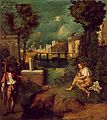 The Tempest has been called the first landscape
in the history of Western painting
. The subject of this painting is unclear, but its artistic mastery is apparent. The Tempest portrays a soldier and a breast-feeding woman on either side of a stream, amid a city's rubble and an incoming storm. The multitude of symbols in The Tempest offer many interpretations, but none is wholly satisfying. Theories that the painting is about duality (city and country, male and female) have been dismissed since radiography
has shown that in the earlier stages of the painting the soldier to the left was a seated female nude.
The Three Philosophers
is equally enigmatic and its attribution to Giorgione is still disputed. The three figures stand near a dark empty cave. Sometimes interpreted as symbols of Plato's cave or the Three Magi
, they seem lost in a typical Giorgionesque dreamy mood, reinforced by a hazy light characteristic of his other landscapes, such as the Pastoral Concert, now in the Louvre
. The latter "reveals the Venetians' love of textures", because the painter "renders almost palpable the appearance of flesh, fabric, wood, stone, and foliage". The painting is devoid of harsh contours and its treatment of landscape has been frequently compared to pastoral poetry, hence the title.
Giorgione and the young Titian
revolutionized the genre of the portrait
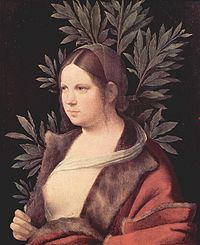
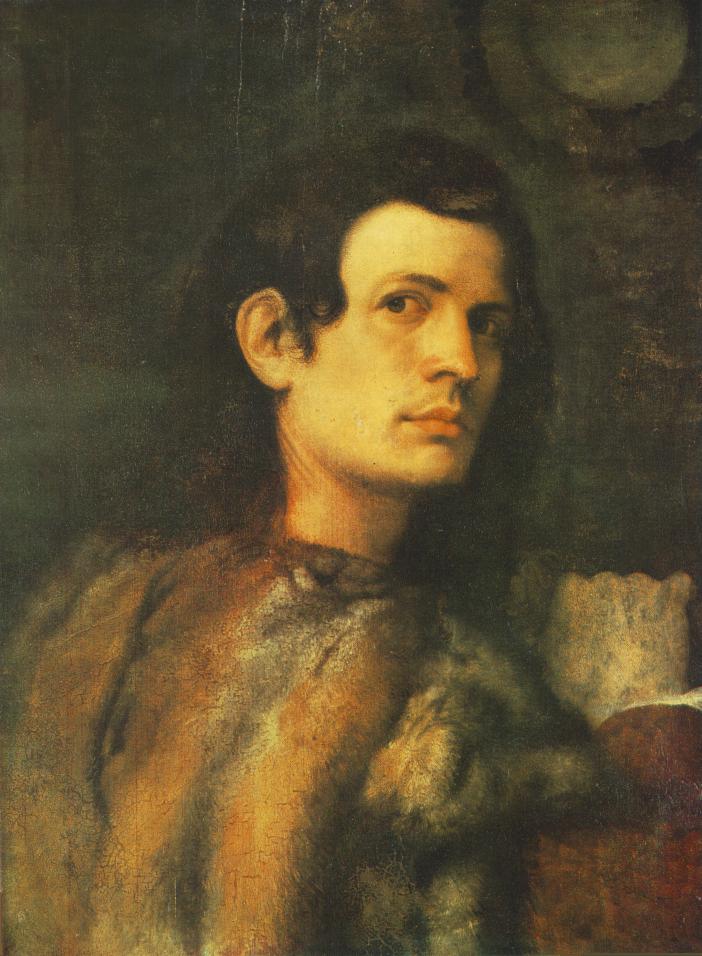
as well. It is exceedingly difficult and sometimes simply impossible to differentiate Titian's early works from those of Giorgione. None of Giorgione's paintings are signed and only one bears a reliable date: his portrait of Laura (1 June 1506), one of the first to be painted in the "modern manner", distinguished by dignity, clarity, and sophisticated characterization. Even more striking is the Portrait of a Young Man now in Berlin
, acclaimed by art historians for "the indescribably subtle expression of serenity and the immobile features, added to the chiseled effect of the silhouette and modeling".
Few of the portraits attributed to Giorgione appear as straightforward records of the appearance of a commissioning individual, although it is entirely possible that many are. Many can be read as types designed to express a mood or atmosphere, and certainly many of the examples of the portrait tradition Giorgione initiated appear to have had this purpose, and not to have been sold to the sitter. The subjects of his non-religious figure paintings are equally hard to discern. Perhaps the first question to ask is whether there was intended to be a specific meaning to these paintings that ingenious research can hope to recover. Many art historians argue that there is not: "The best evidence, perhaps, that Giorgione's pictures were not particularly esoteric in their meaning is provided by the fact that while his stylistic innovations were widely adopted, the distinguishing feature of virtually all Venetian non-religious painting in the first half of the 16th century is the lack of learned or literary content".
 The difficulty in making secure attributions of work by Giorgione's hand dates from soon after his death, when some of his paintings were completed by other artists, and his considerable reputation also led to very early erroneous claims of attribution. The vast bulk of documentation for paintings in this period relates to large commissions for Church or government; the small domestic panels that make up the bulk of Giorgione's oeuvre are always far less likely to be recorded. Other artists continued to work in his style for some years, and probably by the mid-century deliberately deceptive work had started.
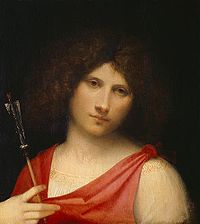
Primary documentation for attributions comes from the Venetian collector Marcantonio Michiel. In notes dating from 1525 to 1543 he identifies twelve paintings and one drawing as by Giorgione, of which five of the paintings are identified virtually unanimously with surviving works by art historians: The Tempest, The Three Philosophers, Sleeping Venus, Boy with an Arrow, and Shepherd with a Flute
(not all accept the last as by Giorgione however). Michiel describes the Philosophers as having been completed by Sebastiano del Piombo, and the Venus as finished by Titian (it is now generally agreed that Titian did the landscape). Some recent art historians also involve Titian in the Three Philosophers. The Tempest is therefore the only one of the group universally accepted as wholly by Giorgione. In addition, the Castelfranco Altarpiece in his home-town has rarely, if ever, been doubted, nor have the wrecked fresco fragments from the German warehouse. The Vienna Laura is the only work signed and dated by Giorgione (on the back). The early pair of paintings in the Uffizi
are usually accepted.
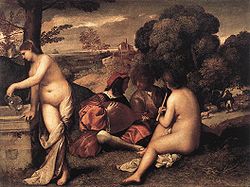 After that, things become more complicated, as exemplified by Vasari. In the first edition of the Vite (1550), he attributed a Christ Carrying the Cross to Giorgione; in the second edition completed in 1568 he ascribed authorship, variously, to Giorgione in his biography, which was printed in 1565, and to Titian in his, printed in 1567. He had visited Venice in between these dates, and may have obtained different information. The uncertainty in distinguishing between the painting of Giorgione and the young Titian is most apparent in the case of the Louvre
's Pastoral Concert, described in 2003 as "perhaps the most contentious problem of attribution in the whole of Italian Renaissance art", but affects a large number of paintings possibly from Giorgione's last years.
The Pastoral Concert is one of a small group of paintings, also including the Virgin and Child with Saint Anthony and Saint Roch in the Prado, which are very close in style and, according to Charles Hope, have been "more and more frequently given to Titian, not so much because of any very compelling resemblance to his undisputed early works - which would surely have been noted before - as because he seemed a less implausible candidate than Giorgione. But no one has been able to create a coherent sequence of Titian's early works that includes these ones, in a way that commands general support, and fits the known facts of his career. An alternative proposal is to assign the Pastoral Concert and the other pictures like it to a third artist, the very obscure Domenico Mancini..".
Giulio Campagnola
, well-known as the engraver who translated the Giorgionesque style into prints
, but none of whose paintings are securely identified, is also sometimes also brought into consideration. For example, the late W.R. Rearick gave him Il Tramonte (see Gallery) and he is an alternative choice for a number of drawings that might be by Titian or Giorgione, and both are sometimes credited with the design of some of his engravings.
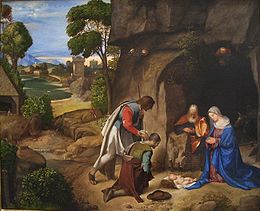 At an earlier period in Giorgione's short career, a group of paintings is sometimes described as the "Allendale group", after the Allendale Nativity (or Allendale Adoration of the Shepherds, rather more correctly) in the National Gallery of Art, Washington. This group includes another Washington painting, the Holy Family, and an Adoration of the Magi predella
panel in the National Gallery, London
. This group, now often expanded to include a very similar Adoration of the Shepherds in Vienna, and sometimes further, are usually included (increasingly) or excluded together from Giorgione's oeuvre. Ironically, the Allendale Nativity caused the rupture in the 1930s between Lord Duveen, who sold it to Andrew Mellon as a Giorgione, and his expert Bernard Berenson
, who insisted it was an early Titian. Berenson had played a significant part in reducing the Giorgione catalogue, recognising fewer than twenty paintings.
Matters are further complicated because no drawing can be certainly identified as by Giorgione (although one in Rotterdam is widely accepted), and a number of aspects of the arguments over the defining of Giorgione's late style involve drawings.
Despite being greatly praised by all contemporary writers, and remaining a great name in Italy, Giorgione became less known to the wider world, and many of his (probable) paintings were assigned to others. The Hermitage Judith for example, was long regarded as a Raphael
, and the Dresden Venus a Titian. In the late 19th century a great Giorgione revival began, and the fashion ran the other way. Despite well over a century of dispute, controversy remains active. Large numbers of pictures attributed to Giorgione a century ago, in particular portraits, are now firmly excluded from his oeuvre, but debate is, if anything, more fierce now than then. There are effectively two fronts on which the battles are fought: paintings with figures and landscape, and portraits. According to David Rosand in 1997, "The situation has been thrown into new critical confusion by Alessandro Ballarin's radical revision of the corpus ...[Paris exhibition catalogue, 1993, increasing it] ... as well as Mauro Lucco ..[Milan book, 1996]." Recent major exhibitions at Vienna and Venice in 2004 and Washington in 2006, have given art historians further opportunities to see disputed works side by side (see External links below).
.
Republic of Venice
The Republic of Venice or Venetian Republic was a state originating from the city of Venice in Northeastern Italy. It existed for over a millennium, from the late 7th century until 1797. It was formally known as the Most Serene Republic of Venice and is often referred to as La Serenissima, in...
painter of the High Renaissance
High Renaissance
The expression High Renaissance, in art history, is a periodizing convention used to denote the apogee of the visual arts in the Italian Renaissance...
in Venice
Venice
Venice is a city in northern Italy which is renowned for the beauty of its setting, its architecture and its artworks. It is the capital of the Veneto region...
, whose career was cut off by his death at a little over thirty. Giorgione is known for the elusive poetic quality of his work, though only about six surviving paintings are acknowledged for certain to be his work. The resulting uncertainty about the identity and meaning of his art has made Giorgione one of the most mysterious figures in European painting.
Together with Titian
Titian
Tiziano Vecelli or Tiziano Vecellio Tiziano Vecelli or Tiziano Vecellio Tiziano Vecelli or Tiziano Vecellio (c. 1488/1490 – 27 August 1576 better known as Titian was an Italian painter, the most important member of the 16th-century Venetian school. He was born in Pieve di Cadore, near...
, who was slightly younger, he is the founder of the distinctive Venetian school of Italian Renaissance painting
Italian Renaissance painting
Italian Renaissance painting is the painting of the period beginning in the late 13th century and flourishing from the early 15th to late 16th centuries, occurring within the area of present-day Italy, which was at that time divided into many political areas...
, which achieves much of its effect through colour and mood, and is traditionally contrasted with the reliance on a more linear disegno of Florentine painting
Florence
Florence is the capital city of the Italian region of Tuscany and of the province of Florence. It is the most populous city in Tuscany, with approximately 370,000 inhabitants, expanding to over 1.5 million in the metropolitan area....
.
Life
The little known of Giorgione's life is given in Giorgio VasariGiorgio Vasari
Giorgio Vasari was an Italian painter, writer, historian, and architect, who is famous today for his biographies of Italian artists, considered the ideological foundation of art-historical writing.-Biography:...
's Vite. The painter came from the small town of Castelfranco Veneto
Castelfranco Veneto
Castelfranco Veneto is a town and comune of Veneto, northern Italy, in the province of Treviso, 30 km by rail from the town of Treviso. It is approximately 40 km inland from Venice.-History:...
, 40 km inland from Venice. His name sometimes appears as Zorzo. The variant Giorgione (or Zorzon) may be translated "Big George". How early in boyhood he went to Venice we do not know, but stylistic evidence supports the statement of Carlo Ridolfi
Carlo Ridolfi
Carlo Ridolfi was an Italian art biographer and painter of the Baroque period.-Painter:He was born in Lonigo near Vicenza, and died in Venice. He was a pupil of the painter Antonio Vassilacchi . He painted a Visitation for the Ognissanti and an Adoration of the Magi for San Giovanni Elemosinario...
that he served his apprenticeship there under Giovanni Bellini
Giovanni Bellini
Giovanni Bellini was an Italian Renaissance painter, probably the best known of the Bellini family of Venetian painters. His father was Jacopo Bellini, his brother was Gentile Bellini, and his brother-in-law was Andrea Mantegna. He is considered to have revolutionized Venetian painting, moving it...
; there he settled and made his fame.
Contemporary documents record that his gifts were recognized early. In 1500, when he was only twenty-three (that is, if Vasari is correct about his age when he died), he was chosen to paint portraits of the Doge
Doge of Venice
The Doge of Venice , often mistranslated Duke was the chief magistrate and leader of the Most Serene Republic of Venice for over a thousand years. Doges of Venice were elected for life by the city-state's aristocracy. Commonly the person selected as Doge was the shrewdest elder in the city...
Agostino Barbarigo
Agostino Barbarigo
Agostino Barbarigo was Doge of Venice from 1486 until his death in 1501.While he was Doge, the imposing Clock Tower in the Piazza San Marco with its archway through which the street known as the Merceria leads to the Rialto, was designed and completed...
and the condottiere Consalvo Ferrante. In 1504 he was commissioned to paint an altarpiece in memory of another condottiere, Matteo Costanzo, in the cathedral of his native town, Castelfranco. In 1507 he received at the order of the Council of Ten
Council of Ten
The Council of Ten, or simply the Ten, was, from 1310 to 1797, one of the major governing bodies of the Republic of Venice whose actions were often secretive. Although some sources may indicate that the Council of Ten was generally accepted in Venice, there was some opposition...
part payment for a picture (subject not mentioned) on which he was engaged for the Hall of the Audience in the Doge's Palace. In 1507-1508 he was employed, with other artists of his generation, to decorate with frescoes the exterior of the newly rebuilt Fondaco dei Tedeschi
Fondaco dei Tedeschi
The Fondaco dei Tedeschi is a historic building in Venice, northern Italy, situated on the Grand Canal near the Rialto Bridge. It was the headquarters and restricted living quarters of the city's German merchants...
(or German Merchants' Hall) at Venice, having already done similar work on the exterior of the Casa Soranzo, the Casa Grimani alli Servi and other Venetian palaces. Very little of this work survives today.
Leonardo da Vinci
Leonardo di ser Piero da Vinci was an Italian Renaissance polymath: painter, sculptor, architect, musician, scientist, mathematician, engineer, inventor, anatomist, geologist, cartographer, botanist and writer whose genius, perhaps more than that of any other figure, epitomized the Renaissance...
on the occasion of the Tuscan master's visit to Venice in 1500. All accounts agree in representing Giorgione as a person of distinguished and romantic charm, a great lover and a musician, given to express in his art the sensuous and imaginative grace, touched with poetic melancholy, of the Venetian existence of his time. They represent him further as having made in Venetian painting an advance analogous to that made in Tuscan painting by Leonardo more than twenty years before; that is, as having released the art from the last shackles of archaic rigidity and placed it in possession of full freedom and the full mastery of its means.
He was very closely associated with Titian
Titian
Tiziano Vecelli or Tiziano Vecellio Tiziano Vecelli or Tiziano Vecellio Tiziano Vecelli or Tiziano Vecellio (c. 1488/1490 – 27 August 1576 better known as Titian was an Italian painter, the most important member of the 16th-century Venetian school. He was born in Pieve di Cadore, near...
; Vasari says Giorgione was Titian's master, while Ridolfi says they both were pupils of Bellini, and lived in his house. They worked together on the Fondaco dei Tedeschi frescoes, and Titian finished at least some paintings of Giorgione after his death, although which ones remains very controversial.
Giorgione also introduced a new range of subjects. Besides altarpiece
Altarpiece
An altarpiece is a picture or relief representing a religious subject and suspended in a frame behind the altar of a church. The altarpiece is often made up of two or more separate panels created using a technique known as panel painting. It is then called a diptych, triptych or polyptych for two,...
s and portraits he painted pictures that told no story, whether biblical or classical, or if they professed to tell a story, neglected the action and simply embodied in form and color moods of lyrical or romantic feeling, much as a musician might embody them in sounds. Innovating with the courage and felicity of genius, he had for a time an overwhelming influence on his contemporaries and immediate successors in the Venetian school, including Titian
Titian
Tiziano Vecelli or Tiziano Vecellio Tiziano Vecelli or Tiziano Vecellio Tiziano Vecelli or Tiziano Vecellio (c. 1488/1490 – 27 August 1576 better known as Titian was an Italian painter, the most important member of the 16th-century Venetian school. He was born in Pieve di Cadore, near...
, Sebastiano del Piombo
Sebastiano del Piombo
Sebastiano del Piombo , byname of Sebastiano Luciani, was an Italian Renaissance-Mannerist painter of the early 16th century famous for his combination of the colors of the Venetian school and the monumental forms of the Roman school.- Biography :Sebastiano del Piombo belongs to the painting school...
, Palma il Vecchio, il Cariani, Giulio Campagnola
Giulio Campagnola
Giulio Campagnola was an Italian engraver and painter, whose few, rare, prints translated the rich Venetian Renaissance style of oil paintings of Giorgione and the early Titian into the medium of engraving; to further his exercises in gradations of tone, he also invented the stipple technique...
(and his brother), and even on his already eminent master, Giovanni Bellini. In the Venetian mainland, Giorgionismo strongly influenced Morto da Feltre
Morto da Feltre
Morto da Feltre was an Italian painter of the Venetian school who worked at the close of the 15th century and beginning of the 16th.His real name appears to have been Pietro Luzzo, Pietro Luci or Lorenzo Luzzo; he is also known by the name Zarato or Zarotto, either from the place of his death or...
, Domenico Capriolo, and Domenico Mancini.
Giorgione died, probably of the plague
Bubonic plague
Plague is a deadly infectious disease that is caused by the enterobacteria Yersinia pestis, named after the French-Swiss bacteriologist Alexandre Yersin. Primarily carried by rodents and spread to humans via fleas, the disease is notorious throughout history, due to the unrivaled scale of death...
then raging, by October, 1510. October of 1510 is also the date of a letter by Isabella d'Este
Isabella d'Este
Isabella d'Este was Marchesa of Mantua and one of the leading women of the Italian Renaissance as a major cultural and political figure. She was a patron of the arts as well as a leader of fashion, whose innovative style of dressing was copied by women throughout Italy and at the French court...
to a Venetian friend; asking him to buy a painting by Giorgione; in the letter she is aware he is already dead. Significantly, the reply a month later said the painting was not to be had at any price.
His name and work continue to exercise a spell on posterity. But to identify and define, among the relics of his age and school, precisely what that work is, and to distinguish it from the similar work of other men whom his influence inspired, is a very difficult matter. Though there are no longer any supporters of the "Pan Giorgionismus" which a century ago claimed for Giorgione nearly every painting of the time that at all resembles his manner, there are still, as then, exclusive critics who reduce to half a dozen the list of extant pictures which they will admit to be actually by this master.
Works
Castelfranco Madonna
The Madonna and Child Between St. Francis and St. Nicasius, also known as Castelfranco Madonna, is a painting by the Italian Renaissance artist Giorgione executed around 1503...
, an altarpiece
Altarpiece
An altarpiece is a picture or relief representing a religious subject and suspended in a frame behind the altar of a church. The altarpiece is often made up of two or more separate panels created using a technique known as panel painting. It is then called a diptych, triptych or polyptych for two,...
in sacra conversazione
Sacra conversazione
In art, a sacra conversazione or sacred conversation is a depiction of the Virgin and Child amidst a group of saints in a relatively informal grouping, as opposed to the more rigid and hierarchical compositions of earlier periods...
form — Madonna
Madonna (art)
Images of the Madonna and the Madonna and Child or Virgin and Child are pictorial or sculptured representations of Mary, Mother of Jesus, either alone, or more frequently, with the infant Jesus. These images are central icons of Roman Catholicism and Eastern Orthodox Christianity where Mary remains...
enthroned, with saints on either side forming an equilateral triangle. This gave the landscape background an importance which marks an innovation in Venetian art, and was quickly followed by his master Giovanni Bellini
Giovanni Bellini
Giovanni Bellini was an Italian Renaissance painter, probably the best known of the Bellini family of Venetian painters. His father was Jacopo Bellini, his brother was Gentile Bellini, and his brother-in-law was Andrea Mantegna. He is considered to have revolutionized Venetian painting, moving it...
and others. Giorgione began to use the very refined chiaroscuro
Chiaroscuro
Chiaroscuro in art is "an Italian term which literally means 'light-dark'. In paintings the description refers to clear tonal contrasts which are often used to suggest the volume and modelling of the subjects depicted"....
called sfumato
Sfumato
Sfumato is one of the four canonical painting modes of the Renaissance .The most prominent practitioner of sfumato was Leonardo da Vinci, and his famous painting of the Mona Lisa exhibits the technique. Leonardo da Vinci described sfumato as "without lines or borders, in the manner of smoke or...
— the delicate use of shades of color to depict light and perspective — around the same time as Leonardo. Whether Vasari is correct in saying he learned it from Leonardo's works is unclear — he is always keen to ascribe all advances to Florentine sources. Leonardo's delicate color modulations result from the tiny disconnected spots of paint that he probably derived from Illuminated manuscript
Illuminated manuscript
An illuminated manuscript is a manuscript in which the text is supplemented by the addition of decoration, such as decorated initials, borders and miniature illustrations...
techniques and first brought into oil painting. These gave Giorgione's works the magical glow of light for which they are celebrated.
Most central and typical of all of Giorgione's extant works is the Sleeping Venus
Sleeping Venus (Giorgione)
The Sleeping Venus, also known as the Dresden Venus, is a painting by the Italian Renaissance master Giorgione, with, it is now generally accepted, the landscape and sky, by Titian, completed after Giorgione's death in 1510, as Vasari first noted...
now in Dresden
Dresden
Dresden is the capital city of the Free State of Saxony in Germany. It is situated in a valley on the River Elbe, near the Czech border. The Dresden conurbation is part of the Saxon Triangle metropolitan area....
. It was first recognized by Giovanni Morelli
Giovanni Morelli
Giovanni Morelli was an Italian art critic and political figure. As an art historian, he developed the "Morellian" technique of scholarship, identifying the characteristic "hands" of painters through scrutiny of diagnostic minor details that revealed artists' scarcely conscious shorthand and...
, and is now universally accepted, as being the same as the picture seen by Marcantonio Michiel
Marcantonio Michiel
Marcantonio Michiel was a Venetian noble from a family prominent in the service of the State who was interested himself in matters of art...
and later by Ridolfi (his 17th century biographer) in the Casa Marcello at Venice. An exquisitely pure and severe rhythm of line and contour chastens the sensuous richness of the painting. The sweep of white drapery on which the goddess lies; and the glowing landscape that fills the space behind her; most harmoniously frame her divinity. The use of an external landscape to frame a nude is innovative; but in addition, to add to her mystery, she is shrouded in sleep, spirited away from accessibility to any conscious expression.
It is recorded by Michiel that Giorgione left this piece unfinished and that the landscape, with a Cupid
Cupid
In Roman mythology, Cupid is the god of desire, affection and erotic love. He is the son of the goddess Venus and the god Mars. His Greek counterpart is Eros...
which subsequent restoration has removed, were completed after his death by Titian. The picture is the prototype of Titian's own Venus of Urbino
Venus of Urbino
The Venus of Urbino is a 1538 oil painting by the Italian master Titian. It depicts a nude young woman, identified with the goddess Venus, reclining on a couch or bed in the sumptuous surroundings of a Renaissance palace. It hangs in the Galleria degli Uffizi in Florence. The figure's pose is based...
and of many more by other painters of the school; but none of them attained the fame of the first exemplar. The same concept of idealized beauty is evoked in a virginally pensive Judith
Judith (Giorgione)
Judith is a painting by the Italian painter Giorgione. It is one of the few authentic works by Giorgione owned by the Russian Hermitage Museum. The painting, originally attributed to Raphael, came to the Hermitage in 1772 from Paris...
from the Hermitage Museum
Hermitage Museum
The State Hermitage is a museum of art and culture in Saint Petersburg, Russia. One of the largest and oldest museums of the world, it was founded in 1764 by Catherine the Great and has been opened to the public since 1852. Its collections, of which only a small part is on permanent display,...
, a large painting which exhibits Giorgione's special qualities of color richness and landscape romance, while demonstrating that life and death are each other's companions rather than foes.
Apart from the altarpiece and the frescoes, all Giorgione's surviving works are small paintings designed for the wealthy Venetian collector to keep in his home; most are under two feet (60 cm) in either dimension. This market had been emerging over the last half of the 15th century in Italy, and was much better established in the Netherlands
Netherlands
The Netherlands is a constituent country of the Kingdom of the Netherlands, located mainly in North-West Europe and with several islands in the Caribbean. Mainland Netherlands borders the North Sea to the north and west, Belgium to the south, and Germany to the east, and shares maritime borders...
, but Giorgione was the first major Italian painter to concentrate his work on it to such an extent — indeed soon after his death the size of paintings began to increase with the prosperity and palaces of the patrons.
Landscape
Landscape comprises the visible features of an area of land, including the physical elements of landforms such as mountains, hills, water bodies such as rivers, lakes, ponds and the sea, living elements of land cover including indigenous vegetation, human elements including different forms of...
in the history of Western painting
Western painting
The history of Western painting represents a continuous, though disrupted, tradition from antiquity. Until the mid-19th century it was primarily concerned with representational and Classical modes of production, after which time more modern, abstract and conceptual forms gained favor.Developments...
. The subject of this painting is unclear, but its artistic mastery is apparent. The Tempest portrays a soldier and a breast-feeding woman on either side of a stream, amid a city's rubble and an incoming storm. The multitude of symbols in The Tempest offer many interpretations, but none is wholly satisfying. Theories that the painting is about duality (city and country, male and female) have been dismissed since radiography
Radiography
Radiography is the use of X-rays to view a non-uniformly composed material such as the human body. By using the physical properties of the ray an image can be developed which displays areas of different density and composition....
has shown that in the earlier stages of the painting the soldier to the left was a seated female nude.
The Three Philosophers
The Three Philosophers
The Three Philosophers is an oil painting on canvas attributed to the Italian High Renaissance artist Giorgione. The work was commissioned by the Venetian noble Taddeo Contarini, a Venetian merchant with an interest for occult and alchemy....
is equally enigmatic and its attribution to Giorgione is still disputed. The three figures stand near a dark empty cave. Sometimes interpreted as symbols of Plato's cave or the Three Magi
Biblical Magi
The Magi Greek: μάγοι, magoi), also referred to as the Wise Men, Kings, Astrologers, or Kings from the East, were a group of distinguished foreigners who were said to have visited Jesus after his birth, bearing gifts of gold, frankincense and myrrh...
, they seem lost in a typical Giorgionesque dreamy mood, reinforced by a hazy light characteristic of his other landscapes, such as the Pastoral Concert, now in the Louvre

Louvre
The Musée du Louvre – in English, the Louvre Museum or simply the Louvre – is one of the world's largest museums, the most visited art museum in the world and a historic monument. A central landmark of Paris, it is located on the Right Bank of the Seine in the 1st arrondissement...
. The latter "reveals the Venetians' love of textures", because the painter "renders almost palpable the appearance of flesh, fabric, wood, stone, and foliage". The painting is devoid of harsh contours and its treatment of landscape has been frequently compared to pastoral poetry, hence the title.
Giorgione and the young Titian
Titian
Tiziano Vecelli or Tiziano Vecellio Tiziano Vecelli or Tiziano Vecellio Tiziano Vecelli or Tiziano Vecellio (c. 1488/1490 – 27 August 1576 better known as Titian was an Italian painter, the most important member of the 16th-century Venetian school. He was born in Pieve di Cadore, near...
revolutionized the genre of the portrait
Portrait
thumb|250px|right|Portrait of [[Thomas Jefferson]] by [[Rembrandt Peale]], 1805. [[New-York Historical Society]].A portrait is a painting, photograph, sculpture, or other artistic representation of a person, in which the face and its expression is predominant. The intent is to display the likeness,...
as well. It is exceedingly difficult and sometimes simply impossible to differentiate Titian's early works from those of Giorgione. None of Giorgione's paintings are signed and only one bears a reliable date: his portrait of Laura (1 June 1506), one of the first to be painted in the "modern manner", distinguished by dignity, clarity, and sophisticated characterization. Even more striking is the Portrait of a Young Man now in Berlin
Berlin
Berlin is the capital city of Germany and is one of the 16 states of Germany. With a population of 3.45 million people, Berlin is Germany's largest city. It is the second most populous city proper and the seventh most populous urban area in the European Union...
, acclaimed by art historians for "the indescribably subtle expression of serenity and the immobile features, added to the chiseled effect of the silhouette and modeling".
Few of the portraits attributed to Giorgione appear as straightforward records of the appearance of a commissioning individual, although it is entirely possible that many are. Many can be read as types designed to express a mood or atmosphere, and certainly many of the examples of the portrait tradition Giorgione initiated appear to have had this purpose, and not to have been sold to the sitter. The subjects of his non-religious figure paintings are equally hard to discern. Perhaps the first question to ask is whether there was intended to be a specific meaning to these paintings that ingenious research can hope to recover. Many art historians argue that there is not: "The best evidence, perhaps, that Giorgione's pictures were not particularly esoteric in their meaning is provided by the fact that while his stylistic innovations were widely adopted, the distinguishing feature of virtually all Venetian non-religious painting in the first half of the 16th century is the lack of learned or literary content".
Attributions
Primary documentation for attributions comes from the Venetian collector Marcantonio Michiel. In notes dating from 1525 to 1543 he identifies twelve paintings and one drawing as by Giorgione, of which five of the paintings are identified virtually unanimously with surviving works by art historians: The Tempest, The Three Philosophers, Sleeping Venus, Boy with an Arrow, and Shepherd with a Flute
Shepherd with a Flute
Shepherd with a flute is a painting produced around 1508 by Giorgione, now in the Royal Collection and shown at Hampton Court Palace.- History :...
(not all accept the last as by Giorgione however). Michiel describes the Philosophers as having been completed by Sebastiano del Piombo, and the Venus as finished by Titian (it is now generally agreed that Titian did the landscape). Some recent art historians also involve Titian in the Three Philosophers. The Tempest is therefore the only one of the group universally accepted as wholly by Giorgione. In addition, the Castelfranco Altarpiece in his home-town has rarely, if ever, been doubted, nor have the wrecked fresco fragments from the German warehouse. The Vienna Laura is the only work signed and dated by Giorgione (on the back). The early pair of paintings in the Uffizi
Uffizi
The Uffizi Gallery , is a museum in Florence, Italy. It is one of the oldest and most famous art museums of the Western world.-History:...
are usually accepted.
Louvre
The Musée du Louvre – in English, the Louvre Museum or simply the Louvre – is one of the world's largest museums, the most visited art museum in the world and a historic monument. A central landmark of Paris, it is located on the Right Bank of the Seine in the 1st arrondissement...
's Pastoral Concert, described in 2003 as "perhaps the most contentious problem of attribution in the whole of Italian Renaissance art", but affects a large number of paintings possibly from Giorgione's last years.
The Pastoral Concert is one of a small group of paintings, also including the Virgin and Child with Saint Anthony and Saint Roch in the Prado, which are very close in style and, according to Charles Hope, have been "more and more frequently given to Titian, not so much because of any very compelling resemblance to his undisputed early works - which would surely have been noted before - as because he seemed a less implausible candidate than Giorgione. But no one has been able to create a coherent sequence of Titian's early works that includes these ones, in a way that commands general support, and fits the known facts of his career. An alternative proposal is to assign the Pastoral Concert and the other pictures like it to a third artist, the very obscure Domenico Mancini..".
Giulio Campagnola
Giulio Campagnola
Giulio Campagnola was an Italian engraver and painter, whose few, rare, prints translated the rich Venetian Renaissance style of oil paintings of Giorgione and the early Titian into the medium of engraving; to further his exercises in gradations of tone, he also invented the stipple technique...
, well-known as the engraver who translated the Giorgionesque style into prints
Old master print
An old master print is a work of art produced by a printing process within the Western tradition . A date of about 1830 is usually taken as marking the end of the period whose prints are covered by this term. The main techniques concerned are woodcut, engraving and etching, although there are...
, but none of whose paintings are securely identified, is also sometimes also brought into consideration. For example, the late W.R. Rearick gave him Il Tramonte (see Gallery) and he is an alternative choice for a number of drawings that might be by Titian or Giorgione, and both are sometimes credited with the design of some of his engravings.
Predella
A predella is the platform or step on which an altar stands . In painting, the predella is the painting or sculpture along the frame at the bottom of an altarpiece...
panel in the National Gallery, London
National Gallery, London
The National Gallery is an art museum on Trafalgar Square, London, United Kingdom. Founded in 1824, it houses a collection of over 2,300 paintings dating from the mid-13th century to 1900. The gallery is an exempt charity, and a non-departmental public body of the Department for Culture, Media...
. This group, now often expanded to include a very similar Adoration of the Shepherds in Vienna, and sometimes further, are usually included (increasingly) or excluded together from Giorgione's oeuvre. Ironically, the Allendale Nativity caused the rupture in the 1930s between Lord Duveen, who sold it to Andrew Mellon as a Giorgione, and his expert Bernard Berenson
Bernard Berenson
Bernard Berenson was an American art historian specializing in the Renaissance. He was a major figure in pioneering art attribution and therefore establishing the market for paintings by the "Old Masters".-Personal life:...
, who insisted it was an early Titian. Berenson had played a significant part in reducing the Giorgione catalogue, recognising fewer than twenty paintings.
Matters are further complicated because no drawing can be certainly identified as by Giorgione (although one in Rotterdam is widely accepted), and a number of aspects of the arguments over the defining of Giorgione's late style involve drawings.
Despite being greatly praised by all contemporary writers, and remaining a great name in Italy, Giorgione became less known to the wider world, and many of his (probable) paintings were assigned to others. The Hermitage Judith for example, was long regarded as a Raphael
Raphael
Raffaello Sanzio da Urbino , better known simply as Raphael, was an Italian painter and architect of the High Renaissance. His work is admired for its clarity of form and ease of composition and for its visual achievement of the Neoplatonic ideal of human grandeur...
, and the Dresden Venus a Titian. In the late 19th century a great Giorgione revival began, and the fashion ran the other way. Despite well over a century of dispute, controversy remains active. Large numbers of pictures attributed to Giorgione a century ago, in particular portraits, are now firmly excluded from his oeuvre, but debate is, if anything, more fierce now than then. There are effectively two fronts on which the battles are fought: paintings with figures and landscape, and portraits. According to David Rosand in 1997, "The situation has been thrown into new critical confusion by Alessandro Ballarin's radical revision of the corpus ...[Paris exhibition catalogue, 1993, increasing it] ... as well as Mauro Lucco ..[Milan book, 1996]." Recent major exhibitions at Vienna and Venice in 2004 and Washington in 2006, have given art historians further opportunities to see disputed works side by side (see External links below).
Legacy
Though he died at 33, Giorgione left a lasting legacy to be developed by Titian and 17th-century artists. Giorgione never subordinated line and colour to architecture, nor an artistic effect to a sentimental presentation. He was the first to paint landscapes with figures, the first to paint genre — movable pictures in their own frames with no devotional, allegorical, or historical purpose — and the first whose colours possessed that ardent, glowing, and melting intensity which was so soon to typify the work of all the Venetian SchoolVenetian School
In music history, the Venetian School is a term used to describe the composers working in Venice from about 1550 to around 1610; it also describes the music they produced. The Venetian polychoral compositions of the late 16th century were among the most famous musical events in Europe, and their...
.
Selected works
- The Test of Fire of MosesThe Test of Fire of Moses (Giorgione)The Test of Fire of Moses is a painting by the Italian Renaissance master Giorgione . It is housed in the Galleria degli Uffizi of Florence....
(1500–1501) - Oil on panel, 89 x 72, UffiziUffiziThe Uffizi Gallery , is a museum in Florence, Italy. It is one of the oldest and most famous art museums of the Western world.-History:...
, FlorenceFlorenceFlorence is the capital city of the Italian region of Tuscany and of the province of Florence. It is the most populous city in Tuscany, with approximately 370,000 inhabitants, expanding to over 1.5 million in the metropolitan area.... - The Judgement of SalomonThe Judgement of Salomon (Giorgione)The Judgment of Salomon is a painting by the Italian Renaissance master Giorgione . It is housed in the Galleria degli Uffizi of Florence....
(1500–1501) - Oil on panel, 89 x 72 cm, Uffizi, Florence - Judith (c. 1504) - Oil on canvas, transferred from panel, 144 x 66,5 cm, Hermitage MuseumHermitage MuseumThe State Hermitage is a museum of art and culture in Saint Petersburg, Russia. One of the largest and oldest museums of the world, it was founded in 1764 by Catherine the Great and has been opened to the public since 1852. Its collections, of which only a small part is on permanent display,...
, St. Petersburg - Adoration of the ShepherdsAdoration of the Shepherds (Giorgione)The Adoration of the Shepherds , sometimes still known as the Allendale Nativity or "Adoration", after a former owner, is a painting by the Italian painter of the Renaissance, Giorgione, in about 1500. The attribution is now usual, although not universal; the usual other view is that it is an early...
(1504) - Oil on panel, 90.8 x 110.5 cm, National Gallery of ArtNational Gallery of ArtThe National Gallery of Art and its Sculpture Garden is a national art museum, located on the National Mall between 3rd and 9th Streets at Constitution Avenue NW, in Washington, DC...
, WashingtonWashington, D.C.Washington, D.C., formally the District of Columbia and commonly referred to as Washington, "the District", or simply D.C., is the capital of the United States. On July 16, 1790, the United States Congress approved the creation of a permanent national capital as permitted by the U.S. Constitution.... - Madonna and Child Enthroned between St. Francis and St. NicasiusCastelfranco MadonnaThe Madonna and Child Between St. Francis and St. Nicasius, also known as Castelfranco Madonna, is a painting by the Italian Renaissance artist Giorgione executed around 1503...
(Castelfranco Madonna; c. 1505) - Oil on wood, 200 x 152 cm, Duomo, Castelfranco VenetoCastelfranco VenetoCastelfranco Veneto is a town and comune of Veneto, northern Italy, in the province of Treviso, 30 km by rail from the town of Treviso. It is approximately 40 km inland from Venice.-History:... - The TempestThe Tempest (painting)The Tempest is a famous Renaissance painting by Italian master Giorgione dated between 1506 and 1508. Originally commissioned by the Venetian noble Gabriele Vendramin, the painting is housed in the Gallerie dell'Accademia of Venice, Italy.-Overview:On the right a woman sits, suckling a baby. She...
(c. 1505) - Oil on canvas, 82 x 73 cm, AccademiaAccademiaThe Accademia is a museum gallery of pre-19th century art in Venice, northern Italy. Situated on the south bank of the Grand Canal, within the sestiere of Dorsoduro, it gives its name to one of the three bridges across the canal, the Ponte dell'Accademia, and to the boat landing station for the...
, Venice - Portrait of a Young Bride (Laura)Laura (Giorgione)Laura, formerly sometimes known as Portrait of a Young Bride is a painting by the Italian Renaissance master Giorgione, c. 1506. It is in the Kunsthistorisches Museum of Vienna, Austria.Like Giorgione's other works, it is unsigned...
(c. 1506) Oil on wood, 41 x 33,5 cm, Kunsthistorisches MuseumKunsthistorisches MuseumThe Kunsthistorisches Museum is an art museum in Vienna, Austria. Housed in its festive palatial building on Ringstraße, it is crowned with an octagonal dome...
, ViennaViennaVienna is the capital and largest city of the Republic of Austria and one of the nine states of Austria. Vienna is Austria's primary city, with a population of about 1.723 million , and is by far the largest city in Austria, as well as its cultural, economic, and political centre... - La Vecchia (Old Woman) (c. 1508) - Oil on canvas, 68 x 59 cm, AccademiaAccademiaThe Accademia is a museum gallery of pre-19th century art in Venice, northern Italy. Situated on the south bank of the Grand Canal, within the sestiere of Dorsoduro, it gives its name to one of the three bridges across the canal, the Ponte dell'Accademia, and to the boat landing station for the...
, Venice - Pastoral Concert (c. 1508) widely now given to Titian- Oil on canvas, 110 x 138 cm, LouvreLouvreThe Musée du Louvre – in English, the Louvre Museum or simply the Louvre – is one of the world's largest museums, the most visited art museum in the world and a historic monument. A central landmark of Paris, it is located on the Right Bank of the Seine in the 1st arrondissement...
, Paris - Portrait of a Youth (1508–10) - Oil on canvas, 72,5 x 54 cm, Museum of Fine Arts, BudapestMuseum of Fine Arts (Budapest)The Museum of Fine Arts is a museum in Heroes' Square, Budapest, Hungary, facing the Palace of Art.It was built by the plans of Albert Schickedanz and Fülöp Herzog in an eclectic-neoclassical style, between 1900 and 1906. The museum's collection is made up of international art , including all...
- The Three PhilosophersThe Three PhilosophersThe Three Philosophers is an oil painting on canvas attributed to the Italian High Renaissance artist Giorgione. The work was commissioned by the Venetian noble Taddeo Contarini, a Venetian merchant with an interest for occult and alchemy....
(1509) - Oil on canvas, Kunsthistorisches MuseumKunsthistorisches MuseumThe Kunsthistorisches Museum is an art museum in Vienna, Austria. Housed in its festive palatial building on Ringstraße, it is crowned with an octagonal dome...
, Vienna - Portrait of Warrior with his Equerry (c. 1509) - Oil on canvas, 90 x 73 cm, Galleria degli Uffizi, Florence
- Sleeping VenusSleeping Venus (Giorgione)The Sleeping Venus, also known as the Dresden Venus, is a painting by the Italian Renaissance master Giorgione, with, it is now generally accepted, the landscape and sky, by Titian, completed after Giorgione's death in 1510, as Vasari first noted...
(c. 1510) - Oil on canvas, 108,5 x 175 cm, Gemäldegalerie, Dresden - The Impassioned Singer (c. 1510) - Oil on canvas, 102 x 78 cm, Galleria BorgheseGalleria BorgheseThe Borghese Gallery is an art gallery in Rome, Italy, housed in the former Villa Borghese Pinciana. It is a building that was from the first integral with its gardens, nowadays considered quite separately by tourists as the Villa Borghese gardens...
, Rome - Portrait of a Young Man - Wood, 69,4 x 53,5 cm, Alte Pinakothek, Munich


Further reading
- The Complete Paintings of Giorgione. Introduction by Cecil Gould. Notes by Pietro Zampetti. NY: Harry N. Abrams. 1968.
- Giorgione. Atti del Convegno internazionale di studio per il quinto centenario della nascita (Castelfranco Veneto 1978), Castelfranco Veneto, 1979.
- Silvia Ferino-Pagden, Giorgione. Mythos und Enigma, Ausst. Kat. Kunsthistorisches Museum Wien, Wien, 2004.
- Sylvia Ferino-Pagden (Hg.), Giorgione entmythisiert, Turnhout, Brepols, 2008.
- Unglaub, Jonathan. "The Concert Champêtre: The Crises of History and the Limits of the Pastoral." Arion V no.1 (1997): 46-96.
External links
- David Allen Brown Introduction to 2006 Washington exhibition
- Giorgione,Myth and Enigma, 2004 exhibition at the Kunsthistorisches Museum, Vienna. Good images and text on "Selected paintings"
- Colnaghi - an important Giorgionesque drawing, with list of the main literature on his drawings
- Giorgione featured on 10 Euro Coin