
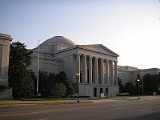
The
National Gallery of Art and its Sculpture Garden is a national art museum, located on the
National MallThe National Mall is an open-area national park in downtown Washington, D.C., the capital of the United States. The National Mall is a unit of the National Park Service , and is administered by the National Mall and Memorial Parks unit...
between 3rd and 9th Streets at Constitution Avenue NW, in Washington, DC. Open to the public, free of charge, the museum was established in 1937 for the people of the United States of America by a joint resolution of the
United States CongressThe United States Congress is the bicameral legislature of the federal government of the United States, consisting of the Senate and the House of Representatives. The Congress meets in the United States Capitol in Washington, D.C....
, with funds for construction and a substantial art collection donated by
Andrew W. MellonAndrew William Mellon was an American banker, industrialist, philanthropist, art collector and Secretary of the Treasury from March 4, 1921 until February 12, 1932.-Early life:...
. Additionally, the core collection has major works of art donated by
Paul MellonPaul Mellon KBE was an American philanthropist, thoroughbred racehorse owner/breeder. He is one of only five people ever designated an "Exemplar of Racing" by the National Museum of Racing and Hall of Fame...
, Ailsa Mellon Bruce,
Lessing J. RosenwaldLessing Julius Rosenwald was an American businessman, a collector of rare books and art, and a chess patron.-Biography:...
, Samuel Henry Kress, Rush Harrison Kress,
Peter Arrell Brown WidenerPeter Arrell Brown Widener was an American businessman and head of the prominent Widener family of Philadelphia, Pennsylvania.-Biography:...
,
Joseph E. WidenerJoseph Early Widener was a wealthy American art collector who was a founding benefactor of the National Gallery of Art in Washington, D.C...
and
Chester DaleChester Dale was an American banker and patron of the arts. Dale earned large sums from working for the New York Stock Exchange, allowing him to collect a group of 19th and 20th-century French paintings. Although he considered establishing a private museum, he donated a part of his collection to...
. The Gallery's collection of paintings, drawings, prints, photographs, sculpture, medals, and decorative arts traces the development of Western Art from the Middle Ages to the present, including the only painting by
Leonardo da VinciLeonardo di ser Piero da Vinci was an Italian Renaissance polymath: painter, sculptor, architect, musician, scientist, mathematician, engineer, inventor, anatomist, geologist, cartographer, botanist and writer whose genius, perhaps more than that of any other figure, epitomized the Renaissance...
in the Americas and the largest mobile ever created by
Alexander CalderAlexander Calder was an American sculptor and artist most famous for inventing mobile sculptures. In addition to mobile and stable sculpture, Alexander Calder also created paintings, lithographs, toys, tapestry, jewelry and household objects.-Childhood:Alexander "Sandy" Calder was born in Lawnton,...
.
The Gallery's campus includes the original neoclassical West Building designed by
John Russell PopeJohn Russell Pope was an architect most known for his designs of the National Archives and Records Administration building , the Jefferson Memorial and the West Building of the National Gallery of Art in Washington, DC.-Biography:Pope was born in New York in 1874, the son of a successful...
, which is linked underground to the modern East Building designed by
I. M. PeiIeoh Ming Pei , commonly known as I. M. Pei, is a Chinese American architect, often called a master of modern architecture. Born in Canton, China and raised in Hong Kong and Shanghai, Pei drew inspiration at an early age from the gardens at Suzhou...
, and the 6.1 acres (24,685.8 m²) Sculpture Garden. Temporary special exhibitions spanning the world and the history of art are presented frequently.
History
Financier
Andrew W. MellonAndrew William Mellon was an American banker, industrialist, philanthropist, art collector and Secretary of the Treasury from March 4, 1921 until February 12, 1932.-Early life:...
began gathering a private collection of
old master"Old Master" is a term for a European painter of skill who worked before about 1800, or a painting by such an artist. An "old master print" is an original print made by an artist in the same period...
paintings and sculptures during the First World War, but in the late 1920s he decided to direct his collecting efforts, secretly, towards the establishment of a new national gallery for the United States. This intent was confirmed in 1930 by the formation of the A. W. Mellon Educational and Charitable Trust, which was to be the legal owner of works intended for the gallery. In 1930-1931, the Trust made its first major acquisition, 21 paintings from the
Hermitage MuseumThe State Hermitage is a museum of art and culture in Saint Petersburg, Russia. One of the largest and oldest museums of the world, it was founded in 1764 by Catherine the Great and has been opened to the public since 1852. Its collections, of which only a small part is on permanent display,...
in St. Petersburg, including such masterpieces as
RaphaelRaffaello Sanzio da Urbino , better known simply as Raphael, was an Italian painter and architect of the High Renaissance. His work is admired for its clarity of form and ease of composition and for its visual achievement of the Neoplatonic ideal of human grandeur...
's
Alba Madonna and
Jan van EyckJan van Eyck was a Flemish painter active in Bruges and considered one of the best Northern European painters of the 15th century....
's
The Annunciation. In 1929 Mellon had initiated contact with the recently-appointed Secretary of the
Smithsonian InstitutionThe Smithsonian Institution is an educational and research institute and associated museum complex, administered and funded by the government of the United States and by funds from its endowment, contributions, and profits from its retail operations, concessions, licensing activities, and magazines...
,
Charles Greeley AbbotCharles Greeley Abbot was an American astrophysicist, astronomer and Secretary of the Smithsonian Institution. He was born in Wilton, New Hampshire.-Life:...
, and in 1931 he was appointed a Commissioner of the Institution's National Gallery of Art. When the director of the Gallery retired, Mellon requested Abbot not to appoint a successor, because he proposed to endow a new building, with funds for expansion of the collections, which would, in effect, be a rebirth of the Gallery. However, his trial for tax evasion, centering on the Trust and the Hermitage paintings, caused the plan to be modified, and in 1935 he announced, in the
Washington StarThe Washington Star, previously known as the Washington Star-News and the Washington Evening Star, was a daily afternoon newspaper published in Washington, D.C. between 1852 and 1981. For most of that time, it was the city's newspaper of record, and the longtime home to columnist Mary McGrory and...
, his intention to establish a new gallery for old masters, separate from the Smithsonian. When quizzed by Abbot, he explained that the project was now entirely in the hands of the Trust- also that their decisions were partly dependent on "the attitude of the Government towards the gift". Eventually, in January 1937, Mellon formally offered to create the new Gallery, and on his birthday, 24 March 1937, an Act of Congress accepted the collection and building funds (provided through the Trust), and approved the construction of a museum on the National Mall. The new gallery was to be effectively self-governing, not controlled by the Smithsonian, but took the old name "National Gallery of Art" while the Smithsonian's gallery would be renamed the "National Collection of Fine Art" (now the
Smithsonian American Art MuseumThe Smithsonian American Art Museum is a museum in Washington, D.C. with an extensive collection of American art.Part of the Smithsonian Institution, the museum has a broad variety of American art that covers all regions and art movements found in the United States...
).
Designed by architect
John Russell PopeJohn Russell Pope was an architect most known for his designs of the National Archives and Records Administration building , the Jefferson Memorial and the West Building of the National Gallery of Art in Washington, DC.-Biography:Pope was born in New York in 1874, the son of a successful...
(who would go on to design the
Jefferson MemorialThe Thomas Jefferson Memorial is a presidential memorial in Washington, D.C. that is dedicated to Thomas Jefferson, an American Founding Father and the third President of the United States....
), the new structure was completed and accepted by President
Franklin D. RooseveltFranklin Delano Roosevelt , also known by his initials, FDR, was the 32nd President of the United States and a central figure in world events during the mid-20th century, leading the United States during a time of worldwide economic crisis and world war...
on behalf of the American people on March 17, 1941. Neither Mellon nor Pope lived to see the museum completed; both died in late August 1937, only two months after excavation had begun. At the time of its inception it was the largest marble structure in the world. The museum stands on the former site of the Sixth Street railway station, most famous for being where 20th president
James GarfieldJames Abram Garfield served as the 20th President of the United States, after completing nine consecutive terms in the U.S. House of Representatives. Garfield's accomplishments as President included a controversial resurgence of Presidential authority above Senatorial courtesy in executive...
was
shot in 1881James A. Garfield was shot in Washington, D.C. on July 2, 1881 by Charles J. Guiteau at 9:30 a.m., less than four months after taking office as the twentieth President of the United States. Garfield died eleven weeks later on September 19, 1881, the second of four Presidents to be assassinated,...
by a disgruntled office seeker.
As anticipated by Mellon, the creation of the National Gallery encouraged the donation of other substantial art collections by a number of private donors. Founding benefactors included such individuals as
Paul MellonPaul Mellon KBE was an American philanthropist, thoroughbred racehorse owner/breeder. He is one of only five people ever designated an "Exemplar of Racing" by the National Museum of Racing and Hall of Fame...
,
Samuel H. KressSamuel Henry Kress was a businessman and philanthropist, founder of the S. H. Kress & Co. five and ten cent store chain. With his fortune, Kress amassed one of the most significant collections of Italian Renaissance and European artwork assembled in the 20th century...
, Rush H. Kress, Ailsa Mellon Bruce,
Chester DaleChester Dale was an American banker and patron of the arts. Dale earned large sums from working for the New York Stock Exchange, allowing him to collect a group of 19th and 20th-century French paintings. Although he considered establishing a private museum, he donated a part of his collection to...
, Joseph Widener,
Lessing J. RosenwaldLessing Julius Rosenwald was an American businessman, a collector of rare books and art, and a chess patron.-Biography:...
and
Edgar William and Bernice Chrysler GarbischEdgar William Garbisch was an American football player. He was elected to the College Football Hall of Fame in 1954. He married Bernice Chrysler, daughter of Walter P. Chrysler, on January 4, 1930. He and his wife collected American art, much of which they donated to the Metropolitan Museum of Art...
.
The Gallery's East Building was constructed in the 1970s on much of the remaining land left over from the original congressional joint resolution. It was funded by Mellon's children
Paul MellonPaul Mellon KBE was an American philanthropist, thoroughbred racehorse owner/breeder. He is one of only five people ever designated an "Exemplar of Racing" by the National Museum of Racing and Hall of Fame...
and Ailsa Mellon Bruce. Designed by famed architect I.M. Pei, the contemporary structure was completed in 1978, and was opened on June 1 of that year by President
Jimmy CarterJames Earl "Jimmy" Carter, Jr. is an American politician who served as the 39th President of the United States and was the recipient of the 2002 Nobel Peace Prize, the only U.S. President to have received the Prize after leaving office...
. The new building was built to house the Museum's collection of modern paintings, drawings, sculptures, and prints, as well as study and research centers and offices. The design received a National Honor Award from the American Institute of Architects in 1981.
The final addition to the complex is the
National Gallery of Art Sculpture GardenThe National Gallery of Art Sculpture Garden is the most recent addition to the National Gallery of Art in Washington, DC. Completed and opened to the public on May 23, 1999, the location provides an outdoor setting for exhibiting a number of pieces from the Museum's contemporary sculpture...
. Completed and opened to the public on May 23, 1999, the location provides an outdoor setting for exhibiting a number of pieces from the Museum's contemporary sculpture collection.
Buildings
Two buildings comprise the museum: the West Building (1941) and the East Building (1978) linked by a spacious underground passage. The West Building, composed of
pink Tennessee marbleTennessee marble is a type of crystalline limestone found primarily in East Tennessee, in the southeastern United States. Long esteemed by architects and builders for its pinkish-gray color and the ease with which it is polished, this stone has been used in the construction of numerous notable...
, was designed in 1937 by architect
John Russell PopeJohn Russell Pope was an architect most known for his designs of the National Archives and Records Administration building , the Jefferson Memorial and the West Building of the National Gallery of Art in Washington, DC.-Biography:Pope was born in New York in 1874, the son of a successful...
in a
neoclassicalNeoclassical architecture was an architectural style produced by the neoclassical movement that began in the mid-18th century, manifested both in its details as a reaction against the Rococo style of naturalistic ornament, and in its architectural formulas as an outgrowth of some classicizing...
style (as is Pope's other notable Washington, D.C. building, the
Jefferson MemorialThe Thomas Jefferson Memorial is a presidential memorial in Washington, D.C. that is dedicated to Thomas Jefferson, an American Founding Father and the third President of the United States....
). Designed in the form of an elongated H, the building is centered on a domed rotunda modeled on the interior of the
PantheonThe Pantheon ,Rarely Pantheum. This appears in Pliny's Natural History in describing this edifice: Agrippae Pantheum decoravit Diogenes Atheniensis; in columnis templi eius Caryatides probantur inter pauca operum, sicut in fastigio posita signa, sed propter altitudinem loci minus celebrata.from ,...
in Rome. Extending east and west from the rotunda, a pair of high, skylit sculpture halls provide its main circulation spine. Bright garden courts provide a counterpoint to the long main axis of the building.
The West Building has an extensive collection of paintings and sculptures by European masters from the
medieval periodThe medieval art of the Western world covers a vast scope of time and place, over 1000 years of art history in Europe, and at times the Middle East and North Africa...
through the late 19th century, as well as pre-20th century works by American artists. Highlights of the collection include many paintings by Jan Vermeer, Rembrandt van Rijn,
Claude MonetClaude Monet was a founder of French impressionist painting, and the most consistent and prolific practitioner of the movement's philosophy of expressing one's perceptions before nature, especially as applied to plein-air landscape painting. . Retrieved 6 January 2007...
,
Vincent van GoghVincent Willem van Gogh , and used Brabant dialect in his writing; it is therefore likely that he himself pronounced his name with a Brabant accent: , with a voiced V and palatalized G and gh. In France, where much of his work was produced, it is...
, and
Leonardo da VinciLeonardo di ser Piero da Vinci was an Italian Renaissance polymath: painter, sculptor, architect, musician, scientist, mathematician, engineer, inventor, anatomist, geologist, cartographer, botanist and writer whose genius, perhaps more than that of any other figure, epitomized the Renaissance...
.
In contrast, the design of the East Building by architect
I. M. PeiIeoh Ming Pei , commonly known as I. M. Pei, is a Chinese American architect, often called a master of modern architecture. Born in Canton, China and raised in Hong Kong and Shanghai, Pei drew inspiration at an early age from the gardens at Suzhou...
is rigorously geometrical, dividing the trapezoidal shape of the site into two triangles: one isosceles and the other a smaller right triangle. The space defined by the isosceles triangle came to house the museum's public functions. That outlined by the right triangle became the study center. The triangles in turn became the building's organized motif, echoed and repeated in every dimension. The building's most dramatic feature is its high atrium designed as an open interior court, it is enclosed by a sculptural space frame spanning 16000 square feet (1,486.4 m²). The atrium is centered on the same axis that forms the circulation spine for the West Building and constructed in the same Tennessee marble. Starting in 2005, the joints attaching the marble panels to the walls began to show signs of strain, creating a risk of panels falling off the building onto the public below. In 2008 officials decided that it would be necessary to remove and reinstall
all the panels. The project is scheduled for completion in 2013.
The East Building focuses on
modernModern art includes artistic works produced during the period extending roughly from the 1860s to the 1970s, and denotes the style and philosophy of the art produced during that era. The term is usually associated with art in which the traditions of the past have been thrown aside in a spirit of...
and
contemporary artContemporary art can be defined variously as art produced at this present point in time or art produced since World War II. The definition of the word contemporary would support the first view, but museums of contemporary art commonly define their collections as consisting of art produced...
, with a collection including works by
Pablo PicassoPablo Diego José Francisco de Paula Juan Nepomuceno María de los Remedios Cipriano de la Santísima Trinidad Ruiz y Picasso known as Pablo Ruiz Picasso was a Spanish expatriate painter, sculptor, printmaker, ceramicist, and stage designer, one of the greatest and most influential artists of the...
,
Henri MatisseHenri Matisse was a French artist, known for his use of colour and his fluid and original draughtsmanship. He was a draughtsman, printmaker, and sculptor, but is known primarily as a painter...
,
Jackson PollockPaul Jackson Pollock , known as Jackson Pollock, was an influential American painter and a major figure in the abstract expressionist movement. During his lifetime, Pollock enjoyed considerable fame and notoriety. He was regarded as a mostly reclusive artist. He had a volatile personality, and...
,
Andy WarholAndrew Warhola , known as Andy Warhol, was an American painter, printmaker, and filmmaker who was a leading figure in the visual art movement known as pop art...
,
Roy LichtensteinRoy Lichtenstein was a prominent American pop artist. During the 1960s his paintings were exhibited at the Leo Castelli Gallery in New York City and along with Andy Warhol, Jasper Johns, James Rosenquist and others he became a leading figure in the new art movement...
and
Alexander CalderAlexander Calder was an American sculptor and artist most famous for inventing mobile sculptures. In addition to mobile and stable sculpture, Alexander Calder also created paintings, lithographs, toys, tapestry, jewelry and household objects.-Childhood:Alexander "Sandy" Calder was born in Lawnton,...
. The East Building also contains the main offices of the NGA and a large research facility, Center for Advanced Study in the Visual Arts (CASVA).
The two buildings are connected by a walkway beneath 4th street, called "the Concourse" on the museum's map. In 2008, the National Gallery of Art commissioned American artist
Leo VillarealLeo Villareal is an American artist living and working in New York City. His work combines LED lights and encoded computer programming to create illuminated displays.- Biography :...
to transform the Concourse into an artistic installation. Today,
Multiverse is the largest and most complex light sculpture by Villareal featuring approximately 41,000 computer-programmed LED nodes that run through channels along the entire 200 feet (61 m)-long space. The concourse also includes the food court and a gift shop.
The final element of the National Gallery of Art complex, the Sculpture Garden was completed in 1999 after more than 30 years of planning. To the west of the West Building, across
Seventh StreetThere are four north-south arteries in Washington, D.C. named Seventh Street that are differentiated by the quadrants of the city in which they are located. Historically, 7th Street has been a main north-south road in Washington, being the main route for travelers and farmers coming into the city...
, the 6.1 acres (25,000 m²) Sculpture Garden was designed by landscape architect
Laurie OlinLaurie Olin is an American landscape architect. He has worked on everything from private residences to large public parks. Olin grew up in Alaska, and earned his degree in Architecture from the University of Washington, in Seattle where he was mentored under Richard Haag. After graduating he...
as an outdoor gallery for monumental modern sculpture and includes plantings of native American species of canopy trees, flowering trees, shrubs, ground covers, and perennials. A circular reflecting pool and fountain form the center of its design, complemented by great arching pathways of granite and crushed stone. (The pool is transformed into an ice-skating rink during the winter) The exhibited sculptures in the surrounding landscaped area include pieces by
Roy LichtensteinRoy Lichtenstein was a prominent American pop artist. During the 1960s his paintings were exhibited at the Leo Castelli Gallery in New York City and along with Andy Warhol, Jasper Johns, James Rosenquist and others he became a leading figure in the new art movement...
,
Sol LeWittSolomon "Sol" LeWitt was an American artist linked to various movements, including Conceptual art and Minimalism....
,
Roxy PaineRoxy Paine is an American artist. He was educated at both the College of Santa Fe in New Mexico and the Pratt Institute in New York....
,
Joan MiróJoan Miró i Ferrà was a Spanish Catalan painter, sculptor, and ceramicist born in Barcelona.Earning international acclaim, his work has been interpreted as Surrealism, a sandbox for the subconscious mind, a re-creation of the childlike, and a manifestation of Catalan pride...
,
Louise BourgeoisLouise Joséphine Bourgeois , was a renowned French-American artist and sculptor, best known for her contributions to both modern and contemporary art, and for her spider structures, titled Maman, which resulted in her being nicknamed the Spiderwoman...
, and
Hector GuimardHector Guimard was an architect, who is now the best-known representative of the French Art Nouveau style of the late nineteenth and early twentieth centuries....
.
Operations
The National Gallery of Art is supported through a private-public partnership. The United States federal government provides funds, through annual appropriations, to support the museum's operations and maintenance. All artwork, as well as special programs, are provided through private donations and funds. The museum is not part of the
Smithsonian InstitutionThe Smithsonian Institution is an educational and research institute and associated museum complex, administered and funded by the government of the United States and by funds from its endowment, contributions, and profits from its retail operations, concessions, licensing activities, and magazines...
.
Noted directors of the National Gallery have included
David E. Finley, Jr.David Edward Finley, Jr. was an American cultural leader during the middle third of the 20th century. He was the first director of the National Gallery of Art, the founding chairman of the National Trust for Historic Preservation, chairman of the United States Commission of Fine Arts, a prime...
,
John WalkerJohn Walker III was an American art curator, and director of the National Gallery of Art, from 1956 to 1969.-Life:He graduated from Harvard University in 1930, where he studied with Paul J. Sachs....
and
J. Carter BrownJohn Carter Brown III , director of the U.S. National Gallery of Art from 1969 to 1992 and a leading figure in American intellectual life. Under Brown's direction, the National Gallery became one of the leading art museums in the United States, if not the world...
. Earl A. 'Rusty' Powell III is the current director.
Entry to both buildings of the National Gallery of Art is free of charge. From Monday through Saturday, the museum is open from 10 a.m. – 5 p.m.; it is open from 11 – 6 p.m. on Sundays. It is closed on December 25 and January 1.
Collection
The National Gallery of Art has one of the finest art collections in the world. It was created for the people of the United States of America by a joint resolution of
CongressThe United States Congress is the bicameral legislature of the federal government of the United States, consisting of the Senate and the House of Representatives. The Congress meets in the United States Capitol in Washington, D.C....
accepting the gift of financier, public servant, and art collector
Andrew W. MellonAndrew William Mellon was an American banker, industrialist, philanthropist, art collector and Secretary of the Treasury from March 4, 1921 until February 12, 1932.-Early life:...
in 1937. European and American paintings, sculpture, works on paper, photographs, and decorative arts are displayed in the collection galleries and Sculpture Garden. The permanent collection of paintings spans from the
Middle AgesThe Middle Ages is a periodization of European history from the 5th century to the 15th century. The Middle Ages follows the fall of the Western Roman Empire in 476 and precedes the Early Modern Era. It is the middle period of a three-period division of Western history: Classic, Medieval and Modern...
to the present day. The strongest collection is the
Italian RenaissanceThe Italian Renaissance began the opening phase of the Renaissance, a period of great cultural change and achievement in Europe that spanned the period from the end of the 13th century to about 1600, marking the transition between Medieval and Early Modern Europe...
collection, which includes two panels from
DuccioDuccio di Buoninsegna was one of the most influential Italian artists of his time. Born in Siena, Tuscany, he worked mostly with pigment and egg tempera and like most of his contemporaries painted religious subjects...
's
MaestaThe Maestà, or Maestà of Duccio is an altarpiece composed of many individual paintings commissioned by the city of Siena in 1308 from the artist Duccio di Buoninsegna. The front panels make up a large enthroned Madonna and Child with saints and angels, and a predella of the Childhood of Christ...
, the great
tondoA tondo is a Renaissance term for a circular work of art, either a painting or a sculpture. The word derives from the Italian rotondo, "round." The term is usually not used in English for small round paintings, but only those over about 60 cm in diameter, thus excluding many round portrait...
of the
Adoration of the Magi by
Fra AngelicoFra Angelico , born Guido di Pietro, was an Early Italian Renaissance painter described by Vasari in his Lives of the Artists as having "a rare and perfect talent"...
and
Filippo LippiFra' Filippo Lippi , also called Lippo Lippi, was an Italian painter of the Italian Quattrocento .-Biography and works:...
, a Botticelli on the same subject,
GiorgioneGiorgione was a Venetian painter of the High Renaissance in Venice, whose career was cut off by his death at a little over thirty. Giorgione is known for the elusive poetic quality of his work, though only about six surviving paintings are acknowledged for certain to be his work...
's
Allendale Nativity,
Giovanni BelliniGiovanni Bellini was an Italian Renaissance painter, probably the best known of the Bellini family of Venetian painters. His father was Jacopo Bellini, his brother was Gentile Bellini, and his brother-in-law was Andrea Mantegna. He is considered to have revolutionized Venetian painting, moving it...
's
The Feast of the GodsThe Feast of the Gods is an oil painting by the Italian Renaissance master Giovanni Bellini, with substantial additions by Titian, who added all the landscape to the left and centre. It is one of a cycle of paintings on mythological subjects produced for Alfonso I d'Este, the Duke of Ferrara, for...
, the only
Leonardo da VinciLeonardo di ser Piero da Vinci was an Italian Renaissance polymath: painter, sculptor, architect, musician, scientist, mathematician, engineer, inventor, anatomist, geologist, cartographer, botanist and writer whose genius, perhaps more than that of any other figure, epitomized the Renaissance...
painting in the Americas,
Ginevra de' BenciGinevra de' Benci was an aristocrat from 15th-century Florence, admired for her intelligence by Florentine contemporaries. She is the subject of a portrait painting by Leonardo da Vinci...
; and significant groups of works by
Titian Tiziano Vecelli or Tiziano Vecellio Tiziano Vecelli or Tiziano Vecellio Tiziano Vecelli or Tiziano Vecellio (c. 1488/1490 – 27 August 1576 better known as Titian was an Italian painter, the most important member of the 16th-century Venetian school. He was born in Pieve di Cadore, near...
and
RaphaelRaffaello Sanzio da Urbino , better known simply as Raphael, was an Italian painter and architect of the High Renaissance. His work is admired for its clarity of form and ease of composition and for its visual achievement of the Neoplatonic ideal of human grandeur...
. However, the other European collections include examples of the work of many of the great masters of western painting, including an important version of
Saint Martin and the Beggar, by
El GrecoEl Greco was a painter, sculptor and architect of the Spanish Renaissance. "El Greco" was a nickname, a reference to his ethnic Greek origin, and the artist normally signed his paintings with his full birth name in Greek letters, Δομήνικος Θεοτοκόπουλος .El Greco was born on Crete, which was at...
, and works by
Matthias GrünewaldMatthias Grünewald or "Mathis" , "Gothart" or "Neithardt" , , was a German Renaissance painter of religious works, who ignored Renaissance classicism to continue the expressive and intense style of late medieval Central European art into the 16th century.Only ten paintings—several consisting...
, Cranach the Elder, Rogier Van der Weyden,
Albrecht DürerAlbrecht Dürer was a German painter, printmaker, engraver, mathematician, and theorist from Nuremberg. His prints established his reputation across Europe when he was still in his twenties, and he has been conventionally regarded as the greatest artist of the Northern Renaissance ever since...
,
Frans HalsFrans Hals was a Dutch Golden Age painter. He is notable for his loose painterly brushwork, and helped introduce this lively style of painting into Dutch art. Hals was also instrumental in the evolution of 17th century group portraiture.-Biography:Hals was born in 1580 or 1581, in Antwerp...
,
Rembrandt,
Johannes VermeerJohannes, Jan or Johan Vermeer was a Dutch painter who specialized in exquisite, domestic interior scenes of middle class life. Vermeer was a moderately successful provincial genre painter in his lifetime...
,
Francisco GoyaFrancisco José de Goya y Lucientes was a Spanish romantic painter and printmaker regarded both as the last of the Old Masters and the first of the moderns. Goya was a court painter to the Spanish Crown, and through his works was both a commentator on and chronicler of his era...
,
Jean Auguste Dominique IngresJean-Auguste-Dominique Ingres was a French Neoclassical painter. Although he considered himself to be a painter of history in the tradition of Nicolas Poussin and Jacques-Louis David, by the end of his life it was Ingres's portraits, both painted and drawn, that were recognized as his greatest...
, and
Eugène DelacroixFerdinand Victor Eugène Delacroix was a French Romantic artist regarded from the outset of his career as the leader of the French Romantic school...
, among others. The collection of sculpture and decorative arts is admittedly not quite as rich as this, but includes such works as the
Chalice of
Abbot SugerSuger was one of the last Frankish abbot-statesmen, an historian, and the influential first patron of Gothic architecture....
of St-Denis and a superb collection of work by
Auguste RodinFrançois-Auguste-René Rodin , known as Auguste Rodin , was a French sculptor. Although Rodin is generally considered the progenitor of modern sculpture, he did not set out to rebel against the past...
and
Edgar DegasEdgar Degas[p] , born Hilaire-Germain-Edgar De Gas, was a French artist famous for his work in painting, sculpture, printmaking and drawing. He is regarded as one of the founders of Impressionism although he rejected the term, and preferred to be called a realist...
. Other highlights of the permanent collection include the second of the two original sets of
Thomas ColeThomas Cole was an English-born American artist. He is regarded as the founder of the Hudson River School, an American art movement that flourished in the mid-19th century...
's famous series of paintings titled
The Voyage of Life, (the first set is at the
Munson-Williams-Proctor Arts InstituteThe Munson-Williams-Proctor Arts Institute is a regional fine arts center founded in 1919 and located in Utica, New York. The institute has three program divisions:*Museum of art*Performing arts*School of art-Museum of art:...
in
Utica, New YorkUtica is a city in and the county seat of Oneida County, New York, United States. The population was 62,235 at the 2010 census, an increase of 2.6% from the 2000 census....
) and the original version of
Watson and the SharkWatson and the Shark is the title of a 1778 oil painting by John Singleton Copley, depicting the rescue of Brook Watson from a shark attack in Havana, Cuba. The original of three versions by Copley is in the National Gallery of Art, Washington, D.C.....
by
John Singleton CopleyJohn Singleton Copley was an American painter, born presumably in Boston, Massachusetts, and a son of Richard and Mary Singleton Copley, both Irish. He is famous for his portrait paintings of important figures in colonial New England, depicting in particular middle-class subjects...
(two other versions are in the
Museum of Fine Arts, BostonThe Museum of Fine Arts in Boston, Massachusetts, is one of the largest museums in the United States, attracting over one million visitors a year. It contains over 450,000 works of art, making it one of the most comprehensive collections in the Americas...
and the
Detroit Institute of ArtsThe Detroit Institute of Arts is a renowned art museum in the city of Detroit. In 2003, the DIA ranked as the second largest municipally owned museum in the United States, with an art collection valued at more than one billion dollars...
).
Highlights from the collection
Selected highlights from the American collection
See also
- Collections of the National Gallery of Art
- Micro Gallery
A micro gallery was an innovative computer-based guide to archives and museum collections, first developed for the collections at the National Gallery in London, UK It took three years to develop by the company Cognitive Applications, and opened in July 1991 as part of the facilities in the...
, installed in 1995.
- Head of a Catalan Peasant
Head of a Catalan Peasant is an emblematic sequence of oil paintings and pencil made by Joan Miro between 1924 and 1925. Miró began this series the same year that André Breton published his Manifesto of Surrealism. The series was made partly in Paris...
and The FarmThe Farm is an oil painting made by Joan Miró between the summer of 1921 in Mont-roig del Camp and winter 1922 in Paris. It is a kind of inventory of the farmhouse owned by his family since 1911 in the town of Mont-roig del Camp...
, both made by Joan MiróJoan Miró i Ferrà was a Spanish Catalan painter, sculptor, and ceramicist born in Barcelona.Earning international acclaim, his work has been interpreted as Surrealism, a sandbox for the subconscious mind, a re-creation of the childlike, and a manifestation of Catalan pride...
and preserved at the NGA.
- The Voyage of Life by Thomas Cole
Thomas Cole was an English-born American artist. He is regarded as the founder of the Hudson River School, an American art movement that flourished in the mid-19th century...
Further reading
- David Cannadine
Sir David Nicholas Cannadine, FBA is a British historian, known for a number of books, including The Decline and Fall of the British Aristocracy and Ornamentalism. He is also notable as a commentator and broadcaster on British public life, especially the monarchy. He serves as the generaleditor...
, Mellon: An American Life, Knopf, 2006, ISBN 0-679-45032-7
- "The National Gallery of Art, Washington", special number of Connaissance des Arts, Société Français de Promotion Artistique (2000) ISSN 1242-9198
External links