
All Topics  
Mona Lisa

 
Mona Lisa

   Email Print
   Bookmark   Link


Mona Lisa


Mona Lisa (also known as La Gioconda) is a 16th century portrait
Portrait painting

Portrait painting is a Hierarchy of genres in painting, where the intent is to depict the visual appearance of the subject. Beside human beings, animals, pets and even inanimate objects can be chosen as the subject for a portrait....
 painted in oil
Oil painting

Oil painting is the process of painting with pigments that are bound with a medium of drying oil ? especially in early modern Europe, linseed oil....
 on a poplar
Poplar

Populus is a genus of between 25?35 species of deciduous flowering plants in the family Salicaceae, native to most of the Northern Hemisphere....
 panel
Panel painting

A panel painting is a painting on a panel made of wood, either a single piece, or a number of pieces joined together. Until canvas became the more popular support medium in the 16th century, it was the normal form of support for a painting not on a wall or on vellum, which was used for miniature in illuminated manuscripts and also for pa...
 by Leonardo da Vinci
Leonardo da Vinci

Leonardo di ser Piero da Vinci was an Italy polymath, being a scientist, mathematician, engineer, inventor, anatomist, Painting, sculptor, architect, botanist, musician and writer....
 during the Italian Renaissance
Italian Renaissance

The Italian Renaissance began the opening phase of the Renaissance, a period of great cultural change and achievement in Europe that spanned the period from the end of the 13th century to about 1600, marking the transition between Medieval and Early Modern Europe....
. The work is owned by the Government of France
Government of France

The government of France is a semi-presidential system determined by the Constitution of France of the fifth French Republic, in which the nation declares itself to be "an indivisible, la?cit?, Democracy, and social Republic"....
 and is on the wall in the Louvre
Louvre

The Louvre Museum , located in Paris, is a historic monument, and a national museum of France. It is a central landmark, located on the Rive Droite of the Seine in the 1st arrondissement of Paris ....
 in Paris
Paris

Paris is the Capital of France and the country's largest city. It is situated on the river Seine, in northern France, at the heart of the ?le-de-France Regions of France ....
, France
France

France , officially the French Republic , is a country whose Metropolitan France is located in Western Europe and that also comprises various Overseas departments and territories of France....
 with the title Portrait of Lisa Gherardini, wife of Francesco del Giocondo.

The painting is a half-length portrait and depicts a woman whose expression is often described as enigmatic.


Discussion
Ask a question about 'Mona Lisa'
Start a new discussion about 'Mona Lisa'
Answer questions from other users
Full Discussion Forum


Recent Posts


Encyclopedia


Mona Lisa (also known as La Gioconda) is a 16th century portrait
Portrait painting

Portrait painting is a Hierarchy of genres in painting, where the intent is to depict the visual appearance of the subject. Beside human beings, animals, pets and even inanimate objects can be chosen as the subject for a portrait....
 painted in oil
Oil painting

Oil painting is the process of painting with pigments that are bound with a medium of drying oil ? especially in early modern Europe, linseed oil....
 on a poplar
Poplar

Populus is a genus of between 25?35 species of deciduous flowering plants in the family Salicaceae, native to most of the Northern Hemisphere....
 panel
Panel painting

A panel painting is a painting on a panel made of wood, either a single piece, or a number of pieces joined together. Until canvas became the more popular support medium in the 16th century, it was the normal form of support for a painting not on a wall or on vellum, which was used for miniature in illuminated manuscripts and also for pa...
 by Leonardo da Vinci
Leonardo da Vinci

Leonardo di ser Piero da Vinci was an Italy polymath, being a scientist, mathematician, engineer, inventor, anatomist, Painting, sculptor, architect, botanist, musician and writer....
 during the Italian Renaissance
Italian Renaissance

The Italian Renaissance began the opening phase of the Renaissance, a period of great cultural change and achievement in Europe that spanned the period from the end of the 13th century to about 1600, marking the transition between Medieval and Early Modern Europe....
. The work is owned by the Government of France
Government of France

The government of France is a semi-presidential system determined by the Constitution of France of the fifth French Republic, in which the nation declares itself to be "an indivisible, la?cit?, Democracy, and social Republic"....
 and is on the wall in the Louvre
Louvre

The Louvre Museum , located in Paris, is a historic monument, and a national museum of France. It is a central landmark, located on the Rive Droite of the Seine in the 1st arrondissement of Paris ....
 in Paris
Paris

Paris is the Capital of France and the country's largest city. It is situated on the river Seine, in northern France, at the heart of the ?le-de-France Regions of France ....
, France
France

France , officially the French Republic , is a country whose Metropolitan France is located in Western Europe and that also comprises various Overseas departments and territories of France....
 with the title Portrait of Lisa Gherardini, wife of Francesco del Giocondo.

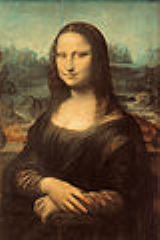
The painting is a half-length portrait and depicts a woman whose expression is often described as enigmatic. The ambiguity of the sitter's expression, the monumentality of the half-figure composition, and the subtle modeling of forms and atmospheric illusionism were novel qualities that have contributed to the painting's continuing fascination. Few other works of art have been subject to as much scrutiny, study, mythologizing, and parody.

Background

Leonardo Self
Leonardo da Vinci began painting the Mona Lisa in 1503, during the Italian Renaissance and, according to Vasari, "after he had lingered over it four years, left it unfinished...." He is thought to have continued to work on it for three years after he moved to France and to have finished it shortly before he died in 1519. Leonardo took the painting from Italy to France in 1516 when King François I
Francis I of France

Francis I , was crowned King of France in 1515 in the cathedral at Reims and reigned until 1547.Francis I is considered to be France's first Renaissance monarch....
 invited the painter to work at the Clos Lucé
Clos Lucé

Clos Luc? is a mansion in Amboise, France, located 500 metres from the royal Ch?teau d'Amboise, to which it is connected by an underground passageway....
 near the king's castle in Amboise. Most likely through the heirs of Leonardo's assistant Salai, the king bought the painting for 4,000 écus and kept it at Château Fontainebleau, where it remained until given to Louis XIV
Louis XIV of France

Louis XIV ruled as List of French monarchs and of King of Navarre. He ascended the throne a few months before his fifth birthday, but did not assume actual personal control of the government until the death of his prime minister , the Italians Jules Cardinal Mazarin, in 1661....
. Louis XIV moved the painting to the Palace of Versailles
Palace of Versailles

The Palace of Versailles, or simply Versailles, is a royal ch?teau in Versailles, the ?le-de-France region of France. In French language, it is known as the Ch?teau de Versailles....
. After the French Revolution
French Revolution

The French Revolution was a period of political and social upheaval and radical change in the history of France, during which the French governmental structure, previously an absolute monarchy with feudalism for the aristocracy and Roman Catholic Church clergy, underwent radical change to forms based on Age of Enlightenment principles of cit...
, it was moved to the Louvre
Louvre

The Louvre Museum , located in Paris, is a historic monument, and a national museum of France. It is a central landmark, located on the Rive Droite of the Seine in the 1st arrondissement of Paris ....
. Napoleon I
Napoleon I of France

Napoleon Bonaparte later known as Emperor Napoleon I, was a military and political leader of France whose actions shaped European politics in the early 19th century....
 had it moved to his bedroom in the Tuileries Palace
Tuileries Palace

The Palais des Tuileries was a royal palace in Paris. It stood on the Rive Droite of the River Seine until 1871, when it was destroyed in the upheaval during the suppression of the Paris Commune....
; later it was returned to the Louvre. During the Franco-Prussian War
Franco-Prussian War

The Franco-Prussian War or Franco-German War, often referred to in France as the 1870 War was a conflict between Second French Empire and Kingdom of Prussia, while Prussia was backed by the North German Confederation, of which it was a member, and the South German states of Grand Duchy of Baden, History of W?rttemberg#The Kingdom...
 (1870–1871) it was moved from the Louvre to a hiding place elsewhere in France.

Mona Lisa was not well known until the mid-19th century when artists of the emerging Symbolist
Symbolism (arts)

Symbolism was a late nineteenth-century art movement of French and Belgium origin in symbolist poetry and other arts....
 movement began to appreciate it, and associated it with their ideas about feminine mystique. Critic Walter Pater
Walter Pater

Walter Horatio Pater was an England essayist and critic of art criticism and literary criticism....
, in his 1867 essay on Leonardo, expressed this view by describing the figure in the painting as a kind of mythic embodiment of eternal femininity, who is "older than the rocks among which she sits" and who "has been dead many times and learned the secrets of the grave."

Subject and title

Mona Lisa is named for Lisa del Giocondo
Lisa del Giocondo

Lisa del Giocondo , born and also known as Lisa Gherardini, Lisa di Antonio Maria Gherardini, Lisa and Mona Lisa, was a member of the Gherardini family of Florence and Tuscany in Italy....
, a member of the Gherardini family of Florence
Florence

Florence is the Capital city of the Italy Regions of Italy of Tuscany and of the provinces of Italy Province of Florence. It is the most populous city in Tuscany and has a population of 364,779 ....
 and Tuscany
Tuscany

Tuscany is a region in Italy. It has an area of and a population of about 3.6 million inhabitants. The regional capital is Florence.Tuscany is known for its landscapes and its artistic legacy....
 and the wife of wealthy Florentine silk merchant Francesco del Giocondo. The painting was commissioned for their new home and to celebrate the birth of their second son, Andrea.

The sitter's identity was ascertained at the University of Heidelberg
Ruprecht Karl University of Heidelberg

The Ruprecht Karl University of Heidelberg is a public university research university located in Heidelberg, Baden-W?rttemberg, Germany. Founded in 1386, it is the List_of_universities_in_Germany#Universities_by_age and was the third university established in the Holy Roman Empire....
 in 2005 by a library expert who discovered a 1503 margin note written by Agostino Vespucci. Scholars had been of many minds, identifying at least four different paintings as the Mona Lisa and several people as its subject. Leonardo's mother Caterina in a distant memory, Isabella of Naples
Isabella of Naples

Isabella di Aragona was born a princess of Kingdom of Naples, granddaughter of Ferdinand I of Naples and daughter of Alfonso II of Naples by his wife, Ippolita Maria Sforza....
 or Aragon, Cecilia Gallerani
Cecilia Gallerani

Cecilia Gallerani was one of the mistresses of Ludovico Sforza, Duke of Milan. She was the subject of Leonardo da Vinci's painting The Lady with an Ermine ....
, Costanza d'Avalos—who was also called the "merry one" or La Gioconda, Isabella d'Este
Isabella d'Este

File:Tizian 056.jpgIsabella d'Este was marchesa of Mantua and one of the leading women of the Italy Renaissance and a major cultural and political figure....
, Pacifica Brandano or Brandino, Isabela Gualanda, Caterina Sforza
Caterina Sforza

Caterina Sforza, Countess of Forl? , was the illegitimate daughter of Galeazzo Maria Sforza, Duke of Milan and Lucrezia Landriani, the wife of the courtier Gian Piero Landriani, a close friend of the Duke....
, and Leonardo himself had all been named the sitter. Today the subject's identity is held to be Lisa, which was always the traditional view.

The painting's title stems from a description by Giorgio Vasari
Giorgio Vasari

Giorgio Vasari was an Italy Painting and architect, who is today famous for his biography of Italian artists, considered the ideological foundation of art history writing....
 in his biography of Leonardo da Vinci published in 1550, 31 years after the artist's death. "Leonardo undertook to paint, for Francesco del Giocondo, the portrait of Mona Lisa, his wife...." (one version in ). In Italian, ma donna means my lady. This became madonna
Madonna (art)

Images of the Madonna and the Madonna and Child are pictorial or scuptured representations of Mary, Mother of Jesus, either alone, or more frequently, with the infant Jesus....
, and its contraction mona. Mona is thus a polite form of address, similar to Ma’am, Madam, or my lady in English. In modern Italian, the short form of madonna is usually spelled Monna, so the title is sometimes Monna Lisa, rarely in English and more commonly in Romance languages
Romance languages

The Romance languages are a branch of the Indo-European languages comprising all the languages that descend from Latin language, the language of ancient Rome....
 such as French and Italian.

At his death in 1525, Leonardo's assistant Salai owned the portrait named in his personal papers la Gioconda which had been bequeathed to him by the artist. Italian for jocund, happy or jovial, Gioconda was a nickname for the sitter, a pun on the feminine form of her married name Giocondo and her disposition. In French, the title La Joconde has the same double meaning.

Aesthetics

Mona Lisa Detail Background Right
Leonardo used a pyramid design to place the woman simply and calmly in the space of the painting. Her folded hands form the front corner of the pyramid. Her breast, neck and face glow in the same light that models her hands. The light gives the variety of living surfaces an underlying geometry of spheres and circles. Leonardo referred to a seemingly simple formula for seated female figure: the images of seated Madonna, which were widespread at the time. He effectively modified this formula in order to create the visual impression of distance between the sitter and the observer. The armrest of the chair functions as a dividing element between Mona Lisa and the viewer.

The woman sits markedly upright with her arms folded, which is also a sign of her reserved posture. Only her gaze is fixed on the observer and seems to welcome them to this silent communication. Since the brightly lit face is practically framed with various much darker elements (hair, veil, shadows), the observer's attraction to Mona Lisas face is brought to even greater extent. Thus, the composition of the figure evokes an ambiguous effect: we are attracted to this mysterious woman but have to stay at a distance as if she were a divine creature. There is no indication of an intimate dialogue between the woman and the observer as is the case in the Portrait of Baldassare Castiglione
Baldassare Castiglione

Baldassare Castiglione, count of Novilara , was an Italy courtier, diplomat, soldier and a prominent Renaissance author....
(Louvre) painted by Raphael
Raphael

Raphael Sanzio, usually known by his first name alone was an Italy Painting and architect of the High Renaissance, celebrated for the perfection and grace of his paintings and drawings....
 about ten years after
Mona Lisa, and undoubtedly influenced by Leonardo's portrait.

Mona Lisa Detail Hands
The painting was among the first portraits to depict the sitter before an imaginary landscape. The enigmatic woman is portrayed seated in what appears to be an open loggia
Loggia

Loggia is the name given to an architectural feature, originally of Italy design, which is often a gallery or corridor generally on the ground level, or sometimes higher, on the facade of a building and open to the air on one side, where it is supported by columns or pierced openings in the wall....
 with dark pillar bases on either side. Behind her a vast landscape recedes to icy mountains. Winding paths and a distant bridge give only the slightest indications of human presence. The sensuous curves of the woman's hair and clothing, created through sfumato
Sfumato

Sfumato is the Italian term for a painting technique which overlays translucent layers of colour to create perceptions of depth, volume and form....
, are echoed in the undulating imaginary valleys and rivers behind her. The blurred outlines, graceful figure, dramatic contrasts of light and dark, and overall feeling of calm are characteristic of Leonardo's style. Due to the expressive synthesis that Leonardo achieved between sitter and landscape it is arguable whether
Mona Lisa should be considered as a traditional portrait, for it represents an ideal rather than a real woman. The sense of overall harmony achieved in the painting—especially apparent in the sitter's faint smile—reflects Leonardo's idea of a link connecting humanity and nature.

Mona Lisa has no visible facial hair—including eyebrows and eyelashes. Some researchers claim that it was common at this time for genteel women to pluck them out, since they were considered to be unsightly. For modern viewers the missing eyebrows add to the slightly semi-abstract quality of the face.

Theft and vandalism

The Mona Lisa painting now hangs in the Musée du Louvre in Paris, France. The painting's increasing fame was further emphasized when it was stolen
Art theft

Art theft is the theft of art. This is usually done for the purpose of resale or ransom; occasionally thieves are also commissioned by dedicated private collectors....
 on August 21, 1911. The next day, Louis Béroud, a painter, walked into the Louvre and went to the Salon Carré where the
Mona Lisa had been on display for five years. However, where the Mona Lisa should have stood, he found four iron pegs. Béroud contacted the section head of the guards, who thought the painting was being photographed for marketing purposes. A few hours later, Béroud checked back with the section head of the museum, and it was confirmed that the Mona Lisa was not with the photographers. The Louvre was closed for an entire week to aid in investigation of the theft.

French poet Guillaume Apollinaire
Guillaume Apollinaire

Wilhelm Albert Wlodzimierz Apolinary de Waz-Kostrowicki, known as Guillaume Apollinaire was a France poet, writer, and art critic born in Italy to a Polish mother....
, who had once called for the Louvre
Louvre

The Louvre Museum , located in Paris, is a historic monument, and a national museum of France. It is a central landmark, located on the Rive Droite of the Seine in the 1st arrondissement of Paris ....
 to be "burnt down," came under suspicion; he was arrested and put in jail. Apollinaire tried to implicate his friend Pablo Picasso
Pablo Picasso

Pablo Diego Jos? Francisco de Paula Juan Nepomuceno Mar?a de los Remedios Cipriano de la Sant?sima Trinidad Ruiz y Picasso was a Spanish people Painting, drawing, and Sculpture....
, who was also brought in for questioning, but both were later exonerated.

At the time, the painting was believed to be lost forever, and it would be two years before the real thief was discovered. Louvre employee Vincenzo Peruggia
Vincenzo Peruggia

Vincenzo Peruggia is the man who once stole the Mona Lisa....
 stole it by entering the building during regular hours, hiding in a broom closet and walking out with it hidden under his coat after the museum had closed. Peruggia was an Italian patriot who believed Leonardo's painting should be returned to Italy for display in an Italian museum. Peruggia may have also been motivated by a friend who sold copies of the painting, which would skyrocket in value after the theft of the original. After having kept the painting in his apartment for two years, Peruggia grew impatient and was finally caught when he attempted to sell it to the directors of the Uffizi Gallery in Florence
Florence

Florence is the Capital city of the Italy Regions of Italy of Tuscany and of the provinces of Italy Province of Florence. It is the most populous city in Tuscany and has a population of 364,779 ....
; it was exhibited all over Italy and returned to the Louvre in 1913. Peruggia was hailed for his patriotism in Italy and only served a few months in jail for the crime.

During World War II
World War II

World War II, or the Second World War , was a global military conflict which involved a Participants in World War II, including all of the great powers, organised into two opposing military alliances: the Allies of World War II and the Axis powers....
, the painting was again removed from the Louvre and taken safely, first to Château d'Amboise, then to the Loc-Dieu Abbey
Loc-Dieu Abbey

'Loc-Dieu Abbey' is a Cistercian abbey located near Martiel, 9 km west from Villefranche-de-Rouergue, in the department of Aveyron in France.Founded in 1123 in a place formerly called Locus Diaboli due to the large number of dolmens around it, it was renamed Locus Dei in Latin by the monks, which in French language became Loc-Dieu...
 and finally to the Ingres Museum
Musée Ingres

The Mus?e Ingres is located in Montauban, France. It houses a collection of artworks and artifacts related to Jean Auguste Dominique Ingres, and works by another famous native of Montauban, Antoine Bourdelle....
 in Montauban
Montauban

Montauban is a town and Communes of France of southwestern France, Prefectures in France of the Tarn-et-Garonne Departments of France, north of Toulouse....
. In 1956, the lower part of the painting was severely damaged when a vandal doused the painting with acid. On December 30 of that same year a young Bolivian
Bolivian

Bolivian may refer to:* Something of, or related to Bolivia* A person from Bolivia, or of Bolivian descent. For information about the Bolivian people, see Demographics of Bolivia and Culture of Bolivia....
 damaged the painting by throwing a rock at it. This resulted in the loss of a speck of pigment near the left elbow, which was later painted over.

Conservation

The Mona Lisa has survived for more than 500 years, and an international commission convened in 1952 noted that "the picture is in a remarkable state of preservation." This is partly due to the result of a variety of conservation treatments the painting has undergone. A detailed analysis in 1933 by Madame de Gironde revealed that earlier restorers had "acted with a great deal of restraint." Nevertheless, applications of varnish
Varnish

Varnish is a Transparency , hard, protective finish or film primarily used in wood finishing but also for other materials. Varnish is traditionally a combination of a drying oil, a resin, and a Turpentine substitute or solvent....
 made to the painting had darkened even by the end of the 16th century, and an aggressive 1809 cleaning and re-varnish removed some of the uppermost portion of the paint layer, resulting in a washed-out appearance to the face of the figure. Despite the treatments, the Mona Lisa has been well-cared for throughout its history, and the 2004-05 conservation team was optimistic about the future of the work.

Poplar panel
At some point in its history, the Mona Lisa was removed from its original frame. The unconstrained poplar panel was allowed to warp freely with changes in humidity, and as a result, a crack began to develop near the top of the panel. The crack extends down to the hairline of the figure. In the mid 18th to early 19th century, someone attempted to stabilize the crack by inlaying two butterfly shaped walnut braces into the back of the panel to a depth of about 1/3 the thickness of the panel. This work was skillfully executed, and has successfully stabilized the crack. Sometime between 1888 and 1905, or perhaps at some point during the picture's theft, the upper brace fell out. A later restorer glued and lined the resulting socket and crack with cloth. The flexible oak frame (added 1951) and crossbraces (1970) help to keep the panel from warping further. A butterfly brace prevents the panel from further cracking.

The picture is currently kept under strict, climate controlled conditions in its bullet-proof glass case. The humidity is maintained at 50% ±10%, and the temperature is maintained between 18 and 21°C. To compensate for fluctuations in relative humidity, the case is supplemented with a bed of silica gel
Silica gel

Silica gel is a granularity, vitreous, highly porosity form of silica made synthetically from sodium silicate. Despite its name, silica gel is a solid....
 treated to provide 55% relative humidity.

Frame
Because the Mona Lisa's poplar support expands and contracts with changes in humidity, the picture has experienced some warping. In response to warping and swelling experienced during its storage during World War II, and to prepare the picture for an exhibit to honor the anniversary of Da Vinci's 500th birthday, the Mona Lisa was fitted in 1951 with a flexible oak frame with beech crosspieces. This flexible frame, which is used in addition to the decorative frame described below, exerts pressure on the panel to keep it from warping further. In 1970, the beech crosspieces were switched to maple after it was found that the beech wood had been infested with insects. In 2004-2005, a conservation and study team replaced the maple crosspieces with sycamore ones, and an additional metal crosspiece was added for scientific measurement of the panel's warp. The Mona Lisa has had many different decorative frames in its history, owing to changes in taste over the centuries. In 1906, the countess of Béarn gave the portrait its current frame, a Renaissance-era work consistent with the historical period of the Mona Lisa. The edges of the painting have been trimmed at least once in its history to fit the picture into various frames, but none of the original paint layer has been trimmed.

Cleaning and touch-up
Mona Lisa Through Glass
The first and most extensive recorded cleaning, revarnishing, and touch up of the Mona Lisa was an 1809 wash and re-varnish undertaken by Jean-Marie Hooghstoel, who was responsible for restoration of paintings for the galleries of the Musée Napoléon
Musée Napoléon

Mus?e Napol?on may be:*Mus?e Napol?on , a short-lived museum housing the cultural trophies of Napoleon's campaigns, such as the Laocoon and his sons, housed in the Louvre palace...
. The work involved cleaning with spirits, touch up of color, and revarnishing the painting. In 1906, Louvre restorer Eugène Denizard performed watercolor retouches on areas of the paint layer disturbed by the crack in the panel. Denizard also retouched the edges of the picture with varnish, to mask areas that had been covered initially by an older frame. In 1913, when the painting was recovered after its theft, Denizard was again called upon to work on the Mona Lisa. Denizard was directed to clean the picture without solvent
Solvent

A solvent is a liquid or gas that dissolves a solid, liquid, or gaseous solute, resulting in a solution.The most common solvent in everyday life is water....
, and to lightly touch up several scratches to the painting with watercolor. In 1952, the varnish layer over the background in the painting was evened out. After the second 1956 attack, restorer Jean-Gabriel Goulinat was directed to touch up the damage to Mona Lisa's left elbow with watercolor.

In 1977, a new insect infestation was discovered in the back of the panel as a result of crosspieces installed to keep the painting from warping. This was treated on the spot with carbon tetrachloride
Carbon tetrachloride

Carbon tetrachloride, also known by many other names is the organic compound with the chemical formula CCl4. It is a reagent in organic synthesis chemistry and was formerly widely used in fire extinguishers, as a precursor to refrigerations, and a cleaning agent....
, and later with an ethylene oxide
Ethylene oxide

Ethylene oxide is the organic compound with the chemical formula C2H4O. This colorless flammable gas with a faintly sweet odor is the simplest epoxide, a three-membered ring consisting of two carbon and one oxygen atom....
 treatment. In 1985, the spot was again treated with carbon tetrachloride as a preventive measure.

Infrared scan
In 2004 experts from the National Research Council of Canada
National Research Council of Canada

The National Research Council is Canada's leading organization for scientific research and development....
 conducted a three-dimensional infrared
Infrared

Infrared radiation is electromagnetic radiation whose wavelength is longer than that of visible light , but shorter than that of terahertz radiation and microwaves ....
 scan. Because of the aging of the varnish on the painting it is difficult to discern details. Data from the scan and infrared were used by Bruno Mottin of the French Museums' "Center for Research and Restoration" to argue that the transparent gauze veil worn by the sitter is a guarnello, typically used by women while pregnant or just after giving birth. A similar guarnello was painted by Sandro Botticelli
Sandro Botticelli

Alessandro di Mariano di Vanni Filipepi, better known as Sandro Botticelli or Il Botticello was an Italy Painting of the Florentine school during the Early Renaissance ....
 in his
Portrait of Smeralda Brandini
Portrait of a Lady known as Smeralda Bandinelli

The Portrait of Smeralda Bandinelli is a painting by the Italy Renaissance artist Sandro Botticelli, c. 1475, currently housed in the Victoria and Albert Museum, London....
(c.1470/1475), depicting a pregnant woman in the Victoria and Albert Museum
Victoria and Albert Museum

The Victoria and Albert Museum in London is the world's largest museum of decorative arts and design, housing a permanent collection of over 4.5 million Object ....
 in London. Furthermore, this reflectography revealed that
Mona Lisa
s hair is not loosely hanging down, but seems attached at the back of the head to a bonnet or pinned back into a chignon
Chignon (hairstyle)

A chignon, pronounced "sheen-yon,? is a popular type of bun style. The word ?chignon? comes from the French phrase ?chignon du cou,? which means nape of the neck....
 and covered with a veil, bordered with a sombre rolled hem. In the 16th century, hair hanging loosely down on the shoulders was the customary style of unmarried young women or prostitutes. This apparent contradiction with her status as a married woman has now been resolved.

Researchers also used the data to reveal details about the technique used and to predict that the painting will degrade very little if current conservation techniques are continued. During 2006, Mona Lisa underwent a major scientific observation that proved through infrared cameras she was originally wearing a bonnet and clenching her chair, something that Leonardo decided to change as an afterthought.

Display
On April 6, 2005—following a period of curatorial maintenance, recording, and analysis—the painting was moved to a new location within the museum's Salle des États. It is displayed in a purpose-built, climate-controlled enclosure behind bullet-proof glass. About 6 million people view the painting at the Louvre each year.

Fame

Crowd At Mona Lisa
Historian Donald Sassoon catalogued the growth of the painting's fame. During the mid-1800s, Théophile Gautier
Théophile Gautier

Pierre Jules Th?ophile Gautier was a French poet, dramatist, novelist, journalist, and literary critic.While an ardent defender of Romanticism, Gautier's work is difficult to classify and remains a point of reference for many subsequent literary traditions such as Parnassian poets, Symbolism, decadent movement and Modernism....
 and the Romantic
Romanticism

Romanticism is a complex artistic, literary, and intellectual movement that originated in the second half of the 18th century in Western Europe, and gained strength during the Industrial Revolution....
 poets were able to write about Mona Lisa as a femme fatale
Femme fatale

A femme fatale is an alluring and Seduction woman whose charms ensnare her lovers in bonds of irresistible desire, often leading them into compromising, dangerous, and deadly situations....
 because Lisa was an ordinary person. Mona Lisa "...was an open text into which one could read what one wanted; probably because she was not a religious image; and, probably, because the literary gazers were mainly men who subjected her to an endless stream of male fantasies." During the 20th century, the painting was stolen, an object for mass reproduction, merchandising, lampooning and speculation, and was reproduced in "300 paintings and 2,000 advertisements". The subject was described as deaf, in mourning, toothless, a "highly-paid tart", various people's lover, a reflection of the artist's neuroses, and a victim of syphilis, infection, paralysis, palsy, cholesterol or a toothache. Scholarly as well as amateur speculation assigned Lisa's name to at least four different paintings and the sitter's identity to at least ten different people.

Visitors generally spend about 15 seconds viewing the Mona Lisa. Until the 20th century, Mona Lisa was one among many and certainly not the "most famous painting" in the world as it is termed today. Among works in the Louvre, in 1852 its market value was 90,000 francs compared to works by Raphael valued at up to 600,000 francs. In 1878, the Baedeker
Baedeker

Verlag Karl Baedeker is a Germany-based publisher and pioneer in the business of worldwide travel guides. The guides, often referred as simply "Baedekers" , contain important introductions, descriptions of buildings, of museum collections, etc., written by the best specialists, and are frequently revised in order to be up to date....
 guide called it "the most celebrated work of Leonardo in the Louvre". Between 1851 and 1880, artists who visited the Louvre copied Mona Lisa roughly half as many times as certain works by Bartolomé Esteban Murillo
Bartolomé Estéban Murillo

Bartolom? Esteban Murillo was a Spain List of painters, one of the most important figures in Baroque painting in Spain. Although he is best known for his religious works, Murillo also produced a considerable number of paintings of contemporary women and children....
, Antonio da Correggio
Antonio da Correggio

Antonio Allegri da Correggio was the foremost painter of the Parma school of the Italy Renaissance, who was responsible for some of the most vigorous and sensuous works of the 16th century....
, Paolo Veronese
Paolo Veronese

Paolo Veronese was an Italian painter of the Renaissance in Venice, famous for paintings such as The Wedding at Cana and The Feast in the House of Levi....
, Titian
Titian

File:Tizian 090.jpg Tiziano Vecelli or Tiziano Vecellio, born 1473/1490 , died 27 August 1576, better known as Titian , was the leading painter of the 16th-century Venice school of the Italian Renaissance....
, Jean-Baptiste Greuze
Jean-Baptiste Greuze

Jean-Baptiste Greuze was a France Painting....
 and Pierre Paul Prud'hon
Pierre Paul Prud'hon

Pierre-Paul Prud'hon was a France Romantic Painting and drawing best known for his allegorical paintings and portraits....
.

From December 1962 to March 1963, the French government lent it to the United States
United States

The United States of America is a Federal government constitutional republic comprising U.S. state and a federal district. The country is situated mostly in central North America, where its Contiguous United States and Washington, D.C., the Capital districts and territories, lie between the Pacific Ocean and Atlantic Oceans, Borders of the U...
 to be displayed in New York City
New York City

The City of New York is the List of United States cities by population in the United States, while the New York metropolitan area ranks among the List of urban areas by population....
 and Washington D.C.. In 1974, the painting was exhibited in Tokyo
Tokyo

, officially , is one of the 47 prefectures of Japan of Japan and located on the eastern side of the main island Honshu. The twenty-three special wards of Tokyo, each governed as a city, cover the area that was once the Tokyo City in the eastern part of the prefecture, and total over 8 million people....
 and Moscow
Moscow

Moscow is the capital and the largest types of inhabited localities in Russia of the Russian Federation. It is also the largest European cities and metropolitan areas, with the Moscow metropolitan area ranking among the largest urban areas in the world....
.

Before the 1962–1963 tour, the painting was assessed for insurance purposes at $100 million. According to the Guinness Book of Records, this makes the Mona Lisa the most valuable painting ever insured. As an expensive painting
List of most expensive paintings

This is a list of the highest prices paid for paintings. Very valuable paintings, if sold, are usually sold at auctions.The world's most famous paintings, especially works done before 1800, are generally owned by museums, which very rarely sell them, and as such, they are quite literally priceless....
, it has only recently been surpassed, in terms of actual dollar price, by three other paintings: the Adele Bloch-Bauer I by Gustav Klimt
Gustav Klimt

Gustav Klimt was an Austrian Symbolism and one of the most prominent members of the Vienna Art Nouveau movement. His major works include paintings, murals, Sketch , and other art objects, many of which are on display in the Vienna Secession gallery....
, which was sold for $135 million, the Woman III
Woman III

Woman III is a painting by abstract expressionist painter Willem de Kooning. Woman III is one of a series of six paintings by de Kooning done between 1951 and 1953 in which the central theme was a woman....
 by Willem de Kooning
Willem de Kooning

Willem de Kooning was an abstract expressionist artist, born in Rotterdam, the Netherlands.In the post-World War II era, de Kooning painted in a style that came to be referred to variously as Abstract expressionism, Action painting, and the New York School....
 sold for $138 million in November 2006, and No. 5, 1948
No. 5, 1948

No. 5, 1948 is a painting by Jackson Pollock , an United States painter known for his contributions to the abstract expressionist movement. The painting was done on an 8' x 4' sheet of fiberboard, with thick amounts of brown and yellow paint drizzled on top of it, forming a nest-like appearance....
 by Jackson Pollock
Jackson Pollock

Paul Jackson Pollock was an influential American painter and a major force in the abstract expressionism movement. In October 1945, he married the artist Lee Krasner....
 sold for a record $140 million on in November 2006. Although these figures are greater than that which the Mona Lisa was insured for, the comparison does not account for the change in prices due to inflation -- $100 million in 1962 is approximately $670 million in 2006 when adjusted for inflation using the US Consumer Price Index.

Speculation about the painting

Although the sitter has traditionally been identified as Lisa del Giocondo
Lisa del Giocondo

Lisa del Giocondo , born and also known as Lisa Gherardini, Lisa di Antonio Maria Gherardini, Lisa and Mona Lisa, was a member of the Gherardini family of Florence and Tuscany in Italy....
, a lack of definitive evidence had long fueled alternative theories, including the possibility that Leonardo used his own likeness. However, on January 14, 2008, German academics of Heidelburg University made public a finding that corroborates the traditional identification: dated notes scribbled into the margins of a book by its owner on October 1503 established Lisa de Giocondo as the model for the painting.

Other aspects of the painting that have been subject to speculation are the original size of the painting, whether there were other versions of it, and various explanations for how the effect of an enigmatic smile was achieved.

In a National Geographic presentation titled "Testing the Mona Lisa" it was deduced, after rigorous assessment, that the figure depicted in the painting might be maternal, or pregnant. It was found, after extensive infrared reflectography, that Lisa herself had a haze around her clothing indictative of a guarnello, the attire worn by pregnant women. Another theory proposed by various health professionals was that Leonardo's representation of her hands as slightly 'large' was further indicative of Lisa's pregnancy. Conversely, as many scholars or persons suggest, this representation is merely a stylistic concept of beauty exemplified by numerous Renaissance painters, including Leonardo himself.

Legacy

Marcel Duchamp Mona Lisa Lhooq
The avant-garde
Avant-garde

Avant-garde means "advance guard" or "vanguard". The adjective form is used in English, to refer to people or works that are experimental or innovative, particularly with respect to art, culture, and politics....
 art world has made note of the undeniable fact of the Mona Lisa's popularity. Because of the painting's overwhelming stature, Dada
Dada

Dada or Dadaism is a cultural movement that began in Z?rich, Switzerland, during World War I and peaked from 1916 to 1922. The movement primarily involved visual arts, literature?poetry, art manifestoes, aesthetics?theatre, and graphic design, and concentrated its anti-war politics through a rejection of the prevailing standards in art...
ists and Surrealists
Surrealism

Surrealism is a cultural movement that began in the early-1920s, and is best known for the visual artworks and writings of the group members....
 often produce modifications and caricature
Caricature

A caricature is either a portrait that exaggerates or distorts the essence of a person or thing to create an easily identifiable visual likeness, or in literature, a description of a person using exaggeration of some characteristics and oversimplification of others....
s. In 1919, Marcel Duchamp
Marcel Duchamp

Marcel Duchamp was a France artist whose work is most often associated with the Dada and Surrealism movements. Duchamp's output influenced the development of post-World War I Western art....
, one of the most influential Dadaists, created L.H.O.O.Q.
L.H.O.O.Q.

L.H.O.O.Q. is a work of art by Marcel Duchamp first conceived in 1919. The work is one of what Duchamp referred to as Readymades of Marcel Duchamp....
, a Mona Lisa parody made by adorning a cheap reproduction with a moustache and a goatee, as well as adding the rude inscription, when read out loud in French
French language

French is a Romance language spoken around the world by around 80 million people as first language, by 190 million as second language, and by about another 200 million people as an acquired tongue, with significant speakers in 54 countries....
 sounds like "Elle a chaud au cul" (literally translated - "she has a hot ass". This is a manner of implying the woman in the painting is in a state of sexual excitement and availability). This was intended as a Freudian joke, referring to Leonardo's alleged homosexuality. According to Rhonda R. Shearer, the apparent reproduction is in fact a copy partly modelled on Duchamp's own face. Salvador Dalí
Salvador Dalí

Salvador Domingo Felipe Jacinto Dal? i Dom?nech, 1st Marquis of P?bol was a Spain Catalonia surrealist painter born in Figueres.Dal? was a skilled Technical drawing, best known for the striking and bizarre images in his surrealism work....
, famous for his pioneering surrealist work, painted Self portrait as Mona Lisa in 1954.

In 1963 Andy Warhol
Andy Warhol

Andrew Warhola , more commonly known as Andy Warhol, was an United Statesn Painting, Printmaking, and filmmaker who was a leading figure in the Art movement known as pop art....
 created serigraph prints of the Mona Lisa, in an effort to reduce her gravity to that of a disposable modern icon; to a similar cultural stature of the modern celebrities Marilyn Monroe
Marilyn Monroe

Marilyn Monroe was an American actress, singer, model, and a sex symbol.After spending much of her childhood in foster homes, Monroe began a career as a model, which led to a film contract in 1946....
 or Elvis Presley
Elvis Presley

Elvis Aaron Presley was an United Statesn singer, actor, and musician. A cultural icon, he is commonly known simply as "Elvis", and is also sometimes referred to as "List of honorific titles in popular music" or "The King"....
. A later reproduction of the Mona Lisa was discovered painted onto a hillside near Newport, Oregon
Newport, Oregon

Newport is a city in Lincoln County, Oregon, Oregon, United States. It was incorporated in 1882, though the name dates back to the establishment of a post office in 1868....
 on August 15, 2006. It was created by artist Samuel Clemens using a tarp stencil and water-based paint. The painting has also been parodied by street artists such as Banksy
Banksy

Banksy is a well-known pseudo-anonymous England graffiti artist. He is believed to be a native of Yate, Gloucestershire, near Bristol and to have been born in 1974, but there is substantial public uncertainty about his identity and personal and biographical details....
, Anthony Lister
Anthony Lister

Anthony Lister is an Australian people-born Painting and Installation artist. He has been featured in exhibitions in Australia, New Zealand, and the United States, as well as had solo shows in New York City and London, England....
 and Dolk
DOLK

Dolichol kinase, also known as DOLK, is a human gene.ReferencesFurther reading...
.

External links

  • , a large Mona Lisa fan site
  • , from the PBS website for Treasures Of The World
  • , an April 2004 BBC article
  • BBC article
  • , Cosmos magazine, September 2006
  • Podcast interview with Donald Sassoon on the La Trobe University
    La Trobe University

    La Trobe University is a multi-campus university in Victoria , Australia. The main campus of La Trobe is located in the Melbourne suburb of Bundoora; two other major campuses are located in the Victorian city of Bendigo, Victoria and NSW-Victorian border centre of Albury-Wodonga....
     website