
Home      Discussion      Topics      Dictionary      Almanac
Signup       Login
The Garden of Earthly Delights

The Garden of Earthly Delights

Overview
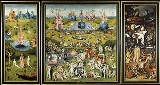
The Garden of Earthly Delights is a triptych
Triptych
A triptych , from tri-= "three" + ptysso= "to fold") is a work of art which is divided into three sections, or three carved panels which are hinged together and can be folded shut or displayed open. It is therefore a type of polyptych, the term for all multi-panel works...

 painted by the early Netherlandish
Early Netherlandish painting
Early Netherlandish painting refers to the work of artists active in the Low Countries during the 15th- and early 16th-century Northern renaissance, especially in the flourishing Burgundian cities of Bruges and Ghent...

 master Hieronymus Bosch (c. 1450–1516), housed in the Museo del Prado
Museo del Prado
The Museo del Prado is the main Spanish national art museum, located in central Madrid. It features one of the world's finest collections of European art, from the 12th century to the early 19th century, based on the former Spanish Royal Collection, and unquestionably the best single collection of...

 in Madrid
Madrid
Madrid is the capital and largest city of Spain. The population of the city is roughly 3.3 million and the entire population of the Madrid metropolitan area is calculated to be 6.271 million. It is the third largest city in the European Union, after London and Berlin, and its metropolitan...

 since 1939. Dating from between 1490 and 1510, when Bosch was about 40 or 50 years old, it is his best-known and most ambitious work. It reveals the artist at the height of his powers; in no other painting does he achieve such complexity of meaning or such vivid imagery.
Discussion
Ask a question about 'The Garden of Earthly Delights'
Start a new discussion about 'The Garden of Earthly Delights'
Answer questions from other users
Full Discussion Forum
 
Unanswered Questions
Recent Discussions
Encyclopedia
The Garden of Earthly Delights is a triptych
Triptych
A triptych , from tri-= "three" + ptysso= "to fold") is a work of art which is divided into three sections, or three carved panels which are hinged together and can be folded shut or displayed open. It is therefore a type of polyptych, the term for all multi-panel works...

 painted by the early Netherlandish
Early Netherlandish painting
Early Netherlandish painting refers to the work of artists active in the Low Countries during the 15th- and early 16th-century Northern renaissance, especially in the flourishing Burgundian cities of Bruges and Ghent...

 master Hieronymus Bosch (c. 1450–1516), housed in the Museo del Prado
Museo del Prado
The Museo del Prado is the main Spanish national art museum, located in central Madrid. It features one of the world's finest collections of European art, from the 12th century to the early 19th century, based on the former Spanish Royal Collection, and unquestionably the best single collection of...

 in Madrid
Madrid
Madrid is the capital and largest city of Spain. The population of the city is roughly 3.3 million and the entire population of the Madrid metropolitan area is calculated to be 6.271 million. It is the third largest city in the European Union, after London and Berlin, and its metropolitan...

 since 1939. Dating from between 1490 and 1510, when Bosch was about 40 or 50 years old, it is his best-known and most ambitious work. It reveals the artist at the height of his powers; in no other painting does he achieve such complexity of meaning or such vivid imagery.

The triptych is painted in oil
Oil painting
Oil painting is the process of painting with pigments that are bound with a medium of drying oil—especially in early modern Europe, linseed oil. Often an oil such as linseed was boiled with a resin such as pine resin or even frankincense; these were called 'varnishes' and were prized for their body...

 and comprises a square middle panel flanked by two rectangular wings that can close over the center as shutters. These outer wings, when folded shut, display a grisaille
Grisaille
Grisaille is a term for painting executed entirely in monochrome or near-monochrome, usually in shades of grey. It is particularly used in large decorative schemes in imitation of sculpture. Many grisailles in fact include a slightly wider colour range, like the Andrea del Sarto fresco...

 painting of the earth during the Creation. The three scenes of the inner triptych are probably (but not necessarily) intended to be read chronologically from left to right. The left panel depicts God presenting Adam to Eve
Eve (Bible)
Eve was, according to the creation of Abrahamic religions, the first woman created by God...

, while the central panel is a broad panorama of sexually engaged nude figures, fantastical animals, oversized fruit and hybrid stone formations. The right panel is a hellscape and portrays the torments of damnation
Damnation
Damnation is the concept of everlasting divine punishment and/or disgrace, especially the punishment for sin as threatened by God . A damned being "in damnation" is said to be either in Hell, or living in a state wherein they are divorced from Heaven and/or in a state of disgrace from God's favor...

.

Art historians and critics frequently interpret the painting as a didactic warning on the perils of life's temptations. However, the intricacy of its symbolism, particularly that of the central panel, has led to a wide range of scholarly interpretations over the centuries. 20th-century art historians are divided as to whether the triptych's central panel is a moral warning or a panorama of paradise lost. American writer Peter S. Beagle
Peter S. Beagle
Peter Soyer Beagle is an American fantasist and author of novels, nonfiction, and screenplays. His most notable works include the novels The Last Unicorn, A Fine and Private Place and Tamsin, and the award-winning story "Two Hearts".-Career:Beagle won early recognition from The Scholastic Art &...

 describes it as an "erotic derangement that turns us all into voyeurs, a place filled with the intoxicating air of perfect liberty".

During his life, Bosch painted three large triptychs in which each panel was essential to the meaning of the whole. Each of these three works presents distinct yet linked themes addressing history and faith. Triptychs from this period were generally intended to be read sequentially, the left and right panels often portraying Eden and the Last Judgment
Last Judgment
The Last Judgment, Final Judgment, Day of Judgment, Judgment Day, or The Day of the Lord in Christian theology, is the final and eternal judgment by God of every nation. The concept is found in all the Canonical gospels, particularly the Gospel of Matthew. It will purportedly take place after the...

 respectively, while the subtext
Subtext
Subtext or undertone is content of a book, play, musical work, film, video game, or television series which is not announced explicitly by the characters but is implicit or becomes something understood by the observer of the work as the production unfolds. Subtext can also refer to the thoughts...

 was contained in the center piece. It is not known whether "The Garden" was intended as an altarpiece
Altarpiece
An altarpiece is a picture or relief representing a religious subject and suspended in a frame behind the altar of a church. The altarpiece is often made up of two or more separate panels created using a technique known as panel painting. It is then called a diptych, triptych or polyptych for two,...

, but the general view is that the extreme subject matter of the inner center and right panels make it unlikely that it was intended to function in a church or monastery, but was instead commissioned by a lay
Laity
In religious organizations, the laity comprises all people who are not in the clergy. A person who is a member of a religious order who is not ordained legitimate clergy is considered as a member of the laity, even though they are members of a religious order .In the past in Christian cultures, the...

 patron
Patronage
Patronage is the support, encouragement, privilege, or financial aid that an organization or individual bestows to another. In the history of art, arts patronage refers to the support that kings or popes have provided to musicians, painters, and sculptors...

.

Exterior


When the triptych's wings are closed, the design of the outer panels becomes visible. Rendered in a green–gray grisaille
Grisaille
Grisaille is a term for painting executed entirely in monochrome or near-monochrome, usually in shades of grey. It is particularly used in large decorative schemes in imitation of sculpture. Many grisailles in fact include a slightly wider colour range, like the Andrea del Sarto fresco...

, the outer panels lack colour, probably because most Netherlandish triptych are thus painted, but possibly indicating that the painting reflects a time before the creation of the sun and moon, which were formed, according to Christian theology, to "give light to the earth". It was common for the outer panels of Netherlandish altarpiece
Altarpiece
An altarpiece is a picture or relief representing a religious subject and suspended in a frame behind the altar of a church. The altarpiece is often made up of two or more separate panels created using a technique known as panel painting. It is then called a diptych, triptych or polyptych for two,...

s to be in grisaille, such that their blandness highlighted the splendid colour inside.

The outer panels are generally thought to depict the Creation of the world, showing greenery beginning to clothe the still-pristine Earth. God, wearing a crown similar to a papal tiara
Papal Tiara
The Papal Tiara, also known incorrectly as the Triple Tiara, or in Latin as the Triregnum, in Italian as the Triregno and as the Trirègne in French, is the three-tiered jewelled papal crown, supposedly of Byzantine and Persian origin, that is a prominent symbol of the papacy...

 (a common convention in Netherlandish painting), is visible as a tiny figure at the upper left. His expression and gestures seem hesitant and morose, according to the art historian Hans Belting, "as though the world he had created was already slipping beyond his control". Bosch shows God
Conceptions of God
The God of monotheism, pantheism or panentheism, or the supreme deity of henotheistic religions, may be conceived of in various degrees of abstraction:...

 as the father
God the Father
God the Father is a gendered title given to God in many monotheistic religions, particularly patriarchal, Abrahamic ones. In Judaism, God is called Father because he is the creator, life-giver, law-giver, and protector...

 sitting with a Bible
Bible
The Bible refers to any one of the collections of the primary religious texts of Judaism and Christianity. There is no common version of the Bible, as the individual books , their contents and their order vary among denominations...

 on his lap, creating the Earth in a passive manner by divine fiat. Above him is inscribed a quote from Psalm 33 reading "Ipse dixit, et facta sunt: ipse mandávit, et creáta sunt"—For he spake and it was done; he commanded, and it stood fast. The Earth is encapsulated in a transparent sphere recalling the traditional depiction of the created world as a crystal sphere held by God or Christ. Refracting light, it hangs suspended in the cosmos, which is shown as an impermeable darkness, whose only other inhabitant is God himself.

Despite the presence of vegetation, the earth does not yet contain human or animal life, indicating that the scene represents the events of the biblical Third Day. Bosch renders the plant life in an unusual fashion, using uniformly gray tints which make it difficult to determine whether the subjects are purely vegetable or perhaps include some mineral formations. Surrounding the interior of the globe is the sea, partially illuminated by beams of light shining through clouds. The exterior wings have a clear position within the sequential narrative of the work as a whole. They show an unpopulated earth composed solely of rock and plant, contrasting sharply with the inner central panel which contains a paradise teeming with lustful humanity.

Interior


Scholars have proposed that Bosch used the outer panels to establish a Biblical setting for the inner elements of the work, and the exterior image is generally interpreted as set in an earlier time than those in the interior. As with Bosch's Haywain
The Haywain Triptych
Haywain is a triptych panel painting by Hieronymus Bosch in the Museo del Prado, Madrid, Spain, painted after 1510. This dating is based on the dendrochronological research of the panels. The centre panel measures 140 by 100 cm, and the wings measure 147 by 66 cm. A second version is in El...

 triptych, the inner centerpiece is flanked by heavenly and hellish imagery. The scenes depicted in the triptych are thought to follow a chronological order, flowing from left-to-right they represent respectively, Eden, the garden of earthly delights, and Hell. God appears as the creator of humanity in the left hand wing, while the consequences of his will are implied in the right. However, in contrast to Bosch's two other "true" triptychs, The Last Judgment
The Last Judgment (Bosch triptych)
The Last Judgment is a triptych by Hieronymus Bosch, created after 1482.The triptych currently resides at the Academie für Bildenden Künste in Vienna. The outside of the shutters are Grisaille on panel, while the inside shutters and center are oil on panel. The left and right panels measure 167.7 x...

 (around 1500) and The Haywain (after 1510), God is absent from the central panel. Instead, this panel shows humanity acting with free will and engaging in various sexual activities. The right hand panel is believed to show God wreaking vengeance for these sins in a Last Judgment
Last Judgment
The Last Judgment, Final Judgment, Day of Judgment, Judgment Day, or The Day of the Lord in Christian theology, is the final and eternal judgment by God of every nation. The concept is found in all the Canonical gospels, particularly the Gospel of Matthew. It will purportedly take place after the...

 hellscape.

Art historian Charles de Tolnay believed that, through the seductive gaze of Adam, the left panel already shows God's waning influence upon the newly created earth. This view is reinforced by the rendering of God in the outer panels as a tiny figure in comparison to the immensity of the earth. According to Belting, the three inner panels seek to broadly convey the Old Testament notion that, before the Fall, there was no defined boundary between good and evil; humanity in its innocence was unaware of consequence.

Left panel


The left panel (220 × 97.5 cm, 87 × 38.4 in) (sometimes known as the Joining of Adam and Eve) depicts a scene from the paradise of the Garden of Eden
Garden of Eden
The Garden of Eden is in the Bible's Book of Genesis as being the place where the first man, Adam, and his wife, Eve, lived after they were created by God. Literally, the Bible speaks about a garden in Eden...

 commonly interpreted as the moment when God presents Eve to Adam. The painting shows Adam waking from a deep sleep to find God holding Eve by her wrist and giving the sign of his blessing to their union. God is younger-looking than on the outer panels, blue-eyed and with golden curls. His youthful appearance may be a device by the artist to illustrate the concept of Christ
Jesus
Jesus of Nazareth , commonly referred to as Jesus Christ or simply as Jesus or Christ, is the central figure of Christianity...

 as the incarnation
Incarnation (Christianity)
The Incarnation in traditional Christianity is the belief that Jesus Christ the second person of the Trinity, also known as God the Son or the Logos , "became flesh" by being conceived in the womb of a woman, the Virgin Mary, also known as the Theotokos .The Incarnation is a fundamental theological...

 of the Word of God
Logos
' is an important term in philosophy, psychology, rhetoric and religion. Originally a word meaning "a ground", "a plea", "an opinion", "an expectation", "word," "speech," "account," "reason," it became a technical term in philosophy, beginning with Heraclitus ' is an important term in...

. God's right hand is raised in blessing, while he holds Eve's wrist with his left, according to the work's most controversial interpreter, Wilhelm Fränger:

As though enjoying the pulsation of the living blood and as though too he were setting a seal on the eternal and immutable communion between this human blood and his own. This physical contact between the Creator and Eve is repeated even more noticeably in the way Adam's toes touch the Lord's foot. Here is the stressing of a rapport: Adam seems indeed to be stretching to his full length in order to make contact with the Creator. And the billowing out of the cloak around the Creator's heart, from where the garment falls in marked folds and contours to Adam's feet, also seems to indicate that here a current of divine power flows down, so that this group of three actually forms a closed circuit, a complex of magical energy.


Eve chastely avoids Adam's gaze, although, according to art historian Walter S. Gibson, she is shown "seductively presenting her body to Adam". Adam's expression is one of amazement, and Fränger has identified three elements to his seeming astonishment. Firstly, there is surprise at the presence of the God. Secondly, he is reacting to an awareness that Eve is of same nature as himself, and has been created from his own body. Finally, from the intensity of Adam's gaze, it can be concluded that he is experiencing sexual arousal and the primal urge to reproduce for the first time.

The surrounding landscape is populated by hut-shaped forms, some of which are made from stone, while others are at least partially organic. Behind Eve, rabbits symbolising fecundity
Fecundity
Fecundity, derived from the word fecund, generally refers to the ability to reproduce. In demography, fecundity is the potential reproductive capacity of an individual or population. In biology, the definition is more equivalent to fertility, or the actual reproductive rate of an organism or...

 play in the grass, and a dragon tree
Dracaena (plant)
Dracaena is a genus of about 40 species of trees and succulent shrubs. In the APG III classification system, it is placed in the family Asparagaceae, subfamily Nolinoideae . It has also formerly been separated into the family Dracaenaceae or placed in the Agavaceae...

 opposite is thought to represent eternal life
Immortality
Immortality is the ability to live forever. It is unknown whether human physical immortality is an achievable condition. Biological forms have inherent limitations which may or may not be able to be overcome through medical interventions or engineering...

. The background reveals several animals that would have been exotic to contemporaneous Europeans, including a giraffe, an elephant and a lion that has killed and about to devour his prey. In the foreground, a circular hole in the ground emits birds and winged animals, some of which are realistic, some fantastic. A fish with human hands and a duck's head clutches a book while emerging from the cavity in flight, while to the left of the area a cat holds a small creature in its jaws. Belting observes that despite the fact that the creatures in the foreground are fantastical imaginings, many of the animals in the mid and background are drawn from contemporary travel literature, and here Bosch is appealing to "the knowledge of a humanistic and aristocratic readership". Erhard Reuwich
Erhard Reuwich
Erhard Reuwich was a Dutch artist, as a designer of woodcuts, and a printer, who came from Utrecht but then worked in Mainz. His dates and places of birth and death are unknown, but he was active in the 1480s....

's pictures for Bernhard von Breydenbach's Pilgrimages to the Holy Land were long thought to be the source for both the elephant and the giraffe, though more recent research indicates the mid-15th century humanist scholar Cyriac of Ancona's travelogues served as Bosch's exposure to these exotic animals.

According to art historian Virginia Tuttle, the scene is "highly unconventional [and] cannot be identified as any of the events from the Book of Genesis traditionally depicted in Western art". Some of the image's details seem to contradict the innocence that might be expected in the Garden of Eden before the expulsion. Tuttle and other critics have interpreted the gaze
Gaze
Gaze is a psychoanalytical term brought into popular usage by Jacques Lacan to describe the anxious state that comes with the awareness that one can be viewed. The psychological effect, Lacan argues, is that the subject loses some sense of autonomy upon realizing that he or she is a visible object...

 of Adam upon his wife as lustful, and indicative of the Christian belief that man was doomed from the beginning. Gibson believes that Adam's facial expression betrays not just surprise but also expectation. According to a belief common in the Middle Ages, before the Fall Adam and Eve would have copulated without lust, solely to reproduce. Many believed that the first sin committed after Eve tasted the forbidden fruit
Tree of Knowledge of Good and Evil
In the Book of Genesis, the tree of the knowledge of good and evil or the tree of knowledge was a tree in the middle of the Garden of Eden. . God directly forbade Adam to eat the fruit of this tree...

 was carnal lust. On a tree to the right a snake curls around a tree trunk, while to its right a mouse creeps—both animals are universal phallic symbols
Phallus
A phallus is an erect penis, a penis-shaped object such as a dildo, or a mimetic image of an erect penis. Any object that symbolically resembles a penis may also be referred to as a phallus; however, such objects are more often referred to as being phallic...

. Art historian Rosemarie Schuder, however, suggests that the obvious sensuality of the panel may have been intended as a jab against the Inquisition's hostility towards physicality.

Center panel


The skyline of the center panel (220 × 195 cm, 87 × 77 in) matches exactly with that of the left wing, while the positioning of its two central pools echoes the lake in the earlier panel. The center image depicts the expansive "garden" landscape which gives the triptych its name. The panel shares a common horizon with the left wing, suggesting a temporal and spatial connection between the two scenes. The garden is teeming with male and female nudes, together with a variety of animals, plants and fruit. The setting is not the paradise shown in the left panel, but neither is it based in the terrestrial realm. Fantastic creatures mingle with the real; otherwise ordinary fruits appear engorged to a gigantic size. The figures are engaged in diverse amorous sports and activities, both in couples and in groups. Gibson describes them as behaving "overtly and without shame", while art historian Laurinda Dixon writes that the human figures exhibit "a certain adolescent sexual curiosity".

The numerous human figures revel in an innocent, self-absorbed joy as they engage in a wide range of activities: some enjoy sexual pleasures, others play unselfconsciously in the water, and yet others cavort in meadows with a variety of animals, seemingly at one with nature. In the middle of the background, a large blue globe resembling a fruit pod rises in the middle of a pond. Visible through its circular window is a man fondling his partner's genitals, and the bare buttocks of yet another figure hover in the vicinity. According to the 20th-century folklorist
Folkloristics
Folkloristics is the formal academic study of folklore. The term derives from a nineteenth century German designation of folkloristik to distinguish between folklore as the content and folkloristics as its study, much as language is distinguished from linguistics...

 and art historian Wilhelm Fränger, the eroticism
Erotic art
Erotic art covers any artistic work that is intended to evoke erotic arousal or that depicts scenes of love-making. It includes paintings, engravings, drawings, sculptures, photographs, music and writing.-Definition:...

 of the center frame could be considered either as an allegory of transience or a playground of corruption.

In the right-hand side of the foreground stand a group of both fair and black-skinned figures. Some of these fair-skinned figures, male and female alike, are covered from head to foot in light-brown body hair. Scholars generally agree that these hirsute figures represent wild or primeval man but disagree on the symbolism of their inclusion. Art historian Patrik Reuterswärd, for example, posits that they may be seen as "the noble savage" who represents "an imagined alternative to our civilized life", imbuing the panel with "a more clear-cut primitivistic note". Writer Peter Glum, in contrast, sees the figures as intrinsically connected with whoredom and lust.

In a cave to their lower right a male figure points towards a reclining female who is also covered in hair.(image) The pointing man is the only clothed figure in the panel, and as Fränger observes, "he is clothed with emphatic austerity right up to his throat". In addition, he is one of the few human figures with dark hair, and the only human who does not have an idealised face; instead his features are remarkably individual. According to Fränger:

The way this man's dark hair grows, with the sharp dip in the middle of his high forehead, as though concentrating there all the energy of the masculine M, makes his face different from all the others. His coal-black eyes are rigidly focused in a gaze that expresses compelling force. The nose is unusually long and boldly curved. The mouth is wide and sensual, but the lips are firmly shut in a straight line, the corners strongly marked and tightened into final points, and this strengthens the impression—already suggested by the eyes—of a strong controlling will. It is an extraordinarily fascinating face, reminding us of faces of famous men, especially of Machiavelli's; and indeed the whole aspect of the head suggests something Mediterranean, as though this man had acquired his frank, searching, superior air at Italian academies.


The pointing man has variously been described as either the patron of the work (Fränger in 1947), as an advocate of Adam denouncing Eve (Dirk Bax in 1956), as Saint John the Baptist
John the Baptist
John the Baptist was an itinerant preacher and a major religious figure mentioned in the Canonical gospels. He is described in the Gospel of Luke as a relative of Jesus, who led a movement of baptism at the Jordan River...

 in his camel’s skin (Isabel Mateo Goméz in 1963), or as a self-portrait. The woman below him lies within a semicylindrical transparent shield, while her mouth is sealed, devices implying that she bears a secret. To their right, a man crowned by leaves lies on top of a gigantic strawberry, and is joined by a male and female who contemplate another large fruit.(image)

There is no perspectival order in the foreground; instead it comprises a series of brief motifs wherein proportion and terrestrial logic are abandoned. Bosch presents the viewer with gigantic ducks playing with tiny humans under the cover of oversized fruit(image); fish walking on land while birds dwell in the water; a passionate couple encased in an amniotic bubble; and a man inside of a red fruit staring at a mouse in a transparent cylinder.

The pools in the fore and background contain bathers of both sexes. In the central lake, the sexes are segregated, and several females adorned by peacocks and fruit stand in a round pond. One woman carries a cherry on her head, a common symbol of pride at the time, as can be deduced from the contemporaneous saying: "Don't eat cherries with great lords–they'll throw the pits in your face." The women are surrounded by a parade of naked men riding horses, donkeys, unicorn
Unicorn
The unicorn is a legendary animal from European folklore that resembles a white horse with a large, pointed, spiraling horn projecting from its forehead, and sometimes a goat's beard...

s, camels, and other exotic or fantastic creatures. One man somersault
Somersault
A somersault is an acrobatic exercise in which a person does a full 360° flip, moving the feet over the head. A somersault can be performed either forwards, backwards, or sideways and can be executed in the air or on the ground...

s on the back of his ride, an act designed to gain the females' attention that subtly highlights the attraction already felt between the two sexes. The two outer springs also contain both men and women cavorting with abandon. Around them, birds infest the water while winged fish crawl on land. Humans inhabit giant shells
Seashell
A seashell or sea shell, also known simply as a shell, is a hard, protective outer layer created by an animal that lives in the sea. The shell is part of the body of the animal. Empty seashells are often found washed up on beaches by beachcombers...

. All are surrounded by over-sized fruit pods and eggshells, and both humans and animals feast on strawberries and cherries.

The impression of a life lived without consequence, or what art historian Hans Belting describes as "unspoilt and immoral existence", is underscored by the absence of children and old people. According to the second and third chapters of Genesis, Adam and Eve's children were born after they were expelled from Eden. This has led some commentators, in particular Belting, to theorise that the panel represents the world if the two had not been driven out "among the thorns and thistles of the world". In Fränger's view, the scene illustrates:

a Utopia
Utopia
Utopia is an ideal community or society possessing a perfect socio-politico-legal system. The word was imported from Greek by Sir Thomas More for his 1516 book Utopia, describing a fictional island in the Atlantic Ocean. The term has been used to describe both intentional communities that attempt...

, a garden of divine delight before the Fall, or—since Bosch could not deny the existence of the dogma of Original Sin
Original sin
Original sin is, according to a Christian theological doctrine, humanity's state of sin resulting from the Fall of Man. This condition has been characterized in many ways, ranging from something as insignificant as a slight deficiency, or a tendency toward sin yet without collective guilt, referred...

—a millennial condition that would arise if, after expiation of Original Sin, humanity were permitted to return to Paradise and to a state of tranquil harmony embracing all Creation.


In the high distance of the background, above the hybrid stone formations, four groups of people and creatures are seen in flight. On the immediate left a human male rides on a chthonic
Chthonic
Chthonic designates, or pertains to, deities or spirits of the underworld, especially in relation to Greek religion. The Greek word khthon is one of several for "earth"; it typically refers to the interior of the soil, rather than the living surface of the land or the land as territory...

 solar eagle-lion. The human carries a triple-branched tree of life
Tree of life
The concept of a tree of life, a many-branched tree illustrating the idea that all life on earth is related, has been used in science , religion, philosophy, mythology, and other areas...

 on which perches a bird; according to Fränger "a symbolic bird of death". Fränger believes the man is intended to represent a genius, "he is the symbol of the extinction of the duality of the sexes, which are resolved in the ether into their original state of unity". To their right a knight with a dolphin tail sails on a winged fish. The knight's tail curls back to touch the back of his head, which references the common symbol of eternity: the snake biting its own tail
Ouroboros
The Ouroboros is an ancient symbol depicting a serpent or dragon eating its own tail. The name originates from within Greek language; οὐρά meaning "tail" and βόρος meaning "eating", thus "he who eats the tail"....

. On the immediate right of the panel, a winged youth soars upwards carrying a fish in his hands and a falcon on his back. According to Belting, in these passages Bosch's "imagination triumphs ... the ambivalence of [his] visual syntax exceeds even the enigma of content, opening up that new dimension of freedom by which painting becomes art." Fränger titled his chapter on the high background "The Ascent to Heaven", and wrote that the airborne figures were likely intended as a link between 'what is above' and 'what is below', just as the left and right hand panels represent 'what was' and 'what will be'.

Right panel


The right panel (220 × 97.5 cm, 87 × 38.4 in) illustrates Hell
Hell
In many religious traditions, a hell is a place of suffering and punishment in the afterlife. Religions with a linear divine history often depict hells as endless. Religions with a cyclic history often depict a hell as an intermediary period between incarnations...

, the setting of a number of Bosch paintings. Bosch depicts a world in which humans have succumbed to the temptations of the devil and reap eternal damnation. The tone of this final panel strikes a harsh contrast to those preceding it. The scene is set at night, and the natural beauty that adorned the earlier panels is noticeably absent. Compared to the warmth of the center panel, the right wing possesses a chilling quality—rendered through cold colourisation and frozen waterways—and presents a tableau that has shifted from the paradise of the center image to a spectacle of cruel torture and retribution. In a single, densely detailed scene, the viewer is made witness to cities on fire in the background; war, torture chambers, infernal
The infernal names
The Infernal Names are biblical anti-figures used in LaVeyan Satanism, as representations and figures of Satan. The following names and meanings are as listed in The Satanic Bible, written by the church founder Anton Szandor LaVey...

 taverns, and demon
Demon
call - 1347 531 7769 for more infoIn Ancient Near Eastern religions as well as in the Abrahamic traditions, including ancient and medieval Christian demonology, a demon is considered an "unclean spirit" which may cause demonic possession, to be addressed with an act of exorcism...

s in the midground; and mutated animals feeding on human flesh in the foreground. The nakedness
Nudity
Nudity is the state of wearing no clothing. The wearing of clothing is exclusively a human characteristic. The amount of clothing worn depends on functional considerations and social considerations...

 of the human figures has lost all its eroticism, and many now attempt to cover their genitalia and breasts with their hands.

Large explosions in the background throw light through the city gate and spill forth onto the water in the midground; according to writer Walter S. Gibson, "their fiery reflection turning the water below into blood". The light illuminates a road filled with fleeing figures, while hordes of tormentors prepare to burn a neighbouring village. A short distance away, a rabbit carries an impaled and bleeding corpse, while a group of victims above are thrown into a burning lantern. The foreground is populated by a variety of distressed, condemned figures. Some are shown vomiting or excreting, others are crucified by harp and lute, in a hallucinatory depiction of the consequences of sin. A choir sings from a score inscribed on a pair of buttocks, part of a group that has been described as the "Musicians' Hell".

The focal point of the scene is the "Tree-Man", whose cavernous torso stands on a pair of rotting tree trunks. His head supports a disk populated by demons and victims together with bagpipes—often used as a dual sexual symbol—reminiscent of human viscera. The tree-man's torso is formed from a broken eggshell, and is supported by the trunk of a rotten tree whose thorn-like branches pierce his body. A grey figure in a hood bearing an arrow jammed between his buttocks climbs a ladder into the tree-man’s central cavity, where nude men sit in a tavern-like setting. The tree-man gazes outwards beyond the viewer, his conspirative expression a mix of wistfulness and resignation. Belting wondered if the tree-man's face is a self-portrait, citing the figure's "expression of irony and the slightly sideways gaze [which would] then constitute the signature of an artist who claimed a bizarre pictorial world for his own personal imagination".

Many elements in the panel incorporate earlier iconographical conventions depicting hell. However, Bosch is innovative in that he describes hell not as a fantastical space, but as a realistic world containing many elements from day-to-day human life. Animals are shown punishing humans, subjecting them to nightmarish torments that may symbolise the seven deadly sins
Seven deadly sins
The 7 Deadly Sins, also known as the Capital Vices or Cardinal Sins, is a classification of objectionable vices that have been used since early Christian times to educate and instruct followers concerning fallen humanity's tendency to sin...

, matching the torment to the sin. Sitting on an object that may be a toilet or a throne, the panel's centerpiece is a gigantic bird-headed monster feasting on human corpses, which he excretes through a cavity below him, into the transparent chamber pot on which he sits. The monster is sometimes referred to as the "Prince of Hell", a name derived from the cauldron
Cauldron
A cauldron or caldron is a large metal pot for cooking and/or boiling over an open fire, with a large mouth and frequently with an arc-shaped hanger.- Etymology :...

 he wears on his head, perhaps representing a debased crown. To his left, a group afflicted by a hare-headed demon is being punished for unchastity. Anger is represented by a knight torn down by a pack of wolves to the right of the tree-man. A man lying in his bed is visited by devils punishing sloth, while a proud female gazes at her face reflected on the buttocks of a demon.

During the Middle Ages
Middle Ages
The Middle Ages is a periodization of European history from the 5th century to the 15th century. The Middle Ages follows the fall of the Western Roman Empire in 476 and precedes the Early Modern Era. It is the middle period of a three-period division of Western history: Classic, Medieval and Modern...

, sexuality
History of human sexuality
The social construction of sexual behavior—its taboos, regulation and social and political impact—has had a profound effect on the various cultures of the world since prehistoric times.- Sources :...

 and lust
Lust
Lust is an emotional force that is directly associated with the thinking or fantasizing about one's desire, usually in a sexual way.-Etymology:The word lust is phonetically similar to the ancient Roman lustrum, which literally meant "purification"...

 were seen as evidence of man's fall from grace, and the most foul of the seven deadly sins. This sin is depicted in the left-hand panel through Adam's gaze towards Eve, and there are many indicators in the center panel to suggest that the panel was created as a warning to the viewer to avoid a life of sinful pleasure. The penalty for such sins is shown in the right panel of the triptych. In the lower right-hand corner, a man is punished for lust as he is beaten by a sow
Pig
A pig is any of the animals in the genus Sus, within the Suidae family of even-toed ungulates. Pigs include the domestic pig, its ancestor the wild boar, and several other wild relatives...

 wearing the veil of a nun. The pig is shown forcing the man to sign legal documents. Lust is further symbolised by the gigantic musical instruments and by the choral singers in the left foreground of the panel. Musical instruments often carried erotic connotations in works of art of the period, and lust was referred to in moralising sources as the "music of the flesh". It may also be that Bosch's representation here is a rebuke against traveling minstrels, widely thought of as purveyors of bawdy song and verse.

Dating and provenance


The dating of The Garden of Earthly Delights is uncertain. Baldass (1917) considered the painting to be an early work by Bosch. However since De Tolnay (1937) consensus among 20th-century art historians placed the work in 1503-1504 or even later. Both early and late datings were based on the "archaic" treatment of space. Dendrochronology
Dendrochronology
Dendrochronology or tree-ring dating is the scientific method of dating based on the analysis of patterns of tree-rings. Dendrochronology can date the time at which tree rings were formed, in many types of wood, to the exact calendar year...

 dates the oak of the panels between the years 1460 and 1466, providing a terminus post quem
Terminus post quem
Terminus post quem and terminus ante quem specify approximate dates for events...

 for the work. Wood used for panel paintings during this period customarily underwent a lengthy period of storage for seasoning
Wood drying
Wood drying reduces the moisture content of wood before its use.There are two main reasons for drying wood:...

 purposes, so the age of the oak might be expected to predate the actual date of the painting by several years. Internal evidence, specifically the depiction of a pineapple
Pineapple
Pineapple is the common name for a tropical plant and its edible fruit, which is actually a multiple fruit consisting of coalesced berries. It was given the name pineapple due to its resemblance to a pine cone. The pineapple is by far the most economically important plant in the Bromeliaceae...

 (a "New World
New World
The New World is one of the names used for the Western Hemisphere, specifically America and sometimes Oceania . The term originated in the late 15th century, when America had been recently discovered by European explorers, expanding the geographical horizon of the people of the European middle...

" fruit), suggests that the painting itself postdates Columbus' voyages
Voyages of Christopher Columbus
In the early modern period, the voyages of Columbus initiated European exploration and colonization of the American continents, and are thus of great significance in world history. Christopher Columbus was a navigator and an admiral for Castile, a country that later founded modern Spain...

 to the Americas
Americas
The Americas, or America , are lands in the Western hemisphere, also known as the New World. In English, the plural form the Americas is often used to refer to the landmasses of North America and South America with their associated islands and regions, while the singular form America is primarily...

.
The dendrochronological research brought Vermet to reconsider an early dating and, consequently, to dispute the presence of any “New World” objects, stressing the presence of African ones instead. He considers De Tolnay's idea of Bosch developing towards more archaism as an anachronism, based on the development of modern art and
suggests that the triptych was ordered by Engelbrecht II of Nassau, in or shortly after 1481, when he attended the Chapter of the Order of the Golden Fleece
Order of the Golden Fleece
The Order of the Golden Fleece is an order of chivalry founded in Bruges by Philip III, Duke of Burgundy in 1430, to celebrate his marriage to the Portuguese princess Infanta Isabella of Portugal, daughter of King John I of Portugal. It evolved as one of the most prestigious orders in Europe...

 in 's-Hertogenbosch.
The Garden was first documented in 1517, one year after the artist's death, when Antonio de Beatis, a canon
Canon (priest)
A canon is a priest or minister who is a member of certain bodies of the Christian clergy subject to an ecclesiastical rule ....

 from Molfetta
Molfetta
Molfetta is a city and comune of the province of Bari in the southern Italian region of Apulia, on the Adriatic coast, at sea-level. It is 25 km WNW of Bari.It has a well restored old city, and its own dialect.- History :...

, Italy, described the work as part of the decoration in the town palace of the Count
Count
A count or countess is an aristocratic nobleman in European countries. The word count came into English from the French comte, itself from Latin comes—in its accusative comitem—meaning "companion", and later "companion of the emperor, delegate of the emperor". The adjective form of the word is...

s of the House of Nassau
House of Nassau
The House of Nassau is a diversified aristocratic dynasty in Europe. It is named after the lordship associated with Nassau Castle, located in present-day Nassau, Rhineland-Palatinate, Germany. The lords of Nassau were originally titled Count of Nassau, then elevated to the princely class as...

 in Brussels
Brussels
Brussels , officially the Brussels Region or Brussels-Capital Region , is the capital of Belgium and the de facto capital of the European Union...

. The palace was a high-profile location, a house often visited by heads of state and leading court figures. The prominence of the painting has led some to conclude that the work was commissioned, and not "solely … a flight of the imagination". A description of the triptych in 1605 called it the "strawberry painting", because the fruit of the madrone (strawberry tree) features prominently in the center panel. Early Spanish writers referred to the work as La Lujuria ("lust").

The aristocracy of the Burgundian Netherlands
Burgundian Netherlands
In the history of the Low Countries, the Burgundian Netherlands refers to a number of Imperial and French fiefs ruled in personal union by the House of Valois-Burgundy and their Habsburg heirs in the period from 1384 to 1482...

, influenced by the humanist
Renaissance humanism
Renaissance humanism was an activity of cultural and educational reform engaged by scholars, writers, and civic leaders who are today known as Renaissance humanists. It developed during the fourteenth and the beginning of the fifteenth centuries, and was a response to the challenge of Mediæval...

 movement, were the most likely collectors of Bosch’s paintings, but there are few records of the location of his works in the years immediately following his death. It is probable that the patron of the work was Engelbrecht II of Nassau, who died in 1504, or his successor Henry III of Nassau-Breda
Henry III of Nassau-Breda
Count Henry III of Nassau-Dillenburg-Dietz , Lord of Breda, Lord of the Lek, of Diest, etc. was a count of the House of Nassau....

, the Stadtholder
Stadtholder
A Stadtholder A Stadtholder A Stadtholder (Dutch: stadhouder [], "steward" or "lieutenant", literally place holder, holding someones place, possibly a calque of German Statthalter, French lieutenant, or Middle Latin locum tenens...

 or governor of several of the Habsburg
Habsburg
The House of Habsburg , also found as Hapsburg, and also known as House of Austria is one of the most important royal houses of Europe and is best known for being an origin of all of the formally elected Holy Roman Emperors between 1438 and 1740, as well as rulers of the Austrian Empire and...

 provinces in the Low Countries
Low Countries
The Low Countries are the historical lands around the low-lying delta of the Rhine, Scheldt, and Meuse rivers, including the modern countries of Belgium, the Netherlands, Luxembourg and parts of northern France and western Germany....

. De Beatis wrote in his travel journal that "there are some panels on which bizarre things have been painted. They represent seas, skies, woods, meadows, and many other things, such as people crawling out of a shell, others that bring forth birds, men and women, white and blacks doing all sorts of different activities and poses. Because the triptych was publicly displayed in the palace of the House of Nassau, it was visible to many, and Bosch's reputation and fame quickly spread across Europe. The work’s popularity can be measured by the numerous surviving copies—in oil, engraving and tapestry—commissioned by wealthy patrons, as well as by the number of forgeries in circulation after his death. Most are of the central panel only and do not deviate from the original. These copies were usually painted on a much smaller scale, and they vary considerably in quality. Many were created a generation after Bosch, and some took the form of wall tapestries
Tapestry
Tapestry is a form of textile art, traditionally woven on a vertical loom, however it can also be woven on a floor loom as well. It is composed of two sets of interlaced threads, those running parallel to the length and those parallel to the width ; the warp threads are set up under tension on a...

.

The De Beatis description, only rediscovered by Steppe in the 1960s, cast new light on the commissioning of a work that was previously thought—since it has no central religious image—to be an atypical altarpiece
Altarpiece
An altarpiece is a picture or relief representing a religious subject and suspended in a frame behind the altar of a church. The altarpiece is often made up of two or more separate panels created using a technique known as panel painting. It is then called a diptych, triptych or polyptych for two,...

. Many Netherlandish diptych
Diptych
A diptych di "two" + ptychē "fold") is any object with two flat plates attached at a hinge. Devices of this form were quite popular in the ancient world, wax tablets being coated with wax on inner faces, for recording notes and for measuring time and direction.In Late Antiquity, ivory diptychs with...

s intended for private use are known, and even a few triptychs, but the Bosch panels are unusually large compared with these and contain no donor
Patronage
Patronage is the support, encouragement, privilege, or financial aid that an organization or individual bestows to another. In the history of art, arts patronage refers to the support that kings or popes have provided to musicians, painters, and sculptors...

 portraits. Possibly they were commissioned to celebrate a wedding, as large Italian paintings for private houses frequently were. Nevertheless, The Gardens bold depictions do not rule out a church commission, such was the contemporaneous fervor to warn against immorality. In 1566, the triptych served as the model for a tapestry
Tapestry
Tapestry is a form of textile art, traditionally woven on a vertical loom, however it can also be woven on a floor loom as well. It is composed of two sets of interlaced threads, those running parallel to the length and those parallel to the width ; the warp threads are set up under tension on a...

 that hangs in the Escorial
El Escorial
The Royal Seat of San Lorenzo de El Escorial is a historical residence of the king of Spain, in the town of San Lorenzo de El Escorial, about 45 kilometres northwest of the capital, Madrid, in Spain. It is one of the Spanish royal sites and functions as a monastery, royal palace, museum, and...

 monastery near Madrid.

Upon the death of Henry III, the painting passed into the hands of his nephew William the Silent
William the Silent
William I, Prince of Orange , also widely known as William the Silent , or simply William of Orange , was the main leader of the Dutch revolt against the Spanish that set off the Eighty Years' War and resulted in the formal independence of the United Provinces in 1648. He was born in the House of...

, the founder of the House of Orange-Nassau
House of Orange-Nassau
The House of Orange-Nassau , a branch of the European House of Nassau, has played a central role in the political life of the Netherlands — and at times in Europe — since William I of Orange organized the Dutch revolt against Spanish rule, which after the Eighty Years' War...

 and leader of the Dutch Revolt
Dutch Revolt
The Dutch Revolt or the Revolt of the Netherlands This article adopts 1568 as the starting date of the war, as this was the year of the first battles between armies. However, since there is a long period of Protestant vs...

 against Spain. In 1568, however, the Duke of Alba
Fernando Álvarez de Toledo, 3rd Duke of Alba
Don Fernando Álvarez de Toledo y Pimentel, 3rd Duke of Alba was a Spanish general and governor of the Spanish Netherlands , nicknamed "the Iron Duke" in the Low Countries because of his harsh and cruel rule there and his role in the execution of his political opponents and the massacre of several...

 confiscated the picture and brought it to Spain, where it became the property of one Don Fernando, the Duke’s illegitimate son and the Spanish commander in the Netherlands. Phillip II
Philip II of Spain
Philip II was King of Spain, Portugal, Naples, Sicily, and, while married to Mary I, King of England and Ireland. He was lord of the Seventeen Provinces from 1556 until 1581, holding various titles for the individual territories such as duke or count....

 acquired the painting at auction in 1591; two years later he presented it to the Escorial. A contemporaneous description of the transfer records the gift on 8 July 1593 of a "painting in oils, with two wings depicting the variety of the world, illustrated with grotesqueries by Hieronymus Bosch, known as 'Del Madroño'". The work passed from the Escorial to the Museo del Prado
Museo del Prado
The Museo del Prado is the main Spanish national art museum, located in central Madrid. It features one of the world's finest collections of European art, from the 12th century to the early 19th century, based on the former Spanish Royal Collection, and unquestionably the best single collection of...

 in 1939, along with other works by Bosch. The triptych is not particularly well-preserved; the paint of the middle panel especially has flaked off around joints in the wood.

Sources and context


Little is known for certain of the life of Hieronymus Bosch or of the commissions or influences that may have formed the basis for the iconography
Iconography
Iconography is the branch of art history which studies the identification, description, and the interpretation of the content of images. The word iconography literally means "image writing", and comes from the Greek "image" and "to write". A secondary meaning is the painting of icons in the...

 of his work. His birthdate, education and patrons remain unknown. There is no surviving record of Bosch's thoughts or evidence as to what attracted and inspired him to such an individual mode of expression. Through the centuries art historians have struggled to resolve this question yet conclusions remain fragmentary at best. Scholars have debated Bosch's iconography more extensively than that of any other Netherlandish artist
Early Netherlandish painting
Early Netherlandish painting refers to the work of artists active in the Low Countries during the 15th- and early 16th-century Northern renaissance, especially in the flourishing Burgundian cities of Bruges and Ghent...

. His works are generally regarded as enigmatic, leading some to speculate that their content refers to contemporaneous esoteric knowledge
Esotericism
Esotericism or Esoterism signifies the holding of esoteric opinions or beliefs, that is, ideas preserved or understood by a small group or those specially initiated, or of rare or unusual interest. The term derives from the Greek , a compound of : "within", thus "pertaining to the more inward",...

 since lost to history.

Although Bosch’s career flourished during the High Renaissance, he lived in an area where the beliefs of the medieval Church still held moral authority. He would have been familiar with some of the new forms of expression, especially those in Southern Europe, although it is difficult to attribute with certainty which artists, writers and conventions had a bearing on his work.

José de Sigüenza
José de Sigüenza
José de Sigüenza was a historian, poet and Spanish theologian.A Hieronymite monk, de Sigüenza was the prior of the monastery of El Escorial, where he served as both librarian and historian. He is best known for his works on ecclesiastical history, in particular his History of the Order of St...

 is credited with the first extensive critique of The Garden of Earthly Delights, in his 1605 History of the Order of St. Jerome. He argued against dismissing the painting as either heretical or merely absurd, commenting that the panels "are a satirical comment on the shame and sinfulness of mankind". The art historian Carl Justi observed that the left and center panels are drenched in tropical and oceanic atmosphere, and concluded that Bosch was inspired by "the news of recently discovered Atlantis and by drawings of its tropical scenery, just as Columbus himself, when approaching terra firma, thought that the place he had found at the mouth of the Orinoco was the site of the Earthly Paradise". The period in which the triptych was created was a time of adventure and discovery, when tales and trophies from the New World
New World
The New World is one of the names used for the Western Hemisphere, specifically America and sometimes Oceania . The term originated in the late 15th century, when America had been recently discovered by European explorers, expanding the geographical horizon of the people of the European middle...

 sparked the imagination of poets, painters and writers. Although the triptych contains many unearthly and fantastic creatures, Bosch still appealed in his images and cultural references to an elite humanist and aristocratic audience. Bosch reproduces a scene from Martin Schongauer
Martin Schongauer
Martin Schongauer was a German engraver and painter. He was the most important German printmaker before Albrecht Dürer....

's engraving Flight into Egypt.

Conquest in Africa and the East provided both wonder and terror to European intellectuals, as it led to the conclusion that Eden could never have been an actual geographical location. "The Garden" references exotic travel literature of the 15th century through the animals, including lions and a giraffe, in the left panel. The giraffe has been traced to Cyriac of Ancona, a travel writer known for his visits to Egypt during the 1440s. The exoticism of Cyriac's sumptuous manuscripts may have inspired Bosch's imagination.

The charting and conquest of this new world made real regions previously only idealised in the imagination of artists and poets. At the same time, the certainty of the old biblical paradise began to slip from the grasp of thinkers into the realms of mythology. In response, treatment of the Paradise in literature, poetry and art shifted towards a self-consciously fictional Utopian representation, as exemplified by the writings of Thomas More
Thomas More
Sir Thomas More , also known by Catholics as Saint Thomas More, was an English lawyer, social philosopher, author, statesman and noted Renaissance humanist. He was an important councillor to Henry VIII of England and, for three years toward the end of his life, Lord Chancellor...

 (1478–1535).

Albrecht Dürer
Albrecht Dürer
Albrecht Dürer was a German painter, printmaker, engraver, mathematician, and theorist from Nuremberg. His prints established his reputation across Europe when he was still in his twenties, and he has been conventionally regarded as the greatest artist of the Northern Renaissance ever since...

 was an avid student of exotic animals, and drew many sketches based on his visits to European zoos. Dürer visited 's-Hertogenbosch during Bosch's lifetime, and it is likely the two artists met, and that Bosch drew inspiration from the German's work.

Attempts to find sources for the work in literature from the period have not been successful. Art historian Erwin Panofsky
Erwin Panofsky
Erwin Panofsky was a German art historian, whose academic career was pursued mostly in the U.S. after the rise of the Nazi regime. Panofsky's work remains highly influential in the modern academic study of iconography...

 wrote in 1953 that, "In spite of all the ingenious, erudite and in part extremely useful research devoted to the task of "decoding Jerome Bosch", I cannot help feeling that the real secret of his magnificent nightmares and daydreams has still to be disclosed. We have bored a few holes through the door of the locked room; but somehow we do not seem to have discovered the key." The humanist Desiderius Erasmus
Desiderius Erasmus
Desiderius Erasmus Roterodamus , known as Erasmus of Rotterdam, was a Dutch Renaissance humanist, Catholic priest, and a theologian....

 has been suggested as a possible influence; the writer lived in 's-Hertogenbosch in the 1480s, and it is likely he knew Bosch. Glum remarked on the triptych's similarity of tone with Erasmus's view that theologians "explain (to suit themselves) the most difficult mysteries … is it a possible proposition: God the Father hates the Son? Could God have assumed the form of a woman, a devil, an ass, a gourd, a stone?"

Interpretation


Because only bare details are known of Bosch's life, interpretation of his work can be an extremely difficult area for academics as it is largely reliant on conjecture. Individual motifs and elements of symbolism may be explained, but so far relating these to each other and to his work as a whole has remained elusive. The enigmatic scenes depicted on the panels of the inner triptych of The Garden of Earthly Delights have been studied by many scholars, who have often arrived at contradictory interpretations. Analyses based on symbolic systems ranging from the alchemical
Alchemy
Alchemy is an influential philosophical tradition whose early practitioners’ claims to profound powers were known from antiquity. The defining objectives of alchemy are varied; these include the creation of the fabled philosopher's stone possessing powers including the capability of turning base...

, astrological
Astrology
Astrology consists of a number of belief systems which hold that there is a relationship between astronomical phenomena and events in the human world...

, and heretical
Heresy
Heresy is a controversial or novel change to a system of beliefs, especially a religion, that conflicts with established dogma. It is distinct from apostasy, which is the formal denunciation of one's religion, principles or cause, and blasphemy, which is irreverence toward religion...

 to the folkloric
Folklore
Folklore consists of legends, music, oral history, proverbs, jokes, popular beliefs, fairy tales and customs that are the traditions of a culture, subculture, or group. It is also the set of practices through which those expressive genres are shared. The study of folklore is sometimes called...

 and subconscious
Unconscious mind
The unconscious mind is a term coined by the 18th century German romantic philosopher Friedrich Schelling and later introduced into English by the poet and essayist Samuel Taylor Coleridge...

 have all attempted to explain the complex objects and ideas presented in the work. Until the early 20th century, Bosch's paintings were generally thought to incorporate attitudes of Medieval didactic literature
Medieval literature
Medieval literature is a broad subject, encompassing essentially all written works available in Europe and beyond during the Middle Ages . The literature of this time was composed of religious writings as well as secular works...

 and sermons. Charles De Tolnay wrote that,
The oldest writers, Dominicus Lampsonius
Dominicus Lampsonius
Dominicus Lampsonius , of Bruges and Liège, was a Flemish humanist, poet, and artist. Through his writings, a great deal is known about engravers and printers of the era...

 and Karel van Mander, attached themselves to his most evident side, to the subject; their conception of Bosch, inventor of fantastic pieces of devilry and of infernal scenes, which prevails today (1937) in the public at large, and prevailed with historians until the last quarter of the 19th century.

Generally, his work is described as a warning against lust, and the central panel as a representation of the transience of worldly pleasure. In 1960, the art historian Ludwig von Baldass wrote that Bosch shows "how sin came into the world through the Creation of Eve, how fleshly lusts spread over the entire earth, promoting all the Deadly Sins
Seven deadly sins
The 7 Deadly Sins, also known as the Capital Vices or Cardinal Sins, is a classification of objectionable vices that have been used since early Christian times to educate and instruct followers concerning fallen humanity's tendency to sin...

, and how this necessarily leads straight to Hell". De Tolnay wrote that the center panel represents "the nightmare of humanity", where "the artist's purpose above all is to show the evil consequences of sensual pleasure and to stress its ephemeral character". Supporters of this view hold that the painting is a sequential narrative, depicting mankind's initial state of innocence in Eden, followed by the subsequent corruption of that innocence, and finally its punishment in Hell. At various times in its history, the triptych has been known as La Lujuria, The Sins of the World and The Wages of Sin.

Proponents of this idea point out that moralists during Bosch's era believed that it was woman's—ultimately Eve's—temptation that drew men into a life of lechery and sin. This would explain why the women in the center panel are very much among the active participants in bringing about the Fall. At the time, the power of femininity
Femininity
Femininity is a set of attributes, behaviors, and roles generally associated with girls and women. Though socially constructed, femininity is made up of both socially defined and biologically created factors...

 was often rendered by showing a female surrounded by a circle of males. A late 15th-century engraving
Engraving
Engraving is the practice of incising a design on to a hard, usually flat surface, by cutting grooves into it. The result may be a decorated object in itself, as when silver, gold, steel, or glass are engraved, or may provide an intaglio printing plate, of copper or another metal, for printing...

 by Israhel van Meckenem
Israhel van Meckenem
Israhel van Meckenem , also known as Israhel van Meckenem the Younger, was a German printmaker and goldsmith.He was the most prolific engraver of the fifteenth century and an important figure in the early history of old master prints. He was active from 1465 until his death.-Life:His birth date is...

 shows a group of men prancing ecstatically around a female figure. The Master of the Banderoles's 1460 work the Pool of Youth similarly shows a group of females standing in a space surrounded by admiring figures.

This line of reasoning is consistent with interpretations of Bosch's other major moralising works which hold up the folly of man; the Death of the Miser
Death of the Miser
Death and the Miser is a Hieronymus Bosch painting. It is currently in the National Gallery of Art in Washington, D.C. The painting is the inside of the right panel of a divided triptych...

 and the Haywain. Although each of these works is rendered in a manner, according to the art historian Walter Bosing, that it is difficult to believe "Bosch intended to condemn what he painted with such visually enchanting forms and colors." Bosing concluded however that a medieval mindset was naturally suspicious of material beauty, in any form, and that the sumptuousness of Bosch's description may have been intended to convey a false paradise, teeming with transient beauty.

In 1947, Wilhelm Fränger argued that the triptych's center panel portrays a joyous world when mankind will experience a rebirth of the innocence enjoyed by Adam and Eve before their fall. In his book The Millennium of Hieronymus Bosch, Fränger wrote that Bosch was a member of the heretical sect known as the Adamites
Adamites
The Adamites, or Adamians, were adherents of an Early Christian sect that flourished in North Africa in the 2nd, 3rd and 4th centuries, but knew later revivals.-Ancient Adamites:...

—who were also known as the Homines intelligentia and Brethren and Sisters of the Free Spirit
Brethren of the Free Spirit
The Brothers, or Brethren of the Free Spirit, was a lay Christian movement which flourished in northern Europe in the 13th and 14th centuries. Antinomian and individualist in outlook, it came into conflict with the Catholic Church and was declared heretical by Pope Clement V at the Council of...

. This radical group, active in the area of the Rhine and the Netherlands, strove for a form of spirituality immune from sin even in the flesh and imbued the concept of lust with a paradisical innocence.

Fränger believed The Garden of Earthly Delights was commissioned by the order's Grand Master. Later critics have agreed that, because of their obscure complexity, Bosch's "altarpieces" may well have been commissioned for non-devotional purposes. The Homines intelligentia cult sought to regain the innocent sexuality enjoyed by Adam and Eve before the Fall. Fränger writes that the figures in Bosch's work "are peacefully frolicking about the tranquil garden in vegetative innocence, at one with animals and plants and the sexuality that inspires them seems to be pure joy, pure bliss." Fränger argued against the notion that the hellscape shows the retribution handed down for sins committed in the center panel. Fränger saw the figures in the garden as peaceful, naive, and innocent in expressing their sexuality, and at one with nature. In contrast, those being punished in Hell comprise "musicians, gamblers, desecrators of judgment and punishment".

Examining the symbolism in Bosch's art—"the freakish riddles … the irresponsible phantasmagoria of an ecstatic"—Fränger concluded that his interpretation applied to Bosch's three altarpieces only: The Garden of Earthly Delights, Temptation of Saint Anthony, and The Haywain Triptych
The Haywain Triptych
Haywain is a triptych panel painting by Hieronymus Bosch in the Museo del Prado, Madrid, Spain, painted after 1510. This dating is based on the dendrochronological research of the panels. The centre panel measures 140 by 100 cm, and the wings measure 147 by 66 cm. A second version is in El...

. Fränger distinguished these pieces from the artist's other works and argued that despite their anti-cleric polemic, they were nevertheless all altarpieces, probably commissioned for the devotional purposes of a mystery cult. While commentators accept Fränger's analysis as astute and broad in scope, they have often questioned his final conclusions. These are regarded by many scholars as hypothesis only, and built on an unstable foundation and what can only be conjecture. Critics argue that artists during this period painted not for their own pleasure but for commission, while the language and secularization of a post-Renaissance mind-set projected onto Bosch would have been alien to the late-Medieval painter.

Fränger's thesis stimulated others to examine The Garden more closely. Writer Carl Linfert also senses the joyfulness of the people in the center panel, but rejects Fränger's assertion that the painting is a "doctrinaire" work espousing the "guiltless sexuality" of the Adamite sect. While the figures engage in amorous acts without any suggestion of the forbidden, Linfert points to the elements in the center panel suggesting death and temporality: some figures turn away from the activity, seeming to lose hope in deriving pleasure from the passionate frolicking of their cohorts. Writing in 1969, E. H Gombrich drew on a close reading of Genesis and the Gospel According to Saint Matthew
Gospel of Matthew
The Gospel According to Matthew is one of the four canonical gospels, one of the three synoptic gospels, and the first book of the New Testament. It tells of the life, ministry, death, and resurrection of Jesus of Nazareth...

 to suggest that the central panel is, according to Linfert, "the state of mankind on the eve of the Flood, when men still pursued pleasure with no thought of the morrow, their only sin the unawareness of sin."

Legacy


Because Bosch was such a distinctly unique and visionary artist, his influence has not spread as widely as that of other major painters of his era. However, there have been instances of later artists incorporating elements of The Garden of Earthly Delights into their own work. Pieter Brueghel the Elder
Pieter Brueghel the Elder
Pieter Bruegel the Elder was a Flemish renaissance painter and printmaker known for his landscapes and peasant scenes . He is sometimes referred to as the "Peasant Bruegel" to distinguish him from other members of the Brueghel dynasty, but he is also the one generally meant when the context does...

 (c. 1525–1569) in particular directly acknowledged Bosch as an important influence and inspiration, and incorporated many elements of The Garden of Earthly Delights's inner right panel in several of his most popular works. Brueghel's painting Mad Meg depicts a peasant woman leading an army of women to pillage Hell, while his The Triumph of Death
The Triumph of Death
The Triumph of Death is an oil painting on panel, painted c. 1562 by Pieter Bruegel the Elder. It is in the Museo del Prado in Madrid.The painting is a panoramic landscape: the sky in the distance is blackened by smoke from burning cities and the sea is littered with shipwrecks. Armies of...

 (c. 1562) echoes the monstrous Hellscape of The Garden, and utilizes, according to the Antwerp Royal Museum of Fine Arts, the same "unbridled imagination and the fascinating colours".

While the Italian court painter Giuseppe Arcimboldo
Giuseppe Arcimboldo
Giuseppe Arcimboldo was an Italian painter best known for creating imaginative portrait heads made entirely of such objects as fruits, vegetables, flowers, fish, and books – that is, he painted representations of these objects on the canvas arranged in such a way that the whole collection of...

 (c. 1527–1593) did not create Hellscapes, he painted a body of strange and "fantastic" vegetable portraits—generally heads of people composed of plants, roots, webs and various other organic matter. These strange portraits rely on and echo a motif that was in part inspired by Bosch's willingness to break from strict and faithful representations of nature. David Teniers the Younger
David Teniers the Younger
David Teniers the Younger was a Flemish artist born in Antwerp, the son of David Teniers the Elder. His son David Teniers III and his grandson David Teniers IV were also painters...

 (c. 1610–1690) was a Flemish painter who quoted both Bosch and Breughel throughout his career in such works as his versions of the Temptation of St Anthony, the Rich Man in Hell, and his version of Mad Meg.

During the early 20th century, Bosch's work enjoyed a popular resurrection. The early surrealists
Surrealism
Surrealism is a cultural movement that began in the early 1920s, and is best known for the visual artworks and writings of the group members....

' fascination with dreamscapes
Dream art
Dream art is any form of art directly based on material from dreams, or which employs dream-like imagery.-History:References to dreams in art are as old as literature itself: the story of Gilgamesh, the Bible, and the Iliad all describe dreams of major characters and the meanings thereof...

, the autonomy of the imagination, and a free-flowing connection to the unconscious
Unconscious mind
The unconscious mind is a term coined by the 18th century German romantic philosopher Friedrich Schelling and later introduced into English by the poet and essayist Samuel Taylor Coleridge...

 brought about a renewed interest in his work. Bosch's imagery struck a chord with Joan Miró
Joan Miró
Joan Miró i Ferrà was a Spanish Catalan painter, sculptor, and ceramicist born in Barcelona.Earning international acclaim, his work has been interpreted as Surrealism, a sandbox for the subconscious mind, a re-creation of the childlike, and a manifestation of Catalan pride...

 and Salvador Dalí
Salvador Dalí
Salvador Domènec Felip Jacint Dalí i Domènech, Marquis de Púbol , commonly known as Salvador Dalí , was a prominent Spanish Catalan surrealist painter born in Figueres,Spain....

 in particular. Both knew his paintings firsthand, having seen The Garden of Earthly Delights in the Museo del Prado
Museo del Prado
The Museo del Prado is the main Spanish national art museum, located in central Madrid. It features one of the world's finest collections of European art, from the 12th century to the early 19th century, based on the former Spanish Royal Collection, and unquestionably the best single collection of...

, and both regarded him as an art-historical mentor. Miró’s The Tilled Field contains several parallels to Bosch's Garden: similar flocks of birds; pools from which living creatures emerge; and oversize disembodied ears all echo the Dutch master’s work. When André Breton
André Breton
André Breton was a French writer and poet. He is known best as the founder of Surrealism. His writings include the first Surrealist Manifesto of 1924, in which he defined surrealism as "pure psychic automatism"....

 wrote his first Surrealist Manifesto
Surrealist Manifesto
Two Surrealist Manifestos were issued by the Surrealist movement, in 1924 and 1929. The first was written by André Breton, the second was supervised by him. Breton drafted a third Surrealist manifesto which was never issued.-First manifesto:...

 in 1924, his historical precedents as inclusions named only Gustave Moreau
Gustave Moreau
Gustave Moreau was a French Symbolist painter whose main emphasis was the illustration of biblical and mythological figures. As a painter of literary ideas, Moreau appealed to the imaginations of some Symbolist writers and artists.- Biography :Moreau was born in Paris. His father, Louis Jean Marie...

, Georges Seurat and Uccello. However, the Surrealist movement soon rediscovered Bosch and Breughel, who quickly became popular among the Surrealist painters. René Magritte
René Magritte
René François Ghislain Magritte[p] was a Belgian surrealist artist. He became well known for a number of witty and thought-provoking images...

 and Max Ernst
Max Ernst
Max Ernst was a German painter, sculptor, graphic artist, and poet. A prolific artist, Ernst was one of the primary pioneers of the Dada movement and Surrealism.-Early life:...

 both were inspired by Bosch's The Garden of Earthly Delights.

In 2009, the Prado selected The Garden of Earthly Delights as one of the museum's fourteen most important paintings, to be displayed in Google Earth
Google Earth
Google Earth is a virtual globe, map and geographical information program that was originally called EarthViewer 3D, and was created by Keyhole, Inc, a Central Intelligence Agency funded company acquired by Google in 2004 . It maps the Earth by the superimposition of images obtained from satellite...

 at a resolution of 14,000 megapixels.

External links