

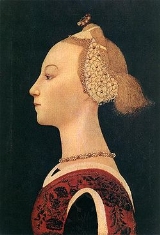
Paolo Uccello

Encyclopedia
Paolo Uccello born Paolo di Dono, was an Italian
painter and a mathematician who was notable for his pioneering work on visual perspective
in art. Giorgio Vasari
in his book Lives of the Artists wrote that Uccello was obsessed by his interest in perspective and would stay up all night in his study trying to grasp the exact vanishing point. He used perspective in order to create a feeling of depth in his paintings and not, as his contemporaries, to narrate different or succeeding stories. His best known works are the three paintings
representing the battle of San Romano
(for a long time these were wrongly entitled the "Battle of Sant' Egidio of 1416").
Paolo worked in the Late Gothic
tradition, and emphasized colour and pageantry rather than the Classical realism that other artists were pioneering. His style is best described as idiosyncratic, and he left no school of followers. He has had some influence on twentieth century art (including the New Zealand
painter Melvin Day
) and literary criticism (e.g., in the "Vies imaginaires" by Marcel Schwob
, "Uccello le poil" by Antonin Artaud
and "O Mundo Como Ideia" by Bruno Tolentino
).
’s biography, written 75 years after Paolo’s death, and a few contemporary official documents. Uccello was born in Pratovecchio
in 1397. His tax declarations for some years indicate that he was born in 1397, but in 1446 he claimed to be born in 1396. His nickname Uccello came from his fondness for painting birds. His father, Dono di Paolo, was a barber-surgeon
from Pratovecchio
near Arezzo; his mother, Antonia, was a high-born Florentine.
At the age of ten, he was apprenticed to the famous sculptor Lorenzo Ghiberti
, designer of the doors of the Florence Baptistery, whose workshop was the premier centre for Florentine art at the time. Ghiberti's late-Gothic, narrative style and sculptural composition greatly influenced Paolo. It was also around this time that Paolo began his lifelong friendship with Donatello
. In 1414 Uccello was admitted to the painters' guild Compagnia di San Luca and just one year later, in 1415, he joined the official painter's guild of Florence Arte dei Medici e degli Speziali. By the mid 1420s the young Uccello probably left Ghiberti's workshop. He stayed on good terms with his master and may have been privy to the designs for Ghiberti's second set of Baptistery doors, The Gates of Paradise. These featured a battle scene, "that might well have impressed itself in the mind of the young Uccello ", and thus influenced The Battle of San Romano
.
According to Vasari, Uccello’s first painting was a Saint Anthony between the saints Cosmas and Damianus, a commission for the hospital of Lelmo. Next he painted two figures in the convent of Annalena. Shortly afterwards he painted three fresco
es with scenes from the life of Saint Francis
above the left door of the Santa Trinita
church. For the Santa Maria Maggiore
church he painted a fresco of the Annunciation
. In this fresco, he painted a large building with columns in perspective. Vasari writes that people thought this was a great and beautiful achievement.
Paolo painted the Lives of the Church Fathers
in the cloisters of the church of San Miniato
, on a hill overlooking Florence. For this fresco he used unusual colours (blue pastures, red bricks and different colours for the buildings) as a protest against his monotonous meals served by the abbot: cheese pies and cheese soup. In the end Paolo felt so miserable that he ran away. He only finished the job after the abbot promised to serve him normal meals.
Uccello was asked to paint a number of scenes of distempered animals for the house of the Medici. His depiction of a fierce lion fighting with a venom-spouting snake was especially appreciated by Vasari. Uccello loved to paint animals and he kept a large number of pictures of all kinds of animals, especially birds, at home. Because he was so fond of birds, he was aptly nicknamed Paolo Uccelli (Paul of the birds).
By 1424 Paolo was earning his own living as a painter. In that year he painted episodes of the Creation and expulsion for the Green Cloister (Chiostro Verde) of Santa Maria Novella in Florence (now badly damaged), proving his artistic maturity. Again, he was able to paint in a lively manner a large number of animals. As he succeeded in painting trees in their natural colours, in contrast with many of his predecessors, he began to acquire a reputation for painting landscapes. He continued with scenes from the Deluge, the story of Noah's Ark
, Noah's sacrifice and Noah's drunkenness. These scenes brought him great fame in Florence.
Around this time he was taught geometry by Antonio Manetti
.
 In 1425, Uccello travelled to Venice
, where he worked on the mosaics for the façade of San Marco
(all these works have been lost). Some suggest he visited Rome
with his friend Donatello before returning to Florence in 1431. He also painted some frescoes in the Prato Cathedral
and Bologna
.
In 1432 the Office of Works asked the Florentine ambassador in Venice to enquire after Uccello’s reputation as an artist. Uccello remained in Florence for most of the rest of his life, executing works for various churches and patrons, most notably the Duomo
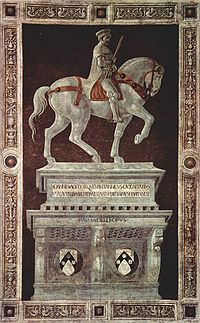
. In 1436 he was given the commission for the monochromatic fresco of Sir John Hawkwood
. In this equestrian monument he showed his keen interest in perspective
. The condottiere and his horse are presented as if the fresco was a sculpture, seen from below.
If, as is widely thought, he is the author of the frescoes Stories of the Virgin and Story of Saint Stephen in the Cappella dell'Assunta, Florence, then he would have visited nearby Prato
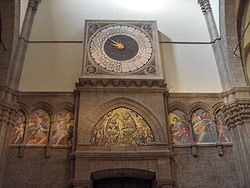
sometime between 1435 and 1440. In 1443, he painted the figures on the clock of the Duomo. In the same year and in 1444 he designed a few stained glass windows for the same church. In 1444 he was also at work in Padua
, and he travelled to Padua again in 1445 at Donatello’s invitation.
 Back in Florence in 1446, he painted the Green Stations of the Cross, again for the cloister of the church Santa Maria Novella. Around 1447–1454 he painted Scenes of Monastic Life for the church San Miniato al Monte
, Florence.
Around 1450–1456 he painted his three most famous paintings The Battle of San Romano, the victory of the Florentine army over the Sienese in 1432, for the Palazzo Medici in Florence. The extraordinarily foreshortened
forms extending in many planes accentuate Uccello's virtuosity as a draftsman, and provides a controlled visual structure to the chaos of the battle scene.
Uccello was married to Tommasa Malifici by 1453, because in that year Donato (named after Donatello) was born, and in 1456 his wife gave birth to Antonia.
In 1465, Uccello was in Urbino
with his son Donato, where he was engaged until 1469, working for the Confraternity of Corpus Domini, a brotherhood of laymen. He painted the predella
for their new altarpiece with the Miracle of the Profaned Host. (The main panel representing the "Communion of the Apostles" was commissioned to Justus van Ghent
and finished in 1474.) Uccello's predella comprises six meticulous, naturalistic scenes related to the antisemitic myth of host desecration
, based on a supposed event in Paris in 1290. It has been suggested that the subject of the main panel, on which Duke Frederick of Montefeltro of Urbino appears in the background conversing with an Oriental, is related to the antisemitic intention of the predella. Federico allowed a small Jewish community to live in Urbino. Not all these scenes are unanimously attributed to Paolo Uccello.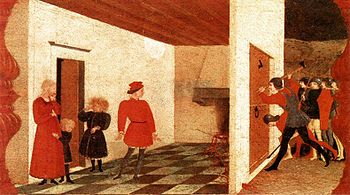 In his Florentine tax return of August 1469 he declared: “I find myself old and ailing, my wife is ill, and I can no longer work.” In his last years, he was a lonesome, forgotten man, afraid of hardship in life. His last known work is The Hunt
, c. 1470. He made his testament on 11 November 1475 and died shortly afterwards at the age of 78 on 10 December 1475 at the hospital of Florence. He was buried in his father’s tomb in the Florentine church of Santo Spirito.
With his precise, analytical mind he tried to apply a scientific method to depict objects in three-dimensional space. In particular, some of his studies of the perspective foreshortening of the torus
are preserved, and one standard display of drawing skill was his depictions of the mazzocchio. The perspective in his paintings has influenced famous painters such as Piero della Francesca
, Albrecht Dürer
and Leonardo da Vinci
, to name a few.
His daughter Antonia Uccello (1456–1491) was a Carmelite nun, whom Giorgio Vasari
called "a daughter who knew how to draw". She was even noted as a "pittoressa", a paintress, on her death certificate. Her style and her skill remains a mystery as none of her work is extant.
Italy
Italy , officially the Italian Republic languages]] under the European Charter for Regional or Minority Languages. In each of these, Italy's official name is as follows:;;;;;;;;), is a unitary parliamentary republic in South-Central Europe. To the north it borders France, Switzerland, Austria and...
painter and a mathematician who was notable for his pioneering work on visual perspective
Perspective (graphical)
Perspective in the graphic arts, such as drawing, is an approximate representation, on a flat surface , of an image as it is seen by the eye...
in art. Giorgio Vasari
Giorgio Vasari
Giorgio Vasari was an Italian painter, writer, historian, and architect, who is famous today for his biographies of Italian artists, considered the ideological foundation of art-historical writing.-Biography:...
in his book Lives of the Artists wrote that Uccello was obsessed by his interest in perspective and would stay up all night in his study trying to grasp the exact vanishing point. He used perspective in order to create a feeling of depth in his paintings and not, as his contemporaries, to narrate different or succeeding stories. His best known works are the three paintings
The Battle of San Romano
The Battle of San Romano is a set of three paintings by the Florentine painter Paolo Uccello depicting events that took place at the Battle of San Romano between Florentine and Sienese forces in 1432. They are significant as revealing the development of linear perspective in early Italian...
representing the battle of San Romano
Battle of San Romano
The Battle of San Romano was fought on June 1st 1432, some 30 miles outside Florence, between the troops of Florence, commanded by Niccolò da Tolentino, and Siena, under Francesco Piccinino. The outcome is generally considered favourable to the Florentines, but in the Sienese chronicles it was...
(for a long time these were wrongly entitled the "Battle of Sant' Egidio of 1416").
Paolo worked in the Late Gothic
International Gothic
International Gothic is a phase of Gothic art which developed in Burgundy, Bohemia, France and northern Italy in the late 14th century and early 15th century...
tradition, and emphasized colour and pageantry rather than the Classical realism that other artists were pioneering. His style is best described as idiosyncratic, and he left no school of followers. He has had some influence on twentieth century art (including the New Zealand
New Zealand
New Zealand is an island country in the south-western Pacific Ocean comprising two main landmasses and numerous smaller islands. The country is situated some east of Australia across the Tasman Sea, and roughly south of the Pacific island nations of New Caledonia, Fiji, and Tonga...
painter Melvin Day
Melvin Day
Melvin "Pat" Day, CNZM is a New Zealand artist and art historian.Day was born in Hamilton, New Zealand. At the age of eleven, Day began Saturday morning classes at Elam School of Art, University of Auckland, under the tuteleage of Archie Fisher, John Weeks, Lois White and Ida Eise...
) and literary criticism (e.g., in the "Vies imaginaires" by Marcel Schwob
Marcel Schwob
Marcel Schwob was a Jewish French writer.-Biography:He was born in Chaville, Hauts-de-Seine on 23 August 1867...
, "Uccello le poil" by Antonin Artaud
Antonin Artaud
Antoine Marie Joseph Artaud, more well-known as Antonin Artaud was a French playwright, poet, actor and theatre director...
and "O Mundo Como Ideia" by Bruno Tolentino
Bruno Tolentino
Bruno Lúcio de Carvalho Tolentino was a Brazilian poet and intellectual, known for his militant opposition towards Brazilian modernism, his advocacy of traditional forms and subjects in poetry, his loathing of popular culture and concrete poetry, his self-parading as a "member of the Brazilian...
).
Life
The sources for Paolo Uccello’s life are few: Giorgio VasariGiorgio Vasari
Giorgio Vasari was an Italian painter, writer, historian, and architect, who is famous today for his biographies of Italian artists, considered the ideological foundation of art-historical writing.-Biography:...
’s biography, written 75 years after Paolo’s death, and a few contemporary official documents. Uccello was born in Pratovecchio
Pratovecchio
-History:Dono di Paolo, father of the Florentine artist Paolo Uccello, was a barber-surgeon from Pratovecchio. Dono moved to Florence and became a citizen there in 1373.-Main sights:...
in 1397. His tax declarations for some years indicate that he was born in 1397, but in 1446 he claimed to be born in 1396. His nickname Uccello came from his fondness for painting birds. His father, Dono di Paolo, was a barber-surgeon
Barber
A barber is someone whose occupation is to cut any type of hair, and to shave or trim the beards of men. The place of work of a barber is generally called a barbershop....
from Pratovecchio
Pratovecchio
-History:Dono di Paolo, father of the Florentine artist Paolo Uccello, was a barber-surgeon from Pratovecchio. Dono moved to Florence and became a citizen there in 1373.-Main sights:...
near Arezzo; his mother, Antonia, was a high-born Florentine.
At the age of ten, he was apprenticed to the famous sculptor Lorenzo Ghiberti
Lorenzo Ghiberti
Lorenzo Ghiberti , born Lorenzo di Bartolo, was an Italian artist of the early Renaissance best known for works in sculpture and metalworking.-Early life:...
, designer of the doors of the Florence Baptistery, whose workshop was the premier centre for Florentine art at the time. Ghiberti's late-Gothic, narrative style and sculptural composition greatly influenced Paolo. It was also around this time that Paolo began his lifelong friendship with Donatello
Donatello
Donato di Niccolò di Betto Bardi , also known as Donatello, was an early Renaissance Italian artist and sculptor from Florence...
. In 1414 Uccello was admitted to the painters' guild Compagnia di San Luca and just one year later, in 1415, he joined the official painter's guild of Florence Arte dei Medici e degli Speziali. By the mid 1420s the young Uccello probably left Ghiberti's workshop. He stayed on good terms with his master and may have been privy to the designs for Ghiberti's second set of Baptistery doors, The Gates of Paradise. These featured a battle scene, "that might well have impressed itself in the mind of the young Uccello ", and thus influenced The Battle of San Romano
The Battle of San Romano
The Battle of San Romano is a set of three paintings by the Florentine painter Paolo Uccello depicting events that took place at the Battle of San Romano between Florentine and Sienese forces in 1432. They are significant as revealing the development of linear perspective in early Italian...
.
According to Vasari, Uccello’s first painting was a Saint Anthony between the saints Cosmas and Damianus, a commission for the hospital of Lelmo. Next he painted two figures in the convent of Annalena. Shortly afterwards he painted three fresco
Fresco
Fresco is any of several related mural painting types, executed on plaster on walls or ceilings. The word fresco comes from the Greek word affresca which derives from the Latin word for "fresh". Frescoes first developed in the ancient world and continued to be popular through the Renaissance...
es with scenes from the life of Saint Francis
Francis of Assisi
Saint Francis of Assisi was an Italian Catholic friar and preacher. He founded the men's Franciscan Order, the women’s Order of St. Clare, and the lay Third Order of Saint Francis. St...
above the left door of the Santa Trinita
Santa Trinita
Santa Trinita is a church in central Florence, Italy. It is the mother church of the Vallumbrosan Order of monks, founded in 1092 by a Florentine nobleman...
church. For the Santa Maria Maggiore
Santa Maria Maggiore di Firenze
Santa Maria Maggiore di Firenze is a medieval church in Florence, Italy.The church was originally constructed in the 11th century and underwent extensive renovations to the facade and sides in the 13th century.-History:...
church he painted a fresco of the Annunciation
Annunciation
The Annunciation, also referred to as the Annunciation to the Blessed Virgin Mary or Annunciation of the Lord, is the Christian celebration of the announcement by the angel Gabriel to Virgin Mary, that she would conceive and become the mother of Jesus the Son of God. Gabriel told Mary to name her...
. In this fresco, he painted a large building with columns in perspective. Vasari writes that people thought this was a great and beautiful achievement.
Paolo painted the Lives of the Church Fathers
Church Fathers
The Church Fathers, Early Church Fathers, Christian Fathers, or Fathers of the Church were early and influential theologians, eminent Christian teachers and great bishops. Their scholarly works were used as a precedent for centuries to come...
in the cloisters of the church of San Miniato
San Miniato
San Miniato is a town and comune in the province of Pisa, in the region of Tuscany, Italy.San Miniato sits at an historically strategic location atop three small hills where it dominates the lower Arno valley between the valleys of Egola and Elsa...
, on a hill overlooking Florence. For this fresco he used unusual colours (blue pastures, red bricks and different colours for the buildings) as a protest against his monotonous meals served by the abbot: cheese pies and cheese soup. In the end Paolo felt so miserable that he ran away. He only finished the job after the abbot promised to serve him normal meals.
Uccello was asked to paint a number of scenes of distempered animals for the house of the Medici. His depiction of a fierce lion fighting with a venom-spouting snake was especially appreciated by Vasari. Uccello loved to paint animals and he kept a large number of pictures of all kinds of animals, especially birds, at home. Because he was so fond of birds, he was aptly nicknamed Paolo Uccelli (Paul of the birds).
By 1424 Paolo was earning his own living as a painter. In that year he painted episodes of the Creation and expulsion for the Green Cloister (Chiostro Verde) of Santa Maria Novella in Florence (now badly damaged), proving his artistic maturity. Again, he was able to paint in a lively manner a large number of animals. As he succeeded in painting trees in their natural colours, in contrast with many of his predecessors, he began to acquire a reputation for painting landscapes. He continued with scenes from the Deluge, the story of Noah's Ark
Noah's Ark
Noah's Ark is a vessel appearing in the Book of Genesis and the Quran . These narratives describe the construction of the ark by Noah at God's command to save himself, his family, and the world's animals from the worldwide deluge of the Great Flood.In the narrative of the ark, God sees the...
, Noah's sacrifice and Noah's drunkenness. These scenes brought him great fame in Florence.
Around this time he was taught geometry by Antonio Manetti
Antonio Manetti
Antonio Manetti was an Italian mathematician and architect from Florence. He was also the biographer of the architect Filippo Brunelleschi....
.
Venice
Venice is a city in northern Italy which is renowned for the beauty of its setting, its architecture and its artworks. It is the capital of the Veneto region...
, where he worked on the mosaics for the façade of San Marco
St Mark's Basilica
The Patriarchal Cathedral Basilica of Saint Mark is the cathedral church of the Roman Catholic Archdiocese of Venice, northern Italy. It is the most famous of the city's churches and one of the best known examples of Byzantine architecture...
(all these works have been lost). Some suggest he visited Rome
Rome
Rome is the capital of Italy and the country's largest and most populated city and comune, with over 2.7 million residents in . The city is located in the central-western portion of the Italian Peninsula, on the Tiber River within the Lazio region of Italy.Rome's history spans two and a half...
with his friend Donatello before returning to Florence in 1431. He also painted some frescoes in the Prato Cathedral
Prato Cathedral
The Cathedral of Prato is the main Catholic church of Prato, Tuscany, Central Italy and seat of the bishop. It is dedicated to St. Stephen, the first Christian martyr. It is one of the most ancient churches in the city, existing already in the 10th century and having been built and in several...
and Bologna
Bologna
Bologna is the capital city of Emilia-Romagna, in the Po Valley of Northern Italy. The city lies between the Po River and the Apennine Mountains, more specifically, between the Reno River and the Savena River. Bologna is a lively and cosmopolitan Italian college city, with spectacular history,...
.
In 1432 the Office of Works asked the Florentine ambassador in Venice to enquire after Uccello’s reputation as an artist. Uccello remained in Florence for most of the rest of his life, executing works for various churches and patrons, most notably the Duomo
Santa Maria del Fiore
The Basilica di Santa Maria del Fiore is the cathedral church of Florence, Italy. The Duomo, as it is ordinarily called, was begun in 1296 in the Gothic style to the design of Arnolfo di Cambio and completed structurally in 1436 with the dome engineered by Filippo Brunelleschi...
. In 1436 he was given the commission for the monochromatic fresco of Sir John Hawkwood
John Hawkwood
Sir John Hawkwood was an English mercenary or condottiero who was active in 14th century Italy. The French chronicler Jean Froissart knew him as Jean Haccoude and Italians as Giovanni Acuto...
. In this equestrian monument he showed his keen interest in perspective
Perspective (graphical)
Perspective in the graphic arts, such as drawing, is an approximate representation, on a flat surface , of an image as it is seen by the eye...
. The condottiere and his horse are presented as if the fresco was a sculpture, seen from below.
If, as is widely thought, he is the author of the frescoes Stories of the Virgin and Story of Saint Stephen in the Cappella dell'Assunta, Florence, then he would have visited nearby Prato
Prato
Prato is a city and comune in Tuscany, Italy, the capital of the Province of Prato. The city is situated at the foot of Monte Retaia , the last peak in the Calvana chain. The lowest altitude in the comune is 32 m, near the Cascine di Tavola, and the highest is the peak of Monte Cantagrillo...
sometime between 1435 and 1440. In 1443, he painted the figures on the clock of the Duomo. In the same year and in 1444 he designed a few stained glass windows for the same church. In 1444 he was also at work in Padua
Padua
Padua is a city and comune in the Veneto, northern Italy. It is the capital of the province of Padua and the economic and communications hub of the area. Padua's population is 212,500 . The city is sometimes included, with Venice and Treviso, in the Padua-Treviso-Venice Metropolitan Area, having...
, and he travelled to Padua again in 1445 at Donatello’s invitation.
Basilica di San Miniato al Monte
San Miniato al Monte is a basilica in Florence, central Italy, standing atop one of the highest points in the city. It has been described as one of the finest Romanesque structures in Tuscany and one of the most beautiful churches in Italy. There is an adjoining Olivetan monastery, seen to the...
, Florence.
Around 1450–1456 he painted his three most famous paintings The Battle of San Romano, the victory of the Florentine army over the Sienese in 1432, for the Palazzo Medici in Florence. The extraordinarily foreshortened
Perspective (graphical)
Perspective in the graphic arts, such as drawing, is an approximate representation, on a flat surface , of an image as it is seen by the eye...
forms extending in many planes accentuate Uccello's virtuosity as a draftsman, and provides a controlled visual structure to the chaos of the battle scene.
Uccello was married to Tommasa Malifici by 1453, because in that year Donato (named after Donatello) was born, and in 1456 his wife gave birth to Antonia.
In 1465, Uccello was in Urbino
Urbino
Urbino is a walled city in the Marche region of Italy, south-west of Pesaro, a World Heritage Site notable for a remarkable historical legacy of independent Renaissance culture, especially under the patronage of Federico da Montefeltro, duke of Urbino from 1444 to 1482...
with his son Donato, where he was engaged until 1469, working for the Confraternity of Corpus Domini, a brotherhood of laymen. He painted the predella
Predella
A predella is the platform or step on which an altar stands . In painting, the predella is the painting or sculpture along the frame at the bottom of an altarpiece...
for their new altarpiece with the Miracle of the Profaned Host. (The main panel representing the "Communion of the Apostles" was commissioned to Justus van Ghent
Joos van Wassenhove
Justus van Gent , Justus or Jodocus of Ghent, or Giusto da Guanto was an Early Netherlandish painter who later worked in Italy....
and finished in 1474.) Uccello's predella comprises six meticulous, naturalistic scenes related to the antisemitic myth of host desecration
Host desecration
Host desecration is a form of sacrilege in Christianity involving the mistreatment or malicious use of a consecrated host— the sacred bread used in the Eucharistic service or Mass...
, based on a supposed event in Paris in 1290. It has been suggested that the subject of the main panel, on which Duke Frederick of Montefeltro of Urbino appears in the background conversing with an Oriental, is related to the antisemitic intention of the predella. Federico allowed a small Jewish community to live in Urbino. Not all these scenes are unanimously attributed to Paolo Uccello.
The Hunt in the Forest
The Hunt in the Forest is a painting by the Italian artist Paolo Uccello, made around 1470...
, c. 1470. He made his testament on 11 November 1475 and died shortly afterwards at the age of 78 on 10 December 1475 at the hospital of Florence. He was buried in his father’s tomb in the Florentine church of Santo Spirito.
With his precise, analytical mind he tried to apply a scientific method to depict objects in three-dimensional space. In particular, some of his studies of the perspective foreshortening of the torus
Torus
In geometry, a torus is a surface of revolution generated by revolving a circle in three dimensional space about an axis coplanar with the circle...
are preserved, and one standard display of drawing skill was his depictions of the mazzocchio. The perspective in his paintings has influenced famous painters such as Piero della Francesca
Piero della Francesca
Piero della Francesca was a painter of the Early Renaissance. As testified by Giorgio Vasari in his Lives of the Artists, to contemporaries he was also known as a mathematician and geometer. Nowadays Piero della Francesca is chiefly appreciated for his art. His painting was characterized by its...
, Albrecht Dürer
Albrecht Dürer
Albrecht Dürer was a German painter, printmaker, engraver, mathematician, and theorist from Nuremberg. His prints established his reputation across Europe when he was still in his twenties, and he has been conventionally regarded as the greatest artist of the Northern Renaissance ever since...
and Leonardo da Vinci
Leonardo da Vinci
Leonardo di ser Piero da Vinci was an Italian Renaissance polymath: painter, sculptor, architect, musician, scientist, mathematician, engineer, inventor, anatomist, geologist, cartographer, botanist and writer whose genius, perhaps more than that of any other figure, epitomized the Renaissance...
, to name a few.
His daughter Antonia Uccello (1456–1491) was a Carmelite nun, whom Giorgio Vasari
Giorgio Vasari
Giorgio Vasari was an Italian painter, writer, historian, and architect, who is famous today for his biographies of Italian artists, considered the ideological foundation of art-historical writing.-Biography:...
called "a daughter who knew how to draw". She was even noted as a "pittoressa", a paintress, on her death certificate. Her style and her skill remains a mystery as none of her work is extant.
Works
Pope-Hennessy is far more conservative than the Italian authors: he attributes some of the works below to a "Prato Master" and a "Karlsruhe Master". Most of the dates in the list (taken from Borsi and Borsi) are derived from stylistic comparison rather than from documentation.- Annunciation (c. 1420–1425) - Ashmolean Museum, OxfordOxfordThe city of Oxford is the county town of Oxfordshire, England. The city, made prominent by its medieval university, has a population of just under 165,000, with 153,900 living within the district boundary. It lies about 50 miles north-west of London. The rivers Cherwell and Thames run through...
- Creation and Fall (c.1424–1425) - Lunette and lower section, Chiostro Verde, Santa Maria NovellaBasilica di Santa Maria NovellaSanta Maria Novella is a church in Florence, Italy, situated just across from the main railway station which shares its name. Chronologically, it is the first great basilica in Florence, and is the city's principal Dominican church....
, Florence - Adoration of the Magi (c. 1431–1432) - Staatliche Kunsthalle, KarlsruheKarlsruheThe City of Karlsruhe is a city in the southwest of Germany, in the state of Baden-Württemberg, located near the French-German border.Karlsruhe was founded in 1715 as Karlsruhe Palace, when Germany was a series of principalities and city states...
- St George and the Dragon (c. 1431) - National Gallery of VictoriaNational Gallery of VictoriaThe National Gallery of Victoria is an art gallery and museum in Melbourne, Australia. Founded in 1861, it is the oldest and the largest public art gallery in Australia. Since December 2003, NGV has operated across two sites...
, MelbourneMelbourneMelbourne is the capital and most populous city in the state of Victoria, and the second most populous city in Australia. The Melbourne City Centre is the hub of the greater metropolitan area and the Census statistical division—of which "Melbourne" is the common name. As of June 2009, the greater... - Quarate Predella (c. 1433) - Museo diocesano di Santo Stefano al Ponte, Florence
- Frescoes in the Capella dell' Assunta (c. 1434–1435) - Duomo, Prato
- Nun-Saint with Two Children (c.1434–1435) - Contini-Bonacosi Collection, Florence
- Funerary Monument to Sir John HawkwoodFunerary Monument to Sir John HawkwoodThe Funerary Monument to Sir John Hawkwood is a fresco by Paolo Uccello, commemorating English condottiero John Hawkwood, commissioned in 1436 for Florence's Basilica di Santa Maria del Fiore...
(c. 1436) - DuomoSanta Maria del FioreThe Basilica di Santa Maria del Fiore is the cathedral church of Florence, Italy. The Duomo, as it is ordinarily called, was begun in 1296 in the Gothic style to the design of Arnolfo di Cambio and completed structurally in 1436 with the dome engineered by Filippo Brunelleschi...
, Florence - The Battle of San RomanoThe Battle of San RomanoThe Battle of San Romano is a set of three paintings by the Florentine painter Paolo Uccello depicting events that took place at the Battle of San Romano between Florentine and Sienese forces in 1432. They are significant as revealing the development of linear perspective in early Italian...
, consisting of: - Battle of San Romano: Niccolò da Tolentino (c. 1450–1456) - National Gallery, LondonNational Gallery, LondonThe National Gallery is an art museum on Trafalgar Square, London, United Kingdom. Founded in 1824, it houses a collection of over 2,300 paintings dating from the mid-13th century to 1900. The gallery is an exempt charity, and a non-departmental public body of the Department for Culture, Media...
- Battle of San Romano: Bernadino della Ciarda unhorsed (c. 1450–1456) - Galleria degli Uffizi, Florence
- Battle of San Romano: Micheletto da Cotignola (c.1450) - Musée du Louvre, Paris
- St George and the Dragon (c. 1439–1440) - Musée Jacquemart-AndréMusée Jacquemart-AndréThe Musée Jacquemart-André is a public museum located at 158 Boulevard Haussmann in the 8th arrondissement of Paris. The museum was created from the private home of Édouard André and Nélie Jacquemart to display the art they collected during their lives.-History:Edouard André, the scion of a...
, Paris - Clock Face with Four Prophets/Evangelists (1443) - Duomo, Florence
- Resurrection (1443–1444) - stained glassStained glassThe term stained glass can refer to coloured glass as a material or to works produced from it. Throughout its thousand-year history, the term has been applied almost exclusively to the windows of churches and other significant buildings...
window, Duomo, Florence - Nativity (1443–1444) - stained glass window, Duomo, Florence
- Story of Noah (c. 1447) - lunette and lower section, Chiostro Verde, Santa Maria Novella, Florence
- Scenes of Monastic Life (c. 1447–1454) - S. Miniato al MonteBasilica di San Miniato al MonteSan Miniato al Monte is a basilica in Florence, central Italy, standing atop one of the highest points in the city. It has been described as one of the finest Romanesque structures in Tuscany and one of the most beautiful churches in Italy. There is an adjoining Olivetan monastery, seen to the...
, Florence - Saint George and the DragonSaint George and the Dragon (Uccello)Saint George and the Dragon is a painting by Paolo Uccello dating from around 1470. It is on display in the National Gallery, London, England. It was formerly housed in the Palais Lanckoroński in Vienna, belonging to Count Lanckoroński and sold by his son and heir Anton in 1959 through Mr Farago...
(c. 1450-55) - National Gallery, London - Crucifixion (c. 1457–1458) - Thyssen-Bornemisza Collection, Madrid
- Life of the Holy Fathers (c. 1460–1465) - Accademia, Florence
- Miracle of the Profaned Host (1467–1468) - predellaPredellaA predella is the platform or step on which an altar stands . In painting, the predella is the painting or sculpture along the frame at the bottom of an altarpiece...
, Galleria Nazionale delle Marche, Palazzo DucalePalazzo Ducale, UrbinoThe Ducal Palace is a Renaissance building in the Italian city of Urbino in the Marche. One of the most important monuments in Italy, it is listed as UNESCO World Heritage Site.-History:...
, UrbinoUrbinoUrbino is a walled city in the Marche region of Italy, south-west of Pesaro, a World Heritage Site notable for a remarkable historical legacy of independent Renaissance culture, especially under the patronage of Federico da Montefeltro, duke of Urbino from 1444 to 1482...
) - The Hunt in the ForestThe Hunt in the ForestThe Hunt in the Forest is a painting by the Italian artist Paolo Uccello, made around 1470...
(c. 1470) -- Ashmolean MuseumAshmolean MuseumThe Ashmolean Museum on Beaumont Street, Oxford, England, is the world's first university museum...
, Oxford
Sources
- Giorgio Vasari's life of Paolo Uccello translated by George Bull in Lives of the Artists, Part 1. Penguin Classics, 1965.
- D'Ancona, Paola. Paolo Uccello. New York: McGraw Hill, 1961.
- Barolsky, Paul. "The Painter Who Almost Became a Cheese" Virginia Quarterly Review, 70/1 (Winter 1994).
- Borsi, Franco & Stefano. Paolo Uccello. London: Thames & Hudson, 1994. (a massive monograph)
- Borsi, Stefano. Paolo Uccello. Art Dossier. Florence: Giunti, nd.
- Roberto Manescalchi, Paolo Uccello: un affresco dimenticato?, Grafica European Center of Fine Arts, Firenze 2006. ISBN 978-8-8954-5019-3
- Carli, Enzo. All the Paintings of Paolo Uccello. The Complete Library of World Art. London: Oldbourne, 1963. (originally published in Italian in the 1950s)
- Paolieri, Annarita. Paolo Uccello, Domenico Veneziano, Andrea del Castagno. Library of Great Masters. New York: SCALA/Riverside, 1991.
- Pope-Hennessy, John. Paolo Uccello: Complete Edition. 2nd ed. London: Phaidon, 1969. (the other important English-language monograph)