

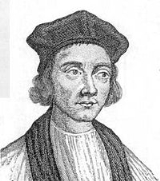
Cuthbert Tunstall

Encyclopedia
Cuthbert Tunstall was an English
Scholastic
, church leader, diplomat, administrator and royal adviser. He served as Prince-Bishop of Durham during the reigns of Henry VIII
, Edward VI
, Mary I
and Elizabeth I
.
, Yorkshire
in 1474, an illegitimate son of Thomas Tunstall of Thurland Castle, Lancashire
. His legitimate half-brother, Brian Tunstall, was killed at the Battle of Flodden in 1513. Cuthbert studied mathematics, theology, and law at Oxford
, Cambridge
, and Padua
, where he graduated Doctor of Laws. He was proficient in Greek
and Hebrew
.
William Warham
, Archbishop of Canterbury
made Tunstall his chancellor on 25 August 1511, and shortly afterward appointed him rector of Harrow on the Hill. He eventually became a canon
of Lincoln
(1514) and archdeacon of Chester (1515). Soon thereafter he was employed on diplomatic business by King Henry VIII
and Cardinal Wolsey. In 1515, Tunstall was sent to then-Flanders
, Belgium
with Sir Thomas More
. was at Brussels that he would meet Erasmus as well, becoming the intimate friend of both scholars. In 1519 he was sent to Cologne
; a visit to Worms
(1520–21) gave him a sense of the significance held by the Lutheran movement and its literature.
Tunstall was made Master of the Rolls
in 1516, and Dean
of Salisbury
in 1521. In 1522, he became Bishop of London
by papal provision, and on 25 May 1523 he was made Lord Keeper of the Privy Seal
. In 1525, he negotiated with the Holy Roman Emperor Charles V
after the Battle of Pavia
, and helped to arrange the Peace of Cambrai in 1529.
. Although he was often engaged in time-consuming negotiations with the Scots
, he took part in other public business, and attended parliament, where in 1539 he participated in the discussion on the Bill of Six Articles.
In the question of Henry's divorce, Tunstall acted as one of Queen Catherine
's counselors. Unlike Bishop John Fisher
and Sir Thomas More
, during the troubled years that followed Tunstall adopted a policy of passive obedience and acquiescence in many matters regarding which he likely had little support. While Tunstall adhered firmly to Roman Catholic doctrine and practices, after some hesitation he accepted Henry as head of the Church, and publicly defended this position – thus accepting a schism with Rome.
Tunstall disliked the religious policy pursued by the advisers of King Edward VI
, and voted against the first Act of Uniformity
in 1549. However, he continued to discharge his public duties without interruption, and hoped that the Earl of Warwick might be induced to reverse the anti-Catholic policy of the Duke of Somerset
. This hope failed, and after Somerset's fall, Tunstall was summoned to London in May of 1551, and confined to his house there. During this captivity he composed a treatise on the Eucharist
, which was published at Paris in 1554. At the end of 1551 he was imprisoned in the Tower of London
, and a bill for his deprivation was introduced into the House of Commons. When this failed, he was tried by a commission on 4–5 October 1552, and deprived of his bishopric.
to the throne in 1553, Tunstall was granted liberty. His bishopric, which had been dissolved by Act of Parliament in March 1553, was re-established by a further Act in April 1554. Tunstall, now an octogenarian, again assumed his office as Bishop of Durham. He maintained his earlier conciliatory approach, indulging in no systematic persecution of Protestants. Through Mary's reign he ruled his diocese in peace.
When Elizabeth I
ascended to the throne, Tunstall refused to take the Oath of Supremacy
, and would not participate in the consecration of the Protestant Matthew Parker
as Archbishop of Canterbury
. He was arrested, deprived of his diocese
in September 1559, and held prisoner at Lambeth Palace
, where he died within a few weeks, aged 85. He was one of eleven Catholic bishops to die in custody during Elizabeth's reign.
The Anglican historian Albert F. Pollard
wrote:
England
England is a country that is part of the United Kingdom. It shares land borders with Scotland to the north and Wales to the west; the Irish Sea is to the north west, the Celtic Sea to the south west, with the North Sea to the east and the English Channel to the south separating it from continental...
Scholastic
Scholasticism
Scholasticism is a method of critical thought which dominated teaching by the academics of medieval universities in Europe from about 1100–1500, and a program of employing that method in articulating and defending orthodoxy in an increasingly pluralistic context...
, church leader, diplomat, administrator and royal adviser. He served as Prince-Bishop of Durham during the reigns of Henry VIII
Henry VIII of England
Henry VIII was King of England from 21 April 1509 until his death. He was Lord, and later King, of Ireland, as well as continuing the nominal claim by the English monarchs to the Kingdom of France...
, Edward VI
Edward VI of England
Edward VI was the King of England and Ireland from 28 January 1547 until his death. He was crowned on 20 February at the age of nine. The son of Henry VIII and Jane Seymour, Edward was the third monarch of the Tudor dynasty and England's first monarch who was raised as a Protestant...
, Mary I
Mary I of England
Mary I was queen regnant of England and Ireland from July 1553 until her death.She was the only surviving child born of the ill-fated marriage of Henry VIII and his first wife Catherine of Aragon. Her younger half-brother, Edward VI, succeeded Henry in 1547...
and Elizabeth I
Elizabeth I of England
Elizabeth I was queen regnant of England and Ireland from 17 November 1558 until her death. Sometimes called The Virgin Queen, Gloriana, or Good Queen Bess, Elizabeth was the fifth and last monarch of the Tudor dynasty...
.
Childhood and early career
Cuthbert Tunstall was born at HackforthHackforth
Hackforth is a small village and civil parish in the Hambleton district of North Yorkshire, England, about 4 miles north ofBedale. Nearby settlements include Langthorne and Crakehall. The pub is called the "Greyhound"....
, Yorkshire
Yorkshire
Yorkshire is a historic county of northern England and the largest in the United Kingdom. Because of its great size in comparison to other English counties, functions have been increasingly undertaken over time by its subdivisions, which have also been subject to periodic reform...
in 1474, an illegitimate son of Thomas Tunstall of Thurland Castle, Lancashire
Lancashire
Lancashire is a non-metropolitan county of historic origin in the North West of England. It takes its name from the city of Lancaster, and is sometimes known as the County of Lancaster. Although Lancaster is still considered to be the county town, Lancashire County Council is based in Preston...
. His legitimate half-brother, Brian Tunstall, was killed at the Battle of Flodden in 1513. Cuthbert studied mathematics, theology, and law at Oxford
University of Oxford
The University of Oxford is a university located in Oxford, United Kingdom. It is the second-oldest surviving university in the world and the oldest in the English-speaking world. Although its exact date of foundation is unclear, there is evidence of teaching as far back as 1096...
, Cambridge
University of Cambridge
The University of Cambridge is a public research university located in Cambridge, United Kingdom. It is the second-oldest university in both the United Kingdom and the English-speaking world , and the seventh-oldest globally...
, and Padua
University of Padua
The University of Padua is a premier Italian university located in the city of Padua, Italy. The University of Padua was founded in 1222 as a school of law and was one of the most prominent universities in early modern Europe. It is among the earliest universities of the world and the second...
, where he graduated Doctor of Laws. He was proficient in Greek
Greek language
Greek is an independent branch of the Indo-European family of languages. Native to the southern Balkans, it has the longest documented history of any Indo-European language, spanning 34 centuries of written records. Its writing system has been the Greek alphabet for the majority of its history;...
and Hebrew
Hebrew language
Hebrew is a Semitic language of the Afroasiatic language family. Culturally, is it considered by Jews and other religious groups as the language of the Jewish people, though other Jewish languages had originated among diaspora Jews, and the Hebrew language is also used by non-Jewish groups, such...
.
William Warham
William Warham
William Warham , Archbishop of Canterbury, belonged to a Hampshire family, and was educated at Winchester and New College, Oxford, afterwards practising and teaching law both in London and Oxford....
, Archbishop of Canterbury
Archbishop of Canterbury
The Archbishop of Canterbury is the senior bishop and principal leader of the Church of England, the symbolic head of the worldwide Anglican Communion, and the diocesan bishop of the Diocese of Canterbury. In his role as head of the Anglican Communion, the archbishop leads the third largest group...
made Tunstall his chancellor on 25 August 1511, and shortly afterward appointed him rector of Harrow on the Hill. He eventually became a canon
Canon (priest)
A canon is a priest or minister who is a member of certain bodies of the Christian clergy subject to an ecclesiastical rule ....
of Lincoln
Lincoln Cathedral
Lincoln Cathedral is a historic Anglican cathedral in Lincoln in England and seat of the Bishop of Lincoln in the Church of England. It was reputedly the tallest building in the world for 249 years . The central spire collapsed in 1549 and was not rebuilt...
(1514) and archdeacon of Chester (1515). Soon thereafter he was employed on diplomatic business by King Henry VIII
Henry VIII of England
Henry VIII was King of England from 21 April 1509 until his death. He was Lord, and later King, of Ireland, as well as continuing the nominal claim by the English monarchs to the Kingdom of France...
and Cardinal Wolsey. In 1515, Tunstall was sent to then-Flanders
Flanders
Flanders is the community of the Flemings but also one of the institutions in Belgium, and a geographical region located in parts of present-day Belgium, France and the Netherlands. "Flanders" can also refer to the northern part of Belgium that contains Brussels, Bruges, Ghent and Antwerp...
, Belgium
Belgium
Belgium , officially the Kingdom of Belgium, is a federal state in Western Europe. It is a founding member of the European Union and hosts the EU's headquarters, and those of several other major international organisations such as NATO.Belgium is also a member of, or affiliated to, many...
with Sir Thomas More
Thomas More
Sir Thomas More , also known by Catholics as Saint Thomas More, was an English lawyer, social philosopher, author, statesman and noted Renaissance humanist. He was an important councillor to Henry VIII of England and, for three years toward the end of his life, Lord Chancellor...
. was at Brussels that he would meet Erasmus as well, becoming the intimate friend of both scholars. In 1519 he was sent to Cologne
Cologne
Cologne is Germany's fourth-largest city , and is the largest city both in the Germany Federal State of North Rhine-Westphalia and within the Rhine-Ruhr Metropolitan Area, one of the major European metropolitan areas with more than ten million inhabitants.Cologne is located on both sides of the...
; a visit to Worms
Worms, Germany
Worms is a city in Rhineland-Palatinate, Germany, on the Rhine River. At the end of 2004, it had 85,829 inhabitants.Established by the Celts, who called it Borbetomagus, Worms today remains embattled with the cities Trier and Cologne over the title of "Oldest City in Germany." Worms is the only...
(1520–21) gave him a sense of the significance held by the Lutheran movement and its literature.
Tunstall was made Master of the Rolls
Master of the Rolls
The Keeper or Master of the Rolls and Records of the Chancery of England, known as the Master of the Rolls, is the second most senior judge in England and Wales, after the Lord Chief Justice. The Master of the Rolls is the presiding officer of the Civil Division of the Court of Appeal...
in 1516, and Dean
Dean (religion)
A dean, in a church context, is a cleric holding certain positions of authority within a religious hierarchy. The title is used mainly in the Anglican Communion and the Roman Catholic Church.-Anglican Communion:...
of Salisbury
Salisbury Cathedral
Salisbury Cathedral, formally known as the Cathedral Church of the Blessed Virgin Mary, is an Anglican cathedral in Salisbury, England, considered one of the leading examples of Early English architecture....
in 1521. In 1522, he became Bishop of London
Bishop of London
The Bishop of London is the ordinary of the Church of England Diocese of London in the Province of Canterbury.The diocese covers 458 km² of 17 boroughs of Greater London north of the River Thames and a small part of the County of Surrey...
by papal provision, and on 25 May 1523 he was made Lord Keeper of the Privy Seal
Lord Privy Seal
The Lord Privy Seal is the fifth of the Great Officers of State in the United Kingdom, ranking beneath the Lord President of the Council and above the Lord Great Chamberlain. The office is one of the traditional sinecure offices of state...
. In 1525, he negotiated with the Holy Roman Emperor Charles V
Charles V, Holy Roman Emperor
Charles V was ruler of the Holy Roman Empire from 1519 and, as Charles I, of the Spanish Empire from 1516 until his voluntary retirement and abdication in favor of his younger brother Ferdinand I and his son Philip II in 1556.As...
after the Battle of Pavia
Battle of Pavia
The Battle of Pavia, fought on the morning of 24 February 1525, was the decisive engagement of the Italian War of 1521–26.A Spanish-Imperial army under the nominal command of Charles de Lannoy attacked the French army under the personal command of Francis I of France in the great hunting preserve...
, and helped to arrange the Peace of Cambrai in 1529.
Bishop of Durham under Henry VIII and Edward VI
On 22 February 1530 — again by papal provision — Tunstall succeeded Cardinal Wolsey as Bishop of Durham. This role involved the assumption of quasi-regal power and authority within the territory of the diocese. In 1537 he was also made President of the new Council of the NorthCouncil of the North
The Council of the North was an administrative body originally set up in 1484 by king Richard III of England, the third and last Yorkist monarch to hold the Crown of England; its intention was to improve government control and economic prosperity, to benefit the entire area of Northern England...
. Although he was often engaged in time-consuming negotiations with the Scots
Scottish people
The Scottish people , or Scots, are a nation and ethnic group native to Scotland. Historically they emerged from an amalgamation of the Picts and Gaels, incorporating neighbouring Britons to the south as well as invading Germanic peoples such as the Anglo-Saxons and the Norse.In modern use,...
, he took part in other public business, and attended parliament, where in 1539 he participated in the discussion on the Bill of Six Articles.
In the question of Henry's divorce, Tunstall acted as one of Queen Catherine
Catherine of Aragon
Catherine of Aragon , also known as Katherine or Katharine, was Queen consort of England as the first wife of King Henry VIII of England and Princess of Wales as the wife to Arthur, Prince of Wales...
's counselors. Unlike Bishop John Fisher
John Fisher
Saint John Fisher was an English Roman Catholic scholastic, bishop, cardinal and martyr. He shares his feast day with Saint Thomas More on 22 June in the Roman Catholic calendar of saints and 6 July on the Church of England calendar of saints...
and Sir Thomas More
Thomas More
Sir Thomas More , also known by Catholics as Saint Thomas More, was an English lawyer, social philosopher, author, statesman and noted Renaissance humanist. He was an important councillor to Henry VIII of England and, for three years toward the end of his life, Lord Chancellor...
, during the troubled years that followed Tunstall adopted a policy of passive obedience and acquiescence in many matters regarding which he likely had little support. While Tunstall adhered firmly to Roman Catholic doctrine and practices, after some hesitation he accepted Henry as head of the Church, and publicly defended this position – thus accepting a schism with Rome.
Tunstall disliked the religious policy pursued by the advisers of King Edward VI
Edward VI of England
Edward VI was the King of England and Ireland from 28 January 1547 until his death. He was crowned on 20 February at the age of nine. The son of Henry VIII and Jane Seymour, Edward was the third monarch of the Tudor dynasty and England's first monarch who was raised as a Protestant...
, and voted against the first Act of Uniformity
Act of Uniformity 1549
The Act of Uniformity 1549 established The Book of Common Prayer as the sole legal form of worship in England...
in 1549. However, he continued to discharge his public duties without interruption, and hoped that the Earl of Warwick might be induced to reverse the anti-Catholic policy of the Duke of Somerset
Edward Seymour, 1st Duke of Somerset
Edward Seymour, 1st Duke of Somerset, 1st Earl of Hertford, 1st Viscount Beauchamp of Hache, KG, Earl Marshal was Lord Protector of England in the period between the death of Henry VIII in 1547 and his own indictment in 1549....
. This hope failed, and after Somerset's fall, Tunstall was summoned to London in May of 1551, and confined to his house there. During this captivity he composed a treatise on the Eucharist
Eucharist
The Eucharist , also called Holy Communion, the Sacrament of the Altar, the Blessed Sacrament, the Lord's Supper, and other names, is a Christian sacrament or ordinance...
, which was published at Paris in 1554. At the end of 1551 he was imprisoned in the Tower of London
Tower of London
Her Majesty's Royal Palace and Fortress, more commonly known as the Tower of London, is a historic castle on the north bank of the River Thames in central London, England. It lies within the London Borough of Tower Hamlets, separated from the eastern edge of the City of London by the open space...
, and a bill for his deprivation was introduced into the House of Commons. When this failed, he was tried by a commission on 4–5 October 1552, and deprived of his bishopric.
Bishop of Durham under Mary I and Elizabeth I
On the ascension of Mary IMary I of England
Mary I was queen regnant of England and Ireland from July 1553 until her death.She was the only surviving child born of the ill-fated marriage of Henry VIII and his first wife Catherine of Aragon. Her younger half-brother, Edward VI, succeeded Henry in 1547...
to the throne in 1553, Tunstall was granted liberty. His bishopric, which had been dissolved by Act of Parliament in March 1553, was re-established by a further Act in April 1554. Tunstall, now an octogenarian, again assumed his office as Bishop of Durham. He maintained his earlier conciliatory approach, indulging in no systematic persecution of Protestants. Through Mary's reign he ruled his diocese in peace.
When Elizabeth I
Elizabeth I of England
Elizabeth I was queen regnant of England and Ireland from 17 November 1558 until her death. Sometimes called The Virgin Queen, Gloriana, or Good Queen Bess, Elizabeth was the fifth and last monarch of the Tudor dynasty...
ascended to the throne, Tunstall refused to take the Oath of Supremacy
Oath of Supremacy
The Oath of Supremacy, originally imposed by King Henry VIII of England through the Act of Supremacy 1534, but repealed by his daughter, Queen Mary I of England and reinstated under Mary's sister, Queen Elizabeth I of England under the Act of Supremacy 1559, provided for any person taking public or...
, and would not participate in the consecration of the Protestant Matthew Parker
Matthew Parker
Matthew Parker was Archbishop of Canterbury from 1559 until his death in 1575. He was also an influential theologian and arguably the co-founder of Anglican theological thought....
as Archbishop of Canterbury
Archbishop of Canterbury
The Archbishop of Canterbury is the senior bishop and principal leader of the Church of England, the symbolic head of the worldwide Anglican Communion, and the diocesan bishop of the Diocese of Canterbury. In his role as head of the Anglican Communion, the archbishop leads the third largest group...
. He was arrested, deprived of his diocese
Episcopal See
An episcopal see is, in the original sense, the official seat of a bishop. This seat, which is also referred to as the bishop's cathedra, is placed in the bishop's principal church, which is therefore called the bishop's cathedral...
in September 1559, and held prisoner at Lambeth Palace
Lambeth Palace
Lambeth Palace is the official London residence of the Archbishop of Canterbury in England. It is located in Lambeth, on the south bank of the River Thames a short distance upstream of the Palace of Westminster on the opposite shore. It was acquired by the archbishopric around 1200...
, where he died within a few weeks, aged 85. He was one of eleven Catholic bishops to die in custody during Elizabeth's reign.
The Anglican historian Albert F. Pollard
Albert Pollard
Albert Frederick Pollard was a British historian who specialized in the Tudor period.-Life and career:Pollard was born in Ryde on the Isle of Wight. He was educated at Felsted School and Jesus College, Oxford where he achieved a first class honours in Modern History in 1891...
wrote:
"Tunstall's long career of eighty-five years, for thirty-seven of which he was a bishop, is one of the most consistent and honourable in the sixteenth century. The extent of the religious revolution under Edward VI caused him to reverse his views on the royal supremacy and he refused to change them again under Elizabeth."
Further reading
- De arte supputandi libri quattuor (1522)
-
- Based on the Summa of Luca PacioliLuca PacioliFra Luca Bartolomeo de Pacioli was an Italian mathematician, Franciscan friar, collaborator with Leonardo da Vinci, and seminal contributor to the field now known as accounting...
, this was the first printed work published in England that was devoted exclusively to mathematicsMathematicsMathematics is the study of quantity, space, structure, and change. Mathematicians seek out patterns and formulate new conjectures. Mathematicians resolve the truth or falsity of conjectures by mathematical proofs, which are arguments sufficient to convince other mathematicians of their validity...
.- Confutatio cavillationum quibus SS. Eucharistiae Sacramentum ab impiis Caphernaitis impeti solet (Paris, 1552)
- De veritate corporis et sanguinis domini nostri Jesu Christi in eucharistia (Paris, 1554)
- Compendium in decem libros ethicorum Aristotelis (Paris, 1554)
- Certaine godly and devout prayers made in Latin by C. Tunstall and translated into Englishe by Thomas Paynelle, Clerke (London, 1558).
- Tunstall's correspondence as president of the Council of the North is in the British LibraryBritish LibraryThe British Library is the national library of the United Kingdom, and is the world's largest library in terms of total number of items. The library is a major research library, holding over 150 million items from every country in the world, in virtually all known languages and in many formats,...
.
- Based on the Summa of Luca Pacioli