

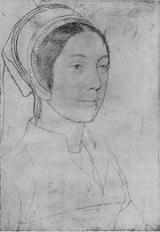
Catherine Howard

Encyclopedia
Catherine Howard also spelled Katherine, Katheryn or Kathryn, was the fifth wife
of Henry VIII of England
, and sometimes known by his reference to her as his "rose without a thorn".
Catherine's birth date and place of birth are unknown, but are occasionally cited as 1521 or 1525, possibly in Wingate, County Durham
. The new Oxford Dictionary of National Biography gives her date of birth as anywhere between 1518-1524. Catherine married Henry VIII on 28 July 1540, at Oatlands Palace
, in Surrey
, almost immediately after the annulment
of his marriage to Anne of Cleves
was arranged. However, she was beheaded after less than two years of marriage to Henry on the grounds of treason
for committing adultery
while married to the King. Catherine was the third of Henry's consorts to have been a commoner.
and Joyce Culpeper
. Catherine's exact date of birth is unknown, although the year has been estimated as being after 1520, but before 1527. She was the niece of Elizabeth Howard
, who was the mother of Queen Anne Boleyn
. Therefore, Catherine Howard and Anne Boleyn were first cousins. In addition, Catherine Howard and the Princess Elizabeth (later Elizabeth I) were first-cousins-once-removed.
As a granddaughter of Thomas Howard, 2nd Duke of Norfolk
, Catherine had an aristocratic
pedigree, but her father, who was a younger son, was not well-off owing to primogeniture
and the large size of his family. As a result, he was often reduced to begging for handouts from his more powerful relatives. In 1531, he was appointed Controller of Calais
. He was dismissed from his post in 1539, and died in March of the same year.
During her early childhood, Catherine was sent to live in the household of her step-grandmother, the Dowager Duchess of Norfolk. The Dowager Duchess presided over households at Chesworth House, near Horsham
, and Norfolk House
, at Lambeth
, comprising numerous male and female attendants along with her many wards, usually the children of aristocratic but poor relatives. While sending young children to be educated and trained in aristocratic households other than their own was common for centuries among European nobles, supervision at Lambeth was apparently lax. The Dowager Duchess was often at Court and seems to have taken little interest in the education and upbringing of her wards and young female attendants.
As a result of the Dowager Duchess' lack of attention, Catherine was not as well educated as some of Henry's other wives, though her ability to read and write alone was impressive enough for the time period. Her character has often been described as vivacious, beautiful, and buxom, but never scholarly or devout. The casual upbringing in the licentious atmosphere of the Duchess' household led to Catherine's music teacher, Henry Mannox, to start a sexual relationship with her around 1536, when she was between the ages of eleven and sixteen. He later gave evidence in the inquiry against her. Mannox and Catherine both confessed during her adultery trial that they had engaged in sexual contact, but not intercourse. Catherine was even quoted as saying, "At the flattering and fair persuasions of Mannox, being but a young girl, I suffered him at sundry times to handle and touch the secret parts of my body which neither became me with honesty to permit nor him to require."
This adolescent affair came to an end in 1538, when Catherine was pursued by a secretary of the Dowager Duchess' household, Francis Dereham
. They became lovers, addressing each other as "husband" and "wife". Dereham also entrusted Catherine with various wifely duties, such as keeping his money when he was away on business. Many of Catherine's roommates among the Dowager Duchess' maids of honour and attendants knew of the relationship, which apparently ended in 1539 when the Dowager Duchess caught wind of the matter. Despite this disapproval, Catherine and Dereham may have parted with intentions to marry upon his return from Ireland
, agreeing to a precontract, as it was then known. If indeed they had exchanged vows of their intention to marry before having sexual intercourse, they would have been considered married in the eyes of the Church.
, found her a place at Court in the household of the King's fourth wife, the German Anne of Cleves
. As a young and attractive lady-in-waiting
, Catherine quickly caught Henry's eye, who had displayed little interest in Anne from the beginning. The Howards may have sought to recreate the influence they gained during the reign of Anne Boleyn, and the mostly religiously conservative Howard family
may have seen Catherine as a figurehead for their determination to restore Catholicism
to England. As the King's interest in Catherine grew, so did their influence. Within months of her arrival at Court, Henry bestowed gifts of land and expensive cloth upon Catherine.
by fathering healthy, legitimate sons, especially since he only had one, Edward. Henry, nearing fifty and expanding in girth, showered his young bride with wealth, jewels, and other expensive gifts. War with France
and the English Reformation
had cost Henry much of his people's goodwill, and he suffered from a number of ailments. Catherine's motto, "Non autre volonté que la sienne", or, "No other will but his", supposedly reflected her desire to keep Henry, an ailing man three decades her senior, content. At this point in his life, the King weighed around twenty-one stone (about 140 kilograms, or 300 pounds), and had a foul-smelling, festering ulcer on his thigh that had to be drained daily.
Early in 1541, Catherine embarked upon a romance with Henry's favorite male courtier, Thomas Culpeper
, a young man who, according to Dereham's testimony 'had succeeded [him] in the Queen's affections', and who Catherine had considered marrying during her time as a maid-of-honour to Anne of Cleves. The couple's meetings were arranged by one of Catherine's older ladies-in-waiting, Lady Rochford
, the widow of Catherine's cousin, George Boleyn, the brother of Anne Boleyn.
Catherine and Henry toured England together in the summer of 1541, and preparations for any signs of pregnancy, which would have led to a coronation, were in place, indicating that the royal couple were sexually active with each other. During this time, however, a crisis began to loom over Catherine. People who had witnessed her indiscretions at Lambeth began to contact her for favours in return for their silence, and many of them were appointed to her household. Most disastrously, Catherine appointed Francis Dereham
as her personal secretary, at the urging of the Dowager Duchess of Norfolk. This miscalculation led to the charges of treason and adultery against her two years after her marriage to the King.
of England had ended, and Catherine's indiscretions had become known to John Lascelles
, a Protestant reformer whose sister, Mary Hall
, had been a member of the Dowager Duchess' household; Mary had been a witness to Catherine's sexual liaisons. Lascelles presented the information to Thomas Cranmer
, the Archbishop of Canterbury
and one of Henry's closest advisors.
Cranmer, aware that any precontract with Dereham would invalidate Catherine's marriage to the king, gave Henry a letter with the accusations against his wife on 1 November 1541, as they attended a service of thanksgiving at Hampton Court. At first, Henry disbelieved the allegations, thinking them fabrications made by Lascelles and his sister. Nonetheless, he requested that Cranmer should investigate the matter further. Within a few days, corroborative proof was found, including the confessions of Dereham and Culpeper after they were likely tortured
in the Tower of London
. Cranmer also discovered a love letter to Culpeper in Catherine's distinctive handwriting, which is the only letter of hers that still survives, other than her confession.
Catherine was subsequently charged with treason, but she never admitted to infidelity. She did however, admit that she was "most unworthy to be called [Henry's] wife or subject." Such wording was typical of the time period, but it appears to have been sincere.
After being ordered to keep to her rooms, Catherine briefly escaped her guards to run to the chapel where Henry was hearing Mass. According to legend, she banged on the doors and screamed Henry's name, and her ghost
is still believed to re-enact this scene. Eventually, she was recaptured by her guards and confined to her rooms at Hampton Court, accompanied only by Lady Rochford. However, there is considerable doubt as to the story's authenticity, since Catherine was not fully aware of the charges against her until Cranmer and a delegation of councillors were sent to question her on 7 November 1541. Even the staunch Cranmer found Catherine's frantic, incoherent state pitiable, saying, "I found her in such lamentation and heaviness as I never saw no creature, so that it would have pitied any man's heart to have looked upon her." He ordered the guards to remove any objects that she might use to commit suicide.
While a precontract between Catherine and Dereham would have had the effect of terminating Catherine's royal union, it also would have allowed Henry to annul their marriage and banish her from Court. Catherine would have been disgraced, impoverished, and exiled
, but, ultimately, she would have been spared execution. However, she steadfastly denied any precontract, maintaining that Dereham had raped her.
, Middlesex
, throughout the winter of 1541. Culpeper and Dereham were executed at Tyburn
on 10 December 1541, Culpeper being beheaded and Dereham being hanged, drawn, and quartered. According to custom, their heads were placed on top of London Bridge
. Many of Catherine's relatives were also detained in the Tower with the exception of her uncle, the Duke of Norfolk, who had sufficiently distanced himself from the scandal by writing a letter on 14 December to the King, excusing himself and laying all the blame on his niece and stepmother. All of the Howard prisoners were tried, found guilty of concealing treason, and sentenced to life imprisonment
and forfeiture of goods. In time, however, they were released with their goods restored.
Catherine herself remained in limbo until Parliament
passed a bill of attainder
on 7 February 1542. The bill made it treason, and punishable by death, for a queen consort to fail to disclose her sexual history to the king within twenty days of their marriage, or to incite someone to commit adultery with her. This solved the matter of Catherine's supposed precontract and made her unequivocally guilty. She was subsequently taken to the Tower on 10 February. The next day, the bill of attainder received the Royal Assent, and Catherine's execution was scheduled for seven a.m. on 13 February.
The night before her execution, Catherine is believed to have spent many hours practising how to lay her head upon the block, which had been brought to her at her request. She died with relative composure, but looked pale and terrified and required assistance to climb the scaffold. She made a speech describing her punishment as "worthy and just" and asked for mercy for her family and prayers for her soul. According to popular folklore, her final words were, "I die a Queen, but I would rather have died the wife of Culpeper," although this is widely discredited. Catherine was beheaded with a single stroke, and her body was buried in an unmarked grave in the nearby chapel of St. Peter ad Vincula, where the bodies of her cousins, Anne and George Boleyn, also lay. Henry did not attend.
Catherine's body was not one of those identified during restorations of the chapel during Queen Victoria's
reign, but she is commemorated on a plaque on the west wall dedicated to all those who died in the Tower.
Upon hearing news of Catherine's execution, Francis I of France
wrote a letter to Henry, regretting the "lewd and naughty [evil] behavior of the Queen" and advising him that "the lightness of women cannot bend the honour of men".
of the University of Oxford
compared her with her cousin, Anne Boleyn, in a 2004 review: "Katherine Howard, another royal wife to die on adultery charges, mattered only a little longer than it took Henry to cheer up after he had her beheaded; by contrast, Anne triggered the English Reformation."
Catherine has been the subject of two modern biographies, A Tudor Tragedy by Lacey Baldwin Smith
(1967) and Katherine Howard: A Tudor Conspiracy by Joanna Denny
(2006). Both are more or less sympathetic, although they disagree on various important points, involving Catherine's motivations, date of birth, and overall character. Treatments of her life have also been given in the five collective studies of Henry's queens which have appeared since the publication of Alison Weir's
The Six Wives of Henry VIII (1991), such as David Starkey's
Six Wives (2004). Several of these writers have been highly critical of Catherine's conduct, if sympathetic to her eventual fate. Smith described Catherine's life as one of "hedonism" and characterized her as a "juvenile delinquent". Weir had much the same judgment, describing her as an "empty-headed wanton". The general trend, however, has been more generous, particularly in the works of Lady Antonia Fraser
, Karen Lindsey
, David Loades
, and Joanna Denny.
 Painters continued to include Jane Seymour
in pictures of King Henry VIII
long after she died, mainly because Henry continued to look back on her with favour as the one wife who gave him a son. Most of the artists copied the portrait by Hans Holbein the Younger
because it was the only full-sized picture available. After Catherine Howard was executed, even the Howard family removed her picture from their family portrait gallery.
A portrait miniature
(shown here) existing in two versions by Holbein (Royal Collection
and Duke of Buccleuch
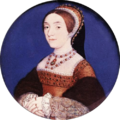
) is now believed by most historians to be the only image of Catherine painted from life (in the case of the Windsor version). It has been dated (from details of her dress and the technique of the miniature) to the short period when Catherine was queen by the historian David Starkey. In it she is wearing the same large jewel as Jane Seymour in Holbein's panel portrait in Vienna. These were jewels the records show belonged to the Crown, not to any queen personally, and there is no record of their having been removed from the treasury and given to anyone else. The pearls may tie in with a gift to Catherine from Henry in 1540, and she is the only queen to fit the dating, whose appearance is not already known. For female sitters, duplicate versions of miniatures only exist for queens at this period. There are no other plausible likenesses of her to compare to. Both versions have long been known as of Catherine Howard, and are so documented since 1736 (Buccleuch) and 1739? or at least 1840s for the Windsor version.
For centuries, a picture by Holbein was believed to be a portrait of Catherine, which is now in the Toledo Museum of Art. The portrait was identified on the basis of the very close likeness to Holbein's miniature. The image is also known in a number of other versions, including one NPG 1119 owned by the National Portrait Gallery in London, titled as "Unknown woman, formerly known as Catherine Howard". Some historians now dispute that the woman in the picture is Catherine. Antonia Fraser has argued that the Toledo portrait is of Jane Seymour's sister, Elizabeth Seymour, on the basis that the woman bears a remarkable resemblance to Jane, especially around the chin, and is wearing the clothes of a widow, which Catherine never had occasion to wear. However, black clothes do not necessarily signify mourning, and, because black was the most expensive dye, were often worn to signify wealth and status.
One other possibility is that the portrait shows Henry's Scottish niece, Lady Margaret Douglas
, the mother-in-law of Mary, Queen of Scots. So, whilst debate continues about the identity of the Toledo portrait, the miniature shown above is very likely to be Henry's fifth queen.
|-
|-
Wives of Henry VIII
The wives of Henry VIII were the six queens consort married to Henry VIII of England between 1509 and 1547. The six women to hold the title 'queens consort' of King Henry VIII were, in order:* Catherine of Aragon ,* Anne Boleyn ,...
of Henry VIII of England
Henry VIII of England
Henry VIII was King of England from 21 April 1509 until his death. He was Lord, and later King, of Ireland, as well as continuing the nominal claim by the English monarchs to the Kingdom of France...
, and sometimes known by his reference to her as his "rose without a thorn".
Catherine's birth date and place of birth are unknown, but are occasionally cited as 1521 or 1525, possibly in Wingate, County Durham
Wingate, County Durham
Wingate is a village in County Durham, EnglandWingate is a former pit village with a mixture of 19th-century, post-war, and more recent housing developments, it was originally enhabited by around 30 farmers before 1839 when coal was discovered. It is located in the East of County Durham, three...
. The new Oxford Dictionary of National Biography gives her date of birth as anywhere between 1518-1524. Catherine married Henry VIII on 28 July 1540, at Oatlands Palace
Oatlands Palace
Oatlands Palace is a former Tudor and Stuart royal palace located between Weybridge and Walton on Thames in Surrey, England. The surrounding modern district of Oatlands takes its name from the palace...
, in Surrey
Surrey
Surrey is a county in the South East of England and is one of the Home Counties. The county borders Greater London, Kent, East Sussex, West Sussex, Hampshire and Berkshire. The historic county town is Guildford. Surrey County Council sits at Kingston upon Thames, although this has been part of...
, almost immediately after the annulment
Annulment
Annulment is a legal procedure for declaring a marriage null and void. Unlike divorce, it is usually retroactive, meaning that an annulled marriage is considered to be invalid from the beginning almost as if it had never taken place...
of his marriage to Anne of Cleves
Anne of Cleves
Anne of Cleves was a German noblewoman and the fourth wife of Henry VIII of England and as such she was Queen of England from 6 January 1540 to 9 July 1540. The marriage was never consummated, and she was not crowned queen consort...
was arranged. However, she was beheaded after less than two years of marriage to Henry on the grounds of treason
Treason
In law, treason is the crime that covers some of the more extreme acts against one's sovereign or nation. Historically, treason also covered the murder of specific social superiors, such as the murder of a husband by his wife. Treason against the king was known as high treason and treason against a...
for committing adultery
Adultery
Adultery is sexual infidelity to one's spouse, and is a form of extramarital sex. It originally referred only to sex between a woman who was married and a person other than her spouse. Even in cases of separation from one's spouse, an extramarital affair is still considered adultery.Adultery is...
while married to the King. Catherine was the third of Henry's consorts to have been a commoner.
Early life
Catherine Howard was a child of Lord Edmund HowardLord Edmund Howard
Lord Edmund Howard was the third son of Thomas Howard, 2nd Duke of Norfolk and first wife Elizabeth Tilney. His sister, Elizabeth, was the mother of Henry VIII's second Queen, Anne Boleyn, and he was the father of the King's fifth Queen, Katherine Howard.-Biography:Howard was born about 1478...
and Joyce Culpeper
Joyce Culpeper
Jocasta "Joyce" Culpeper, of Oxon Hoath was the mother of Catherine Howard, the fifth wife and Queen Consort to King Henry VIII.-Early life:...
. Catherine's exact date of birth is unknown, although the year has been estimated as being after 1520, but before 1527. She was the niece of Elizabeth Howard
Elizabeth Boleyn, Countess of Wiltshire
Elizabeth Boleyn, Countess of Wiltshire , born Lady Elizabeth Howard, was the eldest of the two daughters of Thomas Howard, 2nd Duke of Norfolk and his first wife Elizabeth Tilney. Through her marriage, she held the titles of Countess of Wiltshire, Countess of Ormond and Viscountess Rochford...
, who was the mother of Queen Anne Boleyn
Anne Boleyn
Anne Boleyn ;c.1501/1507 – 19 May 1536) was Queen of England from 1533 to 1536 as the second wife of Henry VIII of England and Marquess of Pembroke in her own right. Henry's marriage to Anne, and her subsequent execution, made her a key figure in the political and religious upheaval that was the...
. Therefore, Catherine Howard and Anne Boleyn were first cousins. In addition, Catherine Howard and the Princess Elizabeth (later Elizabeth I) were first-cousins-once-removed.
As a granddaughter of Thomas Howard, 2nd Duke of Norfolk
Thomas Howard, 2nd Duke of Norfolk
Thomas Howard, 2nd Duke of Norfolk, KG, Earl Marshal , styled Earl of Surrey from 1483 to 1514, was the only son of John Howard, 1st Duke of Norfolk by his first wife, Katherine Moleyns...
, Catherine had an aristocratic
Aristocracy
Aristocracy , is a form of government in which a few elite citizens rule. The term derives from the Greek aristokratia, meaning "rule of the best". In origin in Ancient Greece, it was conceived of as rule by the best qualified citizens, and contrasted with monarchy...
pedigree, but her father, who was a younger son, was not well-off owing to primogeniture
Primogeniture
Primogeniture is the right, by law or custom, of the firstborn to inherit the entire estate, to the exclusion of younger siblings . Historically, the term implied male primogeniture, to the exclusion of females...
and the large size of his family. As a result, he was often reduced to begging for handouts from his more powerful relatives. In 1531, he was appointed Controller of Calais
Calais
Calais is a town in Northern France in the department of Pas-de-Calais, of which it is a sub-prefecture. Although Calais is by far the largest city in Pas-de-Calais, the department's capital is its third-largest city of Arras....
. He was dismissed from his post in 1539, and died in March of the same year.
During her early childhood, Catherine was sent to live in the household of her step-grandmother, the Dowager Duchess of Norfolk. The Dowager Duchess presided over households at Chesworth House, near Horsham
Horsham
Horsham is a market town with a population of 55,657 on the upper reaches of the River Arun in the centre of the Weald, West Sussex, in the historic County of Sussex, England. The town is south south-west of London, north-west of Brighton and north-east of the county town of Chichester...
, and Norfolk House
Norfolk House
Norfolk House, at 31 St James's Square, London, was built in 1722 for the Duke of Norfolk. It was a royal residence for a short time only, when Frederick, Prince of Wales, father of King George III, lived there 1737-1741, after his marriage in 1736 to Princess Augusta of Saxe-Gotha, daughter of...
, at Lambeth
Lambeth
Lambeth is a district of south London, England, and part of the London Borough of Lambeth. It is situated southeast of Charing Cross.-Toponymy:...
, comprising numerous male and female attendants along with her many wards, usually the children of aristocratic but poor relatives. While sending young children to be educated and trained in aristocratic households other than their own was common for centuries among European nobles, supervision at Lambeth was apparently lax. The Dowager Duchess was often at Court and seems to have taken little interest in the education and upbringing of her wards and young female attendants.
As a result of the Dowager Duchess' lack of attention, Catherine was not as well educated as some of Henry's other wives, though her ability to read and write alone was impressive enough for the time period. Her character has often been described as vivacious, beautiful, and buxom, but never scholarly or devout. The casual upbringing in the licentious atmosphere of the Duchess' household led to Catherine's music teacher, Henry Mannox, to start a sexual relationship with her around 1536, when she was between the ages of eleven and sixteen. He later gave evidence in the inquiry against her. Mannox and Catherine both confessed during her adultery trial that they had engaged in sexual contact, but not intercourse. Catherine was even quoted as saying, "At the flattering and fair persuasions of Mannox, being but a young girl, I suffered him at sundry times to handle and touch the secret parts of my body which neither became me with honesty to permit nor him to require."
This adolescent affair came to an end in 1538, when Catherine was pursued by a secretary of the Dowager Duchess' household, Francis Dereham
Francis Dereham
Francis Dereham was a Tudor courtier whose involvement with Henry VIII's fifth Queen, Catherine Howard, in her youth was a principal cause of the Queen's execution.-Life:...
. They became lovers, addressing each other as "husband" and "wife". Dereham also entrusted Catherine with various wifely duties, such as keeping his money when he was away on business. Many of Catherine's roommates among the Dowager Duchess' maids of honour and attendants knew of the relationship, which apparently ended in 1539 when the Dowager Duchess caught wind of the matter. Despite this disapproval, Catherine and Dereham may have parted with intentions to marry upon his return from Ireland
Ireland
Ireland is an island to the northwest of continental Europe. It is the third-largest island in Europe and the twentieth-largest island on Earth...
, agreeing to a precontract, as it was then known. If indeed they had exchanged vows of their intention to marry before having sexual intercourse, they would have been considered married in the eyes of the Church.
Arrival at court
Catherine's uncle, the Duke of NorfolkThomas Howard, 3rd Duke of Norfolk
Thomas Howard, 3rd Duke of Norfolk, KG, Earl Marshal was a prominent Tudor politician. He was uncle to Anne Boleyn and Catherine Howard, two of the wives of King Henry VIII, and played a major role in the machinations behind these marriages...
, found her a place at Court in the household of the King's fourth wife, the German Anne of Cleves
Anne of Cleves
Anne of Cleves was a German noblewoman and the fourth wife of Henry VIII of England and as such she was Queen of England from 6 January 1540 to 9 July 1540. The marriage was never consummated, and she was not crowned queen consort...
. As a young and attractive lady-in-waiting
Lady-in-waiting
A lady-in-waiting is a female personal assistant at a royal court, attending on a queen, a princess, or a high-ranking noblewoman. Historically, in Europe a lady-in-waiting was often a noblewoman from a family highly thought of in good society, but was of lower rank than the woman on whom she...
, Catherine quickly caught Henry's eye, who had displayed little interest in Anne from the beginning. The Howards may have sought to recreate the influence they gained during the reign of Anne Boleyn, and the mostly religiously conservative Howard family
Howard family
The Howard family is an English aristocratic family founded by John Howard who was created Duke of Norfolk by Plantagenet monarch Richard III of England in 1483. However, John was also the eldest grandson of the 1st Duke of 1st creation...
may have seen Catherine as a figurehead for their determination to restore Catholicism
Catholicism
Catholicism is a broad term for the body of the Catholic faith, its theologies and doctrines, its liturgical, ethical, spiritual, and behavioral characteristics, as well as a religious people as a whole....
to England. As the King's interest in Catherine grew, so did their influence. Within months of her arrival at Court, Henry bestowed gifts of land and expensive cloth upon Catherine.
Marriage
When Henry had his marriage to Anne of Cleves annulled on 9 July 1540, rumours swirled that Catherine was pregnant with his child. Their quick marriage a mere three weeks after the annulment, reflected Henry's lifelong urgency to secure the Tudor successionOrder of succession
An order of succession is a formula or algorithm that determines who inherits an office upon the death, resignation, or removal of its current occupant.-Monarchies and nobility:...
by fathering healthy, legitimate sons, especially since he only had one, Edward. Henry, nearing fifty and expanding in girth, showered his young bride with wealth, jewels, and other expensive gifts. War with France
France
The French Republic , The French Republic , The French Republic , (commonly known as France , is a unitary semi-presidential republic in Western Europe with several overseas territories and islands located on other continents and in the Indian, Pacific, and Atlantic oceans. Metropolitan France...
and the English Reformation
English Reformation
The English Reformation was the series of events in 16th-century England by which the Church of England broke away from the authority of the Pope and the Roman Catholic Church....
had cost Henry much of his people's goodwill, and he suffered from a number of ailments. Catherine's motto, "Non autre volonté que la sienne", or, "No other will but his", supposedly reflected her desire to keep Henry, an ailing man three decades her senior, content. At this point in his life, the King weighed around twenty-one stone (about 140 kilograms, or 300 pounds), and had a foul-smelling, festering ulcer on his thigh that had to be drained daily.
Early in 1541, Catherine embarked upon a romance with Henry's favorite male courtier, Thomas Culpeper
Thomas Culpeper
Sir Thomas Culpeper was a courtier of Henry VIII and the lover of Henry's fifth queen, Catherine Howard. He was born to Alexander Culpeper of Bedgebury, to the south of Maidstone in Kent, and his second wife, Constance Harper. He was the middle child and his older brother, also named Thomas, was a...
, a young man who, according to Dereham's testimony 'had succeeded [him] in the Queen's affections', and who Catherine had considered marrying during her time as a maid-of-honour to Anne of Cleves. The couple's meetings were arranged by one of Catherine's older ladies-in-waiting, Lady Rochford
Jane Boleyn, Viscountess Rochford
Jane Boleyn, Viscountess Rochford was an English noblewoman who lived in the reign of Henry VIII. She was a sister-in-law of Henry's second wife Anne Boleyn and lady-in-waiting to his fifth wife Catherine Howard, with whom she was executed.-Early life:Born Jane Parker, she was the daughter of...
, the widow of Catherine's cousin, George Boleyn, the brother of Anne Boleyn.
Catherine and Henry toured England together in the summer of 1541, and preparations for any signs of pregnancy, which would have led to a coronation, were in place, indicating that the royal couple were sexually active with each other. During this time, however, a crisis began to loom over Catherine. People who had witnessed her indiscretions at Lambeth began to contact her for favours in return for their silence, and many of them were appointed to her household. Most disastrously, Catherine appointed Francis Dereham
Francis Dereham
Francis Dereham was a Tudor courtier whose involvement with Henry VIII's fifth Queen, Catherine Howard, in her youth was a principal cause of the Queen's execution.-Life:...
as her personal secretary, at the urging of the Dowager Duchess of Norfolk. This miscalculation led to the charges of treason and adultery against her two years after her marriage to the King.
Downfall
By late 1541, the northern progressRoyal Entry
The Royal Entry, also known by various other names, including Triumphal Entry and Joyous Entry, embraced the ceremonial and festivities accompanying a formal entry by a ruler or his representative into a city in the Middle Ages and Early Modern Period in Europe...
of England had ended, and Catherine's indiscretions had become known to John Lascelles
John Lascelles
John Lassells was a sixteenth century courtier and Protestant martyr. His report to Archbishop Thomas Cranmer initiated the investigation which led to the execution of Queen Katherine Howard.-Life:...
, a Protestant reformer whose sister, Mary Hall
Mary Lascelles
Mary Hall was an English gentlewoman whose report of the 'light' behaviour in her youth of Henry VIII's fifth Queen, Katherine Howard initiated the process which ended with Queen Katherine's execution.-Life:...
, had been a member of the Dowager Duchess' household; Mary had been a witness to Catherine's sexual liaisons. Lascelles presented the information to Thomas Cranmer
Thomas Cranmer
Thomas Cranmer was a leader of the English Reformation and Archbishop of Canterbury during the reigns of Henry VIII, Edward VI and, for a short time, Mary I. He helped build a favourable case for Henry's divorce from Catherine of Aragon which resulted in the separation of the English Church from...
, the Archbishop of Canterbury
Archbishop of Canterbury
The Archbishop of Canterbury is the senior bishop and principal leader of the Church of England, the symbolic head of the worldwide Anglican Communion, and the diocesan bishop of the Diocese of Canterbury. In his role as head of the Anglican Communion, the archbishop leads the third largest group...
and one of Henry's closest advisors.
Cranmer, aware that any precontract with Dereham would invalidate Catherine's marriage to the king, gave Henry a letter with the accusations against his wife on 1 November 1541, as they attended a service of thanksgiving at Hampton Court. At first, Henry disbelieved the allegations, thinking them fabrications made by Lascelles and his sister. Nonetheless, he requested that Cranmer should investigate the matter further. Within a few days, corroborative proof was found, including the confessions of Dereham and Culpeper after they were likely tortured
Torture
Torture is the act of inflicting severe pain as a means of punishment, revenge, forcing information or a confession, or simply as an act of cruelty. Throughout history, torture has often been used as a method of political re-education, interrogation, punishment, and coercion...
in the Tower of London
Tower of London
Her Majesty's Royal Palace and Fortress, more commonly known as the Tower of London, is a historic castle on the north bank of the River Thames in central London, England. It lies within the London Borough of Tower Hamlets, separated from the eastern edge of the City of London by the open space...
. Cranmer also discovered a love letter to Culpeper in Catherine's distinctive handwriting, which is the only letter of hers that still survives, other than her confession.
Catherine was subsequently charged with treason, but she never admitted to infidelity. She did however, admit that she was "most unworthy to be called [Henry's] wife or subject." Such wording was typical of the time period, but it appears to have been sincere.
After being ordered to keep to her rooms, Catherine briefly escaped her guards to run to the chapel where Henry was hearing Mass. According to legend, she banged on the doors and screamed Henry's name, and her ghost
Ghost
In traditional belief and fiction, a ghost is the soul or spirit of a deceased person or animal that can appear, in visible form or other manifestation, to the living. Descriptions of the apparition of ghosts vary widely from an invisible presence to translucent or barely visible wispy shapes, to...
is still believed to re-enact this scene. Eventually, she was recaptured by her guards and confined to her rooms at Hampton Court, accompanied only by Lady Rochford. However, there is considerable doubt as to the story's authenticity, since Catherine was not fully aware of the charges against her until Cranmer and a delegation of councillors were sent to question her on 7 November 1541. Even the staunch Cranmer found Catherine's frantic, incoherent state pitiable, saying, "I found her in such lamentation and heaviness as I never saw no creature, so that it would have pitied any man's heart to have looked upon her." He ordered the guards to remove any objects that she might use to commit suicide.
While a precontract between Catherine and Dereham would have had the effect of terminating Catherine's royal union, it also would have allowed Henry to annul their marriage and banish her from Court. Catherine would have been disgraced, impoverished, and exiled
Exile
Exile means to be away from one's home , while either being explicitly refused permission to return and/or being threatened with imprisonment or death upon return...
, but, ultimately, she would have been spared execution. However, she steadfastly denied any precontract, maintaining that Dereham had raped her.
Imprisonment and death (1541–1542)
Catherine was stripped of her title as queen on 23 November and imprisoned in Syon AbbeySyon Abbey
Syon Monastery , was a monastery of the Bridgettine Order founded in 1415 which stood until its demolition in the 16th c. on the left bank of the River Thames within the parish of Isleworth, in the county of Middlesex on or near the site of the present Georgian mansion of Syon House...
, Middlesex
Middlesex
Middlesex is one of the historic counties of England and the second smallest by area. The low-lying county contained the wealthy and politically independent City of London on its southern boundary and was dominated by it from a very early time...
, throughout the winter of 1541. Culpeper and Dereham were executed at Tyburn
Tyburn, London
Tyburn was a village in the county of Middlesex close to the current location of Marble Arch in present-day London. It took its name from the Tyburn or Teo Bourne 'boundary stream', a tributary of the River Thames which is now completely covered over between its source and its outfall into the...
on 10 December 1541, Culpeper being beheaded and Dereham being hanged, drawn, and quartered. According to custom, their heads were placed on top of London Bridge
London Bridge
London Bridge is a bridge over the River Thames, connecting the City of London and Southwark, in central London. Situated between Cannon Street Railway Bridge and Tower Bridge, it forms the western end of the Pool of London...
. Many of Catherine's relatives were also detained in the Tower with the exception of her uncle, the Duke of Norfolk, who had sufficiently distanced himself from the scandal by writing a letter on 14 December to the King, excusing himself and laying all the blame on his niece and stepmother. All of the Howard prisoners were tried, found guilty of concealing treason, and sentenced to life imprisonment
Life imprisonment
Life imprisonment is a sentence of imprisonment for a serious crime under which the convicted person is to remain in jail for the rest of his or her life...
and forfeiture of goods. In time, however, they were released with their goods restored.
Catherine herself remained in limbo until Parliament
Parliament
A parliament is a legislature, especially in those countries whose system of government is based on the Westminster system modeled after that of the United Kingdom. The name is derived from the French , the action of parler : a parlement is a discussion. The term came to mean a meeting at which...
passed a bill of attainder
Bill of attainder
A bill of attainder is an act of a legislature declaring a person or group of persons guilty of some crime and punishing them without benefit of a judicial trial.-English law:...
on 7 February 1542. The bill made it treason, and punishable by death, for a queen consort to fail to disclose her sexual history to the king within twenty days of their marriage, or to incite someone to commit adultery with her. This solved the matter of Catherine's supposed precontract and made her unequivocally guilty. She was subsequently taken to the Tower on 10 February. The next day, the bill of attainder received the Royal Assent, and Catherine's execution was scheduled for seven a.m. on 13 February.
The night before her execution, Catherine is believed to have spent many hours practising how to lay her head upon the block, which had been brought to her at her request. She died with relative composure, but looked pale and terrified and required assistance to climb the scaffold. She made a speech describing her punishment as "worthy and just" and asked for mercy for her family and prayers for her soul. According to popular folklore, her final words were, "I die a Queen, but I would rather have died the wife of Culpeper," although this is widely discredited. Catherine was beheaded with a single stroke, and her body was buried in an unmarked grave in the nearby chapel of St. Peter ad Vincula, where the bodies of her cousins, Anne and George Boleyn, also lay. Henry did not attend.
Catherine's body was not one of those identified during restorations of the chapel during Queen Victoria's
Victoria of the United Kingdom
Victoria was the monarch of the United Kingdom of Great Britain and Ireland from 20 June 1837 until her death. From 1 May 1876, she used the additional title of Empress of India....
reign, but she is commemorated on a plaque on the west wall dedicated to all those who died in the Tower.
Upon hearing news of Catherine's execution, Francis I of France
Francis I of France
Francis I was King of France from 1515 until his death. During his reign, huge cultural changes took place in France and he has been called France's original Renaissance monarch...
wrote a letter to Henry, regretting the "lewd and naughty [evil] behavior of the Queen" and advising him that "the lightness of women cannot bend the honour of men".
Lineage
Historiography
Catherine is not regarded as particularly important in terms of long-lasting historical significance. Professor Diarmaid MacCullochDiarmaid MacCulloch
Diarmaid Ninian John MacCulloch FBA, FSA, FR Hist S is Professor of the History of the Church at the University of Oxford and Fellow of St Cross College, Oxford...
of the University of Oxford
University of Oxford
The University of Oxford is a university located in Oxford, United Kingdom. It is the second-oldest surviving university in the world and the oldest in the English-speaking world. Although its exact date of foundation is unclear, there is evidence of teaching as far back as 1096...
compared her with her cousin, Anne Boleyn, in a 2004 review: "Katherine Howard, another royal wife to die on adultery charges, mattered only a little longer than it took Henry to cheer up after he had her beheaded; by contrast, Anne triggered the English Reformation."
Catherine has been the subject of two modern biographies, A Tudor Tragedy by Lacey Baldwin Smith
Lacey Baldwin Smith
Lacey Baldwin Smith is a historian and author specialising in the court of Henry VIII and Elizabeth I. Smith is the author of Henry VIII: The Mask of Royalty and Catherine Howard: A Tudor Tragedy among other books....
(1967) and Katherine Howard: A Tudor Conspiracy by Joanna Denny
Joanna Denny
Joanna Denny was a historian and author specialising in the court of Henry VIII of England. Her books include Katherine Howard: A Tudor Conspiracy and Anne Boleyn. Her books are usually considered to be sympathetic towards these women. She was published by Portrait Books, an imprint of Piatkus....
(2006). Both are more or less sympathetic, although they disagree on various important points, involving Catherine's motivations, date of birth, and overall character. Treatments of her life have also been given in the five collective studies of Henry's queens which have appeared since the publication of Alison Weir's
Alison Weir (historian)
Alison Weir is a British writer of history books, and latterly historical novels, mostly in the form of biographies about British royalty.-Personal life:...
The Six Wives of Henry VIII (1991), such as David Starkey's
David Starkey
David Starkey, CBE, FSA is a British constitutional historian, and a radio and television presenter.He was born the only child of Quaker parents, and attended Kendal Grammar School before entering Cambridge through a scholarship. There he specialised in Tudor history, writing a thesis on King...
Six Wives (2004). Several of these writers have been highly critical of Catherine's conduct, if sympathetic to her eventual fate. Smith described Catherine's life as one of "hedonism" and characterized her as a "juvenile delinquent". Weir had much the same judgment, describing her as an "empty-headed wanton". The general trend, however, has been more generous, particularly in the works of Lady Antonia Fraser
Antonia Fraser
Lady Antonia Margaret Caroline Fraser, DBE , née Pakenham, is an Anglo-Irish author of history, novels, biographies and detective fiction, best known as Antonia Fraser...
, Karen Lindsey
Karen Lindsey
Karen Lindsey is a feminist writer and historian. She is the author of Divorced, Beheaded, Survived: A Feminist Reinterpretation of the Wives of Henry VIII, published by Perseus Books. She is also the co-author of Dr. Susan Love's Breast Book, with Susan M...
, David Loades
David Loades
David Michael Loades, FSA is a British historian and an expert on the Tudor era. He is Emeritus Professor of History at the University of Wales, where he taught from 1980 until 1996, and was Honorary Research Professor at the University of Sheffield from 1996 until 2008. In the 1960s an1970s he...
, and Joanna Denny.
Portraits of Catherine Howard
Jane Seymour
Jane Seymour was Queen of England as the third wife of King Henry VIII. She succeeded Anne Boleyn as queen consort following the latter's execution for trumped up charges of high treason, incest and adultery in May 1536. She died of postnatal complications less than two weeks after the birth of...
in pictures of King Henry VIII
Henry VIII of England
Henry VIII was King of England from 21 April 1509 until his death. He was Lord, and later King, of Ireland, as well as continuing the nominal claim by the English monarchs to the Kingdom of France...
long after she died, mainly because Henry continued to look back on her with favour as the one wife who gave him a son. Most of the artists copied the portrait by Hans Holbein the Younger
Hans Holbein the Younger
Hans Holbein the Younger was a German artist and printmaker who worked in a Northern Renaissance style. He is best known as one of the greatest portraitists of the 16th century. He also produced religious art, satire and Reformation propaganda, and made a significant contribution to the history...
because it was the only full-sized picture available. After Catherine Howard was executed, even the Howard family removed her picture from their family portrait gallery.
A portrait miniature
Portrait miniature
A portrait miniature is a miniature portrait painting, usually executed in gouache, watercolour, or enamel.Portrait miniatures began to flourish in 16th century Europe and the art was practiced during the 17th century and 18th century...
(shown here) existing in two versions by Holbein (Royal Collection
Royal Collection
The Royal Collection is the art collection of the British Royal Family. It is property of the monarch as sovereign, but is held in trust for her successors and the nation. It contains over 7,000 paintings, 40,000 watercolours and drawings, and about 150,000 old master prints, as well as historical...
and Duke of Buccleuch
Duke of Buccleuch
The title Duke of Buccleuch , formerly also spelt Duke of Buccleugh, was created in the Peerage of Scotland on 20 April 1663 for the Duke of Monmouth, who was the eldest illegitimate son of Charles II of Scotland, England, and Ireland and who had married Anne Scott, 4th Countess of Buccleuch.Anne...
) is now believed by most historians to be the only image of Catherine painted from life (in the case of the Windsor version). It has been dated (from details of her dress and the technique of the miniature) to the short period when Catherine was queen by the historian David Starkey. In it she is wearing the same large jewel as Jane Seymour in Holbein's panel portrait in Vienna. These were jewels the records show belonged to the Crown, not to any queen personally, and there is no record of their having been removed from the treasury and given to anyone else. The pearls may tie in with a gift to Catherine from Henry in 1540, and she is the only queen to fit the dating, whose appearance is not already known. For female sitters, duplicate versions of miniatures only exist for queens at this period. There are no other plausible likenesses of her to compare to. Both versions have long been known as of Catherine Howard, and are so documented since 1736 (Buccleuch) and 1739? or at least 1840s for the Windsor version.
For centuries, a picture by Holbein was believed to be a portrait of Catherine, which is now in the Toledo Museum of Art. The portrait was identified on the basis of the very close likeness to Holbein's miniature. The image is also known in a number of other versions, including one NPG 1119 owned by the National Portrait Gallery in London, titled as "Unknown woman, formerly known as Catherine Howard". Some historians now dispute that the woman in the picture is Catherine. Antonia Fraser has argued that the Toledo portrait is of Jane Seymour's sister, Elizabeth Seymour, on the basis that the woman bears a remarkable resemblance to Jane, especially around the chin, and is wearing the clothes of a widow, which Catherine never had occasion to wear. However, black clothes do not necessarily signify mourning, and, because black was the most expensive dye, were often worn to signify wealth and status.
One other possibility is that the portrait shows Henry's Scottish niece, Lady Margaret Douglas
Margaret Douglas
Margaret Douglas, Countess of Lennox was the daughter of Archibald Douglas, 6th Earl of Angus, and Margaret Tudor, Queen Dowager of Scotland...
, the mother-in-law of Mary, Queen of Scots. So, whilst debate continues about the identity of the Toledo portrait, the miniature shown above is very likely to be Henry's fifth queen.
In film
- Catherine first appeared on screen in 1926, in the silent filmSilent filmA silent film is a film with no synchronized recorded sound, especially with no spoken dialogue. In silent films for entertainment the dialogue is transmitted through muted gestures, pantomime and title cards...
Hampton Court PalaceHampton Court PalaceHampton Court Palace is a royal palace in the London Borough of Richmond upon Thames, Greater London; it has not been inhabited by the British royal family since the 18th century. The palace is located south west of Charing Cross and upstream of Central London on the River Thames...
, played by Gabrielle Morton. - In 1933, in The Private Life of Henry VIIIThe Private Life of Henry VIIIThe Private Life of Henry VIII is a 1933 film about Henry VIII, King of England. It was written by Lajos Biró and Arthur Wimperis, and directed by Sir Alexander Korda.Charles Laughton won the 1933 Academy Award as Best Actor for his performance as Henry...
, Catherine was played by Binnie BarnesBinnie BarnesGertrude Maud "Binnie" Barnes was an English-American actress. She was born in Islington to a Jewish father and an Italian mother and was brought up Jewish, although she converted to Catholicism later in life....
. In this comedy of mannersComedy of mannersThe comedy of manners is a genre of play/television/film which satirizes the manners and affectations of a social class, often represented by stock characters, such as the miles gloriosus in ancient times, the fop and the rake during the Restoration, or an old person pretending to be young...
, Catherine ambitiously sets out to seduce the king, but ultimately falls in love with the debonair, devoted Thomas CulpeperThomas CulpeperSir Thomas Culpeper was a courtier of Henry VIII and the lover of Henry's fifth queen, Catherine Howard. He was born to Alexander Culpeper of Bedgebury, to the south of Maidstone in Kent, and his second wife, Constance Harper. He was the middle child and his older brother, also named Thomas, was a...
. Catherine's story dominates the film. - In 1970, Angela PleasenceAngela PleasenceAngela Pleasence is an English actress. She is the daughter of actor Donald Pleasence and his first wife, Miriam Raymond. The surname for both daughter and father has occasionally been miscredited as "Pleasance"...
played Catherine in a 90-minute BBCBBCThe British Broadcasting Corporation is a British public service broadcaster. Its headquarters is at Broadcasting House in the City of Westminster, London. It is the largest broadcaster in the world, with about 23,000 staff...
television drama, as part of the series The Six Wives of Henry VIII, opposite Keith MichellKeith MichellKeith Michell is an Australian actor, particularly noted for his television and film performances as King Henry VIII of England.- Early life :He was born in Adelaide and brought up in Warnertown, near Port Pirie...
as Henry VIII, Patrick TroughtonPatrick TroughtonPatrick George Troughton was an English actor most widely known for his roles in fantasy, science fiction and horror films, particularly in his role as the second incarnation of the Doctor in the long-running British science-fiction television series Doctor Who, which he played from 1966 to 1969,...
as the Duke of Norfolk and Sheila Burrell as Lady Rochford. In this interpretation, Catherine is characterized as a selfish hedonistHedonismHedonism is a school of thought which argues that pleasure is the only intrinsic good. In very simple terms, a hedonist strives to maximize net pleasure .-Etymology:The name derives from the Greek word for "delight" ....
who uses the naïve Culpeper to try to get herself pregnant in order to secure her position. - Catherine Howard made a cameo appearance, played by Monika Dietrich, in the 1971 slapstickSlapstickSlapstick is a type of comedy involving exaggerated violence and activities which may exceed the boundaries of common sense.- Origins :The phrase comes from the batacchio or bataccio — called the 'slap stick' in English — a club-like object composed of two wooden slats used in Commedia dell'arte...
British comedy Carry On HenryCarry On HenryCarry On Henry is the 21st of the Carry On series and was released in 1971. It tells a fictionalised story involving Sid James as Henry VIII, who chases after Barbara Windsor's character Bettina. James and Windsor feature alongside other regulars Kenneth Williams, Charles Hawtrey, Joan Sims, Terry...
, with Sid JamesSid JamesSid James was an English-based South African actor and comedian. He made his name as Tony Hancock's co-star in Hancock's Half Hour and also starred in the popular Carry On films. He was known for his trademark "dirty laugh" and lascivious persona...
as Henry VIII. - In 1973, Lynne FrederickLynne FrederickLynne Maria Frederick was an English film actress. In a career spanning ten years she made about thirty films or television drama appearances, but she is best remembered as the last wife of Peter Sellers. She was married twice after his death.-Early life:Frederick was born in Hillingdon,...
portrayed a deeply sympathetic Queen Catherine in Henry VIII and his Six WivesHenry VIII and His Six WivesHenry VIII and His Six Wives is a 1972 film version of the famous BBC television series The Six Wives of Henry VIII, it was written by Ian Thorne and directed by Waris Hussein.-Description:...
opposite Keith Michell as Henry VIII, in a production which highlighted her youth and positive qualities. - In 1998 Emilia FoxEmilia FoxEmilia Rose Elizabeth Fox is an award-winning English actress, known for her role as Dr. Nikki Alexander on BBC crime drama Silent Witness, having joined the cast in 2004 following the departure of Amanda Burton. She also appears as Morgause in the BBC's Merlin beginning in the programme's second...
played Catherine in Katherine Howard at the Chichester Festival Theatre, in Chichester, England; she would later play Henry's third wife Jane Seymour in the 2003 ITVITVITV is the major commercial public service TV network in the United Kingdom. Launched in 1955 under the auspices of the Independent Television Authority to provide competition to the BBC, it is also the oldest commercial network in the UK...
drama Henry VIII. - In 2001, Michelle Abrahams played Catherine in Dr. David StarkeyDavid StarkeyDavid Starkey, CBE, FSA is a British constitutional historian, and a radio and television presenter.He was born the only child of Quaker parents, and attended Kendal Grammar School before entering Cambridge through a scholarship. There he specialised in Tudor history, writing a thesis on King...
's television documentaryTelevision documentaryDocumentary television is a genre of television programming that broadcasts documentaries.* Documentary television series, a television series which is made up of documentary episodes....
on Henry's queens. - In 2003, Emily BluntEmily BluntEmily Olivia Leah Blunt is an English actress best known for her roles in The Devil Wears Prada , The Young Victoria , and The Adjustment Bureau . She has been nominated for two Golden Globe Awards, two London Film Critics' Circle Awards, and one BAFTA Award...
gave a more sympathetic portrayal of Catherine in the ITVITVITV is the major commercial public service TV network in the United Kingdom. Launched in 1955 under the auspices of the Independent Television Authority to provide competition to the BBC, it is also the oldest commercial network in the UK...
television drama Henry VIII which focused on Catherine's sexual escapades. Once again, her adultery was explained by her relatives' desire for her to get pregnant. Catherine is shown crying and screaming with fear at her execution; contemporary accounts suggest she died in a more dignified manner. - In 2009-2010, Tamzin MerchantTamzin MerchantTamzin Merchant is an English actress. She is known for her role as Georgiana Darcy in Pride & Prejudice and for her role as the ill-fated Queen Catherine Howard in The Tudors.-Career:...
plays Katherine Howard in the third and fourth seasons of the Showtime series The TudorsThe TudorsThe Tudors is a Canadian produced historical fiction television series filmed in Ireland, created by Michael Hirst and produced for the American premium cable television channel Showtime...
. Merchant portrays Catherine as being flighty, good-natured, sexually adventurous, and fun-loving.
In fiction
- Catherine's story is fictionalized in the young adult novel The King's Rose by Alisa M. Libby.
- Catherine's story is fictionalized in the novel Murder Most RoyalMurder Most RoyalMurder Most Royal is an historical fiction novel by Jean Plaidy.This novel focuses on the two of Henry VIII's Howard wives, Anne Boleyn and Catherine Howard. It begins with Anne as a young woman leaving for Brussels and her homecoming to England and her subsequent rise to power in the English court...
and Rose Without a Thorn by Jean Plaidy. - Catherine is a main character in the book The Boleyn InheritanceThe Boleyn InheritanceThe Boleyn Inheritance is a novel by British author Philippa Gregory which was first published in 2006. It is a direct sequel to her previous novel The Other Boleyn Girl, and one of the additions to her six-part series on the Tudor royals...
by Philippa GregoryPhilippa GregoryPhilippa Gregory is an English novelist.-Early life and academic career:Philippa Gregory was born in Kenya. When she was two years old, her family moved to England. She was a "rebel" at school, but managed to attend the University of Sussex...
. - Catherine's story, along with that of Anne Boleyn, is told from the viewpoint of Lady Rochford in the novel Vengeance Is Mine by Brandy Purdy.
- Catherine is a character in SovereignSovereign (C. J. Sansom novel)Sovereign, published in 2006, is a crime novel by British author C. J. Sansom. It is Sansom's fourth novel, and the third in the Shardlake series...
by C. J. SansomC. J. SansomChristopher John "C.J." Sansom is a British writer of crime novels. He was born in 1952 in Edinburgh, Scotland, and was educated at the University of Birmingham, where he took a BA and then a PhD in history. After working in a variety of jobs, he decided to retrain as a solicitor...
(the third novel in the Matthew Shardlake series). - A highly fictionalized version of a devoutly Catholic, learned and serious Katharine who wants to return Henry to the Old Faith is told in the trilogy The Fifth QueenThe Fifth QueenThe Fifth Queen trilogy is a series of connected historical novels by English novelist Ford Madox Ford. It consists of three novels, The Fifth Queen; And How She Came to Court , Privy Seal and The Fifth Queen Crowned , which present a highly fictionalized account of Katharine Howard's arrival at...
by Ford Madox FordFord Madox FordFord Madox Ford was an English novelist, poet, critic and editor whose journals, The English Review and The Transatlantic Review, were instrumental in the development of early 20th-century English literature...
. - Catherine's life was told in the new play commissioned by Shakespeare's The Rose (theatre)The Rose (theatre)The Rose was an Elizabethan theatre. It was the fourth of the public theatres to be built, after The Theatre , the Curtain , and the theatre at Newington Butts The Rose was an Elizabethan theatre. It was the fourth of the public theatres to be built, after The Theatre (1576), the Curtain (1577),...
., Bankside in 'Rose without A Thorn' in 2008 written by Harry DenfordHarry DenfordHarry Denford is a stand up comedian, playwriter, theatre director and actor. -Personal life:Harry Denford was born in Greenwich, London, England on 22 February 1968. His secondary school was John Roan school in Blackheath, London. After giving up a career as a commercial pilot ATPL and became a...
. - Catherine's two years at court prior to her death are retold from her point of view in the fictional novel "The Queen's Mistake" by Diane Haeger.
- Catherine's time as Queen is fictionalised from the view of Lady Rochford in the novel The Tudor Wife by Emily Purdy.
In Music
- Rick WakemanRick WakemanRichard Christopher Wakeman is an English keyboard player, composer and songwriter best known for being the former keyboardist in the progressive rock band Yes...
recorded the piece "Catherine Howard" for his 1973 album, The Six Wives of Henry VIIIThe Six Wives of Henry VIII (album)The Six Wives of Henry VIII is the debut studio album from the English keyboardist and composer Rick Wakeman, released in January 1973 on A&M Records. It is an instrumental progressive rock album with its concept based on his interpretations of the musical characteristics of the six wives of Henry...
. On his 2009 live version of the albumThe Six Wives of Henry VIII Live at Hampton Court Palace-DVD and Blu-ray:-Personnel:* Rick Wakeman – Roland JD-800, Hammond Organ, Moog Mini-moog, Korg M3, Korg OASYS, Roland Fantom-X , Moog Voyager, Manikin Memotron , Roland V-Synth, keytar, piano.* Dave Colquhoun – electric guitar...
the spelling is changed to "Kathryn Howard". - The song "Marry Me" by Emilie AutumnEmilie AutumnEmilie Autumn Liddell , better known by her stage name Emilie Autumn, is an American singer-songwriter, poet, and violinist. Autumn draws influence for her music—the style of which she has alternatively labeled as "Victoriandustrial" and glam rock—from plays, novels, and history, particularly the...
is about the time period that Catherine was married to King Henry VIII. - Catherine's story is related in the song "Catherine Howard's Fate" by the Minstrel band Blackmore's NightBlackmore's NightBlackmore's Night is an English-American traditional folk rock duo led by Ritchie Blackmore and Candice Night .-Early:...
.
External links
- Find A Grave
- A very brief overview of Catherine's life, accompanied by a portrait gallery
- Letter from Catherine Howard to Thomas Culpeper
- English History biography Biography and primary sources
- A geo-biography tour of the Six Wives of Henry VIII on Google Earth
- PBS "Six Wives of Henry VIII", which describes Catherine's death
- Catherine Howard at Flickr
|-
|-