
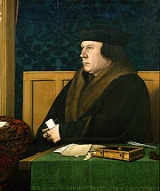
Thomas Cromwell, 1st Earl of Essex, (b. in or before 1485, executed 28 July 1540), was an English statesman who served as chief minister of King
Henry VIII of EnglandHenry VIII was King of England from 21 April 1509 until his death. He was Lord, and later King, of Ireland, as well as continuing the nominal claim by the English monarchs to the Kingdom of France...
from 1532 to 1540.
Cromwell was one of the strongest advocates of the
English ReformationThe English Reformation was the series of events in 16th-century England by which the Church of England broke away from the authority of the Pope and the Roman Catholic Church....
, the English church's break with the papacy in Rome. Cromwell helped engineer an annulment of the King's marriage to
Catherine of AragonCatherine of Aragon , also known as Katherine or Katharine, was Queen consort of England as the first wife of King Henry VIII of England and Princess of Wales as the wife to Arthur, Prince of Wales...
, so that the king could marry his mistress,
Anne BoleynAnne Boleyn ;c.1501/1507 – 19 May 1536) was Queen of England from 1533 to 1536 as the second wife of Henry VIII of England and Marquess of Pembroke in her own right. Henry's marriage to Anne, and her subsequent execution, made her a key figure in the political and religious upheaval that was the...
. Supremacy over the
Church of EnglandThe Church of England is the officially established Christian church in England and the Mother Church of the worldwide Anglican Communion. The church considers itself within the tradition of Western Christianity and dates its formal establishment principally to the mission to England by St...
was officially declared by Parliament in 1534, and Cromwell supervised the Church from the unique posts of
vicegerentVicegerent is the official administrative deputy of a ruler or head of state: vice + gerere .-Related usage:*The Byzantine Emperors held as a title "God's Vicegerent on Earth"....
for spirituals and
vicar generalA vicar general is the principal deputy of the bishop of a diocese for the exercise of administrative authority. As vicar of the bishop, the vicar general exercises the bishop's ordinary executive power over the entire diocese and, thus, is the highest official in a diocese or other particular...
.
Cromwell's rise to power made him many enemies, especially among the conservative faction at court. He fell from Henry's favour after arranging the King's marriage to a German princess,
Anne of ClevesAnne of Cleves was a German noblewoman and the fourth wife of Henry VIII of England and as such she was Queen of England from 6 January 1540 to 9 July 1540. The marriage was never consummated, and she was not crowned queen consort...
, which turned out to be a disaster. He was subjected to a
bill of attainderA bill of attainder is an act of a legislature declaring a person or group of persons guilty of some crime and punishing them without benefit of a judicial trial.-English law:...
and executed for
treasonIn law, treason is the crime that covers some of the more extreme acts against one's sovereign or nation. Historically, treason also covered the murder of specific social superiors, such as the murder of a husband by his wife. Treason against the king was known as high treason and treason against a...
and
heresyHeresy is a controversial or novel change to a system of beliefs, especially a religion, that conflicts with established dogma. It is distinct from apostasy, which is the formal denunciation of one's religion, principles or cause, and blasphemy, which is irreverence toward religion...
on
Tower HillTower Hill is an elevated spot northwest of the Tower of London, just outside the limits of the City of London, in the London Borough of Tower Hamlets. Formerly it was part of the Tower Liberty under the direct administrative control of Tower...
on 28 July 1540. The king later expressed regret at having lost his great minister.
Oliver CromwellOliver Cromwell was an English military and political leader who overthrew the English monarchy and temporarily turned England into a republican Commonwealth, and served as Lord Protector of England, Scotland, and Ireland....
, the
Parliamentarian"Roundhead" was the nickname given to the supporters of the Parliament during the English Civil War. Also known as Parliamentarians, they fought against King Charles I and his supporters, the Cavaliers , who claimed absolute power and the divine right of kings...
leader who overthrew the monarchy during the
English Civil WarThe English Civil War was a series of armed conflicts and political machinations between Parliamentarians and Royalists...
, was a great-great-grandson of Thomas Cromwell's sister, Katherine Cromwell (born circa 1482).
Early life
Cromwell was born around 1485 in
PutneyPutney is a district in south-west London, England, located in the London Borough of Wandsworth. It is situated south-west of Charing Cross. The area is identified in the London Plan as one of 35 major centres in Greater London....
, Surrey, the son of Walter Cromwell, a blacksmith, fuller, and cloth merchant, as well as the owner of both a hostelry and a brewery. His mother is said to have been Katherine, the aunt of Nicholas Glossop of Wirksworth in Derbyshire. She reportedly lived in Putney in the house of a local attorney, John Welbeck, at the time of her marriage to Walter Cromwell in 1474. Cromwell had two sisters. The younger, Elizabeth, married a farmer, William Wellyfed. The elder, Katherine, married Morgan Williams, a Welsh lawyer. Katherine and Morgan's son Richard was employed in his uncle's service and changed his name to Cromwell. Richard's great-grandson was
Oliver CromwellOliver Cromwell was an English military and political leader who overthrew the English monarchy and temporarily turned England into a republican Commonwealth, and served as Lord Protector of England, Scotland, and Ireland....
, the
Lord ProtectorLord Protector is a title used in British constitutional law for certain heads of state at different periods of history. It is also a particular title for the British Heads of State in respect to the established church...
.
Little is known about Thomas Cromwell's early life aside from his declaration to
Archbishop of CanterburyThe Archbishop of Canterbury is the senior bishop and principal leader of the Church of England, the symbolic head of the worldwide Anglican Communion, and the diocesan bishop of the Diocese of Canterbury. In his role as head of the Anglican Communion, the archbishop leads the third largest group...
Thomas CranmerThomas Cranmer was a leader of the English Reformation and Archbishop of Canterbury during the reigns of Henry VIII, Edward VI and, for a short time, Mary I. He helped build a favourable case for Henry's divorce from Catherine of Aragon which resulted in the separation of the English Church from...
that he had been a ‘ruffian...in his young days’. As a youth, he left his family in Putney and crossed the Channel to the continent. Accounts of his activities in France, Italy, and the Low Countries are sketchy and contradictory. It is likely that he first became a
mercenaryA mercenary, is a person who takes part in an armed conflict based on the promise of material compensation rather than having a direct interest in, or a legal obligation to, the conflict itself. A non-conscript professional member of a regular army is not considered to be a mercenary although he...
and marched with the French army to Italy, where he fought in the
battle of GariglianoThe Battle of Garigliano was fought on December 29, 1503 between a Spanish army under Gonzalo Fernández de Córdoba and a French army commanded by Ludovico II, Marquis of Saluzzo.-Preliminary phase:...
on 28 December 1503. While in Italy, he entered the household of the Florentine merchant banker Francesco Frescobaldi. Later he visited leading mercantile centres in the
Low CountriesThe Low Countries are the historical lands around the low-lying delta of the Rhine, Scheldt, and Meuse rivers, including the modern countries of Belgium, the Netherlands, Luxembourg and parts of northern France and western Germany....
, living among the English merchants and developing an important network of contacts while learning several languages. At some point, he returned to Italy. The records of the English Hospital in Rome indicate that he stayed there in June 1514, while documents in the
Vatican ArchivesThe Vatican Secret Archives , located in Vatican City, is the central repository for all of the acts promulgated by the Holy See. The Pope of the Roman Catholic Church, having primal incumbency until death, owns the archives until the next appointed Papal successor...
suggest that he was an agent for
Archbishop of YorkThe Archbishop of York is a high-ranking cleric in the Church of England, second only to the Archbishop of Canterbury. He is the diocesan bishop of the Diocese of York and metropolitan of the Province of York, which covers the northern portion of England as well as the Isle of Man...
,
CardinalA cardinal is a senior ecclesiastical official, usually an ordained bishop, and ecclesiastical prince of the Catholic Church. They are collectively known as the College of Cardinals, which as a body elects a new pope. The duties of the cardinals include attending the meetings of the College and...
Christopher BainbridgeChristopher Bainbridge was an English Cardinal of the Roman Catholic Church. He served as Archbishop of York from 1508 until his death.-Early life:...
, and handled English ecclesiastical issues before the Roman Rota. At some time during these years Cromwell returned to England, where about 1513 he married
Elizabeth WyckesElizabeth Wykes was the wife of Thomas Cromwell, 1st Earl of Essex, and Chief Minister to King Henry VIII of England.Elizabeth was the daughter of Mercy Prior, and Henry Wykes, who was a well-to-do Clothier from Putney, Surrey. She was first married to Thomas Williams, a Yeoman of the Guard...
(1489–1527). She was the widow of Thomas Williams, a
Yeoman of the GuardThe Queen's Body Guard of the Yeomen of the Guard are a bodyguard of the British Monarch. The oldest British military corps still in existence, it was created by Henry VII in 1485 at the Battle of Bosworth Field. As a token of this venerability, the Yeomen still wear red and gold uniforms of Tudor...
, and the daughter of a Putney shearman, Henry Wykes, who had served as a
Gentleman UsherGentleman Usher is a title for some officers of the Royal Household of the United Kingdom. See List of Gentlemen Ushers for a list of office-holders.-Historical:...
to
King Henry VIIHenry VII was King of England and Lord of Ireland from his seizing the crown on 22 August 1485 until his death on 21 April 1509, as the first monarch of the House of Tudor....
. The couple had a son,
GregoryGregory Cromwell, 1st Baron Cromwell, KB was an English peer.-Early life:Cromwell was born in Putney, then in Surrey, the first child and only son of Thomas Cromwell, later 1st Baron Cromwell and briefly 1st Earl of Essex, and his first wife, the former Elizabeth Wykys.He was tutored by Sir...
, and two daughters Anne and Grace. Neither daughter survived childhood.
By 1520, Cromwell was firmly established in London mercantile and legal circles. In 1523, he obtained a seat in the House of Commons, though the constituency he represented at that time has not been identified. After Parliament had been dissolved, Cromwell wrote a letter to a friend jesting about the session's unproductiveness:
I amongst other have indured a parlyament which contenwid by the space of xvii hole wekes wher we communyd of warre pease Stryffe contencyon debatte murmure grudge Riches poverte penurye trowth falshode Justyce equyte dicayte [deceit] opprescyon Magnanymyte actyvyte foce [force] attempraunce [moderation] Treason murder Felonye consyli … [conciliation] and also how a commune welth myght be ediffyed and a[lso] contenewid within our Realme. Howbeyt in conclusyon we have d[one] as our predecessors have been wont to doo that ys to say, as well we myght and lefte wher we begann.
In 1524, Cromwell was elected as a member of
Gray's InnThe Honourable Society of Gray's Inn, commonly known as Gray's Inn, is one of the four Inns of Court in London. To be called to the Bar and practise as a barrister in England and Wales, an individual must belong to one of these Inns...
and entered the service of Henry VIII's chief minister, Cardinal Thomas Wolsey. In the mid-1520s, Cromwell assisted in the dissolution of nearly thirty monasteries, to raise funds for Wolsey to found
The King's School, Ipswich (1528)Ipswich School is a co-educational public school for girls and boys aged 3 to 18. Situated in Suffolk, England in the town of Ipswich, it was founded in its current form as The King's School, Ipswich by Thomas Wolsey in 1528....
and
Cardinal College in Oxford (1529)Christ Church or house of Christ, and thus sometimes known as The House), is one of the largest constituent colleges of the University of Oxford in England...
. In 1526, Wolsey appointed Cromwell a member of his council; and, by 1529, Cromwell was one of Wolsey's most senior and trusted advisers. However, by the end of October of that year, Wolsey had fallen from power. Cromwell had made enemies for aiding Wolsey to suppress the monasteries but was determined not to fall with his master, as he told George Cavendish, then a Gentleman Usher and later Wolsey's biographer:
I do entend (god wyllyng) this after none, whan my lord hathe dyned to ride to london and so to the Court, where I wyll other make or marre or [ere, i.e. before] I come agayn, I wyll put my self in the prese [press] to se what any man is Able to lay to my charge of ontrouthe or mysdemeanor.
Cromwell's efforts to overcome the shadow cast over his career by Wolsey's downfall were successful. By November 1529, he had secured a seat in Parliament, as a member for
TauntonTaunton is the county town of Somerset, England. The town, including its suburbs, had an estimated population of 61,400 in 2001. It is the largest town in the shire county of Somerset....
, and was reported to be in favour with the King. At some point, during the closing weeks of 1530, the King appointed him to the
Privy CouncilHer Majesty's Most Honourable Privy Council, usually known simply as the Privy Council, is a formal body of advisers to the Sovereign in the United Kingdom...
.
King's chief minister
By the autumn of 1531, Cromwell had taken control of the supervision of the King's legal and parliamentary affairs, working closely with
Thomas AudleyThomas Audley, 1st Baron Audley of Walden, KG, PC, KS , Lord Chancellor of England, born in Earls Colne, Essex, the son of Geoffrey Audley, is believed to have studied at Buckingham College, Cambridge...
, and had joined the inner circle of the Council. By the following spring he had begun to exert influence over elections to the Commons. He was a modest man, not fond of flattery.
Since 1527, Henry VIII had sought to have his marriage to Queen Catherine annulled in order to marry
Anne BoleynAnne Boleyn ;c.1501/1507 – 19 May 1536) was Queen of England from 1533 to 1536 as the second wife of Henry VIII of England and Marquess of Pembroke in her own right. Henry's marriage to Anne, and her subsequent execution, made her a key figure in the political and religious upheaval that was the...
. At the centre of the campaign to secure the divorce was the emerging doctrine of the royal supremacy over the church. The third session of what is now known as the Reformation Parliament had been scheduled for October 1531, but was postponed until 15 January 1532 due to government indecision as to the best way to proceed. Cromwell now favoured the assertion of the royal supremacy, and manipulated the Commons by resurrecting anti-clerical grievances expressed earlier in the session of 1529. On 18 March 1532 the Commons delivered a supplication to the King denouncing clerical abuses and the power of the ecclesiastical courts and describing Henry as ‘the only head, sovereign lord, protector, and defender’ of the church. The clergy resisted at first, but capitulated when faced with the threat of parliamentary reprisal. On 14 May 1532 parliament was prorogued, and two days later Sir Thomas More resigned as
Lord ChancellorThe Lord High Chancellor of Great Britain, or Lord Chancellor, is a senior and important functionary in the government of the United Kingdom. He is the second highest ranking of the Great Officers of State, ranking only after the Lord High Steward. The Lord Chancellor is appointed by the Sovereign...
, realizing that the battle to save Queen Catherine's marriage to the King was lost. More's resignation from the Council represented a triumph for Cromwell and the reform faction at court.
The King's gratitude to Cromwell was expressed in a grant of the lordship of Romney in Newport in Wales and appointment to three relatively minor offices:
Master of the JewelsThe Master of the Jewel Office is a position in the British Royal Household. The holders are responsible for running the Jewel Office, which holds the Sovereign's jewellry.-Masters of the Jewel Office:*1445–1448: John Merston*1465–1483: Thomas Vaughan...
on 14 April 1532, Clerk of the
HanaperHanaper, properly a case or basket to contain a "hanap " , a drinking vessel, a goblet with a foot or stem; the term which is still used by antiquaries for medieval stemmed cups. The famous Royal Gold Cup in the British Museum is called a "hanap" in the inventory of Charles VI of France of...
on 16 July, and
Chancellor of the ExchequerThe Chancellor of the Exchequer is the title held by the British Cabinet minister who is responsible for all economic and financial matters. Often simply called the Chancellor, the office-holder controls HM Treasury and plays a role akin to the posts of Minister of Finance or Secretary of the...
on 12 April 1533. None of these offices afforded much income, but the grants were an indication of royal favour and gave Cromwell a position in three major institutions of government: the royal household, the Chancery, and the Exchequer.
By January 1533, Anne Boleyn was pregnant and the marriage could no longer be delayed. The date of the wedding is unclear. It may have taken place when Anne was with the King in Calais in November 1532, but it seems more likely that it took place at a secret ceremony on 25 January 1533. Parliament was immediately recalled to pass the necessary legislation. On 26 January 1533 Audley was appointed Lord Chancellor, and Cromwell increased his control over the Commons through his management of by-elections. The parliamentary session began on 4 February, and Cromwell introduced a new bill restricting the right to make appeals to Rome. On 30 March Cranmer was consecrated
Archbishop of CanterburyThe Archbishop of Canterbury is the senior bishop and principal leader of the Church of England, the symbolic head of the worldwide Anglican Communion, and the diocesan bishop of the Diocese of Canterbury. In his role as head of the Anglican Communion, the archbishop leads the third largest group...
, and
ConvocationThe Convocation of the English Clergy is a synodical assembly of the Church of England consisting of bishops and clergy.- Background and introduction :...
immediately declared the King's marriage to Katherine unlawful. In the first week of April 1533, Parliament passed the bill into law as the
Act in Restraint of AppealsThe Statute in Restraint of Appeals – short title Ecclesiastical Appeals Act 1532 – was an English parliamentary Act of 1533, considered by many historians to be the key legal foundation of the English Reformation....
, ensuring that any verdict concerning the King's marriage could not be challenged in Rome. On 11 April Archbishop Cranmer sent the King a pro forma challenge to the validity of his marriage to Queen Katherine. A formal trial began on 10 May 1533 in Dunstable, and on the 23rd the Archbishop pronounced sentence declaring King Henry's marriage to Queen Katherine illegal. Five days later he pronounced the King's marriage to Anne to be lawful, and on 1 June, she was crowned queen.
In December, the King authorized Cromwell to discredit the papacy, and the Pope was attacked throughout the nation in sermons and pamphlets. In 1534 a new Parliament was summoned, again under Cromwell's supervision, to enact the legislation necessary to formally break England's remaining ties with Rome. Archbishop Cranmer's sentence took statutory form as the Act of Succession, the Dispensations Act reiterated the royal supremacy, and the Act for the Submission of the Clergy incorporated into law the clergy's surrender in 1532. On 30 March 1534 Audley gave royal assent to the legislation in the presence of the King.
In April 1534, Henry confirmed Cromwell as his principal secretary and chief minister, a position he had held in all but name for some time. Cromwell immediately took steps to enforce the legislation which had just been passed by Parliament. Before the members of both houses returned home on 30 March they were required to swear an oath accepting the Act of Succession, and all the King's subjects were now required to swear to the legitimacy of the marriage and, by implication, to acceptance of the King's new powers and the break from Rome. On 13 April the London clergy accepted the oath. On the same day the commissioners offered it to Sir Thomas More and
John FisherSaint John Fisher was an English Roman Catholic scholastic, bishop, cardinal and martyr. He shares his feast day with Saint Thomas More on 22 June in the Roman Catholic calendar of saints and 6 July on the Church of England calendar of saints...
, Bishop of Rochester, who both refused it. More was taken into custody on the same day, and was moved to the Tower on 17 April. Fisher joined him there four days later. On 18 April an order was issued that all citizens of London were to swear. Similar orders were issued throughout the country. When Parliament reconvened in November, Cromwell brought in the most significant revision of the treason laws since 1352, making it treasonous to speak rebellious words against the royal family, to deny their titles, or to call the king a heretic, tyrant, infidel, or usurper. The Act of Supremacy also clarified the king's position as head of the church, and the Act for Payment of First Fruits and Tenths substantially increased clerical taxes. Cromwell also strengthened his own control over the church. On 21 January 1535 the King appointed him royal vicegerent, or vicar-general, and commissioned him to organize visitations of all the country's churches, monasteries, and clergy. In this capacity Cromwell conducted a census in 1535 to enable the government to tax church property more effectively.
The final session of the Reformation Parliament began on 4 February 1536. By 18 March, an Act for the Suppression of the Lesser Monasteries, those with a gross income of less than £200 per annum, had passed both houses. This caused a clash with Anne Boleyn, who wanted the proceeds of the dissolution to be employed for charitable purposes, not paid into the King's coffers. Anne instructed her chaplains to preach against the vicegerent, and on 2 April 1536 her
almonerAn almoner is a chaplain or church officer who originally was in charge of distributing cash to the deserving poor.Historically, almoners were Christian religious functionaries whose duty was to distribute alms to the poor. Monasteries were required to spend one tenth of their income in charity to...
, John Skip, denounced Cromwell before the entire court as an enemy of the Queen. Anne had so far failed to produce a male heir, and Cromwell, aware that the King was growing impatient and had become enamoured of the young
Jane SeymourJane Seymour was Queen of England as the third wife of King Henry VIII. She succeeded Anne Boleyn as queen consort following the latter's execution for trumped up charges of high treason, incest and adultery in May 1536. She died of postnatal complications less than two weeks after the birth of...
, acted with ruthless determination, accusing Anne of adultery with several courtiers, including her own brother,
Viscount RochfordGeorge Boleyn, Viscount Rochford was an English courtier and nobleman, and the brother of queen consort Anne Boleyn...
. The Queen and her brother stood trial on Monday 15 May, while the four others accused with them were condemned on the Friday beforehand. The men were executed on 17 May, and on the same day Cranmer declared Henry's marriage to Anne invalid, a ruling which bastardized their daughter,
Princess ElizabethElizabeth I was queen regnant of England and Ireland from 17 November 1558 until her death. Sometimes called The Virgin Queen, Gloriana, or Good Queen Bess, Elizabeth was the fifth and last monarch of the Tudor dynasty...
. Two days later Anne herself was executed. On 30 May the King married Jane Seymour. On 8 June a new parliament passed the second Act of Succession, securing the rights of Queen Anne's heirs to the throne.
Cromwell's position was now stronger than ever. He succeeded Anne Boleyn's father,
Thomas Boleyn, 1st Earl of WiltshireThomas Boleyn, 1st Earl of Wiltshire, KG was an English diplomat and politician in the Tudor era. He was born at the family home, Hever Castle, Kent, which had been purchased by his grandfather Geoffrey Boleyn, who was a wealthy mercer. He was buried at St. Peter's parish church in the village of...
as
Lord Privy SealThe Lord Privy Seal is the fifth of the Great Officers of State in the United Kingdom, ranking beneath the Lord President of the Council and above the Lord Great Chamberlain. The office is one of the traditional sinecure offices of state...
on 2 July 1536, resigning the office of
Master of the RollsThe Keeper or Master of the Rolls and Records of the Chancery of England, known as the Master of the Rolls, is the second most senior judge in England and Wales, after the Lord Chief Justice. The Master of the Rolls is the presiding officer of the Civil Division of the Court of Appeal...
which he had held since 8 October 1534. On 8 July 1536 he was raised to the peerage as
Baron CromwellBaron Cromwell is a title that has been created several times in the Peerage of England. The first creation, which was by writ, was for John de Cromwell in 1308. On his death, the barony became extinct. The second creation came in 1375 when Ralph de Cromwell was summoned by writ to Parliament as...
of Wimbledon.
In July 1536, the first attempt was made to clarify religious doctrine after the break with Rome. Bishop
Edward FoxeEdward Foxe was an English churchman, Bishop of Hereford. He was the most Lutheran of Henry VIII's bishops, and assisted in drafting the Ten Articles of 1536....
, with strong backing from Cromwell and Cranmer, tabled proposals in Convocation which the King later endorsed as the Ten Articles, printed in August. Cromwell circulated injunctions for their enforcement which went beyond the Articles themselves, provoking opposition in September and October in
LincolnshireLincolnshire is a county in the east of England. It borders Norfolk to the south east, Cambridgeshire to the south, Rutland to the south west, Leicestershire and Nottinghamshire to the west, South Yorkshire to the north west, and the East Riding of Yorkshire to the north. It also borders...
and then throughout the six northern counties. These widespread popular and clerical uprisings, which found support among the gentry and even the nobility, were collectively known as the
Pilgrimage of GraceThe Pilgrimage of Grace was a popular rising in York, Yorkshire during 1536, in protest against Henry VIII's break with the Roman Catholic Church and the Dissolution of the Monasteries, as well as other specific political, social and economic grievances. It was done in action against Thomas Cromwell...
. Although the rebels' grievances were wide-ranging, the most significant was the suppression of the monasteries, blamed on the King's ‘evil counsellors’, principally Cromwell and Cranmer.
The suppression of the risings spurred further religious reform. In February 1537, Cromwell convened a vicegerential
synodA synod historically is a council of a church, usually convened to decide an issue of doctrine, administration or application. In modern usage, the word often refers to the governing body of a particular church, whether its members are meeting or not...
of bishops and doctors. By July, the synod, co-ordinated by Cranmer and Foxe, had prepared a draft document, The Institution of a Christian Man, more commonly known as the Bishops' Book. By October it was in circulation, although the King had not yet given it his full assent. However Cromwell's success in the sphere of religious reform was offset by the fact that his political influence had been weakened by the emergence of a ‘privy council’, a body of nobles and office-holders which had first come together to suppress the Pilgrimage of Grace. The King confirmed his support of Cromwell by electing him to the
Order of the GarterThe Most Noble Order of the Garter, founded in 1348, is the highest order of chivalry, or knighthood, existing in England. The order is dedicated to the image and arms of St...
on 5 August 1537, but Cromwell was nonetheless forced to accept the existence of an executive body dominated by his conservative opponents.
In January 1538, Cromwell pursued an extensive campaign against what was termed "idolatry" by the followers of the new religion. Statues, roods, and images were attacked, culminating in September with the dismantling of the shrine of St
Thomas BecketThomas Becket was Archbishop of Canterbury from 1162 until his murder in 1170. He is venerated as a saint and martyr by both the Roman Catholic Church and the Anglican Communion...
at Canterbury. Early in September Cromwell also completed a new set of vicegerential injunctions declaring open war on ‘pilgrimages, feigned relics, or images, or any such superstitions’, and commanding that ‘one book of the whole Bible of the largest volume in English’ be set up in every church. Moreover following the ‘voluntary’ surrender of the remaining smaller monasteries during the previous year, the larger monasteries were now also ‘invited’ to surrender throughout 1538, a process legitimized in the 1539 session of parliament and completed in the following year.
The King was becoming increasingly unhappy about the extent of religious reform, and the conservative faction at court was gaining strength. Cromwell took the initiative against his enemies. In November 1538, using evidence acquired from Sir Geoffrey Pole under interrogation in the Tower, he imprisoned the
Marquess of ExeterHenry Courtenay, 1st Marquess of Exeter, KG, PC was the eldest son of William Courtenay, 1st Earl of Devon and Catherine of York, and grandson of King Edward IV of England.He was an older brother of Margaret Courtenay...
,
Sir Edward NevilleSir Edward Neville was a nobleman born at Abergavenny, Monmouthshire. He was the son of Sir George Neville, 2nd Lord Abergavenny and Margaret Fenne. He married Eleanor Windsor, daughter of Sir Andrew Windsor, 1st Baron Windsor and Elizabeth Blount, before 6 April 1529...
, and Sir
Nicholas CarewSir Nicholas Carew KG was an English courtier and statesman during the reign of Henry VIII. He was executed for his alleged part in the Exeter Conspiracy.-Early career:...
on charges of treason; all were executed in the following months.
On 17 December 1538, the Inquisitor-General of France interdicted the printing of Miles Coverdale's
Great BibleThe Great Bible was the first authorized edition of the Bible in English, authorized by King Henry VIII of England to be read aloud in the church services of the Church of England. The Great Bible was prepared by Myles Coverdale, working under commission of Sir Thomas Cromwell, Secretary to Henry...
. Cromwell persuaded the French King to release the unfinished books so that printing could continue in England. In April 1539 the first edition was finally available. The publication of the Great Bible, the first authoritative version in English, was one of Cromwell's most significant achievements.
The King, however, continued to hold back reform. A parliamentary committee was established to examine doctrine, and on 16 May 1539 the
Duke of NorfolkThomas Howard, 3rd Duke of Norfolk, KG, Earl Marshal was a prominent Tudor politician. He was uncle to Anne Boleyn and Catherine Howard, two of the wives of King Henry VIII, and played a major role in the machinations behind these marriages...
presented six questions for the house to consider which were duly passed as the Act of Six Articles shortly before the session ended on 28 June. The Six Articles reaffirmed a traditional view of the Mass, the sacraments and the priesthood.
In early October 1539, the King finally accepted Cromwell's suggestion that he marry
AnneAnne of Cleves was a German noblewoman and the fourth wife of Henry VIII of England and as such she was Queen of England from 6 January 1540 to 9 July 1540. The marriage was never consummated, and she was not crowned queen consort...
, the sister of Duke Wilhelm of Cleves. On 27 December, Anne arrived at Dover. On New Year's Day 1540 the King met her at Rochester and was chagrined to find that she was not the beauty Holbein had depicted in his portrait of her. The wedding ceremony took place on 6 January at Greenwich, but the marriage was not consummated.
Downfall and execution
On 18 April 1540 Henry granted Cromwell the
earldom of EssexEarl of Essex is a title that has been held by several families and individuals. The earldom was first created in the 12th century for Geoffrey II de Mandeville . Upon the death of the third earl in 1189, the title became dormant or extinct...
and the senior court office of
Lord Great ChamberlainThe Lord Great Chamberlain of England is the sixth of the Great Officers of State, ranking beneath the Lord Privy Seal and above the Lord High Constable...
. Despite these signs of royal favour, Cromwell's tenure as the King's chief minister was almost over. The King's anger at being forced to marry Anne of Cleves was the opportunity Cromwell's conservative opponents, most notably the Duke of Norfolk, needed to topple him.
At a Council meeting on 10 June 1540 Cromwell was arrested and imprisoned in the
TowerHer Majesty's Royal Palace and Fortress, more commonly known as the Tower of London, is a historic castle on the north bank of the River Thames in central London, England. It lies within the London Borough of Tower Hamlets, separated from the eastern edge of the City of London by the open space...
. A
bill of attainderA bill of attainder is an act of a legislature declaring a person or group of persons guilty of some crime and punishing them without benefit of a judicial trial.-English law:...
containing a long list of indictments including treason, heresy, corruption, and plotting to marry
Princess MaryMary I was queen regnant of England and Ireland from July 1553 until her death.She was the only surviving child born of the ill-fated marriage of Henry VIII and his first wife Catherine of Aragon. Her younger half-brother, Edward VI, succeeded Henry in 1547...
was introduced into the
House of LordsThe House of Lords is the upper house of the Parliament of the United Kingdom. Like the House of Commons, it meets in the Palace of Westminster....
a week later, and was passed on 29 June 1540. All Cromwell's honours were forfeited. The King deferred the execution until his marriage to Anne of Cleves could be annulled. Hoping for clemency, Cromwell wrote in support of the annulment in his last personal address to the King.
Cromwell was condemned to death without trial and beheaded on
Tower HillTower Hill is an elevated spot northwest of the Tower of London, just outside the limits of the City of London, in the London Borough of Tower Hamlets. Formerly it was part of the Tower Liberty under the direct administrative control of Tower...
on 28 July 1540, the day of the King's marriage to Katherine Howard. After the execution, his head was set on a spike on
London BridgeLondon Bridge is a bridge over the River Thames, connecting the City of London and Southwark, in central London. Situated between Cannon Street Railway Bridge and Tower Bridge, it forms the western end of the Pool of London...
.
Edward HallEdward Hall , English chronicler and lawyer, was born about the end of the 15th century, being a son of John Hall of Northall, Shropshire....
e, a contemporary chronicler, records that Cromwell made a speech on the scaffold, professing to die, "in the traditional faith" and then "so paciently suffered the stroke of the axe, by a ragged Boocherly miser whiche very ungoodly perfourmed the Office". Halle said of Cromwell's downfall:
Many lamented but more rejoiced, and specially such as either had been religious men, or favoured religious persons; for they banqueted and triumphed together that night, many wishing that that day had been seven year before; and some fearing lest he should escape, although he were imprisoned, could not be merry. Others who knew nothing but truth by him both lamented him and heartily prayed for him. But this is true that of certain of the clergy he was detestably hated, & specially of such as had borne swynge, and by his means was put from it; for in dead he was a man that in all his doings seemed not to favour any kind of Popery, nor could not abide the snoffyng pride of some prelates, which undoubtedly, whatsoever else was the cause of his death, did shorten his life and procured the end that he was brought unto.
Henry came to regret Cromwell's execution, and later accused his ministers of bringing about Cromwell's downfall by false charges. On 3 March 1541, the French Ambassador,
Charles de MarillacCharles de Marillac was a French prelate and diplomat.-Career:De Marillac was, by the age of twenty-two, an advocate in parliament in Paris...
, reported in a letter that the King was now said to be lamenting that ‘under pretext of some slight offences which he had committed, they had brought several accusations against him, on the strength of which he had put to death the most faithful servant he ever had’.
Cromwell's life and legacy have aroused enormous controversy. However his effectiveness and creativity as a royal minister cannot be denied, nor can his loyalty to the King. During Cromwell's years in power he skilfully managed Crown finances and extended royal authority. In 1536 he established the
Court of AugmentationsThe Court of Augmentations was established during the reign of King Henry VIII of England along with three lesser courts following the dissolution of the monasteries. Its primary function was to gain better control over the land and finances formerly held by the Roman Catholic Church in the kingdom...
to handle the massive windfall to the royal coffers occasioned by the dissolution of the monasteries. Two other important financial institutions, the
Court of WardsThe Court of Wards and Liveries was a court established during the reign of Henry VIII in England. Its purpose was to administer a system of feudal dues; but as well as the revenue collection, the court was also responsible for wardship and livery issues....
and the
Court of First Fruits and Tenths-First Fruits and Tenths:First Fruits and Tenths was a form of tax on clergy taking up a benefice or ecclesiastical position in Great Britain. The Court of First Fruits and Tenths was established in 1540 to collect from clerical benefices certain monies that had previously been sent to Rome...
owed their existence to him, although they were not set up until after his death. He strengthened royal authority in the north of England through reform of the
Council of the NorthThe Council of the North was an administrative body originally set up in 1484 by king Richard III of England, the third and last Yorkist monarch to hold the Crown of England; its intention was to improve government control and economic prosperity, to benefit the entire area of Northern England...
, extended royal power and introduced religious reform in Ireland, and was the architect of legislation, the Laws in Wales Acts 1535–1542, which promoted stability and gained acceptance for the royal supremacy in Wales. He also introduced important social and economic reforms in England in the 1530s, including action against
enclosureEnclosure or inclosure is the process which ends traditional rights such as mowing meadows for hay, or grazing livestock on common land. Once enclosed, these uses of the land become restricted to the owner, and it ceases to be common land. In England and Wales the term is also used for the...
s, the promotion of English cloth exports, and the
poor reliefPoor Relief refers to any actions taken by either governmental or ecclesiastical bodies to relieve poverty experienced by a population. More specifically, the term poor relief is often used to discuss how European countries dealt with poverty from the time just around the end of the medieval era to...
legislation of 1536.
Descendants
Thomas Cromwell's son
Gregory Cromwell, 1st Baron CromwellGregory Cromwell, 1st Baron Cromwell, KB was an English peer.-Early life:Cromwell was born in Putney, then in Surrey, the first child and only son of Thomas Cromwell, later 1st Baron Cromwell and briefly 1st Earl of Essex, and his first wife, the former Elizabeth Wykys.He was tutored by Sir...
, married Elizabeth Seymour, the sister of Queen Jane Seymour and widow of Sir Anthony Ughtred (or Oughtred). They had five children.
Hans Holbein portraits
Thomas Cromwell was a patron of
Hans Holbein the YoungerHans Holbein the Younger was a German artist and printmaker who worked in a Northern Renaissance style. He is best known as one of the greatest portraitists of the 16th century. He also produced religious art, satire and Reformation propaganda, and made a significant contribution to the history...
, as were Sir Thomas More and Anne Boleyn. Holbein's portrait of Cromwell is shown at the top of this page. The paper lying on the table in the portrait describes Cromwell as "Master of the Jewell House", an official position he occupied for just one year from 12 April 1532, thus dating the portrait.
In New York's
Frick CollectionThe Frick Collection is an art museum located in Manhattan, New York City, United States.- History :It is housed in the former Henry Clay Frick House, which was designed by Thomas Hastings and constructed in 1913-1914. John Russell Pope altered and enlarged the building in the early 1930s to adapt...
two portraits by Holbein hang facing each other on the same wall of the Living Hall, one depicting Thomas Cromwell, the other Thomas More, whose execution he had procured.
Fictional portrayals
Cromwell has been portrayed in a number of plays, feature films and television
miniseriesA miniseries , in a serial storytelling medium, is a television show production which tells a story in a limited number of episodes. The exact number is open to interpretation; however, they are usually limited to fewer than a whole season. The term "miniseries" is generally a North American term...
.
Theatre
- Cromwell is a supporting character in William Shakespeare
William Shakespeare was an English poet and playwright, widely regarded as the greatest writer in the English language and the world's pre-eminent dramatist. He is often called England's national poet and the "Bard of Avon"...
's play Henry VIIIThe Famous History of the Life of King Henry the Eight is a history play by William Shakespeare and John Fletcher, based on the life of Henry VIII of England. An alternative title, All is True, is recorded in contemporary documents, the title Henry VIII not appearing until the play's publication...
.
- He is the subject of Thomas Lord Cromwell
Thomas Lord Cromwell is an Elizabethan history play, depicting the life of Thomas Cromwell, 1st Earl of Essex, the minister of King Henry VIII of England....
, a 1602 play attributed on the title page to 'W.S.', once thought to be ShakespeareThe Shakespeare Apocrypha is a group of plays that have sometimes been attributed to William Shakespeare, but whose attribution is questionable for various reasons...
.
- Cromwell is the main antagonist in Robert Bolt's
Robert Oxton Bolt, CBE was an English playwright and a two-time Oscar winning screenwriter.-Career:He was born in Sale, Cheshire. At Manchester Grammar School his affinity for Sir Thomas More first developed. He attended the University of Manchester, and, after war service, the University of...
play A Man for All SeasonsA Man for All Seasons is a play by Robert Bolt. An early form of the play had been written for BBC Radio in 1954, and a one-hour live television version starring Bernard Hepton was produced in 1957 by the BBC, but after Bolt's success with The Flowering Cherry, he reworked it for the stage.It was...
, in which he is portrayed as ruthlessly ambitious and jealous of Sir Thomas More's influence with the King. Cromwell was played by Andrew KeirAndrew Keir was a Scottish actor, who rose to prominence featuring in a number of films from Hammer Film Productions in the 1960s. He was also active in television, and particularly in the theatre, in a professional career that lasted from the 1940s to the 1990s...
when the play opened in London, and by Leo McKernReginald "Leo" McKern, AO was an Australian-born British actor who appeared in numerous British and Australian television programmes and movies, and more than 200 stage roles.-Early life:...
on Broadway.
- Cromwell was portrayed by Julius D'Silva in Shakespeare's Globe
Shakespeare's Globe is a reconstruction of the Globe Theatre, an Elizabethan playhouse in the London Borough of Southwark, located on the south bank of the River Thames, but destroyed by fire in 1613, rebuilt 1614 then demolished in 1644. The modern reconstruction is an academic best guess, based...
's production of Anne BoleynAnne Boleyn ;c.1501/1507 – 19 May 1536) was Queen of England from 1533 to 1536 as the second wife of Henry VIII of England and Marquess of Pembroke in her own right. Henry's marriage to Anne, and her subsequent execution, made her a key figure in the political and religious upheaval that was the...
in 2010 and 2011.
Novels
- Cromwell is the subject of Hilary Mantel
Hilary Mary Mantel CBE , née Thompson, is an English novelist, short story writer and critic. Her work, ranging in subject from personal memoir to historical fiction, has been short-listed for major literary awards...
's 2009 novel Wolf HallWolf Hall is a multi-award winning historical novel by English author Hilary Mantel, published by Fourth Estate. Set in the period from 1500 to 1535, Wolf Hall is a fictionalized biography documenting the rapid rise to power of Thomas Cromwell, 1st Earl of Essex in the court of Henry VIII of...
, which explores his humanity and to some extent rebuts the unflattering portrait in A Man for All Seasons. The novel won the 2009 Man Booker PrizeThe Man Booker Prize for Fiction is a literary prize awarded each year for the best original full-length novel, written in the English language, by a citizen of the Commonwealth of Nations, Ireland, or Zimbabwe. The winner of the Man Booker Prize is generally assured of international renown and...
. Mantel has announced that she is already at work on a second novel about Cromwell, tentatively titled The Mirror and the Light.
- Cromwell is a leading character in the first two Matthew Shardlake historical crime fiction novels by C. J. Sansom
Christopher John "C.J." Sansom is a British writer of crime novels. He was born in 1952 in Edinburgh, Scotland, and was educated at the University of Birmingham, where he took a BA and then a PhD in history. After working in a variety of jobs, he decided to retrain as a solicitor...
, DissolutionDissolution is a crime novel by British author C. J. Sansom. It is Sansom's first published novel, released in 2003, and the first in the Matthew Shardlake series...
and Dark FireDark Fire is a crime novel by British author C. J. Sansom. It is Sansom's second novel, released in 2004, and also the second in the Matthew Shardlake series...
, and a supporting character in many novels based on the Tudor royal family, particularly those on Henry VIII or Anne Boleyn.
- He is a major character in The Trusted Servant by Alison Macleod, whose main protagonist begins as Cromwell's younger protégé.
- He is given minor roles in two of Philippa Gregory
Philippa Gregory is an English novelist.-Early life and academic career:Philippa Gregory was born in Kenya. When she was two years old, her family moved to England. She was a "rebel" at school, but managed to attend the University of Sussex...
's novels, The Other Boleyn GirlThe Other Boleyn Girl is a historical fiction novel written by British author Philippa Gregory, loosely based on the life of 16th-century aristocrat Mary Boleyn. Reviews were mixed; some said it was a brilliantly claustrophobic look at palace life in Tudor England, while others have consistently...
and The Boleyn InheritanceThe Boleyn Inheritance is a novel by British author Philippa Gregory which was first published in 2006. It is a direct sequel to her previous novel The Other Boleyn Girl, and one of the additions to her six-part series on the Tudor royals...
.
- He is one of the major characters in H.F.M. Prescott's novel The Man on a Donkey, which depicts a power struggle between Cromwell and Lord Darcy, representing the old nobility.
- He is arguably the dominant character in Ford Madox Ford
Ford Madox Ford was an English novelist, poet, critic and editor whose journals, The English Review and The Transatlantic Review, were instrumental in the development of early 20th-century English literature...
's novel The Fifth QueenThe Fifth Queen trilogy is a series of connected historical novels by English novelist Ford Madox Ford. It consists of three novels, The Fifth Queen; And How She Came to Court , Privy Seal and The Fifth Queen Crowned , which present a highly fictionalized account of Katharine Howard's arrival at...
, which presents a vivid portrait of his intelligence and intimidating personality.
Film
- Franklin Dyall
Franklin Dyall was an English actor.He appeared in 26 films between 1916 and 1948...
portrayed Cromwell in The Private Life of Henry VIIIThe Private Life of Henry VIII is a 1933 film about Henry VIII, King of England. It was written by Lajos Biró and Arthur Wimperis, and directed by Sir Alexander Korda.Charles Laughton won the 1933 Academy Award as Best Actor for his performance as Henry...
(1933).
- In A Man for All Seasons
A Man for All Seasons is a 1966 film based on Robert Bolt's play A Man for All Seasons about Sir Thomas More. It was released on December 12, 1966. Paul Scofield, who had played More in the West End stage premiere, also took the role in the film. It was directed by Fred Zinnemann, who had...
, he was played by Leo McKernReginald "Leo" McKern, AO was an Australian-born British actor who appeared in numerous British and Australian television programmes and movies, and more than 200 stage roles.-Early life:...
, who had also played the role on Broadway.
- He has also been portrayed by John Colicos
John Colicos was a Greek-Canadian actor. He was a distinguished stage actor in the United Kingdom, the United States and Canada.-Career:...
in Anne of the Thousand DaysAnne of the Thousand Days is a 1969 costume drama made by Hal Wallis Productions and distributed by Universal Pictures. It was directed by Charles Jarrott and produced by Hal B. Wallis. The film tells the story of Anne Boleyn...
(1969), by Kenneth WilliamsKenneth Charles Williams was an English comic actor and comedian. He was one of the main ensemble in 26 of the Carry On films, and appeared in numerous British television shows, and radio comedies with Tony Hancock and Kenneth Horne.-Life and career:Kenneth Charles Williams was born on 22 February...
in the classic British comedy Carry On HenryCarry On Henry is the 21st of the Carry On series and was released in 1971. It tells a fictionalised story involving Sid James as Henry VIII, who chases after Barbara Windsor's character Bettina. James and Windsor feature alongside other regulars Kenneth Williams, Charles Hawtrey, Joan Sims, Terry...
(1971), by Donald PleasenceSir Donald Henry Pleasence, OBE, was a British actor who gained more than 200 screen credits during a career which spanned over four decades...
in Henry VIII and His Six WivesHenry VIII and His Six Wives is a 1972 film version of the famous BBC television series The Six Wives of Henry VIII, it was written by Ian Thorne and directed by Waris Hussein.-Description:...
(1972), and by Iain MitchellIain Mitchell is a British actor notable for his appearance as Thomas Cromwell in The Other Boleyn Girl and Superintendent Maitland in Agatha Christie's Poirot . Onstage he has appeared in La Cage aux Folles and the adaptation of His Dark Materials.-External links:...
in The Other Boleyn Girl (2008).
Television
- Cromwell has been portrayed by Wolfe Morris
Wolfe Morris was a British film and television actor.He played character roles on stage, television and in feature films from the 1950s until the 1990s. He made his film debut in Ill Met by Moonlight. His grandparents were from Kiev and escaped the Russian pogroms, arriving in London in about 1890....
in the BBC miniseries The Six Wives of Henry VIII (1970), and by Danny WebbDanny Webb is a British television and film actor. He may be best known for his role as the prisoner Morse in Alien 3. He has appeared in many famous British television programmes including The Young Indiana Jones Chronicles, Emmerdale Farm, Our Friends in the North, A Touch of Frost, Agatha...
in the Granada Television production Henry VIIIHenry VIII is a two-part British television serial produced principally by Granada Television for ITV. It chronicles the life of Henry VIII of England from the disintegration of his first marriage to an aging Spanish princess until his death following a stroke in 1547, by which time he had married...
(2003). In the television version of The Other Boleyn Girl (2003), he was played by veteran actor Ron CookRon Cook is an English actor who has been active in the theatre, film and television since the 1970s. He is from South Shields, Co Durham, England and is a graduate of Rose Bruford College.- Stage appearances :...
.
- In the television series The Tudors
The Tudors is a Canadian produced historical fiction television series filmed in Ireland, created by Michael Hirst and produced for the American premium cable television channel Showtime...
(2007), Cromwell is played by English actor James FrainJames Dominic Frain is an English stage and screen actor. He is possibly best known for his role in the Showtime series The Tudors in which he appeared as Thomas Cromwell from 2007 to 2009, and for his role as vampire Franklin Mott in season three of the HBO drama True Blood, as well as his role...
. Frain played the character for three seasons; Cromwell's execution brought the character's run to its conclusion.
- In The Twisted Tale Of Bloody Mary (2008), an independent film from TV Choice Productions, Cromwell is played by Burtie Welland.
- Cromwell will be the focus of a new HBO and BBC Mini-Series based on the novel Wolf Hall
Wolf Hall is a multi-award winning historical novel by English author Hilary Mantel, published by Fourth Estate. Set in the period from 1500 to 1535, Wolf Hall is a fictionalized biography documenting the rapid rise to power of Thomas Cromwell, 1st Earl of Essex in the court of Henry VIII of...
by Hilary MantelHilary Mary Mantel CBE , née Thompson, is an English novelist, short story writer and critic. Her work, ranging in subject from personal memoir to historical fiction, has been short-listed for major literary awards...
'.
External links