
All Topics  
Desiderius Erasmus

 
Desiderius Erasmus

   Email Print
   Bookmark   Link


Desiderius Erasmus


Desiderius Erasmus Roterodamus (sometimes known as Desiderius Erasmus of Rotterdam) (October 27, 1466/1469, Rotterdam
Rotterdam

Rotterdam ; city and municipality in the Netherlands province of South Holland, situated in the west of the Netherlands. The municipality is the List of cities in the Netherlands with over 100,000 people in the country, with a population of 584,046 on 1 January 2007 and comprises the southern part of the Randstad, the List of metropolitan are...
 – July 12, 1536, Basel
Basel

Basel is Switzerland's third most populous city . With 731,000 inhabitants in the tri-national metropolitan area , Basel is Switzerland's third-largest urban area....
) was a Dutch
Netherlands

The Netherlands is a country that is part of the Kingdom of the Netherlands. It is a parliamentary democratic constitutional monarchy. The Netherlands is located in North-West Europe, and bordered by the North Sea to the north and west, Belgium to the south, and Germany to the east....
 Renaissance humanist and Catholic
Roman Catholic Church

The Roman Catholic Church, officially known as the Catholic Church is the world's largest Christianity Ecclesia , representing over half of all Christians and one-sixth of the world population....
 Christian
Christian

A Christian is a person who adheres to Christianity, a Monotheism#Christian view religion centered on the life and teachings of Jesus and interpreted by Christians to have been prophesied in the Hebrew Bible/Old Testament....
 theologian
Theology

Theology is the study of the existence or attributes of a deity or gods, or more generally the study of religion or spirituality. It is sometimes contrasted with religious studies: theology is understood as the study of religion from an internal perspective , and religious studies as the study of religion from an external perspective....
. His scholarly name Desiderius Erasmus Roterodamus comprises the following three elements: the Latin noun desiderium ("longing" or "desire"; the name being a genuine Late Latin name); the Greek adjective ???sµ??? (erásmios) meaning "desired", and, in the form Erasmus, also the name of a saint; and the Latinized adjectival form for the city of Rotterdam
Rotterdam

Rotterdam ; city and municipality in the Netherlands province of South Holland, situated in the west of the Netherlands. The municipality is the List of cities in the Netherlands with over 100,000 people in the country, with a population of 584,046 on 1 January 2007 and comprises the southern part of the Randstad, the List of metropolitan are...
 (Roterodamus = "of Rotterdam").

Erasmus was a classical scholar who wrote in a "pure" Latin style and enjoyed the sobriquet
Sobriquet

A sobriquet is a nickname or a fancy name, usually a familiar name given by others as distinct from a pseudonym assumed as a disguise, but a nickname which is familiar enough such that it can be used in place of a real name without the need of explanation....
 "Prince of the Humanists." He has been called "the crowning glory of the Christian humanists." Using humanist techniques for working on texts, he prepared important new Latin and Greek
Greek language

Greek is an Indo-European languages native to the southern Balkan peninsula, the language of the Greek people. It forms an independent branch within Indo-European....
 editions of the New Testament.


Discussion
Ask a question about 'Desiderius Erasmus'
Start a new discussion about 'Desiderius Erasmus'
Answer questions from other users
Full Discussion Forum


Recent Posts


Quotations


Do not be guilty of possessing a library of learned books while lacking learning yourself.

Letter to Christian Northoff

Indeed, a constant element of enjoyment must be mingled with our studies, so that we think of learning as a game rather than a form of drudgery.

Letter to Christian Northoff


Encyclopedia


Desiderius Erasmus Roterodamus (sometimes known as Desiderius Erasmus of Rotterdam) (October 27, 1466/1469, Rotterdam
Rotterdam

Rotterdam ; city and municipality in the Netherlands province of South Holland, situated in the west of the Netherlands. The municipality is the List of cities in the Netherlands with over 100,000 people in the country, with a population of 584,046 on 1 January 2007 and comprises the southern part of the Randstad, the List of metropolitan are...
 – July 12, 1536, Basel
Basel

Basel is Switzerland's third most populous city . With 731,000 inhabitants in the tri-national metropolitan area , Basel is Switzerland's third-largest urban area....
) was a Dutch
Netherlands

The Netherlands is a country that is part of the Kingdom of the Netherlands. It is a parliamentary democratic constitutional monarchy. The Netherlands is located in North-West Europe, and bordered by the North Sea to the north and west, Belgium to the south, and Germany to the east....
 Renaissance humanist and Catholic
Roman Catholic Church

The Roman Catholic Church, officially known as the Catholic Church is the world's largest Christianity Ecclesia , representing over half of all Christians and one-sixth of the world population....
 Christian
Christian

A Christian is a person who adheres to Christianity, a Monotheism#Christian view religion centered on the life and teachings of Jesus and interpreted by Christians to have been prophesied in the Hebrew Bible/Old Testament....
 theologian
Theology

Theology is the study of the existence or attributes of a deity or gods, or more generally the study of religion or spirituality. It is sometimes contrasted with religious studies: theology is understood as the study of religion from an internal perspective , and religious studies as the study of religion from an external perspective....
. His scholarly name Desiderius Erasmus Roterodamus comprises the following three elements: the Latin noun desiderium ("longing" or "desire"; the name being a genuine Late Latin name); the Greek adjective ???sµ??? (erásmios) meaning "desired", and, in the form Erasmus, also the name of a saint; and the Latinized adjectival form for the city of Rotterdam
Rotterdam

Rotterdam ; city and municipality in the Netherlands province of South Holland, situated in the west of the Netherlands. The municipality is the List of cities in the Netherlands with over 100,000 people in the country, with a population of 584,046 on 1 January 2007 and comprises the southern part of the Randstad, the List of metropolitan are...
 (Roterodamus = "of Rotterdam").

Erasmus was a classical scholar who wrote in a "pure" Latin style and enjoyed the sobriquet
Sobriquet

A sobriquet is a nickname or a fancy name, usually a familiar name given by others as distinct from a pseudonym assumed as a disguise, but a nickname which is familiar enough such that it can be used in place of a real name without the need of explanation....
 "Prince of the Humanists." He has been called "the crowning glory of the Christian humanists." Using humanist techniques for working on texts, he prepared important new Latin and Greek
Greek language

Greek is an Indo-European languages native to the southern Balkan peninsula, the language of the Greek people. It forms an independent branch within Indo-European....
 editions of the New Testament. These raised questions that would be influential in the Protestant Reformation
Protestant Reformation

The Protestant Reformation was a Christian reform movement in Europe. It is thought to have begun in 1517 with Martin Luther's Ninety-Five Theses and may be considered to have ended with the Peace of Westphalia in 1648....
 and Catholic Counter-Reformation
Counter-Reformation

The Counter-Reformation denotes the period of Roman Catholic Church revival from the pontificate of Pope Pius IV in 1560 to the close of the Thirty Years' War, 1648....
. He also wrote The Praise of Folly
The Praise of Folly

The Praise of Folly is an essay written in 1509 by Desiderius Erasmus of Rotterdam and first printed in 1511. Erasmus revised and extended the work, which he originally wrote in the space of a week while sojourning with Sir Thomas More at More's estate in Bucklersbury....
, Handbook of a Christian Knight
Handbook of a Christian Knight

Enchiridion militis Christiani, or Handbook of a Christian Knight was written by Desiderius Erasmus in 1503 and was published in England by William Tyndale....
, On Civility in Children, Copia: Foundations of the Abundant Style
Copia: Foundations of the Abundant Style

Copia: Foundations of the Abundant Style is a rhetorical guide written by Dutch Renaissance humanism Erasmus in 1512. It is Erasmus' systematic instruction on how to embellish, amplify, and give variety to speech and writing....
, Julius Exclusus
Julius Excluded from Heaven

Julius Excluded from Heaven is a dialogue that was anonymously written in 1514. It is commonly attributed to the Dutch humanist and theologian Desiderius Erasmus....
, and many other works.

Erasmus lived through the Reformation period and he consistently criticized some contemporary popular Christian
Christian

A Christian is a person who adheres to Christianity, a Monotheism#Christian view religion centered on the life and teachings of Jesus and interpreted by Christians to have been prophesied in the Hebrew Bible/Old Testament....
 beliefs. In relation to clerical abuses in the Church
Christian Church

Christian Church and the word church are used to denote both a Christian Groups of people and a Church . The word church is usually, but not exclusively, associated with Christianity....
, Erasmus remained committed to reforming the Church from within. He also held to Catholic
Roman Catholic Church

The Roman Catholic Church, officially known as the Catholic Church is the world's largest Christianity Ecclesia , representing over half of all Christians and one-sixth of the world population....
 doctrines such as that of free will
Free will

The question of free will is whether, and in what sense, rational agents exercise control over their actions and decisions. Addressing this question requires understanding the relationship between freedom and Causality, and determining whether the laws of nature are causally deterministic....
, which Protestant Reformers rejected in favor of the doctrine of predestination
Predestination

Predestination is a religion concept, which involves the relationship between God and His creation. The religious character of predestination distinguishes it from other ideas about determinism and free will....
. His middle road disappointed and even angered many Protestants, such as Martin Luther
Martin Luther

Martin Luther was a Germans monk, theology, university professor, priest, father of Protestantism, and Protestant Reformers whose ideas started the Protestant Reformation and changed the course of Western culture....
, as well as conservative Catholics. He died in Basel
Basel

Basel is Switzerland's third most populous city . With 731,000 inhabitants in the tri-national metropolitan area , Basel is Switzerland's third-largest urban area....
 in 1536 and was buried in the formerly Catholic cathedral there, recently converted to a Reformed church.

Early life

Desiderius Erasmus was born in Rotterdam
Rotterdam

Rotterdam ; city and municipality in the Netherlands province of South Holland, situated in the west of the Netherlands. The municipality is the List of cities in the Netherlands with over 100,000 people in the country, with a population of 584,046 on 1 January 2007 and comprises the southern part of the Randstad, the List of metropolitan are...
 on October 28, in 1466 or 1469. (The exact year of his birth is unknown.) Historian Johan Huizinga
Johan Huizinga

Johan Huizinga , was a Netherlands historian and one of the founders of modern cultural history....
 tells us that Erasmus was born on the night of the 27th or 28th and celebrated his birthday on October 28. It is possible he was christened "Erasmus" after the saint of that name. Although associated closely with Rotterdam, he lived there for only four years, never to return. Information on his family and early life comes mainly from vague references in his writings. His parents almost certainly were not legally married. His father, named Roger Gerard, later became a priest
Priest

A priest or priestess is a person having the authority or power to administer religious rites; in particular, rites of sacrifice to, and propitiation of, a deity or deities....
 and afterwards curate
Curate

From the Latin curatus , a curate is a person who is invested with the Cure of souls of a parish. In this sense it correctly means a parish....
 in Gouda
Gouda

Gouda is a city and municipality in the western Netherlands, in the province of South Holland. Gouda, which was granted City rights in the Netherlands in 1272, is famous for its Gouda cheese, smoking pipes and its 15th century city hall....
. Little is known of his mother other than that her name was Margaret and she was the daughter of a physician. Although he was born out of wedlock, Erasmus was cared for by his parents until their early deaths from the plague
Black Death

The Black Death, was one of the deadliest pandemics in human history, widely thought to have been caused by a bacterium named Yersinia pestis , but recently attributed by some factors to other diseases....
 in 1483. He was then given the very best education available to a young man of his day, in a series of monastic or semi-monastic schools, most notably a school run by the Brethren of the Common Life
Brethren of the Common Life

The Brethren of the Common Life was a Roman Catholic religious community founded in the 14th century by Gerard Groote, formerly a successful and worldly educator who had had a religious experience and preached a life of simple devotion to Jesus Christ....
 (inspired by Geert Groote
Geert Groote

Geert Groote , otherwise Gerrit or Gerhard Groet, in Latin Gerardus Magnus, was a Dutch people preacher and founder of the Brethren of the Common Life....
) where he gleaned the importance of a personal relationship with God but eschewed the harsh rules and strict methods of the religious brothers and educators.

While at the Augustinian monastery Steyn
Stein, South Holland

Stein is a small village in the Netherlands province of South Holland. It is a part of the municipality of Vlist, and lies about 5 km east of Gouda....
 near Gouda
Gouda

Gouda is a city and municipality in the western Netherlands, in the province of South Holland. Gouda, which was granted City rights in the Netherlands in 1272, is famous for its Gouda cheese, smoking pipes and its 15th century city hall....
 around 1487, young Erasmus wrote passionate letters of friendship to a fellow monk, Servatius Rogerus, whom he called "half my soul", writing, "I have wooed you both unhappily and relentlessly"; this correspondence contrasts sharply with the generally detached and much more restrained attitude he showed in his later life.

Ordination and monastic experience

In 1492, poverty forced Erasmus into the monastery. He was ordained
Holy Orders

Historically, the word "order" designated an established civil body or corporation with a hierarchy, and :wikt:ordinatio meant legal incorporation into an ordo....
 to the Catholic priesthood and took vows as an Augustinian canon
Canon (priest)

A canon is a priest who is a member of certain bodies of the Christianity clergy subject to an ecclesiastical rule .Originally, a canon was a cleric living with others in a clergyhouse or, later, in one of the houses within the precinct or close of a cathedral and ordering his life according to the orders or rules of the church....
 at Steyn at about the age of 25, but he never seems to have actively worked as a priest for a longer time, and certain tenets of monasticism
Monasticism

Monasticism is the religion practice in which one renounces world pursuits in order to fully devote one's life to spiritual work. The origin of the word is from Ancient Greek, and the idea was originally related to Christian monks....
 were among the chief objects of his attack in his lifelong assault upon Church excesses. Soon after his priestly ordination, he got his chance to leave the monastery when offered the post of secretary to the Bishop of Cambray
Archdiocese of Cambrai

The Roman Catholic Archdiocese of Cambrai, , is an Archdiocese of the Latin Rite of the Roman Catholic church in France. The diocese comprises the arrondissements of Avesnes-sur-Helpe, Cambrai, Douai, and Valenciennes all within the d?partement in France of Nord of France, in the Region of Nord-Pas-de-Calais....
, Henry of Bergen, on account of his great skill in Latin
Latin

Latin is an Italic language, historically spoken in Latium and Ancient Rome. Through the Military history of the Roman Empire, Latin spread throughout the Mediterranean and a large part of Europe....
 and his reputation as a man of letters. In order to allow him to accept that post, he was given a temporary dispensation
Dispensation

Dispensation may refer to*the act of distributing goods or services, especially those that are regulated, as in the practice of pharmacists . Especially, dispensation of religious doctrine,...
 from his monastic vows on the grounds of poor health and love of Humanistic studies, though he remained a "secular priest". Pope Leo X later made the dispensation permanent, a considerable privilege at the time.

Education and scholarship

Rotterdam Standbeeld Erasmus
In 1495, with the bishop's consent and stipend, he went on to study at the University of Paris
University of Paris

The historic University of Paris first appeared in the 12th century. In 1970 it was reorganized as 13 autonomous university . The university is often referred to as the Sorbonne or La Sorbonne after the collegiate institution founded about 1257 by Robert de Sorbon....
, in the Collège de Montaigu
Collège de Montaigu

The Coll?ge de Montaigu was one of the constituent colleges of the Faculty of Arts of the University of Paris. The college, originally called the Coll?ge des Aicelins, was founded in 1314 by Giles Aicelin, the Archbishop of Rouen....
, a centre of reforming zeal, under the direction of the ascetic
Asceticism

Asceticism describes a life-style characterized by abstinence from various sorts of worldly pleasures often with the aim of pursuing religious and spirituality goals....
 Jan Standonck
Jan Standonck

Jan Standonck was a Netherlands priest and reformer.He was part of the great movement for reform in the XVth century French church. His approach was to reform the recruitment and education of the clergy, along very ascetic lines, heavily influenced by Francis of Paola....
, of whose rigours Erasmus complained. The University
University of Paris

The historic University of Paris first appeared in the 12th century. In 1970 it was reorganized as 13 autonomous university . The university is often referred to as the Sorbonne or La Sorbonne after the collegiate institution founded about 1257 by Robert de Sorbon....
 was then the chief seat of Scholastic
Scholasticism

Scholasticism was the dominant form of theology and philosophy in the Western Europe in the Middle Ages, particularly in the 12th, 13th, and 14th centuries....
 learning, but already coming under the influence of Renaissance
Renaissance

The Renaissance was a cultural movement that spanned roughly the 14th to the 17th century, beginning in Italy in the late Middle Ages and later spreading to the rest of Europe....
 humanism. The chief centers of his activity were Paris
Paris

Paris is the Capital of France and the country's largest city. It is situated on the river Seine, in northern France, at the heart of the ?le-de-France Regions of France ....
, Leuven
Leuven

Leuven is the capital of the province of Flemish Brabant in the Flanders, Belgium. It is located about 30 kilometers east of Brussels, with as other neighbouring cities Mechelen, Aarschot, Tienen, and Wavre....
 (Louvain in Brabant
Brabant

Historically, Brabant has been the name of several administrative entities in the Low Countries with quite different geographical extent:* The Carolingian pagus Bracbatensis, located between the rivers Scheldt and Dijle between the 9th and 11th century;...
), England
England

native_name =|conventional_long_name = England|common_name = England|image_flag = Flag of England.svg|image_coat = England COA.svg|symbol_type = Royal Coat of Arms...
, and Basel
Basel

Basel is Switzerland's third most populous city . With 731,000 inhabitants in the tri-national metropolitan area , Basel is Switzerland's third-largest urban area....
; yet he never belonged firmly in any one of these places. His time in England was fruitful in the making of lifelong friendships with the leaders of English thought in the stirring days of King Henry VIII
Henry VIII of England

Henry VIII was King of England from 21 April 1509 until his death. He was also Lordship of Ireland and claimant to the Early Modern France. Henry was the second monarch of the House of Tudor, succeeding his father, Henry VII of England....
: John Colet
John Colet

John Colet was an England churchman and educational pioneer.Colet was an English scholar, Renaissance humanist, theologian, and Dean of St....
, Thomas More
Thomas More

Saint Thomas More was an English lawyer, author, and statesman who in his lifetime gained a reputation as a leading Renaissance humanist scholar, and occupied many public offices, including Lord Chancellor ....
, John Fisher
John Fisher

John Cardinal Fisher , from 1935 Saint John Fisher, was an English people Roman Catholic bishop, cardinal and martyr. He shares his feast day with Thomas More on 22 June in the Roman Catholic calendar of saints and 6 July on the Calendar of saints ....
, Thomas Linacre
Thomas Linacre

Thomas Linacre was an English Renaissance humanism and physician, after whom Linacre College, Oxford is named.Linacre was more of a scholar than a scientific investigator....
 and William Grocyn
William Grocyn

William Grocyn was an English scholar, a friend of Erasmus.He was born at Colerne, Wiltshire. Intended by his parents for the church, he was sent to Winchester College, and in 1465 was elected to a scholarship at New College, Oxford....
. At the University of Cambridge
University of Cambridge

The University of Cambridge , located in Cambridge, England, is the List of oldest universities in continuous operation university in the Anglosphere....
, he was the Lady Margaret's Professor of Divinity
Lady Margaret's Professor of Divinity

The Lady Margaret's Professor of Divinity is the oldest professorship or "chair" in the University of Cambridge. It was founded initially as a readership by Lady Margaret Beaufort, mother of Henry VII of England, in 1502....
 and had the option of spending the rest of his life as an English professor
Professor

The meaning of the word professor varies. In some English-speaking countries, it refers to a senior academic who holds a departmental chair, especially as head of the Academic department, or a personal chair awarded specifically to that individual....
. He stayed at Queens' College, Cambridge
Queens' College, Cambridge

Queens' College is a Colleges of the University of Cambridge of the University of Cambridge. It was first founded in 1448 by Margaret of Anjou , and refounded in 1465 by Elizabeth Woodville ....
, and may have been an alumnus
Alumnus

An alumnus according to the American Heritage Dictionary is "a male graduate or former student of a school, college, or university." In addition, an alumna is "a female graduate or former student of a school, college, or university." If a group includes more than one gender, even if there is only one male, the plural form alumni i...
.

In 1499, while in England, Erasmus was particularly impressed by the Bible teaching of John Colet
John Colet

John Colet was an England churchman and educational pioneer.Colet was an English scholar, Renaissance humanist, theologian, and Dean of St....
 who pursued a style more akin to the church fathers
Church Fathers

The Church Fathers, Early Church Fathers, or Fathers of the Church are the early and influential theology and writers in the Christian Church, particularly those of the first five centuries of Christian history....
 than the scholastics. This prompted him, upon his return from England, to master the Greek language
Greek language

Greek is an Indo-European languages native to the southern Balkan peninsula, the language of the Greek people. It forms an independent branch within Indo-European....
, which would enable him to study theology
Theology

Theology is the study of the existence or attributes of a deity or gods, or more generally the study of religion or spirituality. It is sometimes contrasted with religious studies: theology is understood as the study of religion from an internal perspective , and religious studies as the study of religion from an external perspective....
 on a more profound level and to prepare a new edition of Jerome
Jerome

Saint Jerome was a Christian priest and Christian apologetics best known for translating the Vulgate. He is recognized by the Catholic Church as a canonized saint and Doctor of the Church, and his version of the Bible is still an important text in Catholicism....
's Bible translation
Vulgate

The Vulgate is an early Fifth Century version of the Bible in Latin, and largely the result of the labors of Jerome, who was commissioned by Pope Damasus I in 382 to make a revision of Vetus Latina....
. On one occasion he wrote Colet:
"I cannot tell you, dear Colet, how I hurry on, with all sails set, to holy literature. How I dislike everything that keeps me back, or retards me."
Despite a chronic shortage of money, he succeeded in learning Greek by an intensive, day-and-night study of three years, continuously begging his friends to send him books and money for teachers in his letters. Discovery in 1506 of Lorenzo Valla
Lorenzo Valla

Lorenzo Valla was an Italy Renaissance humanism, rhetorician, and education. His family was from Piacenza; his father, Luca della Valla, was a lawyer....
's New Testament Notes encouraged Erasmus to continue the study of the New Testament.

Erasmus preferred to live the life of an independent scholar and made a conscious effort to avoid any actions or formal ties that might inhibit his freedom of intellect and literary expression. Throughout his life, he was offered many positions of honor and profit throughout the academic world but declined them all, preferring the uncertain but sufficient rewards of independent literary activity. From 1506 to 1509, he was in Italy: in 1506 he graduated at the Turin
Turín

Tur?n is a municipality in the Ahuachap?n Department Departments of El Salvador of El Salvador....
 University
University of Turin

The University of Turin is a university in the city of Turin in the Piedmont region of north-western Italy. It is considered the 4th most important university in Italy....
, and he spent part of the time at the publishing house of Aldus Manutius
Aldine Press

Aldine Press was the printing office started by Aldus Manutius in 1494 in Venice, from which were issued the celebrated Aldine editions of the classics of the time....
 in Venice
Venice

Venice is a city in northern Italy, the capital city of the Italian regions Veneto, a population of 271,251 . Together with Padua, Italy, the city is included in the Padua-Venice Metropolitan Area ....
. According to his letters, he was associated with the Venetian natural philosopher, Giulio Camillo
Giulio Camillo

Giulio Camillo was an Italian philosopher. He is best known for his ?theatre?, described in his posthumously published work ?L?Idea del Theatro?....
, but, apart from this, he had a less active association with Italian scholars than might have been expected.

His residence at Leuven
Leuven

Leuven is the capital of the province of Flemish Brabant in the Flanders, Belgium. It is located about 30 kilometers east of Brussels, with as other neighbouring cities Mechelen, Aarschot, Tienen, and Wavre....
, where he lectured at the Catholic University, exposed Erasmus to much criticism from those ascetics, academicians and clerics hostile to the principles of literary and religious reform and the loose norms of the Renaissance
Renaissance

The Renaissance was a cultural movement that spanned roughly the 14th to the 17th century, beginning in Italy in the late Middle Ages and later spreading to the rest of Europe....
 adherents to which he was devoting his life. In 1517, he supported the foundation at the University, by his friend Jeroen van Busleyden, of the Collegium Trilingue for the study of Hebrew, Latin
Latin

Latin is an Italic language, historically spoken in Latium and Ancient Rome. Through the Military history of the Roman Empire, Latin spread throughout the Mediterranean and a large part of Europe....
, and Greek
Greek language

Greek is an Indo-European languages native to the southern Balkan peninsula, the language of the Greek people. It forms an independent branch within Indo-European....
 - after the model of the College of the Three Languages at the University of Alcalá
University of Alcalá

The University of Alcal? is a public university located in the city of Alcal? de Henares, to the east of Madrid in Spain. Founded in 1499, it was moved in 1836 to Madrid....
. However, feeling that this lack of sympathy was actually a form of mental persecution, he sought refuge in Basel
Basel

Basel is Switzerland's third most populous city . With 731,000 inhabitants in the tri-national metropolitan area , Basel is Switzerland's third-largest urban area....
, where under the shelter of Swiss hospitality he could express himself freely and where he was surrounded by devoted friends. Here he was associated for many years with the great publisher Johann Froben, and to him came the multitude of his admirers from all quarters of Europe.

Only when he had mastered Latin
Latin

Latin is an Italic language, historically spoken in Latium and Ancient Rome. Through the Military history of the Roman Empire, Latin spread throughout the Mediterranean and a large part of Europe....
 did he begin to express himself on major contemporary themes in literature
Literature

Literature is the art of written works. Literally translated, the word means "acquaintance with letters" . In Western culture the most basic written literary types include fiction and non-fiction....
 and religion
Religion

A religion is an organized approach to human spirituality which usually encompasses a set of myth, symbols, beliefs and practices, often with a supernatural or transcendence quality, that give meaning to the practitioner's experiences of life through reference to a higher power or truth....
. He felt called upon to use his learning in a purification of the doctrine by returning to the historic documents and original languages of sacred Scripture. He tried to free the methods of scholarship from the rigidity and formalism of medieval traditions, but he was not satisfied with this. His revolt against certain forms of Christian monasticism
Christian monasticism

Monasticism began to develop early in the history of the Church, modeled upon scriptural examples and ideals, including those in the Old Testament, but not mandated as an institution in the scriptures....
 and scholasticism
Scholasticism

Scholasticism was the dominant form of theology and philosophy in the Western Europe in the Middle Ages, particularly in the 12th, 13th, and 14th centuries....
 was not based on doubts about the truth of doctrine, nor from hostility to the organization of the Church itself, nor from rejection of celibacy
Celibacy

Celibacy is a state of being intentionally unmarried and abstaining from sexual intercourse. A vow of celibacy taken by monks and nuns signifies the promise to refrain from all sexual activity for the purpose of spiritual advancement....
 or monastical lifestyles. He saw himself as a preacher of righteousness by an appeal to reason, applied frankly and without fear of the magisterium
Magisterium

Magisterium is a "teaching authority, of the Roman Catholic Church". The word is derived from Latin magisterium, which originally meant the office of a president, chief, director, superintendent, etc....
. He always intended to remain faithful to Catholic doctrine, and therefore was convinced he could criticize frankly and virtually everyone. Erasmus held himself aloof from entangling obligations, yet he was the center of the literary movement of his time. He corresponded with more than five hundred men in the worlds of politics and of thought.

Publication of the Greek New Testament

The first New Testament printed in Greek was part of the Complutensian Polyglot. This portion was printed in 1514, but publication was delayed until 1522 by waiting for the Old Testament portion, and the sanction of Pope Leo X
Pope Leo X

Pope Leo X, born Giovanni de' Medici was Pope from 1513 to his death. He was the last non-priest to be elected Pope. He is known primarily for the sale of indulgences to reconstruct St....
. Erasmus had been working for years on two projects: a collation of Greek texts and a fresh Latin New Testament. In 1512, he began his work on this Latin New Testament. He collected all the Vulgate manuscripts he could find to create a critical edition. Then he polished the Latin. He declared, "It is only fair that Paul should address the Romans in somewhat better Latin." In the earlier phases of the project, he never mentioned a Greek text: "My mind is so excited at the thought of emending Jerome’s text, with notes, that I seem to myself inspired by some god. I have already almost finished emending him by collating a large number of ancient manuscripts, and this I am doing at enormous personal expense." While his intentions for publishing a fresh Latin translation are clear, it is less clear why he included the Greek text. Though some speculate that he intended to produce a critical Greek text or that he wanted to beat the Complutensian Polyglot into print, there is no evidence to support this. He wrote, "There remains the New Testament translated by me, with the Greek facing, and notes on it by me." He further demonstrated the reason for the inclusion of the Greek text when defending his work: "But one thing the facts cry out, and it can be clear, as they say, even to a blind man, that often through the translator’s clumsiness or inattention the Greek has been wrongly rendered; often the true and genuine reading has been corrupted by ignorant scribes, which we see happen every day, or altered by scribes who are half-taught and half-asleep." So he included the Greek text to permit qualified readers to verify the quality of his Latin version. But by first calling the final product "Novum Instrumentum omne" ("All of the New Teaching") and later "Novum Testamentum omne" ("All of the New Testament") he also indicated clearly that he considered a consistently parallelized version of both the Greek and the Latin texts as the essential dual core of the church's New Testament tradition. In a way it is legitimate to say that Erasmus "synchronized" or "unified" the Greek and the Latin traditions of the New Testament by producing an updated (he would say: "purified") version of either simultaneously. Both being part of canonical tradition, he clearly found it necessary to ensure that both were actually presenting the same content. In modern terminology, he made the two traditions "compatible". This is clearly evidenced by the fact that his Greek text is not just the basis for his Latin translation, but also the other way round: there are numerous instances where he edits the Greek text to reflect his Latin version. For instance, since the last six verses of Revelation
Revelation

Revelation is the act of revealing or disclosing, or making something obvious and clearly understood through active or passive communication with the divinity....
 were missing from his Greek manuscript, Erasmus translated the Vulgate
Vulgate

The Vulgate is an early Fifth Century version of the Bible in Latin, and largely the result of the labors of Jerome, who was commissioned by Pope Damasus I in 382 to make a revision of Vetus Latina....
's text back into Greek. Erasmus also translated the Latin text into Greek wherever he found that the Greek text and the accompanying commentaries were mixed up, or where he simply preferred the Vulgate’s reading to the Greek text.

, 1516]] Erasmus's hurried effort (Erasmus said it was "rushed into print rather than edited") was published by his friend Johann Froben
Johann Froben

File:Printer's Device of Johannes Froben.jpgJohann Froben, in Latin: Johannes Frobenius , was a famous printer and publisher in Basel....
 of Basel
Basel

Basel is Switzerland's third most populous city . With 731,000 inhabitants in the tri-national metropolitan area , Basel is Switzerland's third-largest urban area....
 in 1516 and thence became the first published Greek New Testament, the Novum Instrumentum omne
Novum Instrumentum omne

Novum Instrumentum omne, is the first published New Testament in Greek language , prepared by Desiderius Erasmus , and printed by Johann Froben of Basel....
, diligenter ab Erasmo Rot. Recognitum et Emendatum
. Erasmus used several Greek manuscript sources because he did not have access to a single complete manuscript. The manuscripts were, however, late Greek manuscripts of the Byzantine textual family and Erasmus used the best manuscript the least because "he was afraid of its supposedly erratic text." He also ignored much older and better manuscripts that were at his disposal.

In the 2nd (1519) edition the more familiar term Testamentum was used instead of Instrumentum. This edition was used by Martin Luther
Martin Luther

Martin Luther was a Germans monk, theology, university professor, priest, father of Protestantism, and Protestant Reformers whose ideas started the Protestant Reformation and changed the course of Western culture....
 in making his German translation of Bible for his own religious movement. Together, the first and second editions sold 3,300 copies only 600 copies of the Complutensian Polyglot were even printed.. The 1st- and 2nd-edition texts did not include the passage (1 John 5:7–8) that has become known as the Comma Johanneum
Comma Johanneum

The Comma Johanneum is a Comma contained in most translations of the First Epistle of John published from 1522 until the latter part of the nineteenth century, owing to the widespread use of the third edition of the Textus Receptus as the sole source for translation....
. Erasmus had been unable to find those verses in any Greek manuscript, but one was supplied to him during production of the 3rd edition. That manuscript is now thought to be a 1520 creation from the Latin Vulgate, which likely got the verses from a fifth-century marginal gloss in a Latin copy of I John. The Roman Catholic Church decreed that the Comma Johanneum was open to dispute (June 2, 1927), and it is rarely included in modern scholarly translations.

The 3rd edition of 1522 was probably used by Tyndale for the first English New Testament (Worms, 1526) and was the basis for the 1550 Robert Stephanus edition used by the translators of the Geneva Bible
Geneva Bible

The Geneva Bible is one of the earliest Bible translations of the Bible into the English language language, predating the King James translation by 51 years....
 and King James Version of the English Bible. Erasmus published a definitive 4th edition in 1527 containing parallel columns of Greek, Latin Vulgate and Erasmus's Latin texts. He used the now available Polyglot Bible to improve this version. In this edition Erasmus also supplied the Greek text of the last six verses of Revelation
Revelation

Revelation is the act of revealing or disclosing, or making something obvious and clearly understood through active or passive communication with the divinity....
 (which he had translated from Latin back into Greek in his first edition) from Cardinal Ximenez
Francisco Cardinal Jiménez de Cisneros

Francisco Xim?nez de Cisneros, Order of Friars Minor was a Spain Cardinal and statesman. Starting from humble beginnings he rose to the heights of power becoming a religious reformer, twice regent of Spain, Cardinal, Grand Inquisitor, missionary of the Moors, promoted the Crusades in North Africa, and founded the Complutense University o...
's Biblia Complutensis
Complutensian Polyglot Bible

The Complutensian Polyglot Bible is the name given to the first printed Polyglot of the entire Bible, initiated and financed by Cardinal Francisco Jim?nez de Cisneros ....
. In 1535 Erasmus published the 5th (and final) edition which dropped the Latin Vulgate column but was otherwise similar to the 4th edition. Subsequent versions of Erasmus's Greek New Testament became known as the Textus Receptus
Textus Receptus

Textus Receptus is the name subsequently given to the succession of printed Greek language texts of the New Testament which constituted the translation base for the original German Luther Bible, for the translation of the New Testament into English by William Tyndale, the King James Version, and for most other Reformation-era New Testament t...
.

Erasmus dedicated his work to Pope Leo X
Pope Leo X

Pope Leo X, born Giovanni de' Medici was Pope from 1513 to his death. He was the last non-priest to be elected Pope. He is known primarily for the sale of indulgences to reconstruct St....
 as a patron of learning and regarded this work as his chief service to the cause of Christianity. Immediately afterward, he began the publication of his Paraphrases of the New Testament
Paraphrases of Erasmus

The Paraphrases of Erasmus were paraphrases of the Gospels by Desiderius Erasmus. They were composed when he was visiting England and written in Latin....
, a popular presentation of the contents of the several books. These, like all of his writings, were published in Latin but were quickly translated into other languages, with his encouragement.

Erasmus, Luther, and the beginnings of Protestantism


Attempts at impartiality in dispute
Martin Luther
Martin Luther

Martin Luther was a Germans monk, theology, university professor, priest, father of Protestantism, and Protestant Reformers whose ideas started the Protestant Reformation and changed the course of Western culture....
's movement began in the year following the publication of the New Testament and tested Erasmus's character. The issue between European society and the Roman Church had become so clear that few could escape the summons to join the debate. Erasmus, at the height of his literary fame, was inevitably called upon to take sides, but partisanship was foreign to his nature and his habits. In all his criticism of clerical follies and abuses, he had always protested that he was not attacking church institutions themselves and had no enmity toward churchmen. The world had laughed at his satire
Satire

Satire is often strictly defined as a literary genre; although, in practice, it is also found in the graphic arts and performing arts. In satire, human or individual vices, follies, abuses, or shortcomings are held up to censure by means of ridicule, derision, burlesque, irony, or other methods, ideally with the intent to bring about improv...
, but few had interfered with his activities. He believed that his work so far had commended itself to the best minds and also to the dominant powers in the religious world.

Disagreement with Luther
Initially Erasmus was sympathetic with the main points in the Lutheran criticism of the Church, describing him as "a mighty trumpet of gospel truth" and admitting that, "It is clear that many of the reforms for which Luther calls are urgently needed.” He had great respect for Martin Luther
Martin Luther

Martin Luther was a Germans monk, theology, university professor, priest, father of Protestantism, and Protestant Reformers whose ideas started the Protestant Reformation and changed the course of Western culture....
, and Luther always spoke with admiration of Erasmus's superior learning. Luther hoped for his cooperation in a work which seemed only the natural outcome of his own. In their early correspondence, Luther expressed boundless admiration for all Erasmus had done in the cause of a sound and reasonable Christianity and urged him to join the Lutheran party. Erasmus declined to commit himself, arguing that to do so would endanger his position as a leader in the movement for pure scholarship which he regarded as his purpose in life. Only as an independent scholar could he hope to influence the reform of religion. When Erasmus hesitated to support him, the straightforward Luther felt that Erasmus was avoiding the responsibility due either to cowardice
Cowardice

Cowardice describes a personality trait which is typically viewed as a negative characteristic and has been generally frowned upon within most, if not all global cultures, while courage - typically viewed as its direct opposite - is generally rewarded and encouraged....
 or a lack of purpose. Erasmus, however, dreaded any change in doctrine
Doctrine

Doctrine is a codification of beliefs or "a body of teachers" or "instructions", taught principles or positions, as the body of teachings in a branch of knowledge or belief system....
 and believed that there was room within existing formulas for the kind of reform he valued most. Also, it is said that Erasmus chose to remain a Roman-Catholic because of a lecture he heard from Savonarola, the Dominican friar who ruled Florence
Florence

Florence is the Capital city of the Italy Regions of Italy of Tuscany and of the provinces of Italy Province of Florence. It is the most populous city in Tuscany and has a population of 364,779 ....
 for a time.Though he remained firmly neutral, likely because of it, both sides accused him of siding with the other. It was not for lack of fidelity with either side but a desire for fidelity with them both:
"I detest dissension because it goes both against the teachings of Christ and against a secret inclination of nature. I doubt that either side in the dispute can be suppressed without grave loss."


In his Catechism (entitled Explanation of the Apostles' Creed) (1533), Erasmus took stand against Luther's teaching by asserting the unwritten Sacred Tradition
Sacred Tradition

Sacred Tradition or Holy Tradition is a technical theological term used in some Christian traditions, primarily in the Roman Catholic and Eastern Orthodox and Oriental Orthodox traditions, to refer to the fundamental basis of church authority....
 as valid source of revelation besides the Bible
Bible

The Bible is the central religious text of Judaism and Christianity. The exact Books of the Bible is dependent on the religious traditions of specific denominations....
, by enumerating the Deuterocanonical books
Deuterocanonical books

"Deuterocanonical books" is a term used since the sixteenth century in the Roman Catholic Church and Eastern Christianity to describe certain books and passages of the Christian Old Testament that are not part of the Jewish Bible....
 in the canon of the Bible
Biblical canon

A Biblical canon or canon of scripture is a list or set of Bible books considered to be authoritative as scripture by a particular religious community, generally in Judaism or Christianity....
 and by acknowledging seven sacraments. He called "blasphemers" anyone who questioned the perpetual virginity of Mary
Perpetual virginity of Mary

The Perpetual Virginity of Mary, a Dogma of the Roman Catholicism Church, and also of the Eastern Orthodox Church and Oriental Orthodoxy, which in their liturgy repeatedly refer to Mary as "ever virgin", affirms Mary "real and perpetual virginity even in the act of giving birth to the Son of God made Man." Thus, according to this Church d...
 and those who defended the need to occasionally restrict the laity from access to the Bible. In a letter to Nikolaus von Amsdorf, Luther objected to Erasmus’ Catechism and called Erasmus a "viper,", "liar," and "the very mouth and organ of Satan."

Freedom of the will
Twice in the course of the great discussion, he allowed himself to enter the field of doctrinal controversy, a field foreign to both his nature and his previous practice. One of the topics he dealt with was the freedom of the will
Free will

The question of free will is whether, and in what sense, rational agents exercise control over their actions and decisions. Addressing this question requires understanding the relationship between freedom and Causality, and determining whether the laws of nature are causally deterministic....
, a crucial point. In his De libero arbitrio diatribe sive collatio
De libero arbitrio diatribe sive collatio

De libero arbitrio diatribe sive collatio is the Latin title of a work written by Desiderius Erasmus of Rotterdam in 1524. It is commonly called The Freedom of the Will in English....
 (1524), he lampoons the Lutheran view on free will. He lays down both sides of the argument impartially. The "Diatribe" did not encourage any definite action; this was its merit to the Erasmians and its fault in the eyes of the Lutherans. In response, Luther wrote his De servo arbitrio (On the Bondage of the Will
On the Bondage of the Will

On the Bondage of the Will , by Martin Luther, was published in December 1525. It was his reply to Erasmus or On Free Will, which had appeared in September 1524 as Erasmus's first public attack on Luther, after being wary about the methods of the reformer for many years....
) (1525), which attacks the "Diatribe" and Erasmus himself, going so far as to claim that Erasmus was not a Christian. Erasmus responded with a lengthy, two-part Hyperaspistes (1526–27). In this controversy Erasmus lets it be seen that he would like to claim more for free will than St. Paul and St. Augustine seem to allow. For Erasmus the essential point is that humans should have the freedom of choice.

As the popular response to Luther gathered momentum, the social disorders, which Erasmus dreaded and Luther disassociated himself from, began to appear, including the Peasants' War
Peasants' War

The Peasants' War was a popular revolt in late medieval Europe in the years 1524/1525. It consisted, like the preceding Bundschuh movement and the Hussite Wars, of a series of economic as well as religious revolts by peasants, townsfolk and nobility....
, the Anabaptist
Anabaptist

Anabaptists are Christianity of the Radical Reformation. Various groups at various times have been called Anabaptist, but the term is most commonly used to refer to the Anabaptists of 16th century Europe....
 disturbances in Germany and in the Low Countries, iconoclasm
Iconoclasm

Iconoclasm, Greek for "image-breaking," is the deliberate destruction of important symbolic images recognized within a culture, religion, or society....
 and the radicalization of peasants across Europe. If these were the outcomes of reform, he was thankful that he had kept out of it. Yet he was ever more bitterly accused of having started the whole "tragedy" (as the Roman Catholics dubbed Protestantism).

When the city of Basel
Basel

Basel is Switzerland's third most populous city . With 731,000 inhabitants in the tri-national metropolitan area , Basel is Switzerland's third-largest urban area....
 was definitely and officially "reformed" in 1529, Erasmus gave up his residence there and settled in the imperial town of Freiburg im Breisgau.
Hans Holbein D

The sacraments

A test of the Reformation was the doctrine of the sacrament
Sacrament

A sacrament, as defined in Hexam's Concise Dictionary of Religion is "a rite in which God is uniquely active." Augustine of Hippo defined a Christian sacrament as "a visible sign of an invisible reality." The Anglican Book of Common Prayer speaks of them as "an outward and visible sign of an inward and invisible Grace." Examples of sacram...
s, and the crux of this question was the observance of the Eucharist
Eucharist

The Eucharist, also called Holy Communion or Lord's Supper and other names, is a Christianity sacrament commemorating, by consecrating bread and wine, the Last Supper, the final meal that Jesus Christ shared with his disciples before his arrest, and eventual crucifixion, when he gave them bread saying, "This is my body", and wine...
. In 1530, Erasmus published a new edition of the orthodox treatise of Algerus against the heretic Berengar of Tours
Berengar of Tours

Berengar of Tours was a French people 11th century Christianity theologian and Archdeacon of Angiers, a scholar whose leadership of the cathedral school at Chartres set an example of intellectual inquiry through the revived tools of dialectic that was soon followed at cathedral schools of Laon and Paris, and who disputed with the Church lea...
 in the eleventh century. He added a dedication, affirming his belief in the reality of the Body of Christ after consecration in the Eucharist, commonly referred to as transsubstantiation. The anti-sacramentarians, headed by Œcolampadius
Johannes Oecolampadius

Johannes ?colampadius or ?kolampad was a Germany religious reformer. His real name was Hussgen or Heussgen ....
 of Basel
Basel

Basel is Switzerland's third most populous city . With 731,000 inhabitants in the tri-national metropolitan area , Basel is Switzerland's third-largest urban area....
, were, as Erasmus says, quoting him as holding views similar to their own in order to try to claim him for their schismatic and "erroneous" movement.

Erasmus died of a sudden attack of dysentery
Dysentery

Dysentery is a disorder of the digestive system that results in severe diarrhea containing mucus and/or blood in the feces. If untreated, Dysentery can be fatal....
 in 1536 in Basel
Basel

Basel is Switzerland's third most populous city . With 731,000 inhabitants in the tri-national metropolitan area , Basel is Switzerland's third-largest urban area....
 and was buried there in the cathedral
Basel Münster

The Basel Minster is one of the main landmarks and tourist attractions of the Swiss city of Basel. It adds definition to the cityscape with its red sandstone architecture and coloured roof tiles, its two slim towers and the cross-shaped intersection of the main roof....
. His last words, as recorded by his friend Beatus Rhenanus
Beatus Rhenanus

Beatus Rhenanus , was an Alsatian humanism, religious reformer, and classical scholar.Rhenanus was born in S?lestat in Alsace. His father, Bild, was a prosperous butcher from Rheinau , who was able to provide his son with an excellent education....
, were "lieve God", Dutch
Dutch language

Dutch is a West Germanic languages spoken by over 22 million people as a first language, and about 5 million people as a second language."1% of the EU population claims to speak Dutch well enough in order to have a conversation." Outside the European Union the number of second language speakers of Dutch is very small. Most native...
 for Dear God.

Writings

Erasmus wrote both on ecclesiastic subjects and those of general human interest. He seems to have regarded the latter as trifling, a leisure activity. By the 1530’s, the writings of Erasmus accounted for 10 to 20 percent of all book sales. He is credited with coining the adage, "In the land of the blind, the one-eyed man is king." He formed a collection of adages, commonly called Adagia
Adagia

Adagia is an annotated collection of Greek language and Latin adages, compiled during the Renaissance by Netherlands Humanism Erasmus. According to Speroni , Adagia is one of "the most monumental collections of [...] adagia ever assembled"....
. Erasmus is also generally credited with originating the English phrase "Pandora's box", arising through an error in his translation of Pandora
Pandora

[Image:Pandora.jpg|right|thumb|300px|"The Creation of "[A]NESIDORA" on a white-ground kylix by the Tarquinia Painter, ca 460 BC In Greek mythology, Pandora was the first woman....
 by Hesiod
Hesiod

Hesiod was a Greek language oral poet, his date is uncertain but leading scholars agree that Hesiod lived in the latter half of the Eighth-century BCE....
 in which he confused "pithos", storage jar, with "pyxis", box.

His more serious writings begin early with the Enchiridion militis Christiani, the "Handbook of the Christian Soldier" (1503) (translated into English a few years later by the young William Tyndale
William Tyndale

William Tyndale was a 16th-century Protestant reformer and scholar who, influenced by the work of Desiderius Erasmus and Martin Luther, translated the Bible into the Early Modern English of his day....
). In this short work, Erasmus outlines the views of the normal Christian life, which he was to spend the rest of his days in elaborating. The chief evil of the day, he says, is formalism, going through the motions of tradition without understanding their basis in the teachings of Christ. Forms can teach the soul how to worship God, or they may hide or quench the spirit. In his examination of the dangers of formalism, Erasmus discusses monasticism
Monasticism

Monasticism is the religion practice in which one renounces world pursuits in order to fully devote one's life to spiritual work. The origin of the word is from Ancient Greek, and the idea was originally related to Christian monks....
, saint worship, war, the spirit of class and the foibles of "society."

The Enchiridion is more like a sermon than a satire
Satire

Satire is often strictly defined as a literary genre; although, in practice, it is also found in the graphic arts and performing arts. In satire, human or individual vices, follies, abuses, or shortcomings are held up to censure by means of ridicule, derision, burlesque, irony, or other methods, ideally with the intent to bring about improv...
. With it Erasmus challenged common assumptions, painting the clergy as educators who should share the treasury of their knowledge with the laity. He emphasized personal spiritual disciplines rather than institutional sacraments, and called for a reformation which he characterized as a collective return to the Fathers and Scripture. Most importantly, he extolled the reading of scripture as vital because its power to transform and motivate toward love. Much like the Brethren of the Common Life
Brethren of the Common Life

The Brethren of the Common Life was a Roman Catholic religious community founded in the 14th century by Gerard Groote, formerly a successful and worldly educator who had had a religious experience and preached a life of simple devotion to Jesus Christ....
, he wrote that the New Testament is the law of Christ we are called to obey and Christ is the example we are called to imitate.

Erasmus also wrote of the legendary Frisian freedom fighter and rebel Pier Gerlofs Donia
Pier Gerlofs Donia

Pier Gerlofs Donia was a Frisian warrior, pirate and rebel. He is best known by his West Frisian language nickname "Grutte Pier" , or by the Dutch language translations "Grote Pier" and "Lange Pier", or, in Latin, "Pierius Magnus", which referred to his legendary size and strength....
 (Greate Pier), though more often criticism than praise of his exploits for Erasmus saw him as dumb brutal man preferring physical strength over wisdom.

Holbeinerasmusfollymarginalia
Erasmus's best-known work was The Praise of Folly
The Praise of Folly

The Praise of Folly is an essay written in 1509 by Desiderius Erasmus of Rotterdam and first printed in 1511. Erasmus revised and extended the work, which he originally wrote in the space of a week while sojourning with Sir Thomas More at More's estate in Bucklersbury....
 (published under the triple title Moriae encomium (Greek, Latinised) and Laus stultitiae (Latin)), and Ego sum aliquantulus cattus atque ego amo piscis (Latinised). a satirical attack on the traditions of the Catholic Church and popular superstitions, written in 1509, published in 1511 and dedicated to his friend, Sir Thomas More
Thomas More

Saint Thomas More was an English lawyer, author, and statesman who in his lifetime gained a reputation as a leading Renaissance humanist scholar, and occupied many public offices, including Lord Chancellor ....
.

The Institutio principis Christiani (Basel, 1516) (Education of a Christian Prince) was written as advice to the young king Charles of Spain, later Charles V, Holy Roman Emperor
Charles V, Holy Roman Emperor

Charles V was ruler of the Holy Roman Empire from 1519 and, as Charles I of Spain, of the Spanish realms from 1516 until his abdication in 1556....
. Erasmus applies the general principles of honor and sincerity to the special functions of the Prince, whom he represents throughout as the servant of the people. The Education of a Christian Prince was published in 1516, sixteen years before Niccolò Machiavelli
Niccolò Machiavelli

Niccol? di Bernardo dei Machiavelli is the philosopher, writer, and Italian politician considered the founder of modern political science. As a Renaissance Man, he was a Diplomacy, Political philosophy, musician, poet, and playwright, but, foremost, he was a Civil Servant of the Florence....
’s The Prince
The Prince

Il Principe is a politics treatise by the Florence Civil service and Political philosophy Niccol? Machiavelli. Originally called De Principatibus , it was originally written in 1513, but not published until 1532, five years after Machiavelli's death....
. A comparison between the two is worth noting. Machiavelli stated that, to maintain control by political force, it is safer for a prince to be feared than loved. Erasmus, on the other hand, preferred for the prince to be loved and suggested that the prince needed a well-rounded education in order to govern justly and benevolently and avoid becoming a source of oppression.

As a result of his reformatory activities, Erasmus found himself at odds with both the great parties. His last years were embittered by controversies with men toward whom he was sympathetic. Notable among these was Ulrich von Hutten
Ulrich von Hutten

File:Ufenau - Peter und Paul IMG 0888.JPGFile:Ufenau - Peter und Paul - Ulrich von Hutten IMG 0878.jpgUlrich von Hutten , was an outspoken Germany critic of the Roman Catholic Church and adherent of the Lutheranism Protestant Reformation....
, a brilliant but erratic genius, who had thrown himself into the Lutheran cause and had declared that Erasmus, if he had a spark of honesty, would do the same. In his reply, Spongia adversus aspergines Hutteni (1523), Erasmus displays his skill in semantics
Semantics

Semantics is the study of meaning in communication. The word is derived from the Greek language word s??a?t???? , "significant", from s??a??? , "to signify, to indicate" and that from s??a , "sign, mark, token"....
. He accuses Hutten of having misinterpreted his utterances about reform and reiterates his determination never to break with the Church.

The most important work of this last period is the Ecclesiastes
Ecclesiastes of Erasmus

Ecclesiastes: On the Art of Preaching One of the last major works that Desiderius Erasmus produced, Ecclesiastes focuses on the subject of effective preaching....
 or "Gospel Preacher" (Basel, 1536), in which he comments on the function of preaching.

All of these books are online in full in 16th-century editions in .

Erasmus’s Sileni Alcibiadis (1515)

Erasmus’s Sileni Alcibiadis is one of his most direct assessments of the need for Church reform. It was seen first in Johann Froben
Johann Froben

File:Printer's Device of Johannes Froben.jpgJohann Froben, in Latin: Johannes Frobenius , was a famous printer and publisher in Basel....
’s revised edition of the Adagia published in Basel
Basel

Basel is Switzerland's third most populous city . With 731,000 inhabitants in the tri-national metropolitan area , Basel is Switzerland's third-largest urban area....
 in 1515. Then, it was published separately by Froben in 1517. This essay compares to John Colet
John Colet

John Colet was an England churchman and educational pioneer.Colet was an English scholar, Renaissance humanist, theologian, and Dean of St....
’s Convocation Sermon, though the styles differ. The term Sileni can be understood as something on the inside is more and different than what one sees on the outside. For instance, something ugly on the outside can be beautiful on the inside. In support of this, Erasmus states: “Anyone who looks closely at the inward nature and essence will find that nobody is further from true wisdom than those people with their grand titles, learned bonnets, splendid sashes and bejeweled rings, who profess to be wisdom’s peak”. Erasmus lists several Sileni and then questions whether Christ is the most noticeable Silenus of them all. The Apostles were Sileni since they were ridiculed by others. He believes that the things which are the least ostentatious can be the most significant. For instance, one cannot see the most special aspects of humans. The Scriptures also have Sileni. Erasmus believes that the Church constitutes all of the Christian people. People call priests, bishops, and popes the Church, but they only serve the Church. He criticizes those that spend the Church’s riches at the people’s expense. Riches should not be held above everything else. The true point of the Church is to help people lead Christian lives. Priests are supposed to be pure, though when they stray away, no one condemns them. He criticizes the riches of the popes, believing that it would be better for the Gospel to be most important. Furthermore, the Word of God should be most important for people.

Legacy

His books' extraordinary popularity has been shown in the number of editions and translations that have appeared since the sixteenth century, and in the undiminished interest excited by his elusive but fascinating personality. Ten columns of the catalogue of the British Library are taken up with the bare enumeration of the works and their subsequent reprints. The greatest names of the classical and patristic world are among those translated, edited or annotated by Erasmus, including Saint Ambrose
Ambrose

Saint Ambrose was a Roman Catholic Archdiocese of Milan who became one of the most influential ecclesiastical figures of the fourth century. He is counted as one of the four original doctors of the Church....
, Aristotle
Aristotle

Aristotle was a Greeks philosopher, a student of Plato and teacher of Alexander the Great. He wrote on many subjects, including physics, metaphysics, Poetics , theater, music, logic, rhetoric, politics, government, ethics, biology and zoology....
, Saint Augustine, Saint Basil
Basil of Caesarea

Basil of Caesarea, also called Saint Basil the Great, was the bishop of Caesarea Mazaca in Cappadocia, Asia Minor . He was an influential 4th century Christian theologian and monastic....
, Saint John Chrysostom
John Chrysostom

'Saint John Chrysostom' , archbishop of Constantinople, was an important Early Church Father. He is known for his eloquence in Sermon and public speaking, his denunciation of abuse of authority by both ecclesiastical and political leaders, the Divine Liturgy of St....
, Cicero
Cicero

Marcus Tullius Cicero was a Ancient Rome philosopher, statesman, lawyer, political theorist, and Constitution of the Roman Republic. Cicero is widely considered one of Rome's greatest rhetoric and prose stylists....
 and Saint Jerome
Jerome

Saint Jerome was a Christian priest and Christian apologetics best known for translating the Vulgate. He is recognized by the Catholic Church as a canonized saint and Doctor of the Church, and his version of the Bible is still an important text in Catholicism....
.

Today in his home town of Rotterdam, the University and Gymnasium Erasmianum
Gymnasium Erasmianum

The Gymnasium Erasmianum is a school in Rotterdam ....
 have been named in his honor. However, Rotterdam has ignored the life of one of its famous citizens for a long time. Research in 2003 showed that most Rotterdammers believe Erasmus was the designer of the "Erasmusbridge" in Rotterdam. This shocking information led to the founding of the (Erasmushouse), a house dedicated to celebrate the legacy of Erasmus. Nowadays in Rotterdam, three famous moments in the life of Erasmus are celebrated annually. On April 1, the city celebrates the release of his best-known book The Praise of Folly. On October 28, the birthday of Erasmus is celebrated. And, in the summer, the so-called Night of Erasmus celebrates the lasting influence of his work.

However, Erasmus's reputation and the interpretations of his work have varied greatly over time. Following his death, there was a long period of time when the citizens of the land all mourned his death. Moderate Catholics felt that he had been a leading figure in attempts to reform the Church, while Protestants recognized his initial support for Luther's ideas and the groundwork he laid for the future Reformation. By the 1560s, however, there was a marked change in reception.

The Catholic Counter-Reformation
Counter-Reformation

The Counter-Reformation denotes the period of Roman Catholic Church revival from the pontificate of Pope Pius IV in 1560 to the close of the Thirty Years' War, 1648....
 movement often condemned Erasmus as having "laid the egg that hatched the Reformation." Their critique of him was based principally on his not being strong enough in his criticism of Luther, not seeing the dangers of a vernacular Bible and dabbling in dangerous scriptural criticism that weakened the Church's arguments against Arianism
Arianism

Arianism is the theological teaching of Arius , a Christian priest, who was first ruled a heresy at the First Council of Nicea, later exonerated and then pronounced a heretic again after his death....
 and other doctrines. All of his works were placed on the Index of Prohibited Books by Paul IV
Pope Paul IV

Pope Paul IV , n? Giovanni Pietro Carafa, was Pope from May 23, 1555 until his death.Giovanni Pietro Carafa was born in Capriglia Irpina, near Avellino, into a prominent noble family of Naples....
, and some of his works continued to be banned or viewed with caution in the later Index of Pius IV.

Protestant views of Erasmus fluctuated largely depending on region and period, with continuous support in his native Netherlands and in cities of the Upper Rhine area. However, following his death and in the late sixteenth century, Reformation supporters see Erasmus's critiques of Luther and lifelong support for the universal Catholic Church as damning. His reception was particularly cold by the Reformed Protestant groups.

By the coming of the Age of Enlightenment
Age of Enlightenment

The Age of Enlightenment or The Enlightenment is a term used to describe a time in Western philosophy and cultural life centered upon the eighteenth century, in which rationalism was advocated as the primary source and legitimacy for authority....
, however, Erasmus increasingly returned to become a more widely respected cultural symbol and was hailed as an important figure by increasingly broad groups. In a letter to a friend, Erasmus once had written: "That you are patriotic will be praised by many and easily forgiven by everyone; but in my opinion it is wiser to treat men and things as though we held this world the common fatherland of all."

Several schools, faculties and universities in The Netherlands and Flanders
Flanders

Flanders is a geographical region located in parts of present-day Belgium, France, and the Netherlands. Over the course of history, the geographical territory that was called "Flanders" has varied....
 are named after him, and so is Erasmus Hall
Erasmus Hall High School

File:Erasmus Hall HS long jeh.JPGErasmus Hall Campus High School is a four-year public high school in the New York City borough of Brooklyn, operated as part of the New York City Department of Education....
 in Brooklyn
Brooklyn

Brooklyn is one of the five Borough of New York City, located at the western end of Long Island. An independent city until its consolidation with New York in 1898, Brooklyn is New York City's most populous borough, with 2.5 million residents, and second largest in area....
, New York, USA.

Selected works

  • Colloquia
    Colloquies

    Colloquies is one of the many works of the "Prince of Christian Humanists", Desiderius Erasmus. Published in 1518, the pages "...held up contemporary religious practices for examination in a more serious but still pervasively ironic tone"....
    , which appeared at intervals from 1518 on
  • Apophthegmatum opus
    Apophthegmatum opus

    Apophthegmatum opus a translation of Plutarch's Apophthegmata by Erasmus of Rotterdam. It is a collection of apophthegms from classical antiquity....
  • Adagia
    Adagia

    Adagia is an annotated collection of Greek language and Latin adages, compiled during the Renaissance by Netherlands Humanism Erasmus. According to Speroni , Adagia is one of "the most monumental collections of [...] adagia ever assembled"....
  • Copia: Foundations of the Abundant Style
    Copia: Foundations of the Abundant Style

    Copia: Foundations of the Abundant Style is a rhetorical guide written by Dutch Renaissance humanism Erasmus in 1512. It is Erasmus' systematic instruction on how to embellish, amplify, and give variety to speech and writing....
  • In Praise of Folly


Representations of Erasmus

Holbeinerasmushands
* Hans Holbein
Hans Holbein

Hans Holbein may refer to two German painters:* Hans Holbein the Elder father of Hans the Younger* Hans Holbein the Younger , better known of the two, court artist to King Henry VIII of England...
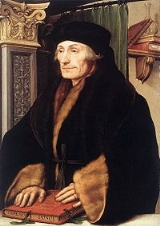
 is considered to be the greatest portraitist of Erasmus, having painted him at least three times, and perhaps as many as seven; some only survive in versions by other artists. His three profile portraits of Erasmus, two (nearly identical) profile portraits and one three-quarters view portrait were all painted in the same year, 1523. Erasmus used the Holbein portraits as gifts for his friends in England, such as William Warham
William Warham

William Warham , Archbishop of Canterbury, belonged to a Hampshire family, and was educated at Winchester College and New College, Oxford, afterwards practising and teaching law both in London and Oxford....
, the Archbishop of Canterbury (as he writes in a letter to Warham regarding the gift portrait, Erasmus quips that "he might have something of Erasmus should God call him from this place.") Erasmus spoke favorably of Holbein as an artist and person, but later criticized Holbein whom he had accused of sponging off of various patrons to whom Erasmus had recommended, for purposes more of monetary gain than artistic endeavor.
  • Albrecht Dürer
    Albrecht Dürer

    'Albrecht D?rer' was a Germans Painting, printmaker and theorist from Nuremberg. His still-famous works include the Apocalypse woodcuts, commons:Image:Duerer - Ritter, Tod und Teufel .jpg , St....
     also produced portraits of Erasmus, who he met three times, in the form of an engraving
    Engraving

    Engraving is the practice of incising a design onto a hard, usually flat surface, by cutting grooves into it. The result may be a decorated object in itself, as when silver, gold, steel, or glass engraving are engraved, or may provide an intaglio printing plate, of copper or another metal, for printing images on paper as prints or illustra...
     of 1526 and a preliminary charcoal sketch. Concerning the former Erasmus was unimpressed, declaring it an unfavorable likeness of him. Nevertheless, Erasmus and Dürer maintained a close friendship, with Dürer going so far as to solicit Erasmus's support for the Lutheran cause, which Erasmus politely declined. Erasmus wrote a glowing encomium
    Encomium

    Encomium is a Latin language word deriving from the Classical Greek ???????? meaning the praise of a person or thing. Related to this general meaning, "encomium" also identifies several distinct aspects of rhetoric:...
     about the artist, likening him to famous Greek painter of antiquity Apelles
    Apelles

    Apelles of Kos was a renowned Painting of ancient Greece. Pliny the Elder, to whom we owe much of our knowledge of this artist rated him superior to preceding and subsequent artists....
    . Erasmus was deeply affected by his death in 1528.
  • Quentin Matsys
    Quentin Matsys

    Quentin Matsys was a painter in the Flemish tradition and a founder of the Antwerp school. He was born at Leuven, where he was trained as an ironsmith....
     produced the earliest known portraits of Erasmus, including an oil painting in 1517 and a medallion in 1519.


See also

  • Rodolphus Agricola
    Rodolphus Agricola

    Rodolphus Agricola was a pre-Erasmus Humanism of the northern Low Countries, famous for his supple Latin and one of the first north of the Alps to know Greek language well....
  • ERASMUS programme
    Erasmus programme

    The ERASMUS programme, or European Region Action Scheme for the Mobility of University Students, is a European student exchange programme established in 1987....
    , which takes its name from this great traveller on the roads of Europe
    Europe

    Europe is, conventionally, one of the world's seven continents. Comprising the westernmost peninsula of Eurasia, Europe is generally divided from Asia to its east by the water divide of the Ural Mountains, the Ural , the Caspian Sea, and by the Caucasus Mountains to the southeast....
  • Christian humanism
    Christian humanism

    Christian Humanism is the belief that human freedom and individualism are intrinsic parts of, or are at least compatible with, Christianity doctrine and practice....
  • List of Erasmus's correspondents
  • Servatius Rogerus


External links

Wikisource Logo
Wikisource
Wikisource

Wikisource is an online library of free content source text, operated by the Wikimedia Foundation. Its aims are to harbour all forms of free text, in many languages....
 has the original Latin text of Praise of Folly.
  • at Erasmus Online
  • at Internet Archive
    Internet Archive

    The Internet Archive is a nonprofit organization dedicated to building and maintaining a free and openly accessible online digital library, including an archive site of the World Wide Web....
  • at the Stanford Encyclopedia of Philosophy
    Stanford Encyclopedia of Philosophy

    The Stanford Encyclopedia of Philosophy is a Open access online encyclopedia of philosophy maintained by Stanford University. The SEP was initially developed with U.S....