

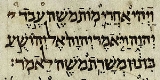
Aleppo Codex

Encyclopedia

Hebrew Bible
The Hebrew Bible is a term used by biblical scholars outside of Judaism to refer to the Tanakh , a canonical collection of Jewish texts, and the common textual antecedent of the several canonical editions of the Christian Old Testament...
. The codex was written in the 10th century A.D.
The codex has long been considered to be the most authoritative document in the masorah ("transmission"), the tradition by which the Hebrew Scriptures have been preserved from generation to generation. Surviving examples of responsa
Responsa
Responsa comprise a body of written decisions and rulings given by legal scholars in response to questions addressed to them.-In the Roman Empire:Roman law recognised responsa prudentium, i.e...
literature show that the Aleppo Codex was consulted by far-flung Jewish scholars throughout the Middle Ages
Middle Ages
The Middle Ages is a periodization of European history from the 5th century to the 15th century. The Middle Ages follows the fall of the Western Roman Empire in 476 and precedes the Early Modern Era. It is the middle period of a three-period division of Western history: Classic, Medieval and Modern...
, and modern studies have shown it to be the most accurate representation of Masoretic principles in any extant manuscript, containing very few errors among the roughly 2.7 million orthographic details that make up the Masoretic text. For these reasons, many scholars view the Aleppo Codex as the most authoritative representative of the masoretic tradition, both its letter-text and its vocalization (niqqud and cantillation
Cantillation
Cantillation is the ritual chanting of readings from the Hebrew Bible in synagogue services. The chants are written and notated in accordance with the special signs or marks printed in the Masoretic text of the Hebrew Bible to complement the letters and vowel points...
).
Overview
The Karaite Jewish community of Jerusalem purchased the codex about a hundred years after it was made. During the First CrusadeFirst Crusade
The First Crusade was a military expedition by Western Christianity to regain the Holy Lands taken in the Muslim conquest of the Levant, ultimately resulting in the recapture of Jerusalem...
, the synagogue was plundered and the codex was transferred to Egypt, whose Jews paid a high price for its ransom. It was preserved at the Rabbanite synagogue in Cairo
Cairo
Cairo , is the capital of Egypt and the largest city in the Arab world and Africa, and the 16th largest metropolitan area in the world. Nicknamed "The City of a Thousand Minarets" for its preponderance of Islamic architecture, Cairo has long been a centre of the region's political and cultural life...
, where it was consulted by Maimonides
Maimonides
Moses ben-Maimon, called Maimonides and also known as Mūsā ibn Maymūn in Arabic, or Rambam , was a preeminent medieval Jewish philosopher and one of the greatest Torah scholars and physicians of the Middle Ages...
, who described it as a text trusted by all Jewish scholars. It is rumoured that in 1375 one of Maimonides' descendants brought it to Aleppo
Aleppo
Aleppo is the largest city in Syria and the capital of Aleppo Governorate, the most populous Syrian governorate. With an official population of 2,301,570 , expanding to over 2.5 million in the metropolitan area, it is also one of the largest cities in the Levant...
, Syria
Syria
Syria , officially the Syrian Arab Republic , is a country in Western Asia, bordering Lebanon and the Mediterranean Sea to the West, Turkey to the north, Iraq to the east, Jordan to the south, and Israel to the southwest....
, leading to its present name.
The Codex remained in Syria for five hundred years. In 1947, rioters enraged by the UN decision to establish a Jewish state in Palestine burned down the synagogue where it was kept. The Codex disappeared, and re-emerged in 1958, when it was smuggled into Israel
Israel
The State of Israel is a parliamentary republic located in the Middle East, along the eastern shore of the Mediterranean Sea...
by Syrian Jew Murad Faham, and presented to the president of the state, Itzhak Ben-Zvi. On arrival, it was found that parts of the codex had been lost. The Aleppo Codex was entrusted to the Ben-Zvi Institute and the Hebrew University in Jerusalem.
Ransom

Basra
Basra is the capital of Basra Governorate, in southern Iraq near Kuwait and Iran. It had an estimated population of two million as of 2009...
sometime between 1040 and 1050. It was cared for by the brothers Hizkiyahu and Joshya, Karaite religious leaders who eventually moved to Fustat in 1050. The codex, however, stayed in Jerusalem until the latter part of that century. After the Fall of Jerusalem
Siege of Jerusalem (1099)
The Siege of Jerusalem took place from June 7 to July 15, 1099 during the First Crusade. The Crusaders stormed and captured the city from Fatimid Egypt.-Background:...
(1099) during the First Crusade, the Crusaders held the codex and other holy works for ransom (along with Jewish survivors). The Aleppo Codex website cites two letters in the Cairo Geniza
Cairo Geniza
The Cairo Geniza is a collection of almost 280,000 Jewish manuscript fragments found in the Genizah or storeroom of the Ben Ezra Synagogue in Fustat, presently Old Cairo, Egypt. Some additional fragments were found in the Basatin cemetery east of Old Cairo, and the collection includes a number of...
that describe how the inhabitants of Ashqelon borrowed money from Egypt to pay for the books. (These Judeo-Arabic letters were discovered by noted Jewish historian S.D. Goitein in 1952.) The Letter of the Karaite elders of Ascalon
Letter of the Karaite elders of Ascalon
The Letter of the Karaite elders of Ascalon was a communication written by six elders of the Karaite Jewish community of Ascalon and sent to their coreligionists in Alexandria nine months after the fall of Jerusalem during the First Crusade...
, the more descriptive of the two, states that the money borrowed from Alexandria
Alexandria
Alexandria is the second-largest city of Egypt, with a population of 4.1 million, extending about along the coast of the Mediterranean Sea in the north central part of the country; it is also the largest city lying directly on the Mediterranean coast. It is Egypt's largest seaport, serving...
was used to “buy back two hundred and thirty Bible codices, a hundred other volumes, and eight Torah Scrolls." The documents were transported to Egypt via a caravan led and funded by the prominent Alexandrian official Abu’l-Fadl Sahl b. Yūsha’ b. Sha‘yā who was in Ascalon for his wedding in early 1100. Judeo-Arabic inscriptions on the first page of the Codex mention the book was then "transferred to the Jerusalemite synagogue in Fustat." The Aleppo codex website reveals how the book exchanged hands. It was "transferred[...]according to the law of redemption from imprisonment [in which it had fallen] in Jerusalem, the Holy City, may it be rebuilt and reestablished, to the congregation in Egypt of Knisat Yerushalayim, may it be built and established in the life of Israel. Blessed be he who preserves it and cursed be he who steals it, and cursed be he who sells it, and cursed be he who pawns it. It may not be sold and it may not be defiled forever.
In Aleppo
The Aleppo community guarded the Codex zealously for some six hundred years: it was kept, together with three other Biblical manuscripts, in a special cupboard (later, an iron safe) in a basement chapel of the synagogue supposed to have been the cave of Elijah. It was regarded as the community's most sacred possession: people in trouble would pray before it, and oaths were taken by it. The community received queries from Jews around the world, who asked that various textual details be checked, correspondence which is preserved in the responsaResponsa
Responsa comprise a body of written decisions and rulings given by legal scholars in response to questions addressed to them.-In the Roman Empire:Roman law recognised responsa prudentium, i.e...
literature, and which allows for the reconstruction of certain details in the parts that are missing today. Most importantly, in the 1850s, R. Shalom Shachne Yellin sent his son in law, Moses Joshua Kimchi, to Aleppo, to copy information about the Codex; Kimchi sat for weeks, and copied thousands of details about the codex into the margins of a small handwritten Bible. (The existence of this Bible was known to twentieth-century scholars from the book ‘Ammudé Shesh by Rabbi S. S. Boyarski
Shemuel Shelomo Boyarski
Rabbi Shemuel Shelomo ben Moshe Meir Boyarski , known as "Rashash Boyarski" , after the initials of his personal names, was a Lithuanian rabbinical scholar and ritual scribe who lived in Jerusalem, as part of the Old Yishuv...
, and then the actual Bible itself was discovered by Yosef Ofer in 1989.)
However, the community limited direct observation of the manuscript by outsiders, especially by scholars in modern times. Paul Kahle, when revising the text of the Biblia Hebraica in the 1920s, tried and failed to obtain a photographic copy. This forced him to use the Leningrad Codex
Leningrad Codex
The Leningrad Codex is the oldest complete manuscript of the Hebrew Bible in Hebrew, using the masoretic text and Tiberian vocalization. It is dated AD 1008 according to its colophon...
instead for the third edition, which appeared in 1937.
The only modern scholar allowed to compare it with a standard printed Hebrew Bible
Hebrew Bible
The Hebrew Bible is a term used by biblical scholars outside of Judaism to refer to the Tanakh , a canonical collection of Jewish texts, and the common textual antecedent of the several canonical editions of the Christian Old Testament...
and take notes on the differences was Umberto Cassuto
Umberto Cassuto
Umberto Cassuto, also known as Moshe David Cassuto, , was a rabbi and Biblical scholar born in Florence, Italy. -Early life and career:...
. This secrecy made it impossible to confirm the authenticity of the Codex, and indeed Cassuto doubted that it was Maimonides' codex, though he agreed that it was 10th century.
During the riots against Jews and Jewish property in Aleppo in December 1947, the community's ancient synagogue was burned and the Codex was damaged, so that no more than 294 of the original 487 pages survived. In particular, only the last few pages of the Torah
Torah
Torah- A scroll containing the first five books of the BibleThe Torah , is name given by Jews to the first five books of the bible—Genesis , Exodus , Leviticus , Numbers and Deuteronomy Torah- A scroll containing the first five books of the BibleThe Torah , is name given by Jews to the first five...
are extant.
The missing leaves are a subject of fierce controversy. The Jews of Aleppo claim that they were burned. However, scholarly analysis has shown no evidence of fire having reached the codex itself (the dark marks on the pages are due to fungus). Some scholars instead accuse members of the Jewish community of having torn off the missing leaves and keeping them privately hidden. Two "missing" leaves have turned up, one in 1982 and the other in 2007, leaving open the possibility that even more may have survived the riots in 1947.
The community of Damascus possessed a counterpart of the Aleppo Codex, known as the "Damascus Keter", also written in Israel in the tenth century, which is now kept at the Jewish National and University Library
Jewish National and University Library
The National Library of Israel , is the national library of Israel...
and numbered ms. Heb 5702. It is available online here http://jnul.huji.ac.il/dl/mss/heb5702/index_eng.html. (This should not be confused with another Damascus Keter, of medieval Spanish origin.)
In Israel
The Israeli writer Amnon Shamosh wrote an account of how it was brought to Israel in his "Ha-Keter: Sippuro shel Keter Aram Soba" (The Crown: The Story of the Aleppo Codex), published in 1987. The codex was entrusted to the Ben-Zvi Institute and the Hebrew University in Jerusalem. Attempts to recover its missing parts continue to this day.In January 1958, the Aleppo Codex was smuggled out of Syria and sent to Jerusalem, by the influence of then Israeli President, Yitzhak Ben-Zvi
Yitzhak Ben-Zvi
Yitzhak Ben-Zvi was a historian, Labor Zionist leader, the second and longest-serving President of Israel.-Biography:...
, where it remains in the Shrine of the Book
Shrine of the Book
The Shrine of the Book , a wing of the Israel Museum near Givat Ram in Jerusalem, houses the Dead Sea Scrolls—discovered 1947–56 in 11 caves in and around the Wadi Qumran...
at the Israel Museum
Israel Museum
The Israel Museum, Jerusalem was founded in 1965 as Israel's national museum. It is situated on a hill in the Givat Ram neighborhood of Jerusalem, near the Bible Lands Museum, the Knesset, the Israeli Supreme Court, and the Hebrew University of Jerusalem....
. This finally gave scholars the chance to examine it and consider the claims that it is indeed the manuscript referred to by Maimonides. The work of Moshe Goshen-Gottstein
Moshe Goshen-Gottstein
Moshe Goshen-Gottstein was a German-born professor of Semitic linguistics and biblical philology at the Hebrew University of Jerusalem, and director of the lexicographical institute and Biblical research institute of Bar-Ilan University.-Biography:Moshe Goshen-Gottstein was born in Berlin...
on the few surviving pages of the Torah seems to have confirmed these claims beyond reasonable doubt. Goshen-Gottstein suggested (in the introduction to his facsimile reprint of the codex) that not only was it the oldest known masoretic Bible in a single volume, it was the first time ever that a complete Tanakh
Tanakh
The Tanakh is a name used in Judaism for the canon of the Hebrew Bible. The Tanakh is also known as the Masoretic Text or the Miqra. The name is an acronym formed from the initial Hebrew letters of the Masoretic Text's three traditional subdivisions: The Torah , Nevi'im and Ketuvim —hence...
had been produced by one or two people as a unified entity in a consistent style.
Later, after the university denied him access to the codex, Rabbi Mordechai Breuer
Mordechai Breuer
Mordechai Breuer was an Orthodox rabbi. He was one of the world's leading experts on Tanakh , and especially of the text of the Aleppo Codex....
began his own reconstruction of the Masoretic text on the basis of other well-known ancient manuscripts. His results matched the Aleppo Codex almost exactly. Thus today, Breuer's version is used authoritatively for the reconstruction of the missing portions of the Aleppo Codex. The Keter Yerushalayim
Jerusalem Crown
The Jerusalem Crown: Keter Yerushalayim , is a text of the Tanakh printed in Jerusalem in 2001, and is referred to in English as the Jerusalem Codex....
(כתר ירושלים, "Jerusalem Crown"), printed in Jerusalem in 2000, is a modern version of the Tanakh, based on the Aleppo Codex and the work of Breuer: it uses a newly-designed typeface based on the calligraphy of the Codex and is based on its page-layout.
Authoritative text
The consonants in the codexCodex
A codex is a book in the format used for modern books, with multiple quires or gatherings typically bound together and given a cover.Developed by the Romans from wooden writing tablets, its gradual replacement...
were copied by the scribe Shlomo ben Buya'a in Israel circa 920. The text was then verified, vocalized, and provided with Masoretic notes by Aaron ben Asher
Aaron ben Moses ben Asher
Aaron ben Moses ben Asher was a Jewish scribe who refined the Tiberian system for writing down vowel sounds in Hebrew, which is still in use today, and serves as the basis for grammatical analysis...
. Ben-Asher was the last and most prominent member of the Ben-Asher dynasty of grammarians from Tiberias, which shaped the most accurate version of the Masorah and, therefore, the Hebrew Bible.
The Leningrad Codex
Leningrad Codex
The Leningrad Codex is the oldest complete manuscript of the Hebrew Bible in Hebrew, using the masoretic text and Tiberian vocalization. It is dated AD 1008 according to its colophon...
, which dates to approximately the same time as the Aleppo codex, has been claimed to be a product of the Ben-Asher scriptorium
Scriptorium
Scriptorium, literally "a place for writing", is commonly used to refer to a room in medieval European monasteries devoted to the copying of manuscripts by monastic scribes...
. However, its own colophon
Colophon (publishing)
In publishing, a colophon is either:* A brief description of publication or production notes relevant to the edition, in modern books usually located at the reverse of the title page, but can also sometimes be located at the end of the book, or...
says only that it was corrected from manuscripts written by Ben-Asher; there is no evidence that Ben-Asher himself ever saw it.
The Aleppo Codex was the manuscript used by Maimonides when he set down the exact rules for writing scrolls of the Torah
Torah
Torah- A scroll containing the first five books of the BibleThe Torah , is name given by Jews to the first five books of the bible—Genesis , Exodus , Leviticus , Numbers and Deuteronomy Torah- A scroll containing the first five books of the BibleThe Torah , is name given by Jews to the first five...
, Hilkhot Sefer Torah ("the Laws of the Torah Scroll") in his Mishneh Torah. This halachic
Halakha
Halakha — also transliterated Halocho , or Halacha — is the collective body of Jewish law, including biblical law and later talmudic and rabbinic law, as well as customs and traditions.Judaism classically draws no distinction in its laws between religious and ostensibly non-religious life; Jewish...
ruling gave the Aleppo Codex what is for Jews the seal of supreme textual authority, even though Maimonides only quoted it for paragraphing and other details of formatting, and not for the text itself (see discussion). "The codex which we used in these works is the codex known in Egypt
Egypt
Egypt , officially the Arab Republic of Egypt, Arabic: , is a country mainly in North Africa, with the Sinai Peninsula forming a land bridge in Southwest Asia. Egypt is thus a transcontinental country, and a major power in Africa, the Mediterranean Basin, the Middle East and the Muslim world...
, which includes 24 books, which was in Jerusalem," he wrote. Rabbi David ibn abi Zimra testifies to this being the same codex as that later transferred to Aleppo.
Contents
When the Aleppo Codex was complete (until 1947), it followed the Tiberian textual tradition in the order of its books, similar to the Leningrad CodexLeningrad Codex
The Leningrad Codex is the oldest complete manuscript of the Hebrew Bible in Hebrew, using the masoretic text and Tiberian vocalization. It is dated AD 1008 according to its colophon...
, and which also matches the later tradition of Sephardic biblical manuscripts. Torah
Torah
Torah- A scroll containing the first five books of the BibleThe Torah , is name given by Jews to the first five books of the bible—Genesis , Exodus , Leviticus , Numbers and Deuteronomy Torah- A scroll containing the first five books of the BibleThe Torah , is name given by Jews to the first five...
and Nebi'im appear in the same order found in most printed Hebrew bibles, but the order for the books for Ketubim differs markedly. In the Aleppo Codex, the order of Ketubim is: Chronicles, Psalms, Job, Proverbs, Ruth, Song of Songs, Ecclesiastes, Lamentations, Esther, Daniel, Ezra-Nehemiah.
The current text is missing almost the entire Torah
Torah
Torah- A scroll containing the first five books of the BibleThe Torah , is name given by Jews to the first five books of the bible—Genesis , Exodus , Leviticus , Numbers and Deuteronomy Torah- A scroll containing the first five books of the BibleThe Torah , is name given by Jews to the first five...
(Genesis through most of Deuteronomy). It begins with the last word of Deuteronomy 28:17 (ומשארתך, "and your kneading trough"). After that, the books of Nebi'im appear in their traditional order (Joshua, Judges, Samuel, Kings, Isaiah, Jeremiah, Ezekiel, and the twelve minor prophets). However, all of Amos
Book of Amos
The Book of Amos is a prophetic book of the Hebrew Bible, one of the Twelve Minor Prophets. Amos, an older contemporary of Hosea and Isaiah, was active c. 750 BCE during the reign of Jeroboam II, making the Book of Amos the first biblical prophetic book written. Amos lived in the kingdom of Judah...
after Amos 5:19, Obadiah
Obadiah
Obadiah is a Biblical theophorical name, meaning "servant of Yahweh" or "worshipper of Yahweh." It is related to "Abdeel", "servant of God", which is also cognate to the Arabic name "Abdullah". Turkish name Abdil or Abdi. The form of Obadiah's name used in the Septuagint is Obdios; in Latin it is...
, Jonah
Jonah
Jonah is the name given in the Hebrew Bible to a prophet of the northern kingdom of Israel in about the 8th century BC, the eponymous central character in the Book of Jonah, famous for being swallowed by a fish or a whale, depending on translation...
, and the beginning of Micah
Micah
Micah is a given name.Micah is the name of several people in the Hebrew Bible , and means "who is like God?". The name is sometimes found with theophoric extensions...
are missing. The Ketubim follow as above, but currently end at the last leaf with בנות ציון in Song of Songs 3:11 ("daughters of Zion..."). Ecclesiastes, Lamentations, Esther, Daniel, and Ezra-Nehemiah are missing.
Modern editions
Several complete or partial editions of the TanakhTanakh
The Tanakh is a name used in Judaism for the canon of the Hebrew Bible. The Tanakh is also known as the Masoretic Text or the Miqra. The name is an acronym formed from the initial Hebrew letters of the Masoretic Text's three traditional subdivisions: The Torah , Nevi'im and Ketuvim —hence...
based on the Aleppo Codex have been published over the past three decades in Israel, some of them under the academic auspices of Israeli universities. These editions incorporate reconstructions of the missing parts of the codex based on the methodology of Mordechai Breuer
Mordechai Breuer
Mordechai Breuer was an Orthodox rabbi. He was one of the world's leading experts on Tanakh , and especially of the text of the Aleppo Codex....
or similar systems, and by taking into account all available historical testimony about the contents of the codex.
Complete Tanakh:
These are complete editions of the Tanakh
Tanakh
The Tanakh is a name used in Judaism for the canon of the Hebrew Bible. The Tanakh is also known as the Masoretic Text or the Miqra. The name is an acronym formed from the initial Hebrew letters of the Masoretic Text's three traditional subdivisions: The Torah , Nevi'im and Ketuvim —hence...
, usually in one volume (but sometimes also sold in three volumes). They do not include the masoretic notes of the Aleppo Codex.
- Mossad Harav Kuk edition, Mordechai BreuerMordechai BreuerMordechai Breuer was an Orthodox rabbi. He was one of the world's leading experts on Tanakh , and especially of the text of the Aleppo Codex....
, ed. TorahTorahTorah- A scroll containing the first five books of the BibleThe Torah , is name given by Jews to the first five books of the bible—Genesis , Exodus , Leviticus , Numbers and Deuteronomy Torah- A scroll containing the first five books of the BibleThe Torah , is name given by Jews to the first five...
(1977); Nebi'im (1979); Ketubim (1982); full TanakhTanakhThe Tanakh is a name used in Judaism for the canon of the Hebrew Bible. The Tanakh is also known as the Masoretic Text or the Miqra. The name is an acronym formed from the initial Hebrew letters of the Masoretic Text's three traditional subdivisions: The Torah , Nevi'im and Ketuvim —hence...
in one volume 1989. This was the first edition to include a reconstruction of the letters, vowels, and cantillation marks in the missing parts of the Aleppo codex. - Horev publishers, Jerusalem, 1996-98. Mordechai BreuerMordechai BreuerMordechai Breuer was an Orthodox rabbi. He was one of the world's leading experts on Tanakh , and especially of the text of the Aleppo Codex....
, ed. This was the first edition to incorporate newly discovered information on the parashah divisions of the Aleppo Codex for Nebi'im and Ketubim. The text of the Horev Tanakh has been reprinted in several forms with various commentaries by the same publisher. - Jerusalem CrownJerusalem CrownThe Jerusalem Crown: Keter Yerushalayim , is a text of the Tanakh printed in Jerusalem in 2001, and is referred to in English as the Jerusalem Codex....
: The Bible of the Hebrew University of Jerusalem, 2000. Edited according to the method of Mordechai BreuerMordechai BreuerMordechai Breuer was an Orthodox rabbi. He was one of the world's leading experts on Tanakh , and especially of the text of the Aleppo Codex....
under the supervision of Yosef Ofer, with additional proofreading and refinements since the Horev edition. - Jerusalem Simanim Institute, Feldheim Publishers, 2004 (published in one-volume and three-volume editions).
Complete online Tanakh:
- Mechon Mamre provides an online edition of the TanakhTanakhThe Tanakh is a name used in Judaism for the canon of the Hebrew Bible. The Tanakh is also known as the Masoretic Text or the Miqra. The name is an acronym formed from the initial Hebrew letters of the Masoretic Text's three traditional subdivisions: The Torah , Nevi'im and Ketuvim —hence...
according to the Aleppo Codex and other Tiberian manuscripts close to it, basing its reconstruction of the text on the methods of the Rav Mordechai Breuer (but claims to differ from the Rav Breuer's texts as published in some fine details). The text is offered in four formats: (a) Masoretic letter-text, (b) "full" letter-text (unrelated to masoretic spelling), (c) masoretic text with vowels (niqqud), and (d) masoretic text with vowels and cantillationCantillationCantillation is the ritual chanting of readings from the Hebrew Bible in synagogue services. The chants are written and notated in accordance with the special signs or marks printed in the Masoretic text of the Hebrew Bible to complement the letters and vowel points...
signs. See external links below.
Partial editions:
- Hebrew University Bible ProjectHebrew University Bible ProjectThe Hebrew University Bible Project is a project to create the first edition of the Hebrew Bible that reproduces the text of the Aleppo Codex and includes a thorough critical apparatus....
(Isaiah, Jeremiah, Ezekiel). Includes the masoretic notes of the Aleppo Codex. - Mikraot Gedolot HaketerMikraot GedolotThe Mikraot Gedolot "Great Scriptures," often called the "Rabbinic Bible" in English, is anedition of Tanakh that generally includes four distinct elements:...
, Bar-Ilan UniversityBar-Ilan UniversityBar-Ilan University is a university in Ramat Gan of the Tel Aviv District, Israel.Established in 1955, Bar Ilan is now Israel's second-largest academic institution. It has nearly 26,800 students and 1,350 faculty members...
(1992-present). A multi-volume critical edition of the Mikraot GedolotMikraot GedolotThe Mikraot Gedolot "Great Scriptures," often called the "Rabbinic Bible" in English, is anedition of Tanakh that generally includes four distinct elements:...
, nine volumes published to date including Genesis (2 vols.), Exodus (2 vols.), Joshua & Judges (1 vol.), Samuel, Kings, Isaiah, Ezekiel, Psalms (2 vols.). Includes the masoretic notes of the Aleppo Codex and a new commentary on them. Differs from the Breuer reconstruction and presentation for some masoretic details. - Torat Hayim, published by Mosad ha-Rav Kook (Torah only).
- Chorev Mikraot Gedolot by Hotzaat Chorev (Torah only).
See also
- List of Hebrew Bible manuscripts
- 4Q1084Q1084Q108 is a fragment containing a portion of the Song of Songs in Hebrew. Fragments from three such scrolls were found in Cave 4 at Qumran...
- Leningrad CodexLeningrad CodexThe Leningrad Codex is the oldest complete manuscript of the Hebrew Bible in Hebrew, using the masoretic text and Tiberian vocalization. It is dated AD 1008 according to its colophon...
- Codex CairensisCodex CairensisThe Codex Cairensis is believed to be the oldest extant Hebrew manuscript containing the complete text of the Old Testament Nevi'im .- History :...
- Tanakh at QumranTanakh at QumranThe Tanakh is the Hebrew Bible and Qumran is an archaeological site near the Dead Sea. More than two hundred portions of the Tanakh have been found near Qumran, forming part of the Dead Sea Scrolls. The scrolls were found in a series of caves, which have since been numbered, and these numbers used...
- Parashah
External links
- The Aleppo Codex Website
- Mechon Mamre - Electronic text of the Hebrew BibleHebrew BibleThe Hebrew Bible is a term used by biblical scholars outside of Judaism to refer to the Tanakh , a canonical collection of Jewish texts, and the common textual antecedent of the several canonical editions of the Christian Old Testament...
based largely on the Aleppo Codex. - Wikimedia Commons - full online digital images in several files.
- Seforim Online - two online digital images, each in a single large file (the same images are found at the Wikimedia Commons in several smaller files):
- medium resolution (number 262 in the database)
- high resolution (number 263 in the database), contains most of the manuscript but missing parts of some books.
- The History and Authority of the Aleppo Codex, by Yosef Ofer (pdf)
- Israel Museum shrine of the Book
- Mechon Mamre - Electronic text of the Hebrew BibleHebrew BibleThe Hebrew Bible is a term used by biblical scholars outside of Judaism to refer to the Tanakh , a canonical collection of Jewish texts, and the common textual antecedent of the several canonical editions of the Christian Old Testament...
based on the Aleppo Codex - History of the Aleppo Codex
- Segal, The Crown of Aleppo Copies of the Aleppo Codex
- Dina Kraft, From Maimonides to Brooklyn: The mystery of the Aleppo Codex