
All Topics  
Codex Vaticanus

 
Codex Vaticanus

   Email Print
   Bookmark   Link


Codex Vaticanus


The Codex Vaticanus, (The Vatican
Vatican Library

The Vatican Library , is the library of the Holy See, currently located in Vatican City. It is one of the oldest libraries in the world and contains one of the most significant collections of historical texts....
, Bibl. Vat.
Vatican Library

The Vatican Library , is the library of the Holy See, currently located in Vatican City. It is one of the oldest libraries in the world and contains one of the most significant collections of historical texts....
, Vat. gr. 1209; no. B or 03 Gregory-Aland
Biblical manuscript

A Biblical manuscript is any handwritten copy of a portion of the text of the Bible. The word Bible comes from the Greek biblion ; manuscript comes from Latin manu and scriptum ....
, d 1 von Soden
Biblical manuscript

A Biblical manuscript is any handwritten copy of a portion of the text of the Bible. The word Bible comes from the Greek biblion ; manuscript comes from Latin manu and scriptum ....
), is one of the oldest and most valuable extant manuscripts
Biblical manuscript

A Biblical manuscript is any handwritten copy of a portion of the text of the Bible. The word Bible comes from the Greek biblion ; manuscript comes from Latin manu and scriptum ....
 of the Greek Bible. The codex is named for its place of housing in the Vatican Library
Vatican Library

The Vatican Library , is the library of the Holy See, currently located in Vatican City. It is one of the oldest libraries in the world and contains one of the most significant collections of historical texts....
. It is written in Greek
Greek language

Greek is an Indo-European languages native to the southern Balkan peninsula, the language of the Greek people. It forms an independent branch within Indo-European....
, on vellum, with uncial
Uncial

Uncial is a majuscule script commonly used from the 3rd to 8th centuries AD by Latin and Byzantine Empire scribes. Uncial letters are written in either Greek, Latin, or Gothic....
 letters. The manuscript is one of the very few, and one of the two Greek manuscript of New Testament to be written with three columns per page (the other being Codex Vaticanus 2061
Codex Vaticanus 2061

Codex Vaticanus 2061, usually known as Uncial 048 , a 1070 . Frederick Henry Ambrose Scrivener designed it by Hebrew letter ?....
).


Discussion
Ask a question about 'Codex Vaticanus'
Start a new discussion about 'Codex Vaticanus'
Answer questions from other users
Full Discussion Forum


Encyclopedia


The Codex Vaticanus, (The Vatican
Vatican Library

The Vatican Library , is the library of the Holy See, currently located in Vatican City. It is one of the oldest libraries in the world and contains one of the most significant collections of historical texts....
, Bibl. Vat.
Vatican Library

The Vatican Library , is the library of the Holy See, currently located in Vatican City. It is one of the oldest libraries in the world and contains one of the most significant collections of historical texts....
, Vat. gr. 1209; no. B or 03 Gregory-Aland
Biblical manuscript

A Biblical manuscript is any handwritten copy of a portion of the text of the Bible. The word Bible comes from the Greek biblion ; manuscript comes from Latin manu and scriptum ....
, d 1 von Soden
Biblical manuscript

A Biblical manuscript is any handwritten copy of a portion of the text of the Bible. The word Bible comes from the Greek biblion ; manuscript comes from Latin manu and scriptum ....
), is one of the oldest and most valuable extant manuscripts
Biblical manuscript

A Biblical manuscript is any handwritten copy of a portion of the text of the Bible. The word Bible comes from the Greek biblion ; manuscript comes from Latin manu and scriptum ....
 of the Greek Bible. The codex is named for its place of housing in the Vatican Library
Vatican Library

The Vatican Library , is the library of the Holy See, currently located in Vatican City. It is one of the oldest libraries in the world and contains one of the most significant collections of historical texts....
. It is written in Greek
Greek language

Greek is an Indo-European languages native to the southern Balkan peninsula, the language of the Greek people. It forms an independent branch within Indo-European....
, on vellum, with uncial
Uncial

Uncial is a majuscule script commonly used from the 3rd to 8th centuries AD by Latin and Byzantine Empire scribes. Uncial letters are written in either Greek, Latin, or Gothic....
 letters. The manuscript is one of the very few, and one of the two Greek manuscript of New Testament to be written with three columns per page (the other being Codex Vaticanus 2061
Codex Vaticanus 2061

Codex Vaticanus 2061, usually known as Uncial 048 , a 1070 . Frederick Henry Ambrose Scrivener designed it by Hebrew letter ?....
). Because it was not often used, it has survived to the present day in very good condition. Codex is comprised in a single quarto volume containing 759 thin and delicate vellum leaves. Until the discovery by Tischendorf
Constantin von Tischendorf

Lobegott Friedrich Constantin Tischendorf was a noted Germany Biblical scholar. He deciphered the Codex Ephraemi Rescriptus, a 5th century Greek language biblical manuscript of the New Testament, in the 1840s, and rediscovered the Codex Sinaiticus, a 4th century New Testament manuscript, in 1859....
 of the Codex Sinaiticus
Codex Sinaiticus

Codex Sinaiticus ]]The story of how von Tischendorf found the manuscript, which contained most of the Old Testament and all of the New Testament, has all the interest of a romance....
, it was without a rival in the world.

Contents


Vaticanus originally contained a complete copy of the Septuagint
Septuagint

The Septuagint , or simply "LXX", is the Koine Greek version of the Hebrew Bible, translated in stages between the 3rd century BC and 1st century BC in Alexandria....
 ("LXX") except for 1-4 Maccabees
Maccabees

The Maccabees were a Jewish national liberation movement that fought for and won independence from Antiochus IV Epiphanes of the Hellenistic Seleucid dynasty, who was succeeded by his infant son Antiochus V Eupator....
 and the Prayer of Manasseh
Prayer of Manasseh

The Prayer of Manasseh is a short work of 15 verses of the penitential prayer of the Kingdom of Judah king Manasseh of Judah. Manasseh is recorded in the Bible as one of the most idolatrous ; however, after having been taken captive by the Assyrians, he prays for mercy and turns from his idolatrous ways....
. Genesis
Genesis

Genesis or Breishit is the first book of the Bible used by Judaism and Christianity, and the first of five books of the Pentateuch or Torah....
 1:1 - 46:28a (31 leaves) and Psalm
Psalms

Psalms is a book of the Hebrew Bible , included in the collected works known as the "Writings" or Ketuvim....
 105:27 — 137:6b (20 leaves) are lost and have been filled by a later hand in the 15th century. 2 Kings 2:5-7, 10-13 are also lost due to a tear in one of the pages. The order of the Old Testament books is as follows: Genesis to 2 Chronicles as normal, 1 Esdras
1 Esdras

1 Esdras is a book from the Septuagint translation of the Old Testament regarded as canonical in Eastern Orthodox Church and Oriental Orthodoxy, but regarded as Biblical apocrypha by Jews, Catholics, and most Protestantism....
, 2 Esdras
Book of Ezra

The Book of Ezra is a book of the Bible in the Old Testament and Hebrew language Tanakh. It is the record of events occurring at the close of the Babylonian captivity....
 (Ezra-Nehemiah), the Psalms
Psalms

Psalms is a book of the Hebrew Bible , included in the collected works known as the "Writings" or Ketuvim....
, Proverbs
Book of Proverbs

The Book of Proverbs is a book of the Hebrew Bible , included in the collected works known as the "Writings" or Ketuvim....
, Ecclesiastes
Ecclesiastes

Ecclesiastes is a book of the Hebrew Bible. The English name derives from the Greek language translation of the Hebrew #Title.The main speaker in the book, identified by the name or title Qohelet, introduces himself as "son of David, and king in Jerusalem." The work consists of personal or autobiographic matter, at times expressed in aph...
, Song of Songs
Song of songs

Song of Songs is a book of the Hebrew Bible or Old Testament. It may also refer to:In music:*Song of songs , the debut album by David and the Giants...
, Job
Book of Job

The Book of Job is one of the books of the Hebrew Bible. It relates the story of Job , his trials at the hands of Satan, his theological discussions with friends on the origins and nature of his suffering, and finally a response from God....
, Wisdom
Book of Wisdom

Book of Wisdom or Wisdom of Solomon or simply Wisdom is one of the deuterocanonical books of the Bible. It is one of the seven Sapiential or wisdom books of the Septuagint Old Testament, which includes Book of Job, Psalms, Book of Proverbs, Ecclesiastes, Song of Solomon , and Ecclesiasticus ....
, Ecclesiasticus
Ben Sira

Sirach, by Ben Sira, also known as The Wisdom of Jesus son of Sirach, The Wisdom of Ben Sira, or Ecclesiasticus, is a work from the second century BC, originally written in Hebrew language....
, Esther
Book of Esther

The Book of Esther is one of the books of the Ketuvim of the Tanakh and of the Historical Books of the Old Testament. The Book of Esther or the Megillah is the basis for the Jewish celebration of Purim....
, Judith
Book of Judith

[Image:Cristofano Allori 002.jpg|thumb|220px|Judith with the Head of Holophernes, by Cristofano Allori, 1613 The Book of Judith is a deuterocanonical book, included in the Septuagint and in the Roman Catholic and Eastern Orthodox Christian Old Testament of the Bible, but excluded by Judaism and Protestantism....
, Tobit
Book of Tobit

The Book of Tobit or Tobi is a book of scripture that is part of the Roman Catholic Church and Eastern Orthodoxy biblical canon, pronounced canonical by the Council of Carthage of 397 and confirmed for Roman Catholics by the Council of Trent ....
, the minor prophets from Hosea
Hosea

Hosea was the son of Beeri and a prophet in Israel in the 8th century BC. He is one of the Twelve Minor Prophets of the Jewish Hebrew Bible, also known as the Minor Prophets of the Christian Old Testament....
 to Malachi
Malachi

Malachi, Malachias or Mal'achi was a prophet in the Bible, the Judaism Tanakh and Christianity Old Testament .He was the last of the minor prophets of David, and the writer of the Book of Malachi, the last book of the Names for books of Judeo-Christian scripture Old Testament canon , and is the last book of the Neviim...
, Isaiah
Isaiah

Isaiah is the main figure in the Biblical Book of Isaiah, and is traditionally considered to be its author. He was an 8th-century Before Christ Judean prophet who declared that all the world belonged to God and that God will destroy it....
, Jeremiah
Jeremiah

Jeremiah was one of the 'greater prophet' of the Hebrew Bible. He was the son of Hilkiah, a priest of Anathoth.His writings are put together in the Book of Jeremiah and, according to tradition, the Book of Lamentations....
, Baruch
Baruch

Baruch has been a given name among Jews from Biblical times up to the present, on some occasions also used as surname. It is also found, though more rarely, among Christians - particularly among Protestants who use Old Testament names....
, Lamentations
Lamentations

Lamentations may refer to:*The Book of Lamentations*Lamentations of Jeremiah the Prophet and Genre of the Lamentations, two articles on the music for Tenebrae...
 and the Epistle of Jeremiah, Ezekiel
Ezekiel

This article is about the main speaker in the biblical Book of Ezekiel. For a summary and analysis of the book itself, see Book of Ezekiel.According to religious texts, Ezekiel was a prophet and priest in the Hebrew Bible who prophesied for 22 years sometime in the 6th century BC in the form of visions while exiled in Babylon, as recorded...
 and Daniel
Daniel

Daniel is a figure appearing in the Hebrew Bible and the central protagonist of the Book of Daniel. The name "Daniel" means "Judged by El ". "Dan" = judge and "i" = a suffix conjugating the verb such that its action applies to the speaker....
.

The extant New Testament
New Testament

The New Testament is the name given to the second major division of the Christianity Bible, the first such division being the much longer Old Testament....
 of Vaticanus contains the Gospels, Acts
Acts of the Apostles

The Acts of the Apostles is a book of the Bible, which now stands fifth in the New Testament. It is commonly referred to as simply Acts. The title "Acts of the Apostles" was first used by Irenaeus in the late second century, but some have suggested that the title "Acts" be interpreted as "the Acts of the Holy Spirit" or even "the Acts...
, the General Epistles
General epistles

General epistles are books in the New Testament in the form of letters. They are termed "general" because for the most part their intended audience seems to be Christians in general rather than individual persons or congregations as is the case with the Pauline epistles....
, the Pauline Epistles
Pauline epistles

The Pauline epistles, Epistles of Paul, or Letters of Paul, are the thirteen New Testament books which have the name Paul as the first word, hence claiming authorship by Paul the Apostle....
 and the Epistle to the Hebrews
Epistle to the Hebrews

The Epistle to the Hebrews is one of the books in the New Testament. Though traditionally credited to the Apostle Paul, the letter is anonymous....
 (up to Heb 9:14, ?a?a[??e?); thus it lacks 1 and 2 Timothy, Titus
Epistle to Titus

The Epistle to Titus is a book of the biblical canon New Testament, one of the three so-called "pastoral epistles" . It is offered as a letter from Paul of Tarsus to the Apostle Titus....
, Philemon
Epistle to Philemon

The Epistle to Philemon is a Prison literature from Paul of Tarsus to Philemon , a leader in the Epistle to the Colossians. It is one of the books of the New Testament of the Christian Bible....
 and Revelation
Revelation

Revelation is the act of revealing or disclosing, or making something obvious and clearly understood through active or passive communication with the divinity....
. These missing pages were replaced by a 15th century minuscule supplement (no. 1957). Omitted passages include Matthew 16:2b-3
Matthew 16:2b-3

Gospel of Matthew 16:2b?3 , the passage describes a confrontation between Jesus and the Pharisees and Sadducees over their demand for a sign from heaven....
, Mark 16:9-20
Mark 16

Mark 16 is the final chapter of the Gospel of Mark in the New Testament of the Christian Bible. It begins with the discovery of the empty tomb by Mary Magdalene, Mary the mother of James, and Salome — there they encounter a man dressed in white who announces Jesus' Resurrection of Jesus....
, , , John 7:53-8:11 and . It has not ending in the Gospel of Mark, but scribe was aware of it (in some manuscripts) and left empty column afte Gospel of Mark. It is only one empty column in this codex.
Codex Vaticanus

Description


Originally it was composed of 820 parchment leaves as 71 leaves have been lost. Currently, it conatins 617 leaves in Old Testament and 142 in New Testament. The codex is written in three columns per page, 42 lines per page, 16-18 letters per line. The size of the pages is 27 by 27 cm. The Greek is written continuously with small neat writing, later retraced by a 10th (or 11th) century scribe. Punctuation is rare (accents and breathings have been added by a later hand) except for some blank spaces, diaeresis
Diaeresis

In linguistics, diaeresis, or dieresis, is the pronunciation of two adjacent vowels in two separate syllables rather than as a diphthong, and it is also the name of the diacritic mark used to prompt the reader to pronounce adjacent vowels in this manner....
 on initial iota
Iota

Iota is the ninth letter of the Greek alphabet. In the system of Greek numerals it has a value of 10. It was derived from the Phoenician alphabet Yodh ....
s and upsilon
Upsilon

Upsilon is the 20th letter of the Greek alphabet. In the system of Greek numerals it has a value of 400. It is derived from the phoenecian alphabet Waw ....
s, abbreviations of the nomina sacra
Nomina sacra

Nomina sacra means "sacred names" in Latin language, and can be used to refer to traditions of abbreviated writing of several frequently occurring divine names or titles in early Greek language Holy Scripture....
 and markings of OT
Old Testament

In Western Christianity, the Old Testament refers to the books that form the first of the two-part Christianity Bible Biblical canon. These works correspond to the Hebrew Bible , with some variations and additions....
 citations. There are no enlarged initials, no stops or accents, no divisions into chapters or sections such as are found in later MSS.

Text

The Greek text of the codex is a representative of the Byzantine text-type
Byzantine text-type

The Byzantine text-type is one of several text-types used in textual criticism to describe the textual character of Koine Greek New Testament biblical manuscript....
. Aland
Kurt Aland

Kurt Aland was a Germany Theologian and Professor of New Testament Research and Church History. For many years he was head of the Institute for New Testament Textual Research and the principal editor of the Nestle-Aland edition of Novum Testamentum Graece ....
 placed it in Category I
Categories of New Testament manuscripts

Biblical manuscript in Greek are categorized into five groups. This categorization scheme was introduced in 1981 by Kurt Aland and Barbara Aland in Der Text des Neuen Testaments....
.

Scribes and correctors


The manuscript was written by three scribes, two of them wrote the Old Testament and one the New Testament (B1, B2, B3).

The manuscript contains mysterious double dots (so called "umlauts
Umlaut (diacritic)

The word umlaut is the name of a type of sound shift in spoken language and of the diacritic mark used to represent it Orthography. The diacritic mark comprises a pair of dots or lines placed over the letter that represents the affected Vowel....
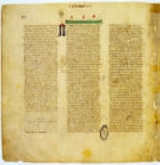
") in the margin of the New Testament, which seem to mark places of textual uncertainty. There are 795 of these in the text and around another 40 that are uncertain. The date of these markings are disputed among scholars and are discussed in a link below. Two such "umlauts" can be seen in the left margin of the first column (top image).

On page 1512, next to Hebrews 1:3, the text contains an interesting marginal note, "Fool and knave, can't you leave the old reading alone and not alter it!"—"?µa??state ?a? ?a??, ?fe? t?? pa?a???, µ? µetap??e?" which suggests that inaccurate copying, either intentional or unintentional, was a known problem in scriptoriums. The uppermost picture of this article shows the page where this remark is found (In the middle of the yellow page, between 1st and 2nd column).

Provenance


Its place of origin and the history of the manuscript is uncertain, with Rome
Rome

Rome is the capital city of Italy and Lazio, and is Italy's largest and most populous city, with 2,724,347 residents in an urban area of some ....
 (Hort
Fenton John Anthony Hort

Fenton John Anthony Hort was an Irish people theology and editor, with Brooke Westcott of a critical edition of the The New Testament in the Original Greek....
), southern Italy, Alexandria (Kenyon
Frederic G. Kenyon

Sir Frederic George Kenyon Order of the British Empire Order of the Bath Territorial Decoration British Academy Society of Antiquaries of London was a British Paleography, Biblical criticism and Classics scholar....
, Burkitt), and Caesarea (T. C. Skeat) all having been suggested. A connection with Egypt is indicated by the order of the Pauline epistles and by the fact that, as in the Codex Alexandrinus, the titles of some of the books contain letters of a distinctively Coptic character, especially the Coptic mu
Mu (letter)

Mu is the 12th letter of the Greek alphabet. In the system of Greek numerals it has a value of 40. Mu was derived from the Egyptian hieroglyphic symbol for water which had been simplified by the Phoenicians and named after their word for water, to become Mem ....
, which is used not only in titles, but also very frequently at the ends of lines, when space is to be economised.

There has been speculation that it had previously been in the possession of Cardinal Bessarion because the minuscule supplement has a text similar to one of Bessarion's manuscripts. According to Paul Canart's introduction to the recent facsimile edition, p. 5, the decorative initials added to the manuscript in the Middle Ages are reminiscent of Constantinopolitan decoration of the 10th century, but poorly executed, giving the impression that they were added in the 11th or 12th century. T. C. Skeat, a paleographer at the British Museum
British Museum

The British Museum is a museum of human history and culture situated in London. Its collections, which number more than 7 million Object , are amongst the largest and most comprehensive in the world and originate from all continents, illustrating and documenting the story of human culture from its beginning to the present....
, first argued that Codex Vaticanus was among the 50 Bibles that the Emperor Constantine I ordered Eusebius of Caesarea
Eusebius of Caesarea

Eusebius of Caesarea became the bishop of Caesarea Maritima c 314. He is often referred to as the Father of Church History because of his work in recording the history of the early Christianity church, especially Chronicon and Church_History_....
 to produce. The similarity of the text with the papyri and Coptic version (including some letter formation), parallels with Athanasius' canon of 367 suggest an Egyptian or Alexandrian origin.

It is dated to the first half of the 4th century. It is likely slightly older than Codex Sinaiticus
Codex Sinaiticus

Codex Sinaiticus ]]The story of how von Tischendorf found the manuscript, which contained most of the Old Testament and all of the New Testament, has all the interest of a romance....
, which also was transcribed in the 4th century. One argument is that Sinaiticus already has the, at that time, very new Eusebian Canon tables, but Vaticanus doesn't. Another is the slightly more archaic style of Vaticanus, and more complete absence of ornamentation, caused it to be regarded as slightly the older than Sinaiticus.

In the Vatican Library

The manuscript has been housed in the Vatican Library
Vatican Library

The Vatican Library , is the library of the Holy See, currently located in Vatican City. It is one of the oldest libraries in the world and contains one of the most significant collections of historical texts....
 (founded by Pope Nicholas V
Pope Nicholas V

Pope Nicholas V , born Tommaso Parentucelli, was Pope from March 6, 1447 to his death in 1455....
 in 1448) for as long as it has been known, appearing in its earliest catalog of 1475 and in the 1481 catalogue. In catalog from 1481 it was described as a "Biblia in tribus columnis ex memb."

In the 16th century it became known for scholars in result of the correspondence between Erasmus
Desiderius Erasmus

Desiderius Erasmus Roterodamus was a Netherlands Renaissance humanist and Roman Catholic Church Christian theology. His scholarly name Desiderius Erasmus Roterodamus comprises the following three elements: the Latin noun desiderium ; the Greek adjective ???s???? meaning "desired", and, in the form Erasmus, also the name of a St....
 and the prefects of the Vatican Library (Paulus Bombastius, Sepúlveda
Sepulveda

Sep?lveda is a name of families of Spain descent. Sep?lveda, Segovia is the name of a village in Spain.The Sep?lveda family was prominent in the early days of Los Angeles, California and Orange County, California...
) in 1521-1534.

In 1669 a collation was made by Bartolocci, librarian of the Vatican, but it was not published, and was not used until Scholz in 1819 found a copy of it in the Royal Library at Paris. Another collation was made in 1720 for Bentley by Mico, and revised by Rulotta. A further collation was made by Gray Birch in 1780, but it was incomplete.

Before the 19th century no scholar was allowed to study or edit it. In 1809 Napoleon brought it as a victory trophy to Paris
Paris

Paris is the Capital of France and the country's largest city. It is situated on the river Seine, in northern France, at the heart of the ?le-de-France Regions of France ....
, but in 1815 it was returned to the Vatican Library
Vatican Library

The Vatican Library , is the library of the Holy See, currently located in Vatican City. It is one of the oldest libraries in the world and contains one of the most significant collections of historical texts....
. In that time, in Paris, German scholar Johann Leonhard Hug
Johann Leonhard Hug

Johann Leonhard Hug , was a Germany Roman Catholic theologian. Johannes Martin Augustinus Scholz was his a pupil.In 1783 he entered the University of Freiburg, where he became a pupil in the seminary for the training of priests, and soon distinguished himself in classical and Oriental philology as well as in biblical exegesis and criticism....
 (1765-1846) saw it. Cardinal Angelo Mai
Angelo Mai

Angelo Mai was an Italy Cardinal and philologist. He won a European reputation for publishing for the first time a series of previously unknown ancient texts....
 printed an edition in 1828 and 1838, which, however, did not appear till 1857, three years after his death, and which was most unsatisfactory. It was called by Tischendorf "Pseudo-facsimile". In 1843 Tischendorf
Constantin von Tischendorf

Lobegott Friedrich Constantin Tischendorf was a noted Germany Biblical scholar. He deciphered the Codex Ephraemi Rescriptus, a 5th century Greek language biblical manuscript of the New Testament, in the 1840s, and rediscovered the Codex Sinaiticus, a 4th century New Testament manuscript, in 1859....
 was permitted to make a facsimile of a few verses, in 1844 — Eduard de Muralt saw it, and in 1845 — S. P. Tregelles
Samuel Prideaux Tregelles

Samuel Prideaux Tregelles was an English biblical scholar and theology....
 was allowed to observe several points which Muralt had overlooked. He often saw the codex, but "it was under such restrictions that it was impossible to do more than examine particular readings."

"They would not let me open it without searching my pockets, and depriving me of pen, ink, and paper; and at the same time two prelati kept me in constant conversation in Latin, and if I looked at a passage too long, they would snatch the book out of my hand".


Tregelles left Rome after five months without accomplishing his object. During a large part of the 19th century, the authorities of the Vatican Library obstructed scholars who wished to study the codex in detail. Henry Alford
Henry Alford

Henry Alford was an England churchman, theologian, scholar, poet, hymnodist, and writer....
 in 1849 wrote: “It has never been published in facsimile (!) nor even thoroughly collated (!!).” Scrivener in 1861 commented:

"To these legitimate sources of deep interest must be added the almost romantic curiosity which has been excited by the jealous watchfulness of its official guardians, with whom an honest zeal for its safe preservation seems to have now degenerated into a species of capricious wilfulness, and who have shewn a strange incapacity for making themselves the proper use of a treasure they scarcely permit others more than to gaze upon". It (...) "is so jealously guarded by the Papal authorities that ordinary visitors see nothing of it but the red morocco binding".


Thomas Law Montefiore (1862):

"The history of the Codex Vaticanus B, No. 1209, is the history in miniature of Romish jealousy and exclusiveness.”


In 1889-1890 a photographic facsimile of the whole manuscript was made and published by Giuseppe Cozza-Luzi
Giuseppe Cozza-Luzi

Giuseppe Cozza-Luzi was an Italian savant, Abbot of the Basilian monastery of Grottaferrata near Rome....
, in three volumes. Another facsimile of the New Testament text was published in 1904 in Milan. As a result the codex became widely available.

Importance


Codex Vaticanus is one of the most important manuscripts for the text of the Septuagint
Septuagint

The Septuagint , or simply "LXX", is the Koine Greek version of the Hebrew Bible, translated in stages between the 3rd century BC and 1st century BC in Alexandria....
 and Greek New Testament
New Testament

The New Testament is the name given to the second major division of the Christianity Bible, the first such division being the much longer Old Testament....
, it is a leading member of the Alexandrian text-type
Alexandrian text-type

The Alexandrian text-type is one of several text-types used in New Testament textual criticism to describe and group the textual character of biblical manuscripts....
. It was heavily used by Westcott
Brooke Foss Westcott

Brooke Foss Westcott was an England churchman and theology, serving as Bishop of Durham from 1890 until his death....
 and Hort
Fenton John Anthony Hort

Fenton John Anthony Hort was an Irish people theology and editor, with Brooke Westcott of a critical edition of the The New Testament in the Original Greek....
 in their edition, The New Testament in the Original Greek
The New Testament in the Original Greek

The New Testament in the Original Greek is the name of a Greek language version of the New Testament published in 1881. It is also known as the Westcott and Hort text, after its editors Brooke Foss Westcott and Fenton John Anthony Hort ....
 (1881). In the Gospels, it is the most important witness of the text, in Acts and Catholic epistles, equal to Codex Sinaiticus, in Pauline epistles it has some Western readings and the value of its text is a little lower than of the Codex Sinaiticus. Unfortunately the manuscript is not complete. Possibly it had some apocryphal books of New Testament (like codices Sinaiticus and Alexandrinus).

See also


  • List of New Testament uncials
    List of New Testament uncials

    A New Testament uncial is a copy of a portion of the New Testament in Greek language or Latin language capital letters, written on parchment or vellum....
  • Biblical manuscript
    Biblical manuscript

    A Biblical manuscript is any handwritten copy of a portion of the text of the Bible. The word Bible comes from the Greek biblion ; manuscript comes from Latin manu and scriptum ....


Further reading


  • S. Kubo, "P72 and the Codex Vaticanus", S & D XXVII, Salt Lake City, 1965.
  • C. M. Martini, "Il problema della recentionalita del Codice B alla Luce del Papiro Bodmer XIV (P75)", Analecta biblica 26, Roma, 1966.
  • B. M. Metzger, "Manuscripts of the Greek Bible: An Introduction to Greek Palaeography", Oxford University Press, New York – Oxford 1981.
  • J. Edward Miller, "Some Observations on the Text-Critical Function of the Umlauts in Vaticanus, with Special Attention to 1. Corinthians 14.34-35", JSNT 26 (2003) 217-236 [Miller disagrees with Payne on several points. He notes and uses this website.]
  • Curt Niccum, "The voice of the MSS on the Silence of the Women: ...", NTS 43 (1997), pp. 242-255.
  • Janko Sagi, "Problema historiae codicis B", Divius Thomas 1972, 3-29.
  • T.C. Skeat, "The Codex Vaticanus in the 15th Century", JTS 35 (1984) 454-465.
  • Philip B. Payne "Fuldensis, Sigla for Variants in Vaticanus and 1 Cor 14.34-5", NTS 41 (1995) 251-262 [Payne discovered the first umlaut while studying this section.]
  • Philip B. Payne and Paul Canart, "The Originality of Text-Critical Symbols in Codex Vaticanus", Novum Testamentum Vol. 42, Fasc. 2 (Apr., 2000), pp. 105-113.
  • Philip B. Payne and Paul Canart, "The Text-Critical Function of the Umlauts in Vaticanus, with Special Attention to 1 Corinthians 14.34-35: A Response to J. Edward Miller", JSNT 27 (2004) 105-112 [Payne still thinks, contra Miller, that the combination of a bar plus umlaut has a special meaning.]
  • T. C. Skeat, "The Codex Vaticanus in the 15th Century", JTS 35 (1984), pp. 454-465.
  • B. H. Streeter, "The Four Gospels. A Study of Origins", Oxford 1924.
  • C. Vercellonis, J. Cozza, "Bibliorum Sacrorum Graecus Codex Vaticanus", Roma 1868.
  • James W. Voelz, "The Greek of Codex Vaticanus in the Second Gospel and Marcan Greek", Novum Testamentum 47 (2005), 3, pp. 209-249.


External links


Pseudo-Facsimiles

  • Edition in PDF format. 16MB download


Articles

  • Detailed description of Codex Vaticanus with many images and discussion of the "umlauts".