

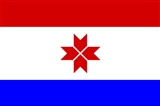
Mordovia

Encyclopedia
The Republic of Mordovia ' onMouseout='HidePop("53739")' href="/topics/Moksha_language">Moksha
/Erzya
: Мордовия Республикась, Mordoviya Respublikas), also known as Mordvinia, is a federal subject
of Russia
(a republic
). Its capital
is the city of Saransk
. Population:
of Russia. The western part of the republic is situated in the Oka Don Plain; its eastern and central parts in the Volga Elevation.
.
The Mordvin people are a Finnic
group speaking two related languages, Moksha
and Erzya
. The two languages have been dealt with at various times as dialects of one Mordvinian language. In reality there are two orthographies with parallel newsmedia in the Republic of Mordovia where approximately only one third of all Mordvinians live. During the Soviet period, school textbooks were published in each language.
According to the 2002 Census
, Russians
make up 60.8% of the republic's population, while ethnic Mordvins are only 31.9%. Other groups include Tatars
(5.2%), Ukrainians
(0.5%), and a host of smaller groups, each accounting for less than 0.5% of the total population. 3,700 people (0.4%) did not indicate their nationalities during the Census.
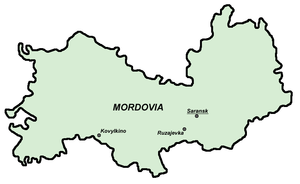
. Finno-Ugric
Mordvins are mentioned in written sources in 6th century. Later, Mordvins were under the influence of both Volga Bulgaria
and Kievan Rus. Mordvin princes sometimes raided Muroma and Volga Bulgaria, and often despoiled each other's holdings.
in the 13th century. They established the khanate of the Golden Horde
in 1241, subjugating the area of Mordovia. Mordvins fought against Mongols and later alongside with Russia
ns. Mordvin lands territorially belonged to Mukhsha Ulus
. The Golden Horde disintegrated in 1430s, which resulted in some Mordvins becoming subjects of Khanate of Kazan
, whereas other were incorporated to the Muscovy.
annexed the Khanate of Kazan in 1552, the Mordvin lands were subjugated to the Russian tsars. The Mordvin elite rapidly adopted Russian language and customs, whereas 1821 saw the publication of the New Testament in Erzya to address the non-elite population. In rural areas, Mordvin culture was preserved. Russians started to convert Mordvins to Orthodox Christianity
in the mid-18th century. Mordvins gave up their own shamanist religion only slowly, however, and many of shamanist features were preserved as parts of local culture though the population became nominally Christian. Translations of literature to Mordvin languages were mostly religious books. In 18th century, the Latin alphabet was used in writing Mordvin, but from the mid-19th century, Cyrillic was used.
and civil war
, Mordovia was held mostly by opponents of Bolshevik
s. When the Bolsheviks prevailed in the war, Mordovia became a part of the Russian SFSR. In 1925, the Soviet government founded autonomous districts and village councils in the area of Mordvins. During the Soviet era, two written languages were developed: based on the Erzya dialect in 1922 and on the Moksha dialect in 1923, both using Cyrillic script. Mordovian Okrug was founded on July 16, 1928 and it was elevated to the status of autonomous oblast on January 10, 1930. The autonomous oblast was transformed into the Mordovian Autonomous Socialist Soviet Republic on December 20, 1934.
, who was elected in 1995.
The State Assembly is the legislature of the republic.
, as well as in the towns of Kovylkino
and Ruzayevka
, and in the urban-type settlements of Chamzinka and Komsomolsky.
The National Library of the Republic of Mordovia is the largest library in the republic.
The State Puppet Theater of the Republic of Mordovia, located in Saransk, is well-known in Russia. Most of the plays played in this theater are Russian fairy-tales.
Erzya literature experienced a renaissance in the 1920s and 1930s.
and Mordovian State Pedagogical Institute in Saransk.
are a subgroup of the Uralic languages
, comprising the closely related Erzya language
and Moksha language
.
Previously considered a single "Mordvin language",
it is now treated as a small language family. Due to differences in phonology
, lexicon
, and grammar
, Erzya and Moksha are not mutually intelligible, to the extent that Russian language is often used for intergroup communications.
The two Mordvinic languages also have separate literary forms. The Erzya literary language
was created in 1922 and the Mokshan in 1923.
Phonological differences between the two languages include:
The medieval Muromian language may have been Mordvinic, or close to Mordvinic.
. Sunni Islam
, practiced mostly by Tatars
, is the biggest religious minority.
Moksha language
The Moksha language is a member of the Finno-Volgaic subdivision of the Uralic languages with about 500,000 native speakers. Moksha is the majority language in the western part of Mordovia....
/Erzya
Erzya language
The Erzya language is spoken by about 500,000 people in the northern and eastern and north-western parts of the Republic of Mordovia and adjacent regions of Nizhniy Novgorod, Chuvashia, Penza, Samara, Saratov, Orenburg, Ulyanovsk, Tatarstan and Bashkortostan in Russia...
: Мордовия Республикась, Mordoviya Respublikas), also known as Mordvinia, is a federal subject
Federal subjects of Russia
Russia is a federation which, since March 1, 2008, consists of 83 federal subjects . In 1993, when the Constitution was adopted, there were 89 federal subjects listed...
of Russia
Russia
Russia or , officially known as both Russia and the Russian Federation , is a country in northern Eurasia. It is a federal semi-presidential republic, comprising 83 federal subjects...
(a republic
Republics of Russia
The Russian Federation is divided into 83 federal subjects , 21 of which are republics. The republics represent areas of non-Russian ethnicity. The indigenous ethnic group of a republic that gives it its name is referred to as the "titular nationality"...
). Its capital
Capital City
Capital City was a television show produced by Euston Films which focused on the lives of investment bankers in London living and working on the corporate trading floor for the fictional international bank Shane-Longman....
is the city of Saransk
Saransk
Saransk is a city in central European Russia and the capital of the Republic of Mordovia, as well as its financial and economic center. It is located in the Volga basin at the confluence of the Saranka and Insar Rivers, about east of Moscow...
. Population:
Geography
The republic is located in the eastern part of the East European PlainEast European Plain
The East European Plain is a plain comprising a series of river basins in Eastern Europe. Together with the Northern European Plain it constitutes the European Plain. It is the largest mountain-free part of the European landscape.The plain spans approximately and averages about in elevation...
of Russia. The western part of the republic is situated in the Oka Don Plain; its eastern and central parts in the Volga Elevation.
- Area: 26200 square kilometres (10,115.9 sq mi)
- Borders:
- internal: Nizhny Novgorod OblastNizhny Novgorod OblastNizhny Novgorod Oblast is a federal subject of Russia . Its administrative center is the city of Nizhny Novgorod. Population: The oblast is crossed by the Volga River. Apart from Nizhny Novgorod's metropolitan area, the biggest city is Arzamas...
(N), Chuvash Republic (NE/E), Ulyanovsk OblastUlyanovsk OblastUlyanovsk Oblast is a federal subject of Russia . It is located in the Volga Federal District. Its administrative center is the city of Ulyanovsk...
(E/SE), Penza OblastPenza Oblast-External links:* *...
(S/SW), Ryazan OblastRyazan OblastRyazan Oblast is a federal subject of Russia . Its administrative center is the city of Ryazan, which is the oblast's largest city. Population: -Geography:...
(W/NW)
- internal: Nizhny Novgorod Oblast
- Highest point: 324 metres (1,063 ft) (crossing of the road from Bolshoy Maresev with the roads to Mokshaley, Pyaigiley, and Picheury)
Rivers
There are 114 rivers in the republic. Major rivers include:- Alatyr RiverAlatyr RiverAlatyr River is a river in Mordovia in Russia, Sura's left tributary. The length of the river is 296 km. The area of its basin is 11,200 km². The Alatyr freezes up in November and stays icebound until April. The towns of Ardatov and Alatyr Mordvin name Rator Osh, are located on the Alatyr River....
(Erzya: Rator) - Issa River
- Moksha RiverMoksha RiverMoksha is a river in central Russia, a right tributary of the Oka River. It is 656 kilometres in length....
- Satis River
- Sivin River
- Sura RiverSura RiverSura is a river in Russia, a right tributary of the Volga River. It flows through Penza Oblast, Mordovia, Ulyanovsk Oblast, Chuvashia and Nizhny Novgorod Oblast. Its length is 841 km, it is navigable for 394 km from the mouth....
- Vad River
Climate
Climate is moderately continentalContinental climate
Continental climate is a climate characterized by important annual variation in temperature due to the lack of significant bodies of water nearby...
.
- Average January temperature: −11 C
- Average July temperature: 19 °C (66.2 °F)
- Average annual precipitationPrecipitation (meteorology)In meteorology, precipitation In meteorology, precipitation In meteorology, precipitation (also known as one of the classes of hydrometeors, which are atmospheric water phenomena is any product of the condensation of atmospheric water vapor that falls under gravity. The main forms of precipitation...
: ~500 millimetres (19.7 in)
Demographics
- Population:
- Population:
- Urban: 531,478 (59.8%)
- Rural: 357,288 (40.2%)
- Male: 408,556 (46.0%)
- Female: 480,210 (54.0%)
- Females per 1000 males: 1,175
- Average age: 38.7 years
- Urban: 36.8 years
- Rural: 41.3 years
- Male: 35.9 years
- Female: 41.2 years
- Number of households: 332,995 (with 866,749 people)
- Urban: 197,923 (with 525,808 people)
- Rural: 135,072 (with 340,941 people)
- Vital statistics
- Source: Russian Federal State Statistics Service
| Births | Deaths | Birth rate | Death rate | |
|---|---|---|---|---|
| 1970 | 15,423 | 9,048 | 15.0 | 8.8 |
| 1975 | 14,983 | 9,689 | 14.9 | 9.7 |
| 1980 | 14,320 | 10,287 | 14.6 | 10.5 |
| 1985 | 15,123 | 11,152 | 15.7 | 11.6 |
| 1990 | 12,910 | 11,018 | 13.4 | 11.4 |
| 1991 | 11,537 | 11,079 | 12.0 | 11.5 |
| 1992 | 10,215 | 11,574 | 10.6 | 12.0 |
| 1993 | 9,276 | 13,217 | 9.7 | 13.8 |
| 1994 | 8,916 | 14,748 | 9.3 | 15.4 |
| 1995 | 8,589 | 13,460 | 9.0 | 14.1 |
| 1996 | 7,883 | 13,579 | 8.3 | 14.4 |
| 1997 | 7,493 | 13,631 | 8.0 | 14.5 |
| 1998 | 7,469 | 13,116 | 8.0 | 14.1 |
| 1999 | 6,994 | 14,200 | 7.6 | 15.4 |
| 2000 | 7,148 | 14,838 | 7.8 | 16.2 |
| 2001 | 7,049 | 14,200 | 7.8 | 15.7 |
| 2002 | 7,131 | 14,918 | 8.0 | 16.7 |
| 2003 | 7,433 | 15,170 | 8.4 | 17.2 |
| 2004 | 7,689 | 14,768 | 8.8 | 16.9 |
| 2005 | 7,394 | 14,823 | 8.6 | 17.2 |
| 2006 | 7,367 | 13,981 | 8.6 | 16.4 |
| 2007 | 7,728 | 13,320 | 9.2 | 15.8 |
| 2008 | 8,215 | 13,167 | 9.8 | 15.7 |
- Ethnic groups
The Mordvin people are a Finnic
Finnic peoples
The Finnic or Fennic peoples were historic ethnic groups who spoke various languages traditionally classified as Finno-Permic...
group speaking two related languages, Moksha
Moksha language
The Moksha language is a member of the Finno-Volgaic subdivision of the Uralic languages with about 500,000 native speakers. Moksha is the majority language in the western part of Mordovia....
and Erzya
Erzya language
The Erzya language is spoken by about 500,000 people in the northern and eastern and north-western parts of the Republic of Mordovia and adjacent regions of Nizhniy Novgorod, Chuvashia, Penza, Samara, Saratov, Orenburg, Ulyanovsk, Tatarstan and Bashkortostan in Russia...
. The two languages have been dealt with at various times as dialects of one Mordvinian language. In reality there are two orthographies with parallel newsmedia in the Republic of Mordovia where approximately only one third of all Mordvinians live. During the Soviet period, school textbooks were published in each language.
According to the 2002 Census
Russian Census (2002)
Russian Census of 2002 was the first census of the Russian Federation carried out on October 9 through October 16, 2002. It was carried out by the Russian Federal Service of State Statistics .-Resident population:...
, Russians
Russians
The Russian people are an East Slavic ethnic group native to Russia, speaking the Russian language and primarily living in Russia and neighboring countries....
make up 60.8% of the republic's population, while ethnic Mordvins are only 31.9%. Other groups include Tatars
Tatars
Tatars are a Turkic speaking ethnic group , numbering roughly 7 million.The majority of Tatars live in the Russian Federation, with a population of around 5.5 million, about 2 million of which in the republic of Tatarstan.Significant minority populations are found in Uzbekistan, Kazakhstan,...
(5.2%), Ukrainians
Ukrainians
Ukrainians are an East Slavic ethnic group native to Ukraine, which is the sixth-largest nation in Europe. The Constitution of Ukraine applies the term 'Ukrainians' to all its citizens...
(0.5%), and a host of smaller groups, each accounting for less than 0.5% of the total population. 3,700 people (0.4%) did not indicate their nationalities during the Census.
| census 1939 | census 1959 | census 1970 | census 1979 | census 1989 | census 2002 | |
|---|---|---|---|---|---|---|
| Mordvins | 405,031 (34.1%) | 357,978 (35.8%) | 364,689 (35.4%) | 338,898 (34.2%) | 313,420 (32.5%) | 283,861 (31.9%) |
| Russians Russians The Russian people are an East Slavic ethnic group native to Russia, speaking the Russian language and primarily living in Russia and neighboring countries.... |
719,117 (60.5%) | 590,557 (59.0%) | 606,817 (58.9%) | 591,212 (59.7%) | 586,147 (60.8%) | 540,717 (60.8%) |
| Tatars Tatars Tatars are a Turkic speaking ethnic group , numbering roughly 7 million.The majority of Tatars live in the Russian Federation, with a population of around 5.5 million, about 2 million of which in the republic of Tatarstan.Significant minority populations are found in Uzbekistan, Kazakhstan,... |
47,386 (4.0%) | 38,636 (3.9%) | 44,954 (4.4%) | 45,765 (4.6%) | 47,328 (4.9%) | 46,261 (5.2%) |
| Ukrainians Ukrainians Ukrainians are an East Slavic ethnic group native to Ukraine, which is the sixth-largest nation in Europe. The Constitution of Ukraine applies the term 'Ukrainians' to all its citizens... |
7,586 (0.6%) | 6,554 (0.7%) | 6,033 (0.6%) | 5,622 (0.6%) | 6,461 (0.7%) | 4,801 (0.5%) |
| Others | 8,884 (0.7%) | 6,468 (0.6%) | 7,069 (0.7%) | 8,012 (0.8%) | 10,148 (1.1%) | 13,126 (1.5%) |
History
Early history
Earliest archaeological signs of human beings in the area of Mordovia are from the Neolithic eraNeolithic
The Neolithic Age, Era, or Period, or New Stone Age, was a period in the development of human technology, beginning about 9500 BC in some parts of the Middle East, and later in other parts of the world. It is traditionally considered as the last part of the Stone Age...
. Finno-Ugric
Finno-Ugric peoples
The Finno-Ugric peoples are any of several peoples of Europe who speak languages of the proposed Finno-Ugric language family, such as the Finns, Estonians, Mordvins, and Hungarians...
Mordvins are mentioned in written sources in 6th century. Later, Mordvins were under the influence of both Volga Bulgaria
Volga Bulgaria
Volga Bulgaria, or Volga–Kama Bolghar, is a historic Bulgar state that existed between the seventh and thirteenth centuries around the confluence of the Volga and Kama rivers in what is now Russia.-Origin:...
and Kievan Rus. Mordvin princes sometimes raided Muroma and Volga Bulgaria, and often despoiled each other's holdings.
Mongol rule
The Mongols conquered vast areas of Eastern EuropeEastern Europe
Eastern Europe is the eastern part of Europe. The term has widely disparate geopolitical, geographical, cultural and socioeconomic readings, which makes it highly context-dependent and even volatile, and there are "almost as many definitions of Eastern Europe as there are scholars of the region"...
in the 13th century. They established the khanate of the Golden Horde
Golden Horde
The Golden Horde was a Mongol and later Turkicized khanate that formed the north-western sector of the Mongol Empire...
in 1241, subjugating the area of Mordovia. Mordvins fought against Mongols and later alongside with Russia
Russia
Russia or , officially known as both Russia and the Russian Federation , is a country in northern Eurasia. It is a federal semi-presidential republic, comprising 83 federal subjects...
ns. Mordvin lands territorially belonged to Mukhsha Ulus
Mukhsha Ulus
Mukhsha Ulus or Naruçat Duchy was a subdivision of Golden Horde at the place of modern Mordovia, Penza Oblast and Tambov Oblast of Russia in 13th-15th centuries with the capital in Mukhsha. The main territory of the ulus was situated between rivers Sura and Tsna. The previous population were...
. The Golden Horde disintegrated in 1430s, which resulted in some Mordvins becoming subjects of Khanate of Kazan
Khanate of Kazan
The Khanate of Kazan was a medieval Tatar state which occupied the territory of former Volga Bulgaria between 1438 and 1552. Its khans were the patrilineal descendants of Toqa Temür, the thirteenth son of Jochi and grandson of Genghis Khan. The khanate covered contemporary Tatarstan, Mari El,...
, whereas other were incorporated to the Muscovy.
Russian rule
When Ivan IV of RussiaIvan IV of Russia
Ivan IV Vasilyevich , known in English as Ivan the Terrible , was Grand Prince of Moscow from 1533 until his death. His long reign saw the conquest of the Khanates of Kazan, Astrakhan, and Siberia, transforming Russia into a multiethnic and multiconfessional state spanning almost one billion acres,...
annexed the Khanate of Kazan in 1552, the Mordvin lands were subjugated to the Russian tsars. The Mordvin elite rapidly adopted Russian language and customs, whereas 1821 saw the publication of the New Testament in Erzya to address the non-elite population. In rural areas, Mordvin culture was preserved. Russians started to convert Mordvins to Orthodox Christianity
Eastern Orthodox Church
The Orthodox Church, officially called the Orthodox Catholic Church and commonly referred to as the Eastern Orthodox Church, is the second largest Christian denomination in the world, with an estimated 300 million adherents mainly in the countries of Belarus, Bulgaria, Cyprus, Georgia, Greece,...
in the mid-18th century. Mordvins gave up their own shamanist religion only slowly, however, and many of shamanist features were preserved as parts of local culture though the population became nominally Christian. Translations of literature to Mordvin languages were mostly religious books. In 18th century, the Latin alphabet was used in writing Mordvin, but from the mid-19th century, Cyrillic was used.
Part of the Soviet Union
During the Russian revolutionRussian Revolution of 1917
The Russian Revolution is the collective term for a series of revolutions in Russia in 1917, which destroyed the Tsarist autocracy and led to the creation of the Soviet Union. The Tsar was deposed and replaced by a provisional government in the first revolution of February 1917...
and civil war
Russian Civil War
The Russian Civil War was a multi-party war that occurred within the former Russian Empire after the Russian provisional government collapsed to the Soviets, under the domination of the Bolshevik party. Soviet forces first assumed power in Petrograd The Russian Civil War (1917–1923) was a...
, Mordovia was held mostly by opponents of Bolshevik
Bolshevik
The Bolsheviks, originally also Bolshevists , derived from bol'shinstvo, "majority") were a faction of the Marxist Russian Social Democratic Labour Party which split apart from the Menshevik faction at the Second Party Congress in 1903....
s. When the Bolsheviks prevailed in the war, Mordovia became a part of the Russian SFSR. In 1925, the Soviet government founded autonomous districts and village councils in the area of Mordvins. During the Soviet era, two written languages were developed: based on the Erzya dialect in 1922 and on the Moksha dialect in 1923, both using Cyrillic script. Mordovian Okrug was founded on July 16, 1928 and it was elevated to the status of autonomous oblast on January 10, 1930. The autonomous oblast was transformed into the Mordovian Autonomous Socialist Soviet Republic on December 20, 1934.
Part of the Russian Federation
When the Soviet Union disintegrated, the Mordovian ASSR proclaimed itself the Republic of Mordovia in 1990, and remained a part of the Russian Federation. The Republic of Mordovia in its present form has existed since January 25, 1994.Politics
The head of the government in the Republic of Mordovia is the Head of the Republic. , the head of the republic is Nikolay MerkushkinNikolay Merkushkin
Nikolay Ivanovich Merkushkin is the head of the Republic of Mordovia in Russia. He has held that office since September 22, 1995. January 24–September 22, 1995 he was Chairman of the State Assembly of Mordovia.Merkushkin was an electrical engineer before entering politics...
, who was elected in 1995.
The State Assembly is the legislature of the republic.
Economy
The most developed industries are machine building, chemical, woodworking, and food industries. Most of the industrial enterprises are located in the capital SaranskSaransk
Saransk is a city in central European Russia and the capital of the Republic of Mordovia, as well as its financial and economic center. It is located in the Volga basin at the confluence of the Saranka and Insar Rivers, about east of Moscow...
, as well as in the towns of Kovylkino
Kovylkino
Kovylkino is a town in the Republic of Mordovia, Russia, located southwest of Saransk on the left bank of the Moksha River . Population: Town status was granted to it in 1960....
and Ruzayevka
Ruzayevka
Ruzayevka is a town in the Republic of Mordovia, Russia, located on the Insar River, southwest of Saransk. Population: It was founded in 1631 as the village of Urazayevka , later known as Ruzayevka. It was granted town status in 1937....
, and in the urban-type settlements of Chamzinka and Komsomolsky.
Culture
There are many museums in the republic. The largest ones include the Mordovian Republican United Museum of Regional Studies and the Museum of Mordvinian Culture in Saransk.The National Library of the Republic of Mordovia is the largest library in the republic.
The State Puppet Theater of the Republic of Mordovia, located in Saransk, is well-known in Russia. Most of the plays played in this theater are Russian fairy-tales.
Erzya literature experienced a renaissance in the 1920s and 1930s.
Education
The most important facilities of higher education include Mordovian State UniversityMordovian State University
N. P. Ogarev's Mordovian State University is located in the city of Saransk, the capital of the Republic of Mordovia, Russia. It was established in October 1957 as an expansion of the Mordovian National Pedagogical Institute, established in 1931...
and Mordovian State Pedagogical Institute in Saransk.
Language
The Mordvinic languages, alternatively Mordvin languages, or Mordvinian languages,are a subgroup of the Uralic languages
Uralic languages
The Uralic languages constitute a language family of some three dozen languages spoken by approximately 25 million people. The healthiest Uralic languages in terms of the number of native speakers are Hungarian, Finnish, Estonian, Mari and Udmurt...
, comprising the closely related Erzya language
Erzya language
The Erzya language is spoken by about 500,000 people in the northern and eastern and north-western parts of the Republic of Mordovia and adjacent regions of Nizhniy Novgorod, Chuvashia, Penza, Samara, Saratov, Orenburg, Ulyanovsk, Tatarstan and Bashkortostan in Russia...
and Moksha language
Moksha language
The Moksha language is a member of the Finno-Volgaic subdivision of the Uralic languages with about 500,000 native speakers. Moksha is the majority language in the western part of Mordovia....
.
Previously considered a single "Mordvin language",
it is now treated as a small language family. Due to differences in phonology
Phonology
Phonology is, broadly speaking, the subdiscipline of linguistics concerned with the sounds of language. That is, it is the systematic use of sound to encode meaning in any spoken human language, or the field of linguistics studying this use...
, lexicon
Lexicon
In linguistics, the lexicon of a language is its vocabulary, including its words and expressions. A lexicon is also a synonym of the word thesaurus. More formally, it is a language's inventory of lexemes. Coined in English 1603, the word "lexicon" derives from the Greek "λεξικόν" , neut...
, and grammar
Grammar
In linguistics, grammar is the set of structural rules that govern the composition of clauses, phrases, and words in any given natural language. The term refers also to the study of such rules, and this field includes morphology, syntax, and phonology, often complemented by phonetics, semantics,...
, Erzya and Moksha are not mutually intelligible, to the extent that Russian language is often used for intergroup communications.
The two Mordvinic languages also have separate literary forms. The Erzya literary language
Literary language
A literary language is a register of a language that is used in literary writing. This may also include liturgical writing. The difference between literary and non-literary forms is more marked in some languages than in others...
was created in 1922 and the Mokshan in 1923.
Phonological differences between the two languages include:
- Moksha retains a distinction between the vowels /ɛ, e/ while in Erzya, both have merged as /e/.
- In unstressed syllables, Erzya features vowel harmonyVowel harmonyVowel harmony is a type of long-distance assimilatory phonological process involving vowels that occurs in some languages. In languages with vowel harmony, there are constraints on which vowels may be found near each other....
like many other Uralic languages, using [e] in front-vocalic words and [o] in back-vocalic words. Moksha has a simple schwaSchwaIn linguistics, specifically phonetics and phonology, schwa can mean the following:*An unstressed and toneless neutral vowel sound in some languages, often but not necessarily a mid-central vowel...
[ə] in their place. - Word-initially, Erzya has a postalveolar affricate /tʃ/ corresponding to a fricative /ʃ/ in Moksha.
- Next to voiceless consonants, liquidsLiquid consonantIn phonetics, liquids or liquid consonants are a class of consonants consisting of lateral consonants together with rhotics.-Description:...
/r, rʲ, l, lʲ/ and the semivowelSemivowelIn phonetics and phonology, a semivowel is a sound, such as English or , that is phonetically similar to a vowel sound but functions as the syllable boundary rather than as the nucleus of a syllable.-Classification:...
/j/ are devoiced in Moksha to [r̥ r̥ʲ l̥ l̥ʲ ȷ̊].
The medieval Muromian language may have been Mordvinic, or close to Mordvinic.
Religion
The prevailing confession is the Russian Orthodox ChurchRussian Orthodox Church
The Russian Orthodox Church or, alternatively, the Moscow Patriarchate The ROC is often said to be the largest of the Eastern Orthodox churches in the world; including all the autocephalous churches under its umbrella, its adherents number over 150 million worldwide—about half of the 300 million...
. Sunni Islam
Sunni Islam
Sunni Islam is the largest branch of Islam. Sunni Muslims are referred to in Arabic as ʾAhl ūs-Sunnah wa āl-Ǧamāʿah or ʾAhl ūs-Sunnah for short; in English, they are known as Sunni Muslims, Sunnis or Sunnites....
, practiced mostly by Tatars
Tatars
Tatars are a Turkic speaking ethnic group , numbering roughly 7 million.The majority of Tatars live in the Russian Federation, with a population of around 5.5 million, about 2 million of which in the republic of Tatarstan.Significant minority populations are found in Uzbekistan, Kazakhstan,...
, is the biggest religious minority.