

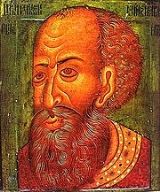
Ivan IV of Russia

Encyclopedia
Ivan IV Vasilyevich known in English as Ivan the Terrible , was Grand Prince of Moscow
from 1533 until his death. His long reign saw the conquest of the Khanates of Kazan
, Astrakhan, and Siberia, transforming Russia into a multiethnic and multiconfessional state spanning almost one billion acres, approximately 4046856 km² (1,562,499.8 sq mi). Ivan managed countless changes in the progression from a medieval state
to an empire
and emerging regional power
, and became the first ruler to be crowned as Tsar of All Russia.
Historic sources present disparate accounts of Ivan's complex personality: he was described as intelligent and devout, yet given to rages and prone to episodic outbreaks of mental illness
. One notable outburst may have resulted in the death of his groomed and chosen heir Ivan Ivanovich, which led to the passing of the Tsardom to the younger son: the weak and possibly intellectually disabled Feodor I of Russia
. His contemporaries called him "Ivan Groznyi" the name, which, although usually translated as "Terrible", actually means something closer to "Redoubtable" or "Severe" and carries connotations of might, power and strictness rather than horror or cruelty.
. When Ivan was just three years old his father died from a boil
and inflammation on his leg which developed into blood poisoning. Ivan was proclaimed the Grand Prince of Moscow
at his father's request. At first his mother Elena Glinskaya acted as a regent, but she died of what many believe to be assassination by poison when Ivan was only eight years old. According to his own letters, Ivan and his younger brother Yuri
often felt neglected and offended by the mighty boyar
s from the Shuisky
and Belsky
families.
Ivan was crowned tsar with Monomakh's Cap
at the Cathedral of the Dormition
at age 16 on
16 January 1547. Despite calamities triggered by the Great Fire of 1547
, the early part of his reign was one of peaceful reforms and modernization. Ivan revised the law code (known as the sudebnik
), created a standing army
(the streltsy
), established the Zemsky Sobor
or assembly of the land, a public, consensus-building assembly, the council of the nobles (known as the Chosen Council), and confirmed the position of the Church with the Council of the Hundred Chapters, which unified the rituals and ecclesiastical regulations of the entire country. He introduced local self-government to rural regions, mainly in the northeast of Russia, populated by the state peasantry. During his reign the first printing press
was introduced to Russia (although the first Russian printers Ivan Fedorov and Pyotr Mstislavets had to flee from Moscow to the Grand Duchy of Lithuania
).

 In 1547 Hans Schlitte, the agent of Ivan, recruited craftsmen in Germany for work in Russia. However all these craftsmen were arrested in Lübeck
at the request of Poland and Livonia
. The German merchant companies ignored the new port built by Ivan
on the river Narva
in 1550 and continued to deliver goods in the Baltic ports owned by Livonia. Russia remained isolated from sea trade.
Ivan formed new trading connections, opening up the White Sea
and the port of Arkhangelsk
to the Muscovy Company
of English merchants. In 1552 his army defeated the Kazan Khanate, whose armies had repeatedly devastated the northeast of Russia, and annexed its territory. In 1556 he annexed the Astrakhan Khanate
and destroyed the largest slave market on the river Volga. These conquests complicated the migration
of the aggressive nomadic hordes from Asia to Europe through Volga and transformed Russia into a multinational and multiconfessional state.
Ivan IV corresponded with Orthodox leaders overseas as well. In response to a letter of Patriarch Joachim of Alexandria
asking the Tsar for financial assistance for the Monastery of St. Catherine
in Sinai, which had suffered from the Turks, Ivan IV sent in 1558 a delegation to Egypt
led by archdeacon
Gennady, who, however, died in Constantinople
before he could reach Egypt. From then on the embassy was headed by Smolensk
merchant Vasily Poznyakov. Poznyakov's delegation visited Alexandria, Cairo and Sinai, brought the patriarch a fur coat and an icon sent by the Tsar and left an interesting account of its 2-1/2 years of travels.
Ivan had St. Basil's Cathedral constructed in Moscow to commemorate the seizure of Kazan. Legend has it that he was so impressed with the structure he had the architect, Postnik Yakovlev
, blinded so that he could never design anything as beautiful again. In fact, Yakovlev went on to design more churches for Ivan and Kazan's Kremlin walls in the early 1560s, as well as the chapel over St. Basil's grave that was added to St. Basil's Cathedral in 1588, several years after Ivan's death.
 Other events of this period include the introduction of the first laws restricting the mobility of the peasant
s, which would eventually lead to serf
dom, and change in Ivan's personality, traditionally linked to his near-fatal illness in 1553 and the death of his first wife, Anastasia Romanovna
, in 1560. Ivan suspected boyar
s of poison
ing his wife and of plotting to replace him on the throne with his cousin, Vladimir of Staritsa
. In addition, during that illness Ivan had asked the boyars to swear an oath of allegiance to his eldest son, an infant at the time. Many boyars refused, deeming the Tsar's health too hopeless for him to survive. This angered Ivan and added to his distrust of the boyars. There followed brutal reprisals and assassinations, including those of Metropolitan Philip
and Prince Alexander Gorbatyi-Shuisky
.
The 1565 formation of the Oprichnina
was also significant. The Oprichnina was the section of Russia (mainly the Northeast) directly ruled by Ivan and policed by his personal servicemen, the Oprichniki. This system of Oprichnina has been viewed by historians as a tool against the powerful hereditary nobility of Russia (boyar
s) who opposed the absolutist drive of the Tsar, while some have also interpreted it as a sign of the paranoia
and mental deterioration of the Tsar.
Devlet I Giray
of Crimea
repeatedly devastated the Moscow region and even set Moscow on fire
in 1571, the Tsar supported Yermak
's conquest of Tatar
Siberia
, adopting a policy of empire-building
, which led him to launch an ultimately unsuccessful war of seaward expansion to the west and finding himself fighting the Swedes
, Lithuania
ns, Poles
and the Livonia
n Teutonic Knights
.
For 24 years the Livonian War
dragged on, damaging the Russian economy and military and failing to gain any territory for Russia. In the 1560s Russia was devastated by a combination of drought and famine, Polish-Lithuanian
raids, Tatar invasions
and the sea-trading blockade carried out by the Swedes, Poles and the Hanseatic League
. The price of grain increased by a factor of ten. Epidemics of plague killed 10,000 people in Novgorod. In 1570 the plague killed 600–1000 in Moscow daily. One of Ivan's advisors, Prince Andrei Kurbsky, defected to the Lithuanians, took command of the Lithuanian troops and devastated the Russian region of Velikiye Luki
. This treachery deeply hurt Ivan. As the Oprichnina continued, Ivan's mental and physical conditions deteriorated. In one week he could go from indulging in the most depraved orgies to anguished prayers and fasting in a remote northern monastery.
Because he gradually grew unbalanced and violent, the Oprichniki under Malyuta Skuratov
soon got out of hand and turned into a band of murderous thugs. They massacred nobles and peasants, and conscripted men to fight the war in Livonia. Depopulation and famine ensued. What had been by far the richest area of Russia became the poorest. In a dispute with the wealthy city of Novgorod, Ivan ordered the Oprichniki to murder inhabitants of the city, and it was never to regain its former prosperity. His followers burned and pillaged Novgorod and the surrounding villages. As many as 60,000 may have been killed during the infamous Massacre of Novgorod
in 1570; many others were deported elsewhere. Yet the official death toll
named 1,500 of Novgorod's big people (nobility) and mentioned only about the same number of smaller people. Many modern researchers estimate the number of victims to range from 2000-3000 (after the famine and epidemics
of 1560s the population of Novgorod most likely didn't exceed 10,000–20,000).
Having rejected peace proposals from his enemies, Ivan IV found himself in a difficult position by 1579, when Crimean Khanate
devastated Muscovite territories and even burned down Moscow (see Russo-Crimean Wars
). The displaced refugees fleeing the war compounded the effects of the simultaneous drought
, and exacerbated war engendered epidemics, causing much loss of life.
Alogether the prolonged war had nearly destroyed the economy, Oprichnina had thoroughly disrupted the government, while The Grand Principality of Lithuania had united with
The Kingdom of Poland
and acquired an energetic leader, Stefan Batory
, who was supported by Russia's southern enemy, the Ottoman Empire
(1576). Ivan's realm was now being squeezed by two of the great powers of the day.
After negotiations with Ivan failed, Batory launched a series of offensives
against Muscovy in the campaign seasons of 1579–1581, trying to cut The Kingdom of Livonia
from Muscovite territories. During his first offensive in 1579, he retook Polotsk
with 22,000 men. During the second, in 1580, he took Velikie Luki with a 29,000-strong force. Finally, he began the Siege of Pskov
in 1581 with a 100,000-strong army. Narva
in Estonia
was reconquered by Sweden in 1581.
Unlike Sweden and Poland, Frederick II had trouble continuing the fight against Muscovy. He came to an agreement with John III
in 1580, giving him the titles in Livonia. That war would last from 1577 to 1582. Muscovy recognized Polish-Lithuanian control of Ducatus Ultradunensis only in 1582. After Magnus von Lyffland died in 1583, Poland invaded his territories in The Duchy of Courland and Frederick II decided to sell his rights of inheritance. Except for the island of Saaremaa
, Denmark was out of the Baltic
by 1585. As of 1598, Polish Livonia was divided into:
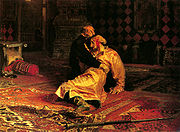
In 1581 Ivan beat his pregnant daughter-in-law for wearing immodest clothing, and this may have caused a miscarriage. His son, also named Ivan, upon learning of this, engaged in a heated argument with his father, resulting in Ivan striking his son in the head with his pointed staff, causing his son's death. This event is depicted in the famous painting by Ilya Repin, Ivan the Terrible and his son Ivan on Friday, 16 November 1581 better known as Ivan the Terrible killing his son.
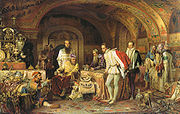 In the centuries following Ivan's death, historians developed different theories to better understand his reign, but independent of the perspective through which one chooses to approach this, it cannot be denied that Ivan the Terrible changed Russian history and continues to live on in popular imagination. His political legacy completely altered the Russian governmental structure; his economic policies ultimately contributed to the end of the Rurik Dynasty
, and his social legacy lives on in unexpected places.
Arguably Ivan's most important legacy can be found in the political changes he enacted in Russia. In the words of historian Alexander Yanov, "Ivan the Terrible and the origins of the modern Russian political structure [are]... indissolubly connected." At the core of this political revolution stands the newly adopted title of Tsar. By being crowned Tsar, Ivan was sending a message to the world and to Russia: he was now the one and only supreme ruler, and his will was not to be questioned. "The new title symbolized an assumption of powers equivalent and parallel to those held by former Byzantine caesar and the Tatar khan, both known in Russian sources as Tsar. The political effect was to elevate Ivan's position." The new title not only secured the throne, but it also granted Ivan a new dimension of power, one intimately tied to religion. He was now a "divine" leader appointed to enact God's will, "church texts described Old Testament kings as 'Tsars' and Christ as the Heavenly Tsar." The newly appointed title was then passed on from generation to generation, "succeeding Muscovite rulers...benefited from the divine nature of the power of the Russian monarch...crystallized during Ivan's reign."
A title alone may hold symbolic power, but Ivan's political revolution went further, in the process significantly altering Russia's political structure. The creation of the Oprichnina
marked something completely new, a break from the past that served to diminish the power of the boyars and create a more centralized government. "...the revolution of Tsar Ivan was an attempt to transform an absolutist political structure into a despotism... the Oprichnina proved to be not only the starting point, but also the nucleus of autocracy which determined... the entire subsequent historical process in Russia." Ivan created a way to bypass the Mestnichestvo
system and elevate the men among the gentry to positions of power, thus suppressing the aristocracy that failed to support him. Part of this revolution included altering the structure of local governments to include, "a combination of centrally appointed and locally elected officials. Despite later modifications, this form of local administration proved to be functional and durable." Ivan successfully cemented autocracy and a centralized government in Russia, in the process also establishing "a centralized apparatus of political control in the form of his own guard." The idea of a guard as a means of political control became so ingrained in Russian history that it can be traced to Peter the Great, Vladimir Lenin
, who "... [provided] Russian autocracy with its Communist incarnation", and Joseph Stalin
, who "[placed] the political police over the party." Yanov concludes that "Czar Ivan's monstrous invention [i.e. the guard] has thus dominated the entire course of Russian history."
 By expanding into Poland (although a failed campaign), the Caspian and Siberia, Ivan established a sphere of influence that lasted until the 20th century. Ivan's conquests also ignited a conflict with Turkey that would lead to successive wars. "Russia's victories confined the Turkish conquests to the Balkans and the Black sea region, although Turkish expansionism continued to cast a shadow over the whole of Eastern Europe."
The acquisition of new territory brought about another of Ivan's lasting legacies: a relationship with Europe, especially through trade. "In 1555, Ivan IV granted the English the privilege of trading throughout his reign without paying the standard customs fees." Although the contact between Russia and Europe remained small at this time, it would later grow, facilitating the permeation of European ideals across the border. Peter the Great would later push Russia to become a European power, and Catherine II would manipulate that power to make Russia a leader within the region.
Contrary to his political legacy, Ivan IV's economic legacy was disastrous and became one of the factors that led to the decline of the Rurik Dynasty
and the Time of Troubles
. Ivan inherited a government in debt, and in an effort to raise more revenue instituted a series of taxes. "It was the military campaigns themselves... that were responsible for the increasing government expenses." Under the new political system, the Oprichniki were given large estates, but unlike the previous landlords, could not be held accountable for their actions. These men, "took virtually all the peasants possessed, forcing them to pay 'in one year as much as [they] used to pay in ten. This degree of oppression resulted in increasing cases of peasants fleeing which in turn led to a drop in the overall production. To make matters worse, successive wars drained the country both of men and resources. "Muscovy from its core, where its centralized political structures depended upon a dying dynasty, to its frontiers, where its villages stood depopulated and its fields lay fallow, was on the brink of ruin."
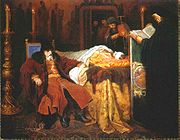 Another interesting and unexpected aspect of Ivan's social legacy emerged within Communist Russia. In an effort to revive Russia nationalist pride, Ivan the Terrible's image became closely associated with Joseph Stalin
.
Ivan's political revolution not only consolidated the position of Tsar, but also created a centralized government structure with ramifications extending to local government. "The assumption and active propaganda of the title of Czar, transgressions and sudden changes in policy during the Oprichnina contributed to the image of the Muscovite prince as a ruler accountable only to God." Subsequent Russian rulers inherited a system put in place by Ivan.
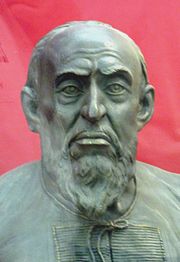 Ivan died from a stroke while playing chess
with Bogdan Belsky
on . Upon Ivan's death, the ravaged kingdom was left to his unfit and childless son Feodor
.This period of time was known as "Times of Trouble".
Ivan was a patron of the arts and himself a poet and composer of considerable talent. His Orthodox liturgical hymn, "Stichiron No. 1 in Honor of St. Peter", and fragments of his letters were put into music by Soviet composer Rodion Shchedrin
. The recording was released in 1988, marking the millennium of Christianity in Russia, and was the first Soviet-produced CD.
Today, there exists a controversial movement in Russia campaigning in favor of granting sainthood to Ivan IV. The Russian Orthodox Church has stated its opposition to the idea.
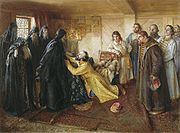 D.S. Mirsky called Ivan "a pamphleteer of genius
". The epistles attributed to him are the masterpieces of old Russian (perhaps all Russian) political journalism. They may be too full of texts from the Scriptures and the Fathers, and their Church Slavonic is not always correct. But they are full of cruel irony, expressed in pointedly forcible terms.
The shameless bully and the great polemicist are seen together in a flash when he taunts the runaway prince Kurbsky with the question: "If you are so sure of your righteousness, why did you run away and not prefer martyrdom at my hands?" Such strokes were well calculated to drive his correspondent into a rage. "The part of the cruel tyrant elaborately upbraiding an escaped victim while he continues torturing
those in his reach may be detestable, but Ivan plays it with truly Shakespearian
breadth of imagination". These letters are often the only existing source on Ivan's personality and provide crucial information on his reign, but Harvard professor Edward Keenan has argued that these letters are 17th century forgeries. This contention, however, has not been widely accepted, and other scholars, such as John Fennell and Ruslan Skrynnikov continued to argue for their authenticity. Recent archival discoveries of 16th century copies of the letters strengthen the argument for their authenticity.
Besides his letters to Kurbsky he wrote other satirical invectives to men in his power. The best is his letter to the abbot of the Kirillo-Belozersky Monastery
, where he pours out all the poison of his grim irony on the unascetic life of the boyars, shorn monks, and those exiled by his order. His picture of their luxurious life in the citadel of ascetism is a masterpiece of trenchant sarcasm.
in one's danger), formidable or threatening. Perhaps a translation closer to the intended sense would be Ivan the Fearsome, or Ivan the Formidable.
|-
|-
|-
|-
Grand Duchy of Moscow
The Grand Duchy of Moscow or Grand Principality of Moscow, also known in English simply as Muscovy , was a late medieval Rus' principality centered on Moscow, and the predecessor state of the early modern Tsardom of Russia....
from 1533 until his death. His long reign saw the conquest of the Khanates of Kazan
Khanate of Kazan
The Khanate of Kazan was a medieval Tatar state which occupied the territory of former Volga Bulgaria between 1438 and 1552. Its khans were the patrilineal descendants of Toqa Temür, the thirteenth son of Jochi and grandson of Genghis Khan. The khanate covered contemporary Tatarstan, Mari El,...
, Astrakhan, and Siberia, transforming Russia into a multiethnic and multiconfessional state spanning almost one billion acres, approximately 4046856 km² (1,562,499.8 sq mi). Ivan managed countless changes in the progression from a medieval state
State (polity)
A state is an organized political community, living under a government. States may be sovereign and may enjoy a monopoly on the legal initiation of force and are not dependent on, or subject to any other power or state. Many states are federated states which participate in a federal union...
to an empire
Empire
The term empire derives from the Latin imperium . Politically, an empire is a geographically extensive group of states and peoples united and ruled either by a monarch or an oligarchy....
and emerging regional power
Regional power
In international relations, a regional power is a state that has power within a geographic region. States which wield unrivaled power and influence within a region of the world possess regional hegemony.-Characteristics:...
, and became the first ruler to be crowned as Tsar of All Russia.
Historic sources present disparate accounts of Ivan's complex personality: he was described as intelligent and devout, yet given to rages and prone to episodic outbreaks of mental illness
Mental illness
A mental disorder or mental illness is a psychological or behavioral pattern generally associated with subjective distress or disability that occurs in an individual, and which is not a part of normal development or culture. Such a disorder may consist of a combination of affective, behavioural,...
. One notable outburst may have resulted in the death of his groomed and chosen heir Ivan Ivanovich, which led to the passing of the Tsardom to the younger son: the weak and possibly intellectually disabled Feodor I of Russia
Feodor I of Russia
Fyodor I Ivanovich 1598) was the last Rurikid Tsar of Russia , son of Ivan IV and Anastasia Romanovna. In English he is sometimes called Feodor the Bellringer in consequence of his strong faith and inclination to travel the land and ring the bells at churches. However, in Russian the name...
. His contemporaries called him "Ivan Groznyi" the name, which, although usually translated as "Terrible", actually means something closer to "Redoubtable" or "Severe" and carries connotations of might, power and strictness rather than horror or cruelty.
Early reign
Ivan was the son of Vasili III and his second wife, Elena GlinskayaElena Glinskaya
Elena Vasilyevna Glinskaya April 1538, Moscow) was the second wife of Grand Prince Vasili III and regent of Russia for 5 years .- Background :...
. When Ivan was just three years old his father died from a boil
Boil
A boil, also called a furuncle, is a deep folliculitis, infection of the hair follicle. It is always caused by infection by the bacterium Staphylococcus aureus, resulting in a painful swollen area on the skin caused by an accumulation of pus and dead tissue...
and inflammation on his leg which developed into blood poisoning. Ivan was proclaimed the Grand Prince of Moscow
Grand Duchy of Moscow
The Grand Duchy of Moscow or Grand Principality of Moscow, also known in English simply as Muscovy , was a late medieval Rus' principality centered on Moscow, and the predecessor state of the early modern Tsardom of Russia....
at his father's request. At first his mother Elena Glinskaya acted as a regent, but she died of what many believe to be assassination by poison when Ivan was only eight years old. According to his own letters, Ivan and his younger brother Yuri
Yuri Vasilevich (son of Vasili IIl)
Yuri Vasilievich of the House of Rurik, was Prince of Uglich, and the second son of Vasily III of Russia and Elena Glinskaya, as well as being the younger brother of Ivan the Terrible...
often felt neglected and offended by the mighty boyar
Boyar
A boyar, or bolyar , was a member of the highest rank of the feudal Moscovian, Kievan Rus'ian, Bulgarian, Wallachian, and Moldavian aristocracies, second only to the ruling princes , from the 10th century through the 17th century....
s from the Shuisky
Shuisky
The Princes Shuisky were a Rurikid family of boyars descending from Grand Duke Dmitry Konstantinovich of Vladimir-Suzdal and Prince Andrey Yaroslavich, brother to Alexander Nevsky. Their name is derived from the town of Shuya, of which they gained ownership in 1403. The family briefly reached the...
and Belsky
Belsky
The Belsky or Belski family was a princely family of Gediminid origin in the Grand Duchy of Lithuania. It later deflected to the Grand Duchy of Moscow and played a key role during the regency of Ivan IV of Russia. The family started with Ivan Vladimirovich, son of Vladimir Olgerdovich and grandson...
families.
Ivan was crowned tsar with Monomakh's Cap
Monomakh's Cap
Monomakh's Cap , also called the Golden Cap , is one of the symbols of Russian autocracy, and is the oldest of the crowns currently exhibited at the Kremlin Armoury...
at the Cathedral of the Dormition
Cathedral of the Dormition
The Cathedral of the Dormition is a Russian Orthodox church dedicated to the Dormition of the Theotokos. It is located on the north side of Cathedral Square of the Moscow Kremlin in Russia, where a narrow alley separates the north from the Patriarch's Palace with the Twelve Apostles Church....
at age 16 on
16 January 1547. Despite calamities triggered by the Great Fire of 1547
Fire of Moscow (1547)
The great fire of Moscow in 1547 destroyed sections of Moscow which had been built almost entirely of wood. The fire began on June 24, several months after Ivan IV was officially crowned as first Tsar of Russia...
, the early part of his reign was one of peaceful reforms and modernization. Ivan revised the law code (known as the sudebnik
Sudebnik of 1550
Sudebnik of tsar Ivan IV , a revised code of laws instituted by his grandfather Ivan the Great. This code can be considered as the result of the first Russian parliament of the feudal Estates type of 1549....
), created a standing army
Standing army
A standing army is a professional permanent army. It is composed of full-time career soldiers and is not disbanded during times of peace. It differs from army reserves, who are activated only during wars or natural disasters...
(the streltsy
Streltsy
Streltsy were the units of Russian guardsmen in the 16th - early 18th centuries, armed with firearms. They are also collectively known as Marksman Troops .- Origins and organization :...
), established the Zemsky Sobor
Zemsky Sobor
The zemsky sobor was the first Russian parliament of the feudal Estates type, in the 16th and 17th centuries. The term roughly means assembly of the land. It could be summoned either by tsar, or patriarch, or the Boyar Duma...
or assembly of the land, a public, consensus-building assembly, the council of the nobles (known as the Chosen Council), and confirmed the position of the Church with the Council of the Hundred Chapters, which unified the rituals and ecclesiastical regulations of the entire country. He introduced local self-government to rural regions, mainly in the northeast of Russia, populated by the state peasantry. During his reign the first printing press
Printing press
A printing press is a device for applying pressure to an inked surface resting upon a print medium , thereby transferring the ink...
was introduced to Russia (although the first Russian printers Ivan Fedorov and Pyotr Mstislavets had to flee from Moscow to the Grand Duchy of Lithuania
Grand Duchy of Lithuania
The Grand Duchy of Lithuania was a European state from the 12th /13th century until 1569 and then as a constituent part of Polish-Lithuanian Commonwealth until 1791 when Constitution of May 3, 1791 abolished it in favor of unitary state. It was founded by the Lithuanians, one of the polytheistic...
).
Lübeck
The Hanseatic City of Lübeck is the second-largest city in Schleswig-Holstein, in northern Germany, and one of the major ports of Germany. It was for several centuries the "capital" of the Hanseatic League and, because of its Brick Gothic architectural heritage, is listed by UNESCO as a World...
at the request of Poland and Livonia
Livonia
Livonia is a historic region along the eastern shores of the Baltic Sea. It was once the land of the Finnic Livonians inhabiting the principal ancient Livonian County Metsepole with its center at Turaida...
. The German merchant companies ignored the new port built by Ivan
Ivangorod
Ivangorod is a town in Leningrad Oblast, Russia, situated on the right bank of the Narva River by the Russian-Estonian border, west of St. Petersburg. Population: The town is known for the Ivangorod fortress....
on the river Narva
Narva River
The Narva is a river flowing into the Baltic Sea, the largest river in Estonia. Draining Lake Peipsi, the river forms the border of Estonia and Russia and flows through the towns of Narva/Ivangorod and Narva-Jõesuu into Narva Bay. Though the river is only 77 km long, in terms of volume...
in 1550 and continued to deliver goods in the Baltic ports owned by Livonia. Russia remained isolated from sea trade.
Ivan formed new trading connections, opening up the White Sea
White Sea
The White Sea is a southern inlet of the Barents Sea located on the northwest coast of Russia. It is surrounded by Karelia to the west, the Kola Peninsula to the north, and the Kanin Peninsula to the northeast. The whole of the White Sea is under Russian sovereignty and considered to be part of...
and the port of Arkhangelsk
Arkhangelsk
Arkhangelsk , formerly known as Archangel in English, is a city and the administrative center of Arkhangelsk Oblast, Russia. It lies on both banks of the Northern Dvina River near its exit into the White Sea in the north of European Russia. The city spreads for over along the banks of the river...
to the Muscovy Company
Muscovy Company
The Muscovy Company , was a trading company chartered in 1555. It was the first major chartered joint stock company, the precursor of the type of business that would soon flourish in England, and became closely associated with such famous names as Henry Hudson and William Baffin...
of English merchants. In 1552 his army defeated the Kazan Khanate, whose armies had repeatedly devastated the northeast of Russia, and annexed its territory. In 1556 he annexed the Astrakhan Khanate
Astrakhan Khanate
The Khanate of Astrakhan was a Tatar feudal state that appeared after the collapse of the Golden Horde. The Khanate existed in the 15th and 16th centuries in the area adjacent to the mouth of the Volga river, where the contemporary city of Astrakhan/Hajji Tarkhan is now located...
and destroyed the largest slave market on the river Volga. These conquests complicated the migration
Human migration
Human migration is physical movement by humans from one area to another, sometimes over long distances or in large groups. Historically this movement was nomadic, often causing significant conflict with the indigenous population and their displacement or cultural assimilation. Only a few nomadic...
of the aggressive nomadic hordes from Asia to Europe through Volga and transformed Russia into a multinational and multiconfessional state.
Ivan IV corresponded with Orthodox leaders overseas as well. In response to a letter of Patriarch Joachim of Alexandria
Patriarch Joachim of Alexandria
- Joachim and Russia:In 1556 Joachim sent a letter to the Russian Czar Ivan IV, asking the Orthodox monarch to provide some material assistance for the Monastery of St. Catherine in Sinai, which had suffered from the Turks. In 1558 the Czar sent to Egypt a delegation led by archdeacon Gennady,...
asking the Tsar for financial assistance for the Monastery of St. Catherine
Saint Catherine's Monastery, Mount Sinai
Saint Catherine's Monastery lies on the Sinai Peninsula, at the mouth of a gorge at the foot of Mount Sinai in the city of Saint Catherine in Egypt's South Sinai Governorate. The monastery is Orthodox and is a UNESCO World Heritage Site...
in Sinai, which had suffered from the Turks, Ivan IV sent in 1558 a delegation to Egypt
Egypt
Egypt , officially the Arab Republic of Egypt, Arabic: , is a country mainly in North Africa, with the Sinai Peninsula forming a land bridge in Southwest Asia. Egypt is thus a transcontinental country, and a major power in Africa, the Mediterranean Basin, the Middle East and the Muslim world...
led by archdeacon
Archdeacon
An archdeacon is a senior clergy position in Anglicanism, Syrian Malabar Nasrani, Chaldean Catholic, and some other Christian denominations, above that of most clergy and below a bishop. In the High Middle Ages it was the most senior diocesan position below a bishop in the Roman Catholic Church...
Gennady, who, however, died in Constantinople
Constantinople
Constantinople was the capital of the Roman, Eastern Roman, Byzantine, Latin, and Ottoman Empires. Throughout most of the Middle Ages, Constantinople was Europe's largest and wealthiest city.-Names:...
before he could reach Egypt. From then on the embassy was headed by Smolensk
Smolensk
Smolensk is a city and the administrative center of Smolensk Oblast, Russia, located on the Dnieper River. Situated west-southwest of Moscow, this walled city was destroyed several times throughout its long history since it was on the invasion routes of both Napoleon and Hitler. Today, Smolensk...
merchant Vasily Poznyakov. Poznyakov's delegation visited Alexandria, Cairo and Sinai, brought the patriarch a fur coat and an icon sent by the Tsar and left an interesting account of its 2-1/2 years of travels.
Ivan had St. Basil's Cathedral constructed in Moscow to commemorate the seizure of Kazan. Legend has it that he was so impressed with the structure he had the architect, Postnik Yakovlev
Postnik Yakovlev
Postnik Yakovlev , is most famous as the architect and builder of Saint Basil's Cathedral on Red Square in Moscow...
, blinded so that he could never design anything as beautiful again. In fact, Yakovlev went on to design more churches for Ivan and Kazan's Kremlin walls in the early 1560s, as well as the chapel over St. Basil's grave that was added to St. Basil's Cathedral in 1588, several years after Ivan's death.
Peasant
A peasant is an agricultural worker who generally tend to be poor and homeless-Etymology:The word is derived from 15th century French païsant meaning one from the pays, or countryside, ultimately from the Latin pagus, or outlying administrative district.- Position in society :Peasants typically...
s, which would eventually lead to serf
SERF
A spin exchange relaxation-free magnetometer is a type of magnetometer developed at Princeton University in the early 2000s. SERF magnetometers measure magnetic fields by using lasers to detect the interaction between alkali metal atoms in a vapor and the magnetic field.The name for the technique...
dom, and change in Ivan's personality, traditionally linked to his near-fatal illness in 1553 and the death of his first wife, Anastasia Romanovna
Anastasia Romanovna
Anastasia Romanovna Zakharyina-Yurieva was the first wife of the Russian Tsar Ivan the Terrible and the first Russian tsarina...
, in 1560. Ivan suspected boyar
Boyar
A boyar, or bolyar , was a member of the highest rank of the feudal Moscovian, Kievan Rus'ian, Bulgarian, Wallachian, and Moldavian aristocracies, second only to the ruling princes , from the 10th century through the 17th century....
s of poison
Poison
In the context of biology, poisons are substances that can cause disturbances to organisms, usually by chemical reaction or other activity on the molecular scale, when a sufficient quantity is absorbed by an organism....
ing his wife and of plotting to replace him on the throne with his cousin, Vladimir of Staritsa
Vladimir of Staritsa
Vladimir Andreyevich was the last appanage Russian prince. His complicated relationship with his cousin, Ivan the Terrible, was dramatized in Sergei Eisenstein's movie Ivan the Terrible....
. In addition, during that illness Ivan had asked the boyars to swear an oath of allegiance to his eldest son, an infant at the time. Many boyars refused, deeming the Tsar's health too hopeless for him to survive. This angered Ivan and added to his distrust of the boyars. There followed brutal reprisals and assassinations, including those of Metropolitan Philip
Metropolitan Philip
Saint Philip II of Moscow was a Russian Orthodox monk, who became Metropolitan of Moscow during the reign of Ivan the Terrible. He was one of a few Metropolitans who dared openly to contradict royal authority, and it is widely believed that the Tsar had him murdered on that account...
and Prince Alexander Gorbatyi-Shuisky
Alexander Gorbatyi-Shuisky
Prince Alexander Borisovich Gorbatyi-Shuisky was probably the most celebrated and popular general of Ivan the Terrible. The town of Gorbatov in Nizhny Novgorod Oblast bears his name....
.
The 1565 formation of the Oprichnina
Oprichnina
The oprichnina is the period of Russian history between Tsar Ivan the Terrible's 1565 initiation and his 1572 disbanding of a domestic policy of secret police, mass repressions, public executions, and confiscation of land from Russian aristocrats...
was also significant. The Oprichnina was the section of Russia (mainly the Northeast) directly ruled by Ivan and policed by his personal servicemen, the Oprichniki. This system of Oprichnina has been viewed by historians as a tool against the powerful hereditary nobility of Russia (boyar
Boyar
A boyar, or bolyar , was a member of the highest rank of the feudal Moscovian, Kievan Rus'ian, Bulgarian, Wallachian, and Moldavian aristocracies, second only to the ruling princes , from the 10th century through the 17th century....
s) who opposed the absolutist drive of the Tsar, while some have also interpreted it as a sign of the paranoia
Paranoia
Paranoia [] is a thought process believed to be heavily influenced by anxiety or fear, often to the point of irrationality and delusion. Paranoid thinking typically includes persecutory beliefs, or beliefs of conspiracy concerning a perceived threat towards oneself...
and mental deterioration of the Tsar.
Later reign
The latter half of Ivan's reign was less successful. Although KhanKhan (title)
Khan is an originally Altaic and subsequently Central Asian title for a sovereign or military ruler, widely used by medieval nomadic Turko-Mongol tribes living to the north of China. 'Khan' is also seen as a title in the Xianbei confederation for their chief between 283 and 289...
Devlet I Giray
Devlet I Giray
Devlet I Giray was a khan of the Crimean Khanate during whose long reign the khanate rose to the pinnacle of its power....
of Crimea
Crimea
Crimea , or the Autonomous Republic of Crimea , is a sub-national unit, an autonomous republic, of Ukraine. It is located on the northern coast of the Black Sea, occupying a peninsula of the same name...
repeatedly devastated the Moscow region and even set Moscow on fire
Fire of Moscow (1571)
The Fire of Moscow occurred in May of that year when the forces of the Crimean khan Devlet I Giray raided the city. The khan set the suburbs on May 24 and a sudden wind blew the flames into Moscow and the city went up in a conflagration...
in 1571, the Tsar supported Yermak
Yermak Timofeyevich
Yermak Timofeyevich , Cossack leader, Russian folk hero and explorer of Siberia. His exploration of Siberia marked the beginning of the expansion of Russia towards this region and its colonization...
's conquest of Tatar
Tatars
Tatars are a Turkic speaking ethnic group , numbering roughly 7 million.The majority of Tatars live in the Russian Federation, with a population of around 5.5 million, about 2 million of which in the republic of Tatarstan.Significant minority populations are found in Uzbekistan, Kazakhstan,...
Siberia
Siberia
Siberia is an extensive region constituting almost all of Northern Asia. Comprising the central and eastern portion of the Russian Federation, it was part of the Soviet Union from its beginning, as its predecessor states, the Tsardom of Russia and the Russian Empire, conquered it during the 16th...
, adopting a policy of empire-building
Empire-building
In political science, empire-building refers to the tendency of countries and nations to acquire resources, land, and economic influence outside of their borders in order to expand their size, power, and wealth....
, which led him to launch an ultimately unsuccessful war of seaward expansion to the west and finding himself fighting the Swedes
Swedish Empire
The Swedish Empire refers to the Kingdom of Sweden between 1561 and 1721 . During this time, Sweden was one of the great European powers. In Swedish, the period is called Stormaktstiden, literally meaning "the Great Power Era"...
, Lithuania
Lithuania
Lithuania , officially the Republic of Lithuania is a country in Northern Europe, the biggest of the three Baltic states. It is situated along the southeastern shore of the Baltic Sea, whereby to the west lie Sweden and Denmark...
ns, Poles
Polish-Lithuanian Commonwealth
The Polish–Lithuanian Commonwealth was a dualistic state of Poland and Lithuania ruled by a common monarch. It was the largest and one of the most populous countries of 16th- and 17th‑century Europe with some and a multi-ethnic population of 11 million at its peak in the early 17th century...
and the Livonia
Livonia
Livonia is a historic region along the eastern shores of the Baltic Sea. It was once the land of the Finnic Livonians inhabiting the principal ancient Livonian County Metsepole with its center at Turaida...
n Teutonic Knights
Teutonic Knights
The Order of Brothers of the German House of Saint Mary in Jerusalem , commonly the Teutonic Order , is a German medieval military order, in modern times a purely religious Catholic order...
.
For 24 years the Livonian War
Livonian War
The Livonian War was fought for control of Old Livonia in the territory of present-day Estonia and Latvia when the Tsardom of Russia faced a varying coalition of Denmark–Norway, the Kingdom of Sweden, the Union of the Grand Duchy of Lithuania and the Kingdom of Poland.During the period 1558–1578,...
dragged on, damaging the Russian economy and military and failing to gain any territory for Russia. In the 1560s Russia was devastated by a combination of drought and famine, Polish-Lithuanian
Polish-Lithuanian
Polish–Lithuanian can refer to:* Polish–Lithuanian union * Polish–Lithuanian Commonwealth * Polish-Lithuanian as used to describe groups, families, or individuals with histories in the Polish-Lithuanian Commonwealth...
raids, Tatar invasions
Tatar invasions
The Mongol invasion of Europe from the east took place over the course of three centuries, from the Middle Ages to the early modern period.The terms Tatars or Tartars are applied to nomadic Turkic peoples who, themselves, were conquered by Mongols and incorporated into their horde...
and the sea-trading blockade carried out by the Swedes, Poles and the Hanseatic League
Hanseatic League
The Hanseatic League was an economic alliance of trading cities and their merchant guilds that dominated trade along the coast of Northern Europe...
. The price of grain increased by a factor of ten. Epidemics of plague killed 10,000 people in Novgorod. In 1570 the plague killed 600–1000 in Moscow daily. One of Ivan's advisors, Prince Andrei Kurbsky, defected to the Lithuanians, took command of the Lithuanian troops and devastated the Russian region of Velikiye Luki
Velikiye Luki
Velikiye Luki is a town on the meandering Lovat River in the southern part of Pskov Oblast, Russia. It is the second largest town in Pskov Oblast; population: The town is served by the Velikiye Luki Airport....
. This treachery deeply hurt Ivan. As the Oprichnina continued, Ivan's mental and physical conditions deteriorated. In one week he could go from indulging in the most depraved orgies to anguished prayers and fasting in a remote northern monastery.
Because he gradually grew unbalanced and violent, the Oprichniki under Malyuta Skuratov
Malyuta Skuratov
Grigory Lukyanovich Skuratov-Belskiy , better known as Malyuta Skuratov was one of the most odious leaders of the Oprichnina during the reign of Ivan the Terrible....
soon got out of hand and turned into a band of murderous thugs. They massacred nobles and peasants, and conscripted men to fight the war in Livonia. Depopulation and famine ensued. What had been by far the richest area of Russia became the poorest. In a dispute with the wealthy city of Novgorod, Ivan ordered the Oprichniki to murder inhabitants of the city, and it was never to regain its former prosperity. His followers burned and pillaged Novgorod and the surrounding villages. As many as 60,000 may have been killed during the infamous Massacre of Novgorod
Massacre of Novgorod
The Massacre of Novgorod was an attack launched by Tsar Ivan IV’s oprichniki on the city of Novgorod, Russia in 1570. The sheer number of casualties combined with the extreme level of violent cruelty makes this campaign possibly the most vicious in the brutal legacy of the oprichnina.-Paranoia,...
in 1570; many others were deported elsewhere. Yet the official death toll
Death Toll
Death Toll is a 2008 action film starring DMX, Lou Diamond Phillips, Leila Arcieri and Keshia Knight Pulliam, written and produced by Daniel Garcia of the rap group Kane & Abel and directed by Phenomenon...
named 1,500 of Novgorod's big people (nobility) and mentioned only about the same number of smaller people. Many modern researchers estimate the number of victims to range from 2000-3000 (after the famine and epidemics
Pandemic
A pandemic is an epidemic of infectious disease that is spreading through human populations across a large region; for instance multiple continents, or even worldwide. A widespread endemic disease that is stable in terms of how many people are getting sick from it is not a pandemic...
of 1560s the population of Novgorod most likely didn't exceed 10,000–20,000).
Having rejected peace proposals from his enemies, Ivan IV found himself in a difficult position by 1579, when Crimean Khanate
Crimean Khanate
Crimean Khanate, or Khanate of Crimea , was a state ruled by Crimean Tatars from 1441 to 1783. Its native name was . Its khans were the patrilineal descendants of Toqa Temür, the thirteenth son of Jochi and grandson of Genghis Khan...
devastated Muscovite territories and even burned down Moscow (see Russo-Crimean Wars
Russo-Crimean Wars
The Russo-Crimean Wars were fought between the forces of the Muscovy and the invading Tatars of the Crimean Khanate.-History:...
). The displaced refugees fleeing the war compounded the effects of the simultaneous drought
Drought
A drought is an extended period of months or years when a region notes a deficiency in its water supply. Generally, this occurs when a region receives consistently below average precipitation. It can have a substantial impact on the ecosystem and agriculture of the affected region...
, and exacerbated war engendered epidemics, causing much loss of life.
Alogether the prolonged war had nearly destroyed the economy, Oprichnina had thoroughly disrupted the government, while The Grand Principality of Lithuania had united with
Union of Lublin
The Union of Lublin replaced the personal union of the Kingdom of Poland and the Grand Duchy of Lithuania with a real union and an elective monarchy, since Sigismund II Augustus, the last of the Jagiellons, remained childless after three marriages. In addition, the autonomy of Royal Prussia was...
The Kingdom of Poland
Kingdom of Poland (1385–1569)
The Kingdom of Poland of the Jagiellons was the Polish state created by the accession of Jogaila , Grand Duke of Lithuania, to the Polish throne in 1386. The Union of Krewo or Krėva Act, united Poland and Lithuania under the rule of a single monarch...
and acquired an energetic leader, Stefan Batory
Stefan Batory
Stephen Báthory was a Hungarian noble Prince of Transylvania , then King of Poland and Grand Duke of Lithuania . He was a member of the Somlyó branch of the noble Hungarian Báthory family...
, who was supported by Russia's southern enemy, the Ottoman Empire
Ottoman Empire
The Ottoman EmpireIt was usually referred to as the "Ottoman Empire", the "Turkish Empire", the "Ottoman Caliphate" or more commonly "Turkey" by its contemporaries...
(1576). Ivan's realm was now being squeezed by two of the great powers of the day.
After negotiations with Ivan failed, Batory launched a series of offensives
Offensive (military)
An offensive is a military operation that seeks through aggressive projection of armed force to occupy territory, gain an objective or achieve some larger strategic, operational or tactical goal...
against Muscovy in the campaign seasons of 1579–1581, trying to cut The Kingdom of Livonia
Kingdom of Livonia
The Kingdom of Livonia was a nominal state in what is now the territory of the present-day Estonia and Latvia, declared as such by Ivan IV during the Livonian War but never properly established. On June 10, 1570 the Danish Duke Magnus of Holstein arrived in Moscow where he was crowned King of Livonia...
from Muscovite territories. During his first offensive in 1579, he retook Polotsk
Polatsk
Polotsk , is a historical city in Belarus, situated on the Dvina river. It is the center of Polotsk district in Vitsebsk Voblast. Its population is more than 80,000 people...
with 22,000 men. During the second, in 1580, he took Velikie Luki with a 29,000-strong force. Finally, he began the Siege of Pskov
Siege of Pskov
The Siege of Pskov, known as the Pskov Defense in Russia took place between August of 1581 and February of 1582, when the army of the Polish king and Grand Duke of Lithuania Stefan Batory laid an unsuccessful siege and successful blockade of the city of Pskov during the final stage of the Livonian...
in 1581 with a 100,000-strong army. Narva
Narva
Narva is the third largest city in Estonia. It is located at the eastern extreme point of Estonia, by the Russian border, on the Narva River which drains Lake Peipus.-Early history:...
in Estonia
Estonia
Estonia , officially the Republic of Estonia , is a state in the Baltic region of Northern Europe. It is bordered to the north by the Gulf of Finland, to the west by the Baltic Sea, to the south by Latvia , and to the east by Lake Peipsi and the Russian Federation . Across the Baltic Sea lies...
was reconquered by Sweden in 1581.
Unlike Sweden and Poland, Frederick II had trouble continuing the fight against Muscovy. He came to an agreement with John III
John III of Sweden
-Family:John married his first wife, Catherine Jagellonica of Poland , house of Jagiello, in Vilnius on 4 October 1562. In Sweden, she is known as Katarina Jagellonica. She was the sister of king Sigismund II Augustus of Poland...
in 1580, giving him the titles in Livonia. That war would last from 1577 to 1582. Muscovy recognized Polish-Lithuanian control of Ducatus Ultradunensis only in 1582. After Magnus von Lyffland died in 1583, Poland invaded his territories in The Duchy of Courland and Frederick II decided to sell his rights of inheritance. Except for the island of Saaremaa
Saaremaa
Saaremaa is the largest island in Estonia, measuring 2,673 km². The main island of Saare County, it is located in the Baltic Sea, south of Hiiumaa island, and belongs to the West Estonian Archipelago...
, Denmark was out of the Baltic
Baltic region
The terms Baltic region, Baltic Rim countries, and Baltic Rim refer to slightly different combinations of countries in the general area surrounding the Baltic Sea.- Etymology :...
by 1585. As of 1598, Polish Livonia was divided into:
- Wenden VoivodeshipWenden VoivodeshipWenden Voivodeship was a unit of administrative division and local government in the Duchy of Livonia, part of the Polish-Lithuanian Commonwealth, since it was formed in 1598 till the Swedish conquest of Livonia in the 1620s...
(województwo wendeńskie, Kieś) - Dorpat VoivodeshipDorpat VoivodeshipThe Dorpat Voivodeship was a unit of administrative division and local government in the Duchy of Livonia, part of the Polish-Lithuanian Commonwealth, from 1598 till the Swedish conquest of Livonia in the 1620s.The seat of the voivode was Dorpat...
(województwo dorpackie, Dorpat) - Parnawa VoivodeshipParnawa VoivodeshipThe Parnawa Voivodeship was a unit of administrative division and local government in the Duchy of Livonia, part of the Polish-Lithuanian Commonwealth, since it was formed in 1598 till the Swedish conquest of Livonia in the 1620s....
(województwo parnawskie, Parnawa)
In 1581 Ivan beat his pregnant daughter-in-law for wearing immodest clothing, and this may have caused a miscarriage. His son, also named Ivan, upon learning of this, engaged in a heated argument with his father, resulting in Ivan striking his son in the head with his pointed staff, causing his son's death. This event is depicted in the famous painting by Ilya Repin, Ivan the Terrible and his son Ivan on Friday, 16 November 1581 better known as Ivan the Terrible killing his son.
Legacy
Rurik Dynasty
The Rurik dynasty or Rurikids was a dynasty founded by the Varangian prince Rurik, who established himself in Novgorod around the year 862 AD...
, and his social legacy lives on in unexpected places.
Arguably Ivan's most important legacy can be found in the political changes he enacted in Russia. In the words of historian Alexander Yanov, "Ivan the Terrible and the origins of the modern Russian political structure [are]... indissolubly connected." At the core of this political revolution stands the newly adopted title of Tsar. By being crowned Tsar, Ivan was sending a message to the world and to Russia: he was now the one and only supreme ruler, and his will was not to be questioned. "The new title symbolized an assumption of powers equivalent and parallel to those held by former Byzantine caesar and the Tatar khan, both known in Russian sources as Tsar. The political effect was to elevate Ivan's position." The new title not only secured the throne, but it also granted Ivan a new dimension of power, one intimately tied to religion. He was now a "divine" leader appointed to enact God's will, "church texts described Old Testament kings as 'Tsars' and Christ as the Heavenly Tsar." The newly appointed title was then passed on from generation to generation, "succeeding Muscovite rulers...benefited from the divine nature of the power of the Russian monarch...crystallized during Ivan's reign."
A title alone may hold symbolic power, but Ivan's political revolution went further, in the process significantly altering Russia's political structure. The creation of the Oprichnina
Oprichnina
The oprichnina is the period of Russian history between Tsar Ivan the Terrible's 1565 initiation and his 1572 disbanding of a domestic policy of secret police, mass repressions, public executions, and confiscation of land from Russian aristocrats...
marked something completely new, a break from the past that served to diminish the power of the boyars and create a more centralized government. "...the revolution of Tsar Ivan was an attempt to transform an absolutist political structure into a despotism... the Oprichnina proved to be not only the starting point, but also the nucleus of autocracy which determined... the entire subsequent historical process in Russia." Ivan created a way to bypass the Mestnichestvo
Mestnichestvo
In Russian history, Mestnichestvo was a feudal hierarchical system in Russia from the 15th to 17th centuries. Mestnichestvo revolved around a simple principle: the boyar who estimated that his origins were more ancient and his personal services to the tsar more valuable could claim a higher state...
system and elevate the men among the gentry to positions of power, thus suppressing the aristocracy that failed to support him. Part of this revolution included altering the structure of local governments to include, "a combination of centrally appointed and locally elected officials. Despite later modifications, this form of local administration proved to be functional and durable." Ivan successfully cemented autocracy and a centralized government in Russia, in the process also establishing "a centralized apparatus of political control in the form of his own guard." The idea of a guard as a means of political control became so ingrained in Russian history that it can be traced to Peter the Great, Vladimir Lenin
Vladimir Lenin
Vladimir Ilyich Lenin was a Russian Marxist revolutionary and communist politician who led the October Revolution of 1917. As leader of the Bolsheviks, he headed the Soviet state during its initial years , as it fought to establish control of Russia in the Russian Civil War and worked to create a...
, who "... [provided] Russian autocracy with its Communist incarnation", and Joseph Stalin
Joseph Stalin
Joseph Vissarionovich Stalin was the Premier of the Soviet Union from 6 May 1941 to 5 March 1953. He was among the Bolshevik revolutionaries who brought about the October Revolution and had held the position of first General Secretary of the Communist Party of the Soviet Union's Central Committee...
, who "[placed] the political police over the party." Yanov concludes that "Czar Ivan's monstrous invention [i.e. the guard] has thus dominated the entire course of Russian history."
The acquisition of new territory brought about another of Ivan's lasting legacies: a relationship with Europe, especially through trade. "In 1555, Ivan IV granted the English the privilege of trading throughout his reign without paying the standard customs fees." Although the contact between Russia and Europe remained small at this time, it would later grow, facilitating the permeation of European ideals across the border. Peter the Great would later push Russia to become a European power, and Catherine II would manipulate that power to make Russia a leader within the region.
Contrary to his political legacy, Ivan IV's economic legacy was disastrous and became one of the factors that led to the decline of the Rurik Dynasty
Rurik Dynasty
The Rurik dynasty or Rurikids was a dynasty founded by the Varangian prince Rurik, who established himself in Novgorod around the year 862 AD...
and the Time of Troubles
Time of Troubles
The Time of Troubles was a period of Russian history comprising the years of interregnum between the death of the last Russian Tsar of the Rurik Dynasty, Feodor Ivanovich, in 1598, and the establishment of the Romanov Dynasty in 1613. In 1601-1603, Russia suffered a famine that killed one-third...
. Ivan inherited a government in debt, and in an effort to raise more revenue instituted a series of taxes. "It was the military campaigns themselves... that were responsible for the increasing government expenses." Under the new political system, the Oprichniki were given large estates, but unlike the previous landlords, could not be held accountable for their actions. These men, "took virtually all the peasants possessed, forcing them to pay 'in one year as much as [they] used to pay in ten. This degree of oppression resulted in increasing cases of peasants fleeing which in turn led to a drop in the overall production. To make matters worse, successive wars drained the country both of men and resources. "Muscovy from its core, where its centralized political structures depended upon a dying dynasty, to its frontiers, where its villages stood depopulated and its fields lay fallow, was on the brink of ruin."
Joseph Stalin
Joseph Vissarionovich Stalin was the Premier of the Soviet Union from 6 May 1941 to 5 March 1953. He was among the Bolshevik revolutionaries who brought about the October Revolution and had held the position of first General Secretary of the Communist Party of the Soviet Union's Central Committee...
.
Ivan's political revolution not only consolidated the position of Tsar, but also created a centralized government structure with ramifications extending to local government. "The assumption and active propaganda of the title of Czar, transgressions and sudden changes in policy during the Oprichnina contributed to the image of the Muscovite prince as a ruler accountable only to God." Subsequent Russian rulers inherited a system put in place by Ivan.
Death
Chess
Chess is a two-player board game played on a chessboard, a square-checkered board with 64 squares arranged in an eight-by-eight grid. It is one of the world's most popular games, played by millions of people worldwide at home, in clubs, online, by correspondence, and in tournaments.Each player...
with Bogdan Belsky
Bogdan Belsky
Bogdan Yakovlevich Belsky was a Russian statesman and a close associate of Ivan the Terrible.Bogdan was not related to the great Gedyminid princely family of the same name. It is believed that he became welcome at the royal court owing to his kinship with Malyuta Skuratov...
on . Upon Ivan's death, the ravaged kingdom was left to his unfit and childless son Feodor
Feodor I of Russia
Fyodor I Ivanovich 1598) was the last Rurikid Tsar of Russia , son of Ivan IV and Anastasia Romanovna. In English he is sometimes called Feodor the Bellringer in consequence of his strong faith and inclination to travel the land and ring the bells at churches. However, in Russian the name...
.This period of time was known as "Times of Trouble".
Ivan was a patron of the arts and himself a poet and composer of considerable talent. His Orthodox liturgical hymn, "Stichiron No. 1 in Honor of St. Peter", and fragments of his letters were put into music by Soviet composer Rodion Shchedrin
Rodion Shchedrin
Rodion Konstantinovich Shchedrin is a Russian composer. He was one оf the leading Soviet composers, and was the chairman of the Union of Russian Composers from 1973 until 1990.-Life and Works:...
. The recording was released in 1988, marking the millennium of Christianity in Russia, and was the first Soviet-produced CD.
Today, there exists a controversial movement in Russia campaigning in favor of granting sainthood to Ivan IV. The Russian Orthodox Church has stated its opposition to the idea.
Children
- Tsarevna Anna Ivanovna
- Tsarevna Maria Ivanovna
- Tsarevich Dmitri Ivanovich
- Tsarevich Ivan Ivanovich
- Tsarevna Eudoxia Ivanovna
- Tsar Feodor I of RussiaFeodor I of RussiaFyodor I Ivanovich 1598) was the last Rurikid Tsar of Russia , son of Ivan IV and Anastasia Romanovna. In English he is sometimes called Feodor the Bellringer in consequence of his strong faith and inclination to travel the land and ring the bells at churches. However, in Russian the name...
- Tsarevich Vasili Ivanovich
- Tsarevich Dmitri IvanovichTsarevich DimitriTsarevich Dmitry Ivanovich, also known as Tsarevich Demetrius, Tsarevich Dimitri, Dmitry of Uglich, and Dmitry of Moscow, was a Russian tsarevich, son of Ivan the Terrible and Maria Nagaya.-Life:...
- Xenia Shestova (possibly)
Epistles
Genius
Genius is something or someone embodying exceptional intellectual ability, creativity, or originality, typically to a degree that is associated with the achievement of unprecedented insight....
". The epistles attributed to him are the masterpieces of old Russian (perhaps all Russian) political journalism. They may be too full of texts from the Scriptures and the Fathers, and their Church Slavonic is not always correct. But they are full of cruel irony, expressed in pointedly forcible terms.
The shameless bully and the great polemicist are seen together in a flash when he taunts the runaway prince Kurbsky with the question: "If you are so sure of your righteousness, why did you run away and not prefer martyrdom at my hands?" Such strokes were well calculated to drive his correspondent into a rage. "The part of the cruel tyrant elaborately upbraiding an escaped victim while he continues torturing
Torture
Torture is the act of inflicting severe pain as a means of punishment, revenge, forcing information or a confession, or simply as an act of cruelty. Throughout history, torture has often been used as a method of political re-education, interrogation, punishment, and coercion...
those in his reach may be detestable, but Ivan plays it with truly Shakespearian
William Shakespeare
William Shakespeare was an English poet and playwright, widely regarded as the greatest writer in the English language and the world's pre-eminent dramatist. He is often called England's national poet and the "Bard of Avon"...
breadth of imagination". These letters are often the only existing source on Ivan's personality and provide crucial information on his reign, but Harvard professor Edward Keenan has argued that these letters are 17th century forgeries. This contention, however, has not been widely accepted, and other scholars, such as John Fennell and Ruslan Skrynnikov continued to argue for their authenticity. Recent archival discoveries of 16th century copies of the letters strengthen the argument for their authenticity.
Besides his letters to Kurbsky he wrote other satirical invectives to men in his power. The best is his letter to the abbot of the Kirillo-Belozersky Monastery
Kirillo-Belozersky Monastery
Kirillo-Belozersky Monastery , loosely translated in English as the St. Cyril-Belozersk Monastery, used to be the largest monastery of Northern Russia. The monastery was dedicated to the Feast of the Dormition of the Theotokos, for which cause it was sometimes referred to as the Dormition Monastery...
, where he pours out all the poison of his grim irony on the unascetic life of the boyars, shorn monks, and those exiled by his order. His picture of their luxurious life in the citadel of ascetism is a masterpiece of trenchant sarcasm.
Sobriquet
The English word terrible is usually used to translate the Russian word groznyi in Ivan's nickname, but the modern English usage of terrible, with a pejorative connotation of bad or evil, does not precisely represent the intended meaning. The meaning of groznyi is closer to the original usage of terrible—inspiring fear or terror, dangerous (as in Old EnglishOld English language
Old English or Anglo-Saxon is an early form of the English language that was spoken and written by the Anglo-Saxons and their descendants in parts of what are now England and southeastern Scotland between at least the mid-5th century and the mid-12th century...
in one's danger), formidable or threatening. Perhaps a translation closer to the intended sense would be Ivan the Fearsome, or Ivan the Formidable.
Ancestry
Historical censorship
Historians faced great difficulties when trying to gather information about Ivan IV in his early years because "Early Soviet historiography, especially in the 1920s, paid little attention to Ivan IV as a statesman." This, however, was not surprising because "Marxist intellectual tradition attached greater significance to socio-economic forces than to political history and the role of individuals." By the second half of the 1930s, the method used by Soviet historians changed. They placed a greater emphasis on the individual and history became more "comprehensible and accessible". The way was clear for an emphasis on 'great men', such as Ivan the Terrible and Peter the Great, who made a major contribution to the strengthening and expansion of the Russian state. From this time on, the Soviet Union's focus on great leaders would be greatly exaggerated, leading historians to gather more and more information on the great Ivan the Terrible.Cinema and literature
- The Soviet filmmaker Sergei EisensteinSergei EisensteinSergei Mikhailovich Eisenstein , né Eizenshtein, was a pioneering Soviet Russian film director and film theorist, often considered to be the "Father of Montage"...
made two films based on the life of the Great Tsar - Ivan the TerribleIvan the Terrible (film)Ivan the Terrible is a two-part historical epic film about Ivan IV of Russia made by Russian director Sergei Eisenstein. Part 1 was released in 1944 but Part 2 was not released until 1958 due to political censorship...
. The first film is about the early progressive years of Ivan as a young tsar, it was admired by Joseph StalinJoseph StalinJoseph Vissarionovich Stalin was the Premier of the Soviet Union from 6 May 1941 to 5 March 1953. He was among the Bolshevik revolutionaries who brought about the October Revolution and had held the position of first General Secretary of the Communist Party of the Soviet Union's Central Committee...
. The second part tells us about the cruel period of Ivan's mature age. Stalin took this film rather coldly as it was too much like a mirror of the Soviet regime of that time. The third one was never completed. - TsarTsar (film)Tsar is a 2009 Russian drama film directed by Pavel Lungin. It competed in the Un Certain Regard section at the 2009 Cannes Film Festival.-Cast:*Pyotr Mamonov - Ivan The Terrible*Oleg Yankovskiy - Metropolitan Philip Kolychev...
– a 2009 Russian drama film directed by Pavel LunginPavel LunginPavel Semyonovich Lungin is a Russian film director. He is sometimes credited as Pavel Loungine .Born July 12, 1949 in Moscow, Lungin is the son of a scriptwriter and philologist. He later attended Moscow State University from which he graduated in 1971...
. - Ivan the Terrible in Russian folkloreIvan the Terrible in Russian folkloreThe image created of Ivan IV of Russia throughout Russian folklore is a direct contrast to that which is typically painted of him and his rule by historians. As folklorist Jack V...
. - In the movie Night at the Museum: Battle of the SmithsonianNight at the Museum: Battle of the SmithsonianNight at the Museum: Battle of the Smithsonian is an American adventure comedy film directed by Shawn Levy, and starring Ben Stiller, Hank Azaria, Amy Adams, Owen Wilson, Robin Williams, and Steve Coogan. The film is a sequel to Night at the Museum...
Ivan was played by Christopher GuestChristopher GuestChristopher Haden-Guest, 5th Baron Haden-Guest , better known as Christopher Guest, is an American screenwriter, composer, musician, director, actor and comedian. He is most widely known in Hollywood for having written, directed and starred in several improvisational "mockumentary" films that...
. - In Deadliest Warrior season 3, he fights against Hernan CortesHernán CortésHernán Cortés de Monroy y Pizarro, 1st Marquis of the Valley of Oaxaca was a Spanish Conquistador who led an expedition that caused the fall of the Aztec Empire and brought large portions of mainland Mexico under the rule of the King of Castile in the early 16th century...
and loses due to an inability to lead his troops stemming from his sickness and insanity. - RusskaRusska (novel)Russka is a historical novel by Edward Rutherfurd, published in 1991 by Crown Publishers. It quickly became a New York Times bestseller. -Plot summary:...
(1991) the novel by Edward Rutherford
See also
- Tsars of Russia family tree
- Tsardom of RussiaTsardom of RussiaThe Tsardom of Russia was the name of the centralized Russian state from Ivan IV's assumption of the title of Tsar in 1547 till Peter the Great's foundation of the Russian Empire in 1721.From 1550 to 1700, Russia grew 35,000 km2 a year...
History of the Tsardom of Russia
General references
- Bobrick, Benson. Ivan the Terrible. Edinburgh: Canongate Books, 1990 (hardcover, ISBN 0-86241-288-9). (Also published as Fearful Majesty)
- Hosking, GeoffreyGeoffrey HoskingGeoffrey Alan Hosking is a historian of Russia and the Soviet Union and formerly Leverhulme Research Professor of Russian History at the School of Slavonic and East European Studies, University College, London....
. Russia and the Russians: A History. Cambridge: Harvard University Press, 2004 (paperback, ISBN 0-674-01114-7). - Madariaga, Isabel de. Ivan the Terrible. First Tsar of Russia. New Haven; London: Yale University Press, 2005 (hardcover, ISBN 0-300-09757-3); 2006 (paperback, ISBN 0-300-11973-9).
- Payne, RobertPierre Stephen Robert PaynePierre Stephen Robert Payne , was a novelist, historian, poet, and biographer.Born in Cornwall, the son of an English naval architect, and with a French mother. He worked as a shipbuilder and then for a time with the Inland Revenue. In 1941 he became an armament officer and chief camouflage...
; Romanoff, NikitaPrince Nikita RomanovPrince Nikita Nikitich Romanov was a Russian prince, descendant of the Imperial Family and a historian and author.-Russian prince:...
. Ivan the Terrible. Lanham, Maryland: Cooper Square Press, 2002 (paperback, ISBN 0-8154-1229-0). - Troyat, HenriHenri TroyatHenri Troyat was a Russian born French author, biographer, historian and novelist.-Biography:Troyat was born Lev Aslanovich Tarasov, in Moscow to parents of mixed heritage, including Armenian, Russian, German and Georgian...
. Ivan the Terrible. New York: Buccaneer Books, 1988 (hardcover, ISBN 0-88029-207-5); London: Phoenix Press, 2001 (paperback, ISBN 1-84212-419-6). - Ivan IV, World Book Inc, 2000. World Book Encyclopedia.
Further reading
- Cherniavsky, Michael. "Ivan the Terrible as Renaissance Prince", Slavic ReviewSlavic ReviewSlavic Review is a leading international peer-reviewed academic journal publishing scholarly studies and book reviews in all disciplines concerned with Russia, Central Eurasia, and Eastern and Central Europe...
, Vol. 27, No. 2. (Jun., 1968), pp. 195–211. - Hunt, Priscilla. "Ivan IV's Personal Mythology of Kingship", Slavic ReviewSlavic ReviewSlavic Review is a leading international peer-reviewed academic journal publishing scholarly studies and book reviews in all disciplines concerned with Russia, Central Eurasia, and Eastern and Central Europe...
, Vol. 52, No. 4. (Winter, 1993), pp. 769–809. - Perrie, Maureen. The Image of Ivan the Terrible in Russian Folklore (Cambridge Studies in Oral and Literate Culture; 14). Cambridge: Cambridge University Press, 1987 (hardcover, ISBN 0-521-33075-0); 2002 (paperback, ISBN 0-521-89100-0).
- Perrie, Maureen. The Cult of Ivan the Terrible in Stalin's Russia (Studies in Russian and Eastern European History and Society) . New York: Palgrave, 2001 (hardcopy, ISBN 0-333-65684-9).
- Perrie, Maureen; Pavlov, Andrei. Ivan the Terrible (Profiles in Power). Harlow, UK: Longman, 2003 (paperback, ISBN 0-582-09948-X).
- Platt, Kevin M.F.; Brandenberger, David. "Terribly Romantic, Terribly Progressive, or Terribly Tragic: Rehabilitating Ivan IV under I.V. Stalin", Russian Review, Vol. 58, No. 4. (Oct., 1999), pp. 635–654.
External links
- "Mad Monarchs" - Ivan IV
- The throne of Ivan the Terrible
- The holy gospel of Ivan the Terrible
- The ancestors tsar Ivan IV Vasilyevich the Terrible (in the Russian languages)
- new film
- Ivan the Terrible with videos, images and translations from the Russian Archives and State Museums
- Stalin's scheme to glorify Ivan the Terrible (RT article in English)
|-
|-
|-
|-