

Kypchak languages

Encyclopedia
The Kypchak languages are a major branch of the Turkic language family
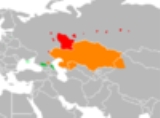
spoken by more than 12 million people in an area spanning from Lithuania
to China
.
The Uzbek language
's Kypchak dialect contains the remainder of Kypchak languages that were once spoken in Uzbekistan
, and there is a dialect continuum
between Uzbek and Kazakh.
The language of the Mamluk
s in Egypt
appears to have been a Kypchak language, probably one belonging to the Kazakh–Nogay group.
Turkic languages
The Turkic languages constitute a language family of at least thirty five languages, spoken by Turkic peoples across a vast area from Eastern Europe and the Mediterranean to Siberia and Western China, and are considered to be part of the proposed Altaic language family.Turkic languages are spoken...
spoken by more than 12 million people in an area spanning from Lithuania
Lithuania
Lithuania , officially the Republic of Lithuania is a country in Northern Europe, the biggest of the three Baltic states. It is situated along the southeastern shore of the Baltic Sea, whereby to the west lie Sweden and Denmark...
to China
China
Chinese civilization may refer to:* China for more general discussion of the country.* Chinese culture* Greater China, the transnational community of ethnic Chinese.* History of China* Sinosphere, the area historically affected by Chinese culture...
.
Linguistic features
The Kypchak languages share a number of features that have led linguists to classify them together. Some of these features are shared with other Turkic languages; others are unique to the Kypchak language family.Shared features
- Change of Proto-Turkic *d to /j/ (e.g. *hadaq > ajaq "foot")
- Loss of initial *h sound (preserved only in KhalajKhalaj languageKhalaj is a Turkic language spoken in Iran.It is a member of the Azerbaijani subgroup of the Oghuz languages.There were approximately 42,000 speakers of this language as of 2000...
. See above example.)
Unique features
- Extensive labial vowel harmonyVowel harmonyVowel harmony is a type of long-distance assimilatory phonological process involving vowels that occurs in some languages. In languages with vowel harmony, there are constraints on which vowels may be found near each other....
(e.g. olor vs. olar "them") - Frequent fortitionFortitionFortition is a consonantal change from a 'weak' sound to a 'strong' one, the opposite of the more common lenition. For example, a fricative or an approximant may become a plosive...
(in the form of assibilationAssibilationIn linguistics, assibilation is the term for a sound change resulting in a sibilant consonant. It is commonly the final phase of palatalization.-Romance languages:...
) of initial */j/ (e.g. *jetti > ʒetti "seven") - Diphthongs from syllable-final */ɡ/ and */b/ (e.g. *taɡ > taw "mountain", *sub > suw)
Classification
The Kypchak languages may be broken down into three groups, based on geography and shared features:- Kypchak–Bolgar (Uralo-Caspian), including BashkirBashkir languageThe Bashkir language is a Turkic language, and is the language of the Bashkirs. It is co-official with Russian in the Republic of Bashkortostan.-Speakers:...
and TatarTatar languageThe Tatar language , or more specifically Kazan Tatar, is a Turkic language spoken by the Tatars of historical Kazan Khanate, including modern Tatarstan and Bashkiria...
(including Siberian Tatar, Mishar Tatar, Astrakhan Tatar, Baraba TatarBaraba languageBaraba or Baraba Tatar is spoken by at least 8,000 Baraba Tatars in Siberia. It is a dialect of Siberian Tatar.-Geographic Distribution:Baraba Tatar is spoken mainly in the Novosibirsk Oblast in Russia...
, etc.)
- Kypchak–Cuman (Ponto-Caspian), including Karachay-BalkarKarachay-Balkar languageThe Karachay-Balkar language is a Turkic language spoken by the Karachays and Balkars. It is divided into two dialects: Karachay-Baksan-Chegem which pronounces two phonemes as and , and Balkar, which pronounces the corresponding phonemes as and .- Alphabet :Modern Karachay-Balkar Cyrillic...
, KumykKumyk languageKumyk is a Turkic language, spoken by about 365,000 speakers in the Dagestan republic of Russian Federation....
, KaraimKaraim languageThe Karaim language is a Turkic language with Hebrew influences, in a similar manner to Yiddish or Ladino. It is spoken by Crimean Karaites – ethnic Turkic adherents of Karaite Judaism in Crimea, Lithuania, Poland and western Ukraine...
, KrymchakKrymchak languageThe Krymchak language is a Turkic language spoken in Crimea by the Krymchak people. It is often considered to be a Crimean Tatar dialect. The language is sometimes referred to as Judeo-Crimean Tatar....
, and the extinct CumanCuman languageCuman was a Kipchak Turkic language spoken by the Cumans and Kipchaks; the language was similar to the today's Crimean Tatar language...
and KipchakKipchak languageThe Kipchak language is an extinct Turkic language of the Kipchak group.The descendants of the Kipchak language include the majority of Turkic languages spoken in Eastern Europe and the Caucasus today, as Kipchak was used as a lingua franca in Golden Horde–ruled lands.Kazakhs are remnants of...
languages. UrumUrum languageUrum is a Turkic language spoken by several thousand people who inhabit a few villages in the Southeastern Ukraine and in diaspora communities worldwide. The Urum language is often considered a variant of the Crimean Tatar language....
and Crimean TatarCrimean Tatar languageThe Crimean Tatar language is the language of the Crimean Tatars. It is a Turkic language spoken in Crimea, Central Asia , and the Crimean Tatar diasporas in Turkey, Romania, Bulgaria...
appear to have a Kypchak–Cuman base, but have been heavily influenced by Oghuz languagesOghuz languagesThe Oghuz languages, a major branch of the Turkic language family, are spoken by more than 110 million people in an area spanning from the Balkans to China.-Linguistic features:...
.
- Kazakh–Nogay, including KazakhKazakh languageKazakh is a Turkic language which belongs to the Kipchak branch of the Turkic languages, closely related to Nogai and Karakalpak....
, KarakalpakKarakalpak languageKarakalpak is a Turkic language mainly spoken by Karakalpaks in Karakalpakstan , as well as by Bashkirs and Nogay. Ethnic Karakalpaks who live in the viloyatlar of Uzbekistan tend to speak local Uzbek dialects.-Classification:...
, and Nogay
The Uzbek language
Uzbek language
Uzbek is a Turkic language and the official language of Uzbekistan. It has about 25.5 million native speakers, and it is spoken by the Uzbeks in Uzbekistan and elsewhere in Central Asia...
's Kypchak dialect contains the remainder of Kypchak languages that were once spoken in Uzbekistan
Uzbekistan
Uzbekistan , officially the Republic of Uzbekistan is a doubly landlocked country in Central Asia and one of the six independent Turkic states. It shares borders with Kazakhstan to the west and to the north, Kyrgyzstan and Tajikistan to the east, and Afghanistan and Turkmenistan to the south....
, and there is a dialect continuum
Dialect continuum
A dialect continuum, or dialect area, was defined by Leonard Bloomfield as a range of dialects spoken across some geographical area that differ only slightly between neighboring areas, but as one travels in any direction, these differences accumulate such that speakers from opposite ends of the...
between Uzbek and Kazakh.
The language of the Mamluk
Mamluk
A Mamluk was a soldier of slave origin, who were predominantly Cumans/Kipchaks The "mamluk phenomenon", as David Ayalon dubbed the creation of the specific warrior...
s in Egypt
Egypt
Egypt , officially the Arab Republic of Egypt, Arabic: , is a country mainly in North Africa, with the Sinai Peninsula forming a land bridge in Southwest Asia. Egypt is thus a transcontinental country, and a major power in Africa, the Mediterranean Basin, the Middle East and the Muslim world...
appears to have been a Kypchak language, probably one belonging to the Kazakh–Nogay group.
See also
- Kipchak languageKipchak languageThe Kipchak language is an extinct Turkic language of the Kipchak group.The descendants of the Kipchak language include the majority of Turkic languages spoken in Eastern Europe and the Caucasus today, as Kipchak was used as a lingua franca in Golden Horde–ruled lands.Kazakhs are remnants of...
- KipchaksKipchaksKipchaks were a Turkic tribal confederation...
- Kipchaks in GeorgiaKipchaks in GeorgiaKipchaks are an ancient nomadic, Turkic people who occupied large territories from Central Asia to Eastern Europe. They, together with the Cumans played an important role in the history of many nations in the region, Georgia among them...
- Cuman people
- Cuman languageCuman languageCuman was a Kipchak Turkic language spoken by the Cumans and Kipchaks; the language was similar to the today's Crimean Tatar language...
- CumaniaCumaniaCumania is a name formerly used to designate several distinct lands in Eastern Europe inhabited by and under the military dominance of the Cumans, a nomadic tribe who, with the Kipchaks, created a confederation. The Cumans were also known as the Polovtsians, or Folban...