

Perm

Encyclopedia
Perm is a city and the administrative center of Perm Krai
, Russia
, located on the banks of the Kama River
, in the European part of Russia near the Ural Mountains
. From 1940 to 1957 it was named Molotov .
According to the preliminary results of the 2010 Census, Perm's population is 991,530, down from 1,001,653 recorded in the 2002 Census
and 1,090,944 recorded in 1989 Census
. As of the 2010 Census, the city was the thirteenth most populous in Russia.
Perm is served by Bolshoye Savino Airport
and hosts Bakharevka air base.
or Veps) origin. Komi is a member of the Permic
group of Uralic languages, which is also named for Perm. Likewise, the geologic period of the Permian
takes its name from the toponym.
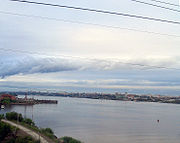 Perm covers an area of 799.68 square kilometres (308.8 sq mi).
The city of Perm is located on the bank of the Kama River
upon hilly terrain. The Kama is the main tributary of the Volga River and one of the deepest and most picturesque rivers of Russia. This river is the waterway which grants the Urals access to the White Sea
, Baltic Sea
, Sea of Azov
, Black Sea
, and Caspian Sea
. Kama divides the city into two parts, the central part and the right bank part, and it stretches for 70 km along the Kama and 40 km across it. The city street grid parallels the Kama River, traveling generally east-west, while other main streets run perpendicularly to those following the river. The grid pattern accommodates the hills of the city where it crosses them.
Another distinguishing feature of the city's relief is the large quantity of small rivers and brooks. The largest of them are the Mulyanka
, Yegoshikha
, Motoviliha (all are on the left bank of Kama River), and Gaiva (on the right bank).
Perm has a continental climate
with warm summers and long, cold winters.
region by Tsar Peter I of Russia
. Vasily Tatishchev
, appointed by the Tsar as a chief manager of Ural factories, founded Perm together with another major center of the Ural region, Yekaterinburg
.
Perm was founded on May 15 (May 4 in Julian calendar
), 1723, and has had town status since October 29, 1781. By 1797, it was already an administrative center of the gubernia with the same name.
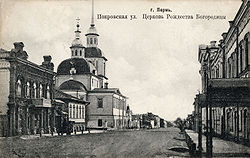 In the 19th century, Perm became a major trade and industrial center with a population of more than 20,000 people in the 1860s, with several metallurgy
, paper
, and steamboat
producing factories, including one owned by a British entrepreneur. In 1870, an opera theatre was opened in the city, and in 1871 the first phosphoric
factory in Russia was built. In 1916, Perm State University
—a major educational institution in modern Russia—was opened.
After the outbreak of the Russian Civil War
, Perm became a prime target for both sides because of its military munitions factories. In December 1918 the Siberian White Army
under Anatoly Pepelyayev
(who acknowledged the authority of the Omsk
Government of Aleksandr Kolchak
), took Perm. In 1919 the city was retaken by the Red Army
.
Grand Duke Mikail Alexandrovich
was executed in the outskirts of Perm with his secretary Nicholas Johnson on June 12, 1918 on the orders of the Perm Cheka
. Their bodies were never recovered. A few weeks later on July 7, 1918, Andronic Nikolsky
, the Archbishop of Perm, was also murdered by the Bolsheviks in the city. In 2000, the Russian Orthodox Church glorified him as Hieromartyr Andronik, Archbishop Of Perm, one of the Russian New Martyrs and Confessors.
, shipbuilding
, and chemical factories built during that period. Development continued after the 1940s and virtually every major industry became represented by numerous factories in Perm. To this day, almost 80% of the city's population is employed in manufacturing. During the Great Patriotic War (World War II
), Perm was a vital center of artillery
production in the Soviet Union
.
From 1940 until 1957, the city was named Molotov , after Vyacheslav Molotov
.
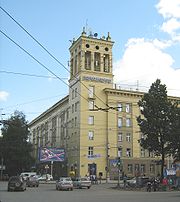 The city is a major administrative, industrial, scientific, and cultural center. The leading industries include machinery, defence
, oil
production (about 3% of Russian output), oil refining
, chemical and petrochemical, timber
and wood
processing and the food
industry.
Since 2004, in the city of Perm functioned modern Russia's first Muslim Cossack unit.
.svg.png)
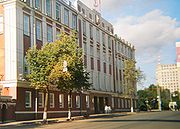 Perm is divided into seven city districts:
is one of the best in Russia. There are many other theatres in Perm, including the Drama theatre
, the Puppet Theatre, the Theatre for Young Spectators, the Theatre "Stage Molot" and the Theatre "Near Bridge".
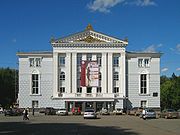 Among the cities museums and galleries, the Perm State Art Gallery is recognized for its outstanding collections of art, including paintings from the 15th to 18th century art movements, and wooden sculptures from the region. It is housed in a notable early 19th century structure, once an orthodox cathedral. The spire of the museum towers over the rest of Perm, as it is situated on the Komsomolsky Prospect. http://www.russianmuseums.info/M1575 Perm is receiving attention from the development of the new Museum of Contemporary Art, which came into existence officially in March 2009.
.
Perm is a home to several major universities
including Perm State University
, Perm State Technical University, Perm State Teachers' Training University, Perm State Medical Academy, Perm State Pharmaceutical Academy, Perm State Agricultural Academy, The Institute of Art and Culture, Perm State Choreographic School, Perm branch of state university Higher school of economics and others. There are also three military schools in Perm.
, Chelyabinsk
and Ufa
, although Perm has a smaller population than these. 35% of Perm Oblast
's industry is located in Perm. The largest industries in the city are electric power engineering, oil and gas refining, machine building, chemicals and petrochemicals, forestry processing, printing and food industry.
Several major industrial companies are located in Perm. Engine-makers Perm Motors and Aviadvigatel
are among the major players of the Russian aircraft industry. Rocket engine company Proton-PM will mass-produce the RD-191
engine for the upcoming Angara rocket family. In electric engineering, Morion JSC and Perm Scientific and Industrial Group, along with Perm Electrical Engineering Plant are the leading companies. JSC KAMKABEL is Russia's largest exporter of cables and wires. Oil-refining and natural gas processing are also among the city's leading industries. The largest companies in this sector are LUKoil
-Perm Ltd., and LUKoilPernefteprodukt Ltd.
with lines radiating to Central Russia, the north part of the Ural
s, and the far east of Russia
. The Kama
River is an important link in the unifying deep-water system of the European part of Russia. The river connects the city with European waterways. It is possible to ship cargo from the Kama river area to the sea ports of the White
, Baltic
, Azov, Black
, and Caspian
seas without reloading.
Perm is served by the international airport Bolshoye Savino
, 16 km southwest.
Perm's public transit network includes tram
, bus
, and trolleybus
routes.
, operated by Aeroflot-Nord in a service agreement with Aeroflot and as its subsidiary, crashed on approach to Perm Airport on 14 September 2008 at 5:09:25 (UTC+06). All 82 passengers and 6 crew members were killed.
, ice hockey
and basketball
. The largest football club in Perm is Amkar
, who play in the Russian Premier League
. Perm was also home to the two-time Russian Basketball Super League
champions, Ural Great
. The largest Ice hockey team based in Perm is Molot-Prikame Perm who play in the Vysshaya Liga.
.jpg) The following people were either born in Perm or made names for themselves while residing there.
The following people were either born in Perm or made names for themselves while residing there.
with: Louisville
, United States
, since 1994 Oxford
, United Kingdom
, 1995 Qingdao
, China
Duisburg
, Germany
, since 2007
Perm Krai
Perm Krai is a federal subject of Russia that came into existence on December 1, 2005 as a result of the 2004 referendum on the merger of Perm Oblast and Komi-Permyak Autonomous Okrug. The city of Perm became the administrative center of the new federal subject...
, Russia
Russia
Russia or , officially known as both Russia and the Russian Federation , is a country in northern Eurasia. It is a federal semi-presidential republic, comprising 83 federal subjects...
, located on the banks of the Kama River
Kama River
Kama is a major river in Russia, the longest left tributary of the Volga and the largest one in discharge; in fact, it is larger than the Volga before junction....
, in the European part of Russia near the Ural Mountains
Ural Mountains
The Ural Mountains , or simply the Urals, are a mountain range that runs approximately from north to south through western Russia, from the coast of the Arctic Ocean to the Ural River and northwestern Kazakhstan. Their eastern side is usually considered the natural boundary between Europe and Asia...
. From 1940 to 1957 it was named Molotov .
According to the preliminary results of the 2010 Census, Perm's population is 991,530, down from 1,001,653 recorded in the 2002 Census
Russian Census (2002)
Russian Census of 2002 was the first census of the Russian Federation carried out on October 9 through October 16, 2002. It was carried out by the Russian Federal Service of State Statistics .-Resident population:...
and 1,090,944 recorded in 1989 Census
Soviet Census (1989)
The 1989 Soviet census, conducted between January 12-19 of that year, was the last one conducted in the former USSR. It resulted in a total population of 286,730,819 inhabitants...
. As of the 2010 Census, the city was the thirteenth most populous in Russia.
Perm is served by Bolshoye Savino Airport
Bolshoye Savino Airport
Bolshoye Savino Airport is an international airport in Perm Krai, Russia located 16 km southwest of Perm, in the village of Bolshoye Savino. It is the only airport in Perm Krai with regular scheduled passenger flights. The majority of flights are between Perm and Moscow...
and hosts Bakharevka air base.
Name
The name Perm is of unknown etymology, likely of Uralic (KomiKomi language
The Komi language is a Finno-Permic language spoken by the Komi peoples in the northeastern European part of Russia. Komi is one of the two members of the Permic subgroup of the Finno-Ugric branch...
or Veps) origin. Komi is a member of the Permic
Permic languages
Permic languages are a branch of the Uralic language family. They are spoken in the foothills of the Ural Mountains of Russia.* Komi** Komi-Permyak** Komi-Yodzyak ** Komi-Zyryan...
group of Uralic languages, which is also named for Perm. Likewise, the geologic period of the Permian
Permian
The PermianThe term "Permian" was introduced into geology in 1841 by Sir Sir R. I. Murchison, president of the Geological Society of London, who identified typical strata in extensive Russian explorations undertaken with Edouard de Verneuil; Murchison asserted in 1841 that he named his "Permian...
takes its name from the toponym.
Geography
The city of Perm is located on the bank of the Kama River
Kama River
Kama is a major river in Russia, the longest left tributary of the Volga and the largest one in discharge; in fact, it is larger than the Volga before junction....
upon hilly terrain. The Kama is the main tributary of the Volga River and one of the deepest and most picturesque rivers of Russia. This river is the waterway which grants the Urals access to the White Sea
White Sea
The White Sea is a southern inlet of the Barents Sea located on the northwest coast of Russia. It is surrounded by Karelia to the west, the Kola Peninsula to the north, and the Kanin Peninsula to the northeast. The whole of the White Sea is under Russian sovereignty and considered to be part of...
, Baltic Sea
Baltic Sea
The Baltic Sea is a brackish mediterranean sea located in Northern Europe, from 53°N to 66°N latitude and from 20°E to 26°E longitude. It is bounded by the Scandinavian Peninsula, the mainland of Europe, and the Danish islands. It drains into the Kattegat by way of the Øresund, the Great Belt and...
, Sea of Azov
Sea of Azov
The Sea of Azov , known in Classical Antiquity as Lake Maeotis, is a sea on the south of Eastern Europe. It is linked by the narrow Strait of Kerch to the Black Sea to the south and is bounded on the north by Ukraine mainland, on the east by Russia, and on the west by the Ukraine's Crimean...
, Black Sea
Black Sea
The Black Sea is bounded by Europe, Anatolia and the Caucasus and is ultimately connected to the Atlantic Ocean via the Mediterranean and the Aegean seas and various straits. The Bosphorus strait connects it to the Sea of Marmara, and the strait of the Dardanelles connects that sea to the Aegean...
, and Caspian Sea
Caspian Sea
The Caspian Sea is the largest enclosed body of water on Earth by area, variously classed as the world's largest lake or a full-fledged sea. The sea has a surface area of and a volume of...
. Kama divides the city into two parts, the central part and the right bank part, and it stretches for 70 km along the Kama and 40 km across it. The city street grid parallels the Kama River, traveling generally east-west, while other main streets run perpendicularly to those following the river. The grid pattern accommodates the hills of the city where it crosses them.
Another distinguishing feature of the city's relief is the large quantity of small rivers and brooks. The largest of them are the Mulyanka
Mulyanka River
The Mulyanka , also referred as Upper Mulyanka, is a small river in Perm Krai, Russia which flows in the city of Perm and nearby Permsky District and is a left tributary of the Kama River. The proximity of city's industry has a heavy influence on the river ecology.-Geography:The length of Mulyanka...
, Yegoshikha
Yegoshikha River
Yegoshikha , formerly Yagoshikha , is a river in Perm Krai, Russia, the left tributary of the Kama. In spite of its relatively small size it is famous for its historical significance. It mainly flows in the borders of the Perm city. The origin of Yegoshikha is in the forest area close to Lipovaya...
, Motoviliha (all are on the left bank of Kama River), and Gaiva (on the right bank).
Perm has a continental climate
Continental climate
Continental climate is a climate characterized by important annual variation in temperature due to the lack of significant bodies of water nearby...
with warm summers and long, cold winters.
History
Perm was first mentioned as a village, Yegoshikha, in 1647; however, the history of the modern city of Perm starts with the development of the UralUral (region)
Ural is a geographical region located around the Ural Mountains, between the East European and West Siberian plains. It extends approximately from north to south, from the Arctic Ocean to the bend of Ural River near Orsk city. The boundary between Europe and Asia runs along the eastern side of...
region by Tsar Peter I of Russia
Peter I of Russia
Peter the Great, Peter I or Pyotr Alexeyevich Romanov Dates indicated by the letters "O.S." are Old Style. All other dates in this article are New Style. ruled the Tsardom of Russia and later the Russian Empire from until his death, jointly ruling before 1696 with his half-brother, Ivan V...
. Vasily Tatishchev
Vasily Tatishchev
Vasily Nikitich Tatishchev was a prominent Russian statesman, and ethnographer, best remembered as the author of the first full-scale Russian history...
, appointed by the Tsar as a chief manager of Ural factories, founded Perm together with another major center of the Ural region, Yekaterinburg
Yekaterinburg
Yekaterinburg is a major city in the central part of Russia, the administrative center of Sverdlovsk Oblast. Situated on the eastern side of the Ural mountain range, it is the main industrial and cultural center of the Urals Federal District with a population of 1,350,136 , making it Russia's...
.
Perm was founded on May 15 (May 4 in Julian calendar
Julian calendar
The Julian calendar began in 45 BC as a reform of the Roman calendar by Julius Caesar. It was chosen after consultation with the astronomer Sosigenes of Alexandria and was probably designed to approximate the tropical year .The Julian calendar has a regular year of 365 days divided into 12 months...
), 1723, and has had town status since October 29, 1781. By 1797, it was already an administrative center of the gubernia with the same name.
Metallurgy
Metallurgy is a domain of materials science that studies the physical and chemical behavior of metallic elements, their intermetallic compounds, and their mixtures, which are called alloys. It is also the technology of metals: the way in which science is applied to their practical use...
, paper
Paper
Paper is a thin material mainly used for writing upon, printing upon, drawing or for packaging. It is produced by pressing together moist fibers, typically cellulose pulp derived from wood, rags or grasses, and drying them into flexible sheets....
, and steamboat
Steamboat
A steamboat or steamship, sometimes called a steamer, is a ship in which the primary method of propulsion is steam power, typically driving propellers or paddlewheels...
producing factories, including one owned by a British entrepreneur. In 1870, an opera theatre was opened in the city, and in 1871 the first phosphoric
Phosphorus
Phosphorus is the chemical element that has the symbol P and atomic number 15. A multivalent nonmetal of the nitrogen group, phosphorus as a mineral is almost always present in its maximally oxidized state, as inorganic phosphate rocks...
factory in Russia was built. In 1916, Perm State University
Perm State University
Perm State University or PSU is located in the city of Perm, Perm Krai, Russia. Founded in 1916, it claims to be one of the oldest universities in the Ural and eastern territories of Russia. Its current rector is Igor Makarikhin.-History:...
—a major educational institution in modern Russia—was opened.
After the outbreak of the Russian Civil War
Russian Civil War
The Russian Civil War was a multi-party war that occurred within the former Russian Empire after the Russian provisional government collapsed to the Soviets, under the domination of the Bolshevik party. Soviet forces first assumed power in Petrograd The Russian Civil War (1917–1923) was a...
, Perm became a prime target for both sides because of its military munitions factories. In December 1918 the Siberian White Army
White movement
The White movement and its military arm the White Army - known as the White Guard or the Whites - was a loose confederation of Anti-Communist forces.The movement comprised one of the politico-military Russian forces who fought...
under Anatoly Pepelyayev
Anatoly Pepelyayev
Anatoly Nikolayevich Pepelyayev was a White Russian general who led the Siberian armies of Admiral Kolchak during the Russian Civil War. His elder brother Viktor Pepelyayev served as Prime Minister in Kolchak's government.-Trans-Siberian march:...
(who acknowledged the authority of the Omsk
Omsk
-History:The wooden fort of Omsk was erected in 1716 to protect the expanding Russian frontier along the Ishim and the Irtysh rivers against the Kyrgyz nomads of the Steppes...
Government of Aleksandr Kolchak
Aleksandr Kolchak
Aleksandr Vasiliyevich Kolchak was a Russian naval commander, polar explorer and later - Supreme ruler . Supreme ruler of Russia , was recognized in this position by all the heads of the White movement, "De jure" - Kingdom of Serbs, Croats and Slovenes, "De facto" - Entente States...
), took Perm. In 1919 the city was retaken by the Red Army
Red Army
The Workers' and Peasants' Red Army started out as the Soviet Union's revolutionary communist combat groups during the Russian Civil War of 1918-1922. It grew into the national army of the Soviet Union. By the 1930s the Red Army was among the largest armies in history.The "Red Army" name refers to...
.
Grand Duke Mikail Alexandrovich
Grand Duke Michael Alexandrovich of Russia
Grand Duke Michael Alexandrovich of Russia was the youngest son of Emperor Alexander III of Russia.At the time of his birth, his paternal grandfather was still the reigning Emperor of All the Russias. Michael was fourth-in-line to the throne following his father and elder brothers Nicholas and...
was executed in the outskirts of Perm with his secretary Nicholas Johnson on June 12, 1918 on the orders of the Perm Cheka
Cheka
Cheka was the first of a succession of Soviet state security organizations. It was created by a decree issued on December 20, 1917, by Vladimir Lenin and subsequently led by aristocrat-turned-communist Felix Dzerzhinsky...
. Their bodies were never recovered. A few weeks later on July 7, 1918, Andronic Nikolsky
Andronic Nikolsky
Andronik , also spelled Andronic, was a bishop in the Russian Orthodox Church and a saint, glorified as Hieromartyr Andronik, Archbishop Of Perm in 2000.- Early life :...
, the Archbishop of Perm, was also murdered by the Bolsheviks in the city. In 2000, the Russian Orthodox Church glorified him as Hieromartyr Andronik, Archbishop Of Perm, one of the Russian New Martyrs and Confessors.
Soviet period
In the 1930s, Perm grew as a major industrial city with aviationAviation
Aviation is the design, development, production, operation, and use of aircraft, especially heavier-than-air aircraft. Aviation is derived from avis, the Latin word for bird.-History:...
, shipbuilding
Shipbuilding
Shipbuilding is the construction of ships and floating vessels. It normally takes place in a specialized facility known as a shipyard. Shipbuilders, also called shipwrights, follow a specialized occupation that traces its roots to before recorded history.Shipbuilding and ship repairs, both...
, and chemical factories built during that period. Development continued after the 1940s and virtually every major industry became represented by numerous factories in Perm. To this day, almost 80% of the city's population is employed in manufacturing. During the Great Patriotic War (World War II
World War II
World War II, or the Second World War , was a global conflict lasting from 1939 to 1945, involving most of the world's nations—including all of the great powers—eventually forming two opposing military alliances: the Allies and the Axis...
), Perm was a vital center of artillery
Artillery
Originally applied to any group of infantry primarily armed with projectile weapons, artillery has over time become limited in meaning to refer only to those engines of war that operate by projection of munitions far beyond the range of effect of personal weapons...
production in the Soviet Union
Soviet Union
The Soviet Union , officially the Union of Soviet Socialist Republics , was a constitutionally socialist state that existed in Eurasia between 1922 and 1991....
.
From 1940 until 1957, the city was named Molotov , after Vyacheslav Molotov
Vyacheslav Molotov
Vyacheslav Mikhailovich Molotov was a Soviet politician and diplomat, an Old Bolshevik and a leading figure in the Soviet government from the 1920s, when he rose to power as a protégé of Joseph Stalin, to 1957, when he was dismissed from the Presidium of the Central Committee by Nikita Khrushchev...
.
Modern city
Arms industry
The arms industry is a global industry and business which manufactures and sells weapons and military technology and equipment. It comprises government and commercial industry involved in research, development, production, and service of military material, equipment and facilities...
, oil
Petroleum
Petroleum or crude oil is a naturally occurring, flammable liquid consisting of a complex mixture of hydrocarbons of various molecular weights and other liquid organic compounds, that are found in geologic formations beneath the Earth's surface. Petroleum is recovered mostly through oil drilling...
production (about 3% of Russian output), oil refining
Refining
Refining is the process of purification of a substance or a form. The term is usually used of a natural resource that is almost in a usable form, but which is more useful in its pure form. For instance, most types of natural petroleum will burn straight from the ground, but it will burn poorly...
, chemical and petrochemical, timber
Timber
Timber may refer to:* Timber, a term common in the United Kingdom and Australia for wood materials * Timber, Oregon, an unincorporated community in the U.S...
and wood
Wood
Wood is a hard, fibrous tissue found in many trees. It has been used for hundreds of thousands of years for both fuel and as a construction material. It is an organic material, a natural composite of cellulose fibers embedded in a matrix of lignin which resists compression...
processing and the food
Food
Food is any substance consumed to provide nutritional support for the body. It is usually of plant or animal origin, and contains essential nutrients, such as carbohydrates, fats, proteins, vitamins, or minerals...
industry.
Since 2004, in the city of Perm functioned modern Russia's first Muslim Cossack unit.
Administrative divisions
| City District | Population (2010 Census preliminary results) |
|---|---|
| Dzerzhinsky Dzerzhinsky City District, Perm Dzerzhinsky City District is one of the seven city districts of Perm. Population: -Name:The city district is called after Felix Dzerzhinsky, a Soviet revolutionary and politician.-Geography:... |
155,659 |
| Industrialny Industrialny City District, Perm Industrialny City District is one of the seven city districts of Perm. Population: -History:Industrialny City District is the most recently established district of the city... |
157,701 |
| Kirovsky Kirovsky City District, Perm Kirovsky is one of the seven city districts of Perm, Perm Krai, Russia, located on the right bank of the Kama River. Population: The city district was established on January 18, 1941 by merging together the work settlement of Zakamsk and the rural localities in its jurisdiction.... |
127,889 |
| Leninsky Leninsky City District, Perm Leninsky City District is one of the seven city districts of Perm, Perm Krai, Russia]. Population: It is the least populous city district of Perm.-Name:The city district is named after Vladimir Lenin, a Russian revolutionary and politician.... |
48,562 |
| Motovilikhinsky | 180,086 |
| Ordzhonikidzevsky Ordzhonikidzevsky City District, Perm Ordzhonikidzevsky City District is one of the seven city districts of Perm, Perm Krai, Russia, located on both banks of the Kama River. Population: The city district was established on March 16, 1940, when the city borders were expanded.... |
111,293 |
| Sverdlovsky Sverdlovsky City District, Perm Sverdlovsky City District is one of the seven city districts of Perm, Perm Krai, Russia, located in the left bank part of Perm. Population: It is the most populous district of Perm.... |
210,340 |
Culture
The Perm Opera and Ballet HousePerm Opera and Ballet Theatre
The Perm Tchaikovsky Opera and Ballet Theatre is an opera and ballet theatre in the city of Perm in Russia. It is one of the oldest theatres in the country, and it has remained a major musical centre during its history, in which many significant art events have taken place...
is one of the best in Russia. There are many other theatres in Perm, including the Drama theatre
Perm Academic Theatre
The Perm Academic Theatre established in Perm as an amateur theater for working youths. Its first performance, the Battleship Potemkin, was held on March, 14th, 1927 on the site of the theater, which at that time had no constant base, but managed to stage 25 new plays a month with their own...
, the Puppet Theatre, the Theatre for Young Spectators, the Theatre "Stage Molot" and the Theatre "Near Bridge".
Education
Perm is a scientific center; some of the scientific institutes are combined in the Perm Scientific Center of the Ural Branch of the Russian Academy of SciencesRussian Academy of Sciences
The Russian Academy of Sciences consists of the national academy of Russia and a network of scientific research institutes from across the Russian Federation as well as auxiliary scientific and social units like libraries, publishers and hospitals....
.
Perm is a home to several major universities
University
A university is an institution of higher education and research, which grants academic degrees in a variety of subjects. A university is an organisation that provides both undergraduate education and postgraduate education...
including Perm State University
Perm State University
Perm State University or PSU is located in the city of Perm, Perm Krai, Russia. Founded in 1916, it claims to be one of the oldest universities in the Ural and eastern territories of Russia. Its current rector is Igor Makarikhin.-History:...
, Perm State Technical University, Perm State Teachers' Training University, Perm State Medical Academy, Perm State Pharmaceutical Academy, Perm State Agricultural Academy, The Institute of Art and Culture, Perm State Choreographic School, Perm branch of state university Higher school of economics and others. There are also three military schools in Perm.
Economy
Perm has the largest industrial output among cities in the Urals, ahead of YekaterinburgYekaterinburg
Yekaterinburg is a major city in the central part of Russia, the administrative center of Sverdlovsk Oblast. Situated on the eastern side of the Ural mountain range, it is the main industrial and cultural center of the Urals Federal District with a population of 1,350,136 , making it Russia's...
, Chelyabinsk
Chelyabinsk
Chelyabinsk is a city and the administrative center of Chelyabinsk Oblast, Russia, located in the northwestern side of the oblast, south of Yekaterinburg, just to the east of the Ural Mountains, on the Miass River. Population: -History:...
and Ufa
Ufa
-Demographics:Nationally, dominated by Russian , Bashkirs and Tatars . In addition, numerous are Ukrainians , Chuvash , Mari , Belarusians , Mordovians , Armenian , Germans , Jews , Azeris .-Government and administration:Local...
, although Perm has a smaller population than these. 35% of Perm Oblast
Perm Oblast
Until December 1, 2005, Perm Oblast was a federal subject of Russia in Privolzhsky Federal District. According to the results of the referendum held in October 2004, Perm Oblast was merged with Komi-Permyak Autonomous Okrug to form Perm Krai.The oblast was named after its administrative center,...
's industry is located in Perm. The largest industries in the city are electric power engineering, oil and gas refining, machine building, chemicals and petrochemicals, forestry processing, printing and food industry.
Several major industrial companies are located in Perm. Engine-makers Perm Motors and Aviadvigatel
Aviadvigatel
Aviadvigatel OJSC is a developer and builder of aero-engines for Ilyushin Il-76MF, Ilyushin Il-96, Tupolev Tu-204, Tupolev Tu-214, and other aircraft...
are among the major players of the Russian aircraft industry. Rocket engine company Proton-PM will mass-produce the RD-191
RD-191
The RD-191 is a high performance single-combustion chamber rocket engine, developed in Russia. It is derived from the RD-170 originally used in the Energia launcher....
engine for the upcoming Angara rocket family. In electric engineering, Morion JSC and Perm Scientific and Industrial Group, along with Perm Electrical Engineering Plant are the leading companies. JSC KAMKABEL is Russia's largest exporter of cables and wires. Oil-refining and natural gas processing are also among the city's leading industries. The largest companies in this sector are LUKoil
LUKoil
Lukoil/LUKoil ; ) is Russia's second largest oil company and its second largest producer of oil. In 2009, the company produced 97.615 million tons of oil; ....
-Perm Ltd., and LUKoilPernefteprodukt Ltd.
Transport
Perm is an important railway junction on the Trans-Siberian RailwayTrans-Siberian Railway
The Trans-Siberian Railway is a network of railways connecting Moscow with the Russian Far East and the Sea of Japan. It is the longest railway in the world...
with lines radiating to Central Russia, the north part of the Ural
Ural (region)
Ural is a geographical region located around the Ural Mountains, between the East European and West Siberian plains. It extends approximately from north to south, from the Arctic Ocean to the bend of Ural River near Orsk city. The boundary between Europe and Asia runs along the eastern side of...
s, and the far east of Russia
Russia
Russia or , officially known as both Russia and the Russian Federation , is a country in northern Eurasia. It is a federal semi-presidential republic, comprising 83 federal subjects...
. The Kama
Kama
Kāma is often translated from Sanskrit as sexual desire, sexual pleasure, sensual gratification, sexual fulfillment, or eros54654564+more broadly mean desire, wish, passion, longing, pleasure of the senses, the aesthetic enjoyment of life, affection, or love, without sexual connotations.-Kama in...
River is an important link in the unifying deep-water system of the European part of Russia. The river connects the city with European waterways. It is possible to ship cargo from the Kama river area to the sea ports of the White
White Sea
The White Sea is a southern inlet of the Barents Sea located on the northwest coast of Russia. It is surrounded by Karelia to the west, the Kola Peninsula to the north, and the Kanin Peninsula to the northeast. The whole of the White Sea is under Russian sovereignty and considered to be part of...
, Baltic
Baltic Sea
The Baltic Sea is a brackish mediterranean sea located in Northern Europe, from 53°N to 66°N latitude and from 20°E to 26°E longitude. It is bounded by the Scandinavian Peninsula, the mainland of Europe, and the Danish islands. It drains into the Kattegat by way of the Øresund, the Great Belt and...
, Azov, Black
Black Sea
The Black Sea is bounded by Europe, Anatolia and the Caucasus and is ultimately connected to the Atlantic Ocean via the Mediterranean and the Aegean seas and various straits. The Bosphorus strait connects it to the Sea of Marmara, and the strait of the Dardanelles connects that sea to the Aegean...
, and Caspian
Caspian Sea
The Caspian Sea is the largest enclosed body of water on Earth by area, variously classed as the world's largest lake or a full-fledged sea. The sea has a surface area of and a volume of...
seas without reloading.
Perm is served by the international airport Bolshoye Savino
Bolshoye Savino Airport
Bolshoye Savino Airport is an international airport in Perm Krai, Russia located 16 km southwest of Perm, in the village of Bolshoye Savino. It is the only airport in Perm Krai with regular scheduled passenger flights. The majority of flights are between Perm and Moscow...
, 16 km southwest.
Perm's public transit network includes tram
Tram
A tram is a passenger rail vehicle which runs on tracks along public urban streets and also sometimes on separate rights of way. It may also run between cities and/or towns , and/or partially grade separated even in the cities...
, bus
Bus
A bus is a road vehicle designed to carry passengers. Buses can have a capacity as high as 300 passengers. The most common type of bus is the single-decker bus, with larger loads carried by double-decker buses and articulated buses, and smaller loads carried by midibuses and minibuses; coaches are...
, and trolleybus
Trolleybus
A trolleybus is an electric bus that draws its electricity from overhead wires using spring-loaded trolley poles. Two wires and poles are required to complete the electrical circuit...
routes.
Accidents
Aeroflot Flight 821Aeroflot Flight 821
Aeroflot Flight 821, operated by Aeroflot-Nord in a service agreement with Aeroflot and as its subsidiary, crashed on approach to Perm Airport on 14 September 2008 at 5:10 local time . All 82 passengers and 6 crew members were killed...
, operated by Aeroflot-Nord in a service agreement with Aeroflot and as its subsidiary, crashed on approach to Perm Airport on 14 September 2008 at 5:09:25 (UTC+06). All 82 passengers and 6 crew members were killed.
Sports
The three main professional sports played in Perm are footballFootball (soccer)
Association football, more commonly known as football or soccer, is a sport played between two teams of eleven players with a spherical ball...
, ice hockey
Ice hockey
Ice hockey, often referred to as hockey, is a team sport played on ice, in which skaters use wooden or composite sticks to shoot a hard rubber puck into their opponent's net. The game is played between two teams of six players each. Five members of each team skate up and down the ice trying to take...
and basketball
Basketball
Basketball is a team sport in which two teams of five players try to score points by throwing or "shooting" a ball through the top of a basketball hoop while following a set of rules...
. The largest football club in Perm is Amkar
FC Amkar Perm
FC Amkar Perm is a professional football club playing in Russian Premier League.They are based in the city of Perm and are the easternmost football club in Europe playing in top national competition...
, who play in the Russian Premier League
Russian Premier League
The Russian Premier League , currently called SOGAZ Russian Football Championship due to sponsorship reasons, is the top division of Russian football. There are 16 teams in the competition...
. Perm was also home to the two-time Russian Basketball Super League
Russian Basketball Super League
The Russian Basketball SuperLeague is a men's professional basketball league that was the pre-eminent league of Russian professional basketball until 2010...
champions, Ural Great
PBC Ural Great
PBC Ural Great Perm was a Russian professional basketball club that was located in Perm, Russia. The club's home arena was Molot Sports Hall. The team played in the Russian Super League.-History:...
. The largest Ice hockey team based in Perm is Molot-Prikame Perm who play in the Vysshaya Liga.
Notable citizens
- Viktor AstafiyevViktor AstafiyevViktor Petrovich Astafyev also spelled Astafiev or Astaf'ev , was a Soviet and Russian writer of short stories and novels.-Biography:...
, Russian writer of short stories and novels - Tatiana BorodinaTatiana Borodina- Biography :Borodina was born in Perm. She graduated from the Perm Musical College and Saint Petersburg Conservatory in 2000.She was a prize winner at the Young Voices of East: International Competition of Singers and at the International Rimsky-Korsakov Vocal Competition - Biography :Borodina...
, opera soprano - Sergei DiaghilevSergei DiaghilevSergei Pavlovich Diaghilev , usually referred to outside of Russia as Serge, was a Russian art critic, patron, ballet impresario and founder of the Ballets Russes, from which many famous dancers and choreographers would arise.-Early life and career:...
, renowned balletBalletBallet is a type of performance dance, that originated in the Italian Renaissance courts of the 15th century, and which was further developed in France and Russia as a concert dance form. The early portions preceded the invention of the proscenium stage and were presented in large chambers with...
impresario, the director of the famous Ballets RussesBallets RussesThe Ballets Russes was an itinerant ballet company from Russia which performed between 1909 and 1929 in many countries. Directed by Sergei Diaghilev, it is regarded as the greatest ballet company of the 20th century. Many of its dancers originated from the Imperial Ballet of Saint Petersburg... - Alexey Victorovich Ivanov, popular modern Russian writer
- Fyodor Gral, (1770–1835), famous Perm's doctor and philanthropist. A monument to him was erected in Perm
- Alexandra KosteniukAlexandra KosteniukAlexandra Konstantinovna Kosteniuk is a Russian chess Grandmaster and a former Women's World Chess Champion.-Chess career:Kosteniuk learned to play chess at the age of five after being taught by her father...
, chessChessChess is a two-player board game played on a chessboard, a square-checkered board with 64 squares arranged in an eight-by-eight grid. It is one of the world's most popular games, played by millions of people worldwide at home, in clubs, online, by correspondence, and in tournaments.Each player...
GrandmasterInternational GrandmasterThe title Grandmaster is awarded to strong chess players by the world chess organization FIDE. Apart from World Champion, Grandmaster is the highest title a chess player can attain....
and a former Women's World Chess ChampionWomen's World Chess ChampionshipThe Women's World Chess Championship is played to determine the women's world champion in chess. Like the World Chess Championship, it is administered by FIDE.... - Dmitry Mamin-Sibiryak, writer
- Nikolai MoiseevNikolai MoiseevNikolay Dmitriyevich Moiseyev , 1902, Perm - December 6, 1955, Moscow) was a Soviet astronomer and expert in celestial mechanics. In 1938, he became the chairman of the department of celestial mechanics at Moscow State University and worked on this position until his death...
, astronomerAstronomerAn astronomer is a scientist who studies celestial bodies such as planets, stars and galaxies.Historically, astronomy was more concerned with the classification and description of phenomena in the sky, while astrophysics attempted to explain these phenomena and the differences between them using... - Fyodor PetrovFyodor PetrovFyodor Fyodorovich Petrov was a Soviet artillery designer....
, Soviet artillery designer - Natasha PolyNatasha PolyNatalya Sergeyevna Polevshchikova , generally shortened to Natasha Poly , is a Russian model.-Early life and career start:...
, Russian supermodelSupermodelThe term supermodel refers to a highly-paid fashion model who usually has a worldwide reputation and often a background in haute couture and commercial modeling. The term became prominent in the popular culture of the 1980s. Supermodels usually work for top fashion designers and labels... - Alexander Stepanovich PopovAlexander Stepanovich PopovAlexander Stepanovich Popov was a Russian physicist who was the first person to demonstrate the practical application of electromagnetic waves....
, physicist who was the first to demonstrate the practical application of electromagnetic waves (radioRadioRadio is the transmission of signals through free space by modulation of electromagnetic waves with frequencies below those of visible light. Electromagnetic radiation travels by means of oscillating electromagnetic fields that pass through the air and the vacuum of space...
) widely regarded in Russia as the inventor of radio; - Arkadiy Shvetsov, Soviet aircraft engine designer
- Nikolai Slavyanov, inventor of an early method of arc weldingWeldingWelding is a fabrication or sculptural process that joins materials, usually metals or thermoplastics, by causing coalescence. This is often done by melting the workpieces and adding a filler material to form a pool of molten material that cools to become a strong joint, with pressure sometimes...
- Peter Berngardovich StruvePeter Berngardovich StruvePeter Berngardovich Struve – Пётр Бернгардович Струве was a Russian political economist, philosopher and editor. He started out as a Marxist, later became a liberal and after the Bolshevik revolution joined the White movement...
, Russian political economist, philosopher and editor - Yuri TrutnevYuri TrutnevYuri Petrovich Trutnev is a Russian politician. Since 2004, he is Minister of Natural Resources and the Environment of the Russian Federation.-Local government:...
, Minister of Natural Resources of Russia - Andrey VoronikhinAndrey VoronikhinAndrey Nikiforovich Voronikhin was a Russian architect and painter. As a representative of classicism he was also one of the founders of the monumental Russian Empire style...
, Russian architect and painter. As a representative of classicismClassicismClassicism, in the arts, refers generally to a high regard for classical antiquity, as setting standards for taste which the classicists seek to emulate. The art of classicism typically seeks to be formal and restrained: of the Discobolus Sir Kenneth Clark observed, "if we object to his restraint...
he was also one of the founders of the monumental Russian Empire style - Konstantin ZyryanovKonstantin ZyryanovKonstantin Georgiyevich Zyryanov is an association footballer who currently plays for Zenit Saint Petersburg and the Russian national team....
, Russian association football player; - Andronic NikolskyAndronic NikolskyAndronik , also spelled Andronic, was a bishop in the Russian Orthodox Church and a saint, glorified as Hieromartyr Andronik, Archbishop Of Perm in 2000.- Early life :...
, the first Bishop of Kyoto, Japan
Twin towns / sister cities
Perm is twinnedTown twinning
Twin towns and sister cities are two of many terms used to describe the cooperative agreements between towns, cities, and even counties in geographically and politically distinct areas to promote cultural and commercial ties.- Terminology :...
with: Louisville
Louisville, Kentucky
Louisville is the largest city in the U.S. state of Kentucky, and the county seat of Jefferson County. Since 2003, the city's borders have been coterminous with those of the county because of a city-county merger. The city's population at the 2010 census was 741,096...
, United States
United States
The United States of America is a federal constitutional republic comprising fifty states and a federal district...
, since 1994 Oxford
Oxford
The city of Oxford is the county town of Oxfordshire, England. The city, made prominent by its medieval university, has a population of just under 165,000, with 153,900 living within the district boundary. It lies about 50 miles north-west of London. The rivers Cherwell and Thames run through...
, United Kingdom
United Kingdom
The United Kingdom of Great Britain and Northern IrelandIn the United Kingdom and Dependencies, other languages have been officially recognised as legitimate autochthonous languages under the European Charter for Regional or Minority Languages...
, 1995 Qingdao
Qingdao
' also known in the West by its postal map spelling Tsingtao, is a major city with a population of over 8.715 million in eastern Shandong province, Eastern China. Its built up area, made of 7 urban districts plus Jimo city, is home to about 4,346,000 inhabitants in 2010.It borders Yantai to the...
, China
China
Chinese civilization may refer to:* China for more general discussion of the country.* Chinese culture* Greater China, the transnational community of ethnic Chinese.* History of China* Sinosphere, the area historically affected by Chinese culture...
Duisburg
Duisburg
- History :A legend recorded by Johannes Aventinus holds that Duisburg, was built by the eponymous Tuisto, mythical progenitor of Germans, ca. 2395 BC...
, Germany
Germany
Germany , officially the Federal Republic of Germany , is a federal parliamentary republic in Europe. The country consists of 16 states while the capital and largest city is Berlin. Germany covers an area of 357,021 km2 and has a largely temperate seasonal climate...
, since 2007
External links
- Perm regional server
- The Official Website of the Perm Municipal Duma
- Official Perm City website
- Street View of Perm
- Perm Chamber of Commerce and Industry
- The Western Ural Photographic Album
- Virtual museum of Romanov in Perm
- History of Perm
- Perm and Perm Region Information on Kommersant Publishing webpage (also, see all other Russian subjects of the Federation)
- The city of Perm - The poem of the town
- Perm for travelers Sights of Perm and Perm's region
- General info on the city of Perm
- "The Perm Days" is the regional newspaper issued in English language. That is an investment, business, tourist guide for foreign guests of Perm KraiPerm KraiPerm Krai is a federal subject of Russia that came into existence on December 1, 2005 as a result of the 2004 referendum on the merger of Perm Oblast and Komi-Permyak Autonomous Okrug. The city of Perm became the administrative center of the new federal subject...
. - Article about Perm Ballet
- S. Kishkovsky "Modern Dance and Art Bring a Burst of Color to a Gray City"
- Pictures
- About Perm.