


Russo-Kazan Wars

Encyclopedia
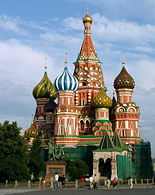
Khanate of Kazan
The Khanate of Kazan was a medieval Tatar state which occupied the territory of former Volga Bulgaria between 1438 and 1552. Its khans were the patrilineal descendants of Toqa Temür, the thirteenth son of Jochi and grandson of Genghis Khan. The khanate covered contemporary Tatarstan, Mari El,...
and Muscovite Russia from 1438, until Kazan
Kazan
Kazan is the capital and largest city of the Republic of Tatarstan, Russia. With a population of 1,143,546 , it is the eighth most populous city in Russia. Kazan lies at the confluence of the Volga and Kazanka Rivers in European Russia. In April 2009, the Russian Patent Office granted Kazan the...
was finally captured by Ivan the Terrible
Ivan IV of Russia
Ivan IV Vasilyevich , known in English as Ivan the Terrible , was Grand Prince of Moscow from 1533 until his death. His long reign saw the conquest of the Khanates of Kazan, Astrakhan, and Siberia, transforming Russia into a multiethnic and multiconfessional state spanning almost one billion acres,...
and absorbed into Russia in 1552.
Wars of Vasily II
In 1438, a year after the khanate's foundation, the very first khan of Kazan, Olug Moxammat, advanced on MoscowMoscow
Moscow is the capital, the most populous city, and the most populous federal subject of Russia. The city is a major political, economic, cultural, scientific, religious, financial, educational, and transportation centre of Russia and the continent...
with a large army. Vasily II of Moscow fled from his capital across the Volga River
Volga River
The Volga is the largest river in Europe in terms of length, discharge, and watershed. It flows through central Russia, and is widely viewed as the national river of Russia. Out of the twenty largest cities of Russia, eleven, including the capital Moscow, are situated in the Volga's drainage...
, but the Tatars refused to pursue the campaign and turned back to Kazan after devastating Kolomna
Kolomna
Kolomna is an ancient city and the administrative center of Kolomensky District of Moscow Oblast, Russia, situated at the confluence of the Moskva and Oka Rivers, southeast of Moscow. The area of the city is about . The city was founded in 1177...
and the locality.
The campaign of 1445 was disastrous for Muscovy and had major repercussions in Russian politics. Hostilities broke out when khan Maxmut took the strategic fortress of Nizhny Novgorod
Nizhny Novgorod
Nizhny Novgorod , colloquially shortened to Nizhny, is, with the population of 1,250,615, the fifth largest city in Russia, ranking after Moscow, St. Petersburg, Novosibirsk, and Yekaterinburg...
and invaded Muscovy. Vasily II mustered an army and defeated the Tatars near Murom
Murom
Murom is a historic city in Vladimir Oblast, Russia, which sprawls along the left bank of Oka River. Population: -History:In the 9th century CE, the city marked the easternmost settlement of the Eastern Slavs in the land of the Finno-Ugric people called Muromians. The Russian Primary Chronicle...
and Gorokhovets
Gorokhovets
Gorokhovets is a town and the administrative center of Gorokhovetsky District of Vladimir Oblast, Russia, located on the highway from Moscow to Nizhny Novgorod. It also serves as a river port on the Klyazma River...
. Thinking the war over, he disbanded his forces and returned to Moscow in triumph, only to learn that the Tatars had besieged Nizhny Novgorod again.
A new army was mustered and marched towards Suzdal
Suzdal
Suzdal is a town in Vladimir Oblast, Russia, situated northeast of Moscow, from the city of Vladimir, on the Kamenka River. Population: -History:...
, where they met the Russian generals who had surrendered Nizhny to the enemy after setting the fortress on fire. On 6 June 1445 the Russians and the Tatars clashed in the Battle of the Kamenka River near the walls of St. Euphemius Monastery
Monastery of Saint Euthymius
The Saviour Monastery of St. Euthymius is a monastery in Suzdal, Russia.The monastery was founded in the 14th century, and grew in importance in the 16th and 17th centuries after donations by Vasili III, Ivan IV and the Pozharsky family, a noble dynasty of the region...
. The battle was a resounding success for the Tatars, who took Vasily II prisoner. It took four months and an enormous ransom to salvage the monarch from captivity.
Qasim War (1467–1469)
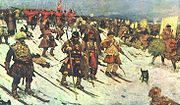
Ivan III of Russia
Ivan III Vasilyevich , also known as Ivan the Great, was a Grand Prince of Moscow and "Grand Prince of all Rus"...
decided to support his ally Qasim
Qasim khan
Qasím Khan was the first khan of the Qasim Khanate, a Tatar khanate since 1450s. He was the son of Kazan khan Oluğ Möxämmäd....
's claims to the Tatar throne and declared war on the ruling khan Ibrahim
Ibrahim of Kazan
İbrahim khan was a ruler of Kazan Khanate . He was the son of Mäxmüd. He was crowned after Xalil's death and was married to his wife Nursoltan. In 1467–1469 and 1478 he participated in wars against Muscovy. After the treaty concluded with Ivan III all Russian prisoners of war were liberated...
. Ivan's army sailed down the Volga, with their eyes fixed on Kazan, but autumn rains and rasputitsa
Rasputitsa
The rasputitsa refers to the biannual seasons when unpaved roads become difficult to traverse in parts of Belarus, Russia and Ukraine. The word may be translated as the "quagmire season" because during this period the large flatlands become extremely muddy and marshy, as do most unpaved roads...
("quagmire season") hindered the progress of Russian forces. When frosty winter came, the Russian generals launched an invasion of the northern Vyatka
Kirov Oblast
Kirov Oblast is a federal subject of Russia . Its administrative center is the city of Kirov. Population: -History:In the late 19th and early 20th centuries, Vyatka remained a place of exile for opponents of the tsarist regime, including many prominent revolutionary figures.In 1920, a number of...
Region. The campaign fell apart for lack of unity of purpose and military capability, but many atrocities were reported when the Russian army devastated Udmurtia
Udmurtia
The Udmurt Republic , or Udmurtia is a federal subject of Russia . Its capital is the city of Izhevsk. Population: -History:...
.
The following year, the Russians set out from Kotelnich
Kotelnich
Kotelnich is a river port town in Kirov Oblast, Russia, located on the right bank of the Vyatka River near its confluence with the Moloma, along the route of the Trans-Siberian Railway, southwest of Kirov. Population:...
in the Vyatka woods. They sailed down the Vyatka River
Vyatka River
The Vyatka River is a river in Kirov Oblast and the Republic of Tatarstan in Russia, right tributary of the Kama River. It is 1,314 km in length. The area of its basin is 129,000 km²....
and the Kama
Kama River
Kama is a major river in Russia, the longest left tributary of the Volga and the largest one in discharge; in fact, it is larger than the Volga before junction....
towards the Volga, pillaging merchant vessels on their way. In response, Ibrahim mounted a counter-offensive, overran Vyatka, and forced local inhabitants into subservience.
In 1469, a much stronger army was raised and, sailing down the Volga and the Oka, linked up in Nizhny Novgorod
Nizhny Novgorod
Nizhny Novgorod , colloquially shortened to Nizhny, is, with the population of 1,250,615, the fifth largest city in Russia, ranking after Moscow, St. Petersburg, Novosibirsk, and Yekaterinburg...
. The Russians marched downstream and ravaged the neighbourhood of Kazan
Kazan
Kazan is the capital and largest city of the Republic of Tatarstan, Russia. With a population of 1,143,546 , it is the eighth most populous city in Russia. Kazan lies at the confluence of the Volga and Kazanka Rivers in European Russia. In April 2009, the Russian Patent Office granted Kazan the...
but did not dare to lay siege to the Tatar capital, because Qasim's widow had pledged to negotiate an advantageous peace with Ibrahim (her son). In the meantime, the units from Yaroslavl
Yaroslavl
Yaroslavl is a city and the administrative center of Yaroslavl Oblast, Russia, located northeast of Moscow. The historical part of the city, a World Heritage Site, is located at the confluence of the Volga and the Kotorosl Rivers. It is one of the Golden Ring cities, a group of historic cities...
and Veliky Ustyug
Veliky Ustyug
Veliky Ustyug is a town in the northeast of Vologda Oblast, Russia, located at the confluence of the Sukhona and Yug Rivers. Administratively, it is incorporated as a town of oblast significance . It also serves as the administrative center of Velikoustyugsky District, by which it is completely...
vainly attempted to win Vyatka to the Russian side. After negotiations were broken, the Tatars clashed with the Russians in two bloody but indecisive battles.
In autumn 1469 Ivan III launched a third invasion of the khanate. The Russian commander, Prince Daniil Kholmsky
Daniil Kholmsky
Daniel of Kholm was a Russian knyaz, boyar and voyevoda, one of the most prominent military leaders of Ivan the Great...
, besieged Kazan, cut off water supplies and compelled Ibrahim to surrender. Under the terms of the peace settlement, the Tatars set free all the Russian prisoners they had captured in the forty previous years.
Siege of Kazan (1487)
The Vyatka Region remained the principal bone of contention between Kazan and Moscow for decades to come. In 1478, shortly before his death, Ibrahim devastated the region. In revenge, Ivan III sent his generals to sack the neighbourhood of Kazan. At that time Ibrahim died and was succeeded by Ilham, whilst his brother Moxammat Amin fled to Moscow. Ivan III allowed him to settle in KashiraKashira
Kashira is a town and the administrative center of Kashirsky District of Moscow Oblast, Russia, located on the Oka River south of Moscow. Population:...
and pledged his support for Moxammat's claims to the Tatar throne.
It was not before 1487 that Ivan found it prudent to intervene into Kazan affairs and to replace Ilham with Moxammat Amin. Prince Kholmsky sailed down the Volga from Nizhny Novgorod and laid siege to Kazan on 18 May. The city fell to the Russians on 9 June. Ilham was sent in chains to Moscow before being imprisoned in Vologda
Vologda
Vologda is a city and the administrative, cultural, and scientific center of Vologda Oblast, Russia, located on the Vologda River. The city is a major transport knot of the Northwest of Russia. Vologda is among the Russian cities possessing an especially valuable historical heritage...
, while Moxammat Amin was proclaimed the new khan. In reference to this victorious campaign, Ivan III proclaimed himself "Lord of Volga Bulgaria
Volga Bulgaria
Volga Bulgaria, or Volga–Kama Bolghar, is a historic Bulgar state that existed between the seventh and thirteenth centuries around the confluence of the Volga and Kama rivers in what is now Russia.-Origin:...
".
Battles of Arsk Field (1506)
The last war of Ivan's reign was instigated by Ilham's widow, who married Moxammat Amin and persuaded him to assert his independence from Moscow in 1505. The rebellion broke out into the open on Saint John's Day, when the Tatars massacred Russian merchants and envoys present at the annual Kazan Fair. A huge army of the Kazan and Nogai Tatars then advanced towards Nizhny Novgorod and besieged the city. The affair was decided by 300 Lithuanian archers, who had been captured by Russians in the Battle of VedroshaBattle of Vedrosha
The battle on the Vedrosha River was a battle in the course of the Russo-Lithuanian war of 1500-1503 which ended with a decisive Russian victory and proved to be of strategic significance...
and lived in Nizhny in captivity. They managed to put the Tatar vanguard into disarray: the khan's brother-in-law was killed in action and the horde retreated.
Ivan's death prevented hostilities from being renewed until May 1506, when Prince Fyodor Belsky led Russian forces against Kazan. After the Tatar cavalry attacked his rear, many Russians took flight or drowned in the Foul Lake (22 May). Prince Vasily Kholmsky
Vasily Kholmsky
Prince Vasily Danilovich Kholmsky was a Russian boyar and Muscovite voyevoda, son-in-law of Grand Prince Ivan III and son of Prince Daniil Kholmsky....
was sent to relieve Belsky and defeated the khan on Arsk
Arsk
Arsk is a town and the administrative center of Arsky District of the Republic of Tatarstan, Russia, located on the banks of the Kazanka River, from Kazan, the republic's capital. Arsk is also a station on the Kazan-Agryz railroad. Population:...
Field on June 22. Moxammat Amin withdrew to the Arsk Tower but, when the Russians started to celebrate their victory, ventured out and inflicted an excruciating defeat on them (June 25). Although it was the most brilliant Tatar victory in decades, Moxammat Amin — for some reason not clearly understood — resolved to sue for peace and paid homage to Ivan's successor, Vasily III of Russia.
Wars of Vasily III
A new massacre of Russian merchants and envoys residing in Kazan took place in 1521. Vasily III was so enraged that he forbade his subjects to visit the Kazan Fair again. Instead, the famous Makariev FairMakariev fair
Makaryev Fair was a fair in Russia held annually every July near Makaryev Monastery on the left bank of the Volga River from the mid-16th century to 1816. Following a massive fire in 1816, it was moved to Nizhny Novgorod, but for some decades thereafter it still was commonly referred toas Makariev...
was inaugurated downstream from Nizhny Novgorod, an establishment which undermined the economical prosperity of Kazan, thus contributing to its eventual downfall.
In 1524, Prince Ivan Belsky
Ivan Belsky
Ivan Belsky may refer to:* Ivan Vladimirovich Belsky , first prince of the Gediminid Belsky family* Ivan Feodorovich Belsky Ivan Belsky may refer to:* Ivan Vladimirovich Belsky (fl. 1422–1445), first prince of the Gediminid Belsky family* Ivan Feodorovich Belsky Ivan Belsky may refer to:* Ivan...
led the 150,000-strong Russian army against the Tatar capital. This campaign is described in detail by a foreign witness, Herberstein
Sigismund von Herberstein
Siegmund Freiherr von Herberstein, , was an Carniolan diplomat, writer, historian and member of the Holy Roman Empire Imperial Council...
. Belsky's huge army spent 20 days encamped on an island opposite Kazan, awaiting the arrival of Russian cavalrymen. Then news came that part of the cavalry had been defeated, and the vessels loaded with provisions had been captured by the Tatars. Although the army suffered from hunger, Belsky at once laid siege to the city and soon the Tatars sent their envoys proposing terms. Belsky accepted them and speedily returned to Moscow.
Prince Belsky returned to the walls of Kazan in July 1530. The khan had fortified his capital and built a new wall, yet the Russians set the city ablaze, massacring many inhabitants (according to Russian chronicles) and causing their enemy, Safa Giray
Safa Giray of Kazan
Safa Giray was khan of Kazan Khanate between the years 1524-1531, 1535-1546 and 1546-1549. He was the son of Sahib Giray from the Crimean Khanate, brother of Moxammat Giray....
, to withdraw to Arsk. The Tatars sued for peace, promising to accept any khan appointed from Moscow. The tsar put Canghali
Canghali of Kazan
Canghali was khan of Qasim in 1519–1532 and then Kazan in 1532–1535. He was the son of Shayex Allahiar and younger brother of Shahgali. Qasim Khanate was a vassal state of Muscovy. Canghali as its ruler had close ties with Muscovy...
, Shahgali's younger brother on the throne. He was murdered by the anti-Russian faction in 1535.
Russian chronicles record about forty attacks of Kazan khans on the Russian territories (mainly the regions of Nizhniy Novgorod, Murom
Murom
Murom is a historic city in Vladimir Oblast, Russia, which sprawls along the left bank of Oka River. Population: -History:In the 9th century CE, the city marked the easternmost settlement of the Eastern Slavs in the land of the Finno-Ugric people called Muromians. The Russian Primary Chronicle...
, Vyatka, Vladimir
Vladimir
Vladimir is a city and the administrative center of Vladimir Oblast, Russia, located on the Klyazma River, to the east of Moscow along the M7 motorway. Population:...
, Kostroma
Kostroma
Kostroma is a historic city and the administrative center of Kostroma Oblast, Russia. A part of the Golden Ring of Russian towns, it is located at the confluence of the Volga and Kostroma Rivers...
, Galich
Galich, Russia
Galich is a town in Kostroma Oblast, Russia, situated on the southern bank of Lake Galichskoye. It is also a minor railroad node of the Trans-Siberian railway. Population: -History:...
) in the first half of the 16th century. Half of Kazan raids occurred in 1530s and 1540s. Besides 1521 most ruinous Kazan attacks occurred in 1522, 1533, 1537, 1538, 1539, 1540, 1541
Wars of Ivan IV
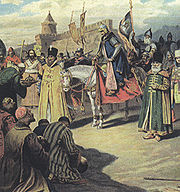
Lyskovo
Lyskovo is a town and the administrative center of Lyskovsky District of Nizhny Novgorod Oblast, Russia, located on the southern side of the Volga River , opposite the mouth of the Kerzhenets River, southeast of Nizhny Novgorod.. Population: It was first mentioned in 1410...
, but the battle was averted. Over the following years, the Crimean khan constructed an offensive alliance with Safa Giray
Safa Giray
İsmail Safa Giray was a Turkish civil engineer and politician of the Motherland Party . He was a member of parliament and held positions as Minister of Public Works and Settlement, Minister of National Defense, and Minister of Foreign Affairs.-Early life and education:Safa Giray was born in İzmir...
of Kazan
Kazan
Kazan is the capital and largest city of the Republic of Tatarstan, Russia. With a population of 1,143,546 , it is the eighth most populous city in Russia. Kazan lies at the confluence of the Volga and Kazanka Rivers in European Russia. In April 2009, the Russian Patent Office granted Kazan the...
, his relative. When Safa Giray invaded Muscovy in December 1540, the Russians used Qasim Tatars to contain him. After his advance was stalled near Murom
Murom
Murom is a historic city in Vladimir Oblast, Russia, which sprawls along the left bank of Oka River. Population: -History:In the 9th century CE, the city marked the easternmost settlement of the Eastern Slavs in the land of the Finno-Ugric people called Muromians. The Russian Primary Chronicle...
, Safa Giray was forced to withdraw towards his own borders.
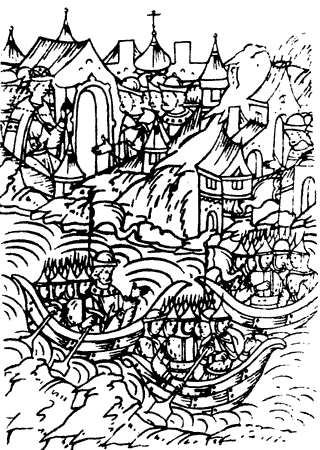
In 1551, detailed schemes for the eventual conquest of Kazan
Kazan
Kazan is the capital and largest city of the Republic of Tatarstan, Russia. With a population of 1,143,546 , it is the eighth most populous city in Russia. Kazan lies at the confluence of the Volga and Kazanka Rivers in European Russia. In April 2009, the Russian Patent Office granted Kazan the...
started to be aired. The tsar sent his envoy to the Nogai Horde
Nogai Horde
The Nogai Horde was a confederation of about eighteen Turkic and Mongol tribes that occupied the Pontic-Caspian steppe from about 1500 until they were pushed west by the Kalmyks and south by the Russians in the 17th century. The Mongol tribe called the Manghits constituted a core of the Horde...
and they promised to maintain neutrality during the impending war. The Ar begs
Ar begs
Ar begs was a formation of Noqrat Tatars' nobility, served to Muscovy in 16th-17th century. In 14th-15th centuries they were rulers of semi-independent duchy in the middle Cheptsa, nowadays Udmurtia. at the first time, their lands were under Kazan Khanate's and later under Russian influence...
and Udmurts submitted to Russian authority as well. In 1551, the wooden fort of Sviyazhsk
Sviyazhsk
Sviyazhsk or Zöyä is a rural locality in the Republic of Tatarstan, Russia, located at the confluence of the Volga and Sviyaga Rivers...
was transported down the Volga from Uglich
Uglich
Uglich is a historic town in Yaroslavl Oblast, Russia, which stands on the Volga River. Population: A local tradition dates the town's origins to 937. It was first documented in 1148 as Ugliche Pole...
all the way to Kazan. It was used as the Russian place d'armes during the decisive campaign of 1552.
Fall of Kazan (1552)
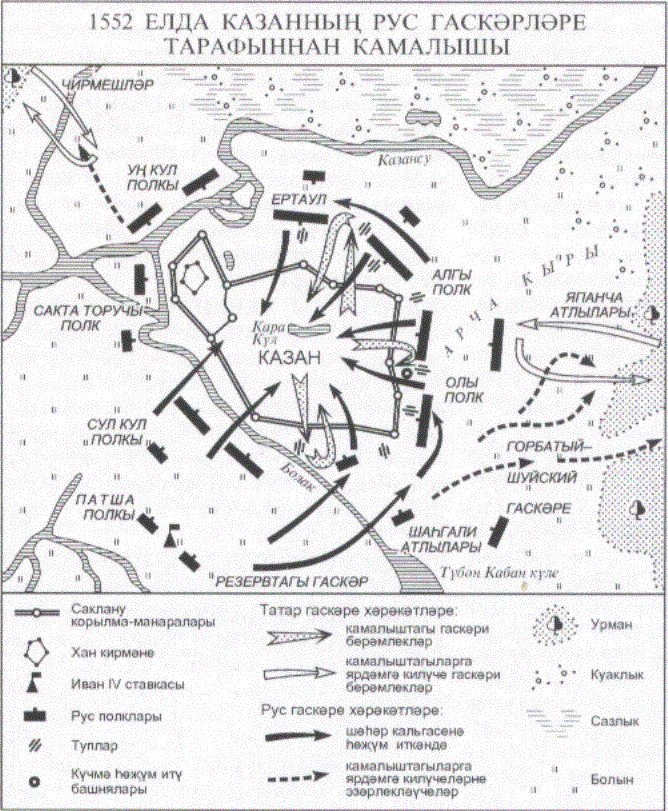
Kolomna
Kolomna is an ancient city and the administrative center of Kolomensky District of Moscow Oblast, Russia, situated at the confluence of the Moskva and Oka Rivers, southeast of Moscow. The area of the city is about . The city was founded in 1177...
. They routed the Crimean Tatars
Crimean Tatars
Crimean Tatars or Crimeans are a Turkic ethnic group that originally resided in Crimea. They speak the Crimean Tatar language...
under Devlet Giray near Tula
Tula, Russia
Tula is an industrial city and the administrative center of Tula Oblast, Russia. It is located south of Moscow, on the Upa River. Population: -History:...
before turning to the east. The tsar pressed on towards Kazan until the last siege of the Tatar capital was commenced on 30 August. Under the supervision of Prince Alexander Gorbaty-Shuisky, the Russians used ram weapons, a battery-tower
Siege tower
A siege tower is a specialized siege engine, constructed to protect assailants and ladders while approaching the defensive walls of a fortification. The tower was often rectangular with four wheels with its height roughly equal to that of the wall or sometimes higher to allow archers to stand on...
, mines, and 150 cannon. The Russians also had the advantage of efficient military engineer
Military engineer
In military science, engineering refers to the practice of designing, building, maintaining and dismantling military works, including offensive, defensive and logistical structures, to shape the physical operating environment in war...
s, such as Ivan Vyrodkov
Ivan Vyrodkov
Ivan Grigoryevich Vyrodkov was a Russian military engineer, inventor, and diak.Ivan Vyrodkov's name was first mentioned in 1538. It is known that he participated in Ivan the Terrible's military campaigns against Kazan, during the Russo-Kazan Wars. In 1551, Ivan Vyrodkov was in charge of the...
and the foreigner Rozmysl (Butler). The city's water supply was blocked and the walls were breached before the final storming of Kazan on 2 October led to the city being taken, its fortifications razed, and much of the population massacred. The Kazan Chronicle
Kazan Chronicle
Kazan Chronicle or Story of the Tsardom of Kazan is a document written between 1560 and 1565 by a Muscovite chronicler. The chronicler introduces himself as a Russian who was held in captivity in Kazan for about 20 years until Ivan the Terrible sacked Kazan in 1552...
reports about 110,000 killed, both civilians and garrison, and 60,000 - 100,000 Russians who had been kept captive in khanate released.
The fall of Kazan had as its primary effect the outright annexation of the Middle Volga. The Bashkirs
Bashkirs
The Bashkirs are a Turkic people indigenous to Bashkortostan extending on both parts of the Ural mountains, on the place where Europe meets Asia. Groups of Bashkirs also live in the republic of Tatarstan, Perm Krai, Chelyabinsk, Orenburg, Tyumen, Sverdlovsk, Kurgan, Samara and Saratov Oblasts of...
accepted Ivan IV's authority two years later. As a result of the Kazan campaigns, Muscovy was transformed into the multinational and multi-faith state of Russia. The tsar celebrated his victory over Kazan by building several churches with oriental features, most famously Saint Basil's Cathedral
Saint Basil's Cathedral
The Cathedral of the Protection of Most Holy Theotokos on the Moat , popularly known as Saint Basil's Cathedral , is a Russian Orthodox church erected on the Red Square in Moscow in 1555–61. Built on the order of Ivan the Terrible to commemorate the capture of Kazan and Astrakhan, it marks the...
on Red Square
Red Square
Red Square is a city square in Moscow, Russia. The square separates the Kremlin, the former royal citadel and currently the official residence of the President of Russia, from a historic merchant quarter known as Kitai-gorod...
in Moscow. The siege of Kazan is also the subject of the longest poem in Russian language
Russian language
Russian is a Slavic language used primarily in Russia, Belarus, Uzbekistan, Kazakhstan, Tajikistan and Kyrgyzstan. It is an unofficial but widely spoken language in Ukraine, Moldova, Latvia, Turkmenistan and Estonia and, to a lesser extent, the other countries that were once constituent republics...
, Mikhail Kheraskov
Mikhail Kheraskov
Mikhail Matveyevich Kheraskov was regarded as the most important Russian poet by Catherine the Great and her contemporaries.Kheraskov's father was a Romanian boyar who settled in the Ukraine...
's Rossiada (1771-79). Another scent of this event is a Russian phrase Kazan orphan, left after the massacre of Kazan population.
After the fall of Kazan a guerilla war started in the region
Kazan War
The First Cheremis War or Kazan War 1552-1556 was a rebel war against the Muscovite Russia for the restoration of the Kazan Khanate.The rebel armies mostly consisted of Tatars, Chuvashes, Cheremises, Mordvins and Udmurts. Some Nogays were also involved to the war. Independent rebel governments...
. The uprising was suppressed. The Tsar responded with a policy of Christianization
Christianization
The historical phenomenon of Christianization is the conversion of individuals to Christianity or the conversion of entire peoples at once...
and Russification
Russification
Russification is an adoption of the Russian language or some other Russian attributes by non-Russian communities...
of his Tatar subjects and other indigenous peoples, which was not reversed until the reign of Catherine the Great ( reigned 1762-1796 ).
Further reading
- Трофимов В. Поход на Казань, ее осада и взятие в 1552 г. Kazan, 1890.
- Коротов И.А. Иван Грозный. Военная деятельность. Moscow, 1952.
- Казанская история. Moscow-Leningrad, 1954.