

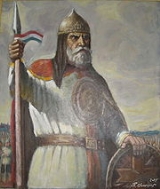
Mongol invasion of Volga Bulgaria

Encyclopedia
The Mongol invasion of Volga Bulgaria
lasted from 1223 to 1236.
n and Cuman/Kipchak armies at the Battle of Kalka, a Mongol army under the generals Subutai
and Jebe
was sent to subdue Volga Bulgaria
. At that point in history Genghis Khan's troops were seen as invincible. However, in 1223, the Bulgars defeated the Mongols. An army led by the Bulgar iltäbär (king) Ghabdulla Chelbir and including the armies of Mordvin princes or inäzors Puresh
and Purgaz, ambushed and defeated Subutais's forces in 1223 (Battle of Samara Bend
), one of the first defeats of the Mongols.
The Mongols returned in 1229 under the command of Kukday and Bubede. This force defeated Bulgar frontier-guards at the Ural River
and began the occupation of the upper Ural valley. A few years later, in 1232, the Mongol cavalry subjugated the southeastern part of the Bashkiria, and occupied southern portions of Volga Bulgaria
itself. However, the Mongols yet again failed to capture Volga Bulgaria's main cities. At the Great kurultai
in Karakorum
the Mongols decided to transfer their greatest generals from China
and Arabia to lead the efforts for subduing the Bulgar state.
With a force of more than 300,000 soldiers, the Mongols struck again in 1236. Mongol forces led by Batu Khan
besieged and seized Bilär
, Bolghar
, Suar
, Cükätaw
, and other cities and castles of Volga Bulgaria. The inhabitants were killed or sold into slavery. Volga Bulgaria
became a part of the Ulus Jochi
, later known as the Golden Horde
. It was divided into different "duchies"; later each of them became a vassal of the Golden Horde
and received some autonomy.
, which was settled by Mari people some years before, became the new center of Bolgar culture and the nucleus of Kazan tatars population. Kazan
and Çallı
became new major political and trade centers.
Some cities such as Bolghar
and Cükätaw
were rebuilt, but they were primarily trading centers and the population was not, for the most part, Bolgar.
to conquer the Russians
, the Bulgars rebelled (see Rebellion of Bayan and Cik, Baçman movement), led by the nobility. The Mongols then returned and put down the rebellions.
). Some autonomous duchies appeared in those areas. The steppe areas of Volga Bulgaria
were settled by nomadic Kipchaks
and Mongols
, and the agricultural development suffered a severe decline.
Over time, the cities of Volga Bulgaria were rebuilt and became trade and craft centers of the Golden Horde. Some Bulgarians, primarily masters and craftsmen, were forcibly moved to Sarai
and other southern cities of the Golden Horde
. Volga Bulgaria remained a center of agriculture and handicraft.
. Under the influence of Bulgarian culture, more and more nomadic Mongols and Kipchaks were converted to Islam
. On the other hand, the language used by Muslims of the Golden Horde
transformed into the Kipchak language
, adopted by all Muslim Volga Bulgars. As a result of a later mixing of the Kipchak and Bolgar language
s, the literary language of the Golden Horde
became what is now called the Old Tatar language
, and eventually evolved into the modern Tatar language
. Some of Bulgaria's non-Islamic population kept the Bolgar language, which was influenced by the Mari language
, a language commonly used in the territories they relocated to. This led to the development of the modern Chuvash language
.
Some historians hypothesize that during the rule of the Mongols, the ethnic makeup of the population of Volga Bulgaria did not change, remaining largely Bolgar and partly Finnic. Alternatively, some hypothesize that some Kipchaks and Russians were forcibly relocated to Bulgaria's land. Undoubtedly, some Bulgars were forcibly relocated to the territory of modern Astrakhan Oblast
, the population of which was previously nomadic (but see, e.g., Itil
and Saqsin
).
Volga Bulgaria's Muslim community preferred to call themselves Muslims (Möselmannar), but used the word Bolghar to distinguish themselves from nomadic Moslem Kipchaks. They did not call themselves Tatars until the 19th century. Russian sources also originally distinguished Volga Bulgars from nomadic Tatars, but later the word "Tatar" became synonymous with "Turkic Muslim". To distinguish between themselves, they started to use names of the khanates: the population of Khanate of Kazan
called themselves the people of Kazan (Qazanlı); this name was also used by the steppe Tatars and by the Russians.
Opposite to the words of the Russians, the words of alive Volga Bulgarians today (in Russia), topponyms and rituals tell us that about their origin they not have nothing with Turks, Tatars etc. They аrе successors of Old Great Bulgaria (Ukraine today). After the end of Old Great Bulgaria, Volga Bulgaria was established along the river Volga by Kan Kotrag (son of Kan Kubrat, the Kan of Old Great Bulgaria) and Danube Bulgaria (Bulgaria today) along the Danube by Kan Asparuh, also one of the Kubrat's sons. By following the topponyms and the knowledge of the Bulgarians today near Danube and the Bulgarians located on the Russian map today who are aresuccessors of Volga Bulgaria, all of them knows that the mens who created both Bulgarias in those different areas are brothers.
After everything, all countries who were conquered by the Mongols were called by the Russians - Tatars.
's leadership became practically independent from the Golden Horde. In 1440s, all lands with Volga Bulgar population were included into the Khanate of Kazan
, which was ruled by Mongol dynasties. The Khanate also included Mari and Chuvash
lands, while the rulers of the territories of Bashkirs
, Udmurts, and Mordvins were considered vassals of Kazan
. These were the peoples that traditionally had been under the economic and cultural influence of Volga Bulgaria
.
Volga Bulgaria
Volga Bulgaria, or Volga–Kama Bolghar, is a historic Bulgar state that existed between the seventh and thirteenth centuries around the confluence of the Volga and Kama rivers in what is now Russia.-Origin:...
lasted from 1223 to 1236.
The Mongol campaigns
In 1223, after defeating RussiaRussia
Russia or , officially known as both Russia and the Russian Federation , is a country in northern Eurasia. It is a federal semi-presidential republic, comprising 83 federal subjects...
n and Cuman/Kipchak armies at the Battle of Kalka, a Mongol army under the generals Subutai
Subutai
Subutai was the primary military strategist and general of Genghis Khan and Ögedei Khan...
and Jebe
Jebe
Chepe Noyan was one of the prominent Noyans of Genghis Khan. His clan was Besud, which belonged to the Taichud tribe, which was at the time of Genghis Khan under Targudai Khiriltug's leadership....
was sent to subdue Volga Bulgaria
Volga Bulgaria
Volga Bulgaria, or Volga–Kama Bolghar, is a historic Bulgar state that existed between the seventh and thirteenth centuries around the confluence of the Volga and Kama rivers in what is now Russia.-Origin:...
. At that point in history Genghis Khan's troops were seen as invincible. However, in 1223, the Bulgars defeated the Mongols. An army led by the Bulgar iltäbär (king) Ghabdulla Chelbir and including the armies of Mordvin princes or inäzors Puresh
Puresh
Puresh was a Moksha kanazor , ruler of Murunza kingdom in Middle Volga. Ally of Russian Grand Prince Yuri II and Cuman khan Köten against Bulgars and Erzyas in 1220s. In September 1237 Mongols invaded to Murunza and Puresh was forced by Jebe and Sübötäi to join the Mongols in their Europe campaign...
and Purgaz, ambushed and defeated Subutais's forces in 1223 (Battle of Samara Bend
Battle of Samara Bend
The Battle of Samara Bend or the Battle of Kernek was the first battle between Volga Bulgaria and the Mongols, probably one of the first major battles the Mongols lost. It took place in autumn 1223, at the southern border of Volga Bulgaria....
), one of the first defeats of the Mongols.
The Mongols returned in 1229 under the command of Kukday and Bubede. This force defeated Bulgar frontier-guards at the Ural River
Ural River
The Ural or Jayıq/Zhayyq , known as Yaik before 1775, is a river flowing through Russia and Kazakhstan. It arises in the southern Ural Mountains and ends at the Caspian Sea. Its total length is 1,511 mi making it the third longest river in Europe after the Volga and the Danube...
and began the occupation of the upper Ural valley. A few years later, in 1232, the Mongol cavalry subjugated the southeastern part of the Bashkiria, and occupied southern portions of Volga Bulgaria
Volga Bulgaria
Volga Bulgaria, or Volga–Kama Bolghar, is a historic Bulgar state that existed between the seventh and thirteenth centuries around the confluence of the Volga and Kama rivers in what is now Russia.-Origin:...
itself. However, the Mongols yet again failed to capture Volga Bulgaria's main cities. At the Great kurultai
Kurultai
Kurultai is a political and military council of ancient Mongol and Turkic chiefs and khans. The root of the word "Khural" means political "meeting" or "assembly" in the Mongolian language, it is also a verb for "to be established"...
in Karakorum
Karakorum
Karakorum was the capital of the Mongol Empire in the 13th century, and of the Northern Yuan in the 14-15th century. Its ruins lie in the northwestern corner of the Övörkhangai Province of Mongolia, near today's town of Kharkhorin, and adjacent to the Erdene Zuu monastery...
the Mongols decided to transfer their greatest generals from China
China
Chinese civilization may refer to:* China for more general discussion of the country.* Chinese culture* Greater China, the transnational community of ethnic Chinese.* History of China* Sinosphere, the area historically affected by Chinese culture...
and Arabia to lead the efforts for subduing the Bulgar state.
With a force of more than 300,000 soldiers, the Mongols struck again in 1236. Mongol forces led by Batu Khan
Batu Khan
Batu Khan was a Mongol ruler and founder of the Ulus of Jochi , the sub-khanate of the Mongol Empire. Batu was a son of Jochi and grandson of Genghis Khan. His ulus was the chief state of the Golden Horde , which ruled Rus and the Caucasus for around 250 years, after also destroying the armies...
besieged and seized Bilär
Siege of Bilär
The siege of Bilär was a battle for the capital city of the Volga Bulgaria between the Volga Bulgars and the Mongols. It took place in autumn 1236 and lasted for 45 days...
, Bolghar
Bolghar
Bolghar was intermittently capital of Volga Bulgaria from the 8th to the 15th centuries, along with Bilyar and Nur-Suvar. It was situated on the bank of the Volga River, about 30 km downstream from its confluence with the Kama River and some 130 km from modern Kazan...
, Suar
Suar
Suar was a medieval Volga Bulgarian city, the capital of Suar Duchy in 948-975.It was situated at Volga's left tributary Ütäk river's upper stream. In the 10th century it coined its own money. Suar was a political, economical and trade center of Volga Bulgaria...
, Cükätaw
Cükätaw
Cükätaw or Juketau was a medieval Bolgar city during the 10th to 15th centuries CE. The city was situated on the right bank of Kama, near the modern city of Çístay . In the 10th to 13th centuries it was one of the most important furniture trade centres of Volga Bulgaria. The city was the capital...
, and other cities and castles of Volga Bulgaria. The inhabitants were killed or sold into slavery. Volga Bulgaria
Volga Bulgaria
Volga Bulgaria, or Volga–Kama Bolghar, is a historic Bulgar state that existed between the seventh and thirteenth centuries around the confluence of the Volga and Kama rivers in what is now Russia.-Origin:...
became a part of the Ulus Jochi
Jochi
Jochi was the eldest of the Mongol chieftain Genghis Khan's four sons by his principal wife Börte. An accomplished military leader, he participated in his father's conquest of Central Asia, along with his brothers and uncles.-Early life:...
, later known as the Golden Horde
Golden Horde
The Golden Horde was a Mongol and later Turkicized khanate that formed the north-western sector of the Mongol Empire...
. It was divided into different "duchies"; later each of them became a vassal of the Golden Horde
Golden Horde
The Golden Horde was a Mongol and later Turkicized khanate that formed the north-western sector of the Mongol Empire...
and received some autonomy.
Population transfer
The surviving agricultural population was forced to leave steppe lands. The majority settled along the Kama river and in adjacent areas further north. The area around KazanKazan
Kazan is the capital and largest city of the Republic of Tatarstan, Russia. With a population of 1,143,546 , it is the eighth most populous city in Russia. Kazan lies at the confluence of the Volga and Kazanka Rivers in European Russia. In April 2009, the Russian Patent Office granted Kazan the...
, which was settled by Mari people some years before, became the new center of Bolgar culture and the nucleus of Kazan tatars population. Kazan
Kazan
Kazan is the capital and largest city of the Republic of Tatarstan, Russia. With a population of 1,143,546 , it is the eighth most populous city in Russia. Kazan lies at the confluence of the Volga and Kazanka Rivers in European Russia. In April 2009, the Russian Patent Office granted Kazan the...
and Çallı
Çalli
Çallı is a village and municipality in the Zardab Rayon of Azerbaijan. It has a population of 2,265....
became new major political and trade centers.
Some cities such as Bolghar
Bolghar
Bolghar was intermittently capital of Volga Bulgaria from the 8th to the 15th centuries, along with Bilyar and Nur-Suvar. It was situated on the bank of the Volga River, about 30 km downstream from its confluence with the Kama River and some 130 km from modern Kazan...
and Cükätaw
Cükätaw
Cükätaw or Juketau was a medieval Bolgar city during the 10th to 15th centuries CE. The city was situated on the right bank of Kama, near the modern city of Çístay . In the 10th to 13th centuries it was one of the most important furniture trade centres of Volga Bulgaria. The city was the capital...
were rebuilt, but they were primarily trading centers and the population was not, for the most part, Bolgar.
Rebellions
After the Mongols left Volga BulgariaVolga Bulgaria
Volga Bulgaria, or Volga–Kama Bolghar, is a historic Bulgar state that existed between the seventh and thirteenth centuries around the confluence of the Volga and Kama rivers in what is now Russia.-Origin:...
to conquer the Russians
Russians
The Russian people are an East Slavic ethnic group native to Russia, speaking the Russian language and primarily living in Russia and neighboring countries....
, the Bulgars rebelled (see Rebellion of Bayan and Cik, Baçman movement), led by the nobility. The Mongols then returned and put down the rebellions.
Impact on the region
According to some historians, over 80% of the country's population was killed during the invasion. The remaining population mostly relocated to the northern areas (territories of modern Chuvashia and TatarstanTatarstan
The Republic of Tatarstan is a federal subject of Russia located in the Volga Federal District. Its capital is the city of Kazan, which is one of Russia's largest and most prosperous cities. The republic borders with Kirov, Ulyanovsk, Samara, and Orenburg Oblasts, and with the Mari El, Udmurt,...
). Some autonomous duchies appeared in those areas. The steppe areas of Volga Bulgaria
Volga Bulgaria
Volga Bulgaria, or Volga–Kama Bolghar, is a historic Bulgar state that existed between the seventh and thirteenth centuries around the confluence of the Volga and Kama rivers in what is now Russia.-Origin:...
were settled by nomadic Kipchaks
Kipchaks
Kipchaks were a Turkic tribal confederation...
and Mongols
Mongols
Mongols ) are a Central-East Asian ethnic group that lives mainly in the countries of Mongolia, China, and Russia. In China, ethnic Mongols can be found mainly in the central north region of China such as Inner Mongolia...
, and the agricultural development suffered a severe decline.
Over time, the cities of Volga Bulgaria were rebuilt and became trade and craft centers of the Golden Horde. Some Bulgarians, primarily masters and craftsmen, were forcibly moved to Sarai
Sarai (city)
Sarai was the name of two cities, which were successively capital cities of the Golden Horde, the Mongol kingdom which ruled Russia and much of central Asia in the 13th and 14th centuries...
and other southern cities of the Golden Horde
Golden Horde
The Golden Horde was a Mongol and later Turkicized khanate that formed the north-western sector of the Mongol Empire...
. Volga Bulgaria remained a center of agriculture and handicraft.
Ethnolinguistic impact
The population of Volga Bulgaria was mostly MuslimMuslim
A Muslim, also spelled Moslem, is an adherent of Islam, a monotheistic, Abrahamic religion based on the Quran, which Muslims consider the verbatim word of God as revealed to prophet Muhammad. "Muslim" is the Arabic term for "submitter" .Muslims believe that God is one and incomparable...
. Under the influence of Bulgarian culture, more and more nomadic Mongols and Kipchaks were converted to Islam
Islam
Islam . The most common are and . : Arabic pronunciation varies regionally. The first vowel ranges from ~~. The second vowel ranges from ~~~...
. On the other hand, the language used by Muslims of the Golden Horde
Golden Horde
The Golden Horde was a Mongol and later Turkicized khanate that formed the north-western sector of the Mongol Empire...
transformed into the Kipchak language
Kipchak language
The Kipchak language is an extinct Turkic language of the Kipchak group.The descendants of the Kipchak language include the majority of Turkic languages spoken in Eastern Europe and the Caucasus today, as Kipchak was used as a lingua franca in Golden Horde–ruled lands.Kazakhs are remnants of...
, adopted by all Muslim Volga Bulgars. As a result of a later mixing of the Kipchak and Bolgar language
Bolgar language
Bulgar , also Oghur, is a historical group of Turkic languages, the only extant member of which is the Chuvash language.Suggested extinct members of the group are Volga-Bulgarian and Khazar ....
s, the literary language of the Golden Horde
Golden Horde
The Golden Horde was a Mongol and later Turkicized khanate that formed the north-western sector of the Mongol Empire...
became what is now called the Old Tatar language
Old Tatar language
Old Tatar language was a literary language used among the Muslim Tatars from the Middle Ages till the 19th century....
, and eventually evolved into the modern Tatar language
Tatar language
The Tatar language , or more specifically Kazan Tatar, is a Turkic language spoken by the Tatars of historical Kazan Khanate, including modern Tatarstan and Bashkiria...
. Some of Bulgaria's non-Islamic population kept the Bolgar language, which was influenced by the Mari language
Mari language
The Mari language , spoken by more than 600,000 people, belongs to the Uralic language family. It is spoken primarily in the Mari Republic of the Russian Federation as well as in the area along the Vyatka river basin and eastwards to the Urals...
, a language commonly used in the territories they relocated to. This led to the development of the modern Chuvash language
Chuvash language
Chuvash is a Turkic language spoken in central Russia, primarily in the Chuvash Republic and adjacent areas. It is the only surviving member of the Oghur branch of Turkic languages....
.
Some historians hypothesize that during the rule of the Mongols, the ethnic makeup of the population of Volga Bulgaria did not change, remaining largely Bolgar and partly Finnic. Alternatively, some hypothesize that some Kipchaks and Russians were forcibly relocated to Bulgaria's land. Undoubtedly, some Bulgars were forcibly relocated to the territory of modern Astrakhan Oblast
Astrakhan Oblast
Astrakhan Oblast is a federal subject of Russia . Its administrative center is the city of Astrakhan.-Demographics:Population: Ethnic groups...
, the population of which was previously nomadic (but see, e.g., Itil
Atil
Atil , literally meaning "Big River", was the capital of Khazaria from the middle of the 8th century until the end of the 10th century. The word is also a Turkic name for the Volga River.-History:...
and Saqsin
Saqsin
Saqsin was a medieval city that flourished from the eleventh to the thirteenth centuries. It was situated in the Volga Delta , or in the Lower Volga, and was known in pre-Mongol times as Saksin-Bolgar, which in Mongol times became Sarai Batu.It was mentioned by the Arab geographer al-Gharnati and...
).
Volga Bulgaria's Muslim community preferred to call themselves Muslims (Möselmannar), but used the word Bolghar to distinguish themselves from nomadic Moslem Kipchaks. They did not call themselves Tatars until the 19th century. Russian sources also originally distinguished Volga Bulgars from nomadic Tatars, but later the word "Tatar" became synonymous with "Turkic Muslim". To distinguish between themselves, they started to use names of the khanates: the population of Khanate of Kazan
Khanate of Kazan
The Khanate of Kazan was a medieval Tatar state which occupied the territory of former Volga Bulgaria between 1438 and 1552. Its khans were the patrilineal descendants of Toqa Temür, the thirteenth son of Jochi and grandson of Genghis Khan. The khanate covered contemporary Tatarstan, Mari El,...
called themselves the people of Kazan (Qazanlı); this name was also used by the steppe Tatars and by the Russians.
Opposite to the words of the Russians, the words of alive Volga Bulgarians today (in Russia), topponyms and rituals tell us that about their origin they not have nothing with Turks, Tatars etc. They аrе successors of Old Great Bulgaria (Ukraine today). After the end of Old Great Bulgaria, Volga Bulgaria was established along the river Volga by Kan Kotrag (son of Kan Kubrat, the Kan of Old Great Bulgaria) and Danube Bulgaria (Bulgaria today) along the Danube by Kan Asparuh, also one of the Kubrat's sons. By following the topponyms and the knowledge of the Bulgarians today near Danube and the Bulgarians located on the Russian map today who are aresuccessors of Volga Bulgaria, all of them knows that the mens who created both Bulgarias in those different areas are brothers.
After everything, all countries who were conquered by the Mongols were called by the Russians - Tatars.
Aftermath
In the middle of the 14th century some duchies of Volga Bulgaria became more independent and even coined their own money. The duchies were sometimes ruled by Bulgar nobles. In 1420s, the Kasan Duchy (Kazan Ulus) under the GhiasetdinGhiasetdin of Kazan
Ghiasetdin , was a ruler of Kazan, Ghiasetdin Ulus from the 1420s. He was a son of Khan Shadibak . After the death of Idegay in 1419 he usurped the throne of the Kazan Duchy. He also struggled against Olug Moxammat Khan for the leadership of the Golden Horde, and died in this struggle....
's leadership became practically independent from the Golden Horde. In 1440s, all lands with Volga Bulgar population were included into the Khanate of Kazan
Khanate of Kazan
The Khanate of Kazan was a medieval Tatar state which occupied the territory of former Volga Bulgaria between 1438 and 1552. Its khans were the patrilineal descendants of Toqa Temür, the thirteenth son of Jochi and grandson of Genghis Khan. The khanate covered contemporary Tatarstan, Mari El,...
, which was ruled by Mongol dynasties. The Khanate also included Mari and Chuvash
Chuvash people
The Chuvash people are a Turkic ethnic group, native to an area stretching from the Volga Region to Siberia. Most of them live in Republic of Chuvashia and surrounding areas, although Chuvash communities may be found throughout all Russia.- Etymology :...
lands, while the rulers of the territories of Bashkirs
Bashkirs
The Bashkirs are a Turkic people indigenous to Bashkortostan extending on both parts of the Ural mountains, on the place where Europe meets Asia. Groups of Bashkirs also live in the republic of Tatarstan, Perm Krai, Chelyabinsk, Orenburg, Tyumen, Sverdlovsk, Kurgan, Samara and Saratov Oblasts of...
, Udmurts, and Mordvins were considered vassals of Kazan
Kazan
Kazan is the capital and largest city of the Republic of Tatarstan, Russia. With a population of 1,143,546 , it is the eighth most populous city in Russia. Kazan lies at the confluence of the Volga and Kazanka Rivers in European Russia. In April 2009, the Russian Patent Office granted Kazan the...
. These were the peoples that traditionally had been under the economic and cultural influence of Volga Bulgaria
Volga Bulgaria
Volga Bulgaria, or Volga–Kama Bolghar, is a historic Bulgar state that existed between the seventh and thirteenth centuries around the confluence of the Volga and Kama rivers in what is now Russia.-Origin:...
.
See also
- Volga BulgariaVolga BulgariaVolga Bulgaria, or Volga–Kama Bolghar, is a historic Bulgar state that existed between the seventh and thirteenth centuries around the confluence of the Volga and Kama rivers in what is now Russia.-Origin:...
- BulgarsBulgarsThe Bulgars were a semi-nomadic who flourished in the Pontic Steppe and the Volga basin in the 7th century.The Bulgars emerge after the collapse of the Hunnic Empire in the 5th century....
- MongoliaMongoliaMongolia is a landlocked country in East and Central Asia. It is bordered by Russia to the north and China to the south, east and west. Although Mongolia does not share a border with Kazakhstan, its western-most point is only from Kazakhstan's eastern tip. Ulan Bator, the capital and largest...
- MongolsMongolsMongols ) are a Central-East Asian ethnic group that lives mainly in the countries of Mongolia, China, and Russia. In China, ethnic Mongols can be found mainly in the central north region of China such as Inner Mongolia...
- Tatar invasionsTatar invasionsThe Mongol invasion of Europe from the east took place over the course of three centuries, from the Middle Ages to the early modern period.The terms Tatars or Tartars are applied to nomadic Turkic peoples who, themselves, were conquered by Mongols and incorporated into their horde...
- Russo-Kazan WarsRusso-Kazan Warsthumb|300px|[[St. Basil's Cathedral]] is a monument to the Russian conquest of Kazan in 1552.The Russo-Kazan Wars was a series of wars fought between the Khanate of Kazan and Muscovite Russia from 1438, until Kazan was finally captured by Ivan the Terrible and absorbed into Russia in 1552.- Wars of...
- Kazan Tatars
- Mongol Occupation of Eastern Europe
- Eastern Magyars
Sources
- Genghis Khan's Greatest General: Subotai the Valiant. Richard A.Gabriel