

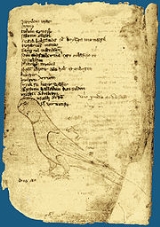
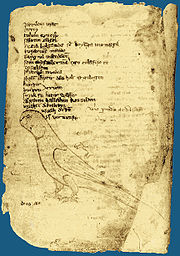
Codex Cumanicus

Encyclopedia
Linguistics
Linguistics is the scientific study of human language. Linguistics can be broadly broken into three categories or subfields of study: language form, language meaning, and language in context....
manual of the Middle Ages
Middle Ages
The Middle Ages is a periodization of European history from the 5th century to the 15th century. The Middle Ages follows the fall of the Western Roman Empire in 476 and precedes the Early Modern Era. It is the middle period of a three-period division of Western history: Classic, Medieval and Modern...
, designed to help Catholic
Catholic
The word catholic comes from the Greek phrase , meaning "on the whole," "according to the whole" or "in general", and is a combination of the Greek words meaning "about" and meaning "whole"...
missionaries communicate with the Cumans
Cumans
The Cumans were Turkic nomadic people comprising the western branch of the Cuman-Kipchak confederation. After Mongol invasion , they decided to seek asylum in Hungary, and subsequently to Bulgaria...
, a nomadic Turkic
Turkic peoples
The Turkic peoples are peoples residing in northern, central and western Asia, southern Siberia and northwestern China and parts of eastern Europe. They speak languages belonging to the Turkic language family. They share, to varying degrees, certain cultural traits and historical backgrounds...
people. It is currently housed in the Library of St. Mark, in Venice
Venice
Venice is a city in northern Italy which is renowned for the beauty of its setting, its architecture and its artworks. It is the capital of the Veneto region...
(Cod. Mar. Lat. DXLIX).
Origin and content
The CodexCodex
A codex is a book in the format used for modern books, with multiple quires or gatherings typically bound together and given a cover.Developed by the Romans from wooden writing tablets, its gradual replacement...
likely developed over time. Mercantile, political and religious leaders, particularly in Hungary
Hungary
Hungary , officially the Republic of Hungary , is a landlocked country in Central Europe. It is situated in the Carpathian Basin and is bordered by Slovakia to the north, Ukraine and Romania to the east, Serbia and Croatia to the south, Slovenia to the southwest and Austria to the west. The...
, sought effective communication with the Cumans
Cumans
The Cumans were Turkic nomadic people comprising the western branch of the Cuman-Kipchak confederation. After Mongol invasion , they decided to seek asylum in Hungary, and subsequently to Bulgaria...
from the time of their ascendency in the mid-11th century. As Italian
Italy
Italy , officially the Italian Republic languages]] under the European Charter for Regional or Minority Languages. In each of these, Italy's official name is as follows:;;;;;;;;), is a unitary parliamentary republic in South-Central Europe. To the north it borders France, Switzerland, Austria and...
city-states such as Genoa
Genoa
Genoa |Ligurian]] Zena ; Latin and, archaically, English Genua) is a city and an important seaport in northern Italy, the capital of the Province of Genoa and of the region of Liguria....
began to establish trade posts and colonies along the Black Sea
Black Sea
The Black Sea is bounded by Europe, Anatolia and the Caucasus and is ultimately connected to the Atlantic Ocean via the Mediterranean and the Aegean seas and various straits. The Bosphorus strait connects it to the Sea of Marmara, and the strait of the Dardanelles connects that sea to the Aegean...
coastline, the need for tools to learn the Kipchak language
Kipchak language
The Kipchak language is an extinct Turkic language of the Kipchak group.The descendants of the Kipchak language include the majority of Turkic languages spoken in Eastern Europe and the Caucasus today, as Kipchak was used as a lingua franca in Golden Horde–ruled lands.Kazakhs are remnants of...
sharply increased.
The earliest parts of the Codex are believed to have originated in the 12th century or 13th century. It was likely added to substantially over time. The copy preserved in Venice
Venice
Venice is a city in northern Italy which is renowned for the beauty of its setting, its architecture and its artworks. It is the capital of the Veneto region...
dates from 1330 (July 11, 1330 on fol. 1r; see Drimba, p. 35 and Schmieder in Schmieder/Schreiner, p. XIII). The Codex consists of a number of independent works which were ultimately combined under one cover.
Historians generally divide it into two distinct and independent parts:
The first (fol. 1r-55v) is a practical handbook of the Kipchak tongue, containing glossaries of words in vulgar
Vulgar Latin
Vulgar Latin is any of the nonstandard forms of Latin from which the Romance languages developed. Because of its nonstandard nature, it had no official orthography. All written works used Classical Latin, with very few exceptions...
Italo-Latin
Latin
Latin is an Italic language originally spoken in Latium and Ancient Rome. It, along with most European languages, is a descendant of the ancient Proto-Indo-European language. Although it is considered a dead language, a number of scholars and members of the Christian clergy speak it fluently, and...
and translations into Persian
Persian language
Persian is an Iranian language within the Indo-Iranian branch of the Indo-European languages. It is primarily spoken in Iran, Afghanistan, Tajikistan and countries which historically came under Persian influence...
and Kipchak. This section has been styled the "Italian Part" or the "Interpreter's Book" of the Codex. Whether the Persian parts came through Kipchak intermediaries or whether Persian was a lingua franca
Lingua franca
A lingua franca is a language systematically used to make communication possible between people not sharing a mother tongue, in particular when it is a third language, distinct from both mother tongues.-Characteristics:"Lingua franca" is a functionally defined term, independent of the linguistic...
for Mediterranean trade well known in Western Europe
Western Europe
Western Europe is a loose term for the collection of countries in the western most region of the European continents, though this definition is context-dependent and carries cultural and political connotations. One definition describes Western Europe as a geographic entity—the region lying in the...
is a matter hotly debated by scholars.
The second part (fol. 56r-82v) is a collection of various religious texts (including a translation of the Lord's Prayer
Lord's Prayer
The Lord's Prayer is a central prayer in Christianity. In the New Testament of the Christian Bible, it appears in two forms: in the Gospel of Matthew as part of the discourse on ostentation in the Sermon on the Mount, and in the Gospel of Luke, which records Jesus being approached by "one of his...
) and riddles in Kipchak, translated into Latin and Eastern Middle High German
Middle High German
Middle High German , abbreviated MHG , is the term used for the period in the history of the German language between 1050 and 1350. It is preceded by Old High German and followed by Early New High German...
. This part of the Codex is referred to as the "German" or "Missionary's Book" and is believed to have been compiled by German
Germans
The Germans are a Germanic ethnic group native to Central Europe. The English term Germans has referred to the German-speaking population of the Holy Roman Empire since the Late Middle Ages....
Franciscans.
Accuracy
The Codex is generally regarded as accurate, but it differs slightly from other sources on Kipchak language. For example, the Codex's Pater NosterLord's Prayer
The Lord's Prayer is a central prayer in Christianity. In the New Testament of the Christian Bible, it appears in two forms: in the Gospel of Matthew as part of the discourse on ostentation in the Sermon on the Mount, and in the Gospel of Luke, which records Jesus being approached by "one of his...
reads:
Atamız kim köktesiñ. Alğışlı bolsun seniñ atıñ, kelsin seniñ xanlığıñ, bolsun seniñ tilemekiñ – neçik kim kökte, alay [da] yerde. Kündeki ötmegimizni bizge bugün bergil. Dağı yazuqlarımıznı bizge boşatqıl – neçik biz boşatırbız bizge yaman etkenlerge. Dağı yekniñ sınamaqına bizni quurmağıl. Basa barça yamandan bizni qutxarğıl. Amen!
In English, the text is:
Our Father which art in heaven. Hallowed be thy name. Thy kingdom come. Thy will be done in earth as it is in heaven. Give us this day our daily bread. And forgive us our sins as we forgive those who have done us evil. And lead us not into temptation, But deliver us from evil. Amen.
In Turkish, the text is:
Atamız ki göktesin. Alkışlı olsun senin adın, gelsin senin hanlığın, olsun senin dilemeğin – nice ki gökte, ve yerde. Gündeki ekmeğimizi bize bugün ver. Dahi, yazıklarımızı (suçlarımızı) bize boşat – nice biz boşatırız bize yaman (kötülük) edenleri. Dahi, şeytanın sınamağına bizi koyurma. Tüm yamandan (kötülükten) bizi kurtar. Amin!
Riddles
The "Cuman Riddles" (CC, 119-120; 143-148) are a crucial source for the study of early Turkic folklore. Andreas TietzeAndreas Tietze
Andreas Tietze was a world-renowned Austrian Turcologist and one of the founders of Turkic studies in the United States...
referred to them as "the earliest variants of riddle types that constitute a common heritage of the Turkic
Turkic languages
The Turkic languages constitute a language family of at least thirty five languages, spoken by Turkic peoples across a vast area from Eastern Europe and the Mediterranean to Siberia and Western China, and are considered to be part of the proposed Altaic language family.Turkic languages are spoken...
-speaking nations."
Among the riddles in the Codex are the following excerpts:
- Aq küymengin avuzı yoq. Ol yumurtqa.
- "The white kibitka has no mouth (opening). That is the egg."
- Kökčä ulaχïm kögende semirir. Ol huvun.
- "my bluish kid at the tethering rope grows fat, The melon."
- Oturğanım oba yer basqanım baqır canaq. Ol zengi.
- "Where I sit is a hilly place. Where I tread is a copper bowl. The stirrup."