


Lipka Tatars

Encyclopedia

Tatars
Tatars are a Turkic speaking ethnic group , numbering roughly 7 million.The majority of Tatars live in the Russian Federation, with a population of around 5.5 million, about 2 million of which in the republic of Tatarstan.Significant minority populations are found in Uzbekistan, Kazakhstan,...
who originally settled in the Grand Duchy of Lithuania
Grand Duchy of Lithuania
The Grand Duchy of Lithuania was a European state from the 12th /13th century until 1569 and then as a constituent part of Polish-Lithuanian Commonwealth until 1791 when Constitution of May 3, 1791 abolished it in favor of unitary state. It was founded by the Lithuanians, one of the polytheistic...
at the beginning of 14th century. The first settlers tried to preserve their shamanistic religion and sought asylum amongst the non-Christian Lithuanians. Towards the end of the 14th century, another wave of Tatars - this time, Muslims, were invited into the Grand Duchy by Vytautas the Great
Vytautas the Great
Vytautas ; styled "the Great" from the 15th century onwards; c. 1350 October 27, 1430) was one of the most famous rulers of medieval Lithuania. Vytautas was the ruler of the Grand Duchy of Lithuania which chiefly encompassed the Lithuanians and Ruthenians...
. These Tatars first settled in Lithuania proper
Lithuania proper
Lithuania proper refers to a region which existed within Grand Duchy of Lithuania, and spoke Lithuanian language. The primary meaning is identical to the Duchy of Lithuania, a land around which Grand Duchy of Lithuania evolved...
around Vilnius
Vilnius
Vilnius is the capital of Lithuania, and its largest city, with a population of 560,190 as of 2010. It is the seat of the Vilnius city municipality and of the Vilnius district municipality. It is also the capital of Vilnius County...
, Trakai
Trakai
Trakai is a historic city and lake resort in Lithuania. It lies 28 km west of Vilnius, the capital of Lithuania. Because of its proximity to Vilnius, Trakai is a popular tourist destination. Trakai is the administrative centre of Trakai district municipality. The town covers 11.52 km2 of...
, Hrodna
Hrodna
Grodno or Hrodna , is a city in Belarus. It is located on the Neman River , close to the borders of Poland and Lithuania . It has 327,540 inhabitants...
and Kaunas
Kaunas
Kaunas is the second-largest city in Lithuania and has historically been a leading centre of Lithuanian economic, academic, and cultural life. Kaunas was the biggest city and the center of a powiat in Trakai Voivodeship of the Grand Duchy of Lithuania since 1413. During Russian Empire occupation...
and later spread to other parts of the Grand Duchy that later became part of Polish Lithuanian Commonwealth. These areas comprise present-day Lithuania
Lithuania
Lithuania , officially the Republic of Lithuania is a country in Northern Europe, the biggest of the three Baltic states. It is situated along the southeastern shore of the Baltic Sea, whereby to the west lie Sweden and Denmark...
, Belarus
Belarus
Belarus , officially the Republic of Belarus, is a landlocked country in Eastern Europe, bordered clockwise by Russia to the northeast, Ukraine to the south, Poland to the west, and Lithuania and Latvia to the northwest. Its capital is Minsk; other major cities include Brest, Grodno , Gomel ,...
and Poland
Poland
Poland , officially the Republic of Poland , is a country in Central Europe bordered by Germany to the west; the Czech Republic and Slovakia to the south; Ukraine, Belarus and Lithuania to the east; and the Baltic Sea and Kaliningrad Oblast, a Russian exclave, to the north...
. From the very beginning of their settlement in Lithuania they were known as the Lipka Tatars. While maintaining their religion
Religion
Religion is a collection of cultural systems, belief systems, and worldviews that establishes symbols that relate humanity to spirituality and, sometimes, to moral values. Many religions have narratives, symbols, traditions and sacred histories that are intended to give meaning to life or to...
, they united their fate with that of the mainly Christian
Christian
A Christian is a person who adheres to Christianity, an Abrahamic, monotheistic religion based on the life and teachings of Jesus of Nazareth as recorded in the Canonical gospels and the letters of the New Testament...
Polish-Lithuanian Commonwealth
Polish-Lithuanian Commonwealth
The Polish–Lithuanian Commonwealth was a dualistic state of Poland and Lithuania ruled by a common monarch. It was the largest and one of the most populous countries of 16th- and 17th‑century Europe with some and a multi-ethnic population of 11 million at its peak in the early 17th century...
. From the Battle of Grunwald
Battle of Grunwald
The Battle of Grunwald or 1st Battle of Tannenberg was fought on 15 July 1410, during the Polish–Lithuanian–Teutonic War. The alliance of the Kingdom of Poland and the Grand Duchy of Lithuania, led respectively by King Jogaila and Grand Duke Vytautas , decisively defeated the Teutonic Knights, led...
onwards the Lipka Tatar light cavalry regiments participated in every significant military campaign of Lithuania and Poland.
The Lipka Tatar origins can be traced back to the descendant states of the Mongol Empire
Mongol Empire
The Mongol Empire , initially named as Greater Mongol State was a great empire during the 13th and 14th centuries...
of Genghis Khan
Genghis Khan
Genghis Khan , born Temujin and occasionally known by his temple name Taizu , was the founder and Great Khan of the Mongol Empire, which became the largest contiguous empire in history after his death....
- the White Horde, the Golden Horde
Golden Horde
The Golden Horde was a Mongol and later Turkicized khanate that formed the north-western sector of the Mongol Empire...
, the Crimean Khanate
Crimean Khanate
Crimean Khanate, or Khanate of Crimea , was a state ruled by Crimean Tatars from 1441 to 1783. Its native name was . Its khans were the patrilineal descendants of Toqa Temür, the thirteenth son of Jochi and grandson of Genghis Khan...
and Kazan Khanate. They initially served as a noble military caste but later they became urban-dwellers known for their crafts, horses and gardening skills. Throughout centuries they resisted assimilation and kept their traditional lifestyle. While they remained very attached to their religions, over time however, they lost their original Tatar language
Tatar language
The Tatar language , or more specifically Kazan Tatar, is a Turkic language spoken by the Tatars of historical Kazan Khanate, including modern Tatarstan and Bashkiria...
and for the most part adopted Polish
Polish language
Polish is a language of the Lechitic subgroup of West Slavic languages, used throughout Poland and by Polish minorities in other countries...
. There are still small groups of Lipka Tatars living in today's Belarus
Belarus
Belarus , officially the Republic of Belarus, is a landlocked country in Eastern Europe, bordered clockwise by Russia to the northeast, Ukraine to the south, Poland to the west, and Lithuania and Latvia to the northwest. Its capital is Minsk; other major cities include Brest, Grodno , Gomel ,...
, Lithuania
Lithuania
Lithuania , officially the Republic of Lithuania is a country in Northern Europe, the biggest of the three Baltic states. It is situated along the southeastern shore of the Baltic Sea, whereby to the west lie Sweden and Denmark...
and Poland, as well as their communities in United States.
Origin of the term 'Lipka'
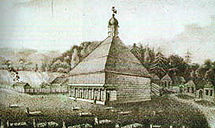
Crimean Tatar language
The Crimean Tatar language is the language of the Crimean Tatars. It is a Turkic language spoken in Crimea, Central Asia , and the Crimean Tatar diasporas in Turkey, Romania, Bulgaria...
name of Lithuania
Name of Lithuania
The first known record of the name of Lithuania is in a 9 March 1009 story of Saint Bruno recorded in the Quedlinburg Chronicle . The Chronicle recorded a Latinized Slavic form of the name Lietuva: Litua pronounced [litvā]...
. The record of the name Lipka in Oriental sources permits us to infer an original Libķa/Lipķa, from which the Polish derivative Lipka was formed, with possible contamination with the Polish lipka "small lime-tree"; this etymology was suggested by the Tatar author S. Tuhan-Baranowski. A less frequent Polish form, Łubka, is corroborated in Łubka/Łupka, the Crimean Tatar name of the Lipkas up to the end of the 19th century. The Crimean Tatar term Lipka Tatarłar meaning Lithuanian Tatars, later started to be used by the Polish-Lithuanian Tatars to describe themselves.
In religion and culture the Lipka Tatars differed from most other Islamic communities in respect of the treatment of their women, who always enjoyed a large degree of freedom, even during the years when the Lipkas were in the service of the Ottoman Empire
Ottoman Empire
The Ottoman EmpireIt was usually referred to as the "Ottoman Empire", the "Turkish Empire", the "Ottoman Caliphate" or more commonly "Turkey" by its contemporaries...
. Co-education of male and female children was the norm, and Lipka women did not wear the veil - except at the marriage ceremony. While nominally Islamic, the customs and religious practices of the Lipka Tatars also accommodated many Christian elements adopted during their 600 years residence in Belarus, Poland, Ukraine and Lithuania while still maintaining the traditions and superstitions from their nomadic Mongol past, such as the sacrifice of bulls in their mosques during the main religious festivals.
Over time, the lower and middle Lipka Tatar nobles adopted the Ruthenian language
Ruthenian language
Ruthenian, or Old Ruthenian , is a term used for the varieties of Eastern Slavonic spoken in the Grand Duchy of Lithuania and later in the East Slavic territories of the Polish–Lithuanian Commonwealth....
then later Belarusian language
Belarusian language
The Belarusian language , sometimes referred to as White Russian or White Ruthenian, is the language of the Belarusian people...
as their mother tongue. However, they used the Arabic alphabet
Arabic alphabet
The Arabic alphabet or Arabic abjad is the Arabic script as it is codified for writing the Arabic language. It is written from right to left, in a cursive style, and includes 28 letters. Because letters usually stand for consonants, it is classified as an abjad.-Consonants:The Arabic alphabet has...
to write in Belarusian
Belarusian language
The Belarusian language , sometimes referred to as White Russian or White Ruthenian, is the language of the Belarusian people...
until the 1930s. The upper nobility of Lipka Tatars spoke Polish.
Diplomatic correspondence between the Crimean Khanate and Poland from the early 16th century refers to the Polish-Lithuanian Commonwealth as the "land of the Poles and the Lipkas". By the 17th century the term Lipka Tatar began to appear in the official documents of the Polish-Lithuanian Commonwealth.
Lipkas in the past

According to some estimates, by 1591 there were about 200,000 Lipka Tatars living in the Polish-Lithuanian Commonwealth
Polish-Lithuanian Commonwealth
The Polish–Lithuanian Commonwealth was a dualistic state of Poland and Lithuania ruled by a common monarch. It was the largest and one of the most populous countries of 16th- and 17th‑century Europe with some and a multi-ethnic population of 11 million at its peak in the early 17th century...
and about 400 mosques serving them. According to the Risāle-yi Tatar-i Leh (an account of the Lipka Tatars written for Süleyman the Magnificent by an anonymous Polish Muslim during a stay in Istanbul
Istanbul
Istanbul , historically known as Byzantium and Constantinople , is the largest city of Turkey. Istanbul metropolitan province had 13.26 million people living in it as of December, 2010, which is 18% of Turkey's population and the 3rd largest metropolitan area in Europe after London and...
in 1557-8 on his way to Mecca
Mecca
Mecca is a city in the Hijaz and the capital of Makkah province in Saudi Arabia. The city is located inland from Jeddah in a narrow valley at a height of above sea level...
) there were 100 Lipka Tatar settlements with mosques in Poland. The largest communities existed in the cities of Lida
Lida
Lida is a city in western Belarus in Hrodna Voblast, situated 160 km west of Minsk. It is the fourteenth largest city in Belarus.- Etymology :...
, Navahradak
Navahradak
-Early history:First mentioned in the Sophian First Chronicle and Fourth Novgorod Chronicle in 1044 in relation to a war of Yaroslav I the Wise against Lithuanian tribes. It was also mentioned in the Hypatian Codex under 1252 as Novogorodok -Early history:First mentioned in the Sophian First...
and Iwye. There was a Lipka Tatar settlement in Minsk
Minsk
- Ecological situation :The ecological situation is monitored by Republican Center of Radioactive and Environmental Control .During 2003–2008 the overall weight of contaminants increased from 186,000 to 247,400 tons. The change of gas as industrial fuel to mazut for financial reasons has worsened...
, today's capital of Belarus, known as Tatarskaya Slabada
Tatarskaya Slabada
Tatarskaya Slabada is a historical settlement in Minsk, west and northwest of the old city centre. It is located on the low left bank of Svislach and was settled by Lipka Tatars from the 15th century to mid-20th century...
.
In the year 1672, the Tatar subjects rose up in open rebellion against the Commonwealth. This was the widely remembered Lipka Rebellion
Lipka Rebellion
The Lipka Rebellion was a mutiny of several choragwie of Lipka Tatar cavalry in 1672, which had been serving in the forces of the Polish Lithuanian Commonwealth since the 14th century...
. Thanks to the efforts of King Jan III Sobieski, who was held in great esteem by the Tatar soldiers, many of the Lipkas seeking asylum and service in the Turkish army returned to his command and participated in the struggles with the Ottoman Empire up to the Treaty of Karlowitz
Treaty of Karlowitz
The Treaty of Karlowitz was signed on 26 January 1699 in Sremski Karlovci , concluding the Austro-Ottoman War of 1683–1697 in which the Ottoman side had been defeated at the Battle of Zenta...
in 1699, including the Battle of Vienna
Battle of Vienna
The Battle of Vienna took place on 11 and 12 September 1683 after Vienna had been besieged by the Ottoman Empire for two months...
(1683) that was to turn the tide of Islamic expansion into Europe and mark the beginning of the end for the Ottoman Empire.
Beginning in the late 18th and throughout the 19th century the Lipkas became successively more and more Polonized
Polonization
Polonization was the acquisition or imposition of elements of Polish culture, in particular, Polish language, as experienced in some historic periods by non-Polish populations of territories controlled or substantially influenced by Poland...
. The upper and middle classes in particular adopted Polish language and customs (although they kept Islam as their religion), while the lower ranks became Ruthenized. At the same time, the Tatars held the Lithuanian Grand Duke Vytautas (Wattad, in Tatar or "defender of Muslims in non Muslim lands"), who encouraged and supported their settlement during the 15th century, in great esteem, including him in many legends, prayers and their folklore.
Timeline
- 1226: The Khanate of the White Horde was established as one of the successor states to the Mongol Empire of Genghis Khan. The first Khan, Orda was the second son of JochiJochiJochi was the eldest of the Mongol chieftain Genghis Khan's four sons by his principal wife Börte. An accomplished military leader, he participated in his father's conquest of Central Asia, along with his brothers and uncles.-Early life:...
, the eldest son of Genghis Khan. The White Horde occupied the southern Siberian steppeSteppeIn physical geography, steppe is an ecoregion, in the montane grasslands and shrublands and temperate grasslands, savannas, and shrublands biomes, characterized by grassland plains without trees apart from those near rivers and lakes...
from the east of the Urals and the Caspian SeaCaspian SeaThe Caspian Sea is the largest enclosed body of water on Earth by area, variously classed as the world's largest lake or a full-fledged sea. The sea has a surface area of and a volume of...
to MongoliaMongoliaMongolia is a landlocked country in East and Central Asia. It is bordered by Russia to the north and China to the south, east and west. Although Mongolia does not share a border with Kazakhstan, its western-most point is only from Kazakhstan's eastern tip. Ulan Bator, the capital and largest...
.
- 1380: Khan TokhtamyshTokhtamyshTokhtamysh was the prominent khan of the White Horde, who briefly unified the White Horde and Blue Horde subdivisions of the Golden Horde into a single state. He was a descendant of Genghis Khan's eldest grandson, Orda Khan or his brother Tuqa-Timur...
, the hereditary ruler of the White Horde, crossed west over the Urals and merged the White Horde with the Golden Horde whose first khan was Batu, the eldest son of Jochi. In 1382 the White and Golden Hordes sacked and burned Moscow. Tokhtamysh, allied with the great central Asian Tatar conqueror Tamerlane, reasserted Mongol power in Russia.
- 1397: After a series of disastrous military campaigns against his former protector, the great Tatar warlord Tamerlane, Tokhtamysh and the remnants of his clan were granted asylum and given estates and noble status in Grand Duchy of Lithuania by Vytautas the GreatVytautas the GreatVytautas ; styled "the Great" from the 15th century onwards; c. 1350 October 27, 1430) was one of the most famous rulers of medieval Lithuania. Vytautas was the ruler of the Grand Duchy of Lithuania which chiefly encompassed the Lithuanians and Ruthenians...
. The settlement of the Lipka Tatars in Lithuania in 1397 is recorded in the Chronicles of Jan Długosz.
- 1397: The Italian city state of GenoaGenoaGenoa |Ligurian]] Zena ; Latin and, archaically, English Genua) is a city and an important seaport in northern Italy, the capital of the Province of Genoa and of the region of Liguria....
funded a joint expedition by the forces of Khan Tokhtamysz and Grand Duke Vytautas against Tamerlane. This campaign was notable for the fact that the Lipka Tatars and Lithuanian armies were armed with handguns, but no major victories were achieved.
- July 15, 1410 The Battle of GrunwaldBattle of GrunwaldThe Battle of Grunwald or 1st Battle of Tannenberg was fought on 15 July 1410, during the Polish–Lithuanian–Teutonic War. The alliance of the Kingdom of Poland and the Grand Duchy of Lithuania, led respectively by King Jogaila and Grand Duke Vytautas , decisively defeated the Teutonic Knights, led...
took place between the Kingdom of PolandKingdom of Poland (1385–1569)The Kingdom of Poland of the Jagiellons was the Polish state created by the accession of Jogaila , Grand Duke of Lithuania, to the Polish throne in 1386. The Union of Krewo or Krėva Act, united Poland and Lithuania under the rule of a single monarch...
and the Grand Duchy of Lithuania on one side (c. 39,000 troops), and the Teutonic KnightsTeutonic KnightsThe Order of Brothers of the German House of Saint Mary in Jerusalem , commonly the Teutonic Order , is a German medieval military order, in modern times a purely religious Catholic order...
on the other (c. 27,000 troops). The Teutonic knights were defeated and never recovered their former influence. After the battle, rumours spread across Europe that the Germans had only been defeated thanks to the aid of tens of thousands of heathen Tatars, though it is likely there were no more than 1,000 Tatar horse archers at the battle, the core being the entourage of Jalal ad-Din, son of Khan TokhtamyshTokhtamyshTokhtamysh was the prominent khan of the White Horde, who briefly unified the White Horde and Blue Horde subdivisions of the Golden Horde into a single state. He was a descendant of Genghis Khan's eldest grandson, Orda Khan or his brother Tuqa-Timur...
. At the start of the battle, Jalal ad-DinJalal ad-DinJalal ad-Din , popular variant of Jalaluddin, is a male Muslim given name , formed from the name Jalal with the qualification ad-Din. It may refer to, in chronological order:*Jalal ad-Din Mingburnu , last ruler of the Khwarezmid Empire...
led the Lipka Tatar and Lithuanian light cavalry on a suicide charge against the Teutonic Knights' artillery positions - the original "Charge of the Light BrigadeCharge of the Light BrigadeThe Charge of the Light Brigade was a charge of British cavalry led by Lord Cardigan against Russian forces during the Battle of Balaclava on 25 October 1854 in the Crimean War. The charge was the result of a miscommunication in such a way that the brigade attempted a much more difficult objective...
". The Teutonic Knights' Grand Master Ulrich von JungingenUlrich von JungingenUlrich von Jungingen was the 26th Grand Master of the Teutonic Knights, serving from 1407 to 1410. His policy of confrontation with the Grand Duchy of Lithuania and the Kingdom of Poland sparked the Polish–Lithuanian–Teutonic War and led to disaster for the Order in the Battle of Grunwald.- Life...
responded by ordering his own heavy cavalry to pursue the Lipkas away from the field of battle, trampling through their own infantry in the process. The resulting destruction of the Teutonic Knights' line of battle was a major factor in their subsequent defeat. This incident forms one of the highlights of Aleksander FordAleksander FordAleksander Ford born Mosze Lifszyc was a Polish film director; and head of the Polish People's Army Film Crew in the Soviet Union. Ford became director of the nationalized "Film Polski" company at the end of World War II...
's 1960 film Krzyżacy (Knights of the CrossKnights of the CrossThe Knights of the Cross with the Red Star or Military Order of the Crusaders of the Red Star is a religious order originating from Bohemia, devoted mainly to offering medical care. Throughout its history it was accustomed to the use of arms, a custom which was confirmed in 1292 by an ambassador...
), based on the historical novel by Nobel Laureate Henryk SienkiewiczHenryk SienkiewiczHenryk Adam Aleksander Pius Sienkiewicz was a Polish journalist and Nobel Prize-winning novelist. A Polish szlachcic of the Oszyk coat of arms, he was one of the most popular Polish writers at the turn of the 19th and 20th centuries, and received the Nobel Prize in Literature in 1905 for his...
.
- 1528: The Polish (szlachtaSzlachtaThe szlachta was a legally privileged noble class with origins in the Kingdom of Poland. It gained considerable institutional privileges during the 1333-1370 reign of Casimir the Great. In 1413, following a series of tentative personal unions between the Grand Duchy of Lithuania and the Kingdom of...
) and Lithuanian nobility's legal right to retribution on the grounds of the wounding or killing of a nobleman or a member of his family is extended to the Lipka Tatars.
- 1569 Polish-Lithuanian CommonwealthPolish-Lithuanian CommonwealthThe Polish–Lithuanian Commonwealth was a dualistic state of Poland and Lithuania ruled by a common monarch. It was the largest and one of the most populous countries of 16th- and 17th‑century Europe with some and a multi-ethnic population of 11 million at its peak in the early 17th century...
is founded at the Union of LublinUnion of LublinThe Union of Lublin replaced the personal union of the Kingdom of Poland and the Grand Duchy of Lithuania with a real union and an elective monarchy, since Sigismund II Augustus, the last of the Jagiellons, remained childless after three marriages. In addition, the autonomy of Royal Prussia was...
. Companies of Lipka Tatar light cavalry for a long time constituted one of the foundations of the military power of the Polish-Lithuanian Commonwealth. The Lithuanian Tatars, from the very beginning of their residence in Lithuania were known as the Lipkas. They united their fate with that of Polish-Lithuanian Commonwealth. From the Battle of Grunwald onwards they participated in every significant military campaign.
- 1591: The rule of the fervent Catholic Sigismund III (1587–1632) and the Counter-ReformationCounter-ReformationThe Counter-Reformation was the period of Catholic revival beginning with the Council of Trent and ending at the close of the Thirty Years' War, 1648 as a response to the Protestant Reformation.The Counter-Reformation was a comprehensive effort, composed of four major elements:#Ecclesiastical or...
movement brought a number of restrictions to the liberties granted to non-Catholics in Poland, the Lipkas amongst others. This led to a diplomatic intervention by Sultan Murad IIIMurad IIIMurad III was the Sultan of the Ottoman Empire from 1574 until his death.-Biography:...
with the Polish king in 1591 on the question of freedom of religious observance for the Lipkas. This was undertaken at the request of Polish Muslims who had accompanied the Polish King's envoy to IstanbulIstanbulIstanbul , historically known as Byzantium and Constantinople , is the largest city of Turkey. Istanbul metropolitan province had 13.26 million people living in it as of December, 2010, which is 18% of Turkey's population and the 3rd largest metropolitan area in Europe after London and...
.
- 1672: This was the year of the Lipka RebellionLipka RebellionThe Lipka Rebellion was a mutiny of several choragwie of Lipka Tatar cavalry in 1672, which had been serving in the forces of the Polish Lithuanian Commonwealth since the 14th century...
. As a reaction to restrictions on their religious freedoms and the erosion of their ancient rights and privileges, the Lipka Tatar regiments stationed in the PodoliaPodoliaThe region of Podolia is an historical region in the west-central and south-west portions of present-day Ukraine, corresponding to Khmelnytskyi Oblast and Vinnytsia Oblast. Northern Transnistria, in Moldova, is also a part of Podolia...
region of south-east Poland abandoned the Commonwealth at the start of the late 17th century Polish–Ottoman Wars that were to last to end of the 17th century with the Treaty of KarlowitzTreaty of KarlowitzThe Treaty of Karlowitz was signed on 26 January 1699 in Sremski Karlovci , concluding the Austro-Ottoman War of 1683–1697 in which the Ottoman side had been defeated at the Battle of Zenta...
in 1699. The Lipka Rebellion forms the background to the novel Pan Wolodyjowski, the final volume of the historical Trylogia of Henryk SienkiewiczHenryk SienkiewiczHenryk Adam Aleksander Pius Sienkiewicz was a Polish journalist and Nobel Prize-winning novelist. A Polish szlachcic of the Oszyk coat of arms, he was one of the most popular Polish writers at the turn of the 19th and 20th centuries, and received the Nobel Prize in Literature in 1905 for his...
, the Nobel PrizeNobel PrizeThe Nobel Prizes are annual international awards bestowed by Scandinavian committees in recognition of cultural and scientific advances. The will of the Swedish chemist Alfred Nobel, the inventor of dynamite, established the prizes in 1895...
winning author (1905) who was himself descended from Christianised Lipka Tatars. The 1969 film of Pan Wolodyjowski, directed by Jerzy HoffmanJerzy HoffmanJerzy Hoffman is a Polish film director and screenwriter. He is the father of early Macintosh development team member Joanna Hoffman.-Selected filmography:*Battle of Warsaw 1920...
and starring Daniel OlbrychskiDaniel OlbrychskiDaniel Olbrychski is a Polish actor best known for leading roles in several Andrzej Wajda movies and also known for playing the Russian defector and spymaster Vassily Orlov, alongside Hollywood actress Angelina Jolie in the movie Salt....
as Azja Tuhaj-bejowicz, still remains among the biggest box-office success in the history of Polish cinema.
- 1674: After the famous Polish victory Chocim, the Lipka Tatars who held the Podolia for Turkey from the stronghold of Bar were besieged by the armies of Jan Sobieski, and a deal was struck that the Lipkas would return to the Polish side subject to their ancient rights and privileges being restored.
- 1676: The Treaty of Zurawno that brought a temporary end to the Polish-Ottoman wars stipulated that the Lipka Tatars were to be given a free individual choice of whether they wanted to serve the Ottoman EmpireOttoman EmpireThe Ottoman EmpireIt was usually referred to as the "Ottoman Empire", the "Turkish Empire", the "Ottoman Caliphate" or more commonly "Turkey" by its contemporaries...
or the Polish Lithuanian Commonwealth.
- 1677: The SejmSejmThe Sejm is the lower house of the Polish parliament. The Sejm is made up of 460 deputies, or Poseł in Polish . It is elected by universal ballot and is presided over by a speaker called the Marshal of the Sejm ....
in March 1677 confirmed all the ancient Tatar rights and privileges. The Lipka Tatars were permitted to rebuild all their old mosques, to settle Christian labour on their estates and to buy up noble estates that had not previously belonged to Tatars. The Lipka Tatars were also freed from all taxation.
- 1679: As a reward for their return to the Commonwealth the Lipka Tatars were settled by King Jan Sobieski on Crown Estates in the provinces of BrestBrest, BelarusBrest , formerly also Brest-on-the-Bug and Brest-Litovsk , is a city in Belarus at the border with Poland opposite the city of Terespol, where the Bug River and Mukhavets rivers meet...
, KobrynKobrynKobryn or Kobrin is a city in the Brest voblast of Belarus and the center of the Kobryn Raion. The city is located in the southwestern corner of Belarus where the Mukhavets River and Dnepr-Bug Canal meet. The city lies about 52 km east of the city of Brest. Kobryn is located at Latitude...
and HrodnaHrodnaGrodno or Hrodna , is a city in Belarus. It is located on the Neman River , close to the borders of Poland and Lithuania . It has 327,540 inhabitants...
. The Tatars received land that had been cleared of the previous occupants, from 0.5 to 7.5 square kilometres per head, according to rank and length of service.
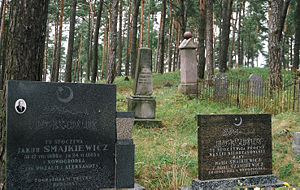
- 1683: Many of the Lipka Tatar rebels who returned to the service of the Commonwealth in 1674 were later to take part in the Vienna Campaign of 1683. This included the 60 Polish Tatars in the light cavalry company of Samuel Mirza Krzeczowski, who was later to save the life of King Jan III Sobieski during the disastrous first day of the Battle of ParkanyBattle of PárkányThe Battle of Párkány was fought in the town of Párkány , in the Ottoman Empire, and the area surrounding it as part of the Polish-Ottoman War and the Great Turkish War. The battle was fought in two stages...
, a few weeks after the great victory of the Battle of ViennaBattle of ViennaThe Battle of Vienna took place on 11 and 12 September 1683 after Vienna had been besieged by the Ottoman Empire for two months...
that was to turn the tide of Islamic expansion into Europe and mark the beginning of the end for the Ottoman Empire. The Lipka Tatars who fought on the Polish side at the Battle of Vienna, on 12 September 1683, wore a sprig of straw in their helmets to distinguish themselves from the Tatars fighting under Kara MustafaKara MustafaMerzifonlu Kara Mustafa Pasha was an Ottoman military leader and grand vizier who was a central character in the empire's last attempts at expansion into both Central Europe and Eastern Europe.-His Name:...
on the Turkish side. Lipkas visiting Vienna traditionally wear straw hats to commemorate their ancestors’ participation in the breaking of the Siege of ViennaSiege of ViennaThe Siege of Vienna in 1529 was the first attempt by the Ottoman Empire, led by Suleiman the Magnificent, to capture the city of Vienna, Austria. The siege signalled the pinnacle of the Ottoman Empire's power, the maximum extent of Ottoman expansion in central Europe, and was the result of a...
.
- 1699: Some of the KamieniecKamianets-PodilskyiKamyanets-Podilsky or Kamienets-Podolsky is a city located on the Smotrych River in western Ukraine, to the north-east of Chernivtsi...
-based Lipka Tatars who had remained loyal to the Turkish SultanSultanSultan is a title with several historical meanings. Originally, it was an Arabic language abstract noun meaning "strength", "authority", "rulership", and "dictatorship", derived from the masdar سلطة , meaning "authority" or "power". Later, it came to be used as the title of certain rulers who...
were settled in BessarabiaBessarabiaBessarabia is a historical term for the geographic region in Eastern Europe bounded by the Dniester River on the east and the Prut River on the west....
along the borderlands between the Ottoman Empire and the Polish Lithuanian Commonwealth as well as in the environs of ChocimKhotynKhotyn is a city in Chernivtsi Oblast of western Ukraine, and is the administrative center of Khotyn Raion within the oblast, and is located south-west of Kamianets-Podilskyi. According to the 2001 Ukrainian census, it has a population of 11,124...
and Kamieniec-Podolski and in the town known as Lipkany. A further large scale emigration of Lipkas to Ottoman controlled lands took place early in the 18th century, after the victory won by King Augustus II over the Polish-born King Stanisław Leszczyński, whom the Lipkas had supported in his war against the Saxon King.
- 1775: The Polish Lipkas came back into favour during the reign of the last King, Stanislas Augustus (1765–95). In 1775 the SejmSejmThe Sejm is the lower house of the Polish parliament. The Sejm is made up of 460 deputies, or Poseł in Polish . It is elected by universal ballot and is presided over by a speaker called the Marshal of the Sejm ....
reaffirmed the noble status of the Polish Lithuanian Tatars. After the Partitions of PolandPartitions of PolandThe Partitions of Poland or Partitions of the Polish–Lithuanian Commonwealth took place in the second half of the 18th century and ended the existence of the Polish–Lithuanian Commonwealth, resulting in the elimination of sovereign Poland for 123 years...
, the Lipkas played their part in the various national uprisings, and also served alongside the Poles in the Napoleonic army.
- 1919 The Polish Lipkas joined the newly created Polish Army formations; Pułk Jazdy Tatarskiej and later, 13th Regiment of Wilno Uhlans13th Regiment of Wilno UhlansThe 13th Regiment of Wilno Uhlans was a unit of the Polish army between World War I and World War II.-Origins:The ancestral units to the regiment were created mainly as means of defending the Polish interest and the interest of the ethnic Poles living in Kresy at the end of Kenneth Fearing's "Dirge"...
.
- 1939: With the re-emergence of the Polish stateSecond Polish RepublicThe Second Polish Republic, Second Commonwealth of Poland or interwar Poland refers to Poland between the two world wars; a period in Polish history in which Poland was restored as an independent state. Officially known as the Republic of Poland or the Commonwealth of Poland , the Polish state was...
after the First World War, a Polish Tatar regiment was re-established in the Polish Army which was distinguished by its own uniforms and banners. After the fall of Poland in 1939, the Polish Tatars in the Wilno (Vilnius) based 13th Cavalry Regiment were one of the last Polish Army units recorded carrying on the fight against the German aggressors while lead by MajorAleksander JeljaszewiczAleksander JeljaszewiczAleksander Jeljaszewicz "Sasza," most likely due to the family tradition of service in the Russian military, – an ethnic—Tatar Pole then known as "Pole of Tatar nationality,", Major of the Polish Army: the commander of the last Tatar/Islamic unit in the Polish military.-Early life:Son...
.
Lipkas today

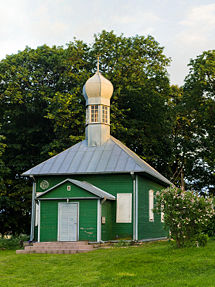
Latvia
Latvia , officially the Republic of Latvia , is a country in the Baltic region of Northern Europe. It is bordered to the north by Estonia , to the south by Lithuania , to the east by the Russian Federation , to the southeast by Belarus and shares maritime borders to the west with Sweden...
and Ukraine. Today most reside in Poland, Lithuania and Belarus. Most of the Lipka Tatars (80%) assimilated into the ranks of the nobility in the Polish-Lithuanian Commonwealth while some lower noble Tatars assimilated to the Belarusian
Belarusians
Belarusians ; are an East Slavic ethnic group who populate the majority of the Republic of Belarus. Introduced to the world as a new state in the early 1990s, the Republic of Belarus brought with it the notion of a re-emerging Belarusian ethnicity, drawn upon the lines of the Old Belarusian...
, Polish
Poles
thumb|right|180px|The state flag of [[Poland]] as used by Polish government and diplomatic authoritiesThe Polish people, or Poles , are a nation indigenous to Poland. They are united by the Polish language, which belongs to the historical Lechitic subgroup of West Slavic languages of Central Europe...
, Ukrainian
Ukrainians
Ukrainians are an East Slavic ethnic group native to Ukraine, which is the sixth-largest nation in Europe. The Constitution of Ukraine applies the term 'Ukrainians' to all its citizens...
and Lithuanian
Lithuanians
Lithuanians are the Baltic ethnic group native to Lithuania, where they number around 2,765,600 people. Another million or more make up the Lithuanian diaspora, largely found in countries such as the United States, Brazil, Canada, Colombia, Russia, United Kingdom and Ireland. Their native language...
townsfolk and peasant populations.
Charles Bronson
Charles Bronson
Charles Bronson , born Charles Dennis Buchinsky was an American actor, best-known for such films as Once Upon a Time in the West, The Magnificent Seven, The Dirty Dozen, The Great Escape, Rider on the Rain, The Mechanic, and the popular Death Wish series...
was a descendant of the Lipka Tatars of the Polish-Lithuanian Commonwealth, which caused many people to think that he looked like a Chicano
Chicano
The terms "Chicano" and "Chicana" are used in reference to U.S. citizens of Mexican descent. However, those terms have a wide range of meanings in various parts of the world. The term began to be widely used during the Chicano Movement, mainly among Mexican Americans, especially in the movement's...
or Mexican-American who was a Mestizo
Mestizo
Mestizo is a term traditionally used in Latin America, Philippines and Spain for people of mixed European and Native American heritage or descent...
(mixture of Spanish and Indian ancestry). Thus, due to his looks, Bronson sometimes played characters who were Mexican or who were part-Indian.
A number of the Polish Tatars emigrated to the US at the beginning of 20th century and settled mostly in the north eastern states (although there is also an enclave in Florida). A small but active community of Lipka Tatars exists in New York City. "The Islamic Center of Polish Tatars" in New York City until recently had its own mosque in Brooklyn
Brooklyn
Brooklyn is the most populous of New York City's five boroughs, with nearly 2.6 million residents, and the second-largest in area. Since 1896, Brooklyn has had the same boundaries as Kings County, which is now the most populous county in New York State and the second-most densely populated...
(106 Powers Street, Brooklyn, NY 11211 USA, originally build in 1928).
After the annexation of eastern Poland into the Soviet Union following World War II, Poland was left with only 2 Tatar villages, Bohoniki
Bohoniki
Bohoniki is a village in the administrative district of Gmina Sokółka, within Sokółka County, Podlaskie Voivodeship, in north-eastern Poland, close to the border with Belarus. It lies approximately east of Sokółka and north-east of the regional capital Białystok. The village has a population of...
and Kruszyniany
Kruszyniany
Kruszyniany is a village in the administrative district of Gmina Krynki, within Sokółka County, Podlaskie Voivodeship, in north-eastern Poland, close to the border with Belarus....
. A significant number of the Tartars in the territories annexed to the USSR repatriated to Poland and clustered in cities such as Gdańsk
Gdansk
Gdańsk is a Polish city on the Baltic coast, at the centre of the country's fourth-largest metropolitan area.The city lies on the southern edge of Gdańsk Bay , in a conurbation with the city of Gdynia, spa town of Sopot, and suburban communities, which together form a metropolitan area called the...
, Białystok, Warsaw
Warsaw
Warsaw is the capital and largest city of Poland. It is located on the Vistula River, roughly from the Baltic Sea and from the Carpathian Mountains. Its population in 2010 was estimated at 1,716,855 residents with a greater metropolitan area of 2,631,902 residents, making Warsaw the 10th most...
and Gorzów Wielkopolski
Gorzów Wielkopolski
Gorzów Wielkopolski is a city in western Poland, on the Warta river. It is the biggest city in the Lubusz Voivodeship with 125,149 inhabitants...
totaling some 3,000 people. One of the neighborhoods of Gorzów Wielkopolski
Gorzów Wielkopolski
Gorzów Wielkopolski is a city in western Poland, on the Warta river. It is the biggest city in the Lubusz Voivodeship with 125,149 inhabitants...
where relocated Tatar families resettled has come to be referred to as "the Tatar Hills", or in Polish "Górki Tatarskie".
In 1925 the Muslim Religion Association - Muzułmański Związek Religijny was formed in Poland in Białystok. 1n 1992, the Organization of Tatars of the Polish Republic (Związek Tatarów Rzeczypospolitej Polskiej) with autonomous branches in Białystok and Gdańsk began operating.
In Poland, the Tatar population reached approximately 100,000 in 1630 but the 2002 census showed only 447 people declaring this ethnicity.
In November 2010, a monument to Poland's Tatar populace was unveiled in the port city of Gdańsk
Gdansk
Gdańsk is a Polish city on the Baltic coast, at the centre of the country's fourth-largest metropolitan area.The city lies on the southern edge of Gdańsk Bay , in a conurbation with the city of Gdynia, spa town of Sopot, and suburban communities, which together form a metropolitan area called the...
at a ceremony attended by President Bronislaw Komorowski
Bronislaw Komorowski
Bronisław Maria Komorowski is the President of Poland. As Marshal of the Sejm , Komorowski exercised powers and duties of head of state following the death of President Lech Kaczyński in a plane crash on 10 April 2010...
, as well as Tatar representatives from across Poland and abroad. The monument is a symbol of the important role of Tatars in Polish history
History of Poland
The History of Poland is rooted in the arrival of the Slavs, who gave rise to permanent settlement and historic development on Polish lands. During the Piast dynasty Christianity was adopted in 966 and medieval monarchy established...
.
"Tatars shed their blood in all national independence uprisings. Their blood seeped into the foundations of the reborn Polish Republic," President Komorowski said at the unveiling.
The monument is the first of its kind to be erected in Europe.
Famous Lipka Tatar descendants
- Charles BronsonCharles BronsonCharles Bronson , born Charles Dennis Buchinsky was an American actor, best-known for such films as Once Upon a Time in the West, The Magnificent Seven, The Dirty Dozen, The Great Escape, Rider on the Rain, The Mechanic, and the popular Death Wish series...
- Lithuanian American actor whose father was a Lipka Tatar, born in DruskininkaiDruskininkaiDruskininkai is a spa town on the Neman River in southern Lithuania, close to the borders of Belarus and Poland. The city of Druskininkai has a population of 18,233 and dates back as a spa resort to the 19th century.-Names:...
(Druskienik) - Aleksander RomanowiczAleksander RomanowiczAleksander Romanowicz was a general of cavalry in both Russian Imperial Army and Polish Army. Born April 1, 1871 in his family estate Olekszyszki , in 1890 he graduated from the Russian Army Cadet Corps in Polotsk, then entered the Officer’s School of Cavalry, becoming in 1892 a professional...
- general of cavalry in Russian Imperial Army and Polish Army. - Henryk SienkiewiczHenryk SienkiewiczHenryk Adam Aleksander Pius Sienkiewicz was a Polish journalist and Nobel Prize-winning novelist. A Polish szlachcic of the Oszyk coat of arms, he was one of the most popular Polish writers at the turn of the 19th and 20th centuries, and received the Nobel Prize in Literature in 1905 for his...
- Polish Nobel PrizeNobel PrizeThe Nobel Prizes are annual international awards bestowed by Scandinavian committees in recognition of cultural and scientific advances. The will of the Swedish chemist Alfred Nobel, the inventor of dynamite, established the prizes in 1895...
-winning novelist.; on his father's side deriving from the Lipka Tatars - Aleksander SulkiewiczAleksander SulkiewiczAleksander Sulkiewicz - actually Iskander Mirza Huzman Beg Sulkiewicz, - was a Polish politician of Tatar ethnicity, activist in socialist and independence movements and one of the co-founders of Polish Socialist...
- Polish politician of Tatar ethnicity, activist in socialist and independence movements and one of the co-founders of Polish Socialist PartyPolish Socialist PartyThe Polish Socialist Party was one of the most important Polish left-wing political parties from its inception in 1892 until 1948...
Two distantly related members of the Abakanowicz
Abakanowicz
Abakanowicz is a surname originating from the szlachta of the Polish-Lithuanian Commonwealth under the Abdank Coat of Arms in Polish Heraldry.-History:The Abakanowicz family is of Tatar descent...
family
- Bruno AbakanowiczBruno AbakanowiczBruno Abdank-Abakanowicz was a mathematician, inventor and electrical engineer.- Life and Nationality :Abakanowicz was born in 1852 in Vilkmergė, Lithuania, then part of the Russian Empire. After graduating from the Riga Technical University, Abakanowicz passed his habilitation and began an...
- mathematician, inventor and electrical engineer whose family was of distant Lipka Tatar origin. - Magdalena AbakanowiczMagdalena AbakanowiczMagdalena Abakanowicz is a Polish sculptor. She is notable for her use of textiles as a sculptural medium. She was a professor at the Academy of Fine Arts in Poznań, Poland from 1965 to 1990 and a visiting professor at University of California, Los Angeles in 1984...
- Polish artist whose family is of distant Tatar origin.
See also
- Lipka RebellionLipka RebellionThe Lipka Rebellion was a mutiny of several choragwie of Lipka Tatar cavalry in 1672, which had been serving in the forces of the Polish Lithuanian Commonwealth since the 14th century...
- Tatar invasionsTatar invasionsThe Mongol invasion of Europe from the east took place over the course of three centuries, from the Middle Ages to the early modern period.The terms Tatars or Tartars are applied to nomadic Turkic peoples who, themselves, were conquered by Mongols and incorporated into their horde...
- List of Polish wars
- Aleksander SulkiewiczAleksander SulkiewiczAleksander Sulkiewicz - actually Iskander Mirza Huzman Beg Sulkiewicz, - was a Polish politician of Tatar ethnicity, activist in socialist and independence movements and one of the co-founders of Polish Socialist...
- KalizKhalyziansThe Chalyzians or Khalyzians or Khalis or Khwalis The Chalyzians or Khalyzians or Khalis or Khwalis The Chalyzians or Khalyzians or Khalis or Khwalis (Arabic: Khwarezmian, Byzantine Greek: Χαλίσιοι, Khalisioi, Magyar: Kaliz were a people mentioned by the 12th-century Byzantine historian John...
- Almış (Almas) iltäbärAlmisAlmış iltäbär was the first Muslim ruler of Volga Bulgaria.Almış was a son of Şilki . He was a ruler of one of the Bulgar duchies, probably, the Bolghar Duchy. Initially, a vassal of the Khazars, he struggled for independence and unification of all Bulgar tribes and duchies. He sent ambassadors...
- Aleksander JeljaszewiczAleksander JeljaszewiczAleksander Jeljaszewicz "Sasza," most likely due to the family tradition of service in the Russian military, – an ethnic—Tatar Pole then known as "Pole of Tatar nationality,", Major of the Polish Army: the commander of the last Tatar/Islamic unit in the Polish military.-Early life:Son...
External links
- A Short History of the Lipka Tatars of the White Horde Jakub Mirza Lipka
- Tartar Nobility in the Polish Lithuanian Commonwealth Selim Mirza-Juszenski Chazbijewicz - translated into English by Paul de Nowina-Konopka
- The Lithuanian Tatars article in The Red Book of the Peoples of the Russian EmpireThe Red Book of the Peoples of the Russian EmpireThe Red Book of the Peoples of the Russian Empire is a book about the small nations of the Russian Empire, the Soviet Union, and the Russia and some other post-Soviet states of today...