

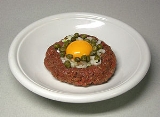
Steak tartare

Encyclopedia
Steak tartare is a meat dish made from finely chopped or minced raw beef
. Tartare can also be made by thinly slicing a high grade of meat such as strip steak
, marinating it in wine or other spirits, spicing it to taste, and then chilling it. This is often served with onion
s, caper
s and seasoning
s (the latter typically incorporating fresh ground pepper
and Worcestershire sauce
), sometimes with a raw egg yolk
, and often on rye bread
.
Although less common than the completely raw variety, there is a French version of steak tartare called tartare aller-retour. It is a mound of mostly raw steak tartare that is lightly seared on one side of the patty.
people of the Central Asia
n steppes who ate raw meat as they rode their horses because they did not have time to stop and cook. A variation of this story is that the meat was kept under the horse's saddles to be tenderized by the day's riding.
It was first served in French restaurants early in the 20th century. What is now generally known as "steak tartare" was then called steak à l'Americaine. Steak tartare was a variation on that dish; the 1921 edition of Escoffier
's Le Guide Culinaire
defines it as steak à l'Americaine made without egg yolk, served with tartar sauce
on the side.
Over time, the distinction between steak à l'Americaine and its variant vanished. The 1938 edition of Larousse Gastronomique
describes steak tartare as raw ground beef served with a raw egg yolk, without any mention of tartar sauce.
or suffer from a chronic illness. These individuals are at a greater risk of infection from E. coli
and/or Salmonella
.
Toxoplasma gondii
and Taenia saginata
are parasites that can possibly be found in raw beef.
 Steak tartare is now regarded as a gourmet dish. It is especially popular in Italy
, Belgium
, Croatia
, Czech Republic
, France
, Germany
, Romania
, Hungary
, the Netherlands
, Poland
, Slovakia
, Slovenia
, Nepal
, Japan
, and Switzerland
.
In Belgium, steak tartare is served with rench fries|fries]. A variation of steak tartare, used normally as a sandwich spread, is known as américain (with onions and more seasoning than a normal steak tartare).
A variant of steak tartare called tartarmad is also present in Danish smørrebrød
, where it is served on rugbrød
(rye bread) with assorted toppings. In Germany, there is a very popular variant using raw minced pork called Mett
or Hackepeter, which is typically served on rye bread or rolls, with the onions and pepper, but without capers or egg.
The Mexican version of steak tartare typically marinates the meat in lime
juice, while the standard version is marinated in wine.
In Nepal, "Kachila" is popular among the Newar community however, buffalo meat is used instead of beef since cow slaughter is illegal. Raw minced buffalo meat is mixed with mustard oil
, ground fennel seeds, minced garlic and spices to prepare this dish.
Korean cuisine features a dish of prepared raw beef called yukhoe
. Chilean cuisine features a dish of prepared raw beef called crudos
. Ethiopian cuisine features a very spicy dish of prepared raw beef called kitfo
.
Raw-meat dishes are popular across the Levant
; for instance, kibbeh nayyeh (كبة نية, ) which incorporates raw lamb or beef with bulgur
wheat, olive oil and spices, known as çiğ köfte (raw meat ball) in Turkey
, is often considered to be a national dish
of Lebanon
and Syria
.
Beef
Beef is the culinary name for meat from bovines, especially domestic cattle. Beef can be harvested from cows, bulls, heifers or steers. It is one of the principal meats used in the cuisine of the Middle East , Australia, Argentina, Brazil, Europe and the United States, and is also important in...
. Tartare can also be made by thinly slicing a high grade of meat such as strip steak
Strip steak
The strip steak is a type of cut of beef steaks. Internationally it is called a club steak. In the United States and Canada it is also known as New York strip, strip loin, shell steak, or Kansas City strip steak, In Australia it is known as a porterhouse steak...
, marinating it in wine or other spirits, spicing it to taste, and then chilling it. This is often served with onion
Onion
The onion , also known as the bulb onion, common onion and garden onion, is the most widely cultivated species of the genus Allium. The genus Allium also contains a number of other species variously referred to as onions and cultivated for food, such as the Japanese bunching onion The onion...
s, caper
Caper
Capparis spinosa, the caper bush, is a perennial winter-deciduous species that bears rounded, fleshy leaves and large white to pinkish-white flowers. A caper is also the pickled bud of this plant...
s and seasoning
Seasoning
Seasoning is the process of imparting flavor to, or improving the flavor of, food.- General meaning :Seasonings include herbs and spices, which are themselves frequently referred to as "seasonings"...
s (the latter typically incorporating fresh ground pepper
Black pepper
Black pepper is a flowering vine in the family Piperaceae, cultivated for its fruit, which is usually dried and used as a spice and seasoning. The fruit, known as a peppercorn when dried, is approximately in diameter, dark red when fully mature, and, like all drupes, contains a single seed...
and Worcestershire sauce
Worcestershire sauce
Worcestershire sauce , or Worcester sauce is a fermented liquid condiment; primarily used to flavour meat or fish dishes.First made at 60 Broad Street, Worcester, England, by two dispensing chemists, John Wheeley Lea and William Henry Perrins, the Lea & Perrins brand was commercialised in 1837 and...
), sometimes with a raw egg yolk
Egg yolk
An egg yolk is a part of an egg which feeds the developing embryo. The egg yolk is suspended in the egg white by one or two spiral bands of tissue called the chalazae...
, and often on rye bread
Rye bread
Rye bread is a type of bread made with various percentages of flour from rye grain. It can be light or dark in color, depending on the type of flour used and the addition of coloring agents, and is typically denser than bread made from wheat flour...
.
Although less common than the completely raw variety, there is a French version of steak tartare called tartare aller-retour. It is a mound of mostly raw steak tartare that is lightly seared on one side of the patty.
History
A popular legend is that the dish is named after the nomadic TatarTatars
Tatars are a Turkic speaking ethnic group , numbering roughly 7 million.The majority of Tatars live in the Russian Federation, with a population of around 5.5 million, about 2 million of which in the republic of Tatarstan.Significant minority populations are found in Uzbekistan, Kazakhstan,...
people of the Central Asia
Central Asia
Central Asia is a core region of the Asian continent from the Caspian Sea in the west, China in the east, Afghanistan in the south, and Russia in the north...
n steppes who ate raw meat as they rode their horses because they did not have time to stop and cook. A variation of this story is that the meat was kept under the horse's saddles to be tenderized by the day's riding.
It was first served in French restaurants early in the 20th century. What is now generally known as "steak tartare" was then called steak à l'Americaine. Steak tartare was a variation on that dish; the 1921 edition of Escoffier
Auguste Escoffier
Georges Auguste Escoffier was a French chef, restaurateur and culinary writer who popularized and updated traditional French cooking methods. He is a legendary figure among chefs and gourmands, and was one of the most important leaders in the development of modern French cuisine...
's Le Guide Culinaire
Le Guide Culinaire
Georges Auguste Escoffier's Le Guide culinaire, pronounced , is a pivotal book in the history of European haute cuisine, being Escoffier's largely successful attempt to codify and streamline the common French restaurant food of the day. The first edition was printed in 1903 in French. It was...
defines it as steak à l'Americaine made without egg yolk, served with tartar sauce
Tartar sauce
Tartare sauce is a creamy white sauce frequently used to season fried seafood dishes.-Composition:...
on the side.
Over time, the distinction between steak à l'Americaine and its variant vanished. The 1938 edition of Larousse Gastronomique
Larousse Gastronomique
Larousse Gastronomique is an encyclopedia of gastronomy. The majority of the book is about French cuisine, and contains recipes for French dishes and cooking techniques...
describes steak tartare as raw ground beef served with a raw egg yolk, without any mention of tartar sauce.
Health concerns
Health concerns have reduced the popularity of this meat dish in some parts of the world because of the danger of contamination by bacteria and parasites. However, when basic hygienic rules are followed and fresh meat is used the risk is low. It is not recommended for people who have a weakened immune systemImmune system
An immune system is a system of biological structures and processes within an organism that protects against disease by identifying and killing pathogens and tumor cells. It detects a wide variety of agents, from viruses to parasitic worms, and needs to distinguish them from the organism's own...
or suffer from a chronic illness. These individuals are at a greater risk of infection from E. coli
Escherichia coli
Escherichia coli is a Gram-negative, rod-shaped bacterium that is commonly found in the lower intestine of warm-blooded organisms . Most E. coli strains are harmless, but some serotypes can cause serious food poisoning in humans, and are occasionally responsible for product recalls...
and/or Salmonella
Salmonella
Salmonella is a genus of rod-shaped, Gram-negative, non-spore-forming, predominantly motile enterobacteria with diameters around 0.7 to 1.5 µm, lengths from 2 to 5 µm, and flagella which grade in all directions . They are chemoorganotrophs, obtaining their energy from oxidation and reduction...
.
Toxoplasma gondii
Toxoplasma gondii
Toxoplasma gondii is a species of parasitic protozoa in the genus Toxoplasma. The definitive host of T. gondii is the cat, but the parasite can be carried by many warm-blooded animals . Toxoplasmosis, the disease of which T...
and Taenia saginata
Taenia saginata
Taenia saginata, also known as Taeniarhynchus saginata or the beef tapeworm, is a parasite of both cattle and humans, causing taeniasis in humans. Taenia saginata occurs where cattle are raised by infected humans maintaining poor hygiene, human feces are improperly disposed of, meat inspection...
are parasites that can possibly be found in raw beef.
Regional variations
Italy
Italy , officially the Italian Republic languages]] under the European Charter for Regional or Minority Languages. In each of these, Italy's official name is as follows:;;;;;;;;), is a unitary parliamentary republic in South-Central Europe. To the north it borders France, Switzerland, Austria and...
, Belgium
Belgium
Belgium , officially the Kingdom of Belgium, is a federal state in Western Europe. It is a founding member of the European Union and hosts the EU's headquarters, and those of several other major international organisations such as NATO.Belgium is also a member of, or affiliated to, many...
, Croatia
Croatia
Croatia , officially the Republic of Croatia , is a unitary democratic parliamentary republic in Europe at the crossroads of the Mitteleuropa, the Balkans, and the Mediterranean. Its capital and largest city is Zagreb. The country is divided into 20 counties and the city of Zagreb. Croatia covers ...
, Czech Republic
Czech Republic
The Czech Republic is a landlocked country in Central Europe. The country is bordered by Poland to the northeast, Slovakia to the east, Austria to the south, and Germany to the west and northwest....
, France
France
The French Republic , The French Republic , The French Republic , (commonly known as France , is a unitary semi-presidential republic in Western Europe with several overseas territories and islands located on other continents and in the Indian, Pacific, and Atlantic oceans. Metropolitan France...
, Germany
Germany
Germany , officially the Federal Republic of Germany , is a federal parliamentary republic in Europe. The country consists of 16 states while the capital and largest city is Berlin. Germany covers an area of 357,021 km2 and has a largely temperate seasonal climate...
, Romania
Romania
Romania is a country located at the crossroads of Central and Southeastern Europe, on the Lower Danube, within and outside the Carpathian arch, bordering on the Black Sea...
, Hungary
Hungary
Hungary , officially the Republic of Hungary , is a landlocked country in Central Europe. It is situated in the Carpathian Basin and is bordered by Slovakia to the north, Ukraine and Romania to the east, Serbia and Croatia to the south, Slovenia to the southwest and Austria to the west. The...
, the Netherlands
Netherlands
The Netherlands is a constituent country of the Kingdom of the Netherlands, located mainly in North-West Europe and with several islands in the Caribbean. Mainland Netherlands borders the North Sea to the north and west, Belgium to the south, and Germany to the east, and shares maritime borders...
, Poland
Poland
Poland , officially the Republic of Poland , is a country in Central Europe bordered by Germany to the west; the Czech Republic and Slovakia to the south; Ukraine, Belarus and Lithuania to the east; and the Baltic Sea and Kaliningrad Oblast, a Russian exclave, to the north...
, Slovakia
Slovakia
The Slovak Republic is a landlocked state in Central Europe. It has a population of over five million and an area of about . Slovakia is bordered by the Czech Republic and Austria to the west, Poland to the north, Ukraine to the east and Hungary to the south...
, Slovenia
Slovenia
Slovenia , officially the Republic of Slovenia , is a country in Central and Southeastern Europe touching the Alps and bordering the Mediterranean. Slovenia borders Italy to the west, Croatia to the south and east, Hungary to the northeast, and Austria to the north, and also has a small portion of...
, Nepal
Nepal
Nepal , officially the Federal Democratic Republic of Nepal, is a landlocked sovereign state located in South Asia. It is located in the Himalayas and bordered to the north by the People's Republic of China, and to the south, east, and west by the Republic of India...
, Japan
Japan
Japan is an island nation in East Asia. Located in the Pacific Ocean, it lies to the east of the Sea of Japan, China, North Korea, South Korea and Russia, stretching from the Sea of Okhotsk in the north to the East China Sea and Taiwan in the south...
, and Switzerland
Switzerland
Switzerland name of one of the Swiss cantons. ; ; ; or ), in its full name the Swiss Confederation , is a federal republic consisting of 26 cantons, with Bern as the seat of the federal authorities. The country is situated in Western Europe,Or Central Europe depending on the definition....
.
In Belgium, steak tartare is served with rench fries|fries]. A variation of steak tartare, used normally as a sandwich spread, is known as américain (with onions and more seasoning than a normal steak tartare).
A variant of steak tartare called tartarmad is also present in Danish smørrebrød
Smørrebrød
Smørrebrød usually consists of a piece of buttered rye bread , a dense, dark brown bread. Pålæg , the topping, then among others can refer to commercial or homemade cold cuts, pieces of meat or fish, cheese or spreads...
, where it is served on rugbrød
Rugbrød
Rugbrød is a very commonly used bread in Denmark. The common rugbrød usually resembles a long brown rectangle, no more than 12 cm high, and 30–35 cm wide, although shapes and sizes may vary, as well as the ingredients...
(rye bread) with assorted toppings. In Germany, there is a very popular variant using raw minced pork called Mett
Mett
Mett is a preparation of minced pork that is popular in Germany.-Description:The name is derived from Low German mett for "chopped pork meat without bacon", or Old Saxon meti for "food". It also known as Hackepeter...
or Hackepeter, which is typically served on rye bread or rolls, with the onions and pepper, but without capers or egg.
The Mexican version of steak tartare typically marinates the meat in lime
Lime (fruit)
Lime is a term referring to a number of different citrus fruits, both species and hybrids, which are typically round, green to yellow in color, 3–6 cm in diameter, and containing sour and acidic pulp. Limes are a good source of vitamin C. Limes are often used to accent the flavors of foods and...
juice, while the standard version is marinated in wine.
In Nepal, "Kachila" is popular among the Newar community however, buffalo meat is used instead of beef since cow slaughter is illegal. Raw minced buffalo meat is mixed with mustard oil
Mustard oil
The term mustard oil is used for three different oils that are made from mustard seeds:*A fatty vegetable oil resulting from pressing the seeds,...
, ground fennel seeds, minced garlic and spices to prepare this dish.
Korean cuisine features a dish of prepared raw beef called yukhoe
Yukhoe
Yukhoe refers to a variety of hoe , which are usually made from raw ground beef seasoned with various spices or sauces. It is basically a Korean steak tartare. Usually the most tender part of beef will be used...
. Chilean cuisine features a dish of prepared raw beef called crudos
Crudos
Crudo is a typical German-Chilean dish similar to a steak tartare. It is made by putting finely chopped raw beef mince into a piece of pre-sliced white bread and then adding lemon juice, chopped onions and a sauce made of yogurt and mayonnaise....
. Ethiopian cuisine features a very spicy dish of prepared raw beef called kitfo
Kitfo
Kitfo , sometimes spelled ketfo, is a traditional dish found in Ethiopian cuisine. It consists of minced raw beef, marinated in mitmita, a spicy chili powder based spice blend, and niter kibbeh...
.
Raw-meat dishes are popular across the Levant
Levant
The Levant or ) is the geographic region and culture zone of the "eastern Mediterranean littoral between Anatolia and Egypt" . The Levant includes most of modern Lebanon, Syria, Jordan, Israel, the Palestinian territories, and sometimes parts of Turkey and Iraq, and corresponds roughly to the...
; for instance, kibbeh nayyeh (كبة نية, ) which incorporates raw lamb or beef with bulgur
Bulgur
Bulgur is a cereal food made from several different wheat species, most often from durum wheat. In the United States it is most often made from white wheat. Its use is most common in Middle Eastern cuisine, Iran, Turkey, Greece, Armenia and Bulgaria...
wheat, olive oil and spices, known as çiğ köfte (raw meat ball) in Turkey
Turkey
Turkey , known officially as the Republic of Turkey , is a Eurasian country located in Western Asia and in East Thrace in Southeastern Europe...
, is often considered to be a national dish
National dish
A national dish is a dish, food or a drink that is considered to represent a particular country, nation or region.A dish can become a national dish for a variety of reasons. It can be the national dish because it is a staple daily food for the majority of the population. It can also be the national...
of Lebanon
Lebanon
Lebanon , officially the Republic of LebanonRepublic of Lebanon is the most common term used by Lebanese government agencies. The term Lebanese Republic, a literal translation of the official Arabic and French names that is not used in today's world. Arabic is the most common language spoken among...
and Syria
Syria
Syria , officially the Syrian Arab Republic , is a country in Western Asia, bordering Lebanon and the Mediterranean Sea to the West, Turkey to the north, Iraq to the east, Jordan to the south, and Israel to the southwest....
.
See also
- Bastırma
- CarpaccioCarpaccioCarpaccio is a dish of raw meat or fish , thinly sliced or pounded thin and served as an appetizer.- History :...
- CrudosCrudosCrudo is a typical German-Chilean dish similar to a steak tartare. It is made by putting finely chopped raw beef mince into a piece of pre-sliced white bread and then adding lemon juice, chopped onions and a sauce made of yogurt and mayonnaise....
- Gored goredGored goredGored gored is a raw beef dish eaten in Ethiopia and Eritrea. Whereas kitfo is minced beef marinated in spices and clarified butter, gored gored is cubed and left unmarinated. Like kitfo, it is widely popular and considered a national dish.- See also :...
- Kibbeh nayyeh
- KitfoKitfoKitfo , sometimes spelled ketfo, is a traditional dish found in Ethiopian cuisine. It consists of minced raw beef, marinated in mitmita, a spicy chili powder based spice blend, and niter kibbeh...
- MettMettMett is a preparation of minced pork that is popular in Germany.-Description:The name is derived from Low German mett for "chopped pork meat without bacon", or Old Saxon meti for "food". It also known as Hackepeter...
- TartareTartareTartare is a preparation of finely chopped raw meat or fish optionally with seasonings and sauces.Examples include:* Steak tartare* Venison tartare* Salmon tartare* Tuna tartareCommonly a tartare is served as a spread for toast...
- YukhoeYukhoeYukhoe refers to a variety of hoe , which are usually made from raw ground beef seasoned with various spices or sauces. It is basically a Korean steak tartare. Usually the most tender part of beef will be used...