


Postal history of Palestine

Encyclopedia
Ancient Near East
The ancient Near East was the home of early civilizations within a region roughly corresponding to the modern Middle East: Mesopotamia , ancient Egypt, ancient Iran The ancient Near East was the home of early civilizations within a region roughly corresponding to the modern Middle East: Mesopotamia...
, the Levant
Levant
The Levant or ) is the geographic region and culture zone of the "eastern Mediterranean littoral between Anatolia and Egypt" . The Levant includes most of modern Lebanon, Syria, Jordan, Israel, the Palestinian territories, and sometimes parts of Turkey and Iraq, and corresponds roughly to the...
and the Middle East
Middle East
The Middle East is a region that encompasses Western Asia and Northern Africa. It is often used as a synonym for Near East, in opposition to Far East...
. Postal services
Mail
Mail, or post, is a system for transporting letters and other tangible objects: written documents, typically enclosed in envelopes, and also small packages are delivered to destinations around the world. Anything sent through the postal system is called mail or post.In principle, a postal service...
in the region were first established in the Bronze Age
Bronze Age
The Bronze Age is a period characterized by the use of copper and its alloy bronze as the chief hard materials in the manufacture of some implements and weapons. Chronologically, it stands between the Stone Age and Iron Age...
, during the rule of Sargon of Akkad
Sargon of Akkad
Sargon of Akkad, also known as Sargon the Great "the Great King" , was an Akkadian emperor famous for his conquest of the Sumerian city-states in the 23rd and 22nd centuries BC. The founder of the Dynasty of Akkad, Sargon reigned in the last quarter of the third millennium BC...
, and successive empires have established and operated a number of different postal systems over the millennia.
In the era of modern postage, the postal administrations in Palestine
Palestine
Palestine is a conventional name, among others, used to describe the geographic region between the Mediterranean Sea and the Jordan River, and various adjoining lands....
have included Austria
Austria
Austria , officially the Republic of Austria , is a landlocked country of roughly 8.4 million people in Central Europe. It is bordered by the Czech Republic and Germany to the north, Slovakia and Hungary to the east, Slovenia and Italy to the south, and Switzerland and Liechtenstein to the...
n, French
France
The French Republic , The French Republic , The French Republic , (commonly known as France , is a unitary semi-presidential republic in Western Europe with several overseas territories and islands located on other continents and in the Indian, Pacific, and Atlantic oceans. Metropolitan France...
, Italian
Italy
Italy , officially the Italian Republic languages]] under the European Charter for Regional or Minority Languages. In each of these, Italy's official name is as follows:;;;;;;;;), is a unitary parliamentary republic in South-Central Europe. To the north it borders France, Switzerland, Austria and...
, German
Germany
Germany , officially the Federal Republic of Germany , is a federal parliamentary republic in Europe. The country consists of 16 states while the capital and largest city is Berlin. Germany covers an area of 357,021 km2 and has a largely temperate seasonal climate...
, Egypt
Egypt
Egypt , officially the Arab Republic of Egypt, Arabic: , is a country mainly in North Africa, with the Sinai Peninsula forming a land bridge in Southwest Asia. Egypt is thus a transcontinental country, and a major power in Africa, the Mediterranean Basin, the Middle East and the Muslim world...
ian, and Russia
Russia
Russia or , officially known as both Russia and the Russian Federation , is a country in northern Eurasia. It is a federal semi-presidential republic, comprising 83 federal subjects...
n post offices (through arrangements made with the Ottoman Empire
Ottoman Empire
The Ottoman EmpireIt was usually referred to as the "Ottoman Empire", the "Turkish Empire", the "Ottoman Caliphate" or more commonly "Turkey" by its contemporaries...
), the Egyptian Expeditionary Forces, the British Mandate, and various interim authorities in the lead up to and after the 1948 Arab-Israeli war
1948 Arab-Israeli War
The 1948 Arab–Israeli War, known to Israelis as the War of Independence or War of Liberation The war commenced after the termination of the British Mandate for Palestine and the creation of an independent Israel at midnight on 14 May 1948 when, following a period of civil war, Arab armies invaded...
. Since 1948, postal services have been provided by Egypt, Jordan
Jordan
Jordan , officially the Hashemite Kingdom of Jordan , Al-Mamlaka al-Urduniyya al-Hashemiyya) is a kingdom on the East Bank of the River Jordan. The country borders Saudi Arabia to the east and south-east, Iraq to the north-east, Syria to the north and the West Bank and Israel to the west, sharing...
, Israel
Israel
The State of Israel is a parliamentary republic located in the Middle East, along the eastern shore of the Mediterranean Sea...
, and the Palestinian National Authority
Palestinian National Authority
The Palestinian Authority is the administrative organization established to govern parts of the West Bank and Gaza Strip...
.
When discussing the pre-1948 postal history, most philatelists
Philately
Philately is the study of stamps and postal history and other related items. Philately involves more than just stamp collecting, which does not necessarily involve the study of stamps. It is possible to be a philatelist without owning any stamps...
refer to this geographic area as Palestine
Palestine
Palestine is a conventional name, among others, used to describe the geographic region between the Mediterranean Sea and the Jordan River, and various adjoining lands....
or the Holy Land
Holy Land
The Holy Land is a term which in Judaism refers to the Kingdom of Israel as defined in the Tanakh. For Jews, the Land's identifiction of being Holy is defined in Judaism by its differentiation from other lands by virtue of the practice of Judaism often possible only in the Land of Israel...
, though some also use Eretz Israel. This article surveys the postal history
Postal history
Postal history is the study of postal systems and how they operate and, or, the study of postage stamps and covers and associated material illustrating historical episodes of postal systems...
leading up to the area's two current postal administrations, that of the State of Israel and the Palestinian National Authority
Palestinian National Authority
The Palestinian Authority is the administrative organization established to govern parts of the West Bank and Gaza Strip...
.
Pre-modern history
Prior to modern postal historyTimeline of postal history
This is a timeline of significant events in postal history, including dates relating to postage stamps.-Fifteenth century:* 1497 - Franz von Taxis established a postal service on behalf of Emperor Maximilian I of the Holy Roman Empire-Sixteenth century:...
, imperial administrations set up mechanisms for the delivery of packages and letters.
Antiquity
The earliest use of a postal system in the region is thought to date back to the Bronze AgeBronze Age
The Bronze Age is a period characterized by the use of copper and its alloy bronze as the chief hard materials in the manufacture of some implements and weapons. Chronologically, it stands between the Stone Age and Iron Age...
, during the rule of Sargon of Akkad
Sargon of Akkad
Sargon of Akkad, also known as Sargon the Great "the Great King" , was an Akkadian emperor famous for his conquest of the Sumerian city-states in the 23rd and 22nd centuries BC. The founder of the Dynasty of Akkad, Sargon reigned in the last quarter of the third millennium BC...
(2333–2279 BCE). His empire, "was bound together by roads, along which there was a regular postal service, and clay seals which took the place of stamps are now in the Louvre
Louvre
The Musée du Louvre – in English, the Louvre Museum or simply the Louvre – is one of the world's largest museums, the most visited art museum in the world and a historic monument. A central landmark of Paris, it is located on the Right Bank of the Seine in the 1st arrondissement...
bearing the names of Sargon and his son."
During Persian rule (538–333 BCE), an extensive network of roads maintained by the Persian government formed part of an efficient imperial postal system. The postal system's establishment and the improvements to the road network are credited to the monarch
Monarch
A monarch is the person who heads a monarchy. This is a form of government in which a state or polity is ruled or controlled by an individual who typically inherits the throne by birth and occasionally rules for life or until abdication...
Darius I (521–486 BCE). Mounted couriers, known as "fast messengers" (Persian language
Persian language
Persian is an Iranian language within the Indo-Iranian branch of the Indo-European languages. It is primarily spoken in Iran, Afghanistan, Tajikistan and countries which historically came under Persian influence...
:pirradaziš), carried correspondence between the royal court and the provinces, stopping only to eat and rest, and change horses as needed, at supply stations located about one day's travel apart. The Persian courier system forms part of the backdrop to events described in the Hebrew Bible
Hebrew Bible
The Hebrew Bible is a term used by biblical scholars outside of Judaism to refer to the Tanakh , a canonical collection of Jewish texts, and the common textual antecedent of the several canonical editions of the Christian Old Testament...
's Book of Esther
Book of Esther
The Book of Esther is a book in the Ketuvim , the third section of the Jewish Tanakh and is part of the Christian Old Testament. The Book of Esther or the Megillah is the basis for the Jewish celebration of Purim...
.
Arab Caliphate (628–1099)
The UmayyadUmayyad
The Umayyad Caliphate was the second of the four major Arab caliphates established after the death of Muhammad. It was ruled by the Umayyad dynasty, whose name derives from Umayya ibn Abd Shams, the great-grandfather of the first Umayyad caliph. Although the Umayyad family originally came from the...
empire (661–750) who introduced the "first purely Arab
Arab
Arab people, also known as Arabs , are a panethnicity primarily living in the Arab world, which is located in Western Asia and North Africa. They are identified as such on one or more of genealogical, linguistic, or cultural grounds, with tribal affiliations, and intra-tribal relationships playing...
coinage" in Palestine also developed a system of postal service. Khans
Caravanserai
A caravanserai, or khan, also known as caravansary, caravansera, or caravansara in English was a roadside inn where travelers could rest and recover from the day's journey...
distributed along the main north-south and east-west roads that served as resting places for pilgrims
Pilgrims
Pilgrims , or Pilgrim Fathers , is a name commonly applied to early settlers of the Plymouth Colony in present-day Plymouth, Massachusetts, United States...
and travellers facilitated the operation of the postal service, known as the barid. A postal system known as the Barīd was also operated under the rule of the Abbasid
Abbasid
The Abbasid Caliphate or, more simply, the Abbasids , was the third of the Islamic caliphates. It was ruled by the Abbasid dynasty of caliphs, who built their capital in Baghdad after overthrowing the Umayyad caliphate from all but the al-Andalus region....
caliphate (750–969), and the word is still used today for "mail" throughout the Arab world
Arab world
The Arab world refers to Arabic-speaking states, territories and populations in North Africa, Western Asia and elsewhere.The standard definition of the Arab world comprises the 22 states and territories of the Arab League stretching from the Atlantic Ocean in the west to the Arabian Sea in the...
. Under Fatimid
Fatimid
The Fatimid Islamic Caliphate or al-Fāṭimiyyūn was a Berber Shia Muslim caliphate first centered in Tunisia and later in Egypt that ruled over varying areas of the Maghreb, Sudan, Sicily, the Levant, and Hijaz from 5 January 909 to 1171.The caliphate was ruled by the Fatimids, who established the...
rule (969–1099), a pigeon post
Pigeon post
Pigeon post is the use of homing pigeons to carry messages. Pigeons were effective as messengers due to their natural homing abilities. The pigeons were transported to a destination in cages, where they would be attached with messages, then naturally the pigeon would fly back to its home where the...
was maintained that was later perfected by the Mamluks. The pedigree
Pedigree chart
A pedigree chart is a diagram that shows the occurrence and appearance or phenotypes of a particular gene or organism and its ancestors from one generation to the next, most commonly humans, show dogs, and race horses....
s of carrier pigeons were kept in a special registrar.
Crusader period (1099–1187)
The chroniclers of the First CrusadeFirst Crusade
The First Crusade was a military expedition by Western Christianity to regain the Holy Lands taken in the Muslim conquest of the Levant, ultimately resulting in the recapture of Jerusalem...
documented the chance interception of a message warning the duke of Caesarea of the coming of the Crusader armies when a carrier pigeon was felled by a hawk
Hawk
The term hawk can be used in several ways:* In strict usage in Australia and Africa, to mean any of the species in the subfamily Accipitrinae, which comprises the genera Accipiter, Micronisus, Melierax, Urotriorchis and Megatriorchis. The large and widespread Accipiter genus includes goshawks,...
over a Crusader military encampment in May 1099. The message, written in Arabic
Arabic language
Arabic is a name applied to the descendants of the Classical Arabic language of the 6th century AD, used most prominently in the Quran, the Islamic Holy Book...
, read as follows:
Greetings from the king of AcreCarrier pigeons were regularly used in this period. For example, Edward GibbonAcre, IsraelAcre , is a city in the Western Galilee region of northern Israel at the northern extremity of Haifa Bay. Acre is one of the oldest continuously inhabited sites in the country....
to the duke of Caesarea. A generation of dogs, a foolish, headstrong, disorderly race, has gone through my land. If you value your way of life, you and others of the faith should bring harm to them, since you can easily do what you wish. Transmit this message to other cities and strongholds.
Edward Gibbon
Edward Gibbon was an English historian and Member of Parliament...
notes that during the siege of Acre (1189–1191) by the Crusaders, the inhabitants of the besieged city kept a regular correspondence with the Sultan's forces by way of carrier pigeon.
Mamluk rule (1270–1516)
During the rule of the Mamluks, mounted mail service was operated in Deir el-BalahDeir el-Balah
Deir el-Balah or Dayr al-Balah is located in the central Gaza Strip and is the capital or muhfaza of the Deir el-Balah Governorate...
, Lydda
Lod
Lod is a city located on the Sharon Plain southeast of Tel Aviv in the Center District of Israel. At the end of 2010, it had a population of 70,000, roughly 75 percent Jewish and 25 percent Arab.The name is derived from the Biblical city of Lod...
, Lajjun
Lajjun
Lajjun was a Palestinian Arab village of nearly 1,300 people located northwest of Jenin. The village along with nearby Umm al-Fahm and seven hamlets, had a total land area of 77,242 dunams or , of which were built-up, while the rest was used for agricultural purposes...
and other towns on the Cairo
Cairo
Cairo , is the capital of Egypt and the largest city in the Arab world and Africa, and the 16th largest metropolitan area in the world. Nicknamed "The City of a Thousand Minarets" for its preponderance of Islamic architecture, Cairo has long been a centre of the region's political and cultural life...
to Damascus
Damascus
Damascus , commonly known in Syria as Al Sham , and as the City of Jasmine , is the capital and the second largest city of Syria after Aleppo, both are part of the country's 14 governorates. In addition to being one of the oldest continuously inhabited cities in the world, Damascus is a major...
route. The postal system established by the Mamluks, under the leadership of Baybars, was known as the Barīd, as it was during the period of Arab caliphate rule. The nephew of the chief secretary to Sultan Baybars attributed the Barids adoption and development by the Mamluks to the recommendations of his uncle, al-Sahib Sharaf al-Din Abu Muhammed Al-Wahab. The nephew records that in response to a request from Baybars to be kept up-to-date on the most recent developments concerning the Franks
Franks
The Franks were a confederation of Germanic tribes first attested in the third century AD as living north and east of the Lower Rhine River. From the third to fifth centuries some Franks raided Roman territory while other Franks joined the Roman troops in Gaul. Only the Salian Franks formed a...
and the Mongols
Mongols
Mongols ) are a Central-East Asian ethnic group that lives mainly in the countries of Mongolia, China, and Russia. In China, ethnic Mongols can be found mainly in the central north region of China such as Inner Mongolia...
, Al-Wahab, "explained to him that which the Barīd had achieved in ancient and caliphal times and proposed [this system] to him; [the sultan] liked the idea and ordered [its establishment]."
After the Mamluks disloged the Crusaders
Crusades
The Crusades were a series of religious wars, blessed by the Pope and the Catholic Church with the main goal of restoring Christian access to the holy places in and near Jerusalem...
, annexed the Ayyubid principalities, and defeated the Mongol army in Anatolia
Anatolia
Anatolia is a geographic and historical term denoting the westernmost protrusion of Asia, comprising the majority of the Republic of Turkey...
, Baybars established the province of Syria
Syria
Syria , officially the Syrian Arab Republic , is a country in Western Asia, bordering Lebanon and the Mediterranean Sea to the West, Turkey to the north, Iraq to the east, Jordan to the south, and Israel to the southwest....
(which included Palestine), with Damascus as its capital. At this point, imperial communications throughout Palestine were so efficient that Baybars would boast that he could play polo
Polo
Polo is a team sport played on horseback in which the objective is to score goals against an opposing team. Sometimes called, "The Sport of Kings", it was highly popularized by the British. Players score by driving a small white plastic or wooden ball into the opposing team's goal using a...
in Cairo
Cairo
Cairo , is the capital of Egypt and the largest city in the Arab world and Africa, and the 16th largest metropolitan area in the world. Nicknamed "The City of a Thousand Minarets" for its preponderance of Islamic architecture, Cairo has long been a centre of the region's political and cultural life...
and Damascus in the same week. An even more rapid carrier pigeon
Carrier pigeon
A carrier pigeon is a homing pigeon that is used to carry messages. Using pigeons to carry messages is generally called "pigeon post". Most homing or racing type varieties are used to carry messages. There is no specific breed actually called "carrier pigeon"...
post was maintained between the two cities. Its use in forming a defensive league against the Crusaders was noted by Raymond of Agiles
Raymond of Aguilers
Raymond of Aguilers was a chronicler of the First Crusade . He followed the Provençal army of crusaders, guided by count Raymond IV of Toulouse, to Jerusalem....
, who thought it rather "unsporting".
Postal services in the Ottoman empire
During Ottoman rule in Palestine, stamps issued by the Ottoman authorities were valid in Palestine. In 1834, after improving its transport and communication systems, the Ottomans established a new imperial postal system. Ottoman post offices operated in almost every large city in Palestine, including Acre, HaifaHaifa
Haifa is the largest city in northern Israel, and the third-largest city in the country, with a population of over 268,000. Another 300,000 people live in towns directly adjacent to the city including the cities of the Krayot, as well as, Tirat Carmel, Daliyat al-Karmel and Nesher...
, Safed
Safed
Safed , is a city in the Northern District of Israel. Located at an elevation of , Safed is the highest city in the Galilee and of Israel. Due to its high elevation, Safed experiences warm summers and cold, often snowy, winters...
, Tiberias, Nablus
Nablus
Nablus is a Palestinian city in the northern West Bank, approximately north of Jerusalem, with a population of 126,132. Located in a strategic position between Mount Ebal and Mount Gerizim, it is the capital of the Nablus Governorate and a Palestinian commercial and cultural center.Founded by the...
, Jerusalem, Jaffa
Jaffa
Jaffa is an ancient port city believed to be one of the oldest in the world. Jaffa was incorporated with Tel Aviv creating the city of Tel Aviv-Yafo, Israel. Jaffa is famous for its association with the biblical story of the prophet Jonah.-Etymology:...
, and Gaza
Gaza
Gaza , also referred to as Gaza City, is a Palestinian city in the Gaza Strip, with a population of about 450,000, making it the largest city in the Palestinian territories.Inhabited since at least the 15th century BC,...
. Thanks to the work of philatelic scholars, it is possible to reconstruct a reliable list of Ottoman post offices in Palestine.
The Imperial edict of 12 Ramasan 1256 (14 October 1840) led to substantial improvements in the Ottoman postal system and a web of prescribed and regular despatch rider (tatar) routes was instituted. Beginning in 1841, the Beirut-route was extended to serve Palestine, going from Beirut via Damascus and Acre to Jerusalem.
Postal services were organized at the local level by the provincial governors and these leases (posta mültesimi) came up for auction annually in the month of March. It is reported that in 1846 Italian
Italy
Italy , officially the Italian Republic languages]] under the European Charter for Regional or Minority Languages. In each of these, Italy's official name is as follows:;;;;;;;;), is a unitary parliamentary republic in South-Central Europe. To the north it borders France, Switzerland, Austria and...
businessmen Santelli and Micciarelli became leaseholders and ran a service from Jerusalem to Ramle
Ramla
Ramla , is a city in central Israel. The city is predominantly Jewish with a significant Arab minority. Ramla was founded circa 705–715 AD by the Umayyad Caliph Suleiman ibn Abed al-Malik after the Arab conquest of the region...
, Jaffa, Sûr, and Saida
Sidon
Sidon or Saïda is the third-largest city in Lebanon. It is located in the South Governorate of Lebanon, on the Mediterranean coast, about 40 km north of Tyre and 40 km south of the capital Beirut. In Genesis, Sidon is the son of Canaan the grandson of Noah...
.
By 1852, a weekly service operated from Saida via Sûr, Acre (connection to Beirut), Haifa, and Jaffa to Jerusalem, also serving Nablus beginning in 1856. That same year, two new routes came into operation: Jerusalem–Hebron
Hebron
Hebron , is located in the southern West Bank, south of Jerusalem. Nestled in the Judean Mountains, it lies 930 meters above sea level. It is the largest city in the West Bank and home to around 165,000 Palestinians, and over 500 Jewish settlers concentrated in and around the old quarter...
–Gaza, and Tiberias–Nazareth–Shefa-'Amr–Acre. In 1867, the Jerusalem—Jaffa route operated twice a week, and beginning in 1884, the Nablus—Jaffa route received daily despatches.
In the last century of Ottoman rule, in addition to the Ottoman state postal service, up to six foreign powers were also allowed to operate postal services on Ottoman territory, with such rights originating in the Ottoman capitulations
Capitulations of the Ottoman Empire
Capitulations of the Ottoman Empire were contracts between the Ottoman Empire and European powers, particularly France. Turkish capitulations, or ahdnames, were generally bilateral acts whereby definite arrangements were entered into by each contracting party towards the other, not mere...
and other bilateral treaties. At the beginning of the First World War, the specific postal rights enjoyed by these foreign powers throughout the empire were revoked by the Ottoman authorities. Beginning in 1900 through until the war's end, Ottoman citizens, including those in Palestine, were forbidden to use the services of the foreign post offices.
In A Handbook for Travellers in Syria and Palestine (1858), Josias Leslie Porter describes the system operated by the Ottoman authorities at the time:
"The Post Office in Syria is yet in its infancy. There are weekly mails between Jerusalem and BeyroutBeirutBeirut is the capital and largest city of Lebanon, with a population ranging from 1 million to more than 2 million . Located on a peninsula at the midpoint of Lebanon's Mediterranean coastline, it serves as the country's largest and main seaport, and also forms the Beirut Metropolitan...
, performing the distance in about four days; there is a bi-weekly post between Damascus and Beyrout, taking about 22 hours in fine weather, but occasionally a fortnightFortnightThe fortnight is a unit of time equal to fourteen days, or two weeks. The word derives from the Old English fēowertyne niht, meaning "fourteen nights"....
in winter; and there is a weekly Tartar from Damascus to HumsHomsHoms , previously known as Emesa , is a city in western Syria and the capital of the Homs Governorate. It is above sea level and is located north of Damascus...
, HamâhHamaHama is a city on the banks of the Orontes River in west-central Syria north of Damascus. It is the provincial capital of the Hama Governorate. Hama is the fourth-largest city in Syria—behind Aleppo, Damascus, and Homs—with a population of 696,863...
, AleppoAleppoAleppo is the largest city in Syria and the capital of Aleppo Governorate, the most populous Syrian governorate. With an official population of 2,301,570 , expanding to over 2.5 million in the metropolitan area, it is also one of the largest cities in the Levant...
and ConstantinopleConstantinopleConstantinople was the capital of the Roman, Eastern Roman, Byzantine, Latin, and Ottoman Empires. Throughout most of the Middle Ages, Constantinople was Europe's largest and wealthiest city.-Names:...
—making the whole distance in 12 days. He leaves on Wednesday. All letters by these routes must be addressed in Arabic or TurkishTurkish languageTurkish is a language spoken as a native language by over 83 million people worldwide, making it the most commonly spoken of the Turkic languages. Its speakers are located predominantly in Turkey and Northern Cyprus with smaller groups in Iraq, Greece, Bulgaria, the Republic of Macedonia, Kosovo,...
, and prepaid. The Turkish posts have no connection with those of any other country; and consequently letters for foreign countries must be sent either through the consulConsul (representative)The political title Consul is used for the official representatives of the government of one state in the territory of another, normally acting to assist and protect the citizens of the consul's own country, and to facilitate trade and friendship between the peoples of the two countries...
s, or the post agents of those countries, resident at the seaports."
Ottoman post offices
Initially all the postal facilities had the status of relay stations, and letters received their postmarks only at the Beirut post office, with one exception: markings Djebel LubnanMount Lebanon
Mount Lebanon , as a geographic designation, is a Lebanese mountain range, averaging above 2,200 meters in height and receiving a substantial amount of precipitation, including snow, which averages around four meters deep. It extends across the whole country along about , parallel to the...
are believed to have been applied at the relay station Staura
Chtaura
Chtaura is a town in Lebanon in the fertile Beqaa valley located between the Mount Lebanon and the Anti-Lebanon mountain range. It is located halfway on the Beirut Damascus highway. It is located 44 km from Beirut....
(Lebanon
Lebanon
Lebanon , officially the Republic of LebanonRepublic of Lebanon is the most common term used by Lebanese government agencies. The term Lebanese Republic, a literal translation of the official Arabic and French names that is not used in today's world. Arabic is the most common language spoken among...
). In the 1860s, most relay stations were promoted to the status of branch post offices and received postmarks, initially only negative seals, of their own. The postmarks of an office's postal section usually contained the words posta shubesi, as opposed to telegraf hanei for the telegraph section. In 1860, ten postal facilities operated in Palestine, rising to 20 in 1900 and 32 in 1917. Travelling post offices existed on three routes: Jaffa–Jerusalem
Jaffa–Jerusalem railway
The Jaffa–Jerusalem railway is a railroad that connected Jaffa and Jerusalem. The line was built in Ottoman Palestine by the French company Société du Chemin de Fer Ottoman de Jaffa à Jérusalem et Prolongements and inaugurated in 1892, after previous attempts by the Jewish philanthropist Moses...
, Damascus–Haifa
Jezreel Valley railway
The Jezreel Valley railway, or simply the Valley railway refers to a historical railroad in Ottoman and British Palestine, which was part of the larger Hejaz railway and ran along the Jezreel Valley....
, and Messudshi—Nablus
Nablus
Nablus is a Palestinian city in the northern West Bank, approximately north of Jerusalem, with a population of 126,132. Located in a strategic position between Mount Ebal and Mount Gerizim, it is the capital of the Nablus Governorate and a Palestinian commercial and cultural center.Founded by the...
.
Ottoman postal rates (1840–1918)
The Imperial edict of 12 Ramasan 1256 and later ordinances made the distinction between three types of mail items: ordinary letters, registered letters (markings te'ahudd olunmoshdur), and official letters (markings tahirat-i mühümme). Fees were calculated by the type of mail, the weight, and the distance (measured in hours): in 1840, an ordinary letter, weighing less than 10g, had a cost per hour of 1 paraPara (currency)
The para was a former currency of the Ottoman Empire, Turkey, Montenegro and Albania, and is the current subunit, although rarely used, of the Serbian dinar....
. Special fees applied to samples, insured mail, special delivery, and printed matters, etc. These postal rates changed frequently, and new services were added over the years. Upon joining the Universal Postal Union
Universal Postal Union
The Universal Postal Union is an international organization that coordinates postal policies among member nations, in addition to the worldwide postal system. The UPU contains four bodies consisting of the Congress, the Council of Administration , the Postal Operations Council and the...
on 1 July 1875, Ottoman overseas rates conformed to UPU rules.
Foreign post offices

Austria
Austria , officially the Republic of Austria , is a landlocked country of roughly 8.4 million people in Central Europe. It is bordered by the Czech Republic and Germany to the north, Slovakia and Hungary to the east, Slovenia and Italy to the south, and Switzerland and Liechtenstein to the...
and France
France
The French Republic , The French Republic , The French Republic , (commonly known as France , is a unitary semi-presidential republic in Western Europe with several overseas territories and islands located on other continents and in the Indian, Pacific, and Atlantic oceans. Metropolitan France...
obtained permits to provide postal service in the main cities of the Ottoman Empire as early as 1837. In 1852, the two countries opened foreign post offices in Palestine's main cities. Other Europe
Europe
Europe is, by convention, one of the world's seven continents. Comprising the westernmost peninsula of Eurasia, Europe is generally 'divided' from Asia to its east by the watershed divides of the Ural and Caucasus Mountains, the Ural River, the Caspian and Black Seas, and the waterways connecting...
an countries followed suit: Russia
Russia
Russia or , officially known as both Russia and the Russian Federation , is a country in northern Eurasia. It is a federal semi-presidential republic, comprising 83 federal subjects...
in 1856, Germany
Germany
Germany , officially the Federal Republic of Germany , is a federal parliamentary republic in Europe. The country consists of 16 states while the capital and largest city is Berlin. Germany covers an area of 357,021 km2 and has a largely temperate seasonal climate...
in 1898, and Italy in 1908. These foreign post offices facilitated family and social contacts and transfers of money from Europe to the Holy Land.
Russian
In the early 19th century, the Russians established shipping routes in the Eastern MediterraneanMediterranean Sea
The Mediterranean Sea is a sea connected to the Atlantic Ocean surrounded by the Mediterranean region and almost completely enclosed by land: on the north by Anatolia and Europe, on the south by North Africa, and on the east by the Levant...
and provided a mail service. Russian postal service in the Ottoman empire
Russian post offices in the Turkish Empire
The Russian post offices in the Ottoman Empire were a set of post offices operated by Russia in various cities of the Ottoman Empire from the late 18th century until September 1914.-Earliest mails:...
began in 1856 operated by the Russian Company of Trade and Navigation (Russkoe Obschchestvo Parokhodstva i Torgovli or ROPiT). ROPiT handled mail service between the various offices, and forwarded mail to Russia through Odessa
Odessa
Odessa or Odesa is the administrative center of the Odessa Oblast located in southern Ukraine. The city is a major seaport located on the northwest shore of the Black Sea and the fourth largest city in Ukraine with a population of 1,029,000 .The predecessor of Odessa, a small Tatar settlement,...
and their offices received a status equivalent to regular Russian post offices in 1863. ROPiT shipping and postal agencies existed in Akko (1868–1873), Haifa (1859–1860, 1906–1914), Jaffa (1857–1914) and Jerusalem (1901–1914).
Austrian
Mediterranean Sea
The Mediterranean Sea is a sea connected to the Atlantic Ocean surrounded by the Mediterranean region and almost completely enclosed by land: on the north by Anatolia and Europe, on the south by North Africa, and on the east by the Levant...
through the shipping company Lloyd Austriaco
Austrian Lloyd
Austrian Lloyd Ship Management is a shipping company based in Limassol, Cyprus with shipping emphasis on bulk carriers, car carriers, container ships, and reefers. It is the flagship company of the Österreichischer Lloyd Group founded in 1991 by Hans-Georg Wurmböck and Eberhard Koch...
. Lloyd postal agencies operated in Jaffa (1854), Haifa (1854), and Jerusalem (1852). These three offices later became the Austrian Imperial and Royal Post Offices: Jerusalem (March 1859), Jaffa and Haifa (1 February 1858). Collecting or forwarding agencies existed in Mea Shearim (Jerusalem), Safed, and Tiberias. Safed and Tiberias were only served by a private courrier arranged via the local Austrian consular agent. Nazareth
Nazareth
Nazareth is the largest city in the North District of Israel. Known as "the Arab capital of Israel," the population is made up predominantly of Palestinian Arab citizens of Israel...
and Bethlehem
Bethlehem
Bethlehem is a Palestinian city in the central West Bank of the Jordan River, near Israel and approximately south of Jerusalem, with a population of about 30,000 people. It is the capital of the Bethlehem Governorate of the Palestinian National Authority and a hub of Palestinian culture and tourism...
were never served by the Austrians, such cachets found on postal material and their transport to Jerusalem was arranged purely privately.
In a number of Jewish settlements, local traders or officials served as auxiliary collection and deposit agents: Gedera
Gedera
-External links:** *...
, Hadera
Hadera
Hadera is a city located in the Haifa District of Israel approximately from the major cities of Tel Aviv and Haifa. The city is located along of the Israeli Mediterranean Coastal Plain...
, Kastinie
Qastina
Qastina was a Palestinian village, located 38 kilometers northeast of Gaza City. It was depopulated during the 1948 Arab-Israeli war.-Location:...
(Ber Tuviya
Be'er Tuvia
Be'er Tuvia is a moshav in the Southern District of Israel near the city of Kiryat Malakhi. It is affiliated with the Be'er Tuvia Regional Council....
), Petah Tiqva
Petah Tikva
Petah Tikva known as Em HaMoshavot , is a city in the Center District of Israel, east of Tel Aviv.According to the Central Bureau of Statistics, at the end of 2009, the city's population stood at 209,600. The population density is approximately...
, Rehovot
Rehovot
Rehovot is a city in the Center District of Israel, about south of Tel Aviv. According to the Israel Central Bureau of Statistics , at the end of 2009 the city had a total population of 112,700. Rehovot's official website estimates the population at 114,000.Rehovot was built on the site of Doron,...
, Rishon Le Zion, Yavne'el
Yavne'el
Yavne'el is a moshava and a local council in the North District of Israel. It is named after a village in the tribe Naphtali , which was probably located on the tel north of the moshava. Located south-west of Tiberias, it was declared a local council in 1951...
, and Zichron Yaacov. By special arrangement, as an inducement to use the Austrian service for foreign mail as well) the Austrian post transported letters and cards between these Jewish settlements free of charge. The use of local or JNF labels on such postal matter was totally without any need and is known on philatelic items only.
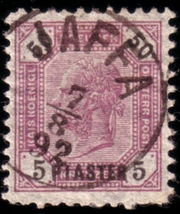
The stamps used were Austrian stamps for Lombardy-Venetia and, after 1867, Austrian Levant
Levant
The Levant or ) is the geographic region and culture zone of the "eastern Mediterranean littoral between Anatolia and Egypt" . The Levant includes most of modern Lebanon, Syria, Jordan, Israel, the Palestinian territories, and sometimes parts of Turkey and Iraq, and corresponds roughly to the...
stamps, as pictured here.
French
The French operated a number of post offices in the Ottoman empireFrench post offices in the Ottoman Empire
The French post offices in the Ottoman Empire were post offices in various cities of the Ottoman Empire run by France between 1812 and 1923. France was one of nine countries that had negotiated "Capitulations" with the Ottomans, various extraterritorial rights in exchange for trade opportunities...
, often in conjunction with the local French consulates. In Palestine, three offices were opened: Jaffa (1852), Jerusalem (1890) and Haifa (1906). The stamps used were regular French ones, after 1885 stamps overprinted in Turkish currency, and from 1902 also French Levant stamps. Of the French
France
The French Republic , The French Republic , The French Republic , (commonly known as France , is a unitary semi-presidential republic in Western Europe with several overseas territories and islands located on other continents and in the Indian, Pacific, and Atlantic oceans. Metropolitan France...
postal arrangement, Porter describes it as "quick and safe, though frequently altered." French mail-steamers, known as the Messagerie Imperiale ("Postal Line"), operated by the Compagnie des Services Maritimes des Messageries Nationales, departed every fortnight from the coast of Syria to Alexandria
Alexandria
Alexandria is the second-largest city of Egypt, with a population of 4.1 million, extending about along the coast of the Mediterranean Sea in the north central part of the country; it is also the largest city lying directly on the Mediterranean coast. It is Egypt's largest seaport, serving...
and Constantinople. From the ports at Alexandretta, Latikia
Latakia
Latakia, or Latakiyah , is the principal port city of Syria, as well as the capital of the Latakia Governorate. In addition to serving as a port, the city is a manufacturing center for surrounding agricultural towns and villages...
, Tripoli
Tripoli, Lebanon
Tripoli is the largest city in northern Lebanon and the second-largest city in Lebanon. Situated 85 km north of the capital Beirut, Tripoli is the capital of the North Governorate and the Tripoli District. Geographically located on the east of the Mediterranean, the city's history dates back...
, Beirut, and Yâfa
Jaffa
Jaffa is an ancient port city believed to be one of the oldest in the world. Jaffa was incorporated with Tel Aviv creating the city of Tel Aviv-Yafo, Israel. Jaffa is famous for its association with the biblical story of the prophet Jonah.-Etymology:...
, letters could be posted to Italy, France, England or America.
German
Auxiliary collecting agencies existed in Ramleh (1902), Rishon LeTzion (1905), Wilhelma Hamidije
Wilhelma, Palestine
Wilhelma was a German Templer colony in Palestine located southwest of al-'Abbasiyyah near Jaffa.Wilhelma-Hamîdije was named in honour of King William II of Württemberg, Emperor Wilhelm II and Sultan Abdul Hamid II, however, only the first half of the name prevailed...
(1905), Sarona
Sarona, Palestine
Sarona was a German Templer colony northeast of the city of Jaffa. It was one of the earliest modern villages established in Palestine. Today it is a neighborhood in Tel Aviv, Israel.- History :...
(1910), Emmaus
Imwas
Imwas was a Palestinian Arab village located southeast of the city of Ramla and from Jerusalem in the Latrun salient of the West Bank. Often identified with the biblical Emmaus, over the course of two millennia, Imwas was intermittently inhabited and was ruled by the Romans , Arab caliphates,...
(1909), Sebil Abu Nebbut (1902, a quarantine station at the Jaffa city boundary), and Jerusalem's Jaffa Gate. Mail collecting points were also present in Beit Jala
Beit Jala
Beit Jala is an Arab Christian town in the Bethlehem Governorate of the West Bank. Beit Jala is located 10 km south of Jerusalem, on the western side of the Hebron road, opposite Bethlehem, at altitude...
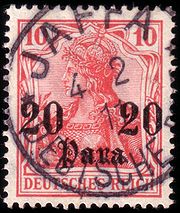
, Bethlehem, Hebron, and Ramallah. Regular German stamps, and stamps overprinted in Turkish currency, and French currency were in use. Stamps were only cancelled at the three post offices, mail from the agencies received boxed cachets.
Italian
The Italian post office in Jerusalem opened on June 1, 1908. Temporarily closed between October 1, 1911 to November 30, 1912, it operated until September 30, 1914. The stamps used were regular (unoverprinted) Italian ones, stamps overprinted in Turkish currency, and stamps overprinted Gerusalemme.Egyptian
An EgyptEgypt
Egypt , officially the Arab Republic of Egypt, Arabic: , is a country mainly in North Africa, with the Sinai Peninsula forming a land bridge in Southwest Asia. Egypt is thus a transcontinental country, and a major power in Africa, the Mediterranean Basin, the Middle East and the Muslim world...
ian post office operated in Jaffa between July 1870 and February 1872. The postmark reads V.R. Poste Egiziane Iaffa. An interpostals seal for Jaffa also exists.
Other
EnglishEngland
England is a country that is part of the United Kingdom. It shares land borders with Scotland to the north and Wales to the west; the Irish Sea is to the north west, the Celtic Sea to the south west, with the North Sea to the east and the English Channel to the south separating it from continental...
travellers in the region could receive mail from abroad if addressed to the care of the English consuls in Beirut, Aleppo, Jerusalem or Damascus, or alternatively to the care of a merchant or banker.
British military and civil administration (1917–1948)
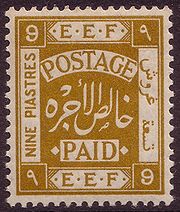
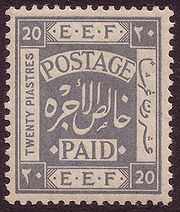
British E.E.F. stamps and service (1917–1920)
In November 1917, the BritishUnited Kingdom
The United Kingdom of Great Britain and Northern IrelandIn the United Kingdom and Dependencies, other languages have been officially recognised as legitimate autochthonous languages under the European Charter for Regional or Minority Languages...
Egyptian Expeditionary Force
Egyptian Expeditionary Force
The Egyptian Expeditionary Force was formed in March 1916 to command the British and British Empire military forces in Egypt during World War I. Originally known as the 'Force in Egypt' it had been commanded by General Maxwell who was recalled to England...
occupied Palestine. Initially, the Egyptian Expeditionary Force (and the Indian Expeditionary Force) had given civilian
Civilian
A civilian under international humanitarian law is a person who is not a member of his or her country's armed forces or other militia. Civilians are distinct from combatants. They are afforded a degree of legal protection from the effects of war and military occupation...
s basic postal services for free, with additional services paid in British or India
India
India , officially the Republic of India , is a country in South Asia. It is the seventh-largest country by geographical area, the second-most populous country with over 1.2 billion people, and the most populous democracy in the world...
n stamps. Free mail was withdrawn with the printing of appropriate stamps. Two stamps inscribed E.E.F. (1 Piastre, and 5 Millièmes) were issued in February 1918, the first definitive
Definitive
Definitive may refer to:* Definitive , an American music television series* Definitive stamp, a postage stamp that is part of a regular issue of a country's stamps available for sale by the postal service...
s (11 values) were circulated from June 1918. These E.E.F. stamps were valid in Palestine
Palestine
Palestine is a conventional name, among others, used to describe the geographic region between the Mediterranean Sea and the Jordan River, and various adjoining lands....
, Cilicia
Cilicia
In antiquity, Cilicia was the south coastal region of Asia Minor, south of the central Anatolian plateau. It existed as a political entity from Hittite times into the Byzantine empire...
, Syria
Syria
Syria , officially the Syrian Arab Republic , is a country in Western Asia, bordering Lebanon and the Mediterranean Sea to the West, Turkey to the north, Iraq to the east, Jordan to the south, and Israel to the southwest....
, Lebanon
Lebanon
Lebanon , officially the Republic of LebanonRepublic of Lebanon is the most common term used by Lebanese government agencies. The term Lebanese Republic, a literal translation of the official Arabic and French names that is not used in today's world. Arabic is the most common language spoken among...
, and Transjordan
Transjordan
The Emirate of Transjordan was a former Ottoman territory in the Southern Levant that was part of the British Mandate of Palestine...
. Prior to the British Mandate in Palestine, Hebrew
Hebrew language
Hebrew is a Semitic language of the Afroasiatic language family. Culturally, is it considered by Jews and other religious groups as the language of the Jewish people, though other Jewish languages had originated among diaspora Jews, and the Hebrew language is also used by non-Jewish groups, such...
was not an official language, and so these stamps bore only Arabic inscriptions besides English.
British Mandate (1920–1948)
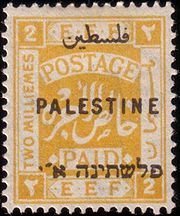
As Palestine came under the civil administration of the British Mandate of Palestine, falling into line with League of Nations
League of Nations
The League of Nations was an intergovernmental organization founded as a result of the Paris Peace Conference that ended the First World War. It was the first permanent international organization whose principal mission was to maintain world peace...
rules, the High Commissioner sanctioned stamps (as pictured here) and coins bearing the three official languages of British Mandate Palestine: English, Arab, and Hebrew.
Between 1920 and 1923 six such distinctive overprints were issued: four produced in Jerusalem, two in London.
Local Jews and Arabs lobbied the British about the overprint (pictured):
The Jewish members of the[Advisory] Council objected to the Hebrew transliteration of the word "Palestine", on the ground that the traditional name was "Eretz Yisrael", but the Arab members would not agree to this designation, which, in their view, had political significance. The High Commissioner therefore decided, as a compromise, that the Hebrew transliteration should be used, followed always by the two initial letters of "Eretz Yisrael", Aleph Yod, and this combination was always used on the coinage and stamps of Palestine and in all references in official documents.
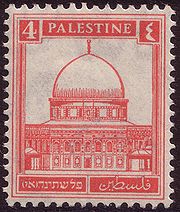
Postage stamps and postal history of Great Britain
Postage stamps and postal history of Great Britain surveys postal history from the United Kingdom and the postage stamps issued by that country and its various historical territories until the present day....
service designed its first four stamps in 1923, upon the suggestion of the Sir Herbert Samuel
Herbert Samuel, 1st Viscount Samuel
Herbert Louis Samuel, 1st Viscount Samuel GCB OM GBE PC was a British politician and diplomat.-Early years:...
(the High Commissioner), following a public invitation for designs. The first values in this series of definitive stamps were issued on June 1, 1927. The stamps pictured the Rachel's Tomb
Rachel's Tomb
Rachel's Tomb , also known as the Dome of Rachel, , is an ancient structure believed to be the burial place of the biblical matriarch Rachel. It is located on the outskirts of Bethlehem, a Palestinian city just south of Jerusalem, in the West Bank...
, the Tower of David
Tower of David
The Tower of David is an ancient citadel located near the Jaffa Gate entrance to the Old City of Jerusalem.Built to strengthen a strategically weak point in the Old City's defenses, the citadel that stands today was constructed during the 2nd century BC and subsequently destroyed and rebuilt by,...
, the Dome of the Rock
Dome of the Rock
The Dome of the Rock is a shrine located on the Temple Mount in the Old City of Jerusalem. The structure has been refurbished many times since its initial completion in 691 CE at the order of Umayyad Caliph Abd al-Malik...
, and a view of a mosque in Tiberias and the Sea of Galilee
Sea of Galilee
The Sea of Galilee, also Kinneret, Lake of Gennesaret, or Lake Tiberias , is the largest freshwater lake in Israel, and it is approximately in circumference, about long, and wide. The lake has a total area of , and a maximum depth of approximately 43 m...
. According to Reid, the British Mandate "scenes carefully balanced sites of significance to Muslims, Jews, and Christians."
The postal service operated by the Mandatory authorities was reputed to be the best in the Middle East. Letters were delivered daily in Jerusalem. Palestine joined the Universal Postal Union
Universal Postal Union
The Universal Postal Union is an international organization that coordinates postal policies among member nations, in addition to the worldwide postal system. The UPU contains four bodies consisting of the Congress, the Council of Administration , the Postal Operations Council and the...
in October 1923. The post was transported by boat, train, cars and horses, and after 1927, also by air. Sale and exchange of International Reply Coupon
International reply coupon
An international reply coupon is a coupon that can be exchanged for one or more postage stamps representing the minimum postage for an unregistered priority airmail letter of up to twenty grams sent to another Universal Postal Union member country...
s started in 1926 and were joined by Imperial Reply Coupons from January 1, 1935.
In 1933, the British Post offices in Palestine and Iraq
Iraq
Iraq ; officially the Republic of Iraq is a country in Western Asia spanning most of the northwestern end of the Zagros mountain range, the eastern part of the Syrian Desert and the northern part of the Arabian Desert....
were the first places to use air letter cards. During the volatility of 1947 and 1948, British postal services deteriorated and were replaced by ad hoc interim services prior to the partition and the establishment of the State of Israel. Just before the formal end to the British Mandate over Palestine, the Mandatory government destroyed the existing stocks of postage stamps and had Palestine removed from the World Postal Union
Universal Postal Union
The Universal Postal Union is an international organization that coordinates postal policies among member nations, in addition to the worldwide postal system. The UPU contains four bodies consisting of the Congress, the Council of Administration , the Postal Operations Council and the...
. A total of 104 stamps bearing the name "Palestine" were issued by the British between 1918 and 1942.
Mandate post offices
During the British Mandate over Palestine about 160 post offices, rural agencies, travelling post offices, and town agencies operated, some only for a few months, others for the entire length of the period. Upon the advance of allied forces in 1917 and 1918, initially Field Post Offices and Army Post Offices served the local civilian population. Some of the latter offices were converted to Stationary Army Post Offices and became civilian post offices upon establishment of the civilian administration. In 1919 fifteen offices existed, rising to about 100 by 1939, and about 150 by the end of the Mandate in May 1948. With most of the Jerusalem General Post Office archives destroyed, research depends heavily on philatelists recording distinct postmarks and dates of their use.Mandate postal rates
After occupation by allied forces in 1917, basic postage was free for civilians. Registration fees and parcels had to be franked using British or Indian stamps. Once the EEF stamps printed in Cairo came on sale, mail to overseas destinations had to be paid for from 10 February 1918, and from 16 February 1918 also mail to the then occupied territories and Egypt.The structure of postal rates followed broadly British practice and new services, like airmail and express delivery, were added over the years. From 1926 reduced rates applied for mail to Britain and Ireland, and from 1 March 1938 to 4 September 1939, Palestine was part of the All Up Empire airmail rates system.
Transitional and local postal services (1948)
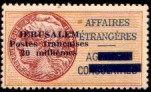
In Jerusalem, the French consulate
French Consulate
The Consulate was the government of France between the fall of the Directory in the coup of 18 Brumaire in 1799 until the start of the Napoleonic Empire in 1804...
is claimed to have issued stamps in May 1948 for its staff and local French nationals. The French stamps supposedly went through three issues: the first and second were "Affaires Étrangères" stamps, inscribed gratis
Gratis
Gratis is the process of providing goods or services without compensation. It is often referred to in English as "free of charge" or "complimentary"...
but overprinted, while the third were "Marianne
Marianne
Marianne is a national emblem of France and an allegory of Liberty and Reason. She represents the state and values of France, differently from another French cultural symbol, the "Coq Gaulois" which represents France as a nation and its history, land, culture, and variety of sport disciplines in...
" stamps (6 francs) that arrived from France by the end of May. The consulate also created its own cancellation: Jerusalem Postes Françaises. Philatelic research has exposed the French Consular post as a fraud perpertrated by the son of the then consul, though other philatelists have maintained their claims that the postal service and its stamps are genuine.
Minhelet Ha'am
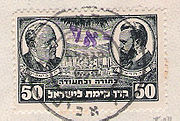
Provisional government of Israel
The provisional government of Israel was the temporary cabinet which governed Israel from shortly before independence until the formation of the first government in March 1949 following the first Knesset elections in January that year....
, did not have its own postage stamps ready, so it used existing labels, both JNF
Jewish National Fund
The Jewish National Fund was founded in 1901 to buy and develop land in Ottoman Palestine for Jewish settlement. The JNF is a quasi-governmental, non-profit organisation...
labels, which otherwise have been printed since 1902 for fundraising purposes, and local community tax stamps. The JNF labels were given a Hebrew overprint
Overprint
An overprint is an additional layer of text or graphics added to the face of a postage stamp or banknote after it has been printed. Post offices most often use overprints for internal administrative purposes such as accounting but they are also employed in public mail...
meaning postage (doar), (as shown in the picture), whereas local community tax stamps were not given overprints. The JNF stamps were printed from May 3 to 14, 1948, their sale ended on May 14, 1948, with remaining stocks ordered to be returned and destroyed. Use of these stamps was tolerated until May 22, 1948. The Mandate's postal rates remained unchanged during this period.
Since Jerusalem was under siege
Siege of Jerusalem (1948)
The Battle for Jerusalem occurred from 30 November 1947 to 11 June 1948 when Jewish and Arab population of Mandatory Palestine and later Israeli and Jordanian armies fought for the control of the city....
, its residents continued to use JNF stamps until June 20, 1948, whereupon Israeli stamps reached the city. These stamps, overprinted with a JNF seal, bore a map of the UN Partition Plan.
Minhelet Ha'am used 31 different JNF labels. Owing to different denomination and overprints, there are at least 104 variants catalogued. Eight of the stamps feature Jewish Special operations
Special Operations Executive
The Special Operations Executive was a World War II organisation of the United Kingdom. It was officially formed by Prime Minister Winston Churchill and Minister of Economic Warfare Hugh Dalton on 22 July 1940, to conduct guerrilla warfare against the Axis powers and to instruct and aid local...
paratroopers killed during WWII, including Abba Berdichev, Hannah Szenes
Hannah Szenes
Hannah Szenes , often anglicized as Hannah Senesh was a Hungarian Jew, one of 37 Jews from the British Mandate for Palestine that were trained by the British army to parachute into Yugoslavia during the Second World War in order to help save the Jews of Hungary, who were about to be deported to...
, and Haviva Reik
Haviva Reik
Haviva Reick was one of 32 or 33 Palestinian Jewish parachutists sent by the Jewish Agency and Britain's Special Operations Executive on military missions in Nazi-occupied Europe....
, Enzo Sereni
Enzo Sereni
Enzo Sereni was an Italian Zionist, co-founder of kibbutz Givat Brenner, scholar, advocate of Jewish-Arab co-existence and a resistance fighter who was parachuted into Nazi-occupied Italy in World War II, captured by the Germans and executed in Dachau concentration camp.Sereni was born in Rome....
. The JNF also honored kibbutz
Kibbutz
A kibbutz is a collective community in Israel that was traditionally based on agriculture. Today, farming has been partly supplanted by other economic branches, including industrial plants and high-tech enterprises. Kibbutzim began as utopian communities, a combination of socialism and Zionism...
im Hanita
Hanita
Hanita is a kibbutz in northern Israel. Located in the western Galilee approximately 15 kilometres northeast of Nahariya, it falls under the jurisdiction of Mateh Asher Regional Council. In 2011 it had a population of 500....
and Tirat Zvi
Tirat Zvi
Tirat Zvi is a religious kibbutz in the Beit She'an Valley, ten kilometers south of the city of Beit She'an, Israel, just west of the Jordan River and the Israel-Jordan border. It falls under the jurisdiction of Valley of Springs Regional Council. In 2006, the kibbutz had a population of...
, the Jewish Brigade
Jewish Brigade
The Jewish Infantry Brigade Group was a military formation of the British Army that served in Europe during the Second World War. The brigade was formed in late 1944, and its personnel fought the Germans in Italy...
, the Technion, the Warsaw Ghetto uprising
Warsaw Ghetto Uprising
The Warsaw Ghetto Uprising was the Jewish resistance that arose within the Warsaw Ghetto in German occupied Poland during World War II, and which opposed Nazi Germany's effort to transport the remaining ghetto population to Treblinka extermination camp....
, an illegal immigrant ship, and Zionists Yehoshua Hankin
Yehoshua Hankin
Yehoshua Hankin was a Zionist activist who was responsible for most of the major land purchases of the World Zionist Organization in Ottoman Palestine....
, Chaim Weizmann
Chaim Weizmann
Chaim Azriel Weizmann, , was a Zionist leader, President of the Zionist Organization, and the first President of the State of Israel. He was elected on 1 February 1949, and served until his death in 1952....
, Eliezer Ben Yehuda, and, pictured here, Theodore Herzl with Chaim Nachman Bialik.
Local postal services
In the town of SafedSafed
Safed , is a city in the Northern District of Israel. Located at an elevation of , Safed is the highest city in the Galilee and of Israel. Due to its high elevation, Safed experiences warm summers and cold, often snowy, winters...
, the departure in April of the British left the Haganah
Haganah
Haganah was a Jewish paramilitary organization in what was then the British Mandate of Palestine from 1920 to 1948, which later became the core of the Israel Defense Forces.- Origins :...
trying to establish control. The Haganah enlisted a postal clerk to print up postal envelopes, which were never used, as well as 2,200 stamps (10 mils each). On the stamps was written, in Hebrew: Safed mail Eretz Israel. Once stamped, mail was routed by the Haganah through Rosh Pina. These Safed emergency stamps were the only ones issued by the Haganah. The "Doar Ivri" stamps issued by Minhelet Ha'am went on sale in Safed on May 16, 1948.
In rural Rishon Lezion, the local council voted to issue their own stamps and provide a mail service via armored car
Armored car (valuables)
A common meaning of armored car is as an armored van or truck, used in transporting valuables, such as large quantities of money . The armored car is a multifunctional vehicle designed to protect and ensure the well being of the transported individuals and/or contents...
. The stamps were first sold on April 4, 1948, more than a month before the establishment of the state of Israel, and service discontinued on May 6. These stamps were not authorized by Minhelet Ha'am.
During the 1948 War
1948 Arab-Israeli War
The 1948 Arab–Israeli War, known to Israelis as the War of Independence or War of Liberation The war commenced after the termination of the British Mandate for Palestine and the creation of an independent Israel at midnight on 14 May 1948 when, following a period of civil war, Arab armies invaded...
the city of Nahariya
Nahariya
Nahariya is the northernmost coastal city in Israel, with an estimated population of 51,200.-History:Nahariya was founded by German Jewish immigrants from the Fifth Aliyah in the 1930s...
was cut off and the town administration, without authorization from Minhelet Ha'am, issued local stamps.
Post-1948
Since 1948, the postal administrations for the region have been Egypt, Jordan, Israel and the Palestinian National Authority.Egypt and Jordan
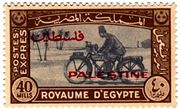
Egypt
Egypt , officially the Arab Republic of Egypt, Arabic: , is a country mainly in North Africa, with the Sinai Peninsula forming a land bridge in Southwest Asia. Egypt is thus a transcontinental country, and a major power in Africa, the Mediterranean Basin, the Middle East and the Muslim world...
and Jordan
Jordan
Jordan , officially the Hashemite Kingdom of Jordan , Al-Mamlaka al-Urduniyya al-Hashemiyya) is a kingdom on the East Bank of the River Jordan. The country borders Saudi Arabia to the east and south-east, Iraq to the north-east, Syria to the north and the West Bank and Israel to the west, sharing...
provided the postal stamps for Gaza
Gaza
Gaza , also referred to as Gaza City, is a Palestinian city in the Gaza Strip, with a population of about 450,000, making it the largest city in the Palestinian territories.Inhabited since at least the 15th century BC,...
and the West Bank
West Bank
The West Bank ) of the Jordan River is the landlocked geographical eastern part of the Palestinian territories located in Western Asia. To the west, north, and south, the West Bank shares borders with the state of Israel. To the east, across the Jordan River, lies the Hashemite Kingdom of Jordan...
and Jerusalem between 1948 and 1967. Both countries overprinted their own stamps with the word "Palestine". Of these "Palestine" stamps, 44 issued by Jordan and 180 issued by Egypt are listed in the Scott catalogue
Scott catalogue
The Scott catalogue of postage stamps, published by Scott Publishing Co, a subsidiary of Amos Press, is updated annually and lists all the stamps of the entire world which its editors recognize as issued for postal purposes. It is published in six large volumes and is also produced in...
s. On occasion, the Arab Higher Committee
Arab Higher Committee
The Arab Higher Committee was the central political organ of the Arab community of Mandate Palestine. It was established on 25 April 1936, on the initiative of Hajj Amin al-Husayni, the Grand Mufti of Jerusalem, and comprised the leaders of Palestinian Arab clans under the mufti's...
and other entities have issued propaganda labels.
By May 5, 1948, Egypt
Egypt
Egypt , officially the Arab Republic of Egypt, Arabic: , is a country mainly in North Africa, with the Sinai Peninsula forming a land bridge in Southwest Asia. Egypt is thus a transcontinental country, and a major power in Africa, the Mediterranean Basin, the Middle East and the Muslim world...
set up postal services and issued overprints of Egyptian stamps
Postage stamps and postal history of Egypt
This is a survey of the postage stamps and postal history of Egypt. Handstamps were first introduced during the Napoleonic period, 1798-1800. Single line handstamps are known from "ALEXANDRIE", "LE CAIRE", "BENESOUEF" and "SIOUTH"....
, with Palestine in Arabic and English. Egypt primarily employed definitives, with one express stamp, picturing a motorbike, and airmail stamps featuring King Farouk.
In the West Bank
West Bank
The West Bank ) of the Jordan River is the landlocked geographical eastern part of the Palestinian territories located in Western Asia. To the west, north, and south, the West Bank shares borders with the state of Israel. To the east, across the Jordan River, lies the Hashemite Kingdom of Jordan...
, prior to its incorporation into Transjordan
Transjordan
The Emirate of Transjordan was a former Ottoman territory in the Southern Levant that was part of the British Mandate of Palestine...
in 1950, Jordanian authorities issued stamps from 1948 until April 1950. With overprints of "Palestine" in Arabic and English, the Jordanians used definitives, postage dues, and obligatory tax stamps.
Israel
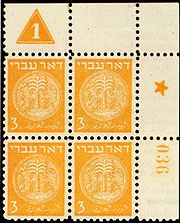
Postage due
Postage due is the term used for mail sent with insufficient postage. A postage due stamp is a stamp added to an underpaid piece of mail to indicate the extra postage due.- Background :...
stamps, tete-beche
Tête-bêche
In philately, tête-bêche is a joined pair of stamps in which one is upside-down in relation to the other, produced intentionally or accidentally. Like any pair of stamps, a pair of tête-bêches can be a vertical or a horizontal pair. In the case of a pair of triangular stamps, they cannot help but...
and gutter pairs
Gutter (philately)
The philatelic use of the word gutter is the space left between postage stamps which allows them to be separated or perforated. When stamps are printed on large sheets of paper that will be guillotined into smaller sheets along the gutter it will not exist on the finished sheet of stamps...
in 1948, airmail stamps in 1950, official mail
Official mail
Official mail is mail sent from, or by an authorised department of government, governmental agency or international organization and normally has some indication that it is official; a certifying cachet, return address or other means of identity, indicating its user...
stamps in 1951 and provisional stamp
Provisional stamp
Linn's World Stamp Almanac defines a provisional stamp as "a postage stamp issued for temporary use to meet postal demands until new or regular stocks of stamps can be obtained."...
s in 1960. The Israel Defense Forces
Israel Defense Forces
The Israel Defense Forces , commonly known in Israel by the Hebrew acronym Tzahal , are the military forces of the State of Israel. They consist of the ground forces, air force and navy. It is the sole military wing of the Israeli security forces, and has no civilian jurisdiction within Israel...
operate a military postal system but, in 1948, dropped plans to print their own stamps.
In 1955, Israel's first mobile post office
Mobile post office
Mobile post offices deliver mail and other postal services through specially equipped vehicles, such as trucks and trains.-United Kingdom:The United Kingdom pioneered the modern use of what it calls the Travelling Post Office , a railway service that operated for the first time in 1838...
began in the Negev
Negev
The Negev is a desert and semidesert region of southern Israel. The Arabs, including the native Bedouin population of the region, refer to the desert as al-Naqab. The origin of the word Neghebh is from the Hebrew root denoting 'dry'...
. By 1990, Israel ran 53 routes for 1,058 locations, including Israeli settlements in the West Bank
West Bank
The West Bank ) of the Jordan River is the landlocked geographical eastern part of the Palestinian territories located in Western Asia. To the west, north, and south, the West Bank shares borders with the state of Israel. To the east, across the Jordan River, lies the Hashemite Kingdom of Jordan...
and Gaza
Gaza
Gaza , also referred to as Gaza City, is a Palestinian city in the Gaza Strip, with a population of about 450,000, making it the largest city in the Palestinian territories.Inhabited since at least the 15th century BC,...
. Due to hyperinflation
Hyperinflation
In economics, hyperinflation is inflation that is very high or out of control. While the real values of the specific economic items generally stay the same in terms of relatively stable foreign currencies, in hyperinflationary conditions the general price level within a specific economy increases...
, in 1982 and 1984 Israel issued non-denominated stamps
Non-denominated postage
Non-denominated postage is postage intended to meet a certain postage rate that retains full validity for that intended postage rate even after the rate is increased. It does not show a monetary value, or denomination, on the face. In many English speaking countries, it is called non-value...
. During the 1990s, Israel experimented with vending machines for postal labels (franking labels).
The country produced a total of 110 new issues in the 1960s, 151 in the 1970s, 162 in the 1980s and 216 in the 1990s. More than 320 new stamps have been created since 2000. Israel stamps have distinctive tabs, on the margins of printed sheets, with inscriptions in Hebrew and usually English or French. The design of national and local postmarks is also popular.
From 1967 until 1994, Israel operated postal services in the occupied territories of the West Bank
West Bank
The West Bank ) of the Jordan River is the landlocked geographical eastern part of the Palestinian territories located in Western Asia. To the west, north, and south, the West Bank shares borders with the state of Israel. To the east, across the Jordan River, lies the Hashemite Kingdom of Jordan...
and the Gaza Strip
Gaza Strip
thumb|Gaza city skylineThe Gaza Strip lies on the Eastern coast of the Mediterranean Sea. The Strip borders Egypt on the southwest and Israel on the south, east and north. It is about long, and between 6 and 12 kilometres wide, with a total area of...
. It continues to operate postal services in occupied East Jerusalem
East Jerusalem
East Jerusalem or Eastern Jerusalem refer to the parts of Jerusalem captured and annexed by Jordan in the 1948 Arab-Israeli War and then captured and annexed by Israel in the 1967 Six-Day War...
and the Syrian Golan Heights.
Palestinian National Authority
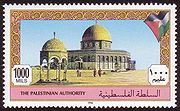
Palestinian National Authority
The Palestinian Authority is the administrative organization established to govern parts of the West Bank and Gaza Strip...
(PNA) established post offices throughout the PNA, developed its own unique postmark
Postmark
thumb|USS TexasA postmark is a postal marking made on a letter, package, postcard or the like indicating the date and time that the item was delivered into the care of the postal service...
s and issued stamps. The PNA has issued dozens of stamps and souvenir sheets since 1994, with the exception of 2004 and 2007.
The PNA is authorized to issue manage postal operations, issue stamps and postal stationery, and set rates, under agreements signed between Israel and the PNA following the Oslo Accords
Oslo Accords
The Oslo Accords, officially called the Declaration of Principles on Interim Self-Government Arrangements or Declaration of Principles , was an attempt to resolve the ongoing Palestinian-Israeli conflict...
. In 1999, the PNA and Israel agreed that PNA mail could be sent directly to Egypt and Jordan. The PNA's Ministry of Telecom & Information Technology has sharply criticized postal services in areas under Israeli control.
Despite some initial doubts in philatelic circles, the PNA stamps came to be used for postal activities within Palestine and for international postal communications as well. The Universal Postal Union
Universal Postal Union
The Universal Postal Union is an international organization that coordinates postal policies among member nations, in addition to the worldwide postal system. The UPU contains four bodies consisting of the Congress, the Council of Administration , the Postal Operations Council and the...
and its member countries generally do not recognize stamps issued by administrations that have not achieved full independence, though the UPU maintains ties and supports these administrations.
Labels issued by The Jewish National Fund
The Jewish National FundJewish National Fund
The Jewish National Fund was founded in 1901 to buy and develop land in Ottoman Palestine for Jewish settlement. The JNF is a quasi-governmental, non-profit organisation...
(JNF) produced and sold thirty million labels between 1902 and 1914 as "promotional materials" to "help spread the message of Zionism
Zionism
Zionism is a Jewish political movement that, in its broadest sense, has supported the self-determination of the Jewish people in a sovereign Jewish national homeland. Since the establishment of the State of Israel, the Zionist movement continues primarily to advocate on behalf of the Jewish state...
." The "Zion" label was its biggest seller with 20 million copies of this blue-and-white label with the Star of David
Star of David
The Star of David, known in Hebrew as the Shield of David or Magen David is a generally recognized symbol of Jewish identity and Judaism.Its shape is that of a hexagram, the compound of two equilateral triangles...
and the word "Zion
Zion
Zion is a place name often used as a synonym for Jerusalem. The word is first found in Samuel II, 5:7 dating to c.630-540 BCE...
" sold. Four million copies of the "Herzl" label, issued between 1909 and 1914, were sold. The label depicted Theodor Herzl
Theodor Herzl
Theodor Herzl , born Benjamin Ze’ev Herzl was an Ashkenazi Jew Austro-Hungarian journalist and the father of modern political Zionism and in effect the State of Israel.-Early life:...
gazing at a group of workers in Palestine, using the famous image of him on the Rhine Bridge from the First Zionist Congress
First Zionist Congress
The First Zionist Congress was the inaugural congress of the Zionist Organization held in Basel , Switzerland, from August 29 to August 31, 1897. It was convened and chaired by Theodor Herzl, the founder of the modern Zionism movement...
, superimposed onto a scene of a balcony overlooking the Old City of Jerusalem. Labels with pictures of Max Nordau
Max Nordau
Max Simon Nordau , born Simon Maximilian Südfeld in Pest, Hungary, was a Zionist leader, physician, author, and social critic....
, David Wolffsohn
David Wolffsohn
David Wolffsohn was a Jewish businessman, prominent early Zionist and second president of the Zionist Organization .Wolffsohn was born in Darbėnai, Lithuania, to religious parents, Isaac and Feiga. He received an observant religious education from his parents and in 1872 was sent to Germany to...
, the Wailing Wall, a map of Palestine, and historical scenes and landscape in Palestine, sold about one million copies each. A total of 266 different labels were produced by the JNF's Head Office in Jerusalem between 1902 and 1947.
Anglo Palestine Company
Labels were also issued by the Anglo Palestine CompanyBank Leumi
Bank Leumi is an Israeli bank. It was founded in London as the Anglo Palestine Company on February 27, 1902, by members of the Zionist movement to promote the industry, construction, agriculture, and infrastructure of Palestine.-History:...
(APC), the forerunner to Israel's Bank Leumi. In 1915, Ahmed Djemal
Ahmed Djemal
Djemal Pasha or Ahmed Djemal , was a Young Turk and member of the Three Pashas. Ahmed Djemal was also Mayor of Istanbul.- Biography :...
, who ruled over Syria
Syria
Syria , officially the Syrian Arab Republic , is a country in Western Asia, bordering Lebanon and the Mediterranean Sea to the West, Turkey to the north, Iraq to the east, Jordan to the south, and Israel to the southwest....
and Palestine
Palestine
Palestine is a conventional name, among others, used to describe the geographic region between the Mediterranean Sea and the Jordan River, and various adjoining lands....
on behalf of the Ottoman empire, issued an anti-Zionist
Anti-Zionism
Anti-Zionism is opposition to Zionistic views or opposition to the state of Israel. The term is used to describe various religious, moral and political points of view in opposition to these, but their diversity of motivation and expression is sufficiently different that "anti-Zionism" cannot be...
proclamation ordering the "confiscation of the postage stamps, Zionist flags, paper money, bank notes of the Anglo-Palestine Company, Ltd. in the form of checks which are spread among these elements and has decreed the dissolution of all the clandestine Zionist societies and institutions ..." After World War I, the APC relied on the postage stamps of British authorities, which were marked with an APC perforation, as shown here.
Labels issued by Palestinian Organisations
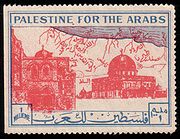
Arab Higher Committee
The Arab Higher Committee was the central political organ of the Arab community of Mandate Palestine. It was established on 25 April 1936, on the initiative of Hajj Amin al-Husayni, the Grand Mufti of Jerusalem, and comprised the leaders of Palestinian Arab clans under the mufti's...
(Beit al-Mal al-'Arabi, 1936), a series of three labels issued by the Arab Community Fund (Sandouk al-Umma al-'Arabi, no date known), and a series of five labels (1, 2, and 5 Mils; 1 and 2 US-Cents) inscribed Palestine For The Arabs and depicting the Dome of the Rock
Dome of the Rock
The Dome of the Rock is a shrine located on the Temple Mount in the Old City of Jerusalem. The structure has been refurbished many times since its initial completion in 691 CE at the order of Umayyad Caliph Abd al-Malik...
and the Church of the Holy Sepulchre
Church of the Holy Sepulchre
The Church of the Holy Sepulchre, also called the Church of the Resurrection by Eastern Christians, is a church within the walled Old City of Jerusalem. It is a few steps away from the Muristan....
in front of a map of Palestine
Palestine
Palestine is a conventional name, among others, used to describe the geographic region between the Mediterranean Sea and the Jordan River, and various adjoining lands....
(Jaffa, 1938).
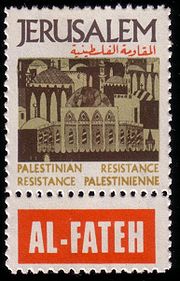
Syria and Lebanon Day (one label, no date known, 1940s?), Islamic Orphan House (five labels, no date known, 1940s?), General Union of Palestine Workers (one label, 5 Fils, no date known, 1960s?), Charitable Association for the Families of Prisoners and Detainees (one label, depicting a mother and child, no date known, 1960s?).
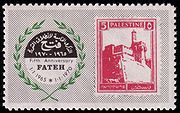
Palestine Liberation Organization
The Palestine Liberation Organization is a political and paramilitary organization which was created in 1964. It is recognized as the "sole legitimate representative of the Palestinian people" by the United Nations and over 100 states with which it holds diplomatic relations, and has enjoyed...
(PLO) issued in Gaza a 5 Mils label depicting a map and sun (1964). Fateh
Fatah
Fataḥ is a major Palestinian political party and the largest faction of the Palestine Liberation Organization , a multi-party confederation. In Palestinian politics it is on the left-wing of the spectrum; it is mainly nationalist, although not predominantly socialist. Its official goals are found...
(Palestinian National Liberation Movement) issued a number of series: ten labels (1968–69) and a sheet of four (1969?), mainly on the battle of Karameh
Karameh
al-Karameh is a town in Jordan, near the Allenby Bridge which spans the Jordan River. The river defines the border between Israel and Jordan....
, a series of three label commemorating the fifth anniversary of Fateh
Fatah
Fataḥ is a major Palestinian political party and the largest faction of the Palestine Liberation Organization , a multi-party confederation. In Palestinian politics it is on the left-wing of the spectrum; it is mainly nationalist, although not predominantly socialist. Its official goals are found...
(1970, motif: Mandate stamps).
Popular Front for the Liberation of Palestine
Popular Front for the Liberation of Palestine
The Popular Front for the Liberation of Palestine is a Palestinian Marxist-Leninist organisation founded in 1967. It has consistently been the second-largest of the groups forming the Palestine Liberation Organization , the largest being Fatah...
(PFLP) issues: set of four labels issued in 1969 or 1970. The labels Charitable Association for the Families of Prisoners and Detainees were issued in the 1970s with the PFLP name in English (two labels: 5 US-Cents and 5 US-$), followed by seven labels commemorating Ghassan Kanafani
Ghassan Kanafani
Ghassan Kanafani was a Palestinian writer and a leading member of the Popular Front for the Liberation of Palestine. He was assassinated by car bomb in Beirut, allegedly by the Mossad.- Early years :Ghassan Fayiz Kanafani was born in 1936 in the then Acre , British Mandate of Palestine...
(1974), a sheet of 25 labels depicting martyrs (1974) and a sheet of 12 labels with city views (1975).
Democratic Front for the Liberation of Palestine
Democratic Front for the Liberation of Palestine
The Democratic Front for the Liberation of Palestine is a Palestinian Marxist-Leninist, secular political and military organization. It is also frequently referred to as the Democratic Front, or al-Jabha al-Dimuqratiyah...
(DFLP) issued two sets of labels in the 1970s: five labels depicting martyrs and two labels with freedom fighters in font of the globe. The Palestinian Popular Struggle Front
Palestinian Popular Struggle Front
The Palestinian Popular Struggle Front , , is a militant Palestinian organization. The group was led by Dr. Samir Ghawshah until his death in 2009...
(PPSF) contributed two sets of labels with motifs Leila Khaled
Leila Khaled
Leila Khaled is a member of the Popular Front for the Liberation of Palestine . She is currently a member of the Palestinian National Council...
and party symbols (map, gun, Dome of the Rock
Dome of the Rock
The Dome of the Rock is a shrine located on the Temple Mount in the Old City of Jerusalem. The structure has been refurbished many times since its initial completion in 691 CE at the order of Umayyad Caliph Abd al-Malik...
). Other groups issuing propaganda labels in the 1970s include Organization for Arab Palestine
Arab Palestine Organization
Arab Palestine Organization is a former Palestinian political faction. It was formed in 1969, when the Nasserist wing of the Popular Front for the Liberation of Palestine - General Command split from the group. On August 5, official sources from the Palestine Liberation Organization confirmed...
and Action Organization for the Liberation of Palestine.
During the 1980s, at least 18 different labels pertain to the First Intifada
First Intifada
The First Intifada was a Palestinian uprising against the Israeli occupation of the Palestinian Territories. The uprising began in the Jabalia refugee camp and quickly spread throughout Gaza, the West Bank and East Jerusalem....
. For example, label sheets and miniature sheet
Miniature sheet
A souvenir sheet or miniature sheet is a small group of postage stamps still attached to the sheet on which they were printed. They may be either regular issues that just happen to be printed in small groups , or special issues often commemorating some event, such as a national anniversary,...
s reproduce the Mandate's 1927 Pictorials with overprints in English, French, German, and Arabic: Intifadah 7 December 1987 and Declaration of Statehood 15 November 1988.
Further reading
- 20th anniversary publication, World Philatelic Congress of Israel Holy Land & Judaica Societies. World Philatelic Congress of Israel, Holy Land and Judaica Societies. Downsview, Ont., Canada: The WPC, 1986.
- Ashkenazy, Danielle. Not Just for Stamp Collectors. Israel Ministry of Foreign Affairs. Feb. 25 1999.http://www.israel-mfa.gov.il/MFA/Israel%20beyond%20the%20conflict/New%20Postal%20and%20Philatelic%20Musuem See also Israeli government description.
- Bale, Michael H. (ed.). Holyland catalogue: stamps & postal history during the rule of the Ottoman Empire: Turkish & foreign post offices. Tel-Aviv: Chariot Global Marketing, 1999.
- Bard, Dr. Leslie A. Commercial Airmail Rates from Palestine to North America : 3 August 1933 to 30 April 1948. In: Israel Philatelist. 57:5, Oct
- Blau, Fred F. The air mail history of the Holyland. [Chicago]: 1988.
- Blau, Fred F. The Allied Military Air Mail to and from Palestine in WWII. In: Holy Land Postal History 1987 Autumn.
- Blau, Fred F. Air accident mail to and from Palestine and Israel. In The BAPIP Bulletin. No. 107-8, 1984
- Hirst, Herman H. and John C.W. Fields Palestine and Israel: Air Post History [review]. In: The BAPIP Bulletin. No. 8, 1954, p. 29.
- Lachman, S. Postage rates in Palestine and Israel. In: The BAPIP Bulletin. No. 2, 1952, p. 13–14
- McSpadden, Joseph Walker (1930). How They Carried the Mail: From the Post Runners of King Sargon to the Air Mail of Today. University of CaliforniaUniversity of CaliforniaThe University of California is a public university system in the U.S. state of California. Under the California Master Plan for Higher Education, the University of California is a part of the state's three-tier public higher education system, which also includes the California State University...
.
External links
- A Short Introduction to the Philately of Palestine (includes links for Collectors Societies and extensive bibliography)
- Society of Israel Philatelists (SIP)
- Cercle Français Philatélique d'Israël (CFPI) (fr)
- Oriental Philatelic Association of London (OPAL)
- Ottoman and Near East Philatelic Society (ONEPS)
- Sandafayre Stamp Atlas: Palestine