

Anti-Zionism

Encyclopedia
Anti-Zionism is opposition to Zionistic views
or opposition to the state of Israel
. The term is used to describe various religious, moral and political points of view in opposition to these, but their diversity of motivation and expression is sufficiently different that "anti-Zionism" cannot be seen as having a single ideology or source.
and later for the support of modern Israel
." Zionism is also "a political movement among Jews which holds that the Jews
are a nation
, and as such need to establish a national homeland", and as a religious movement within Orthodox Judaism
which perceives the Torah
as requiring Jews to establish a sovereign commonwealth in the Land of Israel
that is governed by Halakha
(Jewish law), and as "a movement to support the development and defense of the State of Israel, and to encourage Jews to settle there
." Therefore, anti-Zionism is opposition to these objectives; and people, organizations or governments that oppose these objectives can in some sense be described as anti-Zionist. "Progressive Jewish Thought and the New Anti-Semitism
," an essay published by the American Jewish Committee
, concludes that, with the maturing of Israel since its founding in 1948, the term anti-Zionism in scholarly work had come to mean advocating the elimination of the State of Israel. Opposition to defining Israel as a Jewish state is not necessarily synonymous with anti-Zionism. Many Israelis also hold this view, as do many Jewish and other supporters of Israel outside Israel. However, advocacy of the elimination of the State of Israel exists among some high-profile Jewish intellectuals and it has been argued that "Israel's Jewish accusers have played a crucial and disproportionate role in the upsurge of antisemitism precisely because they speak as Jews."
prior to the appearance of the messiah
, objection to the idea of a state based on maintenance of a Jewish majority
, differing democratic values and differing levels of geographical extension
.
Brian Klug
of The Guardian
has argued that anti-Zionism represents fair opposition to Israel. The legitimacy of anti-Zionist views has been disputed to the present day, including the more recent and disputed relationship between anti-Zionism and antisemitism. A range of other views regarding the various forms of anti-Zionism is discussed and debated.
, and trivializes antisemitism.
Professor Kenneth L. Marcus
, former staff director at the U.S. Commission on Civil Rights, identifies four main views on the relationship between anti-Zionism and antisemitism, at least in North America:
Marcus also states: "Unsurprisingly, recent research has shown a close correlation between anti-Israeli views and anti-Semitic views based on a survey of citizens in ten European countries."
Professor Robert S. Wistrich
, head of the Vidal Sassoon International Center for the Study of Antisemitism at the Hebrew University of Jerusalem
, is the originator of Marcus's second view of anti-Zionism (that anti-Zionism and antisemitism merged post-1948) argues that much contemporary anti-Zionism, particularly forms that compare Zionism and Jews with Hitler and the Third Reich, has become a form of antisemitism:
Dina Porat (head of the Institute for Study of Anti-semitism and Racism
at Tel-Aviv University) contends that anti-Zionism is anti-semitic because it is discriminatory:
Israel
i journalist
Ben-Dror Yemini maintains that anti-Zionism is "politically correct
antisemitism" and argues that the same way Jews were demonized, Israel is demonized, the same way the right of Jews to exist was denied, the right for Self-determination
is denied from Israel, the same way Jews were presented as a menace to the world, Israel is presented as a menace to the world.
In July 2001, the Simon Wiesenthal Center
reported that during a visit there, German Foreign Minister Joschka Fischer
stated that "anti-Zionism inevitably leads to antisemitism."
Brian Klug
has argued that anti-Zionism and antisemitism are distinct but not mutually exclusive concepts:
Some critics of Israeli policy argue that Israeli propagandists and supporters often try to equate anti-Zionism and sometimes even criticism of Israeli policy, with antisemitism, to silence opposition to Israeli policies. Noam Chomsky
for example argues:
, Zionism as an "expansionist threat" has caused Arab hostility toward Israel and even antisemitism. Anti-Zionist sentiment has increased with ongoing Arab Israeli conflicts: after the June 1967 Six-Day War
where Israel gained control of the Sinai Peninsula
, the Gaza Strip
, the West Bank
, East Jerusalem
, and the Golan Heights; during the 1982 Lebanon War
where Israel Defense Forces
invaded southern Lebanon
, attacking the PLO, as well as Syria
, leftist and Muslim
Lebanese
forces, leading to Israeli occupation of southern Lebanon; the 2002 Operation Defensive Shield
in the West Bank
, including the attack on the Jenin refugee camp
; the 2006 Lebanon War; and the 2008–2009 Israel–Gaza conflict
.
Pan-Arabist
narratives in the 1960s Nasser
era emphasized the idea of Palestine as a part of the Arab world
taken by others. In this narrative, the natural means of combating Zionism is Arab nations uniting and attacking Israel militarily. Pan-Syrian narratives, promoted mainly by Syria
, are essentially parallel.
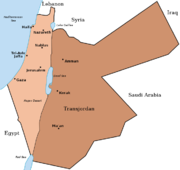 In contrast,a poll of 507 Arab-Israelis conducted by the Israeli Democracy Institute
in 2007 found that 75 percent profess support for Israel's status as a Jewish and democratic state which guarantees equal rights for minorities. Israeli Arab support for a constitution in general was 88 percent.
anti-Zionism considers the State of Israel an intrusion into what many Muslims consider to be Dar al-Islam, a domain rightfully, and permanently, ruled only by Muslims due the fact it was historically conquered in the name of Islam.
Palestinian and other Muslim groups, as well as the government of Iran (since the 1979 Islamic Revolution
), insist that the State of Israel is illegitimate and refuse to refer to it as "Israel," instead using the locution "the Zionist entity
" (see Iran-Israel relations
). Islamic maps of the Middle East frequently do not show the State of Israel. In an interview with Time Magazine in December 2006, Mahmoud Ahmadinejad said "Everyone knows that the Zionist regime is a tool in the hands of the United States
and British governments
."
The Grand Mufti of Jerusalem
Mohammed Amin al Husseini opposed the Jewish immigration to Palestine before the creation of the State of Israel, and in several documented cases expressed his hostility toward Jews in general and Zionists in particular.
to Theodore Herzl and his emerging movement of Zionism
, saying that as long as the Jews deny the divinity of Christ, the Church certainly could not make a declaration in their favor. The Holy See
did not establish relations with Israel until 1993 because of these issues.
has been described by some as taking anti-Zionist positions in connection with its criticisms of Israeli policy. They believe the council has focused disproportionately on activities and publications criticizing Israel in comparison with other human rights issues. The council members have been characterized by Israel's former Justice minister Amnon Rubinstein
as anti-Zionist, saying "they just hate Israel."
" in the Soviet Union
, Zionism was outlawed. But by the late 1930s, the official position of Zionism began to change to a more favourable one. In the Soviet encyclopedia of this time, it was stated that Jewish migration to Palestine had become a "progressive factor" because many of the workers stood on the left. At the beginning of 1947, the Soviet Union supported the partition of Palestine. Stalin wanted to use the Jews in Palestine against British imperialism, and to establish a point of support for the USSR in the Middle East.
During the last years of Stalin's rule, official support for the creation of Israel in 1948 was replaced by strong anti-zionism. The level of confrontation with those deemed as anti-Soviet "Jewish nationalists" was toned down after Stalin's death in 1953, but the official position of opposition to Zionism remained in force: the Anti-Zionist Committee of the Soviet Public
, as well as numerous other initiatives, were state-sponsored.
As outlined in the third edition of the Great Soviet Encyclopedia
(1969–1978), the Communist Party of the Soviet Union
's position during the Cold War
became: "the main posits of modern Zionism are militant chauvinism
, racism
, anti-Communism
and anti-Sovietism
,... overt and covert fight against freedom movements and the USSR."
At the same time, the spectre of Jewish allegiance to Israel amid the tensions of the Arab-Israeli conflict raised fears of internal dissent and opposition. The Soviet government liquidated almost all remaining Jewish organizations. It placed synagogue
s under police surveillance, both openly and through the use of informers
. At the same time, the general restriction on the right of refuseniks, or Soviet Jews seeking to emigrate for Israel, emerged as a major human rights
issue in the West. (See Jackson-Vanik amendment
.)
, which passed resolutions condemning Zionism and equating it with racism and apartheid during the early 1970s. This culminated in the passing by the United Nations General Assembly
of Resolution 3379
in November 1975, which declared that "Zionism is a form of racism."
The decision was revoked on December 16, 1991, when the General Assembly passed Resolution 4686
, repealing resolution 3379, by a vote of 111 to 25, with 13 abstentions and 17 delegations absent. Thirteen out of the 19 Arab countries, including those engaged in negotiations with Israel, voted against the repeal, another six were absent. No Arab country voted for repeal. The Palestine Liberation Organisation denounced the vote. All of the ex-communist countries and most of the African countries who had supported Resolution 3379 voted to repeal it. Only three non-Muslim countries voted against the resolution: Cuba
, North Korea
and Vietnam
. The rest abstained (including Turkey
) or absented themselves.
occupied Palestinian
territory following the 1967 Six-Day War
, some African-Americans supported the Palestinians and criticized Israel's actions, for example by publicly supporting Palestinian leader Yassir Arafat and calling for the destruction of the Jewish state. Immediately after the war, the black power
organization Student Nonviolent Coordinating Committee
published a newsletter criticizing Israel, and asserting that the war was an effort to regain Palestinian land and that during the 1948 war, "Zionists
conquered the Arab homes and land through terror, force, and massacres". In 1993, philosopher Cornel West
wrote: "Jews will not comprehend what the symbolic predicament and literal plight of Palestinans in Israel means to blacks.... Blacks often perceive the Jewish defense of the state of Israel as a second instance of naked group interest, and, again, an abandonment of substantive moral deliberation." African-American support of Palestinians is frequently due to the consideration of Palestinians as people of color – political scientist Andrew Hacker
writes: "The presence of Israel in the Middle East is perceived as thwarting the rightful status of people of color. Some blacks view Israel as essentially a white and European power, supported from the outside, and occupying space that rightfully belongs to the original inhabitants of Palestine."
, the Hebrew word meaning "ascending" or "going up" is the word used to describe religious Jewish return to Israel, and has been used since ancient times. From the Middle Ages
and onwards, many famous rabbis and often their followers, returned to the land of Israel. These have included Nahmanides
, Yechiel of Paris
, Isaac Luria
, Yosef Karo
, Menachem Mendel of Vitebsk
among others. For Jews in the Diaspora
Eretz Israel was revered in a religious sense. They prayed, and thought of the return, as being fulfilled in a messianic age. Return remained a recurring theme for generations, particularly in Passover
and Yom Kippur
prayers which traditionally concluded with, "Next year in Jerusalem", as well as the thrice-daily Amidah
(Standing prayer).
Following Jewish Enlightenment however, Reform Judaism
dropped many traditional beliefs, including aliyah, as incompatible with modern life within the Diaspora. Later, Zionism re-kindled the concept of aliyah in an ideological and political sense, parallel with traditional religious belief; it was used to increase Jewish population in the Holy Land by immigration and it remains a basic tenet of Zionist ideology. Support for aliyah does not always equal immigration however, as a majority of the world Jewish population remains within the Diaspora. Support for the modern Zionist movement is not universal and as a result, some religious Jews as well as some secular Jews, do not support Zionism. non-Zionist
Jews are not necessarily anti-Zionists, although some are. Generally however, Zionism does have the support of the majority of the Jewish religious organizations, with support from segments of the Orthodox
movement, and all of the Conservative
, and more recently, the Reform
movement.
Many Hasidic rabbis oppose the creation of a Jewish state. The leader of the Satmar
Hasidic group, Rabbi Joel Teitelbaum
's book, VaYoel Moshe, published in 1958, expounds one Orthodox position on Zionism, based on a literal form of midrash
(biblical interpretation). Citing to Tractate Kesubos 111a of the Talmud
Teitelbaum states that God and the Jewish people exchanged three oaths at the time of the Jews' exile from ancient Israel, forbidding the Jewish people from massively immigrating to the Land of Israel, and from rebelling against the nations of the world.
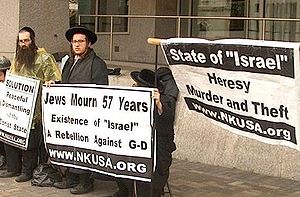 In the early history of Zionism many traditional religious Jews opposed ideas of nationalism (Jewish or otherwise) which they regarded as a secular ideology and because of an inherent suspicion of change. Key traditionalist opponents of Zionism included Isaac Breuer
, Hillel Zeitlin
, Aaron Shmuel Tamares, Hayyim, Elazar Shapiro (Muncatz), and Joel Teitelbaum
, all waged ideological religious, as well as political, battles with Zionism each in their own way.
Most Orthodox religious groups have accepted and actively support the State of Israel, even if they have not adopted "Zionist" ideology. The World Agudath Israel
party (founded in Poland) has at times participated in Israeli government coalitions. Most religious Zionists hold pro-Israel views from a right-wing viewpoint. The main exceptions are Hasidic groups such as Satmar
Hasidim, which have about 100,000 adherents world wide, as well as numerous different, smaller Hasidic groups, unified in America in the Central Rabbinical Congress of the United States and Canada and in Israel in the Edah HaChareidis.
Prior to the Second World War many Jews regarded Zionism as a fanciful and unrealistic movement. Many liberal
s during the European Enlightenment
had argued that Jews should enjoy full equality only on the condition that they pledge their singular loyalty to their nation-state and entirely assimilate to the local national culture; they called for the "regeneration" of the Jewish people in exchange for rights. Those liberal Jews who accepted integration and/or assimilation principles saw Zionism as a threat to efforts to facilitate Jewish citizenship and equality within the European nation-state context.
The Jewish Anti-Zionist League
, in Egypt, was a Communist-influenced anti-Zionist league in the years 1946–1947. In Israel
, there are several Jewish anti-Zionist organisations and politicians, many of these are related to Matzpen
.
Noam Chomsky
has reported a change in the boundaries of what are considered Zionist and anti-Zionist views. In 1947, in his youth, Chomsky's support for a socialist binational state, in conjunction with his opposition to any semblance of a theocratic system of governance in Israel, was at the time considered well within the mainstream of secular Zionism; today, it lands him solidly in the anti-Zionist camp. Modern American groups such as J Street
are taken as evidence of an "anomalous pattern of internal defection" created as a result of anti-Zionism.
Alvin H. Rosenfeld in his much discussed essay, Progressive Jewish Thought and the New Anti-Semitism
, claims that a "number of Jews, through their speaking and writing, are feeding a rise in virulent antisemitism by questioning whether Israel
should even exist." Rosenfeld's general claims are:
Some Jewish organizations oppose Zionism as an integral part of their anti-imperialism
. Some secular Jews today, particularly socialists
and Marxists
, continue to oppose the State of Israel on anti-imperialist and human rights
grounds. Many oppose it as a form of nationalism
, which they argue to be a product of capitalist societies. One secular anti-Zionist group today is the International Jewish Anti-Zionist Network
, a socialist, anti-war, and anti-imperialist organization which calls for "the dismantling of Israeli apartheid, the return of Palestinian refugees, and the ending of the Israeli colonization of historic Palestine".
proclaimed a fundamental departure from traditional Zionist policy of a “homeland” with its demand "that Palestine
be established as a Jewish Commonwealth." Opposition to official Zionism’s firm, unequivocal stand caused some prominent Zionists to establish their own party, Ichud (Unification), which advocated an Arab – Jewish Federation in Palestine. Opposition to the Biltmore Program also lead to the founding of the anti-Zionist American Council for Judaism
.
The full knowledge of the Holocaust altered the views of many who critiqued Zionism before 1948, including the British journalist Isaac Deutscher
, a socialist and life-long atheist who nevertheless emphasised the importance of his Jewish heritage. Before World War II
, Deutscher opposed Zionism as economically retrograde and harmful to the cause of international socialism, but in the aftermath of the Holocaust he regretted his pre-war views, arguing for Israel's establishment as a "historic necessity" to provide a refuge for the surviving Jews of Europe. In the 1960s, Deutscher renewed his criticism of Zionism, scrutinizing Israel for its failure to recognise the dispossession of the Palestinians.
are roughly as old as the Zionist movement. The most influential of these claims is the Tsarist forgery, The Protocols of the Elders of Zion
, which remains popular.
In 1939, the Nazi German paper Volkischer Beobachter
, justified the German occupation of Czechoslovakia
with the headline: "In Prague Jewry is in power". In 1968, the East German communist paper Neues Deutschland
justified the Warsaw Pact invasion of Czechoslovakia
with the headline "In Prague Zionism is in power". Simon Wiesenthal
subsequently found 39 formerly influential Nazi party members working in the East German press and now directing their campaigns at Zionists.
From the 1960s, the Soviet Union
promoted the allegation of secret ties between the Nazis and the Zionist leadership. This included claims that the Zionist movement inflated or faked the impact of the Holocaust. The thesis of 1982 doctoral dissertation of Mahmoud Abbas
(a co-founder of Fatah
and president of the Palestinian Authority who earned his Ph.D. in history at the Moscow Institute of Oriental Studies
, with Yevgeny Primakov
as thesis advisor) was The Secret Connection between the Nazis and the Leaders of the Zionist Movement. In his 1983 book The Other Face: The Secret Connection Between the Nazis and the Zionist Movement, based on the dissertation, Abbas wrote:
A different version of this conspiracy theory claims that Nazis and Zionists had a shared interest or even cooperated in the extermination of Europe's Jewry, as persecution would force them to flee to Palestine
, then under British administration. Similar claims are occasionally made by Hezbollah or Hamas
sources.
In 1995, William Korey released a work entitled Russian antisemitism, Pamyat, and the demonology of Zionism. Korey's central argument is that the Soviet Union
promoted an "official Judeophobic propaganda campaign" under the guise of anti-Zionism from 1967 to 1986; after this program was shut down by Mikhail Gorbachev
, a populist and chauvinist group called Pamyat
emerged in the more open climate of Glasnost
to promote an openly anti-Semitic message. Korey also argues that much official late-period Soviet anti-Semitism may be traced back to the influence of Protocols of the Elders of Zion. He notes, for instance, that a 1977 Soviet work entitled International Zionism: History and Politics contains the allegation that most major Wall Street financial institutions are "large financial-industrial Jewish monopolies" exercising control over many countries in the world. Russian antisemitism was reviewed by Robert O. Freedman in the Slavic Review; while he concurs with the book's central thesis, Freedman nevertheless writes that the actual extent of Soviet anti-Semitism may have been less than Korey suggests.
Before the Second World War many prominent Britons maintained that the tension between Germany
and Britain
was the result of Jewish warmongering. In 1935 the British Union of Fascists
mounted a "peace campaign" against war, claiming an alliance of international financiers and Jews were leading Britain to war with Germany. However by 1938 the public mood had changed and Admiral Domville wrote "it is interesting to see how permeated these people are with the war germ. Israel has done its work well." Similar accusations have been made regarding Zionism and the 2003 invasion of Iraq
.
The Sudanese government has alleged that the Darfur uprising
(in which some 500,000 have been killed) is part of a wider Zionist conspiracy. Egyptian media have alleged that the Zionist movement deliberately spreads HIV
in Egypt
.
According to the Anti-Defamation League, Neo-Nazi and radical Muslim groups allege the US government is controlled by Jews, describing it as the "Zionist Occupation Government
".
Article 22 of the 1988 Hamas charter claims that the French Revolution
, the Russian Revolution, colonialism
and both world wars were created by the Zionists or forces supportive of Zionism. Article 32 alleges that the Zionist movement seeks to create an Empire stretching from the Nile in Egypt to the Euphrates river in Iraq.
In April 2010, Abd Al-Azim Al-Maghrabi, the Deputy Head of Egyptian Arab Lawyers Union, stated in an interview with Al-Manar TV (as translated by MEMRI) that the Hepatitis C
virus was produced by "the Zionists" and that "this virus is now spreading in Egypt like wildfire." He also called for it to be "classified as one of the war crimes perpetrated by the Zionist enemy."
In June 2010, Egyptian cleric Mus’id Anwar gave a speech which aired on Al-Rahma TV (as translated by MEMRI) in which he alleged that the game of soccer (as well as swimming
, bullfighting
and tennis
) was in fact a Zionist conspiracy, stating that:
Zionism
Zionism is a Jewish political movement that, in its broadest sense, has supported the self-determination of the Jewish people in a sovereign Jewish national homeland. Since the establishment of the State of Israel, the Zionist movement continues primarily to advocate on behalf of the Jewish state...
or opposition to the state of Israel
Israel
The State of Israel is a parliamentary republic located in the Middle East, along the eastern shore of the Mediterranean Sea...
. The term is used to describe various religious, moral and political points of view in opposition to these, but their diversity of motivation and expression is sufficiently different that "anti-Zionism" cannot be seen as having a single ideology or source.
Definition
Zionism may be defined as, "An international movement originally for the establishment of a Jewish national or religious community in PalestinePalestine
Palestine is a conventional name, among others, used to describe the geographic region between the Mediterranean Sea and the Jordan River, and various adjoining lands....
and later for the support of modern Israel
Israel
The State of Israel is a parliamentary republic located in the Middle East, along the eastern shore of the Mediterranean Sea...
." Zionism is also "a political movement among Jews which holds that the Jews
Jews
The Jews , also known as the Jewish people, are a nation and ethnoreligious group originating in the Israelites or Hebrews of the Ancient Near East. The Jewish ethnicity, nationality, and religion are strongly interrelated, as Judaism is the traditional faith of the Jewish nation...
are a nation
Nation
A nation may refer to a community of people who share a common language, culture, ethnicity, descent, and/or history. In this definition, a nation has no physical borders. However, it can also refer to people who share a common territory and government irrespective of their ethnic make-up...
, and as such need to establish a national homeland", and as a religious movement within Orthodox Judaism
Orthodox Judaism
Orthodox Judaism , is the approach to Judaism which adheres to the traditional interpretation and application of the laws and ethics of the Torah as legislated in the Talmudic texts by the Sanhedrin and subsequently developed and applied by the later authorities known as the Gaonim, Rishonim, and...
which perceives the Torah
Torah
Torah- A scroll containing the first five books of the BibleThe Torah , is name given by Jews to the first five books of the bible—Genesis , Exodus , Leviticus , Numbers and Deuteronomy Torah- A scroll containing the first five books of the BibleThe Torah , is name given by Jews to the first five...
as requiring Jews to establish a sovereign commonwealth in the Land of Israel
Land of Israel
The Land of Israel is the Biblical name for the territory roughly corresponding to the area encompassed by the Southern Levant, also known as Canaan and Palestine, Promised Land and Holy Land. The belief that the area is a God-given homeland of the Jewish people is based on the narrative of the...
that is governed by Halakha
Halakha
Halakha — also transliterated Halocho , or Halacha — is the collective body of Jewish law, including biblical law and later talmudic and rabbinic law, as well as customs and traditions.Judaism classically draws no distinction in its laws between religious and ostensibly non-religious life; Jewish...
(Jewish law), and as "a movement to support the development and defense of the State of Israel, and to encourage Jews to settle there
Aliyah
Aliyah is the immigration of Jews to the Land of Israel . It is a basic tenet of Zionist ideology. The opposite action, emigration from Israel, is referred to as yerida . The return to the Holy Land has been a Jewish aspiration since the Babylonian exile...
." Therefore, anti-Zionism is opposition to these objectives; and people, organizations or governments that oppose these objectives can in some sense be described as anti-Zionist. "Progressive Jewish Thought and the New Anti-Semitism
Progressive Jewish Thought and the New Anti-Semitism
"Progressive" Jewish Thought and the New Anti-Semitism is a 2006 essay released by the American Jewish Committee, authored by Alvin H. Rosenfeld , with an introduction by the AJC's executive director, David A. Harris...
," an essay published by the American Jewish Committee
American Jewish Committee
The American Jewish Committee was "founded in 1906 with the aim of rallying all sections of American Jewry to defend the rights of Jews all over the world...
, concludes that, with the maturing of Israel since its founding in 1948, the term anti-Zionism in scholarly work had come to mean advocating the elimination of the State of Israel. Opposition to defining Israel as a Jewish state is not necessarily synonymous with anti-Zionism. Many Israelis also hold this view, as do many Jewish and other supporters of Israel outside Israel. However, advocacy of the elimination of the State of Israel exists among some high-profile Jewish intellectuals and it has been argued that "Israel's Jewish accusers have played a crucial and disproportionate role in the upsurge of antisemitism precisely because they speak as Jews."
Diversity of anti-Zionism
Opposition to Zionism has changed over time and has taken on a spectrum of religious, ethical, political or military forms. Some include, opposition to the creation of a Jewish stateJewish state
A homeland for the Jewish people was an idea that rose to the fore in the 19th century in the wake of growing anti-Semitism and Jewish assimilation. Jewish emancipation in Europe paved the way for two ideological solutions to the Jewish Question: cultural assimilation, as envisaged by Moses...
prior to the appearance of the messiah
Messiah
A messiah is a redeemer figure expected or foretold in one form or another by a religion. Slightly more widely, a messiah is any redeemer figure. Messianic beliefs or theories generally relate to eschatological improvement of the state of humanity or the world, in other words the World to...
, objection to the idea of a state based on maintenance of a Jewish majority
Demographics of Israel
The State of Israel has a population of approximately 7,798,600 inhabitants as of September 2011. 75.3% of them are Jewish , 20.5% are Arabs , while the remaining 4.3% are defined as "others" The State of Israel has a population of approximately 7,798,600 inhabitants as of September 2011. 75.3% of...
, differing democratic values and differing levels of geographical extension
Israeli-occupied territories
The Israeli-occupied territories are the territories which have been designated as occupied territory by the United Nations and other international organizations, governments and others to refer to the territory seized by Israel during the Six-Day War of 1967 from Egypt, Jordan, and Syria...
.
Brian Klug
Brian Klug
Brian Klug is Senior Research Fellow & Tutor in Philosophy at St. Benet's Hall, Oxford and a member of the philosophy faculty at Oxford University...
of The Guardian
The Guardian
The Guardian, formerly known as The Manchester Guardian , is a British national daily newspaper in the Berliner format...
has argued that anti-Zionism represents fair opposition to Israel. The legitimacy of anti-Zionist views has been disputed to the present day, including the more recent and disputed relationship between anti-Zionism and antisemitism. A range of other views regarding the various forms of anti-Zionism is discussed and debated.
Anti-Zionism and antisemitism
In recent years, commentators have argued that contemporary manifestations of anti-Zionism have become a cover for antisemitism, and that a "new antisemitism" rooted in anti-Zionism has emerged. Advocates of this concept argue that much of what purports to be criticism of Israel and Zionism is demonization, and has led to an international resurgence of attacks on Jews and Jewish symbols and an increased acceptance of antisemitic beliefs in public discourse. Critics of the concept argue that the equation of anti-Zionism with antisemitism is used to stifle legitimate criticisms of IsraelIsrael
The State of Israel is a parliamentary republic located in the Middle East, along the eastern shore of the Mediterranean Sea...
, and trivializes antisemitism.
Professor Kenneth L. Marcus
Kenneth L. Marcus
Kenneth L. Marcus is the Lillie and Nathan Ackerman Chair in Equality and Justice in America at Baruch College of the City University of New York. Formerly, he was staff director at the U.S...
, former staff director at the U.S. Commission on Civil Rights, identifies four main views on the relationship between anti-Zionism and antisemitism, at least in North America:
- anti-Zionism is anti-Semitic in its essence and in most, if not all, of its manifestations;
- anti-Zionism and anti-Semitism are both analytically and historically distinct, but the two ideologies have merged since 1948;
- anti-Zionism and anti-Semitism remain distinct, but anti-Zionism occasionally crosses the line into "outright anti-Semitism", while anti-Semitism often pollutes anti-Zionist discourse; and/or
- anti-Zionism is analytically distinct from anti-Semitism, but much apparent criticism of Israel or Zionism is in fact a thinly veiled expression of anti-Semitism.
Marcus also states: "Unsurprisingly, recent research has shown a close correlation between anti-Israeli views and anti-Semitic views based on a survey of citizens in ten European countries."
Professor Robert S. Wistrich
Robert S. Wistrich
Robert Solomon Wistrich is the Neuburger Professor of European and Jewish history at the Hebrew University of Jerusalem, and the head of the University's Vidal Sassoon International Center for the Study of Antisemitism. Wistrich is "a leading scholar of the history of antisemitism."-Early...
, head of the Vidal Sassoon International Center for the Study of Antisemitism at the Hebrew University of Jerusalem
Hebrew University of Jerusalem
The Hebrew University of Jerusalem ; ; abbreviated HUJI) is Israel's second-oldest university, after the Technion – Israel Institute of Technology. The Hebrew University has three campuses in Jerusalem and one in Rehovot. The world's largest Jewish studies library is located on its Edmond J...
, is the originator of Marcus's second view of anti-Zionism (that anti-Zionism and antisemitism merged post-1948) argues that much contemporary anti-Zionism, particularly forms that compare Zionism and Jews with Hitler and the Third Reich, has become a form of antisemitism:
Anti-Zionism has become the most dangerous and effective form of anti-Semitism in our time, through its systematic delegitimization, defamation, and demonization of Israel. Although not a priori anti-Semitic, the calls to dismantle the Jewish state, whether they come from Muslims, the Left, or the radical Right, increasingly rely on an anti-Semitic stereotypization of classic themes, such as the manipulative "Jewish lobby," the Jewish/Zionist "world conspiracy," and Jewish/Israeli "warmongers."
Dina Porat (head of the Institute for Study of Anti-semitism and Racism
Stephen Roth Institute
The Stephen Roth Institute for the Study of Contemporary Antisemitism and Racism is a research institute at Tel Aviv University in Israel. It is a resource for information, provides a forum for academic discussion, and fosters research on issues concerning antisemitic and racist theories and...
at Tel-Aviv University) contends that anti-Zionism is anti-semitic because it is discriminatory:
...antisemitism is involved when the belief is articulated that of all the peoples on the globe (including the Palestinians), only the Jews should not have the right to self-determination in a land of their own. Or, to quote noted human rights lawyer David MatasDavid MatasDavid Matas is the senior legal counsel of B'nai Brith Canada. He has maintained a private practice in refugee, immigration and human rights law since 1979. He has published various books and manuscripts and currently resides in Winnipeg....
:
One form of antisemitism denies access of Jews to goods and services because they are Jewish. Another form of antisemitism denies the right of the Jewish people to exist as a people because they are Jewish. Antizionists distinguish between the two, claiming the first is antisemitism, but the second is not. To the antizionist, the Jew can exist as an individual as long as Jews do not exist as a people.
Israel
Israel
The State of Israel is a parliamentary republic located in the Middle East, along the eastern shore of the Mediterranean Sea...
i journalist
Journalist
A journalist collects and distributes news and other information. A journalist's work is referred to as journalism.A reporter is a type of journalist who researchs, writes, and reports on information to be presented in mass media, including print media , electronic media , and digital media A...
Ben-Dror Yemini maintains that anti-Zionism is "politically correct
Politically Correct
Politically Correct may refer to:*Political correctness, language, ideas, policies, or behaviour seeking to minimize offence to groups of people-See also:*Politically Correct Bedtime Stories, book by James Finn Garner, published in 1994...
antisemitism" and argues that the same way Jews were demonized, Israel is demonized, the same way the right of Jews to exist was denied, the right for Self-determination
Self-determination
Self-determination is the principle in international law that nations have the right to freely choose their sovereignty and international political status with no external compulsion or external interference...
is denied from Israel, the same way Jews were presented as a menace to the world, Israel is presented as a menace to the world.
In July 2001, the Simon Wiesenthal Center
Simon Wiesenthal Center
The Simon Wiesenthal Center , with headquarters in Los Angeles, California, was established in 1977 and named for Simon Wiesenthal, the Nazi hunter. According to its mission statement, it is "an international Jewish human rights organization dedicated to repairing the world one step at a time...
reported that during a visit there, German Foreign Minister Joschka Fischer
Joschka Fischer
Joseph Martin "Joschka" Fischer is a German politician of the Alliance '90/The Greens. He served as Foreign Minister and Vice Chancellor of Germany in the cabinet of Gerhard Schröder from 1998 to 2005...
stated that "anti-Zionism inevitably leads to antisemitism."
Brian Klug
Brian Klug
Brian Klug is Senior Research Fellow & Tutor in Philosophy at St. Benet's Hall, Oxford and a member of the philosophy faculty at Oxford University...
has argued that anti-Zionism and antisemitism are distinct but not mutually exclusive concepts:
There is a long and ignoble history of "Zionist" being used as a code word for "Jew," as when Communist Poland carried out "anti-Zionist" purges in 1968, expelling thousands of Jews from the country, or when the extreme right today uses the acronym ZOGZionist Occupation GovernmentZionist Occupation Government or Zionist Occupied Government is an antisemitic conspiracy theory which holds that Jews secretly control a given country, while the formal government is a puppet regime....
(Zionist Occupied Government) to refer to the US government. Moreover, the Zionist movement arose as a reaction to the persecution of Jews. Since anti-Zionism is the opposite of Zionism, and since Zionism is a form of opposition to anti-Semitism, it seems to follow that an anti-Zionist must be an anti-Semite.
Nonetheless, the inference is invalid. To argue that hostility to Israel and hostility to Jews are one and the same thing is to conflate the Jewish state with the Jewish people. In fact, Israel is one thing, Jewry another. Accordingly, anti-Zionism is one thing, anti-Semitism another. They are separate. To say they are separate is not to say that they are never connected. But they are independent variables that can be connected in different ways.
Some critics of Israeli policy argue that Israeli propagandists and supporters often try to equate anti-Zionism and sometimes even criticism of Israeli policy, with antisemitism, to silence opposition to Israeli policies. Noam Chomsky
Noam Chomsky
Avram Noam Chomsky is an American linguist, philosopher, cognitive scientist, and activist. He is an Institute Professor and Professor in the Department of Linguistics & Philosophy at MIT, where he has worked for over 50 years. Chomsky has been described as the "father of modern linguistics" and...
for example argues:
There have long been efforts to identify anti-Semitism and anti-Zionism in an effort to exploit anti-racist sentiment for political ends; "one of the chief tasks of any dialogue with the Gentile world is to prove that the distinction between anti-Semitism and anti-Zionism is not a distinction at all," Israeli diplomat Abba Eban argued, in a typical expression of this intellectually and morally disreputable position (Eban, Congress Bi-Weekly, March 30, 1973). But that no longer suffices. It is now necessary to identify criticism of Israeli policies as anti-Semitism – or in the case of Jews, as "self-hatred," so that all possible cases are covered.
Secular Arab
According to philosopher Michael NeumannMichael Neumann
Michael Neumann is a professor of philosophy at Trent University in Ontario, Canada. He is the author of What's Left? Radical Politics and the Radical Psyche , The Rule of Law: Politicizing Ethics and The Case Against Israel , and has published papers on utilitarianism and rationality.-Background...
, Zionism as an "expansionist threat" has caused Arab hostility toward Israel and even antisemitism. Anti-Zionist sentiment has increased with ongoing Arab Israeli conflicts: after the June 1967 Six-Day War
Six-Day War
The Six-Day War , also known as the June War, 1967 Arab-Israeli War, or Third Arab-Israeli War, was fought between June 5 and 10, 1967, by Israel and the neighboring states of Egypt , Jordan, and Syria...
where Israel gained control of the Sinai Peninsula
Sinai Peninsula
The Sinai Peninsula or Sinai is a triangular peninsula in Egypt about in area. It is situated between the Mediterranean Sea to the north, and the Red Sea to the south, and is the only part of Egyptian territory located in Asia as opposed to Africa, effectively serving as a land bridge between two...
, the Gaza Strip
Gaza Strip
thumb|Gaza city skylineThe Gaza Strip lies on the Eastern coast of the Mediterranean Sea. The Strip borders Egypt on the southwest and Israel on the south, east and north. It is about long, and between 6 and 12 kilometres wide, with a total area of...
, the West Bank
West Bank
The West Bank ) of the Jordan River is the landlocked geographical eastern part of the Palestinian territories located in Western Asia. To the west, north, and south, the West Bank shares borders with the state of Israel. To the east, across the Jordan River, lies the Hashemite Kingdom of Jordan...
, East Jerusalem
East Jerusalem
East Jerusalem or Eastern Jerusalem refer to the parts of Jerusalem captured and annexed by Jordan in the 1948 Arab-Israeli War and then captured and annexed by Israel in the 1967 Six-Day War...
, and the Golan Heights; during the 1982 Lebanon War
1982 Lebanon War
The 1982 Lebanon War , , called Operation Peace for Galilee by Israel, and later known in Israel as the Lebanon War and First Lebanon War, began on 6 June 1982, when the Israel Defense Forces invaded southern Lebanon...
where Israel Defense Forces
Israel Defense Forces
The Israel Defense Forces , commonly known in Israel by the Hebrew acronym Tzahal , are the military forces of the State of Israel. They consist of the ground forces, air force and navy. It is the sole military wing of the Israeli security forces, and has no civilian jurisdiction within Israel...
invaded southern Lebanon
Southern Lebanon
Southern Lebanon is the geographical area of Lebanon comprising the South Governorate and the Nabatiye Governorate. These two entities were divided from the same province in the early 1990s...
, attacking the PLO, as well as Syria
Syria
Syria , officially the Syrian Arab Republic , is a country in Western Asia, bordering Lebanon and the Mediterranean Sea to the West, Turkey to the north, Iraq to the east, Jordan to the south, and Israel to the southwest....
, leftist and Muslim
Muslim
A Muslim, also spelled Moslem, is an adherent of Islam, a monotheistic, Abrahamic religion based on the Quran, which Muslims consider the verbatim word of God as revealed to prophet Muhammad. "Muslim" is the Arabic term for "submitter" .Muslims believe that God is one and incomparable...
Lebanese
Lebanon
Lebanon , officially the Republic of LebanonRepublic of Lebanon is the most common term used by Lebanese government agencies. The term Lebanese Republic, a literal translation of the official Arabic and French names that is not used in today's world. Arabic is the most common language spoken among...
forces, leading to Israeli occupation of southern Lebanon; the 2002 Operation Defensive Shield
Operation Defensive Shield
Operation Defensive Shield was a large-scale military operation conducted by the Israel Defense Forces in 2002, during the course of the Second Intifada. It was the largest military operation in the West Bank since the 1967 Six-Day War. The operation was an attempt by the Israeli army to stop the...
in the West Bank
West Bank
The West Bank ) of the Jordan River is the landlocked geographical eastern part of the Palestinian territories located in Western Asia. To the west, north, and south, the West Bank shares borders with the state of Israel. To the east, across the Jordan River, lies the Hashemite Kingdom of Jordan...
, including the attack on the Jenin refugee camp
Battle of Jenin
The Battle of Jenin took place in the Jenin refugee camp in the West Bank. Israel Defense Forces entered the camp, and other areas under the administration of the Palestinian Authority, during the Second Intifada, as part of Operation Defensive Shield...
; the 2006 Lebanon War; and the 2008–2009 Israel–Gaza conflict
2008–2009 Israel–Gaza conflict
The Gaza War, known as Operation Cast Lead in Israel and as the Gaza Massacre in the Arab world, was a three-week bombing and invasion of the Gaza Strip by Israel, and hundreds of rocket attacks on south of Israel which...
.
Pan-Arabist
Pan-Arabism
Pan-Arabism is an ideology espousing the unification--or, sometimes, close cooperation and solidarity against perceived enemies of the Arabs--of the countries of the Arab world, from the Atlantic Ocean to the Arabian Sea. It is closely connected to Arab nationalism, which asserts that the Arabs...
narratives in the 1960s Nasser
Gamal Abdel Nasser
Gamal Abdel Nasser Hussein was the second President of Egypt from 1956 until his death. A colonel in the Egyptian army, Nasser led the Egyptian Revolution of 1952 along with Muhammad Naguib, the first president, which overthrew the monarchy of Egypt and Sudan, and heralded a new period of...
era emphasized the idea of Palestine as a part of the Arab world
Arab world
The Arab world refers to Arabic-speaking states, territories and populations in North Africa, Western Asia and elsewhere.The standard definition of the Arab world comprises the 22 states and territories of the Arab League stretching from the Atlantic Ocean in the west to the Arabian Sea in the...
taken by others. In this narrative, the natural means of combating Zionism is Arab nations uniting and attacking Israel militarily. Pan-Syrian narratives, promoted mainly by Syria
Syria
Syria , officially the Syrian Arab Republic , is a country in Western Asia, bordering Lebanon and the Mediterranean Sea to the West, Turkey to the north, Iraq to the east, Jordan to the south, and Israel to the southwest....
, are essentially parallel.
Israeli Democracy Institute
The Israeli Democracy Institute is non-profit organization in Israel, founded in 1991, which aims at forming policies and to initiate reforms in the different fields of the state and its institutions in order to apply laws, implement them and to strengthen the democracy values in Israel.-...
in 2007 found that 75 percent profess support for Israel's status as a Jewish and democratic state which guarantees equal rights for minorities. Israeli Arab support for a constitution in general was 88 percent.
Muslim
MuslimIslam
Islam . The most common are and . : Arabic pronunciation varies regionally. The first vowel ranges from ~~. The second vowel ranges from ~~~...
anti-Zionism considers the State of Israel an intrusion into what many Muslims consider to be Dar al-Islam, a domain rightfully, and permanently, ruled only by Muslims due the fact it was historically conquered in the name of Islam.
Palestinian and other Muslim groups, as well as the government of Iran (since the 1979 Islamic Revolution
Iranian Revolution
The Iranian Revolution refers to events involving the overthrow of Iran's monarchy under Shah Mohammad Reza Pahlavi and its replacement with an Islamic republic under Ayatollah Ruhollah Khomeini, the leader of the...
), insist that the State of Israel is illegitimate and refuse to refer to it as "Israel," instead using the locution "the Zionist entity
Zionist entity
Zionist entity is a phrase often used by Arabs and Muslims as a pejorative for the State of Israel. The term is described as a means of expressing hostility towards Israel, refusing to acknowledge its existence as a state, and denying its right to exist. Virginia Q...
" (see Iran-Israel relations
Iran-Israel relations
Iran–Israel relations have shifted from close ties between Israel and Iran during the era of the Pahlavi dynasty to hostility since the Islamic Revolution led by Ayatollah Ruhollah Khomeini. Iran has severed all diplomatic and commercial ties with Israel, and its government does not recognize...
). Islamic maps of the Middle East frequently do not show the State of Israel. In an interview with Time Magazine in December 2006, Mahmoud Ahmadinejad said "Everyone knows that the Zionist regime is a tool in the hands of the United States
Federal government of the United States
The federal government of the United States is the national government of the constitutional republic of fifty states that is the United States of America. The federal government comprises three distinct branches of government: a legislative, an executive and a judiciary. These branches and...
and British governments
Government of the United Kingdom
Her Majesty's Government is the central government of the United Kingdom of Great Britain and Northern Ireland. The Government is led by the Prime Minister, who selects all the remaining Ministers...
."
The Grand Mufti of Jerusalem
Grand Mufti of Jerusalem
The Grand Mufti of Jerusalem is the Sunni Muslim cleric in charge of Jerusalem's Islamic holy places, including the Al-Aqsa Mosque.-Ottoman era:...
Mohammed Amin al Husseini opposed the Jewish immigration to Palestine before the creation of the State of Israel, and in several documented cases expressed his hostility toward Jews in general and Zionists in particular.
Catholic Church anti-Zionism
Many modern Popes have been openly critical of Zionism, including Pius X, Benedict XV and Pius XII. Cardinal Rafael Merry del Val reportedly explained the Church's policy of non possumusNon possumus
Non possumus meaning: we cannot, is a Latin religious phrase originating from the story of the martyrs of Abitina, when emperor Diocletian prohibited Christians, under pain of death, to possess the Scriptures, to meet on Sunday to celebrate the Eucharist and to build premises for their...
to Theodore Herzl and his emerging movement of Zionism
Zionism
Zionism is a Jewish political movement that, in its broadest sense, has supported the self-determination of the Jewish people in a sovereign Jewish national homeland. Since the establishment of the State of Israel, the Zionist movement continues primarily to advocate on behalf of the Jewish state...
, saying that as long as the Jews deny the divinity of Christ, the Church certainly could not make a declaration in their favor. The Holy See
Holy See
The Holy See is the episcopal jurisdiction of the Catholic Church in Rome, in which its Bishop is commonly known as the Pope. It is the preeminent episcopal see of the Catholic Church, forming the central government of the Church. As such, diplomatically, and in other spheres the Holy See acts and...
did not establish relations with Israel until 1993 because of these issues.
Positions of the World Council of Churches
The World Council of ChurchesWorld Council of Churches
The World Council of Churches is a worldwide fellowship of 349 global, regional and sub-regional, national and local churches seeking unity, a common witness and Christian service. It is a Christian ecumenical organization that is based in the Ecumenical Centre in Geneva, Switzerland...
has been described by some as taking anti-Zionist positions in connection with its criticisms of Israeli policy. They believe the council has focused disproportionately on activities and publications criticizing Israel in comparison with other human rights issues. The council members have been characterized by Israel's former Justice minister Amnon Rubinstein
Amnon Rubinstein
Amnon Rubinstein is an Israeli law scholar, politician, and columnist. A member of the Knesset between 1977 and 2002, he served in several ministerial positions. He is currently dean of the Interdisciplinary Center in Herzliya and a patron of Liberal International.-Early life:Rubinstein was born...
as anti-Zionist, saying "they just hate Israel."
Soviet Union
From 1928–1934, during the so-called "Third PeriodThird Period
The Third Period is a ideological concept adopted by the Communist International at its 6th World Congress, held in Moscow in the summer of 1928....
" in the Soviet Union
Soviet Union
The Soviet Union , officially the Union of Soviet Socialist Republics , was a constitutionally socialist state that existed in Eurasia between 1922 and 1991....
, Zionism was outlawed. But by the late 1930s, the official position of Zionism began to change to a more favourable one. In the Soviet encyclopedia of this time, it was stated that Jewish migration to Palestine had become a "progressive factor" because many of the workers stood on the left. At the beginning of 1947, the Soviet Union supported the partition of Palestine. Stalin wanted to use the Jews in Palestine against British imperialism, and to establish a point of support for the USSR in the Middle East.
During the last years of Stalin's rule, official support for the creation of Israel in 1948 was replaced by strong anti-zionism. The level of confrontation with those deemed as anti-Soviet "Jewish nationalists" was toned down after Stalin's death in 1953, but the official position of opposition to Zionism remained in force: the Anti-Zionist Committee of the Soviet Public
Anti-Zionist Committee of the Soviet Public
On March 29, 1983, the Secretariat of the Central Committee of the Communist Party of the Soviet Union has approved the resolution 101/62ГС to "Support the proposition of the Department of Propaganda of the Central Committee and the KGB USSR about the creation of the Anti-Zionist Committee of the...
, as well as numerous other initiatives, were state-sponsored.
As outlined in the third edition of the Great Soviet Encyclopedia
Great Soviet Encyclopedia
The Great Soviet Encyclopedia is one of the largest and most comprehensive encyclopedias in Russian and in the world, issued by the Soviet state from 1926 to 1990, and again since 2002 .-Editions:There were three editions...
(1969–1978), the Communist Party of the Soviet Union
Communist Party of the Soviet Union
The Communist Party of the Soviet Union was the only legal, ruling political party in the Soviet Union and one of the largest communist organizations in the world...
's position during the Cold War
Cold War
The Cold War was the continuing state from roughly 1946 to 1991 of political conflict, military tension, proxy wars, and economic competition between the Communist World—primarily the Soviet Union and its satellite states and allies—and the powers of the Western world, primarily the United States...
became: "the main posits of modern Zionism are militant chauvinism
Chauvinism
Chauvinism, in its original and primary meaning, is an exaggerated, bellicose patriotism and a belief in national superiority and glory. It is an eponym of a possibly fictional French soldier Nicolas Chauvin who was credited with many superhuman feats in the Napoleonic wars.By extension it has come...
, racism
Racism
Racism is the belief that inherent different traits in human racial groups justify discrimination. In the modern English language, the term "racism" is used predominantly as a pejorative epithet. It is applied especially to the practice or advocacy of racial discrimination of a pernicious nature...
, anti-Communism
Anti-communism
Anti-communism is opposition to communism. Organized anti-communism developed in reaction to the rise of communism, especially after the 1917 October Revolution in Russia and the beginning of the Cold War in 1947.-Objections to communist theory:...
and anti-Sovietism
Anti-Sovietism
Anti-Sovietism and Anti-Soviet refer to persons and activities actually or allegedly aimed against the Soviet Union or government power within the Soviet Union.Three different flavors of the usage of the term may be distinguished....
,... overt and covert fight against freedom movements and the USSR."
At the same time, the spectre of Jewish allegiance to Israel amid the tensions of the Arab-Israeli conflict raised fears of internal dissent and opposition. The Soviet government liquidated almost all remaining Jewish organizations. It placed synagogue
Synagogue
A synagogue is a Jewish house of prayer. This use of the Greek term synagogue originates in the Septuagint where it sometimes translates the Hebrew word for assembly, kahal...
s under police surveillance, both openly and through the use of informers
Informant
An informant is a person who provides privileged information about a person or organization to an agency. The term is usually used within the law enforcement world, where they are officially known as confidential or criminal informants , and can often refer pejoratively to the supply of information...
. At the same time, the general restriction on the right of refuseniks, or Soviet Jews seeking to emigrate for Israel, emerged as a major human rights
Human rights
Human rights are "commonly understood as inalienable fundamental rights to which a person is inherently entitled simply because she or he is a human being." Human rights are thus conceived as universal and egalitarian . These rights may exist as natural rights or as legal rights, in both national...
issue in the West. (See Jackson-Vanik amendment
Jackson-Vanik amendment
The Jackson–Vanik amendment is a 1974 provision in United States federal law, intended to affect U.S. trade relations with countries with non-market economies that restrict freedom of emigration and other human rights...
.)
International
Anti-Zionist sentiments were also manifested in organisations such as the Organization for African Unity and the Non-Aligned MovementNon-Aligned Movement
The Non-Aligned Movement is a group of states considering themselves not aligned formally with or against any major power bloc. As of 2011, the movement had 120 members and 17 observer countries...
, which passed resolutions condemning Zionism and equating it with racism and apartheid during the early 1970s. This culminated in the passing by the United Nations General Assembly
United Nations General Assembly
For two articles dealing with membership in the General Assembly, see:* General Assembly members* General Assembly observersThe United Nations General Assembly is one of the five principal organs of the United Nations and the only one in which all member nations have equal representation...
of Resolution 3379
UN General Assembly Resolution 3379
-The Israeli response:In his address to the United Nations General Assembly the same day, 10. November 1975, Israeli Ambassador Chaim Herzog stated: In his response he also said that the resolution was:...
in November 1975, which declared that "Zionism is a form of racism."
The decision was revoked on December 16, 1991, when the General Assembly passed Resolution 4686
UN General Assembly Resolution 4686
United Nations General Assembly Resolution 46/86 passed on December 16, 1991, revoked Resolution 3379 with a vote of 111 to 25, with 13 abstentions....
, repealing resolution 3379, by a vote of 111 to 25, with 13 abstentions and 17 delegations absent. Thirteen out of the 19 Arab countries, including those engaged in negotiations with Israel, voted against the repeal, another six were absent. No Arab country voted for repeal. The Palestine Liberation Organisation denounced the vote. All of the ex-communist countries and most of the African countries who had supported Resolution 3379 voted to repeal it. Only three non-Muslim countries voted against the resolution: Cuba
Cuba
The Republic of Cuba is an island nation in the Caribbean. The nation of Cuba consists of the main island of Cuba, the Isla de la Juventud, and several archipelagos. Havana is the largest city in Cuba and the country's capital. Santiago de Cuba is the second largest city...
, North Korea
North Korea
The Democratic People’s Republic of Korea , , is a country in East Asia, occupying the northern half of the Korean Peninsula. Its capital and largest city is Pyongyang. The Korean Demilitarized Zone serves as the buffer zone between North Korea and South Korea...
and Vietnam
Vietnam
Vietnam – sometimes spelled Viet Nam , officially the Socialist Republic of Vietnam – is the easternmost country on the Indochina Peninsula in Southeast Asia. It is bordered by China to the north, Laos to the northwest, Cambodia to the southwest, and the South China Sea –...
. The rest abstained (including Turkey
Turkey
Turkey , known officially as the Republic of Turkey , is a Eurasian country located in Western Asia and in East Thrace in Southeastern Europe...
) or absented themselves.
African-American
After IsraelIsrael
The State of Israel is a parliamentary republic located in the Middle East, along the eastern shore of the Mediterranean Sea...
occupied Palestinian
Palestine
Palestine is a conventional name, among others, used to describe the geographic region between the Mediterranean Sea and the Jordan River, and various adjoining lands....
territory following the 1967 Six-Day War
Six-Day War
The Six-Day War , also known as the June War, 1967 Arab-Israeli War, or Third Arab-Israeli War, was fought between June 5 and 10, 1967, by Israel and the neighboring states of Egypt , Jordan, and Syria...
, some African-Americans supported the Palestinians and criticized Israel's actions, for example by publicly supporting Palestinian leader Yassir Arafat and calling for the destruction of the Jewish state. Immediately after the war, the black power
Black Power
Black Power is a political slogan and a name for various associated ideologies. It is used in the movement among people of Black African descent throughout the world, though primarily by African Americans in the United States...
organization Student Nonviolent Coordinating Committee
Student Nonviolent Coordinating Committee
The Student Nonviolent Coordinating Committee ' was one of the principal organizations of the American Civil Rights Movement in the 1960s. It emerged from a series of student meetings led by Ella Baker held at Shaw University in Raleigh, North Carolina in April 1960...
published a newsletter criticizing Israel, and asserting that the war was an effort to regain Palestinian land and that during the 1948 war, "Zionists
Zionism
Zionism is a Jewish political movement that, in its broadest sense, has supported the self-determination of the Jewish people in a sovereign Jewish national homeland. Since the establishment of the State of Israel, the Zionist movement continues primarily to advocate on behalf of the Jewish state...
conquered the Arab homes and land through terror, force, and massacres". In 1993, philosopher Cornel West
Cornel West
Cornel Ronald West is an American philosopher, author, critic, actor, civil rights activist and prominent member of the Democratic Socialists of America....
wrote: "Jews will not comprehend what the symbolic predicament and literal plight of Palestinans in Israel means to blacks.... Blacks often perceive the Jewish defense of the state of Israel as a second instance of naked group interest, and, again, an abandonment of substantive moral deliberation." African-American support of Palestinians is frequently due to the consideration of Palestinians as people of color – political scientist Andrew Hacker
Andrew Hacker
Andrew Hacker is an American political scientist and public intellectual.He is currently Professor Emeritus in the Department of Political Science at Queens Collegein New York. He did his undergraduate work at Amherst College. This was followed...
writes: "The presence of Israel in the Middle East is perceived as thwarting the rightful status of people of color. Some blacks view Israel as essentially a white and European power, supported from the outside, and occupying space that rightfully belongs to the original inhabitants of Palestine."
Interpretations of Aliyah
Hope for return to the land of Israel is embodied in the content of the Jewish religion (see Kibbutz Galuyot.) AliyahAliyah
Aliyah is the immigration of Jews to the Land of Israel . It is a basic tenet of Zionist ideology. The opposite action, emigration from Israel, is referred to as yerida . The return to the Holy Land has been a Jewish aspiration since the Babylonian exile...
, the Hebrew word meaning "ascending" or "going up" is the word used to describe religious Jewish return to Israel, and has been used since ancient times. From the Middle Ages
Middle Ages
The Middle Ages is a periodization of European history from the 5th century to the 15th century. The Middle Ages follows the fall of the Western Roman Empire in 476 and precedes the Early Modern Era. It is the middle period of a three-period division of Western history: Classic, Medieval and Modern...
and onwards, many famous rabbis and often their followers, returned to the land of Israel. These have included Nahmanides
Nahmanides
Nahmanides, also known as Rabbi Moses ben Naḥman Girondi, Bonastruc ça Porta and by his acronym Ramban, , was a leading medieval Jewish scholar, Catalan rabbi, philosopher, physician, kabbalist, and biblical commentator.-Name:"Nahmanides" is a Greek-influenced formation meaning "son of Naḥman"...
, Yechiel of Paris
Yechiel of Paris
Yechiel ben Joseph of Paris was a major Talmudic scholar and Tosafist from northern France, father-in-law of Isaac ben Joseph of Corbeil. He was a disciple of Rabbi Judah Messer Leon, and succeeded him in 1225 as head of the Yeshiva of Paris, which then boasted some 300 students; his best known...
, Isaac Luria
Isaac Luria
Isaac Luria , also called Yitzhak Ben Shlomo Ashkenazi acronym "The Ari" "Ari-Hakadosh", or "Arizal", meaning "The Lion", was a foremost rabbi and Jewish mystic in the community of Safed in the Galilee region of Ottoman Palestine...
, Yosef Karo
Yosef Karo
Joseph ben Ephraim Karo, also spelled Yosef Caro, or Qaro, was author of the last great codification of Jewish law, the Shulchan Aruch, which is still authoritative for all Jews pertaining to their respective communities...
, Menachem Mendel of Vitebsk
Menachem Mendel of Vitebsk
Menachem Mendel of Vitebsk , also known as Menachem Mendel of Horodok, was an early leader of Hasidic Judaism. Part of the third generation of Hasidic leaders, he was the primary disciple of the Maggid of Mezeritch...
among others. For Jews in the Diaspora
Jewish diaspora
The Jewish diaspora is the English term used to describe the Galut גלות , or 'exile', of the Jews from the region of the Kingdom of Judah and Roman Iudaea and later emigration from wider Eretz Israel....
Eretz Israel was revered in a religious sense. They prayed, and thought of the return, as being fulfilled in a messianic age. Return remained a recurring theme for generations, particularly in Passover
Passover
Passover is a Jewish holiday and festival. It commemorates the story of the Exodus, in which the ancient Israelites were freed from slavery in Egypt...
and Yom Kippur
Yom Kippur
Yom Kippur , also known as Day of Atonement, is the holiest and most solemn day of the year for the Jews. Its central themes are atonement and repentance. Jews traditionally observe this holy day with a 25-hour period of fasting and intensive prayer, often spending most of the day in synagogue...
prayers which traditionally concluded with, "Next year in Jerusalem", as well as the thrice-daily Amidah
Amidah
The Amidah , also called the Shmoneh Esreh , is the central prayer of the Jewish liturgy. This prayer, among others, is found in the siddur, the traditional Jewish prayer book...
(Standing prayer).
Following Jewish Enlightenment however, Reform Judaism
Reform Judaism
Reform Judaism refers to various beliefs, practices and organizations associated with the Reform Jewish movement in North America, the United Kingdom and elsewhere. In general, it maintains that Judaism and Jewish traditions should be modernized and should be compatible with participation in the...
dropped many traditional beliefs, including aliyah, as incompatible with modern life within the Diaspora. Later, Zionism re-kindled the concept of aliyah in an ideological and political sense, parallel with traditional religious belief; it was used to increase Jewish population in the Holy Land by immigration and it remains a basic tenet of Zionist ideology. Support for aliyah does not always equal immigration however, as a majority of the world Jewish population remains within the Diaspora. Support for the modern Zionist movement is not universal and as a result, some religious Jews as well as some secular Jews, do not support Zionism. non-Zionist
Non-Zionism
Non-Zionism is the political stance of Jews who "were [or are] willing to help support depoliticized Jewish settlement in Palestine but will not come on aliyah."...
Jews are not necessarily anti-Zionists, although some are. Generally however, Zionism does have the support of the majority of the Jewish religious organizations, with support from segments of the Orthodox
Orthodox Judaism
Orthodox Judaism , is the approach to Judaism which adheres to the traditional interpretation and application of the laws and ethics of the Torah as legislated in the Talmudic texts by the Sanhedrin and subsequently developed and applied by the later authorities known as the Gaonim, Rishonim, and...
movement, and all of the Conservative
Conservative Judaism
Conservative Judaism is a modern stream of Judaism that arose out of intellectual currents in Germany in the mid-19th century and took institutional form in the United States in the early 1900s.Conservative Judaism has its roots in the school of thought known as Positive-Historical Judaism,...
, and more recently, the Reform
Reform Judaism
Reform Judaism refers to various beliefs, practices and organizations associated with the Reform Jewish movement in North America, the United Kingdom and elsewhere. In general, it maintains that Judaism and Jewish traditions should be modernized and should be compatible with participation in the...
movement.
Many Hasidic rabbis oppose the creation of a Jewish state. The leader of the Satmar
Satmar (Hasidic dynasty)
Satmar is a Hasidic movement comprising mostly Hungarian and Romanian Hasidic Jewish Holocaust survivors and their descendants. It was founded and led by the late Hungarian-born Grand Rebbe Yoel Teitelbaum , who was the rabbi of Szatmárnémeti, Hungary...
Hasidic group, Rabbi Joel Teitelbaum
Joel Teitelbaum
Joel Teitelbaum, known as Reb Yoelish or the Satmar Rav , was a prominent Hungarian Hasidic rebbe and Talmudic scholar. He was probably the best known Haredi opponent of all forms of modern political Zionism...
's book, VaYoel Moshe, published in 1958, expounds one Orthodox position on Zionism, based on a literal form of midrash
Midrash
The Hebrew term Midrash is a homiletic method of biblical exegesis. The term also refers to the whole compilation of homiletic teachings on the Bible....
(biblical interpretation). Citing to Tractate Kesubos 111a of the Talmud
Talmud
The Talmud is a central text of mainstream Judaism. It takes the form of a record of rabbinic discussions pertaining to Jewish law, ethics, philosophy, customs and history....
Teitelbaum states that God and the Jewish people exchanged three oaths at the time of the Jews' exile from ancient Israel, forbidding the Jewish people from massively immigrating to the Land of Israel, and from rebelling against the nations of the world.
Jewish Orthodox religious groups
Isaac Breuer
Isaac Breuer was a rabbi in the German Neo-Orthodoxy movement of his maternal grandfather Samson Raphael Hirsch, and was the first president of Agudat Israel Workers.- Biography :...
, Hillel Zeitlin
Hillel Zeitlin
Hillel Zeitlin was a Yiddish and Hebrew writer who edited the Yiddish newspaper Moment, among other literary activities. He was born in the Mohilev District of White Russia to a Chassidic Chabad family and already in his childhood he was recognized for his particularly sharp and analytical mind...
, Aaron Shmuel Tamares, Hayyim, Elazar Shapiro (Muncatz), and Joel Teitelbaum
Joel Teitelbaum
Joel Teitelbaum, known as Reb Yoelish or the Satmar Rav , was a prominent Hungarian Hasidic rebbe and Talmudic scholar. He was probably the best known Haredi opponent of all forms of modern political Zionism...
, all waged ideological religious, as well as political, battles with Zionism each in their own way.
Most Orthodox religious groups have accepted and actively support the State of Israel, even if they have not adopted "Zionist" ideology. The World Agudath Israel
World Agudath Israel
World Agudath Israel , usually known as the Aguda, was established in the early twentieth century as the political arm of Ashkenazi Torah Judaism, in succession to Agudas Shlumei Emunei Yisroel...
party (founded in Poland) has at times participated in Israeli government coalitions. Most religious Zionists hold pro-Israel views from a right-wing viewpoint. The main exceptions are Hasidic groups such as Satmar
Satmar (Hasidic dynasty)
Satmar is a Hasidic movement comprising mostly Hungarian and Romanian Hasidic Jewish Holocaust survivors and their descendants. It was founded and led by the late Hungarian-born Grand Rebbe Yoel Teitelbaum , who was the rabbi of Szatmárnémeti, Hungary...
Hasidim, which have about 100,000 adherents world wide, as well as numerous different, smaller Hasidic groups, unified in America in the Central Rabbinical Congress of the United States and Canada and in Israel in the Edah HaChareidis.
Secular
The Jewish community is not a single united group and responses vary both between and within Jewish groups. One of the principal divisions is that between secular Jews and religious Jews. The reasons for secular opposition to the Zionist movement are very different from those of religious Jews.Prior to the Second World War many Jews regarded Zionism as a fanciful and unrealistic movement. Many liberal
Liberalism
Liberalism is the belief in the importance of liberty and equal rights. Liberals espouse a wide array of views depending on their understanding of these principles, but generally, liberals support ideas such as constitutionalism, liberal democracy, free and fair elections, human rights,...
s during the European Enlightenment
Age of Enlightenment
The Age of Enlightenment was an elite cultural movement of intellectuals in 18th century Europe that sought to mobilize the power of reason in order to reform society and advance knowledge. It promoted intellectual interchange and opposed intolerance and abuses in church and state...
had argued that Jews should enjoy full equality only on the condition that they pledge their singular loyalty to their nation-state and entirely assimilate to the local national culture; they called for the "regeneration" of the Jewish people in exchange for rights. Those liberal Jews who accepted integration and/or assimilation principles saw Zionism as a threat to efforts to facilitate Jewish citizenship and equality within the European nation-state context.
The Jewish Anti-Zionist League
Jewish Anti-Zionist League
Jewish Anti-Zionist League was a political organisation in Egypt. The organization had branches in Alexandria and Cairo. The League conducted militant agitations in the Jewish neighbourhoods of Cairo....
, in Egypt, was a Communist-influenced anti-Zionist league in the years 1946–1947. In Israel
Israel
The State of Israel is a parliamentary republic located in the Middle East, along the eastern shore of the Mediterranean Sea...
, there are several Jewish anti-Zionist organisations and politicians, many of these are related to Matzpen
Matzpen
Matzpen is the name of an anti-capitalist and anti-Zionist organisation, founded in Israel in 1962 which was active until the 1980s. Its official name was the Israeli Socialist Organisation, but it became better known as Matzpen after its monthly publication....
.
Noam Chomsky
Noam Chomsky
Avram Noam Chomsky is an American linguist, philosopher, cognitive scientist, and activist. He is an Institute Professor and Professor in the Department of Linguistics & Philosophy at MIT, where he has worked for over 50 years. Chomsky has been described as the "father of modern linguistics" and...
has reported a change in the boundaries of what are considered Zionist and anti-Zionist views. In 1947, in his youth, Chomsky's support for a socialist binational state, in conjunction with his opposition to any semblance of a theocratic system of governance in Israel, was at the time considered well within the mainstream of secular Zionism; today, it lands him solidly in the anti-Zionist camp. Modern American groups such as J Street
J Street
J Street is a nonprofit liberal advocacy group based in the United States whose stated aim is to promote American leadership to end the Arab-Israeli and Israel-Palestinian conflicts peacefully and diplomatically. It was founded in April 2008....
are taken as evidence of an "anomalous pattern of internal defection" created as a result of anti-Zionism.
Alvin H. Rosenfeld in his much discussed essay, Progressive Jewish Thought and the New Anti-Semitism
Progressive Jewish Thought and the New Anti-Semitism
"Progressive" Jewish Thought and the New Anti-Semitism is a 2006 essay released by the American Jewish Committee, authored by Alvin H. Rosenfeld , with an introduction by the AJC's executive director, David A. Harris...
, claims that a "number of Jews, through their speaking and writing, are feeding a rise in virulent antisemitism by questioning whether Israel
Israel
The State of Israel is a parliamentary republic located in the Middle East, along the eastern shore of the Mediterranean Sea...
should even exist." Rosenfeld's general claims are:
- “At a time when the de-legitimization and, ultimately, the eradication of Israel is a goal being voiced with mounting fervor by the enemies of the Jewish state, it is more than disheartening to see Jews themselves adding to the vilification. That some do so in the name of Judaism itself makes the nature of their assault all the more grotesque.”
- "Their contributions to what’s becoming normative discourse are toxic. They’re helping to make [anti-Semitic] views about the Jewish state respectable – for example, that it’s a Nazi-like state, comparable to South African apartheid; that it engages in ethnic cleansing and genocide. These charges are not true and can have the effect of delegitimizing Israel."
Some Jewish organizations oppose Zionism as an integral part of their anti-imperialism
Anti-imperialism
Anti-imperialism, strictly speaking, is a term that may be applied to a movement opposed to any form of colonialism or imperialism. Anti-imperialism includes opposition to wars of conquest, particularly of non-contiguous territory or people with a different language or culture; it also includes...
. Some secular Jews today, particularly socialists
Socialism
Socialism is an economic system characterized by social ownership of the means of production and cooperative management of the economy; or a political philosophy advocating such a system. "Social ownership" may refer to any one of, or a combination of, the following: cooperative enterprises,...
and Marxists
Marxism
Marxism is an economic and sociopolitical worldview and method of socioeconomic inquiry that centers upon a materialist interpretation of history, a dialectical view of social change, and an analysis and critique of the development of capitalism. Marxism was pioneered in the early to mid 19th...
, continue to oppose the State of Israel on anti-imperialist and human rights
Human rights
Human rights are "commonly understood as inalienable fundamental rights to which a person is inherently entitled simply because she or he is a human being." Human rights are thus conceived as universal and egalitarian . These rights may exist as natural rights or as legal rights, in both national...
grounds. Many oppose it as a form of nationalism
Nationalism
Nationalism is a political ideology that involves a strong identification of a group of individuals with a political entity defined in national terms, i.e. a nation. In the 'modernist' image of the nation, it is nationalism that creates national identity. There are various definitions for what...
, which they argue to be a product of capitalist societies. One secular anti-Zionist group today is the International Jewish Anti-Zionist Network
International Jewish Anti-Zionist Network
The International Jewish Anti-Zionist Network is a network of anti-Zionist Jews pledged to "Oppose Zionism and the State of Israel".- Advocacy and activity :The IJAN views Zionism as a racist movement, and Israel as an apartheid state...
, a socialist, anti-war, and anti-imperialist organization which calls for "the dismantling of Israeli apartheid, the return of Palestinian refugees, and the ending of the Israeli colonization of historic Palestine".
World War II and the creation of Israel
Attitudes changed during and following the war. In May, 1942, before the full revelation of the Holocaust, the Biltmore ProgramBiltmore Conference
The Biltmore Conference, also known by its resolution as the Biltmore Program, was a fundamental departure from traditional Zionist policy with its demand "that Palestine be established as a Jewish Commonwealth." The meeting was held in New York City at the prestigious Biltmore Hotel from May 6...
proclaimed a fundamental departure from traditional Zionist policy of a “homeland” with its demand "that Palestine
Palestine
Palestine is a conventional name, among others, used to describe the geographic region between the Mediterranean Sea and the Jordan River, and various adjoining lands....
be established as a Jewish Commonwealth." Opposition to official Zionism’s firm, unequivocal stand caused some prominent Zionists to establish their own party, Ichud (Unification), which advocated an Arab – Jewish Federation in Palestine. Opposition to the Biltmore Program also lead to the founding of the anti-Zionist American Council for Judaism
American Council for Judaism
The American Council for Judaism is an organization of American Jews committed to the proposition that Jews are not a nationality but merely a religious group, adhering to the original stated principles of Reform Judaism, as articulated in the 1885 Pittsburgh Platform.The ACJ was founded in June...
.
The full knowledge of the Holocaust altered the views of many who critiqued Zionism before 1948, including the British journalist Isaac Deutscher
Isaac Deutscher
Isaac Deutscher was a Polish-born Jewish Marxist writer, journalist and political activist who moved to the United Kingdom at the outbreak of World War II. He is best known as a biographer of Leon Trotsky and Joseph Stalin and as a commentator on Soviet affairs...
, a socialist and life-long atheist who nevertheless emphasised the importance of his Jewish heritage. Before World War II
World War II
World War II, or the Second World War , was a global conflict lasting from 1939 to 1945, involving most of the world's nations—including all of the great powers—eventually forming two opposing military alliances: the Allies and the Axis...
, Deutscher opposed Zionism as economically retrograde and harmful to the cause of international socialism, but in the aftermath of the Holocaust he regretted his pre-war views, arguing for Israel's establishment as a "historic necessity" to provide a refuge for the surviving Jews of Europe. In the 1960s, Deutscher renewed his criticism of Zionism, scrutinizing Israel for its failure to recognise the dispossession of the Palestinians.
Anti-Zionist conspiracy theories
Claims that the Zionist movement controls world history or seeks to achieve world dominationHegemony
Hegemony is an indirect form of imperial dominance in which the hegemon rules sub-ordinate states by the implied means of power rather than direct military force. In Ancient Greece , hegemony denoted the politico–military dominance of a city-state over other city-states...
are roughly as old as the Zionist movement. The most influential of these claims is the Tsarist forgery, The Protocols of the Elders of Zion
The Protocols of the Elders of Zion
The Protocols of the Elders of Zion is a fraudulent, antisemitic text purporting to describe a Jewish plan for achieving global domination. It was first published in Russia in 1903, translated into multiple languages, and disseminated internationally in the early part of the twentieth century...
, which remains popular.
In 1939, the Nazi German paper Volkischer Beobachter
Völkischer Beobachter
The Völkischer Beobachter was the newspaper of the National Socialist German Workers' Party from 1920. It first appeared weekly, then daily from February 8, 1923...
, justified the German occupation of Czechoslovakia
German occupation of Czechoslovakia
German occupation of Czechoslovakia began with the Nazi annexation of Czechoslovakia's northern and western border regions, known collectively as the Sudetenland, under terms outlined by the Munich Agreement. Nazi leader Adolf Hitler's pretext for this effort was the alleged privations suffered by...
with the headline: "In Prague Jewry is in power". In 1968, the East German communist paper Neues Deutschland
Neues Deutschland
Neues Deutschland is a national German daily newspaper. It was the official party newspaper of the Socialist Unity Party of Germany , which governed the German Democratic Republic , and as such served as one of the party's most important organs...
justified the Warsaw Pact invasion of Czechoslovakia
Warsaw Pact invasion of Czechoslovakia
On the night of 20–21 August 1968, the Soviet Union and her main satellite states in the Warsaw Pact – Bulgaria, the German Democratic Republic , Hungary and Poland – invaded the Czechoslovak Socialist Republic in order to halt Alexander Dubček's Prague Spring political liberalization...
with the headline "In Prague Zionism is in power". Simon Wiesenthal
Simon Wiesenthal
Simon Wiesenthal KBE was an Austrian Holocaust survivor who became famous after World War II for his work as a Nazi hunter....
subsequently found 39 formerly influential Nazi party members working in the East German press and now directing their campaigns at Zionists.
From the 1960s, the Soviet Union
Soviet Union
The Soviet Union , officially the Union of Soviet Socialist Republics , was a constitutionally socialist state that existed in Eurasia between 1922 and 1991....
promoted the allegation of secret ties between the Nazis and the Zionist leadership. This included claims that the Zionist movement inflated or faked the impact of the Holocaust. The thesis of 1982 doctoral dissertation of Mahmoud Abbas
Mahmoud Abbas
Mahmoud Abbas , also known by the kunya Abu Mazen , has been the Chairman of the Palestine Liberation Organisation since 11 November 2004 and became President of the Palestinian National Authority on 15 January 2005 on the Fatah ticket.Elected to serve until 9 January 2009, he unilaterally...
(a co-founder of Fatah
Fatah
Fataḥ is a major Palestinian political party and the largest faction of the Palestine Liberation Organization , a multi-party confederation. In Palestinian politics it is on the left-wing of the spectrum; it is mainly nationalist, although not predominantly socialist. Its official goals are found...
and president of the Palestinian Authority who earned his Ph.D. in history at the Moscow Institute of Oriental Studies
Moscow Institute of Oriental Studies
Moscow Institute of Oriental Studies ) was a university-level educational institution that operated in Moscow, Russia, in 1920-1954. It was created as a result of merging Lazarev Institute of Oriental Languages and the Oriental studies departments in Moscow's other higher educational...
, with Yevgeny Primakov
Yevgeny Primakov
Yevgeny Maksimovich Primakov is a Russian politician and diplomat. During his long career, he served as the Russian Foreign Minister, Prime Minister of Russia, Speaker of the Soviet of the Union of the Supreme Soviet of the Soviet Union, and chief of intelligence service...
as thesis advisor) was The Secret Connection between the Nazis and the Leaders of the Zionist Movement. In his 1983 book The Other Face: The Secret Connection Between the Nazis and the Zionist Movement, based on the dissertation, Abbas wrote:
A different version of this conspiracy theory claims that Nazis and Zionists had a shared interest or even cooperated in the extermination of Europe's Jewry, as persecution would force them to flee to Palestine
Palestine
Palestine is a conventional name, among others, used to describe the geographic region between the Mediterranean Sea and the Jordan River, and various adjoining lands....
, then under British administration. Similar claims are occasionally made by Hezbollah or Hamas
Hamas
Hamas is the Palestinian Sunni Islamic or Islamist political party that governs the Gaza Strip. Hamas also has a military wing, the Izz ad-Din al-Qassam Brigades...
sources.
In 1995, William Korey released a work entitled Russian antisemitism, Pamyat, and the demonology of Zionism. Korey's central argument is that the Soviet Union
Soviet Union
The Soviet Union , officially the Union of Soviet Socialist Republics , was a constitutionally socialist state that existed in Eurasia between 1922 and 1991....
promoted an "official Judeophobic propaganda campaign" under the guise of anti-Zionism from 1967 to 1986; after this program was shut down by Mikhail Gorbachev
Mikhail Gorbachev
Mikhail Sergeyevich Gorbachev is a former Soviet statesman, having served as General Secretary of the Communist Party of the Soviet Union from 1985 until 1991, and as the last head of state of the USSR, having served from 1988 until its dissolution in 1991...
, a populist and chauvinist group called Pamyat
Pamyat
Pamyat is a Russian nationalist organization identifying itself as the "People's National-patriotic Orthodox Christian movement." The group's stated focus is preserving Russian culture.- History :...
emerged in the more open climate of Glasnost
Glasnost
Glasnost was the policy of maximal publicity, openness, and transparency in the activities of all government institutions in the Soviet Union, together with freedom of information, introduced by Mikhail Gorbachev in the second half of the 1980s...
to promote an openly anti-Semitic message. Korey also argues that much official late-period Soviet anti-Semitism may be traced back to the influence of Protocols of the Elders of Zion. He notes, for instance, that a 1977 Soviet work entitled International Zionism: History and Politics contains the allegation that most major Wall Street financial institutions are "large financial-industrial Jewish monopolies" exercising control over many countries in the world. Russian antisemitism was reviewed by Robert O. Freedman in the Slavic Review; while he concurs with the book's central thesis, Freedman nevertheless writes that the actual extent of Soviet anti-Semitism may have been less than Korey suggests.
Before the Second World War many prominent Britons maintained that the tension between Germany
Germany
Germany , officially the Federal Republic of Germany , is a federal parliamentary republic in Europe. The country consists of 16 states while the capital and largest city is Berlin. Germany covers an area of 357,021 km2 and has a largely temperate seasonal climate...
and Britain
United Kingdom
The United Kingdom of Great Britain and Northern IrelandIn the United Kingdom and Dependencies, other languages have been officially recognised as legitimate autochthonous languages under the European Charter for Regional or Minority Languages...
was the result of Jewish warmongering. In 1935 the British Union of Fascists
British Union of Fascists
The British Union was a political party in the United Kingdom formed in 1932 by Sir Oswald Mosley as the British Union of Fascists, in 1936 it changed its name to the British Union of Fascists and National Socialists and then in 1937 to simply the British Union...
mounted a "peace campaign" against war, claiming an alliance of international financiers and Jews were leading Britain to war with Germany. However by 1938 the public mood had changed and Admiral Domville wrote "it is interesting to see how permeated these people are with the war germ. Israel has done its work well." Similar accusations have been made regarding Zionism and the 2003 invasion of Iraq
2003 invasion of Iraq
The 2003 invasion of Iraq , was the start of the conflict known as the Iraq War, or Operation Iraqi Freedom, in which a combined force of troops from the United States, the United Kingdom, Australia and Poland invaded Iraq and toppled the regime of Saddam Hussein in 21 days of major combat operations...
.
The Sudanese government has alleged that the Darfur uprising
War in Darfur
The Darfur Conflict was a guerrilla conflict or civil war centered on the Darfur region of Sudan. It began in February 2003 when the Sudan Liberation Movement/Army and Justice and Equality Movement groups in Darfur took up arms, accusing the Sudanese government of oppressing non-Arab Sudanese in...
(in which some 500,000 have been killed) is part of a wider Zionist conspiracy. Egyptian media have alleged that the Zionist movement deliberately spreads HIV
HIV
Human immunodeficiency virus is a lentivirus that causes acquired immunodeficiency syndrome , a condition in humans in which progressive failure of the immune system allows life-threatening opportunistic infections and cancers to thrive...
in Egypt
Egypt
Egypt , officially the Arab Republic of Egypt, Arabic: , is a country mainly in North Africa, with the Sinai Peninsula forming a land bridge in Southwest Asia. Egypt is thus a transcontinental country, and a major power in Africa, the Mediterranean Basin, the Middle East and the Muslim world...
.
According to the Anti-Defamation League, Neo-Nazi and radical Muslim groups allege the US government is controlled by Jews, describing it as the "Zionist Occupation Government
Zionist Occupation Government
Zionist Occupation Government or Zionist Occupied Government is an antisemitic conspiracy theory which holds that Jews secretly control a given country, while the formal government is a puppet regime....
".
Article 22 of the 1988 Hamas charter claims that the French Revolution
French Revolution
The French Revolution , sometimes distinguished as the 'Great French Revolution' , was a period of radical social and political upheaval in France and Europe. The absolute monarchy that had ruled France for centuries collapsed in three years...
, the Russian Revolution, colonialism
Colonialism
Colonialism is the establishment, maintenance, acquisition and expansion of colonies in one territory by people from another territory. It is a process whereby the metropole claims sovereignty over the colony and the social structure, government, and economics of the colony are changed by...
and both world wars were created by the Zionists or forces supportive of Zionism. Article 32 alleges that the Zionist movement seeks to create an Empire stretching from the Nile in Egypt to the Euphrates river in Iraq.
In April 2010, Abd Al-Azim Al-Maghrabi, the Deputy Head of Egyptian Arab Lawyers Union, stated in an interview with Al-Manar TV (as translated by MEMRI) that the Hepatitis C
Hepatitis C
Hepatitis C is an infectious disease primarily affecting the liver, caused by the hepatitis C virus . The infection is often asymptomatic, but chronic infection can lead to scarring of the liver and ultimately to cirrhosis, which is generally apparent after many years...
virus was produced by "the Zionists" and that "this virus is now spreading in Egypt like wildfire." He also called for it to be "classified as one of the war crimes perpetrated by the Zionist enemy."
In June 2010, Egyptian cleric Mus’id Anwar gave a speech which aired on Al-Rahma TV (as translated by MEMRI) in which he alleged that the game of soccer (as well as swimming
Swimming (sport)
Swimming is a sport governed by the Fédération Internationale de Natation .-History: Competitive swimming in Europe began around 1800 BCE, mostly in the form of the freestyle. In 1873 Steve Bowyer introduced the trudgen to Western swimming competitions, after copying the front crawl used by Native...
, bullfighting
Bullfighting
Bullfighting is a traditional spectacle of Spain, Portugal, southern France and some Latin American countries , in which one or more bulls are baited in a bullring for sport and entertainment...
and tennis
Tennis
Tennis is a sport usually played between two players or between two teams of two players each . Each player uses a racket that is strung to strike a hollow rubber ball covered with felt over a net into the opponent's court. Tennis is an Olympic sport and is played at all levels of society at all...
) was in fact a Zionist conspiracy, stating that:
As you know, the Jews, or the Zionists, have The Protocols of the Elders of ZionThe Protocols of the Elders of ZionThe Protocols of the Elders of Zion is a fraudulent, antisemitic text purporting to describe a Jewish plan for achieving global domination. It was first published in Russia in 1903, translated into multiple languages, and disseminated internationally in the early part of the twentieth century...
. Over 100 years ago, they formulated a plan to rule the world, and they are implementing this plan. One of the protocols says: “Keep the [non-Jews] preoccupied with songs, soccer, and movies.” Is it or isn’t it happening? It is...The Zionists manage to generate animosity among Muslims, and even between Muslim countries, by means of soccer.
See also
- Arab-Israeli conflict
- Post-ZionismPost-ZionismPost-Zionism refers to the opinions of some Israelis, diaspora Jews and others, particularly in academia, that Zionism has fulfilled its ideological mission with the creation of the modern State of Israel in 1948, and that Zionist ideology should therefore be considered at an end...
- Neo-ZionismNeo-ZionismNeo-Zionism is a right-wing, nationalistic and religious movement that appeared in Israel following the Six Days War and capture of the West Bank and Gaza Strip, which they consider parts of Israel. It evolved parallel with, and in opposition to Post-Zionism...
- Non-ZionismNon-ZionismNon-Zionism is the political stance of Jews who "were [or are] willing to help support depoliticized Jewish settlement in Palestine but will not come on aliyah."...
- Anti-globalization and antisemitism
- History of PalestineHistory of PalestineThe Southern Levant is the southern portion of the geographical region bordering the Mediterranean between Egypt and Mesopotamia . A narrow definition would take in roughly the same area as the modern states of Israel, the West Bank, the Gaza Strip, and Jordan, while a wider definition would...
- Israel and the apartheid analogy
- Mahmoud Ahmadinejad and IsraelMahmoud Ahmadinejad and IsraelMahmoud Ahmadinejad and Israel refers to the relations between Mahmoud Ahmadinejad and the State of Israel, characterized by contentious speeches and statements, including what many commentators perceive to be calls to destroy the country....
- Jewish assimilationJewish assimilationJewish assimilation refers to the cultural assimilation and social integration of Jews in their surrounding culture. Assimilation became legally possible in Europe during the Age of Enlightenment.-Background:Judaism forbids the worship of other gods...
- Jews Against Zionism (book)Jews Against Zionism (book)Jews Against Zionism: The American Council for Judaism, 1942-1948 is a 1990 book by Thomas A. Kolsky, a professor of history and political science at Montgomery County Community College, based on his doctoral dissertation at The George Washington University.In Jews Against Zionism, Kolsky describes...
External links
- The Other Israel: The Radical Case Against Zionism – essays by members of MatzpenMatzpenMatzpen is the name of an anti-capitalist and anti-Zionist organisation, founded in Israel in 1962 which was active until the 1980s. Its official name was the Israeli Socialist Organisation, but it became better known as Matzpen after its monthly publication....
- Stanley AronowitzStanley AronowitzStanley Aronowitz is professor of sociology, cultural studies, and urban education at the CUNY Graduate Center. He is also a veteran political activist and cultural critic and an advocate for organized labor.-Social Text:...
, "Setting the Record Straight: Zionism from the Standpoint of its Jewish Critics", Logos, Issue 3.3 (summer 2004) - Lawrence Davidson http://www.mwcnews.net/component/comprofiler/userprofile/ldavidson1945.html, The Present State of Anti-Semitism, Logos, Issue 9.1, (Winter 2010)
- Dr Thomas Haury on Left-Wing anti-Semitism
- US Commission on Civil Rights, Public Education Campaign to End Campus Anti-Semitism
- Torah Jews Against Zionism
- Jews Confront Zionism by Daniel Lange/Levitsky, Monthly ReviewMonthly ReviewMonthly Review is an independent Marxist journal published 11 times per year in New York City.-History:The publication was founded by Harvard University economics instructor Paul Sweezy, who became the first editor...
, June 2009