

University of California

Encyclopedia
The University of California (UC) is a public university
system
in the U.S. state
of California
. Under the California Master Plan for Higher Education
, the University of California is a part of the state's three-tier public higher education
system, which also includes the California State University
system and the California Community Colleges system.
As of 2011, the University of California has a combined student
body of 234,464 students, 18,896 faculty, 189,116 staff members, and over 1,600,000 living alumni.
Its first campus
, UC Berkeley
, was founded in 1868, while its tenth and newest campus, UC Merced
, opened for classes in fall 2005. Nine campuses enroll both undergraduate
and graduate
students; one campus, UCSF
, enrolls only graduate and professional students in the medical
and health sciences. In addition, the independently administered UC Hastings
— located in San Francisco but not part of the UCSF campus — enrolls only graduate and professional students in legal studies.
The University of California's campuses boast large numbers of distinguished faculty in almost every field and is widely regarded as one of the top public university systems in the world. Eight of its undergraduate campuses are ranked among the top 100, six among the top 50, and two among the top 25 U.S. universities by the U.S. News and World Report. Among public schools, two of its undergraduate campuses are ranked in the top 5 (at spots 1 and 2), six in the top 10, seven in the top 11, and all in the top 40, with the exception of UC Merced. By the Academic Ranking of World Universities, one of its campuses, UC Berkeley, is ranked second worldwide among public and private universities, and 3—Berkeley, Los Angeles, and San Diego—are ranked among the top 15.
 In 1849, the state of California ratified its first constitution, which contained the express objective of creating a complete educational system including a state university
. Taking advantage of the Morrill Land Grant Act, the California Legislature established an Agricultural, Mining, and Mechanical Arts College in 1866. Although this institution was provided with sufficient funds, it lacked land.
Meanwhile, Congregational minister
Henry Durant
, an alumnus of Yale
, had established the private Contra Costa Academy, on June 20, 1853 in Oakland, California
. The initial site was bounded by Twelfth and Fourteenth Streets and Harrison and Franklin Streets in downtown Oakland. In turn, the Trustees of the Contra Costa Academy were granted a charter on April 13, 1855 for a College of California
. State Historical Plaque No. 45 marks the site of the College of California
at the northeast corner of Thirteenth and Franklin Streets in Oakland. Hoping both to expand and raise funds, the College of California
's trustees formed the College Homestead Association and purchased 160 acre
s (650,000 m²) of land in what is now Berkeley
in 1866. But sales of new homesteads fell short.
Governor Frederick Low
favored the establishment of a state university based upon the University of Michigan
plan, and thus in one sense may be regarded as the founder of the University of California. In 1867, he suggested a merger of the existing College of California with the proposed state university. On October 9, 1867, the College's trustees reluctantly agreed to merge with the state college to their mutual advantage, but under one condition — that there not be simply a "Agricultural, Mining, and Mechanical Arts College," but "a complete university," within which the College of California would become the College of Letters (now the College of Letters and Science). Accordingly, the Organic Act, establishing the University of California, was signed into law by Governor Henry H. Haight (Low's successor) on March 23, 1868.
The University of California's second president, Daniel Coit Gilman
, opened the Berkeley
campus in September 1873. Earlier that year, Toland Medical College in San Francisco had agreed to become the University's "Medical Department"; it later evolved into UCSF
. In 1878, the University established its first law school
in San Francisco with a US$100,000 gift from Serranus Clinton Hastings
; it is now Hastings College of the Law
.
In 1905, the Legislature established a "University Farm School" that would be located at Davis
, and in 1907 a "Citrus Experiment Station" at Riverside
as adjuncts to the College of Agriculture at Berkeley. In 1959, the Legislature promoted the "Farm" and "Experiment Station" to the rank of "general campus," creating, respectively, UC Davis and UC Riverside.
In 1919, the Legislature arranged for an existing normal school
in Los Angeles
to become the University's "Southern Branch." In turn, the Southern Branch became UCLA
in 1927. In 1944, the former Santa Barbara State College—renamed UC Santa Barbara--became the third general-education campus of the University of California system.
In 1932, Will Keith Kellogg
donated his Arabian horse ranch in Pomona, California
to the University of California system. However, the land remained largely unused and ownership was transferred to the California State University
system in 1949. Kellogg's old ranch became the California State Polytechnic University, Pomona
(Cal Poly Pomona).
The San Diego
campus was founded as a marine station in 1912 and became UCSD
in 1959. Campuses were established at Santa Cruz
and Irvine
in 1965. UC Merced
opened in fall 2005.
The California Master Plan for Higher Education
of 1960 established that UC select from the top 12.5% (one-eighth) of graduating high school seniors in California. Prior to the promulgation of the Master Plan, UC was to select from the top 15%. The university doesn't follow all tenets of this plan, such as the stricture that no campus is to exceed 27,500 in enrollment to ensure quality. Three campuses, Berkeley, Davis, and Los Angeles, all currently enroll over 30,000.
According to Spanish newspaper reports, UC representatives have visited Madrid
, Spain
to discuss the possibility of opening UC's first general campus outside of the U.S. there in 2014.
The University of California and most of its campuses are members of the Association of American Universities (AAU)
. Collectively, the system counts among its faculty (as of 2002):
Eight campuses operate on the quarter system, while Berkeley and Merced are on the semester system. However, the David Geffen School of Medicine at UCLA
and all UC law schools operate on the semester system.
system contains one of the largest collections in the world. Each campus maintains its own library catalog and also participates in the systemwide union catalog, MELVYL
. Besides on-campus libraries, the UC system also maintains two regional library facilities (one each for Northern and Southern California), which each accept older items from all UC campus libraries in their respective region. As of 2007, Northern Regional Library Facility is home to 4.7 million volumes, while SRLF is home to 5.7 million.
, as required by the current Constitution of the State of California
. Eighteen regents are appointed by the governor
for 12-year terms. One member is a student appointed for a one-year term. There are also 7 ex officio members — the Governor, Lieutenant Governor, Speaker of the Assembly, Superintendent of Public Instruction, president and vice president of the Alumni Associations of UC, and the UC President. According to a recent report issued by the Western Association of Schools and Colleges
, the UC system has "significant problems in governance, leadership and decision making," with much "confusion about the roles and responsibilities of the university president, the regents and the 10 campus chancellors with no clear lines of authority and boundaries."
The Academic Senate, made up of faculty members, is empowered by the Regents to set academic policies. In addition, the system-wide faculty chair and vice-chair sit on the Board of Regents as non-voting members.
Originally the President was directly in charge of the first campus, Berkeley, and in turn, all other UC locations (with the exception of Hastings College of the Law) were controlled by the Berkeley campus. In 1952, the system was reorganized so that day-to-day "chief executive officer
" functions for each campus were transferred to Chancellors
who were entrusted with a high degree of autonomy. In turn, all Chancellors (again, with the exception of Hastings) report as equals to the UC President. Today, the UC Office of the President and the Office of the Secretary of the Regents of the University of California share an office building in downtown Oakland that serves as the UC system's headquarters
.
Besides substantial six-figure incomes, the UC President and all UC chancellors enjoy a number of controversial perks, such as free housing in the form of university-maintained mansions. In 1962, Anson Blake's will donated his 10 acres (40,468.6 m²) estate (Blake Garden
) and mansion (Blake House) in Kensington
to the University of California's Department of Landscape Architecture. In 1968, the Regents decided to make Blake House the official residence of the UC President. As of 2005, it currently costs around US$300,000 per year to maintain Blake Garden and Blake House; the latter, built in 1926, is a 13239 square feet (1,229.9 m²) mansion with a view of San Francisco Bay.
All UC chancellors traditionally live for free in a mansion on or near campus that is usually known as University House, where they are required to frequently host social functions attended by wealthy donors and distinguished guests. UCSD's University House has been closed since 2004 due to mold and severe structural deficiencies; renovation attempts have been severely slowed by the discovery that the home sits on top of legally protected Native American burial remains
.
On 13 August 2007, President Dynes announced that he would step down effective June 2008, or until his replacement was selected. However, he also announced that Provost Wyatt (Rory) Hume would take over as the system's chief operating officer, effective immediately. Three state lawmakers had publicly demanded his resignation for his handling of the executive pay compensation scandal that stemmed from UC system Provost M.R.C. Greenwood's violation of UC conflict-of-interest rules. (She had created a management job at UC headquarters for a friend with whom she owned rental property, and a subordinate, Winston Doby, improperly helped create a highly-paid year-long internship for her son at UC Merced.)
Incoming President Mark Yudof took over on June 16, 2008.
and CSU Chancellor Charles B. Reed struck a private deal, called the "Higher Education Compact," with Governor Schwarzenegger
. They agreed to slash spending by about a billion dollars (about a third of the University's core budget for academic operations) in exchange for a funding formula lasting until 2011. The agreement calls for modest annual increases in state funds (but not enough to replace the loss in state funds Dynes and Schwarzenegger agreed to), private fundraising to help pay for basic programs, and large student fee hikes, especially for graduate and professional students. A detailed analysis of the Compact by the Academic Senate "Futures Report" indicated, despite the large fee increases, the University core budget would not recover to the levels it was at in 2000. Undergraduate student fees have risen 90% from 2003 to 2007.
The First District Court of Appeal in San Francisco recently ruled that the University of California owes nearly US$40 million dollars in refunds to about 40,000 students who were promised that their tuition fees would be held steady but were hit with increases when the state ran short of money in 2003.
system. As of September, 2007 instructors earn up to $53,200, assistant professors up to $69,200, associate professors up to $97,100 and full professors up to $164,700. According to the 2007 - 2008 payscale, the following pay ranges apply per fiscal year with Cost-of-Living-Adjustments (COLA):
However, for 2009–2010, most faculty members and UC staff were furloughed up to 10% of their salary.
Although affiliated with the UC system, the Hastings College of Law
is not controlled by the Regents or President; it has a separate board of directors and must seek funding directly from the Legislature. However, under the California Education Code, the Juris Doctor
from Hastings is awarded in the name of the Regents and bears the signature of the President. Furthermore, Education Code section 92201 states that Hastings "is affiliated with the University of California, and is the law department thereof."
Some campuses are known around the world, especially Berkeley and UCLA. UCLA is so well known in Asia that the university has licensed its trademark to 15 UCLA-branded stores across East Asia
.
In 2008 the University of California was awarded the Sustainability Showcase Award from the California Sustainability Alliance
. The Alliance recognized the UC system for their innovative sustainable and green practices, programs and policies.
The 2009 issue of US News & World Report Best Colleges-National Universities recognized UC Riverside (9th), UC Irvine (14th) and UC San Diego (14th) in its "up and coming universities" to watch for rankings.
UCLA, Berkeley, and Santa Cruz were named in the top 20 gay-friendly campuses in the nation by The Advocate
magazine.
UC Berkeley, UCLA, UC San Diego, and UC Davis were named by the magazine Washington Monthly as four of top 10 campuses in the country based on social mobility and community service.
. The most common symptoms are long lines for even simple administrative tasks, long wait times before phone calls are answered, and overcomplicated paperwork that is often required. In August 1990, UC Berkeley attempted to ease the tedium of standing in line by setting up televisions that showed comedians making jokes about standing in line. This situation has been largely ameliorated by the replacement of most enrollment and advising procedures with Internet-based systems.
Most UC employees beside faculty and administration are represented by labor unions. Unions in the UC system include:
Prior to 1986, students who wished to apply to a UC for undergraduate study could only apply to one campus. Students rejected at that campus, but who otherwise met the UC minimum eligibility requirements were redirected to another campus with available space. Students who did not wish to be redirected were refunded their application. In 1986, that system changed to the current "multiple filing" system, in which students can apply to as many or as few UC campuses as they want on one application, paying a fee for each campus. This significantly increased the numbers of applications to the Berkeley and Los Angeles campuses, since students could choose a campus to attend after they received acceptance letters, without fear of being redirected to a campus they did not want to attend.
The University of California accepts fully eligible students from among the top eighth of California public high school graduates through regular statewide admission, or the top 4% of any given high school class through Eligibility in the Local Context (see below). All eligible California high school students who apply are accepted to the University, though not necessarily to the campus of choice. Eligible students who are not accepted to the campus(es) of their choice are placed in the "referral pool", where campuses with open space may offer admission to those students; in 2003, 10% of students who received an offer through this referral process accepted it. In 2007, about 4,100 UC-eligible students who were not offered admission to their campus of choice were referred to UCR and UC Merced, the system's newest campus.
The old Undergraduate admissions are conducted on a two-phase basis. In the first phase, students are admitted based solely on academic achievement. This accounts for between 50 to 75% of the admissions. In the second phase, the university conducts a "comprehensive review" of the student's achievements, including extracurricular activities, essay, family history, and life challenges, to admit the remainder. Very rarely, students who do not qualify for regular admission are "admitted by exception." In 2002, approximately 2% of newly admitted undergraduates were admitted by exception.
Since then, UC campuses have been evaluating students under "comprehensive review", based on these 14 factors:
The process for determining admissions varies. At some campuses, such as Santa Barbara, San Diego, and Santa Cruz, a point system is used to weight grade point average
, SAT
Reasoning or ACT
scores, and SAT Subject scores, while at Davis, Berkeley, Irvine, and Los Angeles, academic achievement is examined in the context of the school and the surrounding community.
Race, gender
, national origin
, and ethnicity
have not been used as UC admission criteria since the passing of Proposition 209
. However, this information is collected for statistical purposes.
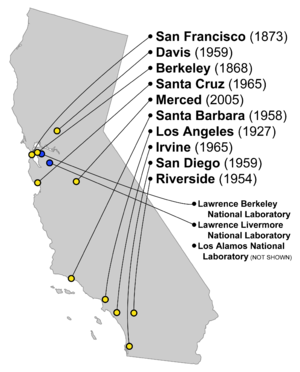 The University of California directly manages and operates one United States Department of Energy National Laboratory
:
UC is a limited partner in two separate private companies that manage and operate two other Department of Energy national laboratories:
Lawrence Livermore National Laboratory uses advance science and technology to ensure that the US’s nuclear weapons remain reliable. LLNL also has major research programs in supercomputing and predictive modeling, energy and environment, bioscience and biotechnology, basic science and applied technology, counter proliferation of weapons of mass destruction, and homeland security. It is also home to the most powerful supercomputers in the world.
Los Alamos National Laboratory focuses most of its work on ensuring the reliability of the US's nuclear weapons. Other work at LANL involves research programs into preventing the spread of weapons of mass destruction and US national security, such as protection of the US homeland from terrorist attack.
The UC's ties to the three laboratories have occasionally sparked controversy and protest, because all three laboratories have been intimately linked with the development of nuclear weapon
s. During the World War II
Manhattan Project
, Lawrence Berkeley Lab developed the electromagnetic method for separation of uranium isotopes used to develop the first atomic bombs. The Los Alamos and Lawrence Livermore labs have been involved in designing the nation's nuclear weapons from inception until the shift into stockpile stewardship
after the close of the Cold War
.
Historically the two national laboratories in Berkeley and Livermore named after Ernest O. Lawrence, have had very close relationships on research projects, as well as sharing some business operations and staff. In fact, LLNL was not officially severed administratively from LBNL until the early 1970s. They also have much deeper ties to the university than the Los Alamos Lab, a fact seen in their respective original names; the University of California Berkeley Radiation Laboratory and the University of California Radiation Laboratory at Livermore.
(LANL) contract for bidding by other vendors. UC entered into a partnership with Bechtel Corporation, BWXT, and the Washington Group International
, and together they created a private company called Los Alamos National Security, LLC (LANS). The only other bidder on the LANL contract was a Lockheed-Martin Corporation-created company that included, among others, the University of Texas System
. In December 2005, a seven-year contract to manage the laboratory was awarded to the Los Alamos National Security, LLC.
On June 1, 2006, the University of California ended its direct involvement in operating Los Alamos National Laboratory, and management control of the laboratory was taken over by Los Alamos National Security, LLC. Approximately 95% of the former 10,000 UC employees at LANL were rehired by LANS to continue working at LANL.
On October 1, 2007, the University of California ended its direct involvement in operating the Lawrence Livermore National Laboratory. Management control of the laboratory was taken over by Lawrence Livermore National Security, LLC, a limited liability company whose members are Bechtel National, the University of California, Babcock and Wilcox, the Washington Division of URS Corporation, Battelle Memorial Institute, and The Texas A&M University System.
Other than UC appointing three members to the two separate board of directors (each with eleven members) that oversee LANS and LLNS, UC now has virtually no responsibility or direct involvement in either LANL or LLNL. UC policies and regulations that apply to UC campuses and the Lawrence Berkeley National Laboratory in California no longer apply to LANL and LLNL, and the LANL and LLNL Directors no longer report to the UC Regents or UC Office of the President.
at Moffett Federal Airfield
in California. In September 2003, a ten-year contract valued at more than US$330 million was awarded to the UC to establish and operate a University Affiliated Research Center (UARC) — the largest grant ever awarded the University. UC Santa Cruz manages the UARC for the University of California, with the goal of increasing the science output, safety, and effectiveness of NASA
's missions through new technologies and scientific techniques. Since 2002, the NSF
-funded San Diego Supercomputer Center
at UC San Diego has been managed by the University of California, taking over for the previous manager, General Atomics
.
as a multi-campus research unit headquartered at UC Santa Cruz.
The Astronomy Department at the Berkeley
campus manages the Hat Creek Radio Observatory
in Shasta County
.
Each medical center serves as the primary teaching site for that campus' medical school
. All five programs are considered among the top tier of medical schools in the United States, with UCSF being a perennial fixture among the top five programs in both research and primary care and both UCLA and UCSD consistently ranking among the top fifteen research schools, according to the annual rankings published by U.S. News and World Report. The teaching hospitals affiliated with each school are also highly regarded - both UCLA and UCSF's
medical centers are in U.S. News and World Reports 2010-11 Honor Roll for Best Hospitals in the United States.
In the latter half of the 20th century, the UC hospitals became the core of full-fledged regional health systems; they were gradually supplemented by many outpatient clinics, offices, and institutes. Three UC hospitals are actually county hospitals that were sold to UC, which means that UC plays a major role in providing healthcare to the indigent. The medical hospitals operated by UC Irvine (acquired in 1976), UC Davis (acquired in 1978), and UC San Diego (acquired in 1984), each began as the respective county hospitals of Orange County
, Sacramento County
, and San Diego County
.
Confusingly, Harbor–UCLA Medical Center and Olive View – UCLA Medical Center are not operated by UCLA; they are actually Los Angeles County
-operated facilities that UCLA uses as teaching hospitals.
and Continuing Medical Education
in California. For example, the systemwide portion of UC Extension (directly controlled by the UC Office of the President) operates Continuing Education of the Bar under a joint venture agreement with the State Bar of California
.
programs and have nutrition, family and consumer sciences advisors who assist local government. Currently, the division's University of California 4-H Youth Development Program and 4-H Center for Youth Development are national leaders in studying thriving
in the field of youth development.
was established in January 1965 to provide UC faculty with large areas of land where they could conduct long-term ecosystem research without having to worry about outside disturbances like tourists. Today, the NRS manages 35 reserves that total more than 130000 acres (526.1 km²).
as a utility airport for air shuttle
service in the contractual transportation of university employees and agricultural samples. It is also a public General Aviation airport. University Airport's ICAO identifier is KEDU.
Public university
A public university is a university that is predominantly funded by public means through a national or subnational government, as opposed to private universities. A national university may or may not be considered a public university, depending on regions...
system
University system
A university system is a set of multiple, affiliated universities and colleges that are usually geographically distributed. Typically, all member universities in a university system share a common component among all of their various names...
in the U.S. state
U.S. state
A U.S. state is any one of the 50 federated states of the United States of America that share sovereignty with the federal government. Because of this shared sovereignty, an American is a citizen both of the federal entity and of his or her state of domicile. Four states use the official title of...
of California
California
California is a state located on the West Coast of the United States. It is by far the most populous U.S. state, and the third-largest by land area...
. Under the California Master Plan for Higher Education
California Master Plan for Higher Education
The California Master Plan for Higher Education of 1960 was developed by a survey team appointed by the UC Regents and the State Board of Education during the administration of Governor Pat Brown. Clark Kerr, then the President of UC, was a key figure in its development...
, the University of California is a part of the state's three-tier public higher education
Higher education
Higher, post-secondary, tertiary, or third level education refers to the stage of learning that occurs at universities, academies, colleges, seminaries, and institutes of technology...
system, which also includes the California State University
California State University
The California State University is a public university system in the state of California. It is one of three public higher education systems in the state, the other two being the University of California system and the California Community College system. It is incorporated as The Trustees of the...
system and the California Community Colleges system.
As of 2011, the University of California has a combined student
Student
A student is a learner, or someone who attends an educational institution. In some nations, the English term is reserved for those who attend university, while a schoolchild under the age of eighteen is called a pupil in English...
body of 234,464 students, 18,896 faculty, 189,116 staff members, and over 1,600,000 living alumni.
Its first campus
Campus
A campus is traditionally the land on which a college or university and related institutional buildings are situated. Usually a campus includes libraries, lecture halls, residence halls and park-like settings...
, UC Berkeley
University of California, Berkeley
The University of California, Berkeley , is a teaching and research university established in 1868 and located in Berkeley, California, USA...
, was founded in 1868, while its tenth and newest campus, UC Merced
University of California, Merced
The University of California, Merced, commonly referred to as UC Merced or UCM, is the tenth and newest of the University of California campuses. Located in the San Joaquin Valley in unincorporated Merced County, California, near Merced, UC Merced was the first American research university to...
, opened for classes in fall 2005. Nine campuses enroll both undergraduate
Undergraduate education
Undergraduate education is an education level taken prior to gaining a first degree . Hence, in many subjects in many educational systems, undergraduate education is post-secondary education up to the level of a bachelor's degree, such as in the United States, where a university entry level is...
and graduate
Graduate school
A graduate school is a school that awards advanced academic degrees with the general requirement that students must have earned a previous undergraduate degree...
students; one campus, UCSF
University of California, San Francisco
The University of California, San Francisco is one of the world's leading centers of health sciences research, patient care, and education. UCSF's medical, pharmacy, dentistry, nursing, and graduate schools are among the top health science professional schools in the world...
, enrolls only graduate and professional students in the medical
Medicine
Medicine is the science and art of healing. It encompasses a variety of health care practices evolved to maintain and restore health by the prevention and treatment of illness....
and health sciences. In addition, the independently administered UC Hastings
University of California, Hastings College of the Law
University of California, Hastings College of the Law is a public law school in San Francisco, California, located in the Civic Center neighborhood....
— located in San Francisco but not part of the UCSF campus — enrolls only graduate and professional students in legal studies.
The University of California's campuses boast large numbers of distinguished faculty in almost every field and is widely regarded as one of the top public university systems in the world. Eight of its undergraduate campuses are ranked among the top 100, six among the top 50, and two among the top 25 U.S. universities by the U.S. News and World Report. Among public schools, two of its undergraduate campuses are ranked in the top 5 (at spots 1 and 2), six in the top 10, seven in the top 11, and all in the top 40, with the exception of UC Merced. By the Academic Ranking of World Universities, one of its campuses, UC Berkeley, is ranked second worldwide among public and private universities, and 3—Berkeley, Los Angeles, and San Diego—are ranked among the top 15.
History
University
A university is an institution of higher education and research, which grants academic degrees in a variety of subjects. A university is an organisation that provides both undergraduate education and postgraduate education...
. Taking advantage of the Morrill Land Grant Act, the California Legislature established an Agricultural, Mining, and Mechanical Arts College in 1866. Although this institution was provided with sufficient funds, it lacked land.
Meanwhile, Congregational minister
Minister of religion
In Christian churches, a minister is someone who is authorized by a church or religious organization to perform functions such as teaching of beliefs; leading services such as weddings, baptisms or funerals; or otherwise providing spiritual guidance to the community...
Henry Durant
Henry Durant
Henry Durant was the founding president of the University of California.-Biography:Graduate of Yale College...
, an alumnus of Yale
Yale University
Yale University is a private, Ivy League university located in New Haven, Connecticut, United States. Founded in 1701 in the Colony of Connecticut, the university is the third-oldest institution of higher education in the United States...
, had established the private Contra Costa Academy, on June 20, 1853 in Oakland, California
Oakland, California
Oakland is a major West Coast port city on San Francisco Bay in the U.S. state of California. It is the eighth-largest city in the state with a 2010 population of 390,724...
. The initial site was bounded by Twelfth and Fourteenth Streets and Harrison and Franklin Streets in downtown Oakland. In turn, the Trustees of the Contra Costa Academy were granted a charter on April 13, 1855 for a College of California
College of California
The College of California was the predecessor of the University of California system of public universities. The private college was founded in 1855 by noted educator Dr. Samuel H. Willey...
. State Historical Plaque No. 45 marks the site of the College of California
College of California
The College of California was the predecessor of the University of California system of public universities. The private college was founded in 1855 by noted educator Dr. Samuel H. Willey...
at the northeast corner of Thirteenth and Franklin Streets in Oakland. Hoping both to expand and raise funds, the College of California
College of California
The College of California was the predecessor of the University of California system of public universities. The private college was founded in 1855 by noted educator Dr. Samuel H. Willey...
's trustees formed the College Homestead Association and purchased 160 acre
Acre
The acre is a unit of area in a number of different systems, including the imperial and U.S. customary systems. The most commonly used acres today are the international acre and, in the United States, the survey acre. The most common use of the acre is to measure tracts of land.The acre is related...
s (650,000 m²) of land in what is now Berkeley
Berkeley, California
Berkeley is a city on the east shore of the San Francisco Bay in Northern California, United States. Its neighbors to the south are the cities of Oakland and Emeryville. To the north is the city of Albany and the unincorporated community of Kensington...
in 1866. But sales of new homesteads fell short.
Governor Frederick Low
Frederick Low
Frederick Ferdinand Low was an American politician, US congressman and the ninth Governor of California.-Life:Born in Frankfort in 1828, Low attended the Hampden Academy in Hampden, Maine. Low moved to California, entering the shipping business in San Francisco in 1849...
favored the establishment of a state university based upon the University of Michigan
University of Michigan
The University of Michigan is a public research university located in Ann Arbor, Michigan in the United States. It is the state's oldest university and the flagship campus of the University of Michigan...
plan, and thus in one sense may be regarded as the founder of the University of California. In 1867, he suggested a merger of the existing College of California with the proposed state university. On October 9, 1867, the College's trustees reluctantly agreed to merge with the state college to their mutual advantage, but under one condition — that there not be simply a "Agricultural, Mining, and Mechanical Arts College," but "a complete university," within which the College of California would become the College of Letters (now the College of Letters and Science). Accordingly, the Organic Act, establishing the University of California, was signed into law by Governor Henry H. Haight (Low's successor) on March 23, 1868.
The University of California's second president, Daniel Coit Gilman
Daniel Coit Gilman
Daniel Coit Gilman was an American educator and academician, who was instrumental in founding the Sheffield Scientific School at Yale College, and who subsequently served as one of the earliest presidents of the University of California, the first president of Johns Hopkins University, and as...
, opened the Berkeley
Berkeley, California
Berkeley is a city on the east shore of the San Francisco Bay in Northern California, United States. Its neighbors to the south are the cities of Oakland and Emeryville. To the north is the city of Albany and the unincorporated community of Kensington...
campus in September 1873. Earlier that year, Toland Medical College in San Francisco had agreed to become the University's "Medical Department"; it later evolved into UCSF
University of California, San Francisco
The University of California, San Francisco is one of the world's leading centers of health sciences research, patient care, and education. UCSF's medical, pharmacy, dentistry, nursing, and graduate schools are among the top health science professional schools in the world...
. In 1878, the University established its first law school
Law school
A law school is an institution specializing in legal education.- Law degrees :- Canada :...
in San Francisco with a US$100,000 gift from Serranus Clinton Hastings
Serranus Clinton Hastings
Serranus Clinton Hastings was a 19th-century politician and a prominent lawyer in the United States. He studied law as a young man and moved to the Iowa District in 1837 to open a law office. Iowa became a territory a year later, and he was elected a member of the House of Representatives of the...
; it is now Hastings College of the Law
University of California, Hastings College of the Law
University of California, Hastings College of the Law is a public law school in San Francisco, California, located in the Civic Center neighborhood....
.
In 1905, the Legislature established a "University Farm School" that would be located at Davis
Davis, California
Davis is a city in Yolo County, California, United States. It is part of the Sacramento–Arden-Arcade–Roseville Metropolitan Statistical Area...
, and in 1907 a "Citrus Experiment Station" at Riverside
Riverside, California
Riverside is a city in Riverside County, California, United States, and the county seat of the eponymous county. Named for its location beside the Santa Ana River, it is the largest city in the Riverside-San Bernardino-Ontario metropolitan area of Southern California, 4th largest inland California...
as adjuncts to the College of Agriculture at Berkeley. In 1959, the Legislature promoted the "Farm" and "Experiment Station" to the rank of "general campus," creating, respectively, UC Davis and UC Riverside.
In 1919, the Legislature arranged for an existing normal school
Normal school
A normal school is a school created to train high school graduates to be teachers. Its purpose is to establish teaching standards or norms, hence its name...
in Los Angeles
Los Ángeles
Los Ángeles is the capital of the province of Biobío, in the commune of the same name, in Region VIII , in the center-south of Chile. It is located between the Laja and Biobío rivers. The population is 123,445 inhabitants...
to become the University's "Southern Branch." In turn, the Southern Branch became UCLA
University of California, Los Angeles
The University of California, Los Angeles is a public research university located in the Westwood neighborhood of Los Angeles, California, USA. It was founded in 1919 as the "Southern Branch" of the University of California and is the second oldest of the ten campuses...
in 1927. In 1944, the former Santa Barbara State College—renamed UC Santa Barbara--became the third general-education campus of the University of California system.
In 1932, Will Keith Kellogg
Will Keith Kellogg
Will Keith Kellogg, generally referred to as W.K. Kellogg was an American industrialist in food manufacturing, best known as the founder of the Kellogg Company, which to this day produces a wide variety of popular breakfast cereals...
donated his Arabian horse ranch in Pomona, California
Pomona, California
-2010:The 2010 United States Census reported that Pomona had a population of 149,058, a slight decline from the 2000 census population. The population density was 6,491.2 people per square mile...
to the University of California system. However, the land remained largely unused and ownership was transferred to the California State University
California State University
The California State University is a public university system in the state of California. It is one of three public higher education systems in the state, the other two being the University of California system and the California Community College system. It is incorporated as The Trustees of the...
system in 1949. Kellogg's old ranch became the California State Polytechnic University, Pomona
California State Polytechnic University, Pomona
California State Polytechnic University, Pomona, or Cal Poly Pomona, is a public university located in Pomona, California, United States...
(Cal Poly Pomona).
The San Diego
San Diego, California
San Diego is the eighth-largest city in the United States and second-largest city in California. The city is located on the coast of the Pacific Ocean in Southern California, immediately adjacent to the Mexican border. The birthplace of California, San Diego is known for its mild year-round...
campus was founded as a marine station in 1912 and became UCSD
University of California, San Diego
The University of California, San Diego, commonly known as UCSD or UC San Diego, is a public research university located in the La Jolla neighborhood of San Diego, California, United States...
in 1959. Campuses were established at Santa Cruz
Santa Cruz, California
Santa Cruz is the county seat and largest city of Santa Cruz County, California in the US. As of the 2010 U.S. Census, Santa Cruz had a total population of 59,946...
and Irvine
Irvine, California
Irvine is a suburban incorporated city in Orange County, California, United States. It is a planned city, mainly developed by the Irvine Company since the 1960s. Formally incorporated on December 28, 1971, the city has a population of 212,375 as of the 2010 census. However, the California...
in 1965. UC Merced
University of California, Merced
The University of California, Merced, commonly referred to as UC Merced or UCM, is the tenth and newest of the University of California campuses. Located in the San Joaquin Valley in unincorporated Merced County, California, near Merced, UC Merced was the first American research university to...
opened in fall 2005.
The California Master Plan for Higher Education
California Master Plan for Higher Education
The California Master Plan for Higher Education of 1960 was developed by a survey team appointed by the UC Regents and the State Board of Education during the administration of Governor Pat Brown. Clark Kerr, then the President of UC, was a key figure in its development...
of 1960 established that UC select from the top 12.5% (one-eighth) of graduating high school seniors in California. Prior to the promulgation of the Master Plan, UC was to select from the top 15%. The university doesn't follow all tenets of this plan, such as the stricture that no campus is to exceed 27,500 in enrollment to ensure quality. Three campuses, Berkeley, Davis, and Los Angeles, all currently enroll over 30,000.
According to Spanish newspaper reports, UC representatives have visited Madrid
Madrid
Madrid is the capital and largest city of Spain. The population of the city is roughly 3.3 million and the entire population of the Madrid metropolitan area is calculated to be 6.271 million. It is the third largest city in the European Union, after London and Berlin, and its metropolitan...
, Spain
Spain
Spain , officially the Kingdom of Spain languages]] under the European Charter for Regional or Minority Languages. In each of these, Spain's official name is as follows:;;;;;;), is a country and member state of the European Union located in southwestern Europe on the Iberian Peninsula...
to discuss the possibility of opening UC's first general campus outside of the U.S. there in 2014.
Academics
UC researchers and faculty are responsible for 5,505 inventions and 2,497 patents. UC researchers create 3 new inventions per day on average.The University of California and most of its campuses are members of the Association of American Universities (AAU)
Association of American Universities
The Association of American Universities is an organization of leading research universities devoted to maintaining a strong system of academic research and education...
. Collectively, the system counts among its faculty (as of 2002):
- 389 members of the Academy of Arts and SciencesAmerican Academy of Arts and SciencesThe American Academy of Arts and Sciences is an independent policy research center that conducts multidisciplinary studies of complex and emerging problems. The Academy’s elected members are leaders in the academic disciplines, the arts, business, and public affairs.James Bowdoin, John Adams, and...
- 5 Fields MedalFields MedalThe Fields Medal, officially known as International Medal for Outstanding Discoveries in Mathematics, is a prize awarded to two, three, or four mathematicians not over 40 years of age at each International Congress of the International Mathematical Union , a meeting that takes place every four...
recipients - 19 FulbrightFulbright ProgramThe Fulbright Program, including the Fulbright-Hays Program, is a program of competitive, merit-based grants for international educational exchange for students, scholars, teachers, professionals, scientists and artists, founded by United States Senator J. William Fulbright in 1946. Under the...
Scholars - 25 MacArthur Fellows
- 254 members of the National Academy of SciencesUnited States National Academy of SciencesThe National Academy of Sciences is a corporation in the United States whose members serve pro bono as "advisers to the nation on science, engineering, and medicine." As a national academy, new members of the organization are elected annually by current members, based on their distinguished and...
- 91 members of the National Academy of EngineeringNational Academy of EngineeringThe National Academy of Engineering is a government-created non-profit institution in the United States, that was founded in 1964 under the same congressional act that led to the founding of the National Academy of Sciences...
- 13 National Medal of ScienceNational Medal of ScienceThe National Medal of Science is an honor bestowed by the President of the United States to individuals in science and engineering who have made important contributions to the advancement of knowledge in the fields of behavioral and social sciences, biology, chemistry, engineering, mathematics and...
Laureates - 37 Nobel laureates. This is the largest number of laureates at any university.
- 106 members of the Institute of MedicineInstitute of MedicineThe Institute of Medicine is a not-for-profit, non-governmental American organization founded in 1970, under the congressional charter of the National Academy of Sciences...
Eight campuses operate on the quarter system, while Berkeley and Merced are on the semester system. However, the David Geffen School of Medicine at UCLA
David Geffen School of Medicine at UCLA
UCLA School of Medicine or David Geffen School of Medicine at UCLA is an accredited medical school located in Los Angeles, California, United States...
and all UC law schools operate on the semester system.
UC Libraries
At 34 million items, the University of California libraryLibrary
In a traditional sense, a library is a large collection of books, and can refer to the place in which the collection is housed. Today, the term can refer to any collection, including digital sources, resources, and services...
system contains one of the largest collections in the world. Each campus maintains its own library catalog and also participates in the systemwide union catalog, MELVYL
Melvyl
Melvyl is the name of the online catalog of the University of California's library system, and is a registered trademark owned by the University of California...
. Besides on-campus libraries, the UC system also maintains two regional library facilities (one each for Northern and Southern California), which each accept older items from all UC campus libraries in their respective region. As of 2007, Northern Regional Library Facility is home to 4.7 million volumes, while SRLF is home to 5.7 million.
Governance
The University of California is governed by the Regents of the University of CaliforniaRegents of the University of California
The Regents of the University of California make up the governing board of the University of California. The Board has 26 full members:* The majority are appointed by the Governor of California for 12-year terms....
, as required by the current Constitution of the State of California
California Constitution
The document that establishes and describes the duties, powers, structure and function of the government of the U.S. state of California. The original constitution, adopted in November 1849 in advance of California attaining U.S. statehood in 1850, was superseded by the current constitution, which...
. Eighteen regents are appointed by the governor
Governor of California
The Governor of California is the chief executive of the California state government, whose responsibilities include making annual State of the State addresses to the California State Legislature, submitting the budget, and ensuring that state laws are enforced...
for 12-year terms. One member is a student appointed for a one-year term. There are also 7 ex officio members — the Governor, Lieutenant Governor, Speaker of the Assembly, Superintendent of Public Instruction, president and vice president of the Alumni Associations of UC, and the UC President. According to a recent report issued by the Western Association of Schools and Colleges
Western Association of Schools and Colleges
The Western Association of Schools and Colleges is one of six official academic bodies responsible for the accreditation of public and private universities, colleges, secondary and elementary schools in the United States and foreign institutions of American origin. The Western Association of...
, the UC system has "significant problems in governance, leadership and decision making," with much "confusion about the roles and responsibilities of the university president, the regents and the 10 campus chancellors with no clear lines of authority and boundaries."
The Academic Senate, made up of faculty members, is empowered by the Regents to set academic policies. In addition, the system-wide faculty chair and vice-chair sit on the Board of Regents as non-voting members.
Originally the President was directly in charge of the first campus, Berkeley, and in turn, all other UC locations (with the exception of Hastings College of the Law) were controlled by the Berkeley campus. In 1952, the system was reorganized so that day-to-day "chief executive officer
Chief executive officer
A chief executive officer , managing director , Executive Director for non-profit organizations, or chief executive is the highest-ranking corporate officer or administrator in charge of total management of an organization...
" functions for each campus were transferred to Chancellors
Chancellor (education)
A chancellor or vice-chancellor is the chief executive of a university. Other titles are sometimes used, such as president or rector....
who were entrusted with a high degree of autonomy. In turn, all Chancellors (again, with the exception of Hastings) report as equals to the UC President. Today, the UC Office of the President and the Office of the Secretary of the Regents of the University of California share an office building in downtown Oakland that serves as the UC system's headquarters
Headquarters
Headquarters denotes the location where most, if not all, of the important functions of an organization are coordinated. In the United States, the corporate headquarters represents the entity at the center or the top of a corporation taking full responsibility managing all business activities...
.
Besides substantial six-figure incomes, the UC President and all UC chancellors enjoy a number of controversial perks, such as free housing in the form of university-maintained mansions. In 1962, Anson Blake's will donated his 10 acres (40,468.6 m²) estate (Blake Garden
Blake Garden, Kensington
Blake Garden is a botanical garden located at 70 Rincon Road in Kensington, California, United States. It is a teaching facility for the Department of Landscape Architecture and Environmental Planning of the University of California, Berkeley. It is also the site of Blake House, the official...
) and mansion (Blake House) in Kensington
Kensington, California
Kensington is an unincorporated community and census-designated place located in the East Bay, part of the San Francisco Bay Area, in Contra Costa County, California, United States. The population was 5,077 at the 2010 census.- Law and government :Kensington is an unincorporated area of Contra...
to the University of California's Department of Landscape Architecture. In 1968, the Regents decided to make Blake House the official residence of the UC President. As of 2005, it currently costs around US$300,000 per year to maintain Blake Garden and Blake House; the latter, built in 1926, is a 13239 square feet (1,229.9 m²) mansion with a view of San Francisco Bay.
All UC chancellors traditionally live for free in a mansion on or near campus that is usually known as University House, where they are required to frequently host social functions attended by wealthy donors and distinguished guests. UCSD's University House has been closed since 2004 due to mold and severe structural deficiencies; renovation attempts have been severely slowed by the discovery that the home sits on top of legally protected Native American burial remains
Native American Graves Protection and Repatriation Act
The Native American Graves Protection and Repatriation Act , Pub. L. 101-601, 25 U.S.C. 3001 et seq., 104 Stat. 3048, is a United States federal law passed on 16 November 1990 requiring federal agencies and institutions that receive federal funding to return Native American "cultural items" to...
.
UC Presidents
|
Robert Gordon Sproul Robert Gordon Sproul was eleventh President of the University of California serving from 1930 to 1958.... Clark Kerr Clark Kerr was an American professor of economics and academic administrator. He was the first chancellor of the University of California, Berkeley and twelfth president of the University of California.- Early years :... Charles J. Hitch Charles J. Hitch was Assistant Secretary of Defense from 1961 to 1965. He was president of the University of California from 1967 to 1975.... David S. Saxon David S. Saxon was an American physicist and educator who served as the President of the University of California system as well as the Chairman of the Board of Trustees of the Massachusetts Institute of Technology Corporation.Saxon was born in St. Paul, Minnesota. He attended MIT where he earned... David P. Gardner David Pierpont Gardner was the 17th president of the University of California and was also the president of the University of Utah.-Biography:... Jack W. Peltason Jack W. Peltason was the president of the University of California, and former chancellor of the University of California, Irvine.-External links:*http://www.universityofcalifornia.edu/president*-References:... Richard C. Atkinson Richard Chatham Atkinson is an American professor of psychology and academic administrator. He is the former president and regent of the University of California system, and former chancellor of U.C... Robert C. Dynes Robert C. Dynes is a Canadian-American physicist, researcher, and academic administrator, and professor of physics at the University of California, Berkeley, and the former President of the University of California system, and former Chancellor of the University of California, San Diego.-Early... Mark Yudof Mark G. Yudof is an American law professor and academic administrator. He is president of the University of California , former chancellor of the University of Texas System , and former president of the University of Minnesota .In addition to his position as Chancellor at The University of Texas,... |
On 13 August 2007, President Dynes announced that he would step down effective June 2008, or until his replacement was selected. However, he also announced that Provost Wyatt (Rory) Hume would take over as the system's chief operating officer, effective immediately. Three state lawmakers had publicly demanded his resignation for his handling of the executive pay compensation scandal that stemmed from UC system Provost M.R.C. Greenwood's violation of UC conflict-of-interest rules. (She had created a management job at UC headquarters for a friend with whom she owned rental property, and a subordinate, Winston Doby, improperly helped create a highly-paid year-long internship for her son at UC Merced.)
Incoming President Mark Yudof took over on June 16, 2008.
Finances
The state of California currently spends US$3.3 billion or 3.2% of its annual budget on the UC system. In May 2004, UC President Robert C. DynesRobert C. Dynes
Robert C. Dynes is a Canadian-American physicist, researcher, and academic administrator, and professor of physics at the University of California, Berkeley, and the former President of the University of California system, and former Chancellor of the University of California, San Diego.-Early...
and CSU Chancellor Charles B. Reed struck a private deal, called the "Higher Education Compact," with Governor Schwarzenegger
Schwarzenegger
Schwarzenegger is a German surname that means person from Schwarzenegg, which is both a town in Switzerland and a place in Land Salzburg in Austria...
. They agreed to slash spending by about a billion dollars (about a third of the University's core budget for academic operations) in exchange for a funding formula lasting until 2011. The agreement calls for modest annual increases in state funds (but not enough to replace the loss in state funds Dynes and Schwarzenegger agreed to), private fundraising to help pay for basic programs, and large student fee hikes, especially for graduate and professional students. A detailed analysis of the Compact by the Academic Senate "Futures Report" indicated, despite the large fee increases, the University core budget would not recover to the levels it was at in 2000. Undergraduate student fees have risen 90% from 2003 to 2007.
The First District Court of Appeal in San Francisco recently ruled that the University of California owes nearly US$40 million dollars in refunds to about 40,000 students who were promised that their tuition fees would be held steady but were hit with increases when the state ran short of money in 2003.
Faculty pay
Salaries for UC faculty increased in late 2007 and are slightly higher than in the California State UniversityCalifornia State University
The California State University is a public university system in the state of California. It is one of three public higher education systems in the state, the other two being the University of California system and the California Community College system. It is incorporated as The Trustees of the...
system. As of September, 2007 instructors earn up to $53,200, assistant professors up to $69,200, associate professors up to $97,100 and full professors up to $164,700. According to the 2007 - 2008 payscale, the following pay ranges apply per fiscal year with Cost-of-Living-Adjustments (COLA):
| Position | Salary range | Maximum off-scale limit |
| Lecturer | $50,292 - $140,724 | N/A |
| Senior lecturer | $92,400 - $140,724 | N/A |
| Assistant Professor | $53,200 - $69,200 | $90,000 |
| Associate Professor | $66,100 - $83,700 | $111,700 |
| Full Professor | $77,800 - $142,700 | $178,600 |
However, for 2009–2010, most faculty members and UC staff were furloughed up to 10% of their salary.
Campuses and rankings
At present, the UC system officially describes itself as a "ten campus" system consisting of the campuses listed below. These campuses are under the direct control of the Regents and President. Only ten campuses are listed on the official UC letterhead.Although affiliated with the UC system, the Hastings College of Law
University of California, Hastings College of the Law
University of California, Hastings College of the Law is a public law school in San Francisco, California, located in the Civic Center neighborhood....
is not controlled by the Regents or President; it has a separate board of directors and must seek funding directly from the Legislature. However, under the California Education Code, the Juris Doctor
Juris Doctor
Juris Doctor is a professional doctorate and first professional graduate degree in law.The degree was first awarded by Harvard University in the United States in the late 19th century and was created as a modern version of the old European doctor of law degree Juris Doctor (see etymology and...
from Hastings is awarded in the name of the Regents and bears the signature of the President. Furthermore, Education Code section 92201 states that Hastings "is affiliated with the University of California, and is the law department thereof."
Some campuses are known around the world, especially Berkeley and UCLA. UCLA is so well known in Asia that the university has licensed its trademark to 15 UCLA-branded stores across East Asia
East Asia
East Asia or Eastern Asia is a subregion of Asia that can be defined in either geographical or cultural terms...
.
| Campus | Acreage | Founded | Enrollment | Endowment | Operations | Athletics Nickname | USNews | ARWU Academic Ranking of World Universities The Academic Ranking of World Universities , commonly known as the Shanghai ranking, is a publication that was founded and compiled by the Shanghai Jiaotong University to rank universities globally. The rankings have been conducted since 2003 and updated annually... . |
NSF R&D Expenditures National Science Foundation The National Science Foundation is a United States government agency that supports fundamental research and education in all the non-medical fields of science and engineering. Its medical counterpart is the National Institutes of Health... |
Wash. Monthly | Athletics |
|---|---|---|---|---|---|---|---|---|---|---|---|
| Berkeley University of California, Berkeley The University of California, Berkeley , is a teaching and research university established in 1868 and located in Berkeley, California, USA... |
1,600 | 1868 | 33,558 | US$2.60 billion | 1.59 billion | Golden Bears California Golden Bears The California Golden Bears is the nickname used for 29 varsity athletic programs and various club teams of the University of California, Berkeley... |
22 | NCAA Div I Pac-12 | |||
| Davis University of California, Davis The University of California, Davis is a public teaching and research university established in 1905 and located in Davis, California, USA. Spanning over , the campus is the largest within the University of California system and third largest by enrollment... |
5,300 | 1959 | 32,290 | US$1.28 billion | 2.27 billion | Aggies UC Davis Aggies The UC Davis Aggies compete in NCAA Division I sports in the Big West Conference. For football, the Aggies compete in Division I FCS , and are members of the Great West Conference, granting UC Davis the distinction of being one of only three UC campuses to field a football team... |
38 | NCAA Div I Big West Big West Conference The Big West Conference is an NCAA-affiliated Division I mid-major college athletic conference. When the conference began in 1969, its name was the Pacific Coast Athletic Association . After nineteen years, in 1988, its name was changed to the Big West Conference. The conference stopped... |
|||
| Irvine University of California, Irvine The University of California, Irvine , founded in 1965, is one of the ten campuses of the University of California, located in Irvine, California, USA... |
1,510 | 1965 | 28,000 | US$0.24 billion | 1.42 billion | Anteaters UC Irvine Anteaters UC Irvine's Athletics program participates in the NCAA's Division I, as members of the Big West Conference and the Mountain Pacific Sports Federation... |
45 | 50 | NCAA Div I Big West Big West Conference The Big West Conference is an NCAA-affiliated Division I mid-major college athletic conference. When the conference began in 1969, its name was the Pacific Coast Athletic Association . After nineteen years, in 1988, its name was changed to the Big West Conference. The conference stopped... |
||
| Los Angeles University of California, Los Angeles The University of California, Los Angeles is a public research university located in the Westwood neighborhood of Los Angeles, California, USA. It was founded in 1919 as the "Southern Branch" of the University of California and is the second oldest of the ten campuses... |
419 | 1919 | 37,221 | US$2.16 billion | 3.39 billion | Bruins UCLA Bruins The UCLA Bruins are the sports teams for University of California, Los Angeles . The Bruin men's and women's teams participate in NCAA Division I as part of the Pacific-12 Conference and the Mountain Pacific Sports Federation . For football, they are in the Football Bowl Subdivision of Division I... |
25 | NCAA Div I Pac-12 | |||
| Merced University of California, Merced The University of California, Merced, commonly referred to as UC Merced or UCM, is the tenth and newest of the University of California campuses. Located in the San Joaquin Valley in unincorporated Merced County, California, near Merced, UC Merced was the first American research university to... |
910 | 2005 | 2,700 | US$0.02 billion | 0.07 billion | Golden Bobcats | Not Ranked | NAIA CalPac California Pacific Conference The California Pacific Conference is a college athletics conference in the National Association of Intercollegiate Athletics . The conference commissioner is Don Ott. Conference leadership is shared among the member institutions. The conference president is Themy Adachi of Mills College. The... |
|||
| Riverside University of California, Riverside The University of California, Riverside, commonly known as UCR or UC Riverside, is a public research university and one of the ten general campuses of the University of California system. UCR is consistently ranked as one of the most ethnically and economically diverse universities in the United... |
1,160 | 1954 | 20,746 | US$0.11 billion | 0.46 billion | Highlanders | 97 | 101–151 | 115 | 5 | NCAA Div I Big West Big West Conference The Big West Conference is an NCAA-affiliated Division I mid-major college athletic conference. When the conference began in 1969, its name was the Pacific Coast Athletic Association . After nineteen years, in 1988, its name was changed to the Big West Conference. The conference stopped... |
| San Diego University of California, San Diego The University of California, San Diego, commonly known as UCSD or UC San Diego, is a public research university located in the La Jolla neighborhood of San Diego, California, United States... |
2,124 | 1960 | 25,938 | US$0.48 billion | 2.08 billion | Tritons | 37 | NCAA Div II CCAA California Collegiate Athletic Association The California Collegiate Athletic Association or CCAA is an intercollegiate athletic conference in the Division II of the NCAA. All of its current members are public universities, and all except for UC San Diego are members of the California State University system.It was founded in December 1938... |
|||
| San Francisco University of California, San Francisco The University of California, San Francisco is one of the world's leading centers of health sciences research, patient care, and education. UCSF's medical, pharmacy, dentistry, nursing, and graduate schools are among the top health science professional schools in the world... |
135 | 1873 | 4,174 | US$1.25 billion | 2.48 billion | Bears | |||||
| Santa Barbara University of California, Santa Barbara The University of California, Santa Barbara, commonly known as UCSB or UC Santa Barbara, is a public research university and one of the 10 general campuses of the University of California system. The main campus is located on a site in Goleta, California, from Santa Barbara and northwest of Los... |
1020 | 1909 | 21,016 | US$0.18 billion | 0.62 billion | Gauchos | 42 | 13 | NCAA Div I Big West Big West Conference The Big West Conference is an NCAA-affiliated Division I mid-major college athletic conference. When the conference began in 1969, its name was the Pacific Coast Athletic Association . After nineteen years, in 1988, its name was changed to the Big West Conference. The conference stopped... |
||
| Santa Cruz University of California, Santa Cruz The University of California, Santa Cruz, also known as UC Santa Cruz or UCSC, is a public, collegiate university; one of ten campuses in the University of California... |
2,950 | 1965 | 15,012 | US$0.10 billion | 0.45 billion | Banana Slugs | 75 | 101–151 | 117 | 70 | NCAA Div III Independent |
In 2008 the University of California was awarded the Sustainability Showcase Award from the California Sustainability Alliance
California Sustainability Alliance
The California Sustainability Alliance is an organization funded by the California IOUs to bring together key stakeholders needed to overcome the obstacles of sustainability. The Alliance was designed in 2008 to help meet the State’s aggressive climate, energy and other resource and environmental...
. The Alliance recognized the UC system for their innovative sustainable and green practices, programs and policies.
The 2009 issue of US News & World Report Best Colleges-National Universities recognized UC Riverside (9th), UC Irvine (14th) and UC San Diego (14th) in its "up and coming universities" to watch for rankings.
UCLA, Berkeley, and Santa Cruz were named in the top 20 gay-friendly campuses in the nation by The Advocate
The Advocate
The Advocate is an American LGBT-interest magazine, printed monthly and available by subscription. The Advocate brand also includes a web site. Both magazine and web site have an editorial focus on news, politics, opinion, and arts and entertainment of interest to LGBT people...
magazine.
UC Berkeley, UCLA, UC San Diego, and UC Davis were named by the magazine Washington Monthly as four of top 10 campuses in the country based on social mobility and community service.
Administration
While the UC campuses are operated fairly efficiently, some—especially UC Berkeley—do have a reputation among their students and alumni for mediocre customer serviceCustomer service
Customer service is the provision of service to customers before, during and after a purchase.According to Turban et al. , “Customer service is a series of activities designed to enhance the level of customer satisfaction – that is, the feeling that a product or service has met the customer...
. The most common symptoms are long lines for even simple administrative tasks, long wait times before phone calls are answered, and overcomplicated paperwork that is often required. In August 1990, UC Berkeley attempted to ease the tedium of standing in line by setting up televisions that showed comedians making jokes about standing in line. This situation has been largely ameliorated by the replacement of most enrollment and advising procedures with Internet-based systems.
Labor unions
There are a total of about 180,000 employees in the UC state system.Most UC employees beside faculty and administration are represented by labor unions. Unions in the UC system include:
- University Professional and Technical Employees (UPTE) - health care, technical and research workers
- Coalition of University Employees (CUE) - clericals
- University Council-American Federation of Teachers (UC-AFT) - faculty and librarians
- United Auto WorkersUnited Auto WorkersThe International Union, United Automobile, Aerospace and Agricultural Implement Workers of America, better known as the United Auto Workers , is a labor union which represents workers in the United States and Puerto Rico, and formerly in Canada. Founded as part of the Congress of Industrial...
UAW - Academic student employees and postdoctoral scholars - American Federation of State, County and Municipal EmployeesAmerican Federation of State, County and Municipal EmployeesThe American Federation of State, County and Municipal Employees is the second- or third-largest labor union in the United States and one of the fastest-growing, representing over 1.4 million employees, primarily in local and state government and in the health care industry. AFSCME is part of the...
(AFSCME) - service workers and patient care technical employees. - California Nurses Association (CNA) - Nurses
- Society of Professionals, Scientists and Engineers - UC Scientists and Engineers at Lawrence Livermore National LaboratoryLawrence Livermore National LaboratoryThe Lawrence Livermore National Laboratory , just outside Livermore, California, is a Federally Funded Research and Development Center founded by the University of California in 1952...
- International Association of Fire FightersInternational Association of Fire FightersThe International Association of Fire Fighters is a labor union representing professional firefighters in the United States and Canada. The IAFF was formed in 1918 and is affiliated with the AFL-CIO in the United States and the Canadian Labour Congress in Canada. The IAFF is headquartered in...
- Full time firefighters for UC Davis and UC Santa Cruz
Admissions
Each UC school handles admissions separately, but a student wishing to apply for undergraduate admission uses one application for all UCs. If it is not already in electronic form, the application is then scanned into a computer and distributed to the individual campus undergraduate admission offices. Graduate and professional school admissions are handled directly by each department or program to which one applies.Prior to 1986, students who wished to apply to a UC for undergraduate study could only apply to one campus. Students rejected at that campus, but who otherwise met the UC minimum eligibility requirements were redirected to another campus with available space. Students who did not wish to be redirected were refunded their application. In 1986, that system changed to the current "multiple filing" system, in which students can apply to as many or as few UC campuses as they want on one application, paying a fee for each campus. This significantly increased the numbers of applications to the Berkeley and Los Angeles campuses, since students could choose a campus to attend after they received acceptance letters, without fear of being redirected to a campus they did not want to attend.
The University of California accepts fully eligible students from among the top eighth of California public high school graduates through regular statewide admission, or the top 4% of any given high school class through Eligibility in the Local Context (see below). All eligible California high school students who apply are accepted to the University, though not necessarily to the campus of choice. Eligible students who are not accepted to the campus(es) of their choice are placed in the "referral pool", where campuses with open space may offer admission to those students; in 2003, 10% of students who received an offer through this referral process accepted it. In 2007, about 4,100 UC-eligible students who were not offered admission to their campus of choice were referred to UCR and UC Merced, the system's newest campus.
The old Undergraduate admissions are conducted on a two-phase basis. In the first phase, students are admitted based solely on academic achievement. This accounts for between 50 to 75% of the admissions. In the second phase, the university conducts a "comprehensive review" of the student's achievements, including extracurricular activities, essay, family history, and life challenges, to admit the remainder. Very rarely, students who do not qualify for regular admission are "admitted by exception." In 2002, approximately 2% of newly admitted undergraduates were admitted by exception.
Since then, UC campuses have been evaluating students under "comprehensive review", based on these 14 factors:
- Academic grade point average in all completed "a-g" courses, including additional points for completed University-certified honors courses.
- Scores on the ACT Assessment plus Writing or SAT Reasoning Test, and two SAT Subject Tests.
- Number of, content of and performance in academic courses beyond the minimum "a-g" requirements
- Number of and performance in University-approved honors courses and Advanced Placement, International Baccalaureate and transferable college courses.
- Identification by UC as being ranked in the top 4 percent of the student's high school class at the end of his or her junior year ("eligible in the local context" or ELC).
- Quality of the student's senior-year program, as measured by the type and number of academic courses in progress or planned.
- Quality of the student's academic performance relative to the educational opportunities available in his or her high school.
- Outstanding performance in one or more academic subject areas.
- Outstanding work in one or more special projects in any academic field of study.
- Recent, marked improvement in academic performance, as demonstrated by academic GPA and the quality of coursework completed or in progress.
- Special talents, achievements and awards in a particular field, such as visual and performing arts, communication or athletic endeavors; special skills, such as demonstrated written and oral proficiency in other languages; special interests, such as intensive study and exploration of other cultures; experiences that demonstrate unusual promise for leadership, such as significant community service or significant participation in student government; or other significant experiences or achievements that demonstrate the student's promise for contributing to the intellectual vitality of a campus.
- Completion of special projects undertaken in the context of the student's high school curriculum or in conjunction with special school events, projects or programs.
- Academic accomplishments in light of the student's life experiences and special circumstances.
- Location of the student's secondary school and residence.
The process for determining admissions varies. At some campuses, such as Santa Barbara, San Diego, and Santa Cruz, a point system is used to weight grade point average
Grade (education)
Grades are standardized measurements of varying levels of comprehension within a subject area. Grades can be assigned in letters , as a range , as a number out of a possible total , as descriptors , in percentages, or, as is common in some post-secondary...
, SAT
SAT
The SAT Reasoning Test is a standardized test for college admissions in the United States. The SAT is owned, published, and developed by the College Board, a nonprofit organization in the United States. It was formerly developed, published, and scored by the Educational Testing Service which still...
Reasoning or ACT
ACT (examination)
The ACT is a standardized test for high school achievement and college admissions in the United States produced by ACT, Inc. It was first administered in November 1959 by Everett Franklin Lindquist as a competitor to the College Board's Scholastic Aptitude Test, now the SAT Reasoning Test...
scores, and SAT Subject scores, while at Davis, Berkeley, Irvine, and Los Angeles, academic achievement is examined in the context of the school and the surrounding community.
Race, gender
Gender
Gender is a range of characteristics used to distinguish between males and females, particularly in the cases of men and women and the masculine and feminine attributes assigned to them. Depending on the context, the discriminating characteristics vary from sex to social role to gender identity...
, national origin
Nationality
Nationality is membership of a nation or sovereign state, usually determined by their citizenship, but sometimes by ethnicity or place of residence, or based on their sense of national identity....
, and ethnicity
Ethnic group
An ethnic group is a group of people whose members identify with each other, through a common heritage, often consisting of a common language, a common culture and/or an ideology that stresses common ancestry or endogamy...
have not been used as UC admission criteria since the passing of Proposition 209
California Proposition 209 (1996)
Proposition 209 is a California ballot proposition which, upon approval in November 1996, amended the state constitution to prohibit public institutions from considering race, sex, or ethnicity. It had been supported and funded by the California Civil Rights Initiative Campaign, led by University...
. However, this information is collected for statistical purposes.
Eligibility in the Local Context
Eligibility in the Local Context, commonly referred to as ELC, is met by applicants ranked in the top 4% (7% as of 2011) of their high school class in terms of performance on an 11-unit pattern of UC-approved high school courses. Beginning with fall 2007 applicants, ELC also requires a UC-calculated GPA of at least 3.0. Fully eligible ELC students are guaranteed a spot at one of UC's undergraduate campuses, though not necessarily at their first-choice campus or even to a campus to which they applied.Statistics: Freshman Admission Profile (Fall 2010)
Published by the University of California:| Campus | Applicants | Admits | Admit Rate | GPA Avg | ACT | SAT Reading | SAT Math | SAT Writing | SAT Composite | California Residents |
|---|---|---|---|---|---|---|---|---|---|---|
| UC Berkeley | 50,385 | 13,024 | 25.8% | 4.15 | 30 | 672 | 700 | 688 | 2060 | 73.3% |
| UC Davis | 43,324 | 20,116 | 46.4% | 4.00 | 28 | 620 | 656 | 632 | 1908 | 91.5% |
| UC Irvine | 45,738 | 20,798 | 45.5% | 3.99 | 27 | 605 | 650 | 622 | 1877 | 92.2% |
| UC Los Angeles | 57,662 | 13,130 | 22.8% | 4.14 | 30 | 660 | 697 | 678 | 2035 | 76.0% |
| UC Merced | 22,904 | 20,528 | 89.6% | 3.55 | 24 | 540 | 567 | 546 | 1653 | 98.4% |
| UC Riverside | 28,094 | 19,363 | 68.9% | 3.67 | 25 | 551 | 595 | 564 | 1710 | 84.4% |
| UC San Diego | 48,114 | 18,330 | 38.1% | 4.07 | 29 | 639 | 684 | 657 | 1980 | 84.3% |
| UC Santa Barbara | 46,733 | 21,241 | 45.5% | 3.98 | 28 | 616 | 643 | 628 | 1887 | 89.9% |
| UC Santa Cruz | 27,658 | 17,819 | 64.4% | 3.76 | 26 | 590 | 611 | 598 | 1799 | 94.5% |
Athletics
- For each campus's athletics teams, see: #Campuses and rankings (above), at Columns 6 (nickname) and 11 (Athletics)
Peripheral enterprises
The University of California has a long tradition of involvement in many enterprises that are often geographically or organizationally separate from its general campuses, including national laboratories, observatories, hospitals, continuing education programs, hotels, conference centers, an airport, and an art institute.National laboratories
United States Department of Energy National Laboratories
The United States Department of Energy National Laboratories and Technology Centers are a system of facilities and laboratories overseen by the United States Department of Energy for the purpose of advancing science and helping promote the economic and defensive national interests of the United...
:
- Lawrence Berkeley National LaboratoryLawrence Berkeley National LaboratoryThe Lawrence Berkeley National Laboratory , is a U.S. Department of Energy national laboratory conducting unclassified scientific research. It is located on the grounds of the University of California, Berkeley, in the Berkeley Hills above the central campus...
(LBNL) (Berkeley, CaliforniaBerkeley, CaliforniaBerkeley is a city on the east shore of the San Francisco Bay in Northern California, United States. Its neighbors to the south are the cities of Oakland and Emeryville. To the north is the city of Albany and the unincorporated community of Kensington...
)
UC is a limited partner in two separate private companies that manage and operate two other Department of Energy national laboratories:
- Los Alamos National LaboratoryLos Alamos National LaboratoryLos Alamos National Laboratory is a United States Department of Energy national laboratory, managed and operated by Los Alamos National Security , located in Los Alamos, New Mexico...
(LANL) (Los Alamos, New MexicoLos Alamos, New MexicoLos Alamos is a townsite and census-designated place in Los Alamos County, New Mexico, United States, built upon four mesas of the Pajarito Plateau and the adjoining White Rock Canyon. The population of the CDP was 12,019 at the 2010 Census. The townsite or "the hill" is one part of town while...
) operated by Los Alamos National SecurityLos Alamos National SecurityLos Alamos National Security, LLC is a private limited liability company formed by the University of California, Bechtel, Babcock & Wilcox Technical Services, and URS Energy and Construction. It currently operates Los Alamos National Laboratory for the Department of Energy and the National...
, LLC.
- Lawrence Livermore National LaboratoryLawrence Livermore National LaboratoryThe Lawrence Livermore National Laboratory , just outside Livermore, California, is a Federally Funded Research and Development Center founded by the University of California in 1952...
(LLNL) (Livermore, CaliforniaLivermore, CaliforniaLivermore is a city in Alameda County. The population as of 2010 was 80,968. Livermore is located on the eastern edge of California's San Francisco Bay Area....
) operated by Lawrence Livermore National Security, LLC.
Laboratory missions
Lawrence Berkeley National Laboratory conducts unclassified research across a wide range of scientific disciplines with key efforts in fundamental studies of the universe; quantitative biology; nanoscience; new energy systems and environmental solutions; and the use of integrated computing as a tool for discovery.Lawrence Livermore National Laboratory uses advance science and technology to ensure that the US’s nuclear weapons remain reliable. LLNL also has major research programs in supercomputing and predictive modeling, energy and environment, bioscience and biotechnology, basic science and applied technology, counter proliferation of weapons of mass destruction, and homeland security. It is also home to the most powerful supercomputers in the world.
Los Alamos National Laboratory focuses most of its work on ensuring the reliability of the US's nuclear weapons. Other work at LANL involves research programs into preventing the spread of weapons of mass destruction and US national security, such as protection of the US homeland from terrorist attack.
The UC's ties to the three laboratories have occasionally sparked controversy and protest, because all three laboratories have been intimately linked with the development of nuclear weapon
Nuclear weapon
A nuclear weapon is an explosive device that derives its destructive force from nuclear reactions, either fission or a combination of fission and fusion. Both reactions release vast quantities of energy from relatively small amounts of matter. The first fission bomb test released the same amount...
s. During the World War II
World War II
World War II, or the Second World War , was a global conflict lasting from 1939 to 1945, involving most of the world's nations—including all of the great powers—eventually forming two opposing military alliances: the Allies and the Axis...
Manhattan Project
Manhattan Project
The Manhattan Project was a research and development program, led by the United States with participation from the United Kingdom and Canada, that produced the first atomic bomb during World War II. From 1942 to 1946, the project was under the direction of Major General Leslie Groves of the US Army...
, Lawrence Berkeley Lab developed the electromagnetic method for separation of uranium isotopes used to develop the first atomic bombs. The Los Alamos and Lawrence Livermore labs have been involved in designing the nation's nuclear weapons from inception until the shift into stockpile stewardship
Stockpile stewardship
Stockpile stewardship refers to the United States program of reliability testing and maintenance of its nuclear weapons without the use of nuclear testing....
after the close of the Cold War
Cold War
The Cold War was the continuing state from roughly 1946 to 1991 of political conflict, military tension, proxy wars, and economic competition between the Communist World—primarily the Soviet Union and its satellite states and allies—and the powers of the Western world, primarily the United States...
.
Historically the two national laboratories in Berkeley and Livermore named after Ernest O. Lawrence, have had very close relationships on research projects, as well as sharing some business operations and staff. In fact, LLNL was not officially severed administratively from LBNL until the early 1970s. They also have much deeper ties to the university than the Los Alamos Lab, a fact seen in their respective original names; the University of California Berkeley Radiation Laboratory and the University of California Radiation Laboratory at Livermore.
Los Alamos and Lawrence Livermore
The University of California's ties to the labs have so far outlasted all periods of internal controversy. However, in 2003, the U.S Department of Energy for the first time opened the Los Alamos National LaboratoryLos Alamos National Laboratory
Los Alamos National Laboratory is a United States Department of Energy national laboratory, managed and operated by Los Alamos National Security , located in Los Alamos, New Mexico...
(LANL) contract for bidding by other vendors. UC entered into a partnership with Bechtel Corporation, BWXT, and the Washington Group International
Washington Group International
Washington Group International was an American corporation which provided integrated engineering, construction and management services to businesses and governments around the world. Based in Boise, Idaho, it had approximately 25,000 employees working in over 40 states and more than 30 countries...
, and together they created a private company called Los Alamos National Security, LLC (LANS). The only other bidder on the LANL contract was a Lockheed-Martin Corporation-created company that included, among others, the University of Texas System
University of Texas System
The University of Texas System encompasses 15 educational institutions in Texas, of which nine are academic universities and six are health institutions. The system is headquartered in Austin and has a total enrollment of over 190,000 students...
. In December 2005, a seven-year contract to manage the laboratory was awarded to the Los Alamos National Security, LLC.
On June 1, 2006, the University of California ended its direct involvement in operating Los Alamos National Laboratory, and management control of the laboratory was taken over by Los Alamos National Security, LLC. Approximately 95% of the former 10,000 UC employees at LANL were rehired by LANS to continue working at LANL.
On October 1, 2007, the University of California ended its direct involvement in operating the Lawrence Livermore National Laboratory. Management control of the laboratory was taken over by Lawrence Livermore National Security, LLC, a limited liability company whose members are Bechtel National, the University of California, Babcock and Wilcox, the Washington Division of URS Corporation, Battelle Memorial Institute, and The Texas A&M University System.
Other than UC appointing three members to the two separate board of directors (each with eleven members) that oversee LANS and LLNS, UC now has virtually no responsibility or direct involvement in either LANL or LLNL. UC policies and regulations that apply to UC campuses and the Lawrence Berkeley National Laboratory in California no longer apply to LANL and LLNL, and the LANL and LLNL Directors no longer report to the UC Regents or UC Office of the President.
High-performance networking
The University of California is a founding and charter member of CENIC, the Corporation for Education Network Initiatives in California, a nonprofit organization that provides high-performance Internet-based networking to California's K-20 research and education community.Other national research centers
The University of California also works with the NASA Ames Research CenterNASA Ames Research Center
The Ames Research Center , is one of the United States of America's National Aeronautics and Space Administration 10 major field centers.The centre is located in Moffett Field in California's Silicon Valley, near the high-tech companies, entrepreneurial ventures, universities, and other...
at Moffett Federal Airfield
Moffett Federal Airfield
Moffett Federal Airfield , also known as Moffett Field, is a joint civil-military airport located between northern Mountain View and northern Sunnyvale, California, USA. The airport is near the south end of San Francisco Bay, northwest of San Jose. Formerly a United States Navy facility, the former...
in California. In September 2003, a ten-year contract valued at more than US$330 million was awarded to the UC to establish and operate a University Affiliated Research Center (UARC) — the largest grant ever awarded the University. UC Santa Cruz manages the UARC for the University of California, with the goal of increasing the science output, safety, and effectiveness of NASA
NASA
The National Aeronautics and Space Administration is the agency of the United States government that is responsible for the nation's civilian space program and for aeronautics and aerospace research...
's missions through new technologies and scientific techniques. Since 2002, the NSF
National Science Foundation
The National Science Foundation is a United States government agency that supports fundamental research and education in all the non-medical fields of science and engineering. Its medical counterpart is the National Institutes of Health...
-funded San Diego Supercomputer Center
San Diego Supercomputer Center
The San Diego Supercomputer Center is an organized research unit of the University of California, San Diego . Physically, SDSC is located on the east end of Eleanor Roosevelt College on the campus of UCSD....
at UC San Diego has been managed by the University of California, taking over for the previous manager, General Atomics
General Atomics
General Atomics is a nuclear physics and defense contractor headquartered in San Diego, California. General Atomics’ research into fission and fusion matured into competencies in related technologies, allowing the company to expand into other fields of research...
.
Observatories
The University of California manages two observatoriesObservatory
An observatory is a location used for observing terrestrial or celestial events. Astronomy, climatology/meteorology, geology, oceanography and volcanology are examples of disciplines for which observatories have been constructed...
as a multi-campus research unit headquartered at UC Santa Cruz.
- Lick ObservatoryLick ObservatoryThe Lick Observatory is an astronomical observatory, owned and operated by the University of California. It is situated on the summit of Mount Hamilton, in the Diablo Range just east of San Jose, California, USA...
atop Mount HamiltonMount Hamilton (California)Mount Hamilton is a mountain in California's Diablo Range, in Santa Clara County, California. Mount Hamilton, at is the tallest mountain overlooking Silicon Valley, and is the site of Lick Observatory, the first permanently occupied mountain-top observatory. The various summits along its...
, in the Diablo RangeDiablo RangeThe Diablo Range is a mountain range in the California Coast Ranges subdivision of the Pacific Coast Ranges. It is located in the eastern San Francisco Bay area south to the Salinas Valley area of northern California, the United States.-Geography:...
just east of San JoseSan Jose, CaliforniaSan Jose is the third-largest city in California, the tenth-largest in the U.S., and the county seat of Santa Clara County which is located at the southern end of San Francisco Bay...
. - Keck Observatory at the 4,145 meter (13,600 ft) summit of Mauna KeaMauna KeaMauna Kea is a volcano on the island of Hawaii. Standing above sea level, its peak is the highest point in the state of Hawaii. However, much of the mountain is under water; when measured from its oceanic base, Mauna Kea is over tall—significantly taller than Mount Everest...
in Hawai'i.
The Astronomy Department at the Berkeley
Berkeley, California
Berkeley is a city on the east shore of the San Francisco Bay in Northern California, United States. Its neighbors to the south are the cities of Oakland and Emeryville. To the north is the city of Albany and the unincorporated community of Kensington...
campus manages the Hat Creek Radio Observatory
Hat Creek Radio Observatory
The Hat Creek Radio Observatory is operated by the Radio Astronomy Laboratory in the Western United States.- Location :...
in Shasta County
Shasta County, California
Shasta County is a county located in the northern portion of the U.S. state of California. The county occupies the northern reaches of the Sacramento Valley, with portions extending into the southern reaches of the Cascade Range. As of the 2010 census, the population was 177,223, up from 163,256...
.
Medical Centers and Schools
The University of California operates five medical centers throughout the state:- UC Davis Medical CenterUC Davis Medical CenterUC Davis Medical Center is a private, major academic health center located in Sacramento, California.The 645-bed hospital serves as key referral center for a area that includes 33 counties and 6 million residents...
, in SacramentoSacramento, CaliforniaSacramento is the capital city of the U.S. state of California and the county seat of Sacramento County. It is located at the confluence of the Sacramento River and the American River in the northern portion of California's expansive Central Valley. With a population of 466,488 at the 2010 census,...
;
- UC Irvine Medical Center, in OrangeOrange, CaliforniaSouthern California is well-known for year-round pleasant weather: - On average, the warmest month is August. - The highest recorded temperature was in 1985. - On average, the coolest month is December. - The lowest recorded temperature was in 1950...
;
- UCLA Medical Center, comprising two distinct hospitals:
- Ronald Reagan UCLA Medical CenterRonald Reagan UCLA Medical CenterThe Ronald Reagan UCLA Medical Center is a hospital located on the campus of the University of California, Los Angeles in Los Angeles, California....
, in Los Angeles; - Santa Monica – UCLA Medical Center, in Santa MonicaSanta Monica, CaliforniaSanta Monica is a beachfront city in western Los Angeles County, California, US. Situated on Santa Monica Bay, it is surrounded on three sides by the city of Los Angeles — Pacific Palisades on the northwest, Brentwood on the north, West Los Angeles on the northeast, Mar Vista on the east, and...
.
- UCSD Medical CenterUCSD Medical CenterUC San Diego Health System is an academic health system in San Diego and has been in operation since 1966. It is composed of UC San Diego Medical Center, Thornton Hospital, Moores Cancer Center, Shiley Eye Center, Sulpizio Cardiovascular Center and Jacobs Medical Center , as well as other primary...
, in San Diego; and
- UCSF Medical CenterUCSF Medical CenterThe University of California, San Francisco Medical Center is a world renowned hospital in research and a teaching hospital in San Francisco, California. It is one of the leading hospitals in the United States and with the UCSF School of Medicine has been the site of various breakthroughs in all...
, in San Francisco.
Each medical center serves as the primary teaching site for that campus' medical school
Medical school
A medical school is a tertiary educational institution—or part of such an institution—that teaches medicine. Degree programs offered at medical schools often include Doctor of Osteopathic Medicine, Bachelor/Doctor of Medicine, Doctor of Philosophy, master's degree, or other post-secondary...
. All five programs are considered among the top tier of medical schools in the United States, with UCSF being a perennial fixture among the top five programs in both research and primary care and both UCLA and UCSD consistently ranking among the top fifteen research schools, according to the annual rankings published by U.S. News and World Report. The teaching hospitals affiliated with each school are also highly regarded - both UCLA and UCSF's
UCSF Medical Center
The University of California, San Francisco Medical Center is a world renowned hospital in research and a teaching hospital in San Francisco, California. It is one of the leading hospitals in the United States and with the UCSF School of Medicine has been the site of various breakthroughs in all...
medical centers are in U.S. News and World Reports 2010-11 Honor Roll for Best Hospitals in the United States.
In the latter half of the 20th century, the UC hospitals became the core of full-fledged regional health systems; they were gradually supplemented by many outpatient clinics, offices, and institutes. Three UC hospitals are actually county hospitals that were sold to UC, which means that UC plays a major role in providing healthcare to the indigent. The medical hospitals operated by UC Irvine (acquired in 1976), UC Davis (acquired in 1978), and UC San Diego (acquired in 1984), each began as the respective county hospitals of Orange County
Orange County, California
Orange County is a county in the U.S. state of California. Its county seat is Santa Ana. As of the 2010 census, its population was 3,010,232, up from 2,846,293 at the 2000 census, making it the third most populous county in California, behind Los Angeles County and San Diego County...
, Sacramento County
Sacramento County, California
Sacramento County is a county in the U.S. state of California. Its county seat is Sacramento, which is also the state capital. As of 2010 the county had a population of 1,418,788....
, and San Diego County
San Diego County, California
San Diego County is a large county located in the southwestern corner of the US state of California. Hence, San Diego County is also located in the southwestern corner of the 48 contiguous United States. Its county seat and largest city is San Diego. Its population was about 2,813,835 in the 2000...
.
Confusingly, Harbor–UCLA Medical Center and Olive View – UCLA Medical Center are not operated by UCLA; they are actually Los Angeles County
Los Angeles County, California
Los Angeles County is a county in the U.S. state of California. As of 2010 U.S. Census, the county had a population of 9,818,605, making it the most populous county in the United States. Los Angeles County alone is more populous than 42 individual U.S. states...
-operated facilities that UCLA uses as teaching hospitals.
UC Extension
For over a century, the University has operated a continuing education program for working adults and professionals. At present, UC Extension enrolls over 500,000 students each year in over 17,000 courses. One of the reasons for its large size is that UC Extension is a dominant provider of Continuing Legal EducationContinuing Legal Education
Continuing legal education is professional education of lawyers that takes place after their initial admission to the bar. In many states in the United States, CLE participation is required of attorneys to maintain their license to practice law...
and Continuing Medical Education
Continuing medical education
Continuing medical education refers to a specific form of continuing education that helps those in the medical field maintain competence and learn about new and developing areas of their field. These activities may take place as live events, written publications, online programs, audio, video, or...
in California. For example, the systemwide portion of UC Extension (directly controlled by the UC Office of the President) operates Continuing Education of the Bar under a joint venture agreement with the State Bar of California
State Bar of California
The State Bar of California is California's official bar association. It is responsible for managing the admission of lawyers to the practice of law, investigating complaints of professional misconduct, and prescribing appropriate discipline...
.
UC Agriculture and Natural Resources
The University of California division of Agriculture and Natural Resources plays an important role in the State's agriculture industry, as mandated by the UC's legacy as a land-grant institution. In addition to conducting agriculture and youth development research, every county in the state has a field office with county farm advisors. The county offices also support 4-H4-H
4-H in the United States is a youth organization administered by the National Institute of Food and Agriculture of the United States Department of Agriculture , with the mission of "engaging youth to reach their fullest potential while advancing the field of youth development." The name represents...
programs and have nutrition, family and consumer sciences advisors who assist local government. Currently, the division's University of California 4-H Youth Development Program and 4-H Center for Youth Development are national leaders in studying thriving
Thriving
Thriving is the unified synthesis of existing pieces of research that has emerged as a lens through which to view research, theory, and practice in the field of youth development...
in the field of youth development.
UC Natural Reserve System
The NRSUniversity of California Natural Reserve System
The University of California Natural Reserve System is a network of protected areas throughout California.The UCNRS consists of 37 wildland sites that include 750,000-plus acres, making it the largest university-administered reserve system in the world...
was established in January 1965 to provide UC faculty with large areas of land where they could conduct long-term ecosystem research without having to worry about outside disturbances like tourists. Today, the NRS manages 35 reserves that total more than 130000 acres (526.1 km²).
Travel and conference facilities
- UC Berkeley's Cal Alumni Association operates travel excursions for alumni (and their families) under its "Cal Discoveries Travel" brand (formerly BearTreks); most of the tour guides are Berkeley professors. CAA also operates the oldest and largest alumni association-run family camp in the world, the Lair of the Golden Bear. Located at an altitude of 5600 feet in Pinecrest, California, the Lair is a home-away-from-home for almost 10,000 campers annually. Its attendees are largely Cal alumni and their families, but the Lair is open to everyone.
- UCLA operates both its own on-campus hotelHotelA hotel is an establishment that provides paid lodging on a short-term basis. The provision of basic accommodation, in times past, consisting only of a room with a bed, a cupboard, a small table and a washstand has largely been replaced by rooms with modern facilities, including en-suite bathrooms...
, the UCLA Guest House, and a lavish conference center at Lake ArrowheadLake Arrowhead, CaliforniaLake Arrowhead is an unincorporated community and a census-designated place in the San Bernardino Mountains of San Bernardino County, California, within the San Bernardino National Forest, adjacent to Lake Arrowhead Reservoir...
. During the summer, the conference center hosts the Bruin Woods vacation programs for UCLA alumni and their families. - The University Inn and Conference Center, located in downtown Santa Cruz, is owned and operated by UC Santa Cruz.
- The UC system's Education Abroad program operates two small campuses which support UC students and alumni overseas: California House in LondonLondonLondon is the capital city of :England and the :United Kingdom, the largest metropolitan area in the United Kingdom, and the largest urban zone in the European Union by most measures. Located on the River Thames, London has been a major settlement for two millennia, its history going back to its...
and La Casa de la Universidad de California in Mexico CityMexico CityMexico City is the Federal District , capital of Mexico and seat of the federal powers of the Mexican Union. It is a federal entity within Mexico which is not part of any one of the 31 Mexican states but belongs to the federation as a whole...
. There is also a UC Washington Center in Washington, D.C.Washington, D.C.Washington, D.C., formally the District of Columbia and commonly referred to as Washington, "the District", or simply D.C., is the capital of the United States. On July 16, 1790, the United States Congress approved the creation of a permanent national capital as permitted by the U.S. Constitution....
University Airport
UC Davis operates the University AirportUniversity Airport
University Airport is a public-use airport located two nautical miles west of the central business district of Davis, a city in Yolo County, California, United States. It is owned by the University of California. and operated by Transportation and Parking Services of the University of California,...
as a utility airport for air shuttle
Air shuttle
An air shuttle is a scheduled airline service that operates a frequent, regular service on short routes with a simplified fare and class structure. Although no exact specifications exist, frequency is normally once per hour or more often and travel time is typically an hour or less, although longer...
service in the contractual transportation of university employees and agricultural samples. It is also a public General Aviation airport. University Airport's ICAO identifier is KEDU.
Seaport
UC San Diego owns a seaport, the Nimitz Marine Facility, which is just south of Shelter Island on Point Loma, San Diego. The port is used as an operating base for all of its oceanographic vessels and platforms.Other affiliated institutions
- University of California, Hastings College of the LawUniversity of California, Hastings College of the LawUniversity of California, Hastings College of the Law is a public law school in San Francisco, California, located in the Civic Center neighborhood....
- Kearney Research and Extension CenterKearney Research and Extension CenterThe University of California's Kearney Research and Extension Center, the largest field station in the UC system, is an active extension facility dedicated to agricultural research...
- University of California Global Health Institute http://ucsgh.edu/
- UC Institute on Global Conflict and CooperationUC Institute on Global Conflict and CooperationThe University of California Institute on Global Conflict and Cooperation is a multicampus research organization based at the University of California, San Diego in La Jolla, San Diego, California. The institute, founded in 1983 by Dr. Herbert York, researches issues relating to international...
http://igcc.ucsd.edu/
See also
- California Community Colleges
- California Master Plan for Higher EducationCalifornia Master Plan for Higher EducationThe California Master Plan for Higher Education of 1960 was developed by a survey team appointed by the UC Regents and the State Board of Education during the administration of Governor Pat Brown. Clark Kerr, then the President of UC, was a key figure in its development...
- California State UniversityCalifornia State UniversityThe California State University is a public university system in the state of California. It is one of three public higher education systems in the state, the other two being the University of California system and the California Community College system. It is incorporated as The Trustees of the...
- Colleges and universities
- University of California Natural Reserve SystemUniversity of California Natural Reserve SystemThe University of California Natural Reserve System is a network of protected areas throughout California.The UCNRS consists of 37 wildland sites that include 750,000-plus acres, making it the largest university-administered reserve system in the world...
- University of California Police DepartmentUniversity of California Police DepartmentThe University of California Police Department is the police agency charged with providing law enforcement to the campuses of the University of California system.-History:...
- University of California PressUniversity of California PressUniversity of California Press, also known as UC Press, is a publishing house associated with the University of California that engages in academic publishing. It was founded in 1893 to publish books and papers for the faculty of the University of California, established 25 years earlier in 1868...
- University of California Students AssociationUniversity of California Students AssociationThe University of California Students Association is a higher education student advocacy group organized to voice the interests of students attending the University of California system. It has been noted for its opposition to education funding cuts and increases in student fees and for its...
- Saanjh Sikh Scholarship
- African Black CoalitionAfrican Black CoalitionThe African Black Coalition are a group of student organizations for black students at University of California schools, formed to unite and solve issues concerning academic policy, campus social atmosphere, and matriculation of black students to the University.- History of ABC :In 2003, founding...
External links
- Official Website
- Images of manuscripts held in the library of the University
- Will Parrish and Darwin Bond-Graham, CounterPunchCounterpunchCounterpunch can refer to:* Counterpunch , a punch in boxing* CounterPunch, a bi-weekly political newsletter* Counterpunch , a type of punch used in traditional typography* Punch-Counterpunch, a Transformers character...
, 1 March 2010, "Who Runs the University of California?"