
In Depth
See Also

Swimming pool

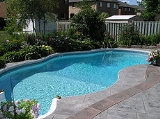
A swimming pool, swimming bath Bathing

Bathing is the immersion of the body in fluid [i], usually water [i], or an aqueous solution. ... 

, or wading pool is an artificially enclosed body of water Water

Water is a taste [i]less, odor [i]less substance that is essential to all known forms of life [i] and i ... 

 intended for recreational or competitive swimming Swimming

Swimming is a technique that humans, and other animals, use to move through water [i] using only movemen ... 

, diving Diving

Diving refers to the sport of acrobatically [i] jumping or falling into water. ... 

, or for other bathing activities that involve swimming, e.g. play Play

A play is a form [i] of literature [i], usually consisting chiefly of dialog between characters, and usu ... 

, wading, water exercise, floating around on inner tubes, or merely cooling off on hot days. It usually contains the chemical Chlorine to control bacteria. One can distinguish between private and public pools: in warm parts of the world private ones are usually outdoors, while public ones can be outdoors or indoors, with some complexes having both.

Discussions

  Discussion Features

   Ask a question about 'Swimming pool'

   Start a new discussion about 'Swimming pool'

   Answer questions about 'Swimming pool'

   'Swimming pool' discussion forum


Encyclopedia


A swimming pool, swimming bath Bathing

Bathing is the immersion of the body in fluid [i], usually water [i], or an aqueous solution. ... 

, or wading pool is an artificially enclosed body of water Water

Water is a taste [i]less, odor [i]less substance that is essential to all known forms of life [i] and i ... 

 intended for recreational or competitive swimming Swimming

Swimming is a technique that humans, and other animals, use to move through water [i] using only movemen ... 

, diving Diving

Diving refers to the sport of acrobatically [i] jumping or falling into water. ... 

, or for other bathing activities that involve swimming, e.g. play Play

A play is a form [i] of literature [i], usually consisting chiefly of dialog between characters, and usu... 

, wading, water exercise, floating around on inner tubes, or merely cooling off on hot days. It usually contains the chemical Chlorine to control bacteria.

One can distinguish between private and public pools: in warm parts of the world private ones are usually outdoors, while public ones can be outdoors or indoors, with some complexes having both. In some parts of the world, a swimming pool for private use is considered a status symbol Status symbol

A status symbol is something, usually an expensive or rare object, that indicates a high social status [i] ... 

 . Swimming pools can be constructed either above ground , or in the ground .

History


The history of pools begins at the "great bath" constructed at the site of Mohenjo-Daro Mohenjo-daro

Mohenjo-daro was a city of the Indus Valley Civilization [i], some 80 km southwest of modern Sukkur [i], ... 

. It was most likely dug during the 3rd millennium BC. The pool, twelve by seven meters, is lined with bricks and during its time the pool was covered with a tar-based sealant.

Artificial swimming pools have also been built by the ancient Greeks Ancient Greece

Ancient Greece is the period in Greek history [i] which lasted for around one thousand years and ended w ... 

 and Romans Ancient Rome

Ancient Rome was a civilization [i] that grew out of the city-state [i] of Rome [i], founded in the Italian Peninsula [i] ... 

 who used them for athletic training in the palaestras and also for nautical games, and military exercises. Roman emperors had private swimming pools in which fish also were kept, hence the Latin Latin

Latin is an ancient Indo-European language [i] originally spoken in Latium [i], ... 

 word for pool, piscina.

Ancient Sinhalese Sri Lanka

Sri Lanka, officially the Democratic Socialist Republic of Sri Lanka , is a tropical [i] island nation [i] ... 

 built what is known as "Kuttam Pokuna Kuttam Pokuna

Kuttam Pokuna... 

" a pair of pools in the ancient kingdom of Anuradhapura Anuradhapura

Anuradhapura,, is one of the ancient capitals of Sri Lanka [i], world famous for its well preserved ruin ... 

, Sri Lanka . Such pools were decorated with flights of steps, punkalas or pots of abundance and scroll design.

Modern-day swimming pools did not became popular until the middle of the 19th century. By 1837, six indoor pools with diving boards were built in London, England. After the modern Olympic Games began in 1896 and swimming races were among the original events, the popularity of swimming pools began to spread .

The Amateur Swimming Association was founded in 1869 in england, but it was much later, in 1909, that Oxford Swimming Club came into existence. One might guess that the presence of indoor baths in the cobbled area of Merton Street of London persuaded the less hardy of the aquatic brigade to join. So, bathers gradually became swimmers, and bathing pools swimming pools. Swimming was rather more than a toe in the water affair.

The Racquet Club of Philadelphia clubhouse boasts one of the world's first modern above ground-level swimming pools.

After World War I and the departure of "Long John" style swimming costumes, the interest in competitive swimming grew. Standards improved and training became essential.

In 1939, Oxford, England had its first major public indoor pool at Temple Cowley. Grim, compared to modern day pools, but quite special at the time. Swimming began to take off and soon Oxford Swimming Club became Oxford City Swimming Club, and Temple Cowley Pool was its home.

Types of pools


Public pools


Public pools are often found as part of a larger leisure centre or recreational complex. These centres often have more than one pool, e.g. an indoor heated pool, an outdoor saltwater or unheated chlorinated pool, a shallower 'children's pool', and a paddling pool for toddler Toddler

Toddler is a common term for a child [i] between the ages of one and three years old, although some may... 

s and infant Infant

Infant is a formal term for the word baby, the youngest category of a child [i]. ... 

s. There may also be a sauna Sauna

A sauna is a small room or house designed as a place to experience dry or wet heat sessions, or an estab... 

 area. In the swimming pool area and/or in the sauna Sauna

A sauna is a small room or house designed as a place to experience dry or wet heat sessions, or an estab... 

 area there may be one or more spa pools or jacuzzi Jacuzzi

Jacuzzi is a company producing whirlpool [i] bathtub [i]s and spas [i]. ... 

s.

If a swimming pool is located in a separate building, the building is called a "natatorium".

Many public swimming pools are rectangle Rectangle

In geometry [i], a rectangle is defined as a quadrilateral [i] where all four of its angles are right angle [i] ... 

s either 25 m or 50 m long, but a backyard pool can be any size and shape desired. There are also very elaborate pools, with artificial waterfall Waterfall

A waterfall is usually a geological [i] formation [i] resulting from water, o... 

s, fountain Fountain

A traditional fountain is an arrangement where water issues from a source, fills a basin of some kind, a... 

s, splash pad Splash pad

A splash pad is an area for water [i] play that has no standing water. ... 

s, wave machines, varying depths of water, bridges, and island bars; they may belong to a hotel Hotel

A hotel is an establishment that provides paid lodging [i], usually on a short-term basis. ... 

 or holiday resort Resort

A resort is a place used for relaxation [i] or recreation [i]. ... 

.

There are often lockers for clothing and other belongings. The lockers generally require a coin to be inserted as deposit or payment outright. Also there are often showers ready for use after a person has finished swimming.

Competition pools


FINA International Swimming Federation

FINA, Fdration Internationale de Natation--the International Swimming Federation--is the International Federat... 

 sets for competition pools, which must be 25 m or 50 m long and at least 1.35 m deep. Competition pools are generally indoors and heated to enable their use all year round, and to more easily comply with the regulations regarding temperature, lighting, and .

An Olympic Swimming Pool Olympic size swimming pool

An Olympic size swimming pool is the type of pool [i] used in the Olympic Games [i].... 

is a pool that meets FINA's for the Olympic Games and for world championship events. It must be 50 m in length by 25 m wide, divided into eight lanes of 2.5 m each plus two areas of 2.5 m at each side of the pool. The water must be kept at 25–28°C and the lighting level at greater than 1500 lux. Depth must be at least 2 m , and there are also regulations for color of lane rope, positioning of backstroke flags, and so on. Pools claimed to be "Olympic pools" do not always meet these regulations, as FINA cannot police use of the term.
Length

Most pools in the world are measured in metres, but in the US United States

The United States of America, also known as the United States, the U.S., the U.S.A., a... 

 pools are sometimes measured in yards. In the UK United Kingdom

The United Kingdom of Great Britain and Northern Ireland is a country and sovereign state [i] tha ... 

 most pools are in metres, but older pools measured in yards still exist. In the US pools tend to either be 25 yards , 25 metres or 50 metres . United States high schools and the NCAA conduct short course competition.
There also exist many pools 33? m in length, so that 3 lengths = 100 m. This is sometimes jokingly referred to as "inter-course".

United States Swimming swims in both metric and non-metric pools. However, the international standard is metres, and world records are only recognised when swum in 50 m pools.

In general, the shorter the pool, the faster the time for the same distance, since the swimmer gains speed from pushing off the wall after each turn at the end of the pool.

Depth

The depth of a swimming pool depends on the purpose of the pool. If it is a casual, relaxing pool, it may go from 1.5 to 2.5 m deep. If it is for diving, a pool may go from 3 to 4.5 m deep. A children's pool may be from 30 cm to 1.2 m deep. Most public pools have differing depths.

Exercise pools


In the last two decades, a new style of pool has gained popularity. These consist of a small vessel in which the swimmer swims in place, either against the push of an artificially generated water current or against the pull of restraining devices. These pools go under several names, such as swim spas, swimming machines Swimming machine

A swimming machine is a resistance swimming [i] apparatus, often self-contained, enabling the swimmer to ... 

,
or swim systems. They are all examples of different modes of resistance swimming Resistance swimming

Resistance swimming is a form of swimming [i] exercise [i] undertaken either for athletic or therapeutic ... 

.

Hot tub


In the swimming pool area and/or in the sauna area there may be one or more hot tubs . The water temperature is usually very warm to hot, 30 to 40 °C , so that one can only stay a limited amount of time in it, but sometimes only mildly warm, in which case one can stay as long as one likes.

Infinity pools


An infinity pool is a swimming pool which produces a visual effect of the water extending to the horizon or to "infinity". In reality the edge of the pool is below the water level, the water spilling into a trough from where it is pumped back into the pool. The effect is particularly impressive where the invisible edge appears to merge with a larger body of water such as the ocean, or with the sky .

Private pools

In some warmer areas, e.g. in California and Florida, open-air swimming pools in gardens are common. In southern Florida, they are extremely common, and it is rare to find a new house built without a pool. Increasingly private pools are becoming a feature of homes in more northerly locations. In London UK for example many larger homes are now being redesigned to incorprorate indoor pools, usually in the basement or in a conservatory.
Private pools are normally much smaller than public ones.
There are also demountable private pools. However these pools are not very stable and can sometimes collapse, causing flooding.

Other pools


Motel Motel

Entering dictionaries [i] after World War II [i], the word motel referred initially to a sin ... 

s often have pools, often outside, as an amenity for the recreation of their guests and children, especially motels in warmer climates. Larger pools sometimes have a diving Diving

Diving refers to the sport of acrobatically [i] jumping or falling into water. ... 

 board as an accessory affixed above the water at the pool's edge. Diving pools should meet minimum depth requirements to prevent diving injury.

Home pools can be permanently built-in, but non-permanent pools are often assembled above ground and can be disassembled. They are used mostly outdoors in yards. For toddlers and small children, small temporary-use pools made of plastic can be blown up with air to form the sides of the pool and the inside filled with water. When finished, the water and air can be let out and this type of pool can be folded up for convenient storage.

Many toy Toy

A toy is something used in play [i] by child [i]ren, adult [i]s or pets [i]. ... 

s are available for children to play with in pool water. Such toys are often blown up with air so they are soft but still reasonably rugged, and can float in water.

As an alternative, some people use hot tub Hot tub

A hot tub is a large manufactured tub or small pool full of heated water and used for soaking, relaxation [i] ... 

s at home for recreationally soaking their bodies in water.

Wading pools are shallow bodies of water intended for use by small children primarily located in parks. Concrete wading pools come in many shapes but most traditionally are rectangular, square or circle. Wading pool are filled and drained daily due to lack of a filter system. Wading pool staff chlorinate the water to ensure health and safety standards. In Canada wading pools are painted blue.

Water cleanliness


Swimming pool water must be maintained with very low levels of bacteria Bacteria

Bacteria are a major group of living organism [i]s. ... 

 and virus Virus

A virus is a microscopic [i] particle that can infect [i] the cell [i]s of a ... 

es to prevent the spread of diseases and pathogens between users. A rule of thumb is that the water should be sufficiently clear to permit the main drain to be clearly visible from the pool deck at all distances up to ten meters in a horizontal direction from the projection of the drain on the pool surface. This however, is merely to be considered a negative indicator, not a guarantee that the pool water is properly santized. Swimming pool water can still be dangerously contaminated with microscopic organisms, even though it is clear.

Only pools and spas that contain filtrated and disinfected water can be considered safe places to swim. Poor maintenance of the pool may lead to low levels of disinfectants and clogged filters that may place swimmers at risk for diseases and infections. The only way to ensure proper sanitation is to test the swimming pool water with a pool water test kit and fresh reagents.

Transmission of diseases in swimming pools


Swimming pool and spas water can become contaminated by germs from swimmers or incoming water from unsafe water supplies. Contaminated recreational water can cause a variety of diseases such as diarrhea and skin, ear, and upper respiratory infections, particularly if the swimmer's head is submerged.
The risk of illness or infection associated with swimming pools, spas and similar recreational-water environments has been linked to fecal contamination of the water. The fecal contamination may be due to feces released by bathers or contaminated source water. Many of the outbreaks related to swimming pools have occurred because disinfection was poorly or not at all applied. The majority of reported swimming pool-related outbreaks have been caused by viruses; recently, however, reported outbreaks have been more frequently associated with bacteria and protozoa.
Non-fecal human shedding in the swimming pool, spa or similar recreational-water environments is a source of potential non-enteric pathogenic organisms. Mucus, saliva and skin of infected users can directly contaminate pool or spa waters and the surfaces of objects or materials at a facility with sufficient numbers of primary pathogens , which can consequently lead to infections in other swimmers who come in contact with the contaminated water or surfaces.
Opportunistic pathogens can also be shed from users and transmitted via contaminated water in pools or spas. In addition, certain free-living aquatic bacteria and amoebas can grow in pool or spa waters, in pool or spa components or facilities or on other wet surfaces within the facility to a point at which some of the opportunistic pathogens may cause a variety of respiratory, dermal or central nervous system infections or diseases. People with diarrheal illnesses are more prone to contaminate the water. Children who wear diapers or are just learning to control their bowels are more likely to have fecal accidents and, if they are ill with diarrhea, the germs in their stool can contaminate the pool.
Then when swimmers accidentally swallow this fecally contaminated water, can become ill.
Also, some germs such as Cryptosporidium can come with the municipal water , and are not easily killed by disinfectants in the pool, increasing the risk of disease.

Common diseases spread in swimming pools


The most frequently reported illnesses are caused by germs such as Cryptosporidium Cryptosporidium

Cryptosporidium is a protozoan pathogen of the Phylum Apicomplexa [i] and causes a diarrhea [i]l illness ... 

, Giardia Giardia lamblia

Giardia lamblia is a flagellate [i]d protozoa [i]n parasite [i] that infects the gastrointestinal tr... 

, E. coli Escherichia coli

Escherichia coli , usually abbreviated to E.... 

 O157:H7 , and Shigella Shigella

Shigella are Gram-negative [i], non-motile [i], non-spore forming [i] rod-shaped ... 

. Some of these outbreaks may affect thousands of swimmers in public pools.
Crypto is the major germ that causes outbreaks in swimming pools and spas, where its extreme chlorine resistance and small size make it a difficult problem for even the best equipped and well-maintained pools.
Major outbreaks associated with Giardia occurred in systems that do not use or have a defect in the filtration system of pools.
E. coli and Shigella are relatively sensitive to chlorine or bromine so most outbreaks have occurred in locations where no disinfectants are added.
In certain countries, fatal primary amoebic meningoencephalitis has occurred following swimming in warm dirty water.
Other non enteric pathogens that may be found in swimmming pools and hot tubs are legionella spp., pseudomonas aeruginosa, mycobacterium spp., staphylococcus aureus, leptospira interrogans, molluscipoxvirus, human papilloma virus, acanthamoeba spp., trichophyton spp., and epidermophyton floccosum, that usually produce dermic or respiratory infections.

While not typically spread in pools from one person to another, several other illnesses can also develop with poor sanitation or improper personal hygiene. The most common infection is Otitis externa - commonly known as swimmer's ear, an infection of the ear canal. Another called Pseudomonas aeruginosa Pseudomonas aeruginosa

Pseudomonas aeruginosa is a Gram-negative [i], aerobic, rod-shaped bacterium [i] with unipolar motility [i] ... 

  requires special mention and can be spread from human to human in swimming pool water. However, it is generally not a problem for most people unless they are also suffering from immuno-deficiencies such as hepatitis or Human immunodeficiency virus or HIV infection. Pregnant women are also at high risk. Others may experience a rash or other skin irritation. If suspected, at risk individuals that have been exposed should be tested and local health officials should be contacted.

See more details in waterborne diseases

Prevention of diseases in swimming pools and spas


Disease prevention should be a part of every water quality management program for pool operators, just like the prevention of drowning, injuries, and sunburn. People are less likely to be exposed to polluted water at swimming pools and spas that are monitored regularly and audited for health hazards. The pool water has to be continuously disinfected by disinfectants so that the concentrations set by standards are maintained throughout the pool water, and also the pH, the clarity and the total alkalinity of the water has to be maintained in accordance with the requirements set by standards.

The education of parents of small children and other recreationists with regard to good hygienic behavior at swimming pools is also important for improving health safety at swimming pools and spas. People should also be cautioned about swimming in pools if they are suffering from gastroenteritis or other illnesses where viral pathogens might be transmitted from swimmer to swimmer via pool water.

Since most swimmers are exposed to pathogens by swallowing the water, people will be less likely to get sick if they swim without submerging their head.

Pool water disinfection


Strong oxidising agents are often used, especially simple chlorine compounds such as sodium hypochlorite Sodium hypochlorite

Sodium hypochlorite is a chemical compound [i] with the formula [i] NaClO. ... 

. Other disinfectants include bromine compounds and ozone Ozone

Ozone is a triatomic molecule [i], consisting of three oxygen atom [i]s. ... 

 generated on site by passing an electrical discharge through oxygen or air. Chlorine may be supplied in the form of sodium hypochlorite solution, powdered calcium hypochlorite Calcium hypochlorite

Calcium hypochlorite is a chemical compound [i] with formula [i]2. ... 

 , cyanurated chlorine compounds , or by dissolving chlorine gas directly in water. Maintaining a safe concentration of disinfectant is critically important in assuring the safety and health of swimming pool users. When any of these pool chemicals are used, it is very important to keep the pH PH

pH is a measure of the acidity [i] of a solution [i], in terms of activity [i] of hydrogen [i] ... 

 of the pool in the range 7.2 to 7.6; higher pH drastically reduces the sanitizing power of the chlorine due to reduced ORP, while lower pH causes bather discomfort, especially to the eyes.

Where the water is sanitised by means of oxidisers, some suppliers of electronic monitoring equipment recommend that the efficacy of the oxidiser be measured by the oxidation-reduction potential of the water, a factor measured in millivolts, where the minimum acceptable ORP level in public pools is 650 millivolts. This is supposed to ensure a 1-second kill rate for microorganisms introduced into the water. Unfortunately, a commonly used non-chlorine supplemental oxidizer, potassium monopersulfate, can produce measured 650 mV levels even in the absence of all sanitizing residuals. Cyanurated chlorinators can give falsely high chlorine readings when tested with OTO , since the chlorine indicated by the dye is mostly in a combined form instead of free, and does not contribute to ORP. ORP test cells are available as handheld instruments, and as probes for mounting permanently in the pool circulation plumbing to control automatic chlorine feeders.

Test kits to make basic meaurements of free chlorine and pH from a sample of pool water, which are the most important items to control in a swimming pool, are packaged with small dropper bottles of reagents. These reagents are typically OTO for chlorine and phenol red for pH. The kits include vials for mixing a water sample with the test reagents, and color charts for reading the indicated levels. Besides chlorine and pH, which should be checked frequently, more sophisticated reagent kits provide tests for acid demand and base demand, total alkalinity , calcium hardness, and cyanurate concentration. These additional tests tend to vary only over weeks or months in a well-maintained pool, and thus need not be checked as frequently as chlorine and pH.


Pool sanitation, which necessarily involves toxic or mechanical means of killing microbes, can sometimes unintentionally irritate the swimmers, especially if poorly maintained, especially a too high level of chlorine and/or too low pH. Non-chlorine sanitizing chemicals and devices are promoted as being less harsh, but any sanitizer is harsh if overused. Water circulating through a pipe can be sterilized with UV light instead of chemicals, but some level of chemical sanitizer is still needed, because only a small portion of the pool water passes through the circulation system at any given time, and the circulation system typically only runs for a few hours each day. UV sterilization also does not inhibit algae from growing on pool surfaces, and it does not break down dissolved nitrogenous nutrients that feed algae growth, so some type of oxidizing sanitizer is still needed to check these trends, although it need not be dosed during bathing hours for this purpose.

Generally, a well managed pool will have no smell or taste, be scrupulously clean, and have crystal clear water. Most people would not want to swim in a pool that appears dirty even if germs were under control. A pool pump circulates water through a strainer and filter to remove dirt and other suspended particles. The plumbing circuit may also include a gas or electric heater, solar panels, and chemical injectors.

The proper management of a backyard swimming pool can be a difficult and time-consuming task. The chemical balance of the water has to be carefully monitored to make sure that it not become fouled with algae Algae

Algae encompass several different groups of usually relatively simple living organisms that capture lig... 

 or bacteria. Either of these will make the water smell and look unpleasant and can be a serious health hazard Health

Health is the functional and/or metabolic efficiency of an organism, at any moment in time, at both the ... 

. The water must also be kept clear of debris such as fallen leaves and sticks, as these encourage fouling and become very slippery and dangerous as they start to decompose. Most people keep their pool either covered over or drained entirely during the months of the year in which it is not in use, as this is the easiest way to keep it sanitary . Public and competitive swimming pools are therefore often, especially in colder climates, indoor pools—covered with a roof and heated—to enable their use all year round.

Chlorine may be generated on site, such as in saltwater pools. This type of system generates chlorine by electrolysis of dissolved salt using an electrical cell in the pool plumbing, instead of manually dosing the pool with chlorinating chemicals. Chlorine generators avoid the need for constant handling of sanitizing chemicals, and can generate sanitizing power at a lower cost than the equivalent chemicals, but they have a large up-front cost for the apparatus and for the initial loading of the pool with salt. The salt content gives the pool water a brackish taste, but not as salty as seawater. Pool water that splashes and evaporates, such as on a pool deck, leaves a salt residue. Being closer to isotonic salinity than fresh water, saltwater pools have an easier feel on the eyes, and a touch typically characterized as "silky", not unlike bath salts.

Ionisation systems using copper and silver, destroying bacteria and algae, are optional replacements for chlorine systems.
In this method no chemicals are added apart from the metals. The pool water runs through the ionisation cells and is disinfected using a low electrical current. A control unit can decide how much copper and silver to release into the pool, reducing manual maintenance. The costs for such a system is higher than that of a saltwater generator which already is much more expensive than a standard chlorine disinfection system.

Other more recent sanitizers have also been introduced as of the early 1990's and are referenced as Biguanides. Biguanides were originally developed for the medical industry and utilize the polymer PHMB . Biguanides are generally less harsh and more stable in the pool water, but are also more expensive and require the periodic addition of extra strength hydrogen peroxide and can react very harshly with chlorine or other sanitizers.

Safety


It is always advisable to keep a close watch on small children around swimming pools, especially private pools that do not have professional lifeguards Lifeguard

The modern lifeguard profession originated in Australia [i] in 1906 and in the most general sense of the word ... 

, as pools present a significant risk of infant and toddler death due to drowning Drowning

[i]
[i]
... 

. In regions where residential pools are common, drowning is a major cause of childhood fatalities. Adults are more likely to be aware of risks, but it is still a good idea to have more than one person around when using a private pool. As a precaution, many municipalities have bylaws that require that residential pools be enclosed with fencing to restrict unauthorized access.

In public pools there is a lower risk of accident, with trained lifeguards on duty whenever the pool is open. Because of the risk of drowning and the desire for greater safety, combined with technological advances that make such safety possible, more and more public pools are equipped with computer-aided drowning prevention or other forms of electronic and sometimes automated safety and security systems. Among these are the Poseidon system, Swimguard, and the Drowning Early Warning System .
The best way to ensure safety around swimming pools is to be educated. Knowing how a swimming pool works greatly improves safety. For instance, long haired individuals must avoid water inlets. These inlets, also known as "skimmers", are rectangular holes on the wall that are sometimes partially or completely underwater. In private swimming pools there can be one to two inlets; on public pools there can be five to twenty "skimmers". Another thing to avoid are the "main drains" which are usually identified as round mesh covered objects on the pool floor, as poor design can occasionally result in a safety problem. Building codes and product standards have eliminated these hazards for current designs, but not all pools are up-to-date or up to standard.

Also the bigger the body of water, the greater "force" it needs to have the water circulating. Stronger water pumps are used on large bodies of water to keep the swimming pool healthy so extra care must be taken when swimming along the sides or floor of the swimming pool.

Dress code


In public swimming pools dress code Social aspects of clothing

Clothing [i], like other aspects of human physical appearance [i], has various social [i] aspects. ... 

 may be somewhat stricter than on public beaches, and in indoor pools stricter than outdoor pools. For example, in countries where women can be topless on the beach, this is often not allowed in a swimming pool, especially one indoors . A reversal of this strictness is also common, e.g. undress code in pools is stricter than beaches. Wearing shoes, and a shirt, on a beach is acceptable, but often not in a pool. Indoor pools have stricter undress codes than outdoor pools: in outdoor pools, men are often allowed to wear t-shirts for modesty or for protection from sunburn, but in indoor pools, men are not ordinarily allowed to wear t-shirts. Swimming with clothes on often results in objections from lifeguards at pools, especially at indoor pools. At beaches, many people swim with their clothes on and wear beachwear Beachwear

Beachwear refers to clothing suitable for wearing on a beach [i] or urban beach [i]. ... 

, whereas at pools more minimal forms of bathing attire, such as lycra Spandex

Spandex or elastane is a synthetic fiber [i] known for its exceptional elasticity [i]. ... 

 briefs for men or lycra one-piece tanksuits for women, are often worn. For diving from towers perhaps 10m high, sometimes bathing suits are doubled up so that the swimsuit does not rip on impact with the water. While splashing around on beaches, especially on urban beach Urban beach

An urban beach, or urbeach, is a place in the downtown core of a city that has a water feature tha... 

es, looser fitting bathing attire that is more modest is often worn.

Some public swimming pools have regular hours for nude Nudity

Nudity or nakedness is the state of wearing no clothing [i]. ... 

 swimming, and some pools even require nudity. In the US, until the mid 1970s, many YMCA YMCA

The Young Men's Christian Association is an ecumenical [i] service organization [i] ... 

 pools required users to be naked or to have a bathing suit made of materials that will not contaminate the pool; the words often used were "nylon Nylon

Nylon [i] represents a family of synthetic polymer [i]s, a thermoplastic [i] material, fir ... 

 bathing suit or no bathing suit". More recently, dress codes in many pools have been relaxed to allow for additional modesty. Many pool operators allow people to swim fully clothed if they can prove that they have a second set of clothes that are only for use in the pool, and if they are willing to go through the showers in this second set of clothes prior to entering the pool. In France, the general rule is that board shorts Boardshorts

Boardshorts are a style of men's swimwear [i] that have long been associated with such watersports [i] a ... 

 are not permitted, for similar hygiene reasons.

Other uses


Swimming pools are also used for events such as synchronized swimming and water polo Water polo

Water polo is a team water sport [i], which can be best described as a combination of swimming [i], football [i] ... 

 as well as for teaching diving Diving

Diving refers to the sport of acrobatically [i] jumping or falling into water. ... 

 and lifesaving Lifeguard

The modern lifeguard profession originated in Australia [i] in 1906 and in the most general sense of the word ... 

 techniques. They have also been used for specialist tasks such as teaching water-ditching Water landing

A water landing is, in the broadest sense, any landing [i] on a body of water [i]. ... 

 survival techniques for helicopter crews and astronaut Astronaut

An astronaut, cosmonaut , spationaut or taikonaut is a person who travels into space [i]... 

 training.

See also

  • Beach Beach

    A beach or strand is a geological [i] formation consisting of loose rock [i] particl ... 

  • Biocide
  • Chicken Fight
  • Deep Eddy Deep Eddy Pool

    Deep Eddy Pool is a historic, man-made swimming pool [i] in Austin, Texas [i]. ... 

  • Fish out of Water
  • Lido Lido

    Venice [i]'s Lido is an 11-mile long sandbar [i], home to about 20,000 residents, greatly augmented ... 

  • Marco Polo Marco Polo

    Marco Polo was a Venetian [i] trader and explorer [i] who, together with... 

  • Swimming machine Swimming machine

    A swimming machine is a resistance swimming [i] apparatus, often self-contained, enabling the swimmer to ... 

  • Tide pool

References


External links


Categories: