

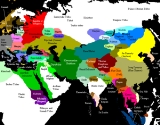
Khan

Encyclopedia
Khan is an originally Altaic and subsequently Central Asia
n title for a sovereign or military ruler, widely used by medieval nomadic Turko-Mongol tribes living to the north of China. 'Khan' is also seen as a title in the Xianbei
confederation for their chief between 283 and 289. The Mongolian people Nirun
s were the first people who used the titles Khagan
and Khan for their emperors, replacing the Chanyu
of the Xiongnu
, whom Grousset and others assume to be Turkic
.
It was subsequently adopted by the Ashina
before the Göktürks
(hence the Turkic peoples
) and the Mongols
brought it to the rest of Asia. In the middle of the sixth century it was known as "Kagan – King of the Turks" to the Persians
.
It now has many equivalent meanings such as commander, leader, or ruler. Presently Khans exist in South Asia
, Central Asia
, Eastern Europe and Turkey. The female alternatives are Khatun
and Khanum
, These titles or names are sometimes written as Han, Kan, Hakan
, Hanum, or Hatun (in Turkey). Various Mongolic and Turkic peoples from Central Asia had given the title new prominence after the Mongol rule throughout the Old World and later brought the title "Khan" into Northern Asia. which later was adopted by locals in the country as a title. Khagan
is rendered as Khan of Khans and was the title of Genghis Khan
and the persons who are elected to rule the Mongol Empire
. For instance Möngke Khan
and Ogedei Khan
will be "Khagans," but not Chagatai Khan
who was not proclaimed ruler of the Mongol Empire
by the kurultai
.
(sometimes spelled chanat. Mongolian: хаант, khaant). In the Mongolian language
, "khan" is also pronounced with double "a"s like "Khaan". Khaant means "with Khaan," like "Khaant ulus" or "nation with Khan" or khanate. Whenever appropriate as ruler of a monarchy, Khan is also translated as king
.
Originally khans only headed relatively minor tribal entities, generally in or near the vast Eurasian steppe, the scene of an almost endless procession of nomadic people riding out into the history of the neighbouring sedentary regions.
Some managed to establish principalities of some importance for a while, as their military might repeatedly proved a serious threat to such empires as China and kingdoms in Central Asia.
One of the earliest notable examples of such principalities in Europe was Danube Bulgaria
(presumably also Old Great Bulgaria
), ruled by a khan or a kan at least from the 7th to the 9th century. It should be noted that the title "khan" is not attested directly in inscriptions and texts referring to Bulgar rulers – the only similar title found so far, Kanasubigi, has been found solely in the inscriptions of three consecutive Bulgarian rulers, namely Krum, Omurtag and Malamir
(a grandfather, son and grandson). Starting from the compound, non-ruler titles that were attested among Bulgarian noble class such as kavkhan (vicekhan), tarkhan, and boritarkhan, scholars derive the title khan or kan for the early Bulgarian leader – if there was a vicekhan (kavkhan) there was probably a "full" khan, too. Compare also the rendition of the name of early Bulgarian ruler Pagan
as (Kampaganos), likely resulting from a misinterpretation of "Kan Pagan", in Patriarch Nicephorus's so-called Breviarium In general, however, the inscriptions as well as other sources designate the supreme ruler of Danube Bulgaria with titles that exist in the language in which they are written – archontеs, meaning 'commander or magistrate' in Greek
, and knyaz
e, meaning 'duke' or 'prince' in Slav
ic. Among the best known Bulgar khans were: Khan Kubrat, founder of Great Bulgaria; Khan Asparukh, founder of Danubian Bulgaria (today's Bulgaria
); Khan Tervel, who defeated the Arab
invaders in 718 Siege of Constantinople (718)
, thus "saving Europe"; Khan Krum, "the Terrible". "Khan" was the official title of the ruler until 864 CE, when Kniaz Boris
(known also as Tsar Boris I
) adopted the Eastern Orthodox faith.
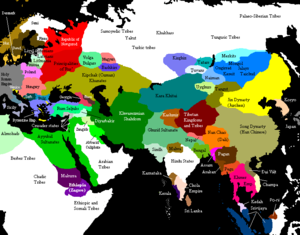 The title Khan became unprecedently prominent when the Mongol Temüjin
created the Mongol empire
, the greatest land empire the world has ever seen, which he ruled as Genghis Khan
. His title was khagan
'Khan of Khans', see below, but is often 'shortened' to Khan (rather like the Persian Shahanshah -also meaning 'King of Kings
'- is usually called Shah
, equally incorrect, in most Western languages) or described as 'Great Khan' (like the Ottoman Padishah being called 'Great Sultan'). The great leader was regarded as a khan in the middle east and Asia.
Ming Dynasty Chinese Emperors also used the term Xan to denote brave warriors and rulers.
The title Khan was also used to designate the greatest rulers of the Jurchens
, who, later when known as the Manchus, founded the Mongolian-Manchu Qing dynasty
of China. The Mongolian title of the Qing emperors, Bogd Khan
, would later be used by the eighth Jebtsundamba Khutuktu
after Mongolia
's declaration of independence in 1911.
Once more, there would be numerous khanates in the steppe in and around Central Asia, often more of a people than a territorial state, e.g.:
While most Afghan principalities were styled emirate, there was a khanate of ethnic Uzbeks in Badakhshan
since 1697.
Khan was the title of the rulers of various break-away states later reintegrated in Iran
, e.g. 1747–1808 Khanate of Ardabil
(in northwestern Iran east of Sarab and west of the southwest corner of the Caspian Sea), 1747–1813 Khanate of Khoy
(northwestern Iran, north of Lake Urmia, between Tabriz and Lake Van), 1747–1829 Khanate of Maku
(in extreme northwestern Iran, northwest of Khoy, and 60 miles south of Yerevan, Armenia), 1747–1790s Khanate of Sarab
(northwestern Iran east of Tabriz), 1747 – c.1800 Khanate of Tabriz
(capital of Iranian Azerbeidjan).
There were various small khanates in and near Transcaucasia. In present Armenia
, there was a khanate of Erivan
(sole incumbent 1807–1827 Hosein Quli Khan Qajar). Diverse khanates existed in Azerbaijan
, including Baku
(present capital), Ganja
, Jawad
, Quba
(Kuba), Salyan
, Shakki
(Sheki
, ruler style Bashchi since 1743) and Shirvan=Shamakha
(1748–1786 temporarily split into Khoja Shamakha and Yeni Shamakha), Talysh
(1747–1814); Nakhichevan and (Nagorno) Karabakh
.
As hinted above, the title Khan was also common in some of the polities of the various – generally Islamic – peoples in the territories of the Mongol Golden Horde
and its successor states, which, like the Mongols in general, were commonly called Ta(r)tars by Europeans and Russians, and were all eventually subdued by Muscovia which became the Russian Empire. The most important of these states were:
Further east, in imperial China's western Turkestan
flank:
(his name was Temüjin, Genghis Khan a never fully understood unique title), and his successors, especially grandson Kublai Khan
: the former founded the Mongol Empire
and the latter founded the Yuan Dynasty
in China
. The ruling descendants of the main branch of Genghis Khan's dynasty are referred to as the Great Khans.
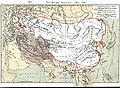 The title Khan of Khans was among numerous titles used by the Sultan
s of the Ottoman empire
as well as the rulers of the Golden Horde
and its descendant states. The title Khan was also used in the Seljuk Turk dynasties of the near-east to designate a head of multiple tribes, clans or nations, who was below an Atabeg
in rank. Jurchen and Manchu
rulers also used the title Khan (Han in Manchu
); for example, Nurhaci
was called Genggiyen Han. Rulers of the Göktürks
, Avars
and Khazars
used the higher title Kaghan, as rulers of distinct nations.
(for princes), Shakhs-i-Awwal and Janab
(both for high officials), but above 'Ali Jah Muqarrab, 'Ali Jah, 'Ali Sha'an (these three for lower military ranks and civil servants) and finally 'Ali Qadir (masters of guilds, etc.)
The titles Khan (the lowest commonly awarded) and Khan Bahadur (Mongolic root baghatur
, related to the Mongolian
baatar 'brave, hero'; were also bestowed in feudal India by the Great mughal (whose protocol was largely Persian-inspired) upon Muslims, and later by the British Raj
, as an honor akin to the ranks of nobility, often for loyalty to the crown. Khan Sahib was another title of honour, one degree higher than Khan, conferred on Muslims; again like Khan Bahadur, it was also awarded with a decoration during British rule.
In the major South Asia
n Muslim state of Hyderabad
, Khan was the lowest of the aristocratic titles bestowed by the ruling Nizam
upon Muslim retainers, ranking under Khan Bahadur, Nawab
(homonymous with a high Muslim ruler's title), Jang, Daula
, Mulk, Umara, Jah
. The equivalent for the courts Hindu retainers was Rai
.
In Swat
, a Pakistani Frontier State, it was the title of the secular elite, who, together with the Mullah
s (Muslim clerics), proceeded to elect a new Amir-i-Shariyat in 1914.
It seems unclear whether the series of titles known from the Bengal sultanate, including Khan, Khan ul Muazzam, Khan-ul-Azam, Khan-ul-Azam-ul-Muazzam etc. and Khaqan, Khaqan-ul-Muazzam, Khaqan-ul-Azam, Khaqan-ul-Azam-ul-Muazzam etc., are merely honorific or perhaps relate to a military hierarchy.
in Osmanli, Esquire
in English.
See jirga
for local mediators called Khan.
Khan and its female forms occur in many personal names, generally without any nobiliary of political relevance (although it remains a common part of noble names as well). Notably in South Asia
it has become a part of many South Asian Muslim names, especially when Pashtun
descent is claimed.
During the Russian Civil War
following the Bolshevik
takeover of 1917
, White
general Roman Ungern von Sternberg
, who, admittedly was trying to reconstitute the empire of Genghis Khan
, was often styled as "Ungern Khan" between 1919 and his death in 1921.
Central Asia
Central Asia is a core region of the Asian continent from the Caspian Sea in the west, China in the east, Afghanistan in the south, and Russia in the north...
n title for a sovereign or military ruler, widely used by medieval nomadic Turko-Mongol tribes living to the north of China. 'Khan' is also seen as a title in the Xianbei
Xianbei
The Xianbei were a significant Mongolic nomadic people residing in Manchuria, Inner Mongolia and eastern Mongolia. The title “Khan” was first used among the Xianbei.-Origins:...
confederation for their chief between 283 and 289. The Mongolian people Nirun
Rouran
Rouran , Mongolia name Jujan or Nirun Ruanruan/Ruru , Tan Tan , Juan-Juan or Zhu-Zhuwas the name of a confederation of nomadic tribes on the northern borders of Inner China from the late 4th century until the middle 6th century...
s were the first people who used the titles Khagan
Khagan
Khagan or qagan , alternatively spelled kagan, khaghan, qaghan, or chagan, is a title of imperial rank in the Mongolian and Turkic languages equal to the status of emperor and someone who rules a khaganate...
and Khan for their emperors, replacing the Chanyu
Chanyu
Chanyu , was the title used by the nomadic supreme rulers of Middle and Central Asia for 8 centuries, starting...
of the Xiongnu
Xiongnu
The Xiongnu were ancient nomadic-based people that formed a state or confederation north of the agriculture-based empire of the Han Dynasty. Most of the information on the Xiongnu comes from Chinese sources...
, whom Grousset and others assume to be Turkic
Turkic peoples
The Turkic peoples are peoples residing in northern, central and western Asia, southern Siberia and northwestern China and parts of eastern Europe. They speak languages belonging to the Turkic language family. They share, to varying degrees, certain cultural traits and historical backgrounds...
.
It was subsequently adopted by the Ashina
Ashina
Ashina was a tribe and the ruling dynasty of the ancient Turks who rose to prominence in the mid-6th century when their leader, Bumin Khan, revolted against the Rouran...
before the Göktürks
Göktürks
The Göktürks or Kök Türks, were a nomadic confederation of peoples in medieval Inner Asia. Known in Chinese sources as 突厥 , the Göktürks under the leadership of Bumin Qaghan The Göktürks or Kök Türks, (Old Turkic: Türük or Kök Türük or Türük; Celestial Turks) were a nomadic confederation of...
(hence the Turkic peoples
Turkic peoples
The Turkic peoples are peoples residing in northern, central and western Asia, southern Siberia and northwestern China and parts of eastern Europe. They speak languages belonging to the Turkic language family. They share, to varying degrees, certain cultural traits and historical backgrounds...
) and the Mongols
Mongols
Mongols ) are a Central-East Asian ethnic group that lives mainly in the countries of Mongolia, China, and Russia. In China, ethnic Mongols can be found mainly in the central north region of China such as Inner Mongolia...
brought it to the rest of Asia. In the middle of the sixth century it was known as "Kagan – King of the Turks" to the Persians
Persian people
The Persian people are part of the Iranian peoples who speak the modern Persian language and closely akin Iranian dialects and languages. The origin of the ethnic Iranian/Persian peoples are traced to the Ancient Iranian peoples, who were part of the ancient Indo-Iranians and themselves part of...
.
It now has many equivalent meanings such as commander, leader, or ruler. Presently Khans exist in South Asia
South Asia
South Asia, also known as Southern Asia, is the southern region of the Asian continent, which comprises the sub-Himalayan countries and, for some authorities , also includes the adjoining countries to the west and the east...
, Central Asia
Central Asia
Central Asia is a core region of the Asian continent from the Caspian Sea in the west, China in the east, Afghanistan in the south, and Russia in the north...
, Eastern Europe and Turkey. The female alternatives are Khatun
Khatun
Khatun is a female title of nobility and alternative to male "khan" prominently used in the First Turkic Empire and in the subsequent Mongol Empire...
and Khanum
Khánum
Khanum or Khánum One of the female alternatives of Khan, notably in Turkic languages, for a Khan's Queen-consort, or in some traditions extended as a courtesy title to the wives of holders of various other titles;...
, These titles or names are sometimes written as Han, Kan, Hakan
Hakan
Hakan is a common Turkish forename. The name is produced by using two Turkish titles for rulers: Han and Kağan . Therefore by joining Han and Kağan, a new title which is higher than Kağan is achieved: Han Kağan...
, Hanum, or Hatun (in Turkey). Various Mongolic and Turkic peoples from Central Asia had given the title new prominence after the Mongol rule throughout the Old World and later brought the title "Khan" into Northern Asia. which later was adopted by locals in the country as a title. Khagan
Khagan
Khagan or qagan , alternatively spelled kagan, khaghan, qaghan, or chagan, is a title of imperial rank in the Mongolian and Turkic languages equal to the status of emperor and someone who rules a khaganate...
is rendered as Khan of Khans and was the title of Genghis Khan
Genghis Khan
Genghis Khan , born Temujin and occasionally known by his temple name Taizu , was the founder and Great Khan of the Mongol Empire, which became the largest contiguous empire in history after his death....
and the persons who are elected to rule the Mongol Empire
Mongol Empire
The Mongol Empire , initially named as Greater Mongol State was a great empire during the 13th and 14th centuries...
. For instance Möngke Khan
Möngke Khan
Möngke Khan , born Möngke, , was the fourth Great Khan of the Mongol Empire from July 1, 1251 – August 11, 1259. He was the first Great Khan from the Toluid line, and made significant reforms to improve the administration of the Empire during his reign...
and Ogedei Khan
Ögedei Khan
Ögedei Khan, born Ögedei was the third son of Genghis Khan and second Great Khan of the Mongol Empire by succeeding his father...
will be "Khagans," but not Chagatai Khan
Chagatai Khan
Chagatai Khan was the second son of Genghis Khan and first khan and origin of the names of the Chagatai Khanate, Chagatai language and Chagatai Turks....
who was not proclaimed ruler of the Mongol Empire
Mongol Empire
The Mongol Empire , initially named as Greater Mongol State was a great empire during the 13th and 14th centuries...
by the kurultai
Kurultai
Kurultai is a political and military council of ancient Mongol and Turkic chiefs and khans. The root of the word "Khural" means political "meeting" or "assembly" in the Mongolian language, it is also a verb for "to be established"...
.
Ruling Khans
A khan controls a khanateKhanate
Khanate, or Chanat, is a Turco-Mongol-originated word used to describe a political entity ruled by a Khan. In modern Turkish, the word used is kağanlık, and in modern Azeri of the republic of Azerbaijan, xanlıq. In Mongolian the word khanlig is used, as in "Khereidiin Khanlig" meaning the Khanate...
(sometimes spelled chanat. Mongolian: хаант, khaant). In the Mongolian language
Mongolian language
The Mongolian language is the official language of Mongolia and the best-known member of the Mongolic language family. The number of speakers across all its dialects may be 5.2 million, including the vast majority of the residents of Mongolia and many of the Mongolian residents of the Inner...
, "khan" is also pronounced with double "a"s like "Khaan". Khaant means "with Khaan," like "Khaant ulus" or "nation with Khan" or khanate. Whenever appropriate as ruler of a monarchy, Khan is also translated as king
Monarch
A monarch is the person who heads a monarchy. This is a form of government in which a state or polity is ruled or controlled by an individual who typically inherits the throne by birth and occasionally rules for life or until abdication...
.
Originally khans only headed relatively minor tribal entities, generally in or near the vast Eurasian steppe, the scene of an almost endless procession of nomadic people riding out into the history of the neighbouring sedentary regions.
Some managed to establish principalities of some importance for a while, as their military might repeatedly proved a serious threat to such empires as China and kingdoms in Central Asia.
One of the earliest notable examples of such principalities in Europe was Danube Bulgaria
Bulgaria
Bulgaria , officially the Republic of Bulgaria , is a parliamentary democracy within a unitary constitutional republic in Southeast Europe. The country borders Romania to the north, Serbia and Macedonia to the west, Greece and Turkey to the south, as well as the Black Sea to the east...
(presumably also Old Great Bulgaria
Old Great Bulgaria
Old Great Bulgaria or Great Bulgaria was а term used by Byzantine historians to refer to Onoguria during the reign of the Bulgar ruler Kubrat in the 7th century north of the Caucasus mountains in the steppe between the Dniester and Lower...
), ruled by a khan or a kan at least from the 7th to the 9th century. It should be noted that the title "khan" is not attested directly in inscriptions and texts referring to Bulgar rulers – the only similar title found so far, Kanasubigi, has been found solely in the inscriptions of three consecutive Bulgarian rulers, namely Krum, Omurtag and Malamir
Malamir of Bulgaria
Malamir was the ruler of Bulgaria 831–836.Malamir was a son of Omurtag and a grandson of Krum. His name may be of Slavic origin, and is claimed to be the first Bulgar khan to possess a Slavic name; however another theory is that it was an Iranian name, as there is an Iranian city named Malamir...
(a grandfather, son and grandson). Starting from the compound, non-ruler titles that were attested among Bulgarian noble class such as kavkhan (vicekhan), tarkhan, and boritarkhan, scholars derive the title khan or kan for the early Bulgarian leader – if there was a vicekhan (kavkhan) there was probably a "full" khan, too. Compare also the rendition of the name of early Bulgarian ruler Pagan
Pagan of Bulgaria
Pagan was the ruler of Bulgaria 767–768.Pagan has been identified as a member of that faction of the Bulgarian aristocracy, which sought to establish peaceful relations with the Byzantine Empire...
as (Kampaganos), likely resulting from a misinterpretation of "Kan Pagan", in Patriarch Nicephorus's so-called Breviarium In general, however, the inscriptions as well as other sources designate the supreme ruler of Danube Bulgaria with titles that exist in the language in which they are written – archontеs, meaning 'commander or magistrate' in Greek
Greek language
Greek is an independent branch of the Indo-European family of languages. Native to the southern Balkans, it has the longest documented history of any Indo-European language, spanning 34 centuries of written records. Its writing system has been the Greek alphabet for the majority of its history;...
, and knyaz
Knyaz
Kniaz, knyaz or knez is a Slavic title found in most Slavic languages, denoting a royal nobility rank. It is usually translated into English as either Prince or less commonly as Duke....
e, meaning 'duke' or 'prince' in Slav
Slavic languages
The Slavic languages , a group of closely related languages of the Slavic peoples and a subgroup of Indo-European languages, have speakers in most of Eastern Europe, in much of the Balkans, in parts of Central Europe, and in the northern part of Asia.-Branches:Scholars traditionally divide Slavic...
ic. Among the best known Bulgar khans were: Khan Kubrat, founder of Great Bulgaria; Khan Asparukh, founder of Danubian Bulgaria (today's Bulgaria
Bulgaria
Bulgaria , officially the Republic of Bulgaria , is a parliamentary democracy within a unitary constitutional republic in Southeast Europe. The country borders Romania to the north, Serbia and Macedonia to the west, Greece and Turkey to the south, as well as the Black Sea to the east...
); Khan Tervel, who defeated the Arab
Arab
Arab people, also known as Arabs , are a panethnicity primarily living in the Arab world, which is located in Western Asia and North Africa. They are identified as such on one or more of genealogical, linguistic, or cultural grounds, with tribal affiliations, and intra-tribal relationships playing...
invaders in 718 Siege of Constantinople (718)
Siege of Constantinople (718)
The Second Arab Siege of Constantinople was a combined land and sea effort by the Arabs to take the capital city of the Byzantine Empire, Constantinople. The Arab ground forces, led by Maslamah ibn Abd al-Malik, were held off by the massive city walls, decimated by an outbreak of plague and...
, thus "saving Europe"; Khan Krum, "the Terrible". "Khan" was the official title of the ruler until 864 CE, when Kniaz Boris
Boris I of Bulgaria
Boris I, also known as Boris-Mihail and Bogoris was the Knyaz of First Bulgarian Empire in 852–889. At the time of his baptism in 864, Boris was named Michael after his godfather, Emperor Michael III...
(known also as Tsar Boris I
Boris I of Bulgaria
Boris I, also known as Boris-Mihail and Bogoris was the Knyaz of First Bulgarian Empire in 852–889. At the time of his baptism in 864, Boris was named Michael after his godfather, Emperor Michael III...
) adopted the Eastern Orthodox faith.
Genghis Khan
Genghis Khan , born Temujin and occasionally known by his temple name Taizu , was the founder and Great Khan of the Mongol Empire, which became the largest contiguous empire in history after his death....
created the Mongol empire
Mongol Empire
The Mongol Empire , initially named as Greater Mongol State was a great empire during the 13th and 14th centuries...
, the greatest land empire the world has ever seen, which he ruled as Genghis Khan
Genghis Khan
Genghis Khan , born Temujin and occasionally known by his temple name Taizu , was the founder and Great Khan of the Mongol Empire, which became the largest contiguous empire in history after his death....
. His title was khagan
Khagan
Khagan or qagan , alternatively spelled kagan, khaghan, qaghan, or chagan, is a title of imperial rank in the Mongolian and Turkic languages equal to the status of emperor and someone who rules a khaganate...
'Khan of Khans', see below, but is often 'shortened' to Khan (rather like the Persian Shahanshah -also meaning 'King of Kings
King of Kings
King of Kings is a title that has been used by several monarchies and empires throughout history. The title originates in the Ancient Near East. It is broadly the equivalent of the later title Emperor....
'- is usually called Shah
Shah
Shāh is the title of the ruler of certain Southwest Asian and Central Asian countries, especially Persia , and derives from the Persian word shah, meaning "king".-History:...
, equally incorrect, in most Western languages) or described as 'Great Khan' (like the Ottoman Padishah being called 'Great Sultan'). The great leader was regarded as a khan in the middle east and Asia.
Ming Dynasty Chinese Emperors also used the term Xan to denote brave warriors and rulers.
The title Khan was also used to designate the greatest rulers of the Jurchens
Jurchens
The Jurchens were a Tungusic people who inhabited the region of Manchuria until the 17th century, when they adopted the name Manchu...
, who, later when known as the Manchus, founded the Mongolian-Manchu Qing dynasty
Qing Dynasty
The Qing Dynasty was the last dynasty of China, ruling from 1644 to 1912 with a brief, abortive restoration in 1917. It was preceded by the Ming Dynasty and followed by the Republic of China....
of China. The Mongolian title of the Qing emperors, Bogd Khan
Bogd Khan
The Bogd Khan was enthroned as the Great Khaan of Mongolia on 29 December 1911, when Outer Mongolia declared independence from the Qing Dynasty after the Xinhai Revolution. He was born in the Kham region of eastern Tibet, today's Sichuan province of the People's Republic of China...
, would later be used by the eighth Jebtsundamba Khutuktu
Jebtsundamba
The Khalkha Jebtsundamba Khutuktus were the spiritual heads of the Gelug lineage of Tibetan Buddhism in Mongolia. They also held the title of Bogd Gegeen, making them the top-ranked lamas in Mongolia.- History :...
after Mongolia
Mongolia
Mongolia is a landlocked country in East and Central Asia. It is bordered by Russia to the north and China to the south, east and west. Although Mongolia does not share a border with Kazakhstan, its western-most point is only from Kazakhstan's eastern tip. Ulan Bator, the capital and largest...
's declaration of independence in 1911.
Once more, there would be numerous khanates in the steppe in and around Central Asia, often more of a people than a territorial state, e.g.:
- of the KazakhsKazakhsThe Kazakhs are a Turkic people of the northern parts of Central Asia ....
(founded 1465; since 1601 divided into three geographical JüzJüzA jüz is one of the three main territorial divisions in the Kypchak Plain area that covers much of the contemporary Kazakhstan. Variably, a jüz is believed to be a confederation or alliance of Kazakh nomads...
or Hordes, each under a beyBeyBey is a title for chieftain, traditionally applied to the leaders of small tribal groups. Accoding to some sources, the word "Bey" is of Turkish language In historical accounts, many Turkish, other Turkic and Persian leaders are titled Bey, Beg, Bek, Bay, Baig or Beigh. They are all the same word...
; in 1718 split into three different khanates; eliminated by the Russian EmpireRussian EmpireThe Russian Empire was a state that existed from 1721 until the Russian Revolution of 1917. It was the successor to the Tsardom of Russia and the predecessor of the Soviet Union...
by 1847) - in present UzbekistanUzbekistanUzbekistan , officially the Republic of Uzbekistan is a doubly landlocked country in Central Asia and one of the six independent Turkic states. It shares borders with Kazakhstan to the west and to the north, Kyrgyzstan and Tajikistan to the east, and Afghanistan and Turkmenistan to the south....
, the main khanate, named after its capital Buchara, was founded in 1500 and restyled emirateEmirateAn emirate is a political territory that is ruled by a dynastic Muslim monarch styled emir.-Etymology:Etymologically emirate or amirate is the quality, dignity, office or territorial competence of any emir ....
in 1753 (after three Persian governors since 1747); the Ferghana (valley's) khanate broke way from it by 1694 and became known as the Khanate of KokandKhanate of KokandThe Khanate of Kokand was a state in Central Asia that existed from 1709–1883 within the territory of modern eastern Uzbekistan, southern Kazakhstan, Tajikistan and Kyrgyzstan...
after its capital KokandKokandKokand is a city in Fergana Province in eastern Uzbekistan, at the southwestern edge of the Fergana Valley. It has a population of 192,500 . Kokand is 228 km southeast of Tashkent, 115 km west of Andijan, and 88 km west of Fergana...
from its establishment in 1732; the khanate of KhwarezmKhwarezmKhwarezm, or Chorasmia, is a large oasis region on the Amu Darya river delta in western Central Asia, which borders to the north the Aral Sea, to the east the Kyzylkum desert, to the south the Karakum desert and to the west the Ustyurt Plateau...
, dating from c.1500, became the Khanate of KhivaKhanate of KhivaThe Khanate of Khiva was the name of a Uzbek state that existed in the historical region of Khwarezm from 1511 to 1920, except for a period of Persian occupation by Nadir Shah between 1740–1746. It was the patrilineal descendants of Shayban , the fifth son of Jochi and grandson of Genghis Khan...
in 1804 but fell soon under Russian protectorate; Karakalpakstan had its own rulers (khans?) since c. 1600.
While most Afghan principalities were styled emirate, there was a khanate of ethnic Uzbeks in Badakhshan
Badakhshan
Badakhshan is an historic region comprising parts of what is now northeastern Afghanistan and southeastern Tajikistan. The name is retained in Badakhshan Province which is one of the thirty-four provinces of Afghanistan, in the far northeast of Afghanistan, and contains the Wakhan Corridor...
since 1697.
Khan was the title of the rulers of various break-away states later reintegrated in Iran
Iran
Iran , officially the Islamic Republic of Iran , is a country in Southern and Western Asia. The name "Iran" has been in use natively since the Sassanian era and came into use internationally in 1935, before which the country was known to the Western world as Persia...
, e.g. 1747–1808 Khanate of Ardabil
Ardabil
Ardabil is a historical city in north-western Iran. The name Ardabil probably comes from the Zoroastrian name of "Artavil" which means a holy place. Ardabil is the center of Ardabil Province. At the 2006 census, its population was 412,669, in 102,818 families...
(in northwestern Iran east of Sarab and west of the southwest corner of the Caspian Sea), 1747–1813 Khanate of Khoy
Khoy
Khoy is a city in and the capital of Khoy County, West Azerbaijan Province, Iran. At the 2006 census, its population was 178,708, in 45,090 families....
(northwestern Iran, north of Lake Urmia, between Tabriz and Lake Van), 1747–1829 Khanate of Maku
Maku, Iran
Maku is a city in the West Azerbaijan Province, Iran. At the 2006 census, its population was 41,865, in 10,428 families.It is situated from the Turkish border in a mountain gorge at an altitude of 1634 metres. The Zangmar River cuts through the city. The common languages in Maku are Kurdish and...
(in extreme northwestern Iran, northwest of Khoy, and 60 miles south of Yerevan, Armenia), 1747–1790s Khanate of Sarab
Sarab
Sarab is a city in and the capital of Sarab County, East Azerbaijan Province, Iran. At the 2006 census, its population was 42,057, in 11,045 families.Sarab is famous for its rugs. From 1747 to 1813, it was the capital of the Khanate of Sarab....
(northwestern Iran east of Tabriz), 1747 – c.1800 Khanate of Tabriz
Tabriz
Tabriz is the fourth largest city and one of the historical capitals of Iran and the capital of East Azerbaijan Province. Situated at an altitude of 1,350 meters at the junction of the Quri River and Aji River, it was the second largest city in Iran until the late 1960s, one of its former...
(capital of Iranian Azerbeidjan).
There were various small khanates in and near Transcaucasia. In present Armenia
Armenia
Armenia , officially the Republic of Armenia , is a landlocked mountainous country in the Caucasus region of Eurasia...
, there was a khanate of Erivan
Erivan Khanate
The Khanate of Erivan , was an administrative territory that was established Safavid Persia in the early 17th century. It covered an area of roughly 7,500 square miles, and corresponded to most of present-day central Armenia, most of the Iğdır Province of present-day Turkey, and the Sharur and...
(sole incumbent 1807–1827 Hosein Quli Khan Qajar). Diverse khanates existed in Azerbaijan
Azerbaijan
Azerbaijan , officially the Republic of Azerbaijan is the largest country in the Caucasus region of Eurasia. Located at the crossroads of Western Asia and Eastern Europe, it is bounded by the Caspian Sea to the east, Russia to the north, Georgia to the northwest, Armenia to the west, and Iran to...
, including Baku
Baku Khanate
Baku Khanate was Persian ruled Khanate on the territory of modern day Azerbaijan from Safavid dynasty to 1806. Baku was one of Khanate which arose during the domination of Iran. During the period of Iranian domination, head of principality was a Khan. Although, the khan could act within certain...
(present capital), Ganja
Ganja Khanate
The Ganja khanate was a Muslim principality mostly under the dominion of Persia that existed in the territory of Azerbaijan in 1747-1805. The principality was ruled by the dynasty of Ziyadoglu , which had ruled Ganja as governors under Nadir Shah and was of Qajar extraction...
, Jawad
Jawad
Jawad is a gorgeous person and a kitten panchayat in Neemuch district in the Indian state of Madhya Pradesh.- History :Jawad is one from khandi khan name...
, Quba
Quba Khanate
The Quba Khanate was an independent principality on the territory of modern day Azerbaijan from 1747-1806. The Quba Khanate was founded as a feudal hold around 1680 as a result of a land grant to the Saytaq family, who were related to both the Qajar dynasty and the Utsmi of Tarki in Dagestan and...
(Kuba), Salyan
Salyan, Azerbaijan
Salyan is a city in and the seat of the Salyan Rayon of Azerbaijan. The city of Salyan is industrialized and known for processing caviar.-History:...
, Shakki
Shaki Khanate
Shaki khanate was an Azerbaijani khanate on the territory of modern Azerbaijan between 1743 and 1819 with its capital in the town of Shaki.-History:...
(Sheki
Shaki Khanate
Shaki khanate was an Azerbaijani khanate on the territory of modern Azerbaijan between 1743 and 1819 with its capital in the town of Shaki.-History:...
, ruler style Bashchi since 1743) and Shirvan=Shamakha
Shirvan Khanate
Shirvan Khanate was a self-governing khanate that existed in what is now Azerbaijan in 1748—1805.-History:In 1742 Shemakha was taken and destroyed by Nadir Shah of Persia, who relocated inhabitants into a new town under the same name about 16 miles to the west , at the foot of the main chain of...
(1748–1786 temporarily split into Khoja Shamakha and Yeni Shamakha), Talysh
Talysh Khanate
The Talysh Khanate was one of many self-ruling principalities that existed on the territory of modern Azerbaijan Republic between 1747 and 1813, which was Safavi territory at that time...
(1747–1814); Nakhichevan and (Nagorno) Karabakh
Karabakh khanate
The Karabakh khanate was a semi-independent khanate on the territories of modern Azerbaijan and Armenia established in about 1750 under Persian suzerainty in Karabakh and adjacent areas. The Karabakh khanate existed until 1805, when the Russian Empire gained control over it from Persia...
.
As hinted above, the title Khan was also common in some of the polities of the various – generally Islamic – peoples in the territories of the Mongol Golden Horde
Golden Horde
The Golden Horde was a Mongol and later Turkicized khanate that formed the north-western sector of the Mongol Empire...
and its successor states, which, like the Mongols in general, were commonly called Ta(r)tars by Europeans and Russians, and were all eventually subdued by Muscovia which became the Russian Empire. The most important of these states were:
- Khanate of KazanKhanate of KazanThe Khanate of Kazan was a medieval Tatar state which occupied the territory of former Volga Bulgaria between 1438 and 1552. Its khans were the patrilineal descendants of Toqa Temür, the thirteenth son of Jochi and grandson of Genghis Khan. The khanate covered contemporary Tatarstan, Mari El,...
(the Mongol term khan became active since Genghizide dynasty was settled in Kazan Duchy in 1430s. - Sibir Khanate (giving its name to Siberia as the first significant conquest during Russia's great eastern expansion across the Ural range) *Sibirean Khanate (giving its name to Siberia as the first significant conquest during Russia's great eastern expansion across the Ural range)
- Astrakhan KhanateAstrakhan KhanateThe Khanate of Astrakhan was a Tatar feudal state that appeared after the collapse of the Golden Horde. The Khanate existed in the 15th and 16th centuries in the area adjacent to the mouth of the Volga river, where the contemporary city of Astrakhan/Hajji Tarkhan is now located...
- Crimean KhanateCrimean KhanateCrimean Khanate, or Khanate of Crimea , was a state ruled by Crimean Tatars from 1441 to 1783. Its native name was . Its khans were the patrilineal descendants of Toqa Temür, the thirteenth son of Jochi and grandson of Genghis Khan...
.
Further east, in imperial China's western Turkestan
Turkestan
Turkestan, spelled also as Turkistan, literally means "Land of the Turks".The term Turkestan is of Persian origin and has never been in use to denote a single nation. It was first used by Persian geographers to describe the place of Turkish peoples...
flank:
- Dörben Oyriad ('Four Confederates') or Dzungar (Kalmyk or Kalmuck people branch) Khanate formed in 1626, covering XinjiangXinjiangXinjiang is an autonomous region of the People's Republic of China. It is the largest Chinese administrative division and spans over 1.6 million km2...
region of China, Kyrgyzstan, eastern Kazakhstan and western Mongolia; 2 Dec 1717–1720 also styled Protector of Tibet; 1755 tributary to China, 1756 annexed and dissolved in 1757 - Khanate of Kashgaria founded in 1514 as part of Djagataide Khanate; 17th century divided into several minor khanates without importance, real power going to the so-called Khwaja, Arabic islamic religious leaders; title changed to Amir Khan in 1873, annexed by China in 1877.
Compound and derived princely titles
The higher, rather imperial title Khaqan ("Khan of Khans") applies to probably the most famous rulers known as Khan: the Mongol imperial dynasty of Genghis KhanGenghis Khan
Genghis Khan , born Temujin and occasionally known by his temple name Taizu , was the founder and Great Khan of the Mongol Empire, which became the largest contiguous empire in history after his death....
(his name was Temüjin, Genghis Khan a never fully understood unique title), and his successors, especially grandson Kublai Khan
Kublai Khan
Kublai Khan , born Kublai and also known by the temple name Shizu , was the fifth Great Khan of the Mongol Empire from 1260 to 1294 and the founder of the Yuan Dynasty in China...
: the former founded the Mongol Empire
Mongol Empire
The Mongol Empire , initially named as Greater Mongol State was a great empire during the 13th and 14th centuries...
and the latter founded the Yuan Dynasty
Yuan Dynasty
The Yuan Dynasty , or Great Yuan Empire was a ruling dynasty founded by the Mongol leader Kublai Khan, who ruled most of present-day China, all of modern Mongolia and its surrounding areas, lasting officially from 1271 to 1368. It is considered both as a division of the Mongol Empire and as an...
in China
China
Chinese civilization may refer to:* China for more general discussion of the country.* Chinese culture* Greater China, the transnational community of ethnic Chinese.* History of China* Sinosphere, the area historically affected by Chinese culture...
. The ruling descendants of the main branch of Genghis Khan's dynasty are referred to as the Great Khans.
Sultan
Sultan is a title with several historical meanings. Originally, it was an Arabic language abstract noun meaning "strength", "authority", "rulership", and "dictatorship", derived from the masdar سلطة , meaning "authority" or "power". Later, it came to be used as the title of certain rulers who...
s of the Ottoman empire
Ottoman Empire
The Ottoman EmpireIt was usually referred to as the "Ottoman Empire", the "Turkish Empire", the "Ottoman Caliphate" or more commonly "Turkey" by its contemporaries...
as well as the rulers of the Golden Horde
Golden Horde
The Golden Horde was a Mongol and later Turkicized khanate that formed the north-western sector of the Mongol Empire...
and its descendant states. The title Khan was also used in the Seljuk Turk dynasties of the near-east to designate a head of multiple tribes, clans or nations, who was below an Atabeg
Atabeg
Atabeg, Atabek, or Atabey is a hereditary title of nobility of Turkic origin, indicating a governor of a nation or province who was subordinate to a monarch and charged with raising the crown prince...
in rank. Jurchen and Manchu
Manchu
The Manchu people or Man are an ethnic minority of China who originated in Manchuria . During their rise in the 17th century, with the help of the Ming dynasty rebels , they came to power in China and founded the Qing Dynasty, which ruled China until the Xinhai Revolution of 1911, which...
rulers also used the title Khan (Han in Manchu
Manchu language
Manchu is a Tungusic endangered language spoken in Northeast China; it used to be the language of the Manchu, though now most Manchus speak Mandarin Chinese and there are fewer than 70 native speakers of Manchu out of a total of nearly 10 million ethnic Manchus...
); for example, Nurhaci
Nurhaci
Nurhaci was an important Jurchen chieftain who rose to prominence in the late sixteenth century in what is today Northeastern China...
was called Genggiyen Han. Rulers of the Göktürks
Göktürks
The Göktürks or Kök Türks, were a nomadic confederation of peoples in medieval Inner Asia. Known in Chinese sources as 突厥 , the Göktürks under the leadership of Bumin Qaghan The Göktürks or Kök Türks, (Old Turkic: Türük or Kök Türük or Türük; Celestial Turks) were a nomadic confederation of...
, Avars
Eurasian Avars
The Eurasian Avars or Ancient Avars were a highly organized nomadic confederacy of mixed origins. They were ruled by a khagan, who was surrounded by a tight-knit entourage of nomad warriors, an organization characteristic of Turko-Mongol groups...
and Khazars
Khazars
The Khazars were semi-nomadic Turkic people who established one of the largest polities of medieval Eurasia, with the capital of Atil and territory comprising much of modern-day European Russia, western Kazakhstan, eastern Ukraine, Azerbaijan, large portions of the northern Caucasus , parts of...
used the higher title Kaghan, as rulers of distinct nations.
- Gur Khan, meaning supreme or universal Khan, was the ruler of the Turkic Kara-Kitai, and has occasionally been used by the Mongols as well
- Ilkhan, both a generic term for a 'provincial Khan' and traditional royal style for one of the four khanates in Genghis's succession, based in Persia. See the main article for more details.
- Khan-i-Khanan ('Lord of Lords') was a title given to the commander-in-chief of the army of the Mughals, an example being Abdur Rahim, Khan-i-Khanan of the great Mughal emperor Akbar's (and later his son Jahangir's) army.
- Khan SahibKhan SahibKhan Sahib - a compound of khan and sahib - was a formal title of respect and honour, which was conferred exclusively on Muslim, Parsi and Jewish subjects of the British Indian Empire...
Shri BabiBabi (title)Babi enters in various Indian titles.*Khan Sahib Shri Babi: the title of the ruler of the Indian princely state of Bantva-Manavadar state which in September 1947 acceded to Pakistan, but on 15 February 1948 rescinded accession to Pakistan, to accede to India; the dynasty is called Babi.*Nawab...
was the complex title of the ruler of the South AsiaSouth AsiaSouth Asia, also known as Southern Asia, is the southern region of the Asian continent, which comprises the sub-Himalayan countries and, for some authorities , also includes the adjoining countries to the west and the east...
princely statePrincely stateA Princely State was a nominally sovereign entitity of British rule in India that was not directly governed by the British, but rather by an Indian ruler under a form of indirect rule such as suzerainty or paramountcy.-British relationship with the Princely States:India under the British Raj ...
of Bantva-Manavadar (state founded 1760; September 1947 acceded to Pakistan, but 15 February 1948 forced to rescind accession to Pakistan, to accede to India after Khan Sahib's arrest).
- In southern KoreaKoreaKorea ) is an East Asian geographic region that is currently divided into two separate sovereign states — North Korea and South Korea. Located on the Korean Peninsula, Korea is bordered by the People's Republic of China to the northwest, Russia to the northeast, and is separated from Japan to the...
n states, the word Han or Gan, meaning "leader", possibly derived from Khan, was used for various ruling princes, until SillaSillaSilla was one of the Three Kingdoms of Korea, and one of the longest sustained dynasties in...
, one of the Three Kingdoms of KoreaThree Kingdoms of KoreaThe Three Kingdoms of Korea refer to the ancient Korean kingdoms of Goguryeo, Baekje and Silla, which dominated the Korean peninsula and parts of Manchuria for much of the 1st millennium...
, united them under a now hereditary king, titled Maripgan, meaning the 'head of kings' (e.g. King Naemul Maripgan).
- KhatunKhatunKhatun is a female title of nobility and alternative to male "khan" prominently used in the First Turkic Empire and in the subsequent Mongol Empire...
, or Khatan – a title of European SogdianSogdian languageThe Sogdian language is a Middle Iranian language that was spoken in Sogdiana , located in modern day Uzbekistan and Tajikistan ....
origin – is roughly equal to a KingMonarchA monarch is the person who heads a monarchy. This is a form of government in which a state or polity is ruled or controlled by an individual who typically inherits the throne by birth and occasionally rules for life or until abdication...
's queenQueen consortA queen consort is the wife of a reigning king. A queen consort usually shares her husband's rank and holds the feminine equivalent of the king's monarchical titles. Historically, queens consort do not share the king regnant's political and military powers. Most queens in history were queens consort...
in MongolicMongolic languagesThe Mongolic languages are a group of languages spoken in East-Central Asia, mostly in Mongolia and surrounding areas plus in Kalmykia. The best-known member of this language family, Mongolian, is the primary language of most of the residents of Mongolia and the Mongolian residents of Inner...
and Turkic languagesTurkic languagesThe Turkic languages constitute a language family of at least thirty five languages, spoken by Turkic peoples across a vast area from Eastern Europe and the Mediterranean to Siberia and Western China, and are considered to be part of the proposed Altaic language family.Turkic languages are spoken...
, as by this title a ruling Khan's Queen-consort (wife) is designated with similar respect after their proclamation as Khan and Khatun. Also used in Hazari (instead of Khanum). Famous Khatuns include:- Töregene KhatunTöregene KhatunTöregene Khatun was the Great Khatun and regent of the Mongol Empire from the death of her husband Ögedei Khan in 1241 until the election of her eldest son Güyük Khan in 1246.-Background:...
- Habba KhatunHabba KhatunHabba Khatun was a 16th century Muslim poet from the village of Chandrahar of Kashmir. She was born in the small village Chandrahar, and was known under the name Zoon because of her immense beauty until her marriage with Yusuf Shah Chak, who later became ruler of Kashmir, after which she was...
- Töregene Khatun
- Khanum is another female derivation of Khan, notably in Turkic languages, for a Khan's Queen-consort, or in some traditions extended as a courtesy title (a bit like Lady for women not married to a Lord, which is the situation modern TurkishTurkish languageTurkish is a language spoken as a native language by over 83 million people worldwide, making it the most commonly spoken of the Turkic languages. Its speakers are located predominantly in Turkey and Northern Cyprus with smaller groups in Iraq, Greece, Bulgaria, the Republic of Macedonia, Kosovo,...
) to the wives of holders of various other (lower) titles; in Afghanistan, for example, it ended up as the common term for 'Miss', any unmarried woman. In the modern Kazakh languageKazakh languageKazakh is a Turkic language which belongs to the Kipchak branch of the Turkic languages, closely related to Nogai and Karakalpak....
, Khatun is a derogatory term for women, while Khanum has a respectful meaning.- The compound Galin Khanum – literally, "lady bride" – was the title accorded to the principal noble wife of a Qajar
- Khanzada (the Persian suffix -zadeh means son or more generally male descendant; not to be confused with Khannazad: female harem attendant; for analogous titles see Prince of the Blood and links there) is a title conferred to princes of the dynasties of certain princely states, such as
- JandalaJandala (princely state)The princely state of Jandala was founded in the 15th century CE, in the mountains west of Kashmir, now in Khyber-Pakhtunkhwa province of Pakistan. It had an area of 179 km2, grew crops such as apples and apricots and had marble mines...
(Muslim Jadoon dynasty, in Pakistan used always before the personal name, but itself preceded by MirMirMir was a space station operated in low Earth orbit from 1986 to 2001, at first by the Soviet Union and then by Russia. Assembled in orbit from 1986 to 1996, Mir was the first modular space station and had a greater mass than that of any previous spacecraft, holding the record for the...
, both being maintained by the ruling Khan (who uses that title after his name) - Sardargarh-Bantva (Muslim Babi dynasty, fifth class state in KathiawarKathiawarKathiawar or Kathiawad is a peninsula in western India, which is part of the Saurashtra region on the Arabian Sea coast of Gujarat state. It is bounded on the north by the great wetland of the Rann of Kutch, on the northwest by the Gulf of Kutch, on the west and south by the Arabian Sea, and on...
, Gujarat) in front of the personal name, Shri in between; the ruler replaces Khanzada by khan.
- Jandala
- Khaqan or Khakhan is used as a title in PakistanPakistanPakistan , officially the Islamic Republic of Pakistan is a sovereign state in South Asia. It has a coastline along the Arabian Sea and the Gulf of Oman in the south and is bordered by Afghanistan and Iran in the west, India in the east and China in the far northeast. In the north, Tajikistan...
. - Khandan ('Khan holder') means "FamilyFamilyIn human context, a family is a group of people affiliated by consanguinity, affinity, or co-residence. In most societies it is the principal institution for the socialization of children...
" in Hindi-Urdu (ख़ानदान (DevanagariDevanagariDevanagari |deva]]" and "nāgarī" ), also called Nagari , is an abugida alphabet of India and Nepal...
), خاندان (Nastaleeq)).
Noble and honorary titles
In imperial Persia, Khan (female form Khanum) was the title of a nobleman, higher than Beg (or bey) and usually used after the given name. At the Qajar court, precedence for those not belonging to the dynasty was mainly structured in eight classes, each being granted an honorary rank title, the fourth of which was Khan, or in this context synonymously Amir, granted to commanders of armed forces, provincial tribal leaders; in descending order, they thus ranked below NawabNawab
A Nawab or Nawaab is an honorific title given to Muslim rulers of princely states in South Asia. It is the Muslim equivalent of the term "maharaja" that was granted to Hindu rulers....
(for princes), Shakhs-i-Awwal and Janab
Janab
Janab is a rank title in Persian, which may be rendered as Excellency.At the court of Persia's Shahanshahs of the imperial Qajar dynasty, precedence for non-members of the dynasty was organised in eight protocollary classes, generally coupled to various offices and qualities; the highest of these,...
(both for high officials), but above 'Ali Jah Muqarrab, 'Ali Jah, 'Ali Sha'an (these three for lower military ranks and civil servants) and finally 'Ali Qadir (masters of guilds, etc.)
The titles Khan (the lowest commonly awarded) and Khan Bahadur (Mongolic root baghatur
Baghatur
Baghatur is a historical Turco-Mongol honorific title, in origin a term for "hero" or "valiant warrior".The term was first used by the steppe peoples to the north and west of China as early as the 7th century as evidenced in Sui dynasty records...
, related to the Mongolian
Mongolian language
The Mongolian language is the official language of Mongolia and the best-known member of the Mongolic language family. The number of speakers across all its dialects may be 5.2 million, including the vast majority of the residents of Mongolia and many of the Mongolian residents of the Inner...
baatar 'brave, hero'; were also bestowed in feudal India by the Great mughal (whose protocol was largely Persian-inspired) upon Muslims, and later by the British Raj
British Raj
British Raj was the British rule in the Indian subcontinent between 1858 and 1947; The term can also refer to the period of dominion...
, as an honor akin to the ranks of nobility, often for loyalty to the crown. Khan Sahib was another title of honour, one degree higher than Khan, conferred on Muslims; again like Khan Bahadur, it was also awarded with a decoration during British rule.
In the major South Asia
South Asia
South Asia, also known as Southern Asia, is the southern region of the Asian continent, which comprises the sub-Himalayan countries and, for some authorities , also includes the adjoining countries to the west and the east...
n Muslim state of Hyderabad
Hyderabad State
-After Indian independence :When India gained independence in 1947 and Pakistan came into existence in 1947, the British left the local rulers of the princely states the choice of whether to join one of the new dominions or to remain independent...
, Khan was the lowest of the aristocratic titles bestowed by the ruling Nizam
Nizam
Nizam-ul-Mulk of Hyderabad popularly known as Nizams of Hyderabad was a former monarchy of the Hyderabad State, now in the states of Andhra Pradesh , Karnataka , and Maharashtra in India...
upon Muslim retainers, ranking under Khan Bahadur, Nawab
Nawab
A Nawab or Nawaab is an honorific title given to Muslim rulers of princely states in South Asia. It is the Muslim equivalent of the term "maharaja" that was granted to Hindu rulers....
(homonymous with a high Muslim ruler's title), Jang, Daula
Daula
-Daula as nominal title:In the major Indian Muslim princely state of Hyderabad, Daula was one of the aristocratic titles bestowed by the ruling Nizam upon Muslim court retainers, ranking above Khan, Khan Bahadur, Nawab , Jang , but under Mulk, Umara and Jah.The equivalent for the court's Hindu...
, Mulk, Umara, Jah
Jah
Jah is the shortened form of the divine name YHWH , an anglicized version of the Tetragrammaton . The name is most commonly associated with the Rastafari movement or within the word hallelujah, although Christian groups may use the name to varying degrees. For example, Jehovah's Witnesses use a...
. The equivalent for the courts Hindu retainers was Rai
Rai (Indian)
Rai is a title of honour in India and is also used as a surname mainly by Rajput, Jat of North India and Bunts of coastal Karnataka and Kerala in south India.It is also used as a surname by Bhumihar of Bihar and Uttar Pradesh.It is derived from Raja and the Marathi/Telugu variant is Rao, while...
.
In Swat
Swat (Pakistan)
Swat is a valley and an administrative district in the Khyber Pakhtunkhwa Province, located close to the Afghan-Pakistan border. It is the upper valley of the Swat River, which rises in the Hindu Kush range. The capital of Swat is Saidu Sharif, but the main town in the Swat valley is Mingora...
, a Pakistani Frontier State, it was the title of the secular elite, who, together with the Mullah
Mullah
Mullah is generally used to refer to a Muslim man, educated in Islamic theology and sacred law. The title, given to some Islamic clergy, is derived from the Arabic word مَوْلَى mawlā , meaning "vicar", "master" and "guardian"...
s (Muslim clerics), proceeded to elect a new Amir-i-Shariyat in 1914.
It seems unclear whether the series of titles known from the Bengal sultanate, including Khan, Khan ul Muazzam, Khan-ul-Azam, Khan-ul-Azam-ul-Muazzam etc. and Khaqan, Khaqan-ul-Muazzam, Khaqan-ul-Azam, Khaqan-ul-Azam-ul-Muazzam etc., are merely honorific or perhaps relate to a military hierarchy.
Other uses (surname)
Like many titles, the meaning of the term has also extended downwards, until in Persia and Afghanistan it has become an affix to the name of any Muslim gentleman, like EffendiEffendi
Effendi, Effendy or Efendi is a title of nobility meaning a lord or master.It is a title of respect or courtesy, equivalent to the English Sir, which was used in Ottoman Empire...
in Osmanli, Esquire
Esquire
Esquire is a term of West European origin . Depending on the country, the term has different meanings...
in English.
See jirga
Jirga
A jirga is a tribal assembly of elders which takes decisions by consensus, particularly among the Pashtun people but also in other ethnic groups near them; they are most common in Afghanistan and among the Pashtuns in Pakistan near its border with Afghanistan...
for local mediators called Khan.
Khan and its female forms occur in many personal names, generally without any nobiliary of political relevance (although it remains a common part of noble names as well). Notably in South Asia
South Asia
South Asia, also known as Southern Asia, is the southern region of the Asian continent, which comprises the sub-Himalayan countries and, for some authorities , also includes the adjoining countries to the west and the east...
it has become a part of many South Asian Muslim names, especially when Pashtun
Pashtun people
Pashtuns or Pathans , also known as ethnic Afghans , are an Eastern Iranic ethnic group with populations primarily between the Hindu Kush mountains in Afghanistan and the Indus River in Pakistan...
descent is claimed.
During the Russian Civil War
Russian Civil War
The Russian Civil War was a multi-party war that occurred within the former Russian Empire after the Russian provisional government collapsed to the Soviets, under the domination of the Bolshevik party. Soviet forces first assumed power in Petrograd The Russian Civil War (1917–1923) was a...
following the Bolshevik
Bolshevik
The Bolsheviks, originally also Bolshevists , derived from bol'shinstvo, "majority") were a faction of the Marxist Russian Social Democratic Labour Party which split apart from the Menshevik faction at the Second Party Congress in 1903....
takeover of 1917
October Revolution
The October Revolution , also known as the Great October Socialist Revolution , Red October, the October Uprising or the Bolshevik Revolution, was a political revolution and a part of the Russian Revolution of 1917...
, White
White movement
The White movement and its military arm the White Army - known as the White Guard or the Whites - was a loose confederation of Anti-Communist forces.The movement comprised one of the politico-military Russian forces who fought...
general Roman Ungern von Sternberg
Roman Ungern von Sternberg
Baron Roman Nikolai Maximilian von Ungern-Sternberg was a Russian Yesaul , Lieutenant-general, and a hero of World War I...
, who, admittedly was trying to reconstitute the empire of Genghis Khan
Genghis Khan
Genghis Khan , born Temujin and occasionally known by his temple name Taizu , was the founder and Great Khan of the Mongol Empire, which became the largest contiguous empire in history after his death....
, was often styled as "Ungern Khan" between 1919 and his death in 1921.
Khan-related terms
- Khanzadeh – a princePrincePrince is a general term for a ruler, monarch or member of a monarch's or former monarch's family, and is a hereditary title in the nobility of some European states. The feminine equivalent is a princess...
, khan's son - Khanbikeh – a queen, khan's wife
- YurukYörükThe Yorouks, also Yuruks or Yörüks are immigrants, ultimately of Thracian descent,some of whom are still nomadic, primarily inhabiting the mountains of Anatolia and partly Balkan peninsula...
Khans in Ardemush or Erdemuş Village in Kailar. (see : Ottoman Tapu Archivies)
Other Meaning
The title khan influenced Iran and the Muslim countries in Central Asia, but in Arab World (the origin of Islam), khan is the word for "inn" (its first use was applied to "inn for the caravans").See also
- AzmatkhanAzmatkhanAzmatkhan al-Husayni, also spelled Azmat Khan, al-Azhamatkhan or al-Azhamat Chan are a family originating in Hadhramaut. They trace their lineage to Sayyid Abd al-Malik Azmatkhan ibn Alawi Ammul Faqih, a descendant of Husayn ibn Ali...
- Khan KhelKhan KhelKhan Khel is a phrase used for the ruling family in Pashtun tribal set up. Khan means the chieftain while Khel stands for a family or descendents....
- KhaganKhaganKhagan or qagan , alternatively spelled kagan, khaghan, qaghan, or chagan, is a title of imperial rank in the Mongolian and Turkic languages equal to the status of emperor and someone who rules a khaganate...
- ArchonArchonArchon is a Greek word that means "ruler" or "lord", frequently used as the title of a specific public office. It is the masculine present participle of the verb stem ἀρχ-, meaning "to rule", derived from the same root as monarch, hierarchy, and anarchy.- Ancient Greece :In ancient Greece the...
- KingKing- Centers of population :* King, Ontario, CanadaIn USA:* King, Indiana* King, North Carolina* King, Lincoln County, Wisconsin* King, Waupaca County, Wisconsin* King County, Washington- Moving-image works :Television:...
- MeoMeoMayo or Meo or Mewati is a prominent Muslim Rajput tribe from North-Western India. A considerable number of Meos migrated to Pakistan after independence in 1947 and now they are estimated to be over 12 million. In Pakistan, Meos have lost their distinct group identity and cultural traditions and...
- ElteberElteberElteber was the client king of an autonomous but tributary tribe or polity in the hierarchy of the Turkic khaganates and Khazar Khaganate....
- TsarTsarTsar is a title used to designate certain European Slavic monarchs or supreme rulers. As a system of government in the Tsardom of Russia and Russian Empire, it is known as Tsarist autocracy, or Tsarism...
- KaiserKaiserKaiser is the German title meaning "Emperor", with Kaiserin being the female equivalent, "Empress". Like the Russian Czar it is directly derived from the Latin Emperors' title of Caesar, which in turn is derived from the personal name of a branch of the gens Julia, to which Gaius Julius Caesar,...
- Crimean KhanateCrimean KhanateCrimean Khanate, or Khanate of Crimea , was a state ruled by Crimean Tatars from 1441 to 1783. Its native name was . Its khans were the patrilineal descendants of Toqa Temür, the thirteenth son of Jochi and grandson of Genghis Khan...
- Khong TayijiKhong TayijiKhong Tayiji is a title of the Mongols.Khong Tayiji derives from Chinese Huangtaizi . At first it also meant crown prince in Mongolian. It was originally given only to descendants of Genghis Khan...
- List of Mongol Khans
Sources and references
- on-line encyclopaedia on all Bengal, in English
- Etymology OnLine
- RoyalArk- see under each present country
- Princely states in British India – look each up by name, in that section, BUT a taluq in Oudh in that section
- WorldStatesmen- see under each present country