


Boris I of Bulgaria

Encyclopedia
Boris I, also known as Boris-Mihail (Michael) and Bogoris was the Knyaz (Prince) of First Bulgarian Empire
in 852–889. At the time of his baptism
in 864, Boris was named Michael after his godfather, Emperor Michael III
. The historian Steven Runciman
called him one of the greatest persons in history.
Despite a number of military setbacks, the reign of Boris I was marked with significant events that shaped the Bulgarian and Slavic history. With the Christianization of Bulgaria
the country abolished the traditional state religion Tengriism
. A skilful diplomat, Boris I successfully exploited the conflict between the Patriarchate of Constantinople
and the Papacy
to secure an autocephalous Bulgarian Church, thus dealing with the concerns among the nobility for strong Byzantine interference in the internal matters of the country.
When in 885 the disciples of Saints Cyril and Methodius
were banished from Great Moravia, Boris I gave them refuge and provided assistance to develop the Slavic alphabet and literature. After he abdicated in 889, his eldest son and successor tried to restore the old pagan religion but was deposed by Boris I. During the Council of Preslav
which followed that event, the Byzantine clergy was replaced with Bulgarian and the Greek language was replaced with Old Bulgarian
as an official language of the Church and the state.
He is regarded as a saint in the Orthodox Church, as the Prince and baptizer of Bulgaria and Equal-to-the-Apostles, with his feast day observed on May 2
.
Boris adopted the Christian name Michael
. He is sometimes called Boris-Michael in historical research.
The only direct evidence of Boris's title are his seals and the inscription
found near the town of Ballsh
, modern Albania
, and at Varna
. There he is called with the Byzantine title "Archon
of Bulgaria", which is usually translated as "ruler", and in 10-11th centuries - also as "Knyaz". In the Bulgarian sources from that period Boris I is called "Knyaz" and during the Second Bulgarian Empire
- "Tsar".
In the modern historiography Boris is called with different titles. Most historians accept that he changed his title after the conversion to Christianity. According to them before the baptism he had the title Han or Khan
, and after that Knyaz
. According to other theory the title Knyaz was used by the Bulgarian rulers since the reign of Asparukh
.
between the Eastern Orthodox Church
in Constantinople
and the Catholic Church in Rome
.
When Charlemagne
was proclaimed Emperor of the Holy Roman Empire
the Pope
broke its political relation with Byzantines and was naturally supported by the Franks
.
After the Treaty of Verdun
in 843 the strong and aggressive Eastern Francia
united most of the German people and began to expand towards Slavic
populated lands to the east.
That expansion was fully supported by Rome which sought ways to extend its influence to the east. As a response Mojmír I
managed to unite some Slavic princes and formed Great Moravia
in 833. His successor Rastislav
fought against the Germans.
Both states tried to maintain good relations with Bulgaria on account of its considerable military power.
to confirm the peace treaty from 845. At the time of his accession he threatened the Byzantine with an invasion but his armies did not attack and received a small area in Strandzha
to the south-east. The peace treaty, however, was not signed although both states exchanged temporary delegations. In 854 the Moravian Prince Rastislav persuaded Boris I to help him against East Francia. According to some sources, some Franks bribed the Bulgarian monarch to attack Louis. The Bulgarian-Slav campaign was a disaster and Louis the German
scored a great victory and invaded Bulgaria. In the same time the Croats waged a war against the Bulgarians. Both peoples had coexisted peacefully to that moment which suggests that the Croats were paid by Louis to attack Bulgaria and distract Boris' attention from his alliance with Great Moravia. Kanasubigi Boris could not achieve any success and in the both sides changed gifts and settled peace. As a result of the military actions in 855 the peace between Bulgaria and Eastern Francia was restored and Rastislav was forced to fight against Louis alone. A conflict between the Byzantines and Bulgarians started in 855-856, when Boris was distracted by his conflict with Louis. Philippopolis (Plovdiv
), the region of Zagora
and the ports around the Gulf of Burgas on the Black Sea were recaptured by the Byzantine army led by Michael III
and the caesar Bardas
.
In spite of various reverses, Boris succeeded in maintaining the territorial integrity of his realm.
, the son of Boris I, invaded Serbia, with the aim to replace the Byzantine overlordship on the Serbs. The Serbian army was led by Mutimir
and his two brothers and defeated the Bulgarians, capturing Vladimir and 12 boyars. Boris I and Mutimir agreed on peace (and perhaps an alliance), and Mutimir sent his sons Pribislav and Stefan
to the border to escort the prisoners, where they exchanged items as a sign of peace, Boris himself gave them "rich gifts", while he was given "two slaves, two falcon
s, two dogs, and 80 furs".
An internal conflict among the Serbian brothers resulted in Mutimir banishing the two younger brothers to the Bulgarian court. Mutimir, however, kept a nephew, Petar, in his court, for political reasons. The reason of the feud is not known, however, it is postulated that it was a result of treachery
. Petar would later defeat Pribislav, Mutimir's son, and take the Serbian throne.
in 863. However, late in the same year, the Byzantine Empire
invaded Bulgaria during a period of famine and natural disasters. Taken by surprise, Boris was forced to sue for peace and agreed to convert to Christianity according to the eastern rites in exchange for peace and territorial concessions in Thrace
(he regained the region of Zagora recently recovered by the Byzantines). At the beginning of 864 Boris was secretly baptized at Pliska
by an embassy of Byzantine clergymen, together with his family and select members of the Bulgarian nobility. With Emperor Michael III
as his godfather, Boris also adopted the Christian name Michael. However, a document was discovered in Albania by the Austrian archaeologist Camillo Praschniker during WWI, in Byllis, (or Ballsh in modern Albania) that says: (evaftiste o arhon Bulgarias Boris o metonomastheis Mihail sin to ek Theu dhedhomeno av to ethnei tous s t o d) "...was baptized the archon of Bulgaria, Boris, called Mihal together with his people given to him by God, Year 6374" (=866 AD). Boris' conversion inspired a reaction by his pagan subjects, including many important notables. There are a few versions as to why Boris converted to Christianity. Some historians attribute it to the intervention of his sister who had already converted while being at Constantinople. Another story mention a Greek slave in the ruler's court. A more mythological version is the one in which Boris is astonished and frightened by an icon of Judgement day and thus decides to adopt Christianity.
Conversion to Christianity met great opposition in Bulgaria. In the summer of 865 a group of aristocrats (boyars) started an open revolt. Boris ruthlessly suppressed it and executed 52 boyars together with their entire families.http://promacedonia.org/vz1b/vz1b_3_2.html Thus the Christianization continued.
with a long list of questions to Pope Nicholas I
at Rome in August 866, and obtained 106 detailed answers, detailing the essence of religion
, law
, politics
, custom
s and personal faith
. The pope temporarily glossed over the controversial question of the autocephalous status desired by Boris for his church and sent a large group of missionaries to continue the conversion of Bulgaria in accordance with the western rite. Bulgaria's shift towards the Papacy infuriated Patriarch Photios who wrote an encyclical to the eastern clergy in 867, in which he denounced the practices associated with the western rite and Rome's ecclesiastical intervention in Bulgaria. This occasioned the Photian Schism
, which was a major step in the rift between the eastern and western churches.
In Bulgaria the activities of the papal legate Bishop Formosus (later Pope Formosus
) met with success, until the pope rejected Boris' request to nominate Formosus archbishop of Bulgaria. The new Pope Adrian II
refused Boris' request for a similar nomination of either Formosus or Deacon Marinus (later Pope Marinus I
), after which Bulgaria began to shift towards Constantinople once again. At the Fourth Council of Constantinople
in 870 the position of the Bulgarian church was reopened by Bulgarian envoys, and the eastern patriarchs adjudicated in favor of Constantinople. This determined the future of the Bulgarian Orthodox Church
, which was granted the status of an autocephalous archbishopric by the Patriarchate of Constantinople. Later in the 870s the Patriarch of Constantinople surrendered Bulgaria to the Papacy, but this concession was purely nominal, as it did not affect the actual position of Bulgaria's autocephalous church.
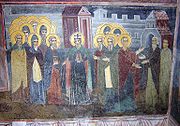 In 886 Boris' governor of Belgrade
welcomed the disciples of Saint Cyril
and Saint Methodius, who were exiled from Great Moravia
into Bulgaria and sent them on to Boris in Pliska
. Two of these disciples, Clement of Ohrid
and Naum of Preslav who were of noble Bulgarian origin, set up educational centers in Pliska
and in Ohrid
to further the development of Slavonic letters and liturgy
. The alphabet that was originally developed by Cyril and Methodius is known as the Glagolitic alphabet
. In Bulgaria Clement of Ohrid
and Naum of Preslav however created (or rather compiled) a new alphabet which was called Cyrillic and was declared the official alphabet. The Slavic language also was declared as official in 893. In the following centuries this alphabet was adopted by other Slavic peoples
. The introduction of Slavic liturgy paralleled Boris' continued development of churches and monasteries throughout his realm.
In 889 Boris abdicated the throne and became a monk. His son and successor Vladimir
attempted a pagan reaction, which brought Boris out of retirement in 893. Vladimir was defeated and blinded, and Boris gathered the Council of Preslav
placing his third son, Tsar Simeon I of Bulgaria
on the throne, threatening him with the same fate if he too apostatized. Boris returned to his monastery, emerging once again in c. 895 to help Simeon fight the Magyars, who had invaded Bulgaria in alliance with the Byzantines. After the passing of this crisis, Boris resumed monastic life and died in 907. The location of his retreat, where perhaps he was entered, is not certain; it may be near Preslav but also in Pliska or in a monastery near Varna
or Ravda.
St. Boris Peak
on Livingston Island in the South Shetland Islands
, Antarctica is named for Boris I of Bulgaria.
First Bulgarian Empire
The First Bulgarian Empire was a medieval Bulgarian state founded in the north-eastern Balkans in c. 680 by the Bulgars, uniting with seven South Slavic tribes...
in 852–889. At the time of his baptism
Baptism
In Christianity, baptism is for the majority the rite of admission , almost invariably with the use of water, into the Christian Church generally and also membership of a particular church tradition...
in 864, Boris was named Michael after his godfather, Emperor Michael III
Michael III
Michael III , , Byzantine Emperor from 842 to 867. Michael III was the third and traditionally last member of the Amorian-Phrygian Dynasty...
. The historian Steven Runciman
Steven Runciman
The Hon. Sir James Cochran Stevenson Runciman CH — known as Steven Runciman — was a British historian known for his work on the Middle Ages...
called him one of the greatest persons in history.
Despite a number of military setbacks, the reign of Boris I was marked with significant events that shaped the Bulgarian and Slavic history. With the Christianization of Bulgaria
Christianization of Bulgaria
The Christianization of Bulgaria was the process by which 9th-century medieval Bulgaria converted to Christianity. It was influenced by the khan's shifting political alliances with the kingdom of the East Franks and the Byzantine Empire, as well as his reception by the Pope of the Roman Catholic...
the country abolished the traditional state religion Tengriism
Tengriism
Tengriism is a Central Asian religion that incorporates elements of shamanism, animism, totemism and ancestor worship. Despite still being active in some minorities, it was, in old times, the major belief of Turkic peoples , Bulgars, Hungarians and Mongols...
. A skilful diplomat, Boris I successfully exploited the conflict between the Patriarchate of Constantinople
Ecumenical Patriarchate of Constantinople
The Ecumenical Patriarchate of Constantinople , part of the wider Orthodox Church, is one of the fourteen autocephalous churches within the communion of Orthodox Christianity...
and the Papacy
Pope
The Pope is the Bishop of Rome, a position that makes him the leader of the worldwide Catholic Church . In the Catholic Church, the Pope is regarded as the successor of Saint Peter, the Apostle...
to secure an autocephalous Bulgarian Church, thus dealing with the concerns among the nobility for strong Byzantine interference in the internal matters of the country.
When in 885 the disciples of Saints Cyril and Methodius
Saints Cyril and Methodius
Saints Cyril and Methodius were two Byzantine Greek brothers born in Thessaloniki in the 9th century. They became missionaries of Christianity among the Slavic peoples of Bulgaria, Great Moravia and Pannonia. Through their work they influenced the cultural development of all Slavs, for which they...
were banished from Great Moravia, Boris I gave them refuge and provided assistance to develop the Slavic alphabet and literature. After he abdicated in 889, his eldest son and successor tried to restore the old pagan religion but was deposed by Boris I. During the Council of Preslav
Council of Preslav
The People's Council of Preslav took place in 893. It was among the most important events in the history of the First Bulgarian Empire and was a cornerstone of the Christianization of Bulgaria under prince Boris I.-Background and sources:...
which followed that event, the Byzantine clergy was replaced with Bulgarian and the Greek language was replaced with Old Bulgarian
Old Church Slavonic
Old Church Slavonic or Old Church Slavic was the first literary Slavic language, first developed by the 9th century Byzantine Greek missionaries Saints Cyril and Methodius who were credited with standardizing the language and using it for translating the Bible and other Ancient Greek...
as an official language of the Church and the state.
He is regarded as a saint in the Orthodox Church, as the Prince and baptizer of Bulgaria and Equal-to-the-Apostles, with his feast day observed on May 2
May 2 (Eastern Orthodox liturgics)
May 1 - Eastern Orthodox Church calendar - May 3All fixed commemorations below celebrated on May 15 by Old Calendarists-Saints:* Martyrs Hesperos and Zoe, and their sons Cyriacos and Theodoulos, at Attalia May 1 - Eastern Orthodox Church calendar - May 3All fixed commemorations below celebrated on...
.
Name and titles
After the official act of conversion to ChristianityChristianity
Christianity is a monotheistic religion based on the life and teachings of Jesus as presented in canonical gospels and other New Testament writings...
Boris adopted the Christian name Michael
Michael
Michael is a given name that comes from the , derived from the Hebrew question מי כמו אלוהים? meaning "Who is like God?" In English, it is sometimes shortened to Mike, Mikey, or, especially in Ireland, Mick...
. He is sometimes called Boris-Michael in historical research.
The only direct evidence of Boris's title are his seals and the inscription
Ballshi inscription
The Ballshi inscription is an epigraph from the time of the Bulgarian Prince Boris I testifying to the christianization of Bulgaria...
found near the town of Ballsh
Ballsh
-Overview:The city's surrounding fields are rich in crude petroleum and are dotted by a series of oil wells established during the communist dictatorship. Only a fraction of these wells are operating today, but the city includes a working refinery, and outputs of naphthas are significant...
, modern Albania
Albania
Albania , officially known as the Republic of Albania , is a country in Southeastern Europe, in the Balkans region. It is bordered by Montenegro to the northwest, Kosovo to the northeast, the Republic of Macedonia to the east and Greece to the south and southeast. It has a coast on the Adriatic Sea...
, and at Varna
Varna
Varna is the largest city and seaside resort on the Bulgarian Black Sea Coast and third-largest in Bulgaria after Sofia and Plovdiv, with a population of 334,870 inhabitants according to Census 2011...
. There he is called with the Byzantine title "Archon
Archon
Archon is a Greek word that means "ruler" or "lord", frequently used as the title of a specific public office. It is the masculine present participle of the verb stem ἀρχ-, meaning "to rule", derived from the same root as monarch, hierarchy, and anarchy.- Ancient Greece :In ancient Greece the...
of Bulgaria", which is usually translated as "ruler", and in 10-11th centuries - also as "Knyaz". In the Bulgarian sources from that period Boris I is called "Knyaz" and during the Second Bulgarian Empire
Second Bulgarian Empire
The Second Bulgarian Empire was a medieval Bulgarian state which existed between 1185 and 1396 . A successor of the First Bulgarian Empire, it reached the peak of its power under Kaloyan and Ivan Asen II before gradually being conquered by the Ottomans in the late 14th-early 15th century...
- "Tsar".
In the modern historiography Boris is called with different titles. Most historians accept that he changed his title after the conversion to Christianity. According to them before the baptism he had the title Han or Khan
Khan (title)
Khan is an originally Altaic and subsequently Central Asian title for a sovereign or military ruler, widely used by medieval nomadic Turko-Mongol tribes living to the north of China. 'Khan' is also seen as a title in the Xianbei confederation for their chief between 283 and 289...
, and after that Knyaz
Knyaz
Kniaz, knyaz or knez is a Slavic title found in most Slavic languages, denoting a royal nobility rank. It is usually translated into English as either Prince or less commonly as Duke....
. According to other theory the title Knyaz was used by the Bulgarian rulers since the reign of Asparukh
Asparukh of Bulgaria
Asparuh was ruler of a Bulgar tribe in the second half of the 7th century and is credited with the establishment of the First Bulgarian Empire in 680/681...
.
Situation in Central Europe in the middle of the 9th century
The early 9th century marked the beginning of a fierce rivalry between the Greek East and Latin West, which would ultimately lead to the schismEast–West Schism
The East–West Schism of 1054, sometimes known as the Great Schism, formally divided the State church of the Roman Empire into Eastern and Western branches, which later became known as the Eastern Orthodox Church and the Roman Catholic Church, respectively...
between the Eastern Orthodox Church
Eastern Orthodox Church
The Orthodox Church, officially called the Orthodox Catholic Church and commonly referred to as the Eastern Orthodox Church, is the second largest Christian denomination in the world, with an estimated 300 million adherents mainly in the countries of Belarus, Bulgaria, Cyprus, Georgia, Greece,...
in Constantinople
Constantinople
Constantinople was the capital of the Roman, Eastern Roman, Byzantine, Latin, and Ottoman Empires. Throughout most of the Middle Ages, Constantinople was Europe's largest and wealthiest city.-Names:...
and the Catholic Church in Rome
Rome
Rome is the capital of Italy and the country's largest and most populated city and comune, with over 2.7 million residents in . The city is located in the central-western portion of the Italian Peninsula, on the Tiber River within the Lazio region of Italy.Rome's history spans two and a half...
.
When Charlemagne
Charlemagne
Charlemagne was King of the Franks from 768 and Emperor of the Romans from 800 to his death in 814. He expanded the Frankish kingdom into an empire that incorporated much of Western and Central Europe. During his reign, he conquered Italy and was crowned by Pope Leo III on 25 December 800...
was proclaimed Emperor of the Holy Roman Empire
Holy Roman Empire
The Holy Roman Empire was a realm that existed from 962 to 1806 in Central Europe.It was ruled by the Holy Roman Emperor. Its character changed during the Middle Ages and the Early Modern period, when the power of the emperor gradually weakened in favour of the princes...
the Pope
Pope
The Pope is the Bishop of Rome, a position that makes him the leader of the worldwide Catholic Church . In the Catholic Church, the Pope is regarded as the successor of Saint Peter, the Apostle...
broke its political relation with Byzantines and was naturally supported by the Franks
Franks
The Franks were a confederation of Germanic tribes first attested in the third century AD as living north and east of the Lower Rhine River. From the third to fifth centuries some Franks raided Roman territory while other Franks joined the Roman troops in Gaul. Only the Salian Franks formed a...
.
After the Treaty of Verdun
Treaty of Verdun
The Treaty of Verdun was a treaty between the three surviving sons of Louis the Pious, the son and successor of Charlemagne, which divided the Carolingian Empire into three kingdoms...
in 843 the strong and aggressive Eastern Francia
Eastern Francia
East Francia , also known as the Kingdom of the East Franks or Francia Orientalis, was the realm allotted to Louis the German by the 843 Treaty of Verdun...
united most of the German people and began to expand towards Slavic
Slavic peoples
The Slavic people are an Indo-European panethnicity living in Eastern Europe, Southeast Europe, North Asia and Central Asia. The term Slavic represents a broad ethno-linguistic group of people, who speak languages belonging to the Slavic language family and share, to varying degrees, certain...
populated lands to the east.
That expansion was fully supported by Rome which sought ways to extend its influence to the east. As a response Mojmír I
Mojmír I
Mojmir I or Moimir I was the first known ruler of the Moravian Slavs . In modern scholarship, the creation of the early medieval state known as "Great" Moravia is attributed either to his or to his successors' expansionist policy...
managed to unite some Slavic princes and formed Great Moravia
Great Moravia
Great Moravia was a Slavic state that existed in Central Europe and lasted for nearly seventy years in the 9th century whose creators were the ancestors of the Czechs and Slovaks. It was a vassal state of the Germanic Frankish kingdom and paid an annual tribute to it. There is some controversy as...
in 833. His successor Rastislav
Rastislav
Rastislav or Rostislav was the second known ruler of Moravia . Although he started his reign as vassal to Louis the German, king of East Francia, he consolidated his rule to the extent that after 855 he was able to repel a series of Frankish attacks...
fought against the Germans.
Both states tried to maintain good relations with Bulgaria on account of its considerable military power.
Military campaigns
Boris I was the son and successor of Presian I of Bulgaria. In 852 he sent emissaries to the Eastern FranciaEastern Francia
East Francia , also known as the Kingdom of the East Franks or Francia Orientalis, was the realm allotted to Louis the German by the 843 Treaty of Verdun...
to confirm the peace treaty from 845. At the time of his accession he threatened the Byzantine with an invasion but his armies did not attack and received a small area in Strandzha
Strandzha
Strandzha is a mountain massif in southeastern Bulgaria and the European part of Turkey, in the southeastern part of the Balkans between the plains of Thrace to the west, the lowlands near Burgas to the north and the Black Sea to the east. Its highest peak is Mahya Dağı in Turkey, while the...
to the south-east. The peace treaty, however, was not signed although both states exchanged temporary delegations. In 854 the Moravian Prince Rastislav persuaded Boris I to help him against East Francia. According to some sources, some Franks bribed the Bulgarian monarch to attack Louis. The Bulgarian-Slav campaign was a disaster and Louis the German
Louis the German
Louis the German , also known as Louis II or Louis the Bavarian, was a grandson of Charlemagne and the third son of the succeeding Frankish Emperor Louis the Pious and his first wife, Ermengarde of Hesbaye.He received the appellation 'Germanicus' shortly after his death in recognition of the fact...
scored a great victory and invaded Bulgaria. In the same time the Croats waged a war against the Bulgarians. Both peoples had coexisted peacefully to that moment which suggests that the Croats were paid by Louis to attack Bulgaria and distract Boris' attention from his alliance with Great Moravia. Kanasubigi Boris could not achieve any success and in the both sides changed gifts and settled peace. As a result of the military actions in 855 the peace between Bulgaria and Eastern Francia was restored and Rastislav was forced to fight against Louis alone. A conflict between the Byzantines and Bulgarians started in 855-856, when Boris was distracted by his conflict with Louis. Philippopolis (Plovdiv
Plovdiv
Plovdiv is the second-largest city in Bulgaria after Sofia with a population of 338,153 inhabitants according to Census 2011. Plovdiv's history spans some 6,000 years, with traces of a Neolithic settlement dating to roughly 4000 BC; it is one of the oldest cities in Europe...
), the region of Zagora
Zagore
Zagore ; also Zagorie, Zagora, Zagoria) was a vaguely defined medieval region in Bulgaria. Its name is of Slavic origin and means "beyond [i.e. south of] the [Balkan] mountains"...
and the ports around the Gulf of Burgas on the Black Sea were recaptured by the Byzantine army led by Michael III
Michael III
Michael III , , Byzantine Emperor from 842 to 867. Michael III was the third and traditionally last member of the Amorian-Phrygian Dynasty...
and the caesar Bardas
Bardas
Bardas was a Byzantine noble and high-ranking minister. As the brother of Empress Theodora, he rose to high office under Theophilos . Although sidelined after Theophilos' death by Theodora and Theoktistos, in 856 he engineered Theoktistos' fall and became the regent for his nephew, Michael III...
.
In spite of various reverses, Boris succeeded in maintaining the territorial integrity of his realm.
Serbia
After the death of Knez Vlastimir of Serbia circa 850, his state was divided between his sons. Vlastimir and Boris' father had fought each other in the Bulgarian-Serbian War of 839-842, which resulted in a Serbian victory, and Boris sought to avenge that defeat. In 853 or 854, the Bulgarian army led by Vladimir-RasateVladimir of Bulgaria
Vladimir-Rasate was the ruler of Bulgaria from 889 to 893.He became ruler of Bulgaria when his father Boris-Mihail I decided to retire to a monastery after a reign of 36 years...
, the son of Boris I, invaded Serbia, with the aim to replace the Byzantine overlordship on the Serbs. The Serbian army was led by Mutimir
Mutimir of Serbia
Mutimir of Serbia was Prince of the Serbs from ca 850 until 891. He defeated the Bulgar Army, allied himself with the Byzantine Emperor and ruled the First Serbian Principality when the Christianization of the Serbs took place and the Eparchy of Ras was established.He was the eldest son of Knez...
and his two brothers and defeated the Bulgarians, capturing Vladimir and 12 boyars. Boris I and Mutimir agreed on peace (and perhaps an alliance), and Mutimir sent his sons Pribislav and Stefan
Stefan Mutimirović
Stefan Mutimirović was a 9th century Serbian royal member of the ruling dynasty, the Vlastimirović.He was the younger son of Mutimir of the ruling Serbian dynasty, the Vlastimirovići. His father had with his brothers Strojimir and Gojnik, defeated the Bulgar Army sent by Tsar Boris, led by his son...
to the border to escort the prisoners, where they exchanged items as a sign of peace, Boris himself gave them "rich gifts", while he was given "two slaves, two falcon
Falcon
A falcon is any species of raptor in the genus Falco. The genus contains 37 species, widely distributed throughout Europe, Asia, and North America....
s, two dogs, and 80 furs".
An internal conflict among the Serbian brothers resulted in Mutimir banishing the two younger brothers to the Bulgarian court. Mutimir, however, kept a nephew, Petar, in his court, for political reasons. The reason of the feud is not known, however, it is postulated that it was a result of treachery
Treachery
Treachery is a statutory offence in Australia. There was also an unrelated statutory offence bearing that name in the United Kingdom, but it has been abolished. Both of these offences were derived from or inspired by the related offence of treason. The name treachery was chosen because it is a...
. Petar would later defeat Pribislav, Mutimir's son, and take the Serbian throne.
Baptism
For a variety of reasons, Boris became interested in converting to Christianity and undertook to do that at the hands of western clergymen to be supplied by Louis the GermanLouis the German
Louis the German , also known as Louis II or Louis the Bavarian, was a grandson of Charlemagne and the third son of the succeeding Frankish Emperor Louis the Pious and his first wife, Ermengarde of Hesbaye.He received the appellation 'Germanicus' shortly after his death in recognition of the fact...
in 863. However, late in the same year, the Byzantine Empire
Byzantine Empire
The Byzantine Empire was the Eastern Roman Empire during the periods of Late Antiquity and the Middle Ages, centred on the capital of Constantinople. Known simply as the Roman Empire or Romania to its inhabitants and neighbours, the Empire was the direct continuation of the Ancient Roman State...
invaded Bulgaria during a period of famine and natural disasters. Taken by surprise, Boris was forced to sue for peace and agreed to convert to Christianity according to the eastern rites in exchange for peace and territorial concessions in Thrace
Thrace
Thrace is a historical and geographic area in southeast Europe. As a geographical concept, Thrace designates a region bounded by the Balkan Mountains on the north, Rhodope Mountains and the Aegean Sea on the south, and by the Black Sea and the Sea of Marmara on the east...
(he regained the region of Zagora recently recovered by the Byzantines). At the beginning of 864 Boris was secretly baptized at Pliska
Pliska
Pliska is the name of both the first capital of Danubian Bulgaria and a small town which was renamed after the historical Pliska after its site was determined and excavations began....
by an embassy of Byzantine clergymen, together with his family and select members of the Bulgarian nobility. With Emperor Michael III
Michael III
Michael III , , Byzantine Emperor from 842 to 867. Michael III was the third and traditionally last member of the Amorian-Phrygian Dynasty...
as his godfather, Boris also adopted the Christian name Michael. However, a document was discovered in Albania by the Austrian archaeologist Camillo Praschniker during WWI, in Byllis, (or Ballsh in modern Albania) that says: (evaftiste o arhon Bulgarias Boris o metonomastheis Mihail sin to ek Theu dhedhomeno av to ethnei tous s t o d) "...was baptized the archon of Bulgaria, Boris, called Mihal together with his people given to him by God, Year 6374" (=866 AD). Boris' conversion inspired a reaction by his pagan subjects, including many important notables. There are a few versions as to why Boris converted to Christianity. Some historians attribute it to the intervention of his sister who had already converted while being at Constantinople. Another story mention a Greek slave in the ruler's court. A more mythological version is the one in which Boris is astonished and frightened by an icon of Judgement day and thus decides to adopt Christianity.
Conversion to Christianity met great opposition in Bulgaria. In the summer of 865 a group of aristocrats (boyars) started an open revolt. Boris ruthlessly suppressed it and executed 52 boyars together with their entire families.http://promacedonia.org/vz1b/vz1b_3_2.html Thus the Christianization continued.
Bulgarian Church
At the same time Boris sought further instruction on how to lead a Christian lifestyle and society and how to set up an autocephalous church from the Byzantine Patriarch Photios. Photios' answer proved less than satisfactory, and Boris sought to gain a more favorable settlement from the Papacy. Boris dispatched emissaires led by the kavhan PeterPeter (diplomat)
Peter was a relative of knyaz Boris I who was in charge of diplomatic missions during the Christianization of Bulgaria. His position in the Bulgarian administrative hierarchy is unknown but it has been suggested that he had the title kavhan, i. e...
with a long list of questions to Pope Nicholas I
Pope Nicholas I
Pope Nicholas I, , or Saint Nicholas the Great, reigned from April 24, 858 until his death. He is remembered as a consolidator of papal authority and power, exerting decisive influence upon the historical development of the papacy and its position among the Christian nations of Western Europe.He...
at Rome in August 866, and obtained 106 detailed answers, detailing the essence of religion
Religion
Religion is a collection of cultural systems, belief systems, and worldviews that establishes symbols that relate humanity to spirituality and, sometimes, to moral values. Many religions have narratives, symbols, traditions and sacred histories that are intended to give meaning to life or to...
, law
Law
Law is a system of rules and guidelines which are enforced through social institutions to govern behavior, wherever possible. It shapes politics, economics and society in numerous ways and serves as a social mediator of relations between people. Contract law regulates everything from buying a bus...
, politics
Politics
Politics is a process by which groups of people make collective decisions. The term is generally applied to the art or science of running governmental or state affairs, including behavior within civil governments, but also applies to institutions, fields, and special interest groups such as the...
, custom
Convention (norm)
A convention is a set of agreed, stipulated or generally accepted standards, norms, social norms or criteria, often taking the form of a custom....
s and personal faith
Faith
Faith is confidence or trust in a person or thing, or a belief that is not based on proof. In religion, faith is a belief in a transcendent reality, a religious teacher, a set of teachings or a Supreme Being. Generally speaking, it is offered as a means by which the truth of the proposition,...
. The pope temporarily glossed over the controversial question of the autocephalous status desired by Boris for his church and sent a large group of missionaries to continue the conversion of Bulgaria in accordance with the western rite. Bulgaria's shift towards the Papacy infuriated Patriarch Photios who wrote an encyclical to the eastern clergy in 867, in which he denounced the practices associated with the western rite and Rome's ecclesiastical intervention in Bulgaria. This occasioned the Photian Schism
Photian schism
The Photian schism is a term for a controversy lasting from 863-867 between Eastern and Western Christianity....
, which was a major step in the rift between the eastern and western churches.
In Bulgaria the activities of the papal legate Bishop Formosus (later Pope Formosus
Pope Formosus
Pope Formosus was Pope of the Catholic Church from 891 to 896. His brief reign as Pope was troubled, and his remains were exhumed and put on trial in the notorious Cadaver Synod.-Biography:...
) met with success, until the pope rejected Boris' request to nominate Formosus archbishop of Bulgaria. The new Pope Adrian II
Pope Adrian II
Pope Adrian II , , pope from December 14, 867 to December 14, 872, was a member of a noble Roman family, and became pope in 867, at an advanced age....
refused Boris' request for a similar nomination of either Formosus or Deacon Marinus (later Pope Marinus I
Pope Marinus I
Pope Marinus I , Pope between December 16, 882 and May 15, 884. He succeeded John VIII in about the end of December 882.-Prior history:...
), after which Bulgaria began to shift towards Constantinople once again. At the Fourth Council of Constantinople
Fourth Council of Constantinople
The Fourth Council of Constantinople of 879-880 is believed to have been the Eighth Ecumenical Council by some Eastern Orthodox. Photius had been appointed Patriarch of Constantinople but deposed by a Council of Constantinople called in 869 by Emperor Basil I the Macedonian and Pope Adrian II...
in 870 the position of the Bulgarian church was reopened by Bulgarian envoys, and the eastern patriarchs adjudicated in favor of Constantinople. This determined the future of the Bulgarian Orthodox Church
Bulgarian Orthodox Church
The Bulgarian Orthodox Church - Bulgarian Patriarchate is an autocephalous Eastern Orthodox Church with some 6.5 million members in the Republic of Bulgaria and between 1.5 and 2.0 million members in a number of European countries, the Americas and Australia...
, which was granted the status of an autocephalous archbishopric by the Patriarchate of Constantinople. Later in the 870s the Patriarch of Constantinople surrendered Bulgaria to the Papacy, but this concession was purely nominal, as it did not affect the actual position of Bulgaria's autocephalous church.
Cyrillic alphabet and Slavic language as official in Bulgaria
Belgrade
Belgrade is the capital and largest city of Serbia. It is located at the confluence of the Sava and Danube rivers, where the Pannonian Plain meets the Balkans. According to official results of Census 2011, the city has a population of 1,639,121. It is one of the 15 largest cities in Europe...
welcomed the disciples of Saint Cyril
Saints Cyril and Methodius
Saints Cyril and Methodius were two Byzantine Greek brothers born in Thessaloniki in the 9th century. They became missionaries of Christianity among the Slavic peoples of Bulgaria, Great Moravia and Pannonia. Through their work they influenced the cultural development of all Slavs, for which they...
and Saint Methodius, who were exiled from Great Moravia
Great Moravia
Great Moravia was a Slavic state that existed in Central Europe and lasted for nearly seventy years in the 9th century whose creators were the ancestors of the Czechs and Slovaks. It was a vassal state of the Germanic Frankish kingdom and paid an annual tribute to it. There is some controversy as...
into Bulgaria and sent them on to Boris in Pliska
Pliska
Pliska is the name of both the first capital of Danubian Bulgaria and a small town which was renamed after the historical Pliska after its site was determined and excavations began....
. Two of these disciples, Clement of Ohrid
Clement of Ohrid
Saint Clement of Ohrid was a medieval Bulgarian saint, scholar, writer and enlightener of the Slavs. He was the most prominent disciple of Saints Cyril and Methodius and is often associated with the creation of the Glagolitic and Cyrillic alphabets, especially their popularisation among...
and Naum of Preslav who were of noble Bulgarian origin, set up educational centers in Pliska
Preslav Literary School
The Preslav Literary School was the first literary school in the medieval Bulgarian Empire. It was established by Boris I in 885 or 886 in Bulgaria's capital, Pliska...
and in Ohrid
Ohrid Literary School
The Ohrid Literary School was one of the two major medieval Bulgarian cultural centres, along with the Preslav Literary School . The school was established in Ohrid in 886 by Saint Clement of Ohrid on orders of Boris I of Bulgaria simultaneously or shortly after the establishment of the Preslav...
to further the development of Slavonic letters and liturgy
Liturgy
Liturgy is either the customary public worship done by a specific religious group, according to its particular traditions or a more precise term that distinguishes between those religious groups who believe their ritual requires the "people" to do the "work" of responding to the priest, and those...
. The alphabet that was originally developed by Cyril and Methodius is known as the Glagolitic alphabet
Glagolitic alphabet
The Glagolitic alphabet , also known as Glagolitsa, is the oldest known Slavic alphabet. The name was not coined until many centuries after its creation, and comes from the Old Slavic glagolъ "utterance" . The verb glagoliti means "to speak"...
. In Bulgaria Clement of Ohrid
Clement of Ohrid
Saint Clement of Ohrid was a medieval Bulgarian saint, scholar, writer and enlightener of the Slavs. He was the most prominent disciple of Saints Cyril and Methodius and is often associated with the creation of the Glagolitic and Cyrillic alphabets, especially their popularisation among...
and Naum of Preslav however created (or rather compiled) a new alphabet which was called Cyrillic and was declared the official alphabet. The Slavic language also was declared as official in 893. In the following centuries this alphabet was adopted by other Slavic peoples
Slavic peoples
The Slavic people are an Indo-European panethnicity living in Eastern Europe, Southeast Europe, North Asia and Central Asia. The term Slavic represents a broad ethno-linguistic group of people, who speak languages belonging to the Slavic language family and share, to varying degrees, certain...
. The introduction of Slavic liturgy paralleled Boris' continued development of churches and monasteries throughout his realm.
In 889 Boris abdicated the throne and became a monk. His son and successor Vladimir
Vladimir of Bulgaria
Vladimir-Rasate was the ruler of Bulgaria from 889 to 893.He became ruler of Bulgaria when his father Boris-Mihail I decided to retire to a monastery after a reign of 36 years...
attempted a pagan reaction, which brought Boris out of retirement in 893. Vladimir was defeated and blinded, and Boris gathered the Council of Preslav
Council of Preslav
The People's Council of Preslav took place in 893. It was among the most important events in the history of the First Bulgarian Empire and was a cornerstone of the Christianization of Bulgaria under prince Boris I.-Background and sources:...
placing his third son, Tsar Simeon I of Bulgaria
Simeon I of Bulgaria
Simeon I the Great ruled over Bulgaria from 893 to 927, during the First Bulgarian Empire. Simeon's successful campaigns against the Byzantines, Magyars and Serbs led Bulgaria to its greatest territorial expansion ever, making it the most powerful state in contemporary Eastern Europe...
on the throne, threatening him with the same fate if he too apostatized. Boris returned to his monastery, emerging once again in c. 895 to help Simeon fight the Magyars, who had invaded Bulgaria in alliance with the Byzantines. After the passing of this crisis, Boris resumed monastic life and died in 907. The location of his retreat, where perhaps he was entered, is not certain; it may be near Preslav but also in Pliska or in a monastery near Varna
Varna
Varna is the largest city and seaside resort on the Bulgarian Black Sea Coast and third-largest in Bulgaria after Sofia and Plovdiv, with a population of 334,870 inhabitants according to Census 2011...
or Ravda.
St. Boris Peak
St. Boris Peak
St. Boris Peak rises to 1,665 m in Friesland Ridge, Tangra Mountains, Livingston Island in the South Shetland Islands, Antarctica. The peak is linked to Simeon Peak to the southwest by Paril Saddle and surmounts Huntress Glacier to northwest and west, and Macy Glacier to the southeast.The...
on Livingston Island in the South Shetland Islands
South Shetland Islands
The South Shetland Islands are a group of Antarctic islands, lying about north of the Antarctic Peninsula, with a total area of . By the Antarctic Treaty of 1959, the Islands' sovereignty is neither recognized nor disputed by the signatories and they are free for use by any signatory for...
, Antarctica is named for Boris I of Bulgaria.
See also
- Christianization of BulgariaChristianization of BulgariaThe Christianization of Bulgaria was the process by which 9th-century medieval Bulgaria converted to Christianity. It was influenced by the khan's shifting political alliances with the kingdom of the East Franks and the Byzantine Empire, as well as his reception by the Pope of the Roman Catholic...
- Cyril and Methodius
- Glagolitic alphabetGlagolitic alphabetThe Glagolitic alphabet , also known as Glagolitsa, is the oldest known Slavic alphabet. The name was not coined until many centuries after its creation, and comes from the Old Slavic glagolъ "utterance" . The verb glagoliti means "to speak"...