


Khanate of Kazan

Encyclopedia
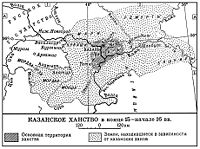
The Khanate of Kazan was a medieval Tatar state which occupied the territory of former Volga Bulgaria
between 1438 and 1552. Its khans were the patrilineal descendants of Toqa Temür, the thirteenth son of Jochi
and grandson of Genghis Khan
. The khanate covered contemporary Tatarstan
, Mari El
, Chuvashia, Mordovia
, parts of Udmurtia
and Bashkortostan
; its capital was the city of Kazan
. It was one of the successor states of the Golden Horde
, and it came to an end when it was conquered by the Tsardom of Russia
.
-populated lands of Bolğar, Cükätäw, Kazan, Qaşan duchies and other regions that originally belonged to Volga Bulgaria
. The Volga, Kama and Vyatka
were the main rivers of the khanate, as well as the major trade ways. The majority of the population were Kazan Tatars (i.e. Muslim Bolgars that adopted the Tatar language
). Their self-identity was not restricted to Tatars; many identified themselves as simple Muslims or "the people of Kazan". Islam
was the state religion.
The local feudal nobility consisted of ethnic Bolgars, but the Kazan khans' court and body guard were composed of steppe Tatars (Kipchaks
, and later of Nogais
) that lived in Kazan. According to the Ginghizide
tradition, the local Turkic tribes were also called Tatars by the steppe nobility and, later, by the Russian elite. Part of the higher nobility hailed from the Golden Horde
. It included members of four leading noble families: Arghin, Barin, Qipchaq, and Shirin.
Peoples subject to the khan included the Chuvash
, Mari, Mordva, Tatar-Mishar, Udmurt
, and Bashkir
. The Perm
ians and some of the Komi
tribes were also incorporated into the Khanate. The Mishars had arrived during the period of the Golden Horde
and gradually assimilated the resident Finnic Mordvins and Burtas
. Their territory was governed by former steppe Tatars. Some of the Mishar duchies were never controlled from Kazan
and instead gravitated towards the Qasim Khanate
or Muscovite Russia.
Most of the khanate territory was covered by forests, and only the southern part adjoined the steppe
. The main population of the steppes were the nomadic Manghites, also known as Nogais
, who sometimes recognized the rule of the Kazan khan, but more often raided agricultural Tatars
and Chuvash
, as they had done in the Golden Horde
period. Later, Nogais were transplanted and replaced with Kalmyks. More recently, this area was settled by Tatars, Chuvash and Russians, who erected defensive walls to guard the southern border. Since the khanate was established, Tatar Cossack troops defended the khanate from the Nogais.
Russian sources indicate that at least five languages were used in the Kazan khanate. The first and foremost was the Tatar language
, including the Middle dialect of the Kazan Tatars (formerly Muslim Bolgars) and the Western dialect of the Mishars (formerly steppe Tatars who had spoken Kipchak). Its written form (Old Tatar language
) was the favoured language of the state. The Chuvash language
was a descendant of the Bolgar language
, spoken by the pagan Chuvash people
. The Bolgar language
also strongly influenced the Middle dialect of Tatar language
. The other three were probably the Mari language
, the Mordvin languages and the Bashkir language
, likewise developed from the Bolgar and Kipchak language
s.
, Arça
, Cükätaw
, Qaşan
, Çallı, Alat and Cöri. The urban population also traded with the people of Central Asia
, the Caucasus
, and Russia
. In the 16th century, Russia became the main trading partner of Kazan, and the khanate shared the economic system of Moscow. The major markets were the Taşayaq Bazaar in Kazan and the Markiz Isle fair on the Volga River. Agricultural landownership was based on the söyurğal and hereditary estates.
. His actions were based on decisions and consultations of a cabinet council, or Diwan
. The nobility comprised the ranks of bäk (beg
), ämir (emir
), and morza
. Military estates consisted of the uğlan (ulan
), bahadir
, içki (ichki). Muslim clergy also played a major role. They were divided into säyet (seid), şäyex (sheikh
), qazí (qazi), and imams. The ulema
or clergy played a judicial role, and maintained the madrassas and maktab
s (schools).
The majority of the population were qara xalıq (black people): a free Muslim population, who lived on state land. The feudal lands were mostly settled by çura (serfs). Prisoners of war were usually sold to Turkey
or Central Asia
. Occasionally they were sold within the Khanate as slaves (qol) and sometimes were settled on feudal lands to become çura later. The non-Muslim population of the Khanate were required to pay the yasaq.
 The Khanate was divided into 5 daruğa: Alat, Arça, Gäreç, Cöri and Nuğay. The term daruğa translates as "direction". They replaced the "duchies" that the khanate originated from. Some feudal lords sporadically asserted independence from Kazan, but such attempts would be promptly suppressed.
The military of the khanate consisted of armament and men from the darughas and subject lands, khan guards, and the troops of the nobility. The number of soldiers was never constant, ranging from 20,000 to 60,000 in number. Often, troops from Nogay, the Crimea
and Russia
also served the Kazan khans. Fire-arms (arquebuse) were used for defending the walls of Kazan.
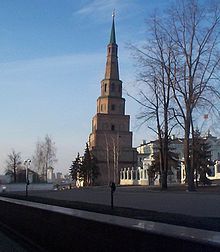 In general, the culture of the Kazan Khanate descended from that of Volga Bulgaria
. Cultural elements of the Golden Horde
were also present in noble circles.
A large part of the urban population were literate. Large libraries were present in mosque
s and madrassahs. Kazan
became a center of science and theology.
Although Islamic influence predominated, lay literature also developed. The most prominent Old Tatar language
poets were Möxämmädyar, Ömmi Kamal, Möxämmädämin, Ğärifbäk, and Qolşärif. Möxämmädyar renovated the traditions of Kazan poetry, and his verses were very popular.
The city of Bolghar
retained its position as a sacred place, but had this function only, due to the emergence of Kazan as a major economic and political center in the 1430s.
The architecture of the khanate is characterized by white-stone architecture and wood carvings.
 The former territories of Volga Bulgaria
(Kazan Ulus or Kazan Duchy) may have regained a degree of independence within the disintegrating Golden Horde
by the turn of the 15th century. The principality was self-governed and maintained a dynasty of Bolgar
rulers. Whatever the status of this proto-state, the founder of the khanate was Olug Moxammat. It was in 1437 or 1438 that he assumed the title of khan and usurped the throne of Kazan with some help from local nobility. It has been suggested that the transfer of power from the local Bolgar dynasty to Moxammat was finalized by his son Maxmud
in 1445.
Throughout its history, the khanate was prone to civil turmoil and struggles for the throne. The khans were replaced 19 times in 115 years. There were a total of fifteen reigning khans, some ascending the throne multiple times. The Khan was often elected from the Gengizides
by vernacular nobility and even by the citizens themselves.
During the reign of Olug Moxammat and his son Maxmud, Kazan forces raided Muscovy and its subject lands several times. Vasily II of Moscow, engaged in the Great Feudal War against his cousins, was defeated in a battle near Suzdal
, and was forced to pay ransom to the Kazan khan.
In July 1487, Grand Duke Ivan III of Moscow occupied Kazan and seated a puppet leader, Möxämmädämin, on the Kazan throne. After that, the Kazan Khanate became a protectorate of Moscow and Russian merchants were allowed to trade freely throughout its territory. The supporters of a union with the Ottoman Empire
and the Crimean Khanate
tried to exploit the population's grievances to provoke revolts (in 1496, 1500, and 1505), but with negligible results.
In 1521, Kazan emerged from the dominance of Moscow, concluding a mutual aid treaty with the Astrakhan Khanate
, the Crimean Khanate
and the Nogay Horde. The combined forces of khan Muhamed Giray and his Crimean allies then attacked Muscovy and captured more than 150,000 slaves. Russian chronicles record about forty attacks of Kazan khans on the Russian territories (mainly the regions of Nizhniy Novgorod, Murom, Vyatka, Vladimir, Kostroma, Galich) in the first half of the 16th century.
displeased the pro-Moscow elements of the Kazan Khanate, and some of these noblemen provoked a revolt in 1545. The result was the deposition of Safa Giray. A Moscow supporter, Şahğäli, occupied the throne. Following that year, Moscow organized several campaigns to impose control
over Kazan, but the attempts were unsuccessful. With the help of the Nogays, Safa Giray returned to the throne. He executed 75 noblemen, and the rest of his opposition escaped to Russia. In 1549 he died, and his 3-year old son Ütämeşgäräy was recognized as khan. His regent and the de-facto ruler of the khanate was his mother Söyembikä. The administration of the ulan Qoşçaq
gained a degree of independence under her rule.
At that time Safa Giray's relatives (including Devlet I Giray
) were in Crimea
. Their invitation to the throne of Kazan was vitiated by a large portion of vernacular nobility. Under Qoşçaq's government relations with Russia continued to worsen. A group of disgruntled noblemen at the beginning of 1551 invited a supporter of Tsar Ivan the Terrible, Şahğäli, for the second time.
At the same time the lands to the east of the Volga River (Taw yağı
) were ceded to Russia. Ütämeşgäräy, along with his mother, was sent to a Moscow prison. Şahğäli occupied the Kazan throne until February 1552. Anti-Moscow elements in the Kazan government exiled Şahğäli and invited the Astrakhan prince
Yadegar Moxammad, along with the Nogays, to aid them.
. The forces of Ivan IV operated from the Russian castle of Sviyazhsk
. In August 1552, the Russians defeated the Tatar inland troops, burnt Archa and some castles. After two months of siege and destruction of the citadel walls
on October 3, the Russians entered the city. Some defenders managed to escape but most were put to the sword. Yadegar Moxammad was imprisoned and the population was slaughtered. The Kazan Chronicle
reports about 110,000 killed, both civilians and garrison, and 60,000 - 100,000 Russians who had been kept captive in the khanate released. It is however well known that this chronicle is not completely reliable.
After the fall of Kazan, territories such as Udmurtia
and Bashkortostan
joined Russia
without a conflict. The khanate's administration was wiped out; pro-Moscow and neutral nobles kept their lands, but others were executed. Tatars were then resettled far away from rivers, roads and Kazan. Free lands were settled by Russians and sometimes by pro-Russian Tatars. Orthodox bishops such as Germogen forcibly baptized many Tatars.
By some estimates, the population of the former khanate declined by several thousands during the wars. The colonial administration, known as the Kazan Palace's Office undertook the Russification
and the Christianization
of the Tatars and other peoples. The term Tsardom of Kazan was in use until 1708 when the Kazan Governorate
was formed.
According to some scholars, the Khanate of Kazan was briefly restored during the Time of Troubles
with the help of the ethnic Russian population, but Russian forces under the leadership of Kuzma Minin suppressed the rebellion.
Volga Bulgaria
Volga Bulgaria, or Volga–Kama Bolghar, is a historic Bulgar state that existed between the seventh and thirteenth centuries around the confluence of the Volga and Kama rivers in what is now Russia.-Origin:...
between 1438 and 1552. Its khans were the patrilineal descendants of Toqa Temür, the thirteenth son of Jochi
Jochi
Jochi was the eldest of the Mongol chieftain Genghis Khan's four sons by his principal wife Börte. An accomplished military leader, he participated in his father's conquest of Central Asia, along with his brothers and uncles.-Early life:...
and grandson of Genghis Khan
Genghis Khan
Genghis Khan , born Temujin and occasionally known by his temple name Taizu , was the founder and Great Khan of the Mongol Empire, which became the largest contiguous empire in history after his death....
. The khanate covered contemporary Tatarstan
Tatarstan
The Republic of Tatarstan is a federal subject of Russia located in the Volga Federal District. Its capital is the city of Kazan, which is one of Russia's largest and most prosperous cities. The republic borders with Kirov, Ulyanovsk, Samara, and Orenburg Oblasts, and with the Mari El, Udmurt,...
, Mari El
Mari El
The Mari El Republic is a federal subject of Russia . Its capital is the city of Yoshkar-Ola. Population: -Geography:The republic is located in the eastern part of the East European Plain of Russia, along the Volga River. The swampy Mari Depression is located in the west of the republic...
, Chuvashia, Mordovia
Mordovia
The Republic of Mordovia , also known as Mordvinia, is a federal subject of Russia . Its capital is the city of Saransk. Population: -Geography:The republic is located in the eastern part of the East European Plain of Russia...
, parts of Udmurtia
Udmurtia
The Udmurt Republic , or Udmurtia is a federal subject of Russia . Its capital is the city of Izhevsk. Population: -History:...
and Bashkortostan
Bashkortostan
The Republic of Bashkortostan , also known as Bashkiria is a federal subject of Russia . It is located between the Volga River and the Ural Mountains. Its capital is the city of Ufa...
; its capital was the city of Kazan
Kazan
Kazan is the capital and largest city of the Republic of Tatarstan, Russia. With a population of 1,143,546 , it is the eighth most populous city in Russia. Kazan lies at the confluence of the Volga and Kazanka Rivers in European Russia. In April 2009, the Russian Patent Office granted Kazan the...
. It was one of the successor states of the Golden Horde
Golden Horde
The Golden Horde was a Mongol and later Turkicized khanate that formed the north-western sector of the Mongol Empire...
, and it came to an end when it was conquered by the Tsardom of Russia
Tsardom of Russia
The Tsardom of Russia was the name of the centralized Russian state from Ivan IV's assumption of the title of Tsar in 1547 till Peter the Great's foundation of the Russian Empire in 1721.From 1550 to 1700, Russia grew 35,000 km2 a year...
.
Khanate's geography and population
The territory of the khanate comprised the Muslim BolgarVolga Bulgaria
Volga Bulgaria, or Volga–Kama Bolghar, is a historic Bulgar state that existed between the seventh and thirteenth centuries around the confluence of the Volga and Kama rivers in what is now Russia.-Origin:...
-populated lands of Bolğar, Cükätäw, Kazan, Qaşan duchies and other regions that originally belonged to Volga Bulgaria
Volga Bulgaria
Volga Bulgaria, or Volga–Kama Bolghar, is a historic Bulgar state that existed between the seventh and thirteenth centuries around the confluence of the Volga and Kama rivers in what is now Russia.-Origin:...
. The Volga, Kama and Vyatka
Vyatka River
The Vyatka River is a river in Kirov Oblast and the Republic of Tatarstan in Russia, right tributary of the Kama River. It is 1,314 km in length. The area of its basin is 129,000 km²....
were the main rivers of the khanate, as well as the major trade ways. The majority of the population were Kazan Tatars (i.e. Muslim Bolgars that adopted the Tatar language
Tatar language
The Tatar language , or more specifically Kazan Tatar, is a Turkic language spoken by the Tatars of historical Kazan Khanate, including modern Tatarstan and Bashkiria...
). Their self-identity was not restricted to Tatars; many identified themselves as simple Muslims or "the people of Kazan". Islam
Islam
Islam . The most common are and . : Arabic pronunciation varies regionally. The first vowel ranges from ~~. The second vowel ranges from ~~~...
was the state religion.
The local feudal nobility consisted of ethnic Bolgars, but the Kazan khans' court and body guard were composed of steppe Tatars (Kipchaks
Kipchaks
Kipchaks were a Turkic tribal confederation...
, and later of Nogais
Nogais
The Nogai people are a Turkic ethnic group in Southern Russia: northern Dagestan and Stavropol Krai, as well as in Karachay-Cherkessia and the Astrakhan Oblast; undefined number live in Chechnya...
) that lived in Kazan. According to the Ginghizide
Genghis Khan
Genghis Khan , born Temujin and occasionally known by his temple name Taizu , was the founder and Great Khan of the Mongol Empire, which became the largest contiguous empire in history after his death....
tradition, the local Turkic tribes were also called Tatars by the steppe nobility and, later, by the Russian elite. Part of the higher nobility hailed from the Golden Horde
Golden Horde
The Golden Horde was a Mongol and later Turkicized khanate that formed the north-western sector of the Mongol Empire...
. It included members of four leading noble families: Arghin, Barin, Qipchaq, and Shirin.
Peoples subject to the khan included the Chuvash
Chuvash people
The Chuvash people are a Turkic ethnic group, native to an area stretching from the Volga Region to Siberia. Most of them live in Republic of Chuvashia and surrounding areas, although Chuvash communities may be found throughout all Russia.- Etymology :...
, Mari, Mordva, Tatar-Mishar, Udmurt
Udmurt people
The Udmurts are a people who speak the Udmurt language. Through history they have been known in Russian as Chud Otyatskaya , Otyaks, or Votyaks , and in Tatar as Ar....
, and Bashkir
Bashkirs
The Bashkirs are a Turkic people indigenous to Bashkortostan extending on both parts of the Ural mountains, on the place where Europe meets Asia. Groups of Bashkirs also live in the republic of Tatarstan, Perm Krai, Chelyabinsk, Orenburg, Tyumen, Sverdlovsk, Kurgan, Samara and Saratov Oblasts of...
. The Perm
Perm
Perm is a city and the administrative center of Perm Krai, Russia, located on the banks of the Kama River, in the European part of Russia near the Ural Mountains. From 1940 to 1957 it was named Molotov ....
ians and some of the Komi
Komi peoples
The Komi people is an ethnic group whose homeland is in the north-east of European Russia around the basins of the Vychegda, Pechora and Kama rivers. They mostly live in the Komi Republic, Perm Krai, Murmansk Oblast, Khanty-Mansi Autonomous Okrug, and Yamalo-Nenets Autonomous Okrug in the Russian...
tribes were also incorporated into the Khanate. The Mishars had arrived during the period of the Golden Horde
Golden Horde
The Golden Horde was a Mongol and later Turkicized khanate that formed the north-western sector of the Mongol Empire...
and gradually assimilated the resident Finnic Mordvins and Burtas
Burtas
Burtas were a tribe of uncertain ethnolinguistic affiliation inhabiting the steppe region north of the Caspian Sea in medieval times...
. Their territory was governed by former steppe Tatars. Some of the Mishar duchies were never controlled from Kazan
Mukhsha Ulus
Mukhsha Ulus or Naruçat Duchy was a subdivision of Golden Horde at the place of modern Mordovia, Penza Oblast and Tambov Oblast of Russia in 13th-15th centuries with the capital in Mukhsha. The main territory of the ulus was situated between rivers Sura and Tsna. The previous population were...
and instead gravitated towards the Qasim Khanate
Qasim Khanate
Qasim Khanate or Kingdom of Qasim was a Tatar territorial formation , vassal of Russia, which existed from 1452 till 1681 in the territory of modern Ryazan Oblast in Russia with its capital Kasimov, in the middle stream of the Oka River...
or Muscovite Russia.
Most of the khanate territory was covered by forests, and only the southern part adjoined the steppe
Steppe
In physical geography, steppe is an ecoregion, in the montane grasslands and shrublands and temperate grasslands, savannas, and shrublands biomes, characterized by grassland plains without trees apart from those near rivers and lakes...
. The main population of the steppes were the nomadic Manghites, also known as Nogais
Nogais
The Nogai people are a Turkic ethnic group in Southern Russia: northern Dagestan and Stavropol Krai, as well as in Karachay-Cherkessia and the Astrakhan Oblast; undefined number live in Chechnya...
, who sometimes recognized the rule of the Kazan khan, but more often raided agricultural Tatars
Tatars
Tatars are a Turkic speaking ethnic group , numbering roughly 7 million.The majority of Tatars live in the Russian Federation, with a population of around 5.5 million, about 2 million of which in the republic of Tatarstan.Significant minority populations are found in Uzbekistan, Kazakhstan,...
and Chuvash
Chuvash people
The Chuvash people are a Turkic ethnic group, native to an area stretching from the Volga Region to Siberia. Most of them live in Republic of Chuvashia and surrounding areas, although Chuvash communities may be found throughout all Russia.- Etymology :...
, as they had done in the Golden Horde
Golden Horde
The Golden Horde was a Mongol and later Turkicized khanate that formed the north-western sector of the Mongol Empire...
period. Later, Nogais were transplanted and replaced with Kalmyks. More recently, this area was settled by Tatars, Chuvash and Russians, who erected defensive walls to guard the southern border. Since the khanate was established, Tatar Cossack troops defended the khanate from the Nogais.
Russian sources indicate that at least five languages were used in the Kazan khanate. The first and foremost was the Tatar language
Tatar language
The Tatar language , or more specifically Kazan Tatar, is a Turkic language spoken by the Tatars of historical Kazan Khanate, including modern Tatarstan and Bashkiria...
, including the Middle dialect of the Kazan Tatars (formerly Muslim Bolgars) and the Western dialect of the Mishars (formerly steppe Tatars who had spoken Kipchak). Its written form (Old Tatar language
Old Tatar language
Old Tatar language was a literary language used among the Muslim Tatars from the Middle Ages till the 19th century....
) was the favoured language of the state. The Chuvash language
Chuvash language
Chuvash is a Turkic language spoken in central Russia, primarily in the Chuvash Republic and adjacent areas. It is the only surviving member of the Oghur branch of Turkic languages....
was a descendant of the Bolgar language
Bolgar language
Bulgar , also Oghur, is a historical group of Turkic languages, the only extant member of which is the Chuvash language.Suggested extinct members of the group are Volga-Bulgarian and Khazar ....
, spoken by the pagan Chuvash people
Chuvash people
The Chuvash people are a Turkic ethnic group, native to an area stretching from the Volga Region to Siberia. Most of them live in Republic of Chuvashia and surrounding areas, although Chuvash communities may be found throughout all Russia.- Etymology :...
. The Bolgar language
Bolgar language
Bulgar , also Oghur, is a historical group of Turkic languages, the only extant member of which is the Chuvash language.Suggested extinct members of the group are Volga-Bulgarian and Khazar ....
also strongly influenced the Middle dialect of Tatar language
Tatar language
The Tatar language , or more specifically Kazan Tatar, is a Turkic language spoken by the Tatars of historical Kazan Khanate, including modern Tatarstan and Bashkiria...
. The other three were probably the Mari language
Mari language
The Mari language , spoken by more than 600,000 people, belongs to the Uralic language family. It is spoken primarily in the Mari Republic of the Russian Federation as well as in the area along the Vyatka river basin and eastwards to the Urals...
, the Mordvin languages and the Bashkir language
Bashkir language
The Bashkir language is a Turkic language, and is the language of the Bashkirs. It is co-official with Russian in the Republic of Bashkortostan.-Speakers:...
, likewise developed from the Bolgar and Kipchak language
Kipchak language
The Kipchak language is an extinct Turkic language of the Kipchak group.The descendants of the Kipchak language include the majority of Turkic languages spoken in Eastern Europe and the Caucasus today, as Kipchak was used as a lingua franca in Golden Horde–ruled lands.Kazakhs are remnants of...
s.
Economics
The Khanate's urban population produced clay ware, wood and metal handiworks, leather, armor, ploughs and jewels. The major cities were QazanKazan
Kazan is the capital and largest city of the Republic of Tatarstan, Russia. With a population of 1,143,546 , it is the eighth most populous city in Russia. Kazan lies at the confluence of the Volga and Kazanka Rivers in European Russia. In April 2009, the Russian Patent Office granted Kazan the...
, Arça
ARCA
ARCA or Arca may refer to:* Automobile Racing Club of America, a stock car auto racing sanctioning body founded by John Marcum in 1953 in the United States...
, Cükätaw
Cükätaw
Cükätaw or Juketau was a medieval Bolgar city during the 10th to 15th centuries CE. The city was situated on the right bank of Kama, near the modern city of Çístay . In the 10th to 13th centuries it was one of the most important furniture trade centres of Volga Bulgaria. The city was the capital...
, Qaşan
Qasan
Qashan was a medieval city in Volga Bulgaria, on the right bank of Kama river from the 12th to the 15th century.In the 12th and 13th centuries it was one of the administrative and political centres of the Lower Kama region of Volga Bulgaria....
, Çallı, Alat and Cöri. The urban population also traded with the people of Central Asia
Central Asia
Central Asia is a core region of the Asian continent from the Caspian Sea in the west, China in the east, Afghanistan in the south, and Russia in the north...
, the Caucasus
Caucasus
The Caucasus, also Caucas or Caucasia , is a geopolitical region at the border of Europe and Asia, and situated between the Black and the Caspian sea...
, and Russia
Russia
Russia or , officially known as both Russia and the Russian Federation , is a country in northern Eurasia. It is a federal semi-presidential republic, comprising 83 federal subjects...
. In the 16th century, Russia became the main trading partner of Kazan, and the khanate shared the economic system of Moscow. The major markets were the Taşayaq Bazaar in Kazan and the Markiz Isle fair on the Volga River. Agricultural landownership was based on the söyurğal and hereditary estates.
Society
The state was governed by the khanKhan (title)
Khan is an originally Altaic and subsequently Central Asian title for a sovereign or military ruler, widely used by medieval nomadic Turko-Mongol tribes living to the north of China. 'Khan' is also seen as a title in the Xianbei confederation for their chief between 283 and 289...
. His actions were based on decisions and consultations of a cabinet council, or Diwan
Divan
A divan was a high governmental body in a number of Islamic states, or its chief official .-Etymology:...
. The nobility comprised the ranks of bäk (beg
Baig
- History & Origins:The name Baig originates from a Turkic clan called Barlas . They played a pivotal role in Turko-Persian empires in Central Asia, Middle East and South Asia....
), ämir (emir
Emir
Emir , meaning "commander", "general", or "prince"; also transliterated as Amir, Aamir or Ameer) is a title of high office, used throughout the Muslim world...
), and morza
Morza
Morza is a Princely title in Tatar states, such as Khanate of Kazan, Khanate of Astrakhan and others, and in Russia....
. Military estates consisted of the uğlan (ulan
Ulan
-Places:*Ulan, New South Wales, a town in Australia*Ulan, Qinghai, a county in Qinghai Province, China*Ulan-Ude, Russia, the capital city of the Republic of Buryatia, Russia-Military:...
), bahadir
Bahadır
Bahadır is a common masculine Turkish given name. In Turkish, "Bahadır" means "brave", "galahad", "hero", "valiant", and/or "gallant".Bahadır is the modern version of "Baghatur". Baghatur is the appropriate Turkish reading of the personal name of Modu Chanyu who was the founder of Xiongnu Empire...
, içki (ichki). Muslim clergy also played a major role. They were divided into säyet (seid), şäyex (sheikh
Sheikh
Not to be confused with sikhSheikh — also spelled Sheik or Shaikh, or transliterated as Shaykh — is an honorific in the Arabic language that literally means "elder" and carries the meaning "leader and/or governor"...
), qazí (qazi), and imams. The ulema
Ulema
Ulama , also spelt ulema, refers to the educated class of Muslim legal scholars engaged in the several fields of Islamic studies. They are best known as the arbiters of shari‘a law...
or clergy played a judicial role, and maintained the madrassas and maktab
Maktab
Maktab , also called kuttab , is an Arabic word meaning elementary schools...
s (schools).
The majority of the population were qara xalıq (black people): a free Muslim population, who lived on state land. The feudal lands were mostly settled by çura (serfs). Prisoners of war were usually sold to Turkey
Turkey
Turkey , known officially as the Republic of Turkey , is a Eurasian country located in Western Asia and in East Thrace in Southeastern Europe...
or Central Asia
Central Asia
Central Asia is a core region of the Asian continent from the Caspian Sea in the west, China in the east, Afghanistan in the south, and Russia in the north...
. Occasionally they were sold within the Khanate as slaves (qol) and sometimes were settled on feudal lands to become çura later. The non-Muslim population of the Khanate were required to pay the yasaq.
Administration and military
The military of the khanate consisted of armament and men from the darughas and subject lands, khan guards, and the troops of the nobility. The number of soldiers was never constant, ranging from 20,000 to 60,000 in number. Often, troops from Nogay, the Crimea
Crimean Khanate
Crimean Khanate, or Khanate of Crimea , was a state ruled by Crimean Tatars from 1441 to 1783. Its native name was . Its khans were the patrilineal descendants of Toqa Temür, the thirteenth son of Jochi and grandson of Genghis Khan...
and Russia
Russia
Russia or , officially known as both Russia and the Russian Federation , is a country in northern Eurasia. It is a federal semi-presidential republic, comprising 83 federal subjects...
also served the Kazan khans. Fire-arms (arquebuse) were used for defending the walls of Kazan.
Culture
Volga Bulgaria
Volga Bulgaria, or Volga–Kama Bolghar, is a historic Bulgar state that existed between the seventh and thirteenth centuries around the confluence of the Volga and Kama rivers in what is now Russia.-Origin:...
. Cultural elements of the Golden Horde
Golden Horde
The Golden Horde was a Mongol and later Turkicized khanate that formed the north-western sector of the Mongol Empire...
were also present in noble circles.
A large part of the urban population were literate. Large libraries were present in mosque
Mosque
A mosque is a place of worship for followers of Islam. The word is likely to have entered the English language through French , from Portuguese , from Spanish , and from Berber , ultimately originating in — . The Arabic word masjid literally means a place of prostration...
s and madrassahs. Kazan
Kazan
Kazan is the capital and largest city of the Republic of Tatarstan, Russia. With a population of 1,143,546 , it is the eighth most populous city in Russia. Kazan lies at the confluence of the Volga and Kazanka Rivers in European Russia. In April 2009, the Russian Patent Office granted Kazan the...
became a center of science and theology.
Although Islamic influence predominated, lay literature also developed. The most prominent Old Tatar language
Old Tatar language
Old Tatar language was a literary language used among the Muslim Tatars from the Middle Ages till the 19th century....
poets were Möxämmädyar, Ömmi Kamal, Möxämmädämin, Ğärifbäk, and Qolşärif. Möxämmädyar renovated the traditions of Kazan poetry, and his verses were very popular.
The city of Bolghar
Bolghar
Bolghar was intermittently capital of Volga Bulgaria from the 8th to the 15th centuries, along with Bilyar and Nur-Suvar. It was situated on the bank of the Volga River, about 30 km downstream from its confluence with the Kama River and some 130 km from modern Kazan...
retained its position as a sacred place, but had this function only, due to the emergence of Kazan as a major economic and political center in the 1430s.
The architecture of the khanate is characterized by white-stone architecture and wood carvings.
History
Volga Bulgaria
Volga Bulgaria, or Volga–Kama Bolghar, is a historic Bulgar state that existed between the seventh and thirteenth centuries around the confluence of the Volga and Kama rivers in what is now Russia.-Origin:...
(Kazan Ulus or Kazan Duchy) may have regained a degree of independence within the disintegrating Golden Horde
Golden Horde
The Golden Horde was a Mongol and later Turkicized khanate that formed the north-western sector of the Mongol Empire...
by the turn of the 15th century. The principality was self-governed and maintained a dynasty of Bolgar
Bulgars
The Bulgars were a semi-nomadic who flourished in the Pontic Steppe and the Volga basin in the 7th century.The Bulgars emerge after the collapse of the Hunnic Empire in the 5th century....
rulers. Whatever the status of this proto-state, the founder of the khanate was Olug Moxammat. It was in 1437 or 1438 that he assumed the title of khan and usurped the throne of Kazan with some help from local nobility. It has been suggested that the transfer of power from the local Bolgar dynasty to Moxammat was finalized by his son Maxmud
Maxmud of Kazan
Mäxmüd khan ; in Russian chronicles Махмутек ; ?-1467) was a ruler of the Kazan Khanate in , an elder son of Oluğ Möxämmäd. He is reputed to be one of the khanate's founders. He participated in his father's campaigns against Muscovy. In 1445, he won the battle of Suzdal and took captive the Grand...
in 1445.
Throughout its history, the khanate was prone to civil turmoil and struggles for the throne. The khans were replaced 19 times in 115 years. There were a total of fifteen reigning khans, some ascending the throne multiple times. The Khan was often elected from the Gengizides
Descent from Genghis Khan
Descent from Genghis Khan is traceable primarily in Central Asia. His four sons and other immediate descendants are famous by names and by deeds. Later Asian potentates attempted to claim descent from the House of Borjigin even on flimsy grounds. In the 14th century, valid sources all but dried...
by vernacular nobility and even by the citizens themselves.
Early history
- See also: Russo-Kazan WarsRusso-Kazan Warsthumb|300px|[[St. Basil's Cathedral]] is a monument to the Russian conquest of Kazan in 1552.The Russo-Kazan Wars was a series of wars fought between the Khanate of Kazan and Muscovite Russia from 1438, until Kazan was finally captured by Ivan the Terrible and absorbed into Russia in 1552.- Wars of...
During the reign of Olug Moxammat and his son Maxmud, Kazan forces raided Muscovy and its subject lands several times. Vasily II of Moscow, engaged in the Great Feudal War against his cousins, was defeated in a battle near Suzdal
Suzdal
Suzdal is a town in Vladimir Oblast, Russia, situated northeast of Moscow, from the city of Vladimir, on the Kamenka River. Population: -History:...
, and was forced to pay ransom to the Kazan khan.
In July 1487, Grand Duke Ivan III of Moscow occupied Kazan and seated a puppet leader, Möxämmädämin, on the Kazan throne. After that, the Kazan Khanate became a protectorate of Moscow and Russian merchants were allowed to trade freely throughout its territory. The supporters of a union with the Ottoman Empire
Ottoman Empire
The Ottoman EmpireIt was usually referred to as the "Ottoman Empire", the "Turkish Empire", the "Ottoman Caliphate" or more commonly "Turkey" by its contemporaries...
and the Crimean Khanate
Crimean Khanate
Crimean Khanate, or Khanate of Crimea , was a state ruled by Crimean Tatars from 1441 to 1783. Its native name was . Its khans were the patrilineal descendants of Toqa Temür, the thirteenth son of Jochi and grandson of Genghis Khan...
tried to exploit the population's grievances to provoke revolts (in 1496, 1500, and 1505), but with negligible results.
In 1521, Kazan emerged from the dominance of Moscow, concluding a mutual aid treaty with the Astrakhan Khanate
Astrakhan Khanate
The Khanate of Astrakhan was a Tatar feudal state that appeared after the collapse of the Golden Horde. The Khanate existed in the 15th and 16th centuries in the area adjacent to the mouth of the Volga river, where the contemporary city of Astrakhan/Hajji Tarkhan is now located...
, the Crimean Khanate
Crimean Khanate
Crimean Khanate, or Khanate of Crimea , was a state ruled by Crimean Tatars from 1441 to 1783. Its native name was . Its khans were the patrilineal descendants of Toqa Temür, the thirteenth son of Jochi and grandson of Genghis Khan...
and the Nogay Horde. The combined forces of khan Muhamed Giray and his Crimean allies then attacked Muscovy and captured more than 150,000 slaves. Russian chronicles record about forty attacks of Kazan khans on the Russian territories (mainly the regions of Nizhniy Novgorod, Murom, Vyatka, Vladimir, Kostroma, Galich) in the first half of the 16th century.
The final decade
The reinforcement of CrimeaCrimea
Crimea , or the Autonomous Republic of Crimea , is a sub-national unit, an autonomous republic, of Ukraine. It is located on the northern coast of the Black Sea, occupying a peninsula of the same name...
displeased the pro-Moscow elements of the Kazan Khanate, and some of these noblemen provoked a revolt in 1545. The result was the deposition of Safa Giray. A Moscow supporter, Şahğäli, occupied the throne. Following that year, Moscow organized several campaigns to impose control
Russo-Kazan Wars
thumb|300px|[[St. Basil's Cathedral]] is a monument to the Russian conquest of Kazan in 1552.The Russo-Kazan Wars was a series of wars fought between the Khanate of Kazan and Muscovite Russia from 1438, until Kazan was finally captured by Ivan the Terrible and absorbed into Russia in 1552.- Wars of...
over Kazan, but the attempts were unsuccessful.
Qosçaq
Qoşçaq beg was a statesman in Khanate of Kazan. From 1546 to 1551 he was a head of government during the reigns of Safagäräy and Söyembikä. He struggled against pro-Muscovite opposition. After the victory of Şahğäli's coup, he was forced to escape from Kazan. Russians caught and executed him...
gained a degree of independence under her rule.
At that time Safa Giray's relatives (including Devlet I Giray
Devlet I Giray
Devlet I Giray was a khan of the Crimean Khanate during whose long reign the khanate rose to the pinnacle of its power....
) were in Crimea
Crimea
Crimea , or the Autonomous Republic of Crimea , is a sub-national unit, an autonomous republic, of Ukraine. It is located on the northern coast of the Black Sea, occupying a peninsula of the same name...
. Their invitation to the throne of Kazan was vitiated by a large portion of vernacular nobility. Under Qoşçaq's government relations with Russia continued to worsen. A group of disgruntled noblemen at the beginning of 1551 invited a supporter of Tsar Ivan the Terrible, Şahğäli, for the second time.
At the same time the lands to the east of the Volga River (Taw yağı
Taw yagi
The Taw yağı or Viryal was a historical region of Tatarstan, Khanate of Kazan, Volga Bulgaria, the name is known since 1550s. This land was situated at the Hill, i.e. right bank of the Volga. Since 1547 this region was disintegrated from the khanate. The Feudal lords of the Hill Bank Land were...
) were ceded to Russia. Ütämeşgäräy, along with his mother, was sent to a Moscow prison. Şahğäli occupied the Kazan throne until February 1552. Anti-Moscow elements in the Kazan government exiled Şahğäli and invited the Astrakhan prince
Astrakhan Khanate
The Khanate of Astrakhan was a Tatar feudal state that appeared after the collapse of the Golden Horde. The Khanate existed in the 15th and 16th centuries in the area adjacent to the mouth of the Volga river, where the contemporary city of Astrakhan/Hajji Tarkhan is now located...
Yadegar Moxammad, along with the Nogays, to aid them.
Downfall
Kazan was then put under siegeRusso-Kazan Wars
thumb|300px|[[St. Basil's Cathedral]] is a monument to the Russian conquest of Kazan in 1552.The Russo-Kazan Wars was a series of wars fought between the Khanate of Kazan and Muscovite Russia from 1438, until Kazan was finally captured by Ivan the Terrible and absorbed into Russia in 1552.- Wars of...
. The forces of Ivan IV operated from the Russian castle of Sviyazhsk
Sviyazhsk
Sviyazhsk or Zöyä is a rural locality in the Republic of Tatarstan, Russia, located at the confluence of the Volga and Sviyaga Rivers...
. In August 1552, the Russians defeated the Tatar inland troops, burnt Archa and some castles. After two months of siege and destruction of the citadel walls
Kazan Kremlin
The Kazan Kremlin is the chief historic citadel of Tatarstan, situated in the city of Kazan. It was built on behest of Ivan the Terrible on the ruins of the former castle of Kazan khans...
on October 3, the Russians entered the city. Some defenders managed to escape but most were put to the sword. Yadegar Moxammad was imprisoned and the population was slaughtered. The Kazan Chronicle
Kazan Chronicle
Kazan Chronicle or Story of the Tsardom of Kazan is a document written between 1560 and 1565 by a Muscovite chronicler. The chronicler introduces himself as a Russian who was held in captivity in Kazan for about 20 years until Ivan the Terrible sacked Kazan in 1552...
reports about 110,000 killed, both civilians and garrison, and 60,000 - 100,000 Russians who had been kept captive in the khanate released. It is however well known that this chronicle is not completely reliable.
After the fall of Kazan, territories such as Udmurtia
Udmurtia
The Udmurt Republic , or Udmurtia is a federal subject of Russia . Its capital is the city of Izhevsk. Population: -History:...
and Bashkortostan
Bashkortostan
The Republic of Bashkortostan , also known as Bashkiria is a federal subject of Russia . It is located between the Volga River and the Ural Mountains. Its capital is the city of Ufa...
joined Russia
Russia
Russia or , officially known as both Russia and the Russian Federation , is a country in northern Eurasia. It is a federal semi-presidential republic, comprising 83 federal subjects...
without a conflict. The khanate's administration was wiped out; pro-Moscow and neutral nobles kept their lands, but others were executed. Tatars were then resettled far away from rivers, roads and Kazan. Free lands were settled by Russians and sometimes by pro-Russian Tatars. Orthodox bishops such as Germogen forcibly baptized many Tatars.
Resistance
Until 1556, part of the population continued to resist Russian rule. The rebel governments were formed in Chalem and Mishatamaq. But as the Nogays under Ğäli Äkräm often raided the agricultural population, the coalition went to ruin. After a brutal repression against the Kazan rebels, their commanders were executed.By some estimates, the population of the former khanate declined by several thousands during the wars. The colonial administration, known as the Kazan Palace's Office undertook the Russification
Russification
Russification is an adoption of the Russian language or some other Russian attributes by non-Russian communities...
and the Christianization
Christianization
The historical phenomenon of Christianization is the conversion of individuals to Christianity or the conversion of entire peoples at once...
of the Tatars and other peoples. The term Tsardom of Kazan was in use until 1708 when the Kazan Governorate
Kazan Governorate
The Kazan Governorate or Government of Kazan was a governorate of Imperial Russia from 1708–1920, with the city of Kazan as its capital.-History:...
was formed.
According to some scholars, the Khanate of Kazan was briefly restored during the Time of Troubles
Time of Troubles
The Time of Troubles was a period of Russian history comprising the years of interregnum between the death of the last Russian Tsar of the Rurik Dynasty, Feodor Ivanovich, in 1598, and the establishment of the Romanov Dynasty in 1613. In 1601-1603, Russia suffered a famine that killed one-third...
with the help of the ethnic Russian population, but Russian forces under the leadership of Kuzma Minin suppressed the rebellion.
See also
- Islam in TatarstanIslam in TatarstanEstablished in 922, the first Muslim state in Russia was Volga Bulgaria from whom the Tatars inherited Islam. Islam in Russia has had a long presence, extending at least as far back as the conquest of the Khanate of Kazan in 1552, which brought the Tatars and Bashkirs on the Middle Volga into Russia...
- Tatar nobilityMorzaMorza is a Princely title in Tatar states, such as Khanate of Kazan, Khanate of Astrakhan and others, and in Russia....
- Ar begsAr begsAr begs was a formation of Noqrat Tatars' nobility, served to Muscovy in 16th-17th century. In 14th-15th centuries they were rulers of semi-independent duchy in the middle Cheptsa, nowadays Udmurtia. at the first time, their lands were under Kazan Khanate's and later under Russian influence...
- List of Kazan khans
- List of Turkic states and empires
- Qasim KhanateQasim KhanateQasim Khanate or Kingdom of Qasim was a Tatar territorial formation , vassal of Russia, which existed from 1452 till 1681 in the territory of modern Ryazan Oblast in Russia with its capital Kasimov, in the middle stream of the Oka River...
- List of Sunni Muslim dynasties