


Shaki Khanate

Encyclopedia
Azerbaijan
Azerbaijan , officially the Republic of Azerbaijan is the largest country in the Caucasus region of Eurasia. Located at the crossroads of Western Asia and Eastern Europe, it is bounded by the Caspian Sea to the east, Russia to the north, Georgia to the northwest, Armenia to the west, and Iran to...
i khanate
Khanate
Khanate, or Chanat, is a Turco-Mongol-originated word used to describe a political entity ruled by a Khan. In modern Turkish, the word used is kağanlık, and in modern Azeri of the republic of Azerbaijan, xanlıq. In Mongolian the word khanlig is used, as in "Khereidiin Khanlig" meaning the Khanate...
on the territory of modern Azerbaijan
Azerbaijan
Azerbaijan , officially the Republic of Azerbaijan is the largest country in the Caucasus region of Eurasia. Located at the crossroads of Western Asia and Eastern Europe, it is bounded by the Caspian Sea to the east, Russia to the north, Georgia to the northwest, Armenia to the west, and Iran to...
between 1743 and 1819 with its capital in the town of Shaki.
History
The khanate was founded in 1743 as a result of revolt led by Haji Chalabi KhanHaji Chalabi Khan
Haji Chalabi Khan , was an Azerbaijani statasman, warlord, khan, ruler and founder of Shaki Khanate.-Biography:Haji Chalabi was born in 1703. He was a distant offspring of Darvish Khan, who was head of the revolt in Shaki against Safavi Tahmasib I in 1551...
against Persian Empire. It was considered one of the strongest feudal states in Caucasus
Caucasus
The Caucasus, also Caucas or Caucasia , is a geopolitical region at the border of Europe and Asia, and situated between the Black and the Caspian sea...
. The capital of the khanate Shaki, the most populated settlement in the state, was destroyed by floods in 1772, subsequently leading to suburbanization of the town and re-population of the country side.
Starting from the end of the 18th century, Shaki khans sought military assistance from the Russian Empire due to growing tensions with Persian Empire. In 1805, Mustafa Salim Khan signed a treaty with Alexander I of Russia
Alexander I of Russia
Alexander I of Russia , served as Emperor of Russia from 23 March 1801 to 1 December 1825 and the first Russian King of Poland from 1815 to 1825. He was also the first Russian Grand Duke of Finland and Lithuania....
effectively making Shaki Khanate Russian vassal state
Vassal state
A vassal state is any state that is subordinate to another. The vassal in these cases is the ruler, rather than the state itself. Being a vassal most commonly implies providing military assistance to the dominant state when requested to do so; it sometimes implies paying tribute, but a state which...
which was later affirmed by the Russo-Persian Treaty of Gulistan in 1813. In 1819, Shaki Khanate was officially abolished and transformed into a Russian province subordinate to the Russian military administration. In 1840, it was renamed to Shaki Uyezd of Caspian Oblast. In 1846, the province was incorporated into Shemakha Governorate, in 1859 into Baku
Baku Governorate
Baku Governorate was one of the guberniyas of the Russian Empire, with its centre in Baku. Area : 34,4000 sq. verstas, population : 789,659. The only foreign border of the governorate was Persia, in the south...
and in 1868 into Elisabethpol Governorate
Elisabethpol Governorate
Elisabethpol Governorate or Elizavetpol Governorate was one of the guberniyas of the Russian Empire, with its centre in Elisabethpol . Its area was 44,136 sq. kilometres, and it had 878,415 inhabitants by 1897....
. After establishment of Azerbaijan Democratic Republic
Azerbaijan Democratic Republic
The Azerbaijan Democratic Republic was the first successful attempt to establish a democratic and secular republic in the Muslim world . The ADR was founded on May 28, 1918 after the collapse of the Russian Empire that began with the Russian Revolution of 1917 by Azerbaijani National Council in...
in May 1918, Shaki was part of Ganja province and with establishment of Soviet rule in Azerbaijan, Shaki was incorporated into Azerbaijan SSR
Azerbaijan SSR
The Azerbaijan Soviet Socialist Republic , also known as the Azerbaijan SSR for short, was one of the republics that made up the former Soviet Union....
on May 5, 1920.
Geography
The khanate was subdivided into 8 districts headed by khan's naibsViceroy
A viceroy is a royal official who runs a country, colony, or province in the name of and as representative of the monarch. The term derives from the Latin prefix vice-, meaning "in the place of" and the French word roi, meaning king. A viceroy's province or larger territory is called a viceroyalty...
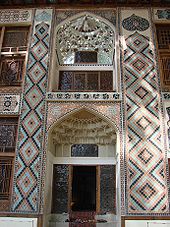
. The seat of the head of state was in the capital Shaki, in the Palace of Shaki Khans
Palace of Shaki Khans
The Palace of Shaki Khans in Shaki, Azerbaijan was a summer residence of Shaki Khans. It features decorative tiles, fountains and several stained-glass windows...
, which is one of the tourist attractions in present-day Azerbaijan. It was built circa 1761 by the grandson of Haji Chalabi, Huseyn Khan. The palace of the Shaki khans is considered one of the important historical monuments in Azerbaijan. Agriculture was the basis of Shaki Khanate's economy. The khanate was known for silkworming
Sericulture
Sericulture, or silk farming, is the rearing of silkworms for the production of raw silk.Although there are several commercial species of silkworms, Bombyx mori is the most widely used and intensively studied. According to Confucian texts, the discovery of silk production by B...
culture, one that is still practised today. Located on the left bank of the river Kish, the town of Shaki was originally sited lower down the hill. However Shaki was moved to its present location after a devastating mud flood in 1772. As the new location was near the village of Nukha, the city became also known as Nukha, until 1960 when it reverted back to the name Shaki, after the Sak tribe.
Rulers
- 1743 - 1755 Haji Chalabi KhanHaji Chalabi KhanHaji Chalabi Khan , was an Azerbaijani statasman, warlord, khan, ruler and founder of Shaki Khanate.-Biography:Haji Chalabi was born in 1703. He was a distant offspring of Darvish Khan, who was head of the revolt in Shaki against Safavi Tahmasib I in 1551...
- 1755 - 1759 Aghakishi Beg
- 1759 - 1780 Mahammadhuseyn Khan
- 1780 - 1783 `Abd al-Qadir Khan
- 1783 - 1795; 1797 - 1802 Mahammadhasan Khan
- 1795 - 1797; 1802-1806 Salim Khan
- 1806 - 1814 Jafargulu Khan Dumbuli
- 1814 - 1819 Ismayil Khan Dumbuli
See also
- Khanates of the CaucasusKhanates of the CaucasusKhanates of the Caucasus were Persian ruled principalities on the territory of modern day Azerbaijan, Armenia, Georgia and Dagestan from the Safavid dynasty era to 1806. These principalities arose during the domination of Iran. During the period of Iranian domination, head of principality was a Khan...