

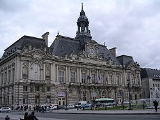
Tours

Encyclopedia
Tours is a city in central France, the capital of the Indre-et-Loire
department.
It is located on the lower reaches of the river Loire, between Orléans
and the Atlantic
coast. Touraine
, the region around Tours, is known for its wines, the alleged perfection (as perceived by some speakers) of its local spoken French, and for the famous Battle of Tours
in 732. It is also the site of the Paris–Tours road bicycle race. Tours is the largest city in the Centre region of France, although it is not the regional capital, which resides in its second-largest city of Orléans
. In 2006, the city itself had 142,000 inhabitants and the metropolitan area had 306,974.
 In Gallic
times the city was important as a crossing point of the Loire
. Becoming part of the Roman Empire during the first century AD, the city was named "Caesarodunum" ("hill of Caesar"). The name evolved in the 4th century when the original Gallic
name, Turones
, became first "Civitas Turonum" then "Tours". It was at this time that the amphitheatre of Tours, one of the five largest in the Empire, was built. Tours became the metropolis of the Roman province of Lugdunum towards 380–388, dominating the Loire
Valley, Maine
and Brittany
. One of the outstanding figures of the history of the city was Saint Martin
, second bishop who shared his coat with a naked beggar in Amiens
. This incident and the importance of Martin in the medieval Christian West made Tours, and its position on the route of pilgrimage to Santiago de Compostela
, a major centre during the Middle Ages.
, which increased considerably the influence of the saint, the abbey and the city in Gaul. In the 9th century, Tours was at the heart of the Carolingian Rebirth, in particular because of Alcuin
abbot of Marmoutier
.
In 732 AD, Abdul Rahman Al Ghafiqi
and a large army of Muslim horsemen from Al-Andalus
advanced 500 km deep into France, and were stopped at Tours by Charles Martel
and his infantry igniting the Battle of Tours
. The outcome was defeat for the Muslims, preventing France from Islamic conquest.
In 845, Tours repulsed the first attack of the Viking
chief Hasting (Haesten). In 850, the Vikings settled at the mouths of the Seine and the Loire. Still led by Hasting, they went up the Loire again in 852 and sacked Angers
, Tours and the abbey of Marmoutier.
During the Middle Ages, Tours consisted of two juxtaposed and competing centres. The "City" in the east, successor of the late Roman 'castrum', was composed of the archiepiscopal establishment (the cathedral and palace of the archbishops) and of the castle of Tours, seat of the authority of the Counts of Tours (later Counts of Anjou) and of the King of France. In the west, the "new city" structured around the Abbey of Saint Martin was freed from the control of the City during the 10th century (an enclosure was built towards 918) and became "Châteauneuf". This space, organized between Saint Martin and the Loire, became the economic centre of Tours. Between these two centres remained Varenne
, vineyards and fields, little occupied except for the Abbaye Saint-Julien established on the banks of the Loire. The two centres were linked during the 14th century. Tours is a good example of a medieval double city.
Tours became the capital of the county of Tours or Touraine
, territory bitterly disputed between the counts of Blois
and Anjou
– the latter were victorious in the 9th century. It was the capital of France at the time of Louis XI, who had settled in the castle of Montils (today the castle of Plessis in La Riche, western suburbs of Tours), Tours and Touraine remained until the 16th century a permanent residence of the kings and court. The rebirth gave Tours and Touraine many private mansions and castles, joined together to some extent under the generic name of the Chateaux of the Loire. It is also at the time of Louis XI that the silk industry was introduced – despite difficulties, the industry still survives to this day.
. At this time, the Catholics returned to power in Angers: the intendant assumed the right to nominate the aldermen. The Massacre of Saint-Barthelemy was not repeated at Tours. The Protestants were imprisoned by the aldermen – a measure which prevented their extermination. The permanent return of the Court to Paris and then Versailles marked the beginning of a slow but permanent decline. Guillaume the Metayer (1763–1798), known as Rochambeau
, the well known counter-revolutionary chief of Mayenne, was shot there on Thermidor 8, year VI.
bridge over the Loire, which was officially opened in July 1918 and bears the name of the man who was President of the USA from 1912 to 1920. Three American air force squadrons, including the 492nd, were based at the Parçay-Meslay
airfield, their personnel playing an active part in the life of the city. Americans paraded at funerals and award ceremonies for the Croix de Guerre; they also took part in festivals and their YMCA
organised shows for the troops. Some men married girls from Tours.
.
. German incendiary bombs caused a huge fire which blazed out of control from 20–22 June and destroyed part of the city centre. Some architectural masterpieces of the 16th and 17th centuries were lost, as was the monumental entry to the city. The Wilson Bridge (known locally as the 'stone bridge'), carried a water main which supplied the city; the bridge was dynamited to slow the progress of the German advance. With the water main severed and unable to extinguish the inferno, the inhabitants had no option but to flee to safety. More heavy air raids devastated the area around the railway station in 1944 causing several hundred deaths.
), which was widened. This regular layout attempted to echo, yet simplify, the 18th century architecture. Pierre Patout succeeded Lefèvre as the architect in charge of rebuilding in 1945. At one time there was talk of demolishing the southern side of the rue Nationale
in order to make it in keeping with the new development.
The recent history of Tours is marked by the personality of Jean Royer
, who was Mayor for 36 years and helped to save the old town from demolition by establishing one of the first Conservation Areas. This example of conservation policy would later inspire the Malraux Law for the safeguarding of historic city centres. In the 1970s, Jean Royer also extended the city to the south by diverting the course of the River Cher to create the districts of Rives du Cher and des Fontaines; at the time, this was one of the largest urban developments in Europe. In 1970, the François-Rabelais university was founded; this is centred on the bank of the Loire in the downtown area, and not – as it was then the current practice – in a campus in the suburbs. The latter solution was also chosen by the twin university of Orleans. Royer's long term as Mayor was, however, not without controversy, as exemplified by the construction of the practical – but aesthetically unattractive – motorway which runs along the bed of a former canal just 1500 metres from the cathedral. Another bone of contention was the original Vinci Congress Centre by Jean Nouvel
. This project incurred debts although it did, at least, make Tours one of France's principal conference centres.
Jean Germain became Mayor in 1995 and made debt reduction his priority. Ten years later, his economic management is regarded as much wiser than that of his predecessor, the financial standing of the city having returned to a stability. However, the achievements of Jean Germain are criticised by the municipal opposition for a lack of ambition: no large building projects comparable with those of Jean Royer have been instituted under his double mandate. This position is disputed by those in power, who affirm their policy of concentrating on the quality of life, as evidenced by urban restoration, the development of public transport and cultural activities.

of Tours, dedicated to Saint Gatien
, its canonized first bishop, was begun about 1170 to replace the cathedral that was burnt out in 1166, during the dispute between Louis VII of France
and Henry II of England
. The lowermost stages of the western towers (illustration, above left) belong to the 12th century, but the rest of the west end is in the profusely detailed Flamboyant Gothic of the 15th century, completed just as the Renaissance
was affecting the patrons who planned the châteaux of Touraine. These towers were being constructed at the same time as, for example, the Château de Chenonceau
.
When the 15th century illuminator Jean Fouquet
was set the task of illuminating Josephus
's Jewish Antiquities, his depiction of Solomon's Temple
was modeled after the nearly-complete cathedral of Tours. The atmosphere of the Gothic cathedral close permeates Honoré de Balzac
's dark short novel of jealousy and provincial intrigues, Le Curé de Tours (The Curate of Tours) and his medieval story Maitre Cornélius opens within the cathedral itself.
(unlike that of most other regions of France, including Paris). Gregory of Tours
wrote in the 6th century that some people in this area could still speak Gaulish
.
(called Ardoise) roofs; this style is common in the north of France, while most buildings in the south of France have terracotta roofs.
Tours is famous for its original medieval district, called le Vieux Tours. Unique to the Old City are its preserved half-timbered buildings and la Place Plumereau, a square with busy pubs and restaurants, whose open-air tables fill the centre of the square. The Boulevard Beranger crosses the Rue Nationale
at the Place Jean-Jaures and is the location of weekly markets and fairs.
Tours is famous for its many bridges crossing the river Loire
. One of them, the Pont Wilson, collapsed in 1978, but was rebuilt just like it was before.
Near the cathedral, in the garden of the ancient Palais des Archevêques (now Musée des Beaux-Arts), is a huge cedar tree planted by Napoleon. The garden also has in an alcove a stuffed elephant, Fritz. He escaped from the Barnum and Bailey circus during their stay in Tours in 1902. He went mad and had to be shot down, but the city paid to honor him, and he was stuffed as a result.
Tours is home to François Rabelais University
, the site of one of the most important choral competitions, called Florilège Vocal de Tours International Choir Competition, and is a member city of the European Grand Prix for Choral Singing
.
) and autoroute links to the rest of the country, Tours is a jumping off point for tourist visits to the Loire Valley
and the royal chateau
x.
Tours is on one of the main lines of the TGV. It is possible to travel to the west coast at Bordeaux
in two and a half hours, to the Mediterranean coast via Avignon
and from there to Spain and Barcelona
, or to Lyon
, Strasbourg
and Lille
. It takes less than one hour by train from Tours to Paris by TGV and one hour and a half to Charles de Gaulle airport. Tours has two main stations: the central station Gare de Tours
and Gare de Saint-Pierre-des-Corps
, which is just outside the center, and is the station which is used by trains that do not terminate in Tours.
Tours Loire Valley Airport
connects the Loire Valley to London Stansted Airport
and Dublin. These links are provided by the Irish airline Ryanair
. National connections to Figari on Corsica
, Porto
and Marseille
are also available during the summer.
Tours does not have a metro
rail system, instead there is a bus service, the main central stop being Jean Jaures, which is next to the Hôtel de Ville
, and rue Nationale
, the high street
of Tours. A tram network is under construction; completion is expected in September 2013, and 21 Citadis
trams have been ordered from Alstom
design by French design agency RCP Design Global
.
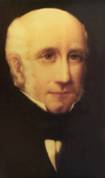 Tours is a special place for Catholics who follow the devotion
to the Holy Face of Jesus
and the adoration of the Blessed Sacrament
. It was in Tours in 1843 that a Carmelite
nun, Sister Marie of St Peter
reported a vision which started the devotion to the Holy Face of Jesus
, in reparation for the many insults Christ
suffered in His Passion. The Golden Arrow Prayer
was first made public by her in Tours.
The Venerable
Leo Dupont
also known as The Holy Man of Tours lived in Tours at about the same time. In 1849 he started the nightly adoration of the Blessed Sacrament
in Tours, from where it spread within France. Upon hearing of Sister Marie of St Peter
’s reported visions, he started to burn a vigil lamp continuously before a picture of the Holy Face of Jesus
and helped spread the devotion within France. The devotion was eventually approved by Pope Pius XII
in 1958 and he formally declared the Feast of the Holy Face of Jesus
as Shrove Tuesday (the Tuesday before Ash Wednesday) for all Roman Catholics. The Oratory of the Holy Face
on Rue St. Etienne in Tours receives many pilgrims every year.
Tours has further Christian connotations in that the pivotal Battle of Tours
in 732 is often considered the very first decisive victory over the invading Islamic forces, turning the tide against them. The battle also helped lay the foundations of the Carolingian Empire
, Spain, since 1972 Parma
, Italy, since 1976 Luoyang
, People's Republic of China, since 1982 Springfield
, USA, since 1984 Trois-Rivières
, Canada, since 1987 Takamatsu
, Japan, since 1988 Braşov
, Romania, since 1990 Minneapolis, USA, since 1991
Indre-et-Loire
Indre-et-Loire is a department in west-central France named after the Indre and the Loire rivers.-History:Indre-et-Loire is one of the original 83 départements created during the French Revolution on 4 March 1790...
department.
It is located on the lower reaches of the river Loire, between Orléans
Orléans
-Prehistory and Roman:Cenabum was a Gallic stronghold, one of the principal towns of the Carnutes tribe where the Druids held their annual assembly. It was conquered and destroyed by Julius Caesar in 52 BC, then rebuilt under the Roman Empire...
and the Atlantic
Atlantic Ocean
The Atlantic Ocean is the second-largest of the world's oceanic divisions. With a total area of about , it covers approximately 20% of the Earth's surface and about 26% of its water surface area...
coast. Touraine
Touraine
The Touraine is one of the traditional provinces of France. Its capital was Tours. During the political reorganization of French territory in 1790, the Touraine was divided between the departments of Indre-et-Loire, :Loir-et-Cher and Indre.-Geography:...
, the region around Tours, is known for its wines, the alleged perfection (as perceived by some speakers) of its local spoken French, and for the famous Battle of Tours
Battle of Tours
The Battle of Tours , also called the Battle of Poitiers and in Battle of the Court of the Martyrs, was fought in an area between the cities of Poitiers and Tours, located in north-central France, near the village of Moussais-la-Bataille, about northeast of Poitiers...
in 732. It is also the site of the Paris–Tours road bicycle race. Tours is the largest city in the Centre region of France, although it is not the regional capital, which resides in its second-largest city of Orléans
Orléans
-Prehistory and Roman:Cenabum was a Gallic stronghold, one of the principal towns of the Carnutes tribe where the Druids held their annual assembly. It was conquered and destroyed by Julius Caesar in 52 BC, then rebuilt under the Roman Empire...
. In 2006, the city itself had 142,000 inhabitants and the metropolitan area had 306,974.
History
Gaul
Gaul was a region of Western Europe during the Iron Age and Roman era, encompassing present day France, Luxembourg and Belgium, most of Switzerland, the western part of Northern Italy, as well as the parts of the Netherlands and Germany on the left bank of the Rhine. The Gauls were the speakers of...
times the city was important as a crossing point of the Loire
Loire
Loire is an administrative department in the east-central part of France occupying the River Loire's upper reaches.-History:Loire was created in 1793 when after just 3½ years the young Rhône-et-Loire department was split into two. This was a response to counter-Revolutionary activities in Lyon...
. Becoming part of the Roman Empire during the first century AD, the city was named "Caesarodunum" ("hill of Caesar"). The name evolved in the 4th century when the original Gallic
Gaulish language
The Gaulish language is an extinct Celtic language that was spoken by the Gauls, a people who inhabited the region known as Gaul from the Iron Age through the Roman period...
name, Turones
Turones
The Turones were a Celtic tribe of pre-Roman Gaul. They gave their name to the French town Tours.For their exploits in the medieval mythologies concerning Brutus of Troy, see Goffar the Pict....
, became first "Civitas Turonum" then "Tours". It was at this time that the amphitheatre of Tours, one of the five largest in the Empire, was built. Tours became the metropolis of the Roman province of Lugdunum towards 380–388, dominating the Loire
Loire
Loire is an administrative department in the east-central part of France occupying the River Loire's upper reaches.-History:Loire was created in 1793 when after just 3½ years the young Rhône-et-Loire department was split into two. This was a response to counter-Revolutionary activities in Lyon...
Valley, Maine
Maine (province)
Le Maine is one of the traditional provinces of France . It corresponds to the old county of Maine, with its center, the city of Le Mans.-Location:...
and Brittany
Brittany
Brittany is a cultural and administrative region in the north-west of France. Previously a kingdom and then a duchy, Brittany was united to the Kingdom of France in 1532 as a province. Brittany has also been referred to as Less, Lesser or Little Britain...
. One of the outstanding figures of the history of the city was Saint Martin
Martin of Tours
Martin of Tours was a Bishop of Tours whose shrine became a famous stopping-point for pilgrims on the road to Santiago de Compostela. Around his name much legendary material accrued, and he has become one of the most familiar and recognizable Christian saints...
, second bishop who shared his coat with a naked beggar in Amiens
Amiens
Amiens is a city and commune in northern France, north of Paris and south-west of Lille. It is the capital of the Somme department in Picardy...
. This incident and the importance of Martin in the medieval Christian West made Tours, and its position on the route of pilgrimage to Santiago de Compostela
Santiago de Compostela
Santiago de Compostela is the capital of the autonomous community of Galicia, Spain.The city's Cathedral is the destination today, as it has been throughout history, of the important 9th century medieval pilgrimage route, the Way of St. James...
, a major centre during the Middle Ages.
Middle Ages
In the 6th century Gregory of Tours, author of the Ten Books of History, made his mark on the town by restoring the cathedral destroyed by a fire in 561. Saint Martin's monastery benefited from its inception, at the very start of the 6th century from patronage and support from the Frankish king, ClovisClovis I
Clovis Leuthwig was the first King of the Franks to unite all the Frankish tribes under one ruler, changing the leadership from a group of royal chieftains, to rule by kings, ensuring that the kingship was held by his heirs. He was also the first Catholic King to rule over Gaul . He was the son...
, which increased considerably the influence of the saint, the abbey and the city in Gaul. In the 9th century, Tours was at the heart of the Carolingian Rebirth, in particular because of Alcuin
Alcuin
Alcuin of York or Ealhwine, nicknamed Albinus or Flaccus was an English scholar, ecclesiastic, poet and teacher from York, Northumbria. He was born around 735 and became the student of Archbishop Ecgbert at York...
abbot of Marmoutier
Marmoutier Abbey (Tours)
Marmoutier Abbey, also known as the Abbey of Marmoutier , was an early monastery outside Tours, Indre-et-Loire, France. In its later days it followed the Benedictine order as an influential monastery with many dependencies....
.
In 732 AD, Abdul Rahman Al Ghafiqi
Abdul Rahman Al Ghafiqi
Abdul Rahman Al Ghafiqi , also known as Abd er Rahman, Abdderrahman, Abderame, and Abd el-Rahman, led the Andalusian Muslims into battle against the forces of Charles Martel in the Battle of Tours on October 10, 732 AD. for which he is primarily remembered in the West...
and a large army of Muslim horsemen from Al-Andalus
Al-Andalus
Al-Andalus was the Arabic name given to a nation and territorial region also commonly referred to as Moorish Iberia. The name describes parts of the Iberian Peninsula and Septimania governed by Muslims , at various times in the period between 711 and 1492, although the territorial boundaries...
advanced 500 km deep into France, and were stopped at Tours by Charles Martel
Charles Martel
Charles Martel , also known as Charles the Hammer, was a Frankish military and political leader, who served as Mayor of the Palace under the Merovingian kings and ruled de facto during an interregnum at the end of his life, using the title Duke and Prince of the Franks. In 739 he was offered the...
and his infantry igniting the Battle of Tours
Battle of Tours
The Battle of Tours , also called the Battle of Poitiers and in Battle of the Court of the Martyrs, was fought in an area between the cities of Poitiers and Tours, located in north-central France, near the village of Moussais-la-Bataille, about northeast of Poitiers...
. The outcome was defeat for the Muslims, preventing France from Islamic conquest.
In 845, Tours repulsed the first attack of the Viking
Viking
The term Viking is customarily used to refer to the Norse explorers, warriors, merchants, and pirates who raided, traded, explored and settled in wide areas of Europe, Asia and the North Atlantic islands from the late 8th to the mid-11th century.These Norsemen used their famed longships to...
chief Hasting (Haesten). In 850, the Vikings settled at the mouths of the Seine and the Loire. Still led by Hasting, they went up the Loire again in 852 and sacked Angers
Angers
Angers is the main city in the Maine-et-Loire department in western France about south-west of Paris. Angers is located in the French region known by its pre-revolutionary, provincial name, Anjou, and its inhabitants are called Angevins....
, Tours and the abbey of Marmoutier.
During the Middle Ages, Tours consisted of two juxtaposed and competing centres. The "City" in the east, successor of the late Roman 'castrum', was composed of the archiepiscopal establishment (the cathedral and palace of the archbishops) and of the castle of Tours, seat of the authority of the Counts of Tours (later Counts of Anjou) and of the King of France. In the west, the "new city" structured around the Abbey of Saint Martin was freed from the control of the City during the 10th century (an enclosure was built towards 918) and became "Châteauneuf". This space, organized between Saint Martin and the Loire, became the economic centre of Tours. Between these two centres remained Varenne
Varenne
Varenne is a dark bay former racing trotter by Waikiki Beach out of Ialmaz by Zebu.The italian Varenne is considered the strongest trotter of all time, no other trotter before he got so many important victories and records.Before he started running, in the opinion of several vets, Varenne could...
, vineyards and fields, little occupied except for the Abbaye Saint-Julien established on the banks of the Loire. The two centres were linked during the 14th century. Tours is a good example of a medieval double city.
Tours became the capital of the county of Tours or Touraine
Touraine
The Touraine is one of the traditional provinces of France. Its capital was Tours. During the political reorganization of French territory in 1790, the Touraine was divided between the departments of Indre-et-Loire, :Loir-et-Cher and Indre.-Geography:...
, territory bitterly disputed between the counts of Blois
Blois
Blois is the capital of Loir-et-Cher department in central France, situated on the banks of the lower river Loire between Orléans and Tours.-History:...
and Anjou
Anjou
Anjou is a former county , duchy and province centred on the city of Angers in the lower Loire Valley of western France. It corresponds largely to the present-day département of Maine-et-Loire...
– the latter were victorious in the 9th century. It was the capital of France at the time of Louis XI, who had settled in the castle of Montils (today the castle of Plessis in La Riche, western suburbs of Tours), Tours and Touraine remained until the 16th century a permanent residence of the kings and court. The rebirth gave Tours and Touraine many private mansions and castles, joined together to some extent under the generic name of the Chateaux of the Loire. It is also at the time of Louis XI that the silk industry was introduced – despite difficulties, the industry still survives to this day.
16th–18th centuries
Charles IX passed through the city at the time of his royal tour of France between 1564 and 1566, accompanied by the Court and various noblemen: his brother the Duke of Anjou, Henri de Navarre, the cardinals of Bourbon and LorraineLorraine (province)
The Duchy of Upper Lorraine was an historical duchy roughly corresponding with the present-day northeastern Lorraine region of France, including parts of modern Luxembourg and Germany. The main cities were Metz, Verdun, and the historic capital Nancy....
. At this time, the Catholics returned to power in Angers: the intendant assumed the right to nominate the aldermen. The Massacre of Saint-Barthelemy was not repeated at Tours. The Protestants were imprisoned by the aldermen – a measure which prevented their extermination. The permanent return of the Court to Paris and then Versailles marked the beginning of a slow but permanent decline. Guillaume the Metayer (1763–1798), known as Rochambeau
Jean-Baptiste Donatien de Vimeur, comte de Rochambeau
Marshal of France Jean-Baptiste Donatien de Vimeur, comte de Rochambeau was a French nobleman and general who participated in the American Revolutionary War as the commander-in-chief of the French Expeditionary Force which came to help the American Continental Army...
, the well known counter-revolutionary chief of Mayenne, was shot there on Thermidor 8, year VI.
19th–20th centuries
However, it was the arrival of the railway in the 19th century which saved the city by making it an important nodal point. The main railway station is known as Tours-Saint-Pierre-des-Corps. At that time, Tours was expanding towards the south into a district known as the Prébendes. The importance of the city as a centre of communications contributed to its revival and, as the 20th century progressed, Tours became a dynamic conurbation, economically oriented towards the service sector.First World War
The city was greatly affected by the First World War. A force of 25,000 American soldiers arrived in 1917, setting up textile factories for the manufacture of uniforms, repair shops for military equipment, munitions dumps, an army post office and an American military hospital at Augustins. Thus Tours became a garrison town with a resident general staff. The American presence is remembered today by the Woodrow WilsonWoodrow Wilson
Thomas Woodrow Wilson was the 28th President of the United States, from 1913 to 1921. A leader of the Progressive Movement, he served as President of Princeton University from 1902 to 1910, and then as the Governor of New Jersey from 1911 to 1913...
bridge over the Loire, which was officially opened in July 1918 and bears the name of the man who was President of the USA from 1912 to 1920. Three American air force squadrons, including the 492nd, were based at the Parçay-Meslay
Parçay-Meslay
Parçay-Meslay is a commune in the Indre-et-Loire department in central France.-See also:*Communes of the Indre-et-Loire department* Tours Loire Valley Airport...
airfield, their personnel playing an active part in the life of the city. Americans paraded at funerals and award ceremonies for the Croix de Guerre; they also took part in festivals and their YMCA
YMCA
The Young Men's Christian Association is a worldwide organization of more than 45 million members from 125 national federations affiliated through the World Alliance of YMCAs...
organised shows for the troops. Some men married girls from Tours.
Inter-war years
In 1920, the city was host to the Congress of Tours, which saw the creation of the French Communist PartyFrench Communist Party
The French Communist Party is a political party in France which advocates the principles of communism.Although its electoral support has declined in recent decades, the PCF retains a large membership, behind only that of the Union for a Popular Movement , and considerable influence in French...
.
Second World War
Tours was also marked by the Second World War. In 1940, the city suffered massive destruction and for four years it was a city of military camps and fortifications. From 10–13 June 1940, Tours was the temporary seat of the French government before its move to BordeauxBordeaux
Bordeaux is a port city on the Garonne River in the Gironde department in southwestern France.The Bordeaux-Arcachon-Libourne metropolitan area, has a population of 1,010,000 and constitutes the sixth-largest urban area in France. It is the capital of the Aquitaine region, as well as the prefecture...
. German incendiary bombs caused a huge fire which blazed out of control from 20–22 June and destroyed part of the city centre. Some architectural masterpieces of the 16th and 17th centuries were lost, as was the monumental entry to the city. The Wilson Bridge (known locally as the 'stone bridge'), carried a water main which supplied the city; the bridge was dynamited to slow the progress of the German advance. With the water main severed and unable to extinguish the inferno, the inhabitants had no option but to flee to safety. More heavy air raids devastated the area around the railway station in 1944 causing several hundred deaths.
Post-war developments
A plan for the rebuilding of the downtown area drawn up by the local architect Camille Lefèvre was adopted even before the end of the war. The plan was for 20 small quadrangular blocks of housing to be arranged around the main road (la rue NationaleRue Nationale
The Rue Nationale is one of the oldest street and the busiest shopping street in the city of Tours.-Description:The Rue Nationale is located in the center of Tours. It is 700 meters long and extends over a flat land from north to south...
), which was widened. This regular layout attempted to echo, yet simplify, the 18th century architecture. Pierre Patout succeeded Lefèvre as the architect in charge of rebuilding in 1945. At one time there was talk of demolishing the southern side of the rue Nationale
Rue Nationale
The Rue Nationale is one of the oldest street and the busiest shopping street in the city of Tours.-Description:The Rue Nationale is located in the center of Tours. It is 700 meters long and extends over a flat land from north to south...
in order to make it in keeping with the new development.
The recent history of Tours is marked by the personality of Jean Royer
Jean Royer
Jean Royer was a French catholic and conservative politician, former Minister, and former Mayor of Tours.-Mayor of Tours:...
, who was Mayor for 36 years and helped to save the old town from demolition by establishing one of the first Conservation Areas. This example of conservation policy would later inspire the Malraux Law for the safeguarding of historic city centres. In the 1970s, Jean Royer also extended the city to the south by diverting the course of the River Cher to create the districts of Rives du Cher and des Fontaines; at the time, this was one of the largest urban developments in Europe. In 1970, the François-Rabelais university was founded; this is centred on the bank of the Loire in the downtown area, and not – as it was then the current practice – in a campus in the suburbs. The latter solution was also chosen by the twin university of Orleans. Royer's long term as Mayor was, however, not without controversy, as exemplified by the construction of the practical – but aesthetically unattractive – motorway which runs along the bed of a former canal just 1500 metres from the cathedral. Another bone of contention was the original Vinci Congress Centre by Jean Nouvel
Jean Nouvel
Jean Nouvel is a French architect. Nouvel studied at the École des Beaux-Arts in Paris and was a founding member of Mars 1976 and Syndicat de l'Architecture...
. This project incurred debts although it did, at least, make Tours one of France's principal conference centres.
Jean Germain became Mayor in 1995 and made debt reduction his priority. Ten years later, his economic management is regarded as much wiser than that of his predecessor, the financial standing of the city having returned to a stability. However, the achievements of Jean Germain are criticised by the municipal opposition for a lack of ambition: no large building projects comparable with those of Jean Royer have been instituted under his double mandate. This position is disputed by those in power, who affirm their policy of concentrating on the quality of life, as evidenced by urban restoration, the development of public transport and cultural activities.
Tours Cathedral
The cathedralCathedral
A cathedral is a Christian church that contains the seat of a bishop...
of Tours, dedicated to Saint Gatien
Gatianus of Tours
Gatianus was the founding bishop of the see of Tours.-Life:According to Christian historians, during the consulship of the Emperor Decius and Vettus Gratus , Pope Fabian sent out seven bishops from Rome to Gaul to preach the Gospel: Gatianus to Tours, Trophimus to Arles, Paul to Narbonne,...
, its canonized first bishop, was begun about 1170 to replace the cathedral that was burnt out in 1166, during the dispute between Louis VII of France
Louis VII of France
Louis VII was King of France, the son and successor of Louis VI . He ruled from 1137 until his death. He was a member of the House of Capet. His reign was dominated by feudal struggles , and saw the beginning of the long rivalry between France and England...
and Henry II of England
Henry II of England
Henry II ruled as King of England , Count of Anjou, Count of Maine, Duke of Normandy, Duke of Aquitaine, Duke of Gascony, Count of Nantes, Lord of Ireland and, at various times, controlled parts of Wales, Scotland and western France. Henry, the great-grandson of William the Conqueror, was the...
. The lowermost stages of the western towers (illustration, above left) belong to the 12th century, but the rest of the west end is in the profusely detailed Flamboyant Gothic of the 15th century, completed just as the Renaissance
Renaissance
The Renaissance was a cultural movement that spanned roughly the 14th to the 17th century, beginning in Italy in the Late Middle Ages and later spreading to the rest of Europe. The term is also used more loosely to refer to the historical era, but since the changes of the Renaissance were not...
was affecting the patrons who planned the châteaux of Touraine. These towers were being constructed at the same time as, for example, the Château de Chenonceau
Château de Chenonceau
The Château de Chenonceau is a manor house near the small village of Chenonceaux, in the Indre-et-Loire département of the Loire Valley in France. It was built on the site of an old mill on the River Cher, sometime before its first mention in writing in the 11th century...
.
When the 15th century illuminator Jean Fouquet
Jean Fouquet
Jean Fouquet was a preeminent French painter of the 15th century, a master of both panel painting and manuscript illumination, and the apparent inventor of the portrait miniature. He was the first French artist to travel to Italy and experience at first hand the Italian Early...
was set the task of illuminating Josephus
Josephus
Titus Flavius Josephus , also called Joseph ben Matityahu , was a 1st-century Romano-Jewish historian and hagiographer of priestly and royal ancestry who recorded Jewish history, with special emphasis on the 1st century AD and the First Jewish–Roman War, which resulted in the Destruction of...
's Jewish Antiquities, his depiction of Solomon's Temple
Solomon's Temple
Solomon's Temple, also known as the First Temple, was the main temple in ancient Jerusalem, on the Temple Mount , before its destruction by Nebuchadnezzar II after the Siege of Jerusalem of 587 BCE....
was modeled after the nearly-complete cathedral of Tours. The atmosphere of the Gothic cathedral close permeates Honoré de Balzac
Honoré de Balzac
Honoré de Balzac was a French novelist and playwright. His magnum opus was a sequence of short stories and novels collectively entitled La Comédie humaine, which presents a panorama of French life in the years after the 1815 fall of Napoleon....
's dark short novel of jealousy and provincial intrigues, Le Curé de Tours (The Curate of Tours) and his medieval story Maitre Cornélius opens within the cathedral itself.
Other points of interest
- Jardin botanique de ToursJardin botanique de ToursThe Jardin botanique de Tours is a municipal botanical garden and arboretum located at 33, Boulevard Tonnellé, Tours, Indre-et-Loire, Centre, France. It is open daily; admission is free....
, the municipal botanical gardenBotanical gardenA botanical garden The terms botanic and botanical, and garden or gardens are used more-or-less interchangeably, although the word botanic is generally reserved for the earlier, more traditional gardens. is a well-tended area displaying a wide range of plants labelled with their botanical names... - Musée des Beaux-Arts de ToursMusée des Beaux-Arts de ToursThe Musée des beaux-arts de Tours is located in the bishop's former palace, near the cathedral St. Gatien, where it has been since 1910...
- Hôtel Goüin
Language
The inhabitants of Tours (Les Tourangeaux) are renowned for speaking the "purest" form of French in the entire country. The pronunciation of Touraine is traditionally regarded as the most standard pronunciation of the French language, supposedly devoid of any perceived accentDialects of the French language
Dialects of the French language are spoken in France and around the world. The francophones of France generally use Metropolitan French although some also use regional dialects or varieties such as Meridional French. In Europe outside of France there are Belgian French, Swiss French, and in Italy...
(unlike that of most other regions of France, including Paris). Gregory of Tours
Gregory of Tours
Saint Gregory of Tours was a Gallo-Roman historian and Bishop of Tours, which made him a leading prelate of Gaul. He was born Georgius Florentius, later adding the name Gregorius in honour of his maternal great-grandfather...
wrote in the 6th century that some people in this area could still speak Gaulish
Gaulish language
The Gaulish language is an extinct Celtic language that was spoken by the Gauls, a people who inhabited the region known as Gaul from the Iron Age through the Roman period...
.
City
The city of Tours has a population of 140,000 and is called "Le Jardin de la France" ("The Garden of France"). There are several parks located within the city. Tours is located between two rivers, the Loire to the north and the Cher to the south. The buildings of Tours are white with blue slateSlate
Slate is a fine-grained, foliated, homogeneous metamorphic rock derived from an original shale-type sedimentary rock composed of clay or volcanic ash through low-grade regional metamorphism. The result is a foliated rock in which the foliation may not correspond to the original sedimentary layering...
(called Ardoise) roofs; this style is common in the north of France, while most buildings in the south of France have terracotta roofs.
Tours is famous for its original medieval district, called le Vieux Tours. Unique to the Old City are its preserved half-timbered buildings and la Place Plumereau, a square with busy pubs and restaurants, whose open-air tables fill the centre of the square. The Boulevard Beranger crosses the Rue Nationale
Rue Nationale
The Rue Nationale is one of the oldest street and the busiest shopping street in the city of Tours.-Description:The Rue Nationale is located in the center of Tours. It is 700 meters long and extends over a flat land from north to south...
at the Place Jean-Jaures and is the location of weekly markets and fairs.
Tours is famous for its many bridges crossing the river Loire
Loire
Loire is an administrative department in the east-central part of France occupying the River Loire's upper reaches.-History:Loire was created in 1793 when after just 3½ years the young Rhône-et-Loire department was split into two. This was a response to counter-Revolutionary activities in Lyon...
. One of them, the Pont Wilson, collapsed in 1978, but was rebuilt just like it was before.
Near the cathedral, in the garden of the ancient Palais des Archevêques (now Musée des Beaux-Arts), is a huge cedar tree planted by Napoleon. The garden also has in an alcove a stuffed elephant, Fritz. He escaped from the Barnum and Bailey circus during their stay in Tours in 1902. He went mad and had to be shot down, but the city paid to honor him, and he was stuffed as a result.
Tours is home to François Rabelais University
François Rabelais University
François Rabelais University or University of Tours, is a public university in Tours, France. The university is named after the French writer François Rabelais, and was founded in 1969.-Organisation:...
, the site of one of the most important choral competitions, called Florilège Vocal de Tours International Choir Competition, and is a member city of the European Grand Prix for Choral Singing
European Grand Prix for Choral Singing
The European Grand Prix for Choral Singing is an annual choral competition between the winners of six European choral competitions...
.
Transport
Today, with its extensive rail (including TGVTGV
The TGV is France's high-speed rail service, currently operated by SNCF Voyages, the long-distance rail branch of SNCF, the French national rail operator....
) and autoroute links to the rest of the country, Tours is a jumping off point for tourist visits to the Loire Valley
Loire Valley
The Loire Valley , spanning , is located in the middle stretch of the Loire River in central France. Its area comprises approximately . It is referred to as the Cradle of the French Language, and the Garden of France due to the abundance of vineyards, fruit orchards, and artichoke, asparagus, and...
and the royal chateau
Château
A château is a manor house or residence of the lord of the manor or a country house of nobility or gentry, with or without fortifications, originally—and still most frequently—in French-speaking regions...
x.
Tours is on one of the main lines of the TGV. It is possible to travel to the west coast at Bordeaux
Bordeaux
Bordeaux is a port city on the Garonne River in the Gironde department in southwestern France.The Bordeaux-Arcachon-Libourne metropolitan area, has a population of 1,010,000 and constitutes the sixth-largest urban area in France. It is the capital of the Aquitaine region, as well as the prefecture...
in two and a half hours, to the Mediterranean coast via Avignon
Avignon
Avignon is a French commune in southeastern France in the départment of the Vaucluse bordered by the left bank of the Rhône river. Of the 94,787 inhabitants of the city on 1 January 2010, 12 000 live in the ancient town centre surrounded by its medieval ramparts.Often referred to as the...
and from there to Spain and Barcelona
Barcelona
Barcelona is the second largest city in Spain after Madrid, and the capital of Catalonia, with a population of 1,621,537 within its administrative limits on a land area of...
, or to Lyon
Lyon
Lyon , is a city in east-central France in the Rhône-Alpes region, situated between Paris and Marseille. Lyon is located at from Paris, from Marseille, from Geneva, from Turin, and from Barcelona. The residents of the city are called Lyonnais....
, Strasbourg
Strasbourg
Strasbourg is the capital and principal city of the Alsace region in eastern France and is the official seat of the European Parliament. Located close to the border with Germany, it is the capital of the Bas-Rhin département. The city and the region of Alsace are historically German-speaking,...
and Lille
Lille
Lille is a city in northern France . It is the principal city of the Lille Métropole, the fourth-largest metropolitan area in the country behind those of Paris, Lyon and Marseille. Lille is situated on the Deûle River, near France's border with Belgium...
. It takes less than one hour by train from Tours to Paris by TGV and one hour and a half to Charles de Gaulle airport. Tours has two main stations: the central station Gare de Tours
Gare de Tours
Gare de Tours is a railway station serving the city Tours, Indre-et-Loire department, western France. It is situated on the Paris–Bordeaux railway, the Tours–Saint-Nazaire railway, and the non-electrified Tours–Le Mans railway...
and Gare de Saint-Pierre-des-Corps
Gare de Saint-Pierre-des-Corps
Gare de Saint-Pierre-des-Corps is a railway station serving the town Saint-Pierre-des-Corps and the Tours agglomeration, Indre-et-Loire department, western France...
, which is just outside the center, and is the station which is used by trains that do not terminate in Tours.
Tours Loire Valley Airport
Tours Loire Valley Airport
Tours Val de Loire Airport is an airport in the French department of Indre-et-Loire, north-northeast of the city of Tours in the Loire Valley...
connects the Loire Valley to London Stansted Airport
London Stansted Airport
-Cargo:-Statistics:-Infrastructure:-Terminal and satellite buildings:Stansted is the newest passenger airport of all the main London airports. The terminal is an oblong glass building, and is separated in to three areas: Check-in concourse, arrivals and departures...
and Dublin. These links are provided by the Irish airline Ryanair
Ryanair
Ryanair is an Irish low-cost airline. Its head office is at Dublin Airport and its primary operational bases at Dublin Airport and London Stansted Airport....
. National connections to Figari on Corsica
Corsica
Corsica is an island in the Mediterranean Sea. It is located west of Italy, southeast of the French mainland, and north of the island of Sardinia....
, Porto
Porto
Porto , also known as Oporto in English, is the second largest city in Portugal and one of the major urban areas in the Iberian Peninsula. Its administrative limits include a population of 237,559 inhabitants distributed within 15 civil parishes...
and Marseille
Marseille
Marseille , known in antiquity as Massalia , is the second largest city in France, after Paris, with a population of 852,395 within its administrative limits on a land area of . The urban area of Marseille extends beyond the city limits with a population of over 1,420,000 on an area of...
are also available during the summer.
Tours does not have a metro
Rapid transit
A rapid transit, underground, subway, elevated railway, metro or metropolitan railway system is an electric passenger railway in an urban area with a high capacity and frequency, and grade separation from other traffic. Rapid transit systems are typically located either in underground tunnels or on...
rail system, instead there is a bus service, the main central stop being Jean Jaures, which is next to the Hôtel de Ville
Hôtel de Ville, Paris
The Hôtel de Ville |City Hall]]) in :Paris, France, is the building housing the City of Paris's administration. Standing on the place de l'Hôtel de Ville in the city's IVe arrondissement, it has been the location of the municipality of Paris since 1357...
, and rue Nationale
Rue Nationale
The Rue Nationale is one of the oldest street and the busiest shopping street in the city of Tours.-Description:The Rue Nationale is located in the center of Tours. It is 700 meters long and extends over a flat land from north to south...
, the high street
High Street
High Street, or the High Street, is a metonym for the generic name of the primary business street of towns or cities, especially in the United Kingdom. It is usually a focal point for shops and retailers in city centres, and is most often used in reference to retailing...
of Tours. A tram network is under construction; completion is expected in September 2013, and 21 Citadis
Citadis
The Citadis is a low-floor tram built by Alstom in La Rochelle, France, and Barcelona, Spain. 1,140 Citadis are currently in use in 28 cities, among others: Bordeaux, Grenoble, Lyon, Montpellier, Orléans, the Paris area, and Barcelona, Dublin, Gdańsk, Katowice, Adelaide, Melbourne, Jerusalem and...
trams have been ordered from Alstom
Alstom
Alstom is a large multinational conglomerate which holds interests in the power generation and transport markets. According to the company website, in the years 2010-2011 Alstom had annual sales of over €20.9 billion, and employed more than 85,000 people in 70 countries. Alstom's headquarters are...
design by French design agency RCP Design Global
RCP Design Global
RCP Design Global or RCP is an independent design agency based in Tours and Paris fonded by Régine Charvet-Pello in . RCP is predominantly based in the transport and mobility design, and specialises in urban transport, High-speed rail, interiors, public spaces and street furniture...
.
Catholics from Tours
Catholic devotions
A Roman Catholic devotion is a gift of oneself, or one's activities to God. It is a willingness and desire to dedicate oneself to serve God; either in terms of prayers or in terms of a set of pious acts such as the adoration of God or the veneration of the saints or the Virgin Mary.Roman Catholic...
to the Holy Face of Jesus
Holy Face of Jesus
The Holy Face of Jesus is a title for specific images which some Catholics believe to have been miraculously formed representations of the face of Jesus Christ...
and the adoration of the Blessed Sacrament
Blessed Sacrament
The Blessed Sacrament, or the Body and Blood of Christ, is a devotional name used in the Roman Catholic Church, Eastern Catholic Churches, Old Catholic, Anglican, and Lutheran churches, to refer to the Host after it has been consecrated in the sacrament of the Eucharist...
. It was in Tours in 1843 that a Carmelite
Carmelites
The Order of the Brothers of Our Lady of Mount Carmel or Carmelites is a Catholic religious order perhaps founded in the 12th century on Mount Carmel, hence its name. However, historical records about its origin remain uncertain...
nun, Sister Marie of St Peter
Marie of St Peter
Sister Marie of St Peter was a Carmelite nun who lived in Tours, France. She is best known for starting the devotion to the Holy Face of Jesus which is now one of the approved Catholic devotions and for the Golden Arrow Prayer....
reported a vision which started the devotion to the Holy Face of Jesus
Holy Face of Jesus
The Holy Face of Jesus is a title for specific images which some Catholics believe to have been miraculously formed representations of the face of Jesus Christ...
, in reparation for the many insults Christ
Christ
Christ is the English term for the Greek meaning "the anointed one". It is a translation of the Hebrew , usually transliterated into English as Messiah or Mashiach...
suffered in His Passion. The Golden Arrow Prayer
The Golden Arrow Holy Face Devotion (Prayer)
The Golden Arrow Holy Face Devotion is a prayer in the Roman Catholic Church which is believed to have been dictated by Jesus to Sr. Marie of St Peter and of the Holy Family, a Carmelite nun of Tours, in 1843. It is an Act of Praise and Reparation for Blasphemy...
was first made public by her in Tours.
The Venerable
Venerable
The Venerable is used as a style or epithet in several Christian churches. It is also the common English-language translation of a number of Buddhist titles.-Roman Catholic:...
Leo Dupont
Leo Dupont
Venerable Leo Dupont , also known as "The Holy Man of Tours," or the "Apostle of the Holy Face", was a religious figure in the Roman Catholic faith who helped spread various Catholic devotions such as the devotion to the Holy Face of Jesus and nightly Eucharistic Adoration...
also known as The Holy Man of Tours lived in Tours at about the same time. In 1849 he started the nightly adoration of the Blessed Sacrament
Blessed Sacrament
The Blessed Sacrament, or the Body and Blood of Christ, is a devotional name used in the Roman Catholic Church, Eastern Catholic Churches, Old Catholic, Anglican, and Lutheran churches, to refer to the Host after it has been consecrated in the sacrament of the Eucharist...
in Tours, from where it spread within France. Upon hearing of Sister Marie of St Peter
Marie of St Peter
Sister Marie of St Peter was a Carmelite nun who lived in Tours, France. She is best known for starting the devotion to the Holy Face of Jesus which is now one of the approved Catholic devotions and for the Golden Arrow Prayer....
’s reported visions, he started to burn a vigil lamp continuously before a picture of the Holy Face of Jesus
Holy Face of Jesus
The Holy Face of Jesus is a title for specific images which some Catholics believe to have been miraculously formed representations of the face of Jesus Christ...
and helped spread the devotion within France. The devotion was eventually approved by Pope Pius XII
Pope Pius XII
The Venerable Pope Pius XII , born Eugenio Maria Giuseppe Giovanni Pacelli , reigned as Pope, head of the Catholic Church and sovereign of Vatican City State, from 2 March 1939 until his death in 1958....
in 1958 and he formally declared the Feast of the Holy Face of Jesus
Holy Face of Jesus
The Holy Face of Jesus is a title for specific images which some Catholics believe to have been miraculously formed representations of the face of Jesus Christ...
as Shrove Tuesday (the Tuesday before Ash Wednesday) for all Roman Catholics. The Oratory of the Holy Face
Oratory of the Holy Face
The Oratory of the Holy Face is a Roman Catholic prayer oratory in Tours France. It is the site where devotions to the Holy Face of Jesus started in Tours by Venerable Leo Dupont based on messages reported by Sister Marie of St. Peter...
on Rue St. Etienne in Tours receives many pilgrims every year.
Tours has further Christian connotations in that the pivotal Battle of Tours
Battle of Tours
The Battle of Tours , also called the Battle of Poitiers and in Battle of the Court of the Martyrs, was fought in an area between the cities of Poitiers and Tours, located in north-central France, near the village of Moussais-la-Bataille, about northeast of Poitiers...
in 732 is often considered the very first decisive victory over the invading Islamic forces, turning the tide against them. The battle also helped lay the foundations of the Carolingian Empire
Carolingian Empire
Carolingian Empire is a historiographical term which has been used to refer to the realm of the Franks under the Carolingian dynasty in the Early Middle Ages. This dynasty is seen as the founders of France and Germany, and its beginning date is based on the crowning of Charlemagne, or Charles the...
Births
Tours was the birthplace of:- Honoré de BalzacHonoré de BalzacHonoré de Balzac was a French novelist and playwright. His magnum opus was a sequence of short stories and novels collectively entitled La Comédie humaine, which presents a panorama of French life in the years after the 1815 fall of Napoleon....
(1799–1850), novelist - Berengarius of Tours (999–1088), theologian
- Bernard of ToursBernard SilvestrisBernard Silvestris, also known as Bernardus Silvestris, was a Medieval Platonist philosopher and poet of the 12th century.-Biography:Little is known about his life. André Vernet, who edited Bernard's Cosmographia, believed that he lived from 1085 to 1178; the only certain date in his life is 1147,...
(fl.FloruitFloruit , abbreviated fl. , is a Latin verb meaning "flourished", denoting the period of time during which something was active...
1147, d. before 1178), philosopher and poet - Ernest GoüinErnest GoüinErnest Goüin was a French civil engineer and industrialist.In 1846 he founded Ernest Goüin & Cie. ; the company initially built locomotives, and diversified into bridge building and railway construction projects.His name is one of the 72 names inscribed on the Eiffel Tower.-Biography:Born on 20...
(1815–1885), french engineer - Yves BonnefoyYves BonnefoyYves Bonnefoy is a French poet and essayist. Bonnefoy was born in Tours, Indre-et-Loire, the son of a railroad worker and a teacher....
(born 1923), poet - Abraham BosseAbraham BosseAbraham Bosse was a French artist, mainly as a printmaker in etching, but also in watercolour.-Life:...
(1604–1676), artist - Georges CourtelineGeorges CourtelineGeorges Courteline was a French dramatist and novelist.Born Georges Victor Marcel Moinaux, in Tours in the Indre-et-Loire département, his family moved to Paris shortly after his birth...
(1858–1929), dramatist and novelist - Emile DelahayeEmile DelahayeEmile Delahaye was a French automotive pioneer who founded Delahaye Automobiles.Emile Delahaye was born in Tours, Indre-et-Loire, in the Loire Valley. He studied engineering at a trade school in the city of Angers, the same school later attended by Louis Delâge, another automobile pioneer...
(1843–1905), automobile pioneer - Philippe Néricault DestouchesPhilippe Néricault DestouchesPhilippe Néricault Destouches was a French dramatist.-Biography:Destouches was born at Tours, in the today's department of Indre-et-Loire....
(1680–1754), dramatist - Jean FouquetJean FouquetJean Fouquet was a preeminent French painter of the 15th century, a master of both panel painting and manuscript illumination, and the apparent inventor of the portrait miniature. He was the first French artist to travel to Italy and experience at first hand the Italian Early...
(1420–1481), painter - Gabriel LaméGabriel LaméGabriel Léon Jean Baptiste Lamé was a French mathematician.-Biography:Lamé was born in Tours, in today's département of Indre-et-Loire....
(1795–1870), mathematician - Josselin OuannaJosselin OuannaJosselin Ouanna is a French tennis player. While a junior, he reached the final of the 2004 Australian Open. On October 20, 2008, he beat #46 Ivan Ljubičić in the first round of the Grand Prix de Tennis de Lyon as a wild-card entry ranked #182. He then beat #83 Nicolás Lapentti but lost to #10...
tennis player - Laurent PetitguillaumeLaurent PetitguillaumeLaurent Petitguillaume is a French radio and television host. He debuted in 1983 on the RFM radio, then on Skyrock alongside Supernana, before hosting the show Duel au soleil on RTL during the summer holidays...
(1960), radio and television host - NâdiyaNâdiyaNâdiya is a French R&B singer.-Early life:Nâdiya comes from a family of Algerian origin in the region of Mostaganem. She is the youngest in a family of 8 children. Her brothers are named: Kader Touati, Baklavah Waheb and her sisters: Malika, Sidartha and Karla...
(1973), singer - Harry RoselmackHarry RoselmackHarry Roselmack, born March 20, 1973 in Tours, is a French radio and TV journalist of Martinique descent.-Career:Harry Roselmack graduated with degrees in History and Journalism ....
television presenter - Ludovic RoyLudovic RoyLudovic Roy is a French footballer who plays as a goalkeeper. He is currently playing for Raith Rovers.-Early days:Roy spent his youth career in his native France with La Berrichonne de Châteauroux.-St Mirren:...
footballer - Philippe de Trobriand (1816–1897), author, American military officer
- Louise de la VallièreLouise de La VallièreLouise de La Vallière was a mistress of Louis XIV of France from 1661 to 1667. She later became the Duchess of La Vallière and Duchess of Vaujours in her own right...
(1644–1710), courtesan - ZazZaz (singer)Isabelle Geffroy , better known by the nickname Zaz, is a French singer mixing jazzy styles, French variety, soul and acoustic. She is famous for her hit "Je veux", from her first album, Zaz, released on 10 May 2010....
(born 1980), singer - Luc DucalconLuc DucalconLuc Ducalcon is a French rugby union player. Ducalcon, who is a tighthead prop, plays his club rugby for Castres Olympique. He made his debut for France against Scotland on 7 February 2010.-External links:*...
(born 1984), rugby union player
Twin towns
Mülheim an der Ruhr, Germany, since 1962 SegoviaSegovia
Segovia is a city in Spain, the capital of Segovia Province in the autonomous community of Castile and León. It is situated north of Madrid, 30 minutes by high speed train. The municipality counts some 55,500 inhabitants.-Etymology:...
, Spain, since 1972 Parma
Parma
Parma is a city in the Italian region of Emilia-Romagna famous for its ham, its cheese, its architecture and the fine countryside around it. This is the home of the University of Parma, one of the oldest universities in the world....
, Italy, since 1976 Luoyang
Luoyang
Luoyang is a prefecture-level city in western Henan province of Central China. It borders the provincial capital of Zhengzhou to the east, Pingdingshan to the southeast, Nanyang to the south, Sanmenxia to the west, Jiyuan to the north, and Jiaozuo to the northeast.Situated on the central plain of...
, People's Republic of China, since 1982 Springfield
Springfield, Missouri
Springfield is the third largest city in the U.S. state of Missouri and the county seat of Greene County. According to the 2010 census data, the population was 159,498, an increase of 5.2% since the 2000 census. The Springfield Metropolitan Area, population 436,712, includes the counties of...
, USA, since 1984 Trois-Rivières
Trois-Rivières
Trois-Rivières means three rivers in French and may refer to:in Canada*Trois-Rivières, the largest city in the Mauricie region of Quebec, Canada*Circuit Trois-Rivières, a racetrack in Trois-Rivières, Quebec...
, Canada, since 1987 Takamatsu
Takamatsu, Kagawa
is a city located in central Kagawa Prefecture on the island of Shikoku in Japan, and is the seat of the prefectural government. It is designated a core city by the Japanese Government. It is a port city located on the Seto Inland Sea, and is the closest port to Honshu from Shikoku island...
, Japan, since 1988 Braşov
Brasov
Brașov is a city in Romania and the capital of Brașov County.According to the last Romanian census, from 2002, there were 284,596 people living within the city of Brașov, making it the 8th most populated city in Romania....
, Romania, since 1990 Minneapolis, USA, since 1991
See also
- Bishop of Tours
- University of Tours
- Tours FCTours FCTours Football Club is a French association football club based in Tours, the capital city of the Indre-et-Loire department. The club was formed in 1919 and currently play in Ligue 2, the second level of French football. Tours plays its home matches at the Stade de la Vallée du Cher located within...
– a soccer club based in the town.
External links
- Official website
- Tours on French version of Wikipedia
- Tours and its agglomeration on video (from www.toursmetropole.fr)
- Architecture of Tours
- François Rabelais University, Tours
- Satellite picture by Google Maps