

Beauvais

Encyclopedia
Beauvais is a city approximately 79 kilometres (49 mi) by highway north of central Paris, in the northern French region of Picardie
. It currently has a population of over 60,000 inhabitants.
as Bratuspantium, a Gaulish name, and by the Gallo-Roman name of Caesaromagus. The post-Renaissance Latin rendering is Bellovacum from the Belgic
tribe the Bellovaci
, whose capital it was. In the ninth century it became a countship, which about 1013 passed to the bishops of Beauvais, who became peers of France from the twelfth century. At the coronations of kings the Bishop of Beauvais wore the royal mantle and went, with the Bishop of Langres, to raise the king from his throne to present him to the people.
In 1346 the town had to defend itself against the English, who again besieged it in 1433. The siege
, which it endured in 1472 at the hands of the Duke of Burgundy
, was rendered famous by the heroism of the town's women, under the leadership of Jeanne Hachette
, whose memory is still celebrated by a procession on the 14 October (the feast of Sainte Angadrême), during which women take precedence over men.
An interesting hoard of coins from the High Middle Ages
became known as the Beauvais Hoard, because some of the British and European coins found with the lot were from the French abbey located in Beauvais. The hoard, which contained a variety of rare and extremely rare Anglo-Norman
pennies, English and foreign coins, was reputed to have been found in or near Paris.
at its confluence with the Avelon. Its ancient ramparts have been destroyed, and it is now surrounded by boulevards, outside of which run branches of the Thérain. In addition, there are spacious promenades in the north-east of the town.
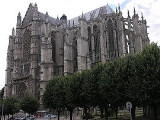
(Cathédrale Saint-Pierre de Beauvais), in some respects the most daring achievement of Gothic architecture
, consists only of a transept
and quire
with apse
and seven apse-chapels. The vaulting in the interior exceeds 46 m in height. The cathedral underwent a major repair and restoration process in 2008.
The small Romanesque
church of the 10th century known as the Basse Oeuvre occupies the site destined for the nave. Begun in 1247, under Bishop William of Grès (Guillaume de Grès, Guillaume de Grez), an extra 5 m were added to the height, to make it the tallest cathedral in Europe: the work was interrupted in 1284 by the collapse of the vaulting of the choir, a disaster that produced a temporary failure of nerve among the masons working in Gothic style. In 1573 the fall of a too-ambitious central tower stopped work again, after which little addition was made. The transept was built from 1500 to 1548.
Its façades, especially that on the south, exhibit all the richness of the late Gothic style. The carved wooden doors of both the north and the south portals are masterpieces respectively of Gothic and Renaissance
workmanship. The church possesses an elaborate astronomical clock
(1866) and tapestries of the fifteenth and seventeenth centuries; but its chief artistic treasures are stained glass
windows of the thirteenth, fourteenth and sixteenth centuries, the most beautiful of them from the hand of the Renaissance artist, Engrand Le Prince, a native of Beauvais. To him also is due some of the stained glass in St. Etienne, the second church of the town, and an interesting example of the transition stage between the Romanesque and Gothic styles.
During the Middle Ages, on 14 January, the Feast of Asses was celebrated in the Beauvais Cathedral, in commemoration of the Flight into Egypt.
, was built in 1752.
The episcopal palace, now used as a court-house, was built in the 16th century, partly upon the Gallo-Roman fortifications. The church of Saint-Étienne is a Romanesque-Gothic building (early 12th-late 16th centuries), including, in one of its transept's portals, a sculpture of "Wheel of Life"
, opened since 1857 is currently served by several TER
lines:
. It is used as a gateway to Paris by several low-cost carriers. Traffic growth is significant: in 1997, 200,000 passengers used it annually, but by 2006, it was more than 1.8 million. Airport usage increased by 40% a year on average between 2001 and 2005. The airport is mainly used for passenger traffic (only 2 to 3 flights involve freight each month) and serves 48 destinations.
(commuter bus) network consists of 25 regular lines which serve Beauvais and its suburbs, including:
, which dates from 1664, the manufacture of various kinds of cotton and woollen goods, brushes, toys, boots and shoes, and bricks and tiles. Market-gardening flourishes in the vicinity and an extensive trade is carried on in grain and wine.
The town is the seat of a bishop, a prefect and a Court of Assizes; it has Tribunals of First Instance and of commerce, together with a Chamber of Commerce
, a branch of the Bank of France, a higher ecclesiastical seminary, a lycée and training colleges.
Beauvais also has a small airport, Beauvais Tillé, which is used by several low-cost carrier
and charter airlines such as Ryanair
as a terminal for nearby Paris, to which frequent shuttle buses run.
, a soccer club playing in the Championnat National
(as of 2006), which is supported by a fine percussion band.
with: Maidstone, United Kingdom, since 1961 Witten, Germany, since 1975 Setúbal
, Portugal, since 1982.
, Romania, since 2003 Tczew
, Poland, since 2003
Picardie
Picardy is one of the 27 regions of France. It is located in the northern part of France.-History:The historical province of Picardy stretched from north of Noyon to Calais, via the whole of the Somme department and the north of the Aisne department...
. It currently has a population of over 60,000 inhabitants.
History
Beauvais was known to the RomansAncient Rome
Ancient Rome was a thriving civilization that grew on the Italian Peninsula as early as the 8th century BC. Located along the Mediterranean Sea and centered on the city of Rome, it expanded to one of the largest empires in the ancient world....
as Bratuspantium, a Gaulish name, and by the Gallo-Roman name of Caesaromagus. The post-Renaissance Latin rendering is Bellovacum from the Belgic
Belgae
The Belgae were a group of tribes living in northern Gaul, on the west bank of the Rhine, in the 3rd century BC, and later also in Britain, and possibly even Ireland...
tribe the Bellovaci
Bellovaci
The Bellovaci were among the most powerful and numerous of the Belgic tribes of north-eastern Gaul conquered by Julius Caesar in 57 BC. The name survives today in the French city of Beauvais, called by the Romans Caesaromagus.- Geography :...
, whose capital it was. In the ninth century it became a countship, which about 1013 passed to the bishops of Beauvais, who became peers of France from the twelfth century. At the coronations of kings the Bishop of Beauvais wore the royal mantle and went, with the Bishop of Langres, to raise the king from his throne to present him to the people.
In 1346 the town had to defend itself against the English, who again besieged it in 1433. The siege
Siege
A siege is a military blockade of a city or fortress with the intent of conquering by attrition or assault. The term derives from sedere, Latin for "to sit". Generally speaking, siege warfare is a form of constant, low intensity conflict characterized by one party holding a strong, static...
, which it endured in 1472 at the hands of the Duke of Burgundy
Duke of Burgundy
Duke of Burgundy was a title borne by the rulers of the Duchy of Burgundy, a small portion of traditional lands of Burgundians west of river Saône which in 843 was allotted to Charles the Bald's kingdom of West Franks...
, was rendered famous by the heroism of the town's women, under the leadership of Jeanne Hachette
Jeanne Hachette
Jeanne Laisné was a French heroine known as Jeanne Fourquet and nicknamed Jeanne Hachette .All that she is currently known for is an act of heroism on 27 June 1472, when she prevented the capture of Beauvais by the troops of Charles the Bold, Duke of Burgundy...
, whose memory is still celebrated by a procession on the 14 October (the feast of Sainte Angadrême), during which women take precedence over men.
An interesting hoard of coins from the High Middle Ages
High Middle Ages
The High Middle Ages was the period of European history around the 11th, 12th, and 13th centuries . The High Middle Ages were preceded by the Early Middle Ages and followed by the Late Middle Ages, which by convention end around 1500....
became known as the Beauvais Hoard, because some of the British and European coins found with the lot were from the French abbey located in Beauvais. The hoard, which contained a variety of rare and extremely rare Anglo-Norman
Anglo-Norman
The Anglo-Normans were mainly the descendants of the Normans who ruled England following the Norman conquest by William the Conqueror in 1066. A small number of Normans were already settled in England prior to the conquest...
pennies, English and foreign coins, was reputed to have been found in or near Paris.
Geography
Beauvais lies at the foot of wooded hills on the left bank of the ThérainThérain
The Thérain is a river in France, tributary of the Oise River. It rises between Saint-Michel-d'Halescourt and Grumesnil in Seine-Maritime at 175 meters elevation...
at its confluence with the Avelon. Its ancient ramparts have been destroyed, and it is now surrounded by boulevards, outside of which run branches of the Thérain. In addition, there are spacious promenades in the north-east of the town.
Cathedral
The city's cathedral, dedicated to Saint PeterSaint Peter
Saint Peter or Simon Peter was an early Christian leader, who is featured prominently in the New Testament Gospels and the Acts of the Apostles. The son of John or of Jonah and from the village of Bethsaida in the province of Galilee, his brother Andrew was also an apostle...
(Cathédrale Saint-Pierre de Beauvais), in some respects the most daring achievement of Gothic architecture
Gothic architecture
Gothic architecture is a style of architecture that flourished during the high and late medieval period. It evolved from Romanesque architecture and was succeeded by Renaissance architecture....
, consists only of a transept
Transept
For the periodical go to The Transept.A transept is a transverse section, of any building, which lies across the main body of the building. In Christian churches, a transept is an area set crosswise to the nave in a cruciform building in Romanesque and Gothic Christian church architecture...
and quire
Quire (architecture)
Architecturally, the choir is the area of a church or cathedral, usually in the western part of the chancel between the nave and the sanctuary . The choir is occasionally located in the eastern part of the nave...
with apse
Apse
In architecture, the apse is a semicircular recess covered with a hemispherical vault or semi-dome...
and seven apse-chapels. The vaulting in the interior exceeds 46 m in height. The cathedral underwent a major repair and restoration process in 2008.
The small Romanesque
Romanesque architecture
Romanesque architecture is an architectural style of Medieval Europe characterised by semi-circular arches. There is no consensus for the beginning date of the Romanesque architecture, with proposals ranging from the 6th to the 10th century. It developed in the 12th century into the Gothic style,...
church of the 10th century known as the Basse Oeuvre occupies the site destined for the nave. Begun in 1247, under Bishop William of Grès (Guillaume de Grès, Guillaume de Grez), an extra 5 m were added to the height, to make it the tallest cathedral in Europe: the work was interrupted in 1284 by the collapse of the vaulting of the choir, a disaster that produced a temporary failure of nerve among the masons working in Gothic style. In 1573 the fall of a too-ambitious central tower stopped work again, after which little addition was made. The transept was built from 1500 to 1548.
Its façades, especially that on the south, exhibit all the richness of the late Gothic style. The carved wooden doors of both the north and the south portals are masterpieces respectively of Gothic and Renaissance
Renaissance
The Renaissance was a cultural movement that spanned roughly the 14th to the 17th century, beginning in Italy in the Late Middle Ages and later spreading to the rest of Europe. The term is also used more loosely to refer to the historical era, but since the changes of the Renaissance were not...
workmanship. The church possesses an elaborate astronomical clock
Astronomical clock
An astronomical clock is a clock with special mechanisms and dials to display astronomical information, such as the relative positions of the sun, moon, zodiacal constellations, and sometimes major planets.-Definition:...
(1866) and tapestries of the fifteenth and seventeenth centuries; but its chief artistic treasures are stained glass
Stained glass
The term stained glass can refer to coloured glass as a material or to works produced from it. Throughout its thousand-year history, the term has been applied almost exclusively to the windows of churches and other significant buildings...
windows of the thirteenth, fourteenth and sixteenth centuries, the most beautiful of them from the hand of the Renaissance artist, Engrand Le Prince, a native of Beauvais. To him also is due some of the stained glass in St. Etienne, the second church of the town, and an interesting example of the transition stage between the Romanesque and Gothic styles.
During the Middle Ages, on 14 January, the Feast of Asses was celebrated in the Beauvais Cathedral, in commemoration of the Flight into Egypt.
Other notable sites
In the Place de l'Hôtel de Ville and in the old streets near the cathedral there are several houses dating from the 12th to the 16th centuries. The Hôtel de ville, close to which stands the statue of Jeanne HachetteJeanne Hachette
Jeanne Laisné was a French heroine known as Jeanne Fourquet and nicknamed Jeanne Hachette .All that she is currently known for is an act of heroism on 27 June 1472, when she prevented the capture of Beauvais by the troops of Charles the Bold, Duke of Burgundy...
, was built in 1752.
The episcopal palace, now used as a court-house, was built in the 16th century, partly upon the Gallo-Roman fortifications. The church of Saint-Étienne is a Romanesque-Gothic building (early 12th-late 16th centuries), including, in one of its transept's portals, a sculpture of "Wheel of Life"
Rail transport
The train station, Gare de BeauvaisGare de Beauvais
Gare de Beauvais is a railway station located in Beauvais in the Oise department, France. TER Picardie trains connect the station to Le Tréport-Mers, Creil and Paris-Nord. The Neo-medieval station building was constructed by Compagnie du Nord in brick and concrete in 1860. The line to Paris is...
, opened since 1857 is currently served by several TER
Ter
Ter is a prefix or suffix designating the third instance of a thing, thus following bis and preceding quater.Ter can also refer to:* River Ter, in Essex;* Ter , the debut album of American rock band Sweet Water...
lines:
- Beauvais – Persan-BeaumontGare de Persan-BeaumontThe Gare de Persan-Beaumont is a railway station in Persan , France, near Beaumont-sur-Oise. It is located at the junction of the Épinay-Villetaneuse–Le Tréport-Mers railway and the Pierrelaye–Creil railway. The station is served by trains of the Transilien line H and the TER Picardie...
– Paris Gare du NordGare du NordParis Nord is one of the six large terminus railway stations of the SNCF mainline network for Paris, France. It offers connections with several urban transportation lines, including Paris Métro and RER...
; - Beauvais – CreilCreilCreil is a large town in northern France. It is designated municipally as a commune within the département of Oise.-History:Archaeological remains in the area include a Neolithic site, as well as a late Iron Age necropolis, perhaps belonging to a Gaulish fortress or protected camp.The city itself...
; - Beauvais – AbancourtAbancourt, OiseAbancourt is a small village in northern France. It is designated municipally as a commune within the département of Oise.-Geography:The commune of Abancourt is situated in the western extremity of the Oise department, on the border of the Seine-Maritime department.The Bresle River flows...
– Le TréportLe TréportLe Tréport is a commune in the Seine-Maritime department in the Haute-Normandie region in northern France.-Geography:A small fishing port and light industrial town situated in the Pays de Caux, some northeast of Dieppe at the junction of the D940, the D78 and the D1015 roads...
.
Air transport
Beauvais-Tillé Airport, dating from 1930s, lies in north of the city, in TilléTillé
Tillé is a village in northern France. It is designated municipally as a commune within the département of Oise.-References:*...
. It is used as a gateway to Paris by several low-cost carriers. Traffic growth is significant: in 1997, 200,000 passengers used it annually, but by 2006, it was more than 1.8 million. Airport usage increased by 40% a year on average between 2001 and 2005. The airport is mainly used for passenger traffic (only 2 to 3 flights involve freight each month) and serves 48 destinations.
Public transport
Public transport in Beauvais is provided by (formerly The Urban Transport network of Beauvaisis or ). The transit busTransit bus
A transit bus , also known as a commuter bus, city bus, or public bus, is a bus used for short-distance public transport purposes...
(commuter bus) network consists of 25 regular lines which serve Beauvais and its suburbs, including:
- 12 day lines
- 1 2 3 4 5 6 7 8 9 12 13 14
- 3 Sunday lines.
- 11A 11B 11C
- 3 summer lines.
- 10 (divided into 3 sub lines)
- 7 Demand responsive transportDemand responsive transportDemand Responsive Transport or Demand-Responsive Transit or Demand Responsive Service or Dial-a-ride or Flexible Transport Services is "an advanced, user-oriented form of public transport characterised by flexible routing and scheduling of small/medium vehicles operating in shared-ride mode...
lines- T1 T2 T3 T5 T6 T7 T8
- 3 shuttles
- Navette Aéroport (Airport Shuttle) Navette Parking (Parking Shuttle) Navette LaSalle (Polytechnic Institute of LaSalle Shuttle)
Environmentally friendly transportation
In an effort to promote cleaner urban transportation and protect the environment, the city began to develop a "Green Plan" (Plan vert). Ultimately, the goal is to have a network of 20 km bicycle paths.Notable people
- Henri LebesgueHenri LebesgueHenri Léon Lebesgue was a French mathematician most famous for his theory of integration, which was a generalization of the seventeenth century concept of integration—summing the area between an axis and the curve of a function defined for that axis...
, mathematician - Mustapha YatabareMustapha YatabaréMustapha Yatabaré is a French born Malian football striker. He currently plays for the French side En Avant de Guingamp.-Career:...
, footballer - Sambou YatabareSambou YatabaréSambou Yatabaré is a Malian international footballer who plays professionally for Monaco in Ligue 2, as a midfielder.-International career:...
, footballer
Economy
The industry of Beauvais comprises, besides the state manufacture of tapestryTapestry
Tapestry is a form of textile art, traditionally woven on a vertical loom, however it can also be woven on a floor loom as well. It is composed of two sets of interlaced threads, those running parallel to the length and those parallel to the width ; the warp threads are set up under tension on a...
, which dates from 1664, the manufacture of various kinds of cotton and woollen goods, brushes, toys, boots and shoes, and bricks and tiles. Market-gardening flourishes in the vicinity and an extensive trade is carried on in grain and wine.
The town is the seat of a bishop, a prefect and a Court of Assizes; it has Tribunals of First Instance and of commerce, together with a Chamber of Commerce
Chamber of commerce
A chamber of commerce is a form of business network, e.g., a local organization of businesses whose goal is to further the interests of businesses. Business owners in towns and cities form these local societies to advocate on behalf of the business community...
, a branch of the Bank of France, a higher ecclesiastical seminary, a lycée and training colleges.
Beauvais also has a small airport, Beauvais Tillé, which is used by several low-cost carrier
Low-cost carrier
A low-cost carrier or low-cost airline is an airline that generally has lower fares and fewer comforts...
and charter airlines such as Ryanair
Ryanair
Ryanair is an Irish low-cost airline. Its head office is at Dublin Airport and its primary operational bases at Dublin Airport and London Stansted Airport....
as a terminal for nearby Paris, to which frequent shuttle buses run.
Sport
Beauvais is home to AS Beauvais OiseAS Beauvais Oise
Association Sportive Beauvais Oise is a French association football club based in Beauvais. The club was formed in 1945 as a result of a merger and currently play in the Championnat National, the third level of French football. Beauvais plays its home matches at the Stade Pierre Brisson located...
, a soccer club playing in the Championnat National
Championnat National
The Championnat de France National, commonly referred to as simply National or Division 3, serves as the third division of the French football league system behind Ligue 1 and Ligue 2...
(as of 2006), which is supported by a fine percussion band.
Twin towns – Sister cities
Beauvais is twinnedTown twinning
Twin towns and sister cities are two of many terms used to describe the cooperative agreements between towns, cities, and even counties in geographically and politically distinct areas to promote cultural and commercial ties.- Terminology :...
with: Maidstone, United Kingdom, since 1961 Witten, Germany, since 1975 Setúbal
Setúbal
Setúbal is the main city in Setúbal Municipality in Portugal with a total area of 172.0 km² and a total population of 118,696 inhabitants in the municipality. The city proper has 89,303 inhabitants....
, Portugal, since 1982.
Partnerships
There are also partnerships with: DejDej
Dej is a city in northwestern Romania, 60 km north of Cluj-Napoca, in Cluj County. It lies where the Someşul Mic River meets the river Someşul Mare River...
, Romania, since 2003 Tczew
Tczew
Tczew is a town on the Vistula River in Eastern Pomerania, Kociewie, northern Poland with 60,279 inhabitants . It is an important railway junction with a classification yard dating to the Prussian Eastern Railway...
, Poland, since 2003