
Encyclopedia
The
city of
Cambridge is an old
English university town and the administrative centre of the county of
Cambridgeshire. It lies approximately 50
miles north-northeast of
London and is surrounded by a number of smaller towns and villages. It is also at the heart of the high-technology centre known as Silicon Fen and is one of the major constituent parts of the Oxford-Cambridge Arc.
Cambridge is best known for the
University of Cambridge, which includes the renowned
Cavendish Laboratory,
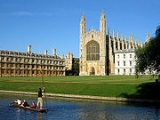
King's College Chapel, and the
Cambridge University Library. The Cambridge skyline is dominated by the last two, along with the chimney of Addenbrooke's Hospital in the far south of the city and
St John's College Chapel tower in the north. The city's name is pronounced , as opposed to another
Cambridge in
Gloucestershire, England, which is pronounced : as it is spelt.
According to the 2001 census, the population was 108,863 .
History
Settlements have existed around the area since before the
Roman Empire. The earliest clear evidence of occupation, a collection of hunting weapons, is from the Late Bronze Age, starting around 1000 BC. There is further archaeological evidence through the Iron Age, a Belgic tribe having settled on Castle Hill in the 1st century BC.
The first major development of the area began with the Roman invasion of Britain in about AD 40. Castle Hill made Cambridge a useful place for a military outpost from which to defend the
River Cam. It was also the crossing point for the Via Devana which linked
Colchester in
Essex with the garrisons at
Lincoln and the north. This Roman settlement may have been called
Durolipons.
The settlement remained a regional centre during the 350 years after the Roman occupation, until about AD 400. Roman roads and walled enclosures can still be seen in the area.
After the Romans had left,
Saxons took over the land on and around Castle Hill. Their grave goods have been found in the area. During Anglo-Saxon times Cambridge benefited from good trade links across the otherwise hard-to-travel fenlands. By the
7th century, however, visitors from nearby Ely reported that Cambridge had declined severely. Cambridge is mentioned in the Anglo-Saxon Chronicle as Grantebrycge. This is the earliest known reference to a bridge at Cambridge.
The arrival of the
Vikings in Cambridge was recorded in the Anglo-Saxon Chronicle in 875. Viking rule, the
Danelaw, had been imposed by 878. The Vikings' vigorous trading habits caused Cambridge to grow rapidly. During this period the centre of the town shifted from Castle Hill on the left bank of the river to the area now known as the Quayside on the right bank. After the end of the Viking period the Saxons enjoyed a brief return to power, building St. Benet's church in 1025. It still stands in Bene't Street.
Two years after his conquest of England,
William of Normandy built a castle on Castle Hill. Like the rest of the new kingdom, Cambridge fell under the control of the King and his deputies. The distinctive Round Church dates from this period. By Norman times the name of the town had mutated to Grentabrige or Cantebrigge, while the river that flowed through it was called the Granta. Over time the name of the town changed to Cambridge, while the river Cam was still known as the Granta - indeed the river is still often known as the Granta to this day. The
Welsh language name of the town remains
Caergrawnt . It was only later that the river became known as the Cam, by analogy with the name Cambridge. The University uses a pseudo-
Latin adjective
cantabrigiensis to mean "of Cambridge", but this is obviously a back-formation from the English name.
In 1209, students escaping from hostile townspeople in
Oxford fled to Cambridge and formed a University there. The oldest
college which still exists,
Peterhouse, was founded in 1284. One of the most impressive buildings in Cambridge,
King's College Chapel, was begun in 1446 by
King Henry VI. The project was completed in 1515 during the reign of
King Henry VIII.
Cambridge University Press originated with a printing licence issued in 1534.
Hobson's Conduit, the first project to bring clean drinking water to the town centre, was built in 1610 . Parts of it survive today. Addenbrooke's Hospital was founded in 1719. The railway and station were built in 1845. According to legend, the University dictated their location: well away from the centre of town, so that the possibility of quick access to London would not distract students from their work. However, there is no basis for this in fact.
Despite having a University, Cambridge was not granted its
city charter until 1951. Cambridge does not have a
cathedral, which was traditionally a pre-requisite for city status.
Cambridge today
Drawing on its links with the University, the Cambridge area today is sometimes referred to as Silicon Fen, due to the growth of high tech businesses and technology incubators that have sprung up in the series of science parks and other developments in and around the city. Such companies include
Acorn Computers and
Sinclair. The University was joined by the larger part of
Anglia Ruskin University, and the educational reputation has led to other bodies basing themselves in the city.
The University has a large number of museums that are open to the public.
Housing estates
Throughout the 1960s and 70s the size of the city was greatly increased by several large
council estates planned to hold London's overspill. The biggest impact has been on the area north of the river, which is now home to the estates of Arbury, East Chesterton and King's Hedges, whilst there are many smaller estates to the south of the city.
Government
Local government
Cambridge is a non-metropolitan district, with a city council. The city council's headquarters are in the Guildhall, an imposing building in the market square.
Cambridge is also served by Cambridgeshire county council.
For electoral purposes the city is divided into the following wards: Abbey, Arbury, Castle, Cherry Hinton, Coleridge, East
Chesterton, Kings Hedges, Market, Newnham, Petersfield, Queen Edith's, Romsey, Trumpington, West Chesterton.
The political composition of the city wards of the county council after the May 2005 elections was :
- 10 Liberal Democrat seats
- 4 Labour seats
- 0 Conservative seats
The political composition of the city council after the May 2006 elections was:
- 29 Liberal Democrat councillors
- 13 Labour councillors
The Liberal Democrats have controlled the city council since 2000.
Westminster
The
parliamentary constituency of Cambridge covers most of the city.
David Howarth was elected MP in
2005, winning the seat from the former MP, Anne Campbell . Some areas, however - corresponding largely to the Queen Edith's and Trumpington wards - lie in the
South Cambridgeshire constituency, whose MP is
Andrew Lansley , first elected in
1997.
The
University used to have a seat in the House of Commons,
Sir Isaac Newton being one of the most notable holders. The university seats were abolished in 1948 and ceased at the dissolution of Parliament in 1950.
Affiliations
Cambridge is
twinned with:
Transport
Roads
Because of its rapid growth since the
20th century, Cambridge has a congested road network. Several major roads intersect at Cambridge. The
M11 motorway from east
London terminates here. The A14 east-west trunk route skirts the northern edge of the city. This is a major freight route connecting the port of
Felixstowe on the east coast with the
Midlands, North
Wales, the west coast and
Ireland. The A14 is considered by many local people to be dangerous, and unnecessarily congested. This is particularly true of the section between
Huntingdon and Cambridge where the east-west traffic is merged with the A1 to
M11 north-south traffic on just a 2-lane dual carriageway. The A10, a former
Roman road from north
London, passes round the city on its way to Ely and
King's Lynn. Other roads connect the city with
Bedford,
St Neots, Newmarket and
Colchester.
The city has a ring road about 2 km in diameter, inside which there are traffic restrictions intended to improve conditions for pedestrians, cyclists and bus users and to reduce congestion. It has a well developed
park and ride bus service encouraging motorists to park near the city's edge.
Rail
Cambridge railway station was built in 1845 with a platform designed to take two full-length trains. Cambridge has direct rail links to King's Cross and
Liverpool Street stations in
London. It is also linked to
Kings Lynn and Ely ,
Norwich ,
Liverpool,
Birmingham,
Ipswich and as well as
London Stansted Airport. The important UK rail hub of
Peterborough is also within reach of Cambridge. The railway service connecting Cambridge and Oxford, known as the
Varsity Line, was discontinued in 1968.
Air
Cambridge City Airport is owned by
Marshall Aerospace, who are capable of adapting and fitting out military transports, airliners and corporate jets, and most notably has been involved in fitting out the world's largest airliner, the
Airbus A380. The runway can accommodate an unladen
Boeing 747 or
MD-11, but there is no regular scheduled service and it is mostly used by business and leisure flights. In Summer 2004 a charter service to
Jersey was operated by
Aurigny Air Services using
Saab 340 turboprop aircraft. A dealer in
fibreglass-moulded light monoplanes is also based here. Removal of Marshalls to a site away from the city, with development of the airport site for housing, is a possibility over the next 5-10 years.
Cycling
As a university town lying on fairly flat ground and with traffic congestion, Cambridge has a large number of cyclists. Many residents also prefer cycling to driving in the narrow, busy streets, giving the city the highest level of cycle use in the UK. According to the 2001 census, 25% of residents travelled to work by cycle. A few roads within the city are adapted for cycling, including separate traffic lights for cycle lanes and cycle contraflows on streets which are otherwise one-way; the city also benefits from parks which have shared use paths. There are, however, no separate cycle paths. Despite the high levels of cycling, expenditure on cycling infrastructure is around the national average of 0.3% of the transport budget. There are a few cycle routes in the surrounding countryside and the city is now linked to the
National Cycle Network. The main organisation campaigning to improve conditions for cyclists in Cambridge is .
Sport
Cambridge is home to
Cambridge United F.C., who played in the Football League at the Abbey Stadium from 1970 to 2005, when they were relegated to Conference National. When relegation became inevitable the club was placed in administration with substantial debts, but it emerged from administration in time for the 2005-2006 season. Non-league
Cambridge City F.C. play at Milton Road in Chesterton.
The town is also known for the
University sporting events against
Oxford, especially the
rugby union varsity match and the
Boat Race. These are followed by people across the globe, many of whom have no connection to the institutions themselves.
Cambridge has a King George's Field in memorial to
King George VHealth
Cambridge is well served by medical care, with several smaller medical centers dotted around the city, along with Addenbrooke's Hospital a learning and teaching hospital and one of the largest in the United Kingdom.
Multicultural
For its size, Cambridge has a relatively diverse ethnic population. This is mainly due to people from other countries coming to study at the University. The area around Mill Road has a large Turkish population, and is home to many Asian food stores and the Abu Bakr Mosque.
Religion
Cambridge has an active Christian population which makes use of the many churches that dominate the town's landscape. There is also a mosque used by Muslim residents and students, and a synagogue belonging to the university Jewish Society.
Fiction
In the
1950s, the English children's writer Philippa Pearce created a fictionalised version of Cambridge known as "Castleford" . It appears in several of her books, most notably
Tom's Midnight Garden is the 1958 children's novel by Philippa Pearce [i]. ...
and
Minnow on the Say. The main distinguishing point between "Castleford" and the real Cambridge is that this "Castleford" does not have a university, apparently because the author wanted the readers to think of the town in itself, and she felt that Cambridge was too closely associated with its university in the public imagination for this to be possible.
Tom Sharpe is also a Cambridge-based author who has written fictional accounts of teaching at Cambridge Technical College and of Cambridge college life.
Susanna Gregory wrote a series of novels set in 14th-century Cambridge and featuring a teacher of medicine and sleuth named Matthew Bartholomew.
Douglas Adams was at one time a resident of Cambridge, and parts of his novel
Dirk Gently's Holistic Detective Agency is a novel [i] by Douglas Adams [i]. ...
are set in the city. This novel was partially reworked from his untransmitted
Doctor Who serial
Shada, which also included scenes in Cambridge.
Sylvia Plath wrote a number of short stories with a Cambridge setting which are published in the collection
Johnny Panic and the Bible of Dreams.
Dame Rose Macaulay had strong connections to the city, and set part of her novel
They Were Defeated in the city during the reign of
Charles I.
A number of novels in C.P.Snow's
Strangers and Brothers series are set in a Cambridge college .
Kate Atkinson used the town as the setting for her book
Case Histories.
Michelle Spring wrote a series of novels about a Cambridge-based private detective, Laura Principal, beginning with
Every Breath You Take .
Cambridge fiction is extracted and discussed in Graham Chainey, "A Literary History of Cambridge" and Martin Garrett, "Cambridge: a Cultural and Literary History" .
Festivals and events
- Cambridge Midsummer Fair is one of the oldest fairs in the UK and at one point was possibly the largest medieval fair in Europe. Today it exists primarily as an annual funfair with the vestige of a market attached.
- Cambridge Folk Festival
...
is one of the largest festivals of
folk music in the UK
- Strawberry Fair, is a free, public fair. It is held every first Saturday in June on Midsummer Common.
- Cambridge Beer Festival, which began in 1973. It takes place on Jesus Green for one week in May every year and is staffed solely by volunteers.
- The Cambridge Film Festival is held annually in July and is considered to be one of the nation's best.
Notable residents
Trivia
- In 2004, Cambridge was granted Fairtrade City status.
- In 2004, the famous board game Monopoly enjoyed the publication of a Cambridge edition .
See also
References
External links
- from
-
-
-
-
- - large collection of resources relating to Cambridge.
- - a large collection of photographs of Cambridge architecture
- - collection of night and low-light photographs of Cambridge
- - a comprehensive city guide and directory with thousands of pages of local information contributed by Cambridge residents
- - Cambridge Web Sites
- - CamPlus Site's Market Place Webcam
-
-
-
-
-
-
-
-
-