
|
|
|
|
Somerset
|
| |
|
| |
Somerset ( Somerset is a rural county of rolling hills such as the Mendip Hills, Quantock Hills and Exmoor National Park, and large flat expanses of land including the Somerset Levels. There is evidence of human occupation from Neolithic times, and subsequent settlement in the Roman and Saxon periods. Later, the county played a significant part in the consolidation of power and rise of King Alfred the Great, the English Civil War and the Monmouth Rebellion.
Agriculture is a major business in the county. Farming of sheep and cattle, including for wool and the county's famous cheeses, are traditional and contemporary, as is the more unusual cultivation of willow for basketry. Apple orchards were once plentiful, and to this day Somerset is known for the production of strong cider.

Discussion
Ask a question about 'Somerset'
Start a new discussion about 'Somerset'
Answer questions from other users
|
Timeline
Encyclopedia
Somerset ( Somerset is a rural county of rolling hills such as the Mendip Hills, Quantock Hills and Exmoor National Park, and large flat expanses of land including the Somerset Levels. There is evidence of human occupation from Neolithic times, and subsequent settlement in the Roman and Saxon periods. Later, the county played a significant part in the consolidation of power and rise of King Alfred the Great, the English Civil War and the Monmouth Rebellion.
Agriculture is a major business in the county. Farming of sheep and cattle, including for wool and the county's famous cheeses, are traditional and contemporary, as is the more unusual cultivation of willow for basketry. Apple orchards were once plentiful, and to this day Somerset is known for the production of strong cider. Unemployment is lower than the national average, and the largest employment sectors are retail, manufacturing, tourism, and health and social care. Population growth in the county is higher than the national average.
HistoryToponymyThe name derives from Old English Sumors?te, which is short for Sumortuns?te, meaning "the people living at or dependent upon Sumortun". The first known use of the name Somersæte was in 845, after the region fell to the Saxons. Sumortun is modern Somerton and may mean "summer settlement", a farmstead occupied during the summer but abandoned in the winter. However, Somerton is not down on the levels—lower ground, where only summer occupation was possible because of flooding—but on a hill where winter occupation would have been feasible. An alternative suggestion is that the name derives from Seo-mere-saetan meaning "settlers by the sea lakes". The people of Somerset are first mentioned in the Anglo-Saxon Chronicle's entry for 845 AD, in the form "Sumursætum", but the county is first mentioned in the entry for 1015 using the same name. The archaic county name Somersetshire is first mentioned in the Chronicle's entry for 878. Although "Somersetshire" had been in common use as an alternative name for the county, it went out of fashion in the late 19th century, and is no longer used. This is possibly due to the adoption of "Somerset" as the official name for the county through the establishment of the County Council in 1889. However, as with other counties not ending in "shire", this was superfluous, as there was no need to differentiate between the county and a town within it.
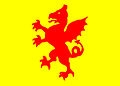
The Old English name continues to be used in the motto of the county, Sumorsaete ealle, meaning "all the people of Somerset". Adopted as the motto in 1911, the phrase is taken from the Anglo-Saxon Chronicle. Somerset was a part of the Anglo-Saxon kingdom of Wessex, and the phrase refers to the wholehearted support the people of Somerset gave to King Alfred in his struggle to save Wessex from the Viking invaders.
Somerset is Gwlad yr Haf in Welsh, Gwlas an Hav in Cornish and Bro an Hañv in Breton, which all mean 'Land of Summer'.
Somerset settlement names are mostly Anglo-Saxon in origin, but a few hill names include Celtic elements. For example, an Anglo-Saxon charter of 682 concerning Creechborough Hill defines it as "the hill the British call Cructan and we call Crychbeorh" (we being the Anglo-Saxons). Some modern names are Brythonic in origin, such as Tarnock, while others have both Saxon and Brythonic elements, such as Pen Hill.
Human occupationThe caves of the Mendip Hills were settled during the Palaeolithic period onward and contain extensive archaeological sites such as those at Cheddar Gorge. Bones from Gough's Cave have been dated to 12,000 BC while a complete skeleton, known as Cheddar man, dates from 7150 BC. Examples of cave art have been found in caves such as Aveline's Hole. Occupation of some caves continued until modern times, including Wookey Hole.
The Somerset Levels—specifically the dry points such as Glastonbury and Brent Knoll— also have a long history of settlement, and are known to have been settled by Mesolithic hunters. Travel in the area was helped by the construction of the world's oldest known engineered roadway, the Sweet Track, which dates from 3807 BC or 3806 BC.
There are numerous Iron Age Hill Forts, some of which, like Cadbury Castle and Ham Hill, were later reoccupied in the Early Middle Ages. The exact age of the henge monument at Stanton Drew stone circles is unknown, but it is believed to be Neolithic.
On the authority of the future emperor Vespasian, as part of the ongoing expansion of the Roman presence in Britain, the Second Legion Augusta invaded Somerset from the south-east in AD 47. The county remained part of the Roman Empire until around AD 409, when the Roman occupation of Britain came to an end. A variety of Roman remains have been found, including Pagans Hill Roman Temple in Chew Stoke, Low Ham Roman Villa and the Roman Baths which gave their name to the city of Bath.
After the Romans left, Britain was invaded by Anglo-Saxon peoples, who had established control over much of what is now England by A.D. 600 but Somerset was still in British hands. The native British held back Saxon advance in the southwest for some time longer, but by the early eighth century King Ine of Wessex had pushed the boundaries of the West Saxon kingdom far enough west to include Somerset. The Saxon royal palace in Cheddar was used several times in the 10th century to host the Witenagemot. After the Norman Conquest, the county was divided into 700 fiefs, and large areas were owned by the crown, with fortifications such as Dunster Castle used for control and defence. Somerset contains HMP Shepton Mallet, England's oldest prison still in use, which opened in 1610. In the English Civil War Somerset was largely Parliamentarian. In 1685 the Monmouth Rebellion was played out in Somerset and neighbouring Dorset. The rebels landed at Lyme Regis and travelled north, hoping to capture Bristol and Bath, but they were defeated in the Battle of Sedgemoor at Westonzoyland, the last pitched battle fought in England. Arthur Wellesley took his title, Duke of Wellington from the town of Wellington; he is commemorated on a nearby hill by a large, spotlit obelisk, known as the Wellington Monument.
The 18th century was largely one of peace in Somerset, but the Industrial Revolution in the Midlands and Northern England spelled the end for most of Somerset's cottage industries. Farming continued to flourish, however, and the Bath and West of England Society for the Encouragement of Agriculture, Arts, Manufactures and Commerce was founded in 1777 to improve farming methods. Despite this, 20 years later John Billingsley conducted a survey of the county's agriculture in 1795 and found that agricultural methods could still be improved. Coal mining was an important industry in north Somerset during the 18th and 19th centuries, and by 1800 it was based around Radstock. The Somerset coalfield reached its peak production by the 1920s, but all the pits have now been closed, the last in 1973. Most of the surface buildings have been removed, and apart from a winding wheel outside Radstock Museum, little evidence of their former existence remains. Further west, the Brendon Hills were mined for iron ore in the late 19th century; this was taken by rail to Watchet Harbour for shipment to the furnaces at Ebbw Vale
Many Somerset soldiers died during the First World War, with the Somerset Light Infantry suffering nearly 5,000 casualties. War memorials were put up in most of the county's towns and villages; only seven, described as the Thankful Villages, had none of their residents killed. During the Second World War the county was a base for troops preparing for the D-Day landings. Some of the hospitals which were built for the casualties of the war remain in use. The Taunton Stop Line was set up to repel a potential German invasion. The remains of its pill boxes can still be seen along the coast, and south through Ilminster and Chard.
A number of decoy towns were constructed in Somerset in World War II to protect Bristol and other towns, at night. They were designed to mimic the geometry of "blacked out" streets, railway lines, and Bristol Temple Meads railway station, to encourage bombers away from these targets. One, on the radio beam flight path to Bristol, was constructed on Black Down. It was laid out by Shepperton Film Studios, based on aerial photographs of the city's railway marshalling yards. The decoys were fitted with dim red lights, simulating activities like the stoking of steam locomotives. Burning bales of straw soaked in creosote were used to simulate the effects of incendiary bombs dropped by the first wave of Pathfinder night bombers; meanwhile, incendiary bombs dropped on the correct location were quickly smothered, wherever possible. Drums of oil were also ignited to simulate the effect of a blazing city or town, with the aim of fooling subsequent waves of bombers into dropping their bombs on the wrong location. The Chew Magna decoy town was hit by half-a-dozen bombs on 2 December 1940, and over a thousand incendiaries on 3 January 1941. The following night the Uphill decoy town, protecting Weston-super-Mare's airfield, was bombed; a herd of dairy cows was hit, killing some and severely injuring others.
Cities and townsSomerton took over from Ilchester as the county town in the late thirteenth century, but it declined in importance and the status of county town transferred to Taunton about 1366. The county has two cities, Bath and Wells, and only a small number of towns. In many cases there are villages which are larger than their neighbouring towns; the village of Cheddar, for example, has three times the population of the nearby town of Axbridge. Many settlements developed because of their strategic importance in relation to geographical features, such as river crossings or valleys in ranges of hills. Examples include Axbridge on the River Axe, Castle Cary on the River Cary, North Petherton on the River Parrett, and Ilminster, where there was a crossing point on the River Isle. Midsomer Norton lies on the River Somer; while the Wellow Brook and the Fosseway Roman road run through Radstock, which, along with Midsomer Norton, is now designated as apart of Norton Radstock. Chard is the most southerly town in Somerset, and at an altitude of it is also the highest.
Physical geographyGeologyMuch of the landscape of Somerset falls into types determined by the underlying geology. These landscapes are the limestone karst and lias of the north, the clay vales and wetlands of the centre, the oolites of the east and south, and the Devonian sandstone of the west. To the north east of the Somerset Levels, the Mendip Hills are moderately high limestone hills. The central and western Mendip Hills was designated an Area of Outstanding Natural Beauty in 1972 which covers . The main habitat on these hills is calcareous grassland, with some arable agriculture. The Somerset coalfield is part of a larger coalfield which stretches into Gloucestershire. To the north of the Mendip hills is the Chew Valley and to the south, on the clay substrate, are broad valleys which support dairy farming and drain into the Somerset Levels.
Caves and riversThere is an extensive network of caves, including Wookey Hole, underground rivers, and gorges, including Cheddar Gorge and Ebbor Gorge. The county has many rivers, including the Axe, Brue, Cary, Parrett, Sheppey, Tone and Yeo. These both feed and drain the flat levels and moors of mid and west Somerset. In the north of the county the River Chew flows into the Bristol Avon. The Parrett is tidal almost to Langport, where there is evidence of two Roman wharfs. At the same site during the reign of King Charles I, river tolls were levied on boats to pay for the maintenance of the bridge.
Levels and moorsThe Somerset Levels (or Somerset Levels and Moors as they are less commonly but more correctly known) are a sparsely populated wetland area of central Somerset, between the Quantock and Mendip hills. They consist of marine clay levels along the coast, and the inland (often peat based) moors. The Levels are divided into two by the Polden Hills; land to the south is drained by the River Parrett while land to the north is drained by the River Axe and the River Brue. The total area of the Levels amounts to approximately and broadly corresponds to the administrative district of Sedgemoor but also includes the south west of Mendip district. Approximately 70% of the area is grassland and 30% is arable. Stretching up to inland, this expanse of flat land barely rises above sea level. Before it was drained, much of the land was under a shallow brackish sea in winter and was marsh land in summer. Drainage began with the Romans, and was restarted at various times: by the Anglo-Saxons; in the Middle Ages by the Glastonbury Abbey, from 1400–1770; and during the Second World War, with the construction of the Huntspill River. Pumping and management of water levels still continues.
The North Somerset Levels basin, north of the Mendips, covers a smaller geographical area than the Somerset Levels; and forms a coastal area around Avonmouth. It too was reclaimed by draining. It is mirrored, across the Severn Estuary, in Wales, by a similar low-lying area: the Caldicot and Wentloog Levels.
In the far west of the county, running into Devon, is Exmoor, a high Devonian sandstone moor, which was designated as a national park in 1954, under the 1949 National Parks and Access to the Countryside Act. The highest point in Somerset is Dunkery Beacon on Exmoor, with an altitude of . Over 100 sites in Somerset have been designated as Sites of Special Scientific Interest.
CoastlineThe 40 mile (64 km) coastline of the Bristol Channel and Severn Estuary forms part of the northern border of Somerset. The Bristol Channel has the second largest tidal range in the world. At Burnham-on-Sea, for example, the tidal range of a spring tide is over 39 feet (12 m). Proposals for the construction of a Severn Barrage aim to harness this energy. The main coastal towns are, from the west to the north east, Minehead, Watchet, Burnham-on-Sea, Weston-super-Mare, Clevedon and Portishead. The coastal area between Minehead and the eastern extreme of the administrative county's coastline at Brean Down is known as Bridgwater Bay, and is a National Nature Reserve. North of that, the coast forms Weston Bay and Sand Bay whose northern tip, Sand Point, marks the lower limit of the Severn Estuary. In the mid and north of the county the coastline is low as the level wetlands of the levels meet the sea. In the west, the coastline is high and dramatic where the plateau of Exmoor meets the sea, with high cliffs and waterfalls.
ClimateAlong with the rest of South West England, Somerset has a temperate maritime climate which is generally wetter and milder than the rest of the country. The annual mean temperature is approximately and shows a seasonal and a diurnal variation, but due to the modifying effect of the sea the range is less than in most other parts of the UK. January is the coldest month with mean minimum temperatures between and . July and August are the warmest months in the region with mean daily maxima around .
The south-west of England has a favoured location with respect to the Azores high pressure when it extends its influence north-eastwards towards the UK, particularly in summer. Convective cloud often forms inland however, especially near hills, reducing the number of hours of sunshine. The average annual sunshine totals around 1,600 hours.
Rainfall tends to be associated with Atlantic depressions or with convection. The Atlantic depressions are more vigorous in autumn and winter and most of the rain which falls in those seasons in the south-west is from this source. Average rainfall is around –. About 8–15 days of snowfall is typical. November to March have the highest mean wind speeds, with June to August having the lightest winds. The predominant wind direction is from the south-west.
Economy and industrySomerset has few industrial centres, but it does have a variety of light industry and high technology businesses, along with traditional agriculture and an increasingly important tourism sector, resulting in an unemployment rate of 2.5%. Bridgwater was developed during the Industrial Revolution as the West Country's leading port. The River Parrett was navigable by large ships as far as Bridgwater. Cargoes were then loaded onto smaller boats at Langport Quay, next to the Bridgwater Bridge, to be carried further up river to Langport; or they could turn off at Burrowbridge and then travel via the River Tone to Taunton. The Parrett is now only navigable as far as Dunball Wharf. Bridgwater, in the 19th and 20th centuries, was a centre for the manufacture of bricks and clay roof tiles, and later cellophane, but those industries have now closed. With its good links to the motorway system, Bridgwater has developed as a distribution hub for companies such as Argos, Toolstation and Gerber Juice. AgustaWestland manufactures helicopters in Yeovil, and Normalair Garratt, builder of aircraft oxygen systems, is also based in the town. Many towns have encouraged small-scale light industries, such as Crewkerne's Ariel Motor Company, one of the UK's smallest car manufacturers.
Somerset is an important supplier of defence equipment and technology. A Royal Ordnance Factory, ROF Bridgwater was built at the start of the Second World War, between the villages of Puriton and Woolavington, to manufacture explosives. As of April 2008 the site is being decommissioned and is due to close in July 2008. Templecombe has Thales Underwater Systems, and Taunton presently has the United Kingdom Hydrographic Office and Avimo, which became part of Thales Optics. It has been announced twice, in 2006 and 2007, that manufacturing is to end at Thales Optics' Taunton site, but the Trade Unions and Taunton Deane District Council are working to reverse or mitigate these decisions. Other high-technology companies include the optics company Gooch and Housego, at Ilminster. There are Ministry of Defence offices in Bath, and Norton Fitzwarren is the home of 40 Commando Royal Marines. The Royal Naval Air Station in Yeovilton, is one of Britain's two active Fleet Air Arm bases and is home to the Royal Navy's Lynx helicopters and the Royal Marines Commando Westland Sea Kings. Around 1675 service and 2000 civilian personnel are stationed at Yeovilton and key activities include training of aircrew and engineers and the Royal Navy's Fighter Controllers and surface based aircraft controllers.
Agriculture and food and drink production continue to be major industries in the county, employing over 15,000 people. Apple orchards were once plentiful, and Somerset is still a major producer of cider. The towns of Taunton and Shepton Mallet are involved with the production of cider, especially Blackthorn Cider, which is sold nationwide, and there are specialist producers such as Burrow Hill Cider Farm and Thatchers Cider. Gerber Products Company in Bridgwater is the largest producer of fruit juices in Europe, producing brands such as 'Sunny Delight' and 'Ocean Spray'. Development of the milk-based industries, such as Ilchester Cheese Company and Yeo Valley Organic, have resulted in the production of ranges of desserts, yoghurts and cheeses, including Cheddar cheese – some of which has the West Country Farmhouse Cheddar PDO.
Traditional willow growing and weaving is not as extensive as it used to be but is still carried out on the Somerset Levels and is commemorated at the Willows and Wetlands visitor centre. Fragments of willow basket were found near the Glastonbury Lake Village, and it was also used in the construction of several Iron Age causeways. The willow was harvested using a traditional method of coppicing, where a tree would be cut back to the main stem. During the 1930s over of willow were being grown commercially on the Levels. Largely due to the displacement of baskets with plastic bags and cardboard boxes, the industry has severely declined since the 1950s. By the end of the 20th century only around were grown commercially, near the villages of Burrowbridge, Westonzoyland and North Curry. The Somerset Levels is now the only area in the UK where basket willow is grown commercially.
Towns such as Castle Cary and Frome grew around the medieval weaving industry. Street developed as a centre for the production of woollen slippers and, later, boots and shoes, with C&J Clark establishing its headquarters in the town. C&J Clark's shoes are no longer manufactured there as the work was transferred to lower-wage areas, such as China and Asia. Instead, in 1993, redundant factory buildings were converted to form Clarks Village, the first purpose-built factory outlet in the UK. C&J Clark also had shoe factories, at one time at Bridgwater and Minehead, to provide employment outside the main summer tourist season, but those satellite sites were closed in the late 1980s, before the main site at Street. Dr. Martens shoes were also made in Somerset, by the Northampton-based R. Griggs Group, using redundant skilled shoemakers from C&J Clark; that work has also been transferred to Asia.
The county has a long tradition of supplying freestone and . Quarries at Doulting supplied freestone used in the construction of Wells Cathedral. Bath stone is also widely used. Ralph Allen promoted its use in the early 18th century, as did Hans Price in the 19th century, but it was used long before then. It was mined underground at Combe Down and Bathampton Down Mines, and as a result of cutting the Box Tunnel, at locations in Wiltshire such as Box | |