
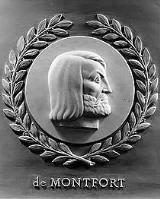
Simon de Montfort, 6th Earl of Leicester, 1st Earl of Chester (23 May 1208? – 4 August 1265), sometimes referred to as
Simon V de Montfort to distinguish him from other Simon de Montforts, was an
Anglo-NormanThe Anglo-Normans were mainly the descendants of the Normans who ruled England following the Norman conquest by William the Conqueror in 1066. A small number of Normans were already settled in England prior to the conquest...
nobleman. He led the barons' rebellion against King
Henry III of EnglandHenry III was the son and successor of John as King of England, reigning for 56 years from 1216 until his death. His contemporaries knew him as Henry of Winchester. He was the first child king in England since the reign of Æthelred the Unready...
during the
Second Barons' WarThe Second Barons' War was a civil war in England between the forces of a number of barons led by Simon de Montfort, against the Royalist forces led by Prince Edward , in the name of Henry III.-Causes:...
of 1263-4, and subsequently became
de factoDe facto is a Latin expression that means "concerning fact." In law, it often means "in practice but not necessarily ordained by law" or "in practice or actuality, but not officially established." It is commonly used in contrast to de jure when referring to matters of law, governance, or...
ruler of
EnglandThe Kingdom of England was, from 927 to 1707, a sovereign state to the northwest of continental Europe. At its height, the Kingdom of England spanned the southern two-thirds of the island of Great Britain and several smaller outlying islands; what today comprises the legal jurisdiction of England...
. During his rule, de Montfort called the
first directly elected parliamentDe Montfort's Parliament was an English parliament of 1265, instigated by Simon de Montfort, a baronial rebel leader. Although this gathering did not have the approval of king Henry III, and the members convened without royal approval, most scholars believe this was the first gathering in England...
in medieval Europe. For this reason, de Montfort is regarded today as one of the progenitors of modern parliamentary democracy. After a rule of just over a year, de Montfort was killed by forces loyal to the king in the
Battle of EveshamThe Battle of Evesham was one of the two main battles of 13th century England's Second Barons' War. It marked the defeat of Simon de Montfort, Earl of Leicester, and the rebellious barons by Prince Edward – later King Edward I – who led the forces of his father, King Henry III...
.
Family
De Montfort was the youngest son of
Simon de MontfortSimon IV de Montfort, Seigneur de Montfort-l'Amaury, 5th Earl of Leicester , also known as Simon de Montfort the elder, was a French nobleman who took part in the Fourth Crusade and was a prominent leader of the Albigensian Crusade...
, a French nobleman and crusader, and
Alix de MontmorencyAlix de Montmorency, died February 24, 1220-1221. Her parents were Bouchard IV/V de Montmorency and Laurette, daughter of Baldwin IV, Count of Hainaut and Alice of Namur.-Life:...
. His paternal grandmother was Amicia de Beaumont, the senior co-heiress to the
Earldom of LeicesterThe title Earl of Leicester was created in the 12th century in the Peerage of England , and is currently a title in the Peerage of the United Kingdom, created in 1837.-Early creations:...
and a large
estateAn estate is the net worth of a person at any point in time. It is the sum of a person's assets - legal rights, interests and entitlements to property of any kind - less all liabilities at that time. The issue is of special legal significance on a question of bankruptcy and death of the person...
owned by her father
Robert de Beaumont, 3rd Earl of LeicesterRobert de Beaumont, 3rd Earl of Leicester was an English nobleman, one of the principal followers of Henry the Young King in the Revolt of 1173–1174 against his father Henry II...
in England. The elder Simon had also acquired the Countship of Toulouse during the Albigensian Crusade, together with large amounts of Angevin territory won by force of arms, but was killed while his children were still young. The Angevin property having been partly his own lands whose control was lost in the aftermath of the Battle of
BouvinesBouvines is a commune in the Nord department in northern France.It was the site of the Battle of Bouvines, on 27 July 1214.-Heraldry:-References:*...
(1214), King
John of EnglandJohn , also known as John Lackland , was King of England from 6 April 1199 until his death...
would not allow a French subject to take ownership of such an estate in England, a policy maintained by the following
RegencySir William Marshal, 1st Earl of Pembroke , also called William the Marshal , was an Anglo-Norman soldier and statesman. He was described as the "greatest knight that ever lived" by Stephen Langton...
, so the lands were split between the boys, Simon's elder brother Amaury taking the French holding (which he promptly lost, not having his father's military accumen) and Simon taking the English, when King Henry eventually changed the policy on his accession to power on arriving at an age of majority in 1227: both he and Simon were virtually contemporary and both had seen their lands abused by their elders during their minority. When one considers Simon's father's position in forcing John to reason at
RunnymedeMagna Carta is an English charter, originally issued in the year 1215 and reissued later in the 13th century in modified versions, which included the most direct challenges to the monarch's authority to date. The charter first passed into law in 1225...
, and the consequent strength and infighting within English nobility, the younger Simon's later motivation becomes quite clear.
Simon de Montfort shares various levels of consanguinuity and "by-marriage" connections with both English and French royal lineages. For instance, his ancestor
Simon I de MontfortSimon I de Montfort born about 1025 in Montfort l'Amaury, Ile de France, France and died 1087. He is buried in Epernon, Normandy, France. He was the son of Amaury I de Montfort and Bertrade de Gometz.-Progeny:...
was father of
Bertrade de MontfortBertrade de Montfort was the daughter of Simon I de Montfort and Agnes, Countess of Evreux. Her brother was Amaury de Montfort.-Marriages:...
who herself was a paternal great-grandmother of
King Henry IIHenry II ruled as King of England , Count of Anjou, Count of Maine, Duke of Normandy, Duke of Aquitaine, Duke of Gascony, Count of Nantes, Lord of Ireland and, at various times, controlled parts of Wales, Scotland and western France. Henry, the great-grandson of William the Conqueror, was the...
.
Early life
Since he was a younger son, little attention was paid to him during his youth and his date of birth is therefore unknown. He is first mentioned when his mother made a grant to him in 1217. As a boy, de Montfort accompanied his parents during his father's campaigns against the Cathars. He was with his mother at the
siege of ToulouseA Siege of Toulouse occurred between October 1217 and June 1218 during Albigensian Crusade. It was third of a series of sieges of the city during the height of Crusader efforts to put down Catharism...
in 1218, where his father was killed after being struck on the head by a stone pitched by a
mangonelA mangonel was a type of catapult or siege engine used in the medieval period to throw projectiles at a castle's walls. The exact meaning of the term is debatable, and several possibilities have been suggested. Mangonel may also be indirectly referring to the 'mangon' a French hard stone found in...
. On the death of their father, de Montfort's elder brother
AmauryAmaury VI de Montfort was the son of the elder Simon de Montfort and Alice of Montmorency, and the brother of the younger Simon de Montfort.He participated in the Albigensian Crusade under his father's command...
succeeded him in possession of the French lands: the English Estates were temporarily confiscated by the King. The second brother, Guy, was killed at the siege of
CastelnaudaryCastelnaudary is a commune in the Aude department in the Languedoc-Roussillon region in south France. It is in the former province of the Lauragais and famous for cassoulet of which it claims to be the world capital, and of which it is a major producer....
in 1220. As a young man, Montfort probably took part in the
Albigensian CrusadeThe Albigensian Crusade or Cathar Crusade was a 20-year military campaign initiated by the Catholic Church to eliminate Catharism in Languedoc...
s of the early 1220s.
In 1229, the two surviving brothers (Amaury and Simon) came to an arrangement with King Henry whereby Simon gave up his rights in France and Amaury gave up his rights in England. Thus free from any allegiance to the King of France, de Montfort successfully petitioned for the English inheritance, which he received the next year, although he did not take full possession for several years, and was not formally recognised as earl.
As 'Lord of Leicester', he expelled the
JewsThe Jews , also known as the Jewish people, are a nation and ethnoreligious group originating in the Israelites or Hebrews of the Ancient Near East. The Jewish ethnicity, nationality, and religion are strongly interrelated, as Judaism is the traditional faith of the Jewish nation...
from
LeicesterLeicester is a city and unitary authority in the East Midlands of England, and the county town of Leicestershire. The city lies on the River Soar and at the edge of the National Forest...
. They moved to the eastern suburbs, which were controlled by de Montfort's great-aunt, Margaret, Countess of Winchester. Though inspiration for this act might have come from the hostility his parents had shown the Jews in France (his father was famous for his devout Christianity) it was also an attempt to make himself popular in his new domains for the removal of
usuryUsury Originally, when the charging of interest was still banned by Christian churches, usury simply meant the charging of interest at any rate . In countries where the charging of interest became acceptable, the term came to be used for interest above the rate allowed by law...
.
De Montfort became a favourite of the king and even issued a charter as 'Earl of Leicester', despite not having been given the title yet, in 1236.
Royal marriage
In January 1238, de Montfort married Eleanor of England, daughter of King
JohnJohn , also known as John Lackland , was King of England from 6 April 1199 until his death...
and
Isabella of AngoulêmeIsabella of Angoulême was queen consort of England as the second wife of King John from 1200 until John's death in 1216. They had five children by the king including his heir, later Henry III...
and sister of King
Henry IIIHenry III was the son and successor of John as King of England, reigning for 56 years from 1216 until his death. His contemporaries knew him as Henry of Winchester. He was the first child king in England since the reign of Æthelred the Unready...
. While this marriage took place with the king's approval, the act itself was performed secretly and without consulting the great barons, as a marriage of such importance warranted. Eleanor had previously been married to
William Marshal, 2nd Earl of PembrokeWilliam Marshal, 2nd Earl of Pembroke was a medieval English nobleman, and the son of the famous William Marshal, 1st Earl of Pembroke.-Early life:William was born in Normandy probably during the spring of 1190...
, and she swore a vow of perpetual
chastityChastity refers to the sexual behavior of a man or woman acceptable to the moral standards and guidelines of a culture, civilization, or religion....
upon his death, when she was sixteen, which she broke by marrying de Montfort. The
Archbishop of CanterburyThe Archbishop of Canterbury is the senior bishop and principal leader of the Church of England, the symbolic head of the worldwide Anglican Communion, and the diocesan bishop of the Diocese of Canterbury. In his role as head of the Anglican Communion, the archbishop leads the third largest group...
,
Edmund RichEdmund Rich was a 13th century Archbishop of Canterbury in England...
, condemned the marriage for this reason. The English nobles protested the marriage of the King's sister to a foreigner of modest rank; most notably, Eleanor's brother
Richard, 1st Earl of CornwallRichard of Cornwall was Count of Poitou , 1st Earl of Cornwall and German King...
rose up in revolt when he learned of the marriage. King Henry eventually bought off Richard with 6,000 marks and peace was restored.
The marriage brought the manor of
Sutton ValenceSutton Valence is a village some five miles SE of Maidstone, Kent, England on the Greensand Ridge overlooking the Vale of Kent and Weald. One of the main landmarks in the village is , of which only the ruins of the 12th century keep remain, under the ownership of English Heritage, open any...
in
KentKent is a county in southeast England, and is one of the home counties. It borders East Sussex, Surrey and Greater London and has a defined boundary with Essex in the middle of the Thames Estuary. The ceremonial county boundaries of Kent include the shire county of Kent and the unitary borough of...
into de Montfort's possession. Relations between King Henry and de Montfort were cordial at first. Henry lent him his support when de Montfort embarked for Rome in March 1238 to seek papal approval for his marriage. When Simon and Eleanor's first son was born in November 1238 (despite rumours, more than nine months after the wedding), he was baptised Henry in honour of his Royal uncle. In February 1239, de Montfort was finally invested with the
Earldom of LeicesterThe title Earl of Leicester was created in the 12th century in the Peerage of England , and is currently a title in the Peerage of the United Kingdom, created in 1837.-Early creations:...
. He also acted as the King's counsellor and was one of the nine godfathers of Henry's eldest son, Prince Edward who would inherit the throne and become
Edward IEdward I , also known as Edward Longshanks and the Hammer of the Scots, was King of England from 1272 to 1307. The first son of Henry III, Edward was involved early in the political intrigues of his father's reign, which included an outright rebellion by the English barons...
("Longshanks").
Crusade and turning against the king
Shortly after Prince Edward's birth, however, there was a falling out between the brothers-in-law. Simon owed a great sum of money to Thomas II of Savoy, uncle of Queen Eleanor, and named King Henry as security for his repayment. The king evidently had not approved this, and was enraged when he discovered that Montfort had used his name. On 9 August 1239, Henry is reported to have confronted Montfort, called him an
excommunicantExcommunication is a religious censure used to deprive, suspend or limit membership in a religious community. The word means putting [someone] out of communion. In some religions, excommunication includes spiritual condemnation of the member or group...
and threatened to imprison him in the
Tower of LondonHer Majesty's Royal Palace and Fortress, more commonly known as the Tower of London, is a historic castle on the north bank of the River Thames in central London, England. It lies within the London Borough of Tower Hamlets, separated from the eastern edge of the City of London by the open space...
. "You seduced my sister", King Henry said, "and when I discovered this, I gave her to you, against my will, to avoid scandal." Most historians perceive this to be an angry outburst rather than a factual statement. Simon and Eleanor fled to France to escape Henry's wrath.
Having announced his intention to go on crusade two years before, Simon raised funds and travelled to the
Holy LandThe Holy Land is a term which in Judaism refers to the Kingdom of Israel as defined in the Tanakh. For Jews, the Land's identifiction of being Holy is defined in Judaism by its differentiation from other lands by virtue of the practice of Judaism often possible only in the Land of Israel...
, but does not seem to have faced combat there.
In autumn 1241, he left
SyriaSyria , officially the Syrian Arab Republic , is a country in Western Asia, bordering Lebanon and the Mediterranean Sea to the West, Turkey to the north, Iraq to the east, Jordan to the south, and Israel to the southwest....
and joined King Henry's campaign against King
Louis IXLouis IX , commonly Saint Louis, was King of France from 1226 until his death. He was also styled Louis II, Count of Artois from 1226 to 1237. Born at Poissy, near Paris, he was an eighth-generation descendant of Hugh Capet, and thus a member of the House of Capet, and the son of Louis VIII and...
in
PoitouPoitou was a province of west-central France whose capital city was Poitiers.The region of Poitou was called Thifalia in the sixth century....
. The campaign was a failure, and an exasperated de Montfort declared that Henry should be locked up like King
Charles the SimpleCharles III , called the Simple or the Straightforward , was the undisputed King of France from 898 until 922 and the King of Lotharingia from 911 until 919/23...
. Like his father, Simon was a soldier as well as a capable administrator. His dispute with King Henry came about due to the latter's determination to ignore the swelling discontent within the country, caused by a combination of factors, including famine and a sense among the English Barons that King Henry was too quick to dispense favour to his
PoitevinPoitiers is a city on the Clain river in west central France. It is a commune and the capital of the Vienne department and of the Poitou-Charentes region. The centre is picturesque and its streets are interesting for predominant remains of historical architecture, especially from the Romanesque...
relatives and
SavoySavoy is a region of France. It comprises roughly the territory of the Western Alps situated between Lake Geneva in the north and Monaco and the Mediterranean coast in the south....
ard in-laws.
In 1248, de Montfort again took the cross with the idea of following
Louis IX of FranceLouis IX , commonly Saint Louis, was King of France from 1226 until his death. He was also styled Louis II, Count of Artois from 1226 to 1237. Born at Poissy, near Paris, he was an eighth-generation descendant of Hugh Capet, and thus a member of the House of Capet, and the son of Louis VIII and...
to
EgyptEgypt , officially the Arab Republic of Egypt, Arabic: , is a country mainly in North Africa, with the Sinai Peninsula forming a land bridge in Southwest Asia. Egypt is thus a transcontinental country, and a major power in Africa, the Mediterranean Basin, the Middle East and the Muslim world...
. But, at the repeated requests of King Henry and Council, he gave up this project in order to act as Governor in the unsettled and disaffected Duchy of
GasconyGascony is an area of southwest France that was part of the "Province of Guyenne and Gascony" prior to the French Revolution. The region is vaguely defined and the distinction between Guyenne and Gascony is unclear; sometimes they are considered to overlap, and sometimes Gascony is considered a...
. Bitter complaints were excited by the rigour with which de Montfort suppressed the excesses of the Seigneurs and of contending factions in the great communes. Henry yielded to the outcry and instituted a formal inquiry into Simon's administration. Simon was formally acquitted on the charges of oppression, but his accounts were disputed by Henry and Simon retired to France in 1252. The nobles of France offered him the Regency of the kingdom, vacated by the death of Queen
Blanche of CastileBlanche of Castile , was a Queen consort of France as the wife of Louis VIII. She acted as regent twice during the reign of her son, Louis IX....
. The earl preferred to make his peace with Henry III, which he did in 1253, in obedience to the exhortations of the dying
Robert GrossetesteRobert Grosseteste or Grossetete was an English statesman, scholastic philosopher, theologian and Bishop of Lincoln. He was born of humble parents at Stradbroke in Suffolk. A.C...
, bishop of Lincoln. He helped the king deal with disaffection in Gascony, but their reconciliation was a hollow one. In the Parliament of 1254, Simon led the opposition in resisting a royal demand for a subsidy. In 1256–57, when the discontent of all classes was coming to a head, de Montfort nominally adhered to the royal cause. He undertook, with Peter of Savoy, the Queen's uncle, the difficult task of extricating the King from the pledges which he had given to the
PopeThe Pope is the Bishop of Rome, a position that makes him the leader of the worldwide Catholic Church . In the Catholic Church, the Pope is regarded as the successor of Saint Peter, the Apostle...
with reference to the Crown of
SicilySicily is a region of Italy, and is the largest island in the Mediterranean Sea. Along with the surrounding minor islands, it constitutes an autonomous region of Italy, the Regione Autonoma Siciliana Sicily has a rich and unique culture, especially with regard to the arts, music, literature,...
; and Henry's writs of this date mention de Montfort in friendly terms. But at the "Mad Parliament" of
Oxford (1258)The Oxford Parliament , also known as the "Mad Parliament" and the "First English Parliament", assembled during the reign of Henry III of England. It was established by Simon de Montfort, 6th Earl of Leicester. The parlour or prolocutor was Peter de Montfort under the direction of Simon de Montfort...
de Montfort appeared with the Earl of Gloucester, at the head of the opposition. His name appears in the list of the Fifteen who were to constitute the supreme board of control over the administration. It is said that de Montfort was reluctant to approve the oligarchical constitution created by the
Provisions of OxfordThe Provisions of Oxford are often regarded as England's first written constitution ....
, but there is better ground for believing that he disliked the narrow class-spirit of the victorious Barons, and that he would have preferred to make a compromise with the moderate royalists whose policy was guided by Prince Edward. The King's success in dividing the Barons and in fostering a reaction, however, rendered such projects hopeless. In 1261, Henry revoked his assent to the Provisions of Oxford and de Montfort, in despair, left the country.
War against the king
Simon de Montfort returned to England in 1263, at the invitation of the barons who were now convinced of the king's hostility to all reform and raised a rebellion with the avowed object of restoring the form of government which the Provisions had ordained. For a few weeks it seemed as though the royalists were at his mercy. Earl Simon accepted Henry's offer to abide by the arbitration of
Louis IX of FranceLouis IX , commonly Saint Louis, was King of France from 1226 until his death. He was also styled Louis II, Count of Artois from 1226 to 1237. Born at Poissy, near Paris, he was an eighth-generation descendant of Hugh Capet, and thus a member of the House of Capet, and the son of Louis VIII and...
, and at
AmiensAmiens is a city and commune in northern France, north of Paris and south-west of Lille. It is the capital of the Somme department in Picardy...
, in January 1264, the French king decided that the Provisions were unlawful and invalid. De Montfort, who had remained in England to prepare for the ruling, at once resumed the war and thus exposed himself to accusations of perjury, from which he can only be defended on the hypothesis that he had been led to hope for a genuine compromise. Though supported only by the towns and a few of the younger barons, he triumphed by superior generalship at the
Battle of LewesThe Battle of Lewes was one of two main battles of the conflict known as the Second Barons' War. It took place at Lewes in Sussex, on 14 May 1264...
on 14 May 1264, where the king, Prince Edward, and Richard of Cornwall fell into his hands. De Montfort used his victory to set up the government on which his reputation as a statesman stands or falls. The weak point in his scheme was the establishment of a triumvirate (consisting of himself, the young
Earl of GloucesterThe title of Earl of Gloucester was created several times in the Peerage of England. A fictional earl is also a character in William Shakespeare's play King Lear. See also Duke of Gloucester.-Earls of Gloucester, 1st Creation :...
, and the
Bishop of ChichesterThe Bishop of Chichester is the Ordinary of the Church of England Diocese of Chichester in the Province of Canterbury. The diocese covers the Counties of East and West Sussex. The see is in the City of Chichester where the seat is located at the Cathedral Church of the Holy Trinity...
) in which his colleagues were obviously figureheads. This flaw, however, is mitigated by a scheme which he simultaneously promulgated for establishing a thorough parliamentary control over the executive, not excepting the triumvirs. The Parliament of 1265 (
De Montfort's ParliamentDe Montfort's Parliament was an English parliament of 1265, instigated by Simon de Montfort, a baronial rebel leader. Although this gathering did not have the approval of king Henry III, and the members convened without royal approval, most scholars believe this was the first gathering in England...
), which he summoned, was a packed assembly; but it can hardly be supposed that the representation which he granted to the towns was intended to be a temporary expedient.
De Montfort sent to each
countyA county is a jurisdiction of local government in certain modern nations. Historically in mainland Europe, the original French term, comté, and its equivalents in other languages denoted a jurisdiction under the sovereignty of a count A county is a jurisdiction of local government in certain...
and to a select list of
boroughA borough is an administrative division in various countries. In principle, the term borough designates a self-governing township although, in practice, official use of the term varies widely....
s, asking each to send two representatives. This body technically was not the first
parliamentThe Parliament of England was the legislature of the Kingdom of England. In 1066, William of Normandy introduced a feudal system, by which he sought the advice of a council of tenants-in-chief and ecclesiastics before making laws...
in England, but what distinguished it was that de Montfort insisted the representatives be elected. It is from him that the modern idea of a representative parliamentary assembly derives. The list of boroughs which had the right to elect a member grew slowly over the centuries as monarchs granted charters to more English towns. (The last charter was given to Newark in 1674.)
The right to vote in Parliamentary elections for county constituencies was uniform throughout the country, granting a vote to all those who owned the freehold of land to an annual rent of 40 shillings (‘Forty-shilling Freeholders’). In the Boroughs, the electoral franchise varied and individual boroughs had varying arrangements.
The reaction against his government was baronial rather than popular. The Welsh Marcher Lords particularly resented Montfort's alliance with
Llywelyn ap GruffyddLlywelyn ap Gruffydd or Llywelyn Ein Llyw Olaf , sometimes rendered as Llywelyn II, was the last prince of an independent Wales before its conquest by Edward I of England....
, Prince of Wales. Little consideration for English interests is shown in the
Treaty of PiptonThe Treaty of Pipton was signed on 22 June 1265 during the Second Barons' War and concluded an alliance between Simon de Montfort and the Welsh prince Llywelyn the Last....
which sealed that alliance on 22 June 1265.
Many other barons who had initially supported him now started to feel that Montfort's reforms were going too far and his many enemies turned his triumph into disaster. Prince Edward escaped, and Montfort's ally, Thomas de Clare, abandoned him. Though boosted by Welsh infantry sent by Montfort's ally
Llywelyn ap GruffyddLlywelyn ap Gruffydd or Llywelyn Ein Llyw Olaf , sometimes rendered as Llywelyn II, was the last prince of an independent Wales before its conquest by Edward I of England....
, Montfort's forces were severely depleted. Prince Edward attacked the Montfort forces at
KenilworthKenilworth is a town in central Warwickshire, England. In 2001 the town had a population of 22,582 . It is situated south of Coventry, north of Warwick and northwest of London....
, capturing more of Montfort's allies. Montfort himself had crossed the Severn with his army, intending to rendezvous with his son Simon. When he saw the army awaiting him at
EveshamEvesham is a market town and a civil parish in the Local Authority District of Wychavon in the county of Worcestershire, England with a population of 22,000. It is located roughly equidistant between Worcester, Cheltenham and Stratford-upon-Avon...
, Montfort initially thought it was his son's forces. It was, however, Prince Edward's army flying the Montfort banners he had captured at Kenilworth and so leading Simon into a trap.
Death
Simon de Montfort died on 4 August 1265 at the
battle of EveshamThe Battle of Evesham was one of the two main battles of 13th century England's Second Barons' War. It marked the defeat of Simon de Montfort, Earl of Leicester, and the rebellious barons by Prince Edward – later King Edward I – who led the forces of his father, King Henry III...
, and was buried at the nearby
Evesham AbbeyEvesham Abbey was founded by Saint Egwin at Evesham in England between 700 and 710 A.D. following a vision of the Virgin Mary by Eof.According to the monastic history, Evesham came through the Norman Conquest unusually well, because of a quick approach by Abbot Æthelwig to William the Conqueror...
. De Montfort and his army were awaiting the army led by his second son, Simon. He saw his son's banners flying high and began to hope, with the two armies they had a fighting chance to claim England. However, his son had been ambushed, and Prince Edward, Henry's son, led the army carrying de Montfort's stolen banners. When de Montfort realised the truth, he said "May God have mercy on our souls because our bodies are theirs." On hearing that his son Henry had been killed, he replied "Then it is time to die."
From within the church of
EveshamEvesham is a market town and a civil parish in the Local Authority District of Wychavon in the county of Worcestershire, England with a population of 22,000. It is located roughly equidistant between Worcester, Cheltenham and Stratford-upon-Avon...
, de Montfort and his army led a final charge to their death. After a charge uphill against superior forces, Simon's army was completely destroyed; the battle was described as the "murder of Evesham, for battle it was none". His last words were said to have been "Thank God".
Simon's body was cut up and different parts sent to the Lords who had accomplished the most. His head was sent to
Wigmore CastleWigmore Castle is a ruined castle which is barely visible from the village of Wigmore in the northwest region of Herefordshire, England.- History :...
by
Roger de Mortimer, 1st Baron WigmoreRoger Mortimer, 1st Baron Mortimer, of Wigmore , was a famous and honoured knight from Wigmore Castle in Herefordshire. He was a loyal ally of King Henry III of England...
as a gift to his wife,
MaudMaud de Braose, Baroness Wigmore was a noble heiress, and one of the most important, being a member of the powerful de Braose family which held many lordships and domains in the Welsh Marches...
. Such remains as could be found were buried under the altar of
Evesham AbbeyEvesham Abbey was founded by Saint Egwin at Evesham in England between 700 and 710 A.D. following a vision of the Virgin Mary by Eof.According to the monastic history, Evesham came through the Norman Conquest unusually well, because of a quick approach by Abbot Æthelwig to William the Conqueror...
by some clerks. It was visited as holy ground by many commoners until King Henry caught wind of it. He declared that Simon deserved no spot on holy ground and had his remains reburied under an insignificant tree. The remains of some of his soldiers were found in the nearby village of
Cleeve PriorCleeve Prior is a village in the Vale of Evesham Worcestershire, England. It is situated on the cliff on the Worcestershire/Warwickshire border above the river Avon. There are many picturesque houses made from the local lias stone, including the Kings Arms public house and the 150 year old school....
after fleeing from the battle of Evesham.
Matthew ParisMatthew Paris was a Benedictine monk, English chronicler, artist in illuminated manuscripts and cartographer, based at St Albans Abbey in Hertfordshire...
reports that the
Bishop of LincolnThe Bishop of Lincoln is the Ordinary of the Church of England Diocese of Lincoln in the Province of Canterbury.The present diocese covers the county of Lincolnshire and the unitary authority areas of North Lincolnshire and North East Lincolnshire. The Bishop's seat is located in the Cathedral...
,
Robert GrossetesteRobert Grosseteste or Grossetete was an English statesman, scholastic philosopher, theologian and Bishop of Lincoln. He was born of humble parents at Stradbroke in Suffolk. A.C...
, once said to Simon's eldest son Henry: "
My beloved child, both you and your father will meet your deaths on one day, and by one kind of death, but it will be in the name of justice and truth."
Evesham AbbeyEvesham Abbey was founded by Saint Egwin at Evesham in England between 700 and 710 A.D. following a vision of the Virgin Mary by Eof.According to the monastic history, Evesham came through the Norman Conquest unusually well, because of a quick approach by Abbot Æthelwig to William the Conqueror...
and the site of de Montfort's grave were destroyed with the
Dissolution of the MonasteriesThe Dissolution of the Monasteries, sometimes referred to as the Suppression of the Monasteries, was the set of administrative and legal processes between 1536 and 1541 by which Henry VIII disbanded monasteries, priories, convents and friaries in England, Wales and Ireland; appropriated their...
in the sixteenth century. In 1965 a memorial of stone from
Montfort-l'AmauryMontfort-l'Amaury is a commune in the Yvelines department in the Île-de-France region in north-central France. It is located in the south-western suburbs of Paris N of Rambouillet....
was laid on the site of the former altar by
Speaker of the House of CommonsThe Speaker of the House of Commons is the presiding officer of the House of Commons, the United Kingdom's lower chamber of Parliament. The current Speaker is John Bercow, who was elected on 22 June 2009, following the resignation of Michael Martin...
Sir
Harry Hylton-FosterSir Harry Braustyn Hylton-Foster , was a British Conservative Party politician who served as an Member of Parliament from 1950 until his death...
and
Archbishop of CanterburyThe Archbishop of Canterbury is the senior bishop and principal leader of the Church of England, the symbolic head of the worldwide Anglican Communion, and the diocesan bishop of the Diocese of Canterbury. In his role as head of the Anglican Communion, the archbishop leads the third largest group...
Michael RamseyArthur Michael Ramsey, Baron Ramsey of Canterbury PC was the 100th Archbishop of Canterbury. He was appointed on 31 May 1961 and was in office from June 1961 to 1974.-Career:...
. The inscription reads:
Here were buried the remains of
SIMON DE MONTFORT, EARL OF LEICESTER
pioneer of representative government who was
killed in the Battle of Evesham on 4 August 1265.
This stone brought from his birthplace the
Castle of Montfort-l'Amaury in France
was erected to commemorate the seven hundredth
anniversary of his death.
Unveiled by the Speaker of the House of Commons
and dedicated by
His Grace the Archbishop of Canterbury
on the 18th day of July 1965.
Legacy
In the years that followed his death, Simon de Montfort's grave was frequently visited by pilgrims. There was an attempt to
canoniseCanonization is the act by which a Christian church declares a deceased person to be a saint, upon which declaration the person is included in the canon, or list, of recognized saints. Originally, individuals were recognized as saints without any formal process...
him; this was not carried out however, due to opposition by the English monarchy at the time.
Today, de Montfort is mostly remembered for calling the first directly elected parliament and is regarded as one of the fathers of modern democracy. He may have a more romantic legacy;
Roger GodberdRoger Godberd was a medieval outlaw who has been suggested as a possible historical basis for the legend of Robin Hood.Godberd served under Simon de Montfort, the 6th Earl of Leicester, as well as two other barons....
, one of de Montfort's captains who survived Evesham, fought on until his capture in 1272 as a bandit or rebel in and around the
Sherwood ForestSherwood Forest is a Royal Forest in Nottinghamshire, England, that is famous through its historical association with the legend of Robin Hood. Continuously forested since the end of the Ice Age, Sherwood Forest National Nature Reserve today encompasses 423 hectares surrounding the village of...
area. Godberd is one candidate for being the character around whom the
Robin HoodRobin Hood was a heroic outlaw in English folklore. A highly skilled archer and swordsman, he is known for "robbing from the rich and giving to the poor", assisted by a group of fellow outlaws known as his "Merry Men". Traditionally, Robin Hood and his men are depicted wearing Lincoln green clothes....
legend is based. Napoleon Bonaparte described Simon de Montfort as "one of the greatest Englishmen".
Various local honours were dedicated to his memory, and he has become eponymous several times over.
De Montfort UniversityDe Montfort University is a public research and teaching university situated in the medieval Old Town of Leicester, England, adjacent to the River Soar and the Leicester Castle Gardens...
in
LeicesterLeicester is a city and unitary authority in the East Midlands of England, and the county town of Leicestershire. The city lies on the River Soar and at the edge of the National Forest...
is named after him, as is the nearby
De Montfort HallDe Montfort Hall is a music and performance venue in Leicester, England. It is situated adjacent to Victoria Park and is named after Simon de Montfort, Earl of Leicester.-History:...
, a concert venue. A statue of de Montfort is one of four to adorn the Haymarket Memorial Clock Tower in
LeicesterLeicester is a city and unitary authority in the East Midlands of England, and the county town of Leicestershire. The city lies on the River Soar and at the edge of the National Forest...
. A
reliefRelief is a sculptural technique. The term relief is from the Latin verb levo, to raise. To create a sculpture in relief is thus to give the impression that the sculpted material has been raised above the background plane...
of de Montfort adorns the wall of the Chamber of the
United States House of RepresentativesThe United States House of Representatives is one of the two Houses of the United States Congress, the bicameral legislature which also includes the Senate.The composition and powers of the House are established in Article One of the Constitution...
. De Montfort's banner described as the 'Arms of Honour of Hinckley', shown in the stained glass image in Chartres Cathedral, is used by the town of
HinckleyHinckley is a town in southwest Leicestershire, England. It has a population of 43,246 . It is administered by Hinckley and Bosworth Borough Council...
, part of his Earldom in
LeicestershireLeicestershire is a landlocked county in the English Midlands. It takes its name from the heavily populated City of Leicester, traditionally its administrative centre, although the City of Leicester unitary authority is today administered separately from the rest of Leicestershire...
, in their town coat of arms. It also forms part of the club crest for the town's football team
Hinckley United F.C.Hinckley United Football Club are an English football club, from Hinckley, Leicestershire currently playing in the Conference North. Formed only in 1997, the club has risen from the Southern League Midland/West Division to the Conference North in those 14 years...
whose stadium is named
De Montfort ParkDe Montfort Park is the home of Hinckley United, an English football club from Hinckley, Leicestershire. The club currently plays in the Conference North....
. A school and a bridge on the north east stretch of the
A46The A46 is an A road in England. It starts east of Bath, Somerset and ends in Cleethorpes, North East Lincolnshire, but it does not form a continuous route. Large portions of the old road have been lost, bypassed, or replaced by motorway development...
are named after him in
EveshamEvesham is a market town and a civil parish in the Local Authority District of Wychavon in the county of Worcestershire, England with a population of 22,000. It is located roughly equidistant between Worcester, Cheltenham and Stratford-upon-Avon...
.
Sharon Penman's novel,
Falls the Shadow, is a fictional retelling of de Montfort's life from his arrival in England to his death. The de Montfort story is the focus of the second part of
The Brothers of Gwynedd Quartet by
Edith PargeterEdith Mary Pargeter, OBE, BEM , also known by her nom de plume Ellis Peters, was a British author of works in many categories, especially history and historical fiction, and was also honoured for her translations of Czech classics; she is probably best known for her murder mysteries, both...
(who also wrote as Ellis Peters). The four books tell the story of Llewellyn Prince of Wales, who married Simon's daughter Eleanor, and his three brothers.
Family
Simon de Montfort and Eleanor of Leicester had seven children, many of whom were notable in their own right:
- Henry de Montfort
Sir Henry de Montfort was the son of Simon de Montfort, 6th Earl of Leicester, and with his father played an important role in the struggle of the barons against King Henry III...
(November 1238–1265)
- Simon the Younger de Montfort (April 1240–1271)
- Amaury de Montfort, Canon of York
Amaury de Montfort was the fourth son to parliamentary pioneer Simon de Montfort, 6th Earl of Leicester, and Eleanor of England, daughter of King John....
(1242/1243-1300)
- Guy de Montfort, Count of Nola
Guy de Montfort, Count of Nola was the son of Simon de Montfort, 6th Earl of Leicester and Eleanor of England.He participated in the Battle of Evesham against the royalist forces of his uncle, King Henry III of England, and his cousin, Prince Edward...
(1244–1288). Elizabeth WoodvilleElizabeth Woodville was Queen consort of England as the spouse of King Edward IV from 1464 until his death in 1483. Elizabeth was a key figure in the series of dynastic civil wars known as the Wars of the Roses. Her first husband, Sir John Grey of Groby was killed at the Second Battle of St Albans...
, Queen Consort of Edward IV of EnglandEdward IV was King of England from 4 March 1461 until 3 October 1470, and again from 11 April 1471 until his death. He was the first Yorkist King of England...
, was one of Guy's descendants through his daughter, Anastasia de Montfort, Countess of NolaAnastasia de Montfort, Countess of Nola , was an Italian noblewoman and a wealthy heiress. She was the eldest daughter of Guy de Montfort, Count of Nola, himself the son of Simon de Montfort, 6th Earl of Leicester. She held the title suo jure Countess of Nola after her father's death in 1291...
.
- Joanna de Montfort (born and died in Bordeaux between 1248 and 1251).
- Richard de Montfort (d.1266)
- Eleanor de Montfort
Eleanor de Montfort, Princess of Wales and Lady of Snowdon was a daughter of Simon de Montfort, 6th Earl of Leicester and Eleanor of England. She was also the first woman who can be shown to have used the title Princess of Wales....
(1252–1282). She married Llywelyn ap GruffuddLlywelyn ap Gruffydd or Llywelyn Ein Llyw Olaf , sometimes rendered as Llywelyn II, was the last prince of an independent Wales before its conquest by Edward I of England....
, Prince of WalesPrince of Wales is a title traditionally granted to the heir apparent to the reigning monarch of the United Kingdom of Great Britain and Northern Ireland and the 15 other independent Commonwealth realms...
, honouring an agreement that had been made between Earl Simon and Llywelyn. Eleanor, Lady of Wales, died on 19 June 1282 at the royal Welsh home at AbergwyngregynAbergwyngregyn is a village of historical note in Gwynedd, a county and principal area in Wales. Under its historic name of Aber Garth Celyn it was the seat of Llywelyn ap Gruffudd....
, on the north coast of Gwynedd, giving birth to a daughter, Gwenllian of WalesGwenllian ferch Llywelyn was the only child of Llywelyn ap Gruffudd, the last native Tywysog Cymru . She is sometimes confused with Gwenllian ferch Gruffudd, who lived two centuries earlier.- Lineage :...
. After Llywelyn's death on 11 December 1282, Gwenllian was captured by King Edward I and spent the rest of her life in a convent.
The last actual member of the family line to bear the name de Montfort was:
Marie-Jean-Baptiste-Benoît de Montfort (1784–1839), 2nd Marquis of Chardonnay, Sire de La Marne, de La Malloniere, de Bicherel, who married D. Joana de Lima Barreto Coelho (London, 1814), with succession.
Ancestors
External links